


Globular cluster

Encyclopedia

Sphere
A sphere is a perfectly round geometrical object in three-dimensional space, such as the shape of a round ball. Like a circle in two dimensions, a perfect sphere is completely symmetrical around its center, with all points on the surface lying the same distance r from the center point...
collection of star
Star
A star is a massive, luminous sphere of plasma held together by gravity. At the end of its lifetime, a star can also contain a proportion of degenerate matter. The nearest star to Earth is the Sun, which is the source of most of the energy on Earth...
s that orbits a galactic core
Galactic Center
The Galactic Center is the rotational center of the Milky Way galaxy. It is located at a distance of 8.33±0.35 kpc from the Earth in the direction of the constellations Sagittarius, Ophiuchus, and Scorpius where the Milky Way appears brightest...
as a satellite
Satellite
In the context of spaceflight, a satellite is an object which has been placed into orbit by human endeavour. Such objects are sometimes called artificial satellites to distinguish them from natural satellites such as the Moon....
. Globular clusters are very tightly bound by gravity, which gives them their spherical shapes and relatively high stellar densities toward their centers. The name of this category of star cluster
Star cluster
Star clusters or star clouds are groups of stars. Two types of star clusters can be distinguished: globular clusters are tight groups of hundreds of thousands of very old stars which are gravitationally bound, while open clusters, more loosely clustered groups of stars, generally contain less than...
is derived from the Latin
Latin
Latin is an Italic language originally spoken in Latium and Ancient Rome. It, along with most European languages, is a descendant of the ancient Proto-Indo-European language. Although it is considered a dead language, a number of scholars and members of the Christian clergy speak it fluently, and...
globulus—a small sphere. A globular cluster is sometimes known more simply as a globular.
Globular clusters, which are found in the halo
Galactic halo
The term galactic halo is used to denote an extended, roughly spherical component of a galaxy, which extends beyond the main, visible component. It can refer to any of several distinct components which share these properties:* the galactic spheroid...
of a galaxy, contain considerably more stars and are much older than the less dense galactic, or open cluster
Open cluster
An open cluster is a group of up to a few thousand stars that were formed from the same giant molecular cloud and have roughly the same age. More than 1,100 open clusters have been discovered within the Milky Way Galaxy, and many more are thought to exist...
s, which are found in the disk. Globular clusters are fairly common; there are about 150 to 158 currently known globular clusters in the Milky Way
Milky Way
The Milky Way is the galaxy that contains the Solar System. This name derives from its appearance as a dim un-resolved "milky" glowing band arching across the night sky...
, with perhaps 10 to 20 more still undiscovered. Large galaxies can have more: Andromeda
Andromeda Galaxy
The Andromeda Galaxy is a spiral galaxy approximately 2.5 million light-years from Earth in the constellation Andromeda. It is also known as Messier 31, M31, or NGC 224, and is often referred to as the Great Andromeda Nebula in older texts. Andromeda is the nearest spiral galaxy to the...
, for instance, may have as many as 500. Some giant elliptical galaxies
Elliptical galaxy
An elliptical galaxy is a galaxy having an approximately ellipsoidal shape and a smooth, nearly featureless brightness profile. They range in shape from nearly spherical to highly flat and in size from hundreds of millions to over one trillion stars...
, particularly those at the centers of galaxy clusters, such as M87, have as many as 13,000 globular clusters. These globular clusters orbit the galaxy out to large radii, 40 kiloparsecs
Parsec
The parsec is a unit of length used in astronomy. It is about 3.26 light-years, or just under 31 trillion kilometres ....
(approximately 131,000 light-year
Light-year
A light-year, also light year or lightyear is a unit of length, equal to just under 10 trillion kilometres...
s) or more.
Every galaxy of sufficient mass in the Local Group
Local Group
The Local Group is the group of galaxies that includes Earth's galaxy, the Milky Way. The group comprises more than 30 galaxies , with its gravitational center located somewhere between the Milky Way and the Andromeda Galaxy...
has an associated group of globular clusters, and almost every large galaxy surveyed has been found to possess a system of globular clusters. The Sagittarius Dwarf
Sagittarius Dwarf Elliptical Galaxy
The Sagittarius Dwarf Elliptical Galaxy is an elliptical loop-shaped satellite galaxy of the Milky Way Galaxy. It consists of four globular clusters, the main cluster being discovered in 1994...
and Canis Major Dwarf
Canis Major Dwarf Galaxy
The Canis Major Dwarf Galaxy is located in the same part of the sky as the constellation Canis Major. The galaxy contains a relatively high percentage of red giant stars, and is thought to contain an estimated one billion stars in all....
galaxies appear to be in the process of donating their associated globular clusters (such as Palomar 12
Palomar 12
Palomar 12 is a globular cluster in the constellation Capricornus that belongs to the halo of the Milky Way galaxy. First discovered on the Palomar Survey Sky plates by Robert G. Harrington and Fritz Zwicky,...
) to the Milky Way. This demonstrates how many of this galaxy's globular clusters might have been acquired in the past.
Although it appears that globular clusters contain some of the first stars to be produced in the galaxy, their origins
Galaxy formation and evolution
The study of galaxy formation and evolution is concerned with the processes that formed a heterogeneous universe from a homogeneous beginning, the formation of the first galaxies, the way galaxies change over time, and the processes that have generated the variety of structures observed in nearby...
and their role in galactic evolution are still unclear. It does appear clear that globular clusters are significantly different from dwarf elliptical galaxies
Dwarf elliptical galaxy
Dwarf elliptical galaxies, or dEs, are elliptical galaxies that are much smaller than others. They are classified as dE, and are quite common in galaxy groups and clusters, and are usually companions to other galaxies.- Examples :...
and were formed as part of the star formation of the parent galaxy rather than as a separate galaxy. However, recent conjectures by astronomers suggest that globular clusters and dwarf spheroidal
Dwarf spheroidal galaxy
Dwarf spheroidal galaxy is a term in astronomy applied to low luminosity galaxies that are companions to the Milky Way and to the similar systems that are companions to the Andromeda Galaxy M31...
s may not be clearly separate and distinct types of objects.
Observation history
| Cluster name | Discovered by | Year |
|---|---|---|
| M22 Messier 22 Messier 22 is an elliptical globular cluster in the constellation Sagittarius, near the Galactic bulge region... |
Abraham Ihle | 1665 |
| ω Cen Omega Centauri Omega Centauri or NGC 5139 is a globular clusterin the constellation of Centaurus, discovered by Edmond Halley in 1677 who listed it as a nebula. Omega Centauri had been listed in Ptolemy's catalog 2000 years ago as a star. Lacaille included it in his catalog as number I.5... |
Edmond Halley Edmond Halley Edmond Halley FRS was an English astronomer, geophysicist, mathematician, meteorologist, and physicist who is best known for computing the orbit of the eponymous Halley's Comet. He was the second Astronomer Royal in Britain, following in the footsteps of John Flamsteed.-Biography and career:Halley... |
1677 |
| M5 Messier 5 Messier 5 or M5 is a globular cluster in the constellation Serpens. It was discovered by Gottfried Kirch in 1702... |
Gottfried Kirch Gottfried Kirch Gottfried Kirch was a German astronomer. The son of a shoemaker in Guben, Electorate of Saxony, Kirch first worked as a calendar-maker in Saxonia and Franconia. He began to learn astronomy in Jena, and studied under Hevelius in Danzig... |
1702 |
| M13 Messier 13 Messier 13 or M13 is a globular cluster of about 300,000 stars in the constellation of Hercules.... |
Edmond Halley | 1714 |
| M71 Messier 71 Messier 71 is a globular cluster in the constellation Sagitta. It was discovered by Philippe Loys de Chéseaux in 1746 and included by Charles Messier in his catalog of comet-like objects in 1780... |
Philippe Loys de Chéseaux | 1745 |
| M4 Messier 4 Messier 4 or M4 is a globular cluster in the constellation of Scorpius. It was discovered by Philippe Loys de Chéseaux in 1746 and catalogued by Charles Messier in 1764. It was the first globular cluster in which individual stars were resolved.-Visibility:M4 is conspicuous in even the smallest of... |
Philippe Loys de Chéseaux | 1746 |
| M15 Messier 15 Messier 15 or M15 is a globular cluster in the constellation Pegasus. It was discovered by Jean-Dominique Maraldi in 1746 and included in Charles Messier's catalogue of comet-like objects in 1764... |
Jean-Dominique Maraldi | 1746 |
| M2 Messier 2 Messier 2 or M2 is a globular cluster in the constellation Aquarius, five degrees north of the star Beta Aquarii... |
Jean-Dominique Maraldi | 1746 |
The first globular cluster discovered was M22
Messier 22
Messier 22 is an elliptical globular cluster in the constellation Sagittarius, near the Galactic bulge region...
in 1665 by Abraham Ihle, a German amateur astronomer. However, given the small aperture
Aperture
In optics, an aperture is a hole or an opening through which light travels. More specifically, the aperture of an optical system is the opening that determines the cone angle of a bundle of rays that come to a focus in the image plane. The aperture determines how collimated the admitted rays are,...
of early telescope
Telescope
A telescope is an instrument that aids in the observation of remote objects by collecting electromagnetic radiation . The first known practical telescopes were invented in the Netherlands at the beginning of the 1600s , using glass lenses...
s, individual stars within a globular cluster were not resolved
Angular resolution
Angular resolution, or spatial resolution, describes the ability of any image-forming device such as an optical or radio telescope, a microscope, a camera, or an eye, to distinguish small details of an object...
until Charles Messier
Charles Messier
Charles Messier was a French astronomer most notable for publishing an astronomical catalogue consisting of deep sky objects such as nebulae and star clusters that came to be known as the 110 "Messier objects"...
observed M4
Messier 4
Messier 4 or M4 is a globular cluster in the constellation of Scorpius. It was discovered by Philippe Loys de Chéseaux in 1746 and catalogued by Charles Messier in 1764. It was the first globular cluster in which individual stars were resolved.-Visibility:M4 is conspicuous in even the smallest of...
. The first eight globular clusters discovered are shown in the table. Subsequently, Abbé Lacaille
Nicolas Louis de Lacaille
Abbé Nicolas Louis de Lacaille was a French astronomer.He is noted for his catalogue of nearly 10,000 southern stars, including 42 nebulous objects. This catalogue, called Coelum Australe Stelliferum, was published posthumously in 1763. It introduced 14 new constellations which have since become...
would list NGC 104
47 Tucanae
47 Tucanae or just 47 Tuc is a globular cluster located in the constellation Tucana. It is about 16,700 light years away from Earth, and 120 light years across. It can be seen with the naked eye, with a visual magnitude of 4.0...
, NGC 4833
NGC 4833
NGC 4833 is a globular cluster discovered by Abbe Lacaille during his 1751-1752 journey to South Africa, and catalogued in 1755. It was subsequently observed and catalogued by James Dunlop and Sir John Herschel whose instruments could resolve it into individual stars.The globular cluster is...
, M55
Messier 55
Messier 55 is a globular cluster in the constellation Sagittarius. It was discovered by Nicolas Louis de Lacaille in 1751 and catalogued by Charles Messier in 1778. M55 is at a distance of about 17,300 light-years away from Earth. Only about half a dozen variable stars have been discovered in...
, M69
Messier 69
Messier 69 is a globular cluster in the constellation Sagittarius. It was discovered by Charles Messier on August 31, 1780, the same night he discovered M70...
, and NGC 6397
NGC 6397
NGC 6397 is a globular cluster in the constellation Ara. It is located about 7,200 light-years from Earth, making it one of the two nearest globular clusters to Earth...
in his 1751–52 catalogue. The M before a number refers to the catalogue of Charles Messier, while NGC is from the New General Catalogue
New General Catalogue
The New General Catalogue of Nebulae and Clusters of Stars is a well-known catalogue of deep sky objects in astronomy. It contains 7,840 objects, known as the NGC objects...
by John Dreyer.
William Herschel
William Herschel
Sir Frederick William Herschel, KH, FRS, German: Friedrich Wilhelm Herschel was a German-born British astronomer, technical expert, and composer. Born in Hanover, Wilhelm first followed his father into the Military Band of Hanover, but emigrated to Britain at age 19...
began a survey program in 1782 using larger telescopes and was able to resolve the stars in all 33 of the known globular clusters. In addition he found 37 additional clusters. In Herschel's 1789 catalog of deep sky objects, his second such, he became the first to use the name globular cluster as their description.
The number of globular clusters discovered continued to increase, reaching 83 in 1915, 93 in 1930 and 97 by 1947. A total of 152 globular clusters have now been discovered in the Milky Way
Milky Way
The Milky Way is the galaxy that contains the Solar System. This name derives from its appearance as a dim un-resolved "milky" glowing band arching across the night sky...
galaxy, out of an estimated total of 180 ± 20. These additional, undiscovered globular clusters are believed to be hidden behind the gas and dust of the Milky Way.
Beginning in 1914, Harlow Shapley
Harlow Shapley
Harlow Shapley was an American astronomer.-Career:He was born on a farm in Nashville, Missouri, and dropped out of school with only the equivalent of a fifth-grade education...
began a series of studies of globular clusters, published in about 40 scientific papers. He examined the RR Lyrae variable
RR Lyrae variable
RR Lyrae variables are periodic variable stars, commonly found in globular clusters, and often used as standard candles to measure galactic distances.This type of variable is named after the prototype, the variable star RR Lyrae in the constellation Lyra....
s in the clusters (which he assumed were cepheid variable
Cepheid variable
A Cepheid is a member of a class of very luminous variable stars. The strong direct relationship between a Cepheid variable's luminosity and pulsation period, secures for Cepheids their status as important standard candles for establishing the Galactic and extragalactic distance scales.Cepheid...
s) and would use their period–luminosity relationship for distance estimates. Later, it was found that RR Lyrae variables are fainter than cepheid variables, which caused Shapley to overestimate the distance to the clusters.
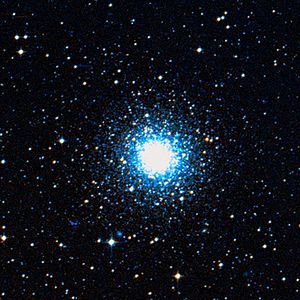
Order of magnitude
An order of magnitude is the class of scale or magnitude of any amount, where each class contains values of a fixed ratio to the class preceding it. In its most common usage, the amount being scaled is 10 and the scale is the exponent being applied to this amount...
as the currently accepted value.
Shapley's measurements also indicated that the Sun was relatively far from the center of the galaxy, contrary to what had previously been inferred from the apparently nearly even distribution of ordinary stars. In reality, ordinary stars lie within the galaxy's disk and are thus often obscured by gas and dust, whereas globular clusters lie outside the disk and can be seen at much further distances.
Shapley was subsequently assisted in his studies of clusters by Henrietta Swope
Henrietta Hill Swope
Henrietta Hill Swope was an American astronomer. She was the daughter of Gerard Swope, and niece of Herbert Bayard Swope.Swope worked with Walter Baade and is credited with several important papers....
and Helen Battles Sawyer
Helen Sawyer Hogg
Helen Battles Sawyer Hogg, CC was a prolific astronomer noted for her research into globular clusters...
(later Hogg). In 1927–29, Harlow Shapley and Helen Sawyer began categorizing clusters according to the degree of concentration the system has toward the core. The most concentrated clusters were identified as Class I, with successively diminishing concentrations ranging to Class XII. This became known as the Shapley–Sawyer Concentration Class
Shapley–Sawyer Concentration Class
The Shapley–Sawyer Concentration Class is a classification system on a scale of one to twelve using Roman numerals for globular clusters according to their concentration. The most highly concentrated clusters such as M75 are classified as Class I, with successively diminishing concentrations...
. (It is sometimes given with numbers [Class 1–12] rather than Roman numerals.)
Formation
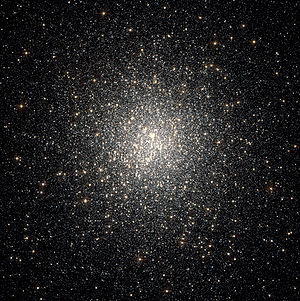
Stellar evolution
Stellar evolution is the process by which a star undergoes a sequence of radical changes during its lifetime. Depending on the mass of the star, this lifetime ranges from only a few million years to trillions of years .Stellar evolution is not studied by observing the life of a single...
, suggesting that they formed at about the same time. However, the star formation history varies from cluster to cluster, with some clusters showing distinct populations of stars. An example of this is the globular clusters in the Large Magellanic Cloud
Large Magellanic Cloud
The Large Magellanic Cloud is a nearby irregular galaxy, and is a satellite of the Milky Way. At a distance of slightly less than 50 kiloparsecs , the LMC is the third closest galaxy to the Milky Way, with the Sagittarius Dwarf Spheroidal and Canis Major Dwarf Galaxy lying closer to the center...
(LMC) that exhibit a bimodal population. During their youth, these LMC clusters may have encountered giant molecular clouds that triggered a second round of star formation. This star-forming period is relatively brief, compared to the age of many globular clusters.
Observations of globular clusters show that these stellar formations arise primarily in regions of efficient star formation, and where the interstellar medium is at a higher density than in normal star-forming regions. Globular cluster formation is prevalent in starburst
Starburst (astronomy)
In astronomy, starburst is a generic term to describe a region of space with an abnormally high rate of star formation. It is reserved for truly unusual objects....
regions and in interacting galaxies
Interacting galaxy
Interacting galaxies are galaxies whose gravitational fields result in a disturbance of one another. An example of a minor interaction is a satellite galaxy's disturbing the primary galaxy's spiral arms. An example of a major interaction is a galactic collision.-Satellite interaction:A giant...
. Research indicates a correlation between the mass of a central supermassive black hole
Supermassive black hole
A supermassive black hole is the largest type of black hole in a galaxy, in the order of hundreds of thousands to billions of solar masses. Most, and possibly all galaxies, including the Milky Way, are believed to contain supermassive black holes at their centers.Supermassive black holes have...
s (SMBH) and the extent of the globular cluster systems of elliptical
Elliptical galaxy
An elliptical galaxy is a galaxy having an approximately ellipsoidal shape and a smooth, nearly featureless brightness profile. They range in shape from nearly spherical to highly flat and in size from hundreds of millions to over one trillion stars...
and lenticular galaxies
Lenticular galaxy
A lenticular galaxy is a type of galaxy which is intermediate between an elliptical galaxy and a spiral galaxy in galaxy morphological classification schemes. Lenticular galaxies are disk galaxies which have used up or lost most of their interstellar matter and therefore have very little ongoing...
. The mass of the SMBH in such a galaxy is often close to the combined mass of the galaxy's globular clusters.
No known globular clusters display active star formation, which is consistent with the view that globular clusters are typically the oldest objects in the Galaxy, and were among the first collections of stars to form. Very large regions of star formation known as super star cluster
Super star cluster
A super star cluster is a very large region that is thought to be the precursor of a globular cluster. They typically contain a very large number of young, massive stars that ionize a surrounding H II region, similar to our Milky Way's so-called "Ultra dense H II regions ". An SSC's H II region is...
s, such as Westerlund 1
Westerlund 1
Westerlund 1 is a compact young star cluster in the Milky Way galaxy, about 3.5–5 kpc away from Earth. In fact, it is the most massive compact young star cluster known in the entire Local Group of galaxies...
in the Milky Way
Milky Way
The Milky Way is the galaxy that contains the Solar System. This name derives from its appearance as a dim un-resolved "milky" glowing band arching across the night sky...
, may be the precursors of globular clusters.
Composition
Globular clusters are generally composed of hundreds of thousands of low-metal, old stars. The type of stars found in a globular cluster are similar to those in the bulge of a spiral galaxySpiral galaxy
A spiral galaxy is a certain kind of galaxy originally described by Edwin Hubble in his 1936 work The Realm of the Nebulae and, as such, forms part of the Hubble sequence. Spiral galaxies consist of a flat, rotating disk containing stars, gas and dust, and a central concentration of stars known as...
but confined to a volume of only a few million cubic parsec
Parsec
The parsec is a unit of length used in astronomy. It is about 3.26 light-years, or just under 31 trillion kilometres ....
s. They are free of gas and dust and it is presumed that all of the gas and dust was long ago turned into stars.
Globular clusters can contain a high density of stars; on average about 0.4 stars per cubic parsec
Parsec
The parsec is a unit of length used in astronomy. It is about 3.26 light-years, or just under 31 trillion kilometres ....
, increasing to 100 or 1000 stars per cubic parsec in the core of the cluster. However, they are not thought to be favorable locations for the survival of planetary systems. Planetary orbits are dynamically unstable within the cores of dense clusters because of the perturbations of passing stars. A planet orbiting at 1 astronomical unit
Astronomical unit
An astronomical unit is a unit of length equal to about or approximately the mean Earth–Sun distance....
around a star that is within the core of a dense cluster such as 47 Tucanae
47 Tucanae
47 Tucanae or just 47 Tuc is a globular cluster located in the constellation Tucana. It is about 16,700 light years away from Earth, and 120 light years across. It can be seen with the naked eye, with a visual magnitude of 4.0...
would only survive on the order of 108 years. There is a planetary system orbiting a pulsar
Pulsar
A pulsar is a highly magnetized, rotating neutron star that emits a beam of electromagnetic radiation. The radiation can only be observed when the beam of emission is pointing towards the Earth. This is called the lighthouse effect and gives rise to the pulsed nature that gives pulsars their name...
(PSR B1620−26
PSR B1620-26
PSR B1620-26 is a binary star system located at a distance of 3,800 parsecs in the globular cluster of Messier 4 in the constellation of Scorpius. The system is composed of a pulsar and a white dwarf...
) that belongs to the globular cluster M4
Messier 4
Messier 4 or M4 is a globular cluster in the constellation of Scorpius. It was discovered by Philippe Loys de Chéseaux in 1746 and catalogued by Charles Messier in 1764. It was the first globular cluster in which individual stars were resolved.-Visibility:M4 is conspicuous in even the smallest of...
, but these planets likely formed after the event that created the pulsar.
Some globular clusters, like Omega Centauri
Omega Centauri
Omega Centauri or NGC 5139 is a globular clusterin the constellation of Centaurus, discovered by Edmond Halley in 1677 who listed it as a nebula. Omega Centauri had been listed in Ptolemy's catalog 2000 years ago as a star. Lacaille included it in his catalog as number I.5...
in our Milky Way
Milky Way
The Milky Way is the galaxy that contains the Solar System. This name derives from its appearance as a dim un-resolved "milky" glowing band arching across the night sky...
and G1
Mayall II
Mayall II also known as NGC-224-G1, SKHB 1, GSC 2788:2139, HBK 0-1, M31GC J003247+393440 or Andromeda's Cluster is a globular cluster orbiting M31, the Andromeda Galaxy....
in M31
Andromeda Galaxy
The Andromeda Galaxy is a spiral galaxy approximately 2.5 million light-years from Earth in the constellation Andromeda. It is also known as Messier 31, M31, or NGC 224, and is often referred to as the Great Andromeda Nebula in older texts. Andromeda is the nearest spiral galaxy to the...
, are extraordinarily massive, with several million solar mass
Solar mass
The solar mass , , is a standard unit of mass in astronomy, used to indicate the masses of other stars and galaxies...
es and multiple stellar populations. Both can be regarded as evidence that supermassive globular clusters are in fact the cores of dwarf galaxies
Dwarf galaxy
A dwarf galaxy is a small galaxy composed of up to several billion stars, a small number compared to our own Milky Way's 200-400 billion stars...
that are consumed by the larger galaxies. About a quarter of the globular cluster population in the Milky Way may have been accreted along with their host dwarf galaxy.
Several globular clusters (like M15
Messier 15
Messier 15 or M15 is a globular cluster in the constellation Pegasus. It was discovered by Jean-Dominique Maraldi in 1746 and included in Charles Messier's catalogue of comet-like objects in 1764...
) have extremely massive cores which may harbor black hole
Black hole
A black hole is a region of spacetime from which nothing, not even light, can escape. The theory of general relativity predicts that a sufficiently compact mass will deform spacetime to form a black hole. Around a black hole there is a mathematically defined surface called an event horizon that...
s, although simulations suggest that a less massive black hole or central concentration of neutron stars or massive white dwarfs explain observations equally well.
Metallic content
Globular clusters normally consist of Population II starsMetallicity
In astronomy and physical cosmology, the metallicity of an object is the proportion of its matter made up of chemical elements other than hydrogen and helium...
, which have a low proportion of elements other than hydrogen and helium when compared to Population I
Metallicity
In astronomy and physical cosmology, the metallicity of an object is the proportion of its matter made up of chemical elements other than hydrogen and helium...
stars such as the Sun
Sun
The Sun is the star at the center of the Solar System. It is almost perfectly spherical and consists of hot plasma interwoven with magnetic fields...
. Astronomers refer to these heavier elements as metals and to the proportions of these elements as the metallicity
Metallicity
In astronomy and physical cosmology, the metallicity of an object is the proportion of its matter made up of chemical elements other than hydrogen and helium...
. These elements are produced by stellar nucleosynthesis
Stellar nucleosynthesis
Stellar nucleosynthesis is the collective term for the nuclear reactions taking place in stars to build the nuclei of the elements heavier than hydrogen. Some small quantity of these reactions also occur on the stellar surface under various circumstances...
and then are recycled into the interstellar medium
Interstellar medium
In astronomy, the interstellar medium is the matter that exists in the space between the star systems in a galaxy. This matter includes gas in ionic, atomic, and molecular form, dust, and cosmic rays. It fills interstellar space and blends smoothly into the surrounding intergalactic space...
, where they enter the next generation of stars. Hence the proportion of metals can be an indication of the age of a star, with older stars typically having a lower metallicity.
The Dutch
Netherlands
The Netherlands is a constituent country of the Kingdom of the Netherlands, located mainly in North-West Europe and with several islands in the Caribbean. Mainland Netherlands borders the North Sea to the north and west, Belgium to the south, and Germany to the east, and shares maritime borders...
astronomer Pieter Oosterhoff
Pieter Oosterhoff
Pieter Theodorus Oosterhoff was a Dutch astronomer.He was the co-administrator, along with Jan Oort, of the Leiden Observatory in the Netherlands....
noticed that there appear to be two populations of globular clusters, which became known as Oosterhoff groups. The second group has a slightly longer period of RR Lyrae
RR Lyrae variable
RR Lyrae variables are periodic variable stars, commonly found in globular clusters, and often used as standard candles to measure galactic distances.This type of variable is named after the prototype, the variable star RR Lyrae in the constellation Lyra....
variable star
Variable star
A star is classified as variable if its apparent magnitude as seen from Earth changes over time, whether the changes are due to variations in the star's actual luminosity, or to variations in the amount of the star's light that is blocked from reaching Earth...
s. Both groups have weak lines of metallic elements
Spectral line
A spectral line is a dark or bright line in an otherwise uniform and continuous spectrum, resulting from a deficiency or excess of photons in a narrow frequency range, compared with the nearby frequencies.- Types of line spectra :...
. But the lines in the stars of Oosterhoff type I (OoI) cluster are not quite as weak as those in type II (OoII). Hence type I are referred to as "metal-rich" while type II are "metal-poor".
These two populations have been observed in many galaxies, especially massive elliptical galaxies
Elliptical galaxy
An elliptical galaxy is a galaxy having an approximately ellipsoidal shape and a smooth, nearly featureless brightness profile. They range in shape from nearly spherical to highly flat and in size from hundreds of millions to over one trillion stars...
. Both groups are nearly as old as the universe itself and are of similar ages, but differ in their metal abundances. Many scenarios have been suggested to explain these subpopulations, including violent gas-rich galaxy mergers, the accretion of dwarf galaxies, and multiple phases of star formation in a single galaxy. In our Milky Way
Milky Way
The Milky Way is the galaxy that contains the Solar System. This name derives from its appearance as a dim un-resolved "milky" glowing band arching across the night sky...
, the metal-poor clusters are associated with the halo and the metal-rich clusters with the bulge.
In the Milky Way it has been discovered that the large majority of the low metallicity clusters are aligned along a plane in the outer part of the galaxy's halo. This result argues in favor of the view that type II clusters in the galaxy were captured from a satellite galaxy, rather than being the oldest members of the Milky Way's globular cluster system as had been previously thought. The difference between the two cluster types would then be explained by a time delay between when the two galaxies formed their cluster systems.
Exotic components
Globular clusters have a very high star density, and therefore close interactions and near-collisions of stars occur relatively often. Due to these chance encounters, some exotic classes of stars, such as blue stragglerBlue straggler
Blue stragglers are main sequence stars in open or globular clusters that are more luminous and bluer than stars at the main sequence turn-off point for the cluster. Blue stragglers were first discovered by Allan Sandage in 1953 while performing photometry of the stars in the globular cluster M3...
s, millisecond pulsar
Millisecond pulsar
A millisecond pulsar is a pulsar with a rotational period in the range of about 1-10 milliseconds. Millisecond pulsars have been detected in the radio, X-ray, and gamma ray portions of the electromagnetic spectrum. The origin of millisecond pulsars is still unknown...
s and low-mass X-ray binaries, are much more common in globular clusters. A blue straggler is formed from the merger of two stars, possibly as a result of an encounter with a binary system. The resulting star has a higher temperature than comparable stars in the cluster with the same luminosity, and thus differs from the main sequence
Main sequence
The main sequence is a continuous and distinctive band of stars that appears on plots of stellar color versus brightness. These color-magnitude plots are known as Hertzsprung–Russell diagrams after their co-developers, Ejnar Hertzsprung and Henry Norris Russell...
stars formed at the beginning of the cluster.
Black hole
A black hole is a region of spacetime from which nothing, not even light, can escape. The theory of general relativity predicts that a sufficiently compact mass will deform spacetime to form a black hole. Around a black hole there is a mathematically defined surface called an event horizon that...
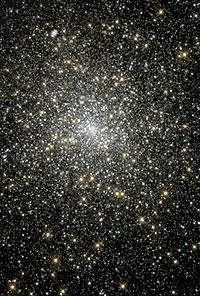
s within globular clusters since the 1970s. The resolution requirements for this task, however, are exacting, and it is only with the Hubble space telescope
Hubble Space Telescope
The Hubble Space Telescope is a space telescope that was carried into orbit by a Space Shuttle in 1990 and remains in operation. A 2.4 meter aperture telescope in low Earth orbit, Hubble's four main instruments observe in the near ultraviolet, visible, and near infrared...
that the first confirmed discoveries have been made. In independent programs, a 4,000 solar mass
Solar mass
The solar mass , , is a standard unit of mass in astronomy, used to indicate the masses of other stars and galaxies...
intermediate-mass black hole
Intermediate-mass black hole
An Intermediate-mass black hole is a black hole whose mass is significantly more than stellar black holes yet far less than supermassive black holes...
has been suggested to exist based on HST observations in the globular cluster M15
Messier 15
Messier 15 or M15 is a globular cluster in the constellation Pegasus. It was discovered by Jean-Dominique Maraldi in 1746 and included in Charles Messier's catalogue of comet-like objects in 1764...
and a 20,000 solar mass black hole in the Mayall II
Mayall II
Mayall II also known as NGC-224-G1, SKHB 1, GSC 2788:2139, HBK 0-1, M31GC J003247+393440 or Andromeda's Cluster is a globular cluster orbiting M31, the Andromeda Galaxy....
cluster in the Andromeda Galaxy
Andromeda Galaxy
The Andromeda Galaxy is a spiral galaxy approximately 2.5 million light-years from Earth in the constellation Andromeda. It is also known as Messier 31, M31, or NGC 224, and is often referred to as the Great Andromeda Nebula in older texts. Andromeda is the nearest spiral galaxy to the...
. Both x-ray
X-ray
X-radiation is a form of electromagnetic radiation. X-rays have a wavelength in the range of 0.01 to 10 nanometers, corresponding to frequencies in the range 30 petahertz to 30 exahertz and energies in the range 120 eV to 120 keV. They are shorter in wavelength than UV rays and longer than gamma...
and radio
Radio
Radio is the transmission of signals through free space by modulation of electromagnetic waves with frequencies below those of visible light. Electromagnetic radiation travels by means of oscillating electromagnetic fields that pass through the air and the vacuum of space...
emissions from Mayall II appear to be consistent with an intermediate-mass black hole.
These are of particular interest because they are the first black holes discovered that were intermediate in mass between the conventional stellar
Star
A star is a massive, luminous sphere of plasma held together by gravity. At the end of its lifetime, a star can also contain a proportion of degenerate matter. The nearest star to Earth is the Sun, which is the source of most of the energy on Earth...
-mass black hole and the supermassive black hole
Supermassive black hole
A supermassive black hole is the largest type of black hole in a galaxy, in the order of hundreds of thousands to billions of solar masses. Most, and possibly all galaxies, including the Milky Way, are believed to contain supermassive black holes at their centers.Supermassive black holes have...
s discovered at the cores of galaxies. The mass of these intermediate mass black holes is proportional to the mass of the clusters, following a pattern previously discovered between supermassive black holes and their surrounding galaxies.
Claims of intermediate mass black holes have been met with some skepticism. The densest objects in globular clusters are expected to migrate to the cluster center due to mass segregation
Mass segregation
In astronomy, dynamical mass segregation is the process by which heavier members of a gravitationally bound system, such as a star cluster or cluster of galaxies, tend to move toward the center, while lighter members tend to move farther away from the center. Primordial mass segregation is...
. These will be white dwarfs and neutron stars in an old stellar population like a globular cluster. As pointed out in two papers by Holger Baumgardt and collaborators, the mass-to-light ratio should rise sharply towards the center of the cluster, even without a black hole, in both M15 and Mayall II.
Color-magnitude diagram
The Hertzsprung-Russell diagram (HR-diagram) is a graph of a large sample of stars that plots their visualabsolute magnitude
Absolute magnitude
Absolute magnitude is the measure of a celestial object's intrinsic brightness. it is also the apparent magnitude a star would have if it were 32.6 light years away from Earth...
against their color index
Color index
In astronomy, the color index is a simple numerical expression that determines the color of an object, which in the case of a star gives its temperature...
. The
color index, B−V, is the difference between the magnitude of the star in blue light, or B, and the magnitude in visual light (green-yellow), or V. Large positive values indicate a red star with a cool surface temperature
Temperature
Temperature is a physical property of matter that quantitatively expresses the common notions of hot and cold. Objects of low temperature are cold, while various degrees of higher temperatures are referred to as warm or hot...
, while negative values imply a blue star with a hotter surface.
When the stars near the Sun
Sun
The Sun is the star at the center of the Solar System. It is almost perfectly spherical and consists of hot plasma interwoven with magnetic fields...
are plotted on an HR diagram, it displays a distribution of stars of various masses, ages, and compositions. Many of the stars lie relatively close to a sloping curve with increasing absolute magnitude as the stars are hotter, known as main sequence
Main sequence
The main sequence is a continuous and distinctive band of stars that appears on plots of stellar color versus brightness. These color-magnitude plots are known as Hertzsprung–Russell diagrams after their co-developers, Ejnar Hertzsprung and Henry Norris Russell...
stars. However the diagram also typically includes stars that are in later stages of their evolution and have wandered away from this main sequence curve.
As all the stars of a globular cluster are at approximately the same distance from us, their absolute magnitudes differ from their visual magnitude by about the same amount. The main sequence stars in the globular cluster will fall along a line that is believed to be comparable to similar stars in the solar neighborhood. The accuracy of this assumption is confirmed by comparable results obtained by comparing the magnitudes of nearby short-period variables, such as RR Lyrae
RR Lyrae
RR Lyrae is a variable star in the Lyra constellation. It is the prototype of the RR Lyrae variable class of stars. It has a period of about 13 hours, and oscillates between apparent magnitudes 7 and 8. Its variable nature was discovered by the Scottish astronomer Williamina Fleming at Harvard...
stars and cepheid variable
Cepheid variable
A Cepheid is a member of a class of very luminous variable stars. The strong direct relationship between a Cepheid variable's luminosity and pulsation period, secures for Cepheids their status as important standard candles for establishing the Galactic and extragalactic distance scales.Cepheid...
s, with those in the cluster.
By matching up these curves on the HR diagram the absolute magnitude of main sequence stars in the cluster can also be determined. This in turn provides a distance estimate to the cluster, based on the visual magnitude of the stars. The difference between the relative and absolute magnitude, the distance modulus
Distance modulus
-Definition:The distance modulus \mu=m-M is the difference between the apparent magnitude m and the absolute magnitude M of an astronomical object...
, yields this estimate of the distance.
When the stars of a particular globular cluster are plotted on an HR diagram, in many cases nearly all of the stars fall upon a relatively well defined curve. This differs from the HR diagram of stars near the Sun, which lumps together stars of differing ages and origins. The shape of the curve for a globular cluster is characteristic of a grouping of stars that were formed at approximately the same time and from the same materials, differing only in their initial mass. As the position of each star in the HR diagram varies with age, the shape of the curve for a globular cluster can be used to measure the overall age of the star population.

Giant star
A giant star is a star with substantially larger radius and luminosity than a main sequence star of the same surface temperature. Typically, giant stars have radii between 10 and 100 solar radii and luminosities between 10 and 1,000 times that of the Sun. Stars still more luminous than giants are...
stage. As the cluster ages, stars of successively lower masses will also enter the giant star
Giant star
A giant star is a star with substantially larger radius and luminosity than a main sequence star of the same surface temperature. Typically, giant stars have radii between 10 and 100 solar radii and luminosities between 10 and 1,000 times that of the Sun. Stars still more luminous than giants are...
stage. Thus the age of a single population cluster can be measured by looking for the stars that are just beginning to enter the giant star stage. This forms a "knee" in the HR diagram, bending to the upper right from the main sequence line. The absolute magnitude at this bend is directly a function of the age of globular cluster, so an age scale can be plotted on an axis parallel to the magnitude.
In addition, globular clusters can be dated by looking at the temperatures of the coolest white dwarfs. Typical results for globular clusters are that they may be as old as 12.7 billion
1000000000 (number)
1,000,000,000 is the natural number following 999,999,999 and preceding 1,000,000,001.In scientific notation, it is written as 109....
years. This is in contrast to open clusters which are only tens of millions of years old.
The ages of globular clusters place a bound on the age limit of the entire universe. This lower limit has been a significant constraint in cosmology
Physical cosmology
Physical cosmology, as a branch of astronomy, is the study of the largest-scale structures and dynamics of the universe and is concerned with fundamental questions about its formation and evolution. For most of human history, it was a branch of metaphysics and religion...
. During the early 1990s, astronomers were faced with age estimates of globular clusters that appeared older than cosmological models would allow. However, better measurements of cosmological parameters through deep sky surveys and satellites such as COBE
COBE
The COsmic Background Explorer , also referred to as Explorer 66, was a satellite dedicated to cosmology. Its goals were to investigate the cosmic microwave background radiation of the universe and provide measurements that would help shape our understanding of the cosmos.This work provided...
have resolved this issue as have computer models of stellar evolution that have different models of mixing.
Evolutionary studies of globular clusters can also be used to determine changes due to the starting composition of the gas and dust that formed the cluster. That is, the evolutionary tracks change with changes in the abundance of heavy elements. The data obtained from studies of globular clusters are then used to study the evolution of the Milky Way as a whole.
In globular clusters a few stars known as blue straggler
Blue straggler
Blue stragglers are main sequence stars in open or globular clusters that are more luminous and bluer than stars at the main sequence turn-off point for the cluster. Blue stragglers were first discovered by Allan Sandage in 1953 while performing photometry of the stars in the globular cluster M3...
s are observed, apparently continuing the main sequence in the direction of brighter, bluer stars. The origins of these stars is still unclear, but most models suggest that these stars are the result of mass transfer in multiple star systems.
Morphology
In contrast to open clusters, most globular clusters remain gravitationally bound for time periods comparable to the life spans of the majority of their stars. However, a possible exception is when strong tidal interactions with other large masses result in the dispersal of the stars.After they are formed, the stars in the globular cluster begin to interact gravitationally with each other. As a result the velocity vectors of the stars are steadily modified, and the stars lose any history of their original velocity. The characteristic interval for this to occur is the relaxation time
Relaxation time
In the physical sciences, relaxation usually means the return of a perturbed system into equilibrium.Each relaxation process can be characterized by a relaxation time τ...
. This is related to the characteristic length of time a star needs to cross the cluster as well as the number of stellar masses in the system. The value of the relaxation time varies by cluster, but the mean value is on the order of 109 years.
| Galaxy | Ellipticity |
|---|---|
| Milky Way | 0.07±0.04 |
| LMC Large Magellanic Cloud The Large Magellanic Cloud is a nearby irregular galaxy, and is a satellite of the Milky Way. At a distance of slightly less than 50 kiloparsecs , the LMC is the third closest galaxy to the Milky Way, with the Sagittarius Dwarf Spheroidal and Canis Major Dwarf Galaxy lying closer to the center... |
0.16±0.05 |
| SMC Small Magellanic Cloud The Small Magellanic Cloud is a dwarf galaxy. It has a diameter of about 7,000 light-years and contains several hundred million stars. It has a total mass of approximately 7 billion times the mass of our Sun.... |
0.19±0.06 |
| M31 Andromeda Galaxy The Andromeda Galaxy is a spiral galaxy approximately 2.5 million light-years from Earth in the constellation Andromeda. It is also known as Messier 31, M31, or NGC 224, and is often referred to as the Great Andromeda Nebula in older texts. Andromeda is the nearest spiral galaxy to the... |
0.09±0.04 |
Although globular clusters generally appear spherical in form, ellipticities can occur due to tidal interactions. Clusters within the Milky Way and the Andromeda Galaxy are typically oblate spheroids in shape, while those in the Large Magellanic Cloud
Large Magellanic Cloud
The Large Magellanic Cloud is a nearby irregular galaxy, and is a satellite of the Milky Way. At a distance of slightly less than 50 kiloparsecs , the LMC is the third closest galaxy to the Milky Way, with the Sagittarius Dwarf Spheroidal and Canis Major Dwarf Galaxy lying closer to the center...
are more elliptical.
Radii
Astronomers characterize the morphology of a globular cluster by means of standard radii. These are the core radius (rc), the half-light radius (rh) and the tidal radius (rt). The overall luminosity of the cluster steadily decreases with distance from the core, and the core radius is the distance at which the apparent surface luminosity has dropped by half. A comparable quantity is the half-light radius, or the distance from the core within which half the total luminosity from the cluster is received. This is typically larger than the core radius.Note that the half-light radius includes stars in the outer part of the cluster that happen to lie along the line of sight, so theorists will also use the half-mass radius (rm)—the radius from the core that contains half the total mass of the cluster. When the half-mass radius of a cluster is small relative to the overall size, it has a dense core. An example of this is Messier 3
Messier 3
Messier 3 is a globular cluster in the constellation Canes Venatici. It was discovered by Charles Messier in 1764, and resolved into stars by William Herschel around 1784. This cluster is one of the largest and brightest, and is made up of around 500,000 stars. It is located at a distance of...
(M3), which has an overall visible dimension of about 18 arc minutes, but a half-mass radius of only 1.12 arc minutes.
Almost all globular clusters have a half-light radius of less than 10 pc
Parsec
The parsec is a unit of length used in astronomy. It is about 3.26 light-years, or just under 31 trillion kilometres ....
, although there are well-established globular clusters with very large radii (i.e. NGC 2419
NGC 2419
NGC 2419 is a globular cluster in the constellation Lynx. It was discovered by William Herschel on December 31, 1788...
(Rh = 18 pc) and Palomar 14 (Rh = 25 pc)).
Finally the tidal radius is the distance from the center of the globular cluster at which the external gravitation of the galaxy has more influence over the stars in the cluster than does the cluster itself. This is the distance at which the individual stars belonging to a cluster can be separated away by the galaxy. The tidal radius of M3 is about 38 arc minutes.
Mass segregation, luminosity and core collapse
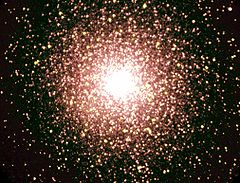
In measuring the luminosity curve of a given globular cluster as a function of distance from the core, most clusters in the Milky Way increase steadily in luminosity as this distance decreases, up to a certain distance from the core, then the luminosity levels off. Typically this distance is about 1–2 parsecs from the core. However about 20% of the globular clusters have undergone a process termed "core collapse". In this type of cluster, the luminosity continues to increase steadily all the way to the core region. An example of a core-collapsed globular isM15
Messier 15
Messier 15 or M15 is a globular cluster in the constellation Pegasus. It was discovered by Jean-Dominique Maraldi in 1746 and included in Charles Messier's catalogue of comet-like objects in 1764...
.
Kinetic energy
The kinetic energy of an object is the energy which it possesses due to its motion.It is defined as the work needed to accelerate a body of a given mass from rest to its stated velocity. Having gained this energy during its acceleration, the body maintains this kinetic energy unless its speed changes...
from the core region, leading the remaining stars grouped in the core region to occupy a more compact volume. When this gravothermal instability occurs, the central region of the cluster becomes densely crowded with stars and the surface brightness
Surface brightness
The overall brightness of an extended astronomical object such as a galaxy, star cluster, or nebula, can be measured by its total magnitude, integrated magnitude or integrated visual magnitude; a related concept is surface brightness, which specifies the brightness of a standard-sized piece of an...
of the cluster forms a power-law cusp. (Note that a core collapse is not the only mechanism that can cause such a luminosity distribution; a massive black hole
Black hole
A black hole is a region of spacetime from which nothing, not even light, can escape. The theory of general relativity predicts that a sufficiently compact mass will deform spacetime to form a black hole. Around a black hole there is a mathematically defined surface called an event horizon that...
at the core can also result in a luminosity cusp.) Over a lengthy period of time this leads to a concentration of massive stars near the core, a phenomenon called mass segregation
Mass segregation
In astronomy, dynamical mass segregation is the process by which heavier members of a gravitationally bound system, such as a star cluster or cluster of galaxies, tend to move toward the center, while lighter members tend to move farther away from the center. Primordial mass segregation is...
.
The dynamical heating effect of binary star systems works to prevent an initial core collapse of the cluster. When a star passes near a binary system, the orbit of the latter pair tends to contract, releasing energy. Only after the primordial supply of binaries are exhausted due to interactions can a deeper core collapse proceed. In contrast, the effect of tidal shock
Tidal shock
A tidal shock occurs when a star cluster or other distributed astronomical object passes by a large masssuch as an interstellar cloud, resulting in gravitational perturbation on a time scale that is much less than the mean time for a star to complete an orbit within the cluster. The tidal force...
s as a globular cluster repeatedly passes through the plane of a spiral galaxy
Spiral galaxy
A spiral galaxy is a certain kind of galaxy originally described by Edwin Hubble in his 1936 work The Realm of the Nebulae and, as such, forms part of the Hubble sequence. Spiral galaxies consist of a flat, rotating disk containing stars, gas and dust, and a central concentration of stars known as...
tends to significantly accelerate core collapse.
The different stages of core-collapse may be divided into three phases. During a globular cluster's adolescence, the process of core-collapse begins with stars near the core. However, the interactions between binary star
Binary star
A binary star is a star system consisting of two stars orbiting around their common center of mass. The brighter star is called the primary and the other is its companion star, comes, or secondary...
systems prevents further collapse as the cluster approaches middle age. Finally, the central binaries are either disrupted or ejected, resulting in a tighter concentration at the core.
The interaction of stars in the collapsed core region causes tight binary systems to form. As other stars interact with these tight binaries, they increase the energy at the core, which causes the cluster to re-expand. As the mean time for a core collapse is typically less than the age of the galaxy, many of a galaxy's globular clusters may have passed through a core collapse stage, then re-expanded.
The Hubble Space Telescope has been used to provide convincing observational evidence of this stellar mass-sorting process in globular clusters. Heavier stars slow down and crowd at the cluster's core, while lighter stars pick up speed and tend to spend more time at the cluster's periphery. The globular star cluster 47 Tucanae
47 Tucanae
47 Tucanae or just 47 Tuc is a globular cluster located in the constellation Tucana. It is about 16,700 light years away from Earth, and 120 light years across. It can be seen with the naked eye, with a visual magnitude of 4.0...
, which is made up of about 1 million stars, is one of the densest globular clusters in the Southern Hemisphere. This cluster was subjected to an intensive photographic survey, which allowed astronomers to track the motion of its stars. Precise velocities were obtained for nearly 15,000 stars in this cluster.
A 2008 study by John Fregeau of 13 globular clusters in the Milky Way shows that three of them have an unusually large number of X-ray sources, or X-ray binaries, suggesting the clusters are middle-aged. Previously, these globular clusters had been classified as being in old age because they had very tight concentrations of stars in their centers, another test of age used by astronomers. The implication is that most globular clusters, including the other ten studied by Fregeau, are not in middle age as previously thought, but are actually in 'adolescence'.
The overall luminosities of the globular clusters within the Milky Way and the Andromeda Galaxy
Andromeda Galaxy
The Andromeda Galaxy is a spiral galaxy approximately 2.5 million light-years from Earth in the constellation Andromeda. It is also known as Messier 31, M31, or NGC 224, and is often referred to as the Great Andromeda Nebula in older texts. Andromeda is the nearest spiral galaxy to the...
can be modeled by means of a gaussian curve. This gaussian can be represented by means of an average magnitude Mv and a variance σ2. This distribution of globular cluster luminosities is called the Globular Cluster Luminosity Function (GCLF). (For the Milky Way, Mv = , σ = magnitudes.) The GCLF has also been used as a "standard candle" for measuring the distance to other galaxies, under the assumption that the globular clusters in remote galaxies follow the same principles as they do in the Milky Way.
N-body simulations
Computing the interactions between the stars within a globular cluster requires solving what is termed the N-body problemN-body problem
The n-body problem is the problem of predicting the motion of a group of celestial objects that interact with each other gravitationally. Solving this problem has been motivated by the need to understand the motion of the Sun, planets and the visible stars...
. That is, each of the stars within the cluster continually interacts with the other N−1 stars, where N is the total number of stars in the cluster. The naive CPU computational "cost" for a dynamic simulation increases in proportion to N3, so the potential computing requirements to accurately simulate such a cluster can be enormous. An efficient method of mathematically simulating the N-body dynamics of a globular cluster is done by subdividing into small volumes and velocity ranges, and using probabilities to describe the locations of the stars. The motions are then described by means of a formula called the Fokker-Planck equation
Fokker-Planck equation
The Fokker–Planck equation describes the time evolution of the probability density function of the velocity of a particle, and can be generalized to other observables as well.It is named after Adriaan Fokkerand Max Planck...
. This can be solved by a simplified form of the equation, or by running Monte Carlo simulations and using random values. However the simulation becomes more difficult when the effects of binaries and the interaction with external gravitation forces (such as from the Milky Way galaxy) must also be included.
The results of N-body simulations have shown that the stars can follow unusual paths through the cluster, often forming loops and often falling more directly toward the core than would a single star orbiting a central mass. In addition, due to interactions with other stars that result in an increase in velocity, some of the stars gain sufficient energy to escape the cluster. Over long periods of time this will result in a dissipation of the cluster, a process termed evaporation. The typical time scale for the evaporation of a globular cluster is 1010 years. In 2010 it became possible to directly compute, star by star, N-body simulations of a globular cluster over the course of its lifetime.
Binary stars form a significant portion of the total population of stellar systems, with up to half of all stars occurring in binary systems. Numerical simulations of globular clusters have demonstrated that binaries can hinder and even reverse the process of core collapse in globular clusters. When a star in a cluster has a gravitational encounter with a binary system, a possible result is that the binary becomes more tightly bound and kinetic energy is added to the solitary star. When the massive stars in the cluster are sped up by this process, it reduces the contraction at the core and limits core collapse.
The ultimate fate of a globular cluster must be either to accrete stars at its core, causing its steady contraction, or gradual shedding of stars from its outer layers.
Intermediate forms
The distinction between cluster types is not alwaysclear-cut, and objects have been found that blur the
lines between the categories. For example, BH 176
in the southern part of the Milky Way has properties
of both an open and a globular cluster.
In 2005, astronomers discovered a completely new type of star cluster in the Andromeda Galaxy, which is, in several ways, very similar to globular clusters. The new-found clusters contain hundreds of thousands of stars, a similar number to that found in globular clusters. The clusters share other characteristics with globular clusters such as stellar populations and metallicity. What distinguishes them from the globular clusters is that they are much larger – several hundred light-years across – and hundreds of times less dense. The distances between the stars are, therefore, much greater within the newly discovered extended clusters. Parametrically, these clusters lie somewhere between a globular cluster and a dwarf spheroidal galaxy
Dwarf spheroidal galaxy
Dwarf spheroidal galaxy is a term in astronomy applied to low luminosity galaxies that are companions to the Milky Way and to the similar systems that are companions to the Andromeda Galaxy M31...
.
How these clusters are formed is not yet known, but their formation might well be related to that of globular clusters. Why M31 has such clusters, while the Milky Way does not, is not yet known. It is also unknown if any other galaxy contains these types of clusters, but it would be very unlikely that M31 is the sole galaxy with extended clusters.
Tidal encounters
When a globular cluster has a close encounter with a large mass, such as the core region of a galaxy, it undergoes a tidal interaction. The difference in the pull of gravity between the part of the cluster nearest the mass and the pull on the furthest part of the cluster results in a tidal forceTidal force
The tidal force is a secondary effect of the force of gravity and is responsible for the tides. It arises because the gravitational force per unit mass exerted on one body by a second body is not constant across its diameter, the side nearest to the second being more attracted by it than the side...
. A "tidal shock" occurs whenever the orbit of a cluster takes it through the plane of a galaxy.
As a result of a tidal shock, streams of stars can be pulled away from the cluster halo, leaving only the core part of the cluster. These tidal interaction effects create tails of stars that can extend up to several degrees of arc away from the cluster. These tails typically both precede and follow the cluster along its orbit. The tails can accumulate significant portions of the original mass of the cluster, and can form clumplike features.
The globular cluster Palomar 5
Palomar 5
Palomar 5 is a globular cluster discovered by Walter Baade in 1950. It was independently found again by Albert George Wilson in 1955. After the initial name of Serpens, it was subsequently catalogued as Palomar 5....
, for example, is near the apogalactic point
Apsis
An apsis , plural apsides , is the point of greatest or least distance of a body from one of the foci of its elliptical orbit. In modern celestial mechanics this focus is also the center of attraction, which is usually the center of mass of the system...
of its orbit after passing through the Milky Way. Streams of stars extend outward toward the front and rear of the orbital path of this cluster, stretching out to distances of 13,000 light-years. Tidal interactions have stripped away much of the mass from Palomar 5, and further interactions as it passes through the galactic core are expected to transform it into a long stream of stars orbiting the Milky Way halo.
Tidal interactions add kinetic energy into a globular cluster, dramatically increasing the evaporation rate and shrinking the size of the cluster. Not only does tidal shock strip off the outer stars from a globular cluster, but the increased evaporation accelerates the process of core collapse. The same physical mechanism may be at work in Dwarf spheroidal galaxies such as the Sagittarius Dwarf, which appears to be undergoing tidal disruption due to its proximity to the Milky Way.
There are many globular clusters with a retrograde orbit round the galaxy.
See also
- Extragalactic Distance Scale
- Leonard-Merritt mass estimatorLeonard-Merritt mass estimatorThe Leonard–Merritt mass estimator is a formula for estimating the mass of a spherical stellar system using the apparent positions and proper motions of its component stars. The distance to the stellar system must also be known....
- List of globular clusters
- Plummer modelPlummer modelThe Plummer model or Plummer sphere is a density law that was first used by H. C. Plummer to fit observations of globular clusters. It is now often used as toy model in N-body simulations of stellar systems.- Description of the model :...
- Polytrope
- Super star clusterSuper star clusterA super star cluster is a very large region that is thought to be the precursor of a globular cluster. They typically contain a very large number of young, massive stars that ionize a surrounding H II region, similar to our Milky Way's so-called "Ultra dense H II regions ". An SSC's H II region is...
General resources
- NASA Astrophysics Data System has a collection of past articles, from all major astrophysics journals and many conference proceedings.
- SCYON is a newsletter dedicated to star clusters.
- MODEST is a loose collaboration of scientists working on star clusters.
Review Articles
- Elson, Rebecca; Hut, Piet; Inagaki, Shogo (1987). Dynamical evolution of globular clusters. Annual review of astronomy and astrophysics 25 565.
- Meylan, G.; Heggie, D. C. (1997). Internal dynamics of globular clusters. The Astronomy and Astrophysics Review 8 1.
External links
- Globular Clusters, SEDS Messier pages
- Milky Way Globular Clusters
- Catalogue of Milky Way Globular Cluster Parameters by William E. Harris, McMaster University, Ontario, Canada
- A galactic globular cluster database by Marco Castellani, Rome Astronomical Observatory, Italy
- Key stars have different birthdays article describes how stars in globular clusters are born in several bursts, rather than all at once
- Globular Clusters Blog News, papers and preprints on Galactic Globular Clusters
- Globular Clusters Group on CiteULikeCiteULikeCiteULike is based on the principle of social bookmarking and is aimed to promote and to develop the sharing of scientific references amongst researchers. In the same way that it is possible to catalog web pages or photographs , scientists can share information on academic papers with specific...
- Clickable Messier Object table including globular clusters