
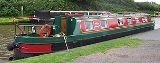
All Topics  
Narrowboat

 
Narrowboat

   Email Print
   Bookmark   Link


Narrowboat


A narrowboat or narrow boat is a boat
Boat

A boat is a watercraft of modest size designed to float or plane on water, and provide transport over it. Usually this water will be inland or in protected coastal areas....
 of a distinctive design, made to fit the narrow canal
Canal

Canals are artificial channels for water. There are two types of canals: Aqueduct canals, which are used for the conveyance and delivery of water, and waterways, which are navigable transportation canals used for passage of goods and people, often connected to existing lakes, rivers, or oceans....
s of England
England

native_name =|conventional_long_name = England|common_name = England|image_flag = Flag of England.svg|image_coat = England COA.svg|symbol_type = Royal Coat of Arms...
 and Wales
Wales

native_name = Cymru|conventional_long_name = Wales|common_name = Wales|image_flag = Flag of Wales 2.svg|national_motto = ...
.

he context of British Inland Waterways, "narrow boat" refers to the original working boats built in the 18th, 19th, and 20th centuries for carrying goods on the narrow canals (where locks and bridge holes would have a minimum width of 7 feet) .


Discussion
Ask a question about 'Narrowboat'
Start a new discussion about 'Narrowboat'
Answer questions from other users
Full Discussion Forum


Recent Posts


Encyclopedia


A narrowboat or narrow boat is a boat
Boat

A boat is a watercraft of modest size designed to float or plane on water, and provide transport over it. Usually this water will be inland or in protected coastal areas....
 of a distinctive design, made to fit the narrow canal
Canal

Canals are artificial channels for water. There are two types of canals: Aqueduct canals, which are used for the conveyance and delivery of water, and waterways, which are navigable transportation canals used for passage of goods and people, often connected to existing lakes, rivers, or oceans....
s of England
England

native_name =|conventional_long_name = England|common_name = England|image_flag = Flag of England.svg|image_coat = England COA.svg|symbol_type = Royal Coat of Arms...
 and Wales
Wales

native_name = Cymru|conventional_long_name = Wales|common_name = Wales|image_flag = Flag of Wales 2.svg|national_motto = ...
.

Traditional and modern boats

Narrowboats At Tardebigge
In the context of British Inland Waterways, "narrow boat" refers to the original working boats built in the 18th, 19th, and 20th centuries for carrying goods on the narrow canals (where locks and bridge holes would have a minimum width of 7 feet) . The term is extended to modern "narrowboats" used for recreation and occasionally as homes, whose design is an interpretation of the old boats for modern purposes and modern materials.

Terminology

Purists tend to use the term with a space (narrow boat) when referring to an original boat or a replica, and to omit the space when referring to a modern boat used for leisure or as a residence - but this is not a hard and fast rule. The single word 'narrowboat' has been adopted by authorities such as British Waterways and the magazine Waterways World to refer to all boats built in the style and tradition of the narrow canal locks.

Although some narrow boats were built to a design based on river barges, it is incorrect to refer to a narrowboat (or narrow boat) as a barge
Barge

A barge is a flat-bottomed boat, built mainly for river and canal transport of heavy goods. Most barges are not self-propelled and need to be towed by tugboats or pushed by towboats....
. In the context of the British inland waterways, a barge is usually a much wider, cargo-carrying boat or a modern boat modeled on one, certainly more than wide.

It is also incorrect (or at least incongruous) to refer to a narrowboat as a longboat
Longboat

In the days of sailing ships, a vessel would carry several boats for various uses. One would be a longboat, an open boat to be rowed by eight or ten oarsmen, two per thwart....
, although this name was sometimes used in the midlands in working-boat days.

Usage has not quite settled down as regards (a) boats based on narrowboat design, but too wide for narrow canals; or (b) boats the same width as narrowboats but based on other types of boat.

Size

The key distinguishing feature of a narrowboat is its width: it must be no more than 7 feet (2.13 m) wide to navigate the British narrow canals. Some old boats are very close to this limit, and can have trouble using locks that are not quite as wide as they should be because of subsidence
Subsidence

In geology, engineering, and surveying, subsidence is the motion of a surface as it shifts downward relative to a datum such as sea-level. The opposite of subsidence is Tectonic uplift, which results in an increase in elevation....
. Modern boats are usually 6 ft 10 in (2.08 m) wide to guarantee easy passage everywhere.

Because of their slenderness, some narrowboats seem very long. The maximum length is about 72 feet (about 22m), the length of the locks on the narrow canals. However, modern narrowboats tend to be shorter than this, so that they can cruise anywhere on the connected network of British canals - including on the "wide" canals (built for wider, but shorter, boats). The shortest lock on the main network is Salterhebble Middle Lock on the Calder and Hebble Navigation
Calder and Hebble Navigation

The Calder and Hebble Navigation is a Broad inland waterway in West Yorkshire, England, which has remained navigable since it was opened....
, at about 56ft (about 17m) long. However, the C&H is a wide canal, so the lock is about 14 ft (4.20m) wide. This makes the largest "go-anywhere-on-the-network" narrowboat slightly longer (about 60ft) than the straight length of the lock, because it can (with a certain amount of "shoehorning") lie diagonally. Some locks on isolated waterways are as short as 40ft (12m).

Hire fleets on British canals can contain narrowboats of many lengths from about upwards, to allow parties of different sizes or different budgets to hire a boat.

Development - traditional working boats

The first working narrow boats played a key part in the economic changes accompanying the British Industrial Revolution
Industrial Revolution

The Industrial Revolution was a period in the late 18th and early 19th centuries when major changes in agriculture, manufacturing, production, and transportation had a profound effect on the socioeconomics and cultural conditions in United Kingdom....
. They were wooden boats drawn by a horse walking on the canal towpath
Towpath

A towpath is a road or trail on the bank of a river, canal, or other inland waterway. The purpose of a towpath is to allow a land vehicle, beasts of burden, or a team of human pullers to tow a boat, often a barge....
 led by a crew member, often a child. Narrowboats were chiefly designed for carrying cargo, though there were some packet boats
Packet trade

Packet trade generally refers to any regularly scheduled cargo, passenger and mail trade conducted by ship. The ships are called "packet boats" as their Packet was to carry mail....
, carrying passengers, letters, and parcels.

Boatmen's families originally lived ashore, but in the 1830s as canals started to feel competition from the new railways, the families took up home afloat - partly because they could no longer afford rents, partly to provide extra hands to work the boats harder, faster and further, and partly to keep families together.

Working Canal Boats
The rear portion of the boat became the cosy "boatman's cabin", familiar from picture postcards and museums, famous for its space-saving ingenuity and for its interior made attractive by a warm stove, a steaming kettle, gleaming brass, fancy lace, painted housewares, and decorated plates. Although such descriptions rarely consider the actual comfort of a large family working an extremely hard and long day, and sleeping in the one tiny cabin, it is no doubt true that at the time there were many workers in harder, indoor, trades with less healthy conditions and worse accommodation where the family were separated for long hours rather than being together all day. Nonetheless it was impossible for such mobile families to send their children to school, and most boat people remained illiterate and ostracised by those living 'on the bank'.

As diesel and steam replaced the tow horse in the early twentieth century, it became possible to move more cargo with the same manpower by towing a second unpowered boat, commonly referred to as a "butty", "buttyboat" or "butty boat". There was now no horse to look after, but someone had to steer the butty, unless on a wide canal such as the Grand Union Canal
Grand Union Canal

The Grand Union Canal in England is part of the Canals of Great Britain. Its main line connects London and Birmingham, stretching for 220 km with 166 Canal lock....
 where the two boats could be roped side-to-side or 'breasted up', and handled as one while working locks.

Cargo-carrying by narrow boat was almost extinguished as a way of life between 1945 and 1965. A few people are doing their best to keep the tradition alive, mostly by "one-off" deliveries rather than regular runs, or by selling goods such as coal to other boaters.

There are many enthusiasts dedicated to restoring the remaining old boats, and there are also many replicas ornately painted with the same traditional designs, usually of roses and castles. If the boat is not horse-drawn it may have a refurbished, massive, slow-revving, vintage diesel engines, and there are even some steam-driven narrowboats such as 'President'.

Painted decoration on narrowboats

By the latter part of the 19th century it was common practice to paint roses and castles on both narrow boats themselves and their fixtures and fittings. Common sites include the doors to the cabin, the water can or barrel and the side of the boat along with ornate lettering giving the boat's name and owner.

The origin of the roses and castles found on canal boats is unclear. The first written reference to them appears to be in an 1858 edition of the magazine Household Words
Household Words

Household Words was an English weekly magazine edited by Charles Dickens which took its name from the line from Shakespeare "Familiar in his mouth as household words" ? Henry V ....
 in one of a series of articles titled “On the Canal” but while this shows that the art form must have existed by this date it doesn’t provide us with an origin. For some time a popular suggestion was that it had some form of Gypsy
Gypsy

The term gypsy has several overlapping meanings. Initially the word was used to referred to the Romani people, who first appeared in England at about the beginning of the 16th century....
 origins however there does not appear to be a significant link between the Gypsy and boater communities. Other suggestion include transfer of styles from the clock making (in particular the decoration on the face) industry, the japanning
Japanning

Japanning is a word originating from the 17th century, used to describe the European imitation of Asian lacquerwork, originally used on furniture....
 industry or the pottery industry. There is certainly a similarity in style and a geographical overlap but no solid proof of a link. There are similar styles of folk art in Scandinavia
Scandinavia

Scandinavia is a historical and geographical subregion in northern Europe that includes the Scandinavian Peninsula. It consists of the kingdoms of Norway, Sweden, and Denmark; some authorities also include Finland and some might even include Iceland....
, Germany
Germany

Germany , officially the Federal Republic of Germany , is a country in Central Europe. It is bordered to the north by the North Sea, Denmark, and the Baltic Sea; to the east by Poland and the Czech Republic; to the south by Austria and Switzerland; and to the west by France, Luxembourg, Belgium, and the Netherlands....
, Turkey
Turkey

Turkey , known officially as the Republic of Turkey , is a Eurasian country that stretches across the Anatolian peninsula in southwest Asia and Thrace in the Balkans region of Southern Europe....
 and Bangladesh
Bangladesh

, officially the People's Republic of Bangladesh is a country in South Asia. It is bordered by India on all sides except for a small border with Burma to the far southeast and by the Bay of Bengal to the south....
.

In the eighteenth century the similar Dutch
Netherlands

The Netherlands is a country that is part of the Kingdom of the Netherlands. It is a parliamentary democratic constitutional monarchy. The Netherlands is located in North-West Europe, and bordered by the North Sea to the north and west, Belgium to the south, and Germany to the east....
 "Hinderloopen" paintwork would only have been a sailing barge journey away from the Thames. There is also an article in the Midland Daily Telegraph of the 22nd of July 1914 that credits the practice painting of water cans at least to a Mr Arthur Atkins. The date of the events make the claim possible but would require the Household Words article to be reporting on the very start of a phenomenon rather than as its tone suggests something that had existed for some time. Until further evidence comes to light it is impossible to support or deny the claim that Arthur Atkins was responsible for the start of the practice and thus the origin of the paintings remains uncertain.

While the practice did decline with the canals it has seen something of a revival in recent times and paintings with roses and castle themes are a reasonably common sight on today’s canals.

Modern narrowboats

The number of licensed boats on canals and rivers managed by British Waterways
British Waterways

British Waterways is a statutory corporation wholly owned by government. It is the navigation authority in England, Scotland and Wales for the vast majority of the canals of Great Britain, and also some rivers and docks....
, a government organisation, was estimated at about 27,000 in 2006. There are perhaps another 5,000 unlicensed boats kept in private moorings or on other waterways. Most of the boats on BW waterways are steel cruisers popularly referred to as narrowboats.

Modern narrowboats are used for annual holidays, weekend breaks or as permanent residences. Usually, they have steel hulls and a steel superstructure, but when they were first being developed for leisure use in the 1970s glass re-inforced plastic (fibre-glass) or timber was often used for the superstructures. They are usually powered by modern diesel engine
Diesel engine

A diesel engine is an internal combustion engine which operates using the diesel cycle . Diesel engines have the highest thermal efficiency compared to any internal combustion or external combustion engine....
s, and are fitted inside to a high standard. There will be at least internal headroom, and similar domestic facilities as a small landward home: central heating, flush toilets, shower or even bath, four-ring hobs, oven, grill, microwave oven, and refrigerator; quite a few also have satellite television, internet-connection using a mobile phone. Externally, their resemblance to traditional boats can vary from a faithful imitation (false "rivets", and copies of traditional paintwork) through "interpretation" (clean lines and simplified paintwork) through to a free-style approach which does not try to pretend in any way that this is a traditional boat.

They can be owned by individuals (or shared by a group of friends or by a more formally organised syndicate), rented out by holiday firms, or used as cruising hotels. A few boats are lived on permanently: either based in one place (though long-term moorings for residential narrowboats are currently very difficult to find) or continuously moving around the network
Continuous cruiser

Continuous Cruiser is a class of licence fees on the Canals of the United Kingdom of the United Kingdom. It also refers to the boats and owners who have such a licence, but some people restrict this usage to boaters who "genuinely" cruise continuously ....
 (perhaps with a fixed location for the coldest months, when many stretches of canal are closed by repair works or "stoppages").

Modern Narrowboat types

On most narrowboats steering is by tiller, as it was on all Working narrowboats, and the steerer stands at the stern of the boat, aft of where a person emerges from the hatchway and rear doors at the top of the steps up from the cabin. The steering area comes in three basic types, each meeting different needs in terms of maximising internal space; having a more traditional appearance; having a big enough rear deck for everyone to enjoy summer weather or long evenings; or protection for the steerer in bad weather. Each type has its strong advocates. However, the boundaries are not fixed, and some boats blur the categories as designers try out slightly different arrangements and combinations.
Narrowboats with traditional stern
Many modern canal boats retain the traditional layout of a small open, unguarded "counter" or deck behind the rear doors from which the crew can step onto land. It is possible to steer from the counter, but this is not very safe, with the propeller churning below only one misstep away. The length of the "tiller extension" allows the steerer to stand more safely on the top step, forward of the rear doors (on a working boat, this step would have been the top of the coal box). On cold days, the steerer can even close the rear doors behind them, and be in relative comfort, their lower body in the warmth of the cabin, and only their upper body emerging from the hatchway and exposed to the elements. In good weather, many trad-stern steerers sit up on the hatchway edge, a high vantage point giving good all-round visibility. On trad boats, the bow "well-deck" forms the main outside viewing area, because the trad stern is not large enough for anyone other than the steerer to stand on safely.

Narrowboats with cruiser stern
Cruiser stern narrowboats were designed to allow more people to be on deck during the reasonably good weather of the British summer holiday season. The hatch and rear doors are farther forward than on a traditional boat, creating a large open deck between counter and rear doors, protected by a rail (perhaps with seats) around the back and sides. At the rear, a "cruiser" narrowboat looks very different from traditional boats. The large rear deck provides a good social space or al fresco dining area, but in the winter (or the occasionally less than perfect weather of the British Summer) the steerer is quite unprotected from wind and rain. The name for this style arises because the large open rear deck resembles that of the large rear cockpits common on glass-fibre (GRP
GRP

GRP may refer to:...
) river cruisers.

Narrowboats with semi-traditional stern
This is a compromise to gain some of the "social" benefits of a cruiser stern, while retaining more traditional lines and some protection for the steerer in bad weather or in cooler seasons. As with the cruiser stern, the deck is extended back from the hatch and rear doors, but in this case most of the deck is protected at the sides by walls which extend back from the cabin sides - giving a more sheltered area for the steerer and companions, usually with lockers to sit on.

Centre cockpit narrowboats
A small number of steel narrowboats dispense with the need for a rear steering deck entirely, by imitating some river cruisers in providing wheel steering from a central cockpit.

National organisations

  • Inland Waterways Association
    Inland Waterways Association

    The Inland Waterways Association was formed in 1946 as a registered charity in the United Kingdom to campaign for the conservation, use, maintenance, restoration and sensitive development of Canals of the United Kingdom and river navigations....
     - campaigns for the use, maintenance, and restoration of Britain's inland waterways
  • National Association of Boat Owners (NABO)
    National Association of Boat Owners (NABO)

    The National Association of Boat Owners is a United Kingdom inland boating organisation concerned with "promoting the interests of private boaters on Britain's canals, rivers and lakes ....
     - 3,000 members in 2004. They publish the only in-print book about living aboard a narrowboat, Living Afloat (2005).
  • Residential Boat Owners' Association


See also

  • Canals of Great Britain
  • History of the British canal system
    History of the British canal system

    The British canal system of water transport played a vital role in the United Kingdom of Great Britain and Ireland's Industrial Revolution at a time when roads were only just emerging from the medieval mud and long trains of pack horses were the only means of "mass" transit by road of raw materials and finished products ....
  • Continuous cruiser
    Continuous cruiser

    Continuous Cruiser is a class of licence fees on the Canals of the United Kingdom of the United Kingdom. It also refers to the boats and owners who have such a licence, but some people restrict this usage to boaters who "genuinely" cruise continuously ....
  • Pleasure craft
    Pleasure craft

    A pleasure craft is a boat used for personal, family, and sometimes sportsmanlike recreation. Typically such watercraft are motorized and are used for holidays, for example on a river, lake, canal or waterway....
  • Cabin cruiser
    Cabin cruiser

    A cabin cruiser is a type of Motor boat that provides accommodation for its crew and passengers inside the structure of the craft. A cabin cruiser usually ranges in size from 25 to 45 feet in length....
  • Houseboat
    Houseboat

    A houseboat is a temporary or permanent dwelling, able to float upon water. Generally, houseboats are tethered to land to provide utilities, but are often capable of operation under their own power....


External links

  • encourage the preservation, restoration and use of working and ex-working narrow boats.
  • preserves and restores narrow boats for the benefit of the public
  • The principal museum dedicated to our waterways
  • — "exists to act in and to further the interests of boat dwellers on the coasts, rivers and canals of Britain"
  • — a non-commercial enthusiast site.
  • A series of articles covering Canal Art Roots, Roses and Castles, Narrowboat Signwriting, Traditional Canalboat Decorations, Boat Painters etc.
  • Website for children to learn more about waterways, boats and water safety.