
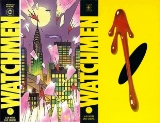
Watchmen is a twelve-issue
comic bookA comic book or comicbook is a magazine made up of comics, narrative artwork in the form of separate panels that represent individual scenes, often accompanied by dialog as well as including...
limited seriesA limited series is a comic book series with a set number of installments. A limited series differs from an ongoing series in that the number of issues is determined before production and it differs from a one shot in that it is composed of multiple issues....
created by writer
Alan MooreAlan Oswald Moore is an English writer primarily known for his work in comic books, a medium where he has produced a number of critically acclaimed and popular series, including Watchmen, V for Vendetta, and From Hell...
, artist
Dave GibbonsDave Gibbons is an English comic book artist, writer and sometime letterer. He is best known for his collaborations with writer Alan Moore, which include the miniseries Watchmen and the Superman story "For the Man Who Has Everything"...
, and colourist
John HigginsJohn Higgins is an English comic book artist and writer. He did significant work for 2000 AD, and he has frequently worked with writer Alan Moore, most notably as colourist for Watchmen.-Biography:...
. The series was published by
DC ComicsDC Comics, Inc. is one of the largest and most successful companies operating in the market for American comic books and related media. It is the publishing unit of DC Entertainment a company of Warner Bros. Entertainment, which itself is owned by Time Warner...
during 1986 and 1987, and has been subsequently reprinted in collected form. Watchmen originated from a story proposal Moore submitted to DC featuring
superheroA superhero is a type of stock character, possessing "extraordinary or superhuman powers", dedicated to protecting the public. Since the debut of the prototypical superhero Superman in 1938, stories of superheroes — ranging from brief episodic adventures to continuing years-long sagas —...
characters that the company had acquired from
Charlton ComicsCharlton Comics was an American comic book publishing company that existed from 1946 to 1985, having begun under a different name in 1944. It was based in Derby, Connecticut...
. As Moore's proposed story would have left many of the characters unusable for future stories, managing editor
Dick GiordanoRichard Joseph "Dick" Giordano was an American comic book artist and editor best known for introducing Charlton Comics' "Action Heroes" stable of superheroes, and serving as executive editor of then–industry leader DC Comics...
convinced the writer to create original characters instead.
Moore used the story as a means to reflect contemporary anxieties and to critique the superhero concept. Watchmen depicts an alternate history where superheroes emerged in the 1940s and 1960s, helping the United States to win the
Vietnam WarThe Vietnam War was a Cold War-era military conflict that occurred in Vietnam, Laos, and Cambodia from 1 November 1955 to the fall of Saigon on 30 April 1975. This war followed the First Indochina War and was fought between North Vietnam, supported by its communist allies, and the government of...
. The country is edging towards a
nuclear warNuclear warfare, or atomic warfare, is a military conflict or political strategy in which nuclear weaponry is detonated on an opponent. Compared to conventional warfare, nuclear warfare can be vastly more destructive in range and extent of damage...
with the
Soviet UnionThe Soviet Union , officially the Union of Soviet Socialist Republics , was a constitutionally socialist state that existed in Eurasia between 1922 and 1991....
, freelance costumed vigilantes have been outlawed and most former superheroes are in retirement or working for the government. The story focuses on the personal development and struggles of the protagonists as an investigation into the murder of a government sponsored superhero pulls them out of retirement, and eventually leads them to confront a plot that would stave off nuclear war by killing millions of people.
Creatively, the focus of Watchmen is on its structure. Gibbons used a nine-panel grid layout throughout the series and added recurring symbols such as a blood-stained
smileyA smiley, smiley face, or happy face, is a stylized representation of a smiling human face, commonly occurring in popular culture. It is commonly represented as a yellow circle with two black dots representing eyes and a black arc representing the mouth...
. All but the last issue feature supplemental fictional documents that add to the series' backstory, and the narrative is intertwined with that of another story, a fictional pirate comic titled Tales of the Black Freighter, which one of the characters reads. Structured as a nonlinear narrative, the story skips through space, time and plot. Watchmen has received critical acclaim both in the comics and mainstream press, and is regarded by critics as a seminal text of the comics medium. After a number of attempts to adapt the series into a feature film, director
Zack SnyderZachary Edward "Zack" Snyder is an American actor, film director, screenwriter, and producer. After making his feature film debut with the 2004 remake Dawn of the Dead, he gained wide recognition with the 2007 box office hit 300, adapted from writer-artist Frank Miller's Dark Horse Comics...
's
WatchmenWatchmen is a 2009 superhero film directed by Zack Snyder and starring Malin Åkerman, Billy Crudup, Matthew Goode, Jackie Earle Haley, Jeffrey Dean Morgan, and Patrick Wilson. It is an adaptation of the comic book of the same name by Alan Moore and Dave Gibbons...
was released in 2009.
Background and creation
In 1985, DC Comics acquired a line of characters from
Charlton ComicsCharlton Comics was an American comic book publishing company that existed from 1946 to 1985, having begun under a different name in 1944. It was based in Derby, Connecticut...
. During that period, writer Alan Moore contemplated writing a story that featured an unused line of superheroes that he could revamp, as he had done in his
MiraclemanMarvelman, also known as Miracleman for trademark reasons in his American reprints and story continuation, is a fictional comic book superhero created in 1954 by writer-artist Mick Anglo for publisher L. Miller & Son. Originally intended as a United Kingdom home-grown substitute for the American...
series in the early 1980s. Moore reasoned that MLJ Comics'
Mighty CrusadersThe Mighty Crusaders is a fictional superhero team published by Archie Comics. The team originally appeared in Fly-Man #31, #32 and #33 before being launched in its own title, Mighty Crusaders. Written by Superman co-creator Jerry Siegel, the series lasted seven issues before being cancelled. The...
might be available for such a project, so he devised a murder mystery plot which would begin with the discovery of the body of The Shield in a harbour. The writer felt it did not matter which set of characters he ultimately used, as long as readers recognized them "so it would have the shock and surprise value when you saw what the reality of these characters was". Moore used this premise and crafted a proposal featuring the Charlton characters titled Who Killed the
PeacemakerThe Peacemaker is the name of a series of superheroes originally owned by Charlton Comics and later acquired by DC Comics. The original Peacemaker first appeared in Fightin' 5 #40 The Peacemaker is the name of a series of superheroes originally owned by Charlton Comics and later acquired by DC...
, and submitted the unsolicited proposal to DC managing editor
Dick GiordanoRichard Joseph "Dick" Giordano was an American comic book artist and editor best known for introducing Charlton Comics' "Action Heroes" stable of superheroes, and serving as executive editor of then–industry leader DC Comics...
. Giordano was receptive to the proposal, but the editor opposed the idea of using the Charlton characters for the story. Moore said, "DC realized their expensive characters would end up either dead or dysfunctional." Instead, Giordano persuaded Moore to continue with new characters. Moore had initially believed that original characters would not provide emotional resonance for the readers, but later changed his mind. He said, "Eventually, I realized that if I wrote the substitute characters well enough, so that they seemed familiar in certain ways, certain aspects of them brought back a kind of generic super-hero resonance or familiarity to the reader, then it might work."
Artist Dave Gibbons, who had collaborated with Moore on previous projects, heard the writer was working on a limited series treatment. The artist said he wanted to be involved, so Moore sent him the story outline. Gibbons told Giordano he wanted to draw the series Moore proposed and Moore approved. Gibbons brought colorist
John HigginsJohn Higgins is an English comic book artist and writer. He did significant work for 2000 AD, and he has frequently worked with writer Alan Moore, most notably as colourist for Watchmen.-Biography:...
onto the project because he liked his "unusual" style; Higgins lived near the artist, which allowed the two to "discuss [the art] and have some kind of human contact rather than just sending it across the ocean".
Len WeinLen Wein is an American comic book writer and editor best known for co-creating DC Comics' Swamp Thing and Marvel Comics' Wolverine, and for helping revive the Marvel superhero team the X-Men...
joined the project as its editor, while Giordano stayed on to oversee it. Both Wein and Giordano stood back and "got out of their way"; Giordano remarked later, "Who copyedits Alan Moore, for God's sake?"
After receiving the go-ahead to work on the project, Moore and Gibbons spent a day at the latter's house creating characters, crafting details for the story's milieu and discussing influences. The pair was particularly influenced by a
MadMad is an American humor magazine founded by editor Harvey Kurtzman and publisher William Gaines in 1952. Launched as a comic book before it became a magazine, it was widely imitated and influential, impacting not only satirical media but the entire cultural landscape of the 20th century.The last...
parody of Superman named "
Superduperman"Superduperman" is a satirical story by Harvey Kurtzman and Wally Wood published in the fourth issue of Mad . Lampooning both Superman and Captain Marvel, it revolutionized the types of stories seen in Mad, leading to greatly improved sales, and it was influential on writers, notably Alan Moore,...
"; Moore said, "We wanted to take Superduperman 180 degrees—dramatic, instead of comedic". Moore and Gibbons conceived of a story that would take "familiar old-fashioned superheroes into a completely new realm"; the writer said his intention was to create "a superhero
Moby DickMoby-Dick; or, The Whale, was written by American author Herman Melville and first published in 1851. It is considered by some to be a Great American Novel and a treasure of world literature. The story tells the adventures of wandering sailor Ishmael, and his voyage on the whaleship Pequod,...
; something that had that sort of weight, that sort of density". The writer came up with the character names and descriptions, but left the specifics of how they looked to Gibbons. Gibbons did not sit down and design the characters deliberately, but rather "did it at odd times ... spend[ing] maybe two or three weeks just doing sketches." Gibbons designed his characters to make them easy to draw; Rorschach was his favorite to draw because "you just have to draw a hat. If you can draw a hat, then you've drawn Rorschach, you just draw kind of a shape for his face and put some black blobs on it and you're done."
Moore began writing the series very early on, hoping to avoid publication delays such as those faced by the DC limited series
Camelot 3000Camelot 3000 is an American twelve-issue comic book limited series written by Mike W. Barr and penciled by Brian Bolland. It was published by DC Comics from 1982 to 1985 as one of its first direct market projects, and as its first maxi-series.-Plot:...
. When writing the script for the first issue, Moore said he realized "I only had enough plot for six issues. We were contracted for 12!" His solution was to alternate issues that dealt with the overall plot of the series with origin issues for the characters. Moore wrote very detailed scripts for Gibbons to work from. Gibbons recalled that "[t]he script for the first issue of Watchmen was, I think, 101 pages of typescript—single-spaced—with no gaps between the individual panel descriptions or, indeed, even between the pages." Upon receiving the scripts, the artist had to number each page "in case I drop them on the floor, because it would take me two days to put them back in the right order", and used a highlighter pen to single out lettering and shot descriptions; he remarked, "It takes quite a bit of organizing before you can actually put pen to paper." Despite Moore's detailed scripts, his panel descriptions would often end with the note "If that doesn't work for you, do what works best"; Gibbons nevertheless worked to Moore's instructions. Gibbons had a great deal of autonomy in developing the visual look of Watchmen, and frequently inserted background details that Moore admitted he did not notice until later. Moore occasionally contacted fellow comics writer
Neil GaimanNeil Richard Gaiman born 10 November 1960)is an English author of short fiction, novels, comic books, graphic novels, audio theatre and films. His notable works include the comic book series The Sandman and novels Stardust, American Gods, Coraline, and The Graveyard Book...
for answers to research questions and for quotes to include in issues.
Despite his intentions, Moore admitted in November 1986 that there were likely to be delays, stating that he was, with issue five on the stands, still writing issue nine. Gibbons mentioned that a major factor in the delays was the "piecemeal way" in which he received Moore's scripts. Gibbons said the team's pace slowed around the fourth issue; from that point onwards the two undertook their work "just several pages at a time. I'll get three pages of script from Alan and draw it and then toward the end, call him up and say, 'Feed me!' And he'll send another two or three pages or maybe one page or sometimes six pages." As the creators began to hit deadlines, Moore would hire a taxi driver to drive 50 miles and deliver scripts to Gibbons. On later issues the artist had his wife and son draw panel grids on pages to help save time. Moore even shortened one of Ozymandias' narrations, because Gibbons was unable to compress the dialogue on to one page where Ozymandias prevents a sneak attack by Rorschach.
Near the end of the project, Moore realized that the story bore some similarity to "The Architects of Fear", an episode of
The Outer LimitsThe Outer Limits is an American television series that aired on ABC from 1963 to 1965. The series is similar in style to the earlier The Twilight Zone, but with a greater emphasis on science fiction, rather than fantasy stories...
television series. The writer and Wein argued over changing the ending; Moore won, but acknowledged the episode by referencing it in the series' last issue.
Story
Watchmen is set in an alternate reality which closely mirrors the contemporary world of the 1980s. The primary difference is the presence of superheroes. The
point of divergenceIn discussion of counterfactual history, a divergence point , also referred to as a departure point or point of divergence , is a historical event with two possible postulated outcomes...
occurs in the year 1938. Their existence in this version of America is shown to have dramatically affected and altered the outcomes of real-world events such as the
Vietnam WarThe Vietnam War was a Cold War-era military conflict that occurred in Vietnam, Laos, and Cambodia from 1 November 1955 to the fall of Saigon on 30 April 1975. This war followed the First Indochina War and was fought between North Vietnam, supported by its communist allies, and the government of...
and the presidency of
Richard NixonRichard Milhous Nixon was the 37th President of the United States, serving from 1969 to 1974. The only president to resign the office, Nixon had previously served as a US representative and senator from California and as the 36th Vice President of the United States from 1953 to 1961 under...
. In keeping with the realism of the series, although the
costumed crimefighters of Watchmen are commonly called "superheroes", the only character who possesses obvious superhuman powers is Doctor Manhattan. The existence of Doctor Manhattan has given the U.S. a strategic advantage over the Soviet Union, which has increased tensions between the two nations. Eventually, superheroes grow unpopular among the police and the public, which has led to the passage of legislation in 1977 to outlaw them. While many of the heroes retired, Doctor Manhattan and The Comedian operate as government-sanctioned agents, and
RorschachRorschach is a fictional comic book character and antihero that was featured in the acclaimed 1986 DC Comics miniseries Watchmen...
continues to operate outside the law.
Plot
In October 1985,
New York CityNew York is the most populous city in the United States and the center of the New York Metropolitan Area, one of the most populous metropolitan areas in the world. New York exerts a significant impact upon global commerce, finance, media, art, fashion, research, technology, education, and...
police are investigating the murder of Edward Blake. With the police having no leads, costumed vigilante Rorschach decides to probe further. Discovering Blake to be the face behind The Comedian, a costumed hero employed by the United States government, Rorschach believes he has discovered a plot to terminate costumed adventurers and sets about warning four of his retired comrades: Dan Dreiberg (formerly the second Nite Owl), the superpowered and emotionally detached Doctor Manhattan and his lover Laurie Juspeczyk (the second Silk Spectre), and Adrian Veidt (once the hero Ozymandias, and now a successful businessman).
After Blake's funeral, Doctor Manhattan is accused on national television of being the cause of cancer in friends and former colleagues. When the U.S. government takes the accusations seriously, Manhattan exiles himself to Mars. In doing so, he throws humanity into political turmoil, with the Soviet Union invading Afghanistan to capitalize on the perceived American weakness. Rorschach's paranoid beliefs appear vindicated when Adrian Veidt narrowly survives an assassination attempt, and Rorschach himself is framed for murdering Moloch, a former supervillain.
Neglected in her relationship with Manhattan, and no longer kept on retainer by the government, Juspeczyk stays with Dreiberg; they don their costumes and resume vigilante work as they grow closer together. With Dreiberg starting to believe some aspects of Rorschach's conspiracy theory, the pair take it upon themselves to break him out of prison. Doctor Manhattan, after looking back on his own personal history, places the fate of his involvement with human affairs in Juspeczyk's hands. He teleports her to Mars to make the case for emotional investment. During the course of the argument, Juspeczyk is forced to come to terms with the fact that Blake, who once attempted to rape her mother, was in fact her biological father following a second consensual relationship. This discovery, reflecting the complexity of human emotions and relationships, re-sparks Doctor Manhattan's interest in humanity.
On Earth, Nite Owl and Rorschach continue to uncover the conspiracy surrounding the death of The Comedian and the accusations that drove Doctor Manhattan into exile. They discover evidence that Adrian Veidt may be behind the plan. Rorschach writes his suspicions about Veidt in his journal, and mails it to New Frontiersman, a small, right-wing newspaper in New York. The pair then confront Veidt at his Antarctic retreat. Veidt explains his underlying plan is to save humanity from impending Atomic war between the United States and Soviet Union by faking an alien invasion in New York City, which will annihilate half the city's population. He hopes this will unite the nations against a perceived common enemy. He also reveals that he had murdered The Comedian, arranged for Dr. Manhattan's past associates to contract cancer, staged the attempt on his own life in order to place himself above suspicion, and eventually staged Moloch's death to frame Rorschach. This was all done in an attempt to prevent his plan from being exposed. Finding his logic callous and abhorrent, Dreiberg and Rorschach attempt to stop him but discover that Veidt had already enacted his plan.
When Doctor Manhattan and Juspeczyk arrive back on Earth, they are confronted by mass destruction and wide scale death in New York City. Doctor Manhattan notices his abilities are limited by
tachyonA tachyon is a hypothetical subatomic particle that always moves faster than light. In the language of special relativity, a tachyon would be a particle with space-like four-momentum and imaginary proper time. A tachyon would be constrained to the space-like portion of the energy-momentum graph...
s emanating from the Antarctic, and the pair teleport there. They discover Veidt's involvement and confront him. Veidt shows everyone news broadcasts confirming the cessation of global hostilities and cooperation against a new threat; this leads almost all present to agree that concealing Veidt's truth from the public is in the best interests of the world to keep it united. Rorschach refuses to compromise and leaves, intent on revealing the truth. As he is making his way back, he is confronted by Manhattan. Rorschach tells him that Manhattan will have to kill him to stop him from exposing Veidt and his actions, and Manhattan responds by vaporizing him. Manhattan then wanders through the base and finds Veidt, who asks Manhattan if he did the right thing in the end. In response, Manhattan states that "Nothing ever ends" before leaving the Earth for a different galaxy. Dreiberg and Juspeczyk go into hiding under new identities and continue their romance. Back in New York, the editor at New Frontiersman complains about having to pull a two page column about Russia due to the new political climate. He asks his assistant to find some filler material from the crank file, a collection of rejected submissions to the paper, many of which had not even been reviewed. The series ends with the young man reaching towards the pile of discarded submissions, near the top of which is Rorschach's journal.
Characters
With Watchmen, Alan Moore's intention was to create four or five "radically opposing ways" to perceive the world and to give readers of the story the privilege of determining which one was most morally comprehensible. Moore did not believe in the notion of "[cramming] regurgitated morals" down the readers' throats and instead sought to show heroes in an ambivalent light. Moore said, "What we wanted to do was show all of these people, warts and all. Show that even the worst of them had something going for them, and even the best of them had their flaws."
Edward Blake / The Comedian: One of two government-sanctioned heroes (along with Doctor Manhattan) who remains active after the Keene Act is passed in 1977 to ban superheroes. His murder, which occurs shortly before the first chapter begins, sets the plot of Watchmen in motion. The character appears throughout the story in flashbacks and aspects of his personality are revealed by other characters. The Comedian was based on the Charlton Comics character
PeacemakerThe Peacemaker is the name of a series of superheroes originally owned by Charlton Comics and later acquired by DC Comics. The original Peacemaker first appeared in Fightin' 5 #40 The Peacemaker is the name of a series of superheroes originally owned by Charlton Comics and later acquired by DC...
, with elements of the
Marvel ComicsMarvel Worldwide, Inc., commonly referred to as Marvel Comics and formerly Marvel Publishing, Inc. and Marvel Comics Group, is an American company that publishes comic books and related media...
spy character
Nick FuryColonel Nicholas Joseph "Nick" Fury is a fictional World War II army hero and present-day super-spy in the Marvel Comics universe. Created by artist Jack Kirby and writer Stan Lee, Fury first appeared in Sgt. Fury and his Howling Commandos #1 , a World War II combat series that portrayed the...
added. Moore and Gibbons saw The Comedian as "a kind of
Gordon LiddyGeorge Gordon Liddy was the chief operative for the White House Plumbers unit that existed from July–September 1971, during Richard Nixon's presidency. Separately, along with E. Howard Hunt, Liddy organized and directed the Watergate burglaries of the Democratic National Committee headquarters in...
character, only a much bigger, tougher guy". Richard Reynolds described The Comedian as "ruthless, cynical, and nihilistic, and yet capable of deeper insights than the others into the role of the costumed hero." Although he attempted to rape the first Silk Spectre in the 1940s, issue nine reveals that years later he fathered her daughter Laurie as part of a consensual sexual relationship.
Dr. Jon Osterman / Doctor Manhattan: A superpowered being who is contracted by the United States government. Scientist Jon Osterman gained power over
matterMatter is a general term for the substance of which all physical objects consist. Typically, matter includes atoms and other particles which have mass. A common way of defining matter is as anything that has mass and occupies volume...
when he was caught in an "Intrinsic Field Subtractor" in 1959. Doctor Manhattan was based upon Charlton's
Captain AtomCaptain Atom is a fictional comic book superhero that has existed in three basic incarnations. Created by writer Joe Gill and artist/co-writer Steve Ditko, he first appeared in Space Adventures #33 . Captain Atom was created for Charlton Comics but was later acquired by DC Comics and revised for...
, who in Moore's original proposal was surrounded by the shadow of nuclear threat. However, the writer found he could do more with Manhattan as a "kind of a quantum super-hero" than he could have with Captain Atom. In contrast to other superheroes who lacked scientific exploration of their origins, Moore sought to delve into
nuclear physicsNuclear physics is the field of physics that studies the building blocks and interactions of atomic nuclei. The most commonly known applications of nuclear physics are nuclear power generation and nuclear weapons technology, but the research has provided application in many fields, including those...
and quantum physics in constructing the character of Dr. Manhattan. The writer believed that a character living in a quantum universe would not perceive time with a linear perspective, which would influence the character's perception of human affairs. Moore also wanted to avoid creating an emotionless character like
SpockSpock is a fictional character in the Star Trek media franchise. First portrayed by Leonard Nimoy in the original Star Trek series, Spock also appears in the animated Star Trek series, two episodes of Star Trek: The Next Generation, seven of the Star Trek feature films, and numerous Star Trek...
from
Star TrekStar Trek is an American science fiction entertainment franchise created by Gene Roddenberry. The core of Star Trek is its six television series: The Original Series, The Animated Series, The Next Generation, Deep Space Nine, Voyager, and Enterprise...
, so he sought for Dr. Manhattan to retain "human habits" and to grow away from them and humanity in general. Gibbons had created the blue character
Rogue TrooperRogue Trooper is a science fiction strip in the British comic 2000 AD, created by Gerry Finley-Day and Dave Gibbons. It follows the adventures of Rogue, a G.I. and his three comrades' search for the Traitor General...
, and explained he reused the blue skin motif for Doctor Manhattan as it resembles skin tonally, but has a different hue. Moore incorporated the color into the story, and Gibbons noted the rest of the comic's color scheme made Manhattan unique. Moore recalled that he was unsure if DC would allow the creators to depict the character as fully nude, which partially influenced how they portrayed the character. Gibbons wanted to be tasteful in depicting Manhattan's nudity, selecting carefully when full frontal shots would occur and giving him "understated" genitals—like a classical sculpture—so the reader would not initially notice it.
Daniel Dreiberg / Nite Owl: A retired superhero who utilizes owl-themed gadgets. Nite Owl was based on the
Ted KordBlue Beetle is the second Blue Beetle, a superhero who was originally published by Charlton Comics and later picked up by DC Comics...
version of the
Blue BeetleBlue Beetle is the name of three fictional superheroes that appear in American comic books published by a variety of companies since 1939.-Publication history:...
. Paralleling the way that Ted Kord had a predecessor, Moore also incorporated an earlier adventurer who used the name "Nite Owl," the retired crime fighter Hollis Mason, into Watchmen. While Moore devised character notes for Gibbons to work from, the artist provided a name and a costume design for Hollis Mason he had created when he was twelve. Richard Reynolds noted in Super Heroes: A Modern Mythology that despite the character's Charlton roots, Nite Owl's modus operandi has more in common with the DC Comics character
BatmanBatman is a fictional character created by the artist Bob Kane and writer Bill Finger. A comic book superhero, Batman first appeared in Detective Comics #27 , and since then has appeared primarily in publications by DC Comics...
. According to Klock, his civilian form "visually suggests an impotent, middle-aged
Clark KentClark Kent is a fictional character created by Jerry Siegel and Joe Shuster. Appearing regularly in stories published by DC Comics, he debuted in Action Comics #1 and serves as the civilian and secret identity of the superhero Superman....
."
Adrian Veidt / Ozymandias: Drawing inspiration from
Alexander the Great, Veidt was once the superhero Ozymandias, but has since retired to devote his attention to the running of his own enterprises. Veidt is believed to be the smartest man on the planet. Ozymandias was directly based on
Peter Cannon, ThunderboltPeter Cannon, Thunderbolt is a fictional superhero character originally owned by Charlton Comics, notable for containing some of the earliest respectful invocations of Eastern mysticism in American pop culture. The character has been owned by the estate of its creator, writer-artist Pete Morisi,...
; Moore liked the idea of a character who "us[ed] the full 100% of his brain" and "[had] complete physical and mental control". Richard Reynolds noted that by taking initiative to "help the world", Veidt displays a trait normally attributed to villains in superhero stories, and in a sense he is the "villain" of the series. Gibbons noted "One of the worst of his sins [is] kind of looking down on the rest of humanity, scorning the rest of humanity."
Walter Joseph Kovacs / RorschachRorschach is a fictional comic book character and antihero that was featured in the acclaimed 1986 DC Comics miniseries Watchmen...
: A vigilante who wears a white mask that contains a symmetrical but constantly shifting ink blot pattern, he continues to fight crime in spite of his outlaw status. Moore said he was trying to "come up with this quintessential
Steve DitkoStephen J. "Steve" Ditko is an American comic book artist and writer best known as the artist co-creator, with Stan Lee, of the Marvel Comics heroes Spider-Man and Doctor Strange....
character—someone who's got a funny name, whose surname begins with a 'K,' who's got an oddly designed mask". Moore based Rorschach on Ditko's creation
Mr. AMr. A is a fictional comic book hero created by Steve Ditko. Unlike most of his work, the character of Mr. A and the Mr. A stories remain the property of Ditko, all of which were written and illustrated by himself. The character first appeared in Witzend #3, 1967. Mr. A's name comes from "A is A",...
; Ditko's Charlton character
The QuestionThe Question is a fictional character, a superhero in comic books published by DC Comics. The original was created by writer-artist Steve Ditko, and first appeared in Blue Beetle #1...
also served as a template for creating Rorschach. Comics historian Bradford W. Wright described the character's world view "a set of black-and-white values that take many shapes but never mix into shades of gray, similar to the
ink blot testsThe Rorschach test is a psychological test in which subjects' perceptions of inkblots are recorded and then analyzed using psychological interpretation, complex algorithms, or both. Some psychologists use this test to examine a person's personality characteristics and emotional functioning...
of his namesake". Rorschach sees existence as random and, according to Wright, this viewpoint leaves the character "free to 'scrawl [his] own design' on a 'morally blank world'". Moore said he did not foresee the death of Rorschach until the fourth issue when he realized that his refusal to compromise would result in him not surviving the story.
Laurie Juspeczyk / Silk Spectre: The daughter of Sally Jupiter (the first Silk Spectre, with whom she has a strained relationship), and The Comedian. She had been the lover of Doctor Manhattan for years. While Silk Spectre was based partially on the Charlton character
NightshadeNightshade is a fictional character, a comic book superheroine published by DC Comics. Created by Joe Gill and Steve Ditko, the character first appeared in Captain Atom v2 #82 originally published by Charlton Comics.-Charlton Comics:...
, Moore was not impressed by the character and drew more from heroines such as
Black CanaryBlack Canary is the name of two fictional characters, DC Comics superheroines created by writer Robert Kanigher and artist Carmine Infantino. The first Black Canary debuted appeared in Flash Comics #86 . The first Black Canary was the alter-ego of Dinah Drake, who took part in Golden Age adventures...
and
Phantom LadyPhantom Lady is a fictional superheroine, one of the first female superhero characters to debut in the 1940s Golden Age of Comic Books. Originally published by Quality Comics, the character was subsequently published by a series of now-defunct comic book companies, and a new version of the...
.
Art and composition
Moore and Gibbons designed Watchmen to showcase the unique qualities of the comics medium and to highlight its particular strengths. In a 1986 interview, Moore said, "What I'd like to explore is the areas that comics succeed in where no other media is capable of operating", and emphasized this by stressing the differences between comics and film. Moore said that Watchmen was designed to be read "four or five times," with some links and allusions only becoming apparent to the reader after several readings. Dave Gibbons notes that, "[a]s it progressed, Watchmen became much more about the telling than the tale itself. The main thrust of the story essentially hinges on what is called a
macguffinA MacGuffin is "a plot element that catches the viewers' attention or drives the plot of a work of fiction". The defining aspect of a MacGuffin is that the major players in the story are willing to do and sacrifice almost anything to obtain it, regardless of what the MacGuffin actually is...
, a gimmick ... So really the plot itself is of no great consequence ... it just really isn't the most interesting thing about Watchmen. As we actually came to tell the tale, that's where the real creativity came in."
Gibbons said he deliberately constructed the visual look of Watchmen so that each page would be identifiable as part of that particular series and "not some other comic book". He made a concerted effort to draw the characters in a manner different than that commonly seen in comics. The artist tried to draw the series with "a particular weight of line, using a hard, stiff pen that didn't have much modulation in terms of thick and thin" which he hoped "would differentiate it from the usual lush, fluid kind of comic book line". In a 2009 interview, Moore recalled that he took advantage of Gibbons' training as a former
surveyorSee Also: Public Land Survey SystemSurveying or land surveying is the technique, profession, and science of accurately determining the terrestrial or three-dimensional position of points and the distances and angles between them...
for "including incredible amounts of detail in every tiny panel, so we could choreograph every little thing". Gibbons described the series as "a comic about comics". Gibbons felt that "Alan is more concerned with the social implications of [the presence of super-heroes] and I've gotten involved in the technical implications." The story's alternate world setting allowed Gibbons to change details of the American landscape, such as adding
electric carAn electric car is an automobile which is propelled by electric motor, using electrical energy stored in batteries or another energy storage device. Electric cars were popular in the late-19th century and early 20th century, until advances in internal combustion engine technology and mass...
s, slightly different buildings, and spark hydrants instead of
fire hydrantA fire hydrant , is an active fire protection measure, and a source of water provided in most urban, suburban and rural areas with municipal water service to enable firefighters to tap into the municipal water...
s, which Moore said, "perhaps gives the American readership a chance in some ways to see their own culture as an outsider would". Gibbons noted that the setting was liberating for him because he did not have to rely primarily on reference books.
Colorist John Higgins used a template that was "moodier" and favored secondary colors. Moore stated that he had also "always loved John's coloring, but always associated him with being an
airbrushAn airbrush is a small, air-operated tool that sprays various media including ink and dye, but most often paint by a process of nebulization. Spray guns developed from the airbrush and are still considered a type of airbrush.-History:...
colorist", which Moore was not fond of; Higgins subsequently decided to color Watchmen in European-style flat color. Moore noted that the artist paid particular attention to lighting and subtle color changes; in issue six, Higgins began with "warm and cheerful" colors and throughout the issue gradually made it darker to give the story a dark and bleak feeling.
Structure
Structurally, certain aspects of Watchmen deviated from the norm in comic books at the time, particularly the panel layout and the coloring. Instead of panels of various sizes, the creators divided each page into a nine-panel grid. Gibbons favored the nine-panel grid system due to its "authority". Moore accepted the use of the nine-panel grid format, which "gave him a level of control over the storytelling he hadn't had previously", according to Gibbons. "There was this element of the pacing and visual impact that he could now predict and use to dramatic effect."
Bhob StewartBhob Stewart is an American writer, editor, artist and film maker who has written for a variety of publications over a span of five decades. His articles and reviews have appeared in TV Guide, Publishers Weekly and other publications, along with online contributions to Allmovie, the Collecting...
of
The Comics JournalThe Comics Journal, often abbreviated TCJ, is an American magazine of news and criticism pertaining to comic books, comic strips and graphic novels...
mentioned to Gibbons in 1987, that the page layouts recalled those of
EC ComicsEntertaining Comics, more commonly known as EC Comics, was an American publisher of comic books specializing in horror fiction, crime fiction, satire, military fiction and science fiction from the 1940s through the mid-1950s, notably the Tales from the Crypt series...
, in addition to the art itself, which Stewart felt particularly echoed that of
John SeverinJohn Powers Severin is an American comic book artist noted for his distinctive work with EC Comics, primarily on the war comics Two-Fisted Tales and Frontline Combat; for Marvel Comics, primarily on its war and Western comics; and for the satiric magazine Cracked...
. Gibbons agreed that the echoing of the EC-style layouts "was a very deliberate thing", although his inspiration was rather
Harvey KurtzmanHarvey Kurtzman was an American cartoonist and the editor of several comic books and magazines. Kurtzman often signed his name H. Kurtz, followed by a stick figure Harvey Kurtzman (October 3, 1924, Brooklyn, New York – February 21, 1993) was an American cartoonist and the editor of several comic...
, but it was altered enough to give the series a unique look. The artist also cited Steve Ditko's work on early issues of
The Amazing Spider-ManThe Amazing Spider-Man is an American comic book series published by Marvel Comics, featuring the adventures of the fictional superhero Spider-Man. Being the mainstream continuity of the franchise, it began publication in 1963 as a monthly periodical and was published continuously until it was...
as an influence, as well as
Doctor StrangeDoctor Stephen Strange is a fictional character that appears in comic books published by Marvel Comics. The character was co-created by writer-editor Stan Lee and artist Steve Ditko, and first appeared in Strange Tales #110 ....
, where "even at his most psychedelic [he] would still keep a pretty straight page layout".
The cover of each issue serves as the first panel to the story. Gibbons said, "The cover of the Watchmen is in the real world and looks quite real, but it's starting to turn into a comic book, a portal to another dimension." The covers were designed as close-ups that focused on a single detail with no human elements present. The creators on occasion experimented with the layout of the issue contents. Gibbons drew issue five, titled "Fearful Symmetry", so the first page mirrors the last (in terms of frame disposition), with the following pages mirroring each other before the center-spread is (broadly) symmetrical in layout.
The end of each issue, with the exception of issue twelve, contains supplemental prose pieces written by Moore. Among the contents are fictional book chapters, letters, reports, and articles written by various Watchmen characters. DC had trouble selling ad space in issues of Watchmen, which left an extra eight to nine pages per issue. DC planned to insert house ads and a longer letters column to fill the space, but editor Len Wein felt this would be unfair to anyone who wrote in during the last four issues of the series. He decided to use the extra pages to fill out the series' backstory. Moore said, "By the time we got around to issue #3, #4, and so on, we thought that the book looked nice without a letters page. It looks less like a comic book, so we stuck with it."
Tales of the Black Freighter
Watchmen features a
story within a storyA story within a story, also rendered story-within-a-story, is a literary device in which one narrative is presented during the action of another narrative. Mise en abyme is the French term for a similar literary device...
in the form of Tales of the Black Freighter, a fictional comic book from which scenes appear in issues three, five, eight, ten and eleven. The fictional comic's story, "Marooned", is read by a youth in New York City. Moore and Gibbons conceived a pirate comic because they reasoned that since the characters of Watchmen experience superheroes in real life, "they probably wouldn't be at all interested in superhero comics." Gibbons suggested a pirate theme, and Moore agreed in part because he is "a big
Bertolt BrechtBertolt Brecht was a German poet, playwright, and theatre director.An influential theatre practitioner of the 20th century, Brecht made equally significant contributions to dramaturgy and theatrical production, the latter particularly through the seismic impact of the tours undertaken by the...
fan": the Black Freighter alludes to the song "
Seeräuberjenny"Pirate Jenny" is a well-known song from The Threepenny Opera by Kurt Weill, with lyrics by Bertolt Brecht. The English lyrics are by Marc Blitzstein...
" ("
Pirate Jenny"Pirate Jenny" is a well-known song from The Threepenny Opera by Kurt Weill, with lyrics by Bertolt Brecht. The English lyrics are by Marc Blitzstein...
") from Brecht's
Threepenny OperaThe Threepenny Opera is a musical by German dramatist Bertolt Brecht and composer Kurt Weill, in collaboration with translator Elisabeth Hauptmann and set designer Caspar Neher. It was adapted from an 18th-century English ballad opera, John Gay's The Beggar's Opera, and offers a Marxist critique...
. Moore theorized that since superheroes existed, and existed as "objects of fear, loathing, and scorn, the main superheroes quickly fell out of popularity in comic books, as we suggest. Mainly, genres like horror, science fiction, and piracy, particularly piracy, became prominent—with EC riding the crest of the wave." Moore felt that "the imagery of the whole pirate genre is so rich and dark that it provided a perfect counterpoint to the contemporary world of Watchmen". The writer expanded upon the premise so that its presentation in the story would add subtext and allegory. The supplemental article detailing the fictional history of Tales of the Black Freighter at the end of issue five credits real-life artist
Joe OrlandoJoseph Orlando was a prolific illustrator, writer, editor and cartoonist during a lengthy career spanning six decades...
as a major contributor to the series. Moore chose Orlando because he felt that if pirate stories were popular in the Watchmen universe that DC editor
Julius SchwartzJulius "Julie" Schwartz was a comic book and pulp magazine editor, and a science fiction agent and prominent fan. He was born in the Bronx, New York...
might have tried to lure the artist over to the company to draw a pirate comic book. Orlando contributed a drawing designed as if it were a page from the fake title to the supplemental piece.
In "Marooned", a young mariner (called "The Sea Captain") journeys to warn his home town of the coming of the Black Freighter, after he survives the destruction of his own ship. He uses the bodies of his dead shipmates as a make-shift raft. When he finally returns home, believing it to be already under the occupation of the Black Freighter's crew, he kills an innocent couple and then attacks his own wife in their darkened home, mistaking her for a pirate. After realizing what he has done, he returns to the sea shore, where he finds that the Black Freighter has not come to claim the town; it has come to claim him. He swims out to sea and climbs aboard the ship. According to Richard Reynold, the mariner is "forced by the urgency of his mission to shed one inhibition after another." Just like Adrian Veidt, he "hopes to stave off disaster by using the dead bodies of his former comrades as a means of reaching his goal". Moore stated that the story of The Black Freighter ends up specifically describing "the story of Adrian Veidt" and that it can also be used as a counterpoint to other parts of the story, such as Rorschach's capture and Dr. Manhattan's self-exile on Mars.
Symbols and imagery
Moore named
William S. BurroughsWilliam Seward Burroughs II was an American novelist, poet, essayist and spoken word performer. A primary figure of the Beat Generation and a major postmodernist author, he is considered to be "one of the most politically trenchant, culturally influential, and innovative artists of the 20th...
as one of his main influences during the conception of Watchmen. He admired Burroughs' use of "repeated symbols that would become laden with meaning" in Burroughs' only comic strip, "
The Unspeakable Mr. HartAh Pook Is Here was a collaboration between author William S. Burroughs and artist Malcolm McNeill. It began in 1970, when Burroughs was living in London and McNeill was in his final year of art school. It first appeared under the title The Unspeakable Mr. Hart as a comic strip in the English...
", which appeared in the British underground magazine Cyclops. Not every intertextual link in the series was planned by Moore, who remarked that "there's stuff in there Dave had put in that even I only noticed on the sixth or seventh read," while other "things ... turned up in there by accident."
A blood-stained smiley face is a recurring image in the story, appearing in many forms. In The System of Comics, Thierry Groensteen described the symbol as a recurring motif that produces "rhyme and remarkable configurations" by appearing in key segments of Watchmen, notably the first and last pages of the series. Groensteen cites it as one form of the circle shape that appears throughout the story, as a "recurrent geometric motif" and due to its symbolic connotations. Gibbons created a smiley face badge as an element of The Comedian's costume in order to "lighten" the overall design, later adding a splash of blood to the badge to imply his murder. Gibbons said the creators came to regard the blood-stained smiley face as "a symbol for the whole series", noting its resemblance to the
Doomsday ClockThe Doomsday Clock is a symbolic clock face, maintained since 1947 by the board of directors of the Bulletin of the Atomic Scientists at the University of Chicago. The closer the clock is to midnight, the closer the world is estimated to be to global disaster. , the Doomsday Clock now stands at six...
ticking up to midnight. Moore drew inspiration from psychological tests of
behaviorismBehaviorism , also called the learning perspective , is a philosophy of psychology based on the proposition that all things that organisms do—including acting, thinking, and feeling—can and should be regarded as behaviors, and that psychological disorders are best treated by altering behavior...
, explaining that the tests had presented the face as "a symbol of complete innocence". With the addition of a blood splash over the eye, the face's meaning was altered to become simultaneously radical and simple enough for the first issue's cover to avoid human detail. Although most evocations of the central image were created on purpose, others were coincidental. Moore mentioned in particular that "the little plugs on the spark hydrants, if you turn them upside down, you discover a little smiley face".
Other symbols, images and allusion that appeared throughout the series often emerged unexpectedly. Moore mentioned that "[t]he whole thing with Watchmen has just been loads of these little bits of synchronicity popping up all over the place". Gibbons noted an unintended theme was contrasting the mundane and the romantic, citing the separate sex scenes between Nite Owl and Silk Spectre on his couch and then high in the sky on Nite Owl's airship. In a book of the
cratersIn the broadest sense, the term impact crater can be applied to any depression, natural or manmade, resulting from the high velocity impact of a projectile with a larger body...
and boulders of Mars, Gibbons discovered a photograph of the
Galle craterGalle is a crater on Mars. It is located on the eastern rim of the huge impact basin Argyre Planitia. It is named after the astronomer Johann Gottfried Galle....
, which resembles a happy face, which they worked into an issue. Moore said, "We found a lot of these things started to generate themselves as if by magic", in particular citing an occasion where they decided to name a lock company the "
Gordian KnotThe Gordian Knot is a legend of Phrygian Gordium associated with Alexander the Great. It is often used as a metaphor for an intractable problem solved by a bold stroke :"Turn him to any cause of policy,...
Lock Company".
Themes
The initial premise for the series was to examine what superheroes would be like "in a credible, real world". As the story became more complex, Moore said Watchmen became about "power and about the idea of the superman manifest within society." The title of the series refers to the question "Who watches the watchmen?", although Moore said in a 1986 interview with
Amazing HeroesAmazing Heroes was a magazine about the comic book medium published by Fantagraphics Books from 1981 to 1992. Unlike its companion title, The Comics Journal, Amazing Heroes was a hobbyist magazine rather than an analytical journal....
he did not know where that sentence originated. After reading the interview, author
Harlan EllisonHarlan Jay Ellison is an American writer. His principal genre is speculative fiction.His published works include over 1,700 short stories, novellas, screenplays, teleplays, essays, a wide range of criticism covering literature, film, television, and print media...
informed Moore that the sentence is a translation of the question "
Quis custodiet ipsos custodes?' is a Latin phrase traditionally attributed to the Roman poet Juvenal from his Satires , which is literally translated as "Who will guard the guards themselves?" Also sometimes rendered as "Who watches the watchmen?", the phrase has other idiomatic translations and adaptations such as "Who will...
", posed by the Roman satirist
JuvenalThe Satires are a collection of satirical poems by the Latin author Juvenal written in the late 1st and early 2nd centuries AD.Juvenal is credited with sixteen known poems divided among five books; all are in the Roman genre of satire, which, at its most basic in the time of the author, comprised a...
. Moore commented in 1987, "In the context of Watchmen, that fits. 'They're watching out for us, who's watching out for them?'" The writer stated in the introduction to the Graphitti hardcover of Watchmen that while writing the series he was able to purge himself of his nostalgia for superheroes, and instead he found an interest in real human beings.
Bradford Wright described Watchmen as "Moore's obituary for the concept of heroes in general and superheroes in particular." Putting the story in a contemporary sociological context, Wright wrote that the characters of Watchmen were Moore's "admonition to those who trusted in 'heroes' and leaders to guard the world's fate." He added that to place faith in such icons was to give up personal responsibility to "the
ReagansRonald Wilson Reagan was the 40th President of the United States , the 33rd Governor of California and, prior to that, a radio, film and television actor....
,
ThatchersMargaret Hilda Thatcher, Baroness Thatcher, was Prime Minister of the United Kingdom from 1979 to 1990...
, and other 'Watchmen' of the world who supposed to 'rescue' us and perhaps lay waste to the planet in the process". Moore specifically stated in 1986 that he was writing Watchmen to be "not anti-Americanism, [but] anti-
ReaganismRonald Reagan was the 40th President of the United States and the 33rd Governor of California .-Cold War:Reagan served as president during the latter part of the Cold War, an era of political and ideological disagreement between the United States and Soviet Union...
," specifically believing that "at the moment a certain part of Reagan's America isn't scared. They think they're invulnerable." While Moore wanted to write about "power politics" and the "worrying" times he lived in, he stated the reason that the story was set in an alternate reality was because he was worried that readers would "switch off" if he attacked a leader they admired. Moore stated in 1986 that he "was consciously trying to do something that would make people feel uneasy."
Citing Watchmen as the point where the comic book medium "came of age", Iain Thomson wrote in his essay "Deconstructing the Hero" that the story accomplished this by "developing its heroes precisely in order to deconstruct the very idea of the hero and so encouraging us to reflect upon its significance from the many different angles of the shards left lying on the ground". Thomson stated that the heroes in Watchmen almost all share a
nihilisticNihilism is the philosophical doctrine suggesting the negation of one or more putatively meaningful aspects of life. Most commonly, nihilism is presented in the form of existential nihilism which argues that life is without objective meaning, purpose, or intrinsic value...
outlook, and that Moore presents this outlook "as the simple, unvarnished truth" to "deconstruct the would-be hero's ultimate motivation, namely, to provide a secular salvation and so attain a mortal immortality". He wrote that the story "develops its heroes precisely in order to ask us if we would not in fact be better off without heroes". Thomson added that the story's deconstruction of the hero concept "suggests that perhaps the time for heroes has passed", which he feels distinguishes "this postmodern work" from the deconstructions of the hero in the
existentialismExistentialism is a term applied to a school of 19th- and 20th-century philosophers who, despite profound doctrinal differences, shared the belief that philosophical thinking begins with the human subject—not merely the thinking subject, but the acting, feeling, living human individual...
movement. Richard Reynolds states that without any supervillains in the story, the superheroes of Watchmen are forced to confront "more intangible social and moral concerns", adding that this removes the superhero concept from the normal narrative expectations of the genre. Reynolds concludes that the series' ironic self awareness of the genre "all mark out Watchmen either as the last key superhero text, or the first in a new maturity of the genre".
Geoff Klock eschewed the term "deconstruction" in favor of describing Watchmen as a "revisionary superhero narrative." He considers Watchmen and
Frank MillerFrank Miller is an American comic book artist, writer and film director best known for his dark, film noir-style comic book stories and graphic novels Ronin, Daredevil: Born Again, Batman: The Dark Knight Returns, Sin City and 300...
's
Batman: The Dark Knight ReturnsBatman: The Dark Knight Returns is a four-issue comic book limited series written and drawn by Frank Miller, originally published by DC Comics under the title Batman: The Dark Knight in 1986. When the issues were released in a collected edition later that year, the story title for the first issue...
to be "the first instances ... of [a] new kind of comic book ... a first phase of development, the transition of the superhero from fantasy to literature." He elaborates by noting that "Alan Moore's realism ... performs a
kenosisIn Christian theology, Kenosis In Christian theology, Kenosis In Christian theology, Kenosis (from the Greek word for emptiness (kénōsis) is the 'self-emptying' of one's own will and becoming entirely receptive to God's divine will....
towards comic book history ... [which] does not ennoble and empower his characters ... Rather, it sends a wave of disruption back through superhero history ... devalue[ing] one of the basic superhero conventions by placing his masked crime fighters in a realistic world". First and foremost, "Moore's exploration of the [often sexual] motives for costumed crimefighting sheds a disturbing light on past superhero stories, and forces the reader to reevaluate—to revision—every superhero in terms of Moore's kenosis—his emptying out of the tradition." Klock relates the title to the quote by Juvenal to highlight the problem of controlling those who hold power and quoted repeatedly within the work itself. The deconstructive nature of Watchmen is, Klock notes, played out on the page also as, "[l]ike Alan Moore's kenosis, [Veidt] must destroy, then reconstruct, in order to build 'a unity which would survive him.'"
Moore has expressed dismay that "[t]he gritty, deconstructivist postmodern superhero comic, as exemplified by Watchmen ... became a genre". He said in 2003 that "to some degree there has been, in the 15 years since Watchmen, an awful lot of the comics field devoted to these grim, pessimistic, nasty, violent stories which kind of use Watchmen to validate what are, in effect, often just some very nasty stories that don't have a lot to recommend them." Gibbons said that while readers "were left with the idea that it was a grim and gritty kind of thing", he said in his view the series was "a wonderful celebration of superheroes as much as anything else."
Publication and reception
When Moore and Gibbons turned in the first issue of Watchmen to DC, their peers were stunned. Gibbons recalled, "What really clinched it ... was [writer/artist]
Howard ChaykinHoward Victor Chaykin is an American comic book writer and artist famous for his innovative storytelling and sometimes controversial material...
, who doesn't give praise lightly, and who came up and said, 'Dave what you've done on Watchmen is fuckin' A.'" Speaking in 1986, Moore stated that "DC backed us all the way ... and have been really supportive about even the most graphic excesses." To promote the series, DC Comics released a limited-edition badge ("button") display card set, featuring characters and images from the series. Ten thousand sets of the four badges, including a replica of the blood-stained
smiley faceA smiley, smiley face, or happy face, is a stylized representation of a smiling human face, commonly occurring in popular culture. It is commonly represented as a yellow circle with two black dots representing eyes and a black arc representing the mouth...
badge worn by the Comedian in the story, were released and sold. Mayfair Games introduced a Watchmen module for its DC Heroes Role-playing Game series that was released before the series concluded. The module, which was endorsed by Moore, adds details to the series' backstory by portraying events that occurred in 1966.
Watchmen was published in single-issue form over the course of 1986 and 1987. The
limited seriesA limited series is a comic book series with a set number of installments. A limited series differs from an ongoing series in that the number of issues is determined before production and it differs from a one shot in that it is composed of multiple issues....
was a commercial success, and its sales helped DC Comics briefly overtake its competitor
Marvel ComicsMarvel Worldwide, Inc., commonly referred to as Marvel Comics and formerly Marvel Publishing, Inc. and Marvel Comics Group, is an American company that publishes comic books and related media...
in the comic book direct market. The series' publishing schedule ran into delays because it was scheduled with three issues completed instead of the six Len Wein believed were necessary. Further delays were caused when later issues each took more than a month to complete. Bhob Stewart of The Comics Journal noted in Spring 1987 that issue 12, which DC solicited for April 1987, "looks like it won't debut until July or August".
After the series concluded, the individual issues were collected and sold in
trade paperbackIn comics, a trade paperback is a collection of stories originally published in comic books, reprinted in book format, usually capturing one story arc from a single title or a series of stories with a connected story arc or common theme from one or more titles...
form. Along with
Frank MillerFrank Miller is an American comic book artist, writer and film director best known for his dark, film noir-style comic book stories and graphic novels Ronin, Daredevil: Born Again, Batman: The Dark Knight Returns, Sin City and 300...
's 1986 Batman: The Dark Knight Returns mini-series, Watchmen was marketed as a "
graphic novelA graphic novel is a narrative work in which the story is conveyed to the reader using sequential art in either an experimental design or in a traditional comics format...
", a term which allowed DC and other publishers to sell similar comic book collections in a way that associated them with novels, but dissociated them from comics. As a result of the publicity given to the books like the Watchmen trade in 1987, bookstore and public libraries began to devote special shelves to them. Subsequently, new comics series were commissioned on the basis of reprinting them in a collected form for these markets. In 1987, Graphitti Design produced a special limited edition, slipcased hardcover volume that contained 48 pages of bonus material, including the original proposal and concept art. In 2005, DC released Absolute Watchmen, an oversized slipcased hardcover edition of the series in DC's Absolute Edition format. Assembled under the supervision of Dave Gibbons, Absolute Watchmen included the Graphitti materials, as well as restored and recolored art by John Higgins. In 2008, Warner Bros. Entertainment released
Watchmen Motion ComicsThe Watchmen: Motion Comic is a 2008 American animated short film series of motion comics for web and television based on the comic book series Watchmen, written by Alan Moore and illustrated by Dave Gibbons. The series consists of twelve abridged 25–30 minute segments, each based on and sharing a...
, a series of narrated animations of the original comic book. The first chapter was released for purchase in the summer of 2008 on digital video stores, such as
iTunes StoreThe iTunes Store is a software-based online digital media store operated by Apple. Opening as the iTunes Music Store on April 28, 2003, with over 200,000 items to purchase, it is, as of April 2008, the number-one music vendor in the United States...
. That December, DC published a new printing of Watchmen issue #1 at the original 1986 cover price of $1.50. A DVD compiling the full
motion comicA motion comic is a form of comics combining elements of print comic books and animation.-History:The earliest examples of motion comics are found in independent creations such as Broken Saints....
series was released in March 2009.
Watchmen received critical praise, both inside and outside of the comics industry.
TimeTime is an American news magazine. A European edition is published from London. Time Europe covers the Middle East, Africa and, since 2003, Latin America. An Asian edition is based in Hong Kong...
magazine, which noted that the series was "by common assent the best of breed" of the new wave of comics published at the time, praised Watchmen as "a superlative feat of imagination, combining sci-fi, political satire, knowing evocations of comics past and bold reworkings of current graphic formats into a dysutopian mystery story." In 1988, Watchmen received a
Hugo AwardThe Hugo Awards are given annually for the best science fiction or fantasy works and achievements of the previous year. The award is named after Hugo Gernsback, the founder of the pioneering science fiction magazine Amazing Stories, and was officially named the Science Fiction Achievement Awards...
in the Other Forms category.
Moore stated in 1985 that if the limited series was well-received, he and Gibbons would possibly create a 12-issue prequel series called Minutemen featuring the 1940s superhero group from the story. DC offered Moore and Gibbons chances to publish prequels to the series, such as Rorschach's Journal or The Comedian's Vietnam War Diary, as well as hinting at the possibility of other authors using the same universe. Tales of the Comedian's Vietnam War experiences were floated because
The 'NamThe 'Nam was a war comic book series detailing the U.S. War in Vietnam from the perspective of active-duty soldiers involved in the conflict...
was popular at the time, while another suggestion was, according to Gibbons, for a "Nite Owl/Rorschach team" (in the manner of
Randall and Hopkirk (Deceased)Randall and Hopkirk , first transmitted during 1969-70, is a British private detective television series starring Mike Pratt and Kenneth Cope as the private detectives Jeff Randall and Marty Hopkirk, respectively. The series was originally created by Dennis Spooner and produced by Monty Berman...
). Neither man felt the stories would have gone anywhere, with Moore particularly adamant that DC not go forward with stories by other individuals. Gibbons was more attracted to the idea of a Minutemen series, because it would have "[paid] homage to the simplicity and unsophisticated nature of Golden Age comic books—with the added dramatic interest that it would be a story whose conclusion is already known. It would be, perhaps, interesting to see how we got to the conclusion."
Disagreements about the ownership of the story ultimately led Alan Moore to sever ties with DC Comics. Not wanting to work under a
work for hireA work made for hire is an exception to the general rule that the person who actually creates a work is the legally recognized author of that work...
arrangement, Moore and Gibbons had a reversion clause in their contract for Watchmen. Speaking at the 1985 San Diego Comic-Con, Moore said "The way it works, if I understand it, is that DC owns it for the time they're publishing it, and then it reverts to Dave and me, so we can make all the money from the
SlurpeeA Slurpee is a flavored frozen drink sold by 7-Eleven. In 1967, 7-Eleven licensed the product from the ICEE Company, and began selling it as the Slurpee.-Slurpee history:Machines to make frozen beverages were invented by Omar Knedlik in the late 1950s...
cups." For Watchmen, Alan Moore and Dave Gibbons received eight percent of the series' earnings. Moore explained in 1986 that his understanding was that when "DC have not used the characters for a year, they're ours." Both Moore and Gibbons said DC paid them "a substantial amount of money" to retain the rights. Moore added, "So basically they're not ours, but if DC is working with the characters in our interests then they might as well be. On the other hand, if the characters have outlived their natural life span and DC doesn't want to do anything with them, then after a year we've got them and we can do what we want with them, which I'm perfectly happy with."
Moore said he left DC in 1989 due to the language in his contracts for Watchmen and his
V for VendettaV for Vendetta is a ten-issue comic book series written by Alan Moore and illustrated mostly by David Lloyd, set in a dystopian future United Kingdom imagined from the 1980s to about the 1990s. A mysterious masked revolutionary who calls himself "V" works to destroy the totalitarian government,...
series with artist David Lloyd. Moore felt the reversion clauses were ultimately meaningless, because DC did not intend to let the publications go out of print. He told The New York Times in 2006, "I said, 'Fair enough,' [...] 'You have managed to successfully swindle me, and so I will never work for you again. In 2000, Moore publicly distanced himself from DC's plans for a fifteenth anniversary Watchmen hardcover release as well as a proposed line of action figures from
DC DirectDC Direct is the collectibles division of DC Comics, the Time Warner subsidiary that publishes comic books and licenses characters such as Superman, Wonder Woman, Green Lantern, Flash, Batman, Batgirl and Hawkgirl. DC Direct produces statues, props, replicas and prints for the direct market, a...
. While DC wanted to mend its relationship with the writer, Moore felt the company was not treating him fairly in regards to his America's Best Comics imprint (launched under the
WildStormWildStorm Productions, or simply WildStorm, published American comic books. Originally an independent company established by Jim Lee and further expanded upon in subsequent years by other creators, WildStorm became a publishing imprint of DC Comics in 1999...
comic imprint, which was bought by DC in 1998; Moore was promised no direct interference by DC as part of the arrangement). Moore added, "As far as I'm concerned, the 15th anniversary of Watchmen is purely a 15th Anniversary of when DC managed to take the Watchmen property from me and Dave [Gibbons]." Soon afterwards, DC Direct cancelled the Watchmen action figure line, although the company had shown prototypes at the 2000 San Diego Comic-Con International. In 2010, Moore told
WiredWired is a full-color monthly American magazine and on-line periodical, published since January 1993, that reports on how new and developing technology affects culture, the economy, and politics...
that DC offered him the rights to Watchmen back earlier that week, if he would agree to prequel and sequel projects. Moore said that "if they said that 10 years ago, when I asked them for that, then yeah it might have worked ... But these days I don't want Watchmen back. Certainly, I don't want it back under those kinds of terms." DC Comics co-publishers
Dan DiDioDan DiDio is an American writer, editor and publisher who has worked in the television and comic book industries. He is currently the Co-Publisher of DC Comics, along with Jim Lee...
and
Jim LeeJim Lee is a Korean-American comic book artist, writer, editor and publisher. He first broke into the industry in 1987 as an artist for Marvel Comics, illustrating titles such as Alpha Flight and Punisher War Journal, before gaining a great deal of popularity on The Uncanny X-Men...
responded, "DC Comics would only revisit these iconic characters if the creative vision of any proposed new stories matched the quality set by Alan Moore and Dave Gibbons nearly 25 years ago, and our first discussion on any of this would naturally be with the creators themselves."
Film adaptation
There have been numerous attempts to make a film version of Watchmen since 1986, when producers Lawrence Gordon and
Joel SilverJoel Silver is an American Hollywood film producer, co-creator of the sport of Ultimate, co-founder of Dark Castle Entertainment and owner of Silver Pictures.-Life and career:...
acquired film rights to the series for
20th Century FoxTwentieth Century Fox Film Corporation — also known as 20th Century Fox, or simply 20th or Fox — is one of the six major American film studios...
. Fox asked Alan Moore to write a screenplay based on his story, but he declined, so the studio enlisted screenwriter
Sam HammSam Hamm is an American screenwriter, perhaps best known for writing the screenplay for Tim Burton's Batman and an unused screenplay for the sequel. As a result of his work, he was invited to write for the Batman comic. The result was Batman: Blind Justice, which introduced Bruce Wayne's mentor,...
. Hamm took the liberty of re-writing Watchmens complicated ending into a "more manageable" conclusion involving an assassination and a time paradox. Fox put the project into
turnaroundA turnaround or turnaround deal is an arrangement in the film industry, whereby the rights to a project one studio has developed are sold to another studio in exchange for the cost of development plus interest....
in 1991, and the project was moved to
Warner Bros.Warner Bros. Entertainment, Inc., also known as Warner Bros. Pictures or simply Warner Bros. , is an American producer of film and television entertainment.One of the major film studios, it is a subsidiary of Time Warner, with its headquarters in Burbank,...
, where
Terry GilliamTerrence Vance "Terry" Gilliam is an American-born British screenwriter, film director, animator, actor and member of the Monty Python comedy troupe. Gilliam is also known for directing several films, including Brazil , The Adventures of Baron Munchausen , The Fisher King , and 12 Monkeys...
was attached to direct and
Charles McKeownCharles McKeown is a British actor and writer, perhaps best known for his collaborations with Terry Gilliam. The two met while shooting Monty Python's Life of Brian, while McKeown was doing bit parts in the film.-Screenwriting career:...
to rewrite it. They used the character Rorschach's diary as a
voice-overVoice-over is a production technique where a voice which is not part of the narrative is used in a radio, television production, filmmaking, theatre, or other presentations...
and restored scenes from the comic book that Hamm had removed. Gilliam and Silver were only able to raise $25 million for the film (a quarter of the necessary budget) because their previous films had gone overbudget. Gilliam abandoned the project because he decided that Watchmen would have been unfilmable. "Reducing [the story] to a two or two-and-a-half hour film [...] seemed to me to take away the essence of what Watchmen is about," he said. After Warner Bros. dropped the project, Gordon invited Gilliam back to helm the film independently. The director again declined, believing that the comic book would be better directed as a five-hour
miniseriesA miniseries , in a serial storytelling medium, is a television show production which tells a story in a limited number of episodes. The exact number is open to interpretation; however, they are usually limited to fewer than a whole season. The term "miniseries" is generally a North American term...
.
In October 2001, Gordon partnered with
Lloyd Levin-Early life:Levin is a native of Paramus, New Jersey, where he attended Paramus High School.-Producing career:He won the Online Film Critics Society Award for Best Picture for his work on United 93. He was also nominated for a BAFTA for the same film. He received a nomination for a Golden Satellite...
and
Universal StudiosUniversal Pictures , a subsidiary of NBCUniversal, is one of the six major movie studios....
, hiring
David HayterDavid Hayter is a Canadian-American voice and screen actor and screenwriter. He is best known for providing the English voices of Solid Snake and Big Boss in the Metal Gear video game series, and for writing the screenplay for X-Men and co-writing the screenplay for The Scorpion King and X2...
to write and direct. Hayter and the producers left Universal due to creative differences, and Gordon and Levin expressed interest in setting up Watchmen at
Revolution StudiosRevolution Studios is an American production company founded in 2000 by Joe Roth, a former chairman of Walt Disney Studios and 20th Century Fox. Revolution was formerly a strategic partner of Sony Pictures Entertainment, which distributed and marketed Revolution's films. The company's film division...
. The project did not hold together at Revolution Studios and subsequently fell apart. In July 2004, it was announced
Paramount PicturesParamount Pictures Corporation is an American film production and distribution company, located at 5555 Melrose Avenue in Hollywood. Founded in 1912 and currently owned by media conglomerate Viacom, it is America's oldest existing film studio; it is also the last major film studio still...
would produce Watchmen, and they attached
Darren AronofskyDarren Aronofsky is an American film director, screenwriter and film producer. He attended Harvard University to study film theory and the American Film Institute to study both live-action and animation filmmaking...
to direct Hayter's script. Producers Gordon and Levin remained attached, collaborating with Aronofsky's producing partner, Eric Watson.
Paul GreengrassPaul Greengrass is an English film director, screenwriter and former journalist. He specialises in dramatisations of real-life events and is known for his signature use of hand-held cameras.-Life and career:...
replaced Aronofsky when he left to focus on
The FountainThe Fountain is a 2006 American romantic drama film, which blends elements of fantasy, history, religion, and science fiction. It was directed by Darren Aronofsky, and starred Hugh Jackman and Rachel Weisz...
. Ultimately, Paramount placed Watchmen in turnaround.
In October 2005, Gordon and Levin met with Warner Bros. to develop the film there again. Impressed with
Zack SnyderZachary Edward "Zack" Snyder is an American actor, film director, screenwriter, and producer. After making his feature film debut with the 2004 remake Dawn of the Dead, he gained wide recognition with the 2007 box office hit 300, adapted from writer-artist Frank Miller's Dark Horse Comics...
's work on
300300 is a 2007 American fantasy action film based on the 1998 comic series of the same name by Frank Miller. It is a fictionalized retelling of the Battle of Thermopylae. The film was directed by Zack Snyder, while Miller served as executive producer and consultant...
, Warner Bros. approached him to direct an adaptation of Watchmen. Screenwriter
Alex TseAlex R. Tse is an American screenwriter who grew up in San Francisco and attended Emerson College in Boston. His first script to be produced was Sucker Free City, a Showtime television movie directed by Spike Lee and released in 2004...
drew from his favorite elements of Hayter's script, but also returned it to the original
Cold WarThe Cold War was the continuing state from roughly 1946 to 1991 of political conflict, military tension, proxy wars, and economic competition between the Communist World—primarily the Soviet Union and its satellite states and allies—and the powers of the Western world, primarily the United States...
setting of the Watchmen comic. Similar to his approach to 300, Snyder used the comic book as a
storyboardStoryboards are graphic organizers in the form of illustrations or images displayed in sequence for the purpose of pre-visualizing a motion picture, animation, motion graphic or interactive media sequence....
. He extended the fight scenes, and added a subplot about energy resources to make the film more topical. Although he intended to stay faithful to the look of the characters in the comic, Snyder intended Nite Owl to look scarier, and made Ozymandias' armor into a parody of the rubber muscle suits from the 1997 superhero film Batman & Robin. After the trailer to the film premiered in July 2008, DC Comics president
Paul LevitzPaul Levitz is an American comic book writer, editor and executive. The president of DC Comics from 2002–2009, he has worked for the company for over 35 years in a wide variety of roles...
said that the company had to print more than 900,000 copies of Watchmen trade collection to meet the additional demand for the book that the advertising campaign had generated, with the total annual print run expected to be over one million copies. While 20th Century Fox filed a lawsuit to block the film's release, the studios eventually settled, and Fox received an upfront payment and a percentage of the worldwide gross from the film and all sequels and spin-offs in return. The film was released to theaters in March 2009.
The Tales of the Black Freighter segments was adapted as a
direct-to-videoDirect-to-video is a term used to describe a film that has been released to the public on home video formats without being released in film theaters or broadcast on television...
animated feature to be released that same month.
Gerard ButlerGerard James Butler is a Scottish actor who has appeared on film, stage, and television. A trained lawyer, Butler turned to acting in the mid-1990s with small roles in productions such as the James Bond film Tomorrow Never Dies , which he followed with steady work on television, most notably in...
, who starred in 300, voices the Captain in the film. The film itself was released on DVD four months after Tales of the Black Freighter, and Warner Bros. is speculated to be considering releasing an extended version, with the animated film edited back into the main picture. Len Wein, the comic's editor, wrote a video game prequel entitled
Watchmen: The End Is NighWatchmen: The End Is Nigh is an episodic video game series that serves as a prequel to the film adaptation of the comic book Watchmen. The game was originally announced for release in downloadable installments on Microsoft Windows, PlayStation Network, and Xbox Live Arcade, with the first one...
.
Dave Gibbons became an adviser on Snyder's film, but Moore has refused to have his name attached to any film adaptations of his work. Moore has stated he has no interest in seeing Snyder's adaptation; he told Entertainment Weekly in 2008, "There are things that we did with Watchmen that could only work in a comic, and were indeed designed to show off things that other media can't". While Moore believes that David Hayter's screenplay was "as close as I could imagine anyone getting to Watchmen," he asserted he did not intend to see the film if it were made.
Legacy
Since its release, Watchmen has garnered acclaim as a seminal work of the comic book medium. In Art of the Comic Book: An Aesthetic History, Robert Harvey wrote that with Watchmen, Moore and Gibbons "had demonstrated as never before the capacity of the [comic book] medium to tell a sophisticated story that could be engineered only in comics". In his review of the Absolute Edition of the collection, Dave Itzkoff of
The New York TimesThe New York Times is an American daily newspaper founded and continuously published in New York City since 1851. The New York Times has won 106 Pulitzer Prizes, the most of any news organization...
wrote that the dark legacy of Watchmen, "one that Moore almost certainly never intended, whose DNA is encoded in the increasingly black inks and bleak storylines that have become the essential elements of the contemporary superhero comic book," is "a domain he has largely ceded to writers and artists who share his fascination with brutality but not his interest in its consequences, his eagerness to tear down old boundaries but not his drive to find new ones." In 1999, The Comics Journal ranked Watchmen at number 91 on its list of the Top 100 English-Language Comics of the 20th Century. Watchmen was the only graphic novel to appear on Time
's 2005 "All-TIME 100 Greatest Novels" list. Time critic Lev Grossman described the story as "a heart-pounding, heartbreaking read and a watershed in the evolution of a young medium." In 2008,
Entertainment WeeklyEntertainment Weekly is an American magazine, published by the Time division of Time Warner, that covers film, television, music, broadway theatre, books and popular culture...
placed it at number 13 on its list of the best 50 novels printed in the last 25 years, describing it as "The greatest superhero story ever told and proof that comics are capable of smart, emotionally resonant narratives worthy of the label literature." In 2009 Lydia Millet of
The Wall Street JournalThe Wall Street Journal is an American English-language international daily newspaper. It is published in New York City by Dow Jones & Company, a division of News Corporation, along with the Asian and European editions of the Journal....
contested that Watchmen was worthy of such acclaim, and wrote that while the series' "vividly drawn panels, moody colors and lush imagery make its popularity well-deserved, if disproportionate", that "it's simply bizarre to assert that, as an illustrated literary narrative, it rivals in artistic merit, say, masterpieces like
Chris WareFranklin Christenson Ware , is an American comic book artist and cartoonist, widely known for his Acme Novelty Library series and the graphic novel Jimmy Corrigan, the Smartest Kid on Earth. Born in Omaha, Nebraska, he resides in the Chicago area, Illinois...
's '
Acme Novelty LibraryAcme Novelty Library is a comic book series created by Chicago cartoonist Chris Ware. Its first issue appeared in 1993. Published from 1994 by Fantagraphics Books and later self-published, it is considered a significant work in alternative comics, selling over 20,000 copies per issue.-Format, style...
' or almost any part of the witty and brilliant work of
Edward GoreyEdward St. John Gorey was an American writer and artist noted for his macabre illustrated books.-Early life:...
".
Watchmen was one of the two comic books that inspired designer
Vincent ConnareVincent Connare is a former Microsoft in-house font designer. Amongst his creations are the Comic Sans font, and the Trebuchet MS font, both of which ship as standard on current releases of Microsoft Windows and Mac OS...
when he created the popular
Comic SansComic Sans MS is a casual script typeface modeled on fonts used in American comic books for several decades. Sans is short for sans-serif. The modern Comic Sans was designed by Vincent Connare and released in 1994 by Microsoft Corporation...
font. In 2009, Brain Scan Studios released the parody
WatchmenschWatchmensch is a one-shot comic book released by Brain Scan Studios which parodies the Watchmen limited series created by writer Alan Moore, artist Dave Gibbons, and colorist John Higgins...
, a comic in which writer
Rich JohnstonRich Johnston is a writer who writes about the comic book industry.-Early life:Johnston grew up in Pontefract, West Yorkshire, studied politics at University of Newcastle upon Tyne, and was an advertising copywriter until 2009; he currently lives in Kingston Vale, London, with his wife, Janice...
based the story around "the debate surrounding Watchmen, the original contracts, the current legal suits over the Fox contract".
External links