
Encyclopedia
The Ashes is a Test cricket contest played between
England and Australia - it is one of cricket's fiercest and most celebrated rivalries and the oldest in international cricket dating back to 1882. It is currently played at approximately two yearly intervals, alternately in England and Australia. The Ashes are “held” by the country which last won a series and to “regain” them the other country must win more Test matches in a series than the country that “holds” them. If a series is “drawn” then the country holding the Ashes retains them. The last
Ashes series was played in
England in 2005 when England regained The Ashes after a gap of 16 years by winning the series 2-1. The next Ashes series will be in
Australia in 2006-07 and the next series in England will be in 2009.
The series is named after a
satirical obituary published in
The Sporting Times in 1882 following the match at
The Oval, in which Australia beat England in
England for the first time. The obituary stated that English cricket had died, and
the body will be cremated and the ashes taken to Australia. The English media dubbed the next English tour, to
Australia as
the quest to regain The Ashes.
A small
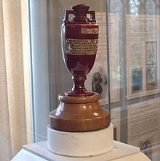
terracotta urn was presented to the
England captain Ivo Bligh by a group of
Melbourne women at some point during the 1882-83 tour. The contents of the urn are reputed to be the ashes of an item of cricket equipment, possibly a bail, ball or stump. The urn is not used as a
trophy for the Ashes series, and whichever side "holds" the Ashes, the urn remains in the
MCC Museum at
Lord's. Since the 1998-99 Ashes series, a
Waterford crystal trophy has been presented to the winners.
The Legend of The Ashes
The first Test match between England and Australia had been played in 1877, but the Ashes legend dates back only to their ninth Test match, played in 1882.
On the 1882 tour, the Australians played only one Test, at
The Oval in
London. It was a low-scoring game on a difficult
pitch. Australia made only 63 runs in their first innings, and England, led by A N Hornby, took a 38-run lead with a total of 101. In the second innings, Australia made 122, leaving England to score only 85 runs to win. Australian bowler Fred Spofforth refused to give in, declaring, "This thing can be done." He devastated the English batting, taking the final four wickets while conceding only two runs, to leave England a mere seven runs short of victory in one of the closest and most nail-biting finishes in
cricket history.
When England's last batsman went in the team needed only 10 runs to win, but the final batsman Ted Peate scored only 2 before being bowled by Boyle. The astonished crowd fell silent, not believing that England could possibly have lost by 7 runs. When what had happened had sunk in, the crowd cheered the Australians.
When Peate returned to the Pavilion he was reprimanded by
W. G. Grace for not allowing his partner at the wicket
Charles Studd to get the runs. Despite Studd being one of the best batsman in England, Peate replied, "I had no confidence in Mr Studd, sir, so thought I had better do my best."
The defeat was widely recorded in the English press. In the 31st August edition of a magazine called “Cricket: A Weekly Record of The Game” there appeared a now obscure mock obitary to “English Supremacy in the Cricket Field which expired on the 29th day of August at the Oval”. Two days later, September 2 1882 a second mock obituary, written by Reginald Brooks, appeared in
The Sporting Times. This notice read as follows:
- "In Affectionate Remembrance of ENGLISH CRICKET, which died at the Oval on 29th AUGUST, 1882, Deeply lamented by a large circle of sorrowing friends and acquaintances R.I.P.
- N.B. — The body will be cremated and the ashes taken to Australia."
The English media dubbed the English tour to
Australia of 1882-83 as
the quest to regain The Ashes of English Cricket. The three match series resulted in a 2-1 win to England, notwithstanding a fourth match, won by an Australian XI whose status remains a matter of dispute.
The term “The Ashes” then largely disappears from puiblic use for the next twenty years; certainly, there is no suggestion that this was the accepted name for the series. Then following the successful English tour of 1902-03 the English captain, Pelham Warner published a book called ‘How we Recovered the Ashes”. Even though the legend is not referred to in the text, the title was enough to revive public interest. The first mention of The Ashes in the
Wisden Cricketers' Almanack occurs in 1905 and the first Wisden account of the Ashes legend was included in the 1922 edition.
The Ashes Urn
As it took many years for the name the Ashes to be given to the ongoing series between England and Australia, there was no concept of there being a representation of the ashes being presented to the winners. As late as 1925, the following verse appeared in The Cricketers Annual:
- So here’s to Chapman, Hendren and Hobbs,
- Gilligan, Woolley and Hearne:
- May they bring back to the Motherland,
- The ashes which have no urn!
Nevertheless, several attempts had been made over the years to embody The Ashes in a physical memorial. Examples include one presented to Warner in 1904, another to Australian Captain MA Noble in 1909 and another to Australian Captain WM Woodfall in 1934.
The oldest however, and the one to enjoy enduring fame, was the one presented to Hon Ivo Bligh, later Lord Darnley, during the 1882-83 tour. The precise nature of the origin of this urn however, is matter of dispute. Based on a statement by Darnley made in 1894, it was believed that a group of Victorian ladies, including Darnley's later wife Florence Morphy, made the presentation after the victory in the third test in 1883. More recent researchers, in particular Ronald Willis and Joy Munns have studied the tour in detail and concluded that the presentation was made after a private cricket match played over Christmas 1882 when the English team were guests of Sir William Clarke, at his property "Rupertswood", in Sunbury, Victoria . This was before the matches had started. The prime evidence for this theory was provided by a descendant of Lord Clarke.
The contents of the Darnley urn are also problematic; they were variously reported to be the remains of a stump, bail or the outer casing of a ball, but in 1998, Lord Darnley’s 82-year-old daughter-in-law said they were the remains of her mother-in-law’s veil, casting a further layer of doubt on the matter. The urn itself is made of
terracotta and is about four
inches tall and may originally have been a perfume jar.
A six verse poem appeared in the 1 February edition of Melbourne Punch, the fourth verse of which makes reference to the urn; at some point this verse was glued to the urn and remains so to the present day. The verse in question reads :
- When Ivo goes back with the urn, the urn;
- Studds, Steel, Read and Tylecote
...
return, return;
- The welkin will ring loud,
- The great crowd will feel proud,
- Seeing Barlow and Bates with the urn, the urn;
- And the rest coming home with the urn.
In February 1883, just before the disputed fourth test, a velvet bag, which was made by Mrs Ann Fletcher, the daughter of Joseph Hines Clarke and Marion Wright, both of
Dublin, was given to Bligh to contain the urn.
During Darnley’s lifetime, there was little public knowledge of the urn, and no record of a published photograph exists before 1924. However, when Darnley died in 1927, his widow presented the urn to the
Marylebone Cricket Club and that was the key event in establishing the urn as the physical embodiment of the legendary ashes. MCC first displayed the urn in the Long Room at
Lord's Cricket Ground and since 1953 in the MCC Cricket Museum at the ground. It is ironic that MCC’s wish for to it been seen by wide a range of cricket enthusiasts as possible has led to its been mistaken for an official trophy.
It is in fact a private memento, and for this reason the Ashes urn itself is never physically awarded to either England or Australia, but is kept permanently in the Museum where it can be seen together with the specially-made red and gold velvet and the scorecard of the 1882 match.
The urn has been back to Australia once, in 1988 for a museum tour as part of Australia's Bicentennial celebrations. Despite the fragile state of the urn, it is planned that the urn will tour Australia again in 2006–7.
In the 1990s, given Australia's long dominance of the Ashes series, and the by now universal acceptance of the Darnley urn as ‘The Ashes’, the idea was mooted that the victorious team in an Ashes series should be awarded the urn as a trophy and allowed to retain it until the next series. As it is not a trophy, and its condition was fragile MCC were reluctant to agree. Furthermore, in 2002, Bligh's great-great-grandson argued that the Ashes urn should not be returned to Australia as it was essentially the property of his family and only given to the MCC for safe-keeping.
As a compromise, the MCC commissioned a trophy in the form of a larger-scale replica of the urn in
Waterford Crystal to award to the winning team of each series. This did little to diminish the status of the Darnley urn as most important icon in cricket, the symbol of this most ancient and keenly fought of contests.
The matches
See also: List of Ashes series for a full listing of all the Ashes series since 1882.First Ashes quest
See also: The Honourable Ivo Bligh led the expedition to Australia to "recover the Ashes" against the side that had beaten England earlier in 1882. Publicity surrounding the series was intense, and it was at some time during this series that the Ashes urn was crafted. Australia won the first Test by nine wickets, but in the next two England were victorious. At the end of the third Test, the four-inch urn was presented to Bligh by some Melburnian ladies, England having been generally considered to have "won back the Ashes" 2–1. A fourth match was in fact played, against a "United Australian XI", which was stronger than the Australian side that had competed in the previous matches; this game, however, is not generally considered part of the Ashes series.
English dominance ends
After this series followed an extended period of English dominance. The tours were shorter in the 1880s and 1890s than people have grown accustomed to in more recent years, possibly owing to the extended travelling time . Thus, England only lost four Ashes Tests in the 1880s, out of 23 played, and they won all the seven series contested. There was also more chopping and changing in the teams, there was no official board of selectors for each country , and popularity with the fans varied. The 1890s games were more closely fought, Australia taking their first series win since the match that sparked the legend in 1891-92 with a 2–1 victory. England still dominated, winning the next three series despite continued player disputes. Towards the end of the decade, though, the Australians got more of a foothold, winning four successive series from 1897-98 to 1902.
Repopularising of the Ashes
After what the
MCC saw as the problems of the earlier professional and amateur series, they decided to take control of organising tours themselves, and this led to the first MCC tour of Australia in 1903-1904. England won it against the odds, and Plum Warner, the England captain, wrote up his version of the tour in his book
How We Recovered The Ashes. This book repopularised the Ashes legend in England, which continues to this day.
England and Australia shared the spoils for the next few years. The entrance of
South Africa onto the world cricketing scene meant less time for Ashes series, but even so there were four played after Plum Warner's series, each of the sides taking two victories. England won the last series in 1911-1912 by four matches to one,
Sir Jack Hobbs establishing himself as a regular with three centuries. England then retained the Ashes when they won the Triangular tournament, which also featured
South Africa, in 1912. England looked as if they had established themselves as the dominating force by the time
World War I intervened and brought a halt to all international cricket.
After the war, however, Australia took firm control of both the Ashes and world cricket. They recorded thumping victories both in England and on home soil, and England only won one Test out of fifteen from the end of the war until 1925. In a rain-hit series in 1926, however, England managed to eke out a 1–0 victory with a win in the final Test at the Oval, and despite the appearance of Donald Bradman, Australia could not win the next series either, losing 4–1. Bradman won the next series almost by himself, however, as one of the best batting line-ups of all time began to form in the early 1930s, including Bradman himself,
Stan McCabe and
Bill Ponsford. It was the prospect of bowling at this line-up that caused England's captain Douglas Jardine to think up the
Bodyline tactic.
Bodyline
In 1932, after Bradman's routing of the English team in the previous series, Douglas Jardine developed a tactic of instructing his
fast bowlers to bowl at the bodies of the Australian batsmen, with the goal of forcing them to defend their bodies with their bats, and provide easy catches to a stacked leg side field. The tactic was descriptively dubbed Bodyline. Although this won England the Ashes, it caused such a furore in Australia that diplomats had to intervene to prevent serious harm to Anglo-Australian relations, and the
MCC eventually changed the
laws of cricket to prevent anyone from using the tactic again.
Jardine's comments summed up England's views: "I've not travelled 6,000 miles to make friends. I'm here to win the Ashes."
On the batting-friendly wickets that prevailed in the late 1930s, most Tests up to the war still gave results, although many batting records were set in this era.
Len Hutton scored 364 at
The Oval to save a draw in the 1938 series, a world record innings, while
Jack Fingleton and Bradman set a sixth-wicket partnership record of 346 runs in the Third Test at
Melbourne that stands to this day. The series were surprisingly competitive, though, considering England's desperation in the early 30s.
The Invincibles
Australia's first tour of England after
World War II, in 1948, was led by the 39-year-old Bradman in his last appearance representing Australia. His team has gone down in cricketing legend as
The Invincibles, as they played 36 matches including five Tests, and remained unbeaten on the tour. They won 27 matches, drawing only 9, including of course the 4–0 Ashes series victory.
This series is also known for one of the most poignant moments in cricket history, as Bradman batted for Australia in the fifth Test at The Oval — his last — needing to score only 4 runs to maintain a career
batting average of 100. Eric Hollies bowled him second ball for a duck, denying those 4 runs and sending Bradman into retirement with a career average of 99.94.
Australia gradually weakened after 1948, allowing England back into the fray in the early 1950s when they won three successive Ashes series, from 1953 to 1956 to be arguably the best Test side in the world at the time. A see-sawing series in 1956 also saw a record that will probably never be beaten: the spinner Jim Laker's monumental effort at Old Trafford when he bowled 68 of 191 overs to take nineteen out of twenty possible Australian wickets. Never has the phrase "He won the match single-handedly" been more appropriate. England's dominance was not to last, however. Australia thumped them 4–0 when they next toured in 1958-59, having found a good bowler of their own in Richie Benaud who took 31 wickets in the 5-Test series. England failed to win any series during the 1960s, a period dominated by draws as teams found it more prudent to save face with a draw than risk losing. Of a total of 25 Ashes Tests playing during this decade, Australia won seven and England three.
In the first series of the 1970s, however, England managed to win 2–0, much thanks to the efforts of
Geoffrey Boycott who scored five fifties and two centuries in the series, but in the mid-1970s Australia regained ascendancy with fast bowler Dennis Lillee taking English wickets all too consistently. However, both teams had their victories, England enjoying an emphatic 5–1 win in 1978-79 while Australia took a non-Ashes series 3–0 a year later. Most would say that the two sides were evenly matched, but no one knew just how evenly they would be matched in the next one.
Botham's Ashes
Ian Botham started the series as captain, but was forced to resign or was sacked after Australia took a 1-0 lead in the first two Tests of the 1981 series. Australia looked certain to make it 2-0 in the third Test at Headingley when they forced England to follow-on 227 runs behind. England, reduced to 135 for 7 wickets, produced a second innings of 356, Botham scoring an unbeaten 149, and adding 221 for the last three wickets in partnerships with Graham Dilley, Chris Old and their fast bowler Bob Willis. Chasing 130, Australia were dismissed for 111, with a devastating spell of 8 for 43 by Willis giving England a miraculous victory by 18 runs. The fourth Test at Edgbaston was a similarly inspired comeback victory for England. Ian Botham this time starred with the ball, taking five for 11, including a spell of five wickets for a solitary run, in Australia's second innings of 121 to give England victory by 29 runs. England also went on to win the fifth Test at Old Trafford to retain the Ashes. The sixth Test at the Oval was drawn.
Lillee and Marsh betting incident
Famously, an English bookmaker offered odds of 500 to 1 for an English victory, and Australian players Dennis Lillee and Rod Marsh laid a small bet. This came back to haunt them as Lillee and Marsh were reprimanded for betting on the outcome of the game, but not suspended.
It should be noted, however, that their actions occurred almost 20 years before the Hansie Cronje scandal at a time when it was not suggested bookmakers had any influence over players, as had any member of the 2005 Australian Ashes team performed any similar action, they would have most likely been
banned for life from Test Cricket. There has never been any suggestion that Marsh and Lillee deliberately helped England win.
Australian Dominance
England were the better team of the early 1980s, although it was close: Australia won the 1982-83 series, but England then took two victories in 1985 and 1986-87. After those wins, however, a period of extended Australian dominance began, and England did not win an Ashes series again until 2005. Australia won the 1989 series 4–0, and an England side weakened by Test bans following the Gatting tour to apartheid
South Africa lost 3–0 in 1990-91. The Australians underlined their superiority in the contest by winning the 1993, 1994-95, 1997, 1998-99 and 2001 series — all by convincing margins.
Australia's record since 1989 has impacted upon the overall statistics between the two sides. Before the 1989 series began, Australia had won 36.9% of all Tests played against England, England 33.5% with 29.7% of matches ending in draws. Previous to the 2005 series, Australia had won 40.8% of all Tests, England 31% with 28.1% drawn.
In the period between 1989 and the beginning of the 2005 series, the two sides had played 43 times. Australia winning 28 times, England 7 times, with 8 draws. More to the point, only a single England victory had come in a match in which the Ashes were still at stake, namely the first test of the 1997 series. All others were consolation victories when the Ashes had been secured by Australia.
Steve Waugh's last Ashes
After playing in nine successive Ashes series, the 2002-03 rubber was to be Australian captain
Steve Waugh's last against England, and was to prove one of the most emphatic victories he enjoyed against the English. The series began with what many regard in hindsight as one of the worst captaincy decisions of all time, as Nasser Hussain won the toss for England in the first Test and sent Australia in to bat. By the end of the first day, Australia had amassed a staggering 364/2, and placed a stamp of authority on the series that would not be undone as they raced to victory by 384 runs. This was followed by two innings victories to Australia, and a fairly comfortable five-wicket win. England only managed to save some face with a 225-run victory in the final Test.
The series' most memorable moment came on the second day of the Fifth Test at the
Sydney Cricket Ground. Leading into the match Waugh had been heavily scrutinised by selectors and the media over his advancing age and lack of recent form, having not posted a Test century since 2001. As this was the last match of the series and last Test of the Australian summer, Waugh was likely to be dropped from the team if he failed again in this match. Asked before the match about the defining moment of a career likely to soon be over, Waugh predicted gamely "It might be yet to come." In a stunning display of determination and defiance, he then fulfilled this prophecy by scoring a chanceless century on the second afternoon. He had entered the final over of the day on 95 not out, and hit a boundary off the last ball to bring up his ton. Waugh left the ground to an emotional standing ovation, his Test career saved. It came to be known as his 'Perfect Day'.
The 2005 series
England were undefeated in Test matches in the 2004 calendar year, which took the team to second in the LG ICC Test Championship and raised hopes that the
2005 Ashes series would be closely fought. In fact, the series proved to be even more competitive than most commentators had predicted. The Ashes were still on the line as the final session of the final test began. While the first Test at
Lord's was convincingly won by Australia, in the remaining four matches the teams were more evenly matched, and England fought back. England won the second Test by 2 runs, the smallest victory by a runs margin in Ashes history, and the second closest such victory margin in all Tests. The rain-affected third Test ended with the final two Australian batsmen holding out to claim a draw, and England won the fourth Test by three wickets after forcing Australia to follow on for the first time in 191 Tests. A draw in the final Test gave England victory in an Ashes series for the first time in 18 years.
The 2005 Ashes series was played throughout at a very high intensity, the tension occasionally leading to mistakes on both sides with many dropped catches, run outs and other errors. Australia were unlucky with the injury to Glenn McGrath and the loss of form of others; England's only change, on the other hand, was forced on them when Simon Jones sustained an ankle injury midway through the Fourth Test, forcing him out of the series decider. Even so, many consider the series to have been the most exciting in living memory, providing enthralling viewing. Respected commentator Richie Benaud is reported by BBC correspondent Bob Chaundry as having said: "In the past two years, I've seen the best cricket I've ever watched. This current Ashes series shades even the great one of 1981." Indeed, no-one would have suggested that the 1981 series had been played between the two best sides of the day - neither side was to beat the
West Indies for over a decade. At the end of the 2005 series,
Andrew Flintoff was chosen as the player of the series for his batting and bowling. His efforts made him something of a national hero amongst followers of English sport, making him perhaps the most recognisable English cricketer since Botham's heyday, and contributed to his selection by
Wisden as the year's
Leading Cricketer in the World, just ahead of Shane Warne who contributed 40 wickets and important lower-order runs to Australia's cause.
Summary of results and statistics
- See also: List of Ashes series for a full listing of all the Ashes series since 1882.
A team must win a series to gain the right to hold the Ashes. A drawn series results in the previous holders retaining the Ashes. To date, a total of 62 Ashes series have been played with Australia winning 30, England winning 27. The remaining five series were drawn, with Australia retaining the Ashes four times and England retaining it once.
Ashes series have generally been played over five Test matches, although there have been four match series and six match series . 293 matches have been played, with Australia winning 115 times, England 92 times, and 86 draws. Australians have made 264 centuries in Ashes Tests, twenty-three of them over 200, while Englishmen have scored 212 centuries, of which ten have been scores over 200. On 41 occasions, individual Australians have taken ten
wickets in a match. Englishmen have performed that feat 38 times.
The Ashes today
The Ashes is one of the most fiercely contested competitions in cricket.
The failure of England to regain the Ashes for 16 years from 1989, coupled with the global dominance of the Australian team, had dulled the lustre of the series in recent years. But the close results in the
2005 Ashes series, and the overall high quality and competitiveness of the cricket, have boosted the popularity of the sport in Britain and considerably enhanced the profile of the Ashes around the world. Whilst the tension of the matches has caused an occasional angry moment, the matches were generally played with good spirit, and
sportsmanship of the players of both sides has been high, with commentators often highlighting
Andrew Flintoff consoling
Brett Lee at the end of the second Test as epitomising this. In interviews following the final match, players from both sides were quick to congratulate their opponents, both the individual players and the team as a whole.
Tickets for most of the upcoming 2006-07 Ashes series in Australia sold out on the day of release, giving a strong indication of the intense and renewed interest in the contest .
Match venues
The series alternate between England and Australia, and within each country each of the five matches is held at a different
cricket ground.
In
Australia, the grounds currently used are the
Melbourne Cricket Ground , the
Sydney Cricket Ground ,
Adelaide Oval ,
The Gabba and
The WACA, Perth . One Test was held at the Brisbane Exhibition Ground in 1928-29.
In
England the grounds used are
The Oval , Old Trafford ,
Lord's ,
Trent Bridge ,
Headingley and
Edgbaston . One Test was held at
Bramall Lane, Sheffield in 1902. Sophia Gardens in
Cardiff,
Wales is scheduled to hold its first Ashes Test in 2009.
The Ashes outside cricket
The popularity and reputation of the cricket series has led to many other events taking the name for England against Australia contests. The best-known and longest-running of these events is the
rugby league contest between
Great Britain and
Australia . The contest first started in 1908, the name being suggested by the touring Australians. Another example is in the British television show
Gladiators was a game show [i] produced by LWT [i] for ITV [i] in the United Kingdom [i] ...
, where two series were based around the Australia–England contest.
The urn is also featured in the
science fiction comedy
novel Life, the Universe and Everything is the third book in the five-volume Hitchhiker's Guide to the Galaxy [i] ...
, the third "
Hitchhiker's Guide To The Galaxy" book by
Douglas Adams. The urn is stolen by alien robots, as it is part of the key needed to unlock the "Wikkit Gate" and release the imprisoned world of "Krikkit"
In the cinema, the Ashes featured in the
film The Final Test, released in 1953, based on a television play by
Terence Rattigan. It stars
Jack Warner as an England cricketer playing the last Test of his career, which is the last of an Ashes series; the film contains cameo appearances from prominent contemporary Ashes cricketers including Jim Laker and
Denis Compton.
See also
- 2006-07 Ashes series
- Ball of the Century
- History of Test cricket
— for more coverage of all things Cricket.
Notes
References
Other- Wisden's Cricketers Almanack
External links
- Ashes
- Crowd sounds and interviews with supporters. Recorded at The Oval, London, Monday, 12 September 2005