

London and Birmingham Railway

Encyclopedia
The London and Birmingham Railway (L&BR) was an early railway company in the United Kingdom
from 1833
to 1846
, when it became part of the London and North Western Railway
(L&NWR).
The 112 miles (180 km) railway line which the company opened in 1838
between London
and Birmingham
was the first intercity line to be built into London. It is now the southern section of the West Coast Main Line
.
The line was engineered by Robert Stephenson
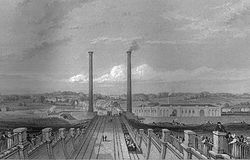
. It started at Euston Station
in London, went north-north-west to Rugby
, where it turned west to Coventry
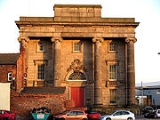
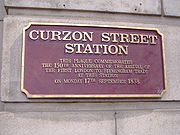
and on to Birmingham. It terminated at Curzon Street Station, which it shared with the Grand Junction Railway
(GJR), whose adjacent platforms gave a link to the Liverpool and Manchester Railway
(L&MR), and allowed through rail travel from London to those cities.
and Banbury
, a route later taken by the Great Western Railway
.
Soon afterwards a rival company was formed by Francis Giles
whose line would have been through the Watford Gap
and Coventry
. Neither company obtained backing for its scheme, and in late 1830 the two companies decided to merge.
The new company appointed Robert Stephenson
chief engineer, and he chose the route through Coventry, largely to avoid possible flooding from the River Thames
at Oxford.
The company was created with an initial capitalisation of £5,500,000. Much of the subscribed funds came from Lancashire, where great profits were being made in the cotton industries.
The Company's first application for an Act of Parliament
to construct the line was rejected in 1832, due to pressure from landowners and road and canal interests. However in May 1833 a second act was approved and the line received the royal assent
. Construction began in November of that year.

amounted to the lifting of 15733000000 cubic feet (445,508,953.9 m³) of stone by 1 foot (445,508,947.4 m³ by 0.305 m).
The railway, excluding a long string of tasks - drainage, ballasting &c - involved the lifting of 25000000000 cubic feet (707,921,175 m³) of material reduced to the weight of stone used in the pyramid. The pyramid involved, he says, the effort ot 300,000 men (according to Diodorus Siculus
) or 100,000 (according to Herodotus
) for twenty years. The railway involved 20,000 men for five years. In passing, he also noted that the cost of the railway in penny pieces, was enough to more than form a belt of pennies around the equator; and the amount of material moved would be enough to build a wall 1 feet (305 mm) high by one foot wide, more than three times around the equator.
 The line had been planned to open at the same time as the Grand Junction Railway
which entered Birmingham from the north. However great difficulty in constructing the Kilsby Tunnel
in Northamptonshire
delayed the opening.
The first part of the line between Euston Station and Boxmoor
(Hemel Hempstead
) opened on 20 July 1837. The line was not finished in time for the coronation of Queen Victoria
on 28 June 1838, but aware of the lucrative traffic the event would generate, the company opened the north end of the line, between Birmingham and Rugby, and the south end from London to Bletchley
with a stagecoach
shuttle service linking the two parts to allow through journeys to London. The line was officially fully opened on 17 September 1838.
 It has often been claimed that initially, owing to the lack of power available to early locomotives, trains from Euston were cable-hauled up the relatively steep incline to Camden
by a stationary steam engine
. This however was denied by Peter Lecount, one of the L&BR engineers, who wrote in his 'History of the Railway connecting London and Birmingham' (1839), page 48: "It is not because locomotives cannot draw a train of carriages up this incline that a fixed engine and endless rope are used, for they can and have done so, but because the Company are restricted, by their Act of Parliament, from running locomotive engines nearer London than Camden Town." The railway opened from Euston on 20 July 1837; the stationary engines and rope haulage did not commence until 27 September, and handled all trains from 14 October 1837. Until then, and whenever the rope system was stopped for repairs, locomotives hauled the trains up the incline. From November 1843 some expresses were worked without recourse to the rope, and from 15 July 1844 the rope working ceased permanently.
The locomotive workshops were established in 1838 at Wolverton
, roughly half-way between the two termini at London and Birmingham. These workshops remained in use as a manufacturing facility up until the 1980s; today just a few parts of the original Wolverton railway works
are used solely for rolling stock maintenance and repair. The first Locomotive Superintendent was Edward Bury
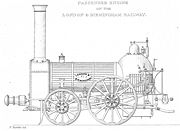
, who also owned the locomotive builders of Edward Bury and Company.
From 1840, when the Midland Counties Railway
made a junction to its line at Rugby, the L&BR also provided through connections from London to the East Midlands and the North East. It also made connections to the Birmingham and Derby Junction Railway
at Hampton-in-Arden
between Coventry and Birmingham.
In 1845, the Northampton and Peterborough Railway
, a 47-mile branch from the main line, was opened from Blisworth
. Also in 1845 branch lines, from Bletchley to Bedford
and from Leighton to Dunstable
, were leased; they opened in 1846 and 1848. In 1846 the L&BR leased the West London Railway (jointly with the GWR
) which opened in 1844 between Willesden Jct and the canal basin at Kensington.
The L&BR purchased the Trent Valley Railway in 1846 on behalf of the LNWR; this fifty-mile line connected Rugby on the L&BR with Stafford on the Grand Junction Railway
thus creating a more direct line from London to Liverpool and Manchester by avoiding the original route through Birmingham. The Rugby and Stamford Railway, a further branch into the Eastern Counties was approved in 1846.
and the Manchester and Birmingham Railway
to form the London and North Western Railway
, which in turn was later absorbed into the London Midland and Scottish Railway, before finally passing into the hands of the nationalised British Rail
in 1948 to become part of the West Coast Main Line
as it is known today. The major change to the line during this period was electrification, which was carried out during the mid 1960s as part of BR's Modernisation Plan.
Neither of the L&BR's original termini, both designed by Philip Hardwick
, has survived in its original form. Curzon Street station in Birmingham closed to passenger traffic in 1854 (the original entrance building remains) when it was replaced by New Street station
and the original Euston station in London was demolished in 1962 to make way for the present structure which opened in 1968.
Image:Entrance to Euston Station on the London and Birmingham railway.jpg|Euston station entrance.
File:The Avon viaduct on the London and Birmingham railway.jpg|The Avon Viaduct at Wolston
in 1838.
File:Berkhampstead railway station 1838.jpg|Berkhamsted railway station
in 1838 with the Grand Junction Canal
to the right.
Image:Denbigh Hall Bridge on the London and Birmingham railway.jpg|Denbigh Hall Bridge.
Image:Beechwood Tunnel, nr Coventry the London and Birmingham railway.jpg|Beechwood Tunnel near Coventry.
Image:Wolverton viaduct.jpg|Landslip on Wolverton viaduct
Image:Birmingham station entrance 1838.jpg|The Birmingham Terminus, as intended with flanking arches, but these were not built.
Image:Lon-Brum-Centenary.jpg|London and Birmingham Railway Centenary, 1938 souvenir from the LMS illustrating the 2-2-0 locomotive of Edward Bury
United Kingdom
The United Kingdom of Great Britain and Northern IrelandIn the United Kingdom and Dependencies, other languages have been officially recognised as legitimate autochthonous languages under the European Charter for Regional or Minority Languages...
from 1833
1833 in the United Kingdom
Events from the year 1833 in the United Kingdom.-Incumbents:*Monarch - King William IV*Prime Minister - Earl Grey, Whig-Events:* 3 January - British forces re-establish British rule on the Falkland Islands in the South Atlantic....
to 1846
1846 in the United Kingdom
Events from the year 1846 in the United Kingdom.-Incumbents:*Monarch — Queen Victoria*Prime Minister — Robert Peel, Conservative , Lord John Russell, Liberal-Events:...
, when it became part of the London and North Western Railway
London and North Western Railway
The London and North Western Railway was a British railway company between 1846 and 1922. It was created by the merger of three companies – the Grand Junction Railway, the London and Birmingham Railway and the Manchester and Birmingham Railway...
(L&NWR).
The 112 miles (180 km) railway line which the company opened in 1838
1838 in the United Kingdom
Events from the year 1838 in the United Kingdom.-Incumbents:*Monarch — Queen Victoria*Prime Minister — Lord Melbourne, Whig-Events:* 10 January — A fire destroys Lloyd's Coffee House and the Royal Exchange in London....
between London
London
London is the capital city of :England and the :United Kingdom, the largest metropolitan area in the United Kingdom, and the largest urban zone in the European Union by most measures. Located on the River Thames, London has been a major settlement for two millennia, its history going back to its...
and Birmingham
Birmingham
Birmingham is a city and metropolitan borough in the West Midlands of England. It is the most populous British city outside the capital London, with a population of 1,036,900 , and lies at the heart of the West Midlands conurbation, the second most populous urban area in the United Kingdom with a...
was the first intercity line to be built into London. It is now the southern section of the West Coast Main Line
West Coast Main Line
The West Coast Main Line is the busiest mixed-traffic railway route in Britain, being the country's most important rail backbone in terms of population served. Fast, long-distance inter-city passenger services are provided between London, the West Midlands, the North West, North Wales and the...
.
The line was engineered by Robert Stephenson
Robert Stephenson
Robert Stephenson FRS was an English civil engineer. He was the only son of George Stephenson, the famed locomotive builder and railway engineer; many of the achievements popularly credited to his father were actually the joint efforts of father and son.-Early life :He was born on the 16th of...
. It started at Euston Station
Euston railway station
Euston railway station, also known as London Euston, is a central London railway terminus in the London Borough of Camden. It is the sixth busiest rail terminal in London . It is one of 18 railway stations managed by Network Rail, and is the southern terminus of the West Coast Main Line...
in London, went north-north-west to Rugby
Rugby railway station
Rugby railway station serves the town of Rugby in Warwickshire, England. It opened during the Victorian era, in 1885, replacing earlier stations situated a little further west...
, where it turned west to Coventry
Coventry
Coventry is a city and metropolitan borough in the county of West Midlands in England. Coventry is the 9th largest city in England and the 11th largest in the United Kingdom. It is also the second largest city in the English Midlands, after Birmingham, with a population of 300,848, although...
and on to Birmingham. It terminated at Curzon Street Station, which it shared with the Grand Junction Railway
Grand Junction Railway
The Grand Junction Railway was an early railway company in the United Kingdom, which existed between 1833 and 1846 when it was merged into the London and North Western Railway...
(GJR), whose adjacent platforms gave a link to the Liverpool and Manchester Railway
Liverpool and Manchester Railway
The Liverpool and Manchester Railway was the world's first inter-city passenger railway in which all the trains were timetabled and were hauled for most of the distance solely by steam locomotives. The line opened on 15 September 1830 and ran between the cities of Liverpool and Manchester in North...
(L&MR), and allowed through rail travel from London to those cities.
Early plans
The railway engineer John Rennie proposed a railway line from London to Birmingham in 1823, and formed a company to build it by a route through OxfordOxford
The city of Oxford is the county town of Oxfordshire, England. The city, made prominent by its medieval university, has a population of just under 165,000, with 153,900 living within the district boundary. It lies about 50 miles north-west of London. The rivers Cherwell and Thames run through...
and Banbury
Banbury
Banbury is a market town and civil parish on the River Cherwell in the Cherwell District of Oxfordshire. It is northwest of London, southeast of Birmingham, south of Coventry and north northwest of the county town of Oxford...
, a route later taken by the Great Western Railway
Great Western Railway
The Great Western Railway was a British railway company that linked London with the south-west and west of England and most of Wales. It was founded in 1833, received its enabling Act of Parliament in 1835 and ran its first trains in 1838...
.
Soon afterwards a rival company was formed by Francis Giles
Francis Giles
Francis Giles was a canal engineer and surveyor who worked under John Rennie and later became a railway engineer-Works and appointments:...
whose line would have been through the Watford Gap
Watford Gap
The Watford Gap is located at a minor gap between two slight hills in the county of Northamptonshire, England. Engineers from Roman times onwards have found it to be an appropriate route connecting the Midlands with the South East....
and Coventry
Coventry
Coventry is a city and metropolitan borough in the county of West Midlands in England. Coventry is the 9th largest city in England and the 11th largest in the United Kingdom. It is also the second largest city in the English Midlands, after Birmingham, with a population of 300,848, although...
. Neither company obtained backing for its scheme, and in late 1830 the two companies decided to merge.
The new company appointed Robert Stephenson
Robert Stephenson
Robert Stephenson FRS was an English civil engineer. He was the only son of George Stephenson, the famed locomotive builder and railway engineer; many of the achievements popularly credited to his father were actually the joint efforts of father and son.-Early life :He was born on the 16th of...
chief engineer, and he chose the route through Coventry, largely to avoid possible flooding from the River Thames
River Thames
The River Thames flows through southern England. It is the longest river entirely in England and the second longest in the United Kingdom. While it is best known because its lower reaches flow through central London, the river flows alongside several other towns and cities, including Oxford,...
at Oxford.
The L&BR
The prospectus for the London and Birmingham Railway offered the following inducements to potential investors:The company was created with an initial capitalisation of £5,500,000. Much of the subscribed funds came from Lancashire, where great profits were being made in the cotton industries.
The Company's first application for an Act of Parliament
Act of Parliament
An Act of Parliament is a statute enacted as primary legislation by a national or sub-national parliament. In the Republic of Ireland the term Act of the Oireachtas is used, and in the United States the term Act of Congress is used.In Commonwealth countries, the term is used both in a narrow...
to construct the line was rejected in 1832, due to pressure from landowners and road and canal interests. However in May 1833 a second act was approved and the line received the royal assent
Royal Assent
The granting of royal assent refers to the method by which any constitutional monarch formally approves and promulgates an act of his or her nation's parliament, thus making it a law...
. Construction began in November of that year.
Construction
Peter Lecount, an assistant engineer of the London Birmingham railway, produced a number of - possibly hyperbolic - comparisons in an effort to demonstrate that the London and Birmingham Railway was "the greatest public work ever executed either in ancient or modern times". In particular, he suggested that the effort to build the Great Pyramid of GizaGreat Pyramid of Giza
The Great Pyramid of Giza is the oldest and largest of the three pyramids in the Giza Necropolis bordering what is now El Giza, Egypt. It is the oldest of the Seven Wonders of the Ancient World, and the only one to remain largely intact...
amounted to the lifting of 15733000000 cubic feet (445,508,953.9 m³) of stone by 1 foot (445,508,947.4 m³ by 0.305 m).
The railway, excluding a long string of tasks - drainage, ballasting &c - involved the lifting of 25000000000 cubic feet (707,921,175 m³) of material reduced to the weight of stone used in the pyramid. The pyramid involved, he says, the effort ot 300,000 men (according to Diodorus Siculus
Diodorus Siculus
Diodorus Siculus was a Greek historian who flourished between 60 and 30 BC. According to Diodorus' own work, he was born at Agyrium in Sicily . With one exception, antiquity affords no further information about Diodorus' life and doings beyond what is to be found in his own work, Bibliotheca...
) or 100,000 (according to Herodotus
Herodotus
Herodotus was an ancient Greek historian who was born in Halicarnassus, Caria and lived in the 5th century BC . He has been called the "Father of History", and was the first historian known to collect his materials systematically, test their accuracy to a certain extent and arrange them in a...
) for twenty years. The railway involved 20,000 men for five years. In passing, he also noted that the cost of the railway in penny pieces, was enough to more than form a belt of pennies around the equator; and the amount of material moved would be enough to build a wall 1 feet (305 mm) high by one foot wide, more than three times around the equator.
Opening
Grand Junction Railway
The Grand Junction Railway was an early railway company in the United Kingdom, which existed between 1833 and 1846 when it was merged into the London and North Western Railway...
which entered Birmingham from the north. However great difficulty in constructing the Kilsby Tunnel
Kilsby Tunnel
The Kilsby Tunnel is a railway tunnel on the West Coast Main Line railway in England. It was designed and engineered by Robert Stephenson.The tunnel is located near the village of Kilsby in Northamptonshire roughly 5 miles south-east of Rugby and is long.The tunnel was opened in 1838 as a part of...
in Northamptonshire
Northamptonshire
Northamptonshire is a landlocked county in the English East Midlands, with a population of 629,676 as at the 2001 census. It has boundaries with the ceremonial counties of Warwickshire to the west, Leicestershire and Rutland to the north, Cambridgeshire to the east, Bedfordshire to the south-east,...
delayed the opening.
The first part of the line between Euston Station and Boxmoor
Boxmoor
Boxmoor, or Boxmoor Village, is a district of Dacorum in Hertfordshire, England. It is now part of Hemel Hempstead. It is a district of mainly nineteenth century housing and meadowland, repeatedly cut through by transport links from London to the The Midlands....
(Hemel Hempstead
Hemel Hempstead
Hemel Hempstead is a town in Hertfordshire in the East of England, to the north west of London and part of the Greater London Urban Area. The population at the 2001 Census was 81,143 ....
) opened on 20 July 1837. The line was not finished in time for the coronation of Queen Victoria
Victoria of the United Kingdom
Victoria was the monarch of the United Kingdom of Great Britain and Ireland from 20 June 1837 until her death. From 1 May 1876, she used the additional title of Empress of India....
on 28 June 1838, but aware of the lucrative traffic the event would generate, the company opened the north end of the line, between Birmingham and Rugby, and the south end from London to Bletchley
Bletchley railway station
Bletchley is a railway station that serves the southern districts of Milton Keynes , and the north-eastern parts of the Buckinghamshire district of Aylesbury Vale....
with a stagecoach
Stagecoach
A stagecoach is a type of covered wagon for passengers and goods, strongly sprung and drawn by four horses, usually four-in-hand. Widely used before the introduction of railway transport, it made regular trips between stages or stations, which were places of rest provided for stagecoach travelers...
shuttle service linking the two parts to allow through journeys to London. The line was officially fully opened on 17 September 1838.
Camden Town
-Economy:In recent years, entertainment-related businesses and a Holiday Inn have moved into the area. A number of retail and food chain outlets have replaced independent shops driven out by high rents and redevelopment. Restaurants have thrived, with the variety of culinary traditions found in...
by a stationary steam engine
Steam engine
A steam engine is a heat engine that performs mechanical work using steam as its working fluid.Steam engines are external combustion engines, where the working fluid is separate from the combustion products. Non-combustion heat sources such as solar power, nuclear power or geothermal energy may be...
. This however was denied by Peter Lecount, one of the L&BR engineers, who wrote in his 'History of the Railway connecting London and Birmingham' (1839), page 48: "It is not because locomotives cannot draw a train of carriages up this incline that a fixed engine and endless rope are used, for they can and have done so, but because the Company are restricted, by their Act of Parliament, from running locomotive engines nearer London than Camden Town." The railway opened from Euston on 20 July 1837; the stationary engines and rope haulage did not commence until 27 September, and handled all trains from 14 October 1837. Until then, and whenever the rope system was stopped for repairs, locomotives hauled the trains up the incline. From November 1843 some expresses were worked without recourse to the rope, and from 15 July 1844 the rope working ceased permanently.
The locomotive workshops were established in 1838 at Wolverton
Wolverton railway works
Wolverton railway works was established in Wolverton, Buckinghamshire, by the London and Birmingham Railway Company in 1838 at the midpoint of the 112 mile-long route from London to Birmingham...
, roughly half-way between the two termini at London and Birmingham. These workshops remained in use as a manufacturing facility up until the 1980s; today just a few parts of the original Wolverton railway works
Wolverton railway works
Wolverton railway works was established in Wolverton, Buckinghamshire, by the London and Birmingham Railway Company in 1838 at the midpoint of the 112 mile-long route from London to Birmingham...
are used solely for rolling stock maintenance and repair. The first Locomotive Superintendent was Edward Bury
Edward Bury
Edward Bury was an English locomotive manufacturer.Edward Bury was born in Salford, Lancashire, the son of a timber merchant, and was educated at Chester. By 1823 he was a partner in Gregson & Bury's steam sawmill at Toxteth Park, Liverpool, but in 1826 he set himself up as an iron-founder and...
, who also owned the locomotive builders of Edward Bury and Company.
Links and branches
The first branch from the main line was the Aylesbury Railway, seven miles of single track, which opened in 1839 and was leased to the L&BR until purchased outright by the LNWR in 1846. The Warwick and Leamington Union Railway, a branch of almost nine miles between Coventry and Leamington, was purchased by the L&BR in 1843 and opened in 1844.From 1840, when the Midland Counties Railway
Midland Counties Railway
The Midland Counties Railway was a railway company in the United Kingdom which existed between 1832 and 1844, connecting Nottingham, Leicester and Derby with Rugby and thence, via the London and Birmingham Railway, to London. The MCR system connected with the North Midland Railway and the...
made a junction to its line at Rugby, the L&BR also provided through connections from London to the East Midlands and the North East. It also made connections to the Birmingham and Derby Junction Railway
Birmingham and Derby Junction Railway
The Birmingham and Derby Junction Railway was a British railway company. From Birmingham it connected at Derby with the North Midland Railway and the Midland Counties Railway at what became known as the Tri Junct Station...
at Hampton-in-Arden
Hampton-in-Arden
Hampton-in-Arden is a village and civil parish located within the Metropolitan Borough of Solihull, in the West Midlands of England. The village was previously located within the county of Warwickshire, until the 1974 county boundary changes. It lies in the countryside between Birmingham and Coventry...
between Coventry and Birmingham.
In 1845, the Northampton and Peterborough Railway
Northampton and Peterborough Railway
The Northampton and Peterborough Railway was an early railway promoted by the London and Birmingham Railway to run from a junction at Blisworth to Northampton and Peterborough.-Origin:...
, a 47-mile branch from the main line, was opened from Blisworth
Blisworth railway station
Blisworth railway station was opened by the London and Birmingham Railway in Blisworth, Northamptonshire in 1838.-History:The station was opened on 17 September 1838. In 1845 the L&BR opened their Northampton and Peterborough Railway a line which connected Peterborough and Northampton from a...
. Also in 1845 branch lines, from Bletchley to Bedford
Marston Vale Line
The Marston Vale Line is the railway line from Bletchley to Bedford in England. It is one of two surviving passenger-carrying sections of the "Varsity Line" between Oxford and Cambridge....
and from Leighton to Dunstable
Dunstable North railway station
Dunstable North was a railway station on the London and North Western Railway's branch line from Leighton Buzzard which served Dunstable in Bedfordshire from 1848 to 1967. Originally the terminus of the London and North Western Railway's branch line from Leighton Buzzard, Dunstable became the point...
, were leased; they opened in 1846 and 1848. In 1846 the L&BR leased the West London Railway (jointly with the GWR
Great Western Railway
The Great Western Railway was a British railway company that linked London with the south-west and west of England and most of Wales. It was founded in 1833, received its enabling Act of Parliament in 1835 and ran its first trains in 1838...
) which opened in 1844 between Willesden Jct and the canal basin at Kensington.
The L&BR purchased the Trent Valley Railway in 1846 on behalf of the LNWR; this fifty-mile line connected Rugby on the L&BR with Stafford on the Grand Junction Railway
Grand Junction Railway
The Grand Junction Railway was an early railway company in the United Kingdom, which existed between 1833 and 1846 when it was merged into the London and North Western Railway...
thus creating a more direct line from London to Liverpool and Manchester by avoiding the original route through Birmingham. The Rugby and Stamford Railway, a further branch into the Eastern Counties was approved in 1846.
Merger
In 1846 the L&BR merged with the Grand Junction RailwayGrand Junction Railway
The Grand Junction Railway was an early railway company in the United Kingdom, which existed between 1833 and 1846 when it was merged into the London and North Western Railway...
and the Manchester and Birmingham Railway
Manchester and Birmingham Railway
The Manchester and Birmingham Railway was built between Manchester and Crewe and opened in stages from 1840. Between Crewe and Birmingham, trains were worked by the Grand Junction Railway...
to form the London and North Western Railway
London and North Western Railway
The London and North Western Railway was a British railway company between 1846 and 1922. It was created by the merger of three companies – the Grand Junction Railway, the London and Birmingham Railway and the Manchester and Birmingham Railway...
, which in turn was later absorbed into the London Midland and Scottish Railway, before finally passing into the hands of the nationalised British Rail
British Rail
British Railways , which from 1965 traded as British Rail, was the operator of most of the rail transport in Great Britain between 1948 and 1997. It was formed from the nationalisation of the "Big Four" British railway companies and lasted until the gradual privatisation of British Rail, in stages...
in 1948 to become part of the West Coast Main Line
West Coast Main Line
The West Coast Main Line is the busiest mixed-traffic railway route in Britain, being the country's most important rail backbone in terms of population served. Fast, long-distance inter-city passenger services are provided between London, the West Midlands, the North West, North Wales and the...
as it is known today. The major change to the line during this period was electrification, which was carried out during the mid 1960s as part of BR's Modernisation Plan.
Neither of the L&BR's original termini, both designed by Philip Hardwick
Philip Hardwick
Philip Hardwick was an eminent English architect, particularly associated with railway stations and warehouses in London and elsewhere...
, has survived in its original form. Curzon Street station in Birmingham closed to passenger traffic in 1854 (the original entrance building remains) when it was replaced by New Street station
Birmingham New Street Station
Birmingham New Street is the main railway station serving Birmingham, England, located in the city centre. It is an important hub for the British railway system, being served by a number of important long-distance and cross-country lines, including the Birmingham loop of the West Coast Main Line,...
and the original Euston station in London was demolished in 1962 to make way for the present structure which opened in 1968.
London and Birmingham railway gallery for 1838
Image:Entrance to Euston Station on the London and Birmingham railway.jpg|
File:The Avon viaduct on the London and Birmingham railway.jpg|The Avon Viaduct at Wolston
Wolston
Wolston is a village and civil parish in the Rugby borough of Warwickshire, England. The village is located roughly halfway between Rugby and Coventry, and has a population of about 2,300. It is close to the A45 road and the Roman road the Fosse Way....
in 1838.
File:Berkhampstead railway station 1838.jpg|Berkhamsted railway station
Berkhamsted railway station
Berkhamsted railway station is in the town of Berkhamsted, Hertfordshire, in the United Kingdom. It is located just beside Berkhamsted Castle, overlooking the Grand Junction Canal. The station is north west of London Euston on the West Coast Main Line...
in 1838 with the Grand Junction Canal
Grand Junction Canal
The Grand Junction Canal is a canal in England from Braunston in Northamptonshire to the River Thames at Brentford, with a number of branches. The mainline was built between 1793 and 1805, to improve the route from the Midlands to London, by-passing the upper reaches of the River Thames near Oxford...
to the right.
Image:Denbigh Hall Bridge on the London and Birmingham railway.jpg|
Image:Beechwood Tunnel, nr Coventry the London and Birmingham railway.jpg|
Image:Wolverton viaduct.jpg|Landslip on Wolverton viaduct
Image:Birmingham station entrance 1838.jpg|The Birmingham Terminus, as intended with flanking arches, but these were not built.
Image:Lon-Brum-Centenary.jpg|London and Birmingham Railway Centenary, 1938 souvenir from the LMS illustrating the 2-2-0 locomotive of Edward Bury