
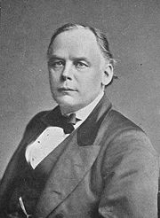
Charles Bradlaugh was a political activist and one of the most famous
EnglishEngland is a country that is part of the United Kingdom. It shares land borders with Scotland to the north and Wales to the west; the Irish Sea is to the north west, the Celtic Sea to the south west, with the North Sea to the east and the English Channel to the south separating it from continental...
atheistsAtheism is, in a broad sense, the rejection of belief in the existence of deities. In a narrower sense, atheism is specifically the position that there are no deities...
of the 19th century. He founded the
National Secular SocietyThe National Secular Society is a British campaigning organisation that promotes secularism and the separation of church and state. It holds that no-one should gain advantage or disadvantage because of their religion or lack of religion. It was founded by Charles Bradlaugh in 1866...
in 1866.
Early life
Born in
HoxtonHoxton is an area in the London Borough of Hackney, immediately north of the financial district of the City of London. The area of Hoxton is bordered by Regent's Canal on the north side, Wharf Road and City Road on the west, Old Street on the south, and Kingsland Road on the east.Hoxton is also a...
(an area in the East End of
LondonLondon is the capital city of :England and the :United Kingdom, the largest metropolitan area in the United Kingdom, and the largest urban zone in the European Union by most measures. Located on the River Thames, London has been a major settlement for two millennia, its history going back to its...
), Bradlaugh was the son of a
solicitorSolicitors are lawyers who traditionally deal with any legal matter including conducting proceedings in courts. In the United Kingdom, a few Australian states and the Republic of Ireland, the legal profession is split between solicitors and barristers , and a lawyer will usually only hold one title...
's clerk. He left school at the age of eleven and then worked as an office errand-boy and later as a clerk to a
coalCoal is a combustible black or brownish-black sedimentary rock usually occurring in rock strata in layers or veins called coal beds or coal seams. The harder forms, such as anthracite coal, can be regarded as metamorphic rock because of later exposure to elevated temperature and pressure...
merchant. After a brief spell as a
Sunday schoolSunday school is the generic name for many different types of religious education pursued on Sundays by various denominations.-England:The first Sunday school may have been opened in 1751 in St. Mary's Church, Nottingham. Another early start was made by Hannah Ball, a native of High Wycombe in...
teacher, he became disturbed by discrepancies between the
Thirty-nine ArticlesThe Thirty-Nine Articles of Religion are the historically defining statements of doctrines of the Anglican church with respect to the controversies of the English Reformation. First established in 1563, the articles served to define the doctrine of the nascent Church of England as it related to...
of the Anglican Church and the
BibleThe Bible refers to any one of the collections of the primary religious texts of Judaism and Christianity. There is no common version of the Bible, as the individual books , their contents and their order vary among denominations...
. When he expressed his concerns, the local vicar, John Graham Packer, accused him of
atheismAtheism is, in a broad sense, the rejection of belief in the existence of deities. In a narrower sense, atheism is specifically the position that there are no deities...
and suspended him from teaching. He was thrown out of the family home and was taken in by Elizabeth Sharples Carlile, the widow of
Richard CarlileRichard Carlile was an important agitator for the establishment of universal suffrage and freedom of the press in the United Kingdom.-Early life :...
, who had been imprisoned for printing
Thomas PaineThomas "Tom" Paine was an English author, pamphleteer, radical, inventor, intellectual, revolutionary, and one of the Founding Fathers of the United States...
's
The Age of ReasonThe Age of Reason; Being an Investigation of True and Fabulous Theology is a deistic pamphlet, written by eighteenth-century British radical and American revolutionary Thomas Paine, that criticizes institutionalized religion and challenges the legitimacy of the Bible, the central sacred text of...
. Soon Bradlaugh was introduced to
George HolyoakeGeorge Jacob Holyoake , English secularist and co-operator, was born in Birmingham, England. He coined the term "secularism" in 1851 and the term "jingoism" in 1878.-Owenism:...
, who organized Bradlaugh's first public lecture as an atheist. At the age of 17, he published his first pamphlet,
A Few Words on the Christian Creed. However, refusing financial support from fellow
freethinkersFreethought is a philosophical viewpoint that holds that opinions should be formed on the basis of science, logic, and reason, and should not be influenced by authority, tradition, or other dogmas...
, he enlisted as a soldier with the
Seventh Dragoon GuardsThe 7th Dragoon Guards was a cavalry regiment in the British Army, first raised in 1688. It saw service for three centuries, before being amalgamated into the 4th/7th Dragoon Guards in 1922....
hoping to serve in
IndiaIndia , officially the Republic of India , is a country in South Asia. It is the seventh-largest country by geographical area, the second-most populous country with over 1.2 billion people, and the most populous democracy in the world...
and make his fortune. Instead he was stationed in
Dublin. In 1853, he was left a legacy by a great-aunt and used it to purchase his discharge from the army.
Activism and journalism
Bradlaugh returned to London in 1853 and took a post as a solicitor's clerk. By this time he was a convinced freethinker and in his free time he became a pamphleteer and writer about "secularist" ideas, adopting the
pseudonymA pseudonym is a name that a person assumes for a particular purpose and that differs from his or her original orthonym...
"
IconoclastIconoclasm is the deliberate destruction of religious icons and other symbols or monuments, usually with religious or political motives. It is a frequent component of major political or religious changes...
" to protect his employer's reputation. He gradually attained prominence in a number of liberal or radical political groups or societies, including the
Reform LeagueThe Reform League was established in 1865 to press for manhood suffrage and the ballot in Great Britain. It collaborated with the more moderate and middle class Reform Union and gave strong support to the abortive Reform Bill 1866 and the successful Reform Act 1867...
, Land Law Reformers, and Secularists. He was President of the London Secular Society from 1858. In 1860 he became editor of the secularist newspaper, the
National Reformer, and in 1866 co-founded the
National Secular SocietyThe National Secular Society is a British campaigning organisation that promotes secularism and the separation of church and state. It holds that no-one should gain advantage or disadvantage because of their religion or lack of religion. It was founded by Charles Bradlaugh in 1866...
, in which
Annie BesantAnnie Besant was a prominent British Theosophist, women's rights activist, writer and orator and supporter of Irish and Indian self rule.She was married at 19 to Frank Besant but separated from him over religious differences. She then became a prominent speaker for the National Secular Society ...
became his close associate. In 1868, the
Reformer was prosecuted by the British Government for
blasphemyBlasphemy is irreverence towards religious or holy persons or things. Some countries have laws to punish blasphemy, while others have laws to give recourse to those who are offended by blasphemy...
and
seditionIn law, sedition is overt conduct, such as speech and organization, that is deemed by the legal authority to tend toward insurrection against the established order. Sedition often includes subversion of a constitution and incitement of discontent to lawful authority. Sedition may include any...
. Bradlaugh was eventually acquitted on all charges, but fierce controversy continued both in the courts and in the press. A decade later (1876), Bradlaugh and Besant decided to republish the American
Charles KnowltonCharles Knowlton was an American physician, atheist and writer.-Education:Knowlton was born May 10, 1800 in Templeton, Massachusetts. His parents were Stephen and Comfort Knowlton; his grandfather Ezekiel Knowlton, who was a Captain in the revolution and a longtime state legislator...
's pamphlet advocating birth control,
The Fruits of Philosophy, or the Private Companion of Young Married People, whose previous British publisher had already been successfully prosecuted for
obscenityAn obscenity is any statement or act which strongly offends the prevalent morality of the time, is a profanity, or is otherwise taboo, indecent, abhorrent, or disgusting, or is especially inauspicious...
. The two activists were both tried in 1877, and
Charles DarwinCharles Robert Darwin FRS was an English naturalist. He established that all species of life have descended over time from common ancestry, and proposed the scientific theory that this branching pattern of evolution resulted from a process that he called natural selection.He published his theory...
refused to give evidence in their defence. They were sentenced to heavy fines and six months' imprisonment, but their conviction was overturned by the Court of Appeal on a legal technicality.
Politics
Bradlaugh was an advocate of trade unionism,
republicanismRepublicanism in the United Kingdom is the movement which seeks to remove the British monarchy and replace it with a republic that has a non-hereditary head of state...
, and
women's suffrageWomen's suffrage or woman suffrage is the right of women to vote and to run for office. The expression is also used for the economic and political reform movement aimed at extending these rights to women and without any restrictions or qualifications such as property ownership, payment of tax, or...
, and he opposed
socialismSocialism is an economic system characterized by social ownership of the means of production and cooperative management of the economy; or a political philosophy advocating such a system. "Social ownership" may refer to any one of, or a combination of, the following: cooperative enterprises,...
. His anti-socialism was divisive, and many secularists who became socialists left the secularist movement because of its identification with Bradlaugh's liberal
individualismIndividualism is the moral stance, political philosophy, ideology, or social outlook that stresses "the moral worth of the individual". Individualists promote the exercise of one's goals and desires and so value independence and self-reliance while opposing most external interference upon one's own...
. He was a supporter of Irish Home Rule, and backed
FranceThe French Republic , The French Republic , The French Republic , (commonly known as France , is a unitary semi-presidential republic in Western Europe with several overseas territories and islands located on other continents and in the Indian, Pacific, and Atlantic oceans. Metropolitan France...
during the
Franco-Prussian WarThe Franco-Prussian War or Franco-German War, often referred to in France as the 1870 War was a conflict between the Second French Empire and the Kingdom of Prussia. Prussia was aided by the North German Confederation, of which it was a member, and the South German states of Baden, Württemberg and...
. He took a strong interest in
IndiaBritish Raj was the British rule in the Indian subcontinent between 1858 and 1947; The term can also refer to the period of dominion...
.
Parliament
In 1880 Bradlaugh was elected
Member of ParliamentA Member of Parliament is a representative of the voters to a :parliament. In many countries with bicameral parliaments, the term applies specifically to members of the lower house, as upper houses often have a different title, such as senate, and thus also have different titles for its members,...
for
NorthamptonNorthampton was a parliamentary constituency centred on the town of Northampton which existed until 1974.It returned two Members of Parliament to the House of Commons of the Parliament of the United Kingdom until its representation was reduced to one member for the 1918 general election...
, and claimed the right to
affirmIn law, an affirmation is a solemn declaration allowed to those who conscientiously object to taking an oath. An affirmation has exactly the same legal effect as an oath, but is usually taken to avoid the religious implications of an oath...
(instead of taking the religious
Oath of AllegianceThe Oath of Allegiance is a promise to be loyal to the British monarch, and their heirs and successors, sworn by certain public servants in the United Kingdom, and also by newly naturalised subjects in citizenship ceremonies.The Oaths Act 1888 The Oath of Allegiance (Judicial or Official Oath) is...
), but this was denied.
Lord Randolph ChurchillLord Randolph Henry Spencer-Churchill MP was a British statesman. He was the third son of the 7th Duke of Marlborough and his wife Lady Frances Anne Emily Vane , daughter of the 3rd Marquess of Londonderry...
roused the
ConservativesThe Conservative Party, formally the Conservative and Unionist Party, is a centre-right political party in the United Kingdom that adheres to the philosophies of conservatism and British unionism. It is the largest political party in the UK, and is currently the largest single party in the House...
by leading resistance to Bradlaugh.
Bradlaugh subsequently offered to take the oath "as a matter of form". This offer, too, was rejected by the House. Because Members must take the oath before being allowed to take their seats, he effectively forfeited his seat in Parliament. He attempted to take his seat regardless and was arrested and briefly imprisoned in
the Clock TowerBig Ben is the nickname for the great bell of the clock at the north end of the Palace of Westminster in London, and is generally extended to refer to the clock or the clock tower as well. It is the largest four-faced chiming clock and the third-tallest free-standing clock tower in the world...
of the
Houses of ParliamentThe Palace of Westminster, also known as the Houses of Parliament or Westminster Palace, is the meeting place of the two houses of the Parliament of the United Kingdom—the House of Lords and the House of Commons...
. His seat fell vacant and a by-election was declared. Bradlaugh was re-elected by Northampton four times in succession as the dispute continued. Supporting Bradlaugh were
William Ewart GladstoneWilliam Ewart Gladstone FRS FSS was a British Liberal statesman. In a career lasting over sixty years, he served as Prime Minister four separate times , more than any other person. Gladstone was also Britain's oldest Prime Minister, 84 years old when he resigned for the last time...
,
T. P. O'ConnorThomas Power O'Connor , known as T. P. O'Connor and occasionally as Tay Pay, was a journalist, an Irish nationalist political figure, and a Member of Parliament in the House of Commons of the United Kingdom of Great Britain and Ireland for nearly fifty years.-Biography:O'Connor was born in...
and
George Bernard ShawGeorge Bernard Shaw was an Irish playwright and a co-founder of the London School of Economics. Although his first profitable writing was music and literary criticism, in which capacity he wrote many highly articulate pieces of journalism, his main talent was for drama, and he wrote more than 60...
as well as hundreds of thousands of people who signed a public petition. Opposing his right to sit were the
Conservative PartyThe Conservative Party, formally the Conservative and Unionist Party, is a centre-right political party in the United Kingdom that adheres to the philosophies of conservatism and British unionism. It is the largest political party in the UK, and is currently the largest single party in the House...
, the
Archbishop of CanterburyThe Archbishop of Canterbury is the senior bishop and principal leader of the Church of England, the symbolic head of the worldwide Anglican Communion, and the diocesan bishop of the Diocese of Canterbury. In his role as head of the Anglican Communion, the archbishop leads the third largest group...
, and other leading figures in the
Church of EnglandThe Church of England is the officially established Christian church in England and the Mother Church of the worldwide Anglican Communion. The church considers itself within the tradition of Western Christianity and dates its formal establishment principally to the mission to England by St...
and
Roman Catholic ChurchThe Catholic Church, also known as the Roman Catholic Church, is the world's largest Christian church, with over a billion members. Led by the Pope, it defines its mission as spreading the gospel of Jesus Christ, administering the sacraments and exercising charity...
.
On at least one occasion, Bradlaugh was escorted from the House by police officers. In 1883 he took his seat and voted three times before being fined £1,500 for voting illegally. A bill allowing him to affirm was defeated in Parliament.
In 1886 Bradlaugh was finally allowed to take the oath, and did so at the risk of prosecution under the Parliamentary Oaths Act. Two years later, in 1888, he secured passage of a
new Oaths ActThe Oaths Act 1888 was an Act of the Parliament of the United Kingdom which set out provisions whereby the oath of allegiance taken to the Sovereign may be solemnly affirmed rather than sworn to God. The Act was the culmination of a campaign by the noted atheist and secularist MP Charles...
, which enshrined into law the right of affirmation for members of both Houses, as well as extending and clarifying the law as it related to witnesses in civil and criminal
trialsIn law, a trial is when parties to a dispute come together to present information in a tribunal, a formal setting with the authority to adjudicate claims or disputes. One form of tribunal is a court...
(the Evidence Amendment Acts of 1869 and 1870 had proved unsatisfactory, though they had given relief to many who would otherwise have been disadvantaged). Bradlaugh spoke in Parliament about the
London matchgirls strike of 1888The London match-girls’ strike of 1888 was a strike of the women and teenage girls working at the Bryant and May Factory in Bow, London.-The strike:...
.
Death
Bradlaugh's funeral was attended by 3,000 mourners, including a then 21 years old Mohandas Gandhi. He is buried in
Brookwood CemeteryBrookwood Cemetery is a burial ground in Brookwood, Surrey, England. It is the largest cemetery in the United Kingdom and one of the largest in western Europe.-History:...
. A statue to Bradlaugh is located on a traffic island at Abington Square,
NorthamptonNorthampton is a large market town and local government district in the East Midlands region of England. Situated about north-west of London and around south-east of Birmingham, Northampton lies on the River Nene and is the county town of Northamptonshire. The demonym of Northampton is...
and he is remembered annually on his birthday. The statue points west towards the centre of Northampton, the accusing finger periodically missing due to vandalism. Various local landmarks are named after Bradlaugh, including Bradlaugh Fields nature reserves, The Charles Bradlaugh pub, and Charles Bradlaugh Hall at the
University of NorthamptonThe University of Northampton is a university in Northampton, Northamptonshire, England.-History:In 1924, Northampton Technical College was opened at St George's Avenue, site of the current Avenue Campus. A new building for the college was formally opened by the then Duke and Duchess of York in 1932...
.
External links