

Virgin Trains

Encyclopedia
Virgin Trains is a train operating company
in the United Kingdom
. It operates long-distance passenger services on the West Coast Main Line
(WCML) between London
, the West Midlands
, North West England
, North Wales
and Scotland
. Although it is branded as part of Virgin Group
, the group's share in it is only 51%, the remaining 49% being held by Stagecoach Group
.
in the mid-1990s. It was initially successful in winning two rail franchises
: InterCity West Coast (Virgin West Coast), operating long-distance services on the WCML, and InterCity CrossCountry (Virgin CrossCountry), operating a group of long-distance non-London routes centred on Birmingham. The two franchises, though legally and operationally separate, were marketed as a single brand.
The CrossCountry franchise was lost to Arriva group
in 2007. Most services were transferred to Arriva, except those between Manchester
and Scotland, which went to First Transpennine Express
, and those between Birmingham
and Scotland (via the west coast mainline), which went to Virgin West Coast.
In 1997 Virgin placed the largest rolling-stock order (£1bn) in British history, for new Class 390
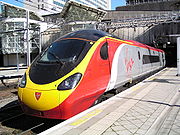
Pendolino
140 mph electric tilting train
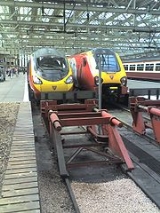
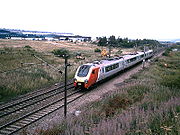
s for the West Coast Main Line (WCML) network. The cross-country routes were served by new diesel-electric four-coach Class 220 Voyager
and five-coach Class 221 SuperVoyager
trains. By December 2004 Virgin Trains had replaced all the rolling stock it had inherited from British Rail.
The West Coast Main Line itself has been the subject of a £9bn refurbishment programme to accept the new trains. The project ran three years over schedule and cost twice the original estimate, and was therefore cut back. As a result the Pendolinos' 140 mph potential speed is not exploited, trains running instead at a maximum 125 mph due to signalling constraints. There have been proposals for 135 mph (60.4 m/s) running on certain sections of the WCML, in particular the remodelled Trent Valley area, but these are yet to be considered by Network Rail
. (See West Coast Main Line
for full details.)
All seats originally had an on-board audio entertainment system featuring a number of radio or pre-recorded music channels. This was disabled in March 2010 and replaced with on-board WiFi
provided by T-Mobile
. The service is available free in First Class, and for a charge in Standard Class.
Virgin Trains' West Coast franchise was to have expired on 31 March 2012, but in May 2011 the Secretary of State of Transport announced that the end-date had been postponed in order to allow officials more time to consult on possible changes to the franchise requirements. The new franchise, for which Virgin was among the bidders, was to start on 9 December 2012 and run until 31 March 2026. Earlier, the company had applied for a two-year extension but this was ruled out by the Department of Transport on legal grounds.
London - Birmingham - Wolverhampton
London - Manchester
London - Stafford - Liverpool
London / West Midlands to Chester / North Wales
London - The North West - Glasgow
Birmingham - The North West - Scotland
compared with some other transport operators between 2001 and 2006, according to Office of Rail Regulation statistics. Punctuality has gradually improved, and the latest figures published on Virgin Trains' website were 89.1% for the last 4 recorded weeks (24 July to 20 August 2011).
The PPM MAA (Public Performance Measure Moving Annual Average - % of trains arriving within 10 minutes of the scheduled times) figures for Virgin Trains (Cross Country services and West Coast services) are as follows:
Financial year to 31 March 2002: West Coast 68.7%, Cross Country 62.5%.
Financial year to 31 March 2003: West Coast 73.5%, Cross Country 61.7%.
Financial year to 31 March 2004: West Coast 74.8%, Cross Country 72.2%.
Financial year to 31 March 2005: West Coast 72.1%, Cross Country 77.8%.
Financial year to 31 March 2006: West Coast 83.5%, Cross Country 80.9%.
Financial year to 31 March 2007: West Coast 86.0%, Cross Country 83.9%.
 Financial year to 31 March 2008: West Coast 86.2%.
Financial year to 31 March 2009: West Coast 80.0%.
Financial year to 31 March 2010: West Coast 84.6%.
Financial year to 31 March 2011: West Coast 86.6%.
The final figures published for the CrossCountry franchise were 83.4% (PPM) for the first half of the third quarter of financial year 2007-8 and 85.3% (MAA) for the final 12 months of the franchise.
The latest figures published for the West Coast franchise were 87.8% (PPM) for the fourth quarter of 2010-11 and 86.6% (MAA) up to 31 March 2011. The quarterly performance is up 4.3 percentage points on the corresponding figure from the same period a year earlier.
Chris Green
as chief executive led a drive to improve reliability and punctuality after much press criticism in 2001, and by 2006, due to improved reliability of trains and completion of major infrastructure projects, performance was better. Virgin has undertaken a number of projects to increase punctuality, including radio-controlled watches.
has ordered two extra coaches for 31 of the 52 sets. These will be supplemented by four entirely new 11-car trains, ordered in 2008. This order is to be completed in time for the May 2012 timetable following the franchise change in April 2012. One set has arrived and had a few test runs before the Virgin Trains Media Room on the website announced on 12 July 2011 that the new 11-car Pendolino (with two carriages removed) was to be handed over to them over the weekend of that time.
Following completion of the Trent Valley Line
quadrupling and Rugby junction upgrades to allow 125 mph running (completed by 2008), West Coast journey times fell further: Glasgow-Euston 4hr 15mins, Euston-Birmingham 1hr 10 mins (fastest) or 1hr 20mins (off-peak). Virgin claims that 135 mph running may be possible in places, although Network Rail remains sceptical, stating that significant signalling upgrades would be required.
In February 2008, Virgin announced that it would begin services between London and Wrexham via Chester, initially on a trial basis with one train per day on weekdays in each direction. Should the service prove successful, Virgin plans to introduce more services during the week and at weekends.
Richard Branson has launched a campaign to have the next franchise period extended for 20 to 30 years, so that Virgin would be able to spend more on infrastructure and be able to see a return on investment. He said the journey time between London and Birmingham could be reduced by 22 minutes to under one hour.
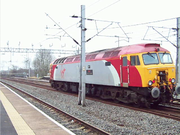
Pendolino EMUs. 16 Class 57 diesel locomotives were operated by Virgin, although four of these are now operated by Arriva Trains Wales
. Network Rail
recently was transferred to the six fleet, leaving Virgin Trains with 6. These locomotives are primarily used for "Thunderbird" duties, i.e. to rescue failed trains. Virgin also operates 21 five-car Class 221
Super Voyager tilting DMUs; these primarily operate on the WCML north of Birmingham, and on the North Wales line.
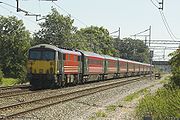
Virgin Trains has now signed a lease on a rake of dedicated Mark 3 coaches
, with a DVT
. This set, nicknamed the 'Pretendolino', has been refurbished to the same standard as the Pendolinos
and Super Voyagers
; re-upholstered seating, power points, wi-fi and a full external re-paint has been implemented. Virgin uses this set with a Class 90
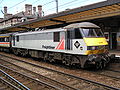
locomotive hired from Freightliner on the 18:43 Euston to Crewe (via Birmingham) Friday relief service, and also to hires the train out as a charter train. It also serves as a spare in the event of breakdown of a Pendolino or Super Voyager. It was used in the filming of Harry Potter and the Deathly Hallows and can be seen at King's Cross station at the end of the film.
The Pendolino fleet is allocated to the Alstom Traincare Centre at Longsight
(Manchester), with lighter maintenance and overnight stabling carried out at Wembley
(London), Oxley
(Wolverhampton), Edge Hill
(Liverpool) and Polmadie
(Glasgow). Longsight is also 'home' to the Class 57 'Thunderbird' fleet. Thunderbird locomotives are stationed at strategic points along the WCML such as Crewe and Preston.
The Class 221 Super Voyager fleet is allocated to Bombardier's
Central Rivers
depot near Burton upon Trent
.
|-
Train operating company
The term train operating company is used in the United Kingdom to describe the various businesses operating passenger trains on the railway system of Great Britain under the collective National Rail brand...
in the United Kingdom
United Kingdom
The United Kingdom of Great Britain and Northern IrelandIn the United Kingdom and Dependencies, other languages have been officially recognised as legitimate autochthonous languages under the European Charter for Regional or Minority Languages...
. It operates long-distance passenger services on the West Coast Main Line
West Coast Main Line
The West Coast Main Line is the busiest mixed-traffic railway route in Britain, being the country's most important rail backbone in terms of population served. Fast, long-distance inter-city passenger services are provided between London, the West Midlands, the North West, North Wales and the...
(WCML) between London
London
London is the capital city of :England and the :United Kingdom, the largest metropolitan area in the United Kingdom, and the largest urban zone in the European Union by most measures. Located on the River Thames, London has been a major settlement for two millennia, its history going back to its...
, the West Midlands
West Midlands (region)
The West Midlands is an official region of England, covering the western half of the area traditionally known as the Midlands. It contains the second most populous British city, Birmingham, and the larger West Midlands conurbation, which includes the city of Wolverhampton and large towns of Dudley,...
, North West England
North West England
North West England, informally known as The North West, is one of the nine official regions of England.North West England had a 2006 estimated population of 6,853,201 the third most populated region after London and the South East...
, North Wales
North Wales
North Wales is the northernmost unofficial region of Wales. It is bordered to the south by the counties of Ceredigion and Powys in Mid Wales and to the east by the counties of Shropshire in the West Midlands and Cheshire in North West England...
and Scotland
Scotland
Scotland is a country that is part of the United Kingdom. Occupying the northern third of the island of Great Britain, it shares a border with England to the south and is bounded by the North Sea to the east, the Atlantic Ocean to the north and west, and the North Channel and Irish Sea to the...
. Although it is branded as part of Virgin Group
Virgin Group
Virgin Group Limited is a British branded venture capital conglomerate organisation founded by business tycoon Richard Branson. The core business areas are travel, entertainment and lifestyle. Virgin Group's date of incorporation is listed as 1989 by Companies House, who class it as a holding...
, the group's share in it is only 51%, the remaining 49% being held by Stagecoach Group
Stagecoach Group
Stagecoach Group plc is an international transport group operating buses, trains, trams, express coaches and ferries. The group was founded in 1980 by the current chairman, Sir Brian Souter, his sister, Ann Gloag, and her former husband Robin...
.
History
Virgin Trains was formed to take advantage of the privatisation of British RailPrivatisation of British Rail
The privatisation of British Rail was set in motion when the Conservative government enacted, on 19 January 1993, the British Coal and British Rail Act 1993 . This enabled the relevant Secretary of State to issue directions to the relevant Board...
in the mid-1990s. It was initially successful in winning two rail franchises
Rail franchising in Great Britain
Rail franchising in Great Britain was created by the Railways Act 1993. Passenger services are franchised, for a limited period, to train operating companies...
: InterCity West Coast (Virgin West Coast), operating long-distance services on the WCML, and InterCity CrossCountry (Virgin CrossCountry), operating a group of long-distance non-London routes centred on Birmingham. The two franchises, though legally and operationally separate, were marketed as a single brand.
The CrossCountry franchise was lost to Arriva group
CrossCountry
CrossCountry is the brand name of XC Trains Ltd., a British train operating company owned by Arriva...
in 2007. Most services were transferred to Arriva, except those between Manchester
Manchester
Manchester is a city and metropolitan borough in Greater Manchester, England. According to the Office for National Statistics, the 2010 mid-year population estimate for Manchester was 498,800. Manchester lies within one of the UK's largest metropolitan areas, the metropolitan county of Greater...
and Scotland, which went to First Transpennine Express
First TransPennine Express
First TransPennine Express is a British train operating company. It is a joint operation between First Group and Keolis . It operates regular passenger services in northern England, including services linking the west and east coasts across the Pennines...
, and those between Birmingham
Birmingham
Birmingham is a city and metropolitan borough in the West Midlands of England. It is the most populous British city outside the capital London, with a population of 1,036,900 , and lies at the heart of the West Midlands conurbation, the second most populous urban area in the United Kingdom with a...
and Scotland (via the west coast mainline), which went to Virgin West Coast.
In 1997 Virgin placed the largest rolling-stock order (£1bn) in British history, for new Class 390
British Rail Class 390
The Class 390 Pendolino is a type of train used in Great Britain. They are electric multiple units using Fiat's tilting train pendolino technology and built by Alstom. Fifty-three 9-car units were originally built for Virgin Trains from 2001 to 2004 for operation on the West Coast Main Line , with...
Pendolino
Pendolino
Pendolino is an Italian family of tilting trains used in Italy, Spain, Portugal, Slovenia, Finland, Russian Federation, the Czech Republic, the United Kingdom, Slovakia, Switzerland, China and shortly in Romania and Poland...
140 mph electric tilting train
Tilting train
A tilting train is a train that has a mechanism enabling increased speed on regular rail tracks. As a train rounds a curve at speed, objects inside the train experience centrifugal force. This can cause packages to slide about or seated passengers to feel squashed by the outboard armrest due to...
s for the West Coast Main Line (WCML) network. The cross-country routes were served by new diesel-electric four-coach Class 220 Voyager
British Rail Class 220
The Class 220 Voyager are a class of diesel-electric high-speed multiple-unit trains built by Bombardier Transportation in 2000 and 2001....
and five-coach Class 221 SuperVoyager
British Rail Class 221
The Class 221 Super Voyager is a class of British diesel-electric multiple-unit express trains built by Bombardier Transportation between 2001 and 2002, entering service on 12 April 2002....
trains. By December 2004 Virgin Trains had replaced all the rolling stock it had inherited from British Rail.
The West Coast Main Line itself has been the subject of a £9bn refurbishment programme to accept the new trains. The project ran three years over schedule and cost twice the original estimate, and was therefore cut back. As a result the Pendolinos' 140 mph potential speed is not exploited, trains running instead at a maximum 125 mph due to signalling constraints. There have been proposals for 135 mph (60.4 m/s) running on certain sections of the WCML, in particular the remodelled Trent Valley area, but these are yet to be considered by Network Rail
Network Rail
Network Rail is the government-created owner and operator of most of the rail infrastructure in Great Britain .; it is not responsible for railway infrastructure in Northern Ireland...
. (See West Coast Main Line
West Coast Main Line
The West Coast Main Line is the busiest mixed-traffic railway route in Britain, being the country's most important rail backbone in terms of population served. Fast, long-distance inter-city passenger services are provided between London, the West Midlands, the North West, North Wales and the...
for full details.)
All seats originally had an on-board audio entertainment system featuring a number of radio or pre-recorded music channels. This was disabled in March 2010 and replaced with on-board WiFi
WIFI
WIFI is a radio station broadcasting a brokered format. Licensed to Florence, New Jersey, USA, the station is currently operated by Florence Broadcasting Partners, LLC.This station was previously owned by Real Life Broadcasting...
provided by T-Mobile
T-Mobile
T-Mobile International AG is a German-based holding company for Deutsche Telekom AG's various mobile communications subsidiaries outside Germany. Based in Bonn, Germany, its subsidiaries operate GSM and UMTS-based cellular networks in Europe, the United States, Puerto Rico and the US Virgin Islands...
. The service is available free in First Class, and for a charge in Standard Class.
Virgin Trains' West Coast franchise was to have expired on 31 March 2012, but in May 2011 the Secretary of State of Transport announced that the end-date had been postponed in order to allow officials more time to consult on possible changes to the franchise requirements. The new franchise, for which Virgin was among the bidders, was to start on 9 December 2012 and run until 31 March 2026. Earlier, the company had applied for a two-year extension but this was ruled out by the Department of Transport on legal grounds.
Services
Virgin Trains' main terminus is . A secondary terminus, for certain trains to Scotland, is . A summary of Virgin Trains services is shown below (most stations with only a limited service are not shown):London - Birmingham - Wolverhampton
| Route | Calling at | Main stock | |
|---|---|---|---|
| A | to and | , , , , , and , with some services extending to and | Pendolino British Rail Class 390 The Class 390 Pendolino is a type of train used in Great Britain. They are electric multiple units using Fiat's tilting train pendolino technology and built by Alstom. Fifty-three 9-car units were originally built for Virgin Trains from 2001 to 2004 for operation on the West Coast Main Line , with... |
London - Manchester
| Route | Calling at | Main stock | |
|---|---|---|---|
| B | to | and , branching off via and or and , and continuing to and | Pendolino British Rail Class 390 The Class 390 Pendolino is a type of train used in Great Britain. They are electric multiple units using Fiat's tilting train pendolino technology and built by Alstom. Fifty-three 9-car units were originally built for Virgin Trains from 2001 to 2004 for operation on the West Coast Main Line , with... |
London - Stafford - Liverpool
| Route | Calling at | Main stock | |
|---|---|---|---|
| C | to | , , and | Pendolino British Rail Class 390 The Class 390 Pendolino is a type of train used in Great Britain. They are electric multiple units using Fiat's tilting train pendolino technology and built by Alstom. Fifty-three 9-car units were originally built for Virgin Trains from 2001 to 2004 for operation on the West Coast Main Line , with... |
London / West Midlands to Chester / North Wales
| Route | Calling at | Main stock | |
|---|---|---|---|
| D | to , and | , , and , with one service extending to and others via , , , and to or , with one weekday service between and North West Wales. | Super Voyager British Rail Class 221 The Class 221 Super Voyager is a class of British diesel-electric multiple-unit express trains built by Bombardier Transportation between 2001 and 2002, entering service on 12 April 2002.... |
London - The North West - Glasgow
| Route | Calling at | Main stock | |
|---|---|---|---|
| E | to | , , , , , , , and | Pendolino British Rail Class 390 The Class 390 Pendolino is a type of train used in Great Britain. They are electric multiple units using Fiat's tilting train pendolino technology and built by Alstom. Fifty-three 9-car units were originally built for Virgin Trains from 2001 to 2004 for operation on the West Coast Main Line , with... |
Birmingham - The North West - Scotland
| Route | Calling at | Main stock | |
|---|---|---|---|
| F | to or | , , , , , , , , and , continuing to or and | Super Voyager British Rail Class 221 The Class 221 Super Voyager is a class of British diesel-electric multiple-unit express trains built by Bombardier Transportation between 2001 and 2002, entering service on 12 April 2002.... |
Performance
Virgin Trains suffered poor punctualityPunctuality
Punctuality is the characteristic of being able to complete a required task or fulfill an obligation before or at a previously designated time. "Punctual" is often used synonymously with "on time."...
compared with some other transport operators between 2001 and 2006, according to Office of Rail Regulation statistics. Punctuality has gradually improved, and the latest figures published on Virgin Trains' website were 89.1% for the last 4 recorded weeks (24 July to 20 August 2011).
The PPM MAA (Public Performance Measure Moving Annual Average - % of trains arriving within 10 minutes of the scheduled times) figures for Virgin Trains (Cross Country services and West Coast services) are as follows:
Financial year to 31 March 2002: West Coast 68.7%, Cross Country 62.5%.
Financial year to 31 March 2003: West Coast 73.5%, Cross Country 61.7%.
Financial year to 31 March 2004: West Coast 74.8%, Cross Country 72.2%.
Financial year to 31 March 2005: West Coast 72.1%, Cross Country 77.8%.
Financial year to 31 March 2006: West Coast 83.5%, Cross Country 80.9%.
Financial year to 31 March 2007: West Coast 86.0%, Cross Country 83.9%.
Financial year to 31 March 2009: West Coast 80.0%.
Financial year to 31 March 2010: West Coast 84.6%.
Financial year to 31 March 2011: West Coast 86.6%.
The final figures published for the CrossCountry franchise were 83.4% (PPM) for the first half of the third quarter of financial year 2007-8 and 85.3% (MAA) for the final 12 months of the franchise.
The latest figures published for the West Coast franchise were 87.8% (PPM) for the fourth quarter of 2010-11 and 86.6% (MAA) up to 31 March 2011. The quarterly performance is up 4.3 percentage points on the corresponding figure from the same period a year earlier.
Chris Green
Chris Green (railway manager)
Chris Green is a British railway manager. He has a reputation for the adoption of business-led management of passenger services both in the British Rail and privatised eras, and has been described as "the best chairman BR never had"....
as chief executive led a drive to improve reliability and punctuality after much press criticism in 2001, and by 2006, due to improved reliability of trains and completion of major infrastructure projects, performance was better. Virgin has undertaken a number of projects to increase punctuality, including radio-controlled watches.
Grayrigg derailment
On 23 February 2007, Pendolino 390033 forming the 17:15 service from London Euston to Glasgow Central derailed near Oxenholme in North West England. The train was carrying 109 people. Several carriages were left lying on the railway embankments. An elderly woman died in the crash. Five people were seriously injured. The accident was caused by a faulty set of points. The train itself was widely praised for the way it stood up to the accident: it kept its shape while rolling down the embankment and did not lose its structural integrity.The future
Projected growth in passenger numbers on the West Coast routes prompted discussions about increasing the length of Pendolino sets to 11 vehicles. The possibility of 10-car trains was foreseen in the original WCML strategy, so the infrastructure improvements required would be minimal. The DfTDepartment for Transport
In the United Kingdom, the Department for Transport is the government department responsible for the English transport network and a limited number of transport matters in Scotland, Wales and Northern Ireland which are not devolved...
has ordered two extra coaches for 31 of the 52 sets. These will be supplemented by four entirely new 11-car trains, ordered in 2008. This order is to be completed in time for the May 2012 timetable following the franchise change in April 2012. One set has arrived and had a few test runs before the Virgin Trains Media Room on the website announced on 12 July 2011 that the new 11-car Pendolino (with two carriages removed) was to be handed over to them over the weekend of that time.
Following completion of the Trent Valley Line
Trent Valley line
The Trent Valley Line is a railway line between Rugby and Stafford in England, forming part of the West Coast Main Line.The line was electrified on 25 kV AC system during the 1960s, in the wake of the 1955 British Rail modernisation plan....
quadrupling and Rugby junction upgrades to allow 125 mph running (completed by 2008), West Coast journey times fell further: Glasgow-Euston 4hr 15mins, Euston-Birmingham 1hr 10 mins (fastest) or 1hr 20mins (off-peak). Virgin claims that 135 mph running may be possible in places, although Network Rail remains sceptical, stating that significant signalling upgrades would be required.
In February 2008, Virgin announced that it would begin services between London and Wrexham via Chester, initially on a trial basis with one train per day on weekdays in each direction. Should the service prove successful, Virgin plans to introduce more services during the week and at weekends.
Richard Branson has launched a campaign to have the next franchise period extended for 20 to 30 years, so that Virgin would be able to spend more on infrastructure and be able to see a return on investment. He said the journey time between London and Birmingham could be reduced by 22 minutes to under one hour.
Current fleet
The majority of Virgin's services along the WCML are operated by its fleet of 53 nine-car Class 390British Rail Class 390
The Class 390 Pendolino is a type of train used in Great Britain. They are electric multiple units using Fiat's tilting train pendolino technology and built by Alstom. Fifty-three 9-car units were originally built for Virgin Trains from 2001 to 2004 for operation on the West Coast Main Line , with...
Pendolino EMUs. 16 Class 57 diesel locomotives were operated by Virgin, although four of these are now operated by Arriva Trains Wales
Arriva Trains Wales
Arriva Trains Wales is a train operating company, owned by Arriva, that operates urban and inter urban passenger services in Wales and the Welsh Marches...
. Network Rail
Network Rail
Network Rail is the government-created owner and operator of most of the rail infrastructure in Great Britain .; it is not responsible for railway infrastructure in Northern Ireland...
recently was transferred to the six fleet, leaving Virgin Trains with 6. These locomotives are primarily used for "Thunderbird" duties, i.e. to rescue failed trains. Virgin also operates 21 five-car Class 221
British Rail Class 221
The Class 221 Super Voyager is a class of British diesel-electric multiple-unit express trains built by Bombardier Transportation between 2001 and 2002, entering service on 12 April 2002....
Super Voyager tilting DMUs; these primarily operate on the WCML north of Birmingham, and on the North Wales line.
Virgin Trains has now signed a lease on a rake of dedicated Mark 3 coaches
British Rail Mark 3
British Rail's third design of standard carriage was designated 'Mark 3' , and was developed primarily for the InterCity 125 High Speed Train...
, with a DVT
Driving Van Trailer
A Driving Van Trailer is a purpose-built railway vehicle that allows the driver to operate a locomotive at the opposite end of a train. Trains operating with a DVT therefore do not require the locomotive to be moved around to the other end of the train at terminal stations...
. This set, nicknamed the 'Pretendolino', has been refurbished to the same standard as the Pendolinos
British Rail Class 390
The Class 390 Pendolino is a type of train used in Great Britain. They are electric multiple units using Fiat's tilting train pendolino technology and built by Alstom. Fifty-three 9-car units were originally built for Virgin Trains from 2001 to 2004 for operation on the West Coast Main Line , with...
and Super Voyagers
British Rail Class 221
The Class 221 Super Voyager is a class of British diesel-electric multiple-unit express trains built by Bombardier Transportation between 2001 and 2002, entering service on 12 April 2002....
; re-upholstered seating, power points, wi-fi and a full external re-paint has been implemented. Virgin uses this set with a Class 90
British Rail Class 90
The British Rail Class 90 electric locomotives were built by BREL at Crewe from 1987-1990. Each locomotive weighs 84.5 tonnes and has a top speed of . They operate from 25 kV AC overhead wires and produce...
locomotive hired from Freightliner on the 18:43 Euston to Crewe (via Birmingham) Friday relief service, and also to hires the train out as a charter train. It also serves as a spare in the event of breakdown of a Pendolino or Super Voyager. It was used in the filming of Harry Potter and the Deathly Hallows and can be seen at King's Cross station at the end of the film.
| Class | Image | Type | Top speed | Number | Cars per set | Routes operated | Built | Notes | |
|---|---|---|---|---|---|---|---|---|---|
| mph | km/h | ||||||||
| Diesel shunter | 20 | 32 | 8 | N/A | Depot shunter | 1953–1962 | |||
| Class 57/3 British Rail Class 57 The Class 57 diesel locomotives were introduced by Brush Traction between 1997-2004. They are rebuilds, with reconditioned EMD engines, of former Class 47 locomotives, originally introduced in 1964-5.- Description :... |
 |
Diesel locomotive Diesel locomotive A diesel locomotive is a type of railroad locomotive in which the prime mover is a diesel engine, a reciprocating engine operating on the Diesel cycle as invented by Dr. Rudolf Diesel... |
95 | 153 | 6 | N/A | Thunderbird locomotive | 2002–2004 | Originally fleet of 16; 6 transferred to Network Rail Network Rail Network Rail is the government-created owner and operator of most of the rail infrastructure in Great Britain .; it is not responsible for railway infrastructure in Northern Ireland... , with 4 being available for use by Arriva Trains Wales Arriva Trains Wales Arriva Trains Wales is a train operating company, owned by Arriva, that operates urban and inter urban passenger services in Wales and the Welsh Marches... . |
| Class 221 Super Voyager British Rail Class 221 The Class 221 Super Voyager is a class of British diesel-electric multiple-unit express trains built by Bombardier Transportation between 2001 and 2002, entering service on 12 April 2002.... |
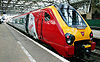 |
Diesel-Electric Multiple Unit | 125 | 200 | 20 | 5 | London - Chester Chester Chester is a city in Cheshire, England. Lying on the River Dee, close to the border with Wales, it is home to 77,040 inhabitants, and is the largest and most populous settlement of the wider unitary authority area of Cheshire West and Chester, which had a population of 328,100 according to the... /Holyhead Holyhead Holyhead is the largest town in the county of Anglesey in the North Wales. It is also a major port adjacent to the Irish Sea serving Ireland.... Birmingham Birmingham Birmingham is a city and metropolitan borough in the West Midlands of England. It is the most populous British city outside the capital London, with a population of 1,036,900 , and lies at the heart of the West Midlands conurbation, the second most populous urban area in the United Kingdom with a... - Glasgow Glasgow Glasgow is the largest city in Scotland and third most populous in the United Kingdom. The city is situated on the River Clyde in the country's west central lowlands... /Edinburgh Edinburgh Edinburgh is the capital city of Scotland, the second largest city in Scotland, and the eighth most populous in the United Kingdom. The City of Edinburgh Council governs one of Scotland's 32 local government council areas. The council area includes urban Edinburgh and a rural area... |
2001–2002 | 221142 and 221143 both originally 4 car sets, 221144 was disbanded to make them up to 5 car sets and its driving cars are now stored. |
| Class 390 Pendolino British Rail Class 390 The Class 390 Pendolino is a type of train used in Great Britain. They are electric multiple units using Fiat's tilting train pendolino technology and built by Alstom. Fifty-three 9-car units were originally built for Virgin Trains from 2001 to 2004 for operation on the West Coast Main Line , with... |
 |
Electric Multiple Unit Electric multiple unit An electric multiple unit or EMU is a multiple unit train consisting of self-propelled carriages, using electricity as the motive power. An EMU requires no separate locomotive, as electric traction motors are incorporated within one or a number of the carriages... |
140 | 225 | 53 | 9 | London - Birmingham Birmingham Birmingham is a city and metropolitan borough in the West Midlands of England. It is the most populous British city outside the capital London, with a population of 1,036,900 , and lies at the heart of the West Midlands conurbation, the second most populous urban area in the United Kingdom with a... /Wolverhampton Wolverhampton Wolverhampton is a city and metropolitan borough in the West Midlands, England. For Eurostat purposes Walsall and Wolverhampton is a NUTS 3 region and is one of five boroughs or unitary districts that comprise the "West Midlands" NUTS 2 region... London - Manchester Manchester Manchester is a city and metropolitan borough in Greater Manchester, England. According to the Office for National Statistics, the 2010 mid-year population estimate for Manchester was 498,800. Manchester lies within one of the UK's largest metropolitan areas, the metropolitan county of Greater... London - Liverpool Liverpool Liverpool is a city and metropolitan borough of Merseyside, England, along the eastern side of the Mersey Estuary. It was founded as a borough in 1207 and was granted city status in 1880... London - Glasgow Glasgow Glasgow is the largest city in Scotland and third most populous in the United Kingdom. The city is situated on the River Clyde in the country's west central lowlands... |
2001–2004 2009-2012 |
390054 reduced from 11 cars, 2 cars stored. 390033 stored/partially scrapped after Grayrigg derailment Grayrigg derailment The Grayrigg derailment was a fatal railway accident that occurred at approximately 20:15 GMT on 23 February 2007, just to the south of Grayrigg, Cumbria, in North West England. The initial conclusion of the accident investigation is that the derailment was caused by a faulty set of points ,... . |
| Class 90 British Rail Class 90 The British Rail Class 90 electric locomotives were built by BREL at Crewe from 1987-1990. Each locomotive weighs 84.5 tonnes and has a top speed of . They operate from 25 kV AC overhead wires and produce... |
 |
Electric locomotive Electric locomotive An electric locomotive is a locomotive powered by electricity from overhead lines, a third rail or an on-board energy storage device... |
110 | 180 | Hired from Freightliner (and occasionally from DB Schenker DB Schenker Rail (UK) DB Schenker Rail , before 2009 known as English, Welsh and Scottish Railway is a British rail freight company. EWS was established by a consortium led by Wisconsin Central Transportation Corporation in 1996 by acquisition of five of the six freight companies created by the privatisation of British... ) |
N/A | Relief train Charter Train Spare Train |
1987–1990 | Part of Virgin hauled set |
| Mark 3 Coach British Rail Mark 3 British Rail's third design of standard carriage was designated 'Mark 3' , and was developed primarily for the InterCity 125 High Speed Train... |
Passenger Coach | 125 | 200 | 9 | N/A | Relief train Charter Train Spare Train |
1975–1986 (refurbished 2009) | Part of Virgin hauled set | |
| Driving Van Trailer Driving Van Trailer A Driving Van Trailer is a purpose-built railway vehicle that allows the driver to operate a locomotive at the opposite end of a train. Trains operating with a DVT therefore do not require the locomotive to be moved around to the other end of the train at terminal stations... |
125 | 200 | 1 | N/A | Relief train Charter Train Spare Train |
1988 (refurbished 2009) | Part of Virgin hauled set | ||
The Pendolino fleet is allocated to the Alstom Traincare Centre at Longsight
Longsight Electric TMD
Longsight Electric TMD is an AC Electric railway locomotive Traction Maintenance Depot situated in Longsight, Manchester, England. The depot code is LG....
(Manchester), with lighter maintenance and overnight stabling carried out at Wembley
Wembley
Wembley is an area of northwest London, England, and part of the London Borough of Brent. It is home to the famous Wembley Stadium and Wembley Arena...
(London), Oxley
Oxley, Wolverhampton
Oxley is a suburb of Wolverhampton, West Midlands, and a ward of Wolverhampton City Council. Its area code is WV10. It is situated in the north of the city, bordering South Staffordshire and the Bushbury North, Bushbury South and Low Hill, St Peter's and Tettenhall Regis wards...
(Wolverhampton), Edge Hill
Edge Hill railway works
Edge Hill railway works was built by the Liverpool and Manchester Railway around 1830 at Edge Hill, Liverpool. A second was built in 1839 by the Grand Junction Railway adjacent to it...
(Liverpool) and Polmadie
Polmadie
Polmadie is a district of Glasgow, a city in Scotland. Polmadie is situated south of the River Clyde, and adjacent to the Gorbals....
(Glasgow). Longsight is also 'home' to the Class 57 'Thunderbird' fleet. Thunderbird locomotives are stationed at strategic points along the WCML such as Crewe and Preston.
The Class 221 Super Voyager fleet is allocated to Bombardier's
Bombardier Transportation
Bombardier Transportation is the rail equipment division of the Canadian firm, Bombardier Inc. Bombardier Transportation is one of the world's largest companies in the rail-equipment manufacturing and servicing industry. Its headquarters are in Berlin, Germany....
Central Rivers
Central Rivers TMD
Central Rivers TMD is a railway locomotive maintenance depot, located in Burton on Trent, England.Built by Bombardier Transportation to create a single-point maintenance facility for their diesel multiple unit of class British Rail Class 220, 221 and 222, it came into operation on 8 September 2001...
depot near Burton upon Trent
Burton upon Trent
Burton upon Trent, also known as Burton-on-Trent or simply Burton, is a town straddling the River Trent in the east of Staffordshire, England. Its associated adjective is "Burtonian"....
.
External links
|-