


M1 motorway

Encyclopedia
The M1 is a north–south motorway in England primarily connecting London to Leeds
Leeds
Leeds is a city and metropolitan borough in West Yorkshire, England. In 2001 Leeds' main urban subdivision had a population of 443,247, while the entire city has a population of 798,800 , making it the 30th-most populous city in the European Union.Leeds is the cultural, financial and commercial...
, where it joins the A1(M) near Aberford
Aberford
Aberford is a large village and civil parish on the eastern outskirts of the City of Leeds metropolitan borough in West Yorkshire, England. It has a population of 1,059 according to the 2001 census...
. While the M1 is considered to be the first inter-urban motorway to be completed in the United Kingdom, the first road to be built to motorway standard in the country was the Preston Bypass, which later became part of the M6
M6 motorway
The M6 motorway runs from junction 19 of the M1 at the Catthorpe Interchange, near Rugby via Birmingham then heads north, passing Stoke-on-Trent, Manchester, Preston, Carlisle and terminating at the Gretna junction . Here, just short of the Scottish border it becomes the A74 which continues to...
.
The motorway is 193 miles (310.6 km) long and was constructed in four phases. Most of the motorway was opened between 1959 and 1968 but the southern end was extended in 1977 and the northern end was extended in 1999. It forms part of the unsigned European route E13
European route E13
European route E13 is part of the International E-road network. It runs most of the length of the M1 motorway in the United Kingdom...
.
History
The first motorways (autostradesAutostrade of Italy
The Autostrada is the Italian national system of motorways. The total length of the system is about 6,400 km. In North and Central Italy this is mainly as tollways, with the biggest portion in concession to the Atlantia group which operates some 3,408 km...
) were built in Italy
Italy
Italy , officially the Italian Republic languages]] under the European Charter for Regional or Minority Languages. In each of these, Italy's official name is as follows:;;;;;;;;), is a unitary parliamentary republic in South-Central Europe. To the north it borders France, Switzerland, Austria and...
on the order of Benito Mussolini
Benito Mussolini
Benito Amilcare Andrea Mussolini was an Italian politician who led the National Fascist Party and is credited with being one of the key figures in the creation of Fascism....
in the 1920s, with other countries subsequently following, notably Germany
Germany
Germany , officially the Federal Republic of Germany , is a federal parliamentary republic in Europe. The country consists of 16 states while the capital and largest city is Berlin. Germany covers an area of 357,021 km2 and has a largely temperate seasonal climate...
with the first 'autobahn' in 1931 and then developed by the Nazis
Nazism
Nazism, the common short form name of National Socialism was the ideology and practice of the Nazi Party and of Nazi Germany...
under Adolf Hitler
Adolf Hitler
Adolf Hitler was an Austrian-born German politician and the leader of the National Socialist German Workers Party , commonly referred to as the Nazi Party). He was Chancellor of Germany from 1933 to 1945, and head of state from 1934 to 1945...
. There had been plans since before the Second World War for a motorway network in the United Kingdom. Lord Montagu
John Douglas-Scott-Montagu, 2nd Baron Montagu of Beaulieu
John Walter Edward Douglas-Scott-Montagu, 2nd Baron Montagu of Beaulieu , was a British Conservative politician and promoter of motoring....
formed a company to build a 'motorway like road' from London to Birmingham in 1923, however it was a further 26 years before the Special Roads Act 1949
Special Roads Act 1949
The Special Roads Act 1949 was an Act of the Parliament of the United Kingdom that:*Authorised the construction of special roads*Allowed these roads to be restricted to specific types of vehicles...
was passed which allowed for the construction of roads limited to a limited vehicle classifications and the 1950s when the country's first motorways were given the government go-ahead. The first section of motorway was the Preston By-pass
Bypass (road)
A bypass is a road or highway that avoids or "bypasses" a built-up area, town, or village, to let through traffic flow without interference from local traffic, to reduce congestion in the built-up area, and to improve road safety....
in Lancashire
Lancashire
Lancashire is a non-metropolitan county of historic origin in the North West of England. It takes its name from the city of Lancaster, and is sometimes known as the County of Lancaster. Although Lancaster is still considered to be the county town, Lancashire County Council is based in Preston...
, which opened in 1958 (now part of the M6 motorway
M6 motorway
The M6 motorway runs from junction 19 of the M1 at the Catthorpe Interchange, near Rugby via Birmingham then heads north, passing Stoke-on-Trent, Manchester, Preston, Carlisle and terminating at the Gretna junction . Here, just short of the Scottish border it becomes the A74 which continues to...
). The M1 was Britain's first full-length motorway and opened in 1959.
First section, 1959
The first section of the motorway opened between junction 5 (WatfordWatford
Watford is a town and borough in Hertfordshire, England, situated northwest of central London and within the bounds of the M25 motorway. The borough is separated from Greater London to the south by the urbanised parish of Watford Rural in the Three Rivers District.Watford was created as an urban...
) and junction 18 (Crick
Crick, Northamptonshire
Crick is a village in the Daventry district of the county of Northamptonshire in England. It is close to the border with Warwickshire, west of Rugby and north-west of Northampton. The villages of Crick and West Haddon were by-passed by the A428 main road from Rugby to Northampton when the...
/Rugby
Rugby, Warwickshire
Rugby is a market town in Warwickshire, England, located on the River Avon. The town has a population of 61,988 making it the second largest town in the county...
) on 2 November 1959 together with the motorway's two spurs, the M10 (from junction 7 to south of St Albans
St Albans
St Albans is a city in southern Hertfordshire, England, around north of central London, which forms the main urban area of the City and District of St Albans. It is a historic market town, and is now a sought-after dormitory town within the London commuter belt...
originally connecting to the A1) and the M45
M45 motorway
The M45 is a motorway in Northamptonshire and Warwickshire, England and is long. It runs from Junction 17 of the M1 motorway south east of Rugby and ends with a junction with the A45 road southwest of Rugby...
(from junction 17 to the A45
A45 road
The A45 is a major road in England. It runs east from Birmingham past the National Exhibition Centre and the M42, then bypasses Coventry and Rugby, where it briefly merges with the M45 until it continues to Daventry...
and Coventry
Coventry
Coventry is a city and metropolitan borough in the county of West Midlands in England. Coventry is the 9th largest city in England and the 11th largest in the United Kingdom. It is also the second largest city in the English Midlands, after Birmingham, with a population of 300,848, although...
). Parts of the Hertfordshire section were built using steam rollers.
The M1 was officially inaugurated from Slip End
Slip End
Slip End is a village and civil parish in Central Bedfordshire, near Luton. As well as the village of Slip End, the parish contains the hamlets of Lower Woodside, Woodside and Pepperstock...
(close to Luton), this was celebrated by a large concrete slab on the bridge next to the village with inscription "London-Yorkshire Motorway, This slab was sealed by the Rt Hon Harold Watkinson M.P. Minister of Transport inauguration day, 24th March 1958". It was removed during widening works in 2007-8.
This section of the M1 broadly follows the route of the A5 north-west. It starts at the Watford Bypass (A41
A41 road
The A41 is a formerly-major trunk road in England that links London and Birkenhead, although it has now largely been superseded by motorways. It passes through or near various towns and cities including Watford, Hemel Hempstead, Aylesbury, Solihull, Birmingham, West Bromwich, Wolverhampton,...
), which runs south-east to meet the A1 at Apex corner, and ended on the A5 at Crick. The M10 spur motorway connected the M1 to the North Orbital Road (A405
A405 road
The A405 is a main five-mile-long dual carriageway road in Hertfordshire. It has, however, been a longer road.-North Orbital Road:As the North Orbital Road, it occupied what is now junctions 17 to 19 of the M25, being one of the first sections of the M25 to open. The section of the M25 from...
/A414
A414 road
The A414 is a major road in England. It runs from the A41 at a junction west of Hemel Hempstead in Hertfordshire, through the town to junction 8 of the M1 motorway at Buncefield, and running parallel to the M1 until junction 7, heading south of St Albans, east through Hatfield, Hertford, then...
, a precursor of the M25
M25 motorway
The M25 motorway, or London Orbital, is a orbital motorway that almost encircles Greater London, England, in the United Kingdom. The motorway was first mooted early in the 20th century. A few sections, based on the now abandoned London Ringways plan, were constructed in the early 1970s and it ...
) where it also met the A5 (now renumbered here as the A5183
A5183 road
The A5183 road is a de-trunked section of the A5. It covers the section between Junction 9 of the M1 motorway and Edgware in north London, largely along Watling Street...
) and, 2 miles (3.2 km) to the east via the A414, the A6, which subsequently became part of the M25.
Although the whole of first section opened in 1959, it was built in two parts with the northern part (junctions 10 to 18) being built by John Laing and the southern part (the St Albans Bypass) being built by Tarmac Construction.
Rugby to Leeds, 1965 to 1968
The continuation of the motorway from junction 18 towards Yorkshire was carried out as a series of extensions between 1965 and 1968. Diverging from the A5, the motorway takes a more northerly route through the East MidlandsEast Midlands
The East Midlands is one of the regions of England, consisting of most of the eastern half of the traditional region of the Midlands. It encompasses the combined area of Nottinghamshire, Derbyshire, Leicestershire, Rutland, Northamptonshire and most of Lincolnshire...
, via Leicester
Leicester
Leicester is a city and unitary authority in the East Midlands of England, and the county town of Leicestershire. The city lies on the River Soar and at the edge of the National Forest...
, Loughborough
Loughborough
Loughborough is a town within the Charnwood borough of Leicestershire, England. It is the seat of Charnwood Borough Council and is home to Loughborough University...
, Nottingham
Nottingham
Nottingham is a city and unitary authority in the East Midlands of England. It is located in the ceremonial county of Nottinghamshire and represents one of eight members of the English Core Cities Group...
to Sheffield
Sheffield
Sheffield is a city and metropolitan borough of South Yorkshire, England. Its name derives from the River Sheaf, which runs through the city. Historically a part of the West Riding of Yorkshire, and with some of its southern suburbs annexed from Derbyshire, the city has grown from its largely...
, where the M18 splits from the M1 at junction 32 to head to Doncaster
Doncaster
Doncaster is a town in South Yorkshire, England, and the principal settlement of the Metropolitan Borough of Doncaster. The town is about from Sheffield and is popularly referred to as "Donny"...
.
Originally, the M1 was planned to end at Doncaster but it was decided to make what was going to be the "Leeds
Leeds
Leeds is a city and metropolitan borough in West Yorkshire, England. In 2001 Leeds' main urban subdivision had a population of 443,247, while the entire city has a population of 798,800 , making it the 30th-most populous city in the European Union.Leeds is the cultural, financial and commercial...
and Sheffield
Sheffield
Sheffield is a city and metropolitan borough of South Yorkshire, England. Its name derives from the River Sheaf, which runs through the city. Historically a part of the West Riding of Yorkshire, and with some of its southern suburbs annexed from Derbyshire, the city has grown from its largely...
Spur" the primary route with the 11 miles (17.7 km) section to the A1(M)
A1(M) motorway
The A1 is a motorway in England that upgrades sections of the A1 road that connects London, the capital of England and the United Kingdom, with Edinburgh, the capital of Scotland...
south of Doncaster given a separate motorway number.
From junction 32, the motorway passes between Sheffield and Rotherham
Rotherham
Rotherham is a town in South Yorkshire, England. It lies on the River Don, at its confluence with the River Rother, between Sheffield and Doncaster. Rotherham, at from Sheffield City Centre, is surrounded by several smaller settlements, which together form the wider Metropolitan Borough of...
towards Barnsley
Barnsley
Barnsley is a town in South Yorkshire, England. It lies on the River Dearne, north of the city of Sheffield, south of Leeds and west of Doncaster. Barnsley is surrounded by several smaller settlements which together form the Metropolitan Borough of Barnsley, of which Barnsley is the largest and...
and then heads towards Wakefield
Wakefield
Wakefield is the main settlement and administrative centre of the City of Wakefield, a metropolitan district of West Yorkshire, England. Located by the River Calder on the eastern edge of the Pennines, the urban area is and had a population of 76,886 in 2001....
, reaching the original end of the motorway at junction 44 to the east of Leeds. There were plans to route the M1 from just south of junction 42 where it interchanges with the M62
M62 motorway
The M62 motorway is a west–east trans-Pennine motorway in Northern England, connecting the cities of Liverpool and Hull via Manchester and Leeds. The road also forms part of the unsigned Euroroutes E20 and E22...
, round the west of Leeds to the A1 at Dishforth
Dishforth
Dishforth is a village and civil parish in the Harrogate district of North Yorkshire, England. It is near RAF Dishforth, a local Army Air Corps helicopter base. The village is close to the A1 and the A168. The original route of the Great North Road runs through the village but an airbase was built...
; the chosen route passes to the east of Leeds. With the M62 and M621
M621 motorway
The M621 motorway is a short loop of motorway in England that takes traffic into central Leeds between the M1 and M62 motorways. It is the second longest motorway in the United Kingdom to carry a three digit number although it carries more junctions than any other three digit motorway within the...
, the M1 forms a ring of motorways around the south of Leeds.
Leeds South Eastern Urban Motorway, 1972
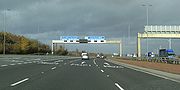
Lighting
In July 1972 the UK Minister for Transport Industries, John PeytonJohn Peyton, Baron Peyton of Yeovil
John Wynne William Peyton, Baron Peyton of Yeovil PC, FZS was a British politician. He was Conservative Member of Parliament for Yeovil for 32 years, from 1951 to 1983, and an early and leading member of the Conservative Monday Club...
announced that 86 miles (138 km) of UK motorway particularly prone to fog would benefit from lighting in a project which "should be" completed by 1973. Sections to be illuminated included the M1 between junctions 3 and 14, and between junctions 24 and 16. In August 2011, the Highways Agency announced that despite being converted to Managed Motorway the lights will be switched off on stretches of the motorway between junctions 10 (Luton) and 13 (Milton Keynes) without affecting road user safety. The motorway junctions and their approaches, and a section of the M1 on either side of junction 11 (north Luton), will have lighting columns replaced and remain lit.
Safety barriers
An increasing official interest in secondary safety was evident in an announcement in March 1973 that work would shortly begin on erecting "tensioned safety barriers" along the central reservation of a 34 miles (54.7 km) section of the M1 between KegworthKegworth
Kegworth is a large village and civil parish in Leicestershire, England....
(J24) and Barlborough
Barlborough
Barlborough is a village and civil parish in the Bolsover district of Derbyshire, England. According to the 2001 census it had a population of 3,018. The village is near junction 30 of the M1 motorway and is about five miles north of Bolsover...
(J30).
Leeds to Hook Moor, 1999
Between 1996 and 1999 the M1 section north of the M62 underwent a major reconstruction and extension to take the M1 on a new route to the A1(M) at AberfordAberford
Aberford is a large village and civil parish on the eastern outskirts of the City of Leeds metropolitan borough in West Yorkshire, England. It has a population of 1,059 according to the 2001 census...
. The new road involved the construction of a series of new junctions, bridges and viaducts to the east of Leeds. When the new section of M1 was completed and opened on 4 February 1999, the Leeds South Eastern Motorway section of the M1 was redesignated as the M621 and the junctions were given new numbers (M621 junctions 4 to 7).
London extensions, 1966, 1967 and 1977
The M1 was extended south from its original starting point at junction 5 towards London in three stages. The first stage, opened in 1966, took the motorway south-east, parallel to the A41 to meet the A5 at junction 4 south of ElstreeElstree
Elstree is a village in the Hertsmere borough of Hertfordshire on the A5 road, about 10 miles north of London. In 2001, its population was 4,765, and forms part of the civil parish of Elstree and Borehamwood, originally known simply as Elstree....
. The second phase continued east to Scratchwood
Scratchwood
Scratchwood is an extensive, mainly wooded, country park in Mill Hill in the London Borough of Barnet. The 55 hectare site was designated a Local Nature Reserve in 1997, and it is a Site of Metropolitan Importance...
(the London Gateway Service Area occupies the location of the missing junction 3 from where an unbuilt spur would have connected to the A1 at Stirling Corner to the north-east. This spur is still visible to southbound traffic approximately 650 yards (594.4 m) before Junction 2). The M1 then runs south alongside the Midland Main Line
Midland Main Line
The Midland Main Line is a major railway route in the United Kingdom, part of the British railway system.The present-day line links London St...
towards Hendon
Hendon
Hendon is a London suburb situated northwest of Charing Cross.-History:Hendon was historically a civil parish in the county of Middlesex. The manor is described in Domesday , but the name, 'Hendun' meaning 'at the highest hill', is earlier...
where it meets the A1 again at Junction 2 via a tightly curved flyover section. These flyovers connecting from the A1 were originally both for northbound traffic; the left one as the on-ramp to the M1, the right one going over the A1/A41 junction beneath to rejoin the A1 northbound.
Junction 2 is about 650 yards (594.4 m) south of the original junction 3. Southbound traffic originally left the motorway via a slip road which passed under the A41/A1 Mill Hill Bypass and looped round to join it at Fiveways Interchange. This slip road is still in place and was maintained until the early 2000s though not accessible to traffic. The northbound slip road from the A1 is now partially used as the entrance way to a business park but no longer reaches the northbound carriageway as it is cut off by the motorway continuing south.
The final section of the M1 was opened to junction 1 at Staples Corner
Staples Corner
Staples Corner is a major road junction in London, United Kingdom.It has two linked roundabouts and flyovers, which connect the A406 North Circular Road with the A5 Edgware Road and the start of the M1 motorway...
in 1977. There the motorway meets the North Circular Road
A406 road
The A406 or the North Circular Road is a road which crosses North London, UK, linking West and East London. It, together with the South Circular Road, forms a ring road through the inner part of Outer London...
(A406) at a grade separated
Grade separation
Grade separation is the method of aligning a junction of two or more transport axes at different heights so that they will not disrupt the traffic flow on other transit routes when they cross each other. The composition of such transport axes does not have to be uniform; it can consist of a...
junction and roundabout. Unrealised plans made in the 1960s would have seen the motorway continue through the junction on an elevated roadway to end at West Hampstead
West Hampstead
West Hampstead is an area in northwest London, England, situated between Childs Hill to the north, Frognal and Hampstead to the north-east, Swiss Cottage to the east, and South Hampstead to the south. Until the late 19th century, the locale was a small village called West End...
where it would have met the North Cross Route
North Cross Route
North Cross Route was a planned motorway-standard road which would have formed the northern section of Ringway 1 and would have formed the innermost circuit of the London Ringways network. The six-lane dual carriageway with grade separated junctions to an extended M1 Motorway was planned during...
, the northern section of the London Motorway Box
Ringway 1
Ringway 1 or the London Motorway Box was the innermost of the series of four motorway standard roads, known as the London Ringways as part of a comprehensive scheme developed by the Greater London Council to provide high speed motorway-standard roads within the capital linking a series of radial...
, a proposed ring of urban motorway around the central area. The layout of the Staples Corner junction was originally built in accordance with these plans although most of the London Ringways
London Ringways
The London Ringways were a series of four ring roads planned in the 1960s to circle London at various distances from the city centre. They were part of a comprehensive scheme developed by the Greater London Council to alleviate traffic congestion on the city's road system by providing high speed...
Plan had been cancelled by 1973. Around the same time the section between the M10 and junction 5 was widened from the original two lanes to three.
On its completion, the M1 acted as a fast link road between London
London
London is the capital city of :England and the :United Kingdom, the largest metropolitan area in the United Kingdom, and the largest urban zone in the European Union by most measures. Located on the River Thames, London has been a major settlement for two millennia, its history going back to its...
and Birmingham
Birmingham
Birmingham is a city and metropolitan borough in the West Midlands of England. It is the most populous British city outside the capital London, with a population of 1,036,900 , and lies at the heart of the West Midlands conurbation, the second most populous urban area in the United Kingdom with a...
. It also provided a link to London Luton Airport
London Luton Airport
London Luton Airport is an international airport located east of the town centre in the Borough of Luton in Bedfordshire, England and is north of Central London. The airport is from Junction 10a of the M1 motorway...
for these regions, and its proximity to the site of the Milton Keynes
Milton Keynes
Milton Keynes , sometimes abbreviated MK, is a large town in Buckinghamshire, in the south east of England, about north-west of London. It is the administrative centre of the Borough of Milton Keynes...
new town
New town
A new town is a specific type of a planned community, or planned city, that was carefully planned from its inception and is typically constructed in a previously undeveloped area. This contrasts with settlements that evolve in a more ad hoc fashion. Land use conflicts are uncommon in new...
(designated in 1967) meant that it was soon providing a vital transport link to another major area.
Recent developments
In 2006 plans were developed to widen 240 miles (386.2 km) from Leicester through to Leeds (junctions 21-42) which were subject to widespread road protests The Transport Select Committee then claimed the Highways Agency had 'lost budgetary control' and the National Audit OfficeNational Audit Office (United Kingdom)
The National Audit Office is an independent Parliamentary body in the United Kingdom which is responsible for auditing central government departments, government agencies and non-departmental public bodies...
was asked to investigate why the price of the project has risen from £3.7 billion to £5.1 billion in 2007. Plans were scaled back with widening to 4 lanes limited to the section from the M25 to Luton (junctions 6a to 10) which was already in progress and from Nottingham and Mansfield (junctions 25-28) with hard-shoulder running being proposed for other sections.
A 10 miles (16.1 km) section between the M25 and Luton (junctions 6a and 10) was widened to dual 4-lanes and opened in 2009. This project included the construction of new parallel roads between Junctions 7 and 8 for local traffic, widening or replacement of 11 underbridges on one or both carriageways and replacing 7 overbridges. The cost was £294 million. As part of the project a variable speed limit system (MIDAS
Motorway Incident Detection and Automatic Signalling
Motorway Incident Detection and Automatic Signalling, usually abbreviated to MIDAS, is a distributed network of traffic sensors, mainly inductive loops, which are designed to set variable message signs and advisory speed limits with little human intervention...
) has been installed, much like the one used on the M25
M25 motorway
The M25 motorway, or London Orbital, is a orbital motorway that almost encircles Greater London, England, in the United Kingdom. The motorway was first mooted early in the 20th century. A few sections, based on the now abandoned London Ringways plan, were constructed in the early 1970s and it ...
. Also, the M10 spur was reclassified as part of the A414 road
A414 road
The A414 is a major road in England. It runs from the A41 at a junction west of Hemel Hempstead in Hertfordshire, through the town to junction 8 of the M1 motorway at Buncefield, and running parallel to the M1 until junction 7, heading south of St Albans, east through Hatfield, Hertford, then...
.
Work to widen the 15 miles (24.1 km) section from Nottingham
Nottingham
Nottingham is a city and unitary authority in the East Midlands of England. It is located in the ceremonial county of Nottinghamshire and represents one of eight members of the English Core Cities Group...
to Mansfield
Mansfield
Mansfield is a town in Nottinghamshire, England. It is the main town in the Mansfield local government district. Mansfield is a part of the Mansfield Urban Area....
(J25-J28) to dual 4-lanes began in January 2008 and was completed in 2010 at a cost of £340 million. Average speed cameras
Automatic number plate recognition
Automatic number plate recognition is a mass surveillance method that uses optical character recognition on images to read the license plates on vehicles. They can use existing closed-circuit television or road-rule enforcement cameras, or ones specifically designed for the task...
which were installed initially only for the period of construction have proven to be so effective that they have been retained permanently on this section of the motorway.
M1 J10 to J13 improvement scheme
Hard shoulder running is being introduced on approximately 15 miles (24.1 km) of motorway between Junction 10, south of LutonLuton
Luton is a large town and unitary authority of Bedfordshire, England, 30 miles north of London. Luton and its near neighbours, Dunstable and Houghton Regis, form the Luton/Dunstable Urban Area with a population of about 250,000....
, and Junction 13 where it joins with the A421
A421 road
The A421 is an important road for east/west journeys across England. Together with the A428, the A43 and A34, it forms the route from Cambridge through Milton Keynes to Oxford...
. Modifications are also being made to junctions 11 and 12. The scheme was announced in January 2009 and will cost between £326 million and £503 million and opening in 2013. This plan replaced earlier proposals to widen the section to 4 lanes and replace bridges crossing the motorway, including some considered to be of historical architectural value. The public inquiry was then delayed by four months in 2007 for further traffic modelling work was undertaken. The widening scheme was abandoned after the estimated cost had escalated from £382 million to £601 million.
Related schemes include the recent upgrade to the A421 road
A421 road
The A421 is an important road for east/west journeys across England. Together with the A428, the A43 and A34, it forms the route from Cambridge through Milton Keynes to Oxford...
to dual two-lane from Junction 13 to the Bedford
Bedford
Bedford is the county town of Bedfordshire, in the East of England. It is a large town and the administrative centre for the wider Borough of Bedford. According to the former Bedfordshire County Council's estimates, the town had a population of 79,190 in mid 2005, with 19,720 in the adjacent town...
southern bypass.
M1 J28-31 Managed Motorways
To introduce managed motorwayManaged motorways in the United Kingdom
Managed motorways are motorways with technology to allow variable speed limits to be applied and hard shoulder running.-Background:The first section of motorway in the UK to use this technique was the M42 in the West Midlands...
technologies between junctions 28 (Mansfield) and 31 (Sheffield) with work taking place between 2012 and 2014.
M1 J32-35a Managed Motorways
Provisional plans for a managed motorway scheme including dynamic hard shoulder running on the M1 motorway between junctions 32 and 35a serving South Yorkshire and in particular the urban areas of Sheffield and Leeds was confirmed in November 2010.M1 Junctions 39–42 Managed Motorways
Provisional plans for a managed motorway scheme including dynamic hard shoulder running on the M1 motorway between junctions 39 and 42 serving South Yorkshire and in particular the urban areas of Wakefield and Leeds was announced in November 2010 which includes a link to the M62 at Junction 42.M1/M69 Junction
There are plans to widen the M1 to dual 4 lane or dual 5 lane between junctions 21 and 21a and construct a new link road between the M1 and the M69M69 motorway
The M69 is a lightly used dual three lane dual carriageway motorway in Leicestershire and Warwickshire, England connecting Leicester and Coventry. It opened in 1977.-History:...
including a new road bridge to take southbound M1 traffic over the motorway to connect to the M69. During this work the Leicester Forest East services
Leicester Forest East services
Leicester Forest East services is a motorway service station situated between junctions 21 and 21a of the M1 motorway, near Leicester, England.-History:...
would be closed. Consultation took place in 2007 and a completion date of 2014 is suggested. However the Highway Agency separately suggests that scheme development will 'recommence' in 2014/15 with a provisional programmed start of works 2017/18.
Other proposals
A planned £201 million to £302 million upgrade to the overloaded Catthorpe InterchangeCatthorpe Interchange
The Catthorpe Interchange is a major intersection at the southern end of the M6, the western end of the A14 and Junction 19 of the M1 near the village of Catthorpe in Leicestershire, England...
between the M1 motorway, M6 motorway
M6 motorway
The M6 motorway runs from junction 19 of the M1 at the Catthorpe Interchange, near Rugby via Birmingham then heads north, passing Stoke-on-Trent, Manchester, Preston, Carlisle and terminating at the Gretna junction . Here, just short of the Scottish border it becomes the A74 which continues to...
and A14 road close to Catthorpe
Catthorpe
Catthorpe is a village and civil parish in the Harborough district of Leicestershire, England. It is close to the A5 road which forms the border with Warwickshire - the nearest town is Rugby, about four miles south-west. The parish had a population of 179 according to the 2001 census. The parish...
was put on hold in June 2010 and was then 'shelved' as a result of the government spending review.
In addition to the above schemes, the Highways Agency also plans to add capacity and improve flows on the following sections of motorway in the longer term.
| Location | Works | Start date |
|---|---|---|
| M1 J21a - J23a | Hard shoulder running | after 2020 |
| M1 J23a - J24a | Various works including hard shoulder running | after 2015 |
| M1 J24 - J25 | Hard shoulder running | after 2015 |
Plans to dual the A421 from Junction 13 to Milton Keynes
Milton Keynes
Milton Keynes , sometimes abbreviated MK, is a large town in Buckinghamshire, in the south east of England, about north-west of London. It is the administrative centre of the Borough of Milton Keynes...
and to add capacity to Junction 10a
Transport in Luton
Luton has excellent transport links and is situated less than 50km north of the centre of London, giving it good links with the City and other parts of the country via the motorway network and the National Rail system. Luton is also home to London Luton Airport, one of the major feeder airports...
on the Luton
Luton
Luton is a large town and unitary authority of Bedfordshire, England, 30 miles north of London. Luton and its near neighbours, Dunstable and Houghton Regis, form the Luton/Dunstable Urban Area with a population of about 250,000....
spur are being developed.
Plans for a new A5-M1 Link (Dunstable Northern Bypass)
Dunstable
Dunstable is a market town and civil parish located in Bedfordshire, England. It lies on the eastward tail spurs of the Chiltern Hills, 30 miles north of London. These geographical features form several steep chalk escarpments most noticeable when approaching Dunstable from the north.-Etymology:In...
from new Junction 11a to the A5 road
A5 road
The A5 is a major road in England and Wales. It is also the first Roman built road in England hence the name Roman Road. It runs for about from London, England to Holyhead, Wales, following in part a section of the Roman Iter II route which later took the Anglo-Saxon name Watling...
are currently on hold awaiting the next government spending review.
Notable events
In March 1972 200 vehicles crashed in thick fog resulting in the deaths of nine people on the M1 north of Luton, Bedfordshire.- On 8 January 1989 forty seven passengers died when a Boeing 737 crashed onto the embankment of the M1Kegworth air disasterThe Kegworth Air Disaster occurred on 8 January 1989, when British Midland Flight 92, a Boeing 737–400, crashed onto the embankment of the M1 motorway near Kegworth, Leicestershire, in England. The aircraft was attempting to conduct an emergency landing at East Midlands Airport...
whilst attempting an emergency landing at East Midlands Airport in LeicestershireLeicestershireLeicestershire is a landlocked county in the English Midlands. It takes its name from the heavily populated City of Leicester, traditionally its administrative centre, although the City of Leicester unitary authority is today administered separately from the rest of Leicestershire...
.
- On 6 September 1997 large sections of the northbound carriageway were closed between London and AlthorpAlthorpAlthorp is a country estate of about and a stately home in Northamptonshire, England. It is about north-west of the county town of Northampton. The late Diana, Princess of Wales is buried in the estate.-History:...
, NorthamptonshireNorthamptonshireNorthamptonshire is a landlocked county in the English East Midlands, with a population of 629,676 as at the 2001 census. It has boundaries with the ceremonial counties of Warwickshire to the west, Leicestershire and Rutland to the north, Cambridgeshire to the east, Bedfordshire to the south-east,...
to allow for the funeral procession of Diana, Princess of WalesDiana, Princess of WalesDiana, Princess of Wales was the first wife of Charles, Prince of Wales, whom she married on 29 July 1981, and an international charity and fundraising figure, as well as a preeminent celebrity of the late 20th century...
. In an unprecedented event, police allowed pedestrians onto the normally busy northbound carriageway almost the entire length of the route to pay their respects.
- In 2002, a section of the M1 near Milton KeynesMilton KeynesMilton Keynes , sometimes abbreviated MK, is a large town in Buckinghamshire, in the south east of England, about north-west of London. It is the administrative centre of the Borough of Milton Keynes...
was cleared using mobile police roadblocks to allow for filming of the movie 28 Days Later28 Days Later28 Days Later is an acclaimed 2002 British horror film directed by Danny Boyle. The screenplay was written by Alex Garland, and the film stars Cillian Murphy, Naomie Harris, Brendan Gleeson, Megan Burns, and Christopher Eccleston...
.
- An 18 miles (29 km) stretch of the motorway was closed entirely on the morning of 11 December 2005 following a major explosion and fire at the Buncefield Oil Depot2005 Hertfordshire Oil Storage Terminal fireThe Buncefield fire was a major conflagration caused by a series of explosions on 11 December 2005 at the Hertfordshire Oil Storage Terminal, an oil storage facility located near the M1 motorway by Hemel Hempstead in Hertfordshire, England. The terminal was the fifth largest oil-products...
which is less than half a mile (800 m) from the M1.
- In June 2007 the section of M1 between Junctions 32 and 36 was closed for a number of days after the UlleyUlleyUlley is a village and civil parish of the Metropolitan Borough of Rotherham in South Yorkshire, England. It is located about south of the town of Rotherham and east of Sheffield City Centre.-History:...
reservoir developed cracks after being deluged in the June 2007 United Kingdom floods.
- Part of the motorway close to Tinsley Viaduct was closed to allow safe demolition of the Tinsley cooling towers in the early hours of the 24 August 2008. the M1 remaining closed for much of the day until the stability of the viaduct was confirmed.
- On 15 April 2011 a seven mile stretch of the road was closed between junctions 1 and 4 due to a fire at a scrapyard underneath the motorway. The road was fully re-opened early on 21 April 2011 with a 50mph speed limit in force whilst repair work continued to an elevated section.
Junctions
{| border=1 cellpadding=2 style="margin-left:1em; margin-bottom: 1em; color: black; border-collapse: collapse; font-size: 95%;" class="wikitable"|- align="center" bgcolor="0080d0" style="color: white;font-size:120%;"
| colspan="5" | M1 Motorway junctions
|-
!scope=col|km
!scope=col abbr="Southbound"|Southbound exits (B Carriageway)
!scope=col|Junction
!scope=col abbr="Northbound"|Northbound exits (A Carriageway)
!scope=col|Coordinates
|- align="center"
|11.3
| North Circular (West), Brent Cross
Brent Cross
Brent Cross is an area of north London, in the London Borough of Barnet. It is located near the A41 Brent Cross Flyover over the A406 North Circular Road. Brent Cross is best known for its shopping centre and the proposed Brent Cross Cricklewood development....
A406
A406 road
The A406 or the North Circular Road is a road which crosses North London, UK, linking West and East London. It, together with the South Circular Road, forms a ring road through the inner part of Outer London...
| J1
M1 - Southern terminus
| Start of motorway
| 51.57515°N 0.23471°W
|- align="center"
|14.6
14.8
| North Circular (East) A406
The City
City of London
The City of London is a small area within Greater London, England. It is the historic core of London around which the modern conurbation grew and has held city status since time immemorial. The City’s boundaries have remained almost unchanged since the Middle Ages, and it is now only a tiny part of...
A1
| J2
| No access
| 51.60399°N 0.23977°W
|- align="center"
|19.3
|London Gateway services
London Gateway services
London Gateway services is the southern-most motorway service station on the M1 motorway, located between Junctions 2 and 4 north of London, England....
|Services
|London Gateway services
| 51.63513°N 0.26610°W
|- align="center"
|21.3
21.8
| Edgware
Edgware
Edgware is an area in London, situated north-northwest of Charing Cross. It forms part of both the London Borough of Barnet and the London Borough of Harrow. The area is identified in the London Plan as one of 35 major centres in Greater London....
A41
A41 road
The A41 is a formerly-major trunk road in England that links London and Birkenhead, although it has now largely been superseded by motorways. It passes through or near various towns and cities including Watford, Hemel Hempstead, Aylesbury, Solihull, Birmingham, West Bromwich, Wolverhampton,...
| J4
| No access
| 51.63612°N 0.30468°W
|- align="center"
|27.5
28.1
| Harrow
Harrow, London
Harrow is an area in the London Borough of Harrow, northwest London, United Kingdom. It is a suburban area and is situated 12.2 miles northwest of Charing Cross...
A41
Watford
Watford
Watford is a town and borough in Hertfordshire, England, situated northwest of central London and within the bounds of the M25 motorway. The borough is separated from Greater London to the south by the urbanised parish of Watford Rural in the Three Rivers District.Watford was created as an urban...
A4008
A4008 road
The A4008 road starts at Hatch End in the London Borough of Harrow at a roundabout on the A410. It runs North from the roundabout and is known as Oxhey Lane. After it passes over the route of the Grims Dyke and Grimsdyke Golf Course is to the East. Very soon afterwards it passes in to Hertfordshire...
| J5
| Aylesbury
Aylesbury
Aylesbury is the county town of Buckinghamshire in South East England. However the town also falls into a geographical region known as the South Midlands an area that ecompasses the north of the South East, and the southern extremities of the East Midlands...
, Watford A41
| 51.67162°N 0.36894°W
|- align="center"
|31.7
32.2
| North Watford A405
A405 road
The A405 is a main five-mile-long dual carriageway road in Hertfordshire. It has, however, been a longer road.-North Orbital Road:As the North Orbital Road, it occupied what is now junctions 17 to 19 of the M25, being one of the first sections of the M25 to open. The section of the M25 from...
| J6
| St Albans
St Albans
St Albans is a city in southern Hertfordshire, England, around north of central London, which forms the main urban area of the City and District of St Albans. It is a historic market town, and is now a sought-after dormitory town within the London commuter belt...
, Heathrow Airport, Harlow A405
| 51.70602°N 0.38182°W
|- align="center"
|32.9
33.5
| Heathrow, Gatwick, M40
M40 motorway
The M40 motorway is a motorway in the British transport network that forms a major part of the connection between London and Birmingham. Part of this road forms a section of the unsigned European route E05...
, M4
M4 motorway
The M4 motorway links London with South Wales. It is part of the unsigned European route E30. Other major places directly accessible from M4 junctions are Reading, Swindon, Bristol, Newport, Cardiff and Swansea...
, M23
M23 motorway
The M23 motorway is a motorway in England. The motorway runs from south of Hooley in Surrey, where it splits from the A23, to Pease Pottage, south of Crawley in West Sussex where it rejoins the A23. The northern end of the motorway starts at junction 7 on what is effectively a spur north from...
,
Stansted Airport M11
M11 motorway
The M11 motorway in England is a major road running approximately north from the North Circular Road in South Woodford in north-east London to the A14, north-west of Cambridge.-Route:...
, M20
M20 motorway
The M20 is a motorway in Kent, England. It runs from the M25 motorway to Folkestone, providing a link to the Channel Tunnel and the ports at Dover. It is long...
, M25
M25 motorway
The M25 motorway, or London Orbital, is a orbital motorway that almost encircles Greater London, England, in the United Kingdom. The motorway was first mooted early in the 20th century. A few sections, based on the now abandoned London Ringways plan, were constructed in the early 1970s and it ...
| J6a
M1 - M25 interchange
| No access
| 51.71831°N 0.38607°W
|- align="center"
|36.2
36.6
| St Albans, Hatfield
Hatfield, Hertfordshire
Hatfield is a town and civil parish in Hertfordshire, England in the borough of Welwyn Hatfield. It has a population of 29,616, and is of Saxon origin. Hatfield House, the home of the Marquess of Salisbury, is the nucleus of the old town...
A414
A414 road
The A414 is a major road in England. It runs from the A41 at a junction west of Hemel Hempstead in Hertfordshire, through the town to junction 8 of the M1 motorway at Buncefield, and running parallel to the M1 until junction 7, heading south of St Albans, east through Hatfield, Hertford, then...
| J7
| No access
| 51.74930°N 0.40928°W
|- align="center"
|37.8
38.3
| Hemel Hempstead
Hemel Hempstead
Hemel Hempstead is a town in Hertfordshire in the East of England, to the north west of London and part of the Greater London Urban Area. The population at the 2001 Census was 81,143 ....
| J8
| Hemel Hempstead A414
| 51.75695°N 0.41641°W
|- align="center"
|44.9
45.6
| Redbourn
Redbourn
Redbourn is a village and civil parish in Hertfordshire, United Kingdom, lying on Watling Street, 3 miles from Harpenden, 4 miles from St Albans and 5 miles from Hemel Hempstead. It has a population of around 6,000.-History:...
A5183
A5183 road
The A5183 road is a de-trunked section of the A5. It covers the section between Junction 9 of the M1 motorway and Edgware in north London, largely along Watling Street...
| J9
| Dunstable A5, Redbourn A5183
| 51.82000°N 0.41714°W
|- align="center"
|48.8
49.2
| Luton Airport A1081
A1081 road
The A1081 road in Hertfordshire, England broadly follows and replaces the former route of the A6 south of Luton in Bedfordshire.It runs from Luton Airport south via Harpenden to St Albans and then bears southeast via London Colney to High Barnet, where it meets the A1000 .The route was renumbered...
| J10
| Luton Airport A1081
| 51.85397°N 0.42370°W
|- align="center"
|54.3
54.7
| Luton
Luton
Luton is a large town and unitary authority of Bedfordshire, England, 30 miles north of London. Luton and its near neighbours, Dunstable and Houghton Regis, form the Luton/Dunstable Urban Area with a population of about 250,000....
, Dunstable
Dunstable
Dunstable is a market town and civil parish located in Bedfordshire, England. It lies on the eastward tail spurs of the Chiltern Hills, 30 miles north of London. These geographical features form several steep chalk escarpments most noticeable when approaching Dunstable from the north.-Etymology:In...
A505
A505 road
The A505 is an A-class road in the United Kingdom. It follows part of the route of the Icknield Way and the corresponding Icknield Way Path.-Bedfordshire:...
| J11
| Luton, Dunstable A505
| 51.89347°N 0.46988°W
|- align="center"
|62.6
|Toddington services
|Services
|Toddington services
| 51.94778°N 0.50275°W
|- align="center"
|62.0
62.6
| Flitwick
Flitwick
Flitwick, pronounced , is a small town and civil parish in Central Bedfordshire, England. The nearby River Flit runs through Flitwick Moor, a nature reserve and a Site of Special Scientific Interest.-Location:...
, Houghton Regis
Houghton Regis
Houghton Regis is a town and civil parish sandwiched between the major towns of Luton to the east and Dunstable to the west. The parish includes the ancient hamlets of Bidwell, Thorn and Sewell...
A5120
A5120 road
The A5120 is an A-class road in Bedfordshire, linking the conjoined towns of Ampthill and Flitwick to Dunstable and, via the M1 motorway, Luton and London. It connects with the M1 at junction 12, being the sole road at this junction, in close proximity to the Toddington services. On its route from...
| J12
| Flitwick, Woburn
Woburn, Bedfordshire
Woburn is a small Saxon village and civil parish in Bedfordshire, England. It is situated about southeast of the centre of Milton Keynes, and about south of junction 13 of the M1 motorway and is a popular tourist attraction.-History:...
A5120
| 51.95744°N 0.51606°W
|- align="center"
|72.7
73.1
| Bedford
Bedford
Bedford is the county town of Bedfordshire, in the East of England. It is a large town and the administrative centre for the wider Borough of Bedford. According to the former Bedfordshire County Council's estimates, the town had a population of 79,190 in mid 2005, with 19,720 in the adjacent town...
A421
A421 road
The A421 is an important road for east/west journeys across England. Together with the A428, the A43 and A34, it forms the route from Cambridge through Milton Keynes to Oxford...
Woburn, Ampthill
Ampthill
Ampthill is a small town and civil parish in Bedfordshire, England, between Bedford and Luton, with a population of about 6,000. It is administered by Central Bedfordshire Council. A regular market has taken place on Thursdays for centuries.-History:...
A507
A507 road
The A507 is an A-class road in England, linking the M1 motorway near Milton Keynes to the A10 at Buntingford. Beginning at junction 13 of the M1, the road heads east past Ridgmont to Ampthill. Here it passes between Ampthill and its close neighbour Flitwick, essentially separating the two. After...
| J13
| Milton Keynes
Milton Keynes
Milton Keynes , sometimes abbreviated MK, is a large town in Buckinghamshire, in the south east of England, about north-west of London. It is the administrative centre of the Borough of Milton Keynes...
, Bedford A421
Ampthill A507
| 52.02657°N 0.60360°W
|- align="center"
|80.0
80.8
| Milton Keynes, Newport Pagnell
Newport Pagnell
Newport Pagnell is a town in the Borough of Milton Keynes , England. It is separated by the M1 motorway from Milton Keynes itself, though part of the same urban area...
A509
A509 road
The A509 is a short A-class road for north-south journeys in south central England, forming the route from Kettering in Northamptonshire to the M1 and A5 in Milton Keynes....
| J14
| Milton Keynes, Newport Pagnell A509
| 52.05877°N 0.70012°W
|- align="center"
|86.5
|Newport Pagnell services
|Services
|Newport Pagnell services
| 52.08330°N 0.74853°W
|- align="center"
|99.4
100.2
| Northampton
Northampton
Northampton is a large market town and local government district in the East Midlands region of England. Situated about north-west of London and around south-east of Birmingham, Northampton lies on the River Nene and is the county town of Northamptonshire. The demonym of Northampton is...
A45
A45 road
The A45 is a major road in England. It runs east from Birmingham past the National Exhibition Centre and the M42, then bypasses Coventry and Rugby, where it briefly merges with the M45 until it continues to Daventry...
Milton Keynes A508
A508 road
The A508 is a short A-class road for north/south journeys in south central England, forming the route from Market Harborough in Leicestershire, via Northampton, to Old Stratford, north-west of Milton Keynes....
| J15
| Northampton A45
Milton Keynes A508
| 52.18588°N 0.89551°W
|- align="center"
|103.5
104.5
| Northampton, Oxford
Oxford
The city of Oxford is the county town of Oxfordshire, England. The city, made prominent by its medieval university, has a population of just under 165,000, with 153,900 living within the district boundary. It lies about 50 miles north-west of London. The rivers Cherwell and Thames run through...
A43
A43 road
The A43 is a primary route in the English Midlands, that runs from the M40 motorway near Ardley in Oxfordshire to Stamford in Lincolnshire. Through Northamptonshire it bypasses the towns of Northampton, Kettering and Corby which are the three principal destinations on the A43 route...
(M40
M40 motorway
The M40 motorway is a motorway in the British transport network that forms a major part of the connection between London and Birmingham. Part of this road forms a section of the unsigned European route E05...
)
Northampton services
| J15a
Services
| Northampton, Oxford A43 (M40)
Northampton Services
| 52.20961°N 0.94435°W
|- align="center"
|109.2
109.9
| Northampton A4500
| J16
| Daventry
Daventry
Daventry is a market town in Northamptonshire, England, with a population of 22,367 .-Geography:The town is also the administrative centre of the larger Daventry district, which has a population of 71,838. The town is 77 miles north-northwest of London, 13.9 miles west of Northampton and 10.2...
A45
| 52.23030°N 1.01598°W
|- align="center"
|120.8
|Watford Gap services
|Services
|Watford Gap services
| 52.30696°N 1.12202°W
|- align="center"
|123.3
123.8
| No access
| J17
| Coventry
Coventry
Coventry is a city and metropolitan borough in the county of West Midlands in England. Coventry is the 9th largest city in England and the 11th largest in the United Kingdom. It is also the second largest city in the English Midlands, after Birmingham, with a population of 300,848, although...
M45
M45 motorway
The M45 is a motorway in Northamptonshire and Warwickshire, England and is long. It runs from Junction 17 of the M1 motorway south east of Rugby and ends with a junction with the A45 road southwest of Rugby...
| 52.32464°N 1.14069°W
|- align="center"
|126.3
126.9
| Daventry, DIRFT
Daventry International Railfreight Terminal
Daventry International Rail Freight Terminal is a rail port and logistics centre located near Rugby, Warwickshire and Crick, Northamptonshire just south of the beginning of the M6 Motorway and near junction 18 of the M1 motorway...
A428
A428 road
The A428 road is a major road in central and eastern England. It connects the cities of Coventry and Cambridge by way of the county towns of Northampton and Bedford.-Coventry - Northampton:...
| J18
| Hinckley
Hinckley
Hinckley is a town in southwest Leicestershire, England. It has a population of 43,246 . It is administered by Hinckley and Bosworth Borough Council...
A5
Rugby
Rugby, Warwickshire
Rugby is a market town in Warwickshire, England, located on the River Avon. The town has a population of 61,988 making it the second largest town in the county...
A428
DIRFT
Daventry International Railfreight Terminal
Daventry International Rail Freight Terminal is a rail port and logistics centre located near Rugby, Warwickshire and Crick, Northamptonshire just south of the beginning of the M6 Motorway and near junction 18 of the M1 motorway...
| 52.35089°N 1.15455°W
|- align="center"
|132.4
133.1
| The NORTH WEST M6
M6 motorway
The M6 motorway runs from junction 19 of the M1 at the Catthorpe Interchange, near Rugby via Birmingham then heads north, passing Stoke-on-Trent, Manchester, Preston, Carlisle and terminating at the Gretna junction . Here, just short of the Scottish border it becomes the A74 which continues to...
Felixstowe
Felixstowe
Felixstowe is a seaside town on the North Sea coast of Suffolk, England. The town gives its name to the nearby Port of Felixstowe, which is the largest container port in the United Kingdom and is owned by Hutchinson Ports UK...
, Corby
Corby
Corby Town is a town and borough located in the county of Northamptonshire. Corby Town is 23 miles north-east of the county town, Northampton. The borough had a population of 53,174 at the 2001 Census; the town on its own accounted for 49,222 of this figure...
, Kettering
Kettering
Kettering is a market town in the Borough of Kettering, Northamptonshire, England. It is situated about from London. Kettering is mainly situated on the west side of the River Ise, a tributary of the River Nene which meets at Wellingborough...
A14
| J19
M1 - M6 - A14 interchange
| The NORTH WEST M6
| 52.40522°N 1.17704°W
|- align="center"
|137.6
138.5
| Lutterworth
Lutterworth
Lutterworth is a market town and civil parish in the Harborough district of Leicestershire, England. The town is located in southern Leicestershire, north of Rugby, in Warwickshire and south of Leicester. It had a population of 8,293 in the 2001 UK census....
, Rugby
Rugby, Warwickshire
Rugby is a market town in Warwickshire, England, located on the River Avon. The town has a population of 61,988 making it the second largest town in the county...
A4303
| J20
| Lutterworth
Lutterworth
Lutterworth is a market town and civil parish in the Harborough district of Leicestershire, England. The town is located in southern Leicestershire, north of Rugby, in Warwickshire and south of Leicester. It had a population of 8,293 in the 2001 UK census....
A4303
Market Harborough
Market Harborough
Market Harborough is a market town within the Harborough district of Leicestershire, England.It has a population of 20,785 and is the administrative headquarters of Harborough District Council. It sits on the Northamptonshire-Leicestershire border...
A4304
| 52.45015°N 1.19146°W
|- align="center"
|154.6
155.4
| Coventry
Coventry
Coventry is a city and metropolitan borough in the county of West Midlands in England. Coventry is the 9th largest city in England and the 11th largest in the United Kingdom. It is also the second largest city in the English Midlands, after Birmingham, with a population of 300,848, although...
, Birmingham
Birmingham
Birmingham is a city and metropolitan borough in the West Midlands of England. It is the most populous British city outside the capital London, with a population of 1,036,900 , and lies at the heart of the West Midlands conurbation, the second most populous urban area in the United Kingdom with a...
M69
M69 motorway
The M69 is a lightly used dual three lane dual carriageway motorway in Leicestershire and Warwickshire, England connecting Leicester and Coventry. It opened in 1977.-History:...
Leicester
Leicester
Leicester is a city and unitary authority in the East Midlands of England, and the county town of Leicestershire. The city lies on the River Soar and at the edge of the National Forest...
A5460
| J21
| Coventry M69
Leicester A5460
| 52.60041°N 1.19498°W
|- align="center"
|157.2
|Leicester Forest East services
Leicester Forest East services
Leicester Forest East services is a motorway service station situated between junctions 21 and 21a of the M1 motorway, near Leicester, England.-History:...
|Services
|Leicester Forest East services
| 52.61920°N 1.20579°W
|- align="center"
|159.8
160.1
| No access
| J21a
| Leicester
Leicester
Leicester is a city and unitary authority in the East Midlands of England, and the county town of Leicestershire. The city lies on the River Soar and at the edge of the National Forest...
, Newark
Newark-on-Trent
Newark-on-Trent is a market town in Nottinghamshire in the East Midlands region of England. It stands on the River Trent, the A1 , and the East Coast Main Line railway. The origins of the town are possibly Roman as it lies on an important Roman road, the Fosse Way...
A46
A46 road
The A46 is an A road in England. It starts east of Bath, Somerset and ends in Cleethorpes, North East Lincolnshire, but it does not form a continuous route. Large portions of the old road have been lost, bypassed, or replaced by motorway development...
| 52.63577°N 1.21798°W
|- align="center"
|167.8
168.5
| Leicester
Leicester
Leicester is a city and unitary authority in the East Midlands of England, and the county town of Leicestershire. The city lies on the River Soar and at the edge of the National Forest...
A50
A50 road
The A50 is a major trunk road in England. It runs from Warrington to Leicester; however, it was once a much longer route.-Current route:...
, Coalville
Coalville
Coalville is a town in North West Leicestershire, England, with a population estimated in 2003 to be almost 33,000. It is situated on the A511 trunk road between Leicester and Burton upon Trent, close to junction 22 of the M1 motorway where the A511 meets the A50 between Ashby-de-la-Zouch and...
A511
A511 road
The A511 road is a stretch of mainly single-carriageway road which runs northwest from junction 22 of the M1 motorway in Leicestershire, England to join the A50 between Uttoxeter and Derby....
| J22
| Coalville
Coalville
Coalville is a town in North West Leicestershire, England, with a population estimated in 2003 to be almost 33,000. It is situated on the A511 trunk road between Leicester and Burton upon Trent, close to junction 22 of the M1 motorway where the A511 meets the A50 between Ashby-de-la-Zouch and...
, Ashby-de-la-Zouch
Ashby-de-la-Zouch
Ashby-de-la-Zouch, — Zouch being pronounced "Zoosh" — often shortened to Ashby, is a small market town and civil parish in North West Leicestershire, England, within the National Forest. It is twinned with Pithiviers in north-central France....
A511
| 52.69592°N 1.29240°W
|- align="center"
|175.1
175.8
| Loughborough
Loughborough
Loughborough is a town within the Charnwood borough of Leicestershire, England. It is the seat of Charnwood Borough Council and is home to Loughborough University...
, Ashby-de-la-Zouch
Ashby-de-la-Zouch
Ashby-de-la-Zouch, — Zouch being pronounced "Zoosh" — often shortened to Ashby, is a small market town and civil parish in North West Leicestershire, England, within the National Forest. It is twinned with Pithiviers in north-central France....
A512
A512 road
The A512 is an A road entirely in Leicestershire, UK. It links the primary destination of Loughborough with the M1, A42 road, and the town of Ashby de la Zouch....
| J23
| Loughborough, Ashby-de-la-Zouch A512
| 52.76032°N 1.27394°W
|- align="center"
|182.5
182.8
| The SOUTH WEST, Tamworth
Tamworth
Tamworth is a town and local government district in Staffordshire, England, located north-east of Birmingham city centre and north-west of London. The town takes its name from the River Tame, which flows through the town, as does the River Anker...
, Birmingham
Birmingham
Birmingham is a city and metropolitan borough in the West Midlands of England. It is the most populous British city outside the capital London, with a population of 1,036,900 , and lies at the heart of the West Midlands conurbation, the second most populous urban area in the United Kingdom with a...
,
Ashby-de-la-Zouch
Ashby-de-la-Zouch
Ashby-de-la-Zouch, — Zouch being pronounced "Zoosh" — often shortened to Ashby, is a small market town and civil parish in North West Leicestershire, England, within the National Forest. It is twinned with Pithiviers in north-central France....
, A42
A42 road
The A42 is a major trunk road in the East Midlands region of the United Kingdom. It links junction 23A of the M1 motorway to junction 11 of the M42 motorway. The A42 is in effect a continuation of the M42, and its junctions are numbered accordingly....
(M42
M42 motorway
The M42 motorway is a major road in England. The motorway runs north east from Bromsgrove in Worcestershire to just south west of Ashby-de-la-Zouch in Leicestershire, passing Redditch, Solihull, the National Exhibition Centre and Tamworth on the way. The section between the M40 and M6 road forms...
)
| J23a
Services
| The SOUTH WEST, Tamworth, Birmingham A42 (M42)
East Midlands Airport A453
A453 road
The A453 road was formerly the main trunk road connecting the English cities of Nottingham and Birmingham. However, the middle section of this mainly single-carriageway road has largely been downgraded to B roads or unclassified roads following the construction of the parallel M42-A42 link around...
Donington Park services
Donington Park services
Donington Park services is a motorway service station off the M1 motorway, A453 and A42 interchange near Kegworth, England.-Characteristics:It is owned by Moto and offers 20% discounts to all RAC members...
| 52.81929°N 1.30544°W
|- align="center"
|184.9
185.7
| Loughborough
Loughborough
Loughborough is a town within the Charnwood borough of Leicestershire, England. It is the seat of Charnwood Borough Council and is home to Loughborough University...
A6
East Midlands Airport A453
Donington Park services
Donington Park services
Donington Park services is a motorway service station off the M1 motorway, A453 and A42 interchange near Kegworth, England.-Characteristics:It is owned by Moto and offers 20% discounts to all RAC members...
| J24
| Stoke
Stoke-on-Trent
Stoke-on-Trent , also called The Potteries is a city in Staffordshire, England, which forms a linear conurbation almost 12 miles long, with an area of . Together with the Borough of Newcastle-under-Lyme Stoke forms The Potteries Urban Area...
A50
Derby A6
Nottingham
Nottingham
Nottingham is a city and unitary authority in the East Midlands of England. It is located in the ceremonial county of Nottinghamshire and represents one of eight members of the English Core Cities Group...
South/Centre A453
| 52.84397°N 1.29570°W
|- align="center"
| 186.3
187.0
| Stoke A50, Derby
Derby
Derby , is a city and unitary authority in the East Midlands region of England. It lies upon the banks of the River Derwent and is located in the south of the ceremonial county of Derbyshire. In the 2001 census, the population of the city was 233,700, whilst that of the Derby Urban Area was 229,407...
A6
| J24a
| No access
| 52.85796°N 1.30106°W
|- align="center"
|193.2
193.9
| Nottingham South, Derby A52
A52 road
The A52 is a major road in the East Midlands, England. It runs east from the junction with the A53 at Newcastle-under-Lyme near Stoke-on-Trent via Ashbourne, Derby, Stapleford, Nottingham, West Bridgford, Bingham, Grantham, Boston and Skegness before terminating on the east Lincolnshire coast at...
| J25
| Derby, Nottingham West/Centre A52
| 52.91589°N 1.29969°W
|- align="center"
|199.8
|Trowell services
Trowell Motorway Services
Trowell services is a motorway service station off the M1 motorway in Nottinghamshire, England, situated north of Junction 25. Opened in 1967 by Mecca Leisure, it is currently owned by Moto....
|Services
|Trowell Motorway Services|Trowell services
| 52.96216°N 1.26725°W
|- align="center"
|202.8
203.7
| Nottingham, Ilkeston
Ilkeston
Ilkeston is a town within the Borough of Erewash, in Derbyshire, England. It lies on the River Erewash, from which the local borough takes its name. Its population at the 2001 census was 37,550...
A610
A610 road
The A610 is an A-road in England, which runs from Nottingham to Ambergate, where it joins the A6.-Route:The road starts in Nottingham at a roundabout which Maid Marian Way and Upper Parliament Street spur from. From here road ascends, passing Nottingham Cathedral. The A610 becomes Alfreton Road as...
| J26
| Ripley, Eastwood, Nottingham North/Centre A610
| 52.98991°N 1.23455°W
|- align="center"
| 211.7
212.4
| Heanor
Heanor
Heanor is a town in the Amber Valley district of Derbyshire in the East Midlands of England. It is northeast of Derby. According to the census of 2001 the town's population was 22,620.-History:...
, Hucknall
Hucknall
Hucknall, formerly known as Hucknall Torkard, is a town in Greater Nottingham, Nottinghamshire, England, in the district of Ashfield. The town was historically a centre for framework knitting and then for mining but is now a focus for other industries as well providing housing for workers in...
A608
| J27
| Mansfield
Mansfield
Mansfield is a town in Nottinghamshire, England. It is the main town in the Mansfield local government district. Mansfield is a part of the Mansfield Urban Area....
A608
| 53.06342°N 1.26909°W
|- align="center"
|217.2
218.0
| Matlock A38
A38 road
The A38, part of which is also known as the Devon Expressway, is a major A-class trunk road in England.The road runs from Bodmin in Cornwall to Mansfield in Nottinghamshire. It is long, making it one of the longest A-roads in England. It was formerly known as the Leeds — Exeter Trunk Road,...
| J28
| Mansfield, Matlock A38
| 53.10129°N 1.32398°W
|- align="center"
|222.5
|Tibshelf services
Tibshelf services
Tibshelf services is a motorway service station between junctions 28 and 29 of the M1 motorway in Derbyshire, England. It lies about a kilometre southeast of the village of Tibshelf. It is known as Tibshelf services despite being geographically closer to the villages of Newton and Blackwell. The...
|Services
|Tibshelf services
| 53.13848°N 1.33093°W
|- align="center"
| 228.1
229.0
| Mansfield, Matlock A617
| J29
| Chesterfield
Chesterfield
Chesterfield is a market town and a borough of Derbyshire, England. It lies north of Derby, on a confluence of the rivers Rother and Hipper. Its population is 70,260 , making it Derbyshire's largest town...
A617
| 53.19773°N 1.32287°W
|- align="center"
|
| Markham Vale A6192
Bolsover
Bolsover
Bolsover is a town near Chesterfield, Derbyshire, England. It is 145 miles from London, 18 miles from Sheffield, 26 miles from Nottingham and 54 miles from Manchester. It is the main town in the Bolsover district.The civil parish for the town is called...
(A632)
| J29a
| Markham Vale A6192
Bolsover (A632)
| 53.24647°N 1.33111°W
|- align="center"
|238.9
239.5
| Chesterfield, Newark A616
A616 road
The A616 is a road which links Newark-on-Trent, Nottinghamshire, to the M1 motorway at Junction 30, then reappears at Junction 35A and goes on to Huddersfield, West Yorkshire....
| J30
| Sheffield
Sheffield
Sheffield is a city and metropolitan borough of South Yorkshire, England. Its name derives from the River Sheaf, which runs through the city. Historically a part of the West Riding of Yorkshire, and with some of its southern suburbs annexed from Derbyshire, the city has grown from its largely...
, Worksop
Worksop
Worksop is the largest town in the Bassetlaw district of Nottinghamshire, England on the River Ryton at the northern edge of Sherwood Forest. It is about east-south-east of the City of Sheffield and its population is estimated to be 39,800...
A6135
| 53.28651°N 1.29604°W
|- align="center"
|243.5
|Woodall services
Woodall services
Woodall services is a motorway service station on the M1 motorway near Sheffield. It lies between junctions 30 and 31. It was opened in 1968 by Trust House Forte but was renamed Welcome Break after the takeover of the company....
|Services
|Woodall services
| 53.31552°N 1.28214°W
|- align="center"
|247.5
248.2
| Worksop A57
A57 road
The A57 is a major road in England. It runs east from Liverpool to Lincoln, via Warrington, Cadishead, Irlam, Patricroft, Eccles, Salford and Manchester, then through the Pennines over the Snake Pass , around the Ladybower Reservoir, through Sheffield and past Worksop...
| J31
| Sheffield (SE) A57
| 53.36221°N 1.28347°W
|- align="center"
|251.6
252.1
| The NORTH
The North
The North may refer to:* a geographical section of the world * the wealthy and technologically advanced nations of the world, as contrasted with the nations comprising the South...
, Doncaster
Doncaster
Doncaster is a town in South Yorkshire, England, and the principal settlement of the Metropolitan Borough of Doncaster. The town is about from Sheffield and is popularly referred to as "Donny"...
, Hull
Kingston upon Hull
Kingston upon Hull , usually referred to as Hull, is a city and unitary authority area in the ceremonial county of the East Riding of Yorkshire, England. It stands on the River Hull at its junction with the Humber estuary, 25 miles inland from the North Sea. Hull has a resident population of...
M18
| J32
M1 - M18 interchange
| The North, Doncaster, Hull M18
| 53.39160°N 1.28231°W
|- align="center"
|255.6
256.2
| Sheffield (centre), Rotherham
Rotherham
Rotherham is a town in South Yorkshire, England. It lies on the River Don, at its confluence with the River Rother, between Sheffield and Doncaster. Rotherham, at from Sheffield City Centre, is surrounded by several smaller settlements, which together form the wider Metropolitan Borough of...
, A630
| J33
| Sheffield (centre), Rotherham, A630
| 53.39848°N 1.34977°W
|- align="center"
|259.9
260.3
| Meadowhall
Meadowhall
Meadowhall is an indoor shopping centre in Sheffield, South Yorkshire, England. It lies three miles north east of Sheffield city centre and four miles from Rotherham town centre....
, Rotherham A6109:
| J34
| Meadowhall, Sheffield, Rotherham A6178:
| 53.41754°N 1.40634°W
|- align="center"
|265.4
266.2
| Rotherham A629
| J35
| Rotherham A629
| 53.45581°N 1.44539°W
|- align="center"
|268.2
268.6
| No access
| J35a
| Manchester
Manchester
Manchester is a city and metropolitan borough in Greater Manchester, England. According to the Office for National Statistics, the 2010 mid-year population estimate for Manchester was 498,800. Manchester lies within one of the UK's largest metropolitan areas, the metropolitan county of Greater...
A616
A616 road
The A616 is a road which links Newark-on-Trent, Nottinghamshire, to the M1 motorway at Junction 30, then reappears at Junction 35A and goes on to Huddersfield, West Yorkshire....
| 53.47525°N 1.45891°W
|- align="center"
|270.3
271.2
| Sheffield A61
A61 road
The A61 is a major trunk road in England. It runs from Derby to Thirsk in North Yorkshire. From Derby, it heads north via Alfreton, Clay Cross, Chesterfield, Sheffield, Barnsley, Wakefield, Leeds, Harrogate and Ripon...
| J36
| Barnsley
Barnsley
Barnsley is a town in South Yorkshire, England. It lies on the River Dearne, north of the city of Sheffield, south of Leeds and west of Doncaster. Barnsley is surrounded by several smaller settlements which together form the Metropolitan Borough of Barnsley, of which Barnsley is the largest and...
A61
| 53.49632°N 1.47547°W
|- align="center"
|276.9
277.8
| Barnsley, Manchester A628
A628 road
The A628 is a major road in the north of England connecting Greater Manchester and South Yorkshire by crossing the Pennine chain of hills by way of the Woodhead Pass through the Peak District National Park. The height and the exposure of the road often creates problems during poor weather in winter...
| J37
| Barnsley, Manchester A628
| 53.54872°N 1.51568°W
|- align="center"
|283.9
284.7
| Huddersfield
Huddersfield
Huddersfield is a large market town within the Metropolitan Borough of Kirklees, in West Yorkshire, England, situated halfway between Leeds and Manchester. It lies north of London, and south of Bradford, the nearest city....
, Barnsley A637
| J38
| Huddersfield, Barnsley A637
| 53.60297°N 1.55092°W
|- align="center"
|287.2
|Woolley Edge services
|Services
|Woolley Edge services
| 53.62161°N 1.54821°W
|- align="center"
|289.5
290.4
| Denby Dale
Denby Dale
Denby Dale is a village and civil parish in the metropolitan borough of Kirklees in West Yorkshire, England, to the South East of Huddersfield. As a civil parish it covers the villages of Denby Dale, Lower Denby, Upper Denby, Upper Cumberworth, Lower Cumberworth, Skelmanthorpe, Emley, Emley...
A636
| J39
| Denby Dale A636
| 53.65064°N 1.52869°W
|- align="center"
|293.8
294.5
| Wakefield
Wakefield
Wakefield is the main settlement and administrative centre of the City of Wakefield, a metropolitan district of West Yorkshire, England. Located by the River Calder on the eastern edge of the Pennines, the urban area is and had a population of 76,886 in 2001....
, Dewsbury
Dewsbury
Dewsbury is a minster town in the Metropolitan Borough of Kirklees, in West Yorkshire, England. It is to the west of Wakefield, east of Huddersfield and south of Leeds...
A638
A638 road
The A638 is a main road in England that runs between the A1 at Markham Moor in Nottinghamshire and Chain Bar Junction 26 of the M62 motorway south of Bradford in West Yorkshire....
| J40
| Wakefield, Dewsbury, Batley
Batley
Batley is a town within the Metropolitan Borough of Kirklees, in West Yorkshire, England. It lies southeast of Bradford, southwest of Leeds and north of Dewsbury, near the M62 motorway. It has a population of 49,448 . Other nearby towns include Morley to the northeast, Ossett to the southeast...
A638
| 53.68357°N 1.55508°W
|- align="center"
|297.9
298.7
| Wakefield, Morley
Morley, West Yorkshire
Morley is a market town and civil parish within the metropolitan borough of the City of Leeds, in West Yorkshire, England. It lies approximately south-west of Leeds city centre. Together with Drighlington, Gildersome, Churwell, Tingley and East/West Ardsley, the town had a population of 47,579 in...
A650
| J41
| Wakefield, Morley A650
| 53.71556°N 1.53534°W
|- align="center"
| 300.1
301.0
| Hull, Manchester M62
M62 motorway
The M62 motorway is a west–east trans-Pennine motorway in Northern England, connecting the cities of Liverpool and Hull via Manchester and Leeds. The road also forms part of the unsigned Euroroutes E20 and E22...
| J42
M1 - M62 interchange
| Hull, Manchester, Bradford
Bradford
Bradford lies at the heart of the City of Bradford, a metropolitan borough of West Yorkshire, in Northern England. It is situated in the foothills of the Pennines, west of Leeds, and northwest of Wakefield. Bradford became a municipal borough in 1847, and received its charter as a city in 1897...
, Liverpool
Liverpool
Liverpool is a city and metropolitan borough of Merseyside, England, along the eastern side of the Mersey Estuary. It was founded as a borough in 1207 and was granted city status in 1880...
M62
| 53.73087°N 1.51195°W
|- align="center"
|303.2
304.1
| No access
| J43
| Leeds
Leeds
Leeds is a city and metropolitan borough in West Yorkshire, England. In 2001 Leeds' main urban subdivision had a population of 443,247, while the entire city has a population of 798,800 , making it the 30th-most populous city in the European Union.Leeds is the cultural, financial and commercial...
M621
M621 motorway
The M621 motorway is a short loop of motorway in England that takes traffic into central Leeds between the M1 and M62 motorways. It is the second longest motorway in the United Kingdom to carry a three digit number although it carries more junctions than any other three digit motorway within the...
| 53.75460°N 1.51461°W
|- align="center"
|304.8
305.6
| Leeds A639
| J44
| Leeds A639
| 53.76256°N 1.49139°W
|- align="center"
| 307.1
307.7
| Leeds A63
A63 road
The A63 is a major road in Yorkshire, England between Leeds and Hull.-Leeds – Howden:The route out to Selby is shadowed by the Leeds-Selby railway....
| J45
| Leeds A63
| 53.77613°N 1.47041°W
|- align="center"
|311.7
312.2
| Leeds A6120
| J46
| Leeds A6120
Selby
Selby
Selby is a town and civil parish in North Yorkshire, England. Situated south of the city of York, along the course of the River Ouse, Selby is the largest and, with a population of 13,012, most populous settlement of the wider Selby local government district.Historically a part of the West Riding...
A63
| 53.79198°N 1.42646°W
|- align="center"
| 316.4
317.1
| Castleford
Castleford
Castleford is the largest of the "five towns" district in the metropolitan borough of the City of Wakefield, in West Yorkshire, England. It is near Pontefract, and has a population of 37,525 according to the 2001 Census, but has seen a rise in recent years and is now around 45-50,000. To the north...
A656
Garforth
Garforth
Garforth is a town within the City of Leeds metropolitan borough, in West Yorkshire, England. The 2001 Census lists 23,892 residents in the Garforth and Swillington ward - 80.57% of which are homeowners, 20% more than the average for Leeds. Garforth itself has 15,394 of those people...
A642
A642 road
The A642 is an A-road in West Yorkshire, England which runs from Huddersfield to the A64 near Leeds. It connects with the M1, M62 and A63.The road begins at Waterloo east of the town centre before going on via Lepton, Grange Moor, Middlestown, Horbury into Wakefield City Centre.The road then goes...
| J47
| Garforth A642
The SOUTH
The South
-Geography:* Southern United States* South of England* South of France* South Italy* South Korea* Republic of Ireland* South Province * Global South, the developing nations of the world-Other uses:* The South , by Victor Erice...
(A1)
| 53.80557°N 1.36149°W
|- align="center"
|318.1
| Start of motorway
| A1(M), J43
M1 - Northern terminus
| The NORTH
The North
The North may refer to:* a geographical section of the world * the wealthy and technologically advanced nations of the world, as contrasted with the nations comprising the South...
, Wetherby
Wetherby
Wetherby is a market town and civil parish within the metropolitan borough of the City of Leeds, in West Yorkshire, England. It stands on the River Wharfe, and has been for centuries a crossing place and staging post on the Great North Road, being mid-way between London and Edinburgh...
A1(M)
| 53.82178°N 1.33866°W
|-
|colspan=4|Notes
- Data from Driver location signsDriver location signsDriver location signs are English highway route markers, first introduced in 2003, that complement distance marker posts. Both types of marker post display the distances from a nominal start point in kilometres...
/location marker posts are used to provide distance and carriageway identification information. Where a junction spans several hundred metres and the data is available, both the start and finish values for the junction are shown. Coordinate data from ACME Mapper.
|-
List of sights visible from the M1
The M1 is the only UK motorway to use transition curves (spirals) to connect straights to curves (circles) as is usual with railways. This was found to be unnecessary and curves connect directly to straights (or curves of a different radius) on later motorways.- Midland Main LineMidland Main LineThe Midland Main Line is a major railway route in the United Kingdom, part of the British railway system.The present-day line links London St...
and ThameslinkThameslinkThameslink is a fifty-station main-line route in the British railway system running north to south through London from Bedford to Brighton, serving both London Gatwick Airport and London Luton Airport. It opened as a through service in 1988 and by 1998 was severely overcrowded, carrying more than...
(between London Gateway services and junction 1, and also between junctions 11 and 12) - Hertfordshire Oil Storage TerminalHertfordshire Oil Storage TerminalHertfordshire Oil Storage Terminal is operated by Hertfordshire Oil Storage Ltd and commonly known as the Buncefield oil depot. It is an oil depot located on the edge of Hemel Hempstead to the north of London in the United Kingdom...
(Buncefield) (after junction 8 northbound) - The Point, XscapeXscape (building)Xscape buildings are large, strikingly designed and unusually shaped buildings. Typically they contain a real snow indoor ski slope, leisure facilities and related shops...
and Milton Keynes TheatreMilton Keynes TheatreMilton Keynes Theatre is a large theatre in Milton Keynes . It opened on 4 October 1999, 25 years after the campaign for a new theatre first started....
, Milton Keynes (between junction 13 to 14) - Express Lift TowerExpress Lift TowerThe National Lift Tower is a lift testing tower built by the Express Lift Company off the Weedon Road in Northampton, England...
in NorthamptonNorthamptonNorthampton is a large market town and local government district in the East Midlands region of England. Situated about north-west of London and around south-east of Birmingham, Northampton lies on the River Nene and is the county town of Northamptonshire. The demonym of Northampton is...
(between junctions 14 and 16) - West Coast Main LineWest Coast Main LineThe West Coast Main Line is the busiest mixed-traffic railway route in Britain, being the country's most important rail backbone in terms of population served. Fast, long-distance inter-city passenger services are provided between London, the West Midlands, the North West, North Wales and the...
(runs alongside between junctions 16 and 18) - Rugby VLF transmitter (between junctions 18 and 19)
- East Midlands Airport (between junctions 23A and 24)
- Ratcliffe-on-Soar Power StationRatcliffe-on-Soar Power StationRatcliffe-on-Soar power station is a coal-fired power station operated by E.ON UK at Ratcliffe-on-Soar in Nottinghamshire, England. Commissioned in 1968 by the then Central Electricity Generating Board, the station has a capacity of 2,000 MW...
(between junctions 24 and 25) - Sutton Scarsdale HallSutton Scarsdale HallSutton Scarsdale Hall is a Grade 1 listed Georgian ruined stately home in Sutton Scarsdale, just outside Chesterfield, Derbyshire.-Estate history:...
(on southern approach to junction 29 - visible only to southbound traffic) - Hardwick HallHardwick HallHardwick Hall , in Derbyshire, is one of the most significant Elizabethan country houses in England. In common with its architect Robert Smythson's other works at both Longleat House and Wollaton Hall, Hardwick Hall is one of the earliest examples of the English interpretation of the Renaissance...
(between junctions 28 and 29) - Bolsover CastleBolsover CastleBolsover Castle is a castle in Bolsover, Derbyshire, England .-History:It was built by the Peverel family in the 12th century and became Crown property in 1155 when the third William Peverel fled into exile...
(between junctions 29 and 30) - Meadowhall shopping centre (Sheffield, near junction 34)
- Former site of the Blackburn Meadows Power StationBlackburn Meadows Power StationBlackburn Meadows Power Station was a coal-fired power station situated on the River Don, between Sheffield and Rotherham. It is well known for its two iconic cooling towers which were demolished on 24 August 2008.-History:...
(Sheffield, near junction 34, opposite Meadowhall) - Wentworth CastleWentworth CastleWentworth Castle is a stately home and estate near Barnsley in South Yorkshire. It was originally the seat of the Earls of Strafford. An older house existed on the estate, then called Stainborough, when it was purchased by Thomas Wentworth, Lord Raby , in 1711...
(between junctions 36 and 37) - Barnsley Town HallBarnsley Town HallBarnsley Town Hall is the seat of local government in the Metropolitan Borough of Barnsley. The Borough's local government was last reorganised in 1986 when the South Yorkshire County Council was abolished...
(visible travelling southbound between junctions 37 and 38) - Emley MoorEmley Moor transmitting stationThe Emley Moor transmitting station is a telecommunications and broadcasting facility on 'Emley Moor' to the west of the village of Emley, in Kirklees, West Yorkshire, England . The station's most visible feature is its concrete tower, which is a Grade II listed building...
mast (between junctions 37 and 38, again between junctions 39 and 40 and also between junctions 45 and 46) - Ferrybridge Power StationFerrybridge power stationThe Ferrybridge power stations refers to a series of three coal-fired power stations situated on the River Aire in West Yorkshire, England. The first station on the site, Ferrybridge A power station, was constructed in the mid-1920s, and was closed as the second station, Ferrybridge B power...
(Leeds, at junction 42 slip road North and Southbound) - Bridgewater PlaceBridgewater PlaceBridgewater Place, nicknamed The Dalek, is an office and residential skyscraper development in Leeds, West Yorkshire, England. It is the tallest building in Yorkshire, and has held this record since being topped out in September 2005...
(Leeds, between junctions 43 and 45) - Temple NewsamTemple NewsamTemple Newsam is a Tudor-Jacobean house with grounds landscaped by Capability Brown, in Leeds, West Yorkshire, England...
(Leeds, between junctions 44 and 45)
External links
- Book on history of design, construction and use of M1 in late 1950s and 1960s http://www.blackwellpublishing.com/book.asp?ref=9781405130738
- CBRD Motorway Database - M1
- Highways Agency
- The Motorway Archive:
- UK-Roads.org.uk - Images of M1
- The London - Yorkshire Motorway - History of the construction of the first section of M1
- BBC website The Backbone of Britain contains link to a video of 2'42" in length
- BBC website 'M1 could be dangerous in rain