


Daventry

Encyclopedia
Daventry is a market town
in Northamptonshire
, England
, with a population of 22,367 (2001 census
).
, which has a population of 71,838. The town is 77 miles (124 km) north-northwest of London
, 13.9 miles (22.4 km) west of Northampton
and 10.2 miles (16.4 km) southeast of Rugby
. Daventry is near the M1 motorway
with access to two junctions to the northeast and southeast of the town. The town is also served by the A45
and the A361
. The nearest railway station is at Long Buckby
where access is gained to the London Midland
services to Birmingham New Street and Northampton
, on the Northampton loop of the West Coast Main Line
. Inter-city services (Virgin Trains
) can be accessed from Rugby railway station
. The nearest major international airport is at Birmingham International.
Daventry now has a lot of estates, which include: Drayton
, Middlemore Farm, Lang Farm, Ashby Fields, Royal Oak, Timken, Stefan Hill, The Grange, the Headlands and the Southbrook and Borough Hill.
centre surrounded by much modern housing and light industrial development. On the edge of the town centre is the popular Daventry Country Park
and reservoir
, just east of the A425.
A street market is held every Tuesday and Friday in High Street, although its original site was on the aptly named Market Square. On the first Saturday of each month a farmers' market
is held in High Street.
The town once had a railway station
on the former LNWR
branch-line from Weedon to Leamington Spa
, but it was closed in September 1958. The local weekly newspaper, the Daventry Express, is nickname
d 'The Gusher', after the steam engine that used to serve the town.
Nearby places to Daventry include: Rugby
, Southam
, Banbury
, Northampton
and Coventry
. The town is twinned
with Westerburg
, Germany
.
An alternative pronunciation for Daventry used by locals is 'Daintree,' but this has become less common.
that overlooks the town, remains have been found of an Iron Age
hill fort – one of the largest found in Britain. Remains have also been found on the hill of a Roman villa
.
village in around 920 and by the 12th century had become home to a priory
. In 1255 Daventry was granted a charter to become a market town
. In 1576 Queen Elizabeth I
granted Daventry borough
status.
The town was mentioned by William Shakespeare
in Henry VI, Part I, which refers to "the red-nosed innkeeper of Daintree".
The earliest form of the name of Daventry, the Celtic dwy-afon-tre, "the town of two avons,"(i.e. "the town of two rivers"), describes its geographical situation between the nearby sources of the River Leam
, which flows west, and the River Nene
which flows east. The "Daintree" Shakespeare wrote about, the name persisting to this day, spelt Danetre, grew from a tradition that Danish settlers planted an oak
tree on the summit of Borough Hill to mark the centre of England. This part of the town's history is reflected in the town's seal of a Viking
/Saxon
axeman and an oak tree. The town appears as Dauentre on the Christopher Saxton
map of 1637.
, the army of King Charles I
stayed at Daventry in 1645 after storming the Parliamentary garrison at Leicester
and on its way to relieve the siege of Oxford
. The Royalist
army, made up of 5,000 foot and as many horse, camped on Borough Hill (then spelt Burrow Hill) while Charles went hunting in the nearby forests.
According to local legend, it was during his stay at the Wheatsheaf Inn in Daventry that Charles was twice visited by the ghost of his former adviser and friend, Thomas Wentworth, 1st Earl of Strafford
, who advised him to keep heading north and warned him that he would not win through force of arms.
However, Parliament's newly formed New Model Army
, led by Sir Thomas Fairfax, was marching north from besieging Oxford after being instructed to engage the king's main army. Fairfax's leading detachments of horse clashed with Royalist outposts near Daventry on the 12th of June, alerting the king to the presence of the Parliamentary army. The Royalists made for their reinforcements at Newark-on-Trent
but after reaching Market Harborough
turned to fight, which resulted in the decisive Battle of Naseby
. The village of Naseby
is approximately 14 miles (23 km) northeast of Daventry.
to Holyhead
passed through Daventry and the town for centuries flourished as a coaching town
. There were many coaching inns in the town of which only the Dun Cow, Saracens Head and the Coach and Horses remain as inns.
But when the London and Birmingham Railway
was opened in 1838 the coaching trade slumped and the town entered a long period of stagnation and decline which lasted for over a century. The Industrial Revolution
largely passed Daventry by owing to its poor transport links. The canal
s passed around Daventry, although the Grand Junction Canal
(now Grand Union) passed a few miles north. A branch from the Grand Union Canal to Daventry was proposed but was never built.
The railways did not connect Daventry until quite late in the 19th century. Although the town was only a few miles from the main London to Birmingham line it took until 1888 before a branch line was built from Weedon
to Daventry railway station
. In 1895 the line was extended to Leamington Spa
, although being only a branch line this failed to spur much growth. Daventry's economy remained largely rural, with shoemaking
as the main industry.
. It was built between 1752 and 1758 by David Hiorne and is constructed of the local ironstone
. The western elevation is broad with large pilaster
s at the angles and the angles of the centre bay. The entrance porch was added in 1951. The tower rises from the centre bay and is square ending with an obelisk
spire
rising above. Inside, the church has three wooden galleries, to the north, south and west elevations. The pulpit
is decorated with marquetry
and fretwork
and has a staircase with a twisted baluster
s. Above the altar
at the eastern elevation is a three-bayed stained glass window.
stands on the north side of the market square next to the Plume of Feathers inn. It was built in 1769 from ironstone
and has had various uses over the years, including town council building, a women’s prison
, the mayor's parlour, town museum and tourist information office and in recent years as an India
n restaurant. The building, which is currently unused, is of two and a half storeys, and has three bays of windows. The main entrance and its porch is on the western elevation where the building is connected to a house built in 1806. The original staircase from the Moot Hall is now installed at Welton
Manor House.
constructed a broadcasting station on Borough Hill
just outside the town. Daventry was chosen because it was the point of maximum contact with the land mass of England and Wales
. From 1932 the BBC Empire Service (now the BBC World Service
) was broadcast from there. The radio announcement of "Daventry calling" made Daventry well-known across the world. It was the BBC's use of the literal pronunciation in this call-sign that resulted in the widespread displacement of the historical pronunciation "Daintree" (ˈdeɪntri), though the latter is still used in some circumstances locally, as in the name of Danetre Hospital.
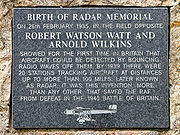
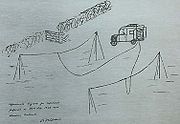 On the early morning of Tuesday 26 February 1935 the radio station at Daventry (Borough Hill) was used for the first-ever practical demonstration of radar
, by its inventor Robert Watson-Watt
and Arnold Frederic Wilkins
, who used a radio receiver installed in a trailer at Stowe Nine Churches
(just off the A5 about three miles (5 km) south of Weedon Bec
and in the Daventry district) to receive signals bounced off a metal-clad Handley Page Heyford
bomber flying across the radio transmissions. The interference picked up from the aircraft allowed its approximate navigational position
to be estimated.
 The station closed in 1992 and only one of the radio masts now remains. A busy directional radio beacon (VOR), identifier "DTY", for aircraft is situated approximately 4 miles (6.4 km) south of the town. The town also gives its name to the busy Daventry air traffic control
sector.
75 Years to the day (26 February 2010) Teams from the Coventry Amateur Radio Society & The Northhampton Radio Club re-enacted the 'Daventry Experiment'. Signals from GB75RDF at Borough Hill, reflected from aircraft all of which were flown by radio hams, were detected in a receiving set housed in a replica Morrris van. The receiving station set up in the field that is the home to The Birth of RADAR memorial at Litchborough. The report of this to be found at http://www.andrewphotographic.co.uk/g8gmu9c.htm
The team was led by Brian Leathley - Andrew G8GMU
See also Borough Hill Roman villa
.
Daventry remained a small rural town until the 1950s; in 1950 it had a population of around 4,000. Real growth started in 1955 when the tapered roller bearing
manufacturer Timken
located a large factory in the town (the factory closed in 2000).
In the early 1960s, Daventry was designated as an 'overspill' to house people and industry moved from Birmingham
; a planned expansion was carried out as part of an agreement with Birmingham City Council. The plan did not, however, live up to expectations. The target population was 36,000 by 1981, but actual growth was much slower than this; nevertheless, by 1981 the population had soared to 16,178 and by 2001 it was 22,367. More recently, a new wave of development has been proposed which could take the town's population to about 40,000 by 2021.
In 1974, the old borough
of Daventry was abolished and merged into the new Daventry district
, which also included a large rural area and had a population of 71,838 in 2001. In 2003, Daventry gained its own Town Council when it became a civil parish. The current mayor of Daventry is Glenda Simmonds
In 2006, the outdoor pool
– which had been built and funded by Daventry residents in the 1950s following the drowning of three children in the local reservoir – was closed due funding difficulties. In 2007, Daventry began plans to modernise the town with a futuristic personal rapid transit
system that would link outer estates to the town centre, and a canal arm with marina
next to the former site of the outdoor pool.
have their largest UK plant at the town where they manufacture diesel engine
s.
Owing to its good transport links, Daventry is now a warehousing
and distribution centre. North of the town Daventry International Rail Freight Terminal (DIRFT) is a major terminal for freight interchange between road and rail. This is much closer to Rugby than Daventry, being situated just off junction 18 of the M1 (its original northern terminus in 1959 until 1964).
The town is accessed via junction 16 of the M1
and the A45
which bypasses the town via Stefen Way, merging with the A425
along Leamington Way. The town is bypassed to the east by the A425.
Due to the proximity to the M1, Ford opened up a large spare parts distribution warehouse on the Royal Oak Industrial Estate. This 130 acre (0.5260918 km²) building, the Daventry Parts Depot, took Taylor Woodrow
a year to build at a cost of £2.25 m and was for many years considered the largest building in the UK. Wetherspoon's have had their main distribution centre on the Drayton Fields Industrial Estate, north of the town since 2004.
s: Daventry William Parker - Specialist Humanities College to the north of the town and Danetre School - Specialist Engineering College in the borough towards the east near the BBC transmitter. And they now have a sixth form
under the DLP (Daventry Learning Partnership). Sixth form provision is provided by Northampton College
(former Daventry Tertiary College).
Primary education facilities include St James' Infant School, Falconer's Hill Junior School, Abbey Junior School and Ashby Fields Primary School - which is a values based school
.
Market town
Market town or market right is a legal term, originating in the medieval period, for a European settlement that has the right to host markets, distinguishing it from a village and city...
in Northamptonshire
Northamptonshire
Northamptonshire is a landlocked county in the English East Midlands, with a population of 629,676 as at the 2001 census. It has boundaries with the ceremonial counties of Warwickshire to the west, Leicestershire and Rutland to the north, Cambridgeshire to the east, Bedfordshire to the south-east,...
, England
England
England is a country that is part of the United Kingdom. It shares land borders with Scotland to the north and Wales to the west; the Irish Sea is to the north west, the Celtic Sea to the south west, with the North Sea to the east and the English Channel to the south separating it from continental...
, with a population of 22,367 (2001 census
Census
A census is the procedure of systematically acquiring and recording information about the members of a given population. It is a regularly occurring and official count of a particular population. The term is used mostly in connection with national population and housing censuses; other common...
).
Geography
The town is also the administrative centre of the larger Daventry districtDaventry (district)
The Daventry district is the largest local government district of western Northamptonshire, England. The district is named after the town of Daventry which is the administrative headquarters and largest town...
, which has a population of 71,838. The town is 77 miles (124 km) north-northwest of London
London
London is the capital city of :England and the :United Kingdom, the largest metropolitan area in the United Kingdom, and the largest urban zone in the European Union by most measures. Located on the River Thames, London has been a major settlement for two millennia, its history going back to its...
, 13.9 miles (22.4 km) west of Northampton
Northampton
Northampton is a large market town and local government district in the East Midlands region of England. Situated about north-west of London and around south-east of Birmingham, Northampton lies on the River Nene and is the county town of Northamptonshire. The demonym of Northampton is...
and 10.2 miles (16.4 km) southeast of Rugby
Rugby, Warwickshire
Rugby is a market town in Warwickshire, England, located on the River Avon. The town has a population of 61,988 making it the second largest town in the county...
. Daventry is near the M1 motorway
M1 motorway
The M1 is a north–south motorway in England primarily connecting London to Leeds, where it joins the A1 near Aberford. While the M1 is considered to be the first inter-urban motorway to be completed in the United Kingdom, the first road to be built to motorway standard in the country was the...
with access to two junctions to the northeast and southeast of the town. The town is also served by the A45
A45 road
The A45 is a major road in England. It runs east from Birmingham past the National Exhibition Centre and the M42, then bypasses Coventry and Rugby, where it briefly merges with the M45 until it continues to Daventry...
and the A361
A361 road
The A361 is a major road in England and at is the longest 3 digit A road in the UK. It runs south from Ilfracombe on the north Devon coast to Barnstaple, turning south-east to Tiverton then, after a break , north east from Taunton in Somerset through Street and Glastonbury, past Frome and then...
. The nearest railway station is at Long Buckby
Long Buckby railway station
Long Buckby railway station is a small railway station that serves the village of Long Buckby in Northamptonshire, England. The station is 15 km north west of Northampton....
where access is gained to the London Midland
London Midland
London Midland is a train operating company in the United Kingdom. Legally named London and Birmingham Railway Ltd, it is a subsidiary of Govia, and has operated the West Midlands franchise since 11 November 2007....
services to Birmingham New Street and Northampton
Northampton railway station
Northampton railway station is a railway station serving the large town of Northampton and other parts of Northamptonshire in England. Other parts of South Northamptonshire are better served by Kings Sutton, Banbury and Milton Keynes Central stations....
, on the Northampton loop of the West Coast Main Line
West Coast Main Line
The West Coast Main Line is the busiest mixed-traffic railway route in Britain, being the country's most important rail backbone in terms of population served. Fast, long-distance inter-city passenger services are provided between London, the West Midlands, the North West, North Wales and the...
. Inter-city services (Virgin Trains
Virgin Trains
Virgin Trains is a train operating company in the United Kingdom. It operates long-distance passenger services on the West Coast Main Line between London, the West Midlands, North West England, North Wales and Scotland...
) can be accessed from Rugby railway station
Rugby railway station
Rugby railway station serves the town of Rugby in Warwickshire, England. It opened during the Victorian era, in 1885, replacing earlier stations situated a little further west...
. The nearest major international airport is at Birmingham International.
Daventry now has a lot of estates, which include: Drayton
Drayton, Northamptonshire
Drayton is a hamlet in England, in the county of Northamptonshire, in the parish and union of Daventry, hundred of Fawsley, ¾ of a mile on the low-lying western side of the town of Daventry.-History:...
, Middlemore Farm, Lang Farm, Ashby Fields, Royal Oak, Timken, Stefan Hill, The Grange, the Headlands and the Southbrook and Borough Hill.
Characteristics
The town comprises a historic marketMarket
A market is one of many varieties of systems, institutions, procedures, social relations and infrastructures whereby parties engage in exchange. While parties may exchange goods and services by barter, most markets rely on sellers offering their goods or services in exchange for money from buyers...
centre surrounded by much modern housing and light industrial development. On the edge of the town centre is the popular Daventry Country Park
Daventry Country Park
Daventry Country Park is a country park located on the north-eastern outskirts of Daventry in Northamptonshire, England. It is managed by Daventry District Council, and covers 140 acres ....
and reservoir
Reservoir
A reservoir , artificial lake or dam is used to store water.Reservoirs may be created in river valleys by the construction of a dam or may be built by excavation in the ground or by conventional construction techniques such as brickwork or cast concrete.The term reservoir may also be used to...
, just east of the A425.
A street market is held every Tuesday and Friday in High Street, although its original site was on the aptly named Market Square. On the first Saturday of each month a farmers' market
Farmers' market
A farmers' market consists of individual vendors—mostly farmers—who set up booths, tables or stands, outdoors or indoors, to sell produce, meat products, fruits and sometimes prepared foods and beverages...
is held in High Street.
The town once had a railway station
Daventry railway station
Daventry was a railway station serving the town of Daventry in Northamptonshire, England. It was on the Weedon to Leamington Spa line. In 1888 a branch from the main line at Weedon reached the town...
on the former LNWR
London and North Western Railway
The London and North Western Railway was a British railway company between 1846 and 1922. It was created by the merger of three companies – the Grand Junction Railway, the London and Birmingham Railway and the Manchester and Birmingham Railway...
branch-line from Weedon to Leamington Spa
Weedon to Leamington Spa line
The Weedon to Marton Junction line was a rural branch line that linked the West Coast Main Line at Weedon to Leamington Spa.-History:The single track line was constructed in two phases. First a branch from the West Coast Main Line at Weedon to Daventry was constructed in 1888...
, but it was closed in September 1958. The local weekly newspaper, the Daventry Express, is nickname
Nickname
A nickname is "a usually familiar or humorous but sometimes pointed or cruel name given to a person or place, as a supposedly appropriate replacement for or addition to the proper name.", or a name similar in origin and pronunciation from the original name....
d 'The Gusher', after the steam engine that used to serve the town.
Nearby places to Daventry include: Rugby
Rugby, Warwickshire
Rugby is a market town in Warwickshire, England, located on the River Avon. The town has a population of 61,988 making it the second largest town in the county...
, Southam
Southam
Southam is a small market town in the Stratford-on-Avon district of Warwickshire, England. The 2001 census recorded a population of 6,509 in the town.The nearest sizeable town to Southam is Leamington Spa, located roughly 7 miles to the west...
, Banbury
Banbury
Banbury is a market town and civil parish on the River Cherwell in the Cherwell District of Oxfordshire. It is northwest of London, southeast of Birmingham, south of Coventry and north northwest of the county town of Oxford...
, Northampton
Northampton
Northampton is a large market town and local government district in the East Midlands region of England. Situated about north-west of London and around south-east of Birmingham, Northampton lies on the River Nene and is the county town of Northamptonshire. The demonym of Northampton is...
and Coventry
Coventry
Coventry is a city and metropolitan borough in the county of West Midlands in England. Coventry is the 9th largest city in England and the 11th largest in the United Kingdom. It is also the second largest city in the English Midlands, after Birmingham, with a population of 300,848, although...
. The town is twinned
Town twinning
Twin towns and sister cities are two of many terms used to describe the cooperative agreements between towns, cities, and even counties in geographically and politically distinct areas to promote cultural and commercial ties.- Terminology :...
with Westerburg
Westerburg
Westerburg is a small town of roughly 6,000 inhabitants in the Westerwaldkreis in Rhineland-Palatinate, Germany. The town is named after the castle built on a hill above the mediaeval town centre -Location:...
, Germany
Germany
Germany , officially the Federal Republic of Germany , is a federal parliamentary republic in Europe. The country consists of 16 states while the capital and largest city is Berlin. Germany covers an area of 357,021 km2 and has a largely temperate seasonal climate...
.
An alternative pronunciation for Daventry used by locals is 'Daintree,' but this has become less common.
Early history
On the 653-foot (199 m)-high Borough HillBorough Hill
Borough Hill is a hill to the east of the town of Daventry in the English county of Northamptonshire. It is over above sea level and dominates the surrounding area.-Archaeology:...
that overlooks the town, remains have been found of an Iron Age
Iron Age
The Iron Age is the archaeological period generally occurring after the Bronze Age, marked by the prevalent use of iron. The early period of the age is characterized by the widespread use of iron or steel. The adoption of such material coincided with other changes in society, including differing...
hill fort – one of the largest found in Britain. Remains have also been found on the hill of a Roman villa
Borough Hill Roman villa
Borough Hill Roman villa is located on the north tip of Borough Hill, a prominent hill near the town of Daventry in Northamptonshire. The villa’s remains lie within the ramparts of an Iron Age fortress which covers the summit of the hill...
.
Saxons
Daventry began as a small Anglo-SaxonAnglo-Saxons
Anglo-Saxon is a term used by historians to designate the Germanic tribes who invaded and settled the south and east of Great Britain beginning in the early 5th century AD, and the period from their creation of the English nation to the Norman conquest. The Anglo-Saxon Era denotes the period of...
village in around 920 and by the 12th century had become home to a priory
Priory
A priory is a house of men or women under religious vows that is headed by a prior or prioress. Priories may be houses of mendicant friars or religious sisters , or monasteries of monks or nuns .The Benedictines and their offshoots , the Premonstratensians, and the...
. In 1255 Daventry was granted a charter to become a market town
Market town
Market town or market right is a legal term, originating in the medieval period, for a European settlement that has the right to host markets, distinguishing it from a village and city...
. In 1576 Queen Elizabeth I
Elizabeth I of England
Elizabeth I was queen regnant of England and Ireland from 17 November 1558 until her death. Sometimes called The Virgin Queen, Gloriana, or Good Queen Bess, Elizabeth was the fifth and last monarch of the Tudor dynasty...
granted Daventry borough
Borough
A borough is an administrative division in various countries. In principle, the term borough designates a self-governing township although, in practice, official use of the term varies widely....
status.
The town was mentioned by William Shakespeare
William Shakespeare
William Shakespeare was an English poet and playwright, widely regarded as the greatest writer in the English language and the world's pre-eminent dramatist. He is often called England's national poet and the "Bard of Avon"...
in Henry VI, Part I, which refers to "the red-nosed innkeeper of Daintree".
The earliest form of the name of Daventry, the Celtic dwy-afon-tre, "the town of two avons,"(i.e. "the town of two rivers"), describes its geographical situation between the nearby sources of the River Leam
River Leam
The River Leam is a river which flows through eastern and southern Warwickshire. It is a small river about 25–30 miles long. The town of Leamington Spa lies on, and is named after, the River Leam....
, which flows west, and the River Nene
River Nene
The River Nene is a river in the east of England that rises from three sources in the county of Northamptonshire. The tidal river forms the border between Cambridgeshire and Norfolk for about . It is the tenth longest river in the United Kingdom, and is navigable for from Northampton to The...
which flows east. The "Daintree" Shakespeare wrote about, the name persisting to this day, spelt Danetre, grew from a tradition that Danish settlers planted an oak
Oak
An oak is a tree or shrub in the genus Quercus , of which about 600 species exist. "Oak" may also appear in the names of species in related genera, notably Lithocarpus...
tree on the summit of Borough Hill to mark the centre of England. This part of the town's history is reflected in the town's seal of a Viking
Viking
The term Viking is customarily used to refer to the Norse explorers, warriors, merchants, and pirates who raided, traded, explored and settled in wide areas of Europe, Asia and the North Atlantic islands from the late 8th to the mid-11th century.These Norsemen used their famed longships to...
/Saxon
Saxons
The Saxons were a confederation of Germanic tribes originating on the North German plain. The Saxons earliest known area of settlement is Northern Albingia, an area approximately that of modern Holstein...
axeman and an oak tree. The town appears as Dauentre on the Christopher Saxton
Christopher Saxton
Christopher Saxton was an English cartographer, probably born in the parish of Dewsbury, in the West Riding of Yorkshire, England around 1540....
map of 1637.
English Civil War
During the English Civil WarEnglish Civil War
The English Civil War was a series of armed conflicts and political machinations between Parliamentarians and Royalists...
, the army of King Charles I
Charles I of England
Charles I was King of England, King of Scotland, and King of Ireland from 27 March 1625 until his execution in 1649. Charles engaged in a struggle for power with the Parliament of England, attempting to obtain royal revenue whilst Parliament sought to curb his Royal prerogative which Charles...
stayed at Daventry in 1645 after storming the Parliamentary garrison at Leicester
Leicester
Leicester is a city and unitary authority in the East Midlands of England, and the county town of Leicestershire. The city lies on the River Soar and at the edge of the National Forest...
and on its way to relieve the siege of Oxford
Oxford
The city of Oxford is the county town of Oxfordshire, England. The city, made prominent by its medieval university, has a population of just under 165,000, with 153,900 living within the district boundary. It lies about 50 miles north-west of London. The rivers Cherwell and Thames run through...
. The Royalist
Cavalier
Cavalier was the name used by Parliamentarians for a Royalist supporter of King Charles I and son Charles II during the English Civil War, the Interregnum, and the Restoration...
army, made up of 5,000 foot and as many horse, camped on Borough Hill (then spelt Burrow Hill) while Charles went hunting in the nearby forests.
According to local legend, it was during his stay at the Wheatsheaf Inn in Daventry that Charles was twice visited by the ghost of his former adviser and friend, Thomas Wentworth, 1st Earl of Strafford
Thomas Wentworth, 1st Earl of Strafford
Thomas Wentworth, 1st Earl of Strafford was an English statesman and a major figure in the period leading up to the English Civil War. He served in Parliament and was a supporter of King Charles I. From 1632 to 1639 he instituted a harsh rule as Lord Deputy of Ireland...
, who advised him to keep heading north and warned him that he would not win through force of arms.
However, Parliament's newly formed New Model Army
New Model Army
The New Model Army of England was formed in 1645 by the Parliamentarians in the English Civil War, and was disbanded in 1660 after the Restoration...
, led by Sir Thomas Fairfax, was marching north from besieging Oxford after being instructed to engage the king's main army. Fairfax's leading detachments of horse clashed with Royalist outposts near Daventry on the 12th of June, alerting the king to the presence of the Parliamentary army. The Royalists made for their reinforcements at Newark-on-Trent
Newark-on-Trent
Newark-on-Trent is a market town in Nottinghamshire in the East Midlands region of England. It stands on the River Trent, the A1 , and the East Coast Main Line railway. The origins of the town are possibly Roman as it lies on an important Roman road, the Fosse Way...
but after reaching Market Harborough
Market Harborough
Market Harborough is a market town within the Harborough district of Leicestershire, England.It has a population of 20,785 and is the administrative headquarters of Harborough District Council. It sits on the Northamptonshire-Leicestershire border...
turned to fight, which resulted in the decisive Battle of Naseby
Battle of Naseby
The Battle of Naseby was the key battle of the first English Civil War. On 14 June 1645, the main army of King Charles I was destroyed by the Parliamentarian New Model Army commanded by Sir Thomas Fairfax and Oliver Cromwell.-The Campaign:...
. The village of Naseby
Naseby
Naseby is a small village in the District of Daventry in Northamptonshire, England.The village is 14 mi north of Northampton, 13.3 mi northeast of Daventry, and 7 mi south of Market Harborough. It is 2.4 mi from Junction 2 of the A14 road, giving it access to the national road system...
is approximately 14 miles (23 km) northeast of Daventry.
Stagnation and decline 1840–1960
The main roads from LondonLondon
London is the capital city of :England and the :United Kingdom, the largest metropolitan area in the United Kingdom, and the largest urban zone in the European Union by most measures. Located on the River Thames, London has been a major settlement for two millennia, its history going back to its...
to Holyhead
Holyhead
Holyhead is the largest town in the county of Anglesey in the North Wales. It is also a major port adjacent to the Irish Sea serving Ireland....
passed through Daventry and the town for centuries flourished as a coaching town
Stagecoach
A stagecoach is a type of covered wagon for passengers and goods, strongly sprung and drawn by four horses, usually four-in-hand. Widely used before the introduction of railway transport, it made regular trips between stages or stations, which were places of rest provided for stagecoach travelers...
. There were many coaching inns in the town of which only the Dun Cow, Saracens Head and the Coach and Horses remain as inns.
But when the London and Birmingham Railway
London and Birmingham Railway
The London and Birmingham Railway was an early railway company in the United Kingdom from 1833 to 1846, when it became part of the London and North Western Railway ....
was opened in 1838 the coaching trade slumped and the town entered a long period of stagnation and decline which lasted for over a century. The Industrial Revolution
Industrial Revolution
The Industrial Revolution was a period from the 18th to the 19th century where major changes in agriculture, manufacturing, mining, transportation, and technology had a profound effect on the social, economic and cultural conditions of the times...
largely passed Daventry by owing to its poor transport links. The canal
Canal
Canals are man-made channels for water. There are two types of canal:#Waterways: navigable transportation canals used for carrying ships and boats shipping goods and conveying people, further subdivided into two kinds:...
s passed around Daventry, although the Grand Junction Canal
Grand Junction Canal
The Grand Junction Canal is a canal in England from Braunston in Northamptonshire to the River Thames at Brentford, with a number of branches. The mainline was built between 1793 and 1805, to improve the route from the Midlands to London, by-passing the upper reaches of the River Thames near Oxford...
(now Grand Union) passed a few miles north. A branch from the Grand Union Canal to Daventry was proposed but was never built.
The railways did not connect Daventry until quite late in the 19th century. Although the town was only a few miles from the main London to Birmingham line it took until 1888 before a branch line was built from Weedon
Weedon Bec
Weedon Bec , usually just called "Weedon", is a large village and parish in the district of Daventry, Northamptonshire, England. It lies close to the source of the River Nene.-Geography:...
to Daventry railway station
Daventry railway station
Daventry was a railway station serving the town of Daventry in Northamptonshire, England. It was on the Weedon to Leamington Spa line. In 1888 a branch from the main line at Weedon reached the town...
. In 1895 the line was extended to Leamington Spa
Leamington Spa
Royal Leamington Spa, commonly known as Leamington Spa or Leamington or Leam to locals, is a spa town in central Warwickshire, England. Formerly known as Leamington Priors, its expansion began following the popularisation of the medicinal qualities of its water by Dr Kerr in 1784, and by Dr Lambe...
, although being only a branch line this failed to spur much growth. Daventry's economy remained largely rural, with shoemaking
Shoemaking
Shoemaking is the process of making footwear. Originally, shoes were made one at a time by hand. Traditional handicraft shoemaking has now been largely superseded in volume of shoes produced by industrial mass production of footwear, but not necessarily in quality, attention to detail, or...
as the main industry.
The Parish Church
Holy Cross is the parish church of Daventry and is the only 18th century town church in NorthamptonshireNorthamptonshire
Northamptonshire is a landlocked county in the English East Midlands, with a population of 629,676 as at the 2001 census. It has boundaries with the ceremonial counties of Warwickshire to the west, Leicestershire and Rutland to the north, Cambridgeshire to the east, Bedfordshire to the south-east,...
. It was built between 1752 and 1758 by David Hiorne and is constructed of the local ironstone
Ironstone
Ironstone is a sedimentary rock, either deposited directly as a ferruginous sediment or created by chemical repacement, that contains a substantial proportion of an iron compound from which iron either can be or once was smelted commercially. This term is customarily restricted to hard coarsely...
. The western elevation is broad with large pilaster
Pilaster
A pilaster is a slightly-projecting column built into or applied to the face of a wall. Most commonly flattened or rectangular in form, pilasters can also take a half-round form or the shape of any type of column, including tortile....
s at the angles and the angles of the centre bay. The entrance porch was added in 1951. The tower rises from the centre bay and is square ending with an obelisk
Obelisk
An obelisk is a tall, four-sided, narrow tapering monument which ends in a pyramid-like shape at the top, and is said to resemble a petrified ray of the sun-disk. A pair of obelisks usually stood in front of a pylon...
spire
Spire
A spire is a tapering conical or pyramidal structure on the top of a building, particularly a church tower. Etymologically, the word is derived from the Old English word spir, meaning a sprout, shoot, or stalk of grass....
rising above. Inside, the church has three wooden galleries, to the north, south and west elevations. The pulpit
Pulpit
Pulpit is a speakers' stand in a church. In many Christian churches, there are two speakers' stands at the front of the church. Typically, the one on the left is called the pulpit...
is decorated with marquetry
Marquetry
Marquetry is the art and craft of applying pieces of veneer to a structure to form decorative patterns, designs or pictures. The technique may be applied to case furniture or even seat furniture, to decorative small objects with smooth, veneerable surfaces or to freestanding pictorial panels...
and fretwork
Fretwork
Fretwork is an interlaced decorative design that is either carved in low relief on a solid background, or cut out with a fretsaw, coping saw, jigsaw or scroll saw. Most fretwork patterns are geometric in design. The materials most commonly used are wood and metal. Fretwork is used to adorn...
and has a staircase with a twisted baluster
Baluster
A baluster is a moulded shaft, square or of lathe-turned form, one of various forms of spindle in woodwork, made of stone or wood and sometimes of metal, standing on a unifying footing, and supporting the coping of a parapet or the handrail of a staircase. Multiplied in this way, they form a...
s. Above the altar
Altar
An altar is any structure upon which offerings such as sacrifices are made for religious purposes. Altars are usually found at shrines, and they can be located in temples, churches and other places of worship...
at the eastern elevation is a three-bayed stained glass window.
The Moot Hall
The Moot HallMoot hall
A moot hall is meeting or assembly building, traditionally to decide local issues.In Anglo-Saxon England, a low ring-shaped earthwork served as a moot hill or moot mound, where the elders of the hundred would meet to take decisions. Some of these acquired permanent buildings, known as moot halls...
stands on the north side of the market square next to the Plume of Feathers inn. It was built in 1769 from ironstone
Ironstone
Ironstone is a sedimentary rock, either deposited directly as a ferruginous sediment or created by chemical repacement, that contains a substantial proportion of an iron compound from which iron either can be or once was smelted commercially. This term is customarily restricted to hard coarsely...
and has had various uses over the years, including town council building, a women’s prison
Prison
A prison is a place in which people are physically confined and, usually, deprived of a range of personal freedoms. Imprisonment or incarceration is a legal penalty that may be imposed by the state for the commission of a crime...
, the mayor's parlour, town museum and tourist information office and in recent years as an India
India
India , officially the Republic of India , is a country in South Asia. It is the seventh-largest country by geographical area, the second-most populous country with over 1.2 billion people, and the most populous democracy in the world...
n restaurant. The building, which is currently unused, is of two and a half storeys, and has three bays of windows. The main entrance and its porch is on the western elevation where the building is connected to a house built in 1806. The original staircase from the Moot Hall is now installed at Welton
Welton, Northamptonshire
Welton is a village and civil parish in the English county of Northamptonshire. The village is located north of the nearest town Daventry. It is west-northwest of Northampton, south east of Rugby and north-west of London. The village is of the A361 that runs between Daventry and Crick where...
Manor House.
Broadcasting station
In 1925 the newly created BBCBBC
The British Broadcasting Corporation is a British public service broadcaster. Its headquarters is at Broadcasting House in the City of Westminster, London. It is the largest broadcaster in the world, with about 23,000 staff...
constructed a broadcasting station on Borough Hill
Borough Hill
Borough Hill is a hill to the east of the town of Daventry in the English county of Northamptonshire. It is over above sea level and dominates the surrounding area.-Archaeology:...
just outside the town. Daventry was chosen because it was the point of maximum contact with the land mass of England and Wales
Wales
Wales is a country that is part of the United Kingdom and the island of Great Britain, bordered by England to its east and the Atlantic Ocean and Irish Sea to its west. It has a population of three million, and a total area of 20,779 km²...
. From 1932 the BBC Empire Service (now the BBC World Service
BBC World Service
The BBC World Service is the world's largest international broadcaster, broadcasting in 27 languages to many parts of the world via analogue and digital shortwave, internet streaming and podcasting, satellite, FM and MW relays...
) was broadcast from there. The radio announcement of "Daventry calling" made Daventry well-known across the world. It was the BBC's use of the literal pronunciation in this call-sign that resulted in the widespread displacement of the historical pronunciation "Daintree" (ˈdeɪntri), though the latter is still used in some circumstances locally, as in the name of Danetre Hospital.
Radar
Radar is an object-detection system which uses radio waves to determine the range, altitude, direction, or speed of objects. It can be used to detect aircraft, ships, spacecraft, guided missiles, motor vehicles, weather formations, and terrain. The radar dish or antenna transmits pulses of radio...
, by its inventor Robert Watson-Watt
Robert Watson-Watt
Sir Robert Alexander Watson-Watt, KCB, FRS, FRAeS is considered by many to be the "inventor of radar". Development of radar, initially nameless, was first started elsewhere but greatly expanded on 1 September 1936 when Watson-Watt became...
and Arnold Frederic Wilkins
Arnold Frederic Wilkins
Arnold Frederic Wilkins O.B.E., was a pioneer in developing the use of radar.-Early life:...
, who used a radio receiver installed in a trailer at Stowe Nine Churches
Stowe Nine Churches
Stowe Nine Churches is a civil parish incorporating the settlements of Church Stowe and Upper Stowe in the English county of Northamptonshire.-Name:...
(just off the A5 about three miles (5 km) south of Weedon Bec
Weedon Bec
Weedon Bec , usually just called "Weedon", is a large village and parish in the district of Daventry, Northamptonshire, England. It lies close to the source of the River Nene.-Geography:...
and in the Daventry district) to receive signals bounced off a metal-clad Handley Page Heyford
Handley Page Heyford
The Handley Page Heyford was a twin-engine British biplane bomber of the 1930s. Although it had a short service life, it equipped several squadrons of the RAF as one of the most important British bombers of the mid-1930s, and was the last biplane heavy bomber to serve with the RAF.-Design and...
bomber flying across the radio transmissions. The interference picked up from the aircraft allowed its approximate navigational position
Bearing (navigation)
In marine navigation, a bearing is the direction one object is from another object, usually, the direction of an object from one's own vessel. In aircraft navigation, a bearing is the actual compass direction of the forward course of the aircraft...
to be estimated.
Air traffic control
Air traffic control is a service provided by ground-based controllers who direct aircraft on the ground and in the air. The primary purpose of ATC systems worldwide is to separate aircraft to prevent collisions, to organize and expedite the flow of traffic, and to provide information and other...
sector.
75 Years to the day (26 February 2010) Teams from the Coventry Amateur Radio Society & The Northhampton Radio Club re-enacted the 'Daventry Experiment'. Signals from GB75RDF at Borough Hill, reflected from aircraft all of which were flown by radio hams, were detected in a receiving set housed in a replica Morrris van. The receiving station set up in the field that is the home to The Birth of RADAR memorial at Litchborough. The report of this to be found at http://www.andrewphotographic.co.uk/g8gmu9c.htm
The team was led by Brian Leathley - Andrew G8GMU
See also Borough Hill Roman villa
Borough Hill Roman villa
Borough Hill Roman villa is located on the north tip of Borough Hill, a prominent hill near the town of Daventry in Northamptonshire. The villa’s remains lie within the ramparts of an Iron Age fortress which covers the summit of the hill...
.
Modern times
The modern growth of Daventry occurred from the 1960s onwards as part of a planned expansion of the town.Daventry remained a small rural town until the 1950s; in 1950 it had a population of around 4,000. Real growth started in 1955 when the tapered roller bearing
Tapered roller bearing
Tapered roller bearings are bearings that can take large axial forces as well as being able to sustain large radial forces.-Description:...
manufacturer Timken
Timken Company
The Timken Company is a global manufacturer of bearings, alloy steels, and related components and assemblies.- History :The company was founded by Henry Timken in St. Louis, Missouri in 1899 and incorporated as The Timken Roller Bearing Axle Company. A year earlier, in 1898, Timken got a patent...
located a large factory in the town (the factory closed in 2000).
In the early 1960s, Daventry was designated as an 'overspill' to house people and industry moved from Birmingham
Birmingham
Birmingham is a city and metropolitan borough in the West Midlands of England. It is the most populous British city outside the capital London, with a population of 1,036,900 , and lies at the heart of the West Midlands conurbation, the second most populous urban area in the United Kingdom with a...
; a planned expansion was carried out as part of an agreement with Birmingham City Council. The plan did not, however, live up to expectations. The target population was 36,000 by 1981, but actual growth was much slower than this; nevertheless, by 1981 the population had soared to 16,178 and by 2001 it was 22,367. More recently, a new wave of development has been proposed which could take the town's population to about 40,000 by 2021.
In 1974, the old borough
Borough
A borough is an administrative division in various countries. In principle, the term borough designates a self-governing township although, in practice, official use of the term varies widely....
of Daventry was abolished and merged into the new Daventry district
Daventry (district)
The Daventry district is the largest local government district of western Northamptonshire, England. The district is named after the town of Daventry which is the administrative headquarters and largest town...
, which also included a large rural area and had a population of 71,838 in 2001. In 2003, Daventry gained its own Town Council when it became a civil parish. The current mayor of Daventry is Glenda Simmonds
In 2006, the outdoor pool
Lido
The Lido is an 11 km long sandbar located in Venice, northern Italy, home to about 20,000 residents. The Venice Film Festival takes place at the Lido every September.-Geography:...
– which had been built and funded by Daventry residents in the 1950s following the drowning of three children in the local reservoir – was closed due funding difficulties. In 2007, Daventry began plans to modernise the town with a futuristic personal rapid transit
Personal rapid transit
Personal rapid transit , also called podcar, is a public transportation mode featuring small automated vehicles operating on a network of specially built guide ways...
system that would link outer estates to the town centre, and a canal arm with marina
Marina
A marina is a dock or basin with moorings and supplies for yachts and small boats.A marina differs from a port in that a marina does not handle large passenger ships or cargo from freighters....
next to the former site of the outdoor pool.
Local economy
CumminsCummins
Cummins Inc. is a Fortune 500 corporation that designs, manufactures, distributes and services engines and related technologies, including fuel systems, controls, air handling, filtration, emission control and electrical power generation systems...
have their largest UK plant at the town where they manufacture diesel engine
Diesel engine
A diesel engine is an internal combustion engine that uses the heat of compression to initiate ignition to burn the fuel, which is injected into the combustion chamber...
s.
Owing to its good transport links, Daventry is now a warehousing
Warehouse
A warehouse is a commercial building for storage of goods. Warehouses are used by manufacturers, importers, exporters, wholesalers, transport businesses, customs, etc. They are usually large plain buildings in industrial areas of cities and towns. They usually have loading docks to load and unload...
and distribution centre. North of the town Daventry International Rail Freight Terminal (DIRFT) is a major terminal for freight interchange between road and rail. This is much closer to Rugby than Daventry, being situated just off junction 18 of the M1 (its original northern terminus in 1959 until 1964).
The town is accessed via junction 16 of the M1
M1 motorway
The M1 is a north–south motorway in England primarily connecting London to Leeds, where it joins the A1 near Aberford. While the M1 is considered to be the first inter-urban motorway to be completed in the United Kingdom, the first road to be built to motorway standard in the country was the...
and the A45
A45 road
The A45 is a major road in England. It runs east from Birmingham past the National Exhibition Centre and the M42, then bypasses Coventry and Rugby, where it briefly merges with the M45 until it continues to Daventry...
which bypasses the town via Stefen Way, merging with the A425
A425 road
The A425 road is an A road in England, which runs between Daventry in Northamptonshire and Warwick in Warwickshire via Staverton, Lower Shuckburgh and Southam.At Southam it links with the A426 as well as the A423....
along Leamington Way. The town is bypassed to the east by the A425.
Due to the proximity to the M1, Ford opened up a large spare parts distribution warehouse on the Royal Oak Industrial Estate. This 130 acre (0.5260918 km²) building, the Daventry Parts Depot, took Taylor Woodrow
Taylor Woodrow
Taylor Woodrow was one of the largest British housebuilding and general construction companies. It was listed on the London Stock Exchange and was once a constituent of the FTSE 100 Index but merged with rival George Wimpey to create Taylor Wimpey on 3 July 2007.-Early years:Frank Taylor was...
a year to build at a cost of £2.25 m and was for many years considered the largest building in the UK. Wetherspoon's have had their main distribution centre on the Drayton Fields Industrial Estate, north of the town since 2004.
Education
Daventry has two secondary schoolSecondary school
Secondary school is a term used to describe an educational institution where the final stage of schooling, known as secondary education and usually compulsory up to a specified age, takes place...
s: Daventry William Parker - Specialist Humanities College to the north of the town and Danetre School - Specialist Engineering College in the borough towards the east near the BBC transmitter. And they now have a sixth form
Sixth form
In the education systems of England, Wales, and Northern Ireland, and of Commonwealth West Indian countries such as Barbados, Trinidad and Tobago, Belize, Jamaica and Malta, the sixth form is the final two years of secondary education, where students, usually sixteen to eighteen years of age,...
under the DLP (Daventry Learning Partnership). Sixth form provision is provided by Northampton College
Northampton College
Northampton College, formerly known as Northampton College of Further Education, is a further education college in Northampton, Northamptonshire, England...
(former Daventry Tertiary College).
Primary education facilities include St James' Infant School, Falconer's Hill Junior School, Abbey Junior School and Ashby Fields Primary School - which is a values based school
Values education
Values education is a term used to name several things, and there is much academic controversy surrounding it. Some regard it as all aspects of the process by which teachers transmit values to pupils...
.
See also
- The hamlet of DraytonDrayton, NorthamptonshireDrayton is a hamlet in England, in the county of Northamptonshire, in the parish and union of Daventry, hundred of Fawsley, ¾ of a mile on the low-lying western side of the town of Daventry.-History:...
, now a suburb of Daventry. - Stagecoach in NorthantsStagecoach in NorthantsStagecoach Northants is the name for most bus routes operated by Stagecoach Midlands in Northamptonshire. The legal name for the company is United Counties Omnibus Company Ltd...
bus routes in Northamptonshire