


List of National Treasures of Japan (crafts-others)

Encyclopedia
The term "National Treasure
" has been used in Japan to denote cultural properties
since 1897,
although the definition and the criteria have changed since the introduction of the term. The crafts items in the list adhere to the current definition, and have been designated National Treasures according to the Law for the Protection of Cultural Properties that came into effect on June 9, 1951. The items are selected by the Ministry of Education, Culture, Sports, Science and Technology
based on their "especially high historical or artistic value". The list presents 130 entries from Classical to early modern Japan, spanning from the 7th century Asuka
to the 18th century Edo period
. The total number of items is higher, however, since groups of related objects have been joined as single entries. The listed objects are of various types and include household goods, objects related to Buddhism, armour and harnesses. Some of the oldest objects were imported from China at the time.
The listed items consist of different materials such as wood over clay, to bronze. Often the articles were decorated using a variety of artistic techniques like gilding
of precious metals, line engraving, maki-e
, mother of pearl inlay or lacquer
. The objects are housed in Buddhist temples, Shinto shrines or museums.
The objects in this list represent about half of the 252 National Treasures in the category "crafts". They are complemented by 100 swords and 12 Japanese sword mountings National Treasures of the List of National Treasures of Japan (crafts: swords).
period, and some of the world's oldest earthenware
from about 14,000 BC has been discovered in Japan. Early pottery objects were made of clay, unglazed and without ornamentation. Later, during the Jōmon
, Yayoi
and Kofun period
s, simple patterned designs and molded ornamentations were added. Such early techniques were formed by coiling or scratching and firing pieces at low temperatures. High-fired Korean Sue ware
, and with it the pottery wheel, arrived in Japan around the 6th century, marking the beginning of major technological advances imported from the mainland. Stoneware
originated in Japan with the development of green-glazed and other color glazed
pottery in the second half of the 7th century. The oldest item in this list is a green-glazed funerary pot from the 12th century.
The popularity of the tea ceremony
among the ruling class had a significant influence on ceramic production. To satisfy the demand for high quality pottery items necessary to the tea ceremony a large number of celadon
vases and tenmoku
ash-glazed teabowls initially were imported from China from the mid-11th to the 16th centuries. These imported items were copied and produced locally at the Seto kiln in Owari Province
. Around the mid-16th century adjacent Mino took over as a production center of conservative Chinese inspired Seto style pottery. The Japanese invasions of Korea from 1592–1598, and subsequent relocation of Korean potters to Kyushu
, brought new pottery styles to Japan. From the late-16th century, Mino potters developed new, distinctly Japanese techniques such as Shino ware or Raku ware. This was also motivated by a general shift of tastes among teamasters and others, who came to prefer simpler unglazed tea bowls formed by hand rather than on a pottery wheel. Of the 14 pottery items in this list, eight entries are chawan
bowls used in the tea ceremony, three are flower vases, one is an incense burner, one a tea-leaf jar and one a funerary pot. Eight objects originated in China, five in Japan and one in Korea.
}
| Life-sized, cock pheasant shaped incense burner composed of two parts; lifelike coloration with green, navy blue, red and gold pigments; used in the tea ceremony
|Edo period
, 17th century
| Incense burner; Kyoto-ware, ; length: 48.3 centimetres (19 in), width: 12.5 cm (4.9 in), height: 18.1 cm (7.1 in)
|Ishikawa Prefectural Museum of Art
, Kanazawa
, Ishikawa
|
|-
|
|
| Blooming wisteria flowers painted over a warm white glaze in enamels of red, purple, gold and silver; base is orange and has a stamp mark reading "Ninsei"; passed down in the Kyogoku family of the Marugame domain, present day Kagawa Prefecture
|Edo period
, 17th century
| Tea-leaf jar; stoneware (Kyoto-ware) with overglaze enamels; height: 28.8 cm (11.3 in), bore diameter: 10.1 cm (4 in), trunk diameter: 27.3 cm (10.7 in), bottom diameter: 10.5 cm (4.1 in)
|MOA Museum of Art
, Atami
, Shizuoka
|
|-
| named
| unknown
| Distorted shape
|Momoyama period
| Chawan
; thick white glaze, red scorch marks, and texture of small holes
|Mitsui Memorial Museum
, Tokyo
|
|-
|
| unknown
| Discovered in the Hakusan Burial Mound; mouth bending slightly outward, bulging upper body, narrow base; covered with green glaze and drawings of autumn grasses (Japanese silver grass, melon) scratched in with a spatula; character "上" in the inside of the mouth
|Heian period
, second half of 12th century
| Funerary pot; Atsumi ware; height: 42 cm (16.5 in), diameter at neck: 16 cm (6.3 in), diameter at body 29 cm (11.4 in), diameter at base 14 cm (5.5 in)
|Keio University
, Tokyo
; currently at Tokyo National Museum
|
|}
}, Tokyo
|
|-
|
| One of four extant tea bowls in the yōhen tenmoku style (three are National Treasures); produced in the Jian kilns in Fujian (福建省建窯) in south China
|Southern Song, 12–13th century
| Chawan
; karamono (唐物), natural ash (yōhen) tenmoku
glaze; blue and green spot marks; height: 6.8 cm (2.7 in), mouth diameter: 12.3 cm (4.8 in), base diameter: 3.8 cm (1.5 in)
|Fujita Art Museum
, Osaka
|
|-
|
| One of four extant tea bowls in the yōhen tenmoku style (three are National Treasures)
|Southern Song, 12–13th century
| Chawan
; karamono (唐物), natural ash (yōhen) tenmoku
glaze; height: 6.6 cm (2.6 in), mouth diameter: 12.1 cm (4.8 in), base diameter: 3.8 cm (1.5 in)
| (Daitoku-ji
), Kyoto
|
|-
|
| Produced in the Jizhou kiln (吉州窯) in Yonghe, Ji'an County
|Southern Song
| Chawan
; tenmoku
glaze
|Shōkoku-ji
, Kyoto
|
|-
|
| Formerly in possession of Toyotomi Hidetsugu
; later handed down in Nishi Hongan-ji, the Mitsui family
and the Sakai clan
|Southern Song, 12–13th century
| Chawan
; tenmoku
glaze; diameter: 12.2 cm (4.8 in)
|, Osaka
|
|-
|
| Produced in the kiln
|Southern Song, 12th century
| Flower vase; celadon
; height: 23.5 cm (9.3 in)
|custody of , Shibukawa
, Gunma
; owned by , Tokyo
|
|-
| or
| Produced in the kiln
|Southern Song, 13th century
| Flower vase; celadon
; height: 23.5 cm (9.3 in), bore diameter: 10.8 cm (4.3 in)
|, Izumi
, Osaka
|
|-
|
| Pear-shaped bottle; about 5 mm (0.196850393700787 in) of glaze at the foot has been scraped away and turned red in the fire; produced in the kiln; handed down through the Konoike family
|Yuan Dynasty
, 13–14th century
| Flower vase; celadon
; height: 27.4 cm (10.8 in)
|, Osaka
|
|-
| or
| Name refers to Takeda Kizaemon, an Osaka merchant and former owner of the bowl; later in possession of Matsudaira Fumai; said to bring sickness and death to its owner
|Joseon Dynasty
, 16th century
| Chawan
; bore diameter: 15.5 cm (6.1 in)
|, Kyoto
|
|}
, initially bringing to Japan from Korea and China iron knives and axes, and later bronze swords, spears and mirrors. Eventually all of these and other metal objects were produced locally.
and are a representation of honji suijaku
, fusing Buddhist deities with local Shinto
kami
. Three early mirror icons with line engravings of various deities have been designated as National Treasures.
. The oldest extant of these bells date to the late-7th century and have been designated as National Treasures. The bells were either engraved or cast in relief, with outer surfaces showing vertical and horizontal relief bands, a boss ornament on the upper wall that sometimes included text, and handles typically shaped in a dragon motif. Thirteen Japanese and one Korean temple bell have been designated as National Treasures.
}, Byōdō-in
, Uji
, Kyoto
|
|-
|
|
| Inscription in embossed carving by founder Lanxi Daolong; donated by Hōjō Tokiyori
|Kamakura period
, February 21, 1255
| Bell; height: 210 cm (82.7 in)
|belfry
(shōrō
) at Kenchō-ji
, Kamakura
, Kanagawa
|
|-
|
|
| Made by order of Hōjō Sadatoki
; largest bell in Kantō; donated by Hōjō Tokiyori
|Kamakura period
, August 1301
| Bell; height: 260 cm (102.4 in)
|Engaku-ji
, Kamakura
, Kanagawa
|
|-
|
|
| Initially at the west pagoda of Enryaku-ji
's ; contains a three line, 24 characters inscription
|Heian period
, August 9, 858
| Bell; aperture: 55.3 cm (21.8 in), height: 116 cm (45.7 in)
|, Moriyama
, Shiga
|
|-
|
|
| Head in dragon design, body decorated with clouds and celestial beings; oldest Korean bell in Japan
|Silla
, March 833
| Bell; aperture: 66.7 cm (26.3 in), height: 112 cm (44.1 in)
|Treasure House at , Tsuruga
, Fukui
|
|}
.
}, Chūson-ji
, Hiraizumi
, Iwate
|
|-
|
| Hōsōge flower design
|late Heian period
| Gong; gilt bronze, line engraving; shoulder width: 23.8 cm (9.4 in), fringe stretch: 27 cm (10.6 in), height: 9.5 cm (3.7 in); thickness: 0.7 centimetre
|, Sakai
, Fukui
|
|-
|
| Lotus flower design
|Heian period
| Gong; gilt bronze
|Eikan-dō Zenrin-ji
, Kyoto
|
|-
|
| Motif of peacocks facing each other and lotus flower; contains an inscription; originally presented to temple
|Kamakura period
, 1209
| Gong
|managed by Usa Shrine
, Usa
, Ōita
; private owner
|
|-
|
| In 734 placed in front of the Buddha in the Western Golden Hall; gong is fitted in a gilt bronze stand with a lion at the base and two dragons (male and female) at the top; gong had been lost and reproduced in the late 12th-early 13th century; stand is original
|Tang Dynasty
| Gong; copper; total height: 96 cm (37.8 in)
|Kōfuku-ji
, Nara
, Nara
|
|-
|
| Decorated with Buddhist figures; front: Amida
flanked by and (two of the Four Guardian Kings); back: Amida Nyorai flanked by and (two of the Four Guardian Kings); probably brought to Japan from China by Kūkai
|Tang Dynasty
| Sistrum
; gilt bronze; length: 55 cm (21.7 in)
|Zentsū-ji
, Zentsūji
, Kagawa
|
|-
|
| Square base with inscriptions on all sides; includes crystal Gorintō
placed inside the iron pagoda
|Kamakura period
, November 22, 1197
| Two miniature pagodas; iron and crystal; height of crystal pagoda: 14 cm (5.5 in)
|, Hōfu
, Yamaguchi
|
|-
|
| Topped by a three-sided flame and gem on a lotus pedestal; water jug shaped container with and lotus arabesque motif in line engraving
|Kamakura period
| Reliquary; gilt copper, silver plating; height: 26.3 cm (10.4 in)
|, Ikoma
, Nara
|
|-
|
| Lion and hōsōge flower pattern; used for offerings; donated by Emperor Shōmu
|Nara period
, 8th century
| Bowl; gilt bronze, line engraving; diameter: 27.5 cm (10.8 in), height: 14.5 cm (5.7 in)
|Gokokushi-ji
, Gifu
, Gifu
|
|-
|
| used for the Buddhist flower-scattering rituals
|Heian period
(5 plates), Kamakura period
(11 plates)
| 16 plates; openwork, gold and silver plating
|, Nagahama
, Shiga
|
|-
|
| Decorated with arabesque pattern, dragon, lion, peony and chrysanthemum motifs; originally used as a lantern
|Kamakura period
, 13th century
| Reliquary; gilt bronze, openwork; height: 37 cm (14.6 in)
|, Saidai-ji
, Nara
, Nara
; entrusted to Nara National Museum
|
|-
|
| Three utensils used during ritual incantation and prayer in Esoteric Buddhism
: a , a , a ; said to have been brought to Japan from China by Kūkai
; kongōban is said to be the oldest example of its kind in Japan
|Heian period
| Utensils; gilt bronze
|Tō-ji
, Kyoto
|
|-
|
| Includes (i) a pagoda
-shaped and lotus flower arabesque; (ii) a , with a seal of Emperor Go-Komatsu
; (iii) wrapping the glass pot; oldest extant article of its kind
|Tang Dynasty
and Kamakura period
| Reliquary set; (i) wood covered with gold sheets (tortoise), gilt copper; (ii) white glass. (iii) knitwork, colored silk thread (navy blue, brown, etc.)
|Tōshōdai-ji
, Nara
, Nara
|
|-
|
| Five utensils used during ritual incantation and prayer in Esoteric Buddhism
: a , a , a , a , a
|Kamakura period
| Utensils; gilt bronze; kongōban: 6.2 × 21.8 × 28.6 cm (2.4 × 8.6 × 11.3 in); gokorei: height 20.9 cm (8.2 in), aperture 9 cm (3.5 in); tokkosho: length 18.5 cm (7.3 in); sankosho: length 18.8 cm (7.4 in); gokosho: length 19.4 cm (7.6 in)
| Itsukushima Shrine
, Hatsukaichi
, Hiroshima
|
|-
|
| Dedicated in 1031 to the in Yokawa Valley on Mount Hiei
by Empress Shōshi
; decorated with auspicious floral motifs and with an inscription; excavated in the Taishō period
|late Heian period
| Sutra
container; forged bronze; 29 × 12 × 8 cm (11 × 5 × 3 in)
| Enryaku-ji
, Ōtsu
, Shiga
|
|-
|
| Used for the Buddhist abhiseka ceremony of sprinkling water on the head of a devotee; honeysuckle arabesque, clouds, Buddhas, bodhisattvas, celestial beings and other decorations; part of the Hōryū-ji
Treasures
|Asuka period
, 7th century
| Six big and small banners; cloth covered with gilt bronze, openwork, line engraving; canopy: 65 centimetre, body of banner: length 74.5 centimetre, width 32.7 centimetre
| The Gallery of Hōryū-ji Treasures, Tokyo National Museum
, Tokyo
|
|-
|
| With flower shaped pedestal and handle in shape of magpie tail; possibly associated with the Eastern Hall at Hōryū-ji
and used by , the Buddhist master of Prince Shōtoku
; part of the Hōryū-ji Treasures
|Asuka period
, 7th century
| Incense burner; gilt brass; 39 centimetre, diameter of censer
13.3 cm (5.2 in)
| The Gallery of Hōryū-ji Treasures, Tokyo National Museum
, Tokyo
|
|-
| and
| Pagoda with similar shape as the gilt bronze pagoda in the same temple; containers in the shape of water jug were placed inside the iron pagoda; included in the nomination is a wooden box
|Kamakura period
, 1284
| Miniature pagoda and five pots; iron (pagoda) and copper (pots); height of pagoda: 176 cm (69.3 in)
|, Saidai-ji
, Nara
, Nara
; entrusted to Nara National Museum
|
|-
| and associated articles
| Besides the gilt bronze pagoda the nomination includes: (i) placed in the lower part; (ii) ;(iii) ; (iv) with a small red brocade bag; (v) placed in the upper part
|Kamakura period
, 1270
| Height of pagoda: 91 cm (35.8 in)
|, Saidai-ji
, Nara
, Nara
; entrusted to Nara National Museum
|
|}
and continued to be imported through the Tang Dynasty
(618–907). During that period mirrors cast in Japan were imitations of Chinese prototypes and subsequently Japanese designs were established. All of these mirrors were generally circular, with a polished front, and a back decorated with molded or engraved reliefs, sometimes inlaid with gold or silver. Three mirrors or sets of mirrorsTwo National Treasures consist of one mirror each, one National Treasure is a set of two mirrors. decorated with floral and animal motifs have been designated as National Treasures.
sculptures, a pitcher and a calligraphy set consisting of a water dropper, spoons and an ink rest.
has a long history, back as far as the Jōmon period
, because of decorative value and the quality as protective finish. Initially lacquer was used to enhance properties of utilitarian objects such as watertight drinking vessels, cooking and household goods. The oldest extant decorated item dates to the 6th century; in the medieval and early modern period lacquer was used in the manufacture of many products such as toiletry boxes, inkstone cases, eating utensils, plates, bowls, containers, furniture, saddles, stirrups or armour.
Lacquerware is produced in a three-step process: first the base is prepared. Most often the base consists of wood, but it can also be of paper or leather. Next is the application of lacquer, which hardens while drying, thereby sealing the base. Generally several layers of lacquer are applied. The lacquer is then decorated with a variety of methods. In the maki-e
technique, a powdered metal (usually gold or silver) is sprinkled on the lacquer before completely hardened. This technique was developed and popular in the Heian period
but continued to be used with refinements into the early modern period. Over the next centuries various other methods that employ precious metals were developed, such as the ikakeji technique originating in the Kamakura period
in which a finely ground gold powder was spread in sufficient quantities to mimic solid gold. The use of metallic powders was complemented with other techniques such as polished shell inlay or gold leaf (kirikane). The former was used in the Heian and Kamakura periods and popular motifs included water, rocks, trees or flowers. Starting in the Kamakura period, larger and more solid objects such as toiletry chests were decorated with realistic images. Towards the end of the medieval period (late-16th century), simpler designs were favoured in decorations. Honami Kōetsu
who lived around this time is the earliest lacquer artist known by name.
Japanese lacquerwork reached its apogee in the 17th century Edo period
when lacquer was used for decorative objects as well as everyday items such as combs, tables, bottle, headrests, small boxes or writing cases. The most famous artist of this time was the lacquerer painter Ogata Kōrin
. He was the first to use mother of pearl and pewter
in larger quantities for decorating lacquerware.
, including four boxes for sutra
scrolls made with a wood or leather base, two miniature shrines, one table, a jewel box, a box for a monk's robe (kesa
), a palanquin and a Buddhist platform, have been designated as lacquered Buddhist National Treasures. With one exception all of these items date to the Heian period
.
, portable shrines for use in festivals of Shinto shrines have been designated as National Treasures.
}, Habikino
, Osaka
|-
|
| Oldest extant Japanese mikoshi
|Heian period
, 12th century
| Lacquered wood, gilt bronze fittings; total height: 226 cm (89 in), bay
: 98.2 cm (38.7 in), shafts: 364 cm (143.3 in), stand width: 141 cm (55.5 in)
|, Kinokawa
, Wakayama
|}
were of Chinese style karagura and later modified for local tastes, resulting in Japanese style saddles from the Heian period
onward. Artisans and carpenters became involved in the saddle production as saddles became more elaborate in the Kamakura period
, with decorations in mother of pearl inlay, gold leaf and multiple coats of lacquer. Saddles ceased to be primarily utilitarian, instead serving as adornment showing the owner's status in processions. Three Japanese style lacquered wooden saddles and a complete set of a Chinese style ritual saddle, dating to the late Heian and Kamakura periods, have been designated as National Treasures.
}, Nara
, Nara
|}
containing many items of furniture, boxes and others have been designated as 15 National Treasures.
}
| unknown
| Marriage outfit of Chiyohime, wife of Tokugawa Mitsutomo
and eldest daughter of Tokugawa Iemitsu
; includes: 47 pieces of Hatsune shelfs and 10 pieces of butterfly maki-e
furniture, 5 maki-e incense boxes, two large oblong chests, two hakama
, a long sword and a set of maki-e aloes wood tools
|Edo period
| Various
| Tokugawa Art Museum, Nagoya
, Aichi
|
|-
|
| unknown
| Decorated with flower and butterfly motifs
|late Heian period
| Arm rest; maki-e
|Fujita Art Museum
, Osaka
|
|-
|
| unknown
| Design of flowers and birds; red, yellow and blue colors remain
|Nara period
, 8th century
| Box; wood colored with oil colors; 70 × 25 × 60 cm (27.6 × 9.8 × 23.6 in)
|Tōdai-ji
, Nara
, Nara
|
|-
|
| unknown
| Small legged Chinese style chest (karabitsu) with plover motifs
|Heian period
, 12th century
| Chest; maki-e
, mother of pearl
| Kongōbu-ji
, Kōya
, Wakayama
|
|-
|
| unknown
| Motifs of deer (parent and child) playing in autumn fields, small birds and more; assembled of 298 pieces
|Kamakura period
| Toiletry case; lack lacquer, maki-e
, mother of pearl; 22.8 × 29.7 × 16.0 cm (9.0 × 11.7 × 6.3 in)
| Izumo-taisha, Izumo
, Shimane
|
|}
fibres. Following a gift of silk clothes and silk worms from the Chinese court, the Japanese court started to support textile and silk production from the 4th century onward. Chinese and Korean weavers were encouraged to exhibit their fabrics bringing new techniques such as those used to make brocade
s or delicate silk gauze
s. In the 8th century Nara period
, Japanese weavers employed a variety of techniques such as tie-dyeing, stenciling, batik
, and embroidery. They skillfully imitated continental weaves including rich damask
s, many types of brocades and chiffon-like gauzes. Because of a general change in aesthetics in the Heian period
weaving and dyeing techniques became less varied with less colourful brocades, smaller patterns, and less elaborate gauzes. The Japanese aristocracy preferred plain silks over woven or dyed designs. A total of seven National Treasures have been designated in the weaving and dyeing category including: two mandala
s, two monk's surplices or kesa
, one brocade, one embroidery with a Buddhist motif and a set of garments presented to a shrine.
has been employed in battles in Japan since the Yayoi period
. Some of the oldest extant items from the 4th to the 7th centuries were excavated from kofun
and have been designated as archaeological National Treasures. These ancient armours were of two types: a tight fitting solid plate cuirass
(tankō) and a skirted lamellar
type (keikō), both believed to be based on Chinese or Korean prototypes. This list includes more recent pieces of armour, developed as result of a trend toward (lamellar) scale armour that began in Japan in the 6th to the 7th centuries and matured in the mid-Heian period
(9th to 10th centuries). Combining materials such as leather and silk with iron or steel parts, these armours had the advantage of being light, flexible, foldable and shock absorbent. They were generally lacquered to protect them from the humid climate and were used widely from the late Heian period to the mid-14th century. A complete set consisted of a helmet, mask, neck guard, throat protector, breastplate with shoulder guards, sleeve armour, skirt, greave
s, shoes and a pennant attached to the back.
During this time, there were two popular kinds of armour: the ō-yoroi
(lit. "great armour") with a boxlike appearance, mainly worn by high-ranking samurai
on horseback, and the lighter and more flexible dō-maru
that wrapped around the body and was initially worn by lower-ranking foot soldiers. The ō-yoroi was made of leather and iron lames
bound together in horizontal layers, ornamented and reinforced with leather, silk and gilt metal. It originated around the 10th century but was only commonly used starting with the Genpei War
at the end of the 12th century. Being the most complete and elaborate Japanese armour, it was also worn for ceremonies. The tighter fitting dō-maru, developed in the 11th century, was generally made of a combination of leather and metal and did not include a solid breastplate or sleeves. In many cases its armour plates were replaced with scales of metal, leather or whalebone laced together with silk or leather cords. Even though it was a plainer armour compared to the ō-yoroi, upper class samurai started to adopt it around 1300, as battles began to be fought on foot favouring a more comfortable suit. Two dō-maru, fifteen ō-yoroi armours and one pair of gauntlets have been designated as National Treasures. Most of the items include a helmet and large sleeve protectors.
}, Chūson-ji
, Hiraizumi
, Iwate
|
|-
|
| Painting in the ashide uta-e style that alludes to a poem through pictorialized kana
and allegorical natural imagery forming a kind of rebus
code
| Heian period
, late 12th century
| Color and gold on wood (Japanese cypress
), 30 by,
| Itsukushima Shrine
, Hatsukaichi
, Hiroshima
|
|-
|
| Contains also drawings of people and monks
| Nara period
, 8th century
| Deer leather; drawings in wax and smoked in pine needles; 76.7 centimetre
| Tōdai-ji
, Nara
, Nara
|
|-
|
| Originally belonged to Tō-ji
; with Karyōbinga (winged female angels) motifs
| Heian period
, 11th century
| 13 ornaments and fragments; openwork cow leather, color, and cut gold leaf; height: 33.5 centimetre, width: 39 centimetre
| Nara National Museum
, Nara
, Nara
|
|-
|
| Repository for sutra scrolls; part of the Hōryū-ji
treasures
| Nara period
, 8th century
| Wooden shelf board; bamboo; height: 55.1 cm (21.7 in), 40 centimetre
| Tokyo National Museum
, Tokyo
|
|-
|
| Includes long swords with boxes, garments, three folding fans, a scepter, arrows and chests and a
| Heian period
, 1183 (long sword box, small chest)
| Various; metalworks, wood; long sword: 64 cm (25.2 in), arrow: 18 cm (7.1 in), sekitai: 34 cm (13.4 in), scepter: 34 cm (13.4 in), folding fan: 16 cm (6.3 in)
| Treasure Hall, Itsukushima Shrine
, Hatsukaichi
, Hiroshima
|
|-
|
| 292 items including: a , spears, swords, a bow, a maki-e
koto
, boxes, a dresser, toiletry cases, a vase, assorted trees
| Heian period
| Various; metalworks, lacquer, wood, pottery; maki-e koto: 153 cm (60.2 in) long
| Kasuga-taisha, Nara
, Nara
|
|-
|
| 49 items including: bows, a spear, cranes, crystal pearls, a koto
, swords, a shō, a , arrows, guardian lion-dogs, figures
| Heian period
, 12th century
| Various; metalworks, lacquer, wood
| Kasuga-taisha, Nara
, Nara
|
|-
|
| Offers presented by worshippers to the Kumano Hayatama Taisha
; includes garments, mirrors, boxes, tweezers, scissors, combs, plates, writing brushes, vases, crystall balls, bags, desks, chests, a saddle, a whip, folding fans, swords, shoes, pestles, bows and arrows, etc.
| Muromachi period
| Various (c. 1000 items)
| Kumano Hayatama Taisha
, Shingū
, Wakayama
|
|-
|
| Worn by women as accessory around their neck; design of: lions, pattern, cherry-circles, cherry branches, pine tree-crane (two cases), incense burners respectively
| late Heian period
| Seven amulet cases
| Shitennō-ji
, Osaka
|
|-
| ,
,
,
,
,
| Reportedly the relics of Sugawara no Michizane
; despite its name the inkstone is made of white (not blue) porcelain and lacks its feet; comb with seven carved flowers and a red color from tortoise shell; mirror with eight floral patterns with a person on the left (possibly not Bo Ya
) playing the koto
and on the right a Chinese phoenix
spreading its wings
| Heian period
| Various; ivory (tablet), porcelain (inkstone), ivory (comb), rhinoceros horn (knife handle) and silver fittings (around knife handle), leather with silver plating (belt), cast copper (mirror)
| Dōmyōji Tenmangū, Fujiidera
, Osaka
|
|}
National treasures of Japan
National Treasures are the most precious of Japan's Tangible Cultural Properties, as determined and designated by the Agency for Cultural Affairs...
" has been used in Japan to denote cultural properties
Cultural Properties of Japan
As defined by the Japanese government's Agency for Cultural Affairs, the are tangible properties and intangible properties created or developed in JapanDespite the official definition, some Cultural Properties of Japan were created in China, Korea or other...
since 1897,
although the definition and the criteria have changed since the introduction of the term. The crafts items in the list adhere to the current definition, and have been designated National Treasures according to the Law for the Protection of Cultural Properties that came into effect on June 9, 1951. The items are selected by the Ministry of Education, Culture, Sports, Science and Technology
Ministry of Education, Culture, Sports, Science and Technology (Japan)
The , also known as MEXT or Monkashō, is one of the ministries of the Japanese government.The Meiji government created the first Ministry of Education in 1871....
based on their "especially high historical or artistic value". The list presents 130 entries from Classical to early modern Japan, spanning from the 7th century Asuka
Asuka period
The , was a period in the history of Japan lasting from 538 to 710 , although its beginning could be said to overlap with the preceding Kofun period...
to the 18th century Edo period
Edo period
The , or , is a division of Japanese history which was ruled by the shoguns of the Tokugawa family, running from 1603 to 1868. The political entity of this period was the Tokugawa shogunate....
. The total number of items is higher, however, since groups of related objects have been joined as single entries. The listed objects are of various types and include household goods, objects related to Buddhism, armour and harnesses. Some of the oldest objects were imported from China at the time.
The listed items consist of different materials such as wood over clay, to bronze. Often the articles were decorated using a variety of artistic techniques like gilding
Gilding
The term gilding covers a number of decorative techniques for applying fine gold leaf or powder to solid surfaces such as wood, stone, or metal to give a thin coating of gold. A gilded object is described as "gilt"...
of precious metals, line engraving, maki-e
Maki-e
is Japanese lacquer sprinkled with gold or silver powder as a decoration using a makizutsu or a kebo brush. The technique was developed mainly in the Heian Period and blossomed in the Edo Period...
, mother of pearl inlay or lacquer
Lacquer
In a general sense, lacquer is a somewhat imprecise term for a clear or coloured varnish that dries by solvent evaporation and often a curing process as well that produces a hard, durable finish, in any sheen level from ultra matte to high gloss and that can be further polished as required...
. The objects are housed in Buddhist temples, Shinto shrines or museums.
The objects in this list represent about half of the 252 National Treasures in the category "crafts". They are complemented by 100 swords and 12 Japanese sword mountings National Treasures of the List of National Treasures of Japan (crafts: swords).
Statistics
| Prefecture Prefectures of Japan The prefectures of Japan are the country's 47 subnational jurisdictions: one "metropolis" , Tokyo; one "circuit" , Hokkaidō; two urban prefectures , Osaka and Kyoto; and 43 other prefectures . In Japanese, they are commonly referred to as... |
City | National Treasures |
|---|---|---|
| Aichi Aichi Prefecture is a prefecture of Japan located in the Chūbu region. The region of Aichi is also known as the Tōkai region. The capital is Nagoya. It is the focus of the Chūkyō Metropolitan Area.- History :... |
Nagoya Nagoya, Aichi is the third-largest incorporated city and the fourth most populous urban area in Japan.Located on the Pacific coast in the Chūbu region on central Honshu, it is the capital of Aichi Prefecture and is one of Japan's major ports along with those of Tokyo, Osaka, Kobe, Yokohama, Chiba, and Moji... |
1 |
| Akita Akita Prefecture is a prefecture of Japan located in the Tōhoku Region of northern Honshu, the main island of Japan. The capital is the city of Akita.- History :The area of Akita has been created from the ancient provinces of Dewa and Mutsu.... |
Daisen Daisen, Akita is a city located in Akita Prefecture, Japan. As of 2011, it has an estimated population of 87,497 and an area of 866.68 km², giving a population density of 101 per square kilometer.... |
1 |
| Aomori Aomori Prefecture is a prefecture of Japan located in the Tōhoku Region. The capital is the city of Aomori.- History :Until the Meiji Restoration, the area of Aomori prefecture was known as Mutsu Province.... |
Hachinohe Hachinohe, Aomori - Neighbouring municipalities :Aomori Prefecture*Sannohe District**Hashikami**Gonohe**Nanbu*Kamikita District**OiraseIwate Prefecture*Karumai-History:... |
2 |
| Chiba Chiba Prefecture is a prefecture of Japan located in the Kantō region and the Greater Tokyo Area. Its capital is Chiba City.- History :Chiba Prefecture was established on June 15, 1873 with the merger of Kisarazu Prefecture and Inba Prefecture... |
Katori Katori, Chiba is a city located in northern Chiba, Japan. As of February 2011, the city had an estimated population of 82,633 and a population density of 315 persons per km². The total area was 262.31 km²... |
1 |
| Ehime Ehime Prefecture is a prefecture in northwestern Shikoku, Japan. The capital is Matsuyama.-History:Until the Meiji Restoration, Ehime prefecture was known as Iyo Province... |
Imabari Imabari, Ehime is a city located in Ehime, Japan. It is the second largest city in Ehime prefecture.Following a recent merger, the city has an estimated population of 172,384 and density of 410.87 persons per km². The total area is .-Transportation:... |
5 |
| Fukui Fukui Prefecture is a prefecture of Japan located in the Chūbu region on Honshū island. The capital is the city of Fukui.- Prehistory :The Kitadani Dinosaur Quarry, on the Sugiyama River within the city limits of Katsuyama, has yielded the Fukuiraptor kitadaniensis and Fukuisaurus tetoriensis as well as an unnamed... |
Echizen Echizen, Fukui is a city in Fukui, Japan.Echizen took its present form on October 1, 2005, when the city of Takefu and the town of Imadate merged to form the new city, although the Echizen Basin has been an important regional center for over 1,500 years. It has many former castle sites and prehistoric... |
1 |
| Sakai Sakai, Fukui is a city located in Fukui, Japan. It lies to the north of Fukui City. It was founded on March 20, 2006, by the merger of the towns of Harue, Maruoka, Mikuni, and Sakai of the former Sakai District, which was dissolved in this merger.... |
1 | |
| Tsuruga Tsuruga, Fukui is a city located in southern Fukui Prefecture, Japan.-Outline:One of city of Wakasa Area, present southern Fukui Prececture. Municipalized on April 1, 1937.... |
1 | |
| Fukuoka Fukuoka Prefecture is a prefecture of Japan located on Kyūshū Island. The capital is the city of Fukuoka.- History :Fukuoka Prefecture includes the former provinces of Chikugo, Chikuzen, and Buzen.... |
Dazaifu Dazaifu, Fukuoka is a city located in Fukuoka Prefecture, Japan. Nearby cities include Ōnojō and Chikushino. Although mostly urban, it does have arable land used for paddy fields and market gardening.... |
1 |
| Fukuoka Fukuoka, Fukuoka is the capital city of Fukuoka Prefecture and is situated on the northern shore of the island of Kyushu in Japan.Voted number 14 in a 2010 poll of the World's Most Livable Cities, Fukuoka is praised for its green spaces in a metropolitan setting. It is the most populous city in Kyushu, followed by... |
1 | |
| Gifu Gifu Prefecture is a prefecture located in the Chūbu region of central Japan. Its capital is the city of Gifu.Located in the center of Japan, it has long played an important part as the crossroads of Japan, connecting the east to the west through such routes as the Nakasendō... |
Gifu Gifu, Gifu is a city located in the south-central portion of Gifu Prefecture, Japan, and serves as the prefectural capital. The city has played an important role in Japan's history because of its location in the middle of the country. During the Sengoku period, various warlords, including Oda Nobunaga, used... |
1 |
| Gunma Gunma Prefecture is a prefecture of Japan located in the northwest corner of the Kantō region on Honshu island. Its capital is Maebashi.- History :The remains of a Paleolithic man were found at Iwajuku, Gunma Prefecture, in the early 20th century and there is a public museum there.Japan was without horses until... |
Shibukawa Shibukawa, Gunma is a city located in the extreme northwest of the Kantō Plain, in the center of landlocked Gunma, Japan. Encompassing the juncture of the Tone River and Agatsuma River, it is about 120km from Tokyo... |
1 |
| Hiroshima Hiroshima Prefecture is a prefecture of Japan located in the Chūgoku region on Honshu island. The capital is the city of Hiroshima.- History :The area around Hiroshima was formerly divided into Bingo Province and Aki Province. This location has been a center of trade and culture since the beginning of Japan's recorded... |
Hatsukaichi Hatsukaichi, Hiroshima is a city of some 120,000 people located in Hiroshima Prefecture, Japan. The name derives from a market traditionally held on the 20th of each month with hatsuka meaning "20th day" and ichi translating to "market"... |
7 |
| Ishikawa Ishikawa Prefecture is a prefecture of Japan located in the Chūbu region on Honshū island. The capital is Kanazawa.- History :Ishikawa was formed from the merger of Kaga Province and the smaller Noto Province.- Geography :Ishikawa is on the Sea of Japan coast... |
Kanazawa Kanazawa, Ishikawa is the capital city of Ishikawa Prefecture, Japan.-Geography, climate, and population:Kanazawa sits on the Sea of Japan, bordered by the Japan Alps, Hakusan National Park and Noto Peninsula National Park. The city sits between the Sai and Asano rivers. Its total area is 467.77 km².Kanazawa's... |
1 |
| Iwate Iwate Prefecture is the second largest prefecture of Japan after Hokkaido. It is located in the Tōhoku region of Honshū island and contains the island's easternmost point. The capital is Morioka. Iwate has the lowest population density of any prefecture outside Hokkaido... |
Hiraizumi Hiraizumi, Iwate is a town located in Nishiiwai District, Iwate, Japan. It was the home of the Hiraizumi Fujiwaras for about 100 years in the late Heian era and most of the following Kamakura period. At the same time it served as the de facto capital of Oshu, an area containing nearly a third of the Japanese land... |
4 |
| Kagawa Kagawa Prefecture is a prefecture of Japan located on Shikoku island. The capital is Takamatsu.- History :Kagawa was formerly known as Sanuki Province.For a brief period between August 1876 and December 1888, Kagawa was made a part of Ehime Prefecture.-Battle of Yashima:... |
Zentsūji Zentsuji, Kagawa is a city in Kagawa Prefecture, Japan.As of June 1, 2011, the city has an estimated population of 34,114 with 13,079 householdd and a population density of 855.42 persons per km². The total area is 39.88 km².... |
1 |
| Kanagawa Kanagawa Prefecture is a prefecture located in the southern Kantō region of Japan. The capital is Yokohama. Kanagawa is part of the Greater Tokyo Area.-History:The prefecture has some archaeological sites going back to the Jōmon period... |
Kamakura Kamakura, Kanagawa is a city located in Kanagawa Prefecture, Japan, about south-south-west of Tokyo. It used to be also called .Although Kamakura proper is today rather small, it is often described in history books as a former de facto capital of Japan as the seat of the Shogunate and of the Regency during the... |
5 |
| Kyoto Kyoto Prefecture is a prefecture of Japan located in the Kansai region of the island of Honshu. The capital is the city of Kyoto.- History :Until the Meiji Restoration, the area of Kyoto prefecture was known as Yamashiro.... |
Kyoto | 13 |
| Uji Uji, Kyoto is a city on the southern outskirts of the city of Kyoto, in Kyoto Prefecture, Japan. Founded on March 1, 1951, Uji is located between the two ancient capitals of Nara and Kyoto. The city sits on the Uji River, which has its source in Lake Biwa. As of April 1, 2008, Uji has an estimated population... |
2 | |
| Nagano Nagano Prefecture is a prefecture of Japan located in the Chūbu region of the island of Honshū. The capital is the city of Nagano.- History :Nagano was formerly known as the province of Shinano... |
Suwa Suwa, Nagano is a city located in Nagano, Japan.As of October 1, 2010, the city had an estimated population of 51,084 and a density of 468.40 persons per km². The total area of the city is 109.06 km².... |
1 |
| Nara Nara Prefecture is a prefecture in the Kansai region on Honshū Island, Japan. The capital is the city of Nara.-History:The present-day Nara Prefecture was created in 1887, making it independent of Osaka Prefecture.... |
Gojō Gojo, Nara is a city located in Nara Prefecture, Japan.As of May 31, 2011, the city has an estimated population of 35,380 wit 13,864 households and the density of 121.17 persons per km²... |
1 |
| Ikaruga Ikaruga, Nara is a town located in Ikoma District, Nara, Japan.Ikaruga is home to Hōryū-ji and Hokki-ji, ancient Buddhist temples collectively inscribed as UNESCO World Heritage. Other ancient temples include Hōrin-ji, also in the vicinity of Hōryū-ji.... |
4 | |
| Ikoma Ikoma, Nara is a city located in the north-west end of Nara Prefecture, Japan.As of June 1, 2011, the city has an estimated population of 120,304, with 46,989 households and the density of 2,262.20 persons per km², and it is the third biggest population in the prefecture... |
1 | |
| Katsuragi Katsuragi, Nara is a city in Nara Prefecture, Japan.As of 2010, the town had an estimated population of 35,622 and a density of 1060 persons per km². The total area is 33.73 km².... |
1 | |
| Nara Nara, Nara is the capital city of Nara Prefecture in the Kansai region of Japan. The city occupies the northern part of Nara Prefecture, directly bordering Kyoto Prefecture... |
24 | |
| Sakurai Sakurai, Nara is a city in Nara, Japan.As of 2007, the city had an estimated population of 63,321 with a density of 630.01 persons per km². The total area is 98.92 km².The city was founded on September 1, 1956.... |
1 | |
| Ōita Oita Prefecture is a prefecture of Japan on Kyūshū Island. The prefectural capital is the city of Ōita.- History :Around the 6th century Kyushu consisted of four regions: Tsukushi-no-kuni 筑紫国, Hi-no-kuni 肥国, and Toyo no kuni... |
Usa Usa, Oita ' is a city located in Ōita Prefecture, Japan. Usa is famous for being the location of the Usa Shrine, built in 725, the head shrine of all of Hachiman shrines in Japan.Usa is made up of three areas.*Usa, the area surrounding the Usa Shrine... |
1 |
| Okayama Okayama Prefecture is a prefecture of Japan located in the Chūgoku region on Honshū island. The capital is the city of Okayama.- History :During the Meiji Restoration, the area of Okayama Prefecture was known as Bitchū Province, Bizen Province and Mimasaka Province.- Geography :... |
Okayama Okayama, Okayama is the capital city of Okayama Prefecture in the Chūgoku region of Japan.The city was founded on June 1, 1889. As of August 2010, the city has an estimated population of 705,224 and a population density of 893 persons per km². The total area is 789.88 km².... |
1 |
| Osaka Osaka Prefecture is a prefecture located in the Kansai region on Honshū, the main island of Japan. The capital is the city of Osaka. It is the center of Osaka-Kobe-Kyoto area.- History :... |
Fujiidera Fujiidera, Osaka is a city located in Osaka, Japan.-History:In 1959 the townships of Fujiidera-cho and Domyoji-cho merged to create Fujiidera-Domyoji-cho. A year later, the town was renamed Misasagi-cho... |
1 |
| Habikino Habikino, Osaka is a city located in eastern Osaka, Japan. It is particularly well-known for its grape production, as well as the many ancient burial mounds that dot its landscape.-Within Japan: Kameyama, Mie Gose, Nara... |
1 | |
| Izumi Izumi, Osaka is a city located in Osaka, Japan.The city was founded on September 1, 1956.As of 2010, the city has an estimated population of 181,935 and the density of 2,140 persons per km². The total area is 84.98 km². It is the last station on the Semboku Kousoku monorail line (泉北高速鉄道) at Izumi Chuo... |
1 | |
| Osaka | 6 | |
| Shiga Shiga Prefecture is a prefecture of Japan, which forms part of the Kansai region on Honshu Island. The capital is the city of Ōtsu.- History :Shiga was known as Ōmi Province or Gōshū before the prefectural system was established... |
Moriyama Moriyama, Shiga is a city located in Shiga Prefecture, Japan.As of August 1, 2011, the city has an estimated population of 77,384 and the density of 1,390 persons per km². The total area is 55.73 km².... |
1 |
| Nagahama Nagahama, Shiga is a city located in Shiga Prefecture, Japan on the eastern shore of Lake Biwa. The city center was developed and renamed by Toyotomi Hideyoshi when Hideyoshi moved his center of administration from Odani Castle... |
1 | |
| Ōtsu Otsu, Shiga is the capital city of Shiga, Japan. The city was founded on October 1, 1898. As of October 1, 2010, the city has an estimated population of 338,629 with an average age of 40.7 years and a population density of 905.28 persons per km²... |
3 | |
| Shimane Shimane Prefecture is a prefecture of Japan located in the Chūgoku region on Honshū island. The capital is Matsue. It is the second least populous prefecture in Japan, after its eastern neighbor Tottori. The prefecture has an area elongated from east to west facing the Chūgoku Mountain Range on the south side and to... |
Izumo Izumo, Shimane is a city located in Shimane, Japan. Izumo is known for Izumo soba noodles and the Izumo Taisha Shinto shrine.-Demographics:The modern city was founded on November 3, 1941.... |
2 |
| Shizuoka Shizuoka Prefecture is a prefecture of Japan located in the Chūbu region on Honshu island. The capital is the city of Shizuoka.- History :Shizuoka prefecture was formed from the former Tōtōmi, Suruga and Izu provinces.The area was the home of the first Tokugawa Shogun... |
Atami Atami, Shizuoka is a city located in the eastern end of Shizuoka Prefecture, Japan. As of February 2010, the city has an estimated population of 39,755 and a population density of 645 people per km². The total area is 61.56 km².-Geography:... |
1 |
| Mishima Mishima, Shizuoka is a city located in eastern Shizuoka Prefecture, Japan. As of 2009, the city has an estimated population of 112,078 and a population density of 1,800 persons per km². The total area is 62.13 km²... |
1 | |
| Tokyo | Ōme Ome, Tokyo is a city located in Tokyo, Japan.As of October 1, 2010, the city has an estimated population of 139,932 and a density of 1,355.14 persons per km². The total area is 103.26 km².The characters 青梅 literally mean blue ume, or Japanese apricot.... |
2 |
| Tokyo | 20 | |
| Wakayama Wakayama Prefecture is a prefecture of Japan located on the Kii Peninsula in the Kansai region on Honshū island. The capital is the city of Wakayama.- History :Present-day Wakayama is mostly the western part of the province of Kii.- 1953 Wakayama Prefecture flood disaster :... |
Kinokawa Kinokawa, Wakayama is a city located in Wakayama Prefecture, Japan.As of April 30, 2011, the city has an estimated population of 67,835 with 25,607 households and a population density of 297.21 persons per km²... |
1 |
| Kōya Koya, Wakayama is a town located on a plateau atop Mt. Koya in Ito District, Wakayama, Japan. The town is known as the headquarters of the Shingon sect of Japanese Buddhism.... |
1 | |
| Shingu Shingu, Wakayama is a city located in Wakayama, Japan.As of May 1, 2011, the city has an estimated population of 32,288, with a household number of 16,003, and the density of 126.41 persons per km². The total area is 255.43 km².... |
1 | |
| Yamaguchi Yamaguchi Prefecture is a prefecture of Japan in the Chūgoku region on Honshū island. The capital is the city of Yamaguchi, in the center of the prefecture. The largest city, however, is Shimonoseki.- History :... |
Hōfu Hofu, Yamaguchi is a city located in Yamaguchi, Japan.-History:Hōfu means "the capital of Suō Province".The eastern part of Yamaguchi prefecture was formerly called Suō Province.The city was founded on August 25, 1936... |
1 |
| Yamanashi Yamanashi Prefecture is a prefecture of Japan located in the Chūbu region of the island of Honshū. The capital is the city of Kōfu.-Pre-history to the 14th century:People have been living in the Yamanashi area for about 30,000 years... |
Kōshū Koshu, Yamanashi is a city located in Yamanashi Prefecture, Japan.The city was founded on November 1, 2005, when the city of Enzan was merged with the town of Katsunuma, and the village of Yamato, both from Higashiyamanashi District, to form the new city of Kōshū.... |
1 |
| PeriodOnly the oldest period is counted, if a National Treasure consists of items from more than one period. | National Treasures |
|---|---|
| Silla Dynasty | 1 |
| Asuka period Asuka period The , was a period in the history of Japan lasting from 538 to 710 , although its beginning could be said to overlap with the preceding Kofun period... |
4 |
| Sui Dynasty Sui Dynasty The Sui Dynasty was a powerful, but short-lived Imperial Chinese dynasty. Preceded by the Southern and Northern Dynasties, it ended nearly four centuries of division between rival regimes. It was followed by the Tang Dynasty.... |
1 |
| Tang Dynasty Tang Dynasty The Tang Dynasty was an imperial dynasty of China preceded by the Sui Dynasty and followed by the Five Dynasties and Ten Kingdoms Period. It was founded by the Li family, who seized power during the decline and collapse of the Sui Empire... |
11 |
| Nara period Nara period The of the history of Japan covers the years from AD 710 to 794. Empress Gemmei established the capital of Heijō-kyō . Except for 5 years , when the capital was briefly moved again, it remained the capital of Japanese civilization until Emperor Kammu established a new capital, Nagaoka-kyō, in 784... |
16 |
| Heian period Heian period The is the last division of classical Japanese history, running from 794 to 1185. The period is named after the capital city of Heian-kyō, or modern Kyōto. It is the period in Japanese history when Buddhism, Taoism and other Chinese influences were at their height... |
50 |
| Southern Song Dynasty | 7 |
| Kamakura period Kamakura period The is a period of Japanese history that marks the governance by the Kamakura Shogunate, officially established in 1192 in Kamakura by the first shogun Minamoto no Yoritomo.... |
27 |
| Yuan Dynasty Yuan Dynasty The Yuan Dynasty , or Great Yuan Empire was a ruling dynasty founded by the Mongol leader Kublai Khan, who ruled most of present-day China, all of modern Mongolia and its surrounding areas, lasting officially from 1271 to 1368. It is considered both as a division of the Mongol Empire and as an... |
1 |
| Muromachi period Muromachi period The is a division of Japanese history running from approximately 1336 to 1573. The period marks the governance of the Muromachi or Ashikaga shogunate, which was officially established in 1338 by the first Muromachi shogun, Ashikaga Takauji, two years after the brief Kemmu restoration of imperial... |
1 |
| Nanboku-chō period | 3 |
| Joseon Dynasty Joseon Dynasty Joseon , was a Korean state founded by Taejo Yi Seong-gye that lasted for approximately five centuries. It was founded in the aftermath of the overthrow of the Goryeo at what is today the city of Kaesong. Early on, Korea was retitled and the capital was relocated to modern-day Seoul... |
1 |
| Momoyama period | 1 |
| Edo period Edo period The , or , is a division of Japanese history which was ruled by the shoguns of the Tokugawa family, running from 1603 to 1868. The political entity of this period was the Tokugawa shogunate.... |
6 |
Usage
The table's columns (except for Remarks, Type and Image) are sortable pressing the arrows symbols. The following gives an overview of what is included in the table and how the sorting works. Not all tables have all of the following columns.- Name: name as registered in the Database of National Cultural Properties
- Artist: name of the artist if known
- Remarks: additional information such as style, special materials, techniques or notable owners
- Date: period and year; the column entries sort by year. If the entry can only be dated to a time-period, they sort by the start year of that period
- Type: general nature of object, main materials and dimensions
- Present location: "temple/museum/shrine-name town-name prefecture-name"; column entries sort as "prefecture-name town-name temple/museum/shrine-name"
- Image: a picture of the item
Pottery
Japanese pottery is one of the country's oldest art forms dating to the neolithicNeolithic
The Neolithic Age, Era, or Period, or New Stone Age, was a period in the development of human technology, beginning about 9500 BC in some parts of the Middle East, and later in other parts of the world. It is traditionally considered as the last part of the Stone Age...
period, and some of the world's oldest earthenware
Earthenware
Earthenware is a common ceramic material, which is used extensively for pottery tableware and decorative objects.-Types of earthenware:Although body formulations vary between countries and even between individual makers, a generic composition is 25% ball clay, 28% kaolin, 32% quartz, and 15%...
from about 14,000 BC has been discovered in Japan. Early pottery objects were made of clay, unglazed and without ornamentation. Later, during the Jōmon
Jomon period
The is the time in Japanese prehistory from about 14,000 BC to 300 BC.The term jōmon means "cord-patterned" in Japanese. This refers to the pottery style characteristic of the Jōmon culture, and which has markings made using sticks with cords wrapped around them...
, Yayoi
Yayoi period
The is an Iron Age era in the history of Japan traditionally dated 300 BC to 300 AD. It is named after the neighbourhood of Tokyo where archaeologists first uncovered artifacts and features from that era. Distinguishing characteristics of the Yayoi period include the appearance of new...
and Kofun period
Kofun period
The is an era in the history of Japan from around 250 to 538. It follows the Yayoi period. The word kofun is Japanese for the type of burial mounds dating from this era. The Kofun and the subsequent Asuka periods are sometimes referred to collectively as the Yamato period...
s, simple patterned designs and molded ornamentations were added. Such early techniques were formed by coiling or scratching and firing pieces at low temperatures. High-fired Korean Sue ware
Sue ware
was a blue-gray form of high-fired pottery which was produced in Japan and southern Korea during the Kofun, Nara, and Heian periods of Japanese history. It was initially used for funerary and ritual objects, and originated from a Korean stoneware style known as “Kaya ware”...
, and with it the pottery wheel, arrived in Japan around the 6th century, marking the beginning of major technological advances imported from the mainland. Stoneware
Stoneware
Stoneware is a vitreous or semi-vitreous ceramic ware with a fine texture. Stoneware is made from clay that is then fired in a kiln, whether by an artisan to make homeware, or in an industrial kiln for mass-produced or specialty products...
originated in Japan with the development of green-glazed and other color glazed
Ceramic glaze
Glaze is a layer or coating of a vitreous substance which has been fired to fuse to a ceramic object to color, decorate, strengthen or waterproof it.-Use:...
pottery in the second half of the 7th century. The oldest item in this list is a green-glazed funerary pot from the 12th century.
The popularity of the tea ceremony
Japanese tea ceremony
The Japanese tea ceremony, also called the Way of Tea, is a Japanese cultural activity involving the ceremonial preparation and presentation of matcha, powdered green tea. In Japanese, it is called . The manner in which it is performed, or the art of its performance, is called...
among the ruling class had a significant influence on ceramic production. To satisfy the demand for high quality pottery items necessary to the tea ceremony a large number of celadon
Celadon
Celadon is a term for ceramics denoting both a type of glaze and a ware of a specific color, also called celadon. This type of ware was invented in ancient China, such as in the Zhejiang province...
vases and tenmoku
Tenmoku
Tenmoku is a dark glaze with a surface that resembles oilspotting.It is made of feldspar, limestone, and iron oxide. The more quickly a piece is cooled, the blacker the glaze will be...
ash-glazed teabowls initially were imported from China from the mid-11th to the 16th centuries. These imported items were copied and produced locally at the Seto kiln in Owari Province
Owari Province
was an old province of Japan that is now the western half of present day Aichi Prefecture, including much of modern Nagoya. Its abbreviation is Bishū .-History:The province was created in 646....
. Around the mid-16th century adjacent Mino took over as a production center of conservative Chinese inspired Seto style pottery. The Japanese invasions of Korea from 1592–1598, and subsequent relocation of Korean potters to Kyushu
Kyushu
is the third largest island of Japan and most southwesterly of its four main islands. Its alternate ancient names include , , and . The historical regional name is referred to Kyushu and its surrounding islands....
, brought new pottery styles to Japan. From the late-16th century, Mino potters developed new, distinctly Japanese techniques such as Shino ware or Raku ware. This was also motivated by a general shift of tastes among teamasters and others, who came to prefer simpler unglazed tea bowls formed by hand rather than on a pottery wheel. Of the 14 pottery items in this list, eight entries are chawan
Chawan
right|thumb|250px|A [[Azuchi-Momoyama period|16th century]] black [[Raku]]-ware tea bowl chawan A chawan is a bowl used for preparing and drinking tea. There are many types of chawan used in a tea ceremony, and the choice of their use depends upon many considerations...
bowls used in the tea ceremony, three are flower vases, one is an incense burner, one a tea-leaf jar and one a funerary pot. Eight objects originated in China, five in Japan and one in Korea.
Japan
| Name | Artist | Remarks | Date | Type | Present location | Image |
|---|---|---|---|---|---|---|
| named | Honami Kōetsu Honami Koetsu was a Japanese craftsman, potter, lacquerer, and calligrapher, whose work is generally considered to have inspired the founding of the Rinpa school of painting.-Early life:... |
Thought to have been a wedding present by Honami Kōetsu | Edo period Edo period The , or , is a division of Japanese history which was ruled by the shoguns of the Tokugawa family, running from 1603 to 1868. The political entity of this period was the Tokugawa shogunate.... , 17th century |
Chawan Chawan right|thumb|250px|A [[Azuchi-Momoyama period|16th century]] black [[Raku]]-ware tea bowl chawan A chawan is a bowl used for preparing and drinking tea. There are many types of chawan used in a tea ceremony, and the choice of their use depends upon many considerations... ; Raku ware; height: 8.6 cm (3.4 in), diameter: 11.5 cm (4.5 in) |
, Suwa Suwa, Nagano is a city located in Nagano, Japan.As of October 1, 2010, the city had an estimated population of 51,084 and a density of 468.40 persons per km². The total area of the city is 109.06 km².... , Nagano Nagano Prefecture is a prefecture of Japan located in the Chūbu region of the island of Honshū. The capital is the city of Nagano.- History :Nagano was formerly known as the province of Shinano... |
|
| Life-sized, cock pheasant shaped incense burner composed of two parts; lifelike coloration with green, navy blue, red and gold pigments; used in the tea ceremony
Japanese tea ceremony
The Japanese tea ceremony, also called the Way of Tea, is a Japanese cultural activity involving the ceremonial preparation and presentation of matcha, powdered green tea. In Japanese, it is called . The manner in which it is performed, or the art of its performance, is called...
|Edo period
Edo period
The , or , is a division of Japanese history which was ruled by the shoguns of the Tokugawa family, running from 1603 to 1868. The political entity of this period was the Tokugawa shogunate....
, 17th century
| Incense burner; Kyoto-ware, ; length: 48.3 centimetres (19 in), width: 12.5 cm (4.9 in), height: 18.1 cm (7.1 in)
|Ishikawa Prefectural Museum of Art
Ishikawa Prefectural Museum of Art
, also known as IPMA, is the main art gallery of Ishikawa Prefecture, Japan. The collection includes some of the prefecture's most important cultural assets and works by artists with some connection to the region. It is located in Kanazawa, Ishikawa within the grounds of the Kenrokuen Garden.The...
, Kanazawa
Kanazawa, Ishikawa
is the capital city of Ishikawa Prefecture, Japan.-Geography, climate, and population:Kanazawa sits on the Sea of Japan, bordered by the Japan Alps, Hakusan National Park and Noto Peninsula National Park. The city sits between the Sai and Asano rivers. Its total area is 467.77 km².Kanazawa's...
, Ishikawa
Ishikawa Prefecture
is a prefecture of Japan located in the Chūbu region on Honshū island. The capital is Kanazawa.- History :Ishikawa was formed from the merger of Kaga Province and the smaller Noto Province.- Geography :Ishikawa is on the Sea of Japan coast...
|
|-
|
|
| Blooming wisteria flowers painted over a warm white glaze in enamels of red, purple, gold and silver; base is orange and has a stamp mark reading "Ninsei"; passed down in the Kyogoku family of the Marugame domain, present day Kagawa Prefecture
Kagawa Prefecture
is a prefecture of Japan located on Shikoku island. The capital is Takamatsu.- History :Kagawa was formerly known as Sanuki Province.For a brief period between August 1876 and December 1888, Kagawa was made a part of Ehime Prefecture.-Battle of Yashima:...
|Edo period
Edo period
The , or , is a division of Japanese history which was ruled by the shoguns of the Tokugawa family, running from 1603 to 1868. The political entity of this period was the Tokugawa shogunate....
, 17th century
| Tea-leaf jar; stoneware (Kyoto-ware) with overglaze enamels; height: 28.8 cm (11.3 in), bore diameter: 10.1 cm (4 in), trunk diameter: 27.3 cm (10.7 in), bottom diameter: 10.5 cm (4.1 in)
|MOA Museum of Art
MOA Museum of Art
The is a private museum in the city of Atami, Japan. It was established in 1982 by the Mokichi Okada Association to house the art collection of their founder, multimillionaire and religious leader Mokichi Okada ....
, Atami
Atami, Shizuoka
is a city located in the eastern end of Shizuoka Prefecture, Japan. As of February 2010, the city has an estimated population of 39,755 and a population density of 645 people per km². The total area is 61.56 km².-Geography:...
, Shizuoka
Shizuoka Prefecture
is a prefecture of Japan located in the Chūbu region on Honshu island. The capital is the city of Shizuoka.- History :Shizuoka prefecture was formed from the former Tōtōmi, Suruga and Izu provinces.The area was the home of the first Tokugawa Shogun...
|
|-
| named
| unknown
| Distorted shape
|Momoyama period
| Chawan
Chawan
right|thumb|250px|A [[Azuchi-Momoyama period|16th century]] black [[Raku]]-ware tea bowl chawan A chawan is a bowl used for preparing and drinking tea. There are many types of chawan used in a tea ceremony, and the choice of their use depends upon many considerations...
; thick white glaze, red scorch marks, and texture of small holes
|Mitsui Memorial Museum
Mitsui Memorial Museum
The is an art museum in Tokyo's Nihonbashi district.-Collection:The museum's collection includes items used in the Japanese tea ceremony as well as Eastern antiques. The current exhibition is entitled Treasures of Tokugawa Ieyasu....
, Tokyo
Tokyo
, ; officially , is one of the 47 prefectures of Japan. Tokyo is the capital of Japan, the center of the Greater Tokyo Area, and the largest metropolitan area of Japan. It is the seat of the Japanese government and the Imperial Palace, and the home of the Japanese Imperial Family...
|
|-
|
| unknown
| Discovered in the Hakusan Burial Mound; mouth bending slightly outward, bulging upper body, narrow base; covered with green glaze and drawings of autumn grasses (Japanese silver grass, melon) scratched in with a spatula; character "上" in the inside of the mouth
|Heian period
Heian period
The is the last division of classical Japanese history, running from 794 to 1185. The period is named after the capital city of Heian-kyō, or modern Kyōto. It is the period in Japanese history when Buddhism, Taoism and other Chinese influences were at their height...
, second half of 12th century
| Funerary pot; Atsumi ware; height: 42 cm (16.5 in), diameter at neck: 16 cm (6.3 in), diameter at body 29 cm (11.4 in), diameter at base 14 cm (5.5 in)
|Keio University
Keio University
,abbreviated as Keio or Keidai , is a Japanese university located in Minato, Tokyo. It is known as the oldest institute of higher education in Japan. Founder Fukuzawa Yukichi originally established it as a school for Western studies in 1858 in Edo . It has eleven campuses in Tokyo and Kanagawa...
, Tokyo
Tokyo
, ; officially , is one of the 47 prefectures of Japan. Tokyo is the capital of Japan, the center of the Greater Tokyo Area, and the largest metropolitan area of Japan. It is the seat of the Japanese government and the Imperial Palace, and the home of the Japanese Imperial Family...
; currently at Tokyo National Museum
Tokyo National Museum
Established 1872, the , or TNM, is the oldest and largest museum in Japan. The museum collects, houses, and preserves a comprehensive collection of art works and archaeological objects of Asia, focusing on Japan. The museum holds over 110,000 objects, which includes 87 Japanese National Treasure...
|
|}
China, Korea
| Name | Remarks | Date | Type | Present location | Image |
|---|---|---|---|---|---|
| or | One of four extant tea bowls in the yōhen tenmoku style (three are National Treasures); passed from the Tokugawa clan Tokugawa clan The was a powerful daimyo family of Japan. They nominally descended from Emperor Seiwa and were a branch of the Minamoto clan by the Nitta clan. However, the early history of this clan remains a mystery.-History:... to Inaba Masayasu Inaba Masayasu was a Japanese hatamoto and daimyō of Aono han in Mino Province in Edo period Japan. Masayasu's family was descended from Konō Michitaka.... and handed down in the Inaba clan Inaba clan The were a samurai kin group which rose to prominence during the Sengoku and Edo periods. In the Edo period, the Inaba were identified as one of the fudai or insider daimyō clans which were hereditary vassals or allies of the Tokugawa clan, in contrast with the tozama .-Clan branches:The fudai... |
Southern Song, 12–13th century | Chawan Chawan right|thumb|250px|A [[Azuchi-Momoyama period|16th century]] black [[Raku]]-ware tea bowl chawan A chawan is a bowl used for preparing and drinking tea. There are many types of chawan used in a tea ceremony, and the choice of their use depends upon many considerations... ; karamono (唐物), natural ash (yōhen) tenmoku Tenmoku Tenmoku is a dark glaze with a surface that resembles oilspotting.It is made of feldspar, limestone, and iron oxide. The more quickly a piece is cooled, the blacker the glaze will be... glaze; height: 6.8 cm (2.7 in), mouth diameter: 12 cm (4.7 in), base diameter: 3.8 cm (1.5 in) |
Tokyo
, ; officially , is one of the 47 prefectures of Japan. Tokyo is the capital of Japan, the center of the Greater Tokyo Area, and the largest metropolitan area of Japan. It is the seat of the Japanese government and the Imperial Palace, and the home of the Japanese Imperial Family...
|
|-
|
| One of four extant tea bowls in the yōhen tenmoku style (three are National Treasures); produced in the Jian kilns in Fujian (福建省建窯) in south China
|Southern Song, 12–13th century
| Chawan
Chawan
right|thumb|250px|A [[Azuchi-Momoyama period|16th century]] black [[Raku]]-ware tea bowl chawan A chawan is a bowl used for preparing and drinking tea. There are many types of chawan used in a tea ceremony, and the choice of their use depends upon many considerations...
; karamono (唐物), natural ash (yōhen) tenmoku
Tenmoku
Tenmoku is a dark glaze with a surface that resembles oilspotting.It is made of feldspar, limestone, and iron oxide. The more quickly a piece is cooled, the blacker the glaze will be...
glaze; blue and green spot marks; height: 6.8 cm (2.7 in), mouth diameter: 12.3 cm (4.8 in), base diameter: 3.8 cm (1.5 in)
|Fujita Art Museum
Fujita Art Museum
The is one of the largest private collections in the Kansai region. The collection was assembled by Fujita Denzaburō and his descendants. It was installed in a storehouse on the family property in Osaka....
, Osaka
Osaka
is a city in the Kansai region of Japan's main island of Honshu, a designated city under the Local Autonomy Law, the capital city of Osaka Prefecture and also the biggest part of Keihanshin area, which is represented by three major cities of Japan, Kyoto, Osaka and Kobe...
|
|-
|
| One of four extant tea bowls in the yōhen tenmoku style (three are National Treasures)
|Southern Song, 12–13th century
| Chawan
Chawan
right|thumb|250px|A [[Azuchi-Momoyama period|16th century]] black [[Raku]]-ware tea bowl chawan A chawan is a bowl used for preparing and drinking tea. There are many types of chawan used in a tea ceremony, and the choice of their use depends upon many considerations...
; karamono (唐物), natural ash (yōhen) tenmoku
Tenmoku
Tenmoku is a dark glaze with a surface that resembles oilspotting.It is made of feldspar, limestone, and iron oxide. The more quickly a piece is cooled, the blacker the glaze will be...
glaze; height: 6.6 cm (2.6 in), mouth diameter: 12.1 cm (4.8 in), base diameter: 3.8 cm (1.5 in)
| (Daitoku-ji
Daitoku-ji
is a Buddhist temple, one of fourteen autonomous branches of the Rinzai school of Japanese Zen. It is located in Kita-ku, Kyoto, Japan. The "mountain name" , who is known by the title Daitō Kokushi, or "National Teacher of the Great Lamp," that he was given by Emperor Go-Daigo...
), Kyoto
Kyoto
is a city in the central part of the island of Honshū, Japan. It has a population close to 1.5 million. Formerly the imperial capital of Japan, it is now the capital of Kyoto Prefecture, as well as a major part of the Osaka-Kobe-Kyoto metropolitan area.-History:...
|
|-
|
| Produced in the Jizhou kiln (吉州窯) in Yonghe, Ji'an County
Ji'an County
The county of Ji'an is an administrative district of the province of Jiangxi, China. It is under the jurisdiction of the prefecture-level city of Ji'an.- External links : -...
|Southern Song
| Chawan
Chawan
right|thumb|250px|A [[Azuchi-Momoyama period|16th century]] black [[Raku]]-ware tea bowl chawan A chawan is a bowl used for preparing and drinking tea. There are many types of chawan used in a tea ceremony, and the choice of their use depends upon many considerations...
; tenmoku
Tenmoku
Tenmoku is a dark glaze with a surface that resembles oilspotting.It is made of feldspar, limestone, and iron oxide. The more quickly a piece is cooled, the blacker the glaze will be...
glaze
|Shōkoku-ji
Shokoku-ji
, formally identified as , is a Buddhist temple in northern Kyoto, founded in 1382 by Ashikaga Yoshimitsu.-Buddhist center:In 1383, the Zen master was designated by Yoshimitsu as founding abbot, however, Myōha insisted that the official honor be posthumously accorded to his own teacher, Musō...
, Kyoto
Kyoto
is a city in the central part of the island of Honshū, Japan. It has a population close to 1.5 million. Formerly the imperial capital of Japan, it is now the capital of Kyoto Prefecture, as well as a major part of the Osaka-Kobe-Kyoto metropolitan area.-History:...
|
|-
|
| Formerly in possession of Toyotomi Hidetsugu
Toyotomi Hidetsugu
was a nephew and retainer of Toyotomi Hideyoshi who lived during the Sengoku period of the 16th century of Japan.A practitioner of the shudō tradition, Hidetsugu had a number of Wakashū...
; later handed down in Nishi Hongan-ji, the Mitsui family
Mitsui family
The Mitsui family is one of the most powerful families of merchants and industrialists in Japan....
and the Sakai clan
Sakai clan
The was a Japanese samurai clan that claimed descent from the Nitta branch of the Minamoto clan, who were in turn descendants of Emperor Seiwa. Serata Arichika, a samurai of the 14th century, was the common ancestor of both the Sakai clan and the Matsudaira clan, which the Sakai later served...
|Southern Song, 12–13th century
| Chawan
Chawan
right|thumb|250px|A [[Azuchi-Momoyama period|16th century]] black [[Raku]]-ware tea bowl chawan A chawan is a bowl used for preparing and drinking tea. There are many types of chawan used in a tea ceremony, and the choice of their use depends upon many considerations...
; tenmoku
Tenmoku
Tenmoku is a dark glaze with a surface that resembles oilspotting.It is made of feldspar, limestone, and iron oxide. The more quickly a piece is cooled, the blacker the glaze will be...
glaze; diameter: 12.2 cm (4.8 in)
|, Osaka
Osaka
is a city in the Kansai region of Japan's main island of Honshu, a designated city under the Local Autonomy Law, the capital city of Osaka Prefecture and also the biggest part of Keihanshin area, which is represented by three major cities of Japan, Kyoto, Osaka and Kobe...
|
|-
|
| Produced in the kiln
|Southern Song, 12th century
| Flower vase; celadon
Celadon
Celadon is a term for ceramics denoting both a type of glaze and a ware of a specific color, also called celadon. This type of ware was invented in ancient China, such as in the Zhejiang province...
; height: 23.5 cm (9.3 in)
|custody of , Shibukawa
Shibukawa, Gunma
is a city located in the extreme northwest of the Kantō Plain, in the center of landlocked Gunma, Japan. Encompassing the juncture of the Tone River and Agatsuma River, it is about 120km from Tokyo...
, Gunma
Gunma Prefecture
is a prefecture of Japan located in the northwest corner of the Kantō region on Honshu island. Its capital is Maebashi.- History :The remains of a Paleolithic man were found at Iwajuku, Gunma Prefecture, in the early 20th century and there is a public museum there.Japan was without horses until...
; owned by , Tokyo
Tokyo
, ; officially , is one of the 47 prefectures of Japan. Tokyo is the capital of Japan, the center of the Greater Tokyo Area, and the largest metropolitan area of Japan. It is the seat of the Japanese government and the Imperial Palace, and the home of the Japanese Imperial Family...
|
|-
| or
| Produced in the kiln
|Southern Song, 13th century
| Flower vase; celadon
Celadon
Celadon is a term for ceramics denoting both a type of glaze and a ware of a specific color, also called celadon. This type of ware was invented in ancient China, such as in the Zhejiang province...
; height: 23.5 cm (9.3 in), bore diameter: 10.8 cm (4.3 in)
|, Izumi
Izumi, Osaka
is a city located in Osaka, Japan.The city was founded on September 1, 1956.As of 2010, the city has an estimated population of 181,935 and the density of 2,140 persons per km². The total area is 84.98 km². It is the last station on the Semboku Kousoku monorail line (泉北高速鉄道) at Izumi Chuo...
, Osaka
Osaka Prefecture
is a prefecture located in the Kansai region on Honshū, the main island of Japan. The capital is the city of Osaka. It is the center of Osaka-Kobe-Kyoto area.- History :...
|
|-
|
| Pear-shaped bottle; about 5 mm (0.196850393700787 in) of glaze at the foot has been scraped away and turned red in the fire; produced in the kiln; handed down through the Konoike family
|Yuan Dynasty
Yuan Dynasty
The Yuan Dynasty , or Great Yuan Empire was a ruling dynasty founded by the Mongol leader Kublai Khan, who ruled most of present-day China, all of modern Mongolia and its surrounding areas, lasting officially from 1271 to 1368. It is considered both as a division of the Mongol Empire and as an...
, 13–14th century
| Flower vase; celadon
Celadon
Celadon is a term for ceramics denoting both a type of glaze and a ware of a specific color, also called celadon. This type of ware was invented in ancient China, such as in the Zhejiang province...
; height: 27.4 cm (10.8 in)
|, Osaka
Osaka
is a city in the Kansai region of Japan's main island of Honshu, a designated city under the Local Autonomy Law, the capital city of Osaka Prefecture and also the biggest part of Keihanshin area, which is represented by three major cities of Japan, Kyoto, Osaka and Kobe...
|
|-
| or
| Name refers to Takeda Kizaemon, an Osaka merchant and former owner of the bowl; later in possession of Matsudaira Fumai; said to bring sickness and death to its owner
|Joseon Dynasty
Joseon Dynasty
Joseon , was a Korean state founded by Taejo Yi Seong-gye that lasted for approximately five centuries. It was founded in the aftermath of the overthrow of the Goryeo at what is today the city of Kaesong. Early on, Korea was retitled and the capital was relocated to modern-day Seoul...
, 16th century
| Chawan
Chawan
right|thumb|250px|A [[Azuchi-Momoyama period|16th century]] black [[Raku]]-ware tea bowl chawan A chawan is a bowl used for preparing and drinking tea. There are many types of chawan used in a tea ceremony, and the choice of their use depends upon many considerations...
; bore diameter: 15.5 cm (6.1 in)
|, Kyoto
Kyoto
is a city in the central part of the island of Honshū, Japan. It has a population close to 1.5 million. Formerly the imperial capital of Japan, it is now the capital of Kyoto Prefecture, as well as a major part of the Osaka-Kobe-Kyoto metropolitan area.-History:...
|
|}
Metalworks
Bronze and iron casting were introduced to Japan from the mainland in the Yayoi periodYayoi period
The is an Iron Age era in the history of Japan traditionally dated 300 BC to 300 AD. It is named after the neighbourhood of Tokyo where archaeologists first uncovered artifacts and features from that era. Distinguishing characteristics of the Yayoi period include the appearance of new...
, initially bringing to Japan from Korea and China iron knives and axes, and later bronze swords, spears and mirrors. Eventually all of these and other metal objects were produced locally.
Mirror icons
Mirror icons or kyōzō (鏡像) are drawings on the surface of a mirror. They first appeared around the mid-Heian periodHeian period
The is the last division of classical Japanese history, running from 794 to 1185. The period is named after the capital city of Heian-kyō, or modern Kyōto. It is the period in Japanese history when Buddhism, Taoism and other Chinese influences were at their height...
and are a representation of honji suijaku
Honji suijaku
The term in Japanese religious terminology refers to a theory widely accepted until the Meiji period according to which Indian Buddhist deities choose to appear in Japan as native kami in order to more easily convert and save the Japanese...
, fusing Buddhist deities with local Shinto
Shinto
or Shintoism, also kami-no-michi, is the indigenous spirituality of Japan and the Japanese people. It is a set of practices, to be carried out diligently, to establish a connection between present day Japan and its ancient past. Shinto practices were first recorded and codified in the written...
kami
Kami
is the Japanese word for the spirits, natural forces, or essence in the Shinto faith. Although the word is sometimes translated as "god" or "deity", some Shinto scholars argue that such a translation can cause a misunderstanding of the term...
. Three early mirror icons with line engravings of various deities have been designated as National Treasures.
| Name | Remarks | Date | Type | Present location | Image |
|---|---|---|---|---|---|
| Thousand-armed Goddess of Mercy surrounded by the ; waterfowl and butterfly on backside; shintai Shintai In Shinto, , or when the honorific prefix go- is used, are physical objects worshiped at or near Shinto shrines as repositories in which spirits or kami reside... of Sui Shrine |
late Heian period Heian period The is the last division of classical Japanese history, running from 794 to 1185. The period is named after the capital city of Heian-kyō, or modern Kyōto. It is the period in Japanese history when Buddhism, Taoism and other Chinese influences were at their height... , end of 11th century |
Mirror; bronze, line engraving Line engraving Line engraving is a term for engraved images printed on paper to be used as prints or illustrations. The term is now much less used and when is, it is mainly in connection with 18th or 19th century commercial illustrations for magazines and books, or reproductions of paintings.Steel engraving is... ; diameter: 14.8 cm (5.8 in), thickness: 6.6 mm (0.259842519685039 in), weight: 520 g (18.3 oz) |
, Daisen Daisen, Akita is a city located in Akita Prefecture, Japan. As of 2011, it has an estimated population of 87,497 and an area of 866.68 km², giving a population density of 101 per square kilometer.... , Akita Akita Prefecture is a prefecture of Japan located in the Tōhoku Region of northern Honshu, the main island of Japan. The capital is the city of Akita.- History :The area of Akita has been created from the ancient provinces of Dewa and Mutsu.... |
||
| Shaka image on top, Samantabhadra Samantabhadra Samantabhadra , is a bodhisattva in Mahayana Buddhism associated with Buddhist practice and meditation. Together with Shakyamuni Buddha and fellow bodhisattva Manjusri he forms the Shakyamuni trinity in Buddhism... , Manjusri Manjusri Mañjuśrī is a bodhisattva associated with transcendent wisdom in Mahāyāna Buddhism. In Esoteric Buddhism he is also taken as a meditational deity. The Sanskrit name Mañjuśrī can be translated as "Gentle Glory"... and Acala Acala In Vajrayana Buddhism, Ācala is the best known of the Five Wisdom Kings of the Womb Realm. He is also known as Ācalanātha, Āryācalanātha, Ācala-vidyā-rāja and . The Sanskrit term ācala means "immovable"; Ācala is also the name of the eighth of the ten completion stages of the Bodhisattva path... on both sides and below Shaka |
Heian period Heian period The is the last division of classical Japanese history, running from 794 to 1185. The period is named after the capital city of Heian-kyō, or modern Kyōto. It is the period in Japanese history when Buddhism, Taoism and other Chinese influences were at their height... , 12th century |
Mirror; cupronickel Cupronickel Cupronickel or copper-nickel or "cupernickel" is an alloy of copper that contains nickel and strengthening elements, such as iron and manganese. Cupronickel is highly resistant to corrosion in seawater, because its electrode potential is adjusted to be neutral with regard to seawater... , line engraving Line engraving Line engraving is a term for engraved images printed on paper to be used as prints or illustrations. The term is now much less used and when is, it is mainly in connection with 18th or 19th century commercial illustrations for magazines and books, or reproductions of paintings.Steel engraving is... ; diameter: 15.1 cm (5.9 in), weight: 777 g (27.4 oz) |
Sen-oku Hakuko Kan, Kyoto Kyoto is a city in the central part of the island of Honshū, Japan. It has a population close to 1.5 million. Formerly the imperial capital of Japan, it is now the capital of Kyoto Prefecture, as well as a major part of the Osaka-Kobe-Kyoto metropolitan area.-History:... |
||
| with 32 family members; Sanskrit characters engraved on back | Heian period Heian period The is the last division of classical Japanese history, running from 794 to 1185. The period is named after the capital city of Heian-kyō, or modern Kyōto. It is the period in Japanese history when Buddhism, Taoism and other Chinese influences were at their height... , 1001 |
Mirror; cast bronze | Sōji-ji, Tokyo Tokyo , ; officially , is one of the 47 prefectures of Japan. Tokyo is the capital of Japan, the center of the Greater Tokyo Area, and the largest metropolitan area of Japan. It is the seat of the Japanese government and the Imperial Palace, and the home of the Japanese Imperial Family... |
Temple bells
The introduction of Buddhism to Japan in the mid-6th century led to the development of large hanging bronze bells without a clapper rung with a mallet or hanging beam. They are generally suspended in dedicated bell towers or shōrōShōrō
The or is the bell tower of a Buddhist temple in Japan. It can also be found at some Shinto shrines, as for example Nikkō Tōshō-gū. Two main types exist, the older , which has walls, and the more recent or , which does not.-History:...
. The oldest extant of these bells date to the late-7th century and have been designated as National Treasures. The bells were either engraved or cast in relief, with outer surfaces showing vertical and horizontal relief bands, a boss ornament on the upper wall that sometimes included text, and handles typically shaped in a dragon motif. Thirteen Japanese and one Korean temple bell have been designated as National Treasures.
| Name | Artists | Remarks | Date | Type | Present location | Image |
|---|---|---|---|---|---|---|
| Handed down in the subtemple; contains an inscription | Nara period Nara period The of the history of Japan covers the years from AD 710 to 794. Empress Gemmei established the capital of Heijō-kyō . Except for 5 years , when the capital was briefly moved again, it remained the capital of Japanese civilization until Emperor Kammu established a new capital, Nagaoka-kyō, in 784... , December 11, 727 |
Bell; bronze; aperture: 89.2 cm (35.1 in), height: 149 cm (58.7 in) | Kōfuku-ji Kofuku-ji is a Buddhist temple in the city of Nara, Nara Prefecture, Japan. The temple is the national headquarters of the Hossō school and is one of the eight Historic Monuments of Ancient Nara inscribed on the UNESCO World Heritage List.-History:... , Nara Nara, Nara is the capital city of Nara Prefecture in the Kansai region of Japan. The city occupies the northern part of Nara Prefecture, directly bordering Kyoto Prefecture... , Nara Nara Prefecture is a prefecture in the Kansai region on Honshū Island, Japan. The capital is the city of Nara.-History:The present-day Nara Prefecture was created in 1887, making it independent of Osaka Prefecture.... |
|||
| Cast for in Hōki Province Hoki Province was an old province of Japan in the area that is today the western part of Tottori Prefecture. It was sometimes called . Hōki bordered on Inaba, Mimasaka, Bitchū, Bingo, and Izumo Provinces.... (in Tottori Prefecture Tottori Prefecture is a prefecture of Japan located in the Chūgoku region. The capital is the city of Tottori. It is the least populous prefecture in Japan.- History :Before the Meiji Restoration, Tottori encompassed the old provinces of Hōki and Inaba... ); moved in 1653 to Izumo-taisha, then in 1889 to , in Shimane Prefecture Shimane Prefecture is a prefecture of Japan located in the Chūgoku region on Honshū island. The capital is Matsue. It is the second least populous prefecture in Japan, after its eastern neighbor Tottori. The prefecture has an area elongated from east to west facing the Chūgoku Mountain Range on the south side and to... until being dedicated in 1897 to Saikō-ji |
Heian period Heian period The is the last division of classical Japanese history, running from 794 to 1185. The period is named after the capital city of Heian-kyō, or modern Kyōto. It is the period in Japanese history when Buddhism, Taoism and other Chinese influences were at their height... , 839 |
Bell; aperture: 77.5 cm (30.5 in), height: 136.4 cm (53.7 in) | , Fukuoka Fukuoka, Fukuoka is the capital city of Fukuoka Prefecture and is situated on the northern shore of the island of Kyushu in Japan.Voted number 14 in a 2010 poll of the World's Most Livable Cities, Fukuoka is praised for its green spaces in a metropolitan setting. It is the most populous city in Kyushu, followed by... , Fukuoka Fukuoka Prefecture is a prefecture of Japan located on Kyūshū Island. The capital is the city of Fukuoka.- History :Fukuoka Prefecture includes the former provinces of Chikugo, Chikuzen, and Buzen.... |
|||
| Also called or (scale in gagaku Gagaku Gagaku is a type of Japanese classical music that has been performed at the Imperial Court in Kyoto for several centuries. It consists of three primary repertoires:#Native Shinto religious music and folk songs and dance, called kuniburi no utamai... , similar to Dorian mode Dorian mode Due to historical confusion, Dorian mode or Doric mode can refer to three very different musical modes or diatonic scales, the Greek, the medieval, and the modern.- Greek Dorian mode :... on A) bell; fundamental frequency: 129 Hz; together with the bell at Kanzeon-ji Kanzeon-ji is a seventh-century Buddhist temple in Dazaifu, Fukuoka Prefecture, Japan. Once the most important temple in Kyushu, its bell is one of the oldest in the country and has been designated a National Treasure. In 1996 the Ministry of the Environment designated its sound as one of the 100 Soundscapes... , one of the oldest extant Japanese bells |
Nara period Nara period The of the history of Japan covers the years from AD 710 to 794. Empress Gemmei established the capital of Heijō-kyō . Except for 5 years , when the capital was briefly moved again, it remained the capital of Japanese civilization until Emperor Kammu established a new capital, Nagaoka-kyō, in 784... , 698 |
Bell; bronze; aperture: 87 cm (34.3 in), height: 124 cm (48.8 in) | at Myōshin-ji Myoshin-ji is a temple complex in Kyoto, Japan. The Myōshin-ji school of Rinzai Zen Buddhism is the largest school in Rinzai Zen. This particular school contains within it more than three thousand temples throughout Japan, along with nineteen monasteries. The head temple was founded in the year 1342 by the... , Kyoto Kyoto is a city in the central part of the island of Honshū, Japan. It has a population close to 1.5 million. Formerly the imperial capital of Japan, it is now the capital of Kyoto Prefecture, as well as a major part of the Osaka-Kobe-Kyoto metropolitan area.-History:... |
|||
| Without inscription; cast in , Kasuya District, Fukuoka Kasuya District, Fukuoka is a district of Fukuoka Prefecture, Japan, east of Fukuoka city.As of 2003, the district has an estimated population of 200,503 and a density of 1,218.05 persons per km². The total area is 164.61 km². It has four stations on the Sasaguri Line, seven on the Kashii Line... , Chikuzen Province Chikuzen Province was an old province of Japan in the area that is today part of Fukuoka Prefecture in Kyūshū. It was sometimes called , with Chikugo Province. Chikuzen bordered Buzen, Bungo, Chikugo, and Hizen Provinces.... using the same mold as the National Treasure bell at Myōshin-ji Myoshin-ji is a temple complex in Kyoto, Japan. The Myōshin-ji school of Rinzai Zen Buddhism is the largest school in Rinzai Zen. This particular school contains within it more than three thousand temples throughout Japan, along with nineteen monasteries. The head temple was founded in the year 1342 by the... ; one of the oldest extant Japanese bells |
Nara period Nara period The of the history of Japan covers the years from AD 710 to 794. Empress Gemmei established the capital of Heijō-kyō . Except for 5 years , when the capital was briefly moved again, it remained the capital of Japanese civilization until Emperor Kammu established a new capital, Nagaoka-kyō, in 784... , ca. 698 |
Bell; bronze; aperture: 86 cm (33.9 in), height: 106 cm (41.7 in) | Kanzeon-ji Kanzeon-ji is a seventh-century Buddhist temple in Dazaifu, Fukuoka Prefecture, Japan. Once the most important temple in Kyushu, its bell is one of the oldest in the country and has been designated a National Treasure. In 1996 the Ministry of the Environment designated its sound as one of the 100 Soundscapes... , Dazaifu Dazaifu, Fukuoka is a city located in Fukuoka Prefecture, Japan. Nearby cities include Ōnojō and Chikushino. Although mostly urban, it does have arable land used for paddy fields and market gardening.... , Fukuoka Fukuoka Prefecture is a prefecture of Japan located on Kyūshū Island. The capital is the city of Fukuoka.- History :Fukuoka Prefecture includes the former provinces of Chikugo, Chikuzen, and Buzen.... |
|||
| Without inscription; long and narrow shape; with cracks and Japanese Honeysuckle Japanese Honeysuckle The Japanese Honeysuckle is a species of honeysuckle native to eastern Asia including China , Japan, and Korea. It is a twining vine able to climb up to high or more in trees, with opposite, simple oval leaves long and broad... arabesque pattern |
Nara period Nara period The of the history of Japan covers the years from AD 710 to 794. Empress Gemmei established the capital of Heijō-kyō . Except for 5 years , when the capital was briefly moved again, it remained the capital of Japanese civilization until Emperor Kammu established a new capital, Nagaoka-kyō, in 784... |
Bell; bronze; aperture: 85 cm (33.5 in), height: 150 cm (59.1 in) | belfry Bell tower A bell tower is a tower which contains one or more bells, or which is designed to hold bells, even if it has none. In the European tradition, such a tower most commonly serves as part of a church and contains church bells. When attached to a city hall or other civic building, especially in... (shōrō Shōrō The or is the bell tower of a Buddhist temple in Japan. It can also be found at some Shinto shrines, as for example Nikkō Tōshō-gū. Two main types exist, the older , which has walls, and the more recent or , which does not.-History:... ) at Taima-dera Taima-dera Taima-dera is a Buddhist temple in Nara, Japan built originally in 612 by the Imperial Prince Maroko, the brother of Prince Shotoku. The temple was moved to its present location in 681 by the grandson of Prince Maroko, and serves as the head temple, or honzan of the now-defunct Hosso sect... , Katsuragi Katsuragi, Nara is a city in Nara Prefecture, Japan.As of 2010, the town had an estimated population of 35,622 and a density of 1060 persons per km². The total area is 33.73 km².... , Nara Nara Prefecture is a prefecture in the Kansai region on Honshū Island, Japan. The capital is the city of Nara.-History:The present-day Nara Prefecture was created in 1887, making it independent of Osaka Prefecture.... |
|||
| Without inscription; biggest bell in Japan | Nara period Nara period The of the history of Japan covers the years from AD 710 to 794. Empress Gemmei established the capital of Heijō-kyō . Except for 5 years , when the capital was briefly moved again, it remained the capital of Japanese civilization until Emperor Kammu established a new capital, Nagaoka-kyō, in 784... , 752 |
Bell; aperture: 271 cm (106.7 in), height: 385 cm (151.6 in), weight: 49 t (48.2 LT) | belfry Bell tower A bell tower is a tower which contains one or more bells, or which is designed to hold bells, even if it has none. In the European tradition, such a tower most commonly serves as part of a church and contains church bells. When attached to a city hall or other civic building, especially in... (shōrō Shōrō The or is the bell tower of a Buddhist temple in Japan. It can also be found at some Shinto shrines, as for example Nikkō Tōshō-gū. Two main types exist, the older , which has walls, and the more recent or , which does not.-History:... ) at Tōdai-ji Todai-ji , is a Buddhist temple complex located in the city of Nara, Japan. Its Great Buddha Hall , the largest wooden building in the world, houses the world's largest bronze statue of the Buddha Vairocana, known in Japanese simply as Daibutsu . The temple also serves as the Japanese headquarters of the ... , Nara Nara, Nara is the capital city of Nara Prefecture in the Kansai region of Japan. The city occupies the northern part of Nara Prefecture, directly bordering Kyoto Prefecture... , Nara Nara Prefecture is a prefecture in the Kansai region on Honshū Island, Japan. The capital is the city of Nara.-History:The present-day Nara Prefecture was created in 1887, making it independent of Osaka Prefecture.... |
 |
||
| Dedicated by Dōkyō Dokyo was a Nara Period Japanese monk of the Dharma character school. As he was born in the family of Yuge, in the lineage of the Mononobe clan, Dōkyō was also known as . He was the brother of Yuge no Kiyoto.-Background:... together with a ; contains inscription |
Nara period Nara period The of the history of Japan covers the years from AD 710 to 794. Empress Gemmei established the capital of Heijō-kyō . Except for 5 years , when the capital was briefly moved again, it remained the capital of Japanese civilization until Emperor Kammu established a new capital, Nagaoka-kyō, in 784... , September 11, 770 |
Bell; aperture: 73.9 cm (29.1 in), height: 109.9 cm (43.3 in), width: 88.5 cm (34.8 in), thickness at aperture: 5.8 cm (2.3 in) | , Echizen Echizen, Fukui is a city in Fukui, Japan.Echizen took its present form on October 1, 2005, when the city of Takefu and the town of Imadate merged to form the new city, although the Echizen Basin has been an important regional center for over 1,500 years. It has many former castle sites and prehistoric... , Fukui Fukui Prefecture is a prefecture of Japan located in the Chūbu region on Honshū island. The capital is the city of Fukui.- Prehistory :The Kitadani Dinosaur Quarry, on the Sugiyama River within the city limits of Katsuyama, has yielded the Fukuiraptor kitadaniensis and Fukuisaurus tetoriensis as well as an unnamed... |
|||
| With inscription by Fujiwara no Toshiyuki Fujiwara no Toshiyuki Fujiwara no Toshiyuki was a middle Heian waka poet and Japanese nobleman... |
Heian period Heian period The is the last division of classical Japanese history, running from 794 to 1185. The period is named after the capital city of Heian-kyō, or modern Kyōto. It is the period in Japanese history when Buddhism, Taoism and other Chinese influences were at their height... , August 23, 875 |
Bell; bronze; aperture: 80.5 cm (31.7 in), height: 148 cm (58.3 in) | belfry Bell tower A bell tower is a tower which contains one or more bells, or which is designed to hold bells, even if it has none. In the European tradition, such a tower most commonly serves as part of a church and contains church bells. When attached to a city hall or other civic building, especially in... (shōrō Shōrō The or is the bell tower of a Buddhist temple in Japan. It can also be found at some Shinto shrines, as for example Nikkō Tōshō-gū. Two main types exist, the older , which has walls, and the more recent or , which does not.-History:... ) at Jingo-ji Jingo-ji is a Buddhist temple in Kyoto. It stands on Mount Takao to the northwest of the center of the city. The temple adheres to Shingon Buddhism. Its honzon is a statue of Yakushi Nyorai, the Buddha of Healing or "Medicine Buddha".... , Kyoto Kyoto is a city in the central part of the island of Honshū, Japan. It has a population close to 1.5 million. Formerly the imperial capital of Japan, it is now the capital of Kyoto Prefecture, as well as a major part of the Osaka-Kobe-Kyoto metropolitan area.-History:... |
|||
| With calligraphy attributed to Ono no Michikaze Ono no Michikaze was a prominent Shodōka who lived in the Heian period . One of the so-called Sanseki 三跡 , along with Fujiwara no Sukemasa and Fujiwara no Yukinari... |
Heian period Heian period The is the last division of classical Japanese history, running from 794 to 1185. The period is named after the capital city of Heian-kyō, or modern Kyōto. It is the period in Japanese history when Buddhism, Taoism and other Chinese influences were at their height... , November 3, 917 |
Bell; bronze; diameter: 90 cm (35.4 in), height: 150 cm (59.1 in) | , Gojō Gojo, Nara is a city located in Nara Prefecture, Japan.As of May 31, 2011, the city has an estimated population of 35,380 wit 13,864 households and the density of 121.17 persons per km²... , Nara Nara Prefecture is a prefecture in the Kansai region on Honshū Island, Japan. The capital is the city of Nara.-History:The present-day Nara Prefecture was created in 1887, making it independent of Osaka Prefecture.... |
|||
| Decorated with lion, dragon, Chinese phoenix Fenghuang Fenghuang are mythological birds of East Asia that reign over all other birds. The males are called Feng and the females Huang. In modern times, however, such a distinction of gender is often no longer made and the Feng and Huang are blurred into a single feminine entity so that the bird can be... and dancing heavenly nymphs; previously located in the belfry Bell tower A bell tower is a tower which contains one or more bells, or which is designed to hold bells, even if it has none. In the European tradition, such a tower most commonly serves as part of a church and contains church bells. When attached to a city hall or other civic building, especially in... (shōrō Shōrō The or is the bell tower of a Buddhist temple in Japan. It can also be found at some Shinto shrines, as for example Nikkō Tōshō-gū. Two main types exist, the older , which has walls, and the more recent or , which does not.-History:... ); one of the Three Great Bells of Japan. |
Heian period Heian period The is the last division of classical Japanese history, running from 794 to 1185. The period is named after the capital city of Heian-kyō, or modern Kyōto. It is the period in Japanese history when Buddhism, Taoism and other Chinese influences were at their height... , c. 11th century |
Bell; aperture: 123 cm (48.4 in), height: 199 cm (78.3 in), weight: 2 t (2 LT) |
Byodo-in
is a Buddhist temple in the city of Uji in Kyoto Prefecture, Japan. It is jointly a temple of the Jōdo-shū and Tendai-shū sects.- History :...
, Uji
Uji, Kyoto
is a city on the southern outskirts of the city of Kyoto, in Kyoto Prefecture, Japan. Founded on March 1, 1951, Uji is located between the two ancient capitals of Nara and Kyoto. The city sits on the Uji River, which has its source in Lake Biwa. As of April 1, 2008, Uji has an estimated population...
, Kyoto
Kyoto Prefecture
is a prefecture of Japan located in the Kansai region of the island of Honshu. The capital is the city of Kyoto.- History :Until the Meiji Restoration, the area of Kyoto prefecture was known as Yamashiro....
|
|-
|
|
| Inscription in embossed carving by founder Lanxi Daolong; donated by Hōjō Tokiyori
Hojo Tokiyori
Hōjō Tokiyori was the fifth shikken of the Kamakura shogunate in Japan. He was born to Hōjō Tokiuji and a daughter of Adachi Kagemori....
|Kamakura period
Kamakura period
The is a period of Japanese history that marks the governance by the Kamakura Shogunate, officially established in 1192 in Kamakura by the first shogun Minamoto no Yoritomo....
, February 21, 1255
| Bell; height: 210 cm (82.7 in)
|belfry
Bell tower
A bell tower is a tower which contains one or more bells, or which is designed to hold bells, even if it has none. In the European tradition, such a tower most commonly serves as part of a church and contains church bells. When attached to a city hall or other civic building, especially in...
(shōrō
Shōrō
The or is the bell tower of a Buddhist temple in Japan. It can also be found at some Shinto shrines, as for example Nikkō Tōshō-gū. Two main types exist, the older , which has walls, and the more recent or , which does not.-History:...
) at Kenchō-ji
Kencho-ji
Kenchō-ji is a Rinzai Zen temple in Kamakura, Kanagawa Prefecture, Japan, which ranks first among Kamakura's so-called Five Great Zen Temples and is the oldest Zen training monastery in Japan. These temples were at the top of the Five Mountain System, a network of Zen temples started by the Hōjō...
, Kamakura
Kamakura, Kanagawa
is a city located in Kanagawa Prefecture, Japan, about south-south-west of Tokyo. It used to be also called .Although Kamakura proper is today rather small, it is often described in history books as a former de facto capital of Japan as the seat of the Shogunate and of the Regency during the...
, Kanagawa
Kanagawa Prefecture
is a prefecture located in the southern Kantō region of Japan. The capital is Yokohama. Kanagawa is part of the Greater Tokyo Area.-History:The prefecture has some archaeological sites going back to the Jōmon period...
|
|-
|
|
| Made by order of Hōjō Sadatoki
Hojo Sadatoki
was the ninth shikken of the Kamakura shogunate , and Tokuso from his appointment as regent until his death....
; largest bell in Kantō; donated by Hōjō Tokiyori
Hojo Tokiyori
Hōjō Tokiyori was the fifth shikken of the Kamakura shogunate in Japan. He was born to Hōjō Tokiuji and a daughter of Adachi Kagemori....
|Kamakura period
Kamakura period
The is a period of Japanese history that marks the governance by the Kamakura Shogunate, officially established in 1192 in Kamakura by the first shogun Minamoto no Yoritomo....
, August 1301
| Bell; height: 260 cm (102.4 in)
|Engaku-ji
Engaku-ji
right|thumb|A stone carvingNot to be confused with Enryaku-ji in Kyoto., or Engaku-ji , is one of the most important Zen Buddhist temple complexes in Japan and is ranked second among Kamakura's Five Mountains. It is situated in the city of Kamakura, in Kanagawa prefecture to the south of Tokyo...
, Kamakura
Kamakura, Kanagawa
is a city located in Kanagawa Prefecture, Japan, about south-south-west of Tokyo. It used to be also called .Although Kamakura proper is today rather small, it is often described in history books as a former de facto capital of Japan as the seat of the Shogunate and of the Regency during the...
, Kanagawa
Kanagawa Prefecture
is a prefecture located in the southern Kantō region of Japan. The capital is Yokohama. Kanagawa is part of the Greater Tokyo Area.-History:The prefecture has some archaeological sites going back to the Jōmon period...
|
|-
|
|
| Initially at the west pagoda of Enryaku-ji
Enryaku-ji
thumb|300px|Konpon Chū-dō , Enryaku-ji's main hall is a Tendai monastery located on Mount Hiei in Ōtsu, overlooking Kyoto. It was founded during the early Heian period. The temple complex was established by Saichō , also known as Dengyō Daishi, who introduced the Tendai sect of Mahayana Buddhism...
's ; contains a three line, 24 characters inscription
|Heian period
Heian period
The is the last division of classical Japanese history, running from 794 to 1185. The period is named after the capital city of Heian-kyō, or modern Kyōto. It is the period in Japanese history when Buddhism, Taoism and other Chinese influences were at their height...
, August 9, 858
| Bell; aperture: 55.3 cm (21.8 in), height: 116 cm (45.7 in)
|, Moriyama
Moriyama, Shiga
is a city located in Shiga Prefecture, Japan.As of August 1, 2011, the city has an estimated population of 77,384 and the density of 1,390 persons per km². The total area is 55.73 km²....
, Shiga
Shiga Prefecture
is a prefecture of Japan, which forms part of the Kansai region on Honshu Island. The capital is the city of Ōtsu.- History :Shiga was known as Ōmi Province or Gōshū before the prefectural system was established...
|
|-
|
|
| Head in dragon design, body decorated with clouds and celestial beings; oldest Korean bell in Japan
|Silla
Silla
Silla was one of the Three Kingdoms of Korea, and one of the longest sustained dynasties in...
, March 833
| Bell; aperture: 66.7 cm (26.3 in), height: 112 cm (44.1 in)
|Treasure House at , Tsuruga
Tsuruga, Fukui
is a city located in southern Fukui Prefecture, Japan.-Outline:One of city of Wakasa Area, present southern Fukui Prececture. Municipalized on April 1, 1937....
, Fukui
Fukui Prefecture
is a prefecture of Japan located in the Chūbu region on Honshū island. The capital is the city of Fukui.- Prehistory :The Kitadani Dinosaur Quarry, on the Sugiyama River within the city limits of Katsuyama, has yielded the Fukuiraptor kitadaniensis and Fukuisaurus tetoriensis as well as an unnamed...
|
|}
Buddhist items
A variety of Buddhist metal implements and objects have been designated as 19 National Treasures. These include fiveIn fact four gongs and one gong stand are National Treasures. The gong associated with the gong stand is a later replacement and not part of the National Treasure. decorated bronze or copper gongs, struck with wooden sticks during Buddhist rituals, a set of flower baskets (keko) used in the Buddhist flower-scattering ritual, six pagoda shaped reliquaries, an incense burner, a sutra container, a bowl for offerings, a banner for ceremonial use, the finial of a pilgrim's staff and two sets of implements used in Esoteric BuddhismVajrayana
Vajrayāna Buddhism is also known as Tantric Buddhism, Tantrayāna, Mantrayāna, Secret Mantra, Esoteric Buddhism and the Diamond Vehicle...
.
| Name | Remarks | Date | Type | Present location | Image |
|---|---|---|---|---|---|
| Originally kept in Senju-dō; pair of peacock motif on both sides | Kamakura period Kamakura period The is a period of Japanese history that marks the governance by the Kamakura Shogunate, officially established in 1192 in Kamakura by the first shogun Minamoto no Yoritomo.... , January 1, 1250 |
Gong; cast bronze gilding; shoulder width: 32.4 cm (12.8 in), chord length: 32.5 cm (12.8 in) |
Chuson-ji
Chūson-ji is a Buddhist temple in Hiraizumi, Iwate Prefecture, Japan. It is the head temple of the Tendai sect in Tōhoku . The Tendai sect claims that the temple was founded in 850 by Ennin, the third chief abbot of the sect, but most scholars believe that Chūson-ji was founded by Fujiwara no...
, Hiraizumi
Hiraizumi, Iwate
is a town located in Nishiiwai District, Iwate, Japan. It was the home of the Hiraizumi Fujiwaras for about 100 years in the late Heian era and most of the following Kamakura period. At the same time it served as the de facto capital of Oshu, an area containing nearly a third of the Japanese land...
, Iwate
Iwate Prefecture
is the second largest prefecture of Japan after Hokkaido. It is located in the Tōhoku region of Honshū island and contains the island's easternmost point. The capital is Morioka. Iwate has the lowest population density of any prefecture outside Hokkaido...
|
|-
|
| Hōsōge flower design
|late Heian period
Heian period
The is the last division of classical Japanese history, running from 794 to 1185. The period is named after the capital city of Heian-kyō, or modern Kyōto. It is the period in Japanese history when Buddhism, Taoism and other Chinese influences were at their height...
| Gong; gilt bronze, line engraving; shoulder width: 23.8 cm (9.4 in), fringe stretch: 27 cm (10.6 in), height: 9.5 cm (3.7 in); thickness: 0.7 centimetre
|, Sakai
Sakai, Fukui
is a city located in Fukui, Japan. It lies to the north of Fukui City. It was founded on March 20, 2006, by the merger of the towns of Harue, Maruoka, Mikuni, and Sakai of the former Sakai District, which was dissolved in this merger....
, Fukui
Fukui Prefecture
is a prefecture of Japan located in the Chūbu region on Honshū island. The capital is the city of Fukui.- Prehistory :The Kitadani Dinosaur Quarry, on the Sugiyama River within the city limits of Katsuyama, has yielded the Fukuiraptor kitadaniensis and Fukuisaurus tetoriensis as well as an unnamed...
|
|-
|
| Lotus flower design
|Heian period
Heian period
The is the last division of classical Japanese history, running from 794 to 1185. The period is named after the capital city of Heian-kyō, or modern Kyōto. It is the period in Japanese history when Buddhism, Taoism and other Chinese influences were at their height...
| Gong; gilt bronze
|Eikan-dō Zenrin-ji
Eikan-do Zenrin-ji
For other temples by similar names, see Zenrin-ji.Eikan-dō Zenrin-ji is the head temple for the Seizan branch of Japan's Jōdo shū Buddhist sect, located in the town of Eikandō, in Kyoto's Sakyō-ku...
, Kyoto
Kyoto
is a city in the central part of the island of Honshū, Japan. It has a population close to 1.5 million. Formerly the imperial capital of Japan, it is now the capital of Kyoto Prefecture, as well as a major part of the Osaka-Kobe-Kyoto metropolitan area.-History:...
|
|-
|
| Motif of peacocks facing each other and lotus flower; contains an inscription; originally presented to temple
|Kamakura period
Kamakura period
The is a period of Japanese history that marks the governance by the Kamakura Shogunate, officially established in 1192 in Kamakura by the first shogun Minamoto no Yoritomo....
, 1209
| Gong
|managed by Usa Shrine
Usa Shrine
, also known as , is a Shinto shrine in the city of Usa in Ōita Prefecture in Japan. Emperor Ojin, who was deified as Hachiman-jin , is said to be enshrined in all the sites dedicated to him; and the first and earliest of these was at Usa in the early 8th century...
, Usa
Usa, Oita
' is a city located in Ōita Prefecture, Japan. Usa is famous for being the location of the Usa Shrine, built in 725, the head shrine of all of Hachiman shrines in Japan.Usa is made up of three areas.*Usa, the area surrounding the Usa Shrine...
, Ōita
Oita Prefecture
is a prefecture of Japan on Kyūshū Island. The prefectural capital is the city of Ōita.- History :Around the 6th century Kyushu consisted of four regions: Tsukushi-no-kuni 筑紫国, Hi-no-kuni 肥国, and Toyo no kuni...
; private owner
|
|-
|
| In 734 placed in front of the Buddha in the Western Golden Hall; gong is fitted in a gilt bronze stand with a lion at the base and two dragons (male and female) at the top; gong had been lost and reproduced in the late 12th-early 13th century; stand is original
|Tang Dynasty
Tang Dynasty
The Tang Dynasty was an imperial dynasty of China preceded by the Sui Dynasty and followed by the Five Dynasties and Ten Kingdoms Period. It was founded by the Li family, who seized power during the decline and collapse of the Sui Empire...
| Gong; copper; total height: 96 cm (37.8 in)
|Kōfuku-ji
Kofuku-ji
is a Buddhist temple in the city of Nara, Nara Prefecture, Japan. The temple is the national headquarters of the Hossō school and is one of the eight Historic Monuments of Ancient Nara inscribed on the UNESCO World Heritage List.-History:...
, Nara
Nara, Nara
is the capital city of Nara Prefecture in the Kansai region of Japan. The city occupies the northern part of Nara Prefecture, directly bordering Kyoto Prefecture...
, Nara
Nara Prefecture
is a prefecture in the Kansai region on Honshū Island, Japan. The capital is the city of Nara.-History:The present-day Nara Prefecture was created in 1887, making it independent of Osaka Prefecture....
|
|-
|
| Decorated with Buddhist figures; front: Amida
Amitabha
Amitābha is a celestial buddha described in the scriptures of the Mahāyāna school of Buddhism...
flanked by and (two of the Four Guardian Kings); back: Amida Nyorai flanked by and (two of the Four Guardian Kings); probably brought to Japan from China by Kūkai
Kukai
Kūkai , also known posthumously as , 774–835, was a Japanese monk, civil servant, scholar, poet, and artist, founder of the Shingon or "True Word" school of Buddhism. Shingon followers usually refer to him by the honorific titles of and ....
|Tang Dynasty
Tang Dynasty
The Tang Dynasty was an imperial dynasty of China preceded by the Sui Dynasty and followed by the Five Dynasties and Ten Kingdoms Period. It was founded by the Li family, who seized power during the decline and collapse of the Sui Empire...
| Sistrum
Sistrum
A sistrum is a musical instrument of the percussion family, chiefly associated with ancient Iraq and Egypt. It consists of a handle and a U-shaped metal frame, made of brass or bronze and between 76 and 30 cm in width...
; gilt bronze; length: 55 cm (21.7 in)
|Zentsū-ji
Zentsū-ji
The is a temple of the Shingon sect in Zentsūji, Kagawa, Japan.It was established by Zentsū Saeki who was Kūkai's father in 813.The east academy and the west academy exist un Zentsu-ji precincts. The west academy is Kūkai's birthplace....
, Zentsūji
Zentsuji, Kagawa
is a city in Kagawa Prefecture, Japan.As of June 1, 2011, the city has an estimated population of 34,114 with 13,079 householdd and a population density of 855.42 persons per km². The total area is 39.88 km²....
, Kagawa
Kagawa Prefecture
is a prefecture of Japan located on Shikoku island. The capital is Takamatsu.- History :Kagawa was formerly known as Sanuki Province.For a brief period between August 1876 and December 1888, Kagawa was made a part of Ehime Prefecture.-Battle of Yashima:...
|
|-
|
| Square base with inscriptions on all sides; includes crystal Gorintō
Gorinto
is the name of a Japanese type of Buddhist pagoda believed to have been first adopted by the Shingon and Tendai sects during the mid Heian period. It is used for memorial or funerary purposes and is therefore common in Buddhist temples and cemeteries. It is also called or , where the term sotoba...
placed inside the iron pagoda
|Kamakura period
Kamakura period
The is a period of Japanese history that marks the governance by the Kamakura Shogunate, officially established in 1192 in Kamakura by the first shogun Minamoto no Yoritomo....
, November 22, 1197
| Two miniature pagodas; iron and crystal; height of crystal pagoda: 14 cm (5.5 in)
|, Hōfu
Hofu, Yamaguchi
is a city located in Yamaguchi, Japan.-History:Hōfu means "the capital of Suō Province".The eastern part of Yamaguchi prefecture was formerly called Suō Province.The city was founded on August 25, 1936...
, Yamaguchi
Yamaguchi Prefecture
is a prefecture of Japan in the Chūgoku region on Honshū island. The capital is the city of Yamaguchi, in the center of the prefecture. The largest city, however, is Shimonoseki.- History :...
|
|-
|
| Topped by a three-sided flame and gem on a lotus pedestal; water jug shaped container with and lotus arabesque motif in line engraving
|Kamakura period
Kamakura period
The is a period of Japanese history that marks the governance by the Kamakura Shogunate, officially established in 1192 in Kamakura by the first shogun Minamoto no Yoritomo....
| Reliquary; gilt copper, silver plating; height: 26.3 cm (10.4 in)
|, Ikoma
Ikoma, Nara
is a city located in the north-west end of Nara Prefecture, Japan.As of June 1, 2011, the city has an estimated population of 120,304, with 46,989 households and the density of 2,262.20 persons per km², and it is the third biggest population in the prefecture...
, Nara
Nara Prefecture
is a prefecture in the Kansai region on Honshū Island, Japan. The capital is the city of Nara.-History:The present-day Nara Prefecture was created in 1887, making it independent of Osaka Prefecture....
|
|-
|
| Lion and hōsōge flower pattern; used for offerings; donated by Emperor Shōmu
Emperor Shomu
was the 45th emperor of Japan, according to the traditional order of succession.Shōmu's reign spanned the years 724 through 723.-Traditional narrative:...
|Nara period
Nara period
The of the history of Japan covers the years from AD 710 to 794. Empress Gemmei established the capital of Heijō-kyō . Except for 5 years , when the capital was briefly moved again, it remained the capital of Japanese civilization until Emperor Kammu established a new capital, Nagaoka-kyō, in 784...
, 8th century
| Bowl; gilt bronze, line engraving; diameter: 27.5 cm (10.8 in), height: 14.5 cm (5.7 in)
|Gokokushi-ji
Gokokushi-ji
is a Buddhist temple of the Shingon sect located in Gifu, Gifu Prefecture, Japan. It is the seventeenth of the Mino Thirty-three Kannon.-History:...
, Gifu
Gifu, Gifu
is a city located in the south-central portion of Gifu Prefecture, Japan, and serves as the prefectural capital. The city has played an important role in Japan's history because of its location in the middle of the country. During the Sengoku period, various warlords, including Oda Nobunaga, used...
, Gifu
Gifu Prefecture
is a prefecture located in the Chūbu region of central Japan. Its capital is the city of Gifu.Located in the center of Japan, it has long played an important part as the crossroads of Japan, connecting the east to the west through such routes as the Nakasendō...
|
|-
|
| used for the Buddhist flower-scattering rituals
|Heian period
Heian period
The is the last division of classical Japanese history, running from 794 to 1185. The period is named after the capital city of Heian-kyō, or modern Kyōto. It is the period in Japanese history when Buddhism, Taoism and other Chinese influences were at their height...
(5 plates), Kamakura period
Kamakura period
The is a period of Japanese history that marks the governance by the Kamakura Shogunate, officially established in 1192 in Kamakura by the first shogun Minamoto no Yoritomo....
(11 plates)
| 16 plates; openwork, gold and silver plating
|, Nagahama
Nagahama, Shiga
is a city located in Shiga Prefecture, Japan on the eastern shore of Lake Biwa. The city center was developed and renamed by Toyotomi Hideyoshi when Hideyoshi moved his center of administration from Odani Castle...
, Shiga
Shiga Prefecture
is a prefecture of Japan, which forms part of the Kansai region on Honshu Island. The capital is the city of Ōtsu.- History :Shiga was known as Ōmi Province or Gōshū before the prefectural system was established...
|
|-
|
| Decorated with arabesque pattern, dragon, lion, peony and chrysanthemum motifs; originally used as a lantern
|Kamakura period
Kamakura period
The is a period of Japanese history that marks the governance by the Kamakura Shogunate, officially established in 1192 in Kamakura by the first shogun Minamoto no Yoritomo....
, 13th century
| Reliquary; gilt bronze, openwork; height: 37 cm (14.6 in)
|, Saidai-ji
Saidai-ji
Saidai-ji or the "Great Western Temple" is a Buddhist temple in the city of Nara, Nara Prefecture, Japan. The temple was established in AD 765 as a counterpart to Tōdai-ji and it is the main temple of the Shingon Risshu sect of Buddhism after the sect's founder, Eison, took over administration in...
, Nara
Nara, Nara
is the capital city of Nara Prefecture in the Kansai region of Japan. The city occupies the northern part of Nara Prefecture, directly bordering Kyoto Prefecture...
, Nara
Nara Prefecture
is a prefecture in the Kansai region on Honshū Island, Japan. The capital is the city of Nara.-History:The present-day Nara Prefecture was created in 1887, making it independent of Osaka Prefecture....
; entrusted to Nara National Museum
Nara National Museum
The is one of the pre-eminent national art museums in Japan.-Introduction:The Nara National Museum is located in Nara, which was the capital of Japan from 710 to 784. Katayama Tōkuma designed the original building, which is a representative Western-style building of the Meiji period and has been...
|
|-
|
| Three utensils used during ritual incantation and prayer in Esoteric Buddhism
Vajrayana
Vajrayāna Buddhism is also known as Tantric Buddhism, Tantrayāna, Mantrayāna, Secret Mantra, Esoteric Buddhism and the Diamond Vehicle...
: a , a , a ; said to have been brought to Japan from China by Kūkai
Kukai
Kūkai , also known posthumously as , 774–835, was a Japanese monk, civil servant, scholar, poet, and artist, founder of the Shingon or "True Word" school of Buddhism. Shingon followers usually refer to him by the honorific titles of and ....
; kongōban is said to be the oldest example of its kind in Japan
|Heian period
Heian period
The is the last division of classical Japanese history, running from 794 to 1185. The period is named after the capital city of Heian-kyō, or modern Kyōto. It is the period in Japanese history when Buddhism, Taoism and other Chinese influences were at their height...
| Utensils; gilt bronze
|Tō-ji
To-ji
is a Buddhist temple of the Shingon sect in Kyoto, Japan. Its name means East Temple, and it once had a partner, Sai-ji . They stood alongside the Rashomon, the gate to the Heian capital. It is formally known as which indicates that it previously functioned as a temple providing protection for the...
, Kyoto
Kyoto
is a city in the central part of the island of Honshū, Japan. It has a population close to 1.5 million. Formerly the imperial capital of Japan, it is now the capital of Kyoto Prefecture, as well as a major part of the Osaka-Kobe-Kyoto metropolitan area.-History:...
|
|-
|
| Includes (i) a pagoda
Tō
The , sometimes also called or is the Japanese version of the Chinese pagoda, itself an interpretation of the Indian stupa. Pagodas are quintessentially Buddhist and an important component of Japanese Buddhist temple compounds but, because until the Kami and Buddhas Separation Act of 1868 a...
-shaped and lotus flower arabesque; (ii) a , with a seal of Emperor Go-Komatsu
Emperor Go-Komatsu
Emperor Go-Komatsu was the 100th emperor of Japan, according to the traditional order of succession. He is officially considered a pretender from May 24, 1382 to October 21, 1392, when Emperor Go-Kameyama abdicated...
; (iii) wrapping the glass pot; oldest extant article of its kind
|Tang Dynasty
Tang Dynasty
The Tang Dynasty was an imperial dynasty of China preceded by the Sui Dynasty and followed by the Five Dynasties and Ten Kingdoms Period. It was founded by the Li family, who seized power during the decline and collapse of the Sui Empire...
and Kamakura period
Kamakura period
The is a period of Japanese history that marks the governance by the Kamakura Shogunate, officially established in 1192 in Kamakura by the first shogun Minamoto no Yoritomo....
| Reliquary set; (i) wood covered with gold sheets (tortoise), gilt copper; (ii) white glass. (iii) knitwork, colored silk thread (navy blue, brown, etc.)
|Tōshōdai-ji
Toshodai-ji
Tōshōdai-ji is a Buddhist temple of the Ritsu sect in the city of Nara, in Nara Prefecture, Japan. The Classic Golden Hall, also known as the kondō, has a single story, hipped tiled roof with a seven bay wide facade. It is considered the archetype of "classical style."It was founded by a Chinese...
, Nara
Nara, Nara
is the capital city of Nara Prefecture in the Kansai region of Japan. The city occupies the northern part of Nara Prefecture, directly bordering Kyoto Prefecture...
, Nara
Nara Prefecture
is a prefecture in the Kansai region on Honshū Island, Japan. The capital is the city of Nara.-History:The present-day Nara Prefecture was created in 1887, making it independent of Osaka Prefecture....
|
|-
|
| Five utensils used during ritual incantation and prayer in Esoteric Buddhism
Vajrayana
Vajrayāna Buddhism is also known as Tantric Buddhism, Tantrayāna, Mantrayāna, Secret Mantra, Esoteric Buddhism and the Diamond Vehicle...
: a , a , a , a , a
|Kamakura period
Kamakura period
The is a period of Japanese history that marks the governance by the Kamakura Shogunate, officially established in 1192 in Kamakura by the first shogun Minamoto no Yoritomo....
| Utensils; gilt bronze; kongōban: 6.2 × 21.8 × 28.6 cm (2.4 × 8.6 × 11.3 in); gokorei: height 20.9 cm (8.2 in), aperture 9 cm (3.5 in); tokkosho: length 18.5 cm (7.3 in); sankosho: length 18.8 cm (7.4 in); gokosho: length 19.4 cm (7.6 in)
| Itsukushima Shrine
Itsukushima Shrine
Itsukushima Shrine is a Shinto shrine on the island of Itsukushima in the city of Hatsukaichi in Hiroshima Prefecture in Japan...
, Hatsukaichi
Hatsukaichi, Hiroshima
is a city of some 120,000 people located in Hiroshima Prefecture, Japan. The name derives from a market traditionally held on the 20th of each month with hatsuka meaning "20th day" and ichi translating to "market"...
, Hiroshima
Hiroshima Prefecture
is a prefecture of Japan located in the Chūgoku region on Honshu island. The capital is the city of Hiroshima.- History :The area around Hiroshima was formerly divided into Bingo Province and Aki Province. This location has been a center of trade and culture since the beginning of Japan's recorded...
|
|-
|
| Dedicated in 1031 to the in Yokawa Valley on Mount Hiei
Mount Hiei
is a mountain to the northeast of Kyoto, lying on the border between the Kyoto and Shiga prefectures, Japan.The temple of Enryaku-ji, the first outpost of the Japanese Tiantai sect of Buddhism, was founded atop Mount Hiei by Saichō in 788. Both Nichiren and Honen studied at the temple before...
by Empress Shōshi
Empress Shōshi
or Empress Shōshi , , also known as , the eldest daughter of Fujiwara no Michinaga, was Empress of Japan from c. 1000 to c. 1011...
; decorated with auspicious floral motifs and with an inscription; excavated in the Taishō period
Taisho period
The , or Taishō era, is a period in the history of Japan dating from July 30, 1912 to December 25, 1926, coinciding with the reign of the Taishō Emperor. The health of the new emperor was weak, which prompted the shift in political power from the old oligarchic group of elder statesmen to the Diet...
|late Heian period
Heian period
The is the last division of classical Japanese history, running from 794 to 1185. The period is named after the capital city of Heian-kyō, or modern Kyōto. It is the period in Japanese history when Buddhism, Taoism and other Chinese influences were at their height...
| Sutra
Sutra
Sūtra is an aphorism or a collection of such aphorisms in the form of a manual. Literally it means a thread or line that holds things together and is derived from the verbal root siv-, meaning to sew , as does the medical term...
container; forged bronze; 29 × 12 × 8 cm (11 × 5 × 3 in)
| Enryaku-ji
Enryaku-ji
thumb|300px|Konpon Chū-dō , Enryaku-ji's main hall is a Tendai monastery located on Mount Hiei in Ōtsu, overlooking Kyoto. It was founded during the early Heian period. The temple complex was established by Saichō , also known as Dengyō Daishi, who introduced the Tendai sect of Mahayana Buddhism...
, Ōtsu
Otsu, Shiga
is the capital city of Shiga, Japan. The city was founded on October 1, 1898. As of October 1, 2010, the city has an estimated population of 338,629 with an average age of 40.7 years and a population density of 905.28 persons per km²...
, Shiga
Shiga Prefecture
is a prefecture of Japan, which forms part of the Kansai region on Honshu Island. The capital is the city of Ōtsu.- History :Shiga was known as Ōmi Province or Gōshū before the prefectural system was established...
|
|-
|
| Used for the Buddhist abhiseka ceremony of sprinkling water on the head of a devotee; honeysuckle arabesque, clouds, Buddhas, bodhisattvas, celestial beings and other decorations; part of the Hōryū-ji
Hōryū-ji
is a Buddhist temple in Ikaruga, Nara Prefecture, Japan. Its full name is Hōryū Gakumonji , or Learning Temple of the Flourishing Law, the complex serving as seminary and monastery both....
Treasures
|Asuka period
Asuka period
The , was a period in the history of Japan lasting from 538 to 710 , although its beginning could be said to overlap with the preceding Kofun period...
, 7th century
| Six big and small banners; cloth covered with gilt bronze, openwork, line engraving; canopy: 65 centimetre, body of banner: length 74.5 centimetre, width 32.7 centimetre
| The Gallery of Hōryū-ji Treasures, Tokyo National Museum
Tokyo National Museum
Established 1872, the , or TNM, is the oldest and largest museum in Japan. The museum collects, houses, and preserves a comprehensive collection of art works and archaeological objects of Asia, focusing on Japan. The museum holds over 110,000 objects, which includes 87 Japanese National Treasure...
, Tokyo
Tokyo
, ; officially , is one of the 47 prefectures of Japan. Tokyo is the capital of Japan, the center of the Greater Tokyo Area, and the largest metropolitan area of Japan. It is the seat of the Japanese government and the Imperial Palace, and the home of the Japanese Imperial Family...
|
|-
|
| With flower shaped pedestal and handle in shape of magpie tail; possibly associated with the Eastern Hall at Hōryū-ji
Hōryū-ji
is a Buddhist temple in Ikaruga, Nara Prefecture, Japan. Its full name is Hōryū Gakumonji , or Learning Temple of the Flourishing Law, the complex serving as seminary and monastery both....
and used by , the Buddhist master of Prince Shōtoku
Prince Shotoku
, also known as or , was a semi-legendary regent and a politician of the Asuka period in Japan who served under Empress Suiko. He was a son of Emperor Yōmei and his younger half-sister Princess Anahobe no Hashihito. His parents were relatives of the ruling Soga clan, and was involved in the defeat...
; part of the Hōryū-ji Treasures
|Asuka period
Asuka period
The , was a period in the history of Japan lasting from 538 to 710 , although its beginning could be said to overlap with the preceding Kofun period...
, 7th century
| Incense burner; gilt brass; 39 centimetre, diameter of censer
Censer
Censers are any type of vessels made for burning incense. These vessels vary greatly in size, form, and material of construction. They may consist of simple earthenware bowls or fire pots to intricately carved silver or gold vessels, small table top objects a few centimetres tall to as many as...
13.3 cm (5.2 in)
| The Gallery of Hōryū-ji Treasures, Tokyo National Museum
Tokyo National Museum
Established 1872, the , or TNM, is the oldest and largest museum in Japan. The museum collects, houses, and preserves a comprehensive collection of art works and archaeological objects of Asia, focusing on Japan. The museum holds over 110,000 objects, which includes 87 Japanese National Treasure...
, Tokyo
Tokyo
, ; officially , is one of the 47 prefectures of Japan. Tokyo is the capital of Japan, the center of the Greater Tokyo Area, and the largest metropolitan area of Japan. It is the seat of the Japanese government and the Imperial Palace, and the home of the Japanese Imperial Family...
|
|-
| and
| Pagoda with similar shape as the gilt bronze pagoda in the same temple; containers in the shape of water jug were placed inside the iron pagoda; included in the nomination is a wooden box
|Kamakura period
Kamakura period
The is a period of Japanese history that marks the governance by the Kamakura Shogunate, officially established in 1192 in Kamakura by the first shogun Minamoto no Yoritomo....
, 1284
| Miniature pagoda and five pots; iron (pagoda) and copper (pots); height of pagoda: 176 cm (69.3 in)
|, Saidai-ji
Saidai-ji
Saidai-ji or the "Great Western Temple" is a Buddhist temple in the city of Nara, Nara Prefecture, Japan. The temple was established in AD 765 as a counterpart to Tōdai-ji and it is the main temple of the Shingon Risshu sect of Buddhism after the sect's founder, Eison, took over administration in...
, Nara
Nara, Nara
is the capital city of Nara Prefecture in the Kansai region of Japan. The city occupies the northern part of Nara Prefecture, directly bordering Kyoto Prefecture...
, Nara
Nara Prefecture
is a prefecture in the Kansai region on Honshū Island, Japan. The capital is the city of Nara.-History:The present-day Nara Prefecture was created in 1887, making it independent of Osaka Prefecture....
; entrusted to Nara National Museum
Nara National Museum
The is one of the pre-eminent national art museums in Japan.-Introduction:The Nara National Museum is located in Nara, which was the capital of Japan from 710 to 784. Katayama Tōkuma designed the original building, which is a representative Western-style building of the Meiji period and has been...
|
|-
| and associated articles
| Besides the gilt bronze pagoda the nomination includes: (i) placed in the lower part; (ii) ;(iii) ; (iv) with a small red brocade bag; (v) placed in the upper part
|Kamakura period
Kamakura period
The is a period of Japanese history that marks the governance by the Kamakura Shogunate, officially established in 1192 in Kamakura by the first shogun Minamoto no Yoritomo....
, 1270
| Height of pagoda: 91 cm (35.8 in)
|, Saidai-ji
Saidai-ji
Saidai-ji or the "Great Western Temple" is a Buddhist temple in the city of Nara, Nara Prefecture, Japan. The temple was established in AD 765 as a counterpart to Tōdai-ji and it is the main temple of the Shingon Risshu sect of Buddhism after the sect's founder, Eison, took over administration in...
, Nara
Nara, Nara
is the capital city of Nara Prefecture in the Kansai region of Japan. The city occupies the northern part of Nara Prefecture, directly bordering Kyoto Prefecture...
, Nara
Nara Prefecture
is a prefecture in the Kansai region on Honshū Island, Japan. The capital is the city of Nara.-History:The present-day Nara Prefecture was created in 1887, making it independent of Osaka Prefecture....
; entrusted to Nara National Museum
Nara National Museum
The is one of the pre-eminent national art museums in Japan.-Introduction:The Nara National Museum is located in Nara, which was the capital of Japan from 710 to 784. Katayama Tōkuma designed the original building, which is a representative Western-style building of the Meiji period and has been...
|
|}
Mirrors
Bronze mirrors arrived to Japan from China as early as the Yayoi periodYayoi period
The is an Iron Age era in the history of Japan traditionally dated 300 BC to 300 AD. It is named after the neighbourhood of Tokyo where archaeologists first uncovered artifacts and features from that era. Distinguishing characteristics of the Yayoi period include the appearance of new...
and continued to be imported through the Tang Dynasty
Tang Dynasty
The Tang Dynasty was an imperial dynasty of China preceded by the Sui Dynasty and followed by the Five Dynasties and Ten Kingdoms Period. It was founded by the Li family, who seized power during the decline and collapse of the Sui Empire...
(618–907). During that period mirrors cast in Japan were imitations of Chinese prototypes and subsequently Japanese designs were established. All of these mirrors were generally circular, with a polished front, and a back decorated with molded or engraved reliefs, sometimes inlaid with gold or silver. Three mirrors or sets of mirrorsTwo National Treasures consist of one mirror each, one National Treasure is a set of two mirrors. decorated with floral and animal motifs have been designated as National Treasures.
| Name | Remarks | Date | Type | Present location | Image |
|---|---|---|---|---|---|
| Dedicated to Hōryū-ji Hōryū-ji is a Buddhist temple in Ikaruga, Nara Prefecture, Japan. Its full name is Hōryū Gakumonji , or Learning Temple of the Flourishing Law, the complex serving as seminary and monastery both.... by Empress Kōmyō Empress Komyo was the Nara period consort of Japanese Emperor Shōmu .A member of the Fujiwara clan, her father was Fujiwara no Fuhito and her mother was Agata Inukai no Michiyo . During her life she was also known as Asukabehime 安宿媛, Kōmyōshi 光明子, and Tōsanjō 藤三娘... in 736 on the anniversary of the death of Prince Shōtoku Prince Shotoku , also known as or , was a semi-legendary regent and a politician of the Asuka period in Japan who served under Empress Suiko. He was a son of Emperor Yōmei and his younger half-sister Princess Anahobe no Hashihito. His parents were relatives of the ruling Soga clan, and was involved in the defeat... ; patterns in Chinese style on both mirrors similar: four mountaineous islands around the circumference with lions, deer, birds and a seated figure and two fishermen in small boats on the sea; place of production unknown either China or Japanese copies of Chinese originals |
Tang Dynasty Tang Dynasty The Tang Dynasty was an imperial dynasty of China preceded by the Sui Dynasty and followed by the Five Dynasties and Ten Kingdoms Period. It was founded by the Li family, who seized power during the decline and collapse of the Sui Empire... or Nara period Nara period The of the history of Japan covers the years from AD 710 to 794. Empress Gemmei established the capital of Heijō-kyō . Except for 5 years , when the capital was briefly moved again, it remained the capital of Japanese civilization until Emperor Kammu established a new capital, Nagaoka-kyō, in 784... , 8th century |
Two mirrors; cast nickel; diameters: 46.5 cm (18.3 in) and 46.2 cm (18.2 in) | Tokyo National Museum Tokyo National Museum Established 1872, the , or TNM, is the oldest and largest museum in Japan. The museum collects, houses, and preserves a comprehensive collection of art works and archaeological objects of Asia, focusing on Japan. The museum holds over 110,000 objects, which includes 87 Japanese National Treasure... , Tokyo Tokyo , ; officially , is one of the 47 prefectures of Japan. Tokyo is the capital of Japan, the center of the Greater Tokyo Area, and the largest metropolitan area of Japan. It is the seat of the Japanese government and the Imperial Palace, and the home of the Japanese Imperial Family... |
||
| Dedicated by Empress Kōgyoku Empress Kogyoku , also known as , was the 35th and 37th emperor of Japan, according to the traditional order of succession.Kōgyoku's reign spanned the years from 642-645. Her reign as Saimei encompassed 655-661... |
Tang Dynasty Tang Dynasty The Tang Dynasty was an imperial dynasty of China preceded by the Sui Dynasty and followed by the Five Dynasties and Ten Kingdoms Period. It was founded by the Li family, who seized power during the decline and collapse of the Sui Empire... |
Cupronickel Cupronickel Cupronickel or copper-nickel or "cupernickel" is an alloy of copper that contains nickel and strengthening elements, such as iron and manganese. Cupronickel is highly resistant to corrosion in seawater, because its electrode potential is adjusted to be neutral with regard to seawater... ; diameter: 27 cm (10.6 in) |
Ōyamazumi Shrine Ōyamazumi Shrine is located on the island of Omishima in the Seto Inland Sea. The shrine is dedicated to the gods who protect sailors and soldiers. Because of this, many daimyo and other military leaders have made offerings at the shrine in hopes of military success, or in thanks for victory in battle.The... , Imabari Imabari, Ehime is a city located in Ehime, Japan. It is the second largest city in Ehime prefecture.Following a recent merger, the city has an estimated population of 172,384 and density of 410.87 persons per km². The total area is .-Transportation:... , Ehime Ehime Prefecture is a prefecture in northwestern Shikoku, Japan. The capital is Matsuyama.-History:Until the Meiji Restoration, Ehime prefecture was known as Iyo Province... |
||
| Grape arabesque pattern; handle in lion shape surrounded by various animal motifs: lion, deer, horse, giraffe, peafowl, mandarin duck, Chinese phoenix Fenghuang Fenghuang are mythological birds of East Asia that reign over all other birds. The males are called Feng and the females Huang. In modern times, however, such a distinction of gender is often no longer made and the Feng and Huang are blurred into a single feminine entity so that the bird can be... , chicken, insects |
Tang Dynasty Tang Dynasty The Tang Dynasty was an imperial dynasty of China preceded by the Sui Dynasty and followed by the Five Dynasties and Ten Kingdoms Period. It was founded by the Li family, who seized power during the decline and collapse of the Sui Empire... |
Cupronickel Cupronickel Cupronickel or copper-nickel or "cupernickel" is an alloy of copper that contains nickel and strengthening elements, such as iron and manganese. Cupronickel is highly resistant to corrosion in seawater, because its electrode potential is adjusted to be neutral with regard to seawater... ; diameter: 29.6 cm (11.7 in), width at edge: 2 cm (0.78740157480315 in), weight: 4560 g (160.8 oz) |
Others
Six National Treasures made of metal are not covered by the above categories. They are two gilt bronze lanterns, a plaque, a pair of phoenixFenghuang
Fenghuang are mythological birds of East Asia that reign over all other birds. The males are called Feng and the females Huang. In modern times, however, such a distinction of gender is often no longer made and the Feng and Huang are blurred into a single feminine entity so that the bird can be...
sculptures, a pitcher and a calligraphy set consisting of a water dropper, spoons and an ink rest.
| Name | Remarks | Date | Type | Present location | Image |
|---|---|---|---|---|---|
| Lid and handle in dragon shape, body with engraved pegasus design; part of the Hōryū-ji Hōryū-ji is a Buddhist temple in Ikaruga, Nara Prefecture, Japan. Its full name is Hōryū Gakumonji , or Learning Temple of the Flourishing Law, the complex serving as seminary and monastery both.... treasures |
Tang Dynasty Tang Dynasty The Tang Dynasty was an imperial dynasty of China preceded by the Sui Dynasty and followed by the Five Dynasties and Ten Kingdoms Period. It was founded by the Li family, who seized power during the decline and collapse of the Sui Empire... or Nara period Nara period The of the history of Japan covers the years from AD 710 to 794. Empress Gemmei established the capital of Heijō-kyō . Except for 5 years , when the capital was briefly moved again, it remained the capital of Japanese civilization until Emperor Kammu established a new capital, Nagaoka-kyō, in 784... , 7th century |
Pitcher; gold and silver plated bronze, line engraving; body diameter: 18.9 cm (7.4 in), overall height: 49.9 cm (19.6 in) | Tokyo National Museum Tokyo National Museum Established 1872, the , or TNM, is the oldest and largest museum in Japan. The museum collects, houses, and preserves a comprehensive collection of art works and archaeological objects of Asia, focusing on Japan. The museum holds over 110,000 objects, which includes 87 Japanese National Treasure... , Tokyo Tokyo , ; officially , is one of the 47 prefectures of Japan. Tokyo is the capital of Japan, the center of the Greater Tokyo Area, and the largest metropolitan area of Japan. It is the seat of the Japanese government and the Imperial Palace, and the home of the Japanese Imperial Family... |
||
| Originally placed in front of the South Octagonal Hall at Kōfuku-ji Kofuku-ji is a Buddhist temple in the city of Nara, Nara Prefecture, Japan. The temple is the national headquarters of the Hossō school and is one of the eight Historic Monuments of Ancient Nara inscribed on the UNESCO World Heritage List.-History:... |
Heian period Heian period The is the last division of classical Japanese history, running from 794 to 1185. The period is named after the capital city of Heian-kyō, or modern Kyōto. It is the period in Japanese history when Buddhism, Taoism and other Chinese influences were at their height... , 816 |
Lantern; gilt bronze; height: 236 cm (92.9 in) | National Treasure Hall, Kōfuku-ji Kofuku-ji is a Buddhist temple in the city of Nara, Nara Prefecture, Japan. The temple is the national headquarters of the Hossō school and is one of the eight Historic Monuments of Ancient Nara inscribed on the UNESCO World Heritage List.-History:... , Nara Nara, Nara is the capital city of Nara Prefecture in the Kansai region of Japan. The city occupies the northern part of Nara Prefecture, directly bordering Kyoto Prefecture... , Nara Nara Prefecture is a prefecture in the Kansai region on Honshū Island, Japan. The capital is the city of Nara.-History:The present-day Nara Prefecture was created in 1887, making it independent of Osaka Prefecture.... |
||
| Hexagonal three-storied pagoda in center of plaque; in top panel: Buddha triads surrounded by 1000 Buddhas; middle panel: two Buddhas on lotus seats, deities and monks; lower panel: 27 line inscription in center framed by two guardian gods | Nara period Nara period The of the history of Japan covers the years from AD 710 to 794. Empress Gemmei established the capital of Heijō-kyō . Except for 5 years , when the capital was briefly moved again, it remained the capital of Japanese civilization until Emperor Kammu established a new capital, Nagaoka-kyō, in 784... |
Plaque; bronze; 84 centimetre | Hase-dera Hase-dera thumb|240px|The Main Hall is the main temple of the Buzan sect of Shingon Buddhism. The temple is located in Sakurai, Nara, Japan.-Overview:According to the description on , the temple was first built in 686 and dedicated to Emperor Temmu, who was suffering from a disease... , Sakurai Sakurai, Nara is a city in Nara, Japan.As of 2007, the city had an estimated population of 63,321 with a density of 630.01 persons per km². The total area is 98.92 km².The city was founded on September 1, 1956.... , Nara Nara Prefecture is a prefecture in the Kansai region on Honshū Island, Japan. The capital is the city of Nara.-History:The present-day Nara Prefecture was created in 1887, making it independent of Osaka Prefecture.... |
||
| Decoration of bodhisattva playing musical instruments; conical jewel top | Nara period Nara period The of the history of Japan covers the years from AD 710 to 794. Empress Gemmei established the capital of Heijō-kyō . Except for 5 years , when the capital was briefly moved again, it remained the capital of Japanese civilization until Emperor Kammu established a new capital, Nagaoka-kyō, in 784... , 8th century |
Lantern; gilt bronze | in front of , Tōdai-ji Todai-ji , is a Buddhist temple complex located in the city of Nara, Japan. Its Great Buddha Hall , the largest wooden building in the world, houses the world's largest bronze statue of the Buddha Vairocana, known in Japanese simply as Daibutsu . The temple also serves as the Japanese headquarters of the ... , Nara Nara, Nara is the capital city of Nara Prefecture in the Kansai region of Japan. The city occupies the northern part of Nara Prefecture, directly bordering Kyoto Prefecture... , Nara Nara Prefecture is a prefecture in the Kansai region on Honshū Island, Japan. The capital is the city of Nara.-History:The present-day Nara Prefecture was created in 1887, making it independent of Osaka Prefecture.... |
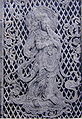 |
|
| Formerly placed on both ends of the roof of the main hall (Phoenix Hall) at Byōdō-in Byodo-in is a Buddhist temple in the city of Uji in Kyoto Prefecture, Japan. It is jointly a temple of the Jōdo-shū and Tendai-shū sects.- History :... |
Heian period Heian period The is the last division of classical Japanese history, running from 794 to 1185. The period is named after the capital city of Heian-kyō, or modern Kyōto. It is the period in Japanese history when Buddhism, Taoism and other Chinese influences were at their height... |
Phoenix (pair); gilt plated copper | Byōdō-in Byodo-in is a Buddhist temple in the city of Uji in Kyoto Prefecture, Japan. It is jointly a temple of the Jōdo-shū and Tendai-shū sects.- History :... , Uji Uji, Kyoto is a city on the southern outskirts of the city of Kyoto, in Kyoto Prefecture, Japan. Founded on March 1, 1951, Uji is located between the two ancient capitals of Nara and Kyoto. The city sits on the Uji River, which has its source in Lake Biwa. As of April 1, 2008, Uji has an estimated population... , Kyoto Kyoto Prefecture is a prefecture of Japan located in the Kansai region of the island of Honshu. The capital is the city of Kyoto.- History :Until the Meiji Restoration, the area of Kyoto prefecture was known as Yamashiro.... |
||
| , and | Utensils for calligraphy: (i) Water pot with oval window on each side and three legs; lid in flower-shape with jewel-shaped knob; (ii) Hexagonal pedestal-shaped rest for the ink stick; engraved with fish-egg circles; (iii) Spoons for drawing water from the pot, in the shape of a lotus flower, a gourd and a willow leaf; all items part of the Hōryū-ji Hōryū-ji is a Buddhist temple in Ikaruga, Nara Prefecture, Japan. Its full name is Hōryū Gakumonji , or Learning Temple of the Flourishing Law, the complex serving as seminary and monastery both.... treasures |
Nara period Nara period The of the history of Japan covers the years from AD 710 to 794. Empress Gemmei established the capital of Heijō-kyō . Except for 5 years , when the capital was briefly moved again, it remained the capital of Japanese civilization until Emperor Kammu established a new capital, Nagaoka-kyō, in 784... or Tang Dynasty Tang Dynasty The Tang Dynasty was an imperial dynasty of China preceded by the Sui Dynasty and followed by the Five Dynasties and Ten Kingdoms Period. It was founded by the Li family, who seized power during the decline and collapse of the Sui Empire... , 8th century |
Water dropper, three spoons, rest; gilt bronze; height: 3.8 cm (1.5 in) (sumi rest), 7.5 cm (3 in) (water dropper), length of spoons: 11.7 centimetre | Tokyo National Museum Tokyo National Museum Established 1872, the , or TNM, is the oldest and largest museum in Japan. The museum collects, houses, and preserves a comprehensive collection of art works and archaeological objects of Asia, focusing on Japan. The museum holds over 110,000 objects, which includes 87 Japanese National Treasure... , Tokyo Tokyo , ; officially , is one of the 47 prefectures of Japan. Tokyo is the capital of Japan, the center of the Greater Tokyo Area, and the largest metropolitan area of Japan. It is the seat of the Japanese government and the Imperial Palace, and the home of the Japanese Imperial Family... |
Lacquer
Japanese lacquerwareJapanese lacquerware
Japanese lacquerware is a broad category of fine and decorative arts, as lacquer has been used in paintings, prints, and on a wide variety of objects from Buddha statues to bento boxes for food.A number of terms are used in Japanese to refer to lacquerware...
has a long history, back as far as the Jōmon period
Jomon period
The is the time in Japanese prehistory from about 14,000 BC to 300 BC.The term jōmon means "cord-patterned" in Japanese. This refers to the pottery style characteristic of the Jōmon culture, and which has markings made using sticks with cords wrapped around them...
, because of decorative value and the quality as protective finish. Initially lacquer was used to enhance properties of utilitarian objects such as watertight drinking vessels, cooking and household goods. The oldest extant decorated item dates to the 6th century; in the medieval and early modern period lacquer was used in the manufacture of many products such as toiletry boxes, inkstone cases, eating utensils, plates, bowls, containers, furniture, saddles, stirrups or armour.
Lacquerware is produced in a three-step process: first the base is prepared. Most often the base consists of wood, but it can also be of paper or leather. Next is the application of lacquer, which hardens while drying, thereby sealing the base. Generally several layers of lacquer are applied. The lacquer is then decorated with a variety of methods. In the maki-e
Maki-e
is Japanese lacquer sprinkled with gold or silver powder as a decoration using a makizutsu or a kebo brush. The technique was developed mainly in the Heian Period and blossomed in the Edo Period...
technique, a powdered metal (usually gold or silver) is sprinkled on the lacquer before completely hardened. This technique was developed and popular in the Heian period
Heian period
The is the last division of classical Japanese history, running from 794 to 1185. The period is named after the capital city of Heian-kyō, or modern Kyōto. It is the period in Japanese history when Buddhism, Taoism and other Chinese influences were at their height...
but continued to be used with refinements into the early modern period. Over the next centuries various other methods that employ precious metals were developed, such as the ikakeji technique originating in the Kamakura period
Kamakura period
The is a period of Japanese history that marks the governance by the Kamakura Shogunate, officially established in 1192 in Kamakura by the first shogun Minamoto no Yoritomo....
in which a finely ground gold powder was spread in sufficient quantities to mimic solid gold. The use of metallic powders was complemented with other techniques such as polished shell inlay or gold leaf (kirikane). The former was used in the Heian and Kamakura periods and popular motifs included water, rocks, trees or flowers. Starting in the Kamakura period, larger and more solid objects such as toiletry chests were decorated with realistic images. Towards the end of the medieval period (late-16th century), simpler designs were favoured in decorations. Honami Kōetsu
Honami Koetsu
was a Japanese craftsman, potter, lacquerer, and calligrapher, whose work is generally considered to have inspired the founding of the Rinpa school of painting.-Early life:...
who lived around this time is the earliest lacquer artist known by name.
Japanese lacquerwork reached its apogee in the 17th century Edo period
Edo period
The , or , is a division of Japanese history which was ruled by the shoguns of the Tokugawa family, running from 1603 to 1868. The political entity of this period was the Tokugawa shogunate....
when lacquer was used for decorative objects as well as everyday items such as combs, tables, bottle, headrests, small boxes or writing cases. The most famous artist of this time was the lacquerer painter Ogata Kōrin
Ogata Korin
was a Japanese painter of the Rinpa school.-Early life:Kōrin was born in Kyoto, to a wealthy merchant who had a taste for the arts and is said to have given his son some elementary instruction therein...
. He was the first to use mother of pearl and pewter
Pewter
Pewter is a malleable metal alloy, traditionally 85–99% tin, with the remainder consisting of copper, antimony, bismuth and lead. Copper and antimony act as hardeners while lead is common in the lower grades of pewter, which have a bluish tint. It has a low melting point, around 170–230 °C ,...
in larger quantities for decorating lacquerware.
Buddhist items
Eleven items related to BuddhismBuddhism
Buddhism is a religion and philosophy encompassing a variety of traditions, beliefs and practices, largely based on teachings attributed to Siddhartha Gautama, commonly known as the Buddha . The Buddha lived and taught in the northeastern Indian subcontinent some time between the 6th and 4th...
, including four boxes for sutra
Sutra
Sūtra is an aphorism or a collection of such aphorisms in the form of a manual. Literally it means a thread or line that holds things together and is derived from the verbal root siv-, meaning to sew , as does the medical term...
scrolls made with a wood or leather base, two miniature shrines, one table, a jewel box, a box for a monk's robe (kesa
Kesa (clothing)
Kāṣāya are the robes of Buddhist monks and nuns, named after a brown or saffron dye. In Sanskrit and Pali, these robes are also given the more general term cīvara, which references the robes without regard to color....
), a palanquin and a Buddhist platform, have been designated as lacquered Buddhist National Treasures. With one exception all of these items date to the Heian period
Heian period
The is the last division of classical Japanese history, running from 794 to 1185. The period is named after the capital city of Heian-kyō, or modern Kyōto. It is the period in Japanese history when Buddhism, Taoism and other Chinese influences were at their height...
.
| Name | Remarks | Date | Type | Present location | Image |
|---|---|---|---|---|---|
| Struts decorated with bells and canopy; top and bottom with pestle and flower pattern; framed with gilt bronze border; eight Karyobinga (winged female angels) on each panel holding a percussion instrument (on front panel) or flower pots (on other panels) | Heian period Heian period The is the last division of classical Japanese history, running from 794 to 1185. The period is named after the capital city of Heian-kyō, or modern Kyōto. It is the period in Japanese history when Buddhism, Taoism and other Chinese influences were at their height... |
Platform; lacquered wood with mother of pearl inlay, gold and silver; height: 52.4 cm (20.6 in), diameter: 193.9 cm (76.3 in), side length : 74.5 cm (29.3 in) | Chūson-ji Chuson-ji Chūson-ji is a Buddhist temple in Hiraizumi, Iwate Prefecture, Japan. It is the head temple of the Tendai sect in Tōhoku . The Tendai sect claims that the temple was founded in 850 by Ennin, the third chief abbot of the sect, but most scholars believe that Chūson-ji was founded by Fujiwara no... , Hiraizumi Hiraizumi, Iwate is a town located in Nishiiwai District, Iwate, Japan. It was the home of the Hiraizumi Fujiwaras for about 100 years in the late Heian era and most of the following Kamakura period. At the same time it served as the de facto capital of Oshu, an area containing nearly a third of the Japanese land... , Iwate Iwate Prefecture is the second largest prefecture of Japan after Hokkaido. It is located in the Tōhoku region of Honshū island and contains the island's easternmost point. The capital is Morioka. Iwate has the lowest population density of any prefecture outside Hokkaido... |
||
| With arabesque pattern of hōsōge flowers | Heian period Heian period The is the last division of classical Japanese history, running from 794 to 1185. The period is named after the capital city of Heian-kyō, or modern Kyōto. It is the period in Japanese history when Buddhism, Taoism and other Chinese influences were at their height... , around 1100 |
Sutra Sutra Sūtra is an aphorism or a collection of such aphorisms in the form of a manual. Literally it means a thread or line that holds things together and is derived from the verbal root siv-, meaning to sew , as does the medical term... box; black lacquered wood, rough maki-e Maki-e is Japanese lacquer sprinkled with gold or silver powder as a decoration using a makizutsu or a kebo brush. The technique was developed mainly in the Heian Period and blossomed in the Edo Period... ; 20.3 centimetre |
Enryaku-ji Enryaku-ji thumb|300px|Konpon Chū-dō , Enryaku-ji's main hall is a Tendai monastery located on Mount Hiei in Ōtsu, overlooking Kyoto. It was founded during the early Heian period. The temple complex was established by Saichō , also known as Dengyō Daishi, who introduced the Tendai sect of Mahayana Buddhism... , Ōtsu Otsu, Shiga is the capital city of Shiga, Japan. The city was founded on October 1, 1898. As of October 1, 2010, the city has an estimated population of 338,629 with an average age of 40.7 years and a population density of 905.28 persons per km²... , Shiga Shiga Prefecture is a prefecture of Japan, which forms part of the Kansai region on Honshu Island. The capital is the city of Ōtsu.- History :Shiga was known as Ōmi Province or Gōshū before the prefectural system was established... |
||
| Arabesque lotus flower design and butterflies in maki-e Maki-e is Japanese lacquer sprinkled with gold or silver powder as a decoration using a makizutsu or a kebo brush. The technique was developed mainly in the Heian Period and blossomed in the Edo Period... |
Heian period Heian period The is the last division of classical Japanese history, running from 794 to 1185. The period is named after the capital city of Heian-kyō, or modern Kyōto. It is the period in Japanese history when Buddhism, Taoism and other Chinese influences were at their height... , 12th century |
Sutra Sutra Sūtra is an aphorism or a collection of such aphorisms in the form of a manual. Literally it means a thread or line that holds things together and is derived from the verbal root siv-, meaning to sew , as does the medical term... box; black lacquered leather, maki-e; 31.8 × 17.6 × 12.1 cm (12.5 × 6.9 × 4.8 in) |
Nara National Museum Nara National Museum The is one of the pre-eminent national art museums in Japan.-Introduction:The Nara National Museum is located in Nara, which was the capital of Japan from 710 to 784. Katayama Tōkuma designed the original building, which is a representative Western-style building of the Meiji period and has been... , Nara Nara, Nara is the capital city of Nara Prefecture in the Kansai region of Japan. The city occupies the northern part of Nara Prefecture, directly bordering Kyoto Prefecture... , Nara Nara Prefecture is a prefecture in the Kansai region on Honshū Island, Japan. The capital is the city of Nara.-History:The present-day Nara Prefecture was created in 1887, making it independent of Osaka Prefecture.... |
||
| Box in which a kesa Kesa (clothing) Kāṣāya are the robes of Buddhist monks and nuns, named after a brown or saffron dye. In Sanskrit and Pali, these robes are also given the more general term cīvara, which references the robes without regard to color.... brought back from Tang Dynasty Tang Dynasty The Tang Dynasty was an imperial dynasty of China preceded by the Sui Dynasty and followed by the Five Dynasties and Ten Kingdoms Period. It was founded by the Li family, who seized power during the decline and collapse of the Sui Empire... China by Kūkai Kukai Kūkai , also known posthumously as , 774–835, was a Japanese monk, civil servant, scholar, poet, and artist, founder of the Shingon or "True Word" school of Buddhism. Shingon followers usually refer to him by the honorific titles of and .... was stored; decorated with a sea motif: marine animals (fish, birds, turtles) in gold and waves in silver maki-e |
Heian period Heian period The is the last division of classical Japanese history, running from 794 to 1185. The period is named after the capital city of Heian-kyō, or modern Kyōto. It is the period in Japanese history when Buddhism, Taoism and other Chinese influences were at their height... , 10th century, before 940 |
Kesa Kesa (clothing) Kāṣāya are the robes of Buddhist monks and nuns, named after a brown or saffron dye. In Sanskrit and Pali, these robes are also given the more general term cīvara, which references the robes without regard to color.... box; lacquered hinoki wood, togidashi (burnished) maki-e Maki-e is Japanese lacquer sprinkled with gold or silver powder as a decoration using a makizutsu or a kebo brush. The technique was developed mainly in the Heian Period and blossomed in the Edo Period... ; 7.9 × 39.1 × 11.5 cm (3.1 × 15.4 × 4.5 in) |
Tō-ji To-ji is a Buddhist temple of the Shingon sect in Kyoto, Japan. Its name means East Temple, and it once had a partner, Sai-ji . They stood alongside the Rashomon, the gate to the Heian capital. It is formally known as which indicates that it previously functioned as a temple providing protection for the... , Kyoto Kyoto is a city in the central part of the island of Honshū, Japan. It has a population close to 1.5 million. Formerly the imperial capital of Japan, it is now the capital of Kyoto Prefecture, as well as a major part of the Osaka-Kobe-Kyoto metropolitan area.-History:... |
||
| Palanquin similar to a mikoshi Mikoshi A is a divine palanquin . Shinto followers believe that it serves as the vehicle to transport a deity in Japan while moving between main shrine and temporary shrine during a festival or when moving to a new shrine... used in the ceremony (dedication of the bones of Buddha) |
Heian period Heian period The is the last division of classical Japanese history, running from 794 to 1185. The period is named after the capital city of Heian-kyō, or modern Kyōto. It is the period in Japanese history when Buddhism, Taoism and other Chinese influences were at their height... |
Palanquin; black lacquered rosewood, mother of pearl inlay | Tō-ji To-ji is a Buddhist temple of the Shingon sect in Kyoto, Japan. Its name means East Temple, and it once had a partner, Sai-ji . They stood alongside the Rashomon, the gate to the Heian capital. It is formally known as which indicates that it previously functioned as a temple providing protection for the... , Kyoto Kyoto is a city in the central part of the island of Honshū, Japan. It has a population close to 1.5 million. Formerly the imperial capital of Japan, it is now the capital of Kyoto Prefecture, as well as a major part of the Osaka-Kobe-Kyoto metropolitan area.-History:... |
||
| Box for eight scrolls of the Lotus Sutra Lotus Sutra The Lotus Sūtra is one of the most popular and influential Mahāyāna sūtras, and the basis on which the Tiantai and Nichiren sects of Buddhism were established.-Title:... ; decorated with five scenes from the lotus sutra in maki-e |
Heian period Heian period The is the last division of classical Japanese history, running from 794 to 1185. The period is named after the capital city of Heian-kyō, or modern Kyōto. It is the period in Japanese history when Buddhism, Taoism and other Chinese influences were at their height... , around 1000 |
Sutra box; black lacquer on thin wood, gold and silver maki-e Maki-e is Japanese lacquer sprinkled with gold or silver powder as a decoration using a makizutsu or a kebo brush. The technique was developed mainly in the Heian Period and blossomed in the Edo Period... ; 23.7 × 32.7 × 16.7 cm (9.3 × 12.9 × 6.6 in) |
Fujita Art Museum Fujita Art Museum The is one of the largest private collections in the Kansai region. The collection was assembled by Fujita Denzaburō and his descendants. It was installed in a storehouse on the family property in Osaka.... , Osaka Osaka is a city in the Kansai region of Japan's main island of Honshu, a designated city under the Local Autonomy Law, the capital city of Osaka Prefecture and also the biggest part of Keihanshin area, which is represented by three major cities of Japan, Kyoto, Osaka and Kobe... |
||
| Decorated with hōsōge flowers, phoenix (chicken) Phoenix (chicken) The Phoenix is one of many breeds of chicken that resulted from European selective breeding of onagadori,. a long-tail fowl bred in Japan for a thousand years.They molt every year or every other year... and cranes on the outside and the Four Heavenly Kings Four Heavenly Kings In the Buddhist faith, the Four Heavenly Kings are four gods, each of whom watches over one cardinal direction of the world.The Kings are collectively named as follows:... inside |
early Heian period Heian period The is the last division of classical Japanese history, running from 794 to 1185. The period is named after the capital city of Heian-kyō, or modern Kyōto. It is the period in Japanese history when Buddhism, Taoism and other Chinese influences were at their height... |
Jewel box; lacquer, maki-e Maki-e is Japanese lacquer sprinkled with gold or silver powder as a decoration using a makizutsu or a kebo brush. The technique was developed mainly in the Heian Period and blossomed in the Edo Period... |
Ninna-ji Ninna-ji is the head temple of the Omuro school of the Shingon Sect of Buddhism. Located in western Kyoto, Japan, it was founded in AD 888 by the retired Emperor Uda. It is part of the "Historic Monuments of Ancient Kyoto", a UNESCO World Heritage Site.-History:... , Kyoto Kyoto is a city in the central part of the island of Honshū, Japan. It has a population close to 1.5 million. Formerly the imperial capital of Japan, it is now the capital of Kyoto Prefecture, as well as a major part of the Osaka-Kobe-Kyoto metropolitan area.-History:... |
||
| Decorated with paintings, lotus petal mouldings and embossed figures of Buddhas | Asuka period Asuka period The , was a period in the history of Japan lasting from 538 to 710 , although its beginning could be said to overlap with the preceding Kofun period... , 7th century |
Miniature shrine; camphor and cypress wood; height: 226.6 cm (89.2 in) | Hōryū-ji Hōryū-ji is a Buddhist temple in Ikaruga, Nara Prefecture, Japan. Its full name is Hōryū Gakumonji , or Learning Temple of the Flourishing Law, the complex serving as seminary and monastery both.... , Ikaruga Ikaruga, Nara is a town located in Ikoma District, Nara, Japan.Ikaruga is home to Hōryū-ji and Hokki-ji, ancient Buddhist temples collectively inscribed as UNESCO World Heritage. Other ancient temples include Hōrin-ji, also in the vicinity of Hōryū-ji.... , Nara Nara Prefecture is a prefecture in the Kansai region on Honshū Island, Japan. The capital is the city of Nara.-History:The present-day Nara Prefecture was created in 1887, making it independent of Osaka Prefecture.... |
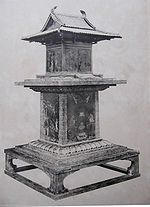 |
|
| Incense burner, candlestick and other items were placed on this table in front of the spirit of the deceased | Heian period Heian period The is the last division of classical Japanese history, running from 794 to 1185. The period is named after the capital city of Heian-kyō, or modern Kyōto. It is the period in Japanese history when Buddhism, Taoism and other Chinese influences were at their height... , mid 12th century |
Table; black lacquer, mother of pearl inlay | Hōryū-ji Hōryū-ji is a Buddhist temple in Ikaruga, Nara Prefecture, Japan. Its full name is Hōryū Gakumonji , or Learning Temple of the Flourishing Law, the complex serving as seminary and monastery both.... , Ikaruga Ikaruga, Nara is a town located in Ikoma District, Nara, Japan.Ikaruga is home to Hōryū-ji and Hokki-ji, ancient Buddhist temples collectively inscribed as UNESCO World Heritage. Other ancient temples include Hōrin-ji, also in the vicinity of Hōryū-ji.... , Nara Nara Prefecture is a prefecture in the Kansai region on Honshū Island, Japan. The capital is the city of Nara.-History:The present-day Nara Prefecture was created in 1887, making it independent of Osaka Prefecture.... |
||
| Decorations of lotus lake (door panels), celestial musicians (underside of roof), butterflies, ducks, cranes, pheasants, wild geese (inside); hōsōge flowers on the ceiling; used to store a Taima Mandala | Heian period Heian period The is the last division of classical Japanese history, running from 794 to 1185. The period is named after the capital city of Heian-kyō, or modern Kyōto. It is the period in Japanese history when Buddhism, Taoism and other Chinese influences were at their height... |
Miniature shrine; wood | Taima-dera Taima-dera Taima-dera is a Buddhist temple in Nara, Japan built originally in 612 by the Imperial Prince Maroko, the brother of Prince Shotoku. The temple was moved to its present location in 681 by the grandson of Prince Maroko, and serves as the head temple, or honzan of the now-defunct Hosso sect... , Nara Nara, Nara is the capital city of Nara Prefecture in the Kansai region of Japan. The city occupies the northern part of Nara Prefecture, directly bordering Kyoto Prefecture... , Nara Nara Prefecture is a prefecture in the Kansai region on Honshū Island, Japan. The capital is the city of Nara.-History:The present-day Nara Prefecture was created in 1887, making it independent of Osaka Prefecture.... |
||
| Lid decorated with Kurikara dragon flanked by two attendants: and | Heian period Heian period The is the last division of classical Japanese history, running from 794 to 1185. The period is named after the capital city of Heian-kyō, or modern Kyōto. It is the period in Japanese history when Buddhism, Taoism and other Chinese influences were at their height... |
Sutra Sutra Sūtra is an aphorism or a collection of such aphorisms in the form of a manual. Literally it means a thread or line that holds things together and is derived from the verbal root siv-, meaning to sew , as does the medical term... box; black lacquer, maki-e Maki-e is Japanese lacquer sprinkled with gold or silver powder as a decoration using a makizutsu or a kebo brush. The technique was developed mainly in the Heian Period and blossomed in the Edo Period... ; 31 centimetre |
Taima-dera Taima-dera Taima-dera is a Buddhist temple in Nara, Japan built originally in 612 by the Imperial Prince Maroko, the brother of Prince Shotoku. The temple was moved to its present location in 681 by the grandson of Prince Maroko, and serves as the head temple, or honzan of the now-defunct Hosso sect... , Nara Nara, Nara is the capital city of Nara Prefecture in the Kansai region of Japan. The city occupies the northern part of Nara Prefecture, directly bordering Kyoto Prefecture... , Nara Nara Prefecture is a prefecture in the Kansai region on Honshū Island, Japan. The capital is the city of Nara.-History:The present-day Nara Prefecture was created in 1887, making it independent of Osaka Prefecture.... |
Mikoshi
Two 12th-century lacquer-coated mikoshiMikoshi
A is a divine palanquin . Shinto followers believe that it serves as the vehicle to transport a deity in Japan while moving between main shrine and temporary shrine during a festival or when moving to a new shrine...
, portable shrines for use in festivals of Shinto shrines have been designated as National Treasures.
| Name | Remarks | Date | Type | Present location |
|---|---|---|---|---|
| Mythical firebird (Fenghuang Fenghuang Fenghuang are mythological birds of East Asia that reign over all other birds. The males are called Feng and the females Huang. In modern times, however, such a distinction of gender is often no longer made and the Feng and Huang are blurred into a single feminine entity so that the bird can be... ) on the roof; fretwork Fretwork Fretwork is an interlaced decorative design that is either carved in low relief on a solid background, or cut out with a fretsaw, coping saw, jigsaw or scroll saw. Most fretwork patterns are geometric in design. The materials most commonly used are wood and metal. Fretwork is used to adorn... flags hanging from the corners of the roof and three fretwork mirrors and cloths on each side |
Kamakura period Kamakura period The is a period of Japanese history that marks the governance by the Kamakura Shogunate, officially established in 1192 in Kamakura by the first shogun Minamoto no Yoritomo.... , Kenkyū Kenkyu was a after Bunji and before Shōji. This period spanned the years from April 1190 through April 1199. The reigning emperor was .-Change of era:* 1190 : The new era name was created to mark an event or a number of events... era (1190–1199) |
Lacquered wood with mother of pearl decoration, gilt bronze fittings |
Habikino, Osaka
is a city located in eastern Osaka, Japan. It is particularly well-known for its grape production, as well as the many ancient burial mounds that dot its landscape.-Within Japan: Kameyama, Mie Gose, Nara...
, Osaka
Osaka Prefecture
is a prefecture located in the Kansai region on Honshū, the main island of Japan. The capital is the city of Osaka. It is the center of Osaka-Kobe-Kyoto area.- History :...
|-
|
| Oldest extant Japanese mikoshi
|Heian period
Heian period
The is the last division of classical Japanese history, running from 794 to 1185. The period is named after the capital city of Heian-kyō, or modern Kyōto. It is the period in Japanese history when Buddhism, Taoism and other Chinese influences were at their height...
, 12th century
| Lacquered wood, gilt bronze fittings; total height: 226 cm (89 in), bay
Bay (architecture)
A bay is a unit of form in architecture. This unit is defined as the zone between the outer edges of an engaged column, pilaster, or post; or within a window frame, doorframe, or vertical 'bas relief' wall form.-Defining elements:...
: 98.2 cm (38.7 in), shafts: 364 cm (143.3 in), stand width: 141 cm (55.5 in)
|, Kinokawa
Kinokawa, Wakayama
is a city located in Wakayama Prefecture, Japan.As of April 30, 2011, the city has an estimated population of 67,835 with 25,607 households and a population density of 297.21 persons per km²...
, Wakayama
Wakayama Prefecture
is a prefecture of Japan located on the Kii Peninsula in the Kansai region on Honshū island. The capital is the city of Wakayama.- History :Present-day Wakayama is mostly the western part of the province of Kii.- 1953 Wakayama Prefecture flood disaster :...
|}
Harnesses
Saddles were made of wood and were designed as a standing platform for archers. They were not suited for riding long distances or at high speed. Early saddles of the Nara periodNara period
The of the history of Japan covers the years from AD 710 to 794. Empress Gemmei established the capital of Heijō-kyō . Except for 5 years , when the capital was briefly moved again, it remained the capital of Japanese civilization until Emperor Kammu established a new capital, Nagaoka-kyō, in 784...
were of Chinese style karagura and later modified for local tastes, resulting in Japanese style saddles from the Heian period
Heian period
The is the last division of classical Japanese history, running from 794 to 1185. The period is named after the capital city of Heian-kyō, or modern Kyōto. It is the period in Japanese history when Buddhism, Taoism and other Chinese influences were at their height...
onward. Artisans and carpenters became involved in the saddle production as saddles became more elaborate in the Kamakura period
Kamakura period
The is a period of Japanese history that marks the governance by the Kamakura Shogunate, officially established in 1192 in Kamakura by the first shogun Minamoto no Yoritomo....
, with decorations in mother of pearl inlay, gold leaf and multiple coats of lacquer. Saddles ceased to be primarily utilitarian, instead serving as adornment showing the owner's status in processions. Three Japanese style lacquered wooden saddles and a complete set of a Chinese style ritual saddle, dating to the late Heian and Kamakura periods, have been designated as National Treasures.
| Name | Remarks | Date | Type | Present location |
|---|---|---|---|---|
| Exterior of ends of saddle decorated with images of oak trees and horned owl Horned owl The American horned owls and the Old World eagle-owls make up the genus Bubo, at least as traditionally described. This genus, depending on definition, contains about one or two dozen species of typical owls and is found in many parts of the world. Some of the largest living Strigiformes are in... s; interior decorated with broken oak tree branches; typical saddle design of a warrior of the late Heian and Kamakura period |
late Heian period Heian period The is the last division of classical Japanese history, running from 794 to 1185. The period is named after the capital city of Heian-kyō, or modern Kyōto. It is the period in Japanese history when Buddhism, Taoism and other Chinese influences were at their height... , 12th century |
Saddle; lacquered wood with mother of pearl inlay; height 30 cm (11.8 in) (saddle fork) and 35 cm (13.8 in) (cantle) | Eisei Bunko Museum Eisei Bunko Museum The is a museum in Bunkyo-ku district in Tokyo, Japan. Its collection includes historical documents and artifacts, and works of fine art. The museum is located what was formerly the grounds of the Hosokawa clan, near the Shin-Edogawa Garden.-History:... , Tokyo Tokyo , ; officially , is one of the 47 prefectures of Japan. Tokyo is the capital of Japan, the center of the Greater Tokyo Area, and the largest metropolitan area of Japan. It is the seat of the Japanese government and the Imperial Palace, and the home of the Japanese Imperial Family... |
|
| Decorated with images of pines, vines twining around the pines and characters forming a love poem | Kamakura period Kamakura period The is a period of Japanese history that marks the governance by the Kamakura Shogunate, officially established in 1192 in Kamakura by the first shogun Minamoto no Yoritomo.... |
Saddle; lacquered wood with mother of pearl inlay; seat length: 43 cm (16.9 in), height 29.7 cm (11.7 in) (saddle fork) and 35 cm (13.8 in) (cantle) | Eisei Bunko Museum Eisei Bunko Museum The is a museum in Bunkyo-ku district in Tokyo, Japan. Its collection includes historical documents and artifacts, and works of fine art. The museum is located what was formerly the grounds of the Hosokawa clan, near the Shin-Edogawa Garden.-History:... , Tokyo Tokyo , ; officially , is one of the 47 prefectures of Japan. Tokyo is the capital of Japan, the center of the Greater Tokyo Area, and the largest metropolitan area of Japan. It is the seat of the Japanese government and the Imperial Palace, and the home of the Japanese Imperial Family... |
|
| Includes a saddle with stirrups, bit Bit (horse) A bit is a type of horse tack used in equestrian activities, usually made of metal or a synthetic material, and is placed in the mouth of a horse or other equid and assists a rider in communicating with the animal. It rests on the bars of the mouth in an interdental region where there are no teeth... and swing |
Kamakura period Kamakura period The is a period of Japanese history that marks the governance by the Kamakura Shogunate, officially established in 1192 in Kamakura by the first shogun Minamoto no Yoritomo.... , 13th century |
Saddle; lacquered wood with mother of pearl inlay; saddle: wood, lacquer, mother of pearl, and gilt copper 30.3 × 43.3 × 29.7 cm (11.9 × 17.0 × 11.7 in); stirrups: iron, lacquer, and wood 27 × 28 × 12 cm (10.6 × 11 × 4.7 in) | , Ōme Ome, Tokyo is a city located in Tokyo, Japan.As of October 1, 2010, the city has an estimated population of 139,932 and a density of 1,355.14 persons per km². The total area is 103.26 km².The characters 青梅 literally mean blue ume, or Japanese apricot.... , Tokyo Tokyo , ; officially , is one of the 47 prefectures of Japan. Tokyo is the capital of Japan, the center of the Greater Tokyo Area, and the largest metropolitan area of Japan. It is the seat of the Japanese government and the Imperial Palace, and the home of the Japanese Imperial Family... |
|
| Includes one saddle, one neck tassel, ten , a pair of stirrups, a pair of leather stirrups, one ,Strap running from the cantle of the saddle to the horse's dock Rump (animal) The rump or croup, in the external morphology of an animal, is the portion of the posterior dorsum that is posterior to the loins and anterior to the tail. Anatomically, the rump corresponds to the sacrum.... . a girth Girth (tack) A girth, sometimes called a cinch , is a piece of equipment used to keep the saddle in place on a horse or other animal. It passes under the barrel of the equine, usually attached to the saddle on both sides by two or three leather straps called billets... , one tail sack, two ,Straps attached to the bit Bit (horse) A bit is a type of horse tack used in equestrian activities, usually made of metal or a synthetic material, and is placed in the mouth of a horse or other equid and assists a rider in communicating with the animal. It rests on the bars of the mouth in an interdental region where there are no teeth... for controlling the horse. one saddle cushion, a pair of 障泥, two ,A type of metal fittings. a bit Bit (horse) A bit is a type of horse tack used in equestrian activities, usually made of metal or a synthetic material, and is placed in the mouth of a horse or other equid and assists a rider in communicating with the animal. It rests on the bars of the mouth in an interdental region where there are no teeth... , a secondary rein Rein Reins are items of horse tack, used to direct a horse or other animal used for riding or driving. Reins can be made of leather, nylon, metal, or other materials, and attach to a bridle via either its bit or its noseband.-Use for riding:... , halter Halter A halter, headcollar, or, less often, headstall, is headgear that is used to lead or tie up livestock and, occasionally, other animals; it fits behind the ears , and around the muzzle. To handle the animal, usually a lead rope or lead shank is attached... , one NDL: 胸繋; Straps used to secure the saddle fork in relation to the horse's breast. and one Headpiece resting over the poll and along the nose ridge, supported by browband. |
Kamakura period Kamakura period The is a period of Japanese history that marks the governance by the Kamakura Shogunate, officially established in 1192 in Kamakura by the first shogun Minamoto no Yoritomo.... |
Saddle of black lacquer and mother of pearl inlay and accessories of various type |
Nara, Nara
is the capital city of Nara Prefecture in the Kansai region of Japan. The city occupies the northern part of Nara Prefecture, directly bordering Kyoto Prefecture...
, Nara
Nara Prefecture
is a prefecture in the Kansai region on Honshū Island, Japan. The capital is the city of Nara.-History:The present-day Nara Prefecture was created in 1887, making it independent of Osaka Prefecture....
|}
Furniture, boxes, musical instruments
Box-like items including five toiletry cases, two writing boxes, four other boxes, a chest, a zither, an arm rest and a marriage trousseauDowry
A dowry is the money, goods, or estate that a woman brings forth to the marriage. It contrasts with bride price, which is paid to the bride's parents, and dower, which is property settled on the bride herself by the groom at the time of marriage. The same culture may simultaneously practice both...
containing many items of furniture, boxes and others have been designated as 15 National Treasures.
| Name | Artists | Remarks | Date | Type | Present location | Image |
|---|---|---|---|---|---|---|
| unknown | Imported from China during the Nara period Nara period The of the history of Japan covers the years from AD 710 to 794. Empress Gemmei established the capital of Heijō-kyō . Except for 5 years , when the capital was briefly moved again, it remained the capital of Japanese civilization until Emperor Kammu established a new capital, Nagaoka-kyō, in 784... ; thirteen circular markers of mother of pearl, two elliptical sound-holes and rosewood fittings at the ends; ink inscription inside the body states the year and place (Jiulong County) of production |
Tang Dynasty Tang Dynasty The Tang Dynasty was an imperial dynasty of China preceded by the Sui Dynasty and followed by the Five Dynasties and Ten Kingdoms Period. It was founded by the Li family, who seized power during the decline and collapse of the Sui Empire... , 724 |
Zither Guqin The guqin is the modern name for a plucked seven-string Chinese musical instrument of the zither family... ; paulownia Paulownia Paulownia is a genus of from 6 to 17 species of plants in the monogeneric family Paulowniaceae, related to and sometimes included in the Scrophulariaceae. They are native to much of China, south to northern Laos and Vietnam, and long cultivated elsewhere in eastern Asia, notably in Japan and Korea... wood with black lacquer and mother of pearl inlay; length: 109 cm (42.9 in) |
Tokyo National Museum Tokyo National Museum Established 1872, the , or TNM, is the oldest and largest museum in Japan. The museum collects, houses, and preserves a comprehensive collection of art works and archaeological objects of Asia, focusing on Japan. The museum holds over 110,000 objects, which includes 87 Japanese National Treasure... , Tokyo Tokyo , ; officially , is one of the 47 prefectures of Japan. Tokyo is the capital of Japan, the center of the Greater Tokyo Area, and the largest metropolitan area of Japan. It is the seat of the Japanese government and the Imperial Palace, and the home of the Japanese Imperial Family... |
||
| unkonwon | Interior of box and lid with flying birds and floral motifs; similar design to the National Treasure box with designation number 64, this box has number 99 | Heian period Heian period The is the last division of classical Japanese history, running from 794 to 1185. The period is named after the capital city of Heian-kyō, or modern Kyōto. It is the period in Japanese history when Buddhism, Taoism and other Chinese influences were at their height... , 12th century |
Toiletry case; black lacquered wood, aogin togidashi maki-e Maki-e is Japanese lacquer sprinkled with gold or silver powder as a decoration using a makizutsu or a kebo brush. The technique was developed mainly in the Heian Period and blossomed in the Edo Period... and mother of pearl inlay, openwork silver fittings; 22.4 × 30.6 × 13.5 cm (8.8 × 12.0 × 5.3 in) |
Tokyo National Museum Tokyo National Museum Established 1872, the , or TNM, is the oldest and largest museum in Japan. The museum collects, houses, and preserves a comprehensive collection of art works and archaeological objects of Asia, focusing on Japan. The museum holds over 110,000 objects, which includes 87 Japanese National Treasure... , Tokyo Tokyo , ; officially , is one of the 47 prefectures of Japan. Tokyo is the capital of Japan, the center of the Greater Tokyo Area, and the largest metropolitan area of Japan. It is the seat of the Japanese government and the Imperial Palace, and the home of the Japanese Imperial Family... |
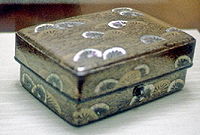 |
|
| Ogata Kōrin Ogata Korin was a Japanese painter of the Rinpa school.-Early life:Kōrin was born in Kyoto, to a wealthy merchant who had a taste for the arts and is said to have given his son some elementary instruction therein... |
Rectangular two-tier box with rounded corners and lid; upper tier holds inkstone and water dropper; lower tier is for paper; eight bridges design after chapter 9 of The Tales of Ise The Tales of Ise is a Japanese collection of tanka poems and associated narratives, dating from the Heian period. The current version collects 125 sections, with each combining poems and prose, giving a total of 209 poems in most versions.... ; irises and plank bridges |
Edo period Edo period The , or , is a division of Japanese history which was ruled by the shoguns of the Tokugawa family, running from 1603 to 1868. The political entity of this period was the Tokugawa shogunate.... , 18th century |
Writing box; black lacquered wood, gold, maki-e Maki-e is Japanese lacquer sprinkled with gold or silver powder as a decoration using a makizutsu or a kebo brush. The technique was developed mainly in the Heian Period and blossomed in the Edo Period... , abalone Abalone Abalone , from aulón, are small to very large-sized edible sea snails, marine gastropod molluscs in the family Haliotidae and the genus Haliotis... shells, silver and corroded lead strips (bridges); 27.3 × 19.7 × 14.2 cm (10.7 × 7.8 × 5.6 in) |
Tokyo National Museum Tokyo National Museum Established 1872, the , or TNM, is the oldest and largest museum in Japan. The museum collects, houses, and preserves a comprehensive collection of art works and archaeological objects of Asia, focusing on Japan. The museum holds over 110,000 objects, which includes 87 Japanese National Treasure... , Tokyo Tokyo , ; officially , is one of the 47 prefectures of Japan. Tokyo is the capital of Japan, the center of the Greater Tokyo Area, and the largest metropolitan area of Japan. It is the seat of the Japanese government and the Imperial Palace, and the home of the Japanese Imperial Family... |
||
| Honami Kōetsu Honami Koetsu was a Japanese craftsman, potter, lacquerer, and calligrapher, whose work is generally considered to have inspired the founding of the Rinpa school of painting.-Early life:... |
Square box with rounded corners and a high, domed lid which fits over the body; boats lined up in a wave pattern and bridge; characters on box quote a poem by Minamoto Hitoshi from the Gosen Wakashū | Edo period Edo period The , or , is a division of Japanese history which was ruled by the shoguns of the Tokugawa family, running from 1603 to 1868. The political entity of this period was the Tokugawa shogunate.... , 17th century |
Writing box; black lacquered wood sprinkled with gold powder, tsukegaki technique (waves), usuniku takamakie (boats), raised characters from silver strips, bridge from thick lead strip; 24.2 × 11.8 × 22.9 cm (9.5 × 4.6 × 9.0 in) | Tokyo National Museum Tokyo National Museum Established 1872, the , or TNM, is the oldest and largest museum in Japan. The museum collects, houses, and preserves a comprehensive collection of art works and archaeological objects of Asia, focusing on Japan. The museum holds over 110,000 objects, which includes 87 Japanese National Treasure... , Tokyo Tokyo , ; officially , is one of the 47 prefectures of Japan. Tokyo is the capital of Japan, the center of the Greater Tokyo Area, and the largest metropolitan area of Japan. It is the seat of the Japanese government and the Imperial Palace, and the home of the Japanese Imperial Family... |
||
| unknown | Inside of the lid with drawings of flowers of the four seasons such as: plum, pine tree, wisteria, cherry and chrysanthemum | Kamakura period Kamakura period The is a period of Japanese history that marks the governance by the Kamakura Shogunate, officially established in 1192 in Kamakura by the first shogun Minamoto no Yoritomo.... , 13th century |
Toiletry case; lacquered wood with mother of pearl inlay and maki-e Maki-e is Japanese lacquer sprinkled with gold or silver powder as a decoration using a makizutsu or a kebo brush. The technique was developed mainly in the Heian Period and blossomed in the Edo Period... ; 36.1 centimetre, height: 23 cm (9.1 in) (total), 6.6 cm (2.6 in) (lid), 16.5 cm (6.5 in) (body) |
Suntory Museum of Art, Tokyo Tokyo , ; officially , is one of the 47 prefectures of Japan. Tokyo is the capital of Japan, the center of the Greater Tokyo Area, and the largest metropolitan area of Japan. It is the seat of the Japanese government and the Imperial Palace, and the home of the Japanese Imperial Family... |
||
| unknown | Used to hold such things as cosmetics, paper, and writing materials; similar design to the National Treasure box with designation number 64, this box has number 99, but bigger size, higher intensity of gold color, regular placement of cart wheels and other designs | Heian period Heian period The is the last division of classical Japanese history, running from 794 to 1185. The period is named after the capital city of Heian-kyō, or modern Kyōto. It is the period in Japanese history when Buddhism, Taoism and other Chinese influences were at their height... , 12th century |
Toiletry case; black lacquered wood, maki-e Maki-e is Japanese lacquer sprinkled with gold or silver powder as a decoration using a makizutsu or a kebo brush. The technique was developed mainly in the Heian Period and blossomed in the Edo Period... and mother of pearl inlay; 27.3 × 35.5 × 20.9 cm (10.7 × 14.0 × 8.2 in) |
Tokyo National Museum Tokyo National Museum Established 1872, the , or TNM, is the oldest and largest museum in Japan. The museum collects, houses, and preserves a comprehensive collection of art works and archaeological objects of Asia, focusing on Japan. The museum holds over 110,000 objects, which includes 87 Japanese National Treasure... , Tokyo Tokyo , ; officially , is one of the 47 prefectures of Japan. Tokyo is the capital of Japan, the center of the Greater Tokyo Area, and the largest metropolitan area of Japan. It is the seat of the Japanese government and the Imperial Palace, and the home of the Japanese Imperial Family... |
||
| unknown | Rectangular box | Nara period Nara period The of the history of Japan covers the years from AD 710 to 794. Empress Gemmei established the capital of Heijō-kyō . Except for 5 years , when the capital was briefly moved again, it remained the capital of Japanese civilization until Emperor Kammu established a new capital, Nagaoka-kyō, in 784... , 8th century |
Box; magnolia (Magnolia obovata Magnolia obovata Magnolia obovata is a species of Magnolia, native to Japan and the adjacent Kurile Islands of Russia. It grows at altitudes of sea level up to 1,800 m in mixed broadleaf forest.-Description:It is a medium-sized deciduous tree 15–30 m tall, with slate grey bark... ) wood covered with slabs of agarwood Agarwood Agarwood or oodh is a dark resinous heartwood that forms in Aquilaria and Gyrinops trees when they become infected with a type of mold... ; 19.7 centimetre |
Tokyo National Museum Tokyo National Museum Established 1872, the , or TNM, is the oldest and largest museum in Japan. The museum collects, houses, and preserves a comprehensive collection of art works and archaeological objects of Asia, focusing on Japan. The museum holds over 110,000 objects, which includes 87 Japanese National Treasure... , Tokyo Tokyo , ; officially , is one of the 47 prefectures of Japan. Tokyo is the capital of Japan, the center of the Greater Tokyo Area, and the largest metropolitan area of Japan. It is the seat of the Japanese government and the Imperial Palace, and the home of the Japanese Imperial Family... |
||
| unknown | Rectangular box with butterfly and peony Peony Peony or paeony is a name for plants in the genus Paeonia, the only genus in the flowering plant family Paeoniaceae. They are native to Asia, southern Europe and western North America... design |
Kamakura period Kamakura period The is a period of Japanese history that marks the governance by the Kamakura Shogunate, officially established in 1192 in Kamakura by the first shogun Minamoto no Yoritomo.... |
Box; maki-e Maki-e is Japanese lacquer sprinkled with gold or silver powder as a decoration using a makizutsu or a kebo brush. The technique was developed mainly in the Heian Period and blossomed in the Edo Period... and mother of pearl inlay |
Hatakeyama Memorial Museum of Fine Art Hatakeyama Memorial Museum of Fine Art The is a private museum in Tokyo, Japan centered around tea utensils. It holds old Japanese, Chinese and Korean works of art such as paintings, calligraphic writings, pottery, lacquer items and Noh costumes. Of the circa 1300 objects in the collection, 6 are National Treasures and 32 have been... , Tokyo Tokyo , ; officially , is one of the 47 prefectures of Japan. Tokyo is the capital of Japan, the center of the Greater Tokyo Area, and the largest metropolitan area of Japan. It is the seat of the Japanese government and the Imperial Palace, and the home of the Japanese Imperial Family... |
||
| unknown | Decorations of chrysanthemum flowers, flying birds and a bamboo hedge; the case was a gift to Minamoto no Yoritomo Minamoto no Yoritomo was the founder and the first shogun of the Kamakura Shogunate of Japan. He ruled from 1192 until 1199.-Early life and exile :Yoritomo was the third son of Minamoto no Yoshitomo, heir of the Minamoto clan, and his official wife, a daughter of Fujiwara no Suenori, who was a member of the... from Emperor Go-Shirakawa Emperor Go-Shirakawa Emperor Go-Shirakawa was the 77th emperor of Japan, according to the traditional order of succession... |
Kamakura period Kamakura period The is a period of Japanese history that marks the governance by the Kamakura Shogunate, officially established in 1192 in Kamakura by the first shogun Minamoto no Yoritomo.... |
Box; lacquer Japanese lacquerware Japanese lacquerware is a broad category of fine and decorative arts, as lacquer has been used in paintings, prints, and on a wide variety of objects from Buddha statues to bento boxes for food.A number of terms are used in Japanese to refer to lacquerware... with maki-e Maki-e is Japanese lacquer sprinkled with gold or silver powder as a decoration using a makizutsu or a kebo brush. The technique was developed mainly in the Heian Period and blossomed in the Edo Period... decorations; 26 centimetre |
Kamakura Museum of National Treasures Kamakura Museum of National Treasures The or Kamakura Museum or Kamakura National Treasure House is a museum located on the grounds of Tsurugaoka Hachiman-gū in Yukinoshita, Kamakura, Kanagawa Prefecture, Japan. The museum houses around 4800 objects from the Kamakura region including sculptures, paintings and industrial art objects... (owned by Tsurugaoka Hachiman-gū), Kamakura Kamakura, Kanagawa is a city located in Kanagawa Prefecture, Japan, about south-south-west of Tokyo. It used to be also called .Although Kamakura proper is today rather small, it is often described in history books as a former de facto capital of Japan as the seat of the Shogunate and of the Regency during the... , Kanagawa Kanagawa Prefecture is a prefecture located in the southern Kantō region of Japan. The capital is Yokohama. Kanagawa is part of the Greater Tokyo Area.-History:The prefecture has some archaeological sites going back to the Jōmon period... |
||
| unknown | Includes 30 items | Kamakura period Kamakura period The is a period of Japanese history that marks the governance by the Kamakura Shogunate, officially established in 1192 in Kamakura by the first shogun Minamoto no Yoritomo.... , 13th century |
Toiletry case; maki-e Maki-e is Japanese lacquer sprinkled with gold or silver powder as a decoration using a makizutsu or a kebo brush. The technique was developed mainly in the Heian Period and blossomed in the Edo Period... |
Mishima Taisha Mishima Taisha The is a Shinto shrine in the city of Mishima in Shizuoka Prefecture, Japan. It is the ichinomiya of former Izu Province. The main festival of the shrine is held annually on August 16, and features yabusame performances.-Enshrined kami:... , Mishima Mishima, Shizuoka is a city located in eastern Shizuoka Prefecture, Japan. As of 2009, the city has an estimated population of 112,078 and a population density of 1,800 persons per km². The total area is 62.13 km²... , Shizuoka Shizuoka Prefecture is a prefecture of Japan located in the Chūbu region on Honshu island. The capital is the city of Shizuoka.- History :Shizuoka prefecture was formed from the former Tōtōmi, Suruga and Izu provinces.The area was the home of the first Tokugawa Shogun... |
||
| unknown
| Marriage outfit of Chiyohime, wife of Tokugawa Mitsutomo
Tokugawa Mitsutomo
was a Japanese daimyo of the Edo period, who ruled the Owari Domain. He was taught Shinkage-ryū by the Owari Yagyū family. He proved so adept that he was named the 6th sōke by Yagyū Toshikane, and added a number of teaching concepts to the ryū....
and eldest daughter of Tokugawa Iemitsu
Tokugawa Iemitsu
Tokugawa Iemitsu was the third shogun of the Tokugawa dynasty. He was the eldest son of Tokugawa Hidetada, and the grandson of Tokugawa Ieyasu. Iemitsu ruled from 1623 to 1651.-Early life :...
; includes: 47 pieces of Hatsune shelfs and 10 pieces of butterfly maki-e
Maki-e
is Japanese lacquer sprinkled with gold or silver powder as a decoration using a makizutsu or a kebo brush. The technique was developed mainly in the Heian Period and blossomed in the Edo Period...
furniture, 5 maki-e incense boxes, two large oblong chests, two hakama
Hakama
are a type of traditional Japanese clothing. They were originally worn only by men, but today they are worn by both sexes. Hakama are tied at the waist and fall approximately to the ankles. Hakama are worn over a kimono ....
, a long sword and a set of maki-e aloes wood tools
|Edo period
Edo period
The , or , is a division of Japanese history which was ruled by the shoguns of the Tokugawa family, running from 1603 to 1868. The political entity of this period was the Tokugawa shogunate....
| Various
| Tokugawa Art Museum, Nagoya
Nagoya, Aichi
is the third-largest incorporated city and the fourth most populous urban area in Japan.Located on the Pacific coast in the Chūbu region on central Honshu, it is the capital of Aichi Prefecture and is one of Japan's major ports along with those of Tokyo, Osaka, Kobe, Yokohama, Chiba, and Moji...
, Aichi
Aichi Prefecture
is a prefecture of Japan located in the Chūbu region. The region of Aichi is also known as the Tōkai region. The capital is Nagoya. It is the focus of the Chūkyō Metropolitan Area.- History :...
|
|-
|
| unknown
| Decorated with flower and butterfly motifs
|late Heian period
Heian period
The is the last division of classical Japanese history, running from 794 to 1185. The period is named after the capital city of Heian-kyō, or modern Kyōto. It is the period in Japanese history when Buddhism, Taoism and other Chinese influences were at their height...
| Arm rest; maki-e
Maki-e
is Japanese lacquer sprinkled with gold or silver powder as a decoration using a makizutsu or a kebo brush. The technique was developed mainly in the Heian Period and blossomed in the Edo Period...
|Fujita Art Museum
Fujita Art Museum
The is one of the largest private collections in the Kansai region. The collection was assembled by Fujita Denzaburō and his descendants. It was installed in a storehouse on the family property in Osaka....
, Osaka
Osaka
is a city in the Kansai region of Japan's main island of Honshu, a designated city under the Local Autonomy Law, the capital city of Osaka Prefecture and also the biggest part of Keihanshin area, which is represented by three major cities of Japan, Kyoto, Osaka and Kobe...
|
|-
|
| unknown
| Design of flowers and birds; red, yellow and blue colors remain
|Nara period
Nara period
The of the history of Japan covers the years from AD 710 to 794. Empress Gemmei established the capital of Heijō-kyō . Except for 5 years , when the capital was briefly moved again, it remained the capital of Japanese civilization until Emperor Kammu established a new capital, Nagaoka-kyō, in 784...
, 8th century
| Box; wood colored with oil colors; 70 × 25 × 60 cm (27.6 × 9.8 × 23.6 in)
|Tōdai-ji
Todai-ji
, is a Buddhist temple complex located in the city of Nara, Japan. Its Great Buddha Hall , the largest wooden building in the world, houses the world's largest bronze statue of the Buddha Vairocana, known in Japanese simply as Daibutsu . The temple also serves as the Japanese headquarters of the ...
, Nara
Nara, Nara
is the capital city of Nara Prefecture in the Kansai region of Japan. The city occupies the northern part of Nara Prefecture, directly bordering Kyoto Prefecture...
, Nara
Nara Prefecture
is a prefecture in the Kansai region on Honshū Island, Japan. The capital is the city of Nara.-History:The present-day Nara Prefecture was created in 1887, making it independent of Osaka Prefecture....
|
|-
|
| unknown
| Small legged Chinese style chest (karabitsu) with plover motifs
|Heian period
Heian period
The is the last division of classical Japanese history, running from 794 to 1185. The period is named after the capital city of Heian-kyō, or modern Kyōto. It is the period in Japanese history when Buddhism, Taoism and other Chinese influences were at their height...
, 12th century
| Chest; maki-e
Maki-e
is Japanese lacquer sprinkled with gold or silver powder as a decoration using a makizutsu or a kebo brush. The technique was developed mainly in the Heian Period and blossomed in the Edo Period...
, mother of pearl
| Kongōbu-ji
Kongobu-ji
Kongōbuji is the ecclesiastic head temple of Koyasan Shingon Buddhism, located on , Wakayama prefecture, Japan. Its name means Temple of the Diamond Mountain...
, Kōya
Koya, Wakayama
is a town located on a plateau atop Mt. Koya in Ito District, Wakayama, Japan. The town is known as the headquarters of the Shingon sect of Japanese Buddhism....
, Wakayama
Wakayama Prefecture
is a prefecture of Japan located on the Kii Peninsula in the Kansai region on Honshū island. The capital is the city of Wakayama.- History :Present-day Wakayama is mostly the western part of the province of Kii.- 1953 Wakayama Prefecture flood disaster :...
|
|-
|
| unknown
| Motifs of deer (parent and child) playing in autumn fields, small birds and more; assembled of 298 pieces
|Kamakura period
Kamakura period
The is a period of Japanese history that marks the governance by the Kamakura Shogunate, officially established in 1192 in Kamakura by the first shogun Minamoto no Yoritomo....
| Toiletry case; lack lacquer, maki-e
Maki-e
is Japanese lacquer sprinkled with gold or silver powder as a decoration using a makizutsu or a kebo brush. The technique was developed mainly in the Heian Period and blossomed in the Edo Period...
, mother of pearl; 22.8 × 29.7 × 16.0 cm (9.0 × 11.7 × 6.3 in)
| Izumo-taisha, Izumo
Izumo, Shimane
is a city located in Shimane, Japan. Izumo is known for Izumo soba noodles and the Izumo Taisha Shinto shrine.-Demographics:The modern city was founded on November 3, 1941....
, Shimane
Shimane Prefecture
is a prefecture of Japan located in the Chūgoku region on Honshū island. The capital is Matsue. It is the second least populous prefecture in Japan, after its eastern neighbor Tottori. The prefecture has an area elongated from east to west facing the Chūgoku Mountain Range on the south side and to...
|
|}
Dyeing and weaving
By the late-3rd century, sewing, followed later by weaving, was introduced to Japan from Korea. Early textiles were made of simple twisted cords from wisteria, mulberry, hemp or ramieRamie
Ramie is a flowering plant in the nettle family Urticaceae, native to eastern Asia. It is a herbaceous perennial growing to 1–2.5 m tall; the leaves are heart-shaped, 7–15 cm long and 6–12 cm broad, and white on the underside with dense small hairs—this gives it a silvery appearance;...
fibres. Following a gift of silk clothes and silk worms from the Chinese court, the Japanese court started to support textile and silk production from the 4th century onward. Chinese and Korean weavers were encouraged to exhibit their fabrics bringing new techniques such as those used to make brocade
Brocade
Brocade is a class of richly decorative shuttle-woven fabrics, often made in colored silks and with or without gold and silver threads. The name, related to the same root as the word "broccoli," comes from Italian broccato meaning "embossed cloth," originally past participle of the verb broccare...
s or delicate silk gauze
Gauze
Gauze is a thin, translucent fabric with a loose open weave.-Uses and types:Gauze was originally made of silk and was used for clothing. It is now used for many different things, including gauze sponges for medical purposes. When used as a medical dressing, gauze is generally made of cotton...
s. In the 8th century Nara period
Nara period
The of the history of Japan covers the years from AD 710 to 794. Empress Gemmei established the capital of Heijō-kyō . Except for 5 years , when the capital was briefly moved again, it remained the capital of Japanese civilization until Emperor Kammu established a new capital, Nagaoka-kyō, in 784...
, Japanese weavers employed a variety of techniques such as tie-dyeing, stenciling, batik
Batik
Batik is a cloth that traditionally uses a manual wax-resist dyeing technique. Batik or fabrics with the traditional batik patterns are found in Indonesia, Malaysia, Japan, China, Azerbaijan, India, Sri Lanka, Egypt, Nigeria, Senegal, and Singapore.Javanese traditional batik, especially from...
, and embroidery. They skillfully imitated continental weaves including rich damask
Damask
Damask is a reversible figured fabric of silk, wool, linen, cotton, or synthetic fibers, with a pattern formed by weaving. Damasks are woven with one warp yarn and one weft yarn, usually with the pattern in warp-faced satin weave and the ground in weft-faced or sateen weave...
s, many types of brocades and chiffon-like gauzes. Because of a general change in aesthetics in the Heian period
Heian period
The is the last division of classical Japanese history, running from 794 to 1185. The period is named after the capital city of Heian-kyō, or modern Kyōto. It is the period in Japanese history when Buddhism, Taoism and other Chinese influences were at their height...
weaving and dyeing techniques became less varied with less colourful brocades, smaller patterns, and less elaborate gauzes. The Japanese aristocracy preferred plain silks over woven or dyed designs. A total of seven National Treasures have been designated in the weaving and dyeing category including: two mandala
Mandala
Maṇḍala is a Sanskrit word that means "circle". In the Buddhist and Hindu religious traditions their sacred art often takes a mandala form. The basic form of most Hindu and Buddhist mandalas is a square with four gates containing a circle with a center point...
s, two monk's surplices or kesa
Kasaya (clothing)
Kāṣāya are the robes of Buddhist monks and nuns, named after a brown or saffron dye. In Sanskrit and Pali, these robes are also given the more general term cīvara, which references the robes without regard to color....
, one brocade, one embroidery with a Buddhist motif and a set of garments presented to a shrine.
| Name | Remarks | Date | Type | Present location | Image |
|---|---|---|---|---|---|
| , two , , . | Kamakura period Kamakura period The is a period of Japanese history that marks the governance by the Kamakura Shogunate, officially established in 1192 in Kamakura by the first shogun Minamoto no Yoritomo.... , 13th century |
Various woven garments | Tsurugaoka Hachiman-gū, Kamakura Kamakura, Kanagawa is a city located in Kanagawa Prefecture, Japan, about south-south-west of Tokyo. It used to be also called .Although Kamakura proper is today rather small, it is often described in history books as a former de facto capital of Japan as the seat of the Shogunate and of the Regency during the... , Kanagawa Kanagawa Prefecture is a prefecture located in the southern Kantō region of Japan. The capital is Yokohama. Kanagawa is part of the Greater Tokyo Area.-History:The prefecture has some archaeological sites going back to the Jōmon period... |
||
| or "Kajū-ji embroidery" | Preserved in Kajū-ji Kaju-ji , also sometimes spelled "Kwajū-ji" or "Kanshu-ji," is a Shingon Buddhist temple in Yamashina-ku, Kyoto, Japan.-History:A temple has existed on this site from as early as 900 AD. Kajū-ji, known familiarly as "Kikki-san," was founded by Emperor Daigo... , Kyoto Kyoto is a city in the central part of the island of Honshū, Japan. It has a population close to 1.5 million. Formerly the imperial capital of Japan, it is now the capital of Kyoto Prefecture, as well as a major part of the Osaka-Kobe-Kyoto metropolitan area.-History:... ; depicts Shaka Nyorai preaching the Lotus Sutra Lotus Sutra The Lotus Sūtra is one of the most popular and influential Mahāyāna sūtras, and the basis on which the Tiantai and Nichiren sects of Buddhism were established.-Title:... on Griddhraj Parvat Griddhraj Parvat Griddhraj Parvat , which literally means the hill of vultures, is a hill of religious, archeological and ecological importance situated in Devrajnagar village of tehsil Ramnagar in Satna district of Madhya Pradesh, India... ; Shaka is depicted wearing a red robe seated on a lion throne beneath a jeweled tree and canopy. He is surrounded by the ten principal disciples The ten principal disciples The ten principal disciples were the main disciples of Shakyamuni Buddha. Depending on the scripture, the disciples included in this group vary. Vimalakirti Sutra includes;#Śāriputra... and lay people. Heavenly musicians and immortals riding on birds float above the clouds; probably produced in China |
Nara period Nara period The of the history of Japan covers the years from AD 710 to 794. Empress Gemmei established the capital of Heijō-kyō . Except for 5 years , when the capital was briefly moved again, it remained the capital of Japanese civilization until Emperor Kammu established a new capital, Nagaoka-kyō, in 784... or Tang Dynasty Tang Dynasty The Tang Dynasty was an imperial dynasty of China preceded by the Sui Dynasty and followed by the Five Dynasties and Ten Kingdoms Period. It was founded by the Li family, who seized power during the decline and collapse of the Sui Empire... , early 8th century |
Embroidery; embroidered silk: white plain-weave silk for the ground, French knots and chain stitch Chain stitch Chain stitch is a sewing and embroidery technique in which a series of looped stitches form a chain-like pattern. Chain stitch is an ancient craft - examples of surviving Chinese chain stitch embroidery worked in silk thread have been dated to the Warring States period... ; 208 centimetre |
Nara National Museum Nara National Museum The is one of the pre-eminent national art museums in Japan.-Introduction:The Nara National Museum is located in Nara, which was the capital of Japan from 710 to 784. Katayama Tōkuma designed the original building, which is a representative Western-style building of the Meiji period and has been... , Nara Nara, Nara is the capital city of Nara Prefecture in the Kansai region of Japan. The city occupies the northern part of Nara Prefecture, directly bordering Kyoto Prefecture... , Nara Nara Prefecture is a prefecture in the Kansai region on Honshū Island, Japan. The capital is the city of Nara.-History:The present-day Nara Prefecture was created in 1887, making it independent of Osaka Prefecture.... |
|
| Stylistically resembling western, Persian art; thought to originate in western China | Tang Dynasty Tang Dynasty The Tang Dynasty was an imperial dynasty of China preceded by the Sui Dynasty and followed by the Five Dynasties and Ten Kingdoms Period. It was founded by the Li family, who seized power during the decline and collapse of the Sui Empire... , 7th century |
Weft Weft In weaving, weft or woof is the yarn which is drawn through the warp yarns to create cloth. In North America, it is sometimes referred to as the "fill" or the "filling yarn".... brocade Brocade Brocade is a class of richly decorative shuttle-woven fabrics, often made in colored silks and with or without gold and silver threads. The name, related to the same root as the word "broccoli," comes from Italian broccato meaning "embossed cloth," originally past participle of the verb broccare... ; 250 centimetre |
Hōryū-ji Hōryū-ji is a Buddhist temple in Ikaruga, Nara Prefecture, Japan. Its full name is Hōryū Gakumonji , or Learning Temple of the Flourishing Law, the complex serving as seminary and monastery both.... , Ikaruga Ikaruga, Nara is a town located in Ikoma District, Nara, Japan.Ikaruga is home to Hōryū-ji and Hokki-ji, ancient Buddhist temples collectively inscribed as UNESCO World Heritage. Other ancient temples include Hōrin-ji, also in the vicinity of Hōryū-ji.... , Nara Nara Prefecture is a prefecture in the Kansai region on Honshū Island, Japan. The capital is the city of Nara.-History:The present-day Nara Prefecture was created in 1887, making it independent of Osaka Prefecture.... |
||
| Image based on Contemplation Sutra Contemplation Sutra The Amitāyurdhyāna Sūtra , is one of the three major Buddhist sūtras found within the Pure Land branch of Mahāyāna Buddhism. Amitāyus is another name for the buddha Amitābha, the preeminent figure in Pure Land Buddhism, and this sūtra focuses mainly on meditations involving complex visualization... ; according to legend woven by Chūjō-hime Chujo-hime was by most accounts a daughter of the court noble Fujiwara no Toyonari who escaped persecution at the hands of her stepmother by becoming a nun at the Taima-dera in Nara. There she took on the name Zenshin-ni or the Dharma name Honyo... from lotus stems |
Nara period Nara period The of the history of Japan covers the years from AD 710 to 794. Empress Gemmei established the capital of Heijō-kyō . Except for 5 years , when the capital was briefly moved again, it remained the capital of Japanese civilization until Emperor Kammu established a new capital, Nagaoka-kyō, in 784... , 8th century |
Mandala | Taima-dera Taima-dera Taima-dera is a Buddhist temple in Nara, Japan built originally in 612 by the Imperial Prince Maroko, the brother of Prince Shotoku. The temple was moved to its present location in 681 by the grandson of Prince Maroko, and serves as the head temple, or honzan of the now-defunct Hosso sect... , Nara Nara, Nara is the capital city of Nara Prefecture in the Kansai region of Japan. The city occupies the northern part of Nara Prefecture, directly bordering Kyoto Prefecture... , Nara Nara Prefecture is a prefecture in the Kansai region on Honshū Island, Japan. The capital is the city of Nara.-History:The present-day Nara Prefecture was created in 1887, making it independent of Osaka Prefecture.... |
||
| Oldest clothing item in Japan as for items handed down from generation to generation; brought back by Saichō Saicho was a Japanese Buddhist monk credited with founding the Tendai school in Japan, based around the Chinese Tiantai tradition he was exposed to during his trip to China beginning in 804. He founded the temple and headquarters of Tendai at Enryaku-ji on Mt. Hiei near Kyoto. He is also said to have... from Tang Dynasty Tang Dynasty The Tang Dynasty was an imperial dynasty of China preceded by the Sui Dynasty and followed by the Five Dynasties and Ten Kingdoms Period. It was founded by the Li family, who seized power during the decline and collapse of the Sui Empire... China |
Tang Dynasty, 8th century | Kesa Kasaya (clothing) Kāṣāya are the robes of Buddhist monks and nuns, named after a brown or saffron dye. In Sanskrit and Pali, these robes are also given the more general term cīvara, which references the robes without regard to color.... ; quilted, linen ground of white, navy blue, brown and other colored fibres; 132 centimetre |
Enryaku-ji Enryaku-ji thumb|300px|Konpon Chū-dō , Enryaku-ji's main hall is a Tendai monastery located on Mount Hiei in Ōtsu, overlooking Kyoto. It was founded during the early Heian period. The temple complex was established by Saichō , also known as Dengyō Daishi, who introduced the Tendai sect of Mahayana Buddhism... , Ōtsu Otsu, Shiga is the capital city of Shiga, Japan. The city was founded on October 1, 1898. As of October 1, 2010, the city has an estimated population of 338,629 with an average age of 40.7 years and a population density of 905.28 persons per km²... , Shiga Shiga Prefecture is a prefecture of Japan, which forms part of the Kansai region on Honshu Island. The capital is the city of Ōtsu.- History :Shiga was known as Ōmi Province or Gōshū before the prefectural system was established... |
||
| and | Brought back by Kūkai Kukai Kūkai , also known posthumously as , 774–835, was a Japanese monk, civil servant, scholar, poet, and artist, founder of the Shingon or "True Word" school of Buddhism. Shingon followers usually refer to him by the honorific titles of and .... from Tang Dynasty Tang Dynasty The Tang Dynasty was an imperial dynasty of China preceded by the Sui Dynasty and followed by the Five Dynasties and Ten Kingdoms Period. It was founded by the Li family, who seized power during the decline and collapse of the Sui Empire... China; "kenda" is said to indicate its yellowish-red color and "kokushi" means tapestry weave; silk threads of various colors create tapestry weave pattern of clouds meant to resemble stains of funzo-e robes — the original kesa Kasaya (clothing) Kāṣāya are the robes of Buddhist monks and nuns, named after a brown or saffron dye. In Sanskrit and Pali, these robes are also given the more general term cīvara, which references the robes without regard to color.... made of rags; worn by generation of elders at important ceremonies |
Tang Dynasty Tang Dynasty The Tang Dynasty was an imperial dynasty of China preceded by the Sui Dynasty and followed by the Five Dynasties and Ten Kingdoms Period. It was founded by the Li family, who seized power during the decline and collapse of the Sui Empire... , 8th century |
Kesa; dyed and woven silk; 116.8 centimetre | Tō-ji To-ji is a Buddhist temple of the Shingon sect in Kyoto, Japan. Its name means East Temple, and it once had a partner, Sai-ji . They stood alongside the Rashomon, the gate to the Heian capital. It is formally known as which indicates that it previously functioned as a temple providing protection for the... , Kyoto Kyoto is a city in the central part of the island of Honshū, Japan. It has a population close to 1.5 million. Formerly the imperial capital of Japan, it is now the capital of Kyoto Prefecture, as well as a major part of the Osaka-Kobe-Kyoto metropolitan area.-History:... |
|
| fragments | Commissioned by Empress Suiko Empress Suiko was the 33rd emperor of Japan, according to the traditional order of succession.Suiko's reign spanned the years from 593 until her death in 628.... to commemorate Prince Shōtoku Prince Shotoku , also known as or , was a semi-legendary regent and a politician of the Asuka period in Japan who served under Empress Suiko. He was a son of Emperor Yōmei and his younger half-sister Princess Anahobe no Hashihito. His parents were relatives of the ruling Soga clan, and was involved in the defeat... 's death and likely used as part of funerary paraphernalia; depicting figures of one hundred tortoise shells bearing the names of deceased persons |
Asuka period Asuka period The , was a period in the history of Japan lasting from 538 to 710 , although its beginning could be said to overlap with the preceding Kofun period... , 7th century, likely between 622 and 628 |
Tapistry fragments; embroidery; various size | Chūgū-ji Chūgū-ji is a temple in Nara Prefecture, Japan, that was founded as a nunnery in the seventh century by Shōtoku Taishi. Located immediately to the northeast of Hōryū-ji, its statue of Miroku and Tenjukoku mandala are National Treasures.-History:... , Ikaruga Ikaruga, Nara is a town located in Ikoma District, Nara, Japan.Ikaruga is home to Hōryū-ji and Hokki-ji, ancient Buddhist temples collectively inscribed as UNESCO World Heritage. Other ancient temples include Hōrin-ji, also in the vicinity of Hōryū-ji.... , Nara Nara Prefecture is a prefecture in the Kansai region on Honshū Island, Japan. The capital is the city of Nara.-History:The present-day Nara Prefecture was created in 1887, making it independent of Osaka Prefecture.... |
|
Armour
ArmourJapanese armour
Armour in Japan has a history that goes back as far as the 4th century. Japanese armour developed enormously over the centuries since its introduction to the battlefield. It was worn to varying degrees by numerous classes; most notably by the Samurai , and was seen on the battlefield both on...
has been employed in battles in Japan since the Yayoi period
Yayoi period
The is an Iron Age era in the history of Japan traditionally dated 300 BC to 300 AD. It is named after the neighbourhood of Tokyo where archaeologists first uncovered artifacts and features from that era. Distinguishing characteristics of the Yayoi period include the appearance of new...
. Some of the oldest extant items from the 4th to the 7th centuries were excavated from kofun
Kofun
Kofun are megalithic tombs or tumuli in Japan, constructed between the early 3rd century and early 7th century. They gave their name to the Kofun period . Many of the Kofun have a distinctive keyhole-shaped mound , unique to ancient Japan...
and have been designated as archaeological National Treasures. These ancient armours were of two types: a tight fitting solid plate cuirass
Cuirass
A cuirass is a piece of armour, formed of a single or multiple pieces of metal or other rigid material, which covers the front of the torso...
(tankō) and a skirted lamellar
Lamellar armour
Lamellar armour was one of three early body armour types made from armour plates. The other two types are scale armour and laminar armour.-Description:...
type (keikō), both believed to be based on Chinese or Korean prototypes. This list includes more recent pieces of armour, developed as result of a trend toward (lamellar) scale armour that began in Japan in the 6th to the 7th centuries and matured in the mid-Heian period
Heian period
The is the last division of classical Japanese history, running from 794 to 1185. The period is named after the capital city of Heian-kyō, or modern Kyōto. It is the period in Japanese history when Buddhism, Taoism and other Chinese influences were at their height...
(9th to 10th centuries). Combining materials such as leather and silk with iron or steel parts, these armours had the advantage of being light, flexible, foldable and shock absorbent. They were generally lacquered to protect them from the humid climate and were used widely from the late Heian period to the mid-14th century. A complete set consisted of a helmet, mask, neck guard, throat protector, breastplate with shoulder guards, sleeve armour, skirt, greave
Greave
A greave is a piece of armour that protects the leg.-Description:...
s, shoes and a pennant attached to the back.
During this time, there were two popular kinds of armour: the ō-yoroi
O-yoroi
The Ō-Yoroi is a prominent example of early Japanese armor worn by the samurai class of feudal Japan. The term ō-yoroi means "great armor."-History:...
(lit. "great armour") with a boxlike appearance, mainly worn by high-ranking samurai
Samurai
is the term for the military nobility of pre-industrial Japan. According to translator William Scott Wilson: "In Chinese, the character 侍 was originally a verb meaning to wait upon or accompany a person in the upper ranks of society, and this is also true of the original term in Japanese, saburau...
on horseback, and the lighter and more flexible dō-maru
Do-maru
Dō-maru , or "body wrap", was a type of chest armour worn by the samurai class of feudal Japan. Dō-maru first started to appear in the 11th century as an armour for lesser samurai and retainers.Like the O-yoroi style it became more common in the Genpei War at the end of the 12th...
that wrapped around the body and was initially worn by lower-ranking foot soldiers. The ō-yoroi was made of leather and iron lames
Lamé (armor)
A lamé is a solid piece of sheet metal used as a component of a larger section of plate armor. Multiple lamés are riveted together or connected by leather straps or cloth lacing to form an articulated piece of armor that provides flexible protection...
bound together in horizontal layers, ornamented and reinforced with leather, silk and gilt metal. It originated around the 10th century but was only commonly used starting with the Genpei War
Genpei War
The was a conflict between the Taira and Minamoto clans during the late-Heian period of Japan. It resulted in the fall of the Taira clan and the establishment of the Kamakura shogunate under Minamoto Yoritomo in 1192....
at the end of the 12th century. Being the most complete and elaborate Japanese armour, it was also worn for ceremonies. The tighter fitting dō-maru, developed in the 11th century, was generally made of a combination of leather and metal and did not include a solid breastplate or sleeves. In many cases its armour plates were replaced with scales of metal, leather or whalebone laced together with silk or leather cords. Even though it was a plainer armour compared to the ō-yoroi, upper class samurai started to adopt it around 1300, as battles began to be fought on foot favouring a more comfortable suit. Two dō-maru, fifteen ō-yoroi armours and one pair of gauntlets have been designated as National Treasures. Most of the items include a helmet and large sleeve protectors.
| Name | Remarks | Date | Type | Present location | Image |
|---|---|---|---|---|---|
| Helmet and large sleeves with chrysanthemum motif; also known as ; nomination includes the helmet and a | late Kamakura period Kamakura period The is a period of Japanese history that marks the governance by the Kamakura Shogunate, officially established in 1192 in Kamakura by the first shogun Minamoto no Yoritomo.... |
Ō-yoroi O-yoroi The Ō-Yoroi is a prominent example of early Japanese armor worn by the samurai class of feudal Japan. The term ō-yoroi means "great armor."-History:... |
, Hachinohe Hachinohe, Aomori - Neighbouring municipalities :Aomori Prefecture*Sannohe District**Hashikami**Gonohe**Nanbu*Kamikita District**OiraseIwate Prefecture*Karumai-History:... , Aomori Aomori Prefecture is a prefecture of Japan located in the Tōhoku Region. The capital is the city of Aomori.- History :Until the Meiji Restoration, the area of Aomori prefecture was known as Mutsu Province.... |
||
| Nomination includes the helmet, cuirass, skirt and a | late Nanboku-chō period, 14th century | Ō-yoroi O-yoroi The Ō-Yoroi is a prominent example of early Japanese armor worn by the samurai class of feudal Japan. The term ō-yoroi means "great armor."-History:... ; iron, copper, gold, leather, lacquer, and silk; height of helmet bowl: 13.5 cm (5.3 in), cuirass height: 32.5 cm (12.8 in), skirt height: 29.5 cm (11.6 in) |
, Hachinohe Hachinohe, Aomori - Neighbouring municipalities :Aomori Prefecture*Sannohe District**Hashikami**Gonohe**Nanbu*Kamikita District**OiraseIwate Prefecture*Karumai-History:... , Aomori Aomori Prefecture is a prefecture of Japan located in the Tōhoku Region. The capital is the city of Aomori.- History :Until the Meiji Restoration, the area of Aomori prefecture was known as Mutsu Province.... |
||
| Nomination includes the helmet; dedicated by Hatakeyama Shigetada Hatakeyama Shigetada was a samurai who fought in the Genpei War, in Japan. Originally fighting for the Taira clan, he switched sides for the battle of Dan-no-ura, and ended the war on the winning side.... in 1191 |
late Heian period Heian period The is the last division of classical Japanese history, running from 794 to 1185. The period is named after the capital city of Heian-kyō, or modern Kyōto. It is the period in Japanese history when Buddhism, Taoism and other Chinese influences were at their height... |
Ō-yoroi O-yoroi The Ō-Yoroi is a prominent example of early Japanese armor worn by the samurai class of feudal Japan. The term ō-yoroi means "great armor."-History:... |
, Ōme Ome, Tokyo is a city located in Tokyo, Japan.As of October 1, 2010, the city has an estimated population of 139,932 and a density of 1,355.14 persons per km². The total area is 103.26 km².The characters 青梅 literally mean blue ume, or Japanese apricot.... , Tokyo Tokyo , ; officially , is one of the 47 prefectures of Japan. Tokyo is the capital of Japan, the center of the Greater Tokyo Area, and the largest metropolitan area of Japan. It is the seat of the Japanese government and the Imperial Palace, and the home of the Japanese Imperial Family... |
||
| With bamboo, tiger, sparrow motif; nomination includes the helmet; said to have been dedicated by Minamoto no Yoshitsune Minamoto no Yoshitsune was a general of the Minamoto clan of Japan in the late Heian and early Kamakura period. Yoshitsune was the ninth son of Minamoto no Yoshitomo, and the third and final son and child that Yoshitomo would father with Tokiwa Gozen. Yoshitsune's older brother Minamoto no Yoritomo founded the Kamakura... ; one of two similar armours at Kasuga-taisha |
Kamakura period Kamakura period The is a period of Japanese history that marks the governance by the Kamakura Shogunate, officially established in 1192 in Kamakura by the first shogun Minamoto no Yoritomo.... |
Ō-yoroi O-yoroi The Ō-Yoroi is a prominent example of early Japanese armor worn by the samurai class of feudal Japan. The term ō-yoroi means "great armor."-History:... |
Kasuga-taisha, Nara Nara, Nara is the capital city of Nara Prefecture in the Kansai region of Japan. The city occupies the northern part of Nara Prefecture, directly bordering Kyoto Prefecture... , Nara Nara Prefecture is a prefecture in the Kansai region on Honshū Island, Japan. The capital is the city of Nara.-History:The present-day Nara Prefecture was created in 1887, making it independent of Osaka Prefecture.... |
||
| With plum and Japanese Bush-warbler motif; nomination includes the helmet; one of two similar armours at Kasuga-taisha. | Kamakura period Kamakura period The is a period of Japanese history that marks the governance by the Kamakura Shogunate, officially established in 1192 in Kamakura by the first shogun Minamoto no Yoritomo.... |
Ō-yoroi O-yoroi The Ō-Yoroi is a prominent example of early Japanese armor worn by the samurai class of feudal Japan. The term ō-yoroi means "great armor."-History:... |
Kasuga-taisha, Nara Nara, Nara is the capital city of Nara Prefecture in the Kansai region of Japan. The city occupies the northern part of Nara Prefecture, directly bordering Kyoto Prefecture... , Nara Nara Prefecture is a prefecture in the Kansai region on Honshū Island, Japan. The capital is the city of Nara.-History:The present-day Nara Prefecture was created in 1887, making it independent of Osaka Prefecture.... |
||
| Nomination does not include the helmet; said to have been dedicated by Minamoto no Yoshitsune Minamoto no Yoshitsune was a general of the Minamoto clan of Japan in the late Heian and early Kamakura period. Yoshitsune was the ninth son of Minamoto no Yoshitomo, and the third and final son and child that Yoshitomo would father with Tokiwa Gozen. Yoshitsune's older brother Minamoto no Yoritomo founded the Kamakura... |
Heian period Heian period The is the last division of classical Japanese history, running from 794 to 1185. The period is named after the capital city of Heian-kyō, or modern Kyōto. It is the period in Japanese history when Buddhism, Taoism and other Chinese influences were at their height... |
Ō-yoroi O-yoroi The Ō-Yoroi is a prominent example of early Japanese armor worn by the samurai class of feudal Japan. The term ō-yoroi means "great armor."-History:... |
Ōyamazumi Shrine Ōyamazumi Shrine is located on the island of Omishima in the Seto Inland Sea. The shrine is dedicated to the gods who protect sailors and soldiers. Because of this, many daimyo and other military leaders have made offerings at the shrine in hopes of military success, or in thanks for victory in battle.The... , Imabari Imabari, Ehime is a city located in Ehime, Japan. It is the second largest city in Ehime prefecture.Following a recent merger, the city has an estimated population of 172,384 and density of 410.87 persons per km². The total area is .-Transportation:... , Ehime Ehime Prefecture is a prefecture in northwestern Shikoku, Japan. The capital is Matsuyama.-History:Until the Meiji Restoration, Ehime prefecture was known as Iyo Province... |
||
| Offered by Kusunoki Masashige Kusunoki Masashige was a 14th century samurai who fought for Emperor Go-Daigo in his attempt to wrest rulership of Japan away from the Kamakura shogunate and is remembered as the ideal of samurai loyalty.-Tactician:... ; nomination includes the helmet |
late Nanboku-chō period | Dō-maru Do-maru Dō-maru , or "body wrap", was a type of chest armour worn by the samurai class of feudal Japan. Dō-maru first started to appear in the 11th century as an armour for lesser samurai and retainers.Like the O-yoroi style it became more common in the Genpei War at the end of the 12th... ; laced with leather cords (kawaodoshi) |
Kasuga-taisha, Nara Nara, Nara is the capital city of Nara Prefecture in the Kansai region of Japan. The city occupies the northern part of Nara Prefecture, directly bordering Kyoto Prefecture... , Nara Nara Prefecture is a prefecture in the Kansai region on Honshū Island, Japan. The capital is the city of Nara.-History:The present-day Nara Prefecture was created in 1887, making it independent of Osaka Prefecture.... |
||
| Nomination includes the helmet | late Kamakura period Kamakura period The is a period of Japanese history that marks the governance by the Kamakura Shogunate, officially established in 1192 in Kamakura by the first shogun Minamoto no Yoritomo.... |
Ō-yoroi O-yoroi The Ō-Yoroi is a prominent example of early Japanese armor worn by the samurai class of feudal Japan. The term ō-yoroi means "great armor."-History:... |
, Izumo Izumo, Shimane is a city located in Shimane, Japan. Izumo is known for Izumo soba noodles and the Izumo Taisha Shinto shrine.-Demographics:The modern city was founded on November 3, 1941.... , Shimane Shimane Prefecture is a prefecture of Japan located in the Chūgoku region on Honshū island. The capital is Matsue. It is the second least populous prefecture in Japan, after its eastern neighbor Tottori. The prefecture has an area elongated from east to west facing the Chūgoku Mountain Range on the south side and to... |
||
| Handed down in the Takeda clan; also called ; nomination includes the helmet | late Heian period Heian period The is the last division of classical Japanese history, running from 794 to 1185. The period is named after the capital city of Heian-kyō, or modern Kyōto. It is the period in Japanese history when Buddhism, Taoism and other Chinese influences were at their height... |
Ō-yoroi O-yoroi The Ō-Yoroi is a prominent example of early Japanese armor worn by the samurai class of feudal Japan. The term ō-yoroi means "great armor."-History:... ; lacing pattern of cherry blossoms printed on leather (kozakura), laced with leather cords (kawaodoshi) |
, Kōshū Koshu, Yamanashi is a city located in Yamanashi Prefecture, Japan.The city was founded on November 1, 2005, when the city of Enzan was merged with the town of Katsunuma, and the village of Yamato, both from Higashiyamanashi District, to form the new city of Kōshū.... , Yamanashi Yamanashi Prefecture is a prefecture of Japan located in the Chūbu region of the island of Honshū. The capital is the city of Kōfu.-Pre-history to the 14th century:People have been living in the Yamanashi area for about 30,000 years... |
||
| Nomination includes the helmet | late Heian period Heian period The is the last division of classical Japanese history, running from 794 to 1185. The period is named after the capital city of Heian-kyō, or modern Kyōto. It is the period in Japanese history when Buddhism, Taoism and other Chinese influences were at their height... |
Ō-yoroi O-yoroi The Ō-Yoroi is a prominent example of early Japanese armor worn by the samurai class of feudal Japan. The term ō-yoroi means "great armor."-History:... ; black lacquered iron and leather (c. 1800 small scales laced together with leather cords (kawaodoshi)), metal plates for the helmet; torso height: 40 cm (15.7 in) (front), 44 cm (17.3 in) (back); circumference: 91 cm (35.8 in), tassets height: 27 cm (10.6 in), helmet height: 13.3 cm (5.2 in), diameter: 20 cm (7.9 in), large sleeves: 46 centimetre, weight c. 25 kg (55.1 lb) |
Okayama Prefectural Museum Okayama Prefectural Museum is a museum in Okayama, Japan, built to house important artifacts from the prefecture dating from prehistory through modern times.-Notable exhibits:The museum houses one National Treasure, red-laced yoroi armor from the 12th century... , Okayama Okayama, Okayama is the capital city of Okayama Prefecture in the Chūgoku region of Japan.The city was founded on June 1, 1889. As of August 2010, the city has an estimated population of 705,224 and a population density of 893 persons per km². The total area is 789.88 km².... , Okayama Okayama Prefecture is a prefecture of Japan located in the Chūgoku region on Honshū island. The capital is the city of Okayama.- History :During the Meiji Restoration, the area of Okayama Prefecture was known as Bitchū Province, Bizen Province and Mimasaka Province.- Geography :... |
||
| Formerly belonged to Minamoto no Tametomo Minamoto no Tametomo was a samurai who fought in the Hōgen Rebellion of 1156. He was the son of Minamoto no Tameyoshi, and brother to Yukiie and Yoshitomo.... ; nomination includes the helmet |
late Heian period Heian period The is the last division of classical Japanese history, running from 794 to 1185. The period is named after the capital city of Heian-kyō, or modern Kyōto. It is the period in Japanese history when Buddhism, Taoism and other Chinese influences were at their height... |
Ō-yoroi O-yoroi The Ō-Yoroi is a prominent example of early Japanese armor worn by the samurai class of feudal Japan. The term ō-yoroi means "great armor."-History:... |
Itsukushima Shrine Itsukushima Shrine Itsukushima Shrine is a Shinto shrine on the island of Itsukushima in the city of Hatsukaichi in Hiroshima Prefecture in Japan... , Hatsukaichi Hatsukaichi, Hiroshima is a city of some 120,000 people located in Hiroshima Prefecture, Japan. The name derives from a market traditionally held on the 20th of each month with hatsuka meaning "20th day" and ichi translating to "market"... , Hiroshima Hiroshima Prefecture is a prefecture of Japan located in the Chūgoku region on Honshu island. The capital is the city of Hiroshima.- History :The area around Hiroshima was formerly divided into Bingo Province and Aki Province. This location has been a center of trade and culture since the beginning of Japan's recorded... |
||
| Nomination includes the helmet | Kamakura period Kamakura period The is a period of Japanese history that marks the governance by the Kamakura Shogunate, officially established in 1192 in Kamakura by the first shogun Minamoto no Yoritomo.... , 12th century |
Ō-yoroi O-yoroi The Ō-Yoroi is a prominent example of early Japanese armor worn by the samurai class of feudal Japan. The term ō-yoroi means "great armor."-History:... ; black lacquered iron and leather (small scales laced together) |
Itsukushima Shrine Itsukushima Shrine Itsukushima Shrine is a Shinto shrine on the island of Itsukushima in the city of Hatsukaichi in Hiroshima Prefecture in Japan... , Hatsukaichi Hatsukaichi, Hiroshima is a city of some 120,000 people located in Hiroshima Prefecture, Japan. The name derives from a market traditionally held on the 20th of each month with hatsuka meaning "20th day" and ichi translating to "market"... , Hiroshima Hiroshima Prefecture is a prefecture of Japan located in the Chūgoku region on Honshu island. The capital is the city of Hiroshima.- History :The area around Hiroshima was formerly divided into Bingo Province and Aki Province. This location has been a center of trade and culture since the beginning of Japan's recorded... |
||
| Nomination includes the helmet; offered by Taira no Shigemori Taira no Shigemori was the eldest son of the Taira clan patriarch, Taira no Kiyomori. He took part in the Hōgen and Heiji rebellions. He died of illness in 1179.... |
Heian period Heian period The is the last division of classical Japanese history, running from 794 to 1185. The period is named after the capital city of Heian-kyō, or modern Kyōto. It is the period in Japanese history when Buddhism, Taoism and other Chinese influences were at their height... |
Ō-yoroi O-yoroi The Ō-Yoroi is a prominent example of early Japanese armor worn by the samurai class of feudal Japan. The term ō-yoroi means "great armor."-History:... ; black lacquered iron and leather laced together with a thick navy blue thread; silver plating |
Itsukushima Shrine Itsukushima Shrine Itsukushima Shrine is a Shinto shrine on the island of Itsukushima in the city of Hatsukaichi in Hiroshima Prefecture in Japan... , Hatsukaichi Hatsukaichi, Hiroshima is a city of some 120,000 people located in Hiroshima Prefecture, Japan. The name derives from a market traditionally held on the 20th of each month with hatsuka meaning "20th day" and ichi translating to "market"... , Hiroshima Hiroshima Prefecture is a prefecture of Japan located in the Chūgoku region on Honshu island. The capital is the city of Hiroshima.- History :The area around Hiroshima was formerly divided into Bingo Province and Aki Province. This location has been a center of trade and culture since the beginning of Japan's recorded... |
||
| Nomination includes the helmet | Heian period Heian period The is the last division of classical Japanese history, running from 794 to 1185. The period is named after the capital city of Heian-kyō, or modern Kyōto. It is the period in Japanese history when Buddhism, Taoism and other Chinese influences were at their height... |
Dō-maru Do-maru Dō-maru , or "body wrap", was a type of chest armour worn by the samurai class of feudal Japan. Dō-maru first started to appear in the 11th century as an armour for lesser samurai and retainers.Like the O-yoroi style it became more common in the Genpei War at the end of the 12th... ; black lacquered iron and leather laced together with leather cords (kawaodoshi) |
Itsukushima Shrine Itsukushima Shrine Itsukushima Shrine is a Shinto shrine on the island of Itsukushima in the city of Hatsukaichi in Hiroshima Prefecture in Japan... , Hatsukaichi Hatsukaichi, Hiroshima is a city of some 120,000 people located in Hiroshima Prefecture, Japan. The name derives from a market traditionally held on the 20th of each month with hatsuka meaning "20th day" and ichi translating to "market"... , Hiroshima Hiroshima Prefecture is a prefecture of Japan located in the Chūgoku region on Honshu island. The capital is the city of Hiroshima.- History :The area around Hiroshima was formerly divided into Bingo Province and Aki Province. This location has been a center of trade and culture since the beginning of Japan's recorded... |
||
| Belonged to ; nomination includes the helmet | Heian period Heian period The is the last division of classical Japanese history, running from 794 to 1185. The period is named after the capital city of Heian-kyō, or modern Kyōto. It is the period in Japanese history when Buddhism, Taoism and other Chinese influences were at their height... |
Ō-yoroi O-yoroi The Ō-Yoroi is a prominent example of early Japanese armor worn by the samurai class of feudal Japan. The term ō-yoroi means "great armor."-History:... ; laced together with a thick navy blue thread |
Ōyamazumi Shrine Ōyamazumi Shrine is located on the island of Omishima in the Seto Inland Sea. The shrine is dedicated to the gods who protect sailors and soldiers. Because of this, many daimyo and other military leaders have made offerings at the shrine in hopes of military success, or in thanks for victory in battle.The... , Imabari Imabari, Ehime is a city located in Ehime, Japan. It is the second largest city in Ehime prefecture.Following a recent merger, the city has an estimated population of 172,384 and density of 410.87 persons per km². The total area is .-Transportation:... , Ehime Ehime Prefecture is a prefecture in northwestern Shikoku, Japan. The capital is Matsuyama.-History:Until the Meiji Restoration, Ehime prefecture was known as Iyo Province... |
||
| Triangular lacing pattern resembling the leaves of the water plantain Alismataceae The water-plantains are a family of flowering plants, comprising 11 genera and between 85-95 species. The family has a cosmopolitan distribution, with the greatest number of species in temperate regions of the Northern Hemisphere... ; nomination includes the helmet; oldest ō-yoroi O-yoroi The Ō-Yoroi is a prominent example of early Japanese armor worn by the samurai class of feudal Japan. The term ō-yoroi means "great armor."-History:... armour |
early Heian period Heian period The is the last division of classical Japanese history, running from 794 to 1185. The period is named after the capital city of Heian-kyō, or modern Kyōto. It is the period in Japanese history when Buddhism, Taoism and other Chinese influences were at their height... |
Ō-yoroi | Ōyamazumi Shrine Ōyamazumi Shrine is located on the island of Omishima in the Seto Inland Sea. The shrine is dedicated to the gods who protect sailors and soldiers. Because of this, many daimyo and other military leaders have made offerings at the shrine in hopes of military success, or in thanks for victory in battle.The... , Imabari Imabari, Ehime is a city located in Ehime, Japan. It is the second largest city in Ehime prefecture.Following a recent merger, the city has an estimated population of 172,384 and density of 410.87 persons per km². The total area is .-Transportation:... , Ehime Ehime Prefecture is a prefecture in northwestern Shikoku, Japan. The capital is Matsuyama.-History:Until the Meiji Restoration, Ehime prefecture was known as Iyo Province... |
||
| Offered by Minamoto no Yoritomo Minamoto no Yoritomo was the founder and the first shogun of the Kamakura Shogunate of Japan. He ruled from 1192 until 1199.-Early life and exile :Yoritomo was the third son of Minamoto no Yoshitomo, heir of the Minamoto clan, and his official wife, a daughter of Fujiwara no Suenori, who was a member of the... ; nomination does not include a helmet |
Kamakura period Kamakura period The is a period of Japanese history that marks the governance by the Kamakura Shogunate, officially established in 1192 in Kamakura by the first shogun Minamoto no Yoritomo.... |
Ō-yoroi O-yoroi The Ō-Yoroi is a prominent example of early Japanese armor worn by the samurai class of feudal Japan. The term ō-yoroi means "great armor."-History:... |
Ōyamazumi Shrine Ōyamazumi Shrine is located on the island of Omishima in the Seto Inland Sea. The shrine is dedicated to the gods who protect sailors and soldiers. Because of this, many daimyo and other military leaders have made offerings at the shrine in hopes of military success, or in thanks for victory in battle.The... , Imabari Imabari, Ehime is a city located in Ehime, Japan. It is the second largest city in Ehime prefecture.Following a recent merger, the city has an estimated population of 172,384 and density of 410.87 persons per km². The total area is .-Transportation:... , Ehime Ehime Prefecture is a prefecture in northwestern Shikoku, Japan. The capital is Matsuyama.-History:Until the Meiji Restoration, Ehime prefecture was known as Iyo Province... |
||
| Formerly in possession of Minamoto no Yoshitsune Minamoto no Yoshitsune was a general of the Minamoto clan of Japan in the late Heian and early Kamakura period. Yoshitsune was the ninth son of Minamoto no Yoshitomo, and the third and final son and child that Yoshitomo would father with Tokiwa Gozen. Yoshitsune's older brother Minamoto no Yoritomo founded the Kamakura... |
Kamakura period Kamakura period The is a period of Japanese history that marks the governance by the Kamakura Shogunate, officially established in 1192 in Kamakura by the first shogun Minamoto no Yoritomo.... , 13th century |
Pair of gauntlets or armored sleeves; iron, copper, gold, silk; length of each: 66.6 cm (26.2 in) | Kasuga-taisha, Nara Nara, Nara is the capital city of Nara Prefecture in the Kansai region of Japan. The city occupies the northern part of Nara Prefecture, directly bordering Kyoto Prefecture... , Nara Nara Prefecture is a prefecture in the Kansai region on Honshū Island, Japan. The capital is the city of Nara.-History:The present-day Nara Prefecture was created in 1887, making it independent of Osaka Prefecture.... |
Others
There are 14 craft National Treasures that do not fit in any of the above categories. Six of these are large collections of items of various type offered to shrines and two are sets of Buddhist items such as platforms, canopies or banners.| Name | Remarks | Date | Type | Present location | Image |
|---|---|---|---|---|---|
| 35 items including one red lacquer bow, 30 black lacquer arrows (one arrow shaft is missing), two quivers and two long swords both with gold maki-e Maki-e is Japanese lacquer sprinkled with gold or silver powder as a decoration using a makizutsu or a kebo brush. The technique was developed mainly in the Heian Period and blossomed in the Edo Period... in ikakeji technique inlaid with mother of pearl decorations of apricot leaves |
Kamakura period Kamakura period The is a period of Japanese history that marks the governance by the Kamakura Shogunate, officially established in 1192 in Kamakura by the first shogun Minamoto no Yoritomo.... |
Height of quiver: 32.7 cm (12.9 in), length of long swords: 105.8 cm (41.7 in) | Kamakura Museum of National Treasures Kamakura Museum of National Treasures The or Kamakura Museum or Kamakura National Treasure House is a museum located on the grounds of Tsurugaoka Hachiman-gū in Yukinoshita, Kamakura, Kanagawa Prefecture, Japan. The museum houses around 4800 objects from the Kamakura region including sculptures, paintings and industrial art objects... (owned by Tsurugaoka Hachiman-gū), Kamakura Kamakura, Kanagawa is a city located in Kanagawa Prefecture, Japan, about south-south-west of Tokyo. It used to be also called .Although Kamakura proper is today rather small, it is often described in history books as a former de facto capital of Japan as the seat of the Shogunate and of the Regency during the... , Kanagawa Kanagawa Prefecture is a prefecture located in the southern Kantō region of Japan. The capital is Yokohama. Kanagawa is part of the Greater Tokyo Area.-History:The prefecture has some archaeological sites going back to the Jōmon period... |
||
| Offers presented by worshippers to the such as robes, a headdress, boxes, fans, shoes, a clothes rack, a toiletry case and mirrors | Nanboku-chō period/Muromachi period Muromachi period The is a division of Japanese history running from approximately 1336 to 1573. The period marks the governance of the Muromachi or Ashikaga shogunate, which was officially established in 1338 by the first Muromachi shogun, Ashikaga Takauji, two years after the brief Kemmu restoration of imperial... , 14th–15th century |
Various; metalworks, metalworks, lacquer, textiles, leather, wood | Kyoto National Museum Kyoto National Museum The is one of the three formerly imperially-mandated art museums in Japan. The museum is located in Higashiyama Ward in Kyoto. The collections of the Kyoto National Museum focus on pre-modern Japanese and Asian art.... , Kyoto Kyoto is a city in the central part of the island of Honshū, Japan. It has a population close to 1.5 million. Formerly the imperial capital of Japan, it is now the capital of Kyoto Prefecture, as well as a major part of the Osaka-Kobe-Kyoto metropolitan area.-History:... |
||
| (i) Three canopies, (ii) a platform, (iii) three , (iv) a , (v) three , (vi) six of three types, (vii) a with eight petaled flower relief and pair of peacocks | Heian period Heian period The is the last division of classical Japanese history, running from 794 to 1185. The period is named after the capital city of Heian-kyō, or modern Kyōto. It is the period in Japanese history when Buddhism, Taoism and other Chinese influences were at their height... |
Various; (i) lacquered wood with gold leaf stamping and eight-petaled openwork; frame diameter: 81.8 cm (32.2 in), inner circle plate diameter: 59 cm (23.2 in), 52 cm (20.5 in), 13 cm (5.1 in); (ii) height: 15.8 cm (6.2 in), 66.2 cm (26.1 in) square. (iii) mother of pearl, height: 42.7 cm (16.8 in), length: 25.1 centimetre, width: all 52.1 cm (20.5 in); (iv) 59 centimetre; (v) gilt bronze openwork with arabesque pattern of vines; height: 90.9 cm (35.8 in), 11.6 cm (4.6 in), 9.3 cm (3.7 in), rhombus length: 29 centimetre; (vi) length: 29 cm (11.4 in), width: 33 centimetre; (vii) cast bronze; width at (top) 15.1 cm (5.9 in), (bottom) 16.9 cm (6.7 in) | , Chūson-ji Chuson-ji Chūson-ji is a Buddhist temple in Hiraizumi, Iwate Prefecture, Japan. It is the head temple of the Tendai sect in Tōhoku . The Tendai sect claims that the temple was founded in 850 by Ennin, the third chief abbot of the sect, but most scholars believe that Chūson-ji was founded by Fujiwara no... , Hiraizumi Hiraizumi, Iwate is a town located in Nishiiwai District, Iwate, Japan. It was the home of the Hiraizumi Fujiwaras for about 100 years in the late Heian era and most of the following Kamakura period. At the same time it served as the de facto capital of Oshu, an area containing nearly a third of the Japanese land... , Iwate Iwate Prefecture is the second largest prefecture of Japan after Hokkaido. It is located in the Tōhoku region of Honshū island and contains the island's easternmost point. The capital is Morioka. Iwate has the lowest population density of any prefecture outside Hokkaido... |
||
| (i) Platform, (ii) , (iii) for gong, (iv) , (v) | Heian period Heian period The is the last division of classical Japanese history, running from 794 to 1185. The period is named after the capital city of Heian-kyō, or modern Kyōto. It is the period in Japanese history when Buddhism, Taoism and other Chinese influences were at their height... |
Various; (i) black lacquered wood with metal ornaments and mother of pear inlay; height: 15.4 cm (6.1 in), 65.4 cm (25.7 in) square; (ii) lacquered wood with mother of pearl, height×length×width: 77.6 × 34.8 × 66.3 cm (30.6 × 13.7 × 26.1 in); (iii) wood with faded mother of pearl inlay; 57.8 centimetre; (iv) gold lacquer with metal ornaments and mother of pearl inlay; height: 80.9 cm (31.9 in), bottom diameter : 24.8 cm (9.8 in); (v) cast bronze; width at (top) 13.4 cm (5.3 in), (bottom) 15.4 cm (6.1 in) |
Chuson-ji
Chūson-ji is a Buddhist temple in Hiraizumi, Iwate Prefecture, Japan. It is the head temple of the Tendai sect in Tōhoku . The Tendai sect claims that the temple was founded in 850 by Ennin, the third chief abbot of the sect, but most scholars believe that Chūson-ji was founded by Fujiwara no...
, Hiraizumi
Hiraizumi, Iwate
is a town located in Nishiiwai District, Iwate, Japan. It was the home of the Hiraizumi Fujiwaras for about 100 years in the late Heian era and most of the following Kamakura period. At the same time it served as the de facto capital of Oshu, an area containing nearly a third of the Japanese land...
, Iwate
Iwate Prefecture
is the second largest prefecture of Japan after Hokkaido. It is located in the Tōhoku region of Honshū island and contains the island's easternmost point. The capital is Morioka. Iwate has the lowest population density of any prefecture outside Hokkaido...
|
|-
|
| Painting in the ashide uta-e style that alludes to a poem through pictorialized kana
Kana
Kana are the syllabic Japanese scripts, as opposed to the logographic Chinese characters known in Japan as kanji and the Roman alphabet known as rōmaji...
and allegorical natural imagery forming a kind of rebus
Rebus
A rebus is an allusional device that uses pictures to represent words or parts of words. It was a favourite form of heraldic expression used in the Middle Ages to denote surnames, for example in its basic form 3 salmon fish to denote the name "Salmon"...
code
| Heian period
Heian period
The is the last division of classical Japanese history, running from 794 to 1185. The period is named after the capital city of Heian-kyō, or modern Kyōto. It is the period in Japanese history when Buddhism, Taoism and other Chinese influences were at their height...
, late 12th century
| Color and gold on wood (Japanese cypress
Chamaecyparis obtusa
Chamaecyparis obtusa is a species of cypress native to central Japan.It is a slow-growing tree which grows to 35 m tall with a trunk up to 1 m in diameter. The bark is dark red-brown...
), 30 by,
| Itsukushima Shrine
Itsukushima Shrine
Itsukushima Shrine is a Shinto shrine on the island of Itsukushima in the city of Hatsukaichi in Hiroshima Prefecture in Japan...
, Hatsukaichi
Hatsukaichi, Hiroshima
is a city of some 120,000 people located in Hiroshima Prefecture, Japan. The name derives from a market traditionally held on the 20th of each month with hatsuka meaning "20th day" and ichi translating to "market"...
, Hiroshima
Hiroshima Prefecture
is a prefecture of Japan located in the Chūgoku region on Honshu island. The capital is the city of Hiroshima.- History :The area around Hiroshima was formerly divided into Bingo Province and Aki Province. This location has been a center of trade and culture since the beginning of Japan's recorded...
|
|-
|
| Contains also drawings of people and monks
| Nara period
Nara period
The of the history of Japan covers the years from AD 710 to 794. Empress Gemmei established the capital of Heijō-kyō . Except for 5 years , when the capital was briefly moved again, it remained the capital of Japanese civilization until Emperor Kammu established a new capital, Nagaoka-kyō, in 784...
, 8th century
| Deer leather; drawings in wax and smoked in pine needles; 76.7 centimetre
| Tōdai-ji
Todai-ji
, is a Buddhist temple complex located in the city of Nara, Japan. Its Great Buddha Hall , the largest wooden building in the world, houses the world's largest bronze statue of the Buddha Vairocana, known in Japanese simply as Daibutsu . The temple also serves as the Japanese headquarters of the ...
, Nara
Nara, Nara
is the capital city of Nara Prefecture in the Kansai region of Japan. The city occupies the northern part of Nara Prefecture, directly bordering Kyoto Prefecture...
, Nara
Nara Prefecture
is a prefecture in the Kansai region on Honshū Island, Japan. The capital is the city of Nara.-History:The present-day Nara Prefecture was created in 1887, making it independent of Osaka Prefecture....
|
|-
|
| Originally belonged to Tō-ji
To-ji
is a Buddhist temple of the Shingon sect in Kyoto, Japan. Its name means East Temple, and it once had a partner, Sai-ji . They stood alongside the Rashomon, the gate to the Heian capital. It is formally known as which indicates that it previously functioned as a temple providing protection for the...
; with Karyōbinga (winged female angels) motifs
| Heian period
Heian period
The is the last division of classical Japanese history, running from 794 to 1185. The period is named after the capital city of Heian-kyō, or modern Kyōto. It is the period in Japanese history when Buddhism, Taoism and other Chinese influences were at their height...
, 11th century
| 13 ornaments and fragments; openwork cow leather, color, and cut gold leaf; height: 33.5 centimetre, width: 39 centimetre
| Nara National Museum
Nara National Museum
The is one of the pre-eminent national art museums in Japan.-Introduction:The Nara National Museum is located in Nara, which was the capital of Japan from 710 to 784. Katayama Tōkuma designed the original building, which is a representative Western-style building of the Meiji period and has been...
, Nara
Nara, Nara
is the capital city of Nara Prefecture in the Kansai region of Japan. The city occupies the northern part of Nara Prefecture, directly bordering Kyoto Prefecture...
, Nara
Nara Prefecture
is a prefecture in the Kansai region on Honshū Island, Japan. The capital is the city of Nara.-History:The present-day Nara Prefecture was created in 1887, making it independent of Osaka Prefecture....
|
|-
|
| Repository for sutra scrolls; part of the Hōryū-ji
Hōryū-ji
is a Buddhist temple in Ikaruga, Nara Prefecture, Japan. Its full name is Hōryū Gakumonji , or Learning Temple of the Flourishing Law, the complex serving as seminary and monastery both....
treasures
| Nara period
Nara period
The of the history of Japan covers the years from AD 710 to 794. Empress Gemmei established the capital of Heijō-kyō . Except for 5 years , when the capital was briefly moved again, it remained the capital of Japanese civilization until Emperor Kammu established a new capital, Nagaoka-kyō, in 784...
, 8th century
| Wooden shelf board; bamboo; height: 55.1 cm (21.7 in), 40 centimetre
| Tokyo National Museum
Tokyo National Museum
Established 1872, the , or TNM, is the oldest and largest museum in Japan. The museum collects, houses, and preserves a comprehensive collection of art works and archaeological objects of Asia, focusing on Japan. The museum holds over 110,000 objects, which includes 87 Japanese National Treasure...
, Tokyo
Tokyo
, ; officially , is one of the 47 prefectures of Japan. Tokyo is the capital of Japan, the center of the Greater Tokyo Area, and the largest metropolitan area of Japan. It is the seat of the Japanese government and the Imperial Palace, and the home of the Japanese Imperial Family...
|
|-
|
| Includes long swords with boxes, garments, three folding fans, a scepter, arrows and chests and a
| Heian period
Heian period
The is the last division of classical Japanese history, running from 794 to 1185. The period is named after the capital city of Heian-kyō, or modern Kyōto. It is the period in Japanese history when Buddhism, Taoism and other Chinese influences were at their height...
, 1183 (long sword box, small chest)
| Various; metalworks, wood; long sword: 64 cm (25.2 in), arrow: 18 cm (7.1 in), sekitai: 34 cm (13.4 in), scepter: 34 cm (13.4 in), folding fan: 16 cm (6.3 in)
| Treasure Hall, Itsukushima Shrine
Itsukushima Shrine
Itsukushima Shrine is a Shinto shrine on the island of Itsukushima in the city of Hatsukaichi in Hiroshima Prefecture in Japan...
, Hatsukaichi
Hatsukaichi, Hiroshima
is a city of some 120,000 people located in Hiroshima Prefecture, Japan. The name derives from a market traditionally held on the 20th of each month with hatsuka meaning "20th day" and ichi translating to "market"...
, Hiroshima
Hiroshima Prefecture
is a prefecture of Japan located in the Chūgoku region on Honshu island. The capital is the city of Hiroshima.- History :The area around Hiroshima was formerly divided into Bingo Province and Aki Province. This location has been a center of trade and culture since the beginning of Japan's recorded...
|
|-
|
| 292 items including: a , spears, swords, a bow, a maki-e
Maki-e
is Japanese lacquer sprinkled with gold or silver powder as a decoration using a makizutsu or a kebo brush. The technique was developed mainly in the Heian Period and blossomed in the Edo Period...
koto
Koto (musical instrument)
The koto is a traditional Japanese stringed musical instrument, similar to the Chinese guzheng, the Mongolian yatga, the Korean gayageum and the Vietnamese đàn tranh. The koto is the national instrument of Japan. Koto are about length, and made from kiri wood...
, boxes, a dresser, toiletry cases, a vase, assorted trees
| Heian period
Heian period
The is the last division of classical Japanese history, running from 794 to 1185. The period is named after the capital city of Heian-kyō, or modern Kyōto. It is the period in Japanese history when Buddhism, Taoism and other Chinese influences were at their height...
| Various; metalworks, lacquer, wood, pottery; maki-e koto: 153 cm (60.2 in) long
| Kasuga-taisha, Nara
Nara, Nara
is the capital city of Nara Prefecture in the Kansai region of Japan. The city occupies the northern part of Nara Prefecture, directly bordering Kyoto Prefecture...
, Nara
Nara Prefecture
is a prefecture in the Kansai region on Honshū Island, Japan. The capital is the city of Nara.-History:The present-day Nara Prefecture was created in 1887, making it independent of Osaka Prefecture....
|
|-
|
| 49 items including: bows, a spear, cranes, crystal pearls, a koto
Koto (musical instrument)
The koto is a traditional Japanese stringed musical instrument, similar to the Chinese guzheng, the Mongolian yatga, the Korean gayageum and the Vietnamese đàn tranh. The koto is the national instrument of Japan. Koto are about length, and made from kiri wood...
, swords, a shō, a , arrows, guardian lion-dogs, figures
| Heian period
Heian period
The is the last division of classical Japanese history, running from 794 to 1185. The period is named after the capital city of Heian-kyō, or modern Kyōto. It is the period in Japanese history when Buddhism, Taoism and other Chinese influences were at their height...
, 12th century
| Various; metalworks, lacquer, wood
| Kasuga-taisha, Nara
Nara, Nara
is the capital city of Nara Prefecture in the Kansai region of Japan. The city occupies the northern part of Nara Prefecture, directly bordering Kyoto Prefecture...
, Nara
Nara Prefecture
is a prefecture in the Kansai region on Honshū Island, Japan. The capital is the city of Nara.-History:The present-day Nara Prefecture was created in 1887, making it independent of Osaka Prefecture....
|
|-
|
| Offers presented by worshippers to the Kumano Hayatama Taisha
Kumano Hayatama Taisha
is a Shinto shrine located in Shingu, Wakayama Prefecture, on the shores of the Kumanogawa in the Kii Peninsula of Japan. It is included as part of the Kumano Sanzan in the UNESCO World Heritage site "Sacred Sites and Pilgrimage Routes in the Kii Mountain Range"...
; includes garments, mirrors, boxes, tweezers, scissors, combs, plates, writing brushes, vases, crystall balls, bags, desks, chests, a saddle, a whip, folding fans, swords, shoes, pestles, bows and arrows, etc.
| Muromachi period
Muromachi period
The is a division of Japanese history running from approximately 1336 to 1573. The period marks the governance of the Muromachi or Ashikaga shogunate, which was officially established in 1338 by the first Muromachi shogun, Ashikaga Takauji, two years after the brief Kemmu restoration of imperial...
| Various (c. 1000 items)
| Kumano Hayatama Taisha
Kumano Hayatama Taisha
is a Shinto shrine located in Shingu, Wakayama Prefecture, on the shores of the Kumanogawa in the Kii Peninsula of Japan. It is included as part of the Kumano Sanzan in the UNESCO World Heritage site "Sacred Sites and Pilgrimage Routes in the Kii Mountain Range"...
, Shingū
Shingu, Wakayama
is a city located in Wakayama, Japan.As of May 1, 2011, the city has an estimated population of 32,288, with a household number of 16,003, and the density of 126.41 persons per km². The total area is 255.43 km²....
, Wakayama
Wakayama Prefecture
is a prefecture of Japan located on the Kii Peninsula in the Kansai region on Honshū island. The capital is the city of Wakayama.- History :Present-day Wakayama is mostly the western part of the province of Kii.- 1953 Wakayama Prefecture flood disaster :...
|
|-
|
| Worn by women as accessory around their neck; design of: lions, pattern, cherry-circles, cherry branches, pine tree-crane (two cases), incense burners respectively
| late Heian period
Heian period
The is the last division of classical Japanese history, running from 794 to 1185. The period is named after the capital city of Heian-kyō, or modern Kyōto. It is the period in Japanese history when Buddhism, Taoism and other Chinese influences were at their height...
| Seven amulet cases
| Shitennō-ji
Shitenno-ji
is a Buddhist temple in Osaka, Japan.Prince Shōtoku is said to have constructed this temple in 593. It is the first Buddhist and oldest officially administered temple in Japan, although the temple buildings have been rebuilt over the centuries. Most of the present structures are from when the...
, Osaka
Osaka
is a city in the Kansai region of Japan's main island of Honshu, a designated city under the Local Autonomy Law, the capital city of Osaka Prefecture and also the biggest part of Keihanshin area, which is represented by three major cities of Japan, Kyoto, Osaka and Kobe...
|
|-
| ,
,
,
,
,
| Reportedly the relics of Sugawara no Michizane
Sugawara no Michizane
, also known as Kan Shōjō , a grandson of Sugawara no Kiyotomo , was a scholar, poet, and politician of the Heian Period of Japan...
; despite its name the inkstone is made of white (not blue) porcelain and lacks its feet; comb with seven carved flowers and a red color from tortoise shell; mirror with eight floral patterns with a person on the left (possibly not Bo Ya
Bo Ya
Bo Ya was a qin player from the Spring and Autumn Period or the Warring States period. He was known by his first name of "Boya", although his surname may have been Yu , thus his complete name is sometimes given as Yu Boya . The Lute Platform in Hanyang, Wuhan, China was where musician Yu Boya is...
) playing the koto
Koto (musical instrument)
The koto is a traditional Japanese stringed musical instrument, similar to the Chinese guzheng, the Mongolian yatga, the Korean gayageum and the Vietnamese đàn tranh. The koto is the national instrument of Japan. Koto are about length, and made from kiri wood...
and on the right a Chinese phoenix
Fenghuang
Fenghuang are mythological birds of East Asia that reign over all other birds. The males are called Feng and the females Huang. In modern times, however, such a distinction of gender is often no longer made and the Feng and Huang are blurred into a single feminine entity so that the bird can be...
spreading its wings
| Heian period
Heian period
The is the last division of classical Japanese history, running from 794 to 1185. The period is named after the capital city of Heian-kyō, or modern Kyōto. It is the period in Japanese history when Buddhism, Taoism and other Chinese influences were at their height...
| Various; ivory (tablet), porcelain (inkstone), ivory (comb), rhinoceros horn (knife handle) and silver fittings (around knife handle), leather with silver plating (belt), cast copper (mirror)
| Dōmyōji Tenmangū, Fujiidera
Fujiidera, Osaka
is a city located in Osaka, Japan.-History:In 1959 the townships of Fujiidera-cho and Domyoji-cho merged to create Fujiidera-Domyoji-cho. A year later, the town was renamed Misasagi-cho...
, Osaka
Osaka Prefecture
is a prefecture located in the Kansai region on Honshū, the main island of Japan. The capital is the city of Osaka. It is the center of Osaka-Kobe-Kyoto area.- History :...
|
|}
See also
- Nara Research Institute for Cultural PropertiesNara Research Institute for Cultural PropertiesOne of two research institutes that comprise the National Research Institute for Cultural Properties, an independent administrative institution created in 2001. Established in 1972, the is located in the city of Nara, Japan with branches elsewhere in Nara prefecture...
- Tokyo Research Institute for Cultural PropertiesTokyo Research Institute for Cultural PropertiesOne of the two research institutes in Japan that are comprised by the National Research Institute for Cultural Properties, an independent administrative institution created in 2001...
- Independent Administrative Institution National MuseumIndependent Administrative Institution National MuseumIndependent Administrative Institution National Museum was the official name of the corporate entity created by the Japanese government in 2001 by merging three formerly independent national museums—the Tokyo National Museum, the Kyoto National Museum, and the Nara National Museum...