
All Topics  
Japanese tea ceremony

 
Japanese Tea Ceremony

   Email Print
   Bookmark   Link


Japanese tea ceremony


What is commonly known in English as the Japanese tea ceremony is called chanoyu (???, lit. "tea hot-water") or also chado or sado ("the way
Tao

Tao is a concept found in Taoism, Confucianism, and more generally in ancient Chinese philosophy. While the character itself translates as 'way', 'path', or 'route', or sometimes more loosely as 'doctrine' or 'principle', it is used philosophically to signify the fundamental or true nature of the world....
 of tea") in Japanese. It is a multifaceted traditional activity in which powdered green tea
Tea

Tea refers to the agricultural products of the leaves, leaf buds, and internodes of the Camellia sinensis plant, prepared and cured by various methods....
, called matcha , is ceremonially prepared and served to others. Zen Buddhism was integral to its development, and this influence pervades many aspects of it.

The get-togethers for chanoyu are called chakai (literally "tea meeting") or chaji (literally "tea function").


Discussion
Ask a question about 'Japanese tea ceremony'
Start a new discussion about 'Japanese tea ceremony'
Answer questions from other users
Full Discussion Forum


Recent Posts


Encyclopedia


What is commonly known in English as the Japanese tea ceremony is called chanoyu (???, lit. "tea hot-water") or also chado or sado ("the way
Tao

Tao is a concept found in Taoism, Confucianism, and more generally in ancient Chinese philosophy. While the character itself translates as 'way', 'path', or 'route', or sometimes more loosely as 'doctrine' or 'principle', it is used philosophically to signify the fundamental or true nature of the world....
 of tea") in Japanese. It is a multifaceted traditional activity in which powdered green tea
Tea

Tea refers to the agricultural products of the leaves, leaf buds, and internodes of the Camellia sinensis plant, prepared and cured by various methods....
, called matcha , is ceremonially prepared and served to others. Zen Buddhism was integral to its development, and this influence pervades many aspects of it.

The get-togethers for chanoyu are called chakai (literally "tea meeting") or chaji (literally "tea function"). Usually the term chakai is used to refer to a relatively simple course of hospitality that includes the service of confections, usucha (thin tea), and perhaps tenshin (a light snack), while the term chaji refers to a more formal course of hospitality usually including a special kind of full-course meal called or more specifically , followed by confections, koicha (thick tea), and usucha (thin tea). A chaji may last up to four hours.

History


According to the Nihon Koki
Nihon Koki

is an officially commissioned History of Japan text. Completed in 840, it is the third volume in the Rikkokushi. It covers the years 792-833....
 (Latter Chronical of Japan), drinking of tea
Tea

Tea refers to the agricultural products of the leaves, leaf buds, and internodes of the Camellia sinensis plant, prepared and cured by various methods....
 was introduced to Japan
Japan

Japan is an island country in East Asia. Located in the Pacific Ocean, it lies to the east of the Sea of Japan, People's Republic of China, North Korea, South Korea and Russia, stretching from the Sea of Okhotsk in the north to the East China Sea and Taiwan in the south....
 in the 9th century, by the Buddhist monk Eichu, who had returned to Japan from China
China

China is a Culture of China, an ancient civilization, and, depending on perspective, a national or multinational entity extending over a large area in East Asia....
. This is the first documented evidence of tea in Japan. The entry in the Nihon Koki states that Eichu personally prepared and served "simmered tea" (??, sencha) to Emperor Saga who was on an excursion in Karasaki (in present Shiga Prefecture) in the year 815. By imperial order in the year 816, tea plantations began to be cultivated in the Kinki region of Japan. However, the interest in tea in Japan faded after this.

In China, tea had already been known, according to legend, for more than a thousand years. The form of tea popular in China in the era when Eichu went for studies was . The brick tea was made by steaming and pounding tea leaves, pressing this into molds, and drying this until hard. This then would be ground in a mortar, and the resulting ground tea decocted together with various other herbs and/or flavorings.

The custom of drinking tea, first for medicinal
Medicine

Medicine is the art and science of healing. It encompasses a range of health care practices evolved to maintain and restore health by the prevention and treatment of illness....
, and then largely also for pleasurable reasons, was already widespread throughout China. In the early 9th century, Chinese author Lu Yu
Lu Yu

Lu Yu is respected as the Sage of Tea for his contribution to Chinese tea culture. He is best known for his monumental book The Classic of Tea , the first definitive work on cultivating, making and drinking tea....
 wrote the Chá jing (??, the Classic of Tea
The Classic of Tea

The Classic of Tea is the very first monograph on tea in the world, written by China writer Lu Yu between 760 CE and 780 CE .According to popular legend, Lu Yu was an orphan of Jinling county who was adopted by a Buddhist monk of the Dragon Cloud Monastery....
), a treatise on tea focusing on its cultivation
Tillage

Tillage is the agricultural preparation of the soil by ploughing, ripping, or turning it. Tillage can also mean the land that is tilled. There are two types of tillage: primary and secondary tillage....
 and preparation. Lu Yu's life had been heavily influenced by Buddhism
Buddhism

Buddhism is a family of beliefs and practices considered by most to be a religionand is based on the teachings attributed to Siddhartha Gautama, commonly known as "The Buddha" , who was born in what is today Nepal....
, particularly the Zen
Zen

Zen is a school of Mahayana Buddhism, referred to in Chinese as Ch?n. Ch?n is itself derived from the Sanskrit Dhyana, which means "meditation" ....
-Chán
Chan

Chan may refer to:...
 school.this statement needs verification His ideas would have a strong influence in the development of the Japanese tea ceremony.

Around the end of the 12th century, the style of tea preparation called "tencha", in which powdered tea was placed in a bowl, hot water poured into the bowl, and the tea and hot water whipped together, was introduced by Eisai
Eisai

Myoan Eisai was a Japanese Buddhism priest, credited with bringing the Rinzai school of Zen Buddhism and green tea from China to Japan. He is often known simply as Eisai Zenji , literally "Zen master Eisai"....
, another Japanese monk returning from China. He also brought tea seeds back with him, which eventually produced tea that was of the most superb quality in all of Japan.

This powdered green tea
Green tea

'Green tea' is a type of tea made solely with the leaves of Camellia sinensis, that has undergone minimal oxidation during processing. Green tea originates from China and has become associated with many cultures in Asia from Japan to the Middle East....
 was first used in religious ritual
Ritual

A ritual is a set of repeated actions, often thought to have symbolic value, the performance of which is usually prescribed by a religion or by the traditions of a community by religious or political laws because of the perceived efficacy of those actions....
s in Buddhist monasteries. By the 13th century, when the Minamoto (see Kamakura Bakufu) gained control over the nation's government and the samurai
Samurai

is the term for the military nobility of Pre-industrial society Japan. According to translator William Scott Wilson: "In Chinese, the character ? was originally a verb meaning to wait upon or accompany a person in the upper ranks of society, and this is also true of the original term in Japanese, saburau....
 warrior class ruled supreme, tea and the luxuries associated with it became a kind of status symbol among the warrior class, and there arose "tea competition" (tocha)parties wherein contestants could win extravagant prizes for guessing the best quality tea -- that grown in Kyoto, deriving from the seeds which Eisai brought from China.

The next major period in Japanese history was the Muromachi Period
Muromachi period

The was a division of History of Japan running from approximately 1336 to 1573. The period marks the governance of the Ashikaga shogunate, which was officially established in 1336 by the first Muromachi shogun, Ashikaga Takauji....
, pointing to the rise of the cultural era known as Kitayama Bunka, centering around the elegant cultural world of Ashikaga Yoshimitsu
Ashikaga Yoshimitsu

was the 3rd shogun of the Ashikaga shogunate who reigned from 1368 to 1394 during the Muromachi period of Japan. Yoshimitsu was the son of the second shogun Ashikaga Yoshiakira....
 and his villa in the northern hills of Kyoto. This period saw the budding of what is generally regarded as Japanese traditional culture as we know it today.

The tea ceremony developed as a "transformative practice," and began to evolve its own aesthetic, in particular that of wabi
Wabi-sabi

represents a comprehensive Japanese world view or aesthetic centered on the acceptance of transience. The phrase comes from the two words wabi and sabi....
. Wabi, meaning quiet or sober refinement, or subdued taste, "is characterized by humility, restraint, simplicity, naturalism, profundity, imperfection, and asymmetry [emphasizing] simple, unadorned objects and architectural space, and [celebrating] the mellow beauty that time and care impart to materials." Ikkyu
Ikkyu

was an Eccentricity , iconoclastic Japanese Zen Buddhism priest and poet. He had a great impact on the infusion of Japanese art and literature with Zen attitudes and ideals.....
, who revitalized Zen in the 15th century, had a profound influence on the tea ceremony.

By the 16th century, tea drinking had spread to all levels of society in Japan. Sen no Rikyu
Sen no Rikyu

is considered the historical figure with the most profound influence on the Japanese tea ceremony, particularly the tradition of wabi-cha. Rikyu is known by many names; for convenience this article will refer to him as Rikyu throughout....
, perhaps the most well-known—and still revered—historical figure in tea ceremony, followed his master, Takeno Joo
Takeno Joo

was a master of the Japanese tea ceremony and a well-known merchant during the Sengoku period of the 16th century in Japan.It is believed that the family descended from the Takeda clan who were guardians of Wakasa province....
's, concept of ichi-go ichi-e
Ichi-go ichi-e

Ichi-go ichi-e is a Japanese language term that describes a cultural concept often linked with famed Japanese tea ceremony Sen no Rikyu. The term is often translated as "for this time only," "never again," or "one chance in a lifetime."...
, a philosophy that each meeting should be treasured, for it can never be reproduced. His teachings perfected many newly developed forms in Japanese architecture
Japanese architecture

has a long history as any other aspect of Culture of Japan. Originally heavily influenced by Chinese architecture from the Tang Dynasty , it has also developed many differences and aspects which are indigenous to Japan....
 and garden
Garden

A garden is a planned space, usually outdoors, set aside for the display, cultivation, and enjoyment of plants and other forms of nature. The garden can incorporate both natural and man-made materials....
s, fine
Fine art

Fine art describes any art form developed primarily for aesthetics and/or concept rather than utility. This type of art is often expressed in the production of art objects using Visual arts and performing art forms, including painting, sculpture, dance, theatre, architecture, photography and printmaking....
 and applied art
Applied art

Applied art refers to the application of design and aesthetics to objects of function and everyday use. Whereas fine arts serve as intellectual stimulation to the viewer or academic sensibilities, the applied arts incorporate design and creative ideals to objects of utility, such as a cup, magazine or decorative park bench....
s, and the full development of chado, "the "way of tea". The principles he set forward - , , , and - are still central to tea ceremony.

Many schools of Japanese tea ceremony
Schools of Japanese tea ceremony

"Schools of Japanese tea ceremony" refers to the various lines or "streams" of the Japanese Japanese tea ceremony. The word "schools" here is an English rendering of the Japanese language term ryuha ....
 have evolved through the long history of chanoyu, and are active today.

Venue


Main article: chashitsu
Chashitsu

File:2002_kenrokuen_hanami_0123.jpgIn Japanese tradition, architectural spaces where Japanese tea ceremony gatherings are held are known as chashitsu ....


Almost any place where the host's implements for the making and serving of the tea can be set out, and where the host can make the tea in the presence of the seated guest(s), can be used as a venue for a chakai. For instance, chakai can be held outdoors, in the open air. This is known as nodate, "tea-making outdoors." On the other hand, a tatami
Tatami

mats are a traditional type of Japanese flooring. Made of woven soft rush straw, and traditionally packed with rice straw , tatami are made in individual mats of uniform size and shape, bordered by brocade or plain cloth....
-floored room with adjacent mizuya
Mizuya

Mizuya is the term for the preparation area in a Japanese tea house or attached to any venue used for the Japanese tea ceremony. For instance, the area used for preparation during outdoor tea ceremonies is also called the mizuya....
 space for the host to conduct preparations of the various items to be used is required for a chaji.

Although rooms for teaching chanoyu are generally at least six tatami in floor space, which makes it possible for the students to practice the various group training exercises, tea rooms (chashitsu
Chashitsu

File:2002_kenrokuen_hanami_0123.jpgIn Japanese tradition, architectural spaces where Japanese tea ceremony gatherings are held are known as chashitsu ....
) that are designed specifically for use for the wabi style of chanoyu, as developed by Sen Rikyu, are usually small, a typical floor size being 4 1/2 tatami. The smallest tea room can be as little as one-and-a-half tatami in floor space. Large rooms in which chanoyu gatherings may be held are almost inevitably general reception rooms, which may loosely be referred to as chashitsu on the particular occasions when they are used for chanoyu. Building materials and decorations are deliberately simple and rustic in wabi style tea rooms.

Ro and Furo


Traditionally in chanoyu, the year is divided into two main seasons. One is the so-called ro (?, "fireplace") season, constituting the cold part of the year in Japan. The other is the so-called furo (??, "brazier") season, constituting the warm part of the year in Japan.

In November, when the weather turns cold, the ro built into the floor of a tea room is opened, for use to heat the kettle for making the tea. Around May, when the weather turns warm, the ro is covered up and, in order to heat the kettle for making the tea, a furo is set in the tea room.

Equipment


Tea equipment is called chadogu (; literally "tea tools"). A wide range of chadogu is necessary for even the most basic style of chanoyu. A full list of tea implements and supplies and their various styles and variations could fill a several-hundred-page book. The following are a few of the essential components:

  • Chakin . The "chakin" is a small rectangular white linen
    Linen

    Linen is a textile made from the fibers of the flax plant, Linum usitatissimum. Linen is labor-intensive to manufacture, but when it is made into garments, it is valued for its exceptional coolness and freshness in hot weather....
     or hemp
    Hemp

    File:Industrialhemp.jpgHemp is the common name for plants of the entire genus Cannabis, although the term is often used to refer only to Cannabis strains cultivated for industrial use....
     cloth mainly used to wipe the tea bowl.


Black Raku Tea Bowl
Chawan
  • Tea bowl (chawan ; main article: chawan
    Chawan

    A chawan is a bowl used for preparing and drinking matcha in Japanese tea ceremony. In Japan, "chawan" also is the standard term for bowls for rice....
    ). Tea bowls are available in a wide range of sizes and styles, and different styles are used for thick and thin tea (see Tea ceremony, below). Shallow bowls, which allow the tea to cool rapidly, are used in summer; deep bowls are used in winter. Bowls are frequently named by their creators or owners, or by a tea master. Bowls over four hundred years old are in use today, but only on unusually special occasions. The best bowls are thrown by hand, and some bowls are extremely valuable. Irregularities and imperfections are prized: they are often featured prominently as the "front" of the bowl.


Broken tea bowls are painstakingly repaired using a mixture of lacquer
Lacquer

In a general sense, lacquer is a clear or coloured varnish that dries by solvent evaporation and often a curing process as well that produces a hard, durable finish, in any sheen level from ultra matte to high Gloss and that can be further polished as required....
 and other natural ingredients. Powdered gold
Gold

Gold is a chemical element with the symbol Au and atomic number 79. It is a highly sought-after precious metal, having been used as money, as a store of value, in jewelry, in sculpture, and for ornamentation since the beginning of recorded history....
 is added to disguise the dark colour of the lacquer, and is known as kintsugi
Kintsugi

is the Japanese art of fixing broken pottery with a lacquer resin sprinkled with powdered gold. Kintsugi may have originated when shogun Ashikaga Yoshimasa sent a damaged Chinese tea bowl back to China for repairs in the late 15th century....
 or "joint with gold," and additional designs are sometimes created with the mixture. Bowls repaired in this fashion are used mainly in November, when tea practitioners begin using the ro, or hearth
Hearth

In common historic and modern usage, a hearth is a brick- or rock -lined fireplace or oven used for cooking and/or heating. Because of its nature, in historic times the hearth was considered an integral part of a home, often its central or most important feature: its Latin name is focus....
, again, as an expression and celebration of the concept of wabi, or humble simplicity.


  • Tea caddy; the relatively small lidded container in which the powdered tea is placed for use in the tea-making procedure (temae). ( ??: main article: chaki
    Chaki

    Chaki is a Japanese term that literally means "tea implement." In the vocabulary of chanoyu, it broadly means 1) any implement used in the practice of chanoyu, and more narrowly means 2) the caddy for the powdered green tea used in the tea-making procedures , although usually this infers 3) the caddies used in the procedures for maki...
    ).


  • Tea scoop (chashaku ). Tea scoops generally are carved from a single piece of bamboo, although they may also be made of ivory or wood. They are used to scoop tea from the tea caddy into the tea bowl. Bamboo tea scoops in the most casual style have a nodule in the approximate center. Larger scoops are used to transfer tea into the tea caddy in the mizuya
    Mizuya

    Mizuya is the term for the preparation area in a Japanese tea house or attached to any venue used for the Japanese tea ceremony. For instance, the area used for preparation during outdoor tea ceremonies is also called the mizuya....
     (preparation area), but these are not seen by guests. Different styles and colours are used in various tea traditions.


  • Tea whisk (chasen ). This is the implement used to mix the powdered tea with the hot water. Tea whisks are carved from a single piece of bamboo. There are various types. Tea whisks quickly become worn and damaged with use, and the host should use a new one when holding a chakai or chaji.


Old and damaged whisks are not simply discarded. Once a year around May, they are taken to local temple
Temple

A temple is a structure reserved for religious or spiritual activities, such as prayer and sacrifice, or analogous rites. A ??templum?? constituted a sacred precinct as defined by a priest, or augur....
s and ritually burned in a simple ceremony called chasen kuyo, which reflects the reverence with which objects are treated in the tea ceremony.


All the tools for tea ceremony are handled with exquisite care. They are scrupulously cleaned before and after each use and before storing.

Tea ceremony

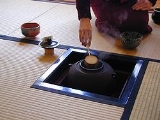
At its most basic, the tea ceremony or chanoyu involves the preparation and serving of a bowl of matcha to a guest or guests.
Chado1
Because of its base in Japanese traditional culture, the host -- male or female -- almost always wears a kimono. Proper attire for guests is kimono or subdued formal wear.

If the tea is to be served in a separate tea house rather than a tea room, the guests will wait in a garden
Japanese garden

, that is, gardens in traditional Japanese style, can be found at private homes, in neighborhood or city parks, and at historical landmarks such as Buddhism temples and old Japanese castles....
 shelter until summoned by the host. They ritually purify themselves by washing their hands and rinsing their mouths with water
Water

Water is a common chemical substance that is essential for the survival of all known forms of life. In typical usage, water refers only to its liquid form or States of matter, but the substance also has a solid state, ice, and a gaseous state, water vapor or steam....
 from a small stone basin, and proceed through a simple garden along a roji, or "dewy path," to the tea house. Guests remove their shoes and enter the tea house through a small door, and proceed to the tokonoma
Tokonoma

A tokonoma is a small raised alcove in a washitsu, a Japanese style room with a tatami floor, where decorative Hanging scroll are hung. Ikebana and/or bonsai or okimono are also often displayed there....
 scroll alcove, and are then seated seiza
Seiza

Seiza is the Japanese term for the traditional formal way of sitting in Japan....
-style on the tatami in order of prestige.

The host may build the charcoal fire in the presence of the guests, to heat the water for making the tea. This is done in a prescribed manner.

Guests may be served a light, simple meal called a "tenshin", or a special kind of full-course meal called "kaiseki" or "chakaiseki". The full-course meal comes with sake
Sake

Sake is a Japanese alcoholic beverage made from rice.This beverage is called sake in English, but in Japanese language, sake or Honorific speech in Japanese refers to alcoholic drinks in general....
, Japanese rice wine. They will then return to the waiting shelter until summoned again by the host.

If no meal is served, the host will proceed directly to the serving of a small sweet
Wagashi

is a traditional Japanese confectionery which is often served with tea, especially the types made of Mochi , azuki bean paste, and fruits.Wagashi is typically made from natural based ingredients....
 or sweets. Sweets are eaten from special paper called kaishi, which each guest carries, often in a decorative wallet or tucked into the breast of the kimono.

Each utensil - including the tea bowl, whisk, and tea scoop - is then ritually cleaned in the presence of the guests in a precise order and using prescribed motions. The utensils are placed in an exact arrangement according to the particular style of tea-making procedure (temae) being performed. When the ritual cleaning and preparation of the utensils is complete, the host will place a measured amount of green tea powder in the bowl and add the appropriate amount of hot water, then whisk the tea using set movements. When the tea is ready, the host places it out and, depending on the circumstances, an assistant takes it to the guest or the guest comes after it.

Bows
Bowing (social)

Bowing is the act of lowering the torso and head as a social gesture in direction to another person or symbol. It is most prominent in Oriental cultures but it is also typical of nobility and aristocracy in many countries and distinctively in Europe....
 are exchanged between the host and guest of honour. The guest then bows to the second guest, and raises the bowl in a gesture of respect to the host. The guest rotates the bowl to avoid drinking from its front, takes a sip, and compliments the host on the tea. If it is thick tea (koicha), the guest then takes two more sips before wiping the rim, rotating the bowl to its original position, and passing it to the next guest with a bow. The procedure is repeated until all guests have taken tea from the same bowl, and the bowl is returned to the host. In some ceremonies, each guest will drink from an individual bowl, but the order of serving and drinking is the same. In the case of thin tea (usucha), the tea is inevitably prepared in individual servings.

If thick tea (koicha) has been served, the host will then prepare thin tea, or usucha, first bringing in a smoking set (tabakobon) and different kind of confections, referred to as higashi (???, "dry confections"), to go with the thin tea. The tea is served in much the same manner as for koicha, but in a more relaxed atmosphere. For example, during the thick tea serving, guests are not expected to have conversation except a ceremonial one between the first guest and the master. In the thin tea serving, after a similar ritual conversation, the guests are expected to switch to more casual and occasional conversation and smoking occasion is offered.

Traditionally both thick and thin tea is expected to be served, except fuji no chakai or chakai in occasion, which is held only with usucha, for the convenience of the unexpected guest. Today it has been developed to ooyose chakai (chakai with many people) where only usucha with cake is served. Nowadays commonly only usucha is served in most of chakai.

After all the guests have taken tea, the host cleans the utensils in preparation for putting them away. The guest of honour will request that the host allow the guests to examine some of the utensils, and each guest in turn examines each item, including the tea caddy and the tea scoop. The items are treated with extreme care and reverence as they may be priceless, irreplaceable, handmade antiques
Antiques

An antique is an old collectible item. It is collected or desirable because of its age, rarity, condition, utility, or other unique features. It is an object that represents a previous era in human society....
, and guests often use a special brocaded cloth to handle them.

The host then collects the utensils, and the guests leave the tea house. The host bows from the door, and the ceremony is over. A tea ceremony can last up to four hours, depending on the type of ceremony performed, the number of guests, and the types of meal and tea served.

Styles of ceremony


There are many styles of chanoyu, depending upon the occasion, season, and countless other possible factors. Note that the word temae, which indicates a formalized chanoyu procedure for conducting as the guests watch, can be written or . At Urasenke, when it pertains to a procedure for laying the charcoal (sumi) to build the fire, it is written ??; otherwise, it is written ??.

Chabako temae

Chabako temae is so called because the equipment is removed from and then replaced into a special box (chabako, literally tea box). Chabako developed as a convenient way to be prepared with the necessary equipment to make tea outdoors. There are various styles of chabako temae. The basic equipment contained in the chabako are the tea bowl, tea whisk in a special container, tea scoop, caddy containing the powdered tea, and linen wiping cloth in a special container, as well as a container for little candy-like sweets. Many of the items are smaller than usual, to fit in the box. This ceremony takes approximately 35-40 minutes.

Hakobi temae

Hakobi temae . The name comes from the fact that, except for the hot water kettle (and brazier if a sunken hearth is not being used), the essential items for the tea-making, including even the fresh water container, are carried into the tea room by the host.

Bon temae

Bon temae (Omotesenke, Mushanokojisenke: , "tray ceremony"; Urasenke: bonryaku temae), is a simple procedure for making usucha (thin tea). The tea bowl, tea whisk, tea scoop, chakin and natsume are on a tray
Tray

A tray is a shallow platform designed for carrying things. It is larger than a salver, a diminutive version commonly used for lighter and smaller servings, and it can be fashioned from numerous materials, including silver, brass, sheet iron, wood, melamine, and Papier-m?ch?....
, and the pot for the hot water conventionally is a spouted and handled iron pot called a tetsubin
Tetsubin

Tetsubin are Japanese cast iron pots having pouring spout and handle crossing over the top, used for boiling and pouring hot water for drinking purposes, such as for making tea....
, heated on a portable hearth like a hibachi. This procedure originated in the Urasenke school. It is usually the first temae learned, and is the easiest to perform, requiring neither much specialized equipment nor a lot of time to complete. It may easily be done sitting at a table, or outdoors, using a thermos pot in place of the tetsubin and portable hearth.

Ryurei

Tea Ceremony Performing 1
In the ryurei (literally standing bow) style, the tea is prepared at a special table. It is possible, therefore, for ryurei style chanoyu to be conducted in non-tatami-floored rooms, and even outdoors. The name refers to the host's practice of performing the first and last bows standing. In ryurei there is usually an assistant who sits near the host and moves the host's stool out of the way as needed for standing or sitting. The assistant also serves the tea and sweets to the guests.

Tea ceremony and calligraphy

Calligraphy
Shodo

"Shodo" is the fortieth single by B'z, released on January 25, 2006. This song is one of B'z many number-one singles in Oricon charts. This song was the opening theme of Case Closed....
, mainly in the form of hanging scrolls, plays a central role in the tea ceremony. Scrolls, often written by famous calligraphers or Buddhist monks, are hung in the tokonoma (scroll alcove) of the tea room. They are selected for their appropriateness for the season
Season

A season is one of the major divisions of the year, generally based on yearly periodic changes in weather.Seasons result from the yearly revolution of the Earth around the Sun and the Axial tilt....
, time of day, or theme of the particular ceremony. Calligraphic scrolls may feature well-known sayings, particularly those associated with Buddhism, poems, descriptions of famous places, or words or phrases associated with tea ceremony. A typical example might have the characters
Chinese character

A Chinese character, also known as a Han character , is a logogram used in writing Chinese language ,'' Japanese language ,'' less frequently Korean language ,'' and formerly Vietnamese language .''...
 wa kei sei jaku (harmony, respect, purity and tranquility). Some contain only a single character; in summer, kaze("wind") would be appropriate. Hanging scrolls that feature a painting instead of calligraphy, or a combination of both, may contain seasonally appropriate images, or images appropriate to the theme of the particular ceremony. Rabbit
Rabbit

Rabbits are small mammals in the family Leporidae of the order Lagomorpha, found in several parts of the world. There are seven different genus in the family taxonomy as rabbits, including the European rabbit , Cottontail rabbit , and the Amami rabbit ....
s, for example, might be chosen for a nighttime ceremony because of their association with the moon
Moon

The Moon is Earth's only natural satellite and the List of natural satellites by diameter satellite in the Solar System. The average centre-to-centre distance from the Earth to the Moon is km, about thirty times the diameter of the Earth....
. Scrolls are sometimes placed in the waiting room as well.

Tea ceremony and flower arranging


Chabana (literally "tea flowers") is the simple style of flower arrangement used in tea ceremony. Chabana has its roots in ikebana
Ikebana

is the Japanese art of flower arrangement, also known as .More than simply putting flowers in a container, ikebana is a disciplined art form in which nature and humanity are brought together....
, an older style of Japanese flower arranging, which itself has roots in Shinto
Shinto

is the former state religion of Japan and remains the most common name for the nation's non-Buddhist ethnic religion practices. It was formed from disparate local mythologies, beginning with the Kojiki of 712, into an imperial cult called State Shinto that solidified in the Meiji period....
 and Buddhism
Buddhism

Buddhism is a family of beliefs and practices considered by most to be a religionand is based on the teachings attributed to Siddhartha Gautama, commonly known as "The Buddha" , who was born in what is today Nepal....
.

Chabana evolved from the 'free-form' style of ikebana called nageire ("thrown in" method), which was used by early tea masters. Chabana is said, depending upon the source, to have been either developed or championed by Sen no Rikyu. He is said to have taught that chabana should give the viewer the same impression that those flowers naturally would give if they were [still] growing outdoors, in nature.

Unnatural and/or out-of-season materials are never used. Also, props and devices such as frogs are not used. The containers in which chabana are arranged are referred to generically as hanaire. Chabana arrangements typically comprise few items, and little or no "filler" material. In the summer, when many flowering grasses are in season in Japan, however, it is seasonally appropropriate to arrange a number of such 'flowering grasses' in an 'airy' basket-type container (???; kago-hanaire). Unlike ikebana (which often uses shallow, wide dishes), tall, narrow hanaire are frequently used in chabana. The containers for the flowers used in chanoyu are typically made from natural materials such as bamboo, as well as metal or ceramic, but rarely glass.

Chabana arrangements are so simple that frequently no more than a single blossom
Blossom

Blossom is a term given to the flowers of stone fruit fruit tree and of some other plants with a similar appearance that flower profusely but for a short period of time in the spring....
 is used; this blossom will invariably lean towards or face the guests.

Kaiseki (Cha-kaiseki)

There are two ways to write the term kaiseki or kaiseki ryori in kanji
Kanji

are the Chinese characters that are used in the modern Japanese language logogram along with hiragana , katakana , Arabic numerals, and the occasional use of the Latin alphabet....
. Written ?? or ????, the term indicates a traditional style Japanese banquet meal. Written ?? or , it indicates the simple meal served in the context of a formal chanoyu function (chaji), which is distinguished as cha-kaiseki. This section deals with the latter kind of meal.

The kanji employed for the chaji meal may be translated as "breast-stone cuisine." This derives from the practice of Zen monks of placing warmed stones
Rock (geology)

In geology, rock is a naturally occurring solid aggregate of minerals and/or mineraloids.The Earth's outer solid layer, the lithosphere, is made of rock....
 in the breast of their robes to stave off hunger while fasting.

In cha-kaiseki, only fresh seasonal ingredients are used, prepared in ways that aim to enhance their flavour. Exquisit care is taken in selecting ingredients and types of food, and finished dishes are carefully presented on serving ware that is chosen to enhance the appearance and seasonal theme of the meal. Dishes are intricately arranged and garnished, often with real edible leaves and flowers that are to help enhance the flavor of the food. Serving ware and garnishes are as much a part of the kaiseki experience as the food; some might argue that the aesthetic experience of seeing the food is even more important than the physical experience of eating it.

The basic constituents of a cha-kaiseki meal are the ichiju sansai or "one soup, three side dishes", and the rice, plus the following: suimono, hassun, yuto, and konomono. The one soup referred to here is usually miso
Miso

is a traditional Japanese cuisine produced by fermentation rice, barley and/or soybeans, with salt and the fungus , the most typical miso being made with soy....
 soup, and the basic three side dishes are the following:
  • mukozuke: foods in a dish arranged on the far side of the meal tray for each guest, which is why it is called mukozuke (lit., "set to the far side"). Often this might be some kind of sashimi. On the near side of the meal tray are arranged the rice and the soup, both in lacquered lidded bowls.
  • nimono: simmered foods, served in individual lidded bowls.
  • yakimono: grilled foods (usually some kind of fish), brought out in a serving dish for the guests to serve themselves.


Here is a description of the additional items mentioned above:
  • suimono: clear soup served in a small lacquered and lidded bowl, to cleanse the palate before the exchange of saké (rice wine) between host and guests. Also referred to as kozuimono (???; small clear soup) or hashiarai (??; chopstick rinser).
  • hassun: a tray of tidbits from mountain and sea that the guests serve themselves to and accompanies the round of saké
    Sake

    Sake is a Japanese alcoholic beverage made from rice.This beverage is called sake in English, but in Japanese language, sake or Honorific speech in Japanese refers to alcoholic drinks in general....
     (rice wine) shared by host and guests. The name derives from the size of the tray.
  • yuto: pitcher of hot water having slightly browned rice in it, which the guests serve themselves to.
  • konomono: pickles that accompany the yuto.


Extra items that may be added to the menu are generally referred to as shiizakana, and these attend further rounds of saké. Because the host leaves them with the first guest, they are also referred to as azukebachi (??; lit., "bowl left in another's care").

Courses are served in small servings in individual dishes. Each diner has a small lacquered tray to him- or herself; very important people may be provided their own low, lacquered table or several small tables.

Because cha-kaiseki generally follows traditional eating habits in Japan, meat dishes are rare.

Tea ceremony and kimono


While a kimono
Kimono

The is the national costume of Japan. Originally the word "kimono" literally meant "thing to wear" but now has come to denote a particular type of traditional full-length Japanese garment....
 used to be the common attire for the Japanese, and thus was the standard attire for participants in chanoyu, this is no longer the case. Still, it is traditional, and on formal occasions most guests will wear a kimono. Consequently, the study of kimono is an essential part of learning chanoyu, and most practitioners will own at least one kimono suitable for wearing when hosting or participating in chanoyu.

The kimono, accordingly, used to be standard dress for student
Student

The word student is etymology derived through Middle English from the Latin Latin conjugation#Principal parts for the active voice Grammatical conjugation verb "studere", Meaning "to direct one's zeal at"; hence a student could be described as 'one who directs zeal at a subject'....
s of chanoyu, and while this practice continues, many teacher
Teacher

In education, a teacher is a person who teaches. A teacher who teaches an individual student may also be described as a personal tutor.The role of teacher is often formal and ongoing, carried out by way of Occupation or Profession at a school or other place of formal education....
s today do not insist upon it; it is not uncommon for students to wear western clothes for practice. Still, most students will practice in kimono at least some of the time. This is essential to learn the prescribed motions properly.

Many of the movements and components of tea ceremony evolved from the wearing of a kimono. For example, certain movements are designed with long kimono sleeve
Sleeve

Sleeve is that part of a garment which covers the arm, or through which the arm passes or slips. Originally invented to serve as a snot-rag or handy handkerchief; the pattern of the sleeve is one of the characteristics of fashion in dress, varying in every country and period....
s in mind; certain motions are intended to move sleeves out of the way or to prevent them from becoming dirtied in the process of making, serving or partaking of tea. Other motions are designed to allow for the straightening of the kimono and hakama
Hakama

Hakama are a type of traditional Japanese clothing. They were originally worn only by men, but today they are worn by both men and women. Hakama are tied at the waist and fall approximately to the ankles....
.

Fukusa (silk cloths) are designed to be folded and tucked into the obi (sash); when no obi is worn, a regular belt must be substituted or the motions cannot be performed properly.

Kaishi (paper) and kobukusa are tucked into the breast of the kimono; fans are tucked into the obi. When Western clothes are worn, the wearer must find other places to keep these objects. The sleeves of the kimono function as pockets, and used kaishi are folded and placed into them.

For formal occasions, men may wear a combination of kimono and hakama (a long divided or undivided skirt worn over the kimono), but some men wear only kimono. Wearing hakama is not essential for men, but, unless the man has earned the right to wear a jittoku jacket instead, it makes the outfit more formal. Women wear various styles of kimono depending on the season and the event; women generally do not wear hakama for tea ceremony, and do not gain the right to wear a jittoku. Lined kimono are worn by both men and women in the winter months, and unlined ones in the summer. For formal occasions, montsuki kimono (kimono with three to five family crests on the sleeves and back) are worn. Men on formal occasions often wear striped hakama. Both men and women wear white tabi
Tabi

are traditional Japanese socks. Ankle high and with a separation between the big toe and other toes, they are worn by both men and women with zori, geta , and other traditional thonged footwear....
 (divided- toe socks).

While men's kimono tend to be plain and largely unpatterned, some women's kimono have patterns on only one side; the wearer must determine which side will be facing the guests and dress accordingly. Both for men and women, the attire worn at a tea ceremony -- whether traditional kimono or other clothing -- should be subdued and conservative, so as not to be distracting.

Tea ceremony and seiza


In that the Japanese tea ceremony is conventionally conducted sitting down on the floor, seiza
Seiza

Seiza is the Japanese term for the traditional formal way of sitting in Japan....
 is integral to it. Unless it is the ryurei style of tea ceremony, which employs chairs and tables, both the host and guests basically sit in seiza style throughout. All the bows (there are three basic variations, differing mainly in depth of bow and position of the hands) performed during tea ceremony originate in the seiza position.

Tea ceremony and tatami


>why is the first guest not sitting in the mat directly in front of the tokonoma?Why is the host's entrance away from the mizuya? Where does this diagram come from? It does not seem accurate.

Shoes or other such footwear are taboo on tatami. Unfresh socks (or tabi
Tabi

are traditional Japanese socks. Ankle high and with a separation between the big toe and other toes, they are worn by both men and women with zori, geta , and other traditional thonged footwear....
), as well as unwashed feet, are a breach of etiquette. The tea bowl and other items that should be perfectly clean may be set directly on the tatami, and so the tatami need to be maintained in a perfectly clean state.

Inasmuch as chanoyu conventionally takes place in a traditional style of Japanese room, tatami
Tatami

mats are a traditional type of Japanese flooring. Made of woven soft rush straw, and traditionally packed with rice straw , tatami are made in individual mats of uniform size and shape, bordered by brocade or plain cloth....
 are an integral part of it. The main areas of traditional style tea rooms and tea houses have tatami floors, and the scroll alcove (tokonoma or toko) in tea rooms often has a tatami floor as well.

Tatami are used in various ways in tea ceremony. Their placement, for example, determines how a person walks through the tea room. When walking on tatami it is customary to shuffle, to avoid causing disturbance. Shuffling forces one to slow down, to maintain erect posture, and to walk quietly, and helps one to maintain balance
Balance

Balance may refer to:...
 as the combination of tabi and tatami makes for a slippery surface; it is also a function of wearing kimono, which restricts stride length. One must avoid walking on the joins between mats, one practical reason being that that would tend to damage the tatami. Therefore, chanoyu students learn to step over such joins when walking in the tea room.

The placement of tatami in tea rooms differs slightly from the normal placement in regular rooms, and may also vary by season (where it is possible to rearrange the mats). In a 4 1/2 mat room, the mats are placed in a circular pattern around a centre mat. Purpose-built tea rooms have a sunken hearth in the floor which is used in winter. A special tatami is used which has a cut-out section providing access to the hearth. In summer, the hearth is covered either with a small square of extra tatami, or, more commonly, the hearth tatami is replaced with a full mat, totally hiding the hearth.

It is customary to avoid stepping on this centre mat whenever possible, as well as to avoid placing the hands palm-down on it, as it functions as a kind of table: tea utensils are placed on it for viewing, and prepared bowls of tea are placed on it for serving to the guests. To avoid stepping on it people may walk around it on the other mats, or shuffle on the hands and knees.

Except when walking, when moving about on the tatami one places one's closed fists on the mats and uses them to pull oneself forward or push backwards while maintaining a seiza position.

There are dozens of real and imaginary lines that crisscross any tearoom. These are used to determine the exact placement of utensils and myriad other details; when performed by skilled practitioners, the placement of utensils will vary infinitesimally from ceremony to ceremony. The lines in tatami mats (??; tatami-me, referring to the weave lines) are used as one guide for placement, and the joins serve as a demarcation indicating where people should sit.

Tatami provide a more comfortable surface for sitting seiza-style. At certain times of year (primarily during the new year's festivities
Japanese New Year

The Japanese people celebrate New Year's Day on January 1 each year on the Gregorian Calendar. Before 1873, the date of the was based on the Chinese calendar and celebrated at the beginning of spring, just as the contemporary Chinese New Year, Korean New Year and T?ts are celebrated to this day....
) the portions of the tatami where guests sit may be covered with a red felt cloth.

Studying tea ceremony


In Japan
Japan

Japan is an island country in East Asia. Located in the Pacific Ocean, it lies to the east of the Sea of Japan, People's Republic of China, North Korea, South Korea and Russia, stretching from the Sea of Okhotsk in the north to the East China Sea and Taiwan in the south....
, those who wish to study tea ceremony typically join what is known in Japanese as a "circle," which is a generic term for a group that meets regularly to participate in a given activity. There are also tea clubs at many junior high and high schools, colleges and universities
List of universities in Japan

The following is a comprehensive list of university in Japan, categorized by prefectures of Japan:The list contains only universities or colleges, either four-year or two-year, that still exist today and are classified as "schools" according to Article 1 of the School Education Law....
.

Most tea circles are run by a local chapter of an established tea school. Classes may be held at community centres, dedicated tea schools, or at private homes. Tea schools often have widely varied groups that all study in the same school but at different times. For example, there may be a women's group, a group for older or younger students, and so on.

Students normally pay a monthly fee which covers tuition and the use of the school's (or teacher's) bowls and other equipment, the tea itself, and the sweets that students serve and eat at every class. Students must be equipped with their own fukusa, fan, paper, and kobukusa, as well as their own wallet in which to place these items. Though western clothing is very common today, if the teacher is in the higher rank of tradition, especially an iemoto
Iemoto

Iemoto is a Japanese language used to refer to the founder or current head master of a certain school of traditional Japanese art. It is used synonymously with the word soke when it refers to the family or house that the iemoto is head of and represents....
, wearing kimono is still considered essential, especially for women. In some cases, advanced students may be given permission to wear the school's mark in place of the usual family crests on formal montsuki kimono.

New students typically begin by observing more advanced students as they practice. New students are normally taught mostly by more advanced students; the most advanced students are taught exclusively by the teacher. The first things new students learn are how to correctly open and close sliding doors
Fusuma

In Japanese architecture, fusuma are vertical rectangular panels which can slide from side to side to redefine spaces within a room, or act as doors....
, how to walk on tatami
Tatami

mats are a traditional type of Japanese flooring. Made of woven soft rush straw, and traditionally packed with rice straw , tatami are made in individual mats of uniform size and shape, bordered by brocade or plain cloth....
, how to enter and exit the tea room, how to bow and to whom and when to do so, how to wash, store and care for the various equipment, how to fold the fukusa, how to ritually clean tea equipment, and how to wash and fold chakin. As they master these essential steps, students are also taught how to behave as a guest at tea ceremonies: the correct words to say, how to handle bowls, how to drink tea and eat sweets, how to use paper and sweet-picks, and myriad other details.

As they master the basics, students will be instructed on how to prepare the powdered tea for use, how to fill the tea caddy, and finally, how to measure the tea and water and whisk it to the proper consistency. Once these basic steps have been mastered, students begin to practice the simplest ceremonies, typically beginning with O-bon temae (see above). Only when the first ceremony has been mastered will students move on. Study is through observation and hands on practice; students do not often take notes, and some schools discourage the practice of note-taking.

As they master each ceremony, some schools and teachers present students with certificates at a formal ceremony. According to the school, this certificate may warrant that the student has mastered a given ceremony, or may give the student permission to study a given ceremony. Acquiring such certificates is often very costly; the student typically must not only pay for the preparation of the certificate itself and for participating in the ceremony during which it is bestowed, but is also expected to thank the teacher by presenting him or her with a gift of money. The cost of acquiring certificates increases as the student's level increases.

Typically, each class ends with the whole group being given brief instruction by the main teacher, usually concerning the contents of the tokonoma (the scroll alcove, which typically features a hanging scroll (usually with calligraphy), a flower arrangement, and occasionally other objects as well) and the sweets that have been served that day. Related topics include incense and kimono, or comments on seasonal variations in equipment or ceremony.

See also

  • Tea ceremony
    Tea ceremony

    A tea ceremony is an Asian ritual form of making tea. The term generally refers to the Japanese tea ceremony. One can also refer to the whole set of rituals, tools, mudra, etc....
    , for tea ceremonies in other Asian countries
  • Matcha, for information about the tea itself


Further reading

  • Okakura Kakuzo
    Okakura Kakuzo

    Okakura Kakuzo was a Japanese people scholar who contributed to the development of arts in Japan. Outside Japan, he is chiefly remembered today as the author of The Book of Tea....
    . The Book of Tea. Tokyo, Japan: Tuttle, 1977.
  • Tanaka, S. The Tea Ceremony. New York: Harmony Books, 1977.
  • Morgan Pitelka, ed. Japanese Tea Culture: Art, History, and Practice. London: RoutledgeCurzon, 2003.
  • Sadler, A.L. Cha-No-Yu: The Japanese Tea Ceremony. Tokyo: Tuttle, 1962.
  • Freeman, Michael. New Zen: the tea-ceremony room in modern Japanese architecture. London, 8 Books, 2007
  • Tsuji, Kaichi. Kaiseki: Zen Tastes in Japanese Cooking. Tokyo, New York, San Francisco: Kodansha International Ltd., 1972. Second printing, 1981. ISBN 0-87011-173-6. Excellent reading not only for cha-kaiseki but the Way of Tea altogether.
  • The Japan Times article and photos by Eric Prideaux, "Tea to soothe the soul," at http://www.pripix.com/features/tea.htm

External links

  • - Tea instructor Elliot Mitchnick describes a formal tea ceremony in this 5 part feature
  • - The official home page for the Santa Barbara Botanical Garden Tea House and Chanoyu classes
  • - A site with personal and scholarly essays on tea ceremony, including photographs, suggestions and links
  • - Practice, history, literature and philosophy of chado
  • - Chanoyu lessons and seminars
  • - Wiki containing information about tea ceremony, with focus on Urasenke tradition
  • : pictures, information, glossary and cha ettiquette
  • - Vast source of information with detailed explanation of preparation steps.
  • - General explanation, including guest etiquette