

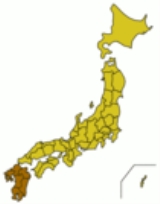
Kyushu

Encyclopedia
is the third largest island
of Japan
and most southwesterly of its four main islands
. Its alternate ancient names include , , and . The historical regional name is referred to Kyushu and its surrounding islands.
In the 8th century Taihō Code
reforms, Dazaifu was established as a special administrative term for the region.
Kyushu has a population of 13,231,995 (2006) and covers 35640 square kilometres (13,760.7 sq mi).
at 1591 metres (5,219.8 ft), is on Kyushu. There are many other signs of tectonic activity, including numerous areas of hot springs. The most famous of these are in Beppu, on the east shore, and around Mt. Aso, in central Kyushu.
The name Kyūshū comes from the nine ancient provinces of Saikaidō situated on the island: Chikuzen
, Chikugo
, Hizen
, Higo
, Buzen
, Bungo
, Hyūga
, Osumi
, and Satsuma
.
Today's is a politically defined region that consists of the seven prefecture
s on the island of Kyushu and also Okinawa Prefecture
to the south:
The world’s 37th largest island by area, Kyushu is smaller than Spitsbergen
but larger than New Britain
and Taiwan
. By population, it ranks 13th, having fewer inhabitants than Borneo
or Sulawesi
, but more than Salsette
(Mumbai
) or Cuba
.
, tea
, tobacco
, sweet potato
es, and soy; silk
is also widely produced. The island is noted for various types of porcelain
, including Arita, Imari, Satsuma, and Karatsu. Heavy industry is concentrated in the north around Fukuoka, Kitakyushu, Nagasaki, and Oita and includes chemicals, automobiles, semiconductors, and metal processing.
In 2010 the graduate employment
rate in the region was the lowest nationwide, at 88.9%.
Besides the volcanic area of the south, there are significant mud hot springs in the northern part of the island, around Beppu. These springs are the site of occurrence of certain extremophile
micro-organisms, that are capable of surviving in extremely hot environments.
Island
An island or isle is any piece of sub-continental land that is surrounded by water. Very small islands such as emergent land features on atolls can be called islets, cays or keys. An island in a river or lake may be called an eyot , or holm...
of Japan
Japan
Japan is an island nation in East Asia. Located in the Pacific Ocean, it lies to the east of the Sea of Japan, China, North Korea, South Korea and Russia, stretching from the Sea of Okhotsk in the north to the East China Sea and Taiwan in the south...
and most southwesterly of its four main islands
Japanese Archipelago
The , which forms the country of Japan, extends roughly from northeast to southwest along the northeastern coast of the Eurasia mainland, washing upon the northwestern shores of the Pacific Ocean...
. Its alternate ancient names include , , and . The historical regional name is referred to Kyushu and its surrounding islands.
In the 8th century Taihō Code
Taiho Code
The was an administrative reorganization enacted in 701 in Japan, at the end of the Asuka period. It was historically one of the . It was compiled at the direction of Prince Osakabe, Fujiwara no Fuhito and Awata no Mahito...
reforms, Dazaifu was established as a special administrative term for the region.
Kyushu has a population of 13,231,995 (2006) and covers 35640 square kilometres (13,760.7 sq mi).
Geography
The island is mountainous, and Japan's most active volcano, Mt AsoMount Aso
is the largest active volcano in Japan, and is among the largest in the world. It stands in Aso Kujū National Park in Kumamoto Prefecture, on the island of Kyūshū. Its peak is 1592 m above sea level. Aso has one of the largest caldera in the world...
at 1591 metres (5,219.8 ft), is on Kyushu. There are many other signs of tectonic activity, including numerous areas of hot springs. The most famous of these are in Beppu, on the east shore, and around Mt. Aso, in central Kyushu.
The name Kyūshū comes from the nine ancient provinces of Saikaidō situated on the island: Chikuzen
Chikuzen Province
was an old province of Japan in the area that is today part of Fukuoka Prefecture in Kyūshū. It was sometimes called , with Chikugo Province. Chikuzen bordered Buzen, Bungo, Chikugo, and Hizen Provinces....
, Chikugo
Chikugo Province
is the name of a former province of Japan in the area that is today the southern part of Fukuoka Prefecture on Kyūshū. It was sometimes called , with Chikuzen Province...
, Hizen
Hizen Province
was an old province of Japan in the area of Saga and Nagasaki prefectures. It was sometimes called , with Higo Province. Hizen bordered on the provinces of Chikuzen and Chikugo. The province was included in Saikaidō...
, Higo
Higo Province
Higo Province was an old province of Japan in the area that is today Kumamoto Prefecture on the island of Kyūshū. It was sometimes called , with Hizen Province. Higo bordered on Chikugo, Bungo, Hyūga, Ōsumi, and Satsuma Provinces....
, Buzen
Buzen Province
was an old province of Japan in northern Kyūshū in the area of Fukuoka Prefecture and Ōita Prefecture. It was sometimes called , with Bungo Province. Buzen bordered on Bungo and Chikuzen Provinces....
, Bungo
Bungo Province
was a province of Japan in eastern Kyūshū in the area of Ōita Prefecture. It was sometimes called , with Buzen Province. Bungo bordered Buzen, Hyūga, Higo, Chikugo, and Chikuzen Provinces.-History:...
, Hyūga
Hyuga Province
was an old province of Japan on the east coast of Kyūshū, corresponding to the modern Miyazaki Prefecture. It was sometimes called or . Hyūga bordered on Bungo, Higo, Ōsumi, and Satsuma Province.The ancient capital was near Saito.-Historical record:...
, Osumi
Osumi Province
was an old province of Japan in the area that is today the eastern part of Kagoshima Prefecture. It was sometimes called . Ōsumi bordered on Hyūga and Satsuma Provinces.Osumi's ancient capital was near modern Kokubu...
, and Satsuma
Satsuma Province
was an old province of Japan that is now the western half of Kagoshima Prefecture on the island of Kyūshū. Its abbreviation is Sasshū .During the Sengoku Period, Satsuma was a fief of the Shimazu daimyo, who ruled much of southern Kyūshū from their castle at Kagoshima city.In 1871, with the...
.
Today's is a politically defined region that consists of the seven prefecture
Prefectures of Japan
The prefectures of Japan are the country's 47 subnational jurisdictions: one "metropolis" , Tokyo; one "circuit" , Hokkaidō; two urban prefectures , Osaka and Kyoto; and 43 other prefectures . In Japanese, they are commonly referred to as...
s on the island of Kyushu and also Okinawa Prefecture
Okinawa Prefecture
is one of Japan's southern prefectures. It consists of hundreds of the Ryukyu Islands in a chain over long, which extends southwest from Kyūshū to Taiwan. Okinawa's capital, Naha, is located in the southern part of Okinawa Island...
to the south:
- Northern KyushuNorthern Kyushuis a subregion of Kyūshū.This northern region encompasses the prefectures of Fukuoka, Saga, Nagasaki, Kumamoto, and Ōita.-History:The northern region of Kyūshū was the first to be colonized by the Chinese and Koreans....
- Fukuoka PrefectureFukuoka Prefectureis a prefecture of Japan located on Kyūshū Island. The capital is the city of Fukuoka.- History :Fukuoka Prefecture includes the former provinces of Chikugo, Chikuzen, and Buzen....
- Saga PrefectureSaga Prefectureis located in the northwest part of the island of Kyūshū, Japan. It touches both the Sea of Japan and the Ariake Sea. The western part of the prefecture is a region famous for producing ceramics and porcelain, particularly the towns of Karatsu, Imari, and Arita...
- Kumamoto PrefectureKumamoto Prefectureis a prefecture of Japan located on Kyushu Island. The capital is the city of Kumamoto.- History :Historically the area was called Higo Province; and the province was renamed Kumamoto during the Meiji Restoration. The creation of prefectures was part of the abolition of the feudal system...
- Nagasaki PrefectureNagasaki Prefectureis a prefecture of Japan located on the island of Kyūshū. The capital is the city of Nagasaki.- History :Nagasaki Prefecture was created by merging of the western half of the former province of Hizen with the island provinces of Tsushima and Iki...
- Ōita PrefectureOita Prefectureis a prefecture of Japan on Kyūshū Island. The prefectural capital is the city of Ōita.- History :Around the 6th century Kyushu consisted of four regions: Tsukushi-no-kuni 筑紫国, Hi-no-kuni 肥国, and Toyo no kuni...
- Fukuoka Prefecture
- Kagoshima PrefectureKagoshima Prefectureis a prefecture of Japan located on the island of Kyushu. The capital is the city of Kagoshima.- Geography :Kagoshima Prefecture is located at the southwest tip of Kyushu and includes a chain of islands stretching further to the southwest for a few hundred kilometers...
- Miyazaki PrefectureMiyazaki Prefectureis a prefecture of Japan located on the island of Kyushu. The capital is the city of Miyazaki.- History :Historically, after the Meiji Restoration, Hyūga Province was renamed Miyazaki Prefecture....
- Okinawa PrefectureOkinawa Prefectureis one of Japan's southern prefectures. It consists of hundreds of the Ryukyu Islands in a chain over long, which extends southwest from Kyūshū to Taiwan. Okinawa's capital, Naha, is located in the southern part of Okinawa Island...
The world’s 37th largest island by area, Kyushu is smaller than Spitsbergen
Spitsbergen
Spitsbergen is the largest and only permanently populated island of the Svalbard archipelago in Norway. Constituting the western-most bulk of the archipelago, it borders the Arctic Ocean, the Norwegian Sea and the Greenland Sea...
but larger than New Britain
New Britain
New Britain, or Niu Briten, is the largest island in the Bismarck Archipelago of Papua New Guinea. It is separated from the island of New Guinea by the Dampier and Vitiaz Straits and from New Ireland by St. George's Channel...
and Taiwan
Taiwan
Taiwan , also known, especially in the past, as Formosa , is the largest island of the same-named island group of East Asia in the western Pacific Ocean and located off the southeastern coast of mainland China. The island forms over 99% of the current territory of the Republic of China following...
. By population, it ranks 13th, having fewer inhabitants than Borneo
Borneo
Borneo is the third largest island in the world and is located north of Java Island, Indonesia, at the geographic centre of Maritime Southeast Asia....
or Sulawesi
Sulawesi
Sulawesi is one of the four larger Sunda Islands of Indonesia and is situated between Borneo and the Maluku Islands. In Indonesia, only Sumatra, Borneo, and Papua are larger in territory, and only Java and Sumatra have larger Indonesian populations.- Etymology :The Portuguese were the first to...
, but more than Salsette
Salsette Island
Salsette Island is an island in Maharashtra state on India's west coast. The metropolis of Mumbai and the city of Thane lie on this island, making it the 14th most populous island and the fourth most densely populated island in the world, after Migingo Island in Kenya, Ap Lei Chau in Hong Kong,...
(Mumbai
Mumbai
Mumbai , formerly known as Bombay in English, is the capital of the Indian state of Maharashtra. It is the most populous city in India, and the fourth most populous city in the world, with a total metropolitan area population of approximately 20.5 million...
) or Cuba
Cuba
The Republic of Cuba is an island nation in the Caribbean. The nation of Cuba consists of the main island of Cuba, the Isla de la Juventud, and several archipelagos. Havana is the largest city in Cuba and the country's capital. Santiago de Cuba is the second largest city...
.
Economy and environment
Parts of Kyushu have a subtropical climate, particularly Miyazaki and Kagoshima prefectures. Major agricultural products are riceRice
Rice is the seed of the monocot plants Oryza sativa or Oryza glaberrima . As a cereal grain, it is the most important staple food for a large part of the world's human population, especially in East Asia, Southeast Asia, South Asia, the Middle East, and the West Indies...
, tea
Tea
Tea is an aromatic beverage prepared by adding cured leaves of the Camellia sinensis plant to hot water. The term also refers to the plant itself. After water, tea is the most widely consumed beverage in the world...
, tobacco
Tobacco
Tobacco is an agricultural product processed from the leaves of plants in the genus Nicotiana. It can be consumed, used as a pesticide and, in the form of nicotine tartrate, used in some medicines...
, sweet potato
Sweet potato
The sweet potato is a dicotyledonous plant that belongs to the family Convolvulaceae. Its large, starchy, sweet-tasting, tuberous roots are an important root vegetable. The young leaves and shoots are sometimes eaten as greens. Of the approximately 50 genera and more than 1,000 species of...
es, and soy; silk
Silk
Silk is a natural protein fiber, some forms of which can be woven into textiles. The best-known type of silk is obtained from the cocoons of the larvae of the mulberry silkworm Bombyx mori reared in captivity...
is also widely produced. The island is noted for various types of porcelain
Porcelain
Porcelain is a ceramic material made by heating raw materials, generally including clay in the form of kaolin, in a kiln to temperatures between and...
, including Arita, Imari, Satsuma, and Karatsu. Heavy industry is concentrated in the north around Fukuoka, Kitakyushu, Nagasaki, and Oita and includes chemicals, automobiles, semiconductors, and metal processing.
In 2010 the graduate employment
Graduate unemployment
Graduate unemployment is unemployment among people with an academic degree. Research undertaken proved that the unemployment, and much more so, the underemployment...
rate in the region was the lowest nationwide, at 88.9%.
Besides the volcanic area of the south, there are significant mud hot springs in the northern part of the island, around Beppu. These springs are the site of occurrence of certain extremophile
Extremophile
An extremophile is an organism that thrives in physically or geochemically extreme conditions that are detrimental to most life on Earth. In contrast, organisms that live in more moderate environments may be termed mesophiles or neutrophiles...
micro-organisms, that are capable of surviving in extremely hot environments.
Education
Major universities and colleges in Kyushu:- National universities
- Kyushu UniversityKyushu UniversityKyushu University is one of the most prestigious universities in Japan. It can be seen in the several rankings such as shown below.-General Rankings:The university has been ranked 8th in 2010 and 2009 in the ranking "Truly Strong Universities" by Toyo Keizai...
- One of seven former "Imperial Universities" - Kyushu Institute of TechnologyKyushu Institute of Technologyis one of the 87 national universities in Japan. Located in Fukuoka Prefecture on the island of Kyūshū, it is dedicated to education and research in the fields of science and technology...
- Saga UniversitySaga University; abbreviated as or , is a higher education institution in Saga, Japan.The University has 5 faculties with a total of around about 7,000 students. Its 2 campuses are in and .-History:...
- Nagasaki UniversityNagasaki Universityis a national university of Japan. Its nickname is Chōdai . The main campus is located in Bunkyo-machi, Nagasaki City, Nagasaki Prefecture, Japan.- History :...
- Kumamoto UniversityKumamoto Universityis a university located in Kumamoto, Japan. It was established on May 31, 1949, at which time the following institutions were subsumed into it; Kumamoto Teachers College , Kumamoto Pharmaceutical College , The Fifth High School , Kumamoto Medical College , and Kumamoto Technical College ....
- Fukuoka University of EducationFukuoka University of Educationis a national university in Munakata, Fukuoka, Japan. The predecessor of the school was founded in 1876, and it was chartered as a university in 1949...
- Oita UniversityOita Universityis a national university in Ōita, Ōita, Japan. The precursor of the school was founded in 1921 and was chartered as a university in 1949....
- Miyazaki University
- Kagoshima UniversityKagoshima University, or is a Japanese national university located in Kagoshima, Kagoshima Prefecture, Japan.There are three campuses:* Shimoarata: Faculty of Fisheries* Sakuragaoka: Faculty of Medicine...
- National Institute of Fitness and Sports in KanoyaNational Institute of Fitness and Sports in Kanoyais a national university in Kanoya, Kagoshima, Japan, founded in 1981.It is the only national physical education university in Japan.Four alumni participated in the swimming and volleyball events in the Beijing Olympics, including Athens Olympics swimming gold medalist Ai Shibata.The facilities in...
- University of the RyukyusUniversity of the RyukyusThe , abbreviated to Ryūdai , is a national university of Japan. It is located in the town of Nishihara on Okinawa Honto in Okinawa Prefecture. There are also campuses in Nakagusuku and Ginowan. It is the westernmost national university of Japan and the largest public university in Okinawa Prefecture...
- Kyushu University
- Universities run by local governments
- University of KitakyushuUniversity of KitakyushuThe is a public university in Kitakyushu, Japan. The main campus is located next to Keibajomae station on the Kitakyushu monorail. The second campus is in the academic zone of Wakamatsu-ku, Kitakyushu called Gakujutsu Kenkyu Toshi...
- Kyushu Dental CollegeKyushu Dental Collegeis a public university in Kitakyushu, Fukuoka, Japan. The predecessor of the school was founded in 1914, and it was chartered as a university in 1949.-External links:*...
- Fukuoka Women's UniversityFukuoka Women's Universityis a public university in Fukuoka, Fukuoka, Japan. The predecessor of the school was founded in 1923, and it was chartered as a university in 1950.-External links:*...
- Fukuoka Prefectural UniversityFukuoka Prefectural Universityis a public university in Tagawa, Fukuoka, Japan, established in 1992.-External links:*...
- Siebold University of NagasakiSiebold University of Nagasakiwas a public university in the town of Nagayo in Nagasaki Prefecture, Japan. Established in 1999, the school merged with Nagasaki Prefectural University to form University of Nagasaki in 2008.-External links:*...
- Nagasaki Prefectural UniversityNagasaki Prefectural Universitywas a public university in Sasebo, Nagasaki, Japan. The predecessor of the school, women's school, was established in 1947. In 2008 the school merged with Siebold University of Nagasaki to form University of Nagasaki.-External links:*...
- Oita University of Nursing and Health SciencesOita University of Nursing and Health Sciencesis a public university in Ōita, Ōita, Japan, established in 1998.-External links:*...
- Prefectural University of KumamotoPrefectural University of Kumamotois a public university in the city of Kumamoto, Kumamoto, Japan. The predecessor of the school was founded in 1947. The school population is approximately 2,200 students and 100 faculty members.-External links:*...
- Miyazaki Municipal UniversityMiyazaki Municipal Universityis a public university in Miyazaki, Miyazaki, Japan, established in 1993.-External links:*...
- Miyazaki Prefectural Nursing UniversityMiyazaki Prefectural Nursing Universityis a public university in Miyazaki, Miyazaki, Japan, established in 1997. A master's program was added in 2001.-External links:*...
- Okinawa Prefectural University of ArtsOkinawa Prefectural University of Artsis a public university in Naha, Okinawa, Japan, founded in 1986.-External links:*...
- University of Kitakyushu
- Major private universities
- Fukuoka UniversityFukuoka Universityis a private university in Fukuoka, Japan. It is the largest general university in western Japan, with more than 20,000 students. It is sometimes mistaken for a national university...
- University with the largest number of students in Kyushu - Kumamoto Gakuen UniversityKumamoto Gakuen UniversityCalled Gakuendai or Shōdai , it is a private Japanese university in Kumamoto, Japan. It was established in 1942, at which time Eastern Language Vocational College was subsumed into it...
- Ritsumeikan Asia Pacific UniversityRitsumeikan Asia Pacific University, or APU, is a private institution inaugurated April 2000 in Beppu, Ōita, Japan. APU was made possible through the collaboration of three parties from the public and private sectors: Ōita Prefecture, Beppu City and the Ritsumeikan Academy. APU has an enrollment of over 6,000 students...
- Seinan Gakuin UniversitySeinan Gakuin Universityis a Christian university in Fukuoka, Japan. Seinan Gakuin, founded in 1916 by Rev. C. K. Dozier, a Southern Baptist missionary from the United States, includes , , a as well as the University . The chancellor of Seinan Gakuin is Yoshiki Terazono, and Gary W. Barkley, a former Baptist missionary,...
- Kyushu Sangyo UniversityKyushu Sangyo Universitywas founded in 1960 in Fukuoka City, and currently has twenty departments and six graduate schools. It is a private university.-Undergraduate Faculties and departments:*Faculty of Economics**Department of Economics*Faculty of Commerce**Department of Commerce...
- Baseball Team won the National Championship in 2005 - University of Occupational and Environmental Health
- Kurume UniversityKurume Universityis a private university, established in 1946. Kurume University is located in Kurume , Fukuoka prefecture , Japan.- History :*1928 Kyūshū Medical School established...
- Fukuoka University
See also
- Azumi people, an ancient group of people who inhabited parts of northern Kyūshū
- Geography of JapanGeography of JapanJapan is an island nation in East Asia comprising a stratovolcanic archipelago extending along the Pacific coast of Asia. Measured from the geographic coordinate system, Japan stretches from 24° to 46° north latitude and from 123° to 146° east longitude...
- Group Kyushu
- Kanmonkyo BridgeKanmonkyo BridgeThe Kanmonkyo Bridge is a suspension bridge crossing the Kanmon Straits, a stretch of water separating two of Japan's four main islands...
connects Kyūshū with Honshū - Kyushu National MuseumKyushu National MuseumThe opened on October 16, 2005 in Dazaifu near Fukuoka -- the first new national museum in Japan in over 100 years, and the first to elevate the focus on history over art. The distinct modern impression created by the architectural facade is mirrored in the Museum's use of technological...
- List of regions in Japan