


Shiga Prefecture

Encyclopedia
is a prefecture
of Japan, which forms part of the Kansai region on Honshu
Island. The capital is the city of Ōtsu
.
or Gōshū before the prefectural system was established. Omi was a neighbor of Nara
and Kyoto
, and junction of western and eastern Japan, so Omi was developed as the hinterland of capitals, the traffic important point and sometimes political center. In the years 667 to 672, Emperor Tenji
founded a palace in Otsu. In 742, Emperor Shōmu
founded a palace in Shigaraki
. In the early Heian Period
, Saichō
was born in north of Otsu and founded Enryaku-ji
, the center of Tendai
and one of the UNESCO
World Heritage Site
Historic Monuments of Ancient Kyoto (Kyoto, Uji and Otsu Cities) now.
In the Medieval Period, Sasaki clan
ruled Omi, and afterward Rokkaku clan
, Kyōgoku clan
and Azai clan ruled Omi. In 1570s, Oda Nobunaga
subjugated Omi and built Azuchi Castle
on the eastern shores of Lake Biwa in 1579. Tōdō Takatora
, Gamō Ujisato
, Oichi
, Yodo-dono
, Ohatsu and Oeyo
were important persons from Omi in Sengoku Period
. In this times, Ninja
was active in Kōka (See also Kōga-ryū
).
In 1600, Ishida Mitsunari
, born in east of Nagahama and based in Sawayama Castle
, made war against Tokugawa Ieyasu
in Sekigahara, Gifu
. After the battle, Ieyasu made Ii Naomasa
a new lord of Sawayama, and Naomasa established the Hikone Domain
. The Hikone Domain is famous for Ii Naosuke
, who became the Tokugawa shogunate's Tairō
and concluded commercial treaties with the Western powers and thus broke Japan's isolation from the world in the 19th century. Besides the Hikone Domain, many domains ruled Omi such as Zeze
.
With the Abolition of the han system
, eight prefectures was formed in Omi, and they were unified into Shiga Prefecture in September 1872. "Shiga Prefecture" was named after "Shiga District
" because Otsu belonged the district until 1898. From August 1876 to February 1881, southern Fukui Prefecture had been incorporated into Shiga Prefecture.
in the north, Gifu Prefecture
in the east, Mie Prefecture
in the southeast, and Kyoto Prefecture
in the west.
Different areas of the prefecture include Kohoku (湖北, north of lake), Kosei (湖西, west of lake), Kotō (湖東, east of lake), and Konan (湖南, south of lake).
Lake Biwa
, Japan's largest lake, is located at the center of this prefecture. It occupies one-sixth the total area of Shiga. The Seta River
flows out from Lake Biwa to Osaka Bay
through Kyoto
. This is the only natural river which flows out from the lake. All of the other natural rivers flow into the lake. There were many lagoons around Lake Biwa, but most of them were reclaimed in 1940s. An example of preserved lagoon is the wetland in Omihachiman, and it was selected as Important Cultural Landscapes
in 2006.
Plains stretch to the eastern coast of Lake Biwa. The prefecture is enclosed by mountain ranges with the Hira Mountains
and Mount Hiei
in the west, the Ibuki Mountains
in the northeast, and the Suzuka Mountains
in the southeast. Mount Ibuki
is the highest mountain in Shiga. In Yogo
, there is a small lake which is famous for a legend of Swan maiden.
The climate of Shiga makes a sharp contrast between northern and southern. Southern Shiga is usually warm, but northern Shiga is substantially cold with high snowfall and there are many skiing grounds. In Nakanokawachi, the northernmost village of Shiga, snow laid 5.6 meter deep on the ground in 1936.
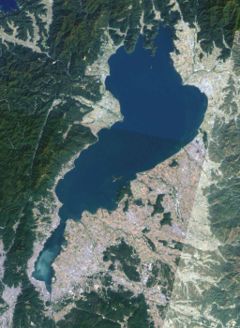
.
. In villages on Lake Biwa, some people are engaged in fishery and freshwater pearl farming.
Since the Medieval Period, especially in Edo period
, many Shiga people have been active in Japanese commercial fields and have been called . For example, Nippon Life, Itochu
, Marubeni
, Takashimaya
, Wacoal
and Yanmar
are founded by people from Shiga. Ōmi merchants were often called by other jealous merchants. In their home towns such as Omihachiman, Hino, Gokashō
and Toyosato, their mansions are preserved as tourist attraction now.
Since 1960s, Shiga developed its industry rapidly, a number of major companies have factories in Shiga such as IBM Japan, Canon, Yanmar Diesel, Mitsubishi
, and Toray
now. According to Cabinet Office
's stastics in 2007, Secondary sector of the economy accounted for 44.8 % of Gross Shiga Product, it is the highest proportion in Japan. The traditional industry of Shiga includes textiles, Shigaraki ware, Butsudan
in Hikone and Nagahama, medicines in Koka, fan ribs in Adogawa
.
(now a part of Nagahama) is a home of The Tonda Traditional Bunraku Puppet Troupe
. Founded in the 1830s, the Tonda Puppet Troupe is one of the most active traditional Bunraku
puppet theaters in Japan outside the National Theater in Osaka. Toyosato and Higashiomi are known to a mecca of Goshu ondo
.
There is the Sagawa Art Museum in Moriyama, the Lake Biwa Museum in Kusatsu and the Miho Museum
in Kōka. In Kōka, a ninja house is preserved as a visitor center.
). It retains ancient style of sushi and has peculiar favor. Shiga is also famous for high quality wagyū
, Omi beef. The Hikone Domain presented beef as medicinal food to shoguns. In addition, tsukemono
of root crops, mallard
sukiyaki
in northern Shiga, red konnyaku
in Omihachiman, salty-sweet cooked sōmen
with mackerel
in Nagahama and lightly seasoned champon
in Hikone are examples of specific cuisine in Shiga.
services local TV programs and NHK
has a Broadcasting Station in Otsu. Shiga is the only prefecture which has no own regional newspapers, and Kyoto Shimbun
is a de facto regional newspaper of Shiga.
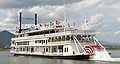
 Shiga has a lot of tourism resources, but Shiga is overshadowed by its much more famous neighbor Kyoto, so many foreign tourists have never heard of Shiga. Over four million foreign tourists visited Japan in 2000, but only sixty-five thousand foreign tourists visited Shiga.
The main gateways to Shiga are the Maibara Station
in northern Shiga and the city of Otsu
in the south.
Shiga's most prominent feature is Lake Biwa
. The northern shore is especially scenic such as cherry blossom of Kaizu Osaki in spring. The western shore has white sand beaches, popular among Kyotoites during the summer. The scenery of southern shore was selected as Omi Hakkei or Eight Views of Omi
, popularized by Hiroshige
's ukiyo-e
. Unfortunately, most of the original eight views are now almost gone or changed from what they were centuries ago. One of them is the Ukimido temple in Katata, northern Otsu. It was reconstructed with concrete in 1937, but still has tasteful scene — a small temple stands on the lake near the shore, accessible by a short bridge.
Beautiful views of the lake can also be had from mountain roads like the Oku-Biwako Parkway road up north and the Hiei-zan Driveway and Oku-Hiei Driveway overlooking the southwestern shore. In Otsu, the Otsu Prince Hotel's Top of Otsu restaurant provides a superb high, panoramic view of the lake and city.
Besides being natural beauty, there are historical buildings and festivals persons that rank among those of national importance. Shiga has 807 National Treasures
and Important Cultural Properties
, that ranks the fourth large number in Japan.
Like other prefectures, festivals abound in Shiga. Unique festivals of Shiga include the hikiyama festival (floats parade festival). The hikiyama festival is held in ten areas such as Nagahama, Otsu, Maibara, Hino, Minakuchi and so on. The Nagahama hikiyama festival held each April is known as one of the three major hikiyama festivals in Japan, and was selected as Important Intangible Cultural Property in 1979. During this festival ornate floats are mounted with miniature stages on which highly skilled boys (playing both male and female roles) act in kabuki
plays. Meanwhile, Higashiomi (formerly Yōkaichi
) city holds a Giant Kite Festival every May along the riverbank. Ordinary people are invited to pull the rope that sends the kites aloft.
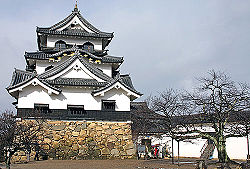
Shiga's most famous historical building is Hikone Castle
, one of four national treasure castles in Japan. The castle tower is well preserved and also has many cherry trees. Other famous building is Ishiyama Temple
in Otsu. It has a room where one of Japan's most famous novels, Tale of Genji was written.
, Shin-Meishin Expressway
and Hokuriku Expressway
pass through Shiga. National highway Route 1, 8, 21
, 8, 161, 303, 306, 307, 365, 367
, 421, 422 and 477
connect with neighbouring prefectures. Two toll bridges span southern part of Lake Biwa.
, Brazil Michigan
, USA Hunan
, People's Republic of China
Prefectures of Japan
The prefectures of Japan are the country's 47 subnational jurisdictions: one "metropolis" , Tokyo; one "circuit" , Hokkaidō; two urban prefectures , Osaka and Kyoto; and 43 other prefectures . In Japanese, they are commonly referred to as...
of Japan, which forms part of the Kansai region on Honshu
Honshu
is the largest island of Japan. The nation's main island, it is south of Hokkaido across the Tsugaru Strait, north of Shikoku across the Inland Sea, and northeast of Kyushu across the Kanmon Strait...
Island. The capital is the city of Ōtsu
Otsu, Shiga
is the capital city of Shiga, Japan. The city was founded on October 1, 1898. As of October 1, 2010, the city has an estimated population of 338,629 with an average age of 40.7 years and a population density of 905.28 persons per km²...
.
History
Shiga was known as Ōmi ProvinceOmi Province
is an old province of Japan, which today comprises Shiga Prefecture. It was one of the provinces that made up the Tōsandō circuit. It is nicknamed as .Lake Biwa, Japan's largest lake, is located at the center of the province...
or Gōshū before the prefectural system was established. Omi was a neighbor of Nara
Nara, Nara
is the capital city of Nara Prefecture in the Kansai region of Japan. The city occupies the northern part of Nara Prefecture, directly bordering Kyoto Prefecture...
and Kyoto
Kyoto
is a city in the central part of the island of Honshū, Japan. It has a population close to 1.5 million. Formerly the imperial capital of Japan, it is now the capital of Kyoto Prefecture, as well as a major part of the Osaka-Kobe-Kyoto metropolitan area.-History:...
, and junction of western and eastern Japan, so Omi was developed as the hinterland of capitals, the traffic important point and sometimes political center. In the years 667 to 672, Emperor Tenji
Emperor Tenji
, also known as Emperor Tenchi, was the 38th emperor of Japan, according to the traditional order of succession.Tenji's reign spanned the years from 661 through 671.-Traditional narrative:...
founded a palace in Otsu. In 742, Emperor Shōmu
Emperor Shomu
was the 45th emperor of Japan, according to the traditional order of succession.Shōmu's reign spanned the years 724 through 723.-Traditional narrative:...
founded a palace in Shigaraki
Shigaraki, Shiga
was a town located in Kōka District, Shiga, Japan.On October 1, 2004 Shigaraki was merged with the towns of Kōka, Kōnan, Minakuchi and Tsuchiyama, all from Kōka District, to form the new city of Kōka....
. In the early Heian Period
Heian period
The is the last division of classical Japanese history, running from 794 to 1185. The period is named after the capital city of Heian-kyō, or modern Kyōto. It is the period in Japanese history when Buddhism, Taoism and other Chinese influences were at their height...
, Saichō
Saicho
was a Japanese Buddhist monk credited with founding the Tendai school in Japan, based around the Chinese Tiantai tradition he was exposed to during his trip to China beginning in 804. He founded the temple and headquarters of Tendai at Enryaku-ji on Mt. Hiei near Kyoto. He is also said to have...
was born in north of Otsu and founded Enryaku-ji
Enryaku-ji
thumb|300px|Konpon Chū-dō , Enryaku-ji's main hall is a Tendai monastery located on Mount Hiei in Ōtsu, overlooking Kyoto. It was founded during the early Heian period. The temple complex was established by Saichō , also known as Dengyō Daishi, who introduced the Tendai sect of Mahayana Buddhism...
, the center of Tendai
Tendai
is a Japanese school of Mahayana Buddhism, a descendant of the Chinese Tiantai or Lotus Sutra school.Chappell frames the relevance of Tendai for a universal Buddhism:- History :...
and one of the UNESCO
UNESCO
The United Nations Educational, Scientific and Cultural Organization is a specialized agency of the United Nations...
World Heritage Site
World Heritage Site
A UNESCO World Heritage Site is a place that is listed by the UNESCO as of special cultural or physical significance...
Historic Monuments of Ancient Kyoto (Kyoto, Uji and Otsu Cities) now.
In the Medieval Period, Sasaki clan
Sasaki clan
are a historical Japanese clan. - Brief history :They are descended directly from Emperor Uda by his grandson Minamoto no Masanobu , but were adopted by the Seiwa Genji...
ruled Omi, and afterward Rokkaku clan
Rokkaku clan
The was a Japanese samurai clan which wielded considerable power in the Muromachi period under the Ashikaga shogunate.-Rise and Fall:Founded by Sasaki Yasutsuna of Ōmi province in the 13th century, the name Rokkaku was taken from their residence within Kyoto; however, many members of this family...
, Kyōgoku clan
Kyōgoku clan
The were a Japanese samurai kin group which rose to prominence during the Sengoku and Edo periods. The clan claimed descent from the Uda Genji. The name derives from the Kyōgoku quarter of Kyoto during the Heian period....
and Azai clan ruled Omi. In 1570s, Oda Nobunaga
Oda Nobunaga
was the initiator of the unification of Japan under the shogunate in the late 16th century, which ruled Japan until the Meiji Restoration in 1868. He was also a major daimyo during the Sengoku period of Japanese history. His opus was continued, completed and finalized by his successors Toyotomi...
subjugated Omi and built Azuchi Castle
Azuchi Castle
' was one of the primary castles of Oda Nobunaga. It was built from 1576 to 1579, on the shores of Lake Biwa, in Ōmi Province. Nobunaga intentionally built it close enough to Kyoto that he could watch over and guard the approaches to the capital, but, being outside the city, his fortress would be...
on the eastern shores of Lake Biwa in 1579. Tōdō Takatora
Todo Takatora
was a Japanese daimyo of the Azuchi-Momoyama period through Edo period. He rose from relatively humble origins as an ashigaru to become a daimyo...
, Gamō Ujisato
Gamo Ujisato
was a Japanese daimyo of the Sengoku and Azuchi-Momoyama periods. The heir and son of Gamō Katahide, lord of Hino Castle in Ōmi Province, he later held Matsusaka and finally Aizuwakamatsu Castle in Mutsu Province...
, Oichi
Oichi
or a female historical figure in the late Sengoku period. She is known primarily as the mother of three daughters who married well -- Yodo-dono, Ohatsu and Oeyo....
, Yodo-dono
Yodo-Dono
or was a prominently-placed figure in late-Sengoku period. She was a concubine and second wife of Toyotomi Hideyoshi, who was then the most powerful man in Japan. She also became the mother of his son and successor, Hideyori. She was also known as Lady Chacha...
, Ohatsu and Oeyo
Oeyo
, , or : 1573 – September 15, 1626) was a prominently-placed female figure in late-Sengoku period. She married three times, first to Saji Kazunari, then to Toyotomi Hideyoshi's nephew Toyotomi Hidekatsu. Her third and last husband Tokugawa Hidetada became the second Tokugawa shogun...
were important persons from Omi in Sengoku Period
Sengoku period
The or Warring States period in Japanese history was a time of social upheaval, political intrigue, and nearly constant military conflict that lasted roughly from the middle of the 15th century to the beginning of the 17th century. The name "Sengoku" was adopted by Japanese historians in reference...
. In this times, Ninja
Ninja
A or was a covert agent or mercenary of feudal Japan specializing in unorthodox arts of war. The functions of the ninja included espionage, sabotage, infiltration, and assassination, as well as open combat in certain situations...
was active in Kōka (See also Kōga-ryū
Koga-ryu
Kōka-ryū is a historical school of ninjutsu. It originated from the region of Kōka...
).
In 1600, Ishida Mitsunari
Ishida Mitsunari
Ishida Mitsunari was a samurai who led the Western army in the Battle of Sekigahara following the Azuchi-Momoyama period of the 17th century. Also known by his court title, Jibunoshō...
, born in east of Nagahama and based in Sawayama Castle
Sawayama Castle
is a castle in the city of Hikone, Shiga Prefecture, Japan. This castle was an important military stronghold of Ōmi Province. The Azai clan held this castle in the Sengoku Period. Ishida Mitsunari held it at the end of the 16th century after the ruin of the Azai clan.This castle was attacked by...
, made war against Tokugawa Ieyasu
Tokugawa Ieyasu
was the founder and first shogun of the Tokugawa shogunate of Japan , which ruled from the Battle of Sekigahara in 1600 until the Meiji Restoration in 1868. Ieyasu seized power in 1600, received appointment as shogun in 1603, abdicated from office in 1605, but...
in Sekigahara, Gifu
Sekigahara, Gifu
is a town located in Fuwa District, Gifu Prefecture, Japan.As of July 2011, the town has an estimated population of 7,965. The total area is 49.29 km².In 1600, the Battle of Sekigahara took place here.-History:...
. After the battle, Ieyasu made Ii Naomasa
Ii Naomasa
was a general under the Sengoku period Daimyo, and later Shogun, Tokugawa Ieyasu. He is regarded as one of the Four Guardians of the Tokugawa along with Honda Tadakatsu, Sakakibara Yasumasa and Sakai Tadatsugu.-Early life:...
a new lord of Sawayama, and Naomasa established the Hikone Domain
Hikone Domain
The was a feudal domain of Japan during the Edo period. It was established in 1600 with Ii Naomasa as the first daimyo. All fifteen daimyo were from the Ii clan.A large fudai domain, Hikone was initially rated at 180,000 koku...
. The Hikone Domain is famous for Ii Naosuke
Ii Naosuke
was daimyo of Hikone and also Tairō of Tokugawa Shogunate, Japan, a position he held from April 23, 1858 until his death on March 24, 1860. He is most famous for signing the Harris Treaty with the United States, granting access to ports for trade to American merchants and seamen and...
, who became the Tokugawa shogunate's Tairō
Tairo
Tairō was a high-ranking official position in the bakuhan taisei government of Japan. The tairō would preside over the governing Rōjū council in the event of an emergency. A tairō would be nominated from among a group of samurai families who supported Tokugawa Ieyasu...
and concluded commercial treaties with the Western powers and thus broke Japan's isolation from the world in the 19th century. Besides the Hikone Domain, many domains ruled Omi such as Zeze
Zeze Domain
The was a feudal domain in Japan during the Edo period. It was established by Tokugawa Ieyasu as a reward to Toda Kazuaki, whom he transferred from a 5,000 koku territory in Musashi Province to this 30,000 koku domain in Ōmi Province. The domain government had its headquarters at Zeze Castle in...
.
With the Abolition of the han system
Abolition of the han system
The was an act, in 1871, of the new Meiji government of the Empire of Japan to replace the traditional feudal domain system and to introduce centralized government authority . This process marked the culmination of the Meiji Restoration in that all daimyo were required to return their authority...
, eight prefectures was formed in Omi, and they were unified into Shiga Prefecture in September 1872. "Shiga Prefecture" was named after "Shiga District
Shiga District, Shiga
Shiga was a district located in Shiga, Japan.As of 2003, the district has an estimated population of 21,964 and a density of 306.20 persons per km². The total area is 71.73 km²....
" because Otsu belonged the district until 1898. From August 1876 to February 1881, southern Fukui Prefecture had been incorporated into Shiga Prefecture.
Geography
Shiga shares a border with Fukui PrefectureFukui Prefecture
is a prefecture of Japan located in the Chūbu region on Honshū island. The capital is the city of Fukui.- Prehistory :The Kitadani Dinosaur Quarry, on the Sugiyama River within the city limits of Katsuyama, has yielded the Fukuiraptor kitadaniensis and Fukuisaurus tetoriensis as well as an unnamed...
in the north, Gifu Prefecture
Gifu Prefecture
is a prefecture located in the Chūbu region of central Japan. Its capital is the city of Gifu.Located in the center of Japan, it has long played an important part as the crossroads of Japan, connecting the east to the west through such routes as the Nakasendō...
in the east, Mie Prefecture
Mie Prefecture
is a prefecture of Japan which is part of the Kansai regions on Honshū island. The capital is the city of Tsu.- History :Until the Meiji Restoration, Mie prefecture was known as Ise Province and Iga Province....
in the southeast, and Kyoto Prefecture
Kyoto Prefecture
is a prefecture of Japan located in the Kansai region of the island of Honshu. The capital is the city of Kyoto.- History :Until the Meiji Restoration, the area of Kyoto prefecture was known as Yamashiro....
in the west.
Different areas of the prefecture include Kohoku (湖北, north of lake), Kosei (湖西, west of lake), Kotō (湖東, east of lake), and Konan (湖南, south of lake).
Lake Biwa
Lake Biwa
is the largest freshwater lake in Japan, located in Shiga Prefecture , northeast of the former capital city of Kyoto. Because of its proximity to the ancient capital, references to Lake Biwa appear frequently in Japanese literature, particularly in poetry and in historical accounts of battles.-...
, Japan's largest lake, is located at the center of this prefecture. It occupies one-sixth the total area of Shiga. The Seta River
Seta River
The , also called the Seta River and the Uji River at portions of its route, is the principal river in Osaka Prefecture on Honshū, Japan. The source of the river is Lake Biwa in Shiga Prefecture to the north....
flows out from Lake Biwa to Osaka Bay
Osaka Bay
Osaka Bay is a bay in western Japan. As an eastern part of the Inland Sea, it is separated from the Pacific Ocean by the Kii Channel and from the neighbor western part of the Inland Sea by the Akashi Strait...
through Kyoto
Kyoto
is a city in the central part of the island of Honshū, Japan. It has a population close to 1.5 million. Formerly the imperial capital of Japan, it is now the capital of Kyoto Prefecture, as well as a major part of the Osaka-Kobe-Kyoto metropolitan area.-History:...
. This is the only natural river which flows out from the lake. All of the other natural rivers flow into the lake. There were many lagoons around Lake Biwa, but most of them were reclaimed in 1940s. An example of preserved lagoon is the wetland in Omihachiman, and it was selected as Important Cultural Landscapes
Cultural Landscapes of Japan
Landscapes which have evolved together with the way of life and geocultural features of a region, and which are indispensable for understanding the lifestyle of the Japanese people, are recognized by the government of Japan as under article 2, paragraph 1, item 5 of the Law for the Protection of...
in 2006.
Plains stretch to the eastern coast of Lake Biwa. The prefecture is enclosed by mountain ranges with the Hira Mountains
Hira Mountains
The are a mountainous region to the west of Lake Biwa on the border of Shiga Prefecture and Kyoto Prefecture, Japan. The highest peak is Mount Bunagatake with an elevation of 1,214.4 meters. The spring snow of the mountains is selected to Eight Views of Omi....
and Mount Hiei
Mount Hiei
is a mountain to the northeast of Kyoto, lying on the border between the Kyoto and Shiga prefectures, Japan.The temple of Enryaku-ji, the first outpost of the Japanese Tiantai sect of Buddhism, was founded atop Mount Hiei by Saichō in 788. Both Nichiren and Honen studied at the temple before...
in the west, the Ibuki Mountains
Ibuki Mountains
The are a mountain range straddling the border between Gifu and Shiga prefectures in Japan. After lowering and nearly disappearing in Shiga Prefecture, the range continues as the Suzuka Mountains...
in the northeast, and the Suzuka Mountains
Suzuka Mountains
are a mountain range running through Mie Prefecture and along the borders of Gifu and Shiga prefectures in central Japan. The tallest peak in the range is Mount Oike at...
in the southeast. Mount Ibuki
Mount Ibuki
is a high mountain, on the border of Maibara, Shiga Prefecture, and Ibigawa, Gifu Prefecture, Japan. It is one of the 100 Famous Japanese Mountains, and is also included on the lists of the 100 Kinki Mountains the 50 Shiga Mountains...
is the highest mountain in Shiga. In Yogo
Yogo, Shiga
was a town located in Ika District, Shiga, Japan.As of 2003, the town had an estimated population of 4,045 and a density of 24.13 persons per km². The total area was 167.62 km².On January 1, 2010, several municipalities were merged into the city of Nagahama...
, there is a small lake which is famous for a legend of Swan maiden.
The climate of Shiga makes a sharp contrast between northern and southern. Southern Shiga is usually warm, but northern Shiga is substantially cold with high snowfall and there are many skiing grounds. In Nakanokawachi, the northernmost village of Shiga, snow laid 5.6 meter deep on the ground in 1936.
Cities
Thirteen cities are located in Shiga Prefecture:
|
Nagahama, Shiga is a city located in Shiga Prefecture, Japan on the eastern shore of Lake Biwa. The city center was developed and renamed by Toyotomi Hideyoshi when Hideyoshi moved his center of administration from Odani Castle... Otsu, Shiga is the capital city of Shiga, Japan. The city was founded on October 1, 1898. As of October 1, 2010, the city has an estimated population of 338,629 with an average age of 40.7 years and a population density of 905.28 persons per km²... (capital) Omihachiman, Shiga is a city in Shiga Prefecture, Japan.The city was founded on March 31, 1954. In the quinquennial census of 2010, it had a population of 81,730... Ritto, Shiga is a city located in Shiga, Japan. It is well-known for Japanese horse racing fans because there is the Japan Racing Association's training center and a famous jockey brothers, Yutaka Take and Koshiro Take, were born in Ritto.... Takashima, Shiga is a city in Shiga Prefecture, Japan.On November 30, 2004 the city had an estimated population of 56,220 and a density of 110 persons per square kilometres. The total area is 511 square kilometres.... Yasu, Shiga is a city located in Shiga Prefecture, Japan. The city was formed on October 1, 2004, by the merger of the towns of Yasu and Chūzu; in doing so, the former Yasu District was dissolved.... |
Towns
These are the towns in each districtDistricts of Japan
The was most recently used as an administrative unit in Japan between 1878 and 1921 and is roughly equivalent to the county of the United States, ranking at the level below prefecture and above city, town or village. As of 2008, cities belong directly to prefectures and are independent from...
.
|
Kora, Shiga is a town located in Inukami District, Shiga, Japan.As of 2003, the town has an estimated population of 8,024 and a density of 587.41 persons per km². The total area is 13.66 km².... Taga, Shiga is a town located in Inukami District, Shiga, Japan. It has developed as a shrine town of Taga-taisha, one of the most famous shrines in Shiga.As of 2003, the town has an estimated population of 8,322 and a density of 61.22 persons per km². The total area is 135.93 km².-External links:* *... Toyosato, Shiga is a town located in Inukami District, Shiga, Japan.As of 2003, the town has an estimated population of 7,292 and a density of 937.28 persons per km². The total area is 7.78 km², the smallest town in Shiga... |
Economy
The cultivated areas occupy nearly one-sixth the total area of Shiga. Rice is the principal crop of Shiga, and over 90 percent of the farmlands are rice fields. The average numbers of management farmland and farm income per household are small scale, so almost farmers depend on another business income. Eastern Shiga is famous for breeding of cattle, and southeastern Shiga is famous for cultivation of green teaGreen tea
Green tea is made solely from the leaves of Camellia sinensis that have undergone minimal oxidation during processing. Green tea originates from China and has become associated with many cultures throughout Asia. It has recently become more widespread in the West, where black tea is traditionally...
. In villages on Lake Biwa, some people are engaged in fishery and freshwater pearl farming.
Since the Medieval Period, especially in Edo period
Edo period
The , or , is a division of Japanese history which was ruled by the shoguns of the Tokugawa family, running from 1603 to 1868. The political entity of this period was the Tokugawa shogunate....
, many Shiga people have been active in Japanese commercial fields and have been called . For example, Nippon Life, Itochu
ITOCHU
, until 1992 "C. Itoh" in English, is a Japanese general trading concern based in Umeda, Kita-ku, Osaka and Aoyama, Minato, Tokyo. It has a common origin with Marubeni Corporation. Itochu is a Fortune 500 company.-History:...
, Marubeni
Marubeni
is a Japanese trading company, one of the largest general trading companies in Japan.-Offices:*Head Office - 4-2, Otemachi 1-chome, Chiyoda, Tokyo, Japan*Head Office -20-6, Shiba 5-chome, Minato, Tokyo, Japan...
, Takashimaya
Takashimaya
is a large Japanese department store chain.Founded in 1829 in Kyoto by Iida Shinkichi as a retailer of used clothing and cotton cloth, the store now has outlets throughout Japan and also in Taipei, Paris and Singapore....
, Wacoal
Wacoal
is a worldwide lingerie manufacturer and marketer headquartered in Kyoto, Japan. It is a subsidiary wholly owned by .Wako Shoji was founded by Koichi Tsukamoto in 1946...
and Yanmar
Yanmar
is a Japanese diesel engine manufacturer with more than 90 years of history. The engines are used in a wide range of applications, including seagoing vessels, construction equipment, agricultural equipment and generator sets.-Company description:...
are founded by people from Shiga. Ōmi merchants were often called by other jealous merchants. In their home towns such as Omihachiman, Hino, Gokashō
Gokasho, Shiga
was a town located in Kanzaki District, Shiga, Japan.On February 11, 2005 Gokashō was merged with the town of Eigenji, also from Kanzaki District, the towns of Aitō and Kotō, both from Echi District, and the old city of Yōkaichi, to form the new city of Higashiōmi.In 2003, the town had an estimated...
and Toyosato, their mansions are preserved as tourist attraction now.
Since 1960s, Shiga developed its industry rapidly, a number of major companies have factories in Shiga such as IBM Japan, Canon, Yanmar Diesel, Mitsubishi
Mitsubishi
The Mitsubishi Group , Mitsubishi Group of Companies, or Mitsubishi Companies is a Japanese multinational conglomerate company that consists of a range of autonomous businesses which share the Mitsubishi brand, trademark and legacy...
, and Toray
Toray
is a multinational corporation headquartered in Japan that specializes in industrial products centered around technologies in organic synthetic chemistry, polymer chemistry, and biochemistry. Its founding business areas were fibers and textiles, as well as plastics and chemicals...
now. According to Cabinet Office
Cabinet Office (Japan)
is an agency in the Cabinet of Japan. It is responsible for handling the day to day affairs of the cabinet. The Cabinet Office is formally headed by the Prime Minister. There are usually three Vice Ministers and three Parliamentary Secretaries in the Cabinet Office.-Organization:-External...
's stastics in 2007, Secondary sector of the economy accounted for 44.8 % of Gross Shiga Product, it is the highest proportion in Japan. The traditional industry of Shiga includes textiles, Shigaraki ware, Butsudan
Butsudan
A butsudan is a shrine commonly found in temples and homes in Japanese Buddhist cultures. A butsudan is a wooden cabinet with doors that enclose and protect a gohonzon or religious icon, typically a statue or painting of a Buddha or Bodhisattva, or a "script" mandala scroll...
in Hikone and Nagahama, medicines in Koka, fan ribs in Adogawa
Adogawa, Shiga
was a town located in the former Takashima District, Shiga, Japan.As of 2003, the town had an estimated population of 14,245 and a density of 293.89 persons per km²...
.
Demographics
The population is concentrated along the southern shore of Lake Biwa in Otsu city (adjacent to Kyoto) and along the eastern shore of Lake Biwa. Cities on the eastern shore like Kusatsu and Moriyama are within commuting distance to Kyoto. The lake's western and northern shores are more rural and resort-oriented with white sand beaches. In recent years, many Brazilians have settled in Shiga to work in nearby factories. 26,471 foreigners live in Shiga and 36% of foreigners are Brazilians as of December 2010. Shiga Prefecture services a weekly information program in Portuguese on Biwako Broadcasting from April 2011.Culture
Biwa townBiwa, Shiga
was a town located in Higashiazai District, Shiga Prefecture, Japan. It is on the northern shore of Lake Biwa and that was the origin of the town's name. Chikubu Island was under the administration of Biwa....
(now a part of Nagahama) is a home of The Tonda Traditional Bunraku Puppet Troupe
Tonda Traditional Bunraku Puppet Troupe
, founded in the 1830s, is one of the most active groups performing traditional ningyō jōruri or Bunraku puppetry in Japan, and has been officially designated an Intangible Cultural Treasure...
. Founded in the 1830s, the Tonda Puppet Troupe is one of the most active traditional Bunraku
Bunraku
, also known as Ningyō jōruri , is a form of traditional Japanese puppet theater, founded in Osaka in 1684.Three kinds of performers take part in a bunraku performance:* Ningyōtsukai or Ningyōzukai—puppeteers* Tayū—the chanters* Shamisen players...
puppet theaters in Japan outside the National Theater in Osaka. Toyosato and Higashiomi are known to a mecca of Goshu ondo
Goshu ondo
The is a type of ondo , a traditional Japanese dance song. It originated in Shiga Prefecture which was formerly known as Gōshū. It is believed to have been perfected around the Meiji Era.- Form :...
.
There is the Sagawa Art Museum in Moriyama, the Lake Biwa Museum in Kusatsu and the Miho Museum
Miho Museum
The Miho Museum is located southeast of Kyoto, Japan, near the town of Shigaraki, in Shiga Prefecture. The museum was the dream of Mihoko Koyama , the heiress to the Toyobo textile business, and one of the wealthiest women in Japan. In 1970 Koyama founded the Shinji Shumeikai spiritual movement...
in Kōka. In Kōka, a ninja house is preserved as a visitor center.
Cuisine
Since ancient times, Shiga people have made use of fishery resources from Lake Biwa for their eating habits. The most famous lake-food of Shiga is funa-zushi (crucian carp sushiSushi
is a Japanese food consisting of cooked vinegared rice combined with other ingredients . Neta and forms of sushi presentation vary, but the ingredient which all sushi have in common is shari...
). It retains ancient style of sushi and has peculiar favor. Shiga is also famous for high quality wagyū
Wagyu
refers to several breeds of cattle genetically predisposed to intense marbling and to producing a high percentage of oleaginous unsaturated fat. The meat from wagyu cattle is known worldwide for its marbling characteristics, increased eating quality through a naturally enhanced flavor, tenderness...
, Omi beef. The Hikone Domain presented beef as medicinal food to shoguns. In addition, tsukemono
Tsukemono
are Japanese pickles. They are served with rice as okazu with drinks as an otsumami , as an accompaniment to or garnish for meals, and as a course in the kaiseki portion of a Japanese tea ceremony....
of root crops, mallard
Mallard
The Mallard , or Wild Duck , is a dabbling duck which breeds throughout the temperate and subtropical Americas, Europe, Asia, and North Africa, and has been introduced to New Zealand and Australia....
sukiyaki
Sukiyaki
Sukiyaki is a Japanese dish in the nabemono style.It consists of meat which is slowly cooked or simmered at the table, alongside vegetables and other ingredients, in a shallow iron pot in a mixture of soy sauce, sugar, and mirin...
in northern Shiga, red konnyaku
Konjac
Konjac , also known as konjak, konjaku, konnyaku potato, devil's tongue, voodoo lily, snake palm, or elephant yam , is a plant of the genus Amorphophallus...
in Omihachiman, salty-sweet cooked sōmen
Somen
are very thin, white Japanese noodles made of wheat flour. The noodles are usually served cold and are less than 1.3 mm in diameter. The distinction between sōmen and the next thicker wheat noodles hiyamugi and even thicker Japanese wheat noodles udon is mostly the size of the noodle...
with mackerel
Mackerel
Mackerel is a common name applied to a number of different species of fish, mostly, but not exclusively, from the family Scombridae. They may be found in all tropical and temperate seas. Most live offshore in the oceanic environment but a few, like the Spanish mackerel , enter bays and can be...
in Nagahama and lightly seasoned champon
Champon
, also known as Chanpon, is a noodle dish that is a regional cuisine of Nagasaki, Japan. Due to the inspiration from Chinese cuisine, it is also a form of Japanese Chinese cuisine. Champon is made by frying pork, seafood and vegetables with lard; a soup made with chicken and pig bones is added. A...
in Hikone are examples of specific cuisine in Shiga.
Mass media
Biwako BroadcastingBiwako Broadcasting
is a fee-free commercial terrestrial television station serving Shiga Prefecture of Japan.It is a member of the Japanese Association of Independent Television Stations .Popular name Independent UHF Station .-Offices:...
services local TV programs and NHK
NHK
NHK is Japan's national public broadcasting organization. NHK, which has always identified itself to its audiences by the English pronunciation of its initials, is a publicly owned corporation funded by viewers' payments of a television license fee....
has a Broadcasting Station in Otsu. Shiga is the only prefecture which has no own regional newspapers, and Kyoto Shimbun
Kyoto Shimbun
is a daily newspaper published in Kyoto, Japan, and the company publishing that newspapers is also called . Kyoto Shimbun has two headquarters in Kyoto and Ōtsu, and three branch offices in Uji, Tokyo and Osaka.-External links:...
is a de facto regional newspaper of Shiga.
Education
There are ten universities, two junior colleges, and a learning center of The Open University of Japan in Shiga.- Shiga UniversityShiga Universityis a national university in Shiga Prefecture, Japan. It has campuses at the cities of Ōtsu and Hikone. The predecessor of the school was founded in 1943, and it was chartered as a university in 1949.-External links:*...
(Hikone and Otsu) - Shiga University of Medical ScienceShiga University of Medical Scienceis a national university in Ōtsu, Shiga, Japan, founded in 1974....
(Otsu) - University of Shiga PrefectureUniversity of Shiga Prefectureis a public university in Hikone, Shiga, Japan. The predecessor of the school was founded in 1950, and it was chartered as a university in 1995....
(Hikone) - Shiga Junior CollegeShiga Junior Collegeis a private junior college in Otsu, Shiga, Japan. Founded in 1970 as a junior women's college, it became coeducational in 2008.-External links:*...
(Otsu) - Shiga Bunkyo Junior CollegeShiga Bunkyo Junior Collegeis a private junior college in Nagahama, Shiga, Japan, established in 1952.-External links:*...
(Nagahama) - Seian University of Art and DesignSeian University of Art and Designis a private university in Otsu, Shiga, Japan. The predecessor of the school was founded in 1920. It was chartered as a junior women's college in 1950 and became coeducational in 1993.-External links:*...
(Otsu) - Seisen UniversitySeisen University (Shiga)is a private university in Hikone, Shiga, Japan. The school was founded in 1985 as a junior college and became a four-year college in 2003.-External links:*...
(Hikone) - Nagahama Institute of Bio-Science and TechnologyNagahama Institute of Bio-Science and Technologyis a private university in Nagahama, Shiga, Japan, established in 2003.-External links:*...
(Nagahama) - Biwako-Gakuin UniversityNewton College (Japan)was a private junior college in Higashiomi, Shiga, Japan. It was originally established in 1990 as a junior women's college and became coeducational in 1997. It was reorganized as a substructure of in 2009.-External links:*...
(Higashiomi) - Biwako Seikei Sport CollegeBiwako Seikei Sport Collegeis a private university in Otsu, Shiga, Japan, established in 2003.-External links:*...
(Otsu) - Ritsumeikan UniversityRitsumeikan UniversityRitsumeikan University has a growing reputation as one of the main private universities of Japan. It is part of a group of prestigious private universities in the Kansai area, called "Kan -Kan -Dou -Ritsu "...
(Kyoto and Kusatsu) - Ryukoku UniversityRyukoku Universityis a private university located in Kyoto, Japan.It was founded as a school for Buddhist monks of the Nishi Hongan-ji denomination in 1639, and became a secularized university in 1876. Professors and students of the university established the famed literary magazine Chūōkōron in 1887. It has three...
(Kyoto and Otsu)
Sports
The following sports teams are based in Shiga.- Basketball: Shiga LakeStars
- Volleyball: Toray Arrows (women's volleyball team)Toray Arrows (women's volleyball team)Toray Arrows is a women's volleyball team based in Ōtsu, Shiga, Japan. It plays in V.Premier League. The club was founded in 2000. The owner of the team is Toray Industries.The jersey number of the team is the order of the age.-Honours:...
(Otsu) - Football (soccer): MIO Biwako KusatsuMIO Biwako Kusatsuis a Japanese football club based in Kusatsu, Shiga Prefecture.They were promoted to Japan Football League for the first time at the end of 2007, and played their first season in 2008 where they finished 14th. "Biwako" is a reference to Biwa Lake, the largest lake in Japan.-History:The club was...
(Kusatsu), Sagawa Shiga F.C.Sagawa Shiga F.C., formerly , is an amateur Japanese association football club based in Moriyama, Shiga. They are members of the Japan Football League . The club formed in 2007 from a merger of two Sagawa Express corporation football clubs in JFL; Sagawa Express Tokyo S.C. and Sagawa Express Osaka S.C.. The Tokyo...
(Moriyama).
Tourism
The main gateways to Shiga are the Maibara Station
Maibara Station
is a train station in Maibara, Shiga Prefecture, Japan. It is the southern terminus of the West Japan Railway Company Hokuriku Main Line, and the boundary of control between JR West and JR Central over the Tōkaidō Main Line....
in northern Shiga and the city of Otsu
Otsu, Shiga
is the capital city of Shiga, Japan. The city was founded on October 1, 1898. As of October 1, 2010, the city has an estimated population of 338,629 with an average age of 40.7 years and a population density of 905.28 persons per km²...
in the south.
Shiga's most prominent feature is Lake Biwa
Lake Biwa
is the largest freshwater lake in Japan, located in Shiga Prefecture , northeast of the former capital city of Kyoto. Because of its proximity to the ancient capital, references to Lake Biwa appear frequently in Japanese literature, particularly in poetry and in historical accounts of battles.-...
. The northern shore is especially scenic such as cherry blossom of Kaizu Osaki in spring. The western shore has white sand beaches, popular among Kyotoites during the summer. The scenery of southern shore was selected as Omi Hakkei or Eight Views of Omi
Eight Views of Omi
The Eight Views of Omi are the most scenic views of Omi Province, the present-day Shiga Prefecture, Japan. They were inspired by the Eight Views of Xiaoxiang in China...
, popularized by Hiroshige
Hiroshige
was a Japanese ukiyo-e artist, and one of the last great artists in that tradition. He was also referred to as Andō Hiroshige and by the art name of Ichiyūsai Hiroshige ....
's ukiyo-e
Ukiyo-e
' is a genre of Japanese woodblock prints and paintings produced between the 17th and the 20th centuries, featuring motifs of landscapes, tales from history, the theatre, and pleasure quarters...
. Unfortunately, most of the original eight views are now almost gone or changed from what they were centuries ago. One of them is the Ukimido temple in Katata, northern Otsu. It was reconstructed with concrete in 1937, but still has tasteful scene — a small temple stands on the lake near the shore, accessible by a short bridge.
Beautiful views of the lake can also be had from mountain roads like the Oku-Biwako Parkway road up north and the Hiei-zan Driveway and Oku-Hiei Driveway overlooking the southwestern shore. In Otsu, the Otsu Prince Hotel's Top of Otsu restaurant provides a superb high, panoramic view of the lake and city.
Besides being natural beauty, there are historical buildings and festivals persons that rank among those of national importance. Shiga has 807 National Treasures
National treasures of Japan
National Treasures are the most precious of Japan's Tangible Cultural Properties, as determined and designated by the Agency for Cultural Affairs...
and Important Cultural Properties
Important Cultural Properties of Japan
The term is often shortened into just are items officially already classified as Tangible Cultural Properties of Japan by the Japanese Agency for Cultural Affairs and judged to be of particular importance to the Japanese people....
, that ranks the fourth large number in Japan.
Like other prefectures, festivals abound in Shiga. Unique festivals of Shiga include the hikiyama festival (floats parade festival). The hikiyama festival is held in ten areas such as Nagahama, Otsu, Maibara, Hino, Minakuchi and so on. The Nagahama hikiyama festival held each April is known as one of the three major hikiyama festivals in Japan, and was selected as Important Intangible Cultural Property in 1979. During this festival ornate floats are mounted with miniature stages on which highly skilled boys (playing both male and female roles) act in kabuki
Kabuki
is classical Japanese dance-drama. Kabuki theatre is known for the stylization of its drama and for the elaborate make-up worn by some of its performers.The individual kanji characters, from left to right, mean sing , dance , and skill...
plays. Meanwhile, Higashiomi (formerly Yōkaichi
Yokaichi, Shiga
was a city located in Shiga, Japan.On February 11, 2005 Yōkaichi was merged with the towns of Eigenji and Gokashō, both from Kanzaki District, and the towns of Aitō and Kotō, both from Echi District, to form the new city of Higashiōmi....
) city holds a Giant Kite Festival every May along the riverbank. Ordinary people are invited to pull the rope that sends the kites aloft.
Shiga's most famous historical building is Hikone Castle
Hikone Castle
is the most famous historical site in Hikone, Shiga Prefecture, Japan. This Edo period castle traces its origin to 1603 when Ii Naokatsu, son of the former daimyo Ii Naomasa, ordered its construction. The keep was originally built in 1575, as part of Ōtsu Castle, and was moved to Hikone by the Ii...
, one of four national treasure castles in Japan. The castle tower is well preserved and also has many cherry trees. Other famous building is Ishiyama Temple
Ishiyama-dera
is a Shingon temple in Ōtsu in Japan's Shiga Prefecture. It was constructed around 762 CE, and is said to have been founded by Rōben. The temple contains a number of cultural assets...
in Otsu. It has a room where one of Japan's most famous novels, Tale of Genji was written.
Transportation
Railways
- West Japan Railway CompanyWest Japan Railway Company, also referred to as , is one of the Japan Railways Group companies and operates in western Honshū. It has its headquarters in Kita-ku, Osaka.-History:...
- Tōkaidō Main LineTokaido Main LineThe is the busiest trunk line of the Japan Railways Group , connecting Tōkyō and Kōbe stations. It is long, not counting its many freight feeder lines around the major cities...
(Biwako Line), Hokuriku Main LineHokuriku Main LineThe is a 358.3 kilometer line of the West Japan Railway Company from Maibara Station in Maibara, Shiga to Naoetsu Station in Jōetsu, Niigata. It serves the Hokuriku region on the northern central coast of Honshū, the largest island of Japan, as well as offering connections to the regions of...
, Kusatsu LineKusatsu LineThe is a railway line in western Japan operated by West Japan Railway Company . It connects Tsuge on the Kansai Main Line with Kusatsu on the Biwako Line .-Stations:...
and Kosei LineKosei LineThe is one of commuter rail lines and services in Osaka-Kobe-Kyoto Metropolitan Area, operated by West Japan Railway Company. The line was completed in 1974 by the former Japanese National Railways to provide faster access from the Kansai region to the Hokuriku region...
- Tōkaidō Main Line
- Central Japan Railway CompanyCentral Japan Railway CompanyThe is the main railway company operating in the Chūbu region of central Japan. It is officially abbreviated in English as JR Central and in Japanese as . Its headquarters are located in the JR Central Towers in Nakamura-ku, Nagoya, Aichi Prefecture.The company's operational hub is Nagoya Station...
- Tōkaidō Shinkansen (Maibara StationMaibara Stationis a train station in Maibara, Shiga Prefecture, Japan. It is the southern terminus of the West Japan Railway Company Hokuriku Main Line, and the boundary of control between JR West and JR Central over the Tōkaidō Main Line....
) and Tōkaidō Main Line
- Tōkaidō Shinkansen (Maibara Station
- Keihan Electric RailwayKeihan Electric Railwayis a Japanese railway operator in Osaka, Kyoto, and Shiga Prefectures. It is known as , or .-History:Keihan started its operation between Osaka and Kyoto in 1910. It was the first electric railway to connect these two cities, and the first line on the left bank of Yodo River...
- Keishin LineKeihan Keishin LineThe is an interurban railway line of Keihan Electric Railway.The 7.5 km line starts from Misasagi Station in Kyoto and ends at Hamaōtsu Station in neighbouring city of Ōtsu.-History:...
and Ishiyama Sakamoto Line
- Keishin Line
- Ohmi RailwayOhmi Railwayis a Japanese private railway company which operates in Shiga Prefecture, and a member of the Seibu group since 1943. The company is named after the Ōmi Province, the former name of the present-day Shiga. The railway is nicknamed by local users because of its noisy sound.- History :Ohmi Railway is...
- Main LineOhmi Railway Main LineThe is a regional railway line in Shiga Prefecture operated by Ohmi Railway. It connects the cities of Maibara and Koka. It is running parallel with the Tōkaidō Shinkansen between Takamiya and Gokasho.The line is long, stretching from Maibara to Kibukawa...
, Yōkaichi LineOhmi Railway Yokaichi LineThe is a regional railway line in Shiga Prefecture operated by Ohmi Railway.The line is 9.3 km long, connecting Yōkaichi on the Main Line in Higashiōmi to Ōmi-Hachiman on the JR West Biwako Line in Omihachiman....
and Taga LineOhmi Railway Taga LineThe is a regional railway line in Shiga Prefecture operated by Ohmi Railway. It connects Hikone city and Taga town.The single-track line is long, connecting Takamiya on the Main Line in Hikone to Taga Taisha-mae in Taga...
- Main Line
- Shigaraki Kōgen RailwayShigaraki Kogen Railwayis a Japanese Third Sector railway company whose investors are Shiga Prefecture and the city of Koka.The railway operates the Shigaraki Line, a former Japanese National Railways line that was transferred to the third sector in 1987. The Shigaraki Line runs from Kibukawa on the JR West Kusatsu Line...
- Sakamoto CableSakamoto CableThe , officially the , is a Japanese funicular line in Ōtsu, Shiga. It is the only line operates. The line opened in 1927, as an eastern route to Enryaku-ji, a famous temple on Mount Hiei...
Roads
Meishin ExpresswayMeishin Expressway
The is a toll expressway in Japan. It runs from a junction with the Tomei Expressway in Nagakute, Aichi west to Nishinomiya, Hyōgo . It is the main road link between Osaka and Nagoya, and, along with the Tōmei Expressway, forms the main road link between Osaka and Tokyo...
, Shin-Meishin Expressway
Shin-Meishin Expressway
or simply Shin-Meishin for short is an expressway, linking Mie prefecture to Hyōgo Prefecture, which is partially open and partially under construction. Current length as of February 2008 is 49.7 km...
and Hokuriku Expressway
Hokuriku Expressway
The ,The ,The ,(abbreviated as , is a 4-laned national expressway in Japan. It is owned and managed by East Nippon Expressway Company and Central Nippon Expressway Company.-Overview:...
pass through Shiga. National highway Route 1, 8, 21
Japan National Route 21
is a national highway connecting Mizunami, Gifu Prefecture and Maibara, Shiga Prefecture in Japan.-Route Data:*Length: *Origin: Mizunami *Terminus: Maibara...
, 8, 161, 303, 306, 307, 365, 367
Japan National Route 367
National Route 367 is a national highway of Japan connecting between Shimogyō-ku, Kyoto and Wakasa, Fukui in Japan, with total length has 68.5 km ....
, 421, 422 and 477
Japan National Route 477
National Route 477 is a national highway of Japan. The highway connects Yokkaichi, Mie and Ikeda, Osaka. It has a total length of ....
connect with neighbouring prefectures. Two toll bridges span southern part of Lake Biwa.
Boats
With development of land transportation in the 20th century, waterborne transportation in Lake Biwa was disused except for steamer services to islands on the lake, and pleasure boats are popular now.Miscellaneous topics
- Sōsuke UnoSosuke Unowas a Japanese politician and the 75th Prime Minister of Japan from June 3, 1989 to August 10, 1989.He was born in Shiga Prefecture and attended the Kobe University of Commerce...
- The 75th prime ministerPrime Minister of JapanThe is the head of government of Japan. He is appointed by the Emperor of Japan after being designated by the Diet from among its members, and must enjoy the confidence of the House of Representatives to remain in office...
from Moriyama. He was one of the shortest-serving prime ministers in Japan, holding office for only three months (June–August 1989). - Takanori NishikawaTakanori Nishikawais a renowned Japanese singer and actor. He performs as T.M.Revolution , which stands for although the name stems from the famous 80s pop electronic band TM Network...
- A singer and actor from Hikone and Yasu. He is also active as the first Cultural Ambassador for Shiga. - HizakiHizakiHizaki is a Japanese visual kei musician, best known as guitarist for the symphonic metal band Versailles. Before forming Versailles he was in several independent bands and had a solo career.- Biography :...
- A musician and songwriter, known for work as guitarist of VersaillesVersailles (Japanese band)Versailles is a Japanese visual kei metal band formed in 2007. Their key characteristics are their rococo-esque costumes, dueling guitars and heavy but melodic arrangements....
.
Sister states
Shiga has cooperative agreements with three states. Rio Grande do SulRio Grande do Sul
Rio Grande do Sul is the southernmost state in Brazil, and the state with the fifth highest Human Development Index in the country. In this state is located the southernmost city in the country, Chuí, on the border with Uruguay. In the region of Bento Gonçalves and Caxias do Sul, the largest wine...
, Brazil Michigan
Michigan
Michigan is a U.S. state located in the Great Lakes Region of the United States of America. The name Michigan is the French form of the Ojibwa word mishigamaa, meaning "large water" or "large lake"....
, USA Hunan
Hunan
' is a province of South-Central China, located to the south of the middle reaches of the Yangtze River and south of Lake Dongting...
, People's Republic of China