

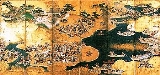
Genpei War

Encyclopedia
The was a conflict
between the Taira and Minamoto
clans during the late-Heian period
of Japan. It resulted in the fall of the Taira clan and the establishment of the Kamakura shogunate
under Minamoto Yoritomo in 1192.
The name "Genpei" comes from alternate readings of the kanji
'Minamoto' (源) and 'Taira' (平). The conflict is also known in Japanese as the , after the two eras
between which it took place.
It began with Minamoto support for a different candidate to take the throne, in conflict with the Taira's nomination. The ensuing Battle of Uji
took place just outside Kyoto
, starting a five-year long war, concluding with a decisive Minamoto victory in the naval Battle of Dan-no-ura
.
and in the Heiji Rebellion
of earlier decades, the Minamoto attempted to regain control from the Taira and failed. The Taira then began a series of executions, intended to eliminate their rivals.
In 1177, relations between the Taira clan and the retired Emperor Go-Shirakawa
became highly strained, and the latter attempted a coup d'état
to oust the Daijō Daijin (prime minister
), Taira no Kiyomori
. Kiyomori defeated the former emperor and abolished the Insei system
. This provoked strong anti-Taira sentiment.
On March 21, 1180, Taira no Kiyomori put his grandson, Antoku
(then only two years of age), on the throne, after the abdication of Emperor Takakura
. Go-Shirakawa's son, Prince Mochihito
, felt that he was being denied his rightful place on the throne and, with the help of Minamoto Yoritomo, sent out a call to arms to the various samurai
families and Buddhist
monasteries on May 5.
In June, Kiyomori moved the seat of imperial power to Fukuhara
(modern day Kobe
), in the hope of promoting trade with Song Dynasty
China, and on the fifteenth of that month, Prince Mochihito fled Kyoto to take refuge in Mii-dera
.
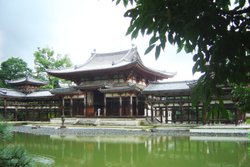 The actions of Taira no Kiyomori having deepened Minamoto hatred for the Taira clan, a call for arms was sent up by Minamoto no Yorimasa
and Prince Mochihito. Not knowing who was behind this rally, Kiyomori called for the arrest of Mochihito, who sought protection at the temple of Mii-dera
. The Mii-dera monks were unable to ensure him sufficient protection, so he was forced to move along. He was then chased by Taira forces to the Byōdō-in
, just outside Kyoto. The war began thus, with a dramatic encounter on and around the bridge over the River Uji
. This battle ended in Yorimasa's ritual suicide inside the Byōdō-in and Mochihito's capture and execution shortly afterwards.
It was at this point that Minamoto no Yoritomo
took over leadership of the Minamoto clan and began traveling the country seeking to rendezvous with allies. Leaving Izu Province
and heading for the Hakone Pass, he was defeated by the Taira in the battle of Ishibashiyama
. However he successfully made it to the provinces of Kai
and Kozuke
, where the Takeda and other friendly families helped repel the Taira army. Meanwhile, Taira no Kiyomori, seeking vengeance against the Mii-dera monks and others, besieged Nara
and burnt much of the city to the ground.
Fighting continued the following year. Minamoto no Yukiie
launched an unsuccessful sneak attack attempt against the army of Taira no Tomomori
at the Battle of Sunomatagawa. He was pursued by them to the Yahahigawa
, destroying the bridge over the river in order to slow the Taira progress. He was defeated and forced to withdraw once again, but Taira no Tomomori fell ill and called off his pursuit of Yukiie's forces.
Taira no Kiyomori died from illness in the spring of 1181, and around the same time Japan began to suffer from a famine which would last through the following year. The Taira moved to attack Minamoto no Yoshinaka
, a cousin of Yoritomo, who had raised forces in the north but were unsuccessful. For nearly two years, the war ceased, only to resume in the spring of 1183.
as a hostage, Yoshinaka would not truly fight alongside his cousin for much of the war. He sought to defeat the Taira himself and to reach Kyoto before Yoritomo, claiming victory and the according honor and power.
Placating Yoritomo's suspicions of treachery or betrayal, Yoshinaka survived an assault on his fortress at Hiuchiyama
by Taira no Koremori
and engaged Koremori again at the battle of Kurikara
. Yoshinaka's victory for the Minamoto at Kurikara, also known as the battle of Tonamiyama, would prove to be the turning point in the war. Through creative tactics, skillful division of his forces and a series of bluffs and diversions, Yoshinaka inflicted heavy losses on the Taira, who fled, confused and demoralized.
The Taira loss at Kurikara was so severe that they found themselves, several months later, under siege in Kyoto, with Yoshinaka approaching the city from the northeast and Yukiie from the east. Both Minamoto leaders had seen little or no opposition in marching to the capital and now forced the Taira to flee the city. Taira no Munemori
, head of the clan since his father Kiyomori's death, led his army, along with the young Emperor Antoku
and the Imperial regalia
, to his clan's fortresses in western Honshū and Shikoku.
surrounding the capital. Empowered with a mandate by Emperor Go-Shirakawa
to pursue the Taira and destroy them, Yoshinaka once again sought to gain control of the Minamoto clan and regain his ancestral lands from his cousins Yoritomo and Yoshitsune
.
Meanwhile, the fleeing Taira set up a temporary Court at Dazaifu in Kyūshū
, the southernmost of Japan's main islands. They were forced out soon afterwards by local revolts, spurred by Emperor Go-Shirakawa and sought refuge at Yashima, a small island in the Inland Sea.
Yoshinaka sent a force to pursue the Taira, while he led a second force back to Kamakura to delay his cousins' actions. While his men lost to the Taira at Mizushima
, Yoshinaka conspired with Yukiie to seize the capital and the Emperor, possibly even establishing a new Court in the north. However, Yukiie revealed these plans to the Emperor, who communicated them to Yoritomo.
Betrayed by Yukiie, Yoshinaka took command of Kyoto and, at the beginning of 1184, set fire to the Hōjūjidono
, taking the Emperor into custody. Minamoto no Yoshitsune arrived soon afterwards with his brother Noriyori
and a considerable force, driving Yoshinaka from the city. After fighting his cousins at the bridge over the Uji
, where the war began, Yoshinaka made his final stand at Awazu
, in Ōmi province
. He was defeated by Yoshitsune, and killed while attempting to flee.
The Minamoto army, led by Yoshitsune and Noriyori, made their first major assault at Ichi-no-Tani
, one of the primary Taira fortresses on Honshū. The fortress was surrounded, and the Taira retreated to Shikoku. However, the Minamoto were not prepared to assault Shikoku; a six-month pause thus ensued during which the Minamoto took the proper steps. Though on the retreat, the Taira enjoyed the distinct advantages of being in friendly, home territories, and of being far more adept at naval combat than their rivals.
It was not until nearly a year after Ichi-no-Tani that the main Taira fortress at Yashima
came under assault. Seeing bonfires on the mainland of Shikoku, the Taira expected a land-based attack and took to their ships. This was a deceptive play on the part of the Minamoto, however, who lay in wait with their own navy. The Yashima fortress fell, along with the improvised imperial palace built there by the Taira, many of whom however escaped along with the Imperial regalia and the Emperor Antoku.
The Genpei War came to an end one month later, following the battle of Dan-no-ura
, one of the most famous and important battles in Japanese history. The Minamoto engaged the Taira fleet in the Straits of Shimonoseki, a tiny body of water separating the islands of Honshū and Kyūshū. After a series of archery duels, hand-to-hand fighting broke out. The tides played a powerful role in the development of the battle, granting the advantage first to the Taira, who were more experienced and abler sailors and later to the Minamoto. The Minamoto advantage was considerably enhanced by the defection of Taguchi Shigeyoshi, a Taira general who revealed the location of Emperor Antoku and the regalia. The Minamoto redirected their attention on the Emperor's ship, and the battle quickly swung in their favor.
Many of the Taira samurai, along with Emperor Antoku and his grandmother Taira no Tokiko
, widow of Taira no Kiyomori, threw themselves into the waves rather than live to see their clan's ultimate defeat at the hands of the Minamoto.
was not the first to ever hold the title of Shogun
, he was the first to wield it in a role of nationwide scope. The end of the Genpei War and beginning of the Kamakura shogunate marked the rise of military (samurai) power and the suppression of the power of the emperor, who was compelled to preside without effective political or military power, until the Meiji Restoration
over 650 years later.
In addition, this war and its aftermath established red and white, the colors of the Taira and Minamoto standards, respectively, as Japan's national colors. Today, these colors can be seen on the flag of Japan
, and also in banners and flags in sumo
and other traditional activities.
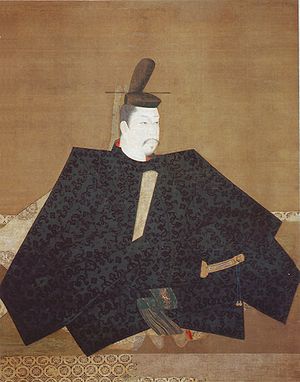 The Minamoto were one of the four great clans that dominated Japanese politics during the Heian period (794-1185). They were, however, decimated by the Taira in the Heiji Rebellion
of 1160. Minamoto no Yoshitomo had been the head of the clan at this time; upon his defeat at the hands of Taira no Kiyomori, two of his sons were killed and the third, Minamoto no Yoritomo, was banished. Following the call to arms of Prince Mochihito and Minamoto no Yorimasa in 1180, the clan would gather together and rise to power again. The Genpei war would see the Minamoto clan defeat the Taira and take command of the entire country.
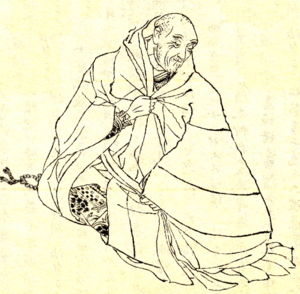 The Taira clan was one of the four great clans which dominated Japanese politics during the Heian period (794-1185). As a result of the near-total destruction of their rival clan, the Minamoto, in the Heiji Rebellion of 1160, Taira no Kiyomori, head of the clan, initiated the Genpei War at the height of his power. The end of the war, however, brought destruction to the Taira clan.
(Heike Monogatari, 平家物語) is one of the most famous, though many Kabuki
and bunraku
plays reproduce events of the war as well. Ichinotani futaba gunki (Chronicle of the battle of Ichi-no-Tani) by Namiki Sōsuke
may be one of the more famous of these.
"Shike
" by Robert Shea
features a somewhat fictionalised account of the wars, as seen from the perspectives of his two main characters, the Zinja Monk Jebu, and the Noblewoman Lady Shima Taniko. The names of the two rival clans have been changed, "Minamoto" to "Muratomo" and "Taira" to "Takashi".
Another fictionalized account of the conflict forms the central plot of Civil War (also known as Turbulent Times), the ninth volume of Osamu Tezuka
's celebrated Phoenix series
.
The Genpei War is the backdrop for much of Katherine Patterson's young adult novel, Of Nightingales That Weep
.
War
War is a state of organized, armed, and often prolonged conflict carried on between states, nations, or other parties typified by extreme aggression, social disruption, and usually high mortality. War should be understood as an actual, intentional and widespread armed conflict between political...
between the Taira and Minamoto
Minamoto clan
was one of the surnames bestowed by the Emperors of Japan upon members of the imperial family who were demoted into the ranks of the nobility. The practice was most prevalent during the Heian Period , although its last occurrence was during the Sengoku Era. The Taira were another such offshoot of...
clans during the late-Heian period
Heian period
The is the last division of classical Japanese history, running from 794 to 1185. The period is named after the capital city of Heian-kyō, or modern Kyōto. It is the period in Japanese history when Buddhism, Taoism and other Chinese influences were at their height...
of Japan. It resulted in the fall of the Taira clan and the establishment of the Kamakura shogunate
Kamakura shogunate
The Kamakura shogunate was a military dictatorship in Japan headed by the shoguns from 1185 to 1333. It was based in Kamakura. The Kamakura period draws its name from the capital of the shogunate...
under Minamoto Yoritomo in 1192.
The name "Genpei" comes from alternate readings of the kanji
Kanji
Kanji are the adopted logographic Chinese characters hanzi that are used in the modern Japanese writing system along with hiragana , katakana , Indo Arabic numerals, and the occasional use of the Latin alphabet...
'Minamoto' (源) and 'Taira' (平). The conflict is also known in Japanese as the , after the two eras
Japanese era name
The Japanese era calendar scheme is a common calendar scheme used in Japan, which identifies a year by the combination of the and the year number within the era...
between which it took place.
It began with Minamoto support for a different candidate to take the throne, in conflict with the Taira's nomination. The ensuing Battle of Uji
Battle of Uji (1180)
The first battle of Uji is famous and important for having opened the Genpei War.In early 1180, Prince Mochihito, the Minamoto Clan's favored claimant to the Imperial Throne, was chased by Taira forces to the Mii-dera, a temple just outside Kyoto....
took place just outside Kyoto
Kyoto
is a city in the central part of the island of Honshū, Japan. It has a population close to 1.5 million. Formerly the imperial capital of Japan, it is now the capital of Kyoto Prefecture, as well as a major part of the Osaka-Kobe-Kyoto metropolitan area.-History:...
, starting a five-year long war, concluding with a decisive Minamoto victory in the naval Battle of Dan-no-ura
Battle of Dan-no-ura
The ' was a major sea battle of the Genpei War, occurring at Dan-no-ura, in the Shimonoseki Strait off the southern tip of Honshū. On March 24, 1185, the Genji clan fleet, led by Minamoto no Yoshitsune, defeated the Heike clan fleet, during a half-day engagement.The Taira were outnumbered, but...
.
Background
The Genpei War was the culmination of a decades-long conflict between the two aforementioned clans over dominance of the Imperial court, and by extension, control of Japan. In the Hōgen RebellionHogen Rebellion
The was a short civil war fought in order to resolve a dispute about Japanese Imperial succession. The dispute was also about the degree of control exercised by the Fujiwara clan who had become hereditary Imperial regents during the Heian period....
and in the Heiji Rebellion
Heiji Rebellion
The was a short civil war fought in order to resolve a dispute about political power. The Heiji no ran encompassed clashes between rival subjects of the cloistered Emperor Go-Shirakawa of Japan in 1159. It was preceded by the Hōgen Rebellion in 1156...
of earlier decades, the Minamoto attempted to regain control from the Taira and failed. The Taira then began a series of executions, intended to eliminate their rivals.
In 1177, relations between the Taira clan and the retired Emperor Go-Shirakawa
Emperor Go-Shirakawa
Emperor Go-Shirakawa was the 77th emperor of Japan, according to the traditional order of succession...
became highly strained, and the latter attempted a coup d'état
Coup d'état
A coup d'état state, literally: strike/blow of state)—also known as a coup, putsch, and overthrow—is the sudden, extrajudicial deposition of a government, usually by a small group of the existing state establishment—typically the military—to replace the deposed government with another body; either...
to oust the Daijō Daijin (prime minister
Prime minister
A prime minister is the most senior minister of cabinet in the executive branch of government in a parliamentary system. In many systems, the prime minister selects and may dismiss other members of the cabinet, and allocates posts to members within the government. In most systems, the prime...
), Taira no Kiyomori
Taira no Kiyomori
was a general of the late Heian period of Japan. He established the first samurai-dominated administrative government in the history of Japan.After the death of his father Taira no Tadamori in 1153, Kiyomori assumed control of the Taira clan and ambitiously entered the political realm in which he...
. Kiyomori defeated the former emperor and abolished the Insei system
Cloistered rule
The Insei system , or cloistered rule, was a specific form of government in Japan during the Heian period. In this bifurcated system, an Emperor abdicated, but he retained power and influence. The emperors who withdrew to live in monasteries continued to act in ways which were intended to...
. This provoked strong anti-Taira sentiment.
On March 21, 1180, Taira no Kiyomori put his grandson, Antoku
Emperor Antoku
Emperor Antoku was the 81st emperor of Japan, according to the traditional order of succession. His reign spanned the years from 1180 through 1185. During this time, the imperial family was involved in a bitter struggle between warring clans...
(then only two years of age), on the throne, after the abdication of Emperor Takakura
Emperor Takakura
Emperor Takakura was the 80th emperor of Japan, according to the traditional order of succession. His reign spanned the years from 1168 through 1180.-Genealogy:...
. Go-Shirakawa's son, Prince Mochihito
Prince Mochihito
' , also known as the Takakura Prince, and as Minamoto Mochimitsu, was a son of Emperor Go-Shirakawa. He is noted for his role in starting the Genpei War....
, felt that he was being denied his rightful place on the throne and, with the help of Minamoto Yoritomo, sent out a call to arms to the various samurai
Samurai
is the term for the military nobility of pre-industrial Japan. According to translator William Scott Wilson: "In Chinese, the character 侍 was originally a verb meaning to wait upon or accompany a person in the upper ranks of society, and this is also true of the original term in Japanese, saburau...
families and Buddhist
Buddhism
Buddhism is a religion and philosophy encompassing a variety of traditions, beliefs and practices, largely based on teachings attributed to Siddhartha Gautama, commonly known as the Buddha . The Buddha lived and taught in the northeastern Indian subcontinent some time between the 6th and 4th...
monasteries on May 5.
In June, Kiyomori moved the seat of imperial power to Fukuhara
Fukuhara
Fukuhara is a Japanese surname. The meaning of the kanji can be translated as "field of fortune", "field of blessings", or "lucky field".Alternate pronunciations that use the same kanji spelling include Fukubara and Fukuwara....
(modern day Kobe
Kobe
, pronounced , is the fifth-largest city in Japan and is the capital city of Hyōgo Prefecture on the southern side of the main island of Honshū, approximately west of Osaka...
), in the hope of promoting trade with Song Dynasty
Song Dynasty
The Song Dynasty was a ruling dynasty in China between 960 and 1279; it succeeded the Five Dynasties and Ten Kingdoms Period, and was followed by the Yuan Dynasty. It was the first government in world history to issue banknotes or paper money, and the first Chinese government to establish a...
China, and on the fifteenth of that month, Prince Mochihito fled Kyoto to take refuge in Mii-dera
Mii-dera
', formally called ', is a Buddhist temple located at the foot of Mount Hiei, in the city of Ōtsu, in Shiga Prefecture. It is only a short distance from both Kyoto, and Lake Biwa, Japan's largest lake. The head temple of the Tendai Jimon sect, it is something of a sister temple to Enryakuji, at...
.
Beginnings of the war
Minamoto no Yorimasa
' was a prominent Japanese poet whose works appeared in various anthologies. He served eight different emperors in his long career, holding posts such as hyōgo no kami...
and Prince Mochihito. Not knowing who was behind this rally, Kiyomori called for the arrest of Mochihito, who sought protection at the temple of Mii-dera
Mii-dera
', formally called ', is a Buddhist temple located at the foot of Mount Hiei, in the city of Ōtsu, in Shiga Prefecture. It is only a short distance from both Kyoto, and Lake Biwa, Japan's largest lake. The head temple of the Tendai Jimon sect, it is something of a sister temple to Enryakuji, at...
. The Mii-dera monks were unable to ensure him sufficient protection, so he was forced to move along. He was then chased by Taira forces to the Byōdō-in
Byodo-in
is a Buddhist temple in the city of Uji in Kyoto Prefecture, Japan. It is jointly a temple of the Jōdo-shū and Tendai-shū sects.- History :...
, just outside Kyoto. The war began thus, with a dramatic encounter on and around the bridge over the River Uji
Battle of Uji (1180)
The first battle of Uji is famous and important for having opened the Genpei War.In early 1180, Prince Mochihito, the Minamoto Clan's favored claimant to the Imperial Throne, was chased by Taira forces to the Mii-dera, a temple just outside Kyoto....
. This battle ended in Yorimasa's ritual suicide inside the Byōdō-in and Mochihito's capture and execution shortly afterwards.
It was at this point that Minamoto no Yoritomo
Minamoto no Yoritomo
was the founder and the first shogun of the Kamakura Shogunate of Japan. He ruled from 1192 until 1199.-Early life and exile :Yoritomo was the third son of Minamoto no Yoshitomo, heir of the Minamoto clan, and his official wife, a daughter of Fujiwara no Suenori, who was a member of the...
took over leadership of the Minamoto clan and began traveling the country seeking to rendezvous with allies. Leaving Izu Province
Izu Province
was a province of Japan in the area of Shizuoka Prefecture. Izu bordered on Sagami and Suruga Provinces. Its abbreviated form name was .The mainland portion of Izu Province, comprising the Izu Peninsula is today the eastern portion of Shizuoka Prefecture and the Izu Islands are now part of...
and heading for the Hakone Pass, he was defeated by the Taira in the battle of Ishibashiyama
Battle of Ishibashiyama
The ' was the first in which Minamoto Yoritomo, who was to become shogun less than a decade later, was commander of the Minamoto forces. In this, his first attempt to challenge the Taira, he was assisted by warriors from the Miura clan....
. However he successfully made it to the provinces of Kai
Kai Province
, also known as , is an old province in Japan in the area of Yamanashi Prefecture. It lies in central Honshū, west of Tokyo, in a landlocked mountainous region that includes Mount Fuji along its border with Shizuoka Prefecture....
and Kozuke
Kozuke Province
was an old province located in the Tōsandō of Japan, which today comprises Gunma Prefecture. It is nicknamed as or .The ancient provincial capital was near modern Maebashi. During the Sengoku period, Kōzuke was controlled variously by Takeda Shingen, Uesugi Kenshin, the late Hōjō clan, and...
, where the Takeda and other friendly families helped repel the Taira army. Meanwhile, Taira no Kiyomori, seeking vengeance against the Mii-dera monks and others, besieged Nara
Siege of Nara
Following the 1180 Battle of the Uji, in which Minamoto no Yorimasa fought a small Taira army with the help of monks from the Mii-dera and other temples, the victorious Taira, angry at being opposed, decided to assault and burn the Miidera, before moving on to Nara. The Taira were opposed by...
and burnt much of the city to the ground.
Fighting continued the following year. Minamoto no Yukiie
Minamoto no Yukiie
was the brother of Minamoto no Yoshitomo, and one of the commanders of the Minamoto forces in the Genpei War at the end of the Heian period of Japanese history....
launched an unsuccessful sneak attack attempt against the army of Taira no Tomomori
Taira no Tomomori
' was the son of Taira no Kiyomori, and one of the Taira Clan's chief commanders in the Genpei War at the end of the Heian period of Japanese history....
at the Battle of Sunomatagawa. He was pursued by them to the Yahahigawa
Battle of Yahagigawa
The took place in 1181. Retreating from the Battle of Sunomatagawa, Minamoto no Yukiie attempted to make a stand by destroying the bridge over the Yahagi River and putting up a defensive shieldwall. He was forced to withdraw in the end, but the Taira pursuit was soon called off when their leader,...
, destroying the bridge over the river in order to slow the Taira progress. He was defeated and forced to withdraw once again, but Taira no Tomomori fell ill and called off his pursuit of Yukiie's forces.
Taira no Kiyomori died from illness in the spring of 1181, and around the same time Japan began to suffer from a famine which would last through the following year. The Taira moved to attack Minamoto no Yoshinaka
Minamoto no Yoshinaka
was a general of the late Heian Period of Japanese history. A member of the Minamoto samurai clan, Minamoto no Yoritomo was his cousin and rival during the Genpei War between the Minamoto and the Taira clans....
, a cousin of Yoritomo, who had raised forces in the north but were unsuccessful. For nearly two years, the war ceased, only to resume in the spring of 1183.
Turning of the tide
Minamoto no Yoritomo, suspicious of the strength of his cousin, launched a series of attacks against Yoshinaka. Yoshinaka had sought to take for himself lands controlled by Yoritomo, which had earlier belonged to Yoshinaka's father. Though the two reconciled with one another and agreed to focus on their common enemy, the Taira, this rivalry would remain strong throughout the war. Forced to recognize Yoritomo as the head of the clan and to send his son Yoshitaka to KamakuraKamakura, Kanagawa
is a city located in Kanagawa Prefecture, Japan, about south-south-west of Tokyo. It used to be also called .Although Kamakura proper is today rather small, it is often described in history books as a former de facto capital of Japan as the seat of the Shogunate and of the Regency during the...
as a hostage, Yoshinaka would not truly fight alongside his cousin for much of the war. He sought to defeat the Taira himself and to reach Kyoto before Yoritomo, claiming victory and the according honor and power.
Placating Yoritomo's suspicions of treachery or betrayal, Yoshinaka survived an assault on his fortress at Hiuchiyama
Siege of Hiuchi
Hiuchiyama was one of Minamoto no Yoshinaka's fortresses in Echizen Province, Japan. In April and May of 1183, a Taira force led by Taira no Koremori attacked the fortress....
by Taira no Koremori
Taira no Koremori
' was one of the Taira clan's commanders in the Genpei War of the late Heian period of Japanese history.He was the eldest son of Taira no Shigemori, who was the eldest son and heir of Taira no Kiyomori....
and engaged Koremori again at the battle of Kurikara
Battle of Kurikara
The battle of Kurikara, also known as the battle of Tonamiyama , was a crucial battle of Japan's Genpei War; in this battle the tide of the war turned in the favor of the Minamoto clan.-Background:...
. Yoshinaka's victory for the Minamoto at Kurikara, also known as the battle of Tonamiyama, would prove to be the turning point in the war. Through creative tactics, skillful division of his forces and a series of bluffs and diversions, Yoshinaka inflicted heavy losses on the Taira, who fled, confused and demoralized.
The Taira loss at Kurikara was so severe that they found themselves, several months later, under siege in Kyoto, with Yoshinaka approaching the city from the northeast and Yukiie from the east. Both Minamoto leaders had seen little or no opposition in marching to the capital and now forced the Taira to flee the city. Taira no Munemori
Taira no Munemori
was heir to Taira no Kiyomori, and one of the Taira clan's chief commanders in the Genpei War.As his father Taira no Kiyomori lay on his deathbed, Kiyomori declared, among his last wishes, that all affairs of the clan be placed in Munemori's hands...
, head of the clan since his father Kiyomori's death, led his army, along with the young Emperor Antoku
Emperor Antoku
Emperor Antoku was the 81st emperor of Japan, according to the traditional order of succession. His reign spanned the years from 1180 through 1185. During this time, the imperial family was involved in a bitter struggle between warring clans...
and the Imperial regalia
Imperial Regalia of Japan
The , also known as the Three Sacred Treasures of Japan, consist of the sword Kusanagi , the mirror Yata no Kagami , and the jewel Yasakani no Magatama...
, to his clan's fortresses in western Honshū and Shikoku.
Internal Minamoto clan hostilities
The Taira clan set fire to their Rokuhara palace and the surrounding district, leaving Minamoto no Yoshinaka with the only force of any significant power in the Home ProvincesKinai
is a Japanese term denoting an ancient division of the country. Kinai is a name for the ancient provinces around the capital Nara and Heian-kyō. The five provinces were called go-kinai after 1760....
surrounding the capital. Empowered with a mandate by Emperor Go-Shirakawa
Emperor Go-Shirakawa
Emperor Go-Shirakawa was the 77th emperor of Japan, according to the traditional order of succession...
to pursue the Taira and destroy them, Yoshinaka once again sought to gain control of the Minamoto clan and regain his ancestral lands from his cousins Yoritomo and Yoshitsune
Minamoto no Yoshitsune
was a general of the Minamoto clan of Japan in the late Heian and early Kamakura period. Yoshitsune was the ninth son of Minamoto no Yoshitomo, and the third and final son and child that Yoshitomo would father with Tokiwa Gozen. Yoshitsune's older brother Minamoto no Yoritomo founded the Kamakura...
.
Meanwhile, the fleeing Taira set up a temporary Court at Dazaifu in Kyūshū
Kyushu
is the third largest island of Japan and most southwesterly of its four main islands. Its alternate ancient names include , , and . The historical regional name is referred to Kyushu and its surrounding islands....
, the southernmost of Japan's main islands. They were forced out soon afterwards by local revolts, spurred by Emperor Go-Shirakawa and sought refuge at Yashima, a small island in the Inland Sea.
Yoshinaka sent a force to pursue the Taira, while he led a second force back to Kamakura to delay his cousins' actions. While his men lost to the Taira at Mizushima
Battle of Mizushima
The naval battle of Mizushima took place on 17 November 1183. One of the most important bases of the Taira was Yashima, a small island off the coast of Shikoku...
, Yoshinaka conspired with Yukiie to seize the capital and the Emperor, possibly even establishing a new Court in the north. However, Yukiie revealed these plans to the Emperor, who communicated them to Yoritomo.
Betrayed by Yukiie, Yoshinaka took command of Kyoto and, at the beginning of 1184, set fire to the Hōjūjidono
Hojujidono
The ' was a Buddhist temple in Kyoto which was, for a time, the home of the Cloistered Emperor Go-Shirakawa.The temple was originally built and founded, as 'Hōjūji', by Fujiwara Tamemitsu in 988. However, it was destroyed in 1032....
, taking the Emperor into custody. Minamoto no Yoshitsune arrived soon afterwards with his brother Noriyori
Minamoto no Noriyori
was a late Heian period general, who fought alongside his brothers Minamoto no Yoritomo and Minamoto no Yoshitsune at a number of battles of the Genpei War. The sixth son of Minamoto no Yoshitomo, he was spared along with his brothers in 1160 by Taira no Kiyomori following Yoshitomo's death.He...
and a considerable force, driving Yoshinaka from the city. After fighting his cousins at the bridge over the Uji
Battle of Uji (1184)
Minamoto no Yoshinaka tried to wrest power from his cousins Yoritomo and Yoshitsune, seeking to take command of the Clan. To that end, he sacked Kyoto, burning the Hōjūji Palace, kidnapping Emperor Go-Shirakawa and having himself named shogun...
, where the war began, Yoshinaka made his final stand at Awazu
Battle of Awazu
Minamoto no Yoshinaka made his final stand at Awazu, after fleeing from his cousins' armies, which confronted him after he attacked Kyoto, burning the Hōjūjiden, and kidnapping Emperor Go-Shirakawa...
, in Ōmi province
Omi Province
is an old province of Japan, which today comprises Shiga Prefecture. It was one of the provinces that made up the Tōsandō circuit. It is nicknamed as .Lake Biwa, Japan's largest lake, is located at the center of the province...
. He was defeated by Yoshitsune, and killed while attempting to flee.
Final stages of the conflict
As the united Minamoto forces left Kyoto, the Taira began consolidating their position at a number of sites in and around the Inland Sea, which was their ancestral home territory. They received a number of missives from the Emperor offering that if they surrendered by the seventh day of the second month, the Minamoto could be convinced to agree to a truce. This was a farce, as neither the Minamoto nor the Emperor had any intentions of waiting until the eighth day to attack. Nevertheless, this tactic offered the Emperor a chance to regain the Regalia and to distract the Taira leadership.The Minamoto army, led by Yoshitsune and Noriyori, made their first major assault at Ichi-no-Tani
Battle of Ichi-no-Tani
' was a Taira fortress at Suma, to the west of present-day Kobe. It sat on a very narrow strip of shore, between mountains on the north, and the sea to the south. This made it quite defensible, but also made it difficult to maneuver troops inside the fortress. Minamoto no Yoshitsune split his force...
, one of the primary Taira fortresses on Honshū. The fortress was surrounded, and the Taira retreated to Shikoku. However, the Minamoto were not prepared to assault Shikoku; a six-month pause thus ensued during which the Minamoto took the proper steps. Though on the retreat, the Taira enjoyed the distinct advantages of being in friendly, home territories, and of being far more adept at naval combat than their rivals.
It was not until nearly a year after Ichi-no-Tani that the main Taira fortress at Yashima
Battle of Yashima
The naval Battle of Yashima took place on 22 March 1185. Following a long string of defeats, the Taira clan retreated to Yashima, today's Takamatsu, just off the coast of Shikoku...
came under assault. Seeing bonfires on the mainland of Shikoku, the Taira expected a land-based attack and took to their ships. This was a deceptive play on the part of the Minamoto, however, who lay in wait with their own navy. The Yashima fortress fell, along with the improvised imperial palace built there by the Taira, many of whom however escaped along with the Imperial regalia and the Emperor Antoku.
The Genpei War came to an end one month later, following the battle of Dan-no-ura
Battle of Dan-no-ura
The ' was a major sea battle of the Genpei War, occurring at Dan-no-ura, in the Shimonoseki Strait off the southern tip of Honshū. On March 24, 1185, the Genji clan fleet, led by Minamoto no Yoshitsune, defeated the Heike clan fleet, during a half-day engagement.The Taira were outnumbered, but...
, one of the most famous and important battles in Japanese history. The Minamoto engaged the Taira fleet in the Straits of Shimonoseki, a tiny body of water separating the islands of Honshū and Kyūshū. After a series of archery duels, hand-to-hand fighting broke out. The tides played a powerful role in the development of the battle, granting the advantage first to the Taira, who were more experienced and abler sailors and later to the Minamoto. The Minamoto advantage was considerably enhanced by the defection of Taguchi Shigeyoshi, a Taira general who revealed the location of Emperor Antoku and the regalia. The Minamoto redirected their attention on the Emperor's ship, and the battle quickly swung in their favor.
Many of the Taira samurai, along with Emperor Antoku and his grandmother Taira no Tokiko
Taira no Tokiko
was the wife of Taira no Kiyomori, mother of Taira no Tokuko, as well as grandmother of Emperor Antoku. Buddhist name – Nii no Ama 二位尼. According to the Tale of the Heike, Taira no Tokiko drowned herself during the Battle of Dan-no-ura together with the boy-Emperor Antoku and the Sacred...
, widow of Taira no Kiyomori, threw themselves into the waves rather than live to see their clan's ultimate defeat at the hands of the Minamoto.
Consequences of the Genpei War
The Taira clan was destroyed, and the Minamoto victory was followed by the establishment of the Kamakura shogunate. Though Minamoto no YoritomoMinamoto no Yoritomo
was the founder and the first shogun of the Kamakura Shogunate of Japan. He ruled from 1192 until 1199.-Early life and exile :Yoritomo was the third son of Minamoto no Yoshitomo, heir of the Minamoto clan, and his official wife, a daughter of Fujiwara no Suenori, who was a member of the...
was not the first to ever hold the title of Shogun
Shogun
A was one of the hereditary military dictators of Japan from 1192 to 1867. In this period, the shoguns, or their shikken regents , were the de facto rulers of Japan though they were nominally appointed by the emperor...
, he was the first to wield it in a role of nationwide scope. The end of the Genpei War and beginning of the Kamakura shogunate marked the rise of military (samurai) power and the suppression of the power of the emperor, who was compelled to preside without effective political or military power, until the Meiji Restoration
Meiji Restoration
The , also known as the Meiji Ishin, Revolution, Reform or Renewal, was a chain of events that restored imperial rule to Japan in 1868...
over 650 years later.
In addition, this war and its aftermath established red and white, the colors of the Taira and Minamoto standards, respectively, as Japan's national colors. Today, these colors can be seen on the flag of Japan
Flag of Japan
The national flag of Japan is a white rectangular flag with a large red disk in the center. This flag is officially called in Japanese, but is more commonly known as ....
, and also in banners and flags in sumo
Sumo
is a competitive full-contact sport where a wrestler attempts to force another wrestler out of a circular ring or to touch the ground with anything other than the soles of the feet. The sport originated in Japan, the only country where it is practiced professionally...
and other traditional activities.
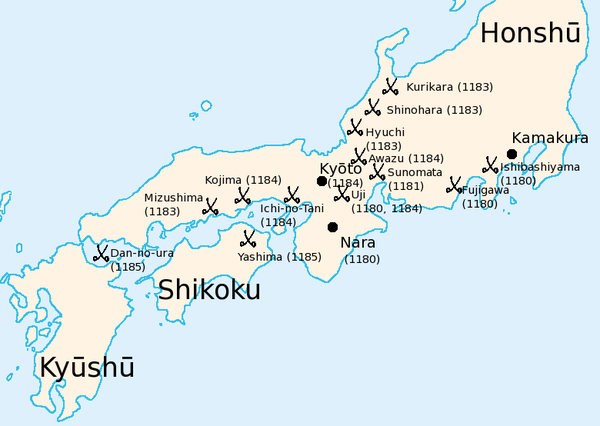
Battles
- 1180 First Battle of UjiBattle of Uji (1180)The first battle of Uji is famous and important for having opened the Genpei War.In early 1180, Prince Mochihito, the Minamoto Clan's favored claimant to the Imperial Throne, was chased by Taira forces to the Mii-dera, a temple just outside Kyoto....
- regarded as the first battle in the Genpei Wars, the monks of the Byodoin fight alongside Minamoto no YorimasaMinamoto no Yorimasa' was a prominent Japanese poet whose works appeared in various anthologies. He served eight different emperors in his long career, holding posts such as hyōgo no kami...
. - 1180 Siege of NaraSiege of NaraFollowing the 1180 Battle of the Uji, in which Minamoto no Yorimasa fought a small Taira army with the help of monks from the Mii-dera and other temples, the victorious Taira, angry at being opposed, decided to assault and burn the Miidera, before moving on to Nara. The Taira were opposed by...
- the Taira set fire to temples and monasteries, to cut supplies to their rivals. - 1180 Battle of IshibashiyamaBattle of IshibashiyamaThe ' was the first in which Minamoto Yoritomo, who was to become shogun less than a decade later, was commander of the Minamoto forces. In this, his first attempt to challenge the Taira, he was assisted by warriors from the Miura clan....
- Minamoto no YoritomoMinamoto no Yoritomowas the founder and the first shogun of the Kamakura Shogunate of Japan. He ruled from 1192 until 1199.-Early life and exile :Yoritomo was the third son of Minamoto no Yoshitomo, heir of the Minamoto clan, and his official wife, a daughter of Fujiwara no Suenori, who was a member of the...
's first battle against the Taira. Minamoto Yoritomo loses the battle. - 1180 Battle of FujigawaBattle of FujigawaThe was a battle of the Genpei War of the Heian period of Japanese history. It took place in 1180, in what is now Shizuoka Prefecture.Attempting to recover quickly from his exile, and to rebuild his army, Minamoto no Yoritomo sent out messengers to recruit other families...
- the Taira mistake a flock of waterfowl for a sneak attack by the Minamoto in the night, and retreat before any fighting occurs. - 1181 Battle of Sunomatagawa - the Taira thwart a sneak attack in the night but retreat.
- 1181 Battle of YahagigawaBattle of YahagigawaThe took place in 1181. Retreating from the Battle of Sunomatagawa, Minamoto no Yukiie attempted to make a stand by destroying the bridge over the Yahagi River and putting up a defensive shieldwall. He was forced to withdraw in the end, but the Taira pursuit was soon called off when their leader,...
- the Minamoto, retreating from SunomataSunomata, Gifuwas a town located in Anpachi District, Gifu, Japan.On March 27, 2006, Sunomata was merged into the city of Ōgaki.As of 2003, the town had an estimated population of 4,652 and a density of 1,372.39 persons per km². The total area was 3.39 km²....
, attempt to make a stand. - 1183 Siege of HiuchiSiege of HiuchiHiuchiyama was one of Minamoto no Yoshinaka's fortresses in Echizen Province, Japan. In April and May of 1183, a Taira force led by Taira no Koremori attacked the fortress....
- the Taira attack a Minamoto fortress. - 1183 Battle of KurikaraBattle of KurikaraThe battle of Kurikara, also known as the battle of Tonamiyama , was a crucial battle of Japan's Genpei War; in this battle the tide of the war turned in the favor of the Minamoto clan.-Background:...
- the tide of the war turns, in the Minamoto's favor. - 1183 Battle of ShinoharaBattle of ShinoharaFollowing the Battle of Kurikara, Minamoto no Yoshinaka caught up with the retreating Taira no Munemori. An archery duel by champions on both sides preceded general fighting, which included several celebrated instances of single combat. Victory went to the Minamoto.-References:* Sansom, George . 'A...
- Yoshinaka pursues the Taira force from Kurikara - 1183 Battle of MizushimaBattle of MizushimaThe naval battle of Mizushima took place on 17 November 1183. One of the most important bases of the Taira was Yashima, a small island off the coast of Shikoku...
- the Taira intercept a Minamoto force, heading for YashimaTakamatsu, Kagawais a city located in central Kagawa Prefecture on the island of Shikoku in Japan, and is the seat of the prefectural government. It is designated a core city by the Japanese Government. It is a port city located on the Seto Inland Sea, and is the closest port to Honshu from Shikoku island...
. - 1183 Siege of FukuryujiSiege of FukuryujiThe siege of the Fukuryūji took place in 1183, and was a battle of the Genpei War, the great 12th century Japanese civil war between the Taira clan and the Minamoto clan. Fukuryūji was a fortress belonging to Seno Kaneyasu, a Taira partisan. Imai Kanehira led his men across muddy ricefields, under...
- the Minamoto attack a Taira fortress. - 1183 Battle of MuroyamaBattle of MuroyamaThe battle of Muroyama was one of many battles of the 12th century Japanese civil war known as the Genpei War. At Muroyama, Minamoto no Yukiie tried to recoup the loss of the Battle of Mizushima by attacking Taira forces. The Taira forces split into five divisions, each attacking in succession, and...
- Minamoto no Yukiie tries and fails to recoup the loss of the battle of Mizushima. - 1184 Siege of HojujidonoSiege of HojujidonoThe 1184 siege of the Hōjūjidono was part of Japan's Genpei War, and was a key element of the conflict between Minamoto no Yoshinaka and his cousins Yoritomo and Yoshitsune for control of the Minamoto clan....
- Yoshinaka sets fire to the Hojuji-dono and kidnaps Emperor Go-Shirakawa. - 1184 Second Battle of UjiBattle of Uji (1184)Minamoto no Yoshinaka tried to wrest power from his cousins Yoritomo and Yoshitsune, seeking to take command of the Clan. To that end, he sacked Kyoto, burning the Hōjūji Palace, kidnapping Emperor Go-Shirakawa and having himself named shogun...
- Yoshinaka is pursued out of the capital by Yoshitsune and Noriyori. - 1184 Battle of AwazuBattle of AwazuMinamoto no Yoshinaka made his final stand at Awazu, after fleeing from his cousins' armies, which confronted him after he attacked Kyoto, burning the Hōjūjiden, and kidnapping Emperor Go-Shirakawa...
- Minamoto no YoshinakaMinamoto no Yoshinakawas a general of the late Heian Period of Japanese history. A member of the Minamoto samurai clan, Minamoto no Yoritomo was his cousin and rival during the Genpei War between the Minamoto and the Taira clans....
is defeated and killed by YoshitsuneMinamoto no Yoshitsunewas a general of the Minamoto clan of Japan in the late Heian and early Kamakura period. Yoshitsune was the ninth son of Minamoto no Yoshitomo, and the third and final son and child that Yoshitomo would father with Tokiwa Gozen. Yoshitsune's older brother Minamoto no Yoritomo founded the Kamakura...
and NoriyoriMinamoto no Noriyoriwas a late Heian period general, who fought alongside his brothers Minamoto no Yoritomo and Minamoto no Yoshitsune at a number of battles of the Genpei War. The sixth son of Minamoto no Yoshitomo, he was spared along with his brothers in 1160 by Taira no Kiyomori following Yoshitomo's death.He...
. - 1184 Battle of Ichi-no-TaniBattle of Ichi-no-Tani' was a Taira fortress at Suma, to the west of present-day Kobe. It sat on a very narrow strip of shore, between mountains on the north, and the sea to the south. This made it quite defensible, but also made it difficult to maneuver troops inside the fortress. Minamoto no Yoshitsune split his force...
- the Minamoto attack one of the Taira's primary fortresses. - 1184 Battle of KojimaBattle of KojimaThe Batte of Kojima was a battle of the Genpei War of the Heian period of Japanese history, taking place in 1184.Following the fleeing Taira from Ichi-no-Tani, on their way to Yashima, Minamoto no Noriyori engaged and defeated his enemies in battle at Kojima...
- Taira fleeing Ichi-no-Tani are attacked by Minamoto no Noriyori. - 1185 Battle of YashimaBattle of YashimaThe naval Battle of Yashima took place on 22 March 1185. Following a long string of defeats, the Taira clan retreated to Yashima, today's Takamatsu, just off the coast of Shikoku...
- the Minamoto assault their enemies' fortress, just off ShikokuShikokuis the smallest and least populous of the four main islands of Japan, located south of Honshū and east of the island of Kyūshū. Its ancient names include Iyo-no-futana-shima , Iyo-shima , and Futana-shima...
. - 1185 Battle of Dan-no-uraBattle of Dan-no-uraThe ' was a major sea battle of the Genpei War, occurring at Dan-no-ura, in the Shimonoseki Strait off the southern tip of Honshū. On March 24, 1185, the Genji clan fleet, led by Minamoto no Yoshitsune, defeated the Heike clan fleet, during a half-day engagement.The Taira were outnumbered, but...
- the decisive naval battle ending the war.
Minamoto Clan (Also known as "Genji")
Heiji Rebellion
The was a short civil war fought in order to resolve a dispute about political power. The Heiji no ran encompassed clashes between rival subjects of the cloistered Emperor Go-Shirakawa of Japan in 1159. It was preceded by the Hōgen Rebellion in 1156...
of 1160. Minamoto no Yoshitomo had been the head of the clan at this time; upon his defeat at the hands of Taira no Kiyomori, two of his sons were killed and the third, Minamoto no Yoritomo, was banished. Following the call to arms of Prince Mochihito and Minamoto no Yorimasa in 1180, the clan would gather together and rise to power again. The Genpei war would see the Minamoto clan defeat the Taira and take command of the entire country.
- Minamoto no NoriyoriMinamoto no Noriyoriwas a late Heian period general, who fought alongside his brothers Minamoto no Yoritomo and Minamoto no Yoshitsune at a number of battles of the Genpei War. The sixth son of Minamoto no Yoshitomo, he was spared along with his brothers in 1160 by Taira no Kiyomori following Yoshitomo's death.He...
(源範頼), general, younger brother of Yoritomo. - Minamoto no YorimasaMinamoto no Yorimasa' was a prominent Japanese poet whose works appeared in various anthologies. He served eight different emperors in his long career, holding posts such as hyōgo no kami...
(源頼政), head of the clan at the beginning of the war. - Minamoto no YoritomoMinamoto no Yoritomowas the founder and the first shogun of the Kamakura Shogunate of Japan. He ruled from 1192 until 1199.-Early life and exile :Yoritomo was the third son of Minamoto no Yoshitomo, heir of the Minamoto clan, and his official wife, a daughter of Fujiwara no Suenori, who was a member of the...
(源頼朝), head of the clan upon Yorimasa's death. - Minamoto no YoshitsuneMinamoto no Yoshitsunewas a general of the Minamoto clan of Japan in the late Heian and early Kamakura period. Yoshitsune was the ninth son of Minamoto no Yoshitomo, and the third and final son and child that Yoshitomo would father with Tokiwa Gozen. Yoshitsune's older brother Minamoto no Yoritomo founded the Kamakura...
(源義経), younger brother of Yoritomo, chief general of the clan. - Minamoto no YukiieMinamoto no Yukiiewas the brother of Minamoto no Yoshitomo, and one of the commanders of the Minamoto forces in the Genpei War at the end of the Heian period of Japanese history....
(源行家), general, uncle to Yoritomo. - Allies and vassals:
- Emperor Go-ShirakawaEmperor Go-ShirakawaEmperor Go-Shirakawa was the 77th emperor of Japan, according to the traditional order of succession...
(後白河), cloistered (retired) emperorCloistered ruleThe Insei system , or cloistered rule, was a specific form of government in Japan during the Heian period. In this bifurcated system, an Emperor abdicated, but he retained power and influence. The emperors who withdrew to live in monasteries continued to act in ways which were intended to...
. - Prince MochihitoPrince Mochihito' , also known as the Takakura Prince, and as Minamoto Mochimitsu, was a son of Emperor Go-Shirakawa. He is noted for his role in starting the Genpei War....
(以仁王), Imperial Prince. - BenkeiSaito Musashibo Benkei, popularly called Benkei, was a Japanese warrior monk who served Minamoto no Yoshitsune. He is commonly depicted as a man of great strength and loyalty, and a popular subject of Japanese folklore.-Biography:...
(弁慶), sōheiSoheiwere Buddhist warrior monks of feudal Japan. At certain points of history they held considerable power, obliging the imperial and military governments to collaborate....
(warrior monk), ally of Yoshitsune. - Hōjō TokimasaHojo Tokimasawas the first Hōjō shikken of the Kamakura bakufu and head of the Hōjō clan. He was shikken from the death of Minamoto no Yoritomo in 1199 until his abdication in 1205.- Background: The Hōjō Clan :...
(時政 北条), head of the Hōjō clanHojo clanSee the late Hōjō clan for the Hōjō clan of the Sengoku Period.The in the history of Japan was a family who controlled the hereditary title of shikken of the Kamakura Shogunate. In practice, the family had actual governmental power, many times dictatorial, rather than Kamakura shoguns, or the...
(北条), father-in-law of Yoritomo. - Kajiwara KagetokiKajiwara Kagetokiwas a spy for Minamoto no Yoritomo in the Genpei War, and a warrior against the Taira. He came to be known for his greed and treachery.Originally from Suruga province, Kajiwara entered the Genpei War fighting under Oba Kagechika, against the Minamoto. After the Taira victory at Ishibashiyama in...
(景時 梶原), officially an ally of Yoshitsune, in fact a spy for Yoritomo. - Kumagai NaozaneKumagai Naozanewas a famous soldier who served the Genji Clan during the Heian period of Japanese history. Kumagai is particularly known for his exploits during the Genpei War, specifically for killing the young warrior Taira no Atsumori at the battle of Ichi-no-tani in 1184...
(直実 熊谷), samurai vassal of Yoritomo. - Sasaki Moritsuna (盛綱 佐々木), vassal of Noriyori who commanded the assault at the battle of Kojima.
- Taguchi Shigeyoshi (重能 田口), Taira general who turned to the Minamoto camp upon seeing the tide turn at the battle of Dan no Ura, thus ensuring Minamoto victory.
- Nasu no YoichiNasu no Yoichi' was a samurai who fought alongside the Minamoto clan in the Genpei War. He is particularly famous for his actions at the Battle of Yashima in 1184. According to the Heike Monogatari, the enemy Taira placed a fan atop the mast of one of their ships, claiming it protected the ship from arrows, and...
(那須与一), celebrated archer and Minamoto ally. - Yada Yoshiyasu (矢田 義康), vassal of Yoshinaka and commander of Minamoto forces at the battle of Mizushima.
- The sōheiSoheiwere Buddhist warrior monks of feudal Japan. At certain points of history they held considerable power, obliging the imperial and military governments to collaborate....
(warrior-monks) of Mii-deraMii-dera', formally called ', is a Buddhist temple located at the foot of Mount Hiei, in the city of Ōtsu, in Shiga Prefecture. It is only a short distance from both Kyoto, and Lake Biwa, Japan's largest lake. The head temple of the Tendai Jimon sect, it is something of a sister temple to Enryakuji, at...
and other temples. Three in particular are mentioned in the Heike Monogatari for their part in the first battle of Uji:- Ichirai HoshiIchirai HoshiIchirai Hōshi was a Japanese warrior monk who supported the Minamoto clan of samurai against their rivals, the Taira clan.He is most well known for his part in the battle of Uji...
(一来 法師), who is famous for having jumped ahead of Jomyo Meishu and led the Mii-dera monks to battle. - Gochin no TajimaGochin no TajimaGochiin no Tajima , called Tajima the arrow-cutter, was a warrior monk from Miidera who fought alongside the Minamoto clan forces, and many of his fellow Miidera monks at the Battle of Uji in 1180....
(ごちん忽), called Tajima the arrow-cutter, and famous for deflecting the arrows of the Taira with his naginata, upon the bridge over the Uji. - Tsutsui Jomyo MeishuTsutsui Jomyo MeishuTsutsui no Jōmyō Meishū was a warrior monk, or sōhei, from Mii-dera, who fought alongside Minamoto no Yorimasa and his fellow monks at the Battle of Uji in 1180, defending the Byōdō-in and Prince Mochihito from the Taira clan....
(筒井 浄妙 めいしゅ), who fought to his last on the bridge over the Uji, taking over sixty arrows and still fighting.
- Ichirai Hoshi
- Emperor Go-Shirakawa
- Partisans of Minamoto no Yoshinaka (源義仲), cousin of Yoritomo, who supported his rebellion:
- Imai KanehiraImai KanehiraImai Kanehira was the milk brother of Minamoto no Yoshinaka. He became joint commander of Yoshinaka's faction during the Genpei War after Yoshinaka met up with him at Seta. He fought with the forces of Minamoto no Yoshitsune, who wanted to bring an end to Yoshinaka's tyranny. Imai commanded...
(兼平 今井), who joined Yoshinaka in his escape to Seta.
- Imai Kanehira
Taira Clan (Also known as "Heike")
- Taira no AtsumoriTaira no Atsumori' was a samurai famous for his early death in single combat. At the Battle of Ichi-no-Tani, Atsumori engaged Kumagai Naozane, an ally of the Minamoto, and was killed. Kumagai had a son the same age as Atsumori...
(平敦盛), young samurai killed by Kumagai Naozane who, because of his youth and innocence, became quite famous in death. - Taira no KiyomoriTaira no Kiyomoriwas a general of the late Heian period of Japan. He established the first samurai-dominated administrative government in the history of Japan.After the death of his father Taira no Tadamori in 1153, Kiyomori assumed control of the Taira clan and ambitiously entered the political realm in which he...
(平清盛), head of the clan at the beginning of the war. - Taira no KoremoriTaira no Koremori' was one of the Taira clan's commanders in the Genpei War of the late Heian period of Japanese history.He was the eldest son of Taira no Shigemori, who was the eldest son and heir of Taira no Kiyomori....
(平維盛), grandson of Kiyomori. - Taira no MunemoriTaira no Munemoriwas heir to Taira no Kiyomori, and one of the Taira clan's chief commanders in the Genpei War.As his father Taira no Kiyomori lay on his deathbed, Kiyomori declared, among his last wishes, that all affairs of the clan be placed in Munemori's hands...
(平宗盛), son and heir of Kiyomori; head of the clan for much of the war. - Taira no NoritsuneTaira no Noritsune' fought in the Genpei War battles of Mizushima, Ichi-no-Tani, and Dan-no-ura alongside his brethren in clan Taira. He is supposed to have died by drowning himself, at Dan-no-ura, while holding a Minamoto warrior under each arm...
(平教経), a Taira clan samurai - Taira no ShigehiraTaira no Shigehira' was one of the sons of Taira no Kiyomori, and one of the Taira Clan's chief commanders during the Heian period of the 12th century of Japan...
(平重衡), general, son of Kiyomori. - Taira no TadanoriTaira no Tadanori' was the brother of clan head Taira no Kiyomori, and one of his generals in the Genpei War against the Minamoto.Tadanori also took part in the Battle of Fujigawa, and in fighting Minamoto no Yoshinaka. He was killed in the Battle of Ichi-no-Tani...
(平忠度), general, brother of Kiyomori. - Taira no TokikoTaira no Tokikowas the wife of Taira no Kiyomori, mother of Taira no Tokuko, as well as grandmother of Emperor Antoku. Buddhist name – Nii no Ama 二位尼. According to the Tale of the Heike, Taira no Tokiko drowned herself during the Battle of Dan-no-ura together with the boy-Emperor Antoku and the Sacred...
(平時子), wife of Kiyomori who committed suicide at the battle of Dan-no-ura. - Taira no TomomoriTaira no Tomomori' was the son of Taira no Kiyomori, and one of the Taira Clan's chief commanders in the Genpei War at the end of the Heian period of Japanese history....
(平知盛), general, son of Kiyomori. - Taira no Yukimori (平行盛), general, commander of the Taira forces at the battle of Kojima.
- Allies and vassals:
- Emperor AntokuEmperor AntokuEmperor Antoku was the 81st emperor of Japan, according to the traditional order of succession. His reign spanned the years from 1180 through 1185. During this time, the imperial family was involved in a bitter struggle between warring clans...
(安徳), Emperor of Japan and grandson of Taira no Kiyomori - Ōba KagechikaOba Kagechika' , also known as Ōba Saburō Kagechika, was a samurai of Japan's Heian period. The third son of Oba Kageyoshi, he fought alongside his father, against the Minamoto clan, in the Hōgen Rebellion of 1156....
(景親 大庭), vassal of the Taira. - Saitō Sanemori (実盛 斎藤), former vassal of Minamoto no Yoshitomo, switched sides and became a vassal of Taira no Munenori.
- Seno Kaneyasu (兼康 妹尾), vassal of the Taira who commanded at the Fukuryūji fortress.
- Taguchi Shigeyoshi (重能 田口), Taira general who turned to the Minamoto camp upon seeing the tide turn at the battle of Dan no Ura, thus ensuring Minamoto victory.
- The sōheiSoheiwere Buddhist warrior monks of feudal Japan. At certain points of history they held considerable power, obliging the imperial and military governments to collaborate....
(warrior-monks) of Enryaku-jiEnryaku-jithumb|300px|Konpon Chū-dō , Enryaku-ji's main hall is a Tendai monastery located on Mount Hiei in Ōtsu, overlooking Kyoto. It was founded during the early Heian period. The temple complex was established by Saichō , also known as Dengyō Daishi, who introduced the Tendai sect of Mahayana Buddhism...
(延暦寺), at least in theory, on account of their rivalry with the Mii-dera, which was allied with the Minamoto.
- Emperor Antoku
Genpei War in literature
Many stories and works of art depict this conflict. The Tale of the HeikeThe Tale of the Heike
is an epic account of the struggle between the Taira and Minamoto clans for control of Japan at the end of the 12th century in the Genpei War...
(Heike Monogatari, 平家物語) is one of the most famous, though many Kabuki
Kabuki
is classical Japanese dance-drama. Kabuki theatre is known for the stylization of its drama and for the elaborate make-up worn by some of its performers.The individual kanji characters, from left to right, mean sing , dance , and skill...
and bunraku
Bunraku
, also known as Ningyō jōruri , is a form of traditional Japanese puppet theater, founded in Osaka in 1684.Three kinds of performers take part in a bunraku performance:* Ningyōtsukai or Ningyōzukai—puppeteers* Tayū—the chanters* Shamisen players...
plays reproduce events of the war as well. Ichinotani futaba gunki (Chronicle of the battle of Ichi-no-Tani) by Namiki Sōsuke
Namiki Sosuke
Namiki Sōsuke , also known as Namiki Senryū, was a prominent Japanese playwright who wrote for both kabuki and bunraku . Nearly forty of his bunraku plays were composed for jōruri, a particular form of musical narrative...
may be one of the more famous of these.
"Shike
Shike
Shike is a two-volume novel published in 1981 by Robert Shea. It fictionalises and compresses Japanese history in order to incorporate the Genpei War and attempted invasion of Japan by the Mongols within the lifespans of two characters: Jebu — a warrior monk of the Order of Zinja who is a highly...
" by Robert Shea
Robert Shea
Robert Joseph Shea was an American novelist and former journalist best known as co-author with Robert Anton Wilson of the science fantasy trilogy Illuminatus!. It became a cult success and was later turned into a marathon-length stage show put on at the British National Theatre and elsewhere. In...
features a somewhat fictionalised account of the wars, as seen from the perspectives of his two main characters, the Zinja Monk Jebu, and the Noblewoman Lady Shima Taniko. The names of the two rival clans have been changed, "Minamoto" to "Muratomo" and "Taira" to "Takashi".
Another fictionalized account of the conflict forms the central plot of Civil War (also known as Turbulent Times), the ninth volume of Osamu Tezuka
Osamu Tezuka
was a Japanese cartoonist, manga artist, animator, producer, activist and medical doctor, although he never practiced medicine. Born in Osaka Prefecture, he is best known as the creator of Astro Boy, Kimba the White Lion and Black Jack...
's celebrated Phoenix series
Phoenix (manga)
is a manga series by Osamu Tezuka. Tezuka considered Phoenix his "life's work"; it consists of 12 books, each of which tells a separate, self-contained story and takes place in a different era. The plots go back and forth from the remote future to prehistoric times. The cycle remains unfinished...
.
The Genpei War is the backdrop for much of Katherine Patterson's young adult novel, Of Nightingales That Weep
Of Nightingales That Weep
Of Nightingales That Weep is a 1974 work of children's literature written by U.S. novelist Katherine Paterson. Set in medieval Japan, the novel tells the story of Takiko, the 11-year-old daughter of a slain samurai warrior. Takiko’s mother remarries Goro, a gentle but unattractive potter/dwarf,...
.
Genpei War in popular culture
On September 27th, 2011, The Creative Assembly released a DLC pack for Total War: Shogun 2 entitled "Rise of the Samurai", which allows players to play as members of the Taira, the Minamoto, or the Fujiwara families. Through a complex system of province building, diplomacy, research, and combat, players can decide the outcome of the Genpei War for themselves.See also
- List of wars
- Military history of JapanMilitary history of JapanThe military history of Japan is characterised by a long period of feudal wars, followed by domestic stability, and then rampant imperialism. It culminates with Japan's defeat by the Allies in World War II...
- Kuroshima and TaijimaKuroshima and Taijimaare a set of islands about one kilometer off the coast of Honshū in Japan by the mouth of the Koza River, a five minute ride by ferry from Koza Port. The islands are considered part of Kushimoto, Wakayama Prefecture...
, a set of islands off the coast of Wakayama used as a naval base during the war