

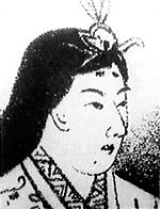
Empress Kogyoku

Encyclopedia
, also known as , was the 35th and 37th emperor
of Japan
, according to the traditional order of succession.
Kōgyoku's reign spanned the years from 642-645. Her reign as Saimei encompassed 655-661. In other words,
The two reigns of this one woman spanned the years from 642 through 661.
In the history of Japan
, Kōgyoku/Saimei was the second of eight women to take on the role of empress regnant. The sole female monarch before Kōgyoku/Saimei was (a) Suiko
-tennō. The six women sovereigns reigning after Kōgyoku/Saimei were (b) Jitō
, (c) Gemmei
, (d) Genshō
, (e) Kōken
/Shōtoku, (f) Meishō
, and (g) Go-Sakuramachi
.
, her personal name (imina) was . As emperor, her name would have been Ametoyo Takara Ikashi Hitarashi hime
.
Princess Takara (Takara no miko) was a great-granddaughter of Emperor Bidatsu
. She became the wife and Empress consort
of her uncle Emperor Jomei
. The Imperial marriage produced three children:
seized power. Her son Naka no Ōe planned a coup d'état and slew Soga no Iruka
at the court in front of her throne. The Empress, shocked by this incident, abdicated the throne.
Kōgyoku's contemporary title would not have been tennō, as most historians believe this title was not introduced until the reigns of Emperor Tenmu and Empress Jitō
. Rather, it was presumably Sumeramikoto or Amenoshita Shiroshimesu Ōkimi (治天下大王), meaning "the great queen who rules all under heaven." Alternatively, Kōgyoku might have been referred to as (ヤマト大王/大君) or the "Great Queen of Yamato."
Empress Kōgyoku reigned for four years. The years of Kōgyoku's reign are not linked by scholars to any era or nengō. The Taika era innovation of naming time periods -- nengō -- was yet to be initiated during her son's too-brief reign.
In this context, Brown and Ishida's translation of Gukanshō offers an explanation about the years of Empress Jitō's reign which muddies a sense of easy clarity in the pre-Taiho time-frame:
The years of Kōgyoku's reign are not more specifically identified by more than one era name or nengō which was an innovation of Kōtoku's brief reign.
In the fifth year of Saimei's reign, Paekche
in Korea
was destroyed in 660. Japan assisted Paekche loyals in the attempt to retrieve former Paekche territory. Early in 661, Saimei responded to the situation by leaving her capital in Yamato province
. Her plan was to lead a military expedition to Korea. The empress stayed in Ishiyu Temporary Palace in Iyo province
, today Dōgo Onsen
. In May she arrived at Asakura Palace in the north part of Tsukushi province in Kyūshū
, today a part of Fukuoka prefecture
. The allied army of Japan and Paekche was preparing for war against Silla
, but the death of the empress thwarted those plans. In 661, Saimei died in the Asakura Palace before the army departed to Korea
. In October her body was brought from Kyūshū by sea to Port Naniwa-zu (today Osaka city); and her state funeral was held in early November.
Empress Saimei ruled for seven years. The years of Saimei's reign are not linked by scholars to any era or nengō. The Taika era innovation of naming time periods -- nengō -- languished until Mommu reasserted an imperial right by proclaiming the commencement of Taihō in 701.
The actual site of Kōgyoku/Saimei's grave
is known, having been identified as the Kengoshizuka tomb in the village of Asuka
, Nara Prefecture
. This empress is traditionally venerated at a memorial
Shinto
shrine
(misasagi) at Nara.
The Imperial Household Agency
designates this location as Kōgyoku/Seimei's mausoleum
. It is formally named Ochi-no-Okanoe no misasagi.
in pre-Meiji
eras.
In general, this elite group included only three to four men at a time. These were hereditary courtiers whose experience and background would have brought them to the pinnacle of a life's career. During Kōgyoku's reign, this apex of the Daijō-kan included:
The kugyō during Saimei's reign included:
Emperor
An emperor is a monarch, usually the sovereign ruler of an empire or another type of imperial realm. Empress, the female equivalent, may indicate an emperor's wife or a woman who rules in her own right...
of Japan
Japan
Japan is an island nation in East Asia. Located in the Pacific Ocean, it lies to the east of the Sea of Japan, China, North Korea, South Korea and Russia, stretching from the Sea of Okhotsk in the north to the East China Sea and Taiwan in the south...
, according to the traditional order of succession.
Kōgyoku's reign spanned the years from 642-645. Her reign as Saimei encompassed 655-661. In other words,
- 642: She ascended the throne as Kōgyoku-tennō, and she stepped down in response to the assassination of Soga no IrukaSoga no Irukawas a statesman in the Asuka Period of Japan.He was a son of Soga no Emishi. He was assassinated by Prince Naka-no-Ōe though he tried to murder Prince Yamashiro, and to rule the emperor family. Emishi also committed suicide soon after his son's death, and the main branch of the Soga clan went...
(see: Isshi Incident). - 645: She abdicated in favor of her brother, who would become known as Emperor KōtokuEmperor Kotokuwas the 36th emperor of Japan, according to the traditional order of succession.The years of his reign lasted from 645 through 654.-Traditional narrative:Before Kōtoku ascension to the Chrysanthemum Throne, his personal name was or...
- 654: Kōtoku died; and the throne was vacant.
- 655: She re-ascended, beginning a new reign as Saimei-tennō.
- 661: Saimei ruled until her death caused the throne to be vacant again.
The two reigns of this one woman spanned the years from 642 through 661.
In the history of Japan
History of Japan
The history of Japan encompasses the history of the islands of Japan and the Japanese people, spanning the ancient history of the region to the modern history of Japan as a nation state. Following the last ice age, around 12,000 BC, the rich ecosystem of the Japanese Archipelago fostered human...
, Kōgyoku/Saimei was the second of eight women to take on the role of empress regnant. The sole female monarch before Kōgyoku/Saimei was (a) Suiko
Empress Suiko
was the 33rd emperor of Japan, according to the traditional order of succession.Suiko's reign spanned the years from 593 until her death in 628....
-tennō. The six women sovereigns reigning after Kōgyoku/Saimei were (b) Jitō
Empress Jito
was the 41st emperor of Japan, according to the traditional order of succession.Jitō's reign spanned the years from 686 through 697.In the history of Japan, Jitō was the third of eight women to take on the role of empress regnant. The two female monarchs before Jitō were Suiko and Kōgyoku/Saimei...
, (c) Gemmei
Empress Gemmei
, also known as Empress Genmyō, was the 43rd emperor of Japan, according to the traditional order of succession.Gemmei's reign spanned the years 707 through 715....
, (d) Genshō
Empress Gensho
was the 44th emperor of Japan, according to the traditional order of succession.Genshō's reign spanned the years 715 through 724.In the history of Japan, Genshō was the fifth of eight women to take on the role of empress regnant. The four female monarchs before Genshō were: Suiko, Kōgyoku/Saimei,...
, (e) Kōken
Empress Koken
, also known as , was the 46th and the 48th emperor of Japan respectively, according to the traditional order of succession. Empress Kōken first reigned from 749 to 758, then she reascended the throne as Empress Shōtoku from 765 until her death in 770....
/Shōtoku, (f) Meishō
Empress Meisho
was the 109th emperor of Japan, according to the traditional order of succession.Meishō's reign spanned the years from 1629 to 1643.In the history of Japan, Meishō was the seventh of eight women to become empress regnant. The six female monarchs who reigned before Meishō-tennō were Suiko, ...
, and (g) Go-Sakuramachi
Empress Go-Sakuramachi
was the 117th emperor of Japan, according to the traditional order of succession.Go-Sakuramachi's reign spanned the years from 1762 through 1771....
.
Traditional narrative
Before her ascension to the Chrysanthemum ThroneChrysanthemum Throne
The is the English term used to identify the throne of the Emperor of Japan. The term can refer to very specific seating, such as the takamikura throne in the Shishin-den at Kyoto Imperial Palace....
, her personal name (imina) was . As emperor, her name would have been Ametoyo Takara Ikashi Hitarashi hime
Hime
is the Japanese word for princess or a lady of higher birth. Daughters of a monarch are actually referred to by other terms, e.g. , literally king's daughter, even though Hime can be used to address Ōjo....
.
Princess Takara (Takara no miko) was a great-granddaughter of Emperor Bidatsu
Emperor Bidatsu
was the 30th emperor of Japan, according to the traditional order of succession.Bidastsu's reign spanned the years from 572 through 585.-Traditional narrative:Bidatsu was called in the Nihonshoki....
. She became the wife and Empress consort
Queen consort
A queen consort is the wife of a reigning king. A queen consort usually shares her husband's rank and holds the feminine equivalent of the king's monarchical titles. Historically, queens consort do not share the king regnant's political and military powers. Most queens in history were queens consort...
of her uncle Emperor Jomei
Emperor Jomei
was the 34th emperor of Japan, according to the traditional order of succession.Jomei's reign spanned the years from 629 through 641.-Traditional narrative:Before Jomei's ascension to the Chrysanthemum Throne, his personal name was or...
. The Imperial marriage produced three children:
- Prince Naka no Ōe (Emperor TenjiEmperor Tenji, also known as Emperor Tenchi, was the 38th emperor of Japan, according to the traditional order of succession.Tenji's reign spanned the years from 661 through 671.-Traditional narrative:...
) - Prince Ōama (Emperor TemmuEmperor Temmuwas the 40th emperor of Japan, according to the traditional order of succession.Temmu's reign lasted from 672 until his death in 686.-Traditional narrative:...
) - Princess Hashihito (Empress consort of Emperor KōtokuEmperor Kotokuwas the 36th emperor of Japan, according to the traditional order of succession.The years of his reign lasted from 645 through 654.-Traditional narrative:Before Kōtoku ascension to the Chrysanthemum Throne, his personal name was or...
)
Events in Kōgyoku's reign
During her first reign the Soga clanSoga clan
The was one of the most powerful clans in Yamato Japan and played a major role in the spread of Buddhism. For many generations, in the 5th and 7th centuries, the Soga monopolized the position of Great Royal Chieftain and was the first of many families to dominate the Imperial House of Japan by...
seized power. Her son Naka no Ōe planned a coup d'état and slew Soga no Iruka
Soga no Iruka
was a statesman in the Asuka Period of Japan.He was a son of Soga no Emishi. He was assassinated by Prince Naka-no-Ōe though he tried to murder Prince Yamashiro, and to rule the emperor family. Emishi also committed suicide soon after his son's death, and the main branch of the Soga clan went...
at the court in front of her throne. The Empress, shocked by this incident, abdicated the throne.
Kōgyoku's contemporary title would not have been tennō, as most historians believe this title was not introduced until the reigns of Emperor Tenmu and Empress Jitō
Empress Jito
was the 41st emperor of Japan, according to the traditional order of succession.Jitō's reign spanned the years from 686 through 697.In the history of Japan, Jitō was the third of eight women to take on the role of empress regnant. The two female monarchs before Jitō were Suiko and Kōgyoku/Saimei...
. Rather, it was presumably Sumeramikoto or Amenoshita Shiroshimesu Ōkimi (治天下大王), meaning "the great queen who rules all under heaven." Alternatively, Kōgyoku might have been referred to as (ヤマト大王/大君) or the "Great Queen of Yamato."
Empress Kōgyoku reigned for four years. The years of Kōgyoku's reign are not linked by scholars to any era or nengō. The Taika era innovation of naming time periods -- nengō -- was yet to be initiated during her son's too-brief reign.
In this context, Brown and Ishida's translation of Gukanshō offers an explanation about the years of Empress Jitō's reign which muddies a sense of easy clarity in the pre-Taiho time-frame:
- "The eras that fell in this reign were: (1) the remaining seven years of Shuchō [(686+7=692?)]; and (2) Taika, which was four years long [695-698]. (The first year of this era was kinoto-hitsuji [695].) ...In the third year of the Taka era [697], Empress Jitō yielded the throne to the Crown Prince."
The years of Kōgyoku's reign are not more specifically identified by more than one era name or nengō which was an innovation of Kōtoku's brief reign.
Events in Saimei's reign
When Kōtoku died, his designated heir was Naka no Ōe. When Naka no Ōe's mother re-ascended, he continued in the role of her heir and crown prince. In this role, he could and did remain active in the political life of Japan.In the fifth year of Saimei's reign, Paekche
Baekje
Baekje or Paekche was a kingdom located in southwest Korea. It was one of the Three Kingdoms of Korea, together with Goguryeo and Silla....
in Korea
Korea
Korea ) is an East Asian geographic region that is currently divided into two separate sovereign states — North Korea and South Korea. Located on the Korean Peninsula, Korea is bordered by the People's Republic of China to the northwest, Russia to the northeast, and is separated from Japan to the...
was destroyed in 660. Japan assisted Paekche loyals in the attempt to retrieve former Paekche territory. Early in 661, Saimei responded to the situation by leaving her capital in Yamato province
Yamato Province
was a province of Japan, located in Kinai, corresponding to present-day Nara Prefecture in Honshū. It was also called . At first, the name was written with one different character , and for about ten years after 737, this was revised to use more desirable characters . The final revision was made in...
. Her plan was to lead a military expedition to Korea. The empress stayed in Ishiyu Temporary Palace in Iyo province
Iyo Province
was an old province of Japan in the area that is today Ehime Prefecture on Shikoku. Iyo bordered on Awa, Sanuki, and Tosa Provinces. It was sometimes called ....
, today Dōgo Onsen
Dogo Onsen
is a hot spring in the city of Matsuyama, Ehime Prefecture on the island of Shikoku, Japan.-History:Dōgo Onsen is one of the oldest onsen hot springs in Japan, with a history stretching back over 1,000 years. The springs are mentioned in the Man'yōshū is a hot spring in the city of Matsuyama,...
. In May she arrived at Asakura Palace in the north part of Tsukushi province in Kyūshū
Kyushu
is the third largest island of Japan and most southwesterly of its four main islands. Its alternate ancient names include , , and . The historical regional name is referred to Kyushu and its surrounding islands....
, today a part of Fukuoka prefecture
Fukuoka Prefecture
is a prefecture of Japan located on Kyūshū Island. The capital is the city of Fukuoka.- History :Fukuoka Prefecture includes the former provinces of Chikugo, Chikuzen, and Buzen....
. The allied army of Japan and Paekche was preparing for war against Silla
Silla
Silla was one of the Three Kingdoms of Korea, and one of the longest sustained dynasties in...
, but the death of the empress thwarted those plans. In 661, Saimei died in the Asakura Palace before the army departed to Korea
Korea
Korea ) is an East Asian geographic region that is currently divided into two separate sovereign states — North Korea and South Korea. Located on the Korean Peninsula, Korea is bordered by the People's Republic of China to the northwest, Russia to the northeast, and is separated from Japan to the...
. In October her body was brought from Kyūshū by sea to Port Naniwa-zu (today Osaka city); and her state funeral was held in early November.
Empress Saimei ruled for seven years. The years of Saimei's reign are not linked by scholars to any era or nengō. The Taika era innovation of naming time periods -- nengō -- languished until Mommu reasserted an imperial right by proclaiming the commencement of Taihō in 701.
The actual site of Kōgyoku/Saimei's grave
Grave (burial)
A grave is a location where a dead body is buried. Graves are usually located in special areas set aside for the purpose of burial, such as graveyards or cemeteries....
is known, having been identified as the Kengoshizuka tomb in the village of Asuka
Asuka, Nara
is a village located in Takaichi District, Nara, Japan.As of September 1, 2007, the village has an estimated population of 6,146 and a density of 255.23 persons per km². The total area is 24.08 km².Asuka is the land where ancient palaces were located...
, Nara Prefecture
Nara Prefecture
is a prefecture in the Kansai region on Honshū Island, Japan. The capital is the city of Nara.-History:The present-day Nara Prefecture was created in 1887, making it independent of Osaka Prefecture....
. This empress is traditionally venerated at a memorial
Memorial
A memorial is an object which serves as a focus for memory of something, usually a person or an event. Popular forms of memorials include landmark objects or art objects such as sculptures, statues or fountains, and even entire parks....
Shinto
Shinto
or Shintoism, also kami-no-michi, is the indigenous spirituality of Japan and the Japanese people. It is a set of practices, to be carried out diligently, to establish a connection between present day Japan and its ancient past. Shinto practices were first recorded and codified in the written...
shrine
Shrine
A shrine is a holy or sacred place, which is dedicated to a specific deity, ancestor, hero, martyr, saint, daemon or similar figure of awe and respect, at which they are venerated or worshipped. Shrines often contain idols, relics, or other such objects associated with the figure being venerated....
(misasagi) at Nara.
The Imperial Household Agency
Imperial Household Agency
The is a government agency of Japan in charge of the state matters concerning Japan's imperial family and also keeping the Privy Seal and the State Seal...
designates this location as Kōgyoku/Seimei's mausoleum
Mausoleum
A mausoleum is an external free-standing building constructed as a monument enclosing the interment space or burial chamber of a deceased person or persons. A monument without the interment is a cenotaph. A mausoleum may be considered a type of tomb or the tomb may be considered to be within the...
. It is formally named Ochi-no-Okanoe no misasagi.
Kugyō
Kugyō (公卿) is a collective term for the very few most powerful men attached to the court of the Emperor of JapanEmperor of Japan
The Emperor of Japan is, according to the 1947 Constitution of Japan, "the symbol of the state and of the unity of the people." He is a ceremonial figurehead under a form of constitutional monarchy and is head of the Japanese Imperial Family with functions as head of state. He is also the highest...
in pre-Meiji
Meiji period
The , also known as the Meiji era, is a Japanese era which extended from September 1868 through July 1912. This period represents the first half of the Empire of Japan.- Meiji Restoration and the emperor :...
eras.
In general, this elite group included only three to four men at a time. These were hereditary courtiers whose experience and background would have brought them to the pinnacle of a life's career. During Kōgyoku's reign, this apex of the Daijō-kan included:
- SadaijinSadaijin, most commonly translated as "Minister of the Left", was a government position in Japan in the late Nara and Heian periods. The position was consolidated in the Taihō Code of 702. The Asuka Kiyomihara Code of 689 marks the initial appearance of the Sadaijin in the context of a central...
- UdaijinUdaijinUdaijin , most commonly translated as the "Minister of the Right", was a government position in Japan in the late Nara and Heian periods. The position was consolidated in the Taihō Code of 702. The Asuka Kiyomihara Code of 689 marks the initial appearance of the Udaijin in the context of a central...
The kugyō during Saimei's reign included:
- SadaijinSadaijin, most commonly translated as "Minister of the Left", was a government position in Japan in the late Nara and Heian periods. The position was consolidated in the Taihō Code of 702. The Asuka Kiyomihara Code of 689 marks the initial appearance of the Sadaijin in the context of a central...
, Kose no Tokoda(巨勢徳太) (593–658), 649–658 - UdaijinUdaijinUdaijin , most commonly translated as the "Minister of the Right", was a government position in Japan in the late Nara and Heian periods. The position was consolidated in the Taihō Code of 702. The Asuka Kiyomihara Code of 689 marks the initial appearance of the Udaijin in the context of a central...
(not appointed) - Naidaijin (内臣), Nakatomi no Kamako(中臣鎌子) (Fujiwara no KamatariFujiwara no KamatariFujiwara no Kamatari was a Japanese statesman, courtier and politician during the Asuka period.Kamatari was the founder of the Fujiwara clan in Japan. His birth clan was the Nakatomi. He was the son of Nakatomi no Mikeko, and his birth name was Nakatomi no Kamatari...
, 藤原鎌足) (614–669), 645–669
See also
- Japanese empressesJapanese empressesIn Japan, empress may refer to either or .- Empresses regnant :There were eight female imperial reigns in Japan's early history between 593 and 770, and two more in the early modern period...
- Emperor of JapanEmperor of JapanThe Emperor of Japan is, according to the 1947 Constitution of Japan, "the symbol of the state and of the unity of the people." He is a ceremonial figurehead under a form of constitutional monarchy and is head of the Japanese Imperial Family with functions as head of state. He is also the highest...
- List of Emperors of Japan
- Imperial cultImperial cultAn imperial cult is a form of state religion in which an emperor, or a dynasty of emperors , are worshipped as messiahs, demigods or deities. "Cult" here is used to mean "worship", not in the modern pejorative sense...