


Chawan

Encyclopedia
Bowl (vessel)
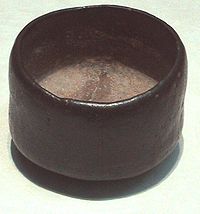
A bowl is a common open-top container used in many cultures to serve food, and is also used for drinking and storing other items. They are typically small and shallow, although some, such as punch bowls and salad bowls, are larger and often intended to serve many people.Bowls have existed for...
used for preparing and drinking tea. There are many types of chawan used in a tea ceremony, and the choice of their use depends upon many considerations. It is used for matcha
Matcha
refers to finely-milled green tea, most popular in Japan. The cultural activity called the Japanese tea ceremony centers on the preparation, serving, and drinking of matcha. In modern times, matcha has also come to be used to flavour and dye foods such as mochi and soba noodles, green tea ice cream...
(powdered green tea
Green tea
Green tea is made solely from the leaves of Camellia sinensis that have undergone minimal oxidation during processing. Green tea originates from China and has become associated with many cultures throughout Asia. It has recently become more widespread in the West, where black tea is traditionally...
) in the Japanese tea ceremony
Japanese tea ceremony
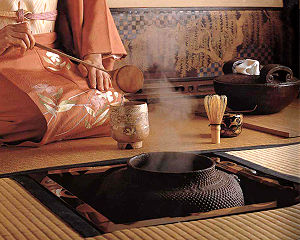
The Japanese tea ceremony, also called the Way of Tea, is a Japanese cultural activity involving the ceremonial preparation and presentation of matcha, powdered green tea. In Japanese, it is called . The manner in which it is performed, or the art of its performance, is called...
.
In Japan
Japan
Japan is an island nation in East Asia. Located in the Pacific Ocean, it lies to the east of the Sea of Japan, China, North Korea, South Korea and Russia, stretching from the Sea of Okhotsk in the north to the East China Sea and Taiwan in the south...
, chawan also is the standard term for bowls for rice
Rice
Rice is the seed of the monocot plants Oryza sativa or Oryza glaberrima . As a cereal grain, it is the most important staple food for a large part of the world's human population, especially in East Asia, Southeast Asia, South Asia, the Middle East, and the West Indies...
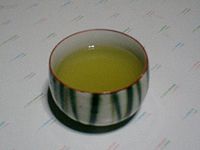
. If it is necessary to distinguish between them, bowls for rice are called gohan jawan, while the those for use in tea ceremony are called matchawan. The handle-less cups used for drinking regular steeped tea are generally referred to as yunomi (literally, cups for hot water), while the small porcelain cups used for fine-quality steeped green tea are often distinguished as senchawan. When the word chawan stands alone, it is normally prefixed with the honorific o-.
History
The first chawan in JapanJapan
Japan is an island nation in East Asia. Located in the Pacific Ocean, it lies to the east of the Sea of Japan, China, North Korea, South Korea and Russia, stretching from the Sea of Okhotsk in the north to the East China Sea and Taiwan in the south...
were imported from China
China
Chinese civilization may refer to:* China for more general discussion of the country.* Chinese culture* Greater China, the transnational community of ethnic Chinese.* History of China* Sinosphere, the area historically affected by Chinese culture...
between the 13th through the 16th century. Up till about the 15th century in Japan, tea was mainly drunk from a Chinese variety of tea bowls called Tenmoku chawan in Japanese. By the end of the Kamakura period
Kamakura period
The is a period of Japanese history that marks the governance by the Kamakura Shogunate, officially established in 1192 in Kamakura by the first shogun Minamoto no Yoritomo....
(1185–1333), as the custom of tea drinking spread throughout Japan and the Tenmoku chawan became desired by all ranks of society, the Japanese began to made their own copies of the Tenmoku chawan in Seto
Seto, Aichi
is a city located in Aichi, Japan. It is located about 35 minutes from Nagoya by way of the Meitetsu Seto Line.As of April 1, 2011, the city has an estimated population of 133,121, with a household number of 53,253, and the density of 1,192.63 persons per km². The total area is 111.62 km².-...
(in present day Aichi Prefecture
Aichi Prefecture
is a prefecture of Japan located in the Chūbu region. The region of Aichi is also known as the Tōkai region. The capital is Nagoya. It is the focus of the Chūkyō Metropolitan Area.- History :...
). The original Chinese Tenmoku chawan came in various colors, shapes, and designs, but the Japanese particularly liked the bowls with a tapered shape, so most Seto-made Tenmoku chawan had this shape. With the rise of the wabi tea ceremony in the late Muromachi period
Muromachi period
The is a division of Japanese history running from approximately 1336 to 1573. The period marks the governance of the Muromachi or Ashikaga shogunate, which was officially established in 1338 by the first Muromachi shogun, Ashikaga Takauji, two years after the brief Kemmu restoration of imperial...
(1336–1573), the Ido chawan, a variety of Korean bowls mainly used for rice in Korea, also became highly prized in Japan.
Styles and classification
Chawan are classified according to their place of origin or manufacture, colour, shape, materials and other characteristics. More than one classification may apply to a given bowl.Most chawan are bowl-shaped, but shapes vary widely. There are names for each general shape, within which there may be many variations. Common shapes include cylindrical, flat and round. Cylindrical bowls are called tsutsu-chawan, while shallow bowls are called hira-chawan.
Chawan are also classified according to the type of tea that will be served in them: bowls for "thin tea" (usucha) are referred to as usuchawan, and those for and "thick tea" (koicha), koichawan.
Karamono
Karamono (唐物) refers generally to styles of chawan that originated in China. These bowls were designed for drinking tea. Note that in all cases, the names are Japanese.- Tenmoku (天目)
- Haikatsugi
- Yohen
- Kensan
- Yuteki
- Taihisan
- Seiji (青磁, celadon-ware)
- Hakuji (白磁, white porcelain)
- Sometsuki (blue and white porcelain)
Kōraimono
Chaki
Chaki is a Japanese term that literally means "tea implement." In the vocabulary of Japanese tea ceremony, it broadly means any implement used in the practice of chanoyu, and more narrowly means the caddy for the powdered green tea used in the tea-making procedures, although usually this...
. Korean bowls were a favourite of Sen no Rikyu
Sen no Rikyu
, is considered the historical figure with the most profound influence on chanoyu, the Japanese "Way of Tea", particularly the tradition of wabi-cha...
because of their rough simplicity.
- Iji
- Mishima
- Kaki-no-heta
- Kinsan
- Ido
- Gōki
- Goshō Maru
- Totoya
- Katade Komogai
- Kohiki
- Amamori
- Hagame
- Sōhaku
- Gohon
- Tamagote
- Sōba
- Unkaku
- Wari-kodai
- Iraho
Wamono
Wamono chawan can be further divided by location and by kiln:
Provincial
- Karatsu
- Asahi
- Oku-gorai
- Iga
- Hagi
- Seto (瀬戸)
- Setoguro (瀬戸黒)
- Izumo
- Shigaraki
- Oribe (織部)
- Shonzui
- Genpin
- Shino (志野)
- Satsuma