


Todai-ji

Encyclopedia
, is a Buddhist
temple complex located in the city of Nara
, Japan
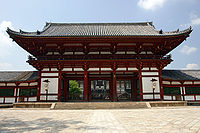
. Its Great Buddha Hall (大仏殿 Daibutsuden), the largest wooden building in the world, houses the world's largest bronze statue of the Buddha Vairocana
, known in Japanese simply as Daibutsu
(大仏). The temple also serves as the Japanese headquarters of the Kegon
school of Buddhism. The temple is a listed UNESCO
World Heritage Site
as "Historic Monuments of Ancient Nara
", together with seven other sites including temples, shrines and places in the city of Nara. Sika deer
, regarded as messengers of the gods in the Shinto
religion, roam the grounds freely.
established Kinshōsen-ji (金鐘山寺) as an appeasement for Prince Motoi, his first son with his Fujiwara clan consort Kōmyōshi. Prince Motoi died a year after his birth.
During the Tenpyō
era, Japan suffered from a series of disasters and epidemics. It was after experiencing these problems that Emperor Shōmu issued an edict in 741
to promote the construction of provincial temple
s throughout the nation. Tōdai-ji (still Kinshōsen-ji at the time) was appointed as the Provincial temple of Yamato Province
and the head of all the provincial temples. With the alleged coup d'état by Nagaya
in 729, an outbreak of smallpox
around 735–737, worsened by consecutive years of poor crops, then followed by a rebellion led by Fujiwara no Hirotsugu in 740, the country was in a chaotic position. Emperor Shōmu had been forced to move the capital four times, indicating the level of instability during this period.
system of government in the Nara Period
, Buddhism was heavily regulated by the state through the . During this time, Tōdai-ji served as the central administrative temple for the provincial temples for the six Buddhist schools in Japan at the time: the Hossō
, Kegon
, Jōjitsu
, Sanron
, Ritsu
and Kusha
. Letters dating from this time also show that all six Buddhist schools had offices at Tōdai-ji, complete with administrators, shrines and their own library.
 Japanese Buddhism during this time still maintained the lineage of the Vinaya
and all officially licensed monks had to take their ordination under the Vinaya at Tōdai-ji. In 754, ordination was given by Ganjin, who arrived in Japan after overcoming hardships over 12 years and six attempts of crossing the sea from China, to Empress Kōken
, former Emperor Shōmu
and others. Later Buddhist monks, including Kūkai
and Saichō
took their ordination here as well. During Kūkai's administration of the Sōgō, additional ordination ceremonies were added to Tōdai-ji, including ordination of the Bodhisattva Precepts
from the Brahma Net Sutra
and the esoteric Precepts, or Samaya
, from Kukai's own newly established Shingon school of Buddhism. Additionally, Kūkai added an Abhiseka Hall for the use of initiating monks of the six Nara schools into the esoteric teachings. by 829.
During its height of power, Tōdai-ji's famous Shuni-e
ceremony was established by the monk Jitchū, and continues to this day.
and the Tendai
sect, and later when the capital of Japan moved to Kamakura
, Tōdai-ji's role in maintaining authority declined as well. In later generations, the Vinaya lineage also died out, despite repeated attempts to revive it, thus no more ordination ceremonies take place at Tōdai-ji.
 In 743, Emperor Shōmu issued a law in which he stated that the people should become directly involved with the establishment of new Buddha temples throughout Japan. His personal belief was that such piety would inspire Buddha to protect his country from further disaster. Gyōki
, with his pupils, traveled the provinces asking for donations. According to records kept by Tōdai-ji, more than 2,600,000 people in total helped construct the Great Buddha and its Hall. The 16 m (52 ft) high statue was built through eight castings over three years, the head and neck being cast together as a separate element. The making of the statue was started first in Shigaraki
. After enduring multiple fires and earthquakes, the construction was eventually resumed in Nara in 745, and the Buddha was finally completed in 751. A year later, in 752, the eye-opening ceremony was held with an attendance of 10,000 people to celebrate the completion of the Buddha. The Indian priest Bodhisena
performed the eye-opening for Emperor Shōmu. The project nearly bankrupted Japan's economy, consuming most of the available bronze
of the time.
The original complex also contained two 100 m pagoda
s, perhaps second only to the pyramids of Egypt in height at the time. These were destroyed by earthquake. The Shōsōin
was its storehouse, and now contains many artifacts from the Tenpyo period of Japanese history
.
several times for various reasons, including earthquake
damage. The current hands of the statue were made in the Momoyama Period
(1568–1615), and the head was made in the Edo period
(1615–1867).
The existing Nandaimon (Great South Gate) is a reconstruction of end-12th century based on Song Dynasty style
. The dancing figures of the Nio
, the two 28-foot-tall guardians at the Nandaimon, were built at around the same time by Unkei
, Kaikei
and their workshop members. The Nio are an A-un
pair known as Ungyo, which by tradition has a facial expression with a closed mouth, and Agyo, which has an open mouthed expression. The two figures were closely evaluated and extensively restored by a team of art conservators between 1988 and 1993. Until then, these sculptures had never before been moved from the niches in which they were originally installed. This complex preservation project, costing $4.7 million, involved a restoration team of 15 experts from the National Treasure Repairing Institute in Kyoto.
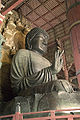 The temple gives the following dimensions for the statue:
The statue weighs 500 tonnes (551.2 ST).
 Various buildings of the Tōdai-ji have been incorporated within the overall aesthetic intention of the gardens' design. Adjacent villas are today considered part of Tōdai-ji.
Some of these structures are now open to the public. The time spent visiting one or more of these less well-known buildings can only enhance an appreciation of the temple complex itself.
Over the centuries, the buildings and gardens have evolved together as to become an integral part of a unique, organic and living temple community.
movie The Barbarian and the Geisha
when Nandaimon, the Great South Gate, doubled as a city's gates.
It also appears in Microsoft
's game Age of Empires II.
.
The Tokyo New Philharmonic Orchestra, X Japan
, INXS
, Bon Jovi
, Joni Mitchell
, Bob Dylan
, Tomoyasu Hotei
, Roger Taylor
, classic Japanese drummers
, and a Buddhist monk choir. This event, organised by British producer Tony Hollingsworth, was simultaneously broadcast in 55 countries on May 22 and May 23, 1994.
Buddhism
Buddhism is a religion and philosophy encompassing a variety of traditions, beliefs and practices, largely based on teachings attributed to Siddhartha Gautama, commonly known as the Buddha . The Buddha lived and taught in the northeastern Indian subcontinent some time between the 6th and 4th...
temple complex located in the city of Nara
Nara, Nara
is the capital city of Nara Prefecture in the Kansai region of Japan. The city occupies the northern part of Nara Prefecture, directly bordering Kyoto Prefecture...
, Japan
Japan
Japan is an island nation in East Asia. Located in the Pacific Ocean, it lies to the east of the Sea of Japan, China, North Korea, South Korea and Russia, stretching from the Sea of Okhotsk in the north to the East China Sea and Taiwan in the south...
. Its Great Buddha Hall (大仏殿 Daibutsuden), the largest wooden building in the world, houses the world's largest bronze statue of the Buddha Vairocana
Vairocana
Vairocana is a celestial Buddha who is often interpreted as the Bliss Body of the historical Gautama Buddha; he can also be referred to as the dharmakaya Buddha and the great solar Buddha. In Sino-Japanese Buddhism, Vairocana is also seen as the embodiment of the Buddhist concept of shunyata or...
, known in Japanese simply as Daibutsu
Daibutsu
or 'giant Buddha' is the Japanese term, often used informally, for large statues of Buddha. The oldest is that at Asuka-dera and the best-known those of Tōdai-ji in Nara and Kōtoku-in in Kamakura , both National Treasures.- Examples :...
(大仏). The temple also serves as the Japanese headquarters of the Kegon
Kegon
Kegon is the name of the Japanese transmission of the Huayan school of Chinese Buddhism.Huayan studies were founded in Japan when, in 736, the scholar-priest Rōben originally a monk of the Hossō tradition invited Shinshō to give lectures on the Avatamsaka Sutra at...
school of Buddhism. The temple is a listed UNESCO
UNESCO
The United Nations Educational, Scientific and Cultural Organization is a specialized agency of the United Nations...
World Heritage Site
World Heritage Site
A UNESCO World Heritage Site is a place that is listed by the UNESCO as of special cultural or physical significance...
as "Historic Monuments of Ancient Nara
Historic Monuments of Ancient Nara
The UNESCO World Heritage Site Historic Monuments of Ancient Nara encompasses eight places in the old capital Nara in Nara Prefecture, Japan. Five are Buddhist temples, one is a Shinto shrine, one is a Palace and one a primeval forest. The properties include 26 buildings designated by the Japanese...
", together with seven other sites including temples, shrines and places in the city of Nara. Sika deer
Sika Deer
The Sika Deer, Cervus nippon, also known as the Spotted Deer or the Japanese Deer, is a species of deer native to much of East Asia and introduced to various other parts of the world...
, regarded as messengers of the gods in the Shinto
Shinto
or Shintoism, also kami-no-michi, is the indigenous spirituality of Japan and the Japanese people. It is a set of practices, to be carried out diligently, to establish a connection between present day Japan and its ancient past. Shinto practices were first recorded and codified in the written...
religion, roam the grounds freely.
Roots
The beginning of building a temple where the huge Tōdai-ji complex sits today can be dated to 728, when Emperor ShōmuEmperor Shomu
was the 45th emperor of Japan, according to the traditional order of succession.Shōmu's reign spanned the years 724 through 723.-Traditional narrative:...
established Kinshōsen-ji (金鐘山寺) as an appeasement for Prince Motoi, his first son with his Fujiwara clan consort Kōmyōshi. Prince Motoi died a year after his birth.
During the Tenpyō
Tenpyo
, also romanized as Tempyō, was a after Jinki and before Tenpyō-kanpō. This period spanned the years from August 729 through April 749. The reigning emperor was .-Change of era:...
era, Japan suffered from a series of disasters and epidemics. It was after experiencing these problems that Emperor Shōmu issued an edict in 741
to promote the construction of provincial temple
Provincial temple
Emperor Shōmu of Japan established so-called provincial temples in each province of Japan...
s throughout the nation. Tōdai-ji (still Kinshōsen-ji at the time) was appointed as the Provincial temple of Yamato Province
Yamato Province
was a province of Japan, located in Kinai, corresponding to present-day Nara Prefecture in Honshū. It was also called . At first, the name was written with one different character , and for about ten years after 737, this was revised to use more desirable characters . The final revision was made in...
and the head of all the provincial temples. With the alleged coup d'état by Nagaya
Nagaya
Nagaya was a politician of the Nara period and an imperial prince of Japan, a son of Prince Takechi ....
in 729, an outbreak of smallpox
Smallpox
Smallpox was an infectious disease unique to humans, caused by either of two virus variants, Variola major and Variola minor. The disease is also known by the Latin names Variola or Variola vera, which is a derivative of the Latin varius, meaning "spotted", or varus, meaning "pimple"...
around 735–737, worsened by consecutive years of poor crops, then followed by a rebellion led by Fujiwara no Hirotsugu in 740, the country was in a chaotic position. Emperor Shōmu had been forced to move the capital four times, indicating the level of instability during this period.
Role in early Japanese Buddhism
Under the RitsuryōRitsuryo
is the historical law system based on the philosophies of Confucianism and Chinese Legalism in Japan. The political system in accord to Ritsuryō is called "Ritsuryō-sei"...
system of government in the Nara Period
Nara period
The of the history of Japan covers the years from AD 710 to 794. Empress Gemmei established the capital of Heijō-kyō . Except for 5 years , when the capital was briefly moved again, it remained the capital of Japanese civilization until Emperor Kammu established a new capital, Nagaoka-kyō, in 784...
, Buddhism was heavily regulated by the state through the . During this time, Tōdai-ji served as the central administrative temple for the provincial temples for the six Buddhist schools in Japan at the time: the Hossō
Dharma character school
East Asian Yogācāra refers to the traditions in East Asia which represent the Indian Yogācāra system of thought. It is a school of Buddhism originating in China. In China, it is known as Wéishí-zōng , or Fǎxiàng-zōng...
, Kegon
Kegon
Kegon is the name of the Japanese transmission of the Huayan school of Chinese Buddhism.Huayan studies were founded in Japan when, in 736, the scholar-priest Rōben originally a monk of the Hossō tradition invited Shinshō to give lectures on the Avatamsaka Sutra at...
, Jōjitsu
Satyasiddhi
The Satyasiddhi school of Buddhism is based on the text known as the Satyasiddhi-Shastra , authored by the Indian master Harivarman...
, Sanron
Sanlun
Mādhyamaka in East Asia refers to the Buddhist traditions in East Asia which represent the Indian Mādhyamaka system of thought. In Chinese Buddhism, these are often referred to as the Sānlùn school Mādhyamaka in East Asia refers to the Buddhist traditions in East Asia which represent the Indian...
, Ritsu
Ritsu
The Ritsu school of Buddhism is one of the six schools of Nara Buddhism in Japan, noted for its use of the Vinaya textual framework of the Dharmaguptaka, one of the early schools of Buddhism...
and Kusha
Kusha (Buddhism)
Kusha was one of the 13 Chinese Buddhist schools and one of the 6 Japanese Buddhism schools , introduced to Japan during Asuka and Nara period. Along with Jōjitsu and Ritsu, it was initially based on Nikaya schools, sometimes known derisively as Hinayana. Kusha was never considered to be an...
. Letters dating from this time also show that all six Buddhist schools had offices at Tōdai-ji, complete with administrators, shrines and their own library.
Vinaya
The Vinaya is the regulatory framework for the Buddhist monastic community, or sangha, based in the canonical texts called Vinaya Pitaka. The teachings of the Buddha, or Buddhadharma can be divided into two broad categories: 'Dharma' or doctrine, and 'Vinaya', or discipline...
and all officially licensed monks had to take their ordination under the Vinaya at Tōdai-ji. In 754, ordination was given by Ganjin, who arrived in Japan after overcoming hardships over 12 years and six attempts of crossing the sea from China, to Empress Kōken
Empress Koken
, also known as , was the 46th and the 48th emperor of Japan respectively, according to the traditional order of succession. Empress Kōken first reigned from 749 to 758, then she reascended the throne as Empress Shōtoku from 765 until her death in 770....
, former Emperor Shōmu
Emperor Shomu
was the 45th emperor of Japan, according to the traditional order of succession.Shōmu's reign spanned the years 724 through 723.-Traditional narrative:...
and others. Later Buddhist monks, including Kūkai
Kukai
Kūkai , also known posthumously as , 774–835, was a Japanese monk, civil servant, scholar, poet, and artist, founder of the Shingon or "True Word" school of Buddhism. Shingon followers usually refer to him by the honorific titles of and ....
and Saichō
Saicho
was a Japanese Buddhist monk credited with founding the Tendai school in Japan, based around the Chinese Tiantai tradition he was exposed to during his trip to China beginning in 804. He founded the temple and headquarters of Tendai at Enryaku-ji on Mt. Hiei near Kyoto. He is also said to have...
took their ordination here as well. During Kūkai's administration of the Sōgō, additional ordination ceremonies were added to Tōdai-ji, including ordination of the Bodhisattva Precepts
Bodhisattva vows
The Sanskrit term Bodhisattva is the name given to anyone who, motivated by great compassion, has generated bodhichitta, which is a spontaneous wish to attain Buddhahood for the benefit of all sentient beings. What makes someone a Bodhisattva is her or his dedication to the ultimate welfare of...
from the Brahma Net Sutra
Brahmajala Sutra (Mahayana)
The Brahmajala Sutra , also called the Brahma's Net Sutra is a text of the Mahayana Buddhist canon. It is not related to the Brahmajala Sutta of the Theravada Buddhist Pali Canon...
and the esoteric Precepts, or Samaya
Samaya
The samaya , is a set of vows or precepts given to initiates of an esoteric Vajrayana Buddhist order as part of the abhiṣeka ceremony that creates a bond between the guru and disciple.According Keown, et al., Samaya may be defined as:*A particular system of teaching or...
, from Kukai's own newly established Shingon school of Buddhism. Additionally, Kūkai added an Abhiseka Hall for the use of initiating monks of the six Nara schools into the esoteric teachings. by 829.
During its height of power, Tōdai-ji's famous Shuni-e
Shuni-e
The is a ceremony held each year at certain Buddhist temples in Japan. The name comes from its observance in the second month of the lunisolar calendar. Today, the service is usually held in either February or March, depending on temples....
ceremony was established by the monk Jitchū, and continues to this day.
Decline
As the center of power in Japanese Buddhism shifted away from Nara to Mount HieiMount Hiei
is a mountain to the northeast of Kyoto, lying on the border between the Kyoto and Shiga prefectures, Japan.The temple of Enryaku-ji, the first outpost of the Japanese Tiantai sect of Buddhism, was founded atop Mount Hiei by Saichō in 788. Both Nichiren and Honen studied at the temple before...
and the Tendai
Tendai
is a Japanese school of Mahayana Buddhism, a descendant of the Chinese Tiantai or Lotus Sutra school.Chappell frames the relevance of Tendai for a universal Buddhism:- History :...
sect, and later when the capital of Japan moved to Kamakura
Kamakura, Kanagawa
is a city located in Kanagawa Prefecture, Japan, about south-south-west of Tokyo. It used to be also called .Although Kamakura proper is today rather small, it is often described in history books as a former de facto capital of Japan as the seat of the Shogunate and of the Regency during the...
, Tōdai-ji's role in maintaining authority declined as well. In later generations, the Vinaya lineage also died out, despite repeated attempts to revive it, thus no more ordination ceremonies take place at Tōdai-ji.
Initial construction
Gyoki
was a Japanese Buddhist priest of the Nara period, born in Ōtori county, Kawachi Province , to family of Korean Baekje descent. Gyōki became a monk at Asuka-dera temple in Nara at the age of 15, and studied under master Dōshō as one of his first pupils. Gyōki studied Yogacara , a core doctrine of...
, with his pupils, traveled the provinces asking for donations. According to records kept by Tōdai-ji, more than 2,600,000 people in total helped construct the Great Buddha and its Hall. The 16 m (52 ft) high statue was built through eight castings over three years, the head and neck being cast together as a separate element. The making of the statue was started first in Shigaraki
Shigaraki, Shiga
was a town located in Kōka District, Shiga, Japan.On October 1, 2004 Shigaraki was merged with the towns of Kōka, Kōnan, Minakuchi and Tsuchiyama, all from Kōka District, to form the new city of Kōka....
. After enduring multiple fires and earthquakes, the construction was eventually resumed in Nara in 745, and the Buddha was finally completed in 751. A year later, in 752, the eye-opening ceremony was held with an attendance of 10,000 people to celebrate the completion of the Buddha. The Indian priest Bodhisena
Bodhisena
Bodhisena was an Indian Buddhist scholar and monk, known for traveling to Japan and establishing the Kegon school, the Japanese transmission of the Huayan school of Chinese Buddhism....
performed the eye-opening for Emperor Shōmu. The project nearly bankrupted Japan's economy, consuming most of the available bronze
Bronze
Bronze is a metal alloy consisting primarily of copper, usually with tin as the main additive. It is hard and brittle, and it was particularly significant in antiquity, so much so that the Bronze Age was named after the metal...
of the time.
The original complex also contained two 100 m pagoda
Pagoda
A pagoda is the general term in the English language for a tiered tower with multiple eaves common in Nepal, India, China, Japan, Korea, Vietnam and other parts of Asia. Some pagodas are used as Taoist houses of worship. Most pagodas were built to have a religious function, most commonly Buddhist,...
s, perhaps second only to the pyramids of Egypt in height at the time. These were destroyed by earthquake. The Shōsōin
Shosoin
The is the treasure house that belongs to Tōdai-ji, Nara The building is in the azekura log-cabin style, with a raised floor. It lies to the northwest of the Daibutsuden...
was its storehouse, and now contains many artifacts from the Tenpyo period of Japanese history
History of Japan
The history of Japan encompasses the history of the islands of Japan and the Japanese people, spanning the ancient history of the region to the modern history of Japan as a nation state. Following the last ice age, around 12,000 BC, the rich ecosystem of the Japanese Archipelago fostered human...
.
Reconstructions post-Nara Period
The Great Buddha Hall (Daibutsuden) has been rebuilt twice after fire. The current building was finished in 1709, and although immense—57 m long and 50 m wide—it is actually 30% smaller than its predecessor. Nevertheless, the Daibutsuden is considered the largest building in the world made primarily of wood. The Great Buddha statue has been recastCasting
In metalworking, casting involves pouring liquid metal into a mold, which contains a hollow cavity of the desired shape, and then allowing it to cool and solidify. The solidified part is also known as a casting, which is ejected or broken out of the mold to complete the process...
several times for various reasons, including earthquake
Earthquake
An earthquake is the result of a sudden release of energy in the Earth's crust that creates seismic waves. The seismicity, seismism or seismic activity of an area refers to the frequency, type and size of earthquakes experienced over a period of time...
damage. The current hands of the statue were made in the Momoyama Period
Azuchi-Momoyama period
The came at the end of the Warring States Period in Japan, when the political unification that preceded the establishment of the Tokugawa shogunate took place. It spans the years from approximately 1573 to 1603, during which time Oda Nobunaga and his successor, Toyotomi Hideyoshi, imposed order...
(1568–1615), and the head was made in the Edo period
Edo period
The , or , is a division of Japanese history which was ruled by the shoguns of the Tokugawa family, running from 1603 to 1868. The political entity of this period was the Tokugawa shogunate....
(1615–1867).
The existing Nandaimon (Great South Gate) is a reconstruction of end-12th century based on Song Dynasty style
Architecture of the Song Dynasty
The architecture of the Song Dynasty was noted for its towering Buddhist pagodas, enormous stone and wooden bridges, lavish tombs, and palaces. Although literary works on architecture existed beforehand, architectural writing blossomed during the Song Dynasty, maturing into a more professional...
. The dancing figures of the Nio
Nio
Kongōrikishi or Niō are two wrath-filled and muscular guardians of the Buddha, standing today at the entrance of many Buddhist temples in China, Japan and Korea in the form of frightening wrestler-like statues. They are manifestations of the Bodhisattva ' protector deity and are part of the...
, the two 28-foot-tall guardians at the Nandaimon, were built at around the same time by Unkei
Unkei
Unkei was a Japanese sculptor of the Kei school, which flourished in the Kamakura period. He specialized in statues of the Buddha and other important Buddhist figures. Unkei's early works are fairly traditional, similar in style to pieces by his father, Kōkei...
, Kaikei
Kaikei
Kaikei was a Japanese Busshi of Kamakura period, known alongside Unkei. Because many busshi of the school have a name including kei , his school is called Kei-ha . Kaikei being also called Anna-dabutsu, his style is called Anna-miyou and is known to be intelligent, pictorial and delicate...
and their workshop members. The Nio are an A-un
A-un
The term is the transliteration in Japanese of the syllable "aum" . Written in Devanagari as , it is sacred to the Indian religions of Hinduism, Buddhism, and Jainism....
pair known as Ungyo, which by tradition has a facial expression with a closed mouth, and Agyo, which has an open mouthed expression. The two figures were closely evaluated and extensively restored by a team of art conservators between 1988 and 1993. Until then, these sculptures had never before been moved from the niches in which they were originally installed. This complex preservation project, costing $4.7 million, involved a restoration team of 15 experts from the National Treasure Repairing Institute in Kyoto.
Dimensions of the Daibutsu
- Height: 14.98 m (49.1 ft)
- Face: 5.33 m (17.5 ft)
- Eyes: 1.02 m (3.3 ft)
- Nose: 0.5 m (1.6 ft)
- Ears: 2.54 m (8.3 ft)
The statue weighs 500 tonnes (551.2 ST).
Temple precincts and gardens
Some of these structures are now open to the public. The time spent visiting one or more of these less well-known buildings can only enhance an appreciation of the temple complex itself.
Over the centuries, the buildings and gardens have evolved together as to become an integral part of a unique, organic and living temple community.
Japanese national treasures at Todai-ji
The architectural master-works are classified as:| Romaji | Kanji |
|---|---|
| Kon-dō Kondo Kondō is a Japanese surname, and is sometimes used in other contexts.People named Kondo:* Koji Kondo, musician, composer* Dorinne K... (Daibutsuden) |
金堂 (大仏殿) |
| Nandaimon | 南大門 |
| Kaizan-dō | 開山堂 |
| Shōrō | 鐘楼 |
| Hokke-dō (Sangatsu-dō) | 法華堂 (三月堂) |
| Nigatsu-dō Nigatsu-do Nigatsu-dō is one of the important structures of Tōdai-ji, a temple in Nara, Japan. Nigatsu-dō is located to the east of the Great Buddha Hall, on the hillside of Mount Wakakusa. It includes several other buildings in addition to the specific hall named Nigatsu-dō, thus comprising its own... |
二月堂 |
| Tegaimon | 転害門 |
Major historical events
- 728: Kinshōsen-ji, the forerunner of Tōdai-ji is established as a gesture of appeasement for the troubled spirit of Prince Motoi.
- 741: Emperor Shōmu calls for nationwide establishment of provincial temples; and Kinshōsen-ji appointed as the head provincial temple of Yamato.
- 743: The Emperor commands that a very large image Buddhist statue shall be built—the Daibutsu or Great Buddha—and initial work is begun at Shigaraki-no-miya.
- 745: The capital returns to Heijō-kyō, construction of the Great Buddha resumes in Nara. Usage of the name Tōdai-ji appears on record.
- 752: The Eye-opening Ceremony celebrating the completion of the Great Buddha held.
- 855: The head of the great statue of Buddha suddenly fell to the ground; and gifts from the pious from throughout the empire were collected to create another, more well-seated head for the restored Daibutsu.
Cultural references
Tōdai-ji has been used as a location in several Japanese films and television dramas. It was also used in the 1950s John WayneJohn Wayne
Marion Mitchell Morrison , better known by his stage name John Wayne, was an American film actor, director and producer. He epitomized rugged masculinity and became an enduring American icon. He is famous for his distinctive calm voice, walk, and height...
movie The Barbarian and the Geisha
The Barbarian and the Geisha
The Barbarian and the Geisha is a 1958 film starring John Wayne, Sam Jaffe and Japanese American actress Eiko Ando set in 1850s Japan. Shot largely on location, it was directed by John Huston.-Plot:...
when Nandaimon, the Great South Gate, doubled as a city's gates.
It also appears in Microsoft
Microsoft
Microsoft Corporation is an American public multinational corporation headquartered in Redmond, Washington, USA that develops, manufactures, licenses, and supports a wide range of products and services predominantly related to computing through its various product divisions...
's game Age of Empires II.
UNESCO-sponsored music festival
On May 20, 1994, the international music festival The Great Music Experience was held at Tōdai-ji, supported by UNESCOUNESCO
The United Nations Educational, Scientific and Cultural Organization is a specialized agency of the United Nations...
.
The Tokyo New Philharmonic Orchestra, X Japan
X Japan
is a Japanese heavy metal band founded in 1982 by Yoshiki and Toshi. Originally named X , the group achieved their breakthrough success in 1989 with the release of their second album Blue Blood...
, INXS
INXS
INXS are an Australian rock band, formed as The Farriss Brothers in 1977 in Sydney, New South Wales. Mainstays are Garry Gary Beers on bass guitar, Andrew Farriss on guitar/keyboards, Jon Farriss on drums, Tim Farriss on lead guitar and Kirk Pengilly on guitar/sax...
, Bon Jovi
Bon Jovi
Bon Jovi is an American rock band from Sayreville, New Jersey. Formed in 1983, Bon Jovi consists of lead singer and namesake Jon Bon Jovi , guitarist Richie Sambora, keyboardist David Bryan, drummer Tico Torres, as well as current bassist Hugh McDonald...
, Joni Mitchell
Joni Mitchell
Joni Mitchell, CC is a Canadian musician, singer songwriter, and painter. Mitchell began singing in small nightclubs in her native Saskatchewan and Western Canada and then busking in the streets and dives of Toronto...
, Bob Dylan
Bob Dylan
Bob Dylan is an American singer-songwriter, musician, poet, film director and painter. He has been a major and profoundly influential figure in popular music and culture for five decades. Much of his most celebrated work dates from the 1960s when he was an informal chronicler and a seemingly...
, Tomoyasu Hotei
Tomoyasu Hotei
is a Japanese musician, guitarist and actor. In 2003, HMV Japan ranked Hotei at number 70 on their list of the 100 most important Japanese pop acts.- Life and career :...
, Roger Taylor
Roger Meddows-Taylor
Roger Meddows Taylor , known as Roger Taylor, is a British musician, singer-songwriter and multi-instrumentalist. He is best known as the drummer, backing vocalist and occasional lead vocalist of British rock band Queen. As a drummer he is known for his "big" unique sound and is considered one of...
, classic Japanese drummers
Taiko
means "drum" in Japanese . Outside Japan, the word is often used to refer to any of the various Japanese drums and to the relatively recent art-form of ensemble taiko drumming...
, and a Buddhist monk choir. This event, organised by British producer Tony Hollingsworth, was simultaneously broadcast in 55 countries on May 22 and May 23, 1994.
See also
- Kōtoku-inKotoku-inis a Buddhist temple of the Jōdo-shū sect in the city of Kamakura in Kanagawa Prefecture, Japan.The temple is renowned for its , a monumental outdoor bronze statue of Amida Buddha which is one of the most famous icons of Japan.- The Great Buddha :...
, location of the Kamakura Great Buddha - Shōhō-jiShoho-ji (Gifu)is a Buddhist temple of the Ōbaku school of Buddhism in Gifu, Gifu Prefecture, Japan. It is a branch temple of Mampuku-ji in Uji, Kyoto Prefecture. The temple has many aspects of the Ōbaku school, but its building style and sacraments are in the Chinese style. Additionally, it is much larger than...
, location of the Gifu Great BuddhaGifu Great BuddhaThe is a large Buddhist statue located in Shōhō-ji in Gifu City, Gifu Prefecture, Japan. It was conceived by the 11th head priest of Kinpouzan Shōhō temple, Ichyuu, around 1790, in hopes of averting large earthquakes and famines. Ichyuu died in 1815 before it was completed, but his successor,... - For an explanation of terms concerning Japanese Buddhism, Japanese Buddhist art, and Japanese Buddhist temple architecture, see the Glossary of Japanese BuddhismGlossary of Japanese BuddhismThis is the glossary of Japanese Buddhism, including major terms the casual reader might find useful in understanding articles on the subject. Words followed by an asterisk are illustrated by an image in one of the photo galleries...
. - List of National Treasures of Japan (ancient documents)
- List of National Treasures of Japan (temples)
- List of National Treasures of Japan (archaeological materials)
- List of National Treasures of Japan (paintings)
- List of National Treasures of Japan (sculptures)
- List of National Treasures of Japan (writings)
- List of National Treasures of Japan (crafts-others)
- New Zealand Parliament BuildingsNew Zealand Parliament BuildingsThe New Zealand Parliament Buildings house the New Zealand Parliament and are on a 45,000 square metre site at the northern end of Lambton Quay, Wellington...
, Old Government Buildings (Wellington)Old Government Buildings (Wellington)The Government Buildings Historic Reserve, or more commonly referred to as the Old Government Buildings, is situated on Lambton Quay in Wellington...
- second-largest wooden building in the world - Ostankino PalaceOstankino PalaceOstankino Palace is a former summer residence and private opera theater of Sheremetev family, originally situated several kilometres to the north from Moscow but now a part of the North-Eastern Administrative Okrug of Moscow...
, third-largest wooden building in the world - Tourism in JapanTourism in JapanTourism in Japan attracted 8.3 million foreign visitors in 2008, slightly more than Singapore and Ireland. Japan has 16 World Heritage Sites, including Himeji Castle and Historic Monuments of Ancient Kyoto . Kyoto receives over 30 million tourists annually...