


Minamoto no Yoshitsune

Encyclopedia
was a general of the Minamoto clan of Japan
in the late Heian
and early Kamakura period
. Yoshitsune was the ninth son of Minamoto no Yoshitomo
, and the third and final son and child that Yoshitomo would father with Tokiwa Gozen
. Yoshitsune's older brother Minamoto no Yoritomo
(the third son of Yoshitomo) founded the Kamakura shogunate
. Yoshitsune's name in childhood was Ushiwakamaru . He is considered one of the greatest and the most popular warriors of his era, and one of the most famous samurai fighters in the history of Japan.
of 1159 in which his father and oldest two brothers were killed. His life was spared and he was put under the care of Kurama Temple
, nestled in the Hiei Mountains near the capital of Kyoto
, while Yoritomo was banished to Izu Province
. Eventually, Yoshitsune was put under the protection of Fujiwara no Hidehira
, head of the powerful regional Northern Fujiwara
clan in Hiraizumi
, Mutsu Province
.
.
 In 1180, Yoshitsune heard that Yoritomo, now head of the Minamoto clan, had raised an army at the request of Prince Mochihito
to fight against the Taira clan
(also known as the Heike) which had usurped the power of the emperor. Yoshitsune shortly thereafter joined Yoritomo, along with Minamoto no Noriyori
, all brothers who had never before met, in the last of three conflicts between the rival Minamoto and Taira samurai clans, known as the Genpei War
.
Yoshitsune defeated and killed his rival cousin Minamoto no Yoshinaka
at the Battle of Awazu
in Ōmi Province
in the first month of 1184 and in the next month defeated the Taira at the Battle of Ichi-no-Tani
in present day Kobe. In 1185, Yoshitsune defeated the Taira again at the Battle of Yashima
in Shikoku
and destroyed them at the Battle of Dan-no-ura
in present day Yamaguchi Prefecture
.
After the Genpei War, Yoshitsune joined the cloistered Emperor Go-Shirakawa
against his brother Yoritomo. Fleeing to the temporary protection of Fujiwara no Hidehira in Mutsu again, Yoshitsune was betrayed, defeated at the Battle of Koromo River, and forced to commit seppuku
along with his wife and daughter, by Hidehira's son Fujiwara no Yasuhira
. Yoshitsune is enshrined in the Shinto
shrine Shirahata Jinja in Fujisawa
.
. The Japanese term for "sympathy for a tragic hero", , comes from Yoshitsune's title Hōgan, which he received from the Imperial Court.
and Chronicle of Yoshitsune (Gikeiki
), which relates events of Yoshitsune's life after the defeat of the Heike, a great many other works of literature and drama feature him, and together form the sekai ("world") of Yoshitsune, a concept akin to the notion of the literary cycle.
These include:
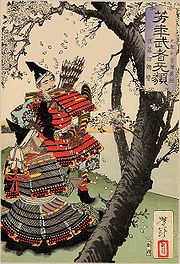
In the visual arts, Yoshitsune is commonly depicted as a bishōnen
, though this is at odds with contemporary descriptions of his appearance.
Some tales however tell of Minamoto's no Yoshitsune escaping his pursuers and would live on to live more glorious battle under a new name Genghis Khan
.
Japan
Japan is an island nation in East Asia. Located in the Pacific Ocean, it lies to the east of the Sea of Japan, China, North Korea, South Korea and Russia, stretching from the Sea of Okhotsk in the north to the East China Sea and Taiwan in the south...
in the late Heian
Heian period
The is the last division of classical Japanese history, running from 794 to 1185. The period is named after the capital city of Heian-kyō, or modern Kyōto. It is the period in Japanese history when Buddhism, Taoism and other Chinese influences were at their height...
and early Kamakura period
Kamakura period
The is a period of Japanese history that marks the governance by the Kamakura Shogunate, officially established in 1192 in Kamakura by the first shogun Minamoto no Yoritomo....
. Yoshitsune was the ninth son of Minamoto no Yoshitomo
Minamoto no Yoshitomo
was the head of the Minamoto clan and a general of the late Heian period of Japanese history. His son Minamoto no Yoritomo became shogun and founded the Kamakura Shogunate, the first shogunate in the history of Japan.-Hōgen Rebellion:...
, and the third and final son and child that Yoshitomo would father with Tokiwa Gozen
Tokiwa Gozen
Tokiwa Gozen , or Lady Tokiwa, was a Japanese noblewoman of the late Heian period and mother of the great samurai general Minamoto no Yoshitsune...
. Yoshitsune's older brother Minamoto no Yoritomo
Minamoto no Yoritomo
was the founder and the first shogun of the Kamakura Shogunate of Japan. He ruled from 1192 until 1199.-Early life and exile :Yoritomo was the third son of Minamoto no Yoshitomo, heir of the Minamoto clan, and his official wife, a daughter of Fujiwara no Suenori, who was a member of the...
(the third son of Yoshitomo) founded the Kamakura shogunate
Kamakura shogunate
The Kamakura shogunate was a military dictatorship in Japan headed by the shoguns from 1185 to 1333. It was based in Kamakura. The Kamakura period draws its name from the capital of the shogunate...
. Yoshitsune's name in childhood was Ushiwakamaru . He is considered one of the greatest and the most popular warriors of his era, and one of the most famous samurai fighters in the history of Japan.
Early life
Yoshitsune was born during the Heiji RebellionHeiji Rebellion
The was a short civil war fought in order to resolve a dispute about political power. The Heiji no ran encompassed clashes between rival subjects of the cloistered Emperor Go-Shirakawa of Japan in 1159. It was preceded by the Hōgen Rebellion in 1156...
of 1159 in which his father and oldest two brothers were killed. His life was spared and he was put under the care of Kurama Temple
Mount Kurama
is a mountain to the north-west of the city of Kyoto. It is the birthplace of the Reiki practice, and is said to be the home of Sōjōbō, King of the Tengu, who taught swordsmanship to Minamoto no Yoshitsune...
, nestled in the Hiei Mountains near the capital of Kyoto
Kyoto
is a city in the central part of the island of Honshū, Japan. It has a population close to 1.5 million. Formerly the imperial capital of Japan, it is now the capital of Kyoto Prefecture, as well as a major part of the Osaka-Kobe-Kyoto metropolitan area.-History:...
, while Yoritomo was banished to Izu Province
Izu Province
was a province of Japan in the area of Shizuoka Prefecture. Izu bordered on Sagami and Suruga Provinces. Its abbreviated form name was .The mainland portion of Izu Province, comprising the Izu Peninsula is today the eastern portion of Shizuoka Prefecture and the Izu Islands are now part of...
. Eventually, Yoshitsune was put under the protection of Fujiwara no Hidehira
Fujiwara no Hidehira
was the third ruler of Northern Fujiwara in Mutsu Province, Japan, the grandson of Fujiwara no Kiyohira. During the Genpei War, he controlled his territory independently of the central government; however, he was the official imperial governor for Mutsu Province as of 1181. He offered shelter to...
, head of the powerful regional Northern Fujiwara
Northern Fujiwara
The Northern Fujiwara were a Japanese noble family that ruled the Tōhoku region of Japan from the 12th to the 13th centuries as if it were their own realm. They succeeded the semi-independent Emishi families of the 11th century who were gradually brought down by the Minamoto clan loyal to the...
clan in Hiraizumi
Hiraizumi, Iwate
is a town located in Nishiiwai District, Iwate, Japan. It was the home of the Hiraizumi Fujiwaras for about 100 years in the late Heian era and most of the following Kamakura period. At the same time it served as the de facto capital of Oshu, an area containing nearly a third of the Japanese land...
, Mutsu Province
Mutsu Province
was an old province of Japan in the area of Fukushima, Miyagi, Iwate and Aomori prefecture and the municipalities of Kazuno and Kosaka in Akita Prefecture...
.
Career
A skillful swordsman, he defeated the legendary warrior monk Benkei in a duel. From then on, Benkei became Yoshitsune's right-hand man, eventually dying with him at the Siege of KoromogawaBattle of Koromogawa
The Battle of Koromo River took place during the opening years of the Kamakura period of Japan.After the destruction of Heike, Minamoto no Yoshitsune conflicted with his brother Minamoto no Yoritomo, and fled into Hiraizumi, Mutsu Province. He was sheltered by Northern Fujiwara's 3rd ruler...
.
Prince Mochihito
' , also known as the Takakura Prince, and as Minamoto Mochimitsu, was a son of Emperor Go-Shirakawa. He is noted for his role in starting the Genpei War....
to fight against the Taira clan
Taira clan
The was a major Japanese clan of samurai in historical Japan.In reference to Japanese history, along with Minamoto, Taira was a hereditary clan name bestowed by the emperors of the Heian Period to certain ex-members of the imperial family when they became subjects...
(also known as the Heike) which had usurped the power of the emperor. Yoshitsune shortly thereafter joined Yoritomo, along with Minamoto no Noriyori
Minamoto no Noriyori
was a late Heian period general, who fought alongside his brothers Minamoto no Yoritomo and Minamoto no Yoshitsune at a number of battles of the Genpei War. The sixth son of Minamoto no Yoshitomo, he was spared along with his brothers in 1160 by Taira no Kiyomori following Yoshitomo's death.He...
, all brothers who had never before met, in the last of three conflicts between the rival Minamoto and Taira samurai clans, known as the Genpei War
Genpei War
The was a conflict between the Taira and Minamoto clans during the late-Heian period of Japan. It resulted in the fall of the Taira clan and the establishment of the Kamakura shogunate under Minamoto Yoritomo in 1192....
.
Yoshitsune defeated and killed his rival cousin Minamoto no Yoshinaka
Minamoto no Yoshinaka
was a general of the late Heian Period of Japanese history. A member of the Minamoto samurai clan, Minamoto no Yoritomo was his cousin and rival during the Genpei War between the Minamoto and the Taira clans....
at the Battle of Awazu
Battle of Awazu
Minamoto no Yoshinaka made his final stand at Awazu, after fleeing from his cousins' armies, which confronted him after he attacked Kyoto, burning the Hōjūjiden, and kidnapping Emperor Go-Shirakawa...
in Ōmi Province
Omi Province
is an old province of Japan, which today comprises Shiga Prefecture. It was one of the provinces that made up the Tōsandō circuit. It is nicknamed as .Lake Biwa, Japan's largest lake, is located at the center of the province...
in the first month of 1184 and in the next month defeated the Taira at the Battle of Ichi-no-Tani
Battle of Ichi-no-Tani
' was a Taira fortress at Suma, to the west of present-day Kobe. It sat on a very narrow strip of shore, between mountains on the north, and the sea to the south. This made it quite defensible, but also made it difficult to maneuver troops inside the fortress. Minamoto no Yoshitsune split his force...
in present day Kobe. In 1185, Yoshitsune defeated the Taira again at the Battle of Yashima
Battle of Yashima
The naval Battle of Yashima took place on 22 March 1185. Following a long string of defeats, the Taira clan retreated to Yashima, today's Takamatsu, just off the coast of Shikoku...
in Shikoku
Shikoku
is the smallest and least populous of the four main islands of Japan, located south of Honshū and east of the island of Kyūshū. Its ancient names include Iyo-no-futana-shima , Iyo-shima , and Futana-shima...
and destroyed them at the Battle of Dan-no-ura
Battle of Dan-no-ura
The ' was a major sea battle of the Genpei War, occurring at Dan-no-ura, in the Shimonoseki Strait off the southern tip of Honshū. On March 24, 1185, the Genji clan fleet, led by Minamoto no Yoshitsune, defeated the Heike clan fleet, during a half-day engagement.The Taira were outnumbered, but...
in present day Yamaguchi Prefecture
Yamaguchi Prefecture
is a prefecture of Japan in the Chūgoku region on Honshū island. The capital is the city of Yamaguchi, in the center of the prefecture. The largest city, however, is Shimonoseki.- History :...
.
After the Genpei War, Yoshitsune joined the cloistered Emperor Go-Shirakawa
Emperor Go-Shirakawa
Emperor Go-Shirakawa was the 77th emperor of Japan, according to the traditional order of succession...
against his brother Yoritomo. Fleeing to the temporary protection of Fujiwara no Hidehira in Mutsu again, Yoshitsune was betrayed, defeated at the Battle of Koromo River, and forced to commit seppuku
Seppuku
is a form of Japanese ritual suicide by disembowelment. Seppuku was originally reserved only for samurai. Part of the samurai bushido honor code, seppuku was either used voluntarily by samurai to die with honor rather than fall into the hands of their enemies , or as a form of capital punishment...
along with his wife and daughter, by Hidehira's son Fujiwara no Yasuhira
Fujiwara no Yasuhira
was the fourth ruler of Northern Fujiwara in Mutsu Province, Japan, the second son of Hidehira. Against his father's will, he first hid Yoshitsune in escape but later killed him, fearing the possibility of Yoritomo's intervention...
. Yoshitsune is enshrined in the Shinto
Shinto
or Shintoism, also kami-no-michi, is the indigenous spirituality of Japan and the Japanese people. It is a set of practices, to be carried out diligently, to establish a connection between present day Japan and its ancient past. Shinto practices were first recorded and codified in the written...
shrine Shirahata Jinja in Fujisawa
Fujisawa, Kanagawa
is a city located in Kanagawa, Japan. As of 2010, the city had an estimated population of 407,731 and a population density of 5,870 people per km². The total area is 69.51 km²-Geography:...
.
In literature
Yoshitsune has long been a popular figure in Japanese literature and culture due to his appearance as the main character in the third section of the Japanese literary classic Heike Monogatari (Tale of the Heike)The Tale of the Heike
is an epic account of the struggle between the Taira and Minamoto clans for control of Japan at the end of the 12th century in the Genpei War...
. The Japanese term for "sympathy for a tragic hero", , comes from Yoshitsune's title Hōgan, which he received from the Imperial Court.
Traditional arts
In addition to The Tale of the HeikeThe Tale of the Heike
is an epic account of the struggle between the Taira and Minamoto clans for control of Japan at the end of the 12th century in the Genpei War...
and Chronicle of Yoshitsune (Gikeiki
Gikeiki
The is a Japanese gunki monogatari that focuses on the legends of Minamoto no Yoshitsune and his followers. Considered to have been composed during the Nanboku-chō period, it has provided inspiration to numerous Noh, kabuki and bunraku plays...
), which relates events of Yoshitsune's life after the defeat of the Heike, a great many other works of literature and drama feature him, and together form the sekai ("world") of Yoshitsune, a concept akin to the notion of the literary cycle.
These include:
- Yoshitsune Shin TakadachiYoshitsune Shin TakadachiYoshitsune Shin-Takadachi , or Yoshitsune and the New Takadachi, is a Japanese jōruri play which centers on the conflict between Minamoto no Yoshitsune and his brother, Shogun Minamoto no Yoritomo...
(jōruriBunraku, also known as Ningyō jōruri , is a form of traditional Japanese puppet theater, founded in Osaka in 1684.Three kinds of performers take part in a bunraku performance:* Ningyōtsukai or Ningyōzukai—puppeteers* Tayū—the chanters* Shamisen players...
) - Yoshitsune Senbon ZakuraYoshitsune Senbon ZakuraYoshitsune Senbon Zakura , or Yoshitsune and the Thousand Cherry Trees, is a Japanese play, one of the three most popular and famous in the Kabuki repertoire...
(jōruriBunraku, also known as Ningyō jōruri , is a form of traditional Japanese puppet theater, founded in Osaka in 1684.Three kinds of performers take part in a bunraku performance:* Ningyōtsukai or Ningyōzukai—puppeteers* Tayū—the chanters* Shamisen players...
and kabukiKabukiis classical Japanese dance-drama. Kabuki theatre is known for the stylization of its drama and for the elaborate make-up worn by some of its performers.The individual kanji characters, from left to right, mean sing , dance , and skill...
) - KanjinchōKanjinchoKanjinchō is a Japanese kabuki play by Namiki Gohei III, based on the Noh play Ataka. It is one of the most popular plays in the modern kabuki repertory....
(kabukiKabukiis classical Japanese dance-drama. Kabuki theatre is known for the stylization of its drama and for the elaborate make-up worn by some of its performers.The individual kanji characters, from left to right, mean sing , dance , and skill...
)
In the visual arts, Yoshitsune is commonly depicted as a bishōnen
Bishonen
is a Japanese term literally meaning "beautiful youth ". The equivalent English concept is a "pretty boy".The term describes an aesthetic that can be found in disparate areas in East Asia: a young man whose beauty transcends the boundary of gender or sexual orientation...
, though this is at odds with contemporary descriptions of his appearance.
Some tales however tell of Minamoto's no Yoshitsune escaping his pursuers and would live on to live more glorious battle under a new name Genghis Khan
Genghis Khan
Genghis Khan , born Temujin and occasionally known by his temple name Taizu , was the founder and Great Khan of the Mongol Empire, which became the largest contiguous empire in history after his death....
.