

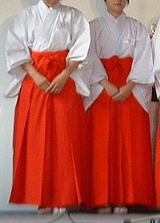
Hakama

Encyclopedia

Japanese clothing
The various traditional ethnic garments worn in Japan are still in use, they are mainly worn for ceremonies and special occasions- like weddings or festivals. Both men and women favor "western-style" clothing in their daily lives- due to the comparative convenience and the influx of global...
. They were originally worn only by men, but today they are worn by both sexes. Hakama are tied at the waist and fall approximately to the ankles. Hakama are worn over a kimono
Kimono
The is a Japanese traditional garment worn by men, women and children. The word "kimono", which literally means a "thing to wear" , has come to denote these full-length robes...
(hakamashita).
There are two types of hakama, divided and undivided . The umanori type have divided legs, similar to trousers
Trousers
Trousers are an item of clothing worn on the lower part of the body from the waist to the ankles, covering both legs separately...
. Both these types appear similar. A "mountain" or "field" type of umanori hakama was traditionally worn by field or forest workers. They are looser in the waist and narrower in the leg.
Hakama are secured by four straps (himo); two longer himo attached on either side of the front of the garment, and two shorter himo attached on either side of the rear. The rear of the garment has a rigid board-like section, called a , below that is a hakama-dome (袴止め) (a spoon shaped component sometimes referred to as a hera) which is tucked into the obi
Obi (sash)
is a sash for traditional Japanese dress, keikogi worn for Japanese martial arts, and a part of kimono outfits.The obi for men's kimono is rather narrow, wide at most, but a woman's formal obi can be wide and more than long. Nowadays, a woman's wide and decorative obi does not keep the kimono...
or himo at the rear, and helps to keep the hakama in place.
Hakama have seven deep pleats, two on the back and five on the front. The pleats are said to represent the seven virtues of bushido
Bushido
, meaning "Way of the Warrior-Knight", is a Japanese word which is used to describe a uniquely Japanese code of conduct and a way of the samurai life, loosely analogous to the concept of chivalry. It originates from the samurai moral code and stresses frugality, loyalty, martial arts mastery, and...
, considered essential to the samurai
Samurai
is the term for the military nobility of pre-industrial Japan. According to translator William Scott Wilson: "In Chinese, the character 侍 was originally a verb meaning to wait upon or accompany a person in the upper ranks of society, and this is also true of the original term in Japanese, saburau...
way. Although they appear balanced, the arrangement of the front pleats, (three to the right, two to the left) is asymmetrical, and as such is an example of asymmetry
Asymmetry
Asymmetry is the absence of, or a violation of, symmetry.-In organisms:Due to how cells divide in organisms, asymmetry in organisms is fairly usual in at least one dimension, with biological symmetry also being common in at least one dimension....
in Japanese aesthetics
Japanese aesthetics
The modern study of a Japanese aesthetics in the Western sense only started a little over two hundred years ago. But, by the term Japanese aesthetic, we tend to mean not this modern study, but a set of ancient ideals that include wabi , sabi , and yûgen...
.
Men's hakama
The most formal type of men's hakama are made of stiff, striped silkSilk
Silk is a natural protein fiber, some forms of which can be woven into textiles. The best-known type of silk is obtained from the cocoons of the larvae of the mulberry silkworm Bombyx mori reared in captivity...
, usually black and white, or black and navy blue. These are worn with black montsuki kimono (kimono with one, three, or five family coats of arms on the back, chest, and shoulders), white tabi
Tabi
are traditional Japanese socks. Ankle-high and with a separation between the big toe and other toes, they are worn by both men and women with zori, geta, and other traditional thonged footwear. Tabi are also essential with traditional clothing—kimono and other wafuku as well as being worn by...
(divided-toe socks), white nagajuban (under-kimono) and various types of footwear. In cooler weather, a montsuki haori (long jacket) with a white haori-himo (haori-fastener) completes the outfit.
Hakama can be worn with any type of kimono except yukata
Yukata
A is a Japanese garment, a casual summer kimono usually made of cotton. People wearing yukata are a common sight in Japan at fireworks displays, bon-odori festivals, and other summer events. The yukata is also frequently worn after bathing at traditional Japanese inns...
(light cotton summer kimono generally worn for relaxing, for sleeping, or at festivals or summer outings). While striped hakama are usually worn with formal kimono, stripes in colours other than black, grey and white may be worn with less formal wear. Solid and graduated colours are also common.
While hakama used to be a required part of men's wear, nowadays typical Japanese men usually wear hakama only on extremely formal occasions and at tea ceremonies
Japanese tea ceremony
The Japanese tea ceremony, also called the Way of Tea, is a Japanese cultural activity involving the ceremonial preparation and presentation of matcha, powdered green tea. In Japanese, it is called . The manner in which it is performed, or the art of its performance, is called...
, weddings, and funerals. Hakama are also regularly worn by practitioners of a variety of martial arts
Martial arts
Martial arts are extensive systems of codified practices and traditions of combat, practiced for a variety of reasons, including self-defense, competition, physical health and fitness, as well as mental and spiritual development....
, such as kendo
Kendo
, meaning "Way of The Sword", is a modern Japanese martial art of sword-fighting based on traditional Japanese swordsmanship, or kenjutsu.Kendo is a physically and mentally challenging activity that combines strong martial arts values with sport-like physical elements.-Practitioners:Practitioners...
, iaido
Iaido
is a modern Japanese martial art associated with the smooth, controlled movements of drawing the sword from its scabbard, striking or cutting an opponent, removing blood from the blade, and then replacing the sword in the scabbard...
, taido
Taido
Taidō is a Japanese martial art created in 1965 by Seiken Shukumine . The word taidō means "way of the body." Taidō has its roots in traditional Okinawan Karate...
, aikido
Aikido
is a Japanese martial art developed by Morihei Ueshiba as a synthesis of his martial studies, philosophy, and religious beliefs. Aikido is often translated as "the Way of unifying life energy" or as "the Way of harmonious spirit." Ueshiba's goal was to create an art that practitioners could use to...
, ryu-te, and kyūdō
Kyudo
, literally meaning "way of the bow", is the Japanese art of archery. It is a modern Japanese martial art and practitioners are known as .It is estimated that there are approximately half a million practitioners of kyudo today....
. Sumo
Sumo
is a competitive full-contact sport where a wrestler attempts to force another wrestler out of a circular ring or to touch the ground with anything other than the soles of the feet. The sport originated in Japan, the only country where it is practiced professionally...
wrestlers, who do not wear hakama in the context of their sport, are, however, required to wear traditional Japanese dress whenever they appear in public. As hakama are one of the most important parts of traditional male formal dress, sumo wrestlers are often seen wearing hakama when attending appropriately formal functions.
In addition to martial artists, hakama are also part of the every-day wear of Shinto kannushi
Kannushi
A , also called , is the person responsible for the maintenance of a Shinto shrine as well as for leading worship of a given kami. The characters for kannushi are sometimes also read jinshu with the same meaning....
, priests who maintain and perform services at shrines.
Kamishimo, kataginu, and naga-bakama
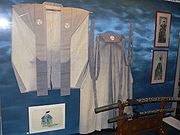
Edo period
The , or , is a division of Japanese history which was ruled by the shoguns of the Tokugawa family, running from 1603 to 1868. The political entity of this period was the Tokugawa shogunate....
, the outfit included a formal kimono, hakama, and a sleeveless jacket with exaggerated shoulders called a kataginu (pictured).
Samurai visiting the shōgun
Shogun
A was one of the hereditary military dictators of Japan from 1192 to 1867. In this period, the shoguns, or their shikken regents , were the de facto rulers of Japan though they were nominally appointed by the emperor...
and other high-ranking daimyo
Daimyo
is a generic term referring to the powerful territorial lords in pre-modern Japan who ruled most of the country from their vast, hereditary land holdings...
at court were sometimes required to wear very long hakama called naga-bakama (long hakama). These resemble normal hakama in every way except their remarkable length in both the back and front, forming a train one or two feet long and impeding the ability to walk normally, thus helping to prevent a surprise attack or assassination attempt (see image here). Naga-bakama are now only worn particularly in noh
Noh
, or - derived from the Sino-Japanese word for "skill" or "talent" - is a major form of classical Japanese musical drama that has been performed since the 14th century. Many characters are masked, with men playing male and female roles. Traditionally, a Noh "performance day" lasts all day and...
plays (including kyōgen
Kyogen
is a form of traditional Japanese comic theater. It developed alongside Noh, was performed along with Noh as an intermission of sorts between Noh acts, on the same Noh stage, and retains close links to Noh in the modern day; therefore, it is sometimes designated Noh-kyōgen...
), Kabuki plays and Shinto
Shinto
or Shintoism, also kami-no-michi, is the indigenous spirituality of Japan and the Japanese people. It is a set of practices, to be carried out diligently, to establish a connection between present day Japan and its ancient past. Shinto practices were first recorded and codified in the written...
rituals.
Karusan-bakama
Some hakama during the Sengoku periodSengoku period
The or Warring States period in Japanese history was a time of social upheaval, political intrigue, and nearly constant military conflict that lasted roughly from the middle of the 15th century to the beginning of the 17th century. The name "Sengoku" was adopted by Japanese historians in reference...
had the hems made narrower than the body in imitation of the ballooning trousers worn by the Portuguese. This style carried on into the Edo period and became called karusan-bakama. In addition to the taper, they had a secured band of cloth—looking rather like a pants cuff—sewn around each leg’s hem, so the ballooning fabric would not open out like regular hakama.
Sashinuki hakama
Sashinuki are a type of hakama that are meant to be worn blousing over the leg and exposing the foot. To accomplish this, they are somewhat longer than normal hakama, and a cord is run through the hem and drawn tight, creating a "ballooning" effect . To allow for the body required, more formal sashinuki were six-panel hakama rather than four panels. Technically, this cord around the ankle makes sashinuki a type of kukuri- (tied) hakama. The earliest form of sashinuki were cut like normal hakama (albeit a bit longer) and have a cord running through the hem of each leg. These cords were pulled tight and tied off at the ankle. This was the form commonly worn during the Heian period. Sashinuki were worn by court nobles with various types of leisure or semi-formal wear.Women's hakama

While men's hakama can be worn on both formal and informal occasions, except as part of martial arts wear, women rarely wear hakama except at graduation ceremonies and for traditional Japanese sports such as kyudo
Kyudo
, literally meaning "way of the bow", is the Japanese art of archery. It is a modern Japanese martial art and practitioners are known as .It is estimated that there are approximately half a million practitioners of kyudo today....
, aikido
Aikido
is a Japanese martial art developed by Morihei Ueshiba as a synthesis of his martial studies, philosophy, and religious beliefs. Aikido is often translated as "the Way of unifying life energy" or as "the Way of harmonious spirit." Ueshiba's goal was to create an art that practitioners could use to...
and kendo
Kendo
, meaning "Way of The Sword", is a modern Japanese martial art of sword-fighting based on traditional Japanese swordsmanship, or kenjutsu.Kendo is a physically and mentally challenging activity that combines strong martial arts values with sport-like physical elements.-Practitioners:Practitioners...
. Only very rarely are hakama worn by women at tea ceremony.
The most iconic image of women in hakama is the miko
Miko
is a Japanese term that anciently meant a "female shaman, spirit medium" who conveyed oracles from kami , and currently means a "shrine maiden; virgin consecrated to a deity" who serves at Shinto shrines.-Word:...
or shrine maidens who assist in maintenance and ceremonies. A miko's uniform consists of a plain white kimono with a bright red hakama, sometimes a red naga-bakama during formal ceremonies.
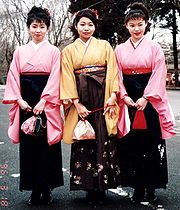
Sakura
A cherry blossom is the flower of any of several trees of genus Prunus, particularly the Japanese Cherry, Prunus serrulata, which is sometimes called sakura after the Japanese . Many of the varieties that have been cultivated for ornamental use do not produce fruit...
. Women typically wear hakama just below the bust line, while men wear them at the waist.
Tying hakama
There are many ways for men to tie hakama. First, the obi is tied in a special knot (an "under-hakama knot") at the rear. Starting with the front, the ties are brought around the waist and crossed over the top of the knot of the obi. The ties are brought to the front and crossed below the waist, then tied at the back, under the knot of the obi. The hakama-dome is then tucked behind the obi, the koshi-ita is adjusted, and the rear ties brought to the front and tied in a variety of ways. The most formal method results in a knot that resembles two bow-ties in a cross shape.The method of tying the ties is also different, with women's hakama being tied in a simpler knot or a bow. As with men's hakama, the front ties are first brought to the back, then to the front, then tied at the back in a knot. Then the back himo are brought around to the front. At this point, they may be tied with a bow at the left hip, just in front of the opening, with the ends of the ties at equal lengths. For more secure fastening, the ties may be wrapped once at center front, then tied inside at the back.
Folding hakama

Hakama are often considered particularly challenging to learn to fold properly, in part because of their pleats and in part because their long ties must be correctly smoothed and gathered before being tied in specific patterns.
Various martial arts traditions in which practitioners wear them have prescribed methods of folding the hakama. This is often considered an important part of etiquette
Etiquette
Etiquette is a code of behavior that delineates expectations for social behavior according to contemporary conventional norms within a society, social class, or group...
.
In some martial arts it is also an old tradition that the highest ranking student has the responsibility to fold the teacher's hakama as a token of respect.
Further reading
- How to tie a Hakama, AikidoStyle 40Door Corporation.
- How to fold the Hakama, Southern California Naginata Federation.
- How to tie a Hakama, Bu Jin Design Corporation.
- How to wash a Hakama, Kendo America. La structure secrète du hakama