


Emperor Go-Shirakawa

Encyclopedia
Emperor Go-Shirakawa (October 18, 1127 – April 26, 1192) was the 77th emperor
of Japan
, according to the traditional order of succession. His reign spanned the years from 1155 through 1158.
This 12th century sovereign was named after the 11th century Emperor Shirakawa
and go- (後), translates literally as "later;" and thus, he is sometimes called the "Later Emperor Shirakawa". The Japanese word "go" has also been translated to mean the "second one;" and in some older sources, this emperor may be identified as "Shirakawa, the second," or as "Shirakawa II."
, his personal name (his imina) was Masahito-shinnō (雅仁親王).
He was the fourth son of Emperor Toba
. His mother was Shōko
(璋子), the daughter of Fujiwara Kinzane (藤原公実)
Major consorts and children
He accumulated power steadily after the Hōgen Rebellion
; his reign commenced in 1155. In 1158, he abdicated, but continued to hold power as a cloistered emperor
. He attempted to decrease the influence of the Fujiwara clan and increased the power of the samurai
. His policy allowed Taira no Kiyomori
to seize power, and at the end of his life he allowed Minamoto no Yoritomo
to establish the Kamakura shogunate
in Kamakura
, in the province of Sagami, modern-day Kanagawa
. The establishment of the Shogunate (or Bakufu) was the beginning of samurai control of Japan for 700 years until the Meiji Restoration
in the middle of the 19th century.
Retired Emperor Toba
expected him to be on the throne. When his brother, Emperor Konoe
, died in 1155, Go-Shirakawa became emperor with support of Toba and a powerful lord Fujiwara no Tadamichi
, since they were against Retired Emperor Sutoku
and did not want his son to be the next emperor. They expected Go-Shirakawa to keep the throne until his son, the future Emperor Nijō
would be old enough succeed him. The coronation of Go-Shirakawa made the political tension between Toba and Sutoku stronger. At the beginning of Go-Shirakawa's reign Toba continued to reign as a cloistered emperor
until his death.
In 1156 Toba died and soon afterwards the Hōgen Rebellion
arose. Go-Shirakawa gained the support of samurai including Minamoto no Yoshitomo
and Taira no Kiyomori
, and they defeated the armies of Sutoku. After the rebellion, Go-Shirakawa ruled Japan by himself.
In 1158 he abdicated to his son Nijō and became cloistered emperor, through the reigns of five emperors (Emperor Nijō
, Emperor Rokujō
, Emperor Takakura
, Emperor Antoku
, and Emperor Go-Toba
) until his death in 1192.
Taira no Kiyomori
and Go-Shirakawa were on good terms initially. Kiyomori began trade with China
and supported Go-Shirakawa, not just militarily but also financially. Two samurai clans, the Taira and the Minamoto, stood against each other, and the Heiji Rebellion
occurred in 1159.
The Minamoto lost and the Taira seized power. With Kiyomori's power at its peak, the good relationship between Kiyomori and Go-Shirakawa ended. Go-Shirakawa attempted a coup d'état
to expel Kiyomori in 1177 but failed. Kiyomori forced Go-Shirakawa to stay in Toba-in, the former palace of his father, Emperor Toba, in 1179. In 1178 Kiyomori made Imperial Prince Tokihito
crown prince. Tokihito was his grandson, the child of Emperor Takakura
and empress consort Taira no Tokuko
, who was a daughter of Kiyomori.
Go-Shirakawa planned to regain power, and secretly sent his son Prince Mochihito
to deliver a message to the Minamoto in which Go-Shirakawa proclaimed the Taira as the enemy of the court and requested that the Minamotos fight against them. In 1180 Mochihito and Minamoto no Yorimasa
started the first rebellion. It failed, but several other samurai followed their attempt. In 1181 Kiyomori died and the decline of the Taira began. Go-Shirakawa began ruling again as cloistered emperor. In 1183 Minamoto no Yoshinaka
from Musashi province
defeated the Taira and entered Kyōto
. After internal struggles within the Minamoto clan, Minamoto no Yoshitsune
, a brother of Yoritomo
finally destroyed the Taira clan entirely in 1185 at the Battle of Dan-no-ura
.
Go-Shirakawa came to bad terms with Yoritomo, and between them Yoshitsune was sacrificed. Yoritomo considered Yoshitsune disloyal to him and finally in 1189 Yoshitsune died in the battle of Mutsu province
. At the same time the Ōshū Fujiwara clan, the Fujiwara clan in Mutsu province, was destroyed because they supported Yoshitsune against Yoritomo, who claimed then the title of chief of all samurai. After the death of Yoshitsune, Go-Shirakawa and Yoritomo reconciled and Go-Shirakawa allowed Yoritomo found a new shogunate.
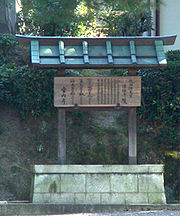
The Imperial Household has designated Hōjū-ji no Misasagi at Kyoto as the emperor's official mausoleum.
in pre-Meiji
eras.
In general, this elite group included only three to four men at a time. These were hereditary courtiers whose experience and background would have brought them to the pinnacle of a life's career. During Go-Shirakawa's reign, this apex of the Daijō-kan included:
Emperor of Japan
The Emperor of Japan is, according to the 1947 Constitution of Japan, "the symbol of the state and of the unity of the people." He is a ceremonial figurehead under a form of constitutional monarchy and is head of the Japanese Imperial Family with functions as head of state. He is also the highest...
of Japan
Japan
Japan is an island nation in East Asia. Located in the Pacific Ocean, it lies to the east of the Sea of Japan, China, North Korea, South Korea and Russia, stretching from the Sea of Okhotsk in the north to the East China Sea and Taiwan in the south...
, according to the traditional order of succession. His reign spanned the years from 1155 through 1158.
This 12th century sovereign was named after the 11th century Emperor Shirakawa
Emperor Shirakawa
was the 72nd emperor of Japan, according to the traditional order of succession.Shirakawa's reign lasted from 1073 to 1087.-Genealogy:Before his ascension to the Chrysanthemum Throne, his personal name was Sadahito-shinnō ....
and go- (後), translates literally as "later;" and thus, he is sometimes called the "Later Emperor Shirakawa". The Japanese word "go" has also been translated to mean the "second one;" and in some older sources, this emperor may be identified as "Shirakawa, the second," or as "Shirakawa II."
Genealogy
Before his ascension to the Chrysanthemum ThroneChrysanthemum Throne
The is the English term used to identify the throne of the Emperor of Japan. The term can refer to very specific seating, such as the takamikura throne in the Shishin-den at Kyoto Imperial Palace....
, his personal name (his imina) was Masahito-shinnō (雅仁親王).
He was the fourth son of Emperor Toba
Emperor Toba
was the 74th emperor of Japan, according to the traditional order of succession.Toba's reign spanned the years from 1107 through 1123.- Genealogy :...
. His mother was Shōko
Shōko
The shōko is a small bronze gong, struck with two horn beaters, used in Japanese gagaku. It is suspended in a vertical frame and comes in three sizes.-See also:*Kane...
(璋子), the daughter of Fujiwara Kinzane (藤原公実)
Major consorts and children
- Empress (chūgū): TokudaijiFujiwara no Kinshi (Go-Shirakawa)Fujiwara no Kinshi was an Empress consort of Japan. She was the consort of Emperor Go-Shirakawa of Japan.- Sources :...
(Fujiwara) ?? - Consort (shinnō-hi): Minamoto Atsushiko (?) (源懿子)
- First son: Imperial Prince Morihito (守仁親王) (Emperor NijōEmperor NijoEmperor Nijō was the 78th emperor of Japan, according to the traditional order of succession. His reign spaned the years from 1158 through 1165.- Genealogy :...
)
- First son: Imperial Prince Morihito (守仁親王) (Emperor Nijō
- Court Lady: Sanjō (Fujiwara) Sōko (?) (三条(藤原)琮子)
- Court Lady: Taira no Shigeko (平滋子)
- Seventh son: Imperial Prince Norihito (憲仁親王) (Emperor TakakuraEmperor TakakuraEmperor Takakura was the 80th emperor of Japan, according to the traditional order of succession. His reign spanned the years from 1168 through 1180.-Genealogy:...
)
- Seventh son: Imperial Prince Norihito (憲仁親王) (Emperor Takakura
- Consort: Fujiwara Naruko ?? (藤原成子)
- Third son: Prince MochihitoPrince Mochihito' , also known as the Takakura Prince, and as Minamoto Mochimitsu, was a son of Emperor Go-Shirakawa. He is noted for his role in starting the Genpei War....
(以仁王)
- Third son: Prince Mochihito
Events of Go-Shirakawa's life
- August 22, 1155 (KyūjuKyujuwas a after Ninpei and before Hōgen. This period spanned the years from October 1151 through April 1154. The reigning emperors were and .-Change of era:* February 14, 1154 : The new era name was created to mark an event or a number of events...
2, 23rd day of the 7th month): Emperor KonoeEmperor Konoewas the 76th emperor of Japan, according to the traditional order of succession.Konoe's reign spanned the years from 1142 through 1155.-Genealogy:...
died at the age of 17 years without leaving any heirs.
- August 23, 1155 (Kyūju 2, 24th day of the 7th month): In the 14th year of Konoe-tennō 's reign (近衛天皇14年), the emperor died; and despite an ensuring dispute over who should follow him as sovereign, contemporary scholars then construed that the succession (senso) was received by a younger brother, the 14th son of former-Emperor Toba. Shortly thereafter, Emperor Go-Shirakawa is said to have acceded to the throne (sokui).
He accumulated power steadily after the Hōgen Rebellion
Hogen Rebellion
The was a short civil war fought in order to resolve a dispute about Japanese Imperial succession. The dispute was also about the degree of control exercised by the Fujiwara clan who had become hereditary Imperial regents during the Heian period....
; his reign commenced in 1155. In 1158, he abdicated, but continued to hold power as a cloistered emperor
Cloistered rule
The Insei system , or cloistered rule, was a specific form of government in Japan during the Heian period. In this bifurcated system, an Emperor abdicated, but he retained power and influence. The emperors who withdrew to live in monasteries continued to act in ways which were intended to...
. He attempted to decrease the influence of the Fujiwara clan and increased the power of the samurai
Samurai
is the term for the military nobility of pre-industrial Japan. According to translator William Scott Wilson: "In Chinese, the character 侍 was originally a verb meaning to wait upon or accompany a person in the upper ranks of society, and this is also true of the original term in Japanese, saburau...
. His policy allowed Taira no Kiyomori
Taira no Kiyomori
was a general of the late Heian period of Japan. He established the first samurai-dominated administrative government in the history of Japan.After the death of his father Taira no Tadamori in 1153, Kiyomori assumed control of the Taira clan and ambitiously entered the political realm in which he...
to seize power, and at the end of his life he allowed Minamoto no Yoritomo
Minamoto no Yoritomo
was the founder and the first shogun of the Kamakura Shogunate of Japan. He ruled from 1192 until 1199.-Early life and exile :Yoritomo was the third son of Minamoto no Yoshitomo, heir of the Minamoto clan, and his official wife, a daughter of Fujiwara no Suenori, who was a member of the...
to establish the Kamakura shogunate
Kamakura shogunate
The Kamakura shogunate was a military dictatorship in Japan headed by the shoguns from 1185 to 1333. It was based in Kamakura. The Kamakura period draws its name from the capital of the shogunate...
in Kamakura
Kamakura, Kanagawa
is a city located in Kanagawa Prefecture, Japan, about south-south-west of Tokyo. It used to be also called .Although Kamakura proper is today rather small, it is often described in history books as a former de facto capital of Japan as the seat of the Shogunate and of the Regency during the...
, in the province of Sagami, modern-day Kanagawa
Kanagawa Prefecture
is a prefecture located in the southern Kantō region of Japan. The capital is Yokohama. Kanagawa is part of the Greater Tokyo Area.-History:The prefecture has some archaeological sites going back to the Jōmon period...
. The establishment of the Shogunate (or Bakufu) was the beginning of samurai control of Japan for 700 years until the Meiji Restoration
Meiji Restoration
The , also known as the Meiji Ishin, Revolution, Reform or Renewal, was a chain of events that restored imperial rule to Japan in 1868...
in the middle of the 19th century.
Retired Emperor Toba
Emperor Toba
was the 74th emperor of Japan, according to the traditional order of succession.Toba's reign spanned the years from 1107 through 1123.- Genealogy :...
expected him to be on the throne. When his brother, Emperor Konoe
Emperor Konoe
was the 76th emperor of Japan, according to the traditional order of succession.Konoe's reign spanned the years from 1142 through 1155.-Genealogy:...
, died in 1155, Go-Shirakawa became emperor with support of Toba and a powerful lord Fujiwara no Tadamichi
Fujiwara no Tadamichi
was the eldest son of the Japanese regent Fujiwara no Tadazane and a member of the politically powerful Fujiwara clan. He was the father of Fujiwara no Kanefusa and Jien.In the Hōgen Rebellion of 1156, Tadamichi sided with the Emperor Go-Shirakawa....
, since they were against Retired Emperor Sutoku
Emperor Sutoku
was the 75th emperor of Japan, according to the traditional order of succession.Sutoku's reign spanned the years from 1123 through 1142.-Genealogy:Before his ascension to the Chrysanthemum Throne, his personal name was Akihito ....
and did not want his son to be the next emperor. They expected Go-Shirakawa to keep the throne until his son, the future Emperor Nijō
Emperor Nijo
Emperor Nijō was the 78th emperor of Japan, according to the traditional order of succession. His reign spaned the years from 1158 through 1165.- Genealogy :...
would be old enough succeed him. The coronation of Go-Shirakawa made the political tension between Toba and Sutoku stronger. At the beginning of Go-Shirakawa's reign Toba continued to reign as a cloistered emperor
Cloistered rule
The Insei system , or cloistered rule, was a specific form of government in Japan during the Heian period. In this bifurcated system, an Emperor abdicated, but he retained power and influence. The emperors who withdrew to live in monasteries continued to act in ways which were intended to...
until his death.
- July 20, 1156 (HōgenHogen (era)was a after Kyūju and before Heiji. This period spanned the years from April 1156 through April 1159. The reigning emperors were and .-Change of era:* January 24, 1156 : The new era name was created to mark an event or series of events...
1, 2nd day of the 7th month): The former-Emperor Toba died at the age of 54.
In 1156 Toba died and soon afterwards the Hōgen Rebellion
Hogen Rebellion
The was a short civil war fought in order to resolve a dispute about Japanese Imperial succession. The dispute was also about the degree of control exercised by the Fujiwara clan who had become hereditary Imperial regents during the Heian period....
arose. Go-Shirakawa gained the support of samurai including Minamoto no Yoshitomo
Minamoto no Yoshitomo
was the head of the Minamoto clan and a general of the late Heian period of Japanese history. His son Minamoto no Yoritomo became shogun and founded the Kamakura Shogunate, the first shogunate in the history of Japan.-Hōgen Rebellion:...
and Taira no Kiyomori
Taira no Kiyomori
was a general of the late Heian period of Japan. He established the first samurai-dominated administrative government in the history of Japan.After the death of his father Taira no Tadamori in 1153, Kiyomori assumed control of the Taira clan and ambitiously entered the political realm in which he...
, and they defeated the armies of Sutoku. After the rebellion, Go-Shirakawa ruled Japan by himself.
In 1158 he abdicated to his son Nijō and became cloistered emperor, through the reigns of five emperors (Emperor Nijō
Emperor Nijo
Emperor Nijō was the 78th emperor of Japan, according to the traditional order of succession. His reign spaned the years from 1158 through 1165.- Genealogy :...
, Emperor Rokujō
Emperor Rokujo
Emperor Rokujō was the 79th emperor of Japan, according to the traditional order of succession. His reign spanned the years from 1165 through 1168.-Genealogy:...
, Emperor Takakura
Emperor Takakura
Emperor Takakura was the 80th emperor of Japan, according to the traditional order of succession. His reign spanned the years from 1168 through 1180.-Genealogy:...
, Emperor Antoku
Emperor Antoku
Emperor Antoku was the 81st emperor of Japan, according to the traditional order of succession. His reign spanned the years from 1180 through 1185. During this time, the imperial family was involved in a bitter struggle between warring clans...
, and Emperor Go-Toba
Emperor Go-Toba
was the 82nd emperor of Japan, according to the traditional order of succession. His reign spanned the years from 1183 through 1198....
) until his death in 1192.
Taira no Kiyomori
Taira no Kiyomori
was a general of the late Heian period of Japan. He established the first samurai-dominated administrative government in the history of Japan.After the death of his father Taira no Tadamori in 1153, Kiyomori assumed control of the Taira clan and ambitiously entered the political realm in which he...
and Go-Shirakawa were on good terms initially. Kiyomori began trade with China
China
Chinese civilization may refer to:* China for more general discussion of the country.* Chinese culture* Greater China, the transnational community of ethnic Chinese.* History of China* Sinosphere, the area historically affected by Chinese culture...
and supported Go-Shirakawa, not just militarily but also financially. Two samurai clans, the Taira and the Minamoto, stood against each other, and the Heiji Rebellion
Heiji Rebellion
The was a short civil war fought in order to resolve a dispute about political power. The Heiji no ran encompassed clashes between rival subjects of the cloistered Emperor Go-Shirakawa of Japan in 1159. It was preceded by the Hōgen Rebellion in 1156...
occurred in 1159.
- 1169 (KaōKaoKao may refer to:* Kao, a Japanese term for face., a stylized signature or a mark used in place of a signature in China and Japan* Kao , a crater on the Moon.* Kaō , a Japanese era name* Kao , a film by Michiyo Okusu...
1, 6th month): Emperor Go-Shirakawa entered the Buddhist priesthood at the age of 42. He took the Buddhist name of Gyōshin.
The Minamoto lost and the Taira seized power. With Kiyomori's power at its peak, the good relationship between Kiyomori and Go-Shirakawa ended. Go-Shirakawa attempted a coup d'état
Coup d'état
A coup d'état state, literally: strike/blow of state)—also known as a coup, putsch, and overthrow—is the sudden, extrajudicial deposition of a government, usually by a small group of the existing state establishment—typically the military—to replace the deposed government with another body; either...
to expel Kiyomori in 1177 but failed. Kiyomori forced Go-Shirakawa to stay in Toba-in, the former palace of his father, Emperor Toba, in 1179. In 1178 Kiyomori made Imperial Prince Tokihito
Emperor Antoku
Emperor Antoku was the 81st emperor of Japan, according to the traditional order of succession. His reign spanned the years from 1180 through 1185. During this time, the imperial family was involved in a bitter struggle between warring clans...
crown prince. Tokihito was his grandson, the child of Emperor Takakura
Emperor Takakura
Emperor Takakura was the 80th emperor of Japan, according to the traditional order of succession. His reign spanned the years from 1168 through 1180.-Genealogy:...
and empress consort Taira no Tokuko
Taira no Tokuko
For the asteroid, see 5242 Kenreimonin, later known as , was the last Heike Imperial survivor from the modest vessel carrying the emperor in the great naval battle of Dan-no-ura....
, who was a daughter of Kiyomori.
Go-Shirakawa planned to regain power, and secretly sent his son Prince Mochihito
Prince Mochihito
' , also known as the Takakura Prince, and as Minamoto Mochimitsu, was a son of Emperor Go-Shirakawa. He is noted for his role in starting the Genpei War....
to deliver a message to the Minamoto in which Go-Shirakawa proclaimed the Taira as the enemy of the court and requested that the Minamotos fight against them. In 1180 Mochihito and Minamoto no Yorimasa
Minamoto no Yorimasa
' was a prominent Japanese poet whose works appeared in various anthologies. He served eight different emperors in his long career, holding posts such as hyōgo no kami...
started the first rebellion. It failed, but several other samurai followed their attempt. In 1181 Kiyomori died and the decline of the Taira began. Go-Shirakawa began ruling again as cloistered emperor. In 1183 Minamoto no Yoshinaka
Minamoto no Yoshinaka
was a general of the late Heian Period of Japanese history. A member of the Minamoto samurai clan, Minamoto no Yoritomo was his cousin and rival during the Genpei War between the Minamoto and the Taira clans....
from Musashi province
Musashi Province
was a province of Japan, which today comprises Tokyo Prefecture, most of Saitama Prefecture and part of Kanagawa Prefecture. It was sometimes called . The province encompassed Kawasaki and Yokohama...
defeated the Taira and entered Kyōto
Kyoto
is a city in the central part of the island of Honshū, Japan. It has a population close to 1.5 million. Formerly the imperial capital of Japan, it is now the capital of Kyoto Prefecture, as well as a major part of the Osaka-Kobe-Kyoto metropolitan area.-History:...
. After internal struggles within the Minamoto clan, Minamoto no Yoshitsune
Minamoto no Yoshitsune
was a general of the Minamoto clan of Japan in the late Heian and early Kamakura period. Yoshitsune was the ninth son of Minamoto no Yoshitomo, and the third and final son and child that Yoshitomo would father with Tokiwa Gozen. Yoshitsune's older brother Minamoto no Yoritomo founded the Kamakura...
, a brother of Yoritomo
Minamoto no Yoritomo
was the founder and the first shogun of the Kamakura Shogunate of Japan. He ruled from 1192 until 1199.-Early life and exile :Yoritomo was the third son of Minamoto no Yoshitomo, heir of the Minamoto clan, and his official wife, a daughter of Fujiwara no Suenori, who was a member of the...
finally destroyed the Taira clan entirely in 1185 at the Battle of Dan-no-ura
Battle of Dan-no-ura
The ' was a major sea battle of the Genpei War, occurring at Dan-no-ura, in the Shimonoseki Strait off the southern tip of Honshū. On March 24, 1185, the Genji clan fleet, led by Minamoto no Yoshitsune, defeated the Heike clan fleet, during a half-day engagement.The Taira were outnumbered, but...
.
Go-Shirakawa came to bad terms with Yoritomo, and between them Yoshitsune was sacrificed. Yoritomo considered Yoshitsune disloyal to him and finally in 1189 Yoshitsune died in the battle of Mutsu province
Mutsu Province
was an old province of Japan in the area of Fukushima, Miyagi, Iwate and Aomori prefecture and the municipalities of Kazuno and Kosaka in Akita Prefecture...
. At the same time the Ōshū Fujiwara clan, the Fujiwara clan in Mutsu province, was destroyed because they supported Yoshitsune against Yoritomo, who claimed then the title of chief of all samurai. After the death of Yoshitsune, Go-Shirakawa and Yoritomo reconciled and Go-Shirakawa allowed Yoritomo found a new shogunate.
- 1192 (KenkyūKenkyuwas a after Bunji and before Shōji. This period spanned the years from April 1190 through April 1199. The reigning emperor was .-Change of era:* 1190 : The new era name was created to mark an event or a number of events...
3, 13th day of the 3rd month): The former-Emperor Go-Shirakawa died at the age of 66. He had been father or grandfather to five emperors—Nijō, the 78th emperor; Rokujō, the 79th emperor; Takakura, the 80th emperor; Antoku, the 81st emperor; and Go-Toba, the 82nd emperor.
The Imperial Household has designated Hōjū-ji no Misasagi at Kyoto as the emperor's official mausoleum.
Kugyō
Kugyō (公卿) is a collective term for the very few most powerful men attached to the court of the Emperor of JapanEmperor of Japan
The Emperor of Japan is, according to the 1947 Constitution of Japan, "the symbol of the state and of the unity of the people." He is a ceremonial figurehead under a form of constitutional monarchy and is head of the Japanese Imperial Family with functions as head of state. He is also the highest...
in pre-Meiji
Meiji period
The , also known as the Meiji era, is a Japanese era which extended from September 1868 through July 1912. This period represents the first half of the Empire of Japan.- Meiji Restoration and the emperor :...
eras.
In general, this elite group included only three to four men at a time. These were hereditary courtiers whose experience and background would have brought them to the pinnacle of a life's career. During Go-Shirakawa's reign, this apex of the Daijō-kan included:
- Kampaku, Fujiwara Tadamichi, 1099–1164.
- Daijō-daijin, Sanjō Saneyuki, 1079–1162.
- SadaijinSadaijin, most commonly translated as "Minister of the Left", was a government position in Japan in the late Nara and Heian periods. The position was consolidated in the Taihō Code of 702. The Asuka Kiyomihara Code of 689 marks the initial appearance of the Sadaijin in the context of a central...
, Fujiwara Yorinaga, 1120–1156. - UdaijinUdaijinUdaijin , most commonly translated as the "Minister of the Right", was a government position in Japan in the late Nara and Heian periods. The position was consolidated in the Taihō Code of 702. The Asuka Kiyomihara Code of 689 marks the initial appearance of the Udaijin in the context of a central...
- Nadaijin
- DainagonDainagonwas a counselor of the first rank in the Imperial court of Japan. The role dates from the 7th century.This advisory position remained a part of the Imperial court from the 8th century until the Meiji period in the 19th century....
Eras of Go-Shirakawa's reign
The years of Go-Shirakawa's reign are more specifically identified by more than one era name or nengō.- KyūjuKyujuwas a after Ninpei and before Hōgen. This period spanned the years from October 1151 through April 1154. The reigning emperors were and .-Change of era:* February 14, 1154 : The new era name was created to mark an event or a number of events...
(1154–1156) - HōgenHogen (era)was a after Kyūju and before Heiji. This period spanned the years from April 1156 through April 1159. The reigning emperors were and .-Change of era:* January 24, 1156 : The new era name was created to mark an event or series of events...
(1156–1159)