


Akita Prefecture

Encyclopedia
is a prefecture
of Japan
located in the Tōhoku Region
of northern Honshu
, the main island of Japan. The capital is the city of Akita
.
and Mutsu
.
Separated from the principal Japanese centres of commerce, politics, and population by several hundred kilometres and the Ōu
and Dewa mountain ranges to the east, Akita remained largely isolated from Japanese society until after the year 600. Akita was a region of hunter-gatherers and principally nomadic tribes.
The first historical record of what is now Akita Prefecture dates to 658, when the Abe no Hirafu
conquered the native Ezo
tribes at what are now the cities of Akita and Noshiro. Hirafu, then governor of Koshi Province
(the northwest part of Honshū bordering the Sea of Japan
), established a fort on the Mogami River
, and thus began the Japanese settlement of the region.
In 733, a new military settlement—later renamed Akita Castle—was built in modern-day Akita city at Takashimizu, and more permanent roads and structures were developed. The region was used as a base of operations for the Japanese empire as it drove the native Ezo people from northern Honshū.
It shifted hands several times. During the Tokugawa shogunate
it was appropriated to the Satake clan
, who ruled the region for 260 years, developing the agriculture and mining industries that are still predominant today. Throughout this period, it was classified as part of Dewa Province
. In 1871, during the Meiji Restoration, Dewa Province was reshaped and the old daimyō domains were abolished and administratively reconstructed, resulting in the modern-day borders of Akita.
The famous Heian period
waka
poet, Ono no Komachi
, is said to have been born in Yuzawa City, Ogachi Town, located in the southeast of the prefecture.
in the west and is bordered by four other prefectures: Aomori
in the north, Iwate
in the east, Miyagi
in the southeast, and Yamagata
in the south.
Akita Prefecture is rectangular in shape, roughly 181 km from north to south and 111 km from west to east. The Ōu Mountains
mark the eastern border of the prefecture, and the higher Dewa Mountains run parallel through the center of the prefecture. Like much of northern Japan, the prefecture has cold winters, particularly away from the sea.
The Oga Peninsula
is a prominent feature of the coastline.
.
, Akita's economy remains dominated by traditional industries, such as agriculture, fishing, and forestry. This has led many young people to migrate to Tokyo and other large cities. Akita Prefecture is where declines in population are most severe in Japan; it is one of four prefectures in Japan registering declines in population since 1945. It also has the lowest number of children as a percentage of the population, at 11.2%. As of 2010, it has a population of just over 1 million people.
, and thought to be the origin of the Akita breed of dog which carries the prefecture's name. The women of the region, referred to as , have also gained widespread renown for their white skin, rounded faces and high voices, all of which are considered highly desirable. Ono no Komachi
is a famous example of an Akita bijin.
 Near Lake Tazawa
, there are a number of hot springs resorts (onsen
). These are popular with tourists from all over Japan. In addition, its numerous seasonal festivals (matsuri) offer a glimpse of rural or traditional Japan. Some famous examples are the Akita Kantō, the Omagari Fireworks, Namahage
Festival, and the Yokote Kamakura Festivals.
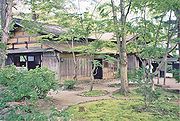
Kakunodate is a particularly charming old town, known as the little Kyoto
, full of preserved samurai houses. The Aoyagi house is the former residence of Odano Naotake, the man who illustrated Japan's first modern guide to the human anatomy. The house is now a museum and gallery of medical illustrations and traditional crafts.
Starting in 2009, Akita began experiencing a huge surge in Korean tourism after the airing of the popular drama Iris
, which featured several scenes shot in Akita, most notably at Lake Tazawa and Oga's GAO Aquarium.
Prefectures of Japan
The prefectures of Japan are the country's 47 subnational jurisdictions: one "metropolis" , Tokyo; one "circuit" , Hokkaidō; two urban prefectures , Osaka and Kyoto; and 43 other prefectures . In Japanese, they are commonly referred to as...
of Japan
Japan
Japan is an island nation in East Asia. Located in the Pacific Ocean, it lies to the east of the Sea of Japan, China, North Korea, South Korea and Russia, stretching from the Sea of Okhotsk in the north to the East China Sea and Taiwan in the south...
located in the Tōhoku Region
Tohoku region
The is a geographical area of Japan. The region occupies the northeastern portion of Honshu, the largest island of Japan. The region consists of six prefectures : Akita, Aomori, Fukushima, Iwate, Miyagi and Yamagata....
of northern Honshu
Honshu
is the largest island of Japan. The nation's main island, it is south of Hokkaido across the Tsugaru Strait, north of Shikoku across the Inland Sea, and northeast of Kyushu across the Kanmon Strait...
, the main island of Japan. The capital is the city of Akita
Akita, Akita
is the capital city of Akita Prefecture in the Tohoku region of Japan.As of June 11, 2005, with the merger of the former Kawabe District , the city has an estimated population of 323,310 and density of...
.
History
The area of Akita has been created from the ancient provinces of DewaDewa Province
is an old province of Japan, comprising modern-day Yamagata Prefecture and Akita Prefecture, except for the city of Kazuno and the town of Kosaka. It was sometimes called .-Historical record:...
and Mutsu
Mutsu Province
was an old province of Japan in the area of Fukushima, Miyagi, Iwate and Aomori prefecture and the municipalities of Kazuno and Kosaka in Akita Prefecture...
.
Separated from the principal Japanese centres of commerce, politics, and population by several hundred kilometres and the Ōu
Ou Mountains
The are a mountain range in the Tōhoku region of Honshū, Japan. The range is the longest range in Japan and stretch south from the Natsudomari Peninsula of Aomori Prefecture to the Nasu volcanoes at the northern boundary of the Kantō region. Though long, the range is only about wide...
and Dewa mountain ranges to the east, Akita remained largely isolated from Japanese society until after the year 600. Akita was a region of hunter-gatherers and principally nomadic tribes.
The first historical record of what is now Akita Prefecture dates to 658, when the Abe no Hirafu
Abe no Hirafu
was a governor of Koshi Province. He fought against the aboriginal inhabitants of Japan . This was in 658...
conquered the native Ezo
Ezo
is a Japanese name which historically referred to the lands to the north of Japan. It was used in various senses, sometimes meaning the northern Japanese island of Hokkaidō, and sometimes meaning lands and waters further north in the Sea of Okhotsk, like Sakhalin and the Kuril Islands...
tribes at what are now the cities of Akita and Noshiro. Hirafu, then governor of Koshi Province
Koshi Province
was an ancient province or region of Japan in the area of Echigo, Etchū and Echizen provinces. Also encompassed are Noto and Kaga provinces which were once part of Echizen. It was sometimes called ....
(the northwest part of Honshū bordering the Sea of Japan
Sea of Japan
The Sea of Japan is a marginal sea of the western Pacific Ocean, between the Asian mainland, the Japanese archipelago and Sakhalin. It is bordered by Japan, North Korea, Russia and South Korea. Like the Mediterranean Sea, it has almost no tides due to its nearly complete enclosure from the Pacific...
), established a fort on the Mogami River
Mogami River
The is a river in Yamagata Prefecture, Japan. It is 224 km long and has a watershed of 7,040 km². It is regarded as one of the three most rapid rivers of Japan ....
, and thus began the Japanese settlement of the region.
In 733, a new military settlement—later renamed Akita Castle—was built in modern-day Akita city at Takashimizu, and more permanent roads and structures were developed. The region was used as a base of operations for the Japanese empire as it drove the native Ezo people from northern Honshū.
It shifted hands several times. During the Tokugawa shogunate
Tokugawa shogunate
The Tokugawa shogunate, also known as the and the , was a feudal regime of Japan established by Tokugawa Ieyasu and ruled by the shoguns of the Tokugawa family. This period is known as the Edo period and gets its name from the capital city, Edo, which is now called Tokyo, after the name was...
it was appropriated to the Satake clan
Satake clan
The was a Japanese samurai clan that claimed descent from the Minamoto clan. Its first power base was in Hitachi Province. The clan was subdued by Minamoto no Yoritomo in the late 12th century, but later entered Yoritomo's service as vassals...
, who ruled the region for 260 years, developing the agriculture and mining industries that are still predominant today. Throughout this period, it was classified as part of Dewa Province
Dewa Province
is an old province of Japan, comprising modern-day Yamagata Prefecture and Akita Prefecture, except for the city of Kazuno and the town of Kosaka. It was sometimes called .-Historical record:...
. In 1871, during the Meiji Restoration, Dewa Province was reshaped and the old daimyō domains were abolished and administratively reconstructed, resulting in the modern-day borders of Akita.
The famous Heian period
Heian period
The is the last division of classical Japanese history, running from 794 to 1185. The period is named after the capital city of Heian-kyō, or modern Kyōto. It is the period in Japanese history when Buddhism, Taoism and other Chinese influences were at their height...
waka
Waka (poetry)
Waka or Yamato uta is a genre of classical Japanese verse and one of the major genres of Japanese literature...
poet, Ono no Komachi
Ono no Komachi
was a famous Japanese waka poet, one of the Rokkasen—the Six best Waka poets of the early Heian period. She was noted as a rare beauty; Komachi is a symbol of a beautiful woman in Japan. She also figures among the Thirty-six Poetry Immortals....
, is said to have been born in Yuzawa City, Ogachi Town, located in the southeast of the prefecture.
Geography
Located in the north of Honshu, Akita Prefecture faces the Sea of JapanSea of Japan
The Sea of Japan is a marginal sea of the western Pacific Ocean, between the Asian mainland, the Japanese archipelago and Sakhalin. It is bordered by Japan, North Korea, Russia and South Korea. Like the Mediterranean Sea, it has almost no tides due to its nearly complete enclosure from the Pacific...
in the west and is bordered by four other prefectures: Aomori
Aomori Prefecture
is a prefecture of Japan located in the Tōhoku Region. The capital is the city of Aomori.- History :Until the Meiji Restoration, the area of Aomori prefecture was known as Mutsu Province....
in the north, Iwate
Iwate Prefecture
is the second largest prefecture of Japan after Hokkaido. It is located in the Tōhoku region of Honshū island and contains the island's easternmost point. The capital is Morioka. Iwate has the lowest population density of any prefecture outside Hokkaido...
in the east, Miyagi
Miyagi Prefecture
is a prefecture of Japan in the Tōhoku Region on Honshu island. The capital is Sendai.- History :Miyagi Prefecture was formerly part of the province of Mutsu. Mutsu Province, on northern Honshu, was one of the last provinces to be formed as land was taken from the indigenous Emishi, and became the...
in the southeast, and Yamagata
Yamagata Prefecture
-Fruit:Yamagata Prefecture is the largest producer of cherries and pears in Japan. A large quantity of other kinds of fruits such as grapes, apples, peaches, melons, persimmons and watermelons are also produced.- Demographics :...
in the south.
Akita Prefecture is rectangular in shape, roughly 181 km from north to south and 111 km from west to east. The Ōu Mountains
Ou Mountains
The are a mountain range in the Tōhoku region of Honshū, Japan. The range is the longest range in Japan and stretch south from the Natsudomari Peninsula of Aomori Prefecture to the Nasu volcanoes at the northern boundary of the Kantō region. Though long, the range is only about wide...
mark the eastern border of the prefecture, and the higher Dewa Mountains run parallel through the center of the prefecture. Like much of northern Japan, the prefecture has cold winters, particularly away from the sea.
The Oga Peninsula
Oga Peninsula
The Oga Peninsula is a rugged peninsula which projects west into the Sea of Japan from the coast of Akita in northern Honshū, the main island of Japan...
is a prominent feature of the coastline.
Cities
Thirteen cities are located in Akita Prefecture:
|
Oga, Akita is a city located in Akita Prefecture, Japan. It is located on the Oga Peninsula.The city was founded on March 31, 1954.As of 2003, the city has an estimated population of 29,377 and a population density of 148.34 persons per km². The total area is 198.04 km².... Odate, Akita is a city located in Akita in Tōhoku region of Japan.The city was founded on April 1, 1951.As of 2003, the city had an estimated population of 65,090 and the density of 162.10 persons per km²... Yokote, Akita is a city located in Akita in the Tōhoku region of Japan.As of October 1, 2011, the city has an estimated population of 96,955, with a household number of 34,314 and the density of 140 persons per km²... Yurihonjo, Akita is a city located in Akita, Japan.The city was founded on March 22, 2005 from the merger of the former city of Honjō and the former towns of Chōkai, Higashiyuri, Iwaki, Nishime, Ōuchi, Yashima and Yuri... Yuzawa, Akita is a city located in Akita, Japan. In 2011 the city had an estimated population of 50,902. The total area was 790.72 km².- History :The city was founded on March 31, 1954.... |
Towns and villages
These are all of the towns and villages in each districtDistricts of Japan
The was most recently used as an administrative unit in Japan between 1878 and 1921 and is roughly equivalent to the county of the United States, ranking at the level below prefecture and above city, town or village. As of 2008, cities belong directly to prefectures and are independent from...
.
|
Ogachi District, Akita is a district located in Akita, Japan.In 2003, the district had an estimated population of 44,129. On March 22, 2005, three towns formerly in Ogachi District merged into the city of Yuzawa....
Yamamoto District, Akita is a district located in Akita, Japan.There are three towns in the district.*Fujisato*Happō*Mitane-District Timeline:*September 1, 1962 - The village of Yamamoto gained town status....
|
Economy
Like much of the Tōhoku RegionTohoku region
The is a geographical area of Japan. The region occupies the northeastern portion of Honshu, the largest island of Japan. The region consists of six prefectures : Akita, Aomori, Fukushima, Iwate, Miyagi and Yamagata....
, Akita's economy remains dominated by traditional industries, such as agriculture, fishing, and forestry. This has led many young people to migrate to Tokyo and other large cities. Akita Prefecture is where declines in population are most severe in Japan; it is one of four prefectures in Japan registering declines in population since 1945. It also has the lowest number of children as a percentage of the population, at 11.2%. As of 2010, it has a population of just over 1 million people.
Culture
Akita is famous for rice farming and its sake breweries. It is well-known for having the highest consumption of sake in JapanJapan
Japan is an island nation in East Asia. Located in the Pacific Ocean, it lies to the east of the Sea of Japan, China, North Korea, South Korea and Russia, stretching from the Sea of Okhotsk in the north to the East China Sea and Taiwan in the south...
, and thought to be the origin of the Akita breed of dog which carries the prefecture's name. The women of the region, referred to as , have also gained widespread renown for their white skin, rounded faces and high voices, all of which are considered highly desirable. Ono no Komachi
Ono no Komachi
was a famous Japanese waka poet, one of the Rokkasen—the Six best Waka poets of the early Heian period. She was noted as a rare beauty; Komachi is a symbol of a beautiful woman in Japan. She also figures among the Thirty-six Poetry Immortals....
is a famous example of an Akita bijin.
Tourism
Lake Tazawa
is a caldera lake in Semboku, Akita Prefecture, northern Japan. It is the deepest lake in Japan . Because of its depth, it never freezes....
, there are a number of hot springs resorts (onsen
Onsen
An is a term for hot springs in the Japanese language, though the term is often used to describe the bathing facilities and inns around the hot springs. As a volcanically active country, Japan has thousands of onsen scattered along its length and breadth...
). These are popular with tourists from all over Japan. In addition, its numerous seasonal festivals (matsuri) offer a glimpse of rural or traditional Japan. Some famous examples are the Akita Kantō, the Omagari Fireworks, Namahage
Namahage
is a Japanese ritual which is observed throughout Oga Peninsula, Akita Prefecture in northern Honshū, Japan. It is said to have originated as a ritual for cleansing people's souls, and for blessing the new year. It is a kind of toshigami....
Festival, and the Yokote Kamakura Festivals.
Kakunodate is a particularly charming old town, known as the little Kyoto
Kyoto
is a city in the central part of the island of Honshū, Japan. It has a population close to 1.5 million. Formerly the imperial capital of Japan, it is now the capital of Kyoto Prefecture, as well as a major part of the Osaka-Kobe-Kyoto metropolitan area.-History:...
, full of preserved samurai houses. The Aoyagi house is the former residence of Odano Naotake, the man who illustrated Japan's first modern guide to the human anatomy. The house is now a museum and gallery of medical illustrations and traditional crafts.
Starting in 2009, Akita began experiencing a huge surge in Korean tourism after the airing of the popular drama Iris
Iris (TV series)
Iris is a South Korean espionage television drama series broadcast by KBS in 2009. With a budget in excess of 20 billion won , it, along with its spin-off Athena: Goddess of War, share the record for the most expensive Korean dramas ever produced.Premiering in October 2009, the series was a...
, which featured several scenes shot in Akita, most notably at Lake Tazawa and Oga's GAO Aquarium.
Television
- Akita Broadcasting SystemAkita Broadcasting SystemAkita Broadcasting System, Inc. is a Japanese broadcaster in Akita Prefecture. Its radio station is affiliated with Japan Radio Network and National Radio Network , and its TV station is affiliated with Nippon News Network and Nippon TV Network System .-The Headquarters:* 7-9-42 San-no,Akita...
(ABS) - Akita Television (AKT)
- Akita Asahi BroadcastingAkita Asahi Broadcasting, also known as AAB, is a Japanese broadcast network affiliated with the ANN. Their headquarters are located in Akita Prefecture.-The Headquarters:*233-209 Kawajiri-machi aza Okobata Akita-city, AKITA 010-0941 JAPAN*Telephone Number:+81-18-866-5111...
(AAB)