
All Topics  
Hannah Arendt


   Email Print
   Bookmark   Link


Hannah Arendt


Hannah Arendt (October 14, 1906 – December 4, 1975) was an influential German
Germany

Germany , officially the Federal Republic of Germany , is a country in Central Europe. It is bordered to the north by the North Sea, Denmark, and the Baltic Sea; to the east by Poland and the Czech Republic; to the south by Austria and Switzerland; and to the west by France, Luxembourg, Belgium, and the Netherlands....
-Jewish political theorist. She has often been described as a philosopher, although she always refused that label on the grounds that philosophy is concerned with "man in the singular." She described herself instead as a political theorist because her work centers on the fact that "men, not Man, live on the earth and inhabit the world."

ah Arendt was born into a family of secular Jewish Germans in the city of Linden (now part of Hanover
Hanover

Hanover or Hannover#Definitions , on the river Leine, is the capital city of the Federal states of Germany of Lower Saxony , Germany and was once by personal union the family seat of the House of Hanover, in their dignities as the dukes of Brunswick-L?neburg ....
), and grew up in Königsberg
Königsberg

K?nigsberg was after World War II in 1946 renamed Kaliningrad by the Soviet Union.The city was the Capital of East Prussia from the Late Middle Ages until 1945....
 and Berlin
Berlin

Berlin is the Capital of Germany city and one of sixteen States of Germany of Germany. With a population of 3.4 million within its city limits, Berlin is the country's largest city....
.

At the University of Marburg, she studied philosophy with Martin Heidegger
Martin Heidegger

Martin Heidegger was an influential Germany Philosophy. His best known book, Being and Time, is generally considered to be one of the most important philosophical works of the 20th century....
, with whom she embarked on a long, stormy and romantic relationship for which she was later criticized because of Heidegger's support for the Nazi
Nazism

Nazism, officially National Socialism , refers to the ideology and practices of the National Socialist German Workers? Party under Adolf Hitler, and the policies adopted by the dictatorial government of Nazi Germany from 1933 to 1945....
 party while he was rector of Freiburg University
University of Freiburg

University of Freiburg , sometimes referred to in English language as the Albert Ludwig University of Freiburg, is a public university research university located in Freiburg im Breisgau, Baden-W?rttemberg, Germany....
.

In the wake of one of their breakups, Arendt moved to Heidelberg
Heidelberg

Heidelberg is a city in Baden-W?rttemberg, Germany. As of 2006, over 140,000 people live within the city's area. The town of Heidelberg is an administrative district of its own....
, where she wrote her dissertation on the concept of love in the thought of Saint Augustine, under the existentialist philosopher-psychologist Karl Jaspers
Karl Jaspers

Karl Theodor Jaspers was a Germany psychiatrist and philosopher who had a strong influence on modern theology, psychiatry and philosophy. Trained in and practiced psychiatry, Jaspers later turned to philosophical inquiry and attempted to discover an innovative philosophical system....
.

She married Günther Stern, later known as Günther Anders
Günther Anders

G?nther Anders was a Jewish philosopher and journalist who developed a philosophical anthropology for the age of technology, focusing on such themes as the effects of mass media on our emotional and ethical existence, the nuclear threat, the Shoah and the question of being a philosopher....
, in 1929 in Berlin (they divorced in 1937).

The dissertation was published the same year, but Arendt was prevented from habilitating, a prerequisite for teaching in German universities, because she was Jewish.


Discussion
Ask a question about 'Hannah Arendt'
Start a new discussion about 'Hannah Arendt'
Answer questions from other users
Full Discussion Forum


Quotations


The most radical revolutionary will become a conservative the day after the revolution.

The New Yorker, 12 September 1970

The point, as Marx saw it, is that dreams never come true.

Crises of the Republic (1969): "On Violence"

The sad truth is that most evil is done by people who never make up their minds to be good or evil.

The Life of the Mind (1978): "Thinking"

Man cannot be free if he does not know that he is subject to necessity, because his freedom is always won in his never wholly successful attempts to liberate himself from necessity.

The Human Condition (1958), part 3, chapter 16

Power and violence are opposites; where the one rules absolutely, the other is absent. Violence appears where power is in jeopardy, but left to its own course it ends in power's disappearance.

Crises of the Republic (1969): "On Violence"

The defiance of established authority, religious and secular, social and political, as a world-wide phenomenon may well one day be accounted the outstanding event of the last decade.

Crises of the Republic (1969): "Civil Disobedience"


Encyclopedia


Hannah Arendt (October 14, 1906 – December 4, 1975) was an influential German
Germany

Germany , officially the Federal Republic of Germany , is a country in Central Europe. It is bordered to the north by the North Sea, Denmark, and the Baltic Sea; to the east by Poland and the Czech Republic; to the south by Austria and Switzerland; and to the west by France, Luxembourg, Belgium, and the Netherlands....
-Jewish political theorist. She has often been described as a philosopher, although she always refused that label on the grounds that philosophy is concerned with "man in the singular." She described herself instead as a political theorist because her work centers on the fact that "men, not Man, live on the earth and inhabit the world."

Biography

Hannah Arendt was born into a family of secular Jewish Germans in the city of Linden (now part of Hanover
Hanover

Hanover or Hannover#Definitions , on the river Leine, is the capital city of the Federal states of Germany of Lower Saxony , Germany and was once by personal union the family seat of the House of Hanover, in their dignities as the dukes of Brunswick-L?neburg ....
), and grew up in Königsberg
Königsberg

K?nigsberg was after World War II in 1946 renamed Kaliningrad by the Soviet Union.The city was the Capital of East Prussia from the Late Middle Ages until 1945....
 and Berlin
Berlin

Berlin is the Capital of Germany city and one of sixteen States of Germany of Germany. With a population of 3.4 million within its city limits, Berlin is the country's largest city....
.

At the University of Marburg, she studied philosophy with Martin Heidegger
Martin Heidegger

Martin Heidegger was an influential Germany Philosophy. His best known book, Being and Time, is generally considered to be one of the most important philosophical works of the 20th century....
, with whom she embarked on a long, stormy and romantic relationship for which she was later criticized because of Heidegger's support for the Nazi
Nazism

Nazism, officially National Socialism , refers to the ideology and practices of the National Socialist German Workers? Party under Adolf Hitler, and the policies adopted by the dictatorial government of Nazi Germany from 1933 to 1945....
 party while he was rector of Freiburg University
University of Freiburg

University of Freiburg , sometimes referred to in English language as the Albert Ludwig University of Freiburg, is a public university research university located in Freiburg im Breisgau, Baden-W?rttemberg, Germany....
.

In the wake of one of their breakups, Arendt moved to Heidelberg
Heidelberg

Heidelberg is a city in Baden-W?rttemberg, Germany. As of 2006, over 140,000 people live within the city's area. The town of Heidelberg is an administrative district of its own....
, where she wrote her dissertation on the concept of love in the thought of Saint Augustine, under the existentialist philosopher-psychologist Karl Jaspers
Karl Jaspers

Karl Theodor Jaspers was a Germany psychiatrist and philosopher who had a strong influence on modern theology, psychiatry and philosophy. Trained in and practiced psychiatry, Jaspers later turned to philosophical inquiry and attempted to discover an innovative philosophical system....
.

She married Günther Stern, later known as Günther Anders
Günther Anders

G?nther Anders was a Jewish philosopher and journalist who developed a philosophical anthropology for the age of technology, focusing on such themes as the effects of mass media on our emotional and ethical existence, the nuclear threat, the Shoah and the question of being a philosopher....
, in 1929 in Berlin (they divorced in 1937).

The dissertation was published the same year, but Arendt was prevented from habilitating, a prerequisite for teaching in German universities, because she was Jewish. She worked for some time researching anti-Semitism
Anti-Semitism

Antisemitism is prejudice against or hostility towards Jews.This prejudice or hostility is usually characterized by a combination of Religion, Race , cultural and ethnic group biases....
 before being interrogated by the Gestapo
Gestapo

The was the official secret police of Nazi Germany. Under the overall administration of the Schutzstaffel , it was administered by the Reichssicherheitshauptamt and was considered a dual organization of the Sicherheitsdienst and also a suboffice of the Sicherheitspolizei ....
, and thereupon fled Germany for Paris
Paris

Paris is the Capital of France and the country's largest city. It is situated on the river Seine, in northern France, at the heart of the ?le-de-France Regions of France ....
. Here she met and befriended the literary critic and Marxist
Marxism

Marxism is the political philosophy and practice derived from the work of Karl Marx and Friedrich Engels. Marxism holds at its core a Marxist analysis of Critique of capitalism and a theory of social change....
 philosopher Walter Benjamin
Walter Benjamin

Walter Bendix Sch?nflies Benjamin was a Germany-Jewish Marxist literary critic, essayist, translator, and philosopher. He was at times associated with the Frankfurt School of critical theory and was also influenced by the writings of his younger contemporaries Bertolt Brecht, who developed Marxist aesthetics of dialectical materialism, and G...
, her first husband's cousin. While in France, Arendt worked to support and aid Jewish refugees. She was imprisoned in Camp Gurs
Camp Gurs

Camp Gurs was an Internment camps in France constructed by the French government in 1939. The camp was originally set up in southwestern France after the fall of Catalonia at the end of the Spanish Civil War to control those who fled Spain out of fear of retaliation from Francisco Franco's regime....
 but was able to escape after a couple of weeks.

However, with the German military occupation of northern France during World War II, and the deportation of Jews to Nazi concentration camps, even by the Vichy collaborator regime
Vichy France

Vichy France, or the Vichy regime are the common terms used to describe the government of France from July 1940 to August 1944. This government, which succeeded the French Third Republic, officially called itself the French State , in contrast with the previous designation, "French Republic." Marshal of France Philippe P?tain pro...
 in the unoccupied south, Arendt was forced to flee France. In 1940, she married the German poet and Marxist philosopher Heinrich Blücher
Heinrich Blücher

Heinrich Bl?cher was a Germany poet and philosopher. He was the second husband of Hannah Arendt.Bl?cher was born in Berlin. He was a member of the Communist Party of Germany until 1928, but soon rejected Stalinism and left the party in protest of its Stalinist policies....
, by then a former Communist Party member.

In 1941, Arendt escaped with her husband and her mother to the United States
United States

The United States of America is a Federal government constitutional republic comprising U.S. state and a federal district. The country is situated mostly in central North America, where its Contiguous United States and Washington, D.C., the Capital districts and territories, lie between the Pacific Ocean and Atlantic Oceans, Borders of the U...
 with the assistance of the American diplomat Hiram Bingham IV
Hiram Bingham IV

Hiram "Harry" Bingham IV was an United States diplomat. He served as a Vice-Consul in Marseille, France, during World War II, and helped over 2,500 Jews to flee from France as Nazism forces advanced....
, who illegally issued visas to her and around 2500 other Jewish refugees and an American Varian Fry
Varian Fry

Varian Mackey Fry was a Taft School and Harvard University educated American journalist who ran a rescue network in Vichy France that helped approximately 2,000 to 4,000 anti-Nazi and Jewish refugees to escape Nazi Germany and the Holocaust....
 who paid for her travels and helped in securing these visas. Arendt then became active in the German-Jewish community in New York. In 1941-1945, she wrote a column for the German-language Jewish newspaper, Aufbau
Aufbau

Aufbau is a journal for German language Jews around the globe. It was founded in 1934 and is a member of Internationale Medienhilfe . Hannah Arendt, Albert Einstein, Thomas Mann, and Stefan Zweig wrote for the publication....
. From 1944, she directed research for the Commission of European Jewish Cultural Reconstruction and traveled frequently to Germany in this capacity.

After World War II she returned to Germany and worked for Youth Aliyah
Youth Aliyah

The Youth Aliyah is a Jewish organization that rescued 22,000 Jewish children from the Nazis during the Third Reich, arranging for their resettlement in Palestine in kibbutzim and youth villages that became both home and school....
. She became a close friend of Jaspers and his Jewish wife, developing a deep intellectual friendship with him and began corresponding with Mary McCarthy
Mary McCarthy (author)

Mary Therese McCarthy was an United States author and critic. She was politically active for many years....
. In 1950, she became a naturalized citizen of the United States. Arendt served as a visiting scholar at the University of California, Berkeley
University of California, Berkeley

The University of California, Berkeley is a public university research university located in Berkeley, California, California, United States. The oldest of the ten major campuses affiliated with the University of California, Berkeley offers some 300 undergraduate and graduate degree programs in a wide range of disciplines....
, Princeton University
Princeton University

Princeton University is a private university university located in Princeton, New Jersey, New Jersey, United States. The school is one of the eight universities of the Ivy League and has the largest per-student Financial endowment in the world....
 and Northwestern University
Northwestern University

Northwestern University is a non-sectarian private university research university located in Evanston, Illinois and downtown Chicago, Illinois, United States....
. She also served as a professor on the Committee on Social Thought
Committee on Social Thought

The Committee on Social Thought, one of several PhD-granting committees at the University of Chicago, was started in 1941 by historian John U. Nef along with economist Frank Knight, anthropologist Robert Redfield, and University President Robert Maynard Hutchins....
 at the University of Chicago
University of Chicago

The University of Chicago is a private university located principally in the Hyde Park, Chicago neighborhood of Chicago. Although an older university by the same name existed prior to its founding, the modern University of Chicago credits its founding to the oil magnate John D....
, as well as at The New School
The New School

The New School is a university in New York City, located mostly around Greenwich Village. From its founding in 1919 and for most of its history, the university was known as the New School for Social Research....
 in New York City, and served as a fellow at Yale University
Yale University

Yale University is a private university in New Haven, Connecticut. Founded in 1701 as the Collegiate School, Yale is the Colonial Colleges institution of higher education in the United States and is a member of the Ivy League....
 and Wesleyan University
Wesleyan University

Wesleyan University is a private university Liberal arts colleges in the United States founded in 1831 and located in Middletown, Connecticut, Connecticut....
. In 1959, she became the first woman appointed to a full professorship at Princeton.

She died at age 69 in 1975, and was buried at Bard College
Bard College

Bard College, founded in 1860, is a small, highly selective four-year Liberal arts colleges in the United States located in Annandale-on-Hudson, New York, New York....
 in Annandale-on-Hudson, New York
Annandale-on-Hudson, New York

Annandale-on-Hudson is a Hamlet in Dutchess County, New York , New York, USA, in the Hudson Valley in the Red Hook, New York , across the Hudson River from Kingston, New York....
, where her husband taught for many years. Arendt was instrumental in the creation of Structured Liberal Education
Structured Liberal Education

Structured Liberal Education is an academically demanding program at Stanford University that offers an alternative three-course sequence for freshmen to fulfill their Introduction to the Humanities and Program in Writing and Rhetoric requirements....
 (SLE) at Stanford University
Stanford University

Leland Stanford Junior University, commonly referred to as Stanford University or Stanford, is a private university research university located in Stanford, California, California, United States....
. She wrote a letter to the then president of Stanford University to convince the university to enact Mark Mancall's vision of a residentially-based humanities program.

Works

Arendt's work deals with the nature of power
Power (sociology)

Power is a measure of a person's ability to control the environment around them, including the behavior of other people. The term authority is often used for power, perceived as legitimate by the social structure....
, and the subjects of politics
Politics

Politics is the process by which groups of people make decisions. The term is generally applied to behaviour within civil governments, but politics has been observed in all human group interactions, including corporation, academia, and religion institutions....
, authority
Authority

In government, authority is often used interchangeably with the term "power ". However, their meanings differ: while "power" refers to the ability to achieve certain ends, "authority" refers to a claim of legitimacy , the justification and right to exercise that power....
, and totalitarianism
Totalitarianism

Totalitarianism is a concept used to describe political systems whereby a state regulates nearly every aspect of public and private life. Totalitarian regimes or movements maintain themselves in political power by means of an official all-embracing ideology and propaganda disseminated through the state-controlled mass media, single-party st...
. Much of her work focuses on affirming a conception of freedom which is synonymous with collective political action among equals.

Arendt theorizes freedom as public and associative, drawing on examples from the Greek "polis
Polis

A polis -- plural: poleis --is a city, a city-state and also citizenship and body of citizens. When used to describe Classical Athens and its contemporaries, polis is often translated as "city-state."...
", American townships
Township (United States)

A township in the United States refers to a small geographic area. Townships range in size from 6 to 54 square miles , with 36 square miles being the norm....
, the Paris Commune
Paris Commune

The Paris Commune was a government that briefly ruled Paris from March 28 to May 28, 1871. It existed before the split between Anarchism and Socialism, and is hailed by both as the first seizure of power by the working class....
, and the civil rights movement
Civil rights movement

The Civil Rights Movement was a worldwide political movement for equality before the law occurring approximately between 1960 to 1980. It was accompanied by much civil unrest and popular rebellion....
s of the 1960s (among others) to illustrate this conception of freedom.

Another key concept in her work is "natality", the capacity to bring something new into the world, such as the founding of a government that endures.

Her first major book was The Origins of Totalitarianism
The Origins of Totalitarianism

The Origins of Totalitarianism is a book by Hannah Arendt which classed Nazism and Stalinism as totalitarian movements.It was recognized upon its 1951 publication as the comprehensive account of its subject, and was later hailed as a classic by the Times Literary Supplement....
 (1951), which traced the roots of Stalinist Communism
Communism

Communism is a socioeconomic structure and political ideology that promotes the establishment of an egalitarianism, classlessness, stateless society based on common ownership and control of the means of production and property in general....
 and Nazism
Nazism

Nazism, officially National Socialism , refers to the ideology and practices of the National Socialist German Workers? Party under Adolf Hitler, and the policies adopted by the dictatorial government of Nazi Germany from 1933 to 1945....
 in both anti-Semitism
Anti-Semitism

Antisemitism is prejudice against or hostility towards Jews.This prejudice or hostility is usually characterized by a combination of Religion, Race , cultural and ethnic group biases....
 and imperialism
Imperialism

Imperialism has two meanings; one describing an action and the other describing an attitude.#Action: Imperialism is the practice of extending the power, control or rule by one country over areas outside its borders....
. The book was controversial because it suggested an essential identity between the two phenomena, which can be considered as completely separated in both origins and nature.

Arguably her most influential work, The Human Condition
The Human Condition (book)

The Human Condition, published in 1958, is one of the central theoretical works of the philosopher Hannah Arendt. The subject to various interpretations, the most common of which is that it is an account for the historical development of the situation of human existence, from the Ancient Greeks to modern Europe....
 (1958) distinguishes between labour, work, and action, and explores the implications of these distinctions. Her theory of political action is extensively developed in this work.

Another of her important books is the collection of essays Men in Dark Times. These intellectual biographies provide insight into the lives of some of the creative and moral figures of the 20th century, among them Walter Benjamin
Walter Benjamin

Walter Bendix Sch?nflies Benjamin was a Germany-Jewish Marxist literary critic, essayist, translator, and philosopher. He was at times associated with the Frankfurt School of critical theory and was also influenced by the writings of his younger contemporaries Bertolt Brecht, who developed Marxist aesthetics of dialectical materialism, and G...
, Karl Jaspers
Karl Jaspers

Karl Theodor Jaspers was a Germany psychiatrist and philosopher who had a strong influence on modern theology, psychiatry and philosophy. Trained in and practiced psychiatry, Jaspers later turned to philosophical inquiry and attempted to discover an innovative philosophical system....
, Rosa Luxemburg
Rosa Luxemburg

Rosa Luxemburg was a Poland Germany Marxist theory, Socialism philosopher, and revolutionary for the Social Democracy of the Kingdom of Poland and Lithuania, the German Social Democratic Party of Germany, the Independent Social Democratic Party of Germany and the Communist Party of Germany....
, Hermann Broch
Hermann Broch

Hermann Broch was a 20th century Austrian writer, considered one of the major Modernisms....
, Pope John XXIII
Pope John XXIII

Blessed Pope John XXIII , born Angelo Giuseppe Roncalli , known as Blessed John XXIII since his beatification, was elected as the 261st Pope of the Roman Catholic Church and monarch of Vatican City on 28 October 1958....
, and Isak Dinesen.

In her reporting of the Eichmann
Adolf Eichmann

Karl Adolf Eichmann , sometimes referred to as "the architect of the Holocaust", was a Nazism and Schutzstaffel-Obersturmbannf?hrer . Due to his organizational talents and ideological reliability, he was charged by Obergruppenf?hrer Reinhard Heydrich with the task of facilitating and managing the logistics of mass deportation of J...
 trial for The New Yorker
The New Yorker

The New Yorker is an United States magazine that publishes reportage, commentary, criticism, essays, fiction, satire, cartoons, and poetry. Starting as a weekly in the mid-1920s, the magazine is now published 47 times per year, with five of these issues covering two-week spans....
, which evolved into Eichmann in Jerusalem: A Report on the Banality of Evil (1963), she coined the phrase "the banality of evil
Banality of Evil

The banality of evil is a phrase coined by Hannah Arendt and incorporated in the title of her 1963 work Eichmann in Jerusalem: A Report on the Banality of Evil. It describes the thesis that the great evils in history generally, and the Holocaust in particular, were not executed by fanatics or Antisocial personality disorder but rather by...
" to describe Eichmann. She raised the question of whether evil
Evil

Evil, in many cultures, is a broad term used to describe intentional negative moral acts or thoughts that are cruel, unjust or selfish. Evil is usually good and evil, which describes acts that are kind, just or unselfish....
 is radical or simply a function of banality
Banality of Evil

The banality of evil is a phrase coined by Hannah Arendt and incorporated in the title of her 1963 work Eichmann in Jerusalem: A Report on the Banality of Evil. It describes the thesis that the great evils in history generally, and the Holocaust in particular, were not executed by fanatics or Antisocial personality disorder but rather by...
—the tendency of ordinary people to obey orders and conform to mass opinion without critically thinking about the results of their action or inaction. Arendt was extremely critical of the way that Israel
Israel

Israel officially the State of Israel , is a country in the Middle East located on the eastern shore of the Mediterranean Sea. It borders Lebanon in the north, Syria in the northeast, Jordan in the east, and Egypt on the southwest, and contains geographically diverse features within its relatively small area....
 conducted the trial. She was also critical of the way that many Jewish leaders (notably M. C. Rumkowski) acted during the Holocaust, which caused an enormous controversy and resulted in a great deal of animosity directed toward Arendt within the Jewish community. Her friend Gershom Scholem
Gershom Scholem

Gershom Scholem , also known as Gerhard Scholem, was a Jewish philosopher and historian raised in Germany. He is widely regarded as the founder of the modern, academic study of Kabbalah, becoming the first Professor of Jewish Mysticism at the Hebrew University of Jerusalem....
, a major scholar of Jewish Mysticism
Kabbalah

Kabbalah is a discipline and school of thought discussing the mysticism aspect of Judaism. It is a set of esoteric teachings that are meant to explain the relationship between an infinite, eternal and essentially unknowable Creator deity with the finite and mortal universe of His creation....
, broke off relations with her. She was criticized by many Jewish public figures, who charged her with coldness and lack of sympathy for the victims of the Shoah
Shoah

Headline text Shoah is a Hebrew word meaning "disaster" or "conflagration". "The Shoa" or, with the addition of "Ha" , HaShoah is commonly used to refer to the Holocaust....
. Her book has only recently been translated into Hebrew. Arendt ended the book by endorsing the execution of Eichmann, writing:

Arendt published another book in the same year that was controversial in its own right: On Revolution, a study of the two most famous revolution
Revolution

A revolution is a fundamental social change in power or organizational structures that takes place in a relatively short period of time....
s of the 18th century. Arendt went against the grain of Marxist and leftist
Left-wing politics

In politics, left-wing, leftist, and the Left are terms applied to Social progressivism and Egalitarianism positions. Originally, during the French Revolution, left-wing referred to seating arrangements in parliament; those who sat on the left opposed the monarchy and supported Political radicalism reform....
 thought by contending that the American Revolution
American Revolution

The American Revolution refers to the political upheaval during the last half of the 18th century in which the Thirteen Colonies of North America overthrew the governance of the British Empire and then rejected the British monarchy to become the sovereign United States of America....
 was a successful revolution while the French Revolution
French Revolution

The French Revolution was a period of political and social upheaval and radical change in the history of France, during which the French governmental structure, previously an absolute monarchy with feudalism for the aristocracy and Roman Catholic Church clergy, underwent radical change to forms based on Age of Enlightenment principles of cit...
 was not. Some saw in this argument a post-Holocaust anti-French sentiment. Nevertheless, it echoed that of Edmund Burke
Edmund Burke

Edmund Burke was an Irish statesman, author, orator, political theorist, and philosophy who, after relocating to Great Britain, served for many years in the British House of Commons as a member of the British Whig Party party....
. Arendt also argued that the revolutionary spirit had not been preserved in America because the majority of people had no role to play in politics other than voting. She admired Thomas Jefferson
Thomas Jefferson

Thomas Jefferson was the List of Presidents of the United States President of the United States , the principal author of the United States Declaration of Independence , and one of the most influential Founding Fathers of the United States for his promotion of the ideals of republicanism in the United States....
's idea of dividing the counties into townships, similar to the soviets that appeared during the Russian Revolution. Arendt's interest in such a "council system", which she saw as the only alternative to the state, continued all her life.

Her posthumous book, The Life of the Mind (1978, edited by Mary McCarthy
Mary McCarthy (author)

Mary Therese McCarthy was an United States author and critic. She was politically active for many years....
), was incomplete at her death. Stemming from her Gifford Lectures
Gifford Lectures

The Gifford Lectures were established by the will of Adam Gifford . They were established to "promote and diffuse the study of Natural Theology in the widest sense of the term — in other words, the knowledge of God." The term natural theology as used by Gifford means theology supported by science and not dependent on the miracle....
 at the University of Aberdeen
University of Aberdeen

The University of Aberdeen is an ancient university founded in 1495, in Old Aberdeen, Scotland. It is the fifth oldest university in what is now the United Kingdom, and in the wider English-speaking world....
 in Scotland, this book focuses on the mental faculties of thinking and willing (in a sense moving beyond her previous work concerning the vita activa). In her discussion of thinking, she focuses mainly on Socrates
Socrates

Socrates was a Classical Greece Philosophy. Credited as one of the founders of Western philosophy, he is an enigmatic figure known only through the classical accounts of his students....
 and his notion of thinking as a solitary dialogue between me and myself. This appropriation of Socrates leads her to introduce novel concepts of conscience (which gives no positive prescriptions, but instead tells me what I cannot do if I would remain friends with myself when I re-enter the two-in-one of thought where I must render an account of my actions to myself) and morality (an entirely negative enterprise concerned with non-participation in certain actions for the sake of remaining friends with one's self). In her volume on Willing, Arendt, relying heavily on Augustine's notion of the will, discusses the will as an absolutely free mental faculty that makes new beginnings possible. In the third volume, Arendt was planning to engage the faculty of judgment by appropriating Kant's Critique of Judgment ; however, she did not live to write it. Nevertheless, although we will never fully understand her notion of judging, Arendt did leave us with manuscripts ("Thinking and Moral Considerations", "Some Questions on Moral Philosophy,") and lectures (Lectures on Kant's Political Philosophy ) concerning her thoughts on this mental faculty. The first two articles were edited and published by Jerome Kohn, who was an assistant of Arendt and is a director of Hannah Arendt Library, and the last was edited and published by Ronald Beiner, who was taught by Arendt and is a professor of political science at the University of Toronto. Her papers were deposited at Bard College at the Stevenson Library in 1976, and comprise approximately 4,000 books, ephemera, and pamphlets from Arendt's last apartment. The college has begun digitally archiving some of the collection, which is available at http://www.bard.edu/arendtcollection/

Commemoration

  • The asteroid
    Asteroid

    Asteroids, sometimes called minor planets or planetoids, are small Solar System bodies in orbit around the Sun, smaller than planets but larger than meteoroids....
     100027 Hannaharendt
    100027 Hannaharendt

    100027 Hannaharendt is an asteroid. It was discovered by Freimut B?rngen and Lutz D. Schmadel on October 12, 1990. Its provisional designation was 1990 TR3. It was named after Hannah Arendt....
     is named in her honour
    Meanings of asteroid names

    This is a list of named minor planets , with links to the Wikipedia articles on the people, places, characters and concepts that they are named for....
    .
  • The German railway authority operates a Hannah Arendt Express between Karlsruhe and Hanover.
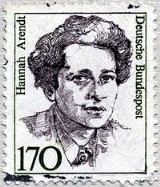
  • The German post office has issued a Hannah Arendt commemorative stamp.
  • Hannah-Arendt-Straße in the Mitte
    Mitte

    Berlin-Mitte or Mitte is the first and most central boroughs and localities of Berlin of Berlin . Mitte encompasses Berlin's historic core....
     district of Berlin is named in her honor.


Selected works

  • Der Liebesbegriff bei Augustin. Versuch einer philosophischen Interpretation (1929)
  • The Origins of Totalitarianism
    The Origins of Totalitarianism

    The Origins of Totalitarianism is a book by Hannah Arendt which classed Nazism and Stalinism as totalitarian movements.It was recognized upon its 1951 publication as the comprehensive account of its subject, and was later hailed as a classic by the Times Literary Supplement....
     (1951). Rev. ed.; New York: Schocken, 2004. (Includes all the prefaces and additions from the 1958, 1968, and 1972 editions.)
  • The Human Condition
    The Human Condition (book)

    The Human Condition, published in 1958, is one of the central theoretical works of the philosopher Hannah Arendt. The subject to various interpretations, the most common of which is that it is an account for the historical development of the situation of human existence, from the Ancient Greeks to modern Europe....
     (Chicago: University of Chicago Press, 1958).
  • Rahel Varnhagen
    Rahel Varnhagen

    Rahel Varnhagen n?e Levin was a German-Jewish writer who hosted one of the most prominent salon s in Europe during the late 18th and early 19th centuries....
    : the life of a Jewess
    . Translated by Richard and Clara Winston (1958). Complete ed.; Ed. Liliane Weissberg (Baltimore: Johns Hopkins University Press, 1997).
  • Die ungarische Revolution und der totalitäre Imperialismus (1958)
  • Between Past and Future: Six exercises in political thought (New York: Viking, 1961). (Two more essays were added in 1968.)
  • On Revolution (New York: Viking, 1963).
  • Eichmann in Jerusalem
    Eichmann in Jerusalem

    Eichmann in Jerusalem: A Report on the Banality of Evil is a book written by political theorist Hannah Arendt, originally published in 1963....
    : A Report on the Banality of Evil
    (1963). (Rev. ed. New York: Viking, 1968).
  • Men in Dark Times (New York: Harcourt, Brace and World, 1968).
  • On Violence. Harvest Books (New York: Harcourt, Brace and World, 1970) (Also included in Crises of the Republic.)
  • Crises of the Republic: Lying in Politics; Civil Disobedience; On Violence; Thoughts on Politics and Revolution (New York: Harcourt, Brace, Jovanovich, 1972). "Civil Disobedience" originally appeared, in somewhat different form, in The New Yorker
    The New Yorker

    The New Yorker is an United States magazine that publishes reportage, commentary, criticism, essays, fiction, satire, cartoons, and poetry. Starting as a weekly in the mid-1920s, the magazine is now published 47 times per year, with five of these issues covering two-week spans....
    . Versions of the other essays originally appeared in The New York Review of Books
    The New York Review of Books

    The New York Review of Books is a fortnightly magazine with articles on literature, culture and current affairs published in New York City....
    .
  • The Jew as Pariah: Jewish Identity and Politics in the Modern Age, edited with an introduction by Ron H. Feldman (1978)
  • Life of the Mind Ed. Mary McCarthy, 2 vols. (New York: Harcourt Brace Jovanovich, 1978).
  • Hannah Arendt/Karl Jaspers Correspondence, 1926–1969 Edited by Lotte Kohler and Hans Saner, translated by Robert Kimber and Rita Kimber (New York: Harcourt Brace Jovanovich, 1992).
  • Essays in Understanding, 1930-1954: Formation, Exile, and Totalitarianism, Ed. Jerome Kohn (New York: Harcourt, Brace, 1994), Paperback ed. (New York: Schocken, 2005).
  • Love and Saint Augustine Edited with an Interpretive Essay by Joanna Vecchiarelli Scott and Judith Chelius Scott (Chicago: The University of Chicago Press, 1996/1998).
  • Lectures on Kant's Political Philosophy. Edited and with an Interpretive Essay by Ronald Beiner (The University of Chicago Press, 1992).
  • Within Four Walls: The Correspondence between Hannah Arendt and Heinrich Blücher
    Heinrich Blücher

    Heinrich Bl?cher was a Germany poet and philosopher. He was the second husband of Hannah Arendt.Bl?cher was born in Berlin. He was a member of the Communist Party of Germany until 1928, but soon rejected Stalinism and left the party in protest of its Stalinist policies....
    , 1936-1968
    . Edited by Lotte Kohler, translated by Peter Constantine
    Peter Constantine

    Peter Constantine is a British and American award-winning literary translation who has translated literary works from German, Russian, French, Modern Greek, Ancient Greek, Italian, Albanian, Dutch, and Slovene....
     (New York: Harcourt, 1996).
  • Responsibility and Judgment. Edited with an introduction by Jerome Kohn (New York: Schocken, 2003).
  • Hannah Arendt and Martin Heidegger. Letters, 1925–1975, Ed. Ursula Ludz, translated Andrew Shields (New York: Harcourt, 2004).
  • The Promise of Politics. Edited with an Introduction by Jerome Kohn (New York: Schocken, 2005).
  • Arendt und Benjamin: Texte, Briefe, Dokumente. Edited by Detlev Schöttker and Erdmut Wizisla. (2006)
  • The Jewish Writings. Edited by Jerome Kohn and Ron H. Feldman. Schocken Books. (2007)


Further reading

  • Elisabeth Young-Bruehl
    Elisabeth Young-Bruehl

    Elisabeth Young-Bruehl is an United States academic and psychotherapy, currently a practicing psychoanalysis in New York City and on the faculty of the Columbia University Center for Psychoanalytic Training and Research....
     (1982), Hannah Arendt: For Love of the World, Yale University Press, ISBN 0-300-02660-9. (Paperback reprint edition, September 10, 1983, ISBN 0-300-03099-1; Second edition October 11, 2004 ISBN 0-300-10588-6.)
  • Villa, Dana ed. (2000), The Cambridge Companion to Hannah Arendt, Cambridge University Press, ISBN 9780521645713 (hb).
  • Villa, Dana (1995), Arendt and Heidegger: the Fate of the Political, Princeton University Press, ISBN 0-691-04400-7.
  • Villa, Dana (1999), Politics, Philosophy, Terror: Essays on the Thought of Hannah Arendt, Princeton University Press, ISBN 0-691-00935-X.
  • Villa, Dana (2008), Public Freedom, Princeton University Press, ISBN 978-0-691-13594-6.
  • Harms, Klaus: Hannah Arendt und Hans Jonas. Grundlagen einer philosophischen Theologie der Weltverantwortung. Berlin: WiKu-Verlag (2003). ISBN 3-936749-84-1. (de)
  • Elzbieta Ettinger: Hannah Arendt/Martin Heidegger, Yale University Press (1997). ISBN 0-300-07254-6.
  • Young-Bruehl, Elisabeth. Why Arendt Matters. New Haven, CT; London: Yale University Press, 2006 (hardcover, ISBN 0-300-12044-3).
  • Dietz, Mary G. Turning Operations: Feminism, Arendt, and Politics, Routledge (2002). ISBN 0-415-93244-0.
  • Julia Kristeva. Hannah Arendt. Trans. Ross Guberman. Columbia University Press. 2001. ISBN 9780231121026
  • Seyla Benhabib. The Reluctant Modernism of Hannah Arendt. Rowan and Littlefield Publishers. 2003. ISBN 9780742521513
  • Jennifer Nedelsky and Ronald Beiner, ed. Judgment, Imagination, and Politics: Themes from Kant and Arendt. Rowan and Littlefield Publishers. 2001. ISBN 9780847699711
  • Birmingham, Peg. Hannah Arendt and Human Rights: The Predicament of Common Responsibility. Indian University Press (2006) ISBN 9780253218650
  • Maurizio Passerin d'Entrèves. The Political Philosophy of Hannah Arendt. New York: Routledge, 1994. ISBN 9780415087902
  • David Keen. 2007. . Counterpunch. September 24.


External links


Writings

  • , on the Internet Archive
    Internet Archive

    The Internet Archive is a nonprofit organization dedicated to building and maintaining a free and openly accessible online digital library, including an archive site of the World Wide Web....
  • collection at the Library of Congress
    Library of Congress

    The Library of Congress is the de facto national library of the United States and the research arm of the United States Congress. Located in three buildings in Washington, D.C., it is the largest library in the world by shelf space and holds the largest number of books....
     contains her personal archive, with scanned portions available on the internet.
  • - Stevenson Library, Bard College
    Bard College

    Bard College, founded in 1860, is a small, highly selective four-year Liberal arts colleges in the United States located in Annandale-on-Hudson, New York, New York....
  • at the New York Review of Books: Freely available letters and subscription-based essays
  • , on FindArticles
    FindArticles

    FindArticles is a website which provides access to articles previously published in over 3,000 magazines, journals, and other sources. Many articles are freely accessible, but the site also offers a large amount of premium content, which is provided through the HighBeam Research database and is only available with a free trial or a monthly fe...


Overviews

  • at the Internet Encyclopedia of Philosophy
    Internet Encyclopedia of Philosophy

    The Internet Encyclopedia of Philosophy is a free online encyclopedia on Philosophy topics and philosophers founded by James Fieser in 1995....
    *
  • , in Paula Hyman
    Paula Hyman

    Paula Hyman is the Lucy Moses Professor of Modern History of Judaism at Yale University and president of the American Academy of Jewish Research....
     and Deborah Dash Moore
    Deborah Dash Moore

    Deborah Dash Moore is the Director of the Frankel Center for Judaic Studies and a Frederick G.L. Huetwell Professor of History at the University of Michigan in Ann Arbor, Michigan....
     (eds.), Jewish Women in America. New York: Routledge, 1997.


Works on Arendt

  • , audio recording of joint seminar hosted by Holocaust Research Centre and The Postcolonial Research Group at Royal Holloway, University of London
  • of Social Research
    Social research

    Social research refers to research conducted by social scientists , but also within other disciplines such as social policy, human geography, political science, social anthropology and education....
    : "Hannah Arendt: The Origins of Totalitarianism Fifty Years Later" Guest Editor: Jerome Kohn
  • of Social Research
    Social research

    Social research refers to research conducted by social scientists , but also within other disciplines such as social policy, human geography, political science, social anthropology and education....
    : "Hannah Arendt's Centenary: Political and Philosophic Perspectives, Part I". Guest Editor: Jerome Kohn
  • of Social Research
    Social research

    Social research refers to research conducted by social scientists , but also within other disciplines such as social policy, human geography, political science, social anthropology and education....
    : "Hannah Arendt's Centenary: Political and Philosophic Perspectives, Part II". Guest Editor: Jerome Kohn
  • by Jerome Kohn (Director, , New School University)
  • , in Lingua Franca, fall 1999. (review, Politics, Philosophy, Terror: Essays on the Thought of Hannah Arendt)
  • , Munteanu, Raluca. Paper presented at the annual meeting of the American Political Science Association, 2003-08-27
  • by Mark Greif
    Mark Greif

    Mark Greif is the co-editing, co-Entrepreneur, and contributor to the magazine n+1, as well as a frequent contributor to American Prospect and occasional contributor to the London Review of Books....
     in Dissent
    Dissent (magazine)

    Dissent is a leading intellectual magazine of politics and culture. It was founded in 1954 by a group of New York Intellectuals, which included Irving Howe, Lewis A....
     magazine, spring 2004. (review, Responsibility and Judgment by Hannah Arendt and Letters 1925-1975: Hannah Arendt and Martin Heidegger, edited by Ursula Ludz)
  • , Daniel Cohn-Bendit
    Daniel Cohn-Bendit

    Daniel Marc Cohn-Bendit is a France-Germany politician and was a student leader during the unrest of May 1968 in France. He was also known during that time as Dany le Rouge ....
     recalls his relationship with the philosopher and reflects on her and on his generation, 2005-12-14
  • : Interview with the historian Joachim Fest
    Joachim Fest

    Joachim Clemens Fest , Germany historian, journalist, critic and editor, is best known for his writings and public commentary on Nazi Germany, including an important biography of Adolf Hitler and books about Albert Speer and the German Resistance....
     about Hannah Arendt, by Volker Maria Neumann, February 2006.
  • , Benjamin Balint
    Benjamin Balint

    Benjamin Balint a writer living in Jerusalem, is a fellow at the Hudson Institute. His reviews and articles have appeared in the Wall Street Journal, Commentary Magazine, the Weekly Standard, the Claremont Review of Books, the American Scholar, the Wilson Quarterly, Policy Review, the Forward, and Haaretz....
    , The Forward, 2006-10-06
  • , NPR audio interview with Elisabeth Young-Bruehl, 2006-10-14
  • , by Judith Butler
    Judith Butler

    Judith Butler is an United States post-structuralist philosopher, who has contributed to the fields of feminism, queer theory, political philosophy, and ethics....
    , London Review of Books
    London Review of Books

    The London Review of Books is a fortnightly United Kingdom literary and political magazine.The LRB was founded in 1979 during the year-long lock-out at The Times....
    , 2007-05-10 (review, The Jewish Writings)
  • , Steven E. Aschheim, The Times Literary Supplement, 2007-09-26 (review, The Jewish Writings)


Organizations

  • , clearinghouse for information on and about Hannah Arendt


Other

  • (German Education Server)
  • .
  • .


Other languages