
All Topics  
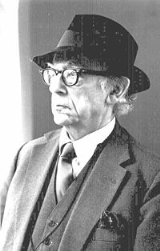
Isaiah Berlin

 
Isaiah Berlin

   Email Print
   Bookmark   Link


Isaiah Berlin


Sir Isaiah Berlin, OM (6 June 1909 – 5 November 1997) was a philosopher and historian of ideas, regarded as one of the leading liberal thinkers of the twentieth century. He excelled as an essayist, lecturer and conversationalist; and as a brilliant speaker who delivered, rapidly and spontaneously, richly allusive and coherently structured material, whether for a lecture series at Oxford University or as a broadcaster on the BBC Third Programme
BBC Third Programme

The BBC Third Programme was a national radio network broadcast by the BBC. The network first went on air on 29 September 1946 and became one of the leading cultural and intellectual forces in Britain, playing a crucial role in disseminating the arts....
, usually without a script.


Discussion
Ask a question about 'Isaiah Berlin'
Start a new discussion about 'Isaiah Berlin'
Answer questions from other users
Full Discussion Forum


Quotations


Everything is what it is: liberty is liberty, not equality or fairness or justice or culture, or human happiness or a quiet conscience.

Injustice, poverty, slavery, ignorance – these may be cured by reform or revolution. But men do not live only by fighting evils. They live by positive goals, individual and collective, a vast variety of them, seldom predictable, at times incompatible.

But to manipulate men, to propel them towards goals which you - the social reformer - see, but they may not, is to deny their human essence, to treat them as objects without wills of their own, and therefore to degrade them.

Freedom for the pike is death for the minnow.

The fundamental sense of freedom is freedom from chains, from imprisonment, from enslavement by others. The rest is extension of this sense, or else metaphor.

Those who have ever valued liberty for its own sake believed that to be free to choose, and not to be chosen for, is an inalienable ingredient in what makes human beings human.


Encyclopedia


Sir Isaiah Berlin, OM (6 June 1909 – 5 November 1997) was a philosopher and historian of ideas, regarded as one of the leading liberal thinkers of the twentieth century. He excelled as an essayist, lecturer and conversationalist; and as a brilliant speaker who delivered, rapidly and spontaneously, richly allusive and coherently structured material, whether for a lecture series at Oxford University or as a broadcaster on the BBC Third Programme
BBC Third Programme

The BBC Third Programme was a national radio network broadcast by the BBC. The network first went on air on 29 September 1946 and became one of the leading cultural and intellectual forces in Britain, playing a crucial role in disseminating the arts....
, usually without a script. Many of his essays and lectures were later collected in book form.

Born in Riga
Riga

Riga the Capital of Latvia, is situated on the Baltic Sea coast on the mouth of the river Daugava River. Riga is the largest city in the Baltic states....
, now capital of Latvia
Latvia

Latvia The Latvians are a Baltic peoples culturally related to the Estonians and Lithuanians, with the Latvian language having many similarities with Lithuanian language, but not with the Estonian language....
, then part of the Russian Empire
Russian Empire

File:Russian Emperor Flag.jpgFile:Romanov Flag.svgThe Russian Empire was a state that existed from 1721 until the Russian Revolution of 1917....
, he was the first person of Jew
Jew

A Jew is a member of the Jewish people, an ethnoreligious group that traces its ancestry to the Israelites or Hebrews of the Ancient Near East....
ish descent to be elected to a prize fellowship at All Souls College, Oxford
All Souls College, Oxford

All Souls College is one of the Colleges of the University of Oxford of the University of Oxford in England.Unique to All Souls, all of its members automatically become Fellows, i.e., full members of the College's governing body....
. From 1957 to 1967, he was Chichele Professor of Social and Political Theory
Chichele Professor of Social and Political Theory

The Chichele professorial chair in social and political theory is one of the statutory Chichele Professorships at All Souls College, Oxford. This Chair was established 1944....
 at the University of Oxford
University of Oxford

The University of Oxford , located in the city of Oxford, Oxfordshire, England, is the List of oldest universities in continuous operation in the English-speaking world....
. He was president of the Aristotelian Society
Aristotelian Society

The Aristotelian Society for the Systematic Study of Philosophy was founded at a meeting on 19 April 1880 which resolved "to constitute a society of about twenty and to include ladies; the society to meet fortnightly, on Mondays at 8 o'clock, at the rooms of the Spelling Reform Association?"...
 from 1963 to 1964. In 1966, he helped to found Wolfson College, Oxford
Wolfson College, Oxford

Wolfson College is a Colleges of the University of Oxford of the University of Oxford in England. Quietly located in north Oxford along the River Cherwell, Wolfson is an all-graduate college with over sixty governing body fellows, in addition to both research and junior research fellows....
, and became its first President. He was knighted
Knight Bachelor

The rank of Knight Bachelor is a part of the British honours system. It is the rank of a man who has been knighted by the monarch but not as a member of one of the organised Chivalric order....
 in 1957, and was awarded the Order of Merit in 1971. He was President of the British Academy
British Academy

The British Academy is the United Kingdom's national academy for the humanities and the social sciences. It was established by Royal Charter in 1902, and is a fellowship of more than 800 scholars....
 from 1974 to 1978. He also received the 1979 Jerusalem Prize
Jerusalem Prize

The Jerusalem Prize for the Freedom of the Individual in Society is a biennial literary award given to writers whose work has dealt with themes of human freedom, society, politics, and government....
 for his writings on individual freedom.

Berlin's work on liberal theory has had a lasting influence. His 1958 inaugural lecture, "Two Concepts of Liberty
Two Concepts of Liberty

Two Concepts of Liberty was the inaugural lecture delivered by Isaiah Berlin before the University of Oxford on October 31, 1958. It was subsequently published as a 57-page pamphlet by Oxford at the Clarendon Press....
", famous for its distinction between positive
Positive liberty

Positive liberty refers to having the power and resources to act to fulfill one's own potential, as opposed to negative liberty, which refers to freedom from restraint....
 and negative liberty
Negative liberty

The concept of negative liberty refers to freedom from interference by other people. According to Thomas Hobbes, "a free man is he that in those things which by his strength and wit he is able to do is not hindered to do what he hath the will to do." ...
, has informed much of the debate since then on the relationship between liberty and other values.

Life

Berlin was born as an only child into a wealthy Jewish family, the son of Mendel Berlin, a timber merchant, and lineal descendant of Israel ben Eliezer, and his wife Marie, nιe Volshonok. He spent his childhood in Riga (now Latvia
Latvia

Latvia The Latvians are a Baltic peoples culturally related to the Estonians and Lithuanians, with the Latvian language having many similarities with Lithuanian language, but not with the Estonian language....
), and later lived in Andreapol΄ and Petrograd, witnessing both episodes of the Russian Revolution of 1917
Russian Revolution of 1917

The Russian Revolution is the series of revolutions in Russia in 1917, which destroyed the Tsarist autocracy and led to the creation of the Soviet Union....
.

The family moved to Britain in 1921, when Berlin was twelve. In London, he lived in South Kensington
South Kensington

South Kensington is a district in the Royal Borough of Kensington and Chelsea in London. It is a built-up area located 2.4 miles west south-west of Charing Cross....
 and later Hampstead
Hampstead

Hampstead is an area of London, England, located north-west of Charing Cross. It is part of the London Borough of Camden. It is situated within Inner London....
. He was educated at London's St. Paul's school, then at Corpus Christi College, Oxford
Corpus Christi College, Oxford

Corpus Christi College is one of the Colleges of the University of Oxford of the University of Oxford in the United Kingdom. Founded in 1517, it is the twelfth oldest college in Oxford, with an estimated financial endowment of ?58m as of 2006....
, where he studied Greats (Classics
Classics

Classics is the branch of the Humanities comprising the languages, literature, philosophy, history, art, and other culture of the ancient Mediterranean World; especially Ancient Greece and Ancient Rome during Classical Antiquity ....
) and PPE (Philosophy, Politics and Economics). As an undergraduate, he notably befriended A. J. Ayer (with whom he was to share a friendly rivalry for the rest of his life), Stuart Hampshire
Stuart Hampshire

Sir Stuart Newton Hampshire was an Oxford University philosopher, literary critic and university administrator. He was one of the rationalism Oxford thinkers who gave a new direction to moral and political thought in the post-World War II era....
, Maurice Bowra
Maurice Bowra

Sir Cecil Maurice Bowra was an England classical scholar, academic, and known for his wit. He was warden of Wadham College, Oxford, from 1938 to 1970, and served as Vice-Chancellor of the University of Oxford from 1951 to 1954....
 and J. L. Austin
J. L. Austin

John Langshaw Austin was a British philosophy of language, born in Lancaster, Lancashire and educated at Shrewsbury School and Balliol College, Oxford....
. He was to remain at Oxford
Oxford

Oxford is a City status in the United Kingdom, and the county town of Oxfordshire, in South East England. It has a population of 151,000. The rivers River Cherwell and River Thames run through Oxford and meet south of the city centre....
 for the rest of his life, apart from a period working for British Information Services in New York from 1940 to 1942, and the British embassies in Washington, DC, and Moscow from then until 1946. In 1956, he married Aline Halban, nιe de Gunzbourg.

Berlin died in Oxford in 1997, aged 88. He is buried there in Wolvercote Cemetery
Wolvercote Cemetery

Wolvercote Cemetery is a cemetery close to the north Oxford suburb of Wolvercote, England, off the Banbury Road. Unusually, this single cemetery is divided into areas to accommodate graves of the Jewish and Muslim communities, as well as all categories of Christians....
.

His work


"Two Concepts of Liberty"

Berlin is best known for his essay "Two Concepts of Liberty
Two Concepts of Liberty

Two Concepts of Liberty was the inaugural lecture delivered by Isaiah Berlin before the University of Oxford on October 31, 1958. It was subsequently published as a 57-page pamphlet by Oxford at the Clarendon Press....
", delivered in 1958 as his inaugural lecture as Chichele Professor of Social and Political Theory at Oxford. He defined negative liberty
Negative liberty

The concept of negative liberty refers to freedom from interference by other people. According to Thomas Hobbes, "a free man is he that in those things which by his strength and wit he is able to do is not hindered to do what he hath the will to do." ...
 as the absence of constraints on, or interference with, agents' possible action. Greater "negative freedom" meant fewer restrictions on possible action. Berlin associated positive liberty
Positive liberty

Positive liberty refers to having the power and resources to act to fulfill one's own potential, as opposed to negative liberty, which refers to freedom from restraint....
 with the idea of self-mastery, or the capacity to determine oneself, to be in control of one's destiny. While Berlin granted that both concepts of liberty represent valid human ideals, as a matter of history the positive concept of liberty has proven particularly susceptible to political abuse.

Berlin contended that under the influence of Jean-Jacques Rousseau
Jean-Jacques Rousseau

Jean Jacques Rousseau was a major philosopher, writer, and composer of the eighteenth century The Age of Enlightenment, whose political philosophy influenced the French Revolution and the development of modern political and educational thought....
, Immanuel Kant
Immanuel Kant

Immanuel Kant was an 18th-century German Philosophy from the Kingdom of Prussia city of K?nigsberg . He is regarded as one of the most influential thinkers of modern Europe and of the late Age of Enlightenment....
 and G. W. F. Hegel (all committed to the positive concept of liberty), European political thinkers often equated liberty with forms of political discipline or constraint. This became politically dangerous when notions of positive liberty were, in the nineteenth century, used to defend nationalism, self-determination and the Communist idea of collective rational control over human destiny. Berlin argued that, following this line of thought, demands for freedom paradoxically become demands for forms of collective control and discipline – those deemed necessary for the "self-mastery" or self-determination of nations, classes, democratic communities, and even humanity as a whole. There is thus an elective affinity, for Berlin, between positive liberty and political totalitarianism
Totalitarianism

Totalitarianism is a concept used to describe political systems whereby a state regulates nearly every aspect of public and private life. Totalitarian regimes or movements maintain themselves in political power by means of an official all-embracing ideology and propaganda disseminated through the state-controlled mass media, single-party st...
.

Conversely, negative liberty represents a different, perhaps safer, understanding of the concept of liberty. Its proponents (such as Jeremy Bentham
Jeremy Bentham

Jeremy Bentham was an England jurist, philosopher, and legal and social reformer. He was the brother of Samuel Bentham. He was a political radical, and a leading theorist in Anglo-American philosophy of law....
 and John Stuart Mill
John Stuart Mill

John Stuart Mill , United Kingdom philosopher, political economy, civil servant and Parliament of the United Kingdom, was an influential liberalism thinker of the 19th century....
) insisted that constraint and discipline were the antithesis of liberty and so were (and are) less prone to confusing liberty and constraint in the manner of the philosophical harbingers of modern totalitarianism. It is this concept of Negative Liberty that Isaiah Berlin was a proponent of. It dominated heavily his early chapters in his third lecture.

This negative liberty is central to the claim for toleration due to incommensurability. This concept is mirrored in the work of Joseph Raz
Joseph Raz

Joseph Raz is an influential legal philosophy, moral philosophy and political philosophy philosopher. He is one of the most prominent living advocates of legal positivism....
.

Other work

Berlin's essay "Historical Inevitability" (1954) focused on a controversy in the philosophy of history
Philosophy of history

Philosophy of history is an area of philosophy concerning the eventual significance, if any, of human history. Furthermore, it speculates as to a possible teleology end to its development?that is, it asks if there is a design, purpose, directive principle, or finality in the processes of human history....
. In Berlin's words, the choice is whether one believes that "the lives of entire peoples and societies
Society

A society is a group of humans characterized by patterns of relationships between individuals that share a distinctive culture and/or institutions....
 have been decisively influenced by exceptional individuals" or, conversely, that whatever happens occurs as a result of impersonal forces oblivious to human intentions. Berlin is also well known for his writings on Russian intellectual history, most of which are collected in Russian Thinkers (1978; 2nd ed., 2008), edited, like most of Berlin's work, by Henry Hardy
Henry Hardy

Henry Hardy is a United Kingdom author and editing....
 (in the case of this volume, jointly with Aileen Kelly).

Berlin's writings on the Enlightenment and its critics – for whom Berlin used the term "the Counter-Enlightenment" – and particularly Romanticism
Romanticism

Romanticism is a complex artistic, literary, and intellectual movement that originated in the second half of the 18th century in Western Europe, and gained strength during the Industrial Revolution....
, contributed to his advocacy of an ethical theory now usually termed value pluralism. For Berlin, values are creations of mankind, rather than products of nature waiting to be discovered, though he also argued that the nature of mankind is such that certain values – for example, the importance of individual liberty – will hold true across cultures, which is part of what he meant when he called his position "objective pluralism". With his account of value pluralism, he proposed the view that moral values may be equally, or rather incommensurably, valid and yet incompatible, and may therefore come into conflict with one another in a way that admits of no resolution without reference to particular contexts of decision. When values clash, it may not be that one is more important than the other. Keeping a promise may conflict with the pursuit of truth; liberty may clash with social justice
Social justice

Social justice, sometimes called civil justice, refers to the concept of a society in which justice is achieved in every aspect of society, rather than merely the administration of law....
. Moral conflicts are "an intrinsic, irremovable element in human life". "These collisions of values are of the essence of what they are and what we are."

Bibliography


Major works:

All publications listed from 1978 onwards are compilations or transcripts of various lectures, essays, and letters, edited by Henry Hardy. Details given are of first and current UK editions. For US editions see link above.

  • Karl Marx: His Life and Environment, Thornton Butterworth, 1939. 4th ed., 1978, Oxford University Press
    Oxford University Press

    Oxford University Press is a publisher and a department of the University of Oxford in England. It is the largest university press in the world, being larger than all the American university presses combined with Cambridge University Press....
    . ISBN 0-19-510326-2.
  • Vico and Herder: Two Studies in the History of Ideas, Chato and Windass, 1976. Redwood Burn Ltd.. ISBN 0-7011-2512-8.
  • The Hedgehog and the Fox: An Essay on Tolstoy's View of History
    The Hedgehog and the Fox

    "The Hedgehog and the Fox" is the title of an essay by Isaiah Berlin, regarding the Russian author Leo Tolstoy theory of history.The title is a reference to a fragment attributed to the Ancient Greece poet Archilochus: p???' ??d ???p??, ???' ?????? ?? ???a ....
    , Weidenfeld & Nicolson, London, 1953. Phoenix. ISBN 978-075380-867-2.
  • Four Essays on Liberty, Oxford University Press, 1969. Superseded by Liberty.
  • Russian Thinkers (co-edited with Aileen Kelly), Hogarth Press, 1978. 2nd ed., Penguin
    Penguin Books

    Penguin Books is a United Kingdom publisher founded in 1935 by Allen Lane. Lane's idea was to provide quality writing cheaply, for the same price as a pack of cigarettes....
    . ISBN 978-0-14-144220-4
  • Concepts and Categories: Philosophical Essays, Hogarth Press, 1978. Pimlico. ISBN 0-670-23552-0.
  • Against the Current: Essays in the History of Ideas, Hogarth Press, 1979. Pimlico. ISBN 0–7126–6690–7.
  • Personal Impressions, Hogarth Press, 1980. 2nd ed., 1998, Pimlico. ISBN 0–7126–6601–X.
  • The Crooked Timber of Humanity: Chapters in the History of Ideas, John Murray
    John Murray (publisher)

    John Murray was a United Kingdom publishing house, renowned for the roster of authors it has published in its history, including Jane Austen, Sir Arthur Conan Doyle, George Gordon Byron, 6th Baron Byron, Charles Lyell, Johann Wolfgang von Goethe and Charles Darwin....
    , 1990. Pimlico. ISBN 0–7126–0616–5.
  • The Sense of Reality: Studies in Ideas and their History, Chatto & Windus, 1996. Pimlico. ISBN 0–7126–7367–9.
  • The Proper Study of Mankind: An Anthology of Essays (co-edited with Roger Hausheer), Chatto & Windus, 1997. Pimlico. ISBN 0–7126–7322–9.
  • The Roots of Romanticism (recorded 1965), Chatto & Windus, 1999. ISBN 0–7126–6544–7.
  • Three Critics of the Enlightenment: Vico, Hamann, Herder, Pimlico, 2000. ISBN 0–7126–6492–0.
  • The Power of Ideas, Chatto & Windus, 2000. Pimlico. ISBN 0–7126–6554–4.
  • Freedom and its Betrayal: Six Enemies of Human Liberty (recorded 1952), Chatto & Windus, 2002. Pimlico. ISBN 0–7126–6842–0.
  • Liberty (revised and expanded edition of Four Essays On Liberty), Oxford University Press, 2002. ISBN 0-19-924989-X.
  • The Soviet Mind: Russian Culture under Communism, Brookings Institution Press, 2004. ISBN 0-8157-0904-8.
  • Flourishing: Selected Letters 1928–1946, Chatto & Windus, 2004. ISBN 0-7011-7420-X. (Published as Selected Letters 1928–1946 by Cambridge University Press
    Cambridge University Press

    Cambridge University Press is a printer and publisher granted a Royal Letters Patent by Henry VIII of England in 1534. It is the world's oldest continually operating book publisher....
    , 2004. ISBN 0-521-83368-X.)
  • Political Ideas in the Romantic Age: Their Rise and Influence on Modern Thought, Chatto & Windus, 2006. ISBN 0-701-17909-0. Princeton University Press
    Princeton University Press

    The Princeton University Press is an independent Academic publishing with close connections to Princeton University. Its mission is to disseminate scholarship within academia and society at large....
    , 2006. ISBN 978-0-691-12687-6.0. Pimlico
    Pimlico

    Pimlico is a small area of central London in the City of Westminster that is primarily residential and well known for its collection of small hotels and impressive Regency architecture....
    , ISBN 978–1–844–13926–2.


  • (with Beata Polanowska-Sygulska) Unfinished Dialogue, Prometheus, 2006. ISBN 978-1-59102-376-0/1-59102-376-9.


See also

  • Liberalism
    Liberalism

    Liberalism is a broad class of political philosophy that considers individualism liberty and equality to be the most important political goals....
  • Contributions to liberal theory
    Contributions to liberal theory

    This is a partial list of individual contributions to Liberalism on a worldwide scale. These individuals are strongly associated philosophers of the Enlightenment....
  • The Hedgehog and the Fox
    The Hedgehog and the Fox

    "The Hedgehog and the Fox" is the title of an essay by Isaiah Berlin, regarding the Russian author Leo Tolstoy theory of history.The title is a reference to a fragment attributed to the Ancient Greece poet Archilochus: p???' ??d ???p??, ???' ?????? ?? ???a ....
  • Counter-Enlightenment
    Counter-Enlightenment

    "Counter-Enlightenment" is a term used to refer to a movement that arose in the late-eighteenth and early-nineteenth centuries in opposition to the eighteenth century Age of Enlightenment....


Further reading

  • .
  • , Wolfson College, Oxford.
  • .
  • , Wolfson College, Oxford.
  • .
  • .
  • from .*, 23 October 1997.
  • .
  • John Gray
    John Gray

    John Gray may refer to:...
    . Isaiah Berlin, Princeton: Princeton University Press, 1996. ISBN 0-691-04824-X.
  • Michael Ignatieff
    Michael Ignatieff

    Michael Grant Ignatieff, Doctor of Philosophy, Member of Parliament is a Canadian historian, politician, leader of the Liberal Party of Canada and the Leader of the Opposition in Canada....
    , Isaiah Berlin: A Life, New York: Henry Holt & Co., 1999. ISBN 0-8050-6300-5. Authorised biography.
  • Charles Blattberg
    Charles Blattberg

    Charles Blattberg is a professor of political philosophy at the Universit? de Montr?al. Blattberg grew up in Toronto and completed his undergraduate degree at the University of Toronto, where he also served as president of its Students? Administrative Council during the 1989-90 academic year....
    , From Pluralist to Patriotic Politics: Putting Practice First, Oxford and New York: Oxford University Press, 2000. ISBN 0-19-829688-6. A critique of Berlin's value pluralism.
  • George Crowder, Isaiah Berlin: Liberty and Pluralism, Cambridge: Polity Press, 2004. ISBN 0-7456-2476-6.
  • Joshua Cherniss, 'Isaiah Berlin: A Defence',
  • Claude Galipeau, Isaiah Berlin's Liberalism, Oxford: Clarendon Press, 1994. ISBN 0-19-827868-3.
  • Ned O'Gorman, 'My dinners with Isaiah: the music of a philosopher's life - Sir Isaiah Berlin' - includes related article on Isaiah Berlin's commitment to ideals of genuine understanding over intellectual mastery,
  • Conversations with Isaiah Berlin, Ramin Jahanbegloo
    Ramin Jahanbegloo

    Ramin Jahanbegloo is an Iranian intellectual and academic who is currently based in Canada....
     (1992)