


University of Freiburg

Encyclopedia
The University of Freiburg (German Albert-Ludwigs-Universität Freiburg, colloquially Uni Freiburg or just Freiburg), sometimes referred to in English as the Albert Ludwig University of Freiburg, is a public
research university located in Freiburg im Breisgau, Baden-Württemberg
, Germany.
The university was founded in 1457 by the Habsburg dynasty as the second university in Austrian
-Habsburg territory after the University of Vienna
. Today, Freiburg is the fifth-oldest university in Germany, with a long tradition of teaching the humanities, social sciences and natural sciences. The university is made up of 11 faculties and attracts students from across Germany as well as from over one hundred and twenty other countries. Foreign students constitute about 16% of total student numbers.
The University of Freiburg is one of Europe's most prestigious universities and is amongst its top research and teaching institutions. With its long-standing reputation of excellence, the university looks both to the past, to maintain its historic academic and cultural heritage, and to the future, developing new methods and opportunities to meet the needs of a changing world. The University of Freiburg has been home to some of the greatest minds of the Western tradition
, including such eminent figures as Hannah Arendt
, Rudolf Carnap
, David Daube
, Johann Eck
, Hans-Georg Gadamer
, Friedrich Hayek
, Martin Heidegger
, Edmund Husserl
, Friedrich Meinecke
, and Max Weber
. In addition, 19 Nobel laureates are affiliated with the University of Freiburg and 15 academics have been honored with the highest German research prize, the Gottfried Wilhelm Leibniz Prize
, while working at the University of Freiburg.
As of 2007, the university has been designated an elite German "University of Excellence
".
, philosophy
, medicine
and law
). Its establishment belongs to the second wave of German university foundings in the late Middle Ages
, like the Eberhard Karls University of Tübingen
and the University of Basel
. Established by papal privilege (papal bull
) the University in Freiburg actually was - like all or most universities in the Middle Ages - a corporation of the church body and therefore belonged to the Roman Catholic Church
and its hierarchy. The bishop of Basel
consequently was its provost
or chancellor
(Kanzler), the bishop of Constance
was its patron while the real founder of the university was the sovereign, Archduke Albert VI of Austria, being the brother of Frederick III
, Emperor of the Holy Roman Empire of the German Nation. At its founding, the university was named after Albert VI of Austria. He provided the university with land and endowments
as well as its own jurisdiction
. Also he declared Albrechts University as the "county university" (German Landesuniversität) for his territory until it was handed over to the Austrian House of Habsburg in 1490.
The University soon attracted many students as the humanists Geiler von Kaysersberg, Johann Reuchlin
or Jakob Wimpfeling
. When Ulrich Zasius was teaching law (until 1536), Freiburg became a centre of humanist
jurisprudence. From 1529 to 1535 Erasmus of Rotterdam lived and taught in Freiburg
. From around 1559 on, the university was housed at the Altes Collegium ("Old College"), today called the "new town-hall". The importance of the university decreased during the time of the Counter-Reformation
. To counter reformatory tendencies, the administration of two faculties was handed over to the Roman Catholic order of the Jesuits in 1620. From 1682 on, the Jesuits built their college as well as the Jesuit church (nowadays the "University Church" or Universitätskirche).
The university had to move out of Freiburg several times, as from 1686 to 1698, when French troops occupied Freiburg and the southern parts of the upper Rhine
region.
.jpg) After Freiburg was re-conquered and appointed as capital of Further Austria
After Freiburg was re-conquered and appointed as capital of Further Austria
, a new time began for the university by the reforms of Empress Maria Theresa of Austria
. The requirements for admission were changed for all faculties in 1767 (before that time only Roman Catholics were allowed to study) and Natural Sciences were added as well as Public Administration. Also in 1767, the university became a governmental institution despite the Church's protests. The Church finally lost its predominant influence on the university when the Jesuits were suppressed following a decree signed by Pope Clement XIII
in 1773. Consequently, Johann Georg Jacobi
(brother of the more famous philosopher Friedrich Heinrich Jacobi
) in 1784 was the first Protestant professor teaching at the university in Freiburg.
When Freiburg became a part of the newly established Grand Duchy
of Baden
(in German "Großherzogtum Baden") in 1805 (after Napoleon occupied the area of the formerly Further Austria
), a crisis began for the university in Freiburg. Indeed there were considerations by Karl Friedrich, Grand Duke of Baden
and Karl, Grand Duke of Baden
to close down the university in Freiburg while both of them thought that the Grand Duchy
could not afford to run two universities at the same time (the Ruprecht Karl University of Heidelberg
also already existed since 1386). The university had enough endowments
and earnings to survive until the beginning of the regency of Ludwig I, Grand Duke of Baden
in 1818. Finally in 1820 he saved the university with an annual contribution. Since then the university has been named Albert Ludwigs University Freiburg (Albert-Ludwigs-Universität Freiburg) as an acknowledgement of gratitude by the university and the citizens of Freiburg.
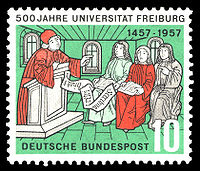 In the 1880s the population of the student
body and faculty started to grow quickly. The scientific reputation of Albert Ludwigs University attracted several researchers like economist Adolph Wagner
, historians Georg von Below and Friedrich Meinecke
, or jurists Karl von Amira and Paul Lenel.
The University of Freiburg, among others, served as a role model for the establishment of Johns Hopkins University
in Baltimore
, USA, in 1875. Johns Hopkins was the first US university committed to research following Alexander von Humboldt
's ideas of research as practiced at German universities at the time. Daniel Coit Gilman
, founding president of Johns Hopkins, who had studied in Germany, visited Freiburg and other German universities in preparation for the founding of Johns Hopkins.
In 1900 Freiburg became the first German university to accept a female student. Just before World War I
the university counted 3,000 students. After World War I the philosophers
Edmund Husserl
and (since 1928) Martin Heidegger taught at Albert Ludwigs University, as well as Edith Stein
. On the field of social sciences, Walter Eucken
developed the idea of ordoliberalism
, which consequently is also known as the "Freiburg School
".
In the beginning of the 20th century several new university buildings were built in the centre of Freiburg, such as in 1911 the new main building. During the "Third Reich" the university went through the process of "political alignment" (Gleichschaltung
) like the rest of the German universities. Under the rector Martin Heidegger all Jewish faculty members were forced to leave the university in accordance with the "‘Law for the Reintroduction of Professional Civil Service".
After World War II
the university was re-opened. New buildings for natural sciences were erected in the Institutsviertel ("institute quarter").
 In the postwar years, the ideas of ordoliberalism
, developed earlier by economists of the Freiburg School
such as Walter Eucken
, Franz Böhm
, Hans Grossmann-Doerth and Leonhard Miksch drove the creation of the German social market economy and its attendant Wirtschaftswunder
. Nobel Prize
winner and former professor at the University of Freiburg, Friedrich Hayek
is also associated with this theory. He directed the Walter Eucken Institut
, an economic think tank in Freiburg cooperating with the university. Arnold Bergstraesser, considered a founding father or German political science after World War II, was also a professor at the University of Freiburg. His research group later formed what is now the Arnold Bergstraesser Institute for socio-cultural research at the university.
In the late 20th century, the university was part of a mass education campaign and expanded rapidly. The student body grew to 10,000 by the 1960s, and doubled to 20,000 students by 1980. In the 1970s, the faculty structure was changed to 14 departments, with the Faculty of Applied Sciences
becoming the 15th faculty in 1994. In 2002, the number of faculties was reduced to eleven. The university opened a memorial dedicated to the victims of National Socialism among the students, staff, and faculty in 2003.
In 2006, the University of Freiburg joined the League of European Research Universities (LERU)
. One year later, in 2007, the University of Freiburg was chosen as one of nine German Universities of Excellence.

seated on a gothic throne holding the gospel in his right hand with the temple curtain in the background. Christ offers the teachings of the gospel to the Jewish scholars who are crouched at his feet. To the left and right of Christ are structures resembling towers, most likely symbolic of the Temple of Jerusalem. Located to the right of Christ is the coat of arms
of the Austrian duchies, a banner with five eagles. The shield on the opposite side symbolizes the coat of arms used by the Habsburgs in conjunction with their territories. The coat of arms of the city of Freiburg is located at the bottom of the seal, displaying St George's Cross
. The Latin inscription on the seal reads Sigillum universitatis studii friburgensis brisgaudie. The seal was slightly modified in 1913, but has otherwise been in continuous use since it was adopted in 1462.
 Having grown with the city since the 15th century, the university's buildings are deeply intertwined with the city. There are three large campuses (the university center next to the historical city center, the institutes quarter and the applied sciences campus), but other buildings can be found scattered throughout Freiburg.
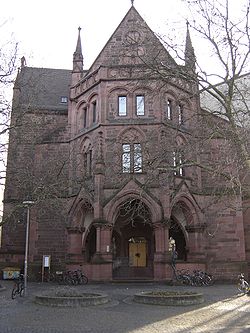
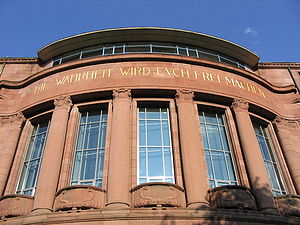
The university complex in the historical center of Freiburg contains such picturesque buildings as the Jugendstil Kollegiengebäude I, built in 1911 by Hermann Billing, and the gothic revival
old university library. The current University Library
is also located in the historical center; it is a monumental building erected in the 1970s, and is to be renovated and redesigned beginning in September, 2008. It is one of the largest in Germany and placed 4th in an October, 2007 German national ranking of university libraries.
The University Church
, located across from Kollegiengebäude II, was built in 1683 by the Jesuit order. The church and the Jesuit college were handed over to the university after the Jesuit order was suppressed in 1773. The church was destroyed in the November 27, 1944 bombing raid on Freiburg, and reconstructed in 1956.
The “institute quarter” (Institutsviertel) is home to the science faculties. This campus was destroyed almost completely in the Freiburg bombing raid in 1944. After World War II
, the reconstruction of the institutes began. Today, the quarter houses the physics buildings, the tall main chemistry building, visible from afar, the famous Institute for Macromolecular Chemistry at the Hermann-Staudinger-Haus, various other science buildings, as well as the renowned pre-clinical institutes of the Faculty of Medicine
.
_4.jpg) The applied sciences campus is located next to the small Freiburg airfield to the northwest of the city center, close to the University Medical Center. The campus is home to the IMTEK
The applied sciences campus is located next to the small Freiburg airfield to the northwest of the city center, close to the University Medical Center. The campus is home to the IMTEK
(Institut für Mikrosystemtechnik, Department of Microsystems Engineering) and the Department of Computer Science. With the addition of the Faculty for Applied Sciences, the University of Freiburg became the first classical university to combine traditional disciplines with microsystems technologies.
The University Medical Center Freiburg
(Universitätsklinikum Freiburg) is one of Germany's largest medical centers. It boasts 1,600 beds and handles 55,000 in-patients a year, with another 357,000 being treated ambulatorily. It consists of 13 specialized clinics, 5 clinical institutes, and 5 centers (e.g. Center for Transplantation Medicine). The University Medical Center achieved many technical advances, such as the first implantation of an artificial heart Jarvik 2000 (2002).
Most recently, the University of Freiburg purchased a large historic villa in the district of Herdern, which will house part of the literature and linguistics as well as history departments of the Freiburg Institute for Advanced Studies
(FRIAS).
 The university has a combined undergraduate and graduate student population of around 21,600. Approximately 16% of these students are foreigners, from ca. 120 different countries. The admission largely depends on the faculty and program applied for and is strictly merit based, with the average score of final secondary-school examinations (German Abitur
) or A-levels playing an important role. Overall, in the Fall of 2010, roughly 4,000 out of approximately 26,000 applicants were admitted.
The University of Freiburg offers a large variety of undergraduate, graduate
, and postdoctoral degree programs at its eleven faculties in 150 fields of study.
As common among German universities, the academic year consists of summer and winter terms (semesters). The winter term runs from October 1 to March 31, while the summer term runs from April 1 to September 30. However, lectures and classes usually do not run for the full duration of these periods and allow for breaks in spring and fall.
German universities enjoy government subsidies, so tuition fees are moderate. The University of Freiburg charges EUR 1210 per year for all undergraduate and most graduate and doctoral programs, regardless of the EU or non-EU citizenship of students.
station, echo-fm, and a Student television station
, alma*, which is also available as a podcast. Because of the nearby French and Swiss borders and the adjacent Black Forest
, where the university owns a retreat on Schauinsland
Mountain, there are fine opportunities for leisure and outdoor activities.
The university provides student housing in its various dormitories, run by the Stundentenwerk. Additionally, there are further dormitories in Freiburg which are operated by other institutions, such as the Catholic Archdiocese or the Evangelical Church
. Due to the affordable rent and limited spots, rooms in the various dormitories are very popular. Many students find private living arrangements, such as Wohngemeinschaften (shared apartments). However, the popularity of Freiburg for prospective students can make finding an apartment or room quite time consuming, especially before the start of the academic terms.
The university has its own career center, singled out as one of the best in Germany by the Stifterverband für die Deutsche Wissenschaft.
. The university received funding in all three categories. In the first category, funding for a new graduate school, the Spemann Graduate School of Biology and Medicine, was granted; in the second, funding was granted for the excellence cluster Centre for Biological Signalling Studies (bioss); and in the third category, Institutional Strategy Line of Funding, open only to institutions with submissions qualified in the first two categories, the university is receiving funding for "Windows for Research", which aims to promote a high level of interdisciplinarity between research fields and attract scientists from all over the world. To that end, the university founded the Freiburg Institute for Advanced Studies
(FRIAS). Being selected for the third category ranks Freiburg as one of nine "excellence universities" in Germany. The University is to receive over EUR 130 million in additional funds over five years (from 2007) from this third category funding.
In 2009, the University was also successful in a nationwide competition for excellence in teaching, held by the Stifterverband der deutschen Wissenschaft. The University of Freiburg, with its plans for future innovative teaching concepts, was selected as one of ten winners from a field of over one hundred higher education institutions.
, Die Zeit
, Focus
, etc.) the University of Freiburg has established itself as one of Germany's top universities. The faculties for law, medicine, economics, history, English studies, German studies, biology, dentistry, and pharmacology achieve especially high scores. In regards to the natural sciences, the University of Freiburg ranked 6th in Europe and 2nd in Germany in a ranking of the European Commission of the universities according to their overall impact on scientific research. The Centre for Higher Education Development (CHE), a German higher education think tank
, periodically publishes a comprehensive ranking of European Master's
and PhD
programs. Freiburg garnered five spots in the top Excellence Group among seven subject fields examined.
The ranking results of various commonly referenced international rankings are shown below.
twice. The humanoid robot team of the Faculty for Applied Sciences regularly competes with distinction in international tournaments. The University of Freiburg team has also repeatedly scored highly at the iGEM
undergraduate synthetic biology competition held at the Massachusetts Institute of Technology
. The team was supported by numerous university institutions, among them the recently established bioss cluster of excellence. The University of Freiburg also participates in the National Model United Nations
(NMUN) held annually in New York City, NY.
The genetically engineered golden rice
was developed by the University of Freiburg (Peter Beyer
) and the ETH Zurich
(Ingo Potrykus
) from 1992 to 2000. It was considered a breakthrough in biotechnology at the time of publication and now helps to provide Vitamin A
to people lacking access to it in their diet.
When previous rector Prof. Dr. Jäger retired in 2008, law professor Prof. Dr. Andreas Voßkuhle
was chosen as his successor. However, shortly after the start of his term, the Social Democratic Party of Germany
(SPD) nominated Voßkuhle as vice-president of the Federal Constitutional Court of Germany
. Voßkuhle accepted the nomination, was confirmed and took his seat on the court in May 2008. In July 2008, then vice-rector Prof. Dr. Hans-Jochen Schiewer was elected as successor to Voßkuhle. Schiewer has assumed the position of rector with the start of the winter term 2008/2009.
The University of Freiburg offers educational audio and video content on the iTunes U software platform since January 2008.
 Today, at the university there are about 430 professors, 3,695 academic employees and 8,644 non-academic employees working for the Albert Ludwigs University, making it Freiburg's and the region's biggest employer. The university attracts many academics from abroad and was awarded excellent positions in the 2005 and 2009 Humboldt Ranking,.
and divided into 11 faculties:
 The University of Freiburg has a variety of graduate education and research opportunities. In an evaluation of European graduate programs, Freiburg was ranked among the leading universities in several subject fields examined.
One of the notable graduate opportunities is the Freiburg Institute for Advanced Studies
(FRIAS), a project funded by the German Excellence Initiative.(see Current affairs and academics above)
Apart from the many graduate programs of its faculties, Freiburg has set up additional specialized graduate schools and graduate research centers, coordinated by the newly founded International Graduate Academy (IGA) Freiburg. The IGA coordinates five Graduate Schools: the Spemann Graduate School of Biology and Medicine (SGBM); the European Cultures and Intercultural Interweaving school; the Theology and Religious Studies school; the Hermann Paul School of Language Sciences and the Environment, Society and Global Change graduate school of the Faculty of Forest and Environmental Sciences.
The IGA also coordinates twelve Graduate Research Centers (Graduiertenkolleg): Biochemistry of Enzymes; Friends, Patrons, Clients; Formation and Development of Present-Day Landscapes; Mathematical Logics and Applications; Mechanisms of Neuronal Signal Transduction; Catalysts and Catalytic Reactions for Organic Synthesis (in cooperation with the University of Basel
); Hadron Collider Physics; Embedded Microsystems; From Cells to Organs: Molecular Mechanisms of Organogenesis; Signal Systems in Model Organisms of Plant Origin; Micro Energy Harvesting; and PhD program Computational Neuroscience at the Bernstein Center for Computational Neuroscience Freiburg
Finally, the university operates three joint graduate schools with the Max Planck Society
: the International Max Planck Research School for Molecular and Cellular Biology
; the International Max Planck Research School on Retaliation, Mediation and Punishment; and the International Max Planck Research School for Comparative Criminal Law.
Together with the EUCOR universities of Basel
and Strasbourg
and the Karlsruhe Institute of Technology
, the University of Freiburg also runs the shared graduate school École supérieure de biotechnologie Strasbourg
, enabling the students to obtain an international degree in biotechnology and a trilingual education, as classes are taught in English, German, and French.
courses for foreign students since 1911. The courses take place at the university's Language Teaching Centre (Sprachlehrinstitut, SLI) during the semester breaks and attract students from over 50 nations to Freiburg. The intensive language lessons are bolstered by a supplementary program with lectures and seminars on German culture
, politics, philosophy
, and art
as well as excursions to the Black Forest
, the Alsace
region in France, Basel
(Switzerland) or Lake Constance
. In addition to classes for all language levels, professional German courses (e.g. Business German) are also offered.
 The city of Freiburg is known for its environmentally friendly policies and focus on renewable energy and sustainability, attracting solar industry and research to the city. This environmentally conscious attitude also extends to the University of Freiburg which has founded the work group "Nachhaltige Universität Freiburg" (Sustainable University of Freiburg) and has drawn up environmental guidelines to be implemented in university practice.
The university has also founded the initiative Solar-Uni Freiburg in 2007, with the aim of further expanding its capabilities in sustainability and environmental research. Solar panels were installed on the roofs of university buildings. To bundle renewable energy research and teaching at the university, the Center for Renewable Energy (ZEE, Zentrum für Erneuerbare Energien), an interdisciplinary and cross-faculty facility, was founded. Aside from research in the fields of solar energy, biomass, geothermal energy, energy efficiency and new energies, an international Master of Science
degree in Renewable Energy Management is being offered.
In addition to its own expertise, the Center for Renewable Energy can draw upon the support of the renewable energy industrial sector in Freiburg, as well as the university's cooperation with other research institutes in the area, such as the Fraunhofer Institute for Solar Energy Systems, the Öko-Institut - Institute for Applied Ecology, or the University of Applied Sciences Offenburg.
Collaborating institutions include:
 The university is part of the regional EUCOR federation together with the Karlsruhe Institute of Technology
, the universities of Basel
, Mulhouse
, and, marked by particularly close ties, Strasbourg
. Freiburg is further a member of the League of European Research Universities
; the European University Association
; ASEA-Uninet; AC21; and the International Forum of Public Universities
(IFPU). The university also has exchange agreements and cooperative efforts with renowned universities on almost every continent.
The University of Freiburg initiated an English language international master's program in social sciences
, the Global Studies Programme (GSP) in 2001. The aim of the program is to enable students to study social sciences in different regions and cultures. Combining various disciplines such as sociology
, political sciences, anthropology
and geography
, students approach globalization with a unique perspective. The program is conducted jointly by the University of Freiburg with the University of KwaZulu-Natal
in Durban
, South Africa, the Jawaharlal Nehru University
in New Delhi, India, the Latin American Social Sciences Institute
in Buenos Aires
, Argentina
, and the Chulalongkorn University
in Bangkok
, Thailand
. Students in the GSP master's program study on three different continents during the two-year degree program. Since 2008, the GSP also offers a PhD program in Global Studies. The Global Studies Program has received many awards, among them the BMW Group Award for Intercultural Learning in 2004 as well as being listed a Top Ten International Master's Degree Course in Germany by the German Academic Exchange Service
(DAAD) in 2006.
The university also supports the Institute for Russian-German Literature and Cultural Relations at the Russian State University for the Humanities
as well as the Vladimir Admoni School for Doctoral Studies at the University of Latvia
.
, Edmund Husserl
, Martin Heidegger
, Paul Ehrlich
, Hans Adolf Krebs
, Hans Spemann
, and Friedrich August von Hayek.
Among the affiliates are numerous Nobel laureates and Leibniz Prize
winners.
For a complete list of notable alumni and professors, see: People associated with the University of Freiburg
Public university
A public university is a university that is predominantly funded by public means through a national or subnational government, as opposed to private universities. A national university may or may not be considered a public university, depending on regions...
research university located in Freiburg im Breisgau, Baden-Württemberg
Baden-Württemberg
Baden-Württemberg is one of the 16 states of Germany. Baden-Württemberg is in the southwestern part of the country to the east of the Upper Rhine, and is the third largest in both area and population of Germany's sixteen states, with an area of and 10.7 million inhabitants...
, Germany.
The university was founded in 1457 by the Habsburg dynasty as the second university in Austrian
Austrians
Austrians are a nation and ethnic group, consisting of the population of the Republic of Austria and its historical predecessor states who share a common Austrian culture and Austrian descent....
-Habsburg territory after the University of Vienna
University of Vienna
The University of Vienna is a public university located in Vienna, Austria. It was founded by Duke Rudolph IV in 1365 and is the oldest university in the German-speaking world...
. Today, Freiburg is the fifth-oldest university in Germany, with a long tradition of teaching the humanities, social sciences and natural sciences. The university is made up of 11 faculties and attracts students from across Germany as well as from over one hundred and twenty other countries. Foreign students constitute about 16% of total student numbers.
The University of Freiburg is one of Europe's most prestigious universities and is amongst its top research and teaching institutions. With its long-standing reputation of excellence, the university looks both to the past, to maintain its historic academic and cultural heritage, and to the future, developing new methods and opportunities to meet the needs of a changing world. The University of Freiburg has been home to some of the greatest minds of the Western tradition
Western culture
Western culture, sometimes equated with Western civilization or European civilization, refers to cultures of European origin and is used very broadly to refer to a heritage of social norms, ethical values, traditional customs, religious beliefs, political systems, and specific artifacts and...
, including such eminent figures as Hannah Arendt
Hannah Arendt
Hannah Arendt was a German American political theorist. She has often been described as a philosopher, although she refused that label on the grounds that philosophy is concerned with "man in the singular." She described herself instead as a political theorist because her work centers on the fact...
, Rudolf Carnap
Rudolf Carnap
Rudolf Carnap was an influential German-born philosopher who was active in Europe before 1935 and in the United States thereafter. He was a major member of the Vienna Circle and an advocate of logical positivism....
, David Daube
David Daube
David Daube DCL, FBA was the twentieth century's preeminent scholar of ancient law. He combined a familiarity with many legal systems, particularly Roman law and biblical law, with an expertise in Greek, Roman, Jewish, and Christian literature, and used literary, religious, and legal texts to...
, Johann Eck
Johann Eck
Dr. Johann Maier von Eck was a German Scholastic theologian and defender of Catholicism during the Protestant Reformation. It was Eck who argued that the beliefs of Martin Luther and Jan Hus were similar.-Life:...
, Hans-Georg Gadamer
Hans-Georg Gadamer
Hans-Georg Gadamer was a German philosopher of the continental tradition, best known for his 1960 magnum opus, Truth and Method .-Life:...
, Friedrich Hayek
Friedrich Hayek
Friedrich August Hayek CH , born in Austria-Hungary as Friedrich August von Hayek, was an economist and philosopher best known for his defense of classical liberalism and free-market capitalism against socialist and collectivist thought...
, Martin Heidegger
Martin Heidegger
Martin Heidegger was a German philosopher known for his existential and phenomenological explorations of the "question of Being."...
, Edmund Husserl
Edmund Husserl
Edmund Gustav Albrecht Husserl was a philosopher and mathematician and the founder of the 20th century philosophical school of phenomenology. He broke with the positivist orientation of the science and philosophy of his day, yet he elaborated critiques of historicism and of psychologism in logic...
, Friedrich Meinecke
Friedrich Meinecke
Friedrich Meinecke was a liberal German historian, probably the most famous German historian of his generation. As a representative of an older tradition still writing after World War II, he was an important figure to the end of his life.-Life:Meinecke was born in Salzwedel in the Province of Saxony...
, and Max Weber
Max Weber
Karl Emil Maximilian "Max" Weber was a German sociologist and political economist who profoundly influenced social theory, social research, and the discipline of sociology itself...
. In addition, 19 Nobel laureates are affiliated with the University of Freiburg and 15 academics have been honored with the highest German research prize, the Gottfried Wilhelm Leibniz Prize
Gottfried Wilhelm Leibniz Prize
The Gottfried Wilhelm Leibniz Prize is a research prize awarded by the Deutsche Forschungsgemeinschaft every year since 1985 to scientists working in Germany. This highest German research prize consists of a research grant of 2.5 million euro, to be used within seven years...
, while working at the University of Freiburg.
As of 2007, the university has been designated an elite German "University of Excellence
German Universities Excellence Initiative
The Excellence Initiative of the German Federal Ministry of Education and Research and the German Research Foundation aims to promote cutting-edge research and to create outstanding conditions for young scientists at universities, to deepen cooperation between disciplines and institutions, to...
".
History
Originally Albrechts University, the university started with four faculties (theologyTheology
Theology is the systematic and rational study of religion and its influences and of the nature of religious truths, or the learned profession acquired by completing specialized training in religious studies, usually at a university or school of divinity or seminary.-Definition:Augustine of Hippo...
, philosophy
Philosophy
Philosophy is the study of general and fundamental problems, such as those connected with existence, knowledge, values, reason, mind, and language. Philosophy is distinguished from other ways of addressing such problems by its critical, generally systematic approach and its reliance on rational...
, medicine
Medicine
Medicine is the science and art of healing. It encompasses a variety of health care practices evolved to maintain and restore health by the prevention and treatment of illness....
and law
Law
Law is a system of rules and guidelines which are enforced through social institutions to govern behavior, wherever possible. It shapes politics, economics and society in numerous ways and serves as a social mediator of relations between people. Contract law regulates everything from buying a bus...
). Its establishment belongs to the second wave of German university foundings in the late Middle Ages
Middle Ages
The Middle Ages is a periodization of European history from the 5th century to the 15th century. The Middle Ages follows the fall of the Western Roman Empire in 476 and precedes the Early Modern Era. It is the middle period of a three-period division of Western history: Classic, Medieval and Modern...
, like the Eberhard Karls University of Tübingen
Eberhard Karls University of Tübingen
Eberhard Karls University, Tübingen is a public university located in the city of Tübingen, Baden-Württemberg, Germany. It is one of Germany's oldest universities, internationally noted in medicine, natural sciences and the humanities. In the area of German Studies it has been ranked first among...
and the University of Basel
University of Basel
The University of Basel is located in Basel, Switzerland, and is considered to be one of leading universities in the country...
. Established by papal privilege (papal bull
Papal bull
A Papal bull is a particular type of letters patent or charter issued by a Pope of the Catholic Church. It is named after the bulla that was appended to the end in order to authenticate it....
) the University in Freiburg actually was - like all or most universities in the Middle Ages - a corporation of the church body and therefore belonged to the Roman Catholic Church
Roman Catholic Church
The Catholic Church, also known as the Roman Catholic Church, is the world's largest Christian church, with over a billion members. Led by the Pope, it defines its mission as spreading the gospel of Jesus Christ, administering the sacraments and exercising charity...
and its hierarchy. The bishop of Basel
Basel
Basel or Basle In the national languages of Switzerland the city is also known as Bâle , Basilea and Basilea is Switzerland's third most populous city with about 166,000 inhabitants. Located where the Swiss, French and German borders meet, Basel also has suburbs in France and Germany...
consequently was its provost
Provost (education)
A provost is the senior academic administrator at many institutions of higher education in the United States, Canada and Australia, the equivalent of a pro-vice-chancellor at some institutions in the United Kingdom and Ireland....
or chancellor
Chancellor
Chancellor is the title of various official positions in the governments of many nations. The original chancellors were the Cancellarii of Roman courts of justice—ushers who sat at the cancelli or lattice work screens of a basilica or law court, which separated the judge and counsel from the...
(Kanzler), the bishop of Constance
Constance
Constance is a female given name that derives from Latin and means "constant." Variations of the name include Connie, Constancia, Constanze, Constanza, Stanzy, and Konstanze.Constance may refer to:-People:*Constance Bennett , American actress...
was its patron while the real founder of the university was the sovereign, Archduke Albert VI of Austria, being the brother of Frederick III
Frederick III, Holy Roman Emperor
Frederick the Peaceful KG was Duke of Austria as Frederick V from 1424, the successor of Albert II as German King as Frederick IV from 1440, and Holy Roman Emperor as Frederick III from 1452...
, Emperor of the Holy Roman Empire of the German Nation. At its founding, the university was named after Albert VI of Austria. He provided the university with land and endowments
Financial endowment
A financial endowment is a transfer of money or property donated to an institution. The total value of an institution's investments is often referred to as the institution's endowment and is typically organized as a public charity, private foundation, or trust....
as well as its own jurisdiction
Jurisdiction
Jurisdiction is the practical authority granted to a formally constituted legal body or to a political leader to deal with and make pronouncements on legal matters and, by implication, to administer justice within a defined area of responsibility...
. Also he declared Albrechts University as the "county university" (German Landesuniversität) for his territory until it was handed over to the Austrian House of Habsburg in 1490.
The University soon attracted many students as the humanists Geiler von Kaysersberg, Johann Reuchlin
Johann Reuchlin
Johann Reuchlin was a German humanist and a scholar of Greek and Hebrew. For much of his life, he was the real centre of all Greek and Hebrew teaching in Germany.-Early life:...
or Jakob Wimpfeling
Jakob Wimpfeling
Jakob Wimpfeling was a Renaissance humanist and theologian.- Biography :Wimpfeling was born in Sélestat, Alsace. He went to the school at Sélestat, which was run by Ludwig Dringenberg, the founder of the Humanist Library of Sélestat...
. When Ulrich Zasius was teaching law (until 1536), Freiburg became a centre of humanist
Humanism
Humanism is an approach in study, philosophy, world view or practice that focuses on human values and concerns. In philosophy and social science, humanism is a perspective which affirms some notion of human nature, and is contrasted with anti-humanism....
jurisprudence. From 1529 to 1535 Erasmus of Rotterdam lived and taught in Freiburg
Freiburg
Freiburg im Breisgau is a city in Baden-Württemberg, Germany. In the extreme south-west of the country, it straddles the Dreisam river, at the foot of the Schlossberg. Historically, the city has acted as the hub of the Breisgau region on the western edge of the Black Forest in the Upper Rhine Plain...
. From around 1559 on, the university was housed at the Altes Collegium ("Old College"), today called the "new town-hall". The importance of the university decreased during the time of the Counter-Reformation
Counter-Reformation
The Counter-Reformation was the period of Catholic revival beginning with the Council of Trent and ending at the close of the Thirty Years' War, 1648 as a response to the Protestant Reformation.The Counter-Reformation was a comprehensive effort, composed of four major elements:#Ecclesiastical or...
. To counter reformatory tendencies, the administration of two faculties was handed over to the Roman Catholic order of the Jesuits in 1620. From 1682 on, the Jesuits built their college as well as the Jesuit church (nowadays the "University Church" or Universitätskirche).
The university had to move out of Freiburg several times, as from 1686 to 1698, when French troops occupied Freiburg and the southern parts of the upper Rhine
Upper Rhine
The Upper Rhine is the section of the Rhine in the Upper Rhine Plain between Basel, Switzerland and Bingen, Germany. The river is marked by Rhine-kilometers 170 to 529 ....
region.
Further Austria
Further Austria or Anterior Austria was the collective name for the old possessions of the House of Habsburg in the former Swabian stem duchy of south-western Germany, including territories in the Alsace region west of the Rhine and in Vorarlberg, after the focus of the Habsburgs had moved to the...
, a new time began for the university by the reforms of Empress Maria Theresa of Austria
Maria Theresa of Austria
Maria Theresa Walburga Amalia Christina was the only female ruler of the Habsburg dominions and the last of the House of Habsburg. She was the sovereign of Austria, Hungary, Croatia, Bohemia, Mantua, Milan, Lodomeria and Galicia, the Austrian Netherlands and Parma...
. The requirements for admission were changed for all faculties in 1767 (before that time only Roman Catholics were allowed to study) and Natural Sciences were added as well as Public Administration. Also in 1767, the university became a governmental institution despite the Church's protests. The Church finally lost its predominant influence on the university when the Jesuits were suppressed following a decree signed by Pope Clement XIII
Pope Clement XIII
Pope Clement XIII , born Carlo della Torre di Rezzonico, was Pope from 16 July 1758 to 2 February 1769....
in 1773. Consequently, Johann Georg Jacobi
Johann Georg Jacobi
Johann Georg Jacobi was a German poet.The elder brother of the philosopher Friedrich Heinrich Jacobi, Johann Georg was born at Pempelfort near Düsseldorf. He studied theology at Göttingen and jurisprudence at Helmstedt, and was appointed, in 1766, professor of philosophy in Halle. In this year he...
(brother of the more famous philosopher Friedrich Heinrich Jacobi
Friedrich Heinrich Jacobi
Friedrich Heinrich Jacobi was an influential German philosopher, literary figure, socialite and the younger brother of poet Johann Georg Jacobi...
) in 1784 was the first Protestant professor teaching at the university in Freiburg.
When Freiburg became a part of the newly established Grand Duchy
Grand duchy
A grand duchy, sometimes referred to as a grand dukedom, is a territory whose head of state is a monarch, either a grand duke or grand duchess.Today Luxembourg is the only remaining grand duchy...
of Baden
Baden
Baden is a historical state on the east bank of the Rhine in the southwest of Germany, now the western part of the Baden-Württemberg of Germany....
(in German "Großherzogtum Baden") in 1805 (after Napoleon occupied the area of the formerly Further Austria
Further Austria
Further Austria or Anterior Austria was the collective name for the old possessions of the House of Habsburg in the former Swabian stem duchy of south-western Germany, including territories in the Alsace region west of the Rhine and in Vorarlberg, after the focus of the Habsburgs had moved to the...
), a crisis began for the university in Freiburg. Indeed there were considerations by Karl Friedrich, Grand Duke of Baden
Karl Friedrich, Grand Duke of Baden
Charles Frederick, 1st Grand Duke of Baden was Margrave, elector and later Grand Duke of Baden from 1738 until his death.-Biography:...
and Karl, Grand Duke of Baden
Karl, Grand Duke of Baden
Charles, Grand Duke of Baden became ruler of Baden on June 11, 1811 and ruled until his death. He was born in Karlsruhe....
to close down the university in Freiburg while both of them thought that the Grand Duchy
Grand duchy
A grand duchy, sometimes referred to as a grand dukedom, is a territory whose head of state is a monarch, either a grand duke or grand duchess.Today Luxembourg is the only remaining grand duchy...
could not afford to run two universities at the same time (the Ruprecht Karl University of Heidelberg
Ruprecht Karl University of Heidelberg
The Ruprecht-Karls-Universität Heidelberg is a public research university located in Heidelberg, Baden-Württemberg, Germany. Founded in 1386, it is the oldest university in Germany and was the third university established in the Holy Roman Empire. Heidelberg has been a coeducational institution...
also already existed since 1386). The university had enough endowments
Financial endowment
A financial endowment is a transfer of money or property donated to an institution. The total value of an institution's investments is often referred to as the institution's endowment and is typically organized as a public charity, private foundation, or trust....
and earnings to survive until the beginning of the regency of Ludwig I, Grand Duke of Baden
Ludwig I, Grand Duke of Baden
Ludwig I, Grand Duke of Baden became Grand Duke on December 8, 1818.He was the uncle of his predecessor Karl Ludwig Friedrich, and when he died the Zähringen line of the Baden house came to an end...
in 1818. Finally in 1820 he saved the university with an annual contribution. Since then the university has been named Albert Ludwigs University Freiburg (Albert-Ludwigs-Universität Freiburg) as an acknowledgement of gratitude by the university and the citizens of Freiburg.
Student
A student is a learner, or someone who attends an educational institution. In some nations, the English term is reserved for those who attend university, while a schoolchild under the age of eighteen is called a pupil in English...
body and faculty started to grow quickly. The scientific reputation of Albert Ludwigs University attracted several researchers like economist Adolph Wagner
Adolph Wagner
Adolph Wagner was a German economist and politician, a leading Kathedersozialist and public finance scholar and advocate of Agrarianism...
, historians Georg von Below and Friedrich Meinecke
Friedrich Meinecke
Friedrich Meinecke was a liberal German historian, probably the most famous German historian of his generation. As a representative of an older tradition still writing after World War II, he was an important figure to the end of his life.-Life:Meinecke was born in Salzwedel in the Province of Saxony...
, or jurists Karl von Amira and Paul Lenel.
The University of Freiburg, among others, served as a role model for the establishment of Johns Hopkins University
Johns Hopkins University
The Johns Hopkins University, commonly referred to as Johns Hopkins, JHU, or simply Hopkins, is a private research university based in Baltimore, Maryland, United States...
in Baltimore
Baltimore
Baltimore is the largest independent city in the United States and the largest city and cultural center of the US state of Maryland. The city is located in central Maryland along the tidal portion of the Patapsco River, an arm of the Chesapeake Bay. Baltimore is sometimes referred to as Baltimore...
, USA, in 1875. Johns Hopkins was the first US university committed to research following Alexander von Humboldt
Alexander von Humboldt
Friedrich Wilhelm Heinrich Alexander Freiherr von Humboldt was a German naturalist and explorer, and the younger brother of the Prussian minister, philosopher and linguist Wilhelm von Humboldt...
's ideas of research as practiced at German universities at the time. Daniel Coit Gilman
Daniel Coit Gilman
Daniel Coit Gilman was an American educator and academician, who was instrumental in founding the Sheffield Scientific School at Yale College, and who subsequently served as one of the earliest presidents of the University of California, the first president of Johns Hopkins University, and as...
, founding president of Johns Hopkins, who had studied in Germany, visited Freiburg and other German universities in preparation for the founding of Johns Hopkins.
In 1900 Freiburg became the first German university to accept a female student. Just before World War I
World War I
World War I , which was predominantly called the World War or the Great War from its occurrence until 1939, and the First World War or World War I thereafter, was a major war centred in Europe that began on 28 July 1914 and lasted until 11 November 1918...
the university counted 3,000 students. After World War I the philosophers
Philosophy
Philosophy is the study of general and fundamental problems, such as those connected with existence, knowledge, values, reason, mind, and language. Philosophy is distinguished from other ways of addressing such problems by its critical, generally systematic approach and its reliance on rational...
Edmund Husserl
Edmund Husserl
Edmund Gustav Albrecht Husserl was a philosopher and mathematician and the founder of the 20th century philosophical school of phenomenology. He broke with the positivist orientation of the science and philosophy of his day, yet he elaborated critiques of historicism and of psychologism in logic...
and (since 1928) Martin Heidegger taught at Albert Ludwigs University, as well as Edith Stein
Edith Stein
Saint Teresia Benedicta of the Cross, sometimes also known as Saint Edith Stein , was a German Roman Catholic philosopher and nun, regarded as a martyr and saint of the Roman Catholic Church...
. On the field of social sciences, Walter Eucken
Walter Eucken
Walter Eucken was a German economist and father of ordoliberalism. His name is closely linked with the development of the "social market economy".-Life:...
developed the idea of ordoliberalism
Ordoliberalism
Ordoliberalism is a school of liberalism that emphasised the need for the state to ensure that the free market produces results close to its theoretical potential . The theory was developed by German economists and legal scholars such as Walter Eucken, Franz Böhm, Hans Grossmann-Doerth and Leonhard...
, which consequently is also known as the "Freiburg School
Freiburg School
The Freiburg School is a school of economic thought founded in the 1930s at the University of Freiburg.It builds somewhat on the earlier Historical school of economics but stresses that only some forms of competition are good, while others may require oversight. This is considered a lawful and...
".
In the beginning of the 20th century several new university buildings were built in the centre of Freiburg, such as in 1911 the new main building. During the "Third Reich" the university went through the process of "political alignment" (Gleichschaltung
Gleichschaltung
Gleichschaltung , meaning "coordination", "making the same", "bringing into line", is a Nazi term for the process by which the Nazi regime successively established a system of totalitarian control and tight coordination over all aspects of society. The historian Richard J...
) like the rest of the German universities. Under the rector Martin Heidegger all Jewish faculty members were forced to leave the university in accordance with the "‘Law for the Reintroduction of Professional Civil Service".
After World War II
World War II
World War II, or the Second World War , was a global conflict lasting from 1939 to 1945, involving most of the world's nations—including all of the great powers—eventually forming two opposing military alliances: the Allies and the Axis...
the university was re-opened. New buildings for natural sciences were erected in the Institutsviertel ("institute quarter").
Ordoliberalism
Ordoliberalism is a school of liberalism that emphasised the need for the state to ensure that the free market produces results close to its theoretical potential . The theory was developed by German economists and legal scholars such as Walter Eucken, Franz Böhm, Hans Grossmann-Doerth and Leonhard...
, developed earlier by economists of the Freiburg School
Freiburg School
The Freiburg School is a school of economic thought founded in the 1930s at the University of Freiburg.It builds somewhat on the earlier Historical school of economics but stresses that only some forms of competition are good, while others may require oversight. This is considered a lawful and...
such as Walter Eucken
Walter Eucken
Walter Eucken was a German economist and father of ordoliberalism. His name is closely linked with the development of the "social market economy".-Life:...
, Franz Böhm
Franz Böhm
Franz Böhm was a German politician, lawyer, and economist.-Early Life:Franz Böhm was born on 16 February 1895 in Konstanz...
, Hans Grossmann-Doerth and Leonhard Miksch drove the creation of the German social market economy and its attendant Wirtschaftswunder
Wirtschaftswunder
The term describes the rapid reconstruction and development of the economies of West Germany and Austria after World War II . The expression was used by The Times in 1950...
. Nobel Prize
Nobel Prize
The Nobel Prizes are annual international awards bestowed by Scandinavian committees in recognition of cultural and scientific advances. The will of the Swedish chemist Alfred Nobel, the inventor of dynamite, established the prizes in 1895...
winner and former professor at the University of Freiburg, Friedrich Hayek
Friedrich Hayek
Friedrich August Hayek CH , born in Austria-Hungary as Friedrich August von Hayek, was an economist and philosopher best known for his defense of classical liberalism and free-market capitalism against socialist and collectivist thought...
is also associated with this theory. He directed the Walter Eucken Institut
Walter Eucken Institut
The Walter Eucken Institut is a German ordo-liberal economic think tank based in Freiburg im Breisgau, Baden-Württemberg, Germany.The Institute was founded in 1954, four years after the death of economist Walter Eucken, by a number of his friends and pupils. The Institute's creation was supported...
, an economic think tank in Freiburg cooperating with the university. Arnold Bergstraesser, considered a founding father or German political science after World War II, was also a professor at the University of Freiburg. His research group later formed what is now the Arnold Bergstraesser Institute for socio-cultural research at the university.
In the late 20th century, the university was part of a mass education campaign and expanded rapidly. The student body grew to 10,000 by the 1960s, and doubled to 20,000 students by 1980. In the 1970s, the faculty structure was changed to 14 departments, with the Faculty of Applied Sciences
Applied science
Applied science is the application of scientific knowledge transferred into a physical environment. Examples include testing a theoretical model through the use of formal science or solving a practical problem through the use of natural science....
becoming the 15th faculty in 1994. In 2002, the number of faculties was reduced to eleven. The university opened a memorial dedicated to the victims of National Socialism among the students, staff, and faculty in 2003.
In 2006, the University of Freiburg joined the League of European Research Universities (LERU)
League of European Research Universities
The League of European Research Universities is a consortium of Europe's most prominent and renowned research universities.-History and Overview:...
. One year later, in 2007, the University of Freiburg was chosen as one of nine German Universities of Excellence.
University seal
The seal of the University of Freiburg depicts the educator ChristChrist
Christ is the English term for the Greek meaning "the anointed one". It is a translation of the Hebrew , usually transliterated into English as Messiah or Mashiach...
seated on a gothic throne holding the gospel in his right hand with the temple curtain in the background. Christ offers the teachings of the gospel to the Jewish scholars who are crouched at his feet. To the left and right of Christ are structures resembling towers, most likely symbolic of the Temple of Jerusalem. Located to the right of Christ is the coat of arms
Coat of arms
A coat of arms is a unique heraldic design on a shield or escutcheon or on a surcoat or tabard used to cover and protect armour and to identify the wearer. Thus the term is often stated as "coat-armour", because it was anciently displayed on the front of a coat of cloth...
of the Austrian duchies, a banner with five eagles. The shield on the opposite side symbolizes the coat of arms used by the Habsburgs in conjunction with their territories. The coat of arms of the city of Freiburg is located at the bottom of the seal, displaying St George's Cross
St George's Cross
St George's Cross is a red cross on a white background used as a symbolic reference to Saint George. The red cross on white was associated with St George from medieval times....
. The Latin inscription on the seal reads Sigillum universitatis studii friburgensis brisgaudie. The seal was slightly modified in 1913, but has otherwise been in continuous use since it was adopted in 1462.
Campus
The university complex in the historical center of Freiburg contains such picturesque buildings as the Jugendstil Kollegiengebäude I, built in 1911 by Hermann Billing, and the gothic revival
Gothic Revival architecture
The Gothic Revival is an architectural movement that began in the 1740s in England...
old university library. The current University Library
University Library Freiburg
The University Library Freiburg is the library of the University of Freiburg. As an academic and research library, the University Library caters to students and staff of the University of Freiburg, the University of Education Freiburg, the Catholic University of Applied Sciences Freiburg, and the...
is also located in the historical center; it is a monumental building erected in the 1970s, and is to be renovated and redesigned beginning in September, 2008. It is one of the largest in Germany and placed 4th in an October, 2007 German national ranking of university libraries.
The University Church
University Church, Freiburg
The University Church, or Universitätskirche, is a Catholic church at the University of Freiburg. Located on Bertoldstrasse amongst the university buildings, the former Jesuit church has been part of the university since the 18th Century.- History :The church was built between 1683 and 1701...
, located across from Kollegiengebäude II, was built in 1683 by the Jesuit order. The church and the Jesuit college were handed over to the university after the Jesuit order was suppressed in 1773. The church was destroyed in the November 27, 1944 bombing raid on Freiburg, and reconstructed in 1956.
The “institute quarter” (Institutsviertel) is home to the science faculties. This campus was destroyed almost completely in the Freiburg bombing raid in 1944. After World War II
World War II
World War II, or the Second World War , was a global conflict lasting from 1939 to 1945, involving most of the world's nations—including all of the great powers—eventually forming two opposing military alliances: the Allies and the Axis...
, the reconstruction of the institutes began. Today, the quarter houses the physics buildings, the tall main chemistry building, visible from afar, the famous Institute for Macromolecular Chemistry at the Hermann-Staudinger-Haus, various other science buildings, as well as the renowned pre-clinical institutes of the Faculty of Medicine
University of Freiburg Faculty of Medicine
The University of Freiburg Faculty of Medicine is the medical school and biomedical research unit of the University of Freiburg...
.
IMTEK
IMTEK stands for Department of Microsystems Engineering at the University of Freiburg in Germany. With currently more than 250 graduate students and 20 research groups, it is Germany's largest research institute dedicated to all aspects of MEMS....
(Institut für Mikrosystemtechnik, Department of Microsystems Engineering) and the Department of Computer Science. With the addition of the Faculty for Applied Sciences, the University of Freiburg became the first classical university to combine traditional disciplines with microsystems technologies.
The University Medical Center Freiburg
University Medical Center Freiburg
The University Medical Center Freiburg in Freiburg, Germany is the teaching hospital and part of the medical research unit of the University of Freiburg and home to its Faculty of Medicine. The medical center is one of the largest and most reputable in Europe, due to its extensive clinical...
(Universitätsklinikum Freiburg) is one of Germany's largest medical centers. It boasts 1,600 beds and handles 55,000 in-patients a year, with another 357,000 being treated ambulatorily. It consists of 13 specialized clinics, 5 clinical institutes, and 5 centers (e.g. Center for Transplantation Medicine). The University Medical Center achieved many technical advances, such as the first implantation of an artificial heart Jarvik 2000 (2002).
Most recently, the University of Freiburg purchased a large historic villa in the district of Herdern, which will house part of the literature and linguistics as well as history departments of the Freiburg Institute for Advanced Studies
Freiburg Institute for Advanced Studies
Freiburg Institute for Advanced Studies was founded at the University of Freiburg in Freiburg, Germany, in 2008. The institute was initially part of the university's proposal for funding in the Excellence Initiative in 2007, an initiative by the German Federal Ministry of Education and Research...
(FRIAS).
Students and Admission
Abitur
Abitur is a designation used in Germany, Finland and Estonia for final exams that pupils take at the end of their secondary education, usually after 12 or 13 years of schooling, see also for Germany Abitur after twelve years.The Zeugnis der Allgemeinen Hochschulreife, often referred to as...
) or A-levels playing an important role. Overall, in the Fall of 2010, roughly 4,000 out of approximately 26,000 applicants were admitted.
The University of Freiburg offers a large variety of undergraduate, graduate
Graduate school
A graduate school is a school that awards advanced academic degrees with the general requirement that students must have earned a previous undergraduate degree...
, and postdoctoral degree programs at its eleven faculties in 150 fields of study.
As common among German universities, the academic year consists of summer and winter terms (semesters). The winter term runs from October 1 to March 31, while the summer term runs from April 1 to September 30. However, lectures and classes usually do not run for the full duration of these periods and allow for breaks in spring and fall.
German universities enjoy government subsidies, so tuition fees are moderate. The University of Freiburg charges EUR 1210 per year for all undergraduate and most graduate and doctoral programs, regardless of the EU or non-EU citizenship of students.
Student life
There are numerous student clubs and organizations, among them a campus radioCampus radio
Campus radio is a type of radio station that is run by the students of a college, university or other educational institution. Programming may be exclusively by students, or may include programmers from the wider community in which the radio station is based...
station, echo-fm, and a Student television station
Student television station
A student television station is a television station run by university, high or middle school students that primarily airs school/university news and in many cases, student-produced soap operas, entertainment shows, and other programming....
, alma*, which is also available as a podcast. Because of the nearby French and Swiss borders and the adjacent Black Forest
Black Forest
The Black Forest is a wooded mountain range in Baden-Württemberg, southwestern Germany. It is bordered by the Rhine valley to the west and south. The highest peak is the Feldberg with an elevation of 1,493 metres ....
, where the university owns a retreat on Schauinsland
Schauinsland
The Schauinsland , is a mountain in the Black Forest with an elevation of 1,284 m above sea level....
Mountain, there are fine opportunities for leisure and outdoor activities.
The university provides student housing in its various dormitories, run by the Stundentenwerk. Additionally, there are further dormitories in Freiburg which are operated by other institutions, such as the Catholic Archdiocese or the Evangelical Church
Evangelical Church in Germany
The Evangelical Church in Germany is a federation of 22 Lutheran, Unified and Reformed Protestant regional church bodies in Germany. The EKD is not a church in a theological understanding because of the denominational differences. However, the member churches share full pulpit and altar...
. Due to the affordable rent and limited spots, rooms in the various dormitories are very popular. Many students find private living arrangements, such as Wohngemeinschaften (shared apartments). However, the popularity of Freiburg for prospective students can make finding an apartment or room quite time consuming, especially before the start of the academic terms.
The university has its own career center, singled out as one of the best in Germany by the Stifterverband für die Deutsche Wissenschaft.
Excellence Initiative
The university scored well with its submissions to the German Universities Excellence InitiativeGerman Universities Excellence Initiative
The Excellence Initiative of the German Federal Ministry of Education and Research and the German Research Foundation aims to promote cutting-edge research and to create outstanding conditions for young scientists at universities, to deepen cooperation between disciplines and institutions, to...
. The university received funding in all three categories. In the first category, funding for a new graduate school, the Spemann Graduate School of Biology and Medicine, was granted; in the second, funding was granted for the excellence cluster Centre for Biological Signalling Studies (bioss); and in the third category, Institutional Strategy Line of Funding, open only to institutions with submissions qualified in the first two categories, the university is receiving funding for "Windows for Research", which aims to promote a high level of interdisciplinarity between research fields and attract scientists from all over the world. To that end, the university founded the Freiburg Institute for Advanced Studies
Freiburg Institute for Advanced Studies
Freiburg Institute for Advanced Studies was founded at the University of Freiburg in Freiburg, Germany, in 2008. The institute was initially part of the university's proposal for funding in the Excellence Initiative in 2007, an initiative by the German Federal Ministry of Education and Research...
(FRIAS). Being selected for the third category ranks Freiburg as one of nine "excellence universities" in Germany. The University is to receive over EUR 130 million in additional funds over five years (from 2007) from this third category funding.
In 2009, the University was also successful in a nationwide competition for excellence in teaching, held by the Stifterverband der deutschen Wissenschaft. The University of Freiburg, with its plans for future innovative teaching concepts, was selected as one of ten winners from a field of over one hundred higher education institutions.
Rankings
In university rankings published by German magazines and periodicals (Der SpiegelDer Spiegel
Der Spiegel is a German weekly news magazine published in Hamburg. It is one of Europe's largest publications of its kind, with a weekly circulation of more than one million.-Overview:...
, Die Zeit
Die Zeit
Die Zeit is a German nationwide weekly newspaper that is highly respected for its quality journalism.With a circulation of 488,036 and an estimated readership of slightly above 2 million, it is the most widely read German weekly newspaper...
, Focus
Focus (German magazine)
Focus is a German weekly news magazine published in Munich and distributed throughout Germany. It is the third-largest weekly news magazine in Germany. It is considered conservative and leaned towards economic liberalism.- Overview :...
, etc.) the University of Freiburg has established itself as one of Germany's top universities. The faculties for law, medicine, economics, history, English studies, German studies, biology, dentistry, and pharmacology achieve especially high scores. In regards to the natural sciences, the University of Freiburg ranked 6th in Europe and 2nd in Germany in a ranking of the European Commission of the universities according to their overall impact on scientific research. The Centre for Higher Education Development (CHE), a German higher education think tank
Think tank
A think tank is an organization that conducts research and engages in advocacy in areas such as social policy, political strategy, economics, military, and technology issues. Most think tanks are non-profit organizations, which some countries such as the United States and Canada provide with tax...
, periodically publishes a comprehensive ranking of European Master's
Master's degree
A master's is an academic degree granted to individuals who have undergone study demonstrating a mastery or high-order overview of a specific field of study or area of professional practice...
and PhD
PHD
PHD may refer to:*Ph.D., a doctorate of philosophy*Ph.D. , a 1980s British group*PHD finger, a protein sequence*PHD Mountain Software, an outdoor clothing and equipment company*PhD Docbook renderer, an XML renderer...
programs. Freiburg garnered five spots in the top Excellence Group among seven subject fields examined.
The ranking results of various commonly referenced international rankings are shown below.
| Ranking | 2010 Rank (Change, 2009 Rank) |
|---|---|
| QS QS World University Rankings The QS World University Rankings is a ranking of the world’s top 500 universities by Quacquarelli Symonds using a method that has published annually since 2004.... |
97 ( 122) |
| ARWU Academic Ranking of World Universities The Academic Ranking of World Universities , commonly known as the Shanghai ranking, is a publication that was founded and compiled by the Shanghai Jiaotong University to rank universities globally. The rankings have been conducted since 2003 and updated annually... |
101-150 ( 101-150) |
| THE Times Higher Education World University Rankings The Times Higher Education World University Rankings is an international ranking of universities published by the British magazine Times Higher Education in partnership with Thomson Reuters, which provided citation database information... |
132 ( 122) |
| Ranking | 2011 Rank |
| QS QS World University Rankings The QS World University Rankings is a ranking of the world’s top 500 universities by Quacquarelli Symonds using a method that has published annually since 2004.... |
105 |
| ARWU Academic Ranking of World Universities The Academic Ranking of World Universities , commonly known as the Shanghai ranking, is a publication that was founded and compiled by the Shanghai Jiaotong University to rank universities globally. The rankings have been conducted since 2003 and updated annually... |
|
| THE Times Higher Education World University Rankings The Times Higher Education World University Rankings is an international ranking of universities published by the British magazine Times Higher Education in partnership with Thomson Reuters, which provided citation database information... |
Current affairs
Teams of the University of Freiburg frequently participate in academic competitions with considerable success. The moot court team of the Faculty of Law has already won the Willem C. Vis International Commercial Arbitration MootWillem C. Vis Moot
The Willem C. Vis International Commercial Arbitration Moot is a prestigious international moot court competition for law students. Since 1994, it is annually being held in Vienna, Austria....
twice. The humanoid robot team of the Faculty for Applied Sciences regularly competes with distinction in international tournaments. The University of Freiburg team has also repeatedly scored highly at the iGEM
IGEM
The International Genetically Engineered Machine competition is a worldwide Synthetic Biology competition aimed at undergraduate university students.- Competition details :...
undergraduate synthetic biology competition held at the Massachusetts Institute of Technology
Massachusetts Institute of Technology
The Massachusetts Institute of Technology is a private research university located in Cambridge, Massachusetts. MIT has five schools and one college, containing a total of 32 academic departments, with a strong emphasis on scientific and technological education and research.Founded in 1861 in...
. The team was supported by numerous university institutions, among them the recently established bioss cluster of excellence. The University of Freiburg also participates in the National Model United Nations
National Model United Nations
National Model United Nations, or NMUN, is an international, college-level Model United Nations conference run by the National Collegiate Conference Association, a small non-profit based in Minneapolis, Minnesota, USA...
(NMUN) held annually in New York City, NY.
The genetically engineered golden rice
Golden rice
Golden rice is a variety of Oryza sativa rice produced through genetic engineering to biosynthesize beta-carotene, a precursor of pro-vitamin A in the edible parts of rice...
was developed by the University of Freiburg (Peter Beyer
Peter Beyer
Peter Beyer is a German Professor for Cell Biology at the Faculty of Biology of the University of Freiburg. He is known as co-inventor of the Golden rice, together with Ingo Potrykus from the ETH Zurich...
) and the ETH Zurich
ETH Zurich
The Swiss Federal Institute of Technology Zurich or ETH Zürich is an engineering, science, technology, mathematics and management university in the City of Zurich, Switzerland....
(Ingo Potrykus
Ingo Potrykus
Ingo Potrykus was full Professor of Plant Sciences, specifically of Biotechnology of Plants, at the Institute of Plant Sciences of the ETH Zurich from June 1, 1987 until his retirement on April 1, 1999. His research group applied gene-technology to contribute to food security in developing countries...
) from 1992 to 2000. It was considered a breakthrough in biotechnology at the time of publication and now helps to provide Vitamin A
Vitamin A
Vitamin A is a vitamin that is needed by the retina of the eye in the form of a specific metabolite, the light-absorbing molecule retinal, that is necessary for both low-light and color vision...
to people lacking access to it in their diet.
When previous rector Prof. Dr. Jäger retired in 2008, law professor Prof. Dr. Andreas Voßkuhle
Andreas Voßkuhle
Andreas Voßkuhle is a German legal scholar and the president of the Federal Constitutional Court of Germany.-Life:...
was chosen as his successor. However, shortly after the start of his term, the Social Democratic Party of Germany
Social Democratic Party of Germany
The Social Democratic Party of Germany is a social-democratic political party in Germany...
(SPD) nominated Voßkuhle as vice-president of the Federal Constitutional Court of Germany
Federal Constitutional Court of Germany
The Federal Constitutional Court is a special court established by the Grundgesetz, the German basic law...
. Voßkuhle accepted the nomination, was confirmed and took his seat on the court in May 2008. In July 2008, then vice-rector Prof. Dr. Hans-Jochen Schiewer was elected as successor to Voßkuhle. Schiewer has assumed the position of rector with the start of the winter term 2008/2009.
The University of Freiburg offers educational audio and video content on the iTunes U software platform since January 2008.
Organization and Faculties
Faculties
The university is headed by a rectorRector
The word rector has a number of different meanings; it is widely used to refer to an academic, religious or political administrator...
and divided into 11 faculties:
| Faculty of Theology University of Freiburg Faculty of Theology The University of Freiburg Faculty of Theology is one of the constituent faculties of the University of Freiburg located in Freiburg, Baden-Württemberg in Germany. The Faculty of Theology was one of the four founding faculties of the university in 1457... |
Website |
| Faculty of Law Law Law is a system of rules and guidelines which are enforced through social institutions to govern behavior, wherever possible. It shapes politics, economics and society in numerous ways and serves as a social mediator of relations between people. Contract law regulates everything from buying a bus... |
Website |
| Faculty of Medicine University of Freiburg Faculty of Medicine The University of Freiburg Faculty of Medicine is the medical school and biomedical research unit of the University of Freiburg... |
Website |
| Faculty of Economics Economics Economics is the social science that analyzes the production, distribution, and consumption of goods and services. The term economics comes from the Ancient Greek from + , hence "rules of the house"... and Behavioural Sciences Psychology Psychology is the study of the mind and behavior. Its immediate goal is to understand individuals and groups by both establishing general principles and researching specific cases. For many, the ultimate goal of psychology is to benefit society... |
Website |
| Faculty of Philology Philology Philology is the study of language in written historical sources; it is a combination of literary studies, history and linguistics.Classical philology is the philology of Greek and Classical Latin... |
Website |
| Faculty of Philosophy Philosophy Philosophy is the study of general and fundamental problems, such as those connected with existence, knowledge, values, reason, mind, and language. Philosophy is distinguished from other ways of addressing such problems by its critical, generally systematic approach and its reliance on rational... (history History History is the discovery, collection, organization, and presentation of information about past events. History can also mean the period of time after writing was invented. Scholars who write about history are called historians... , sociology Sociology Sociology is the study of society. It is a social science—a term with which it is sometimes synonymous—which uses various methods of empirical investigation and critical analysis to develop a body of knowledge about human social activity... , etc.) |
Website |
| Faculty of Mathematics Mathematics Mathematics is the study of quantity, space, structure, and change. Mathematicians seek out patterns and formulate new conjectures. Mathematicians resolve the truth or falsity of conjectures by mathematical proofs, which are arguments sufficient to convince other mathematicians of their validity... and Physics Physics Physics is a natural science that involves the study of matter and its motion through spacetime, along with related concepts such as energy and force. More broadly, it is the general analysis of nature, conducted in order to understand how the universe behaves.Physics is one of the oldest academic... |
Website |
| Faculty of Chemistry Chemistry Chemistry is the science of matter, especially its chemical reactions, but also its composition, structure and properties. Chemistry is concerned with atoms and their interactions with other atoms, and particularly with the properties of chemical bonds.... , Pharmacy Pharmacy Pharmacy is the health profession that links the health sciences with the chemical sciences and it is charged with ensuring the safe and effective use of pharmaceutical drugs... and Geo-sciences Earth science Earth science is an all-embracing term for the sciences related to the planet Earth. It is arguably a special case in planetary science, the Earth being the only known life-bearing planet. There are both reductionist and holistic approaches to Earth sciences... |
Website |
| Faculty of Biology Biology Biology is a natural science concerned with the study of life and living organisms, including their structure, function, growth, origin, evolution, distribution, and taxonomy. Biology is a vast subject containing many subdivisions, topics, and disciplines... |
Website |
| Faculty of Forest Forestry Forestry is the interdisciplinary profession embracing the science, art, and craft of creating, managing, using, and conserving forests and associated resources in a sustainable manner to meet desired goals, needs, and values for human benefit. Forestry is practiced in plantations and natural stands... and Environmental Sciences Environmental science Environmental science is an interdisciplinary academic field that integrates physical and biological sciences, to the study of the environment, and the solution of environmental problems... |
Website |
| Faculty of Engineering Engineering Engineering is the discipline, art, skill and profession of acquiring and applying scientific, mathematical, economic, social, and practical knowledge, in order to design and build structures, machines, devices, systems, materials and processes that safely realize improvements to the lives of... |
Website |
Graduate Schools
One of the notable graduate opportunities is the Freiburg Institute for Advanced Studies
Freiburg Institute for Advanced Studies
Freiburg Institute for Advanced Studies was founded at the University of Freiburg in Freiburg, Germany, in 2008. The institute was initially part of the university's proposal for funding in the Excellence Initiative in 2007, an initiative by the German Federal Ministry of Education and Research...
(FRIAS), a project funded by the German Excellence Initiative.(see Current affairs and academics above)
Apart from the many graduate programs of its faculties, Freiburg has set up additional specialized graduate schools and graduate research centers, coordinated by the newly founded International Graduate Academy (IGA) Freiburg. The IGA coordinates five Graduate Schools: the Spemann Graduate School of Biology and Medicine (SGBM); the European Cultures and Intercultural Interweaving school; the Theology and Religious Studies school; the Hermann Paul School of Language Sciences and the Environment, Society and Global Change graduate school of the Faculty of Forest and Environmental Sciences.
The IGA also coordinates twelve Graduate Research Centers (Graduiertenkolleg): Biochemistry of Enzymes; Friends, Patrons, Clients; Formation and Development of Present-Day Landscapes; Mathematical Logics and Applications; Mechanisms of Neuronal Signal Transduction; Catalysts and Catalytic Reactions for Organic Synthesis (in cooperation with the University of Basel
University of Basel
The University of Basel is located in Basel, Switzerland, and is considered to be one of leading universities in the country...
); Hadron Collider Physics; Embedded Microsystems; From Cells to Organs: Molecular Mechanisms of Organogenesis; Signal Systems in Model Organisms of Plant Origin; Micro Energy Harvesting; and PhD program Computational Neuroscience at the Bernstein Center for Computational Neuroscience Freiburg
Finally, the university operates three joint graduate schools with the Max Planck Society
Max Planck Society
The Max Planck Society for the Advancement of Science is a formally independent non-governmental and non-profit association of German research institutes publicly funded by the federal and the 16 state governments of Germany....
: the International Max Planck Research School for Molecular and Cellular Biology
International Max Planck Research School for Molecular and Cellular Biology
The International Max Planck Research School for Molecular and Cellular Biology is an international PhD program in molecular biology and cellular biology founded in 2006 by the Max Planck Institute for Immunobiology and the University of Freiburg.The Max Planck Society started in 2000 an...
; the International Max Planck Research School on Retaliation, Mediation and Punishment; and the International Max Planck Research School for Comparative Criminal Law.
Together with the EUCOR universities of Basel
University of Basel
The University of Basel is located in Basel, Switzerland, and is considered to be one of leading universities in the country...
and Strasbourg
University of Strasbourg
The University of Strasbourg in Strasbourg, Alsace, France, is the largest university in France, with about 43,000 students and over 4,000 researchers....
and the Karlsruhe Institute of Technology
Karlsruhe Institute of Technology
The Karlsruhe Institute of Technology is a German academic research and education institution with university status resulting from a merger of the university and the research center of the city of Karlsruhe. The university, also known as Fridericiana, was founded in 1825...
, the University of Freiburg also runs the shared graduate school École supérieure de biotechnologie Strasbourg
École supérieure de biotechnologie Strasbourg
The French École supérieure de biotechnologie Strasbourg is a scientific college situated in Illkirch . It was founded in 1982 as an autonomous institute within the University of Strasbourg and offers an international biotechnology program.In the year of 1988 the ESBS signed a convention on...
, enabling the students to obtain an international degree in biotechnology and a trilingual education, as classes are taught in English, German, and French.
International language courses
The University of Freiburg has offered German languageGerman language
German is a West Germanic language, related to and classified alongside English and Dutch. With an estimated 90 – 98 million native speakers, German is one of the world's major languages and is the most widely-spoken first language in the European Union....
courses for foreign students since 1911. The courses take place at the university's Language Teaching Centre (Sprachlehrinstitut, SLI) during the semester breaks and attract students from over 50 nations to Freiburg. The intensive language lessons are bolstered by a supplementary program with lectures and seminars on German culture
Culture of Germany
German culture began long before the rise of Germany as a nation-state and spanned the entire German-speaking world. From its roots, culture in Germany has been shaped by major intellectual and popular currents in Europe, both religious and secular...
, politics, philosophy
German philosophy
German philosophy, here taken to mean either philosophy in the German language or philosophy by Germans, has been extremely diverse, and central to both the analytic and continental traditions in philosophy for centuries, from Leibniz through Kant, Hegel, Schopenhauer, Marx, Nietzsche, Heidegger...
, and art
German art
German art has a long and distinguished tradition in the visual arts, from the earliest known work of figurative art to its current output of contemporary art....
as well as excursions to the Black Forest
Black Forest
The Black Forest is a wooded mountain range in Baden-Württemberg, southwestern Germany. It is bordered by the Rhine valley to the west and south. The highest peak is the Feldberg with an elevation of 1,493 metres ....
, the Alsace
Alsace
Alsace is the fifth-smallest of the 27 regions of France in land area , and the smallest in metropolitan France. It is also the seventh-most densely populated region in France and third most densely populated region in metropolitan France, with ca. 220 inhabitants per km²...
region in France, Basel
Basel
Basel or Basle In the national languages of Switzerland the city is also known as Bâle , Basilea and Basilea is Switzerland's third most populous city with about 166,000 inhabitants. Located where the Swiss, French and German borders meet, Basel also has suburbs in France and Germany...
(Switzerland) or Lake Constance
Lake Constance
Lake Constance is a lake on the Rhine at the northern foot of the Alps, and consists of three bodies of water: the Obersee , the Untersee , and a connecting stretch of the Rhine, called the Seerhein.The lake is situated in Germany, Switzerland and Austria near the Alps...
. In addition to classes for all language levels, professional German courses (e.g. Business German) are also offered.
Sustainability
The university has also founded the initiative Solar-Uni Freiburg in 2007, with the aim of further expanding its capabilities in sustainability and environmental research. Solar panels were installed on the roofs of university buildings. To bundle renewable energy research and teaching at the university, the Center for Renewable Energy (ZEE, Zentrum für Erneuerbare Energien), an interdisciplinary and cross-faculty facility, was founded. Aside from research in the fields of solar energy, biomass, geothermal energy, energy efficiency and new energies, an international Master of Science
Master of Science
A Master of Science is a postgraduate academic master's degree awarded by universities in many countries. The degree is typically studied for in the sciences including the social sciences.-Brazil, Argentina and Uruguay:...
degree in Renewable Energy Management is being offered.
In addition to its own expertise, the Center for Renewable Energy can draw upon the support of the renewable energy industrial sector in Freiburg, as well as the university's cooperation with other research institutes in the area, such as the Fraunhofer Institute for Solar Energy Systems, the Öko-Institut - Institute for Applied Ecology, or the University of Applied Sciences Offenburg.
Local partner institutions
The University of Freiburg cooperates closely with external research institutions located in Freiburg, several of which are connected with chairs at the university.Collaborating institutions include:
|
Fraunhofer Society The Fraunhofer Society is a German research organization with 60 institutes spread throughout Germany, each focusing on different fields of applied science . It employs around 18,000, mainly scientists and engineers, with an annual research budget of about €1.65 billion... for Applied Solid-State Physics Confucius Institute Confucius Institutes are non-profit public institutions that aim to promote Chinese language and culture, support local Chinese teaching internationally, as well as facilitating cultural exchanges. They are sometimes compared to language and culture promotion organizations such as France's... |
International cooperation
Karlsruhe Institute of Technology
The Karlsruhe Institute of Technology is a German academic research and education institution with university status resulting from a merger of the university and the research center of the city of Karlsruhe. The university, also known as Fridericiana, was founded in 1825...
, the universities of Basel
University of Basel
The University of Basel is located in Basel, Switzerland, and is considered to be one of leading universities in the country...
, Mulhouse
Haute Alsace University
Haute Alsace University is a multidisciplinary teaching and research centre based in the two cities of Mulhouse and Colmar....
, and, marked by particularly close ties, Strasbourg
University of Strasbourg
The University of Strasbourg in Strasbourg, Alsace, France, is the largest university in France, with about 43,000 students and over 4,000 researchers....
. Freiburg is further a member of the League of European Research Universities
League of European Research Universities
The League of European Research Universities is a consortium of Europe's most prominent and renowned research universities.-History and Overview:...
; the European University Association
European University Association
The European University Association represents and supports more than 850 institutions of higher education in 46 countries, providing them with a forum for cooperation and exchange of information on higher education and research policies...
; ASEA-Uninet; AC21; and the International Forum of Public Universities
International Forum of Public Universities
The International Forum of Public Universities is a consortium of twenty-three public universities. The forum's permanent secretariat currently resides at the Université de Montréal in Montreal, Canada...
(IFPU). The university also has exchange agreements and cooperative efforts with renowned universities on almost every continent.
The University of Freiburg initiated an English language international master's program in social sciences
Social sciences
Social science is the field of study concerned with society. "Social science" is commonly used as an umbrella term to refer to a plurality of fields outside of the natural sciences usually exclusive of the administrative or managerial sciences...
, the Global Studies Programme (GSP) in 2001. The aim of the program is to enable students to study social sciences in different regions and cultures. Combining various disciplines such as sociology
Sociology
Sociology is the study of society. It is a social science—a term with which it is sometimes synonymous—which uses various methods of empirical investigation and critical analysis to develop a body of knowledge about human social activity...
, political sciences, anthropology
Anthropology
Anthropology is the study of humanity. It has origins in the humanities, the natural sciences, and the social sciences. The term "anthropology" is from the Greek anthrōpos , "man", understood to mean mankind or humanity, and -logia , "discourse" or "study", and was first used in 1501 by German...
and geography
Geography
Geography is the science that studies the lands, features, inhabitants, and phenomena of Earth. A literal translation would be "to describe or write about the Earth". The first person to use the word "geography" was Eratosthenes...
, students approach globalization with a unique perspective. The program is conducted jointly by the University of Freiburg with the University of KwaZulu-Natal
University of KwaZulu-Natal
The University of KwaZulu-Natal or UKZN is a university with five campuses all located in the province of KwaZulu-Natal in South Africa. It was formed on 1 January 2004 after the merger between the University of Natal and the University of Durban-Westville.-History:-University of...
in Durban
Durban
Durban is the largest city in the South African province of KwaZulu-Natal and the third largest city in South Africa. It forms part of the eThekwini metropolitan municipality. Durban is famous for being the busiest port in South Africa. It is also seen as one of the major centres of tourism...
, South Africa, the Jawaharlal Nehru University
Jawaharlal Nehru University
Jawaharlal Nehru University, also known as JNU, is located in New Delhi, the capital of India. It is mainly a research oriented postgraduate University with approximately 5,500 students and a faculty strength of around 550.-History:...
in New Delhi, India, the Latin American Social Sciences Institute
Latin American Social Sciences Institute
The Latin American Social Sciences Institute is an inter-governmental autonomous organization for Latin America and the Caribbean dedicated to research, teaching and spreading of social sciences....
in Buenos Aires
Buenos Aires
Buenos Aires is the capital and largest city of Argentina, and the second-largest metropolitan area in South America, after São Paulo. It is located on the western shore of the estuary of the Río de la Plata, on the southeastern coast of the South American continent...
, Argentina
Argentina
Argentina , officially the Argentine Republic , is the second largest country in South America by land area, after Brazil. It is constituted as a federation of 23 provinces and an autonomous city, Buenos Aires...
, and the Chulalongkorn University
Chulalongkorn University
Chulalongkorn University is the oldest university in Thailand and is the country's highest ranked university. It now has nineteen faculties and institutes. Regarded as the best and most selective university in Thailand, it consistently attracts top students from around the country...
in Bangkok
Bangkok
Bangkok is the capital and largest urban area city in Thailand. It is known in Thai as Krung Thep Maha Nakhon or simply Krung Thep , meaning "city of angels." The full name of Bangkok is Krung Thep Mahanakhon Amon Rattanakosin Mahintharayutthaya Mahadilok Phop Noppharat Ratchathani Burirom...
, Thailand
Thailand
Thailand , officially the Kingdom of Thailand , formerly known as Siam , is a country located at the centre of the Indochina peninsula and Southeast Asia. It is bordered to the north by Burma and Laos, to the east by Laos and Cambodia, to the south by the Gulf of Thailand and Malaysia, and to the...
. Students in the GSP master's program study on three different continents during the two-year degree program. Since 2008, the GSP also offers a PhD program in Global Studies. The Global Studies Program has received many awards, among them the BMW Group Award for Intercultural Learning in 2004 as well as being listed a Top Ten International Master's Degree Course in Germany by the German Academic Exchange Service
German Academic Exchange Service
The German Academic Exchange Service or DAAD is the largest German support organisation in the field of international academic co-operation....
(DAAD) in 2006.
The university also supports the Institute for Russian-German Literature and Cultural Relations at the Russian State University for the Humanities
Russian State University for the Humanities
The Russian State University for the Humanities , is a university in Moscow, Russia with over 5500 students. It was created in 1991 as the result of the merger of the Moscow Public University and the Moscow State Institute for History and Archives The Russian State University for the Humanities...
as well as the Vladimir Admoni School for Doctoral Studies at the University of Latvia
University of Latvia
University of Latvia is a university located in Riga, Latvia. Being established in 1919, University of Latvia is the biggest university in the Baltic states.-History:...
.
Alumni and Professors
Perhaps best known amongst the alumni of the university are Hannah ArendtHannah Arendt
Hannah Arendt was a German American political theorist. She has often been described as a philosopher, although she refused that label on the grounds that philosophy is concerned with "man in the singular." She described herself instead as a political theorist because her work centers on the fact...
, Edmund Husserl
Edmund Husserl
Edmund Gustav Albrecht Husserl was a philosopher and mathematician and the founder of the 20th century philosophical school of phenomenology. He broke with the positivist orientation of the science and philosophy of his day, yet he elaborated critiques of historicism and of psychologism in logic...
, Martin Heidegger
Martin Heidegger
Martin Heidegger was a German philosopher known for his existential and phenomenological explorations of the "question of Being."...
, Paul Ehrlich
Paul Ehrlich
Paul Ehrlich was a German scientist in the fields of hematology, immunology, and chemotherapy, and Nobel laureate. He is noted for curing syphilis and for his research in autoimmunity, calling it "horror autotoxicus"...
, Hans Adolf Krebs
Hans Adolf Krebs
Sir Hans Adolf Krebs was a German-born British physician and biochemist. Krebs is best known for his identification of two important metabolic cycles: the urea cycle and the citric acid cycle...
, Hans Spemann
Hans Spemann
Hans Spemann was a German embryologist who was awarded a Nobel Prize in Physiology or Medicine in 1935 for his discovery of the effect now known as embryonic induction, an influence, exercised by various parts of the embryo, that directs the development of groups of cells into particular tissues...
, and Friedrich August von Hayek.
Among the affiliates are numerous Nobel laureates and Leibniz Prize
Gottfried Wilhelm Leibniz Prize
The Gottfried Wilhelm Leibniz Prize is a research prize awarded by the Deutsche Forschungsgemeinschaft every year since 1985 to scientists working in Germany. This highest German research prize consists of a research grant of 2.5 million euro, to be used within seven years...
winners.
For a complete list of notable alumni and professors, see: People associated with the University of Freiburg
See also
- University Medical Center FreiburgUniversity Medical Center FreiburgThe University Medical Center Freiburg in Freiburg, Germany is the teaching hospital and part of the medical research unit of the University of Freiburg and home to its Faculty of Medicine. The medical center is one of the largest and most reputable in Europe, due to its extensive clinical...
- Freiburg Institute for Advanced StudiesFreiburg Institute for Advanced StudiesFreiburg Institute for Advanced Studies was founded at the University of Freiburg in Freiburg, Germany, in 2008. The institute was initially part of the university's proposal for funding in the Excellence Initiative in 2007, an initiative by the German Federal Ministry of Education and Research...
- University Church, FreiburgUniversity Church, FreiburgThe University Church, or Universitätskirche, is a Catholic church at the University of Freiburg. Located on Bertoldstrasse amongst the university buildings, the former Jesuit church has been part of the university since the 18th Century.- History :The church was built between 1683 and 1701...
- Freiburg School of Economic ThoughtFreiburg SchoolThe Freiburg School is a school of economic thought founded in the 1930s at the University of Freiburg.It builds somewhat on the earlier Historical school of economics but stresses that only some forms of competition are good, while others may require oversight. This is considered a lawful and...
- IMTEKIMTEKIMTEK stands for Department of Microsystems Engineering at the University of Freiburg in Germany. With currently more than 250 graduate students and 20 research groups, it is Germany's largest research institute dedicated to all aspects of MEMS....
- List of medieval universities