
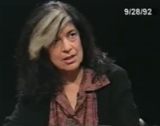
Susan Sontag (ˈsɒntɑːɡ; January 16, 1933 – December 28, 2004) was an American author, literary theorist, feminist and political activist whose works include
On PhotographyOn Photography is a 1977 collection of essays by Susan Sontag. It originally appeared as a series of essays in the New York Review of Books between 1973 and 1977.-Contents:...
and
Against InterpretationAgainst Interpretation and Other Essays is a collection of essays by Susan Sontag which was published in 1966. It includes some of Sontag's best-known works, including "On Style", "Notes on 'Camp'", and the titular essay "Against Interpretation"...
.
Life
Sontag, born Susan Rosenblatt, was born in
New York CityNew York is the most populous city in the United States and the center of the New York Metropolitan Area, one of the most populous metropolitan areas in the world. New York exerts a significant impact upon global commerce, finance, media, art, fashion, research, technology, education, and...
to Jack Rosenblatt and Mildred Jacobsen, both Jewish. Her father managed a fur trading business in China, where he died of
tuberculosisTuberculosis, MTB, or TB is a common, and in many cases lethal, infectious disease caused by various strains of mycobacteria, usually Mycobacterium tuberculosis. Tuberculosis usually attacks the lungs but can also affect other parts of the body...
when Susan was five years old. Seven years later, her mother married Nathan Sontag. Susan and her sister, Judith, were given their stepfather's surname, although he never adopted them formally. Sontag did not have a religious upbringing. She claimed not to have entered a synagogue until her mid-twenties.
Sontag grew up in
TucsonTucson is a city in and the county seat of Pima County, Arizona, United States. The city is located 118 miles southeast of Phoenix and 60 miles north of the U.S.-Mexico border. The 2010 United States Census puts the city's population at 520,116 with a metropolitan area population at 1,020,200...
,
ArizonaArizona ; is a state located in the southwestern region of the United States. It is also part of the western United States and the mountain west. The capital and largest city is Phoenix...
, and, later, in
Los AngelesLos Angeles , with a population at the 2010 United States Census of 3,792,621, is the most populous city in California, USA and the second most populous in the United States, after New York City. It has an area of , and is located in Southern California...
, where she graduated from
North Hollywood High SchoolNorth Hollywood High School, originally called Lankershim High School when it opened in 1927, is a secondary school in North Hollywood in Los Angeles, California. The school mascot is the husky, and the school colors are blue, white and grey....
at the age of 15. She began her undergraduate studies at
BerkeleyThe University of California, Berkeley , is a teaching and research university established in 1868 and located in Berkeley, California, USA...
but transferred to the
University of ChicagoThe University of Chicago is a private research university in Chicago, Illinois, USA. It was founded by the American Baptist Education Society with a donation from oil magnate and philanthropist John D. Rockefeller and incorporated in 1890...
in admiration of its famed
core curriculumThe Common Core is the University of Chicago's implementation of the Great Books program for its college. These courses cover topics in the humanities, social sciences, mathematics, and sciences. It forms the general education requirements for the college and uses the Socratic method to teach...
. At Chicago, she undertook studies in philosophy, ancient history and literature alongside her other requirements (
Leo StraussLeo Strauss was a political philosopher and classicist who specialized in classical political philosophy. He was born in Germany to Jewish parents and later emigrated to the United States...
,
Richard McKeonRichard McKeon was an American philosopher.-Life, times, and influences:McKeon obtained his undergraduate degree from Columbia University in 1920, graduating at the early age of 20 despite serving briefly in the U.S. Navy during the First World War...
,
Peter von BlanckenhagenPeter Heinrich von Blanckenhagen was a scholar of Roman art, and especially ancient wall painting.Born in Latvia, von Blanckenhagen and his family fled to Germany following the Bolshevik Revolution. It was in German universities that he received his training in classical archaeology...
and
Kenneth BurkeKenneth Duva Burke was a major American literary theorist and philosopher. Burke's primary interests were in rhetoric and aesthetics.-Personal history:...
were among her lecturers) and graduated with an A.B. She did graduate work in
philosophyPhilosophy is the study of general and fundamental problems, such as those connected with existence, knowledge, values, reason, mind, and language. Philosophy is distinguished from other ways of addressing such problems by its critical, generally systematic approach and its reliance on rational...
,
literatureLiterature is the art of written works, and is not bound to published sources...
, and
theologyTheology is the systematic and rational study of religion and its influences and of the nature of religious truths, or the learned profession acquired by completing specialized training in religious studies, usually at a university or school of divinity or seminary.-Definition:Augustine of Hippo...
at
HarvardHarvard University is a private Ivy League university located in Cambridge, Massachusetts, United States, established in 1636 by the Massachusetts legislature. Harvard is the oldest institution of higher learning in the United States and the first corporation chartered in the country...
with
Paul TillichPaul Johannes Tillich was a German-American theologian and Christian existentialist philosopher. Tillich was one of the most influential Protestant theologians of the 20th century...
,
Jacob TaubesJacob Taubes was a sociologist of religion, philosopher, and scholar of Judaism.Taubes was born into an old rabbinical family. He was married to the writer Susan Taubes...
and
Morton WhiteMorton White is an American philosopher and historian of ideas. He is both a central figure in the philosophical movement of Holistic Pragmatism and a noted historian of American philosophical thought...
et al. After completing her
Master of ArtsA Master of Arts from the Latin Magister Artium, is a type of Master's degree awarded by universities in many countries. The M.A. is usually contrasted with the M.S. or M.Sc. degrees...
in philosophy and beginning doctoral research into Metaphysics, Ethics, Greek Philosophy and Continental Philosophy and Theology at Harvard, Sontag was awarded an American Association of University Women's fellowship for the 1957-1958 academic year to St Anne's College, Oxford, where she had classes with
Iris MurdochDame Iris Murdoch DBE was an Irish-born British author and philosopher, best known for her novels about political and social questions of good and evil, sexual relationships, morality, and the power of the unconscious...
,
J. L. AustinJohn Langshaw Austin was a British philosopher of language, born in Lancaster and educated at Shrewsbury School and Balliol College, Oxford University. Austin is widely associated with the concept of the speech act and the idea that speech is itself a form of action...
,
Stuart HampshireSir Stuart Newton Hampshire was an Oxford University philosopher, literary critic and university administrator. He was one of the antirationalist Oxford thinkers who gave a new direction to moral and political thought in the post-World War II era.Hampshire was educated at Repton School and at...
and others.
OxfordThe city of Oxford is the county town of Oxfordshire, England. The city, made prominent by its medieval university, has a population of just under 165,000, with 153,900 living within the district boundary. It lies about 50 miles north-west of London. The rivers Cherwell and Thames run through...
did not appeal to her, however, and she transferred after
MichaelmasMichaelmas, the feast of Saint Michael the Archangel is a day in the Western Christian calendar which occurs on 29 September...
term of 1957 to the
University of ParisThe University of Paris was a university located in Paris, France and one of the earliest to be established in Europe. It was founded in the mid 12th century, and officially recognized as a university probably between 1160 and 1250...
. It was in
ParisParis is the capital and largest city in France, situated on the river Seine, in northern France, at the heart of the Île-de-France region...
that Sontag socialised with expatriate artists and academics including
Allan BloomAllan David Bloom was an American philosopher, classicist, and academic. He studied under David Grene, Leo Strauss, Richard McKeon and Alexandre Kojève. He subsequently taught at Cornell University, the University of Toronto, Yale University, École Normale Supérieure of Paris, and the University...
,
Jean WahlJean André Wahl was a French philosopher.-Early career:He was professor at the Sorbonne from 1936 to 1967, broken by World War II. He was in the U.S...
,
Alfred ChesterAlfred Chester was an American writer known for his provocative, experimental work, including the novels Jamie Is My Heart's Desire and The Exquisite Corpse and the short story collection Behold Goliath....
, Harriet Sohmers and
Maria Irene FornesMaría Irene Fornés is a Cuban-American avant garde playwright and director who is associated with the establishment of the Off-off-Broadway movement in the 1960s. Fornes themes focused on poverty and feminism. In 1965, she won her first Obie Award for Promenade and her second for The Successful...
. Sontag remarked that her time in
ParisParis is the capital and largest city in France, situated on the river Seine, in northern France, at the heart of the Île-de-France region...
was, perhaps, the most important period of her life. It certainly provided the basis of her long intellectual and artistic association with the
culture of FranceThe culture of France and of the French people has been shaped by geography, by profound historical events, and by foreign and internal forces and groups. France, and in particular Paris, has played an important role as a center of high culture and of decorative arts since the seventeenth...
.
At 17, while at Chicago, Sontag married
Philip RieffPhilip Rieff was an American sociologist and cultural critic, who taught sociology at the University of Pennsylvania from 1961 until 1992. He was the author of a number of books on Sigmund Freud and his legacy, including Freud: The Mind of the Moralist and The Triumph of the Therapeutic: Uses of...
after a ten-day courtship. The philosopher
Herbert MarcuseHerbert Marcuse was a German Jewish philosopher, sociologist and political theorist, associated with the Frankfurt School of critical theory...
lived with Sontag and Rieff for a year while working on his book
Eros and CivilizationEros and Civilization is one of German philosopher and social critic Herbert Marcuse's best known works. Written in 1955, it is a synthesis of Karl Marx and Sigmund Freud. Its title alludes to Freud's Civilization and Its Discontents...
. Sontag and Rieff were married for eight years. The couple had a son,
David RieffDavid Rieff is an American polemicist and pundit. His books have focused on issues of immigration, international conflict, and humanitarianism...
, who later became his mother's editor at
Farrar, Straus and GirouxFarrar, Straus and Giroux is an American book publishing company, founded in 1946 by Roger W. Straus, Jr. and John C. Farrar. Known primarily as Farrar, Straus in its first decade of existence, the company was renamed several times, including Farrar, Straus and Young and Farrar, Straus and Cudahy...
, as well as a writer in his own right.
The publication of
Against InterpretationAgainst Interpretation and Other Essays is a collection of essays by Susan Sontag which was published in 1966. It includes some of Sontag's best-known works, including "On Style", "Notes on 'Camp'", and the titular essay "Against Interpretation"...
(1966), accompanied by a striking dust-jacket photo by
Peter HujarPeter Hujar was an American photographer known for his black and white portraits. Born in Trenton, New Jersey, United States. Hujar later moved to Manhattan to work in the magazine, advertising, and fashion industries. His subjects also consisted of farm animals and nudes...
, helped establish Sontag's reputation as "The Dark Lady of American Letters." Movie stars like
Woody AllenWoody Allen is an American screenwriter, director, actor, comedian, jazz musician, author, and playwright. Allen's films draw heavily on literature, sexuality, philosophy, psychology, Jewish identity, and the history of cinema...
, philosophers like
Arthur DantoArthur Coleman Danto Arthur Coleman Danto Arthur Coleman Danto (born January 1, 1924 is an American art critic, and professor of philosophy. He is best known as the influential, long-time art critic for The Nation and for his work in philosophical aesthetics and philosophy of history, though he...
, and politicians like Mayor
John LindsayJohn Vliet Lindsay was an American politician, lawyer and broadcaster who was a U.S. Congressman, Mayor of New York City, candidate for U.S...
met her.
Like
Jane FondaJane Fonda is an American actress, writer, political activist, former fashion model, and fitness guru. She rose to fame in the 1960s with films such as Barbarella and Cat Ballou. She has won two Academy Awards and received several other movie awards and nominations during more than 50 years as an...
, Sontag went to
HanoiHanoi , is the capital of Vietnam and the country's second largest city. Its population in 2009 was estimated at 2.6 million for urban districts, 6.5 million for the metropolitan jurisdiction. From 1010 until 1802, it was the most important political centre of Vietnam...
, and wrote of the
North VietnamThe Democratic Republic of Vietnam , was a communist state that ruled the northern half of Vietnam from 1954 until 1976 following the Geneva Conference and laid claim to all of Vietnam from 1945 to 1954 during the First Indochina War, during which they controlled pockets of territory throughout...
ese society with much sympathy and appreciation (see "Trip to Hanoi" in
Styles of Radical WillStyles of Radical Will is a collection of essays by Susan Sontag published in 1969.-Contents:* The Aesthetics of Silence* The Pornographic Imagination* "Thinking Against Oneself": Reflections on Cioran* Theatre and Film* Bergman's Persona...
). She maintained a distinction, however, between
North VietnamThe Democratic Republic of Vietnam , was a communist state that ruled the northern half of Vietnam from 1954 until 1976 following the Geneva Conference and laid claim to all of Vietnam from 1945 to 1954 during the First Indochina War, during which they controlled pockets of territory throughout...
and
MaoistMaoism, also known as the Mao Zedong Thought , is claimed by Maoists as an anti-Revisionist form of Marxist communist theory, derived from the teachings of the Chinese political leader Mao Zedong . Developed during the 1950s and 1960s, it was widely applied as the political and military guiding...
ChinaChinese civilization may refer to:* China for more general discussion of the country.* Chinese culture* Greater China, the transnational community of ethnic Chinese.* History of China* Sinosphere, the area historically affected by Chinese culture...
and the
Soviet UnionThe Soviet Union , officially the Union of Soviet Socialist Republics , was a constitutionally socialist state that existed in Eurasia between 1922 and 1991....
, as well as East-European communism, which she all later criticized as "fascism with a human face."
Sontag died in New York City on 28 December 2004, aged 71, from complications of
myelodysplastic syndromeThe myelodysplastic syndromes are a diverse collection of hematological medical conditions that involve ineffective production of the myeloid class of blood cells....
which had evolved into acute myelogenous leukemia. Sontag is buried in Montparnasse Cemetery, in
ParisParis is the capital and largest city in France, situated on the river Seine, in northern France, at the heart of the Île-de-France region...
. Her final illness has been chronicled by her son,
David RieffDavid Rieff is an American polemicist and pundit. His books have focused on issues of immigration, international conflict, and humanitarianism...
.
Work
Sontag's literary career began and ended with works of
fictionFiction is the form of any narrative or informative work that deals, in part or in whole, with information or events that are not factual, but rather, imaginary—that is, invented by the author. Although fiction describes a major branch of literary work, it may also refer to theatrical,...
. After teaching philosophy and theology at
Sarah Lawrence CollegeSarah Lawrence College is a private liberal arts college in the United States, and a leader in progressive education since its founding in 1926. Located just 30 minutes north of Midtown Manhattan in southern Westchester County, New York, in the city of Yonkers, this coeducational college offers...
,
City University of New YorkThe City University of New York is the public university system of New York City, with its administrative offices in Yorkville in Manhattan. It is the largest urban university in the United States, consisting of 23 institutions: 11 senior colleges, six community colleges, the William E...
and
Columbia UniversityColumbia University in the City of New York is a private, Ivy League university in Manhattan, New York City. Columbia is the oldest institution of higher learning in the state of New York, the fifth oldest in the United States, and one of the country's nine Colonial Colleges founded before the...
under
Jacob TaubesJacob Taubes was a sociologist of religion, philosopher, and scholar of Judaism.Taubes was born into an old rabbinical family. He was married to the writer Susan Taubes...
from 1960 to 1964, Sontag ended her relationship with academia and devoted herself to full-time writing. At age 30, she published an experimental novel called The Benefactor (1963), following it four years later with Death Kit (1967).
Despite a relatively small output, Sontag thought of herself principally as a
novelA novel is a book of long narrative in literary prose. The genre has historical roots both in the fields of the medieval and early modern romance and in the tradition of the novella. The latter supplied the present generic term in the late 18th century....
ist and writer of fiction. Her short story "
The Way We Live Now"The Way We Live Now" is a short story by Susan Sontag which was published to great acclaim on November 24, 1986 in The New Yorker. The story describes the beginnings of the AIDS crisis in the early 1980s, as the disease began to claim members of the New York cultural elite.The story is told...
" was published to great acclaim on 26 November 1986 in
The New YorkerThe New Yorker is an American magazine of reportage, commentary, criticism, essays, fiction, satire, cartoons and poetry published by Condé Nast...
. Written in an experimental narrative style, it remains a significant text on the AIDS epidemic. She achieved late popular success as a best-selling novelist with
The Volcano LoverThe Volcano Lover is a 1992 novel by Susan Sontag, set largely in Naples.It focuses upon Emma Hamilton, her marriage to Sir William Hamilton, the scandal relating to her affair with Lord Nelson, her abandonment, and her descent into poverty....
(1992). At age 67, Sontag published her final novel In America (2000). The last two novels were set in the past, which Sontag said gave her greater freedom to write in the
polyphonicIn literature, polyphony is a feature of narrative, which includes a diversity of points of view and voices. The concept was introduced by Mikhail Bakhtin, based on the musical concept polyphony....
voice.
It was as an essayist, however, that Sontag gained early fame and notoriety. Sontag wrote frequently about the intersection of
highHigh culture is a term, now used in a number of different ways in academic discourse, whose most common meaning is the set of cultural products, mainly in the arts, held in the highest esteem by a culture...
and
low artLow culture is a term for some forms of popular culture. Its opposite is high culture. It has been said by culture theorists that both high culture and low culture are subcultures....
and the form/content dichotomy across the arts. Her celebrated and widely-read 1964 essay "Notes on 'Camp'" was epoch-defining, examining an alternative sensibility to that which considers the best art in terms of its seriousness. It gestured towards and expounded the "so bad it's good" concept of popular culture for the first time. In 1977, Sontag wrote the essay
On PhotographyOn Photography is a 1977 collection of essays by Susan Sontag. It originally appeared as a series of essays in the New York Review of Books between 1973 and 1977.-Contents:...
. The essay is an exploration of photographs as a collection of the world, mainly by travelers or tourists, and the way we therefore experience it. She outlines the concept of her theory of taking pictures as you travel:
The method especially appeals to people handicapped by a ruthless work ethic – Germans, Japanese and Americans. Using a camera appeases the anxiety which the work driven feel about not working when they are on vacation and supposed to be having fun. They have something to do that is like a friendly imitation of work: they can take pictures.
Sontag suggested photographic "evidence" be used as a presumption that "something exists, or did exist", regardless of distortion. For her, the art of photography is "as much an interpretation of the world as paintings and drawings are", for cameras are produced rapidly as a "mass art form" and are available to all of those with the means to attain them. Focusing also on the effect of the camera and photograph on the wedding and modern family life, Sontag reflects that these are a "rite of family life" in industrialized areas such as Europe and America.
To Sontag "picture-taking is an event in itself, and one with ever more peremptory rights - to interfere with, to invade, or to ignore whatever is going on". She considers the camera a
phallusA phallus is an erect penis, a penis-shaped object such as a dildo, or a mimetic image of an erect penis. Any object that symbolically resembles a penis may also be referred to as a phallus; however, such objects are more often referred to as being phallic...
, comparable to ray guns and cars, which are "fantasy-machines whose use is addictive". For Sontag the camera can be linked to murder and a promotion of nostalgia while evoking "the sense of the unattainable" in the industrialized world. The photograph familiarizes the wealthy with "the oppressed, the exploited, the starving, and the massacred" but removes the shock of these images because they are available widely and have ceased to be novel.
Sontag championed European writers such as
Walter BenjaminWalter Bendix Schönflies Benjamin was a German-Jewish intellectual, who functioned variously as a literary critic, philosopher, sociologist, translator, radio broadcaster and essayist...
,
Roland BarthesRoland Gérard Barthes was a French literary theorist, philosopher, critic, and semiotician. Barthes' ideas explored a diverse range of fields and he influenced the development of schools of theory including structuralism, semiotics, existentialism, social theory, Marxism, anthropology and...
,
Antonin ArtaudAntoine Marie Joseph Artaud, more well-known as Antonin Artaud was a French playwright, poet, actor and theatre director...
, E. M. Cioran, and
W. G. SebaldW. G. Maximilian Sebald was a German writer and academic. At the time of his death at the age of 57, he was being cited by many literary critics as one of the greatest living authors and had been tipped as a possible future winner of the Nobel Prize in Literature...
, along with some Americans such as
María Irene FornésMaría Irene Fornés is a Cuban-American avant garde playwright and director who is associated with the establishment of the Off-off-Broadway movement in the 1960s. Fornes themes focused on poverty and feminism. In 1965, she won her first Obie Award for Promenade and her second for The Successful...
. Over several decades she would turn her attention to novels, film, and photography. In more than one book, Sontag wrote about cultural attitudes toward
illnessIllness is a state of poor health. Illness is sometimes considered another word for disease. Others maintain that fine distinctions exist...
. Her final nonfiction work,
Regarding the Pain of OthersRegarding the Pain of Others was Susan Sontag's last published book before her death in 2004. It is regarded by many to be a follow-up or addendum to On Photography, despite the fact that the two books have radically different opinions about photography. This long essay is especially interested in...
, re-examined art and photography from a moral standpoint. It considered how the media affects culture's views of conflict.
A new visual code
In her essay On Photography Sontag says that the evolution of modern technology has changed the viewer in three key ways. She calls this the emergence of a new visual code.
Firstly, Sontag suggests that modern photography, with its convenience and ease, has created an overabundance of visual material. As photographing is now a practice of the masses, due to a drastic decrease of camera size and increase of ease in developing photographs, we are left in a position where “just about everything has been photographed” (Sontag, Susan, (1977), On Photography 3). We now have so many images available to us of: things, places, events and people from all over the world, and of not immediate relevance to our own existence, that our expectations of what we have the right to view, want to view or should view has been drastically affected. Arguably, gone are the days that we felt entitled to view only those things in our immediate presence or that affected our micro world; we now seem to feel entitled to gain access to any existing images. “In teaching us a new visual code, photographs alter and enlarge our notion of what is worth looking at and what we have the right to observe” (3). This is what Sontag calls a change in the “ethics of seeing” (3).
Secondly, Sontag comments on the effect of modern photography on our education, claiming that photographs “now provide most of the knowledge people have about the look of the past and the reach of the present”(4). Without photography only those few people who had been there would know what the Egyptian pyramids or the Parthenon look like, yet most of us have a good idea of the appearance of these places. Photography teaches us about those parts of the world that are beyond our touch in ways that literature can not.
Thirdly, Sontag also talked about the way in which photography desensitizes its audience. Sontag introduced this discussion by telling her own story of the first time she saw images of horrific human experience. At twelve years old, Sontag found images of holocaust camps and was so distressed by them she says “When I looked at those photographs something broke... something went dead, something is still crying” (20).
Sontag argues that there was no good to come from her seeing these images as a young girl, before she fully understood what the holocaust was. For Sontag the viewing of these images has left her a degree more numb to any following horrific image she viewed, as she had been desensitized. According to this argument, “Images anesthetize” and the open accessibility to them is a negative result of photography (20).
Sontag examines the relationship between
photographyPhotography is the art, science and practice of creating durable images by recording light or other electromagnetic radiation, either electronically by means of an image sensor or chemically by means of a light-sensitive material such as photographic film...
and reality. Photographs are depicted as a representation of
realismRealism in the visual arts and literature refers to the general attempt to depict subjects "in accordance with secular, empirical rules", as they are considered to exist in third person objective reality, without embellishment or interpretation...
. Sontag claimed that “such images are indeed able to usurp reality because first of all a photograph is not only an image, an interpretation of the real; it is also a trace, something directly stenciled off the real (Sontag, Susan (1982), The Image World 350). It is a resemblance of the real as the photograph becomes an extension of the subject. However, the role of the photograph has changed, as copies destroy the idea of an experience. The image has altered to convey information and become an act of classification. Sontag highlights the notion that photographs are a way of imprisoning reality- making the memory stand still. Ultimately images are surveillance of events that trigger the memory. In modern society, photographs are a form of recycling the real. When a moment is captured it is assigned a new meaning as people interpret the image in their own manner. Sontag claims that images desensitize the reality, as people's perceptions are distorted by the construction of the
photographA photograph is an image created by light falling on a light-sensitive surface, usually photographic film or an electronic imager such as a CCD or a CMOS chip. Most photographs are created using a camera, which uses a lens to focus the scene's visible wavelengths of light into a reproduction of...
. However this has not stopped people from consuming images; there is still a demand for more photographs.
Sontag observed some uses of photography, “Photography has become one of the principal devices for experiencing something, for giving an appearance of participation” (Sontag,1977 10), such as memorizing and providing evidence. She also states that “to collect photographs is to collect the world.” (Sontag,1997 3)
Sontag believes that photography implies that we know about the world if we accept it as the camera records it. She states that photography has ‘become one of the principal devices for experiencing something, for giving an appearance of participation’. She refers to photographs as
memento moriMemento mori is a Latin phrase translated as "Remember your mortality", "Remember you must die" or "Remember you will die". It names a genre of artistic work which varies widely, but which all share the same purpose: to remind people of their own mortality...
, where to take a photograph is to participate in another person’s mortality, vulnerability and mutability. The progression from written word to an image shifts the interpretation from the author to the receiver. Sontag believes however that ‘photographed images do not seem to be statements about the world so much as pieces of it, miniatures of reality that anyone can make or acquire’. It is a slice in time and in effect, is more memorable than moving images for example, videos. It fills the gaps in our mind of the past and present.
Even though photography has such effect, there are limits to photographic knowledge of the world. The limitations are that it can never be interpreted ethical or political knowledge. It will always be some kind of sentimentalism, whether cynical or humanist.
Activism
In 1968, Sontag signed the “Writers and Editors War Tax Protest” pledge, vowing to refuse tax payments in protest against the Vietnam War.
During 1989 Sontag was the President of
PEN American CenterPEN American Center , founded in 1922 and based in New York City, works to advance literature, to defend free expression, and to foster international literary fellowship. The Center has a membership of 3,300 writers, editors, and translators...
, the main U.S. branch of the
International PENPEN International , the worldwide association of writers, was founded in London in 1921 to promote friendship and intellectual co-operation among writers everywhere....
writers' organization. This was the year when Iranian leader Ayatollah Khomeini issued a
fatwaA fatwā in the Islamic faith is a juristic ruling concerning Islamic law issued by an Islamic scholar. In Sunni Islam any fatwā is non-binding, whereas in Shia Islam it could be considered by an individual as binding, depending on his or her relation to the scholar. The person who issues a fatwā...
death sentence against writer
Salman Rushdie after the publication of his novel
The Satanic VersesThe Satanic Verses is Salman Rushdie's fourth novel, first published in 1988 and inspired in part by the life of Prophet Muhammad. As with his previous books, Rushdie used magical realism and relied on contemporary events and people to create his characters...
. Khomeini and some other
Islamic fundamentalistsIslamic fundamentalism is a term used to describe religious ideologies seen as advocating a return to the "fundamentals" of Islam: the Quran and the Sunnah. Definitions of the term vary. According to Christine L...
claimed the novel was blasphemous. Sontag's uncompromising support of Rushdie was critical in rallying American writers to his cause.
A few years later, Sontag gained attention for directing
Samuel BeckettSamuel Barclay Beckett was an Irish avant-garde novelist, playwright, theatre director, and poet. He wrote both in English and French. His work offers a bleak, tragicomic outlook on human nature, often coupled with black comedy and gallows humour.Beckett is widely regarded as among the most...
's
Waiting for GodotWaiting for Godot is an absurdist play by Samuel Beckett, in which two characters, Vladimir and Estragon, wait endlessly and in vain for someone named Godot to arrive. Godot's absence, as well as numerous other aspects of the play, have led to many different interpretations since the play's...
during the nearly four-year
Siege of SarajevoThe Siege of Sarajevo is the longest siege of a capital city in the history of modern warfare. Serb forces of the Republika Srpska and the Yugoslav People's Army besieged Sarajevo, the capital city of Bosnia and Herzegovina, from 5 April 1992 to 29 February 1996 during the Bosnian War.After Bosnia...
. Early in that conflict, Sontag referred to the War in Bosnia and Herzegovina as the "
Spanish Civil WarThe Spanish Civil WarAlso known as The Crusade among Nationalists, the Fourth Carlist War among Carlists, and The Rebellion or Uprising among Republicans. was a major conflict fought in Spain from 17 July 1936 to 1 April 1939...
of our time". She sparked controversy among
U.S. leftistsIn politics, Left, left-wing and leftist generally refer to support for social change to create a more egalitarian society...
for advocating U.S. and European military intervention. Sontag lived in
SarajevoSarajevo |Bosnia]], surrounded by the Dinaric Alps and situated along the Miljacka River in the heart of Southeastern Europe and the Balkans....
for many months of the Sarajevo siege.
Sontag continued to theorize about the role of photography in real life in her essay "Looking at War: Photography's View of Devastation and Death" which appeared in the December 9th, 2002 issue of
The New YorkerThe New Yorker is an American magazine of reportage, commentary, criticism, essays, fiction, satire, cartoons and poetry published by Condé Nast...
. In it she acknowledges that the problem of our reliance on images and especially photographic images is not that "people remember through photographs but that they remember only the photographs, .... that the photographic image eclipses other forms of understanding--and remembering. .... To remember is, more and more, not to recall a story but to be able to call up a picture" (94). She re-examines the arguments she posed in On Photography.
Controversies
Sontag drew critism for writing in the 1967
Partisan ReviewPartisan Review was an American political and literary quarterly published from 1934 to 2003, though it suspended publication between October 1936 and December 1937.-Overview:...
that:
"MozartWolfgang Amadeus Mozart , baptismal name Johannes Chrysostomus Wolfgangus Theophilus Mozart , was a prolific and influential composer of the Classical era. He composed over 600 works, many acknowledged as pinnacles of symphonic, concertante, chamber, piano, operatic, and choral music...
, Pascal Blaise Pascal , was a French mathematician, physicist, inventor, writer and Catholic philosopher. He was a child prodigy who was educated by his father, a tax collector in Rouen...
, Boolean algebra, ShakespeareWilliam Shakespeare was an English poet and playwright, widely regarded as the greatest writer in the English language and the world's pre-eminent dramatist. He is often called England's national poet and the "Bard of Avon"...
, parliamentary government, baroque churchesBaroque architecture is a term used to describe the building style of the Baroque era, begun in late sixteenth century Italy, that took the Roman vocabulary of Renaissance architecture and used it in a new rhetorical and theatrical fashion, often to express the triumph of the Catholic Church and...
, NewtonSir Isaac Newton PRS was an English physicist, mathematician, astronomer, natural philosopher, alchemist, and theologian, who has been "considered by many to be the greatest and most influential scientist who ever lived."...
, the emancipation of women, KantImmanuel Kant was a German philosopher from Königsberg , researching, lecturing and writing on philosophy and anthropology at the end of the 18th Century Enlightenment....
, BalanchineGeorge Balanchine , born Giorgi Balanchivadze in Saint Petersburg, Russia, to a Georgian father and a Russian mother, was one of the 20th century's most famous choreographers, a developer of ballet in the United States, co-founder and balletmaster of New York City Ballet...
ballets, et al. don't redeem what this particular civilization has wrought upon the world. The white race is the cancer of human history."
According to journalist
Christopher HitchensChristopher Eric Hitchens is an Anglo-American author and journalist whose books, essays, and journalistic career span more than four decades. He has been a columnist and literary critic at The Atlantic, Vanity Fair, Slate, World Affairs, The Nation, Free Inquiry, and became a media fellow at the...
, Sontag later recanted this statement, saying that "it slandered cancer patients".
In "Sontag, Bloody Sontag," an essay in her book Vamps and Tramps,
Camille PagliaCamille Anna Paglia , is an American author, teacher, and social critic. Paglia, a self-described dissident feminist, has been a Professor at The University of the Arts in Philadelphia, Pennsylvania since 1984...
describes her initial admiration for Sontag and her subsequent disillusionment. Paglia writes,
Sontag's cool exile was a disaster for the American women's movement. Only a woman of her prestige could have performed the necessary critique and debunking of the first instant-canon feminist screeds, such as those of Kate MillettKate Millett is an American lesbian feminist writer and activist. A seminal influence on second-wave feminism, Millet is best known for her 1970 book Sexual Politics.-Career:...
or Sandra GilbertSandra M. Gilbert , Professor Emerita of English at the University of California, Davis, is an influential literary critic and poet who has published widely in the fields of feminist literary criticism, feminist theory, and psychoanalytic criticism...
and Susan GubarDr. Susan D. Gubar is an American academic and Distinguished Professor of English and Women's Studies at Indiana University. She is co-author with Dr. Sandra M. Gilbert of the standard feminist text, The Madwoman in the Attic and a trilogy on women's writing in the twentieth century.Her book...
, whose middlebrow mediocrity crippled women's studies from the start. No patriarchal villains held Sontag back; her failures are her own.
Paglia mentions several criticisms of Sontag, including
Harold BloomHarold Bloom is an American writer and literary critic, and is Sterling Professor of Humanities at Yale University. He is known for his defense of 19th-century Romantic poets, his unique and controversial theories of poetic influence, and his prodigious literary output, particularly for a literary...
's comment on Paglia's doctoral dissertation, of "Mere Sontagisme!" This "had become synonymous with a shallow kind of hip posturing." Paglia also describes Sontag as a "sanctimonious moralist of the old-guard literary world", and tells of a visit by Sontag to
Bennington CollegeBennington College is a liberal arts college located in Bennington, Vermont, USA. The college was founded in 1932 as a women's college and became co-educational in 1969.-History:-Early years:...
, in which she arrived hours late, ignored the agreed-upon topic of the event, and made an incessant series of ridiculous demands.
Ellen Lee accused Sontag of
plagiarismPlagiarism is defined in dictionaries as the "wrongful appropriation," "close imitation," or "purloining and publication" of another author's "language, thoughts, ideas, or expressions," and the representation of them as one's own original work, but the notion remains problematic with nebulous...
when Lee discovered at least twelve passages in In America that were similar to passages in four other books about
Helena ModjeskaHelena Modjeska Helena Modjeska Helena Modjeska (October 12, 1840 – April 8, 1909, whose actual Polish surname was Modrzejewska , was a renowned actress who specialized in Shakespearean and tragic roles.Modjeska was the mother of Polish-American bridge engineer Ralph Modjeski....
. Those books included a novel by
Willa CatherWilla Seibert Cather was an American author who achieved recognition for her novels of frontier life on the Great Plains, in works such as O Pioneers!, My Ántonia, and The Song of the Lark. In 1923 she was awarded the Pulitzer Prize for One of Ours , a novel set during World War I...
. (Cather wrote: "When Oswald asked her to propose a toast, she put out her long arm, lifted her glass, and looking into the blur of the candlelight with a grave face, said: 'To my coun-n-try!'" Sontag wrote, "When asked to propose a toast, she put out her long arm, lifted her glass, and looking into the blur of the candlelight, crooned, 'To my new country!'" "Country," muttered Miss Collingridge. "Not 'coun-n-try.'") The quotations were presented without credit or attribution.
Sontag said about using the passages, "All of us who deal with real characters in history transcribe and adopt original sources in the original domain. I've used these sources and I've completely transformed them. I have these books. I've looked at these books. There's a larger argument to be made that all of literature is a series of references and allusions."
"Fascism with a human face"
At a New York pro-Solidarity rally in 1982, Sontag stated that "people on the left", like herself, "have willingly or unwillingly told a lot of lies". She added that they
Sontag's speech "drew boos and shouts from the audience". The Nation published her speech, excluding the passage comparing the magazine with Reader's Digest, and reactions to the speech from fellow intellectuals. Responses varied, with some claiming that she had betrayed her ideals.
Personal life
Sontag became aware of her
bisexualityBisexuality is sexual behavior or an orientation involving physical or romantic attraction to both males and females, especially with regard to men and women. It is one of the three main classifications of sexual orientation, along with a heterosexual and a homosexual orientation, all a part of the...
during her early teens and at 15 wrote in her diary, "so now I feel I have lesbian tendencies (how reluctantly I write this)." At 16, she had her first sexual encounter with a woman: "Perhaps I was drunk, after all, because it was so beautiful when H began making love to me .... It had been 4:00 before we had gotten to bed ... I became fully conscious that I desired her, she knew it, too...."
During the early 1970s, Sontag was involved romantically with
Nicole StéphaneNicole Stéphane was a French actress, producer and director. As an actress, she is mostly known for her role in two films by Jean-Pierre Melville, Les Enfants terribles and Le Silence de la mer.The elder of the two daughters of Baron James-Henri de Rothschild and his first wife, Claude Dupont,...
(1923–2007), a Rothschild banking heiress turned movie actress. Sontag later engaged in a committed relationship with
photographer Annie LeibovitzAnna-Lou "Annie" Leibovitz is an American portrait photographer.-Early life and education:Born in Waterbury, Connecticut, Leibovitz is the third of six children. She is a third-generation American whose great-grandparents were Jewish immigrants, from Central and Eastern Europe. Her father's...
, with whom she was close during her last years; choreographer
Lucinda ChildsLucinda Childs is an American postmodern dancer/choreographer. Her compositions are known for their minimalistic movements yet complex transitions. Childs is most famous for being able to turn the slightest movements into an intricate choreographic masterpiece...
, writers
María Irene FornésMaría Irene Fornés is a Cuban-American avant garde playwright and director who is associated with the establishment of the Off-off-Broadway movement in the 1960s. Fornes themes focused on poverty and feminism. In 1965, she won her first Obie Award for Promenade and her second for The Successful...
and
Harriet Sohmers ZwerlingHarriet Sohmers, later Zwerling , is an American writer and artist's model. She lived in Paris in the 1950s as part of the bohemian expatriate scene centered around James Baldwin, with whom she shared space in a magazine called New Story.She translated a novel by the Marquis de Sade for Maurice...
, and other women.
In an interview in
The GuardianThe Guardian, formerly known as The Manchester Guardian , is a British national daily newspaper in the Berliner format...
in 2000, Sontag was quite open about being bisexual:
- "Shall I tell you about getting older?", she says, and she is laughing. "When you get older, 45 plus, men stop fancying you. Or put it another way, the men I fancy don't fancy me. I want a young man. I love beauty
Beauty is a characteristic of a person, animal, place, object, or idea that provides a perceptual experience of pleasure, meaning, or satisfaction. Beauty is studied as part of aesthetics, sociology, social psychology, and culture...
. So what's new?" She says she has been in loveLove is an emotion of strong affection and personal attachment. In philosophical context, love is a virtue representing all of human kindness, compassion, and affection. Love is central to many religions, as in the Christian phrase, "God is love" or Agape in the Canonical gospels...
seven times in her life, which seems quite a lot. "No, hang on," she says. "Actually, it's nine. Five women, four men."
Many of Sontag's obituaries failed to mention her significant same-sex relationships, most notably that with Leibovitz. In response to this criticism,
The New York TimesThe New York Times is an American daily newspaper founded and continuously published in New York City since 1851. The New York Times has won 106 Pulitzer Prizes, the most of any news organization...
Public Editor,
Daniel OkrentDaniel Okrent is an American writer and editor. He is best known for having served as the first public editor of The New York Times newspaper, for inventing Rotisserie League Baseball, and for writing several books, most recently Last Call: The Rise and Fall of Prohibition.-Education and...
, defended the newspaper's obituary, stating that at the time of Sontag's death, a reporter could make no independent verification of her romantic relationship with Leibovitz (despite attempts to do so). After Sontag's death,
NewsweekNewsweek is an American weekly news magazine published in New York City. It is distributed throughout the United States and internationally. It is the second-largest news weekly magazine in the U.S., having trailed Time in circulation and advertising revenue for most of its existence...
published an article about Leibovitz that made clear reference to her decade-plus relationship with Sontag, stating: "The two first met in the late '80s, when Leibovitz photographed her for a book jacket. They never lived together, though they each had an apartment within view of the other's." Susan Sontag's son,
David RieffDavid Rieff is an American polemicist and pundit. His books have focused on issues of immigration, international conflict, and humanitarianism...
, the executor of her estate, has said that only sentimental items were bequeathed to Leibovitz.
Sontag was quoted by Editor-in-Chief Brendan Lemon of Out magazine as saying "I grew up in a time when the
modus operandiModus operandi is a Latin phrase, approximately translated as "mode of operation". The term is used to describe someone's habits or manner of working, their method of operating or functioning...
was the '
open secretAn open secret is a concept or idea that is "officially" secret or restricted in knowledge, but is actually widely known; or refers to something which is widely known to be true, but which none of the people most intimately concerned are willing to categorically acknowledge in public.Examples of...
'. I'm used to that, and quite OK with it. Intellectually, I know why I haven't spoken more about my sexuality, but I do wonder if I haven't
repressedPsychological repression, also psychic repression or simply repression, is the psychological attempt by an individual to repel one's own desires and impulses towards pleasurable instincts by excluding the desire from one's consciousness and holding or subduing it in the unconscious...
something there to my detriment. Maybe I could have given comfort to some people if I had dealt with the subject of my private sexuality more, but it's never been my prime mission to give comfort, unless somebody's in drastic need. I'd rather give pleasure, or shake things up."
Fiction
- (1963) The Benefactor ISBN 0-385-26710-X
- (1967) Death Kit ISBN 0-312-42011-0
- (1977) I, etcetera
-Contents:* “Project for a trip to China”* “Debriefing”* “American spirits”* “The dummy”* “Old complaints revisited”* “Baby”* “Doctor Jekyll”* “Unguided tour”-Editions:* ISBN 0-374-17402-4...
(Collection of short stories) ISBN 0-374-17402-4
- (1991) The Way We Live Now
"The Way We Live Now" is a short story by Susan Sontag which was published to great acclaim on November 24, 1986 in The New Yorker. The story describes the beginnings of the AIDS crisis in the early 1980s, as the disease began to claim members of the New York cultural elite.The story is told...
(short story) ISBN 0-374-52305-3
- (1992) The Volcano Lover
The Volcano Lover is a 1992 novel by Susan Sontag, set largely in Naples.It focuses upon Emma Hamilton, her marriage to Sir William Hamilton, the scandal relating to her affair with Lord Nelson, her abandonment, and her descent into poverty....
ISBN 1-55800-818-7
- (1999) In America
In America is a 1999 novel by Susan Sontag which won the National Book Award in 2000. Although it is fiction, it is based upon the true story of the Polish actress Helena Modjeska , her arrival in California in 1876, and her ascendency to American stardom.Sontag was accused of plagiarism by Ellen...
ISBN 1-56895-898-6 (National Book AwardThe National Book Awards are a set of American literary awards. Started in 1950, the Awards are presented annually to American authors for literature published in the current year. In 1989 the National Book Foundation, a nonprofit organization which now oversees and manages the National Book...
for fiction in 2000)
Plays
- (1991) "A Parsifal" [one-act play, first published in _Antaeus_ 67 (1991): 180-185.]
- (1993) Alice in Bed Library of Congress catalog card number 93-71280
- (1999) "Lady from the Sea" [adaptation of Henrik Ibsen's play of the same name; first published in _Theater_ 29.1 (1999): 89-91.]
Collections of essays
- (1967) Against Interpretation
Against Interpretation and Other Essays is a collection of essays by Susan Sontag which was published in 1966. It includes some of Sontag's best-known works, including "On Style", "Notes on 'Camp'", and the titular essay "Against Interpretation"...
ISBN 0-385-26708-8 (includes Notes on "Camp")
- (1969) Styles of Radical Will
Styles of Radical Will is a collection of essays by Susan Sontag published in 1969.-Contents:* The Aesthetics of Silence* The Pornographic Imagination* "Thinking Against Oneself": Reflections on Cioran* Theatre and Film* Bergman's Persona...
ISBN 0-312-42021-8
- (1980) Under the Sign of Saturn
Under the Sign of Saturn was Susan Sontag's third collection of criticism, consisting of seven essays. The collection was originally published in 1980...
ISBN 0-374-28076-2
- (2001) Where the Stress Falls
Where the Stress Falls, published in 2001, is the last collection of essays published by Susan Sontag before her death in 2004. The essays vary between her experiences in the theater to book reviews....
ISBN 0-374-28917-4
- (2002) Regarding the Pain of Others
Regarding the Pain of Others was Susan Sontag's last published book before her death in 2004. It is regarded by many to be a follow-up or addendum to On Photography, despite the fact that the two books have radically different opinions about photography. This long essay is especially interested in...
ISBN 0-374-248583
- (2007) At the Same Time: Essays & Speeches ISBN 0-374-10072-1 (edited by Paolo Dilonardo and Anne Jump, with a foreword by David Rieff
David Rieff is an American polemicist and pundit. His books have focused on issues of immigration, international conflict, and humanitarianism...
)
Sontag also published nonfiction essays in
The New YorkerThe New Yorker is an American magazine of reportage, commentary, criticism, essays, fiction, satire, cartoons and poetry published by Condé Nast...
,
The New York Review of BooksThe New York Review of Books is a fortnightly magazine with articles on literature, culture and current affairs. Published in New York City, it takes as its point of departure that the discussion of important books is itself an indispensable literary activity...
, Times Literary Supplement, The Nation,
GrantaGranta is a literary magazine and publisher in the United Kingdom whose mission centers on its "belief in the power and urgency of the story, both in fiction and non-fiction, and the story’s supreme ability to describe, illuminate and make real." In 2007, The Observer stated, "In its blend of...
,
Partisan ReviewPartisan Review was an American political and literary quarterly published from 1934 to 2003, though it suspended publication between October 1936 and December 1937.-Overview:...
and the
London Review of BooksThe London Review of Books is a fortnightly British magazine of literary and intellectual essays.-History:The LRB was founded in 1979, during the year-long lock-out at The Times, by publisher A...
.
Monographs
- (1977) On Photography
On Photography is a 1977 collection of essays by Susan Sontag. It originally appeared as a series of essays in the New York Review of Books between 1973 and 1977.-Contents:...
ISBN 0-374-22626-1
- (1978) Illness as Metaphor
Illness as Metaphor is a nonfiction work written by Susan Sontag and published in 1978. She challenged the "blame the victim" mentality behind the language society often uses to describe diseases and those who suffer from them....
ISBN 0-394-72844-0
- (1988) AIDS and Its Metaphors
AIDS and Its Metaphors is the companion book to Illness as Metaphor, also by Susan Sontag. While Illness as Metaphor drew on her experiences as a cancer patient and focused on the various metaphors that we attribute to cancer, AIDS and Its Metaphors extends this argument to the AIDS crisis...
(a continuation of Illness as Metaphor) ISBN 0-374-10257-0
- (2003) Regarding the Pain of Others
Regarding the Pain of Others was Susan Sontag's last published book before her death in 2004. It is regarded by many to be a follow-up or addendum to On Photography, despite the fact that the two books have radically different opinions about photography. This long essay is especially interested in...
ISBN 0-374-24858-3
Films
- (1969) Duett för kannibaler (Duet for Cannibals)
- (1971) Broder Carl (Brother Carl)
- (1974) Promised Lands
- (1983) Unguided Tour AKA Letter from Venice
Other
- (2004) Contribution of phrases to Fischerspooner
Fischerspooner is an electroclash duo and performance troupe formed in 1998 in New York. The name is a portmanteau of the founders' last names, Warren Fischer and Casey Spooner...
's third album "Odyssey."
- (2002) Liner notes for Patti Smith
Patricia Lee "Patti" Smith is an American singer-songwriter, poet and visual artist, who became a highly influential component of the New York City punk rock movement with her 1975 debut album Horses....
album Land.
- (2008) Reborn: Journals and Notebooks 1947-1963
Books and articles on Susan Sontag
- Sontag and Kael
Pauline Kael was an American film critic who wrote for The New Yorker magazine from 1968 to 1991. Earlier in her career, her work appeared in City Lights, McCall's and The New Republic....
by Craig Seligman ISBN 1-58243-311-9.
- The Din in the Head. Essays by Cynthia Ozick
Cynthia Ozick is an American short story writer, novelist, and essayist. She is the niece of the Hebraist Abraham Regelson.-Background:Cynthia Shoshana Ozick was born in New York City, the second of two children...
ISBN 978-0-618-47050-1 See Forward: On Discord and Desire.
- Conversations with Susan Sontag. Edited by Leland Poague ISBN 0-87805-833-8 Susan Sontag in her own words.
- Susan Sontag: The Elegiac Modernist by Sohnya Sayres ISBN 0-415-90031-X
- Swimming in a Sea of Death by David Rieff
David Rieff is an American polemicist and pundit. His books have focused on issues of immigration, international conflict, and humanitarianism...
A memoir about Susan Sontag's death by her son.
- Notes on Sontag by Phillip Lopate
Doctor Phillip Lopate is an American film critic, essayist, fiction writer, poet, and teacher. He is the younger brother of radio host Leonard Lopate.-Early life and education:...
- Sempre Susan: A Memoir of Susan Sontag by Sigrid Nunez
-Biography:Sigrid Nunez is the daughter of a Chinese-Panamanian father and a German mother. She was born and raised in New York City. She received her BA from Barnard College and her MFA from Columbia University. After finishing school she worked for a time as an editorial assistant at The New York...
Awards and honors
- 1978: National Book Critics Circle Award
The National Book Critics Circle Award is an annual award given by the National Book Critics Circle to promote the finest books and reviews published in English....
for On Photography
- 1990: MacArthur Fellowship
The John D. and Catherine T. MacArthur Foundation is one of the largest private foundations in the United States. Based in Chicago but supporting non-profit organizations that work in 60 countries, MacArthur has awarded more than US$4 billion since its inception in 1978...
- 1992: Malaparte Prize, Italy
- 1999: Commandeur de l'Ordre des Arts et des Lettres, France
- 2000: National Book Award
The National Book Awards are a set of American literary awards. Started in 1950, the Awards are presented annually to American authors for literature published in the current year. In 1989 the National Book Foundation, a nonprofit organization which now oversees and manages the National Book...
for In America
- 2001: Was awarded the Jerusalem Prize
The Jerusalem Prize for the Freedom of the Individual in Society is a biennial literary award given to writers whose works have dealt with themes of human freedom in society. It is awarded at the Jerusalem International Book Fair, and the recipient usually delivers an address when accepting the award...
, which is awarded every two years to a writer whose work explores the freedom of the individual in society.
- 2002: Received her second George Polk Award, for Cultural Criticism for "Looking at War," in The New Yorker
- 2003: Received the Peace Prize of the German Book Trade
The Peace Prize of the German Book Trade is an international peace prize given yearly at the Frankfurt Book Fair in the Paulskirche in Frankfurt am Main, Germany...
(Friedenspreis des deutschen Buchhandels) during the Frankfurt Book FairThe Frankfurt Book Fair is the world's largest trade fair for books, based on the number of publishing companies represented. As to the number of visitors, the Turin Book Fair attracts about as many visitors, viz. some 300,000....
(Frankfurter Buchmesse).
- 2003: Won the Prince of Asturias Award on Literature
The Prince of Asturias Awards are a series of annual prizes awarded in Spain by the Prince of Asturias Foundation to individuals, entities or organizations from around the world who make notable achievements in the sciences, humanities, and public affairs....
.
- 2004: Two days after her death, the mayor of Sarajevo
Sarajevo |Bosnia]], surrounded by the Dinaric Alps and situated along the Miljacka River in the heart of Southeastern Europe and the Balkans....
announced the city would name a street after her, calling her an "author and a humanist who actively participated in the creation of the history of SarajevoSarajevo |Bosnia]], surrounded by the Dinaric Alps and situated along the Miljacka River in the heart of Southeastern Europe and the Balkans....
and Bosnia." An initiative by Sarajevo Mayor Muhidin Hamamdzic to pay tribute to Susan Sontag, who has died recently, by renaming Theatre Square outside the National Theatre Susan Sontag Theatre Square, was accepted on Thursday (27 January) at a session of the Sarajevo City Council. It took long 5 years for that to become official, since nationalist political parties ignored that promise. On March 30, 2009, it was officially announced that Theater Square in front of National Theater in Sarajevo will get the name of Susan Sontag. On January 13, 2010, the city of Sarajevo posted a plate with a new street name for Theater Square: Theater Square of Susan Sontag.
External links
- "with Ramona Koval", Books and Writing, ABC Radio National, 30/1/2005
- Susan Sontag, official website
- Susan Sontag – Photos by Mathieu Bourgois.
- The Friedenspreis acceptance speech (2003-10-12)
- Fascinating Fascism illustrated text of Sontag's seminal 1974 article on Nazi filmmaker Leni Riefenstahl
Helene Bertha Amalie "Leni" Riefenstahl was a German film director, actress and dancer widely noted for her aesthetics and innovations as a filmmaker. Her most famous film was Triumph des Willens , a propaganda film made at the 1934 Nuremberg congress of the Nazi Party...
's aesthetics, from Under the Sign of SaturnUnder the Sign of Saturn was Susan Sontag's third collection of criticism, consisting of seven essays. The collection was originally published in 1980...
- Sontag's comments in the New Yorker, September 24, 2001 about the September 11th attack on the United States
- Terry Castle, Desperately Seeking Susan, London Review of Books, March 2005
- Sheelah Kolhatkar, "Notes on camp Sontag" New York Observer, January 8, 2005
- 'Susan Sontag: The Collector', by Daniel Mendelsohn, The New Republic
- A review of "Reborn" - by James Patrick