
All Topics  
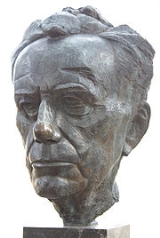
Paul Tillich

 
Paul Tillich

   Email Print
   Bookmark   Link


Paul Tillich


Paul Johannes Tillich (August 20, 1886 – October 22, 1965) was a German
Germany

Germany , officially the Federal Republic of Germany , is a country in Central Europe. It is bordered to the north by the North Sea, Denmark, and the Baltic Sea; to the east by Poland and the Czech Republic; to the south by Austria and Switzerland; and to the west by France, Luxembourg, Belgium, and the Netherlands....
-American
United States

The United States of America is a Federal government constitutional republic comprising U.S. state and a federal district. The country is situated mostly in central North America, where its Contiguous United States and Washington, D.C., the Capital districts and territories, lie between the Pacific Ocean and Atlantic Oceans, Borders of the U...
 theologian
Theology

Theology is the study of the existence or attributes of a deity or gods, or more generally the study of religion or spirituality. It is sometimes contrasted with religious studies: theology is understood as the study of religion from an internal perspective , and religious studies as the study of religion from an external perspective....
 and Christian existentialist
Christian existentialism

Christian existentialism describes a group of writings that take a philosophically existentialist approach to Christian theology. The school of thought is often traced back to the work of Denmark philosopher S?ren Kierkegaard ....
 philosopher. Tillich was, along with his contemporaries Rudolf Bultmann
Rudolf Bultmann

Rudolf Karl Bultmann was a Germany theology of Lutheran background, who was for three decades professor of New Testament studies at the University of Marburg....
 (Germany), Karl Barth
Karl Barth

Karl Barth was a Switzerland Reformed theologian whom some critics held to be among the most important Christian thinkers of the 20th century; Pope Pius XII described him as the most important theologian since Thomas Aquinas....
 (Switzerland), and Reinhold Niebuhr
Reinhold Niebuhr

Karl Paul Reinhold Niebuhr was an United States theology. A Protestant, he is best known for his study of the task of relating the Christian faith to the realities of modern politics and diplomacy....
 (United States), one of the four most influential Protestant theologians of the twentieth century. Among the general populace, he is best known for his works The Courage to Be (1952) and Dynamics of Faith (1957), which introduced issues of theology and modern culture to a general readership.


Discussion
Ask a question about 'Paul Tillich'
Start a new discussion about 'Paul Tillich'
Answer questions from other users
Full Discussion Forum


Recent Posts


Encyclopedia


Paul Johannes Tillich (August 20, 1886 – October 22, 1965) was a German
Germany

Germany , officially the Federal Republic of Germany , is a country in Central Europe. It is bordered to the north by the North Sea, Denmark, and the Baltic Sea; to the east by Poland and the Czech Republic; to the south by Austria and Switzerland; and to the west by France, Luxembourg, Belgium, and the Netherlands....
-American
United States

The United States of America is a Federal government constitutional republic comprising U.S. state and a federal district. The country is situated mostly in central North America, where its Contiguous United States and Washington, D.C., the Capital districts and territories, lie between the Pacific Ocean and Atlantic Oceans, Borders of the U...
 theologian
Theology

Theology is the study of the existence or attributes of a deity or gods, or more generally the study of religion or spirituality. It is sometimes contrasted with religious studies: theology is understood as the study of religion from an internal perspective , and religious studies as the study of religion from an external perspective....
 and Christian existentialist
Christian existentialism

Christian existentialism describes a group of writings that take a philosophically existentialist approach to Christian theology. The school of thought is often traced back to the work of Denmark philosopher S?ren Kierkegaard ....
 philosopher. Tillich was, along with his contemporaries Rudolf Bultmann
Rudolf Bultmann

Rudolf Karl Bultmann was a Germany theology of Lutheran background, who was for three decades professor of New Testament studies at the University of Marburg....
 (Germany), Karl Barth
Karl Barth

Karl Barth was a Switzerland Reformed theologian whom some critics held to be among the most important Christian thinkers of the 20th century; Pope Pius XII described him as the most important theologian since Thomas Aquinas....
 (Switzerland), and Reinhold Niebuhr
Reinhold Niebuhr

Karl Paul Reinhold Niebuhr was an United States theology. A Protestant, he is best known for his study of the task of relating the Christian faith to the realities of modern politics and diplomacy....
 (United States), one of the four most influential Protestant theologians of the twentieth century. Among the general populace, he is best known for his works The Courage to Be (1952) and Dynamics of Faith (1957), which introduced issues of theology and modern culture to a general readership. Theologically, he is best known for his major three-volume work Systematic Theology (1951–63), in which he developed his "method of correlation": an approach of exploring the symbols of Christian revelation
Revelation

Revelation is the act of revealing or disclosing, or making something obvious and clearly understood through active or passive communication with the divinity....
 as answers to the problems of human existence raised by contemporary existential
Existentialism

Existentialism is a term that has been applied to the work of a number of nineteenth and twentieth century philosophers who, despite profound doctrinal differences, took the human subject — not merely the thinking subject, but the acting, feeling, living human individual and his or her conditions of existence — as a starting point...
 philosophical analysis.

Biography

Paul Tillich’s life has been chronicled in a biography, a partially biographical book (Hopper, 1968), an autobiographical sketch (in On the Boundary), and two autobiographical essays (in Kegley and My Search for Absolutes).

Tillich was born on August 20, 1886, in the small village of Starzeddel in the province of Brandenburg
Brandenburg

Brandenburg is one of the sixteen states of Germany of Germany. It lies in the east of the country and is one of the new federal states that were re-created in 1990 upon the reunification of the former West Germany and East Germany....
 in eastern Germany
Germany

Germany , officially the Federal Republic of Germany , is a country in Central Europe. It is bordered to the north by the North Sea, Denmark, and the Baltic Sea; to the east by Poland and the Czech Republic; to the south by Austria and Switzerland; and to the west by France, Luxembourg, Belgium, and the Netherlands....
. He was the oldest of three children, with two sisters: Johanna (b. 1888, d. 1920) and Elisabeth (b. 1893). Tillich’s Prussian father was a conservative Lutheran pastor; his mother was from the Rhineland
Rhineland

The Rhineland is the general name for the land on both sides of the river Rhine in the west of Germany. After the collapse of the First French Empire in the early 19th century, the German-speaking regions at the middle and lower course of the Rhine were annexed to the kingdom of Prussia....
 and was more liberal. When Tillich was four, his father became superintendent of a diocese in Schönfliess, a town of three thousand, where Tillich began elementary school. In 1898 Tillich was sent to Königsberg
Königsberg

K?nigsberg was after World War II in 1946 renamed Kaliningrad by the Soviet Union.The city was the Capital of East Prussia from the Late Middle Ages until 1945....
 to begin gymnasium
Gymnasium (school)

A gymnasium is a type of school providing secondary education in some parts of Europe, comparable to English Grammar schools in the United Kingdoms or sixth form colleges and U.S....
. At Königsberg he lived in a boarding house and experienced loneliness that he sought to overcome by reading the Bible. Simultaneously, however, he was exposed to humanistic
Humanism

Humanism is a broad category of ethics that affirm the dignity and worth of all people, based on the ability to determine right and wrong by appealing to universal human qualities, particularly rationalism, without resorting to the supernatural or alleged divine authority from religious texts....
 ideas at school.

In 1900, Tillich’s father was transferred to Berlin
Berlin

Berlin is the Capital of Germany city and one of sixteen States of Germany of Germany. With a population of 3.4 million within its city limits, Berlin is the country's largest city....
, Tillich switching in 1901 to a Berlin school, from which he graduated in 1904. Before his graduation, however, his mother died of cancer in September 1903, when Tillich was 17. Tillich attended several universities—the University of Berlin beginning in 1904, the University of Tübingen in 1905, and the University of Halle in 1905-07. He received his Doctor of Philosophy degree at the University of Breslau in 1911 and his Licentiate of Theology degree at the University of Halle in 1912. During his time at university, he became a member of the Wingolf
Wingolf

Wingolf is an umbrella organisation of 36 Studentenverbindung at 34 universities in Germany, Austria and Estonia. Founded as early as 1844, it is the oldest type of fraternity in Germany....
.

That same year, 1912, Tillich was ordained as a Lutheran minister in the province of Brandenburg. In September 1914 he married Margarethe ("Grethi") Wever, and in October he joined the German army as a chaplain. Grethi deserted Tillich in 1919 after an affair that produced a child not fathered by Tillich; the two then divorced. Tillich’s academic career began after the war: he became a Privadozent of Theology at the University of Berlin, a post he held from 1919 to 1924. On his return from the war he had met Hannah Werner Gottswchow, then married and pregnant. In March 1924 they married; it was the second marriage for both.

During 1924-25 he was a Professor of Theology at the University of Marburg, where he began to develop his systematic theology, teaching a course on it during the last of his three terms. From 1925 until 1929, Tillich was a Professor of Theology at the University of Dresden and the University of Leipzig
University of Leipzig

The University of Leipzig , located in Leipzig in the Free State of Saxony, Germany, is one of the oldest University in Europeand currently the List_of_universities_in_Germany#Universities_by_age university in Germany....
. He held the same post at the University of Frankfurt
University of Frankfurt

University of Frankfurt may refer to several German universities:*Johann Wolfgang Goethe University Frankfurt am Main in Frankfurt am Main*Viadrina European University in Frankfurt or its historical predecessor, which existed in the same city from 1506 until 1811, when it was merged with the Wroclaw University....
 during 1929-33.

While at Frankfurt
Frankfurt

is the largest city in the German States of Germany of Hesse and the List of cities in Germany with more than 100,000 inhabitants in Germany, with a 2008 population of 670,000....
, Tillich gave public lectures and speeches throughout Germany that brought him into conflict with the Nazi movement. When Hitler became German Chancellor in 1933, Tillich was dismissed from his position. Reinhold Niebuhr visited Germany in the summer of 1933 and, already impressed with Tillich’s writings, contacted Tillich upon learning of Tillich’s dismissal. Niebuhr urged Tillich to join the faculty at New York City’s Union Theological Seminary
Union Theological Seminary

Union Theological Seminary may refer to:* Union Theological Seminary in the City of New York, an ecumenical seminary affiliated with Columbia University in Manhattan...
; Tillich accepted

At the age of 47, Tillich moved with his family to America. This meant learning English, the language in which Tillich would eventually publish works such as the Systematic Theology. From 1933 until 1955 he taught at Union, where he began as a Visiting Professor of Philosophy of Religion. During 1933-34 he was also a Visiting Lecturer in Philosophy at Columbia University
Columbia University

Columbia University in the City of New York , is a private university in the United States and a member of the Ivy League. Columbia's main campus lies in the Morningside Heights, Manhattan neighborhood in the borough of Manhattan, in New York City....
. Tillich acquired tenure at Union in 1937, and in 1940 he was promoted to Professor of Philosophical Theology and became an American citizen..

At the Union Theological Seminary, Tillich earned his reputation, publishing a series of books that outlined his particular synthesis of Protestant Christian theology and existential philosophy. He published On the Boundary in 1936; The Protestant Era, a collection of his essays, in 1948; and The Shaking of the Foundations, the first of three volumes of his sermons, also in 1948. His collections of sermons would give Tillich a broader audience than he had yet experienced. His most heralded achievements though, were the 1951 publication of volume one of Systematic Theology which brought Tillich academic acclaim, and the 1952 publication of The Courage to Be. The first volume of the systematic theology series prompted an invitation to give the prestigious Gifford lectures
Gifford Lectures

The Gifford Lectures were established by the will of Adam Gifford . They were established to "promote and diffuse the study of Natural Theology in the widest sense of the term — in other words, the knowledge of God." The term natural theology as used by Gifford means theology supported by science and not dependent on the miracle....
 during 1953–54 at the University of Aberdeen
University of Aberdeen

The University of Aberdeen is an ancient university founded in 1495, in Old Aberdeen, Scotland. It is the fifth oldest university in what is now the United Kingdom, and in the wider English-speaking world....
. The latter book, called "his masterpiece" in the Pauks’s biography of Tillich (p. 225), was based on his 1950 Dwight H. Terry Lectureship
Dwight H. Terry Lectureship

The Dwight H. Terry Lectureship, also known as the Terry Lectures, was established at Yale University in 1905 by a gift from Dwight H. Terry of Bridgeport, Connecticut....
 and reached a wide general readership.

These works led to an appointment at the Harvard Divinity School
Harvard Divinity School

Harvard Divinity School is one of the constituent schools of Harvard University, located in Cambridge, Massachusetts, in the United States of America....
 in 1955, where he became one of the University’s five University Professors – the five highest ranking professors at Harvard. Tillich’s Harvard career lasted until 1962. During this period he published volume 2 of Systematic Theology and also published the popular book, Dynamics of Faith (1957).

In 1962, Tillich moved to the University of Chicago
University of Chicago

The University of Chicago is a private university located principally in the Hyde Park, Chicago neighborhood of Chicago. Although an older university by the same name existed prior to its founding, the modern University of Chicago credits its founding to the oil magnate John D....
, where he was a Professor of Theology until his death in Chicago in 1965. Volume 3 of Systematic Theology was published in 1963. In 1964 Tillich became the first theologian to be honored in Kegley and Bretall's Library of Living Theology. They wrote: "The adjective ‘great,’ in our opinion, can be applied to very few thinkers of our time, but Tillich, we are far from alone in believing, stands unquestionably amongst these few" (Kegley and Bretall, 1964, pp. ix-x). A widely quoted critical assessment of his importance was Georgia Harkness
Georgia Harkness

Georgia Elma Harkness was a Christian theology in the Methodist tradition. Born in Harkness, New York, a town named after her grandfather, Harkness has been described as one of the first significant American female theologians and was important in the movement to gain ordination for women in United Methodist Church....
' comment, "What Whitehead
Alfred North Whitehead

Alfred North Whitehead, Order of Merit was an England mathematician who became a philosopher. He wrote on algebra, logic, foundations of mathematics, philosophy of science, physics, metaphysics, and education....
 was to American philosophy, Tillich has been to American theology".

Tillich died on October 22, 1965, ten days after experiencing a heart attack. In 1966 his ashes were interred in the Paul Tillich Park
New Harmony, Indiana

New Harmony is a historic town in Harmony Township, Posey County, Indiana, Posey County, Indiana, Indiana, 15 miles north of Mount Vernon, Indiana, the county seat, on the Wabash River....
 in New Harmony
New Harmony, Indiana

New Harmony is a historic town in Harmony Township, Posey County, Indiana, Posey County, Indiana, Indiana, 15 miles north of Mount Vernon, Indiana, the county seat, on the Wabash River....
, Indiana
Indiana

The State of Indiana was the 19th U.S. state admitted into the union. It is located in the Midwestern United States of the United States of America....
.
Paul Johannes Tillich's Gravestone in the Paul Tillich Park, New Harmony, Indiana

Theology


Method of Correlation

Key to an understanding of Tillich’s theology is his "method of correlation": an approach of correlating insights from Christian revelation
Revelation

Revelation is the act of revealing or disclosing, or making something obvious and clearly understood through active or passive communication with the divinity....
 with the issues raised by existential
Existentialism

Existentialism is a term that has been applied to the work of a number of nineteenth and twentieth century philosophers who, despite profound doctrinal differences, took the human subject — not merely the thinking subject, but the acting, feeling, living human individual and his or her conditions of existence — as a starting point...
 philosophical analysis.

Though the method is at work throughout the Systematic Theology, it finds its most explicit formulation in the introduction to that work:

For Tillich, the existential questions of human existence are associated with the field of philosophy and, more specifically, ontology
Ontology

Ontology in philosophy is the study of the nature of being, existence or reality in general, as well as of the basic category of being and their relations....
 (the study of being). To be correlated with these questions are the theological answers, themselves derived from Christian revelation. The task of the philosopher primarily involves developing the questions, whereas the task of the theologian primarily involves developing the answers to these questions. However, it should be remembered that the two tasks overlap and include one another: the theologian must be somewhat of a philosopher and vice versa, for Tillich’s notion of faith as “ultimate concern” necessitates that the theological answer be correlated with, compatible with, and in response to the general ontological question which must be developed independently from the answers. Thus, on one side of the correlation lies an ontological analysis of the human situation, whereas on the other is a presentation of the Christian message as a response to this existential dilemma. It is important to remember that, for Tillich, no formulation of the question can contradict the theological answer. This is because the Christian message claims, a priori, that the logos “who became flesh” is also the universal logos of the Greeks.

In addition to the intimate relationship between philosophy and theology, another important aspect of the method of correlation is Tillich’s distinction between form and content in the theological answers. While the nature of revelation determines the actual content of the theological answers, the character of the questions determines the form of these answers. This is because, for Tillich, theology must be an answering theology, or apologetic theology. God is called the “ground of being” because God is the answer to the ontological threat of non-being, and this characterization of the theological answer in philosophical terms means that the answer has been conditioned (insofar as its form is considered) by the question. It is important that, throughout the Systematic Theology, Tillich is careful to maintain this distinction between form and content without allowing one to be inadvertently conditioned by the other. Many criticisms of Tillich’s methodology revolve around this issue of whether the integrity of the Christian message is really maintained when its form is conditioned by philosophy.

The theological answer is also determined by the sources of theology, our experience, and the norm of theology. Though the form of the theological answers are determined by the character of the question, these answers (which “are contained in the revelatory events on which Christianity is based”) are also “taken by systematic theology from the sources, through the medium, under the norm.” There are three main sources of systematic theology: the Bible, Church history, and the history of religion and culture. Experience is not a source but a medium through which the sources speak. And the norm of theology is that by which both sources and experience are judged with regard to the content of the Christian faith. Thus, we have the following as elements of the method and structure of systematic theology:

  • Sources of theology
    • Bible
    • Church history
    • History of religion and culture
  • Experience (medium of sources)
  • Norm of theology (determines use of sources)


As McKelway explains, the sources of theology contribute to the formation of the norm, which then becomes the criterion through which the sources and experience are judged. The relationship is circular, as it is the present situation which conditions the norm in the interaction between church and biblical message. The norm is then subject to change, but Tillich insists that its basic content remains the same: that of the biblical message. It is tempting to conflate revelation with the norm, but we must keep in mind that revelation (whether original or dependent) is not an element of the structure of systematic theology per se, but an event. For Tillich, the present day norm is the “New Being in Jesus as the Christ as our Ultimate Concern.” This is because the present question is one of estrangement, and the overcoming of this estrangement is what Tillich calls the “New Being.” But since Christianity answers the question of estrangement with “Jesus as the Christ,” the norm tells us that we find the New Being in Jesus as the Christ.

There is also the question of the validity of the method of correlation. Certainly one could reject the method on the grounds that there is no a priori reason for its adoption. But Tillich claims that the method of any theology and its system are interdependent. That is, an absolute methodological approach cannot be adopted because the method is continually being determined by the system and the objects of theology.

Bibliography

  • The Religious Situation (1925, Die religiose Lage der Gegenwart), Holt 1932, Meridian Press 1956,
  • The Interpretation of History (1936),
  • The Protestant Era (1948), The University of Chicago Press,
  • The Shaking of the Foundations (1948), Charles Scribner's Sons, a sermon collection,
  • Systematic Theology, 1951–63 (3 volumes), University of Chicago Press
    • Volume 1 (1951). ISBN 0-226-80337-6
    • Volume 2: Existence and the Christ (1957). ISBN 0-226-80338-4
    • Volume 3: Life and the Spirit: History and the Kingdom of God (1963). ISBN 0-226-80339-2
  • The Courage to Be (1952), Yale University Press, ISBN 0-300-08471-4 (2nd ed)
  • Love, Power, and Justice: Ontological Analysis and Ethical Applications (1954), Oxford University Press, ISBN 0-19-500222-9
  • Biblical Religion and the Search for Ultimate Reality (1955), University Of Chicago Press, ISBN 0-226-80341-4
  • The New Being (1955), Charles Scribner's Sons, ISBN 0-68471908-8, a sermon collection, , 2006 Bison Press edition with introduction by Mary Ann Stenger: ISBN 0-80329458-1
  • Dynamics of Faith (1957), Harper and Row, ISBN 0-06-093713-0
  • Theology of Culture (1959), Oxford University Press, ISBN 0-19-500711-5
  • Christianity and the Encounter of the World Religions (1963), Columbia University Press,
  • Morality and Beyond (1963), Harper and Row, 1995 edition: Westminster John Knox Press, ISBN 0-66425564-7
  • The Eternal Now (1963), Charles Scribner’s Sons, 2003 SCM Press: ISBN 0-33402875-2, university sermons 1955–63,
  • Ultimate Concern: Tillich in Dialogue (1965), editor D. Mackenzie Brown, Harper & Row,
  • On the Boundary, 1966 New York: Charles Scribner’s
  • My Search for Absolutes (1967, posthumous), ed. Ruth Nanda Anshen, Simon & Schuster, 1984 reprint: ISBN 0-671-50585-8 (includes autobiographical chapter)
  • "The Philosophy of Religion", in What Is Religion? (1969), ed. James Luther Adams. New York: Harper & Row
    • "The Conquest of the Concept of Religion in the Philosophy of Religion" in What is Religion?
    • "On the Idea of a Theology of Culture" in What is Religion?
  • My Travel Diary 1936: Between Two Worlds (1970), Harper & Row, (edited and published posthumously by J.C. Brauer)
  • A History of Christian Thought: From its Judaic and Hellenistic Origins to Existentialism (1972), Simon and Schuster, (edited from his lectures and published posthumously by C. E. Braaten), ISBN 0-671-21426-8;
    • A History of Christian Thought (1968), Harper & Row, contains the first part of the two part 1972 edition (comprising the 38 New York lectures)
  • The System of the Sciences (1981), Translated by Paul Wiebe. London: Bucknell University Press. (originally published in German in 1923)
  • The Essential Tillich (1987), (anthology) F. Forrester Church, editor; (Macmillan): ISBN 0-02-018920-6; 1999 (U. of Chicago Press): ISBN 0-226-80343-0


Further reading

  • Adams, James Luther. 1965. Paul Tillich’s Philosophy of Culture, Science, and Religion. New York: New York University Press
  • Armbruster, Carl J. 1967. The Vision of Paul Tillich. New York: Sheed and Ward
  • Breisach, Ernst. 1962. Introduction to Modern Existentialism. New York: Grove Press
  • Carey, Patrick W., and Lienhard, Joseph. 2002. "Biographical Dictionary of Christian Theologians". Mass: Hendrickson
  • Ford, Lewis S. 1966. "Tillich and Thomas: The Analogy of Being." Journal of Religion 46:2 (April)
  • Freeman, David H. 1962. Tillich. Philadelphia: Presbyterian and Reformed Publishing Co.
  • Grenz, Stanley, and Olson, Roger E. 1997. 20th Century Theology God & the World in a Transitional Age
  • Hamilton, Kenneth. 1963. The System and the Gospel: A Critique of Paul Tillich. New York: Macmillan
  • Hammond, Guyton B. 1965. Estrangement: A Comparison of the Thought of Paul Tillich and Erich Fromm. Nashville: Vanderbilt University Press.
  • Hegel, G. W. F. 1967. The Phenomenology of Mind, trans. With intro. J. B. Baillie, Torchbook intro. by George Lichtheim. New York: Harper Torchbooks
  • Hook, Sidney, ed. 1961 Religious Experience and Truth: A Symposium (New York: New York University Press)
  • Hopper, David. 1968. Tillich: A Theological Portrait. Philadelphia: Lippincott
  • Howlett, Duncan. 1964. The Fourth American Faith. New York: Harper & Row
  • Kaufman, Walter. 1961a. The Faith of a Heretic. New York: Doubleday
  • — 1961b. Critique of Religion and Philosophy. Garden City, NY: Anchor Books, Doubleday
  • Kegley, Charles W., and Bretall, Robert W., eds. 1964. The Theology of Paul Tillich. New York: Macmillan
  • Kelsey, David H. 1967 The Fabric of Paul Tillich’s Theology. New Haven: Yale University Press
  • MacIntyre, Alasdair. 1963. “God and the Theologians,” Encounter 21:3 (September)
  • Martin, Bernard. 1963. The Existentialist Theology of Paul Tillich. New Haven: College and University Press
  • Marx, Karl. n.d. Capital. Ed. Frederick Engels. trans. from 3rd German ed. by Samuel Moore and Edward Aveling. New York: The Modern Library
  • May, Rollo. 1973. Paulus: Reminiscences of a Friendship. New York: Harper & Row
  • McKelway, Alexander J. 1964. The Systematic Theology of Paul Tillich: A Review and Analysis. Richmond: John Knox Press
  • Modras, Ronald. 1976. Paul Tillich 's Theology of the Church: A Catholic Appraisal. Detroit: Wayne State University Press, 1976.
  • Palmer, Michael. 1984. Paul Tillich's Philosophy of Art. New York: Walter de Gruyter
  • Pauck, Wilhelm & Marion. 1976. Paul Tillich: His Life & Thought–Volume 1: Life. New York: Harper & Row
  • Rowe, William L. 1968. Religious Symbols and God: A Philosophical Study of Tillich’s Theology. Chicago: University of Chicago Press
  • Scharlemann, Robert P. 1969. Reflection and Doubt in the Theology of Paul Tillich. New Haven: Yale University Press
  • Schweitzer, Albert. 1961. The Quest of the Historical Jesus, trans. W. Montgomery. New York: Macmillan
  • Soper, David Wesley. 1952. Major Voices in American Theology: Six Contemporary Leaders Philadelphia: Westminster
  • Tavard, George H. 1962. Paul Tillich and the Christian Message. New York: Charles Scribner’s Sons
  • Thomas, George F. 1965. Religious Philosophies of the West. New York: Scribner's, 1965.
  • Thomas, J. Heywood. 1963. Paul Tillich: An Appraisal. Philadelphia, Westminster
  • Tillich, Hannah. 1973. From Time to Time. New York: Stein and Day
  • Tucker, Robert. 1961. Philosophy and Myth in Karl Marx. Cambridge: Cambridge University Press
  • Wheat, Leonard F. 1970. Paul Tillich’s Dialectical Humanism: Unmasking the God above God. Baltimore: The Johns Hopkins Press


See also

  • Christian existentialism
    Christian existentialism

    Christian existentialism describes a group of writings that take a philosophically existentialist approach to Christian theology. The school of thought is often traced back to the work of Denmark philosopher S?ren Kierkegaard ....
  • Liberal Christianity
    Liberal Christianity

    Liberal Christianity, sometimes called liberal theology, is an umbrella term covering diverse, philosophically informed religious movements and ideas within late 18th, 19th and 20th century Christianity....
  • Neo-orthodoxy
    Neo-orthodoxy

    Neo-orthodoxy is an approach to theology in Protestantism that was developed in the aftermath of the First World War . It is also called theology of crisis and dialectical theology....
  • Postmodern Christianity
    Postmodern Christianity

    Postmodern Christianity is an outlook of Christianity that is closely associated with the body of writings known as postmodern philosophy. Although it is a relatively recent development in the Christian religion, many Christian postmodernists assert that their style of thought has an affinity with foundational Christian thinkers such as Augus...
  • Progressive Christianity
    Progressive Christianity

    Progressive Christianity is the name given to a movement within contemporary Protestant Christianity characterized by willingness to question tradition, acceptance of human diversity , strong emphasis on social justice or care for the poor and the oppressed ...


External links

  • of Gifford Lectures
    Gifford Lectures

    The Gifford Lectures were established by the will of Adam Gifford . They were established to "promote and diffuse the study of Natural Theology in the widest sense of the term — in other words, the knowledge of God." The term natural theology as used by Gifford means theology supported by science and not dependent on the miracle....
  • in the German-language Biographisch-Bibliographisches Kirchenlexikon with further reading
  • in the Paul Tillich Park in New Harmony, Indiana
  • Walk Tillich Park while discerning Tillich's theology. Created by Rev. Ressl after an inspirational walk in Tillich Park in New Harmony, Indiana.
  • – audio recordings on Compact Disc
    Compact Disc

    A Compact Disc is an optical disc used to store Data , originally developed for storing digital audio. The CD, available on the market since October 1982, remains the standard physical medium for sale of commercial Sound recording and reproduction to the present day....