


Foreign policy of the Clinton Administration

Encyclopedia

President of the United States
The President of the United States of America is the head of state and head of government of the United States. The president leads the executive branch of the federal government and is the commander-in-chief of the United States Armed Forces....
Bill Clinton
Bill Clinton
William Jefferson "Bill" Clinton is an American politician who served as the 42nd President of the United States from 1993 to 2001. Inaugurated at age 46, he was the third-youngest president. He took office at the end of the Cold War, and was the first president of the baby boomer generation...
. Clinton's main foreign policy advisors were Secretaries of State
United States Secretary of State
The United States Secretary of State is the head of the United States Department of State, concerned with foreign affairs. The Secretary is a member of the Cabinet and the highest-ranking cabinet secretary both in line of succession and order of precedence...
Warren Christopher and Madeleine Albright
Madeleine Albright
Madeleine Korbelová Albright is the first woman to become a United States Secretary of State. She was appointed by U.S. President Bill Clinton on December 5, 1996, and was unanimously confirmed by a U.S. Senate vote of 99–0...
and National Security Advisors Anthony Lake
Anthony Lake
William Anthony Kirsopp Lake, best known as Tony Lake, is the Executive Director of the United Nations Children's Fund , author, academic, and former American diplomat, Foreign Service Officer, and political advisor. He has been a foreign policy advisor to many Democratic U.S...
and Sandy Berger
Sandy Berger
Samuel Richard "Sandy" Berger was United States National Security Advisor, under President Bill Clinton from 1997 to 2001. In his position, he helped to formulate the foreign policy of the Clinton Administration...
.
President Clinton assumed office shortly after the fall of the Soviet Union
Soviet Union
The Soviet Union , officially the Union of Soviet Socialist Republics , was a constitutionally socialist state that existed in Eurasia between 1922 and 1991....
and end of the Cold War
Cold War
The Cold War was the continuing state from roughly 1946 to 1991 of political conflict, military tension, proxy wars, and economic competition between the Communist World—primarily the Soviet Union and its satellite states and allies—and the powers of the Western world, primarily the United States...
, but nevertheless was forced to confront numerous international conflicts. Shortly after taking office, Clinton had to decide whether the United States, as a world superpower
Superpower
A superpower is a state with a dominant position in the international system which has the ability to influence events and its own interests and project power on a worldwide scale to protect those interests...
, should have a say in the conflicts and violence occurring in Somalia
Somalia
Somalia , officially the Somali Republic and formerly known as the Somali Democratic Republic under Socialist rule, is a country located in the Horn of Africa. Since the outbreak of the Somali Civil War in 1991 there has been no central government control over most of the country's territory...
, Rwanda
Rwanda
Rwanda or , officially the Republic of Rwanda , is a country in central and eastern Africa with a population of approximately 11.4 million . Rwanda is located a few degrees south of the Equator, and is bordered by Uganda, Tanzania, Burundi and the Democratic Republic of the Congo...
, Bosnia and Herzegovina
Bosnia and Herzegovina
Bosnia and Herzegovina , sometimes called Bosnia-Herzegovina or simply Bosnia, is a country in Southern Europe, on the Balkan Peninsula. Bordered by Croatia to the north, west and south, Serbia to the east, and Montenegro to the southeast, Bosnia and Herzegovina is almost landlocked, except for the...
, Kosovo
Kosovo
Kosovo is a region in southeastern Europe. Part of the Ottoman Empire for more than five centuries, later the Autonomous Province of Kosovo and Metohija within Serbia...
, and Haiti
Haiti
Haiti , officially the Republic of Haiti , is a Caribbean country. It occupies the western, smaller portion of the island of Hispaniola, in the Greater Antillean archipelago, which it shares with the Dominican Republic. Ayiti was the indigenous Taíno or Amerindian name for the island...
. The Administration endorsed a doctrine of forceful intervention in world affairs, arguing "that the U.S. has the right to use military force to ensure uninhibited access to key markets, energy supplies, and strategic resources," and must maintain huge military forces "forward deployed" in Europe and Asia "in order to shape people's opinions about us" and "to shape events that will affect our livelihood and our security."
Clinton also spent much of his foreign policy on the conflicts in the former Yugoslavia
Former Yugoslavia
The former Yugoslavia is a term used to describe the present day states which succeeded the collapse of the Socialist Federal Republic of Yugoslavia....
, Northern Ireland
Northern Ireland
Northern Ireland is one of the four countries of the United Kingdom. Situated in the north-east of the island of Ireland, it shares a border with the Republic of Ireland to the south and west...
, and the Middle East
Middle East
The Middle East is a region that encompasses Western Asia and Northern Africa. It is often used as a synonym for Near East, in opposition to Far East...
, with the Israeli-Palestinian conflict
Israeli-Palestinian conflict
The Israeli–Palestinian conflict is the ongoing conflict between Israelis and Palestinians. The conflict is wide-ranging, and the term is also used in reference to the earlier phases of the same conflict, between Jewish and Zionist yishuv and the Arab population living in Palestine under Ottoman or...
in particular. Also in East Timor
East Timor
The Democratic Republic of Timor-Leste, commonly known as East Timor , is a state in Southeast Asia. It comprises the eastern half of the island of Timor, the nearby islands of Atauro and Jaco, and Oecusse, an exclave on the northwestern side of the island, within Indonesian West Timor...
.
Africa
Just weeks before Clinton took office, President George H. W. BushGeorge H. W. Bush
George Herbert Walker Bush is an American politician who served as the 41st President of the United States . He had previously served as the 43rd Vice President of the United States , a congressman, an ambassador, and Director of Central Intelligence.Bush was born in Milton, Massachusetts, to...
had deployed American soldiers to Somalia
Somalia
Somalia , officially the Somali Republic and formerly known as the Somali Democratic Republic under Socialist rule, is a country located in the Horn of Africa. Since the outbreak of the Somali Civil War in 1991 there has been no central government control over most of the country's territory...
, a coastal nation on the Horn of Africa
Horn of Africa
The Horn of Africa is a peninsula in East Africa that juts hundreds of kilometers into the Arabian Sea and lies along the southern side of the Gulf of Aden. It is the easternmost projection of the African continent...
, where people were suffering and dying from starvation and civil war. The soldiers were sent to guard food and other relief supplies from being stolen by warring factions. After soldiers faced fire from armed clans and 19 soldiers were killed in 1993 in the Battle of Mogadishu, the mission quickly lost popularity with the American people. Fearing anarchy resulting in the starvation of Somalia’s civilians and to help U.S. Forces defend themselves, Clinton increased troop presence in the country. Demands for withdrawal, however, grew louder and Clinton ordered troops out of the country in March 1994. This left Somalia in a state of anarchy, with warlords battling for control, even 15 years later.
In April 1994, a genocide
Rwandan Genocide
The Rwandan Genocide was the 1994 mass murder of an estimated 800,000 people in the small East African nation of Rwanda. Over the course of approximately 100 days through mid-July, over 500,000 people were killed, according to a Human Rights Watch estimate...
erupted in Rwanda
Rwanda
Rwanda or , officially the Republic of Rwanda , is a country in central and eastern Africa with a population of approximately 11.4 million . Rwanda is located a few degrees south of the Equator, and is bordered by Uganda, Tanzania, Burundi and the Democratic Republic of the Congo...
due to a conflict between Hutu
Hutu
The Hutu , or Abahutu, are a Central African people, living mainly in Rwanda, Burundi, and eastern DR Congo.-Population statistics:The Hutu are the largest of the three peoples in Burundi and Rwanda; according to the United States Central Intelligence Agency, 84% of Rwandans and 85% of Burundians...
and Tutsi
Tutsi
The Tutsi , or Abatutsi, are an ethnic group in Central Africa. Historically they were often referred to as the Watussi or Watusi. They are the second largest caste in Rwanda and Burundi, the other two being the Hutu and the Twa ....
ethnic groups. Over the next few months, an estimated 500,000 to 1 million Rwandans, mainly Tutsi, were killed. By July, the Rwandan Patriotic Front
Rwandan Patriotic Front
The Rwandan Patriotic Front abbreviated as RPF is the current ruling political party of Rwanda, led by President Paul Kagame. It governs in a coalition with other parties...
took over the country. Although the Clinton Administration and the international community was aware of the genocide taking place in Rwanda, no action was undertaken. By the end of July, nearly two million of Hutus fled the country for safety, spawning the growth of refugee camps in neighboring countries. As thousands of people died of disease and starvation in these refugee camps, Clinton ordered airdrops of food and supplies for the Hutu refugees, including known genocidaires
Rwandan Genocide
The Rwandan Genocide was the 1994 mass murder of an estimated 800,000 people in the small East African nation of Rwanda. Over the course of approximately 100 days through mid-July, over 500,000 people were killed, according to a Human Rights Watch estimate...
. In July, he sent 200 non-combatant troops to the Rwanda capital of Kigali to manage the airport and distribute relief supplies. These troops were subsequently withdrawn by October 1994. Clinton and the United Nations
United Nations
The United Nations is an international organization whose stated aims are facilitating cooperation in international law, international security, economic development, social progress, human rights, and achievement of world peace...
faced criticism for their non-response to the genocide. When Clinton traveled to Africa
Africa
Africa is the world's second largest and second most populous continent, after Asia. At about 30.2 million km² including adjacent islands, it covers 6% of the Earth's total surface area and 20.4% of the total land area...
in 1998, he said that the international community, presumably including the US, must accept responsibility for the failure to respond to the massacres. When speaking about the Rwanda Crisis, Clinton called it his worst failure, admitting "I blew it."
In August 1998, terrorists bombed the United States embassies in the capitals of two East African countries, Nairobi
Nairobi
Nairobi is the capital and largest city of Kenya. The city and its surrounding area also forms the Nairobi County. The name "Nairobi" comes from the Maasai phrase Enkare Nyirobi, which translates to "the place of cool waters". However, it is popularly known as the "Green City in the Sun" and is...
, Kenya
Kenya
Kenya , officially known as the Republic of Kenya, is a country in East Africa that lies on the equator, with the Indian Ocean to its south-east...
, and Dar es Salaam
Dar es Salaam
Dar es Salaam , formerly Mzizima, is the largest city in Tanzania. It is also the country's richest city and a regionally important economic centre. Dar es Salaam is actually an administrative province within Tanzania, and consists of three local government areas or administrative districts: ...
, Tanzania
Tanzania
The United Republic of Tanzania is a country in East Africa bordered by Kenya and Uganda to the north, Rwanda, Burundi, and the Democratic Republic of the Congo to the west, and Zambia, Malawi, and Mozambique to the south. The country's eastern borders lie on the Indian Ocean.Tanzania is a state...
. About 250 people were killed, including 12 Americans, and more than 5,500 were injured. After intelligence linked the bombings to Osama bin Laden
Osama bin Laden
Osama bin Mohammed bin Awad bin Laden was the founder of the militant Islamist organization Al-Qaeda, the jihadist organization responsible for the September 11 attacks on the United States and numerous other mass-casualty attacks against civilian and military targets...
, a wealthy Saudi Arabian living in Afghanistan
Afghanistan
Afghanistan , officially the Islamic Republic of Afghanistan, is a landlocked country located in the centre of Asia, forming South Asia, Central Asia and the Middle East. With a population of about 29 million, it has an area of , making it the 42nd most populous and 41st largest nation in the world...
who was suspected of terrorist activity, Clinton ordered missile attacks on sites in Afghanistan and Sudan
Sudan
Sudan , officially the Republic of the Sudan , is a country in North Africa, sometimes considered part of the Middle East politically. It is bordered by Egypt to the north, the Red Sea to the northeast, Eritrea and Ethiopia to the east, South Sudan to the south, the Central African Republic to the...
in retaliation for the bombings at the U.S. embassies and to deter future terrorist attacks. The Clinton administration maintained that the sites–a pharmaceutical factory at Khartoum
Khartoum
Khartoum is the capital and largest city of Sudan and of Khartoum State. It is located at the confluence of the White Nile flowing north from Lake Victoria, and the Blue Nile flowing west from Ethiopia. The location where the two Niles meet is known as "al-Mogran"...
(the capital of Sudan) and several alleged terrorist camps in Afghanistan–were involved in terrorist activities.
The Balkans
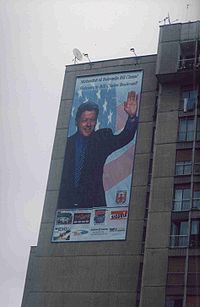
Bosnia and Herzegovina
Bosnia and Herzegovina , sometimes called Bosnia-Herzegovina or simply Bosnia, is a country in Southern Europe, on the Balkan Peninsula. Bordered by Croatia to the north, west and south, Serbia to the east, and Montenegro to the southeast, Bosnia and Herzegovina is almost landlocked, except for the...
(often referred to simply as Bosnia), a nation in southeastern Europe that declared its independence from Yugoslavia in 1992 (see Wars of Yugoslav Succession). This declaration was the catalyst of a war between Bosnian Serbs, who wanted Bosnia to remain in the Yugoslav federation, and Bosnian Muslims and Croats
Croats
Croats are a South Slavic ethnic group mostly living in Croatia, Bosnia and Herzegovina and nearby countries. There are around 4 million Croats living inside Croatia and up to 4.5 million throughout the rest of the world. Responding to political, social and economic pressure, many Croats have...
. The Bosnian Serbs, who were supported by Serbia
Serbia
Serbia , officially the Republic of Serbia , is a landlocked country located at the crossroads of Central and Southeast Europe, covering the southern part of the Carpathian basin and the central part of the Balkans...
, were better equipped than the Muslims and the Croats and populated and controlled much of the countryside. They besieged cities, including the capital of Sarajevo
Sarajevo
Sarajevo |Bosnia]], surrounded by the Dinaric Alps and situated along the Miljacka River in the heart of Southeastern Europe and the Balkans....
, causing widespread suffering. Clinton proposed bombing Serb supply lines and lifting an embargo that prevented the shipment of military arms to the former Yugoslavia, a policy known as lift and strike
Lift and strike (Bosnia)
Lift and strike was the name of an American policy, which sought to improve the chances of a political settlement in the Bosnian War. The idea of the proposal was to lift a United Nations arms embargo in order to allow the poorly armed Bosniaks to arm with imported weapons, thus balancing the...
, but European nations were opposed to such a move. In 1994 Clinton opposed an effort by Republicans in Congress to lift the arms embargo, as it were, because the U.S. allies in Western Europe were still resistant to that policy.
Clinton continued to pressure Western European countries throughout 1994 to take strong measures against the Serbs. But in November, as the Serbs seemed on the verge of defeating the Muslims and Croats in several strongholds, Clinton changed course and called for conciliation with the Serbs. After the 2nd Markale massacres carried out by Bosnian Serbs in August 28, 1995, NATO led by the United States launched Operation Deliberate Force with series of airstrikes against Bosnian Serb targets. The air campaign along with a counteroffensive by a better-equipped Muslim and Croatian forces succeeded in pressuring Bosnian Serbs into taking seriously into negotiation and in November 1995, Clinton hosted peace talks between the warring parties in Dayton
Dayton, Ohio
Dayton is the 6th largest city in the U.S. state of Ohio and the county seat of Montgomery County, the fifth most populous county in the state. The population was 141,527 at the 2010 census. The Dayton Metropolitan Statistical Area had a population of 841,502 in the 2010 census...
, Ohio
Ohio
Ohio is a Midwestern state in the United States. The 34th largest state by area in the U.S.,it is the 7th‑most populous with over 11.5 million residents, containing several major American cities and seven metropolitan areas with populations of 500,000 or more.The state's capital is Columbus...
. The parties reached a peace agreement known as the Dayton Accords, leaving Bosnia as a single state made up of two separate entities with a central government.
In the spring of 1998, ethnic tension in the Federal Republic of Yugoslavia (FRY)–the state formed from the former Yugoslav republics of Serbia
Republic of Serbia (federal)
The Republic of Serbia was a federal unit of the Socialist Federal Republic of Yugoslavia from 1990 to 1992, the Federal Republic of Yugoslavia from 1992 to 2003 and the state union of Serbia and Montenegro between 2003 and 2006...
and Montenegro
Republic of Montenegro (federal)
The Republic of Montenegro was a federal unit of the Federal Republic of Yugoslavia between 1992 and 2006...
–heightened when the military forces responded in the Autonomous Province of Kosovo and Metohija. More than 90 percent of the residents of Kosovo were Muslim and ethnic Albanians
Albanians in Kosovo
Albanians are the largest ethnic group in Kosovo . According to the 1991 Serbian census, boycotted by Albanians, there were 1,596,072 ethnic Albanians in Kosovo or 81.6% of population...
, many of whom wanted independence from Yugoslavia. The Serbs, however, consider Kosovo sovereign territory. Serb forces were mobilized into the province to quell Albanian rebels.
Through attempting to impose the Rambouillet Agreement
Rambouillet Agreement
The Rambouillet Agreement is the name of a proposed peace agreement between then-Yugoslavia and a delegation representing the ethnic-Albanian majority population of Kosovo. It was drafted by the North Atlantic Treaty Organisation and named for Chateau Rambouillet, where it was initially proposed...
, Clinton, who strongly supported the Albanians, threatened the Yugoslav administration with military strikes. In March 24, 1999, military forces from the North Atlantic Treaty Organization (NATO), led by the United States, began launching the bombardment of Yugoslavia
1999 NATO bombing of Yugoslavia
The NATO bombing of Yugoslavia was NATO's military operation against the Federal Republic of Yugoslavia during the Kosovo War. The strikes lasted from March 24, 1999 to June 10, 1999...
. The strikes were not limited to military installations and NATO targets included civilian targets such as factories, oil refineries, television stations and various infrastructure. This war was not approved by the U.N. administration, General assembly or the Security Council; it was strongly opposed by Russia and China. NATO air strikes devastated Yugoslavia. It was the first time in NATO’s history that its forces had attacked a European country, and the first time in which air power alone won a battle. In June 1999 NATO and Yugoslav military leaders approved an international peace plan for Kosovo, and the attacks were suspended after a Serb forces withdrew from Kosovo.
Haiti
A September 1991 military coup, led by Lieutenant General Raoul CédrasRaoul Cédras
Raoul Cédras is a former military officer, and was de facto ruler of Haiti from 1991 to 1994.-Background:Cédras was educated in the United States and was a member of the US-trained Leopard Corps...
, had ousted the country’s elected president, Jean-Bertrand Aristide
Jean-Bertrand Aristide
Jean-Bertrand Aristide is a Haitian former Catholic priest and politician who served as Haiti's first democratically elected president. A proponent of liberation theology, Aristide was appointed to a parish in Port-au-Prince in 1982 after completing his studies...
. Aristide escaped to the United States. In 1993 thousands of Haitians tried to flee to the United States as well, but more than half were sent back to Haiti by the United States Coast Guard
United States Coast Guard
The United States Coast Guard is a branch of the United States Armed Forces and one of the seven U.S. uniformed services. The Coast Guard is a maritime, military, multi-mission service unique among the military branches for having a maritime law enforcement mission and a federal regulatory agency...
. Although Clinton had criticized former President George H. W. Bush for returning Haitian refugees to their country, he continued part of Bush’s policy because he feared that accepting refugees might encourage many more to flee to the United States and slow the formation of a democratic government in the country.
In 1994, Clinton publicly demanded that the Haitian government step aside and restore democratic rule, despite the fact that before the coup, Washington had repeatedly been undermining it. Congress was united in opposition to American intervention. However, Clinton deployed a large U.S. military force to the country in September 1994. Just before U.S. troops reached Haiti, Clinton sent a delegation led by former President Jimmy Carter
Jimmy Carter
James Earl "Jimmy" Carter, Jr. is an American politician who served as the 39th President of the United States and was the recipient of the 2002 Nobel Peace Prize, the only U.S. President to have received the Prize after leaving office...
to urge Cédras to step down and leave the country. Cédras agreed and surrendered the government to Aristide. Cédras and his top lieutenants left the country in October, and just days later, U.S. troops escorted Aristide into the capital as part of Operation Uphold Democracy
Operation Uphold Democracy
Operation Uphold Democracy was an intervention designed to remove the military regime installed by the 1991 Haitian coup d'état that overthrew the elected President Jean-Bertrand Aristide...
. The democratic government of Aristride was restored, but only on the condition that it adopt the economic programme of the defeated U.S.-backed candidate in the 1990 elections.
Israeli–Palestinian conflict
Israel
The State of Israel is a parliamentary republic located in the Middle East, along the eastern shore of the Mediterranean Sea...
and the Palestinians, as well as with the Arab
Arab
Arab people, also known as Arabs , are a panethnicity primarily living in the Arab world, which is located in Western Asia and North Africa. They are identified as such on one or more of genealogical, linguistic, or cultural grounds, with tribal affiliations, and intra-tribal relationships playing...
governments of Jordan
Jordan
Jordan , officially the Hashemite Kingdom of Jordan , Al-Mamlaka al-Urduniyya al-Hashemiyya) is a kingdom on the East Bank of the River Jordan. The country borders Saudi Arabia to the east and south-east, Iraq to the north-east, Syria to the north and the West Bank and Israel to the west, sharing...
, Syria
Syria
Syria , officially the Syrian Arab Republic , is a country in Western Asia, bordering Lebanon and the Mediterranean Sea to the West, Turkey to the north, Iraq to the east, Jordan to the south, and Israel to the southwest....
and Lebanon
Lebanon
Lebanon , officially the Republic of LebanonRepublic of Lebanon is the most common term used by Lebanese government agencies. The term Lebanese Republic, a literal translation of the official Arabic and French names that is not used in today's world. Arabic is the most common language spoken among...
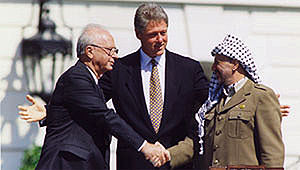
. Secret negotiations mediated by Clinton between Israeli Prime Minister Yitzhak Rabin
Yitzhak Rabin
' was an Israeli politician, statesman and general. He was the fifth Prime Minister of Israel, serving two terms in office, 1974–77 and 1992 until his assassination in 1995....
and Palestine Liberation Organization
Palestine Liberation Organization
The Palestine Liberation Organization is a political and paramilitary organization which was created in 1964. It is recognized as the "sole legitimate representative of the Palestinian people" by the United Nations and over 100 states with which it holds diplomatic relations, and has enjoyed...
(PLO) Chairman Yasser Arafat
Yasser Arafat
Mohammed Yasser Abdel Rahman Abdel Raouf Arafat al-Qudwa al-Husseini , popularly known as Yasser Arafat or by his kunya Abu Ammar , was a Palestinian leader and a Laureate of the Nobel Prize. He was Chairman of the Palestine Liberation Organization , President of the Palestinian National Authority...
led to a historic declaration of peace in September 1993, called the Oslo Accords
Oslo Accords
The Oslo Accords, officially called the Declaration of Principles on Interim Self-Government Arrangements or Declaration of Principles , was an attempt to resolve the ongoing Palestinian-Israeli conflict...
. Clinton personally arranged for the peace accord to be signed at the White House on September 13, 1993. The agreement allowed a limited Palestinian self-rule in the Israeli-occupied West Bank
West Bank
The West Bank ) of the Jordan River is the landlocked geographical eastern part of the Palestinian territories located in Western Asia. To the west, north, and south, the West Bank shares borders with the state of Israel. To the east, across the Jordan River, lies the Hashemite Kingdom of Jordan...
and Gaza Strip
Gaza Strip
thumb|Gaza city skylineThe Gaza Strip lies on the Eastern coast of the Mediterranean Sea. The Strip borders Egypt on the southwest and Israel on the south, east and north. It is about long, and between 6 and 12 kilometres wide, with a total area of...
. In July 1994 Clinton helped coordinate a historic compromise between longtime enemies Israel and Jordan
Jordan
Jordan , officially the Hashemite Kingdom of Jordan , Al-Mamlaka al-Urduniyya al-Hashemiyya) is a kingdom on the East Bank of the River Jordan. The country borders Saudi Arabia to the east and south-east, Iraq to the north-east, Syria to the north and the West Bank and Israel to the west, sharing...
to end their state of war. With this agreement between Jordan’s King Hussein and Israel’s Rabin, Jordan became only the second Arab state (after Egypt
Egypt
Egypt , officially the Arab Republic of Egypt, Arabic: , is a country mainly in North Africa, with the Sinai Peninsula forming a land bridge in Southwest Asia. Egypt is thus a transcontinental country, and a major power in Africa, the Mediterranean Basin, the Middle East and the Muslim world...
) to normalize relations with Israel.
The 1993 and 1995 peace agreements between Israel and Palestine, however, did not end the conflict in the Middle East. As the peace process came to a stall, Clinton invited Israeli Prime Minister Benjamin Netanyahu
Benjamin Netanyahu
Benjamin "Bibi" Netanyahu is the current Prime Minister of Israel. He serves also as the Chairman of the Likud Party, as a Knesset member, as the Health Minister of Israel, as the Pensioner Affairs Minister of Israel and as the Economic Strategy Minister of Israel.Netanyahu is the first and, to...
and Palestinian leader Yasser Arafat to peace talks on the Wye River
Wye River (Maryland)
The Wye River is a tributary of the Chesapeake Bay, on the Eastern Shore of Maryland. It was named by the Lloyd family, Edward Lloyd , and Edward Lloyd , after the River Wye in Wales. It falls within Queen Anne's County and Talbot County, and joins the Miles River near its mouth to the Eastern Bay...
in October 1998. The two leaders signed yet another agreement, known as the Wye River Memorandum
Wye River Memorandum
The Wye River Memorandum was an agreement negotiated between Israel and the Palestine Authority to implement the earlier Interim Agreement of 28 September, 1995...
, which called for Israel to transfer more territory in the West Bank to the Palestinians. In return, the Palestinians agreed to take steps to curb terrorism. They also agreed to a timetable to negotiate a final resolution of the Palestinian fight for an independent state.
After an abrupt outbreak of violence sparked by the agreement, however, Netanyahu refused to cede any more West Bank territory and placed new demands upon Palestine. His ceding of territory had shaken his own coalition, though, and together with other factors, this contributed to the downfall of the Netanyahu government in Israel. As a result, in May 1999 Israelis elected Ehud Barak
Ehud Barak
Ehud Barak is an Israeli politician who served as Prime Minister from 1999 until 2001. He was leader of the Labor Party until January 2011 and holds the posts of Minister of Defense and Deputy Prime Minister in Binyamin Netanyahu's government....
, the leader of a political coalition that favored resuming the peace process, to replace Netanyahu as prime minister. Clinton continued to work passionately on negotiations between Israel and the Palestinians. Throughout his last year in office, Clinton came close to arranging a final peace settlement but failed, according to Clinton, as a result of Arafat’s reluctance. Clinton related a phone conversation he had with Arafat three days before he left office. "You are a great man," Arafat said. Clinton replied, "The hell I am. I'm a colossal failure, and you made me one."
Iraq
Clinton was also confronted with problems in IraqIraq
Iraq ; officially the Republic of Iraq is a country in Western Asia spanning most of the northwestern end of the Zagros mountain range, the eastern part of the Syrian Desert and the northern part of the Arabian Desert....
. In 1991, two years before Clinton became president, the United States participated in the Persian Gulf War
Gulf War
The Persian Gulf War , commonly referred to as simply the Gulf War, was a war waged by a U.N.-authorized coalition force from 34 nations led by the United States, against Iraq in response to Iraq's invasion and annexation of Kuwait.The war is also known under other names, such as the First Gulf...
to liberate Kuwait
Kuwait
The State of Kuwait is a sovereign Arab state situated in the north-east of the Arabian Peninsula in Western Asia. It is bordered by Saudi Arabia to the south at Khafji, and Iraq to the north at Basra. It lies on the north-western shore of the Persian Gulf. The name Kuwait is derived from the...
from Iraqi occupation. In 1991 the warring parties signed a cease-fire agreement requiring Iraq to eliminate its weapons of mass destruction
Weapons of mass destruction
A weapon of mass destruction is a weapon that can kill and bring significant harm to a large number of humans and/or cause great damage to man-made structures , natural structures , or the biosphere in general...
and allow inspectors from the United Nations Special Commission
United Nations Special Commission
United Nations Special Commission was an inspection regime created by the United Nations to ensure Iraq's compliance with policies concerning Iraqi production and use of weapons of mass destruction after the Gulf War...
(UNSCOM) to monitor the country’s adherence to the agreement.
On June 26, 1993, Clinton ordered a cruise missile attack on the Iraqi Intelligence Service's (IIS) principal command and control complex in Baghdad, publicly announced as retaliation for the assassination attempt by the IIS on ex-president George H. W. Bush while he was visiting Kuwait in April of that year to commemorate a coalition victory over Iraq in the 1991 Persian Gulf War. Fourteen cruise missiles were launched from the USS Peterson, nine were launched from the USS Chancellorsville. 16 of the missiles hit the target, three struck a residential area, killing nine civilians and wounding 12. Four of the missiles were unaccounted for. This strike was in violation of international law, although that point is contentious.
The UNSCOM team faced resistance from Iraq, which blocked inspections and hid deadly germ agents and warheads. Clinton threatened military action several times when Iraqi president Saddam Hussein
Saddam Hussein
Saddam Hussein Abd al-Majid al-Tikriti was the fifth President of Iraq, serving in this capacity from 16 July 1979 until 9 April 2003...
attempted to stall the UNSCOM inspections. In December 16-19, 1998 Clinton ordered four days of concentrated air attacks against military installations in Iraq
Operation Desert Fox
The December 1998 bombing of Iraq was a major four-day bombing campaign on Iraqi targets from December 16–19, 1998 by the United States and United Kingdom...
. After the bombing, Hussein blocked any further UN inspections and announced it's attempt to shoot down coalition planes in the Iraqi no-fly zones
Iraqi no-fly zones
The Iraqi no-fly zones were a set of two separate no-fly zones , and were proclaimed by the United States, United Kingdom and France after the Gulf War of 1991 to protect the Kurdish people in northern Iraq and Shiite Muslims in the south. Iraqi aircraft were forbidden from flying inside the zones...
. For several years afterward, U.S. air assaults continued to target defense installations in Iraq, in response to what the Clinton administration claimed were “provocations” by the Iraqi military, including antiaircraft fire and radar locks on U.S. planes and missiles.
The UN sanctions against Iraq that the Security Council imposed after the Gulf War remained in place during the Clinton administration. These sanctions are alleged to have contributed to increased child mortality there. Albright later wrote "Saddam Hussein could have prevented any child from suffering simply by meeting his obligations.
Iran
In regards to IranIran
Iran , officially the Islamic Republic of Iran , is a country in Southern and Western Asia. The name "Iran" has been in use natively since the Sassanian era and came into use internationally in 1935, before which the country was known to the Western world as Persia...
, on May 6, 1995, Clinton signed Executive Order 12957 which implemented tight oil and trade sanctions on Iran and made it illegal for American corporations or their foreign subsidiaries to participate in any contract "for the financing of the development of petroleum resources located in Iran." On May 6, 1995, President Clinton issued Executive Order 12959 which banned almost all trade between U.S. businesses and the Iranian government with the exception of informational materials.
A year before, the President declared that Iran was a 'state sponsor of terrorism' and a 'rogue state', marking the first time that an American President used that term. In 1996, the Clinton administration agreed to compensate towards the Iranian government to pay for the death of 248 Iranians in a 1988 incident in which a plane carrying the passengers was reportedly shot down by an American military plane. In Clinton's second term as President, beginning in 1997, the administration began to take a softer approach towards Iran, particularly after the election of reformist Mohammad Khatami
Mohammad Khatami
Sayyid Mohammad Khātamī is an Iranian scholar, philosopher, Shiite theologian and Reformist politician. He served as the fifth President of Iran from August 2, 1997 to August 3, 2005. He also served as Iran's Minister of Culture in both the 1980s and 1990s...
as the President of Iran. That year, Secretary of State
Secretary of State
Secretary of State or State Secretary is a commonly used title for a senior or mid-level post in governments around the world. The role varies between countries, and in some cases there are multiple Secretaries of State in the Government....
Madeleine Albright
Madeleine Albright
Madeleine Korbelová Albright is the first woman to become a United States Secretary of State. She was appointed by U.S. President Bill Clinton on December 5, 1996, and was unanimously confirmed by a U.S. Senate vote of 99–0...
and President Clinton mandated what could be considered an apology to the Iranian people for the 1953 CIA-assisted coup that overthrew the democratically elected Prime Minister, Mohammed Mossadegh, and replaced him with the Shah
Shah
Shāh is the title of the ruler of certain Southwest Asian and Central Asian countries, especially Persia , and derives from the Persian word shah, meaning "king".-History:...
, thus leading to the 1979 Islamic Revolution two decades later. Albright and Clinton also acknowledged that the U.S.-backed government of the Shah "oppressed political opponents."
In the months that followed, an Iranian professional wrestling team was allowed entry into the U.S. to face American pros, and a significant increase in cultural and academic overtures were made between the two countries. In fact, in 1998, Iran and the United States faced each other in a game at the FIFA World Cup
FIFA World Cup
The FIFA World Cup, often simply the World Cup, is an international association football competition contested by the senior men's national teams of the members of Fédération Internationale de Football Association , the sport's global governing body...
that year (Iran beat the US by 2-1). Khatami also encouraged Americans to travel to Iran for vacational purposes, citing the city of Esfahan, a popular location for tourists where, according to CNN
CNN
Cable News Network is a U.S. cable news channel founded in 1980 by Ted Turner. Upon its launch, CNN was the first channel to provide 24-hour television news coverage, and the first all-news television channel in the United States...
, several "well-preserved" sites often "surprise" tourists. In a well-publicized 1997 interview, Khatami refused to fully apologize for the '79 hostage crisis in which 52 American diplomats were held hostage for 444 days yet did offer to open up a dialogue with the American people. Clinton actually offered to open up an official dialogue with the Iranian government and renew diplomatic relations with the country after 20 years of no such relations. However, Ayatollah Ali Khamenei
Ali Khamenei
Ayatollah Seyed Ali Hoseyni Khāmene’i is the Supreme Leader of Iran and the figurative head of the Muslim conservative establishment in Iran and Twelver Shi'a marja...
refused to accept the offer for dialogue unless the U.S. formally withdrew its support for Israel
Israel
The State of Israel is a parliamentary republic located in the Middle East, along the eastern shore of the Mediterranean Sea...
, lifted the '95 sanctions imposed on the country, stopped accusing Tehran of attempting to develop nuclear weaponry, and officially ended its policy of considering Iran a "rogue state that sponsors terrorism." Although Clinton did privately weigh the idea of revoking the executive orders he signed in the spring of 1995, the administration refused to comply with Iran's other demands. Eventually, President Clinton did ease restrictions on export of food and medical equipment to Iran. Albright announced in 2000 that the U.S. would begin to "enable Americans to purchase and import carpets and food products such as dried fruits, nuts, and caviar from Iran" and also was confident that Iran would provide cooperation with the United States in the battle against narcotics and international drug abuse. In 1995, the State Department warned U.S. citizens against traveling in Iran due to that government's rampant anti-Americanism yet five years later Albright decided to repeal this warning. By the time Clinton left office in January 2001, it was clear that relations between Iran and the United States had significantly cooled despite the fact that President Khatami and President Clinton failed to initiate an official diplomatic dialogue between the nations, something which has not existed since the 1979 hostage crisis. Some conservatives claim that Clinton overreached in his overtures to Iran and these same critics point to what they purportedly suggest was the President's willingness to offer blueprints for technological development in the field of uranium enrichment and related activities in exchange for a vow from the Iranian government not to pursue the creation of nuclear weapons. Critics believe Clinton's plan backfired and that it was a weak policy that strengthened Iran and set the stage for a potential confrontation with Iran a decade later in the George W. Bush
George W. Bush
George Walker Bush is an American politician who served as the 43rd President of the United States, from 2001 to 2009. Before that, he was the 46th Governor of Texas, having served from 1995 to 2000....
administration
North Korea
North KoreaNorth Korea
The Democratic People’s Republic of Korea , , is a country in East Asia, occupying the northern half of the Korean Peninsula. Its capital and largest city is Pyongyang. The Korean Demilitarized Zone serves as the buffer zone between North Korea and South Korea...
's feared aim to create nuclear weapons and ballistic missiles was a serious problem for the Clinton Administration. In 1994, North Korea, a signatory of the Nuclear Nonproliferation Treaty, refused to allow international inspectors to review two nuclear waste sites. The inspectors wanted to see if North Korea was in violation of the treaty since they were suspected of reprocessing spent fuel into plutonium
Plutonium
Plutonium is a transuranic radioactive chemical element with the chemical symbol Pu and atomic number 94. It is an actinide metal of silvery-gray appearance that tarnishes when exposed to air, forming a dull coating when oxidized. The element normally exhibits six allotropes and four oxidation...
, which could be used to manufacture nuclear weapons. Despite diplomatic pressure and repeated warnings by Clinton, North Korea refused to allow the inspections and even raised the prospect of war with South Korea
South Korea
The Republic of Korea , , is a sovereign state in East Asia, located on the southern portion of the Korean Peninsula. It is neighbored by the People's Republic of China to the west, Japan to the east, North Korea to the north, and the East China Sea and Republic of China to the south...
, an ally of the United States.
With private diplomacy by former president Jimmy Carter, the Clinton administration reached a breakthrough with North Korea in October 1994 when North Korea agreed to shut down the nuclear plants that could produce materials for weapons if the United States would help North Korea build plants that generated electricity with light-water nuclear reactors. These reactors would be more efficient and their waste could not easily be used for nuclear weaponry. The United States also agreed to supply fuel oil for electricity until the new plants were built, and North Korea agreed to allow inspection of the old waste sites when construction began on the new plants. This 1994 Agreed Framework
Agreed Framework between the United States of America and the Democratic People's Republic of Korea
The Agreed Framework between the United States of America and the Democratic People's Republic of Korea was signed on October 21, 1994 between North Korea and the United States...
, as it was known, kept the Yongbyon plutonium enrichment plant closed and under international inspection until 2002, after which North Korea broke off from the treaty and restarted plutonium production. In October 2006, North Korea tested its first nuclear weapon. President Bush warned that he was not pleased by such actions as it is he invited the international community to take a stand. As a result, North Korea, the United States, Russia, China were involved in negotiations and North Korea agreed to close down their nuclear station temporarily.
Mexico
Clinton faced yet another foreign crisis in early 1995, when the value of the pesoMexican peso
The peso is the currency of Mexico. Modern peso and dollar currencies have a common origin in the 15th–19th century Spanish dollar, most continuing to use its sign, "$". The Mexican peso is the 12th most traded currency in the world, the third most traded in the Americas, and by far the most...
, the currency of Mexico
Mexico
The United Mexican States , commonly known as Mexico , is a federal constitutional republic in North America. It is bordered on the north by the United States; on the south and west by the Pacific Ocean; on the southeast by Guatemala, Belize, and the Caribbean Sea; and on the east by the Gulf of...
, began to fall sharply and threatened the collapse of the Mexican economy
Economy of Mexico
The economy of Mexico is the 13th largest in the world in nominal terms and the 11th by purchasing power parity, according to the World Bank.Since the 1994 crisis, administrations have improved the country's macroeconomic fundamentals...
. Clinton believed the collapse of Mexico’s economy would have a negative impact on the United States because of their close economic ties. He proposed a plan that would have helped Mexico ease out of financial crisis, but the new Republican-controlled Congress, fearing that voters would not favor aid money to Mexico, rejected the plan. In response, Clinton drafted a $20 billion loan package for Mexico to restore international confidence in the Mexican economy. The loan was approved and Mexico completed its loan payments to the United States in January 1997, three years ahead of schedule. However, issues such as drug smuggling and U.S. immigration policies
Immigration
Immigration is the act of foreigners passing or coming into a country for the purpose of permanent residence...
continued to strain relations between the United States and Mexico during Clinton's terms in office.
Cuba
After negotiations with representatives of the Cuban government, Clinton revealed in May 1995 a controversial policy reversing the decades-old policy of automatically granting asylum to Cuban refugees. Some 20,000 Cuban refugees detained at Guantanamo Bay Naval BaseGuantanamo Bay Naval Base
Guantanamo Bay Naval Base is located on of land and water at Guantánamo Bay, Cuba which the United States leased for use as a coaling station following the Cuban-American Treaty of 1903. The base is located on the shore of Guantánamo Bay at the southeastern end of Cuba. It is the oldest overseas...
in Cuba
Cuba
The Republic of Cuba is an island nation in the Caribbean. The nation of Cuba consists of the main island of Cuba, the Isla de la Juventud, and several archipelagos. Havana is the largest city in Cuba and the country's capital. Santiago de Cuba is the second largest city...
were to be admitted to the United States over a period of three months. In order to prevent a mass exodus of refugees to the United States, all future refugees would be returned to Cuba. The influx of refugees into Guantanamo Bay overwhelmed the facilities, necessitating Operations Safe Haven and Safe Passage
Operations Safe Haven and Safe Passage
Operations Safe Haven and Safe Passage were operations by the United States Joint Task Force designed to relieve the overcrowded migrant camps at Guantanamo Bay Naval Base. Safe Haven established four camps on Empire Range, Panama to provide a safe haven for up to ten thousand Cuban migrants...
involving Panama. Clinton also implemented the wet foot/dry foot policy for Cuban refugees. This policy meant that Cuban refugees caught at sea were returned to Cuba (wet foot), while Cuban refugees that made it to dry land (dry foot) were allowed to stay in the U.S. This changed the refugees tactics from slow rafts to speed boats.
Relations between the United States and Cuba deteriorated in February 1996 when Cuba shot down two American civilian planes. Cuba accused the planes of violating Cuban airspace. Clinton tightened sanctions against Cuba and suspended charter flights from the United States to Cuba, hoping this would cripple Cuba’s tourism industry.
In their response to the incident, the U.S. Congress passed the Helms-Burton Act
Helms-Burton Act
The Cuban Liberty and Democratic Solidarity Act of 1996 is a United States federal law which strengthens and continues the United States embargo against Cuba...
in March 1996. Some parts of the bill strengthened an embargo against imports of Cuban products. Title III, however, made the bill controversial because it allowed American citizens whose property was seized during and after the 1959 Cuban Revolution
Cuban Revolution
The Cuban Revolution was an armed revolt by Fidel Castro's 26th of July Movement against the regime of Cuban dictator Fulgencio Batista between 1953 and 1959. Batista was finally ousted on 1 January 1959, and was replaced by a revolutionary government led by Castro...
to sue in American courts foreign companies that later invested in those properties. Title III sparked an immediate uproar from countries such as Mexico, Canada
Canada
Canada is a North American country consisting of ten provinces and three territories. Located in the northern part of the continent, it extends from the Atlantic Ocean in the east to the Pacific Ocean in the west, and northward into the Arctic Ocean...
, and members of the European Union
European Union
The European Union is an economic and political union of 27 independent member states which are located primarily in Europe. The EU traces its origins from the European Coal and Steel Community and the European Economic Community , formed by six countries in 1958...
because they believed that they would be penalized for doing business with Cuba. In response, Clinton repeatedly suspended Title III of the legislation (the act gave the president the right to exercise this option every six months).
Clinton softened his Cuban policy in 1998 and 1999. In March 1998, at the urging of Pope John Paul II
Pope John Paul II
Blessed Pope John Paul II , born Karol Józef Wojtyła , reigned as Pope of the Catholic Church and Sovereign of Vatican City from 16 October 1978 until his death on 2 April 2005, at of age. His was the second-longest documented pontificate, which lasted ; only Pope Pius IX ...
, Clinton lifted restrictions and allowed humanitarian charter flights to resume. He also took steps to increase educational, religious, and humanitarian contacts in Cuba. The U.S. government decided to allow Cuban citizens to receive more money from American friends and family members and to buy more American food and medicine.
Northern Ireland
Clinton also sought to end the conflict in Northern IrelandThe Troubles
The Troubles was a period of ethno-political conflict in Northern Ireland which spilled over at various times into England, the Republic of Ireland, and mainland Europe. The duration of the Troubles is conventionally dated from the late 1960s and considered by many to have ended with the Belfast...
by arranging a peace agreement between the nationalist
Irish nationalism
Irish nationalism manifests itself in political and social movements and in sentiment inspired by a love for Irish culture, language and history, and as a sense of pride in Ireland and in the Irish people...
and unionist
Unionism in Ireland
Unionism in Ireland is an ideology that favours the continuation of some form of political union between the islands of Ireland and Great Britain...
factions. In 1998 former Senator George Mitchell
George J. Mitchell
George John Mitchell, Jr., is the former U.S. Special Envoy for Middle East Peace under the Obama administration. A Democrat, Mitchell was a United States Senator who served as the Senate Majority Leader from 1989 to 1995...
–whom Clinton had appointed to assist in peace talks–supported an accord that became known as the Good Friday Agreement. It called for the British Parliament to devolve legislative and executive authority of the province to a new Northern Ireland Assembly
Northern Ireland Assembly
The Northern Ireland Assembly is the devolved legislature of Northern Ireland. It has power to legislate in a wide range of areas that are not explicitly reserved to the Parliament of the United Kingdom, and to appoint the Northern Ireland Executive...
, whose Executive
Northern Ireland Executive
The Northern Ireland Executive is the executive arm of the Northern Ireland Assembly, the devolved legislature for Northern Ireland. It is answerable to the Assembly and was established according to the terms of the Northern Ireland Act 1998, which followed the Good Friday Agreement...
would include members of both communities. Years of stalemate have followed the agreement, mainly due to the refusal of the Provisional Irish Republican Army
Provisional Irish Republican Army
The Provisional Irish Republican Army is an Irish republican paramilitary organisation whose aim was to remove Northern Ireland from the United Kingdom and bring about a socialist republic within a united Ireland by force of arms and political persuasion...
(IRA), a nationalist paramilitary group, to decommission its weapons for some years and after that the refusal of the Democratic Unionist Party
Democratic Unionist Party
The Democratic Unionist Party is the larger of the two main unionist political parties in Northern Ireland. Founded by Ian Paisley and currently led by Peter Robinson, it is currently the largest party in the Northern Ireland Assembly and the fourth-largest party in the House of Commons of the...
to push the process forward. Mitchell returned to the region and arranged yet another blueprint for a further peace settlement that resulted in a December 1999 formation of the power-sharing government agreed the previous year, which was to be followed by steps toward the IRA’s disarmament. That agreement eventually faltered as well, although Clinton continued peace talks to prevent the peace process from collapsing completely. In 2005 the IRA decommissioned all of its arms and, in 2007, Sinn Féin expressed a willingness to support the reformed Police Service of Northern Ireland
Police Service of Northern Ireland
The Police Service of Northern Ireland is the police force that serves Northern Ireland. It is the successor to the Royal Ulster Constabulary which, in turn, was the successor to the Royal Irish Constabulary in Northern Ireland....
(PSNI). Power was restored to the Assembly in May 2007, marking renewed promise for the fulfillment of the Good Friday Agreement.
Vietnam
In 1994, the Clinton administration announced that it was lifting the trade embargo on VietnamVietnam
Vietnam – sometimes spelled Viet Nam , officially the Socialist Republic of Vietnam – is the easternmost country on the Indochina Peninsula in Southeast Asia. It is bordered by China to the north, Laos to the northwest, Cambodia to the southwest, and the South China Sea –...
, citing progress on the Vietnam War POW/MIA issue
Vietnam War POW/MIA issue
The Vietnam War POW/MIA issue concerns the fate of United States servicemen who were reported as missing in action during the Vietnam War and associated theaters of operation in Southeast Asia...
regarding the search for American soldiers listed as missing in action
Missing in action
Missing in action is a casualty Category assigned under the Status of Missing to armed services personnel who are reported missing during active service. They may have been killed, wounded, become a prisoner of war, or deserted. If deceased, neither their remains nor grave can be positively...
and the remains of those killed in action
Killed in action
Killed in action is a casualty classification generally used by militaries to describe the deaths of their own forces at the hands of hostile forces. The United States Department of Defense, for example, says that those declared KIA need not have fired their weapons but have been killed due to...
, as well as the capitalist reforms that Vietnam implemented from 1986. On July 10, 1995, Clinton announced that his administration was restoring full diplomatic relations with Vietnam, citing the continued progress in determining the whereabouts of MIA's and locating the remains of soldiers killed in the Vietnam War
Vietnam War
The Vietnam War was a Cold War-era military conflict that occurred in Vietnam, Laos, and Cambodia from 1 November 1955 to the fall of Saigon on 30 April 1975. This war followed the First Indochina War and was fought between North Vietnam, supported by its communist allies, and the government of...
. Clinton nonetheless stressed that the search for Americans would continue, especially for the soldiers listed as "discrepancies;" namely 55 American soldiers believed to still be alive when they went missing. On November 16, 2000, Clinton arrived in Hanoi
Hanoi
Hanoi , is the capital of Vietnam and the country's second largest city. Its population in 2009 was estimated at 2.6 million for urban districts, 6.5 million for the metropolitan jurisdiction. From 1010 until 1802, it was the most important political centre of Vietnam...
with his wife, Senator-elect Hillary Rodham Clinton
Hillary Rodham Clinton
Hillary Diane Rodham Clinton is the 67th United States Secretary of State, serving in the administration of President Barack Obama. She was a United States Senator for New York from 2001 to 2009. As the wife of the 42nd President of the United States, Bill Clinton, she was the First Lady of the...
and daughter Chelsea shortly before his second term in office ended. The next day Clinton spoke to the Vietnamese people publicly about both the conflict as well as the promise renewed relations meant.
People's Republic of China
In 1995, tense relations with China and the imprisonment of an innocent American in the Communist nation, led to pressure for the U.S. to boycott the 1995 United NationsUnited Nations
The United Nations is an international organization whose stated aims are facilitating cooperation in international law, international security, economic development, social progress, human rights, and achievement of world peace...
Fourth World Conference on Women
Fourth World Conference on Women
The United Nations convened the Fourth World Conference on Women: Action for Equality, Development and Peace on 4-15 September 1995 in Beijing, China. 189 governments and more than 5,000 representatives from 2,100 non-governmental organizations participated in the Conference...
in Beijing
Beijing
Beijing , also known as Peking , is the capital of the People's Republic of China and one of the most populous cities in the world, with a population of 19,612,368 as of 2010. The city is the country's political, cultural, and educational center, and home to the headquarters for most of China's...
. The U.S. delegation, chaired by First Lady Hillary Rodham Clinton and Madeleine Albright, then the United States Ambassador to the United Nations
United States Ambassador to the United Nations
The United States Ambassador to the United Nations is the leader of the U.S. delegation, the U.S. Mission to the United Nations. The position is more formally known as the "Permanent Representative of the United States of America to the United Nations, with the rank and status of Ambassador...
, was assigned with the task of confronting China about its human rights
Human rights
Human rights are "commonly understood as inalienable fundamental rights to which a person is inherently entitled simply because she or he is a human being." Human rights are thus conceived as universal and egalitarian . These rights may exist as natural rights or as legal rights, in both national...
abuses, but not so strongly as to damage sensitive relations. Hillary Rodham Clinton gave a successful speech before the entire Chinese leadership and the Conference where she, without bringing up China or any particular nation, attacked human rights abuses against humanity in general, and women and girls in particular.
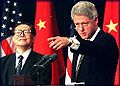
In 1999 Clinton signed a landmark trade agreement with the People's Republic of China. The agreement–the result of more than a decade of negotiations–would lower many trade barriers between the two countries, making it easier to export U.S. products such as automobiles, banking services, and motion pictures. The Chinese citizens ability to afford and purchase U.S. goods should have been taken into consideration. However, the agreement could only take effect if China was accepted into the WTO and was granted permanent “normal trade relations” status by the U.S. Congress. Under the pact, the United States would support China’s membership in the WTO. Many Democrats as well as Republicans were reluctant to grant permanent status to China because they were concerned about human rights in the country and the impact of Chinese imports on U.S. industries and jobs. Congress, however, voted in 2000 to grant permanent normal trade relations with China.
Counterterrorism and Osama bin Laden
On February 26, 1993—thirty-six days after Clinton took office, terrorists who the CIA would later reveal were working under the direction of Osama bin LadenOsama bin Laden
Osama bin Mohammed bin Awad bin Laden was the founder of the militant Islamist organization Al-Qaeda, the jihadist organization responsible for the September 11 attacks on the United States and numerous other mass-casualty attacks against civilian and military targets...
detonated a timed car bomb in the parking garage below Tower One of the World Trade Center
World Trade Center
The original World Trade Center was a complex with seven buildings featuring landmark twin towers in Lower Manhattan, New York City, United States. The complex opened on April 4, 1973, and was destroyed in 2001 during the September 11 attacks. The site is currently being rebuilt with five new...
in New York City
New York City
New York is the most populous city in the United States and the center of the New York Metropolitan Area, one of the most populous metropolitan areas in the world. New York exerts a significant impact upon global commerce, finance, media, art, fashion, research, technology, education, and...
. (See World Trade Center bombing) Clinton responded by ordering his National Security Council
United States National Security Council
The White House National Security Council in the United States is the principal forum used by the President of the United States for considering national security and foreign policy matters with his senior national security advisors and Cabinet officials and is part of the Executive Office of the...
, under the direction of Anthony Lake
Anthony Lake
William Anthony Kirsopp Lake, best known as Tony Lake, is the Executive Director of the United Nations Children's Fund , author, academic, and former American diplomat, Foreign Service Officer, and political advisor. He has been a foreign policy advisor to many Democratic U.S...
, and the FBI to find and punish those responsible. The FBI was able to quickly identify the vehicle used in the bomb from a remnant found in the rubble: a Ryder rental van, which had been reported stolen in Jersey City
Jersey City, New Jersey
Jersey City is the seat of Hudson County, New Jersey, United States.Part of the New York metropolitan area, Jersey City lies between the Hudson River and Upper New York Bay across from Lower Manhattan and the Hackensack River and Newark Bay...
, New Jersey
New Jersey
New Jersey is a state in the Northeastern and Middle Atlantic regions of the United States. , its population was 8,791,894. It is bordered on the north and east by the state of New York, on the southeast and south by the Atlantic Ocean, on the west by Pennsylvania and on the southwest by Delaware...
the day before. The truck was rented by Mohammed Salameh, whom the FBI immediately detained. Similar evidence led to the arrests of other plotters behind the attack, including Nidal Ayyad, Mahmoud Abouhalima, Ahmad Ajaj, and Ramzi Yousef
Ramzi Yousef
Ramzi Yousef was one of the main perpetrators of the 1993 World Trade Center bombing and a co-conspirator in the Bojinka plot. In 1995, he was arrested at a guest house in Islamabad, by the Pakistani Inter-Services Intelligence and United States Diplomatic Security Service, then extradited to the...
—who was identified as the key player in the bombing. All men were tried and convicted for the bombing and other terrorists activities.
In his 1995 State of the Union address, Clinton proposed "comprehensive legislation to strengthen our hand in combating terrorists, whether they strike at home or abroad." He sent legislation to Congress to extend federal criminal jurisdiction, make it easier to deport terrorists, and act against terrorist fund-raising. Following the bombing
Oklahoma City bombing
The Oklahoma City bombing was a terrorist bomb attack on the Alfred P. Murrah Federal Building in downtown Oklahoma City on April 19, 1995. It was the most destructive act of terrorism on American soil until the September 11, 2001 attacks. The Oklahoma blast claimed 168 lives, including 19...
of the Alfred P. Murrah Federal Building
Alfred P. Murrah Federal Building
The Alfred P. Murrah Federal Building was a United States Federal Government complex located at 200 N.W. 5th Street in downtown Oklahoma City, Oklahoma, United States. The building was the target of the Oklahoma City bombing on April 19, 1995, which killed 168 people, including 19 children...
in Oklahoma City
Oklahoma city
Oklahoma City is the capital and largest city of the U.S. state of Oklahoma.Oklahoma City may also refer to:*Oklahoma City metropolitan area*Downtown Oklahoma City*Uptown Oklahoma City*Oklahoma City bombing*Oklahoma City National Memorial...
, Clinton amended that legislation to increase wiretap and electronic surveillance authority for the FBI, require explosives to be equipped with traceable taggants, and appropriate more funds to the FBI, CIA, and local police.
In June 1995, Clinton issued Presidential Decision Directive 39, which stated that the United States "should deter, defeat and respond vigorously to all terrorist attacks on our territory and against our citizens." Furthermore, it called terrorism both a "matter of national security" and a crime. The implementation of his proposals led to a substantial increase in counter-terrorism
Counter-terrorism
Counter-terrorism is the practices, tactics, techniques, and strategies that governments, militaries, police departments and corporations adopt to prevent or in response to terrorist threats and/or acts, both real and imputed.The tactic of terrorism is available to insurgents and governments...
funds for the FBI and CIA.
In 1996, the CIA established a special unit of officers to analyze intelligence received about bin Laden and plan operations against him, coined the "Bin Laden Issue Station
Bin Laden Issue Station
The Bin Laden Issue Station was a unit of the Central Intelligence Agency dedicated to tracking Osama bin Laden.Soon after its creation the Station developed a new, deadlier vision of bin Laden's activities. In 1999 the CIA inaugurated a grand "Plan" against al-Qaeda, but struggled to find the...
". It was this unit that first realized bin Laden was more than just a terrorist financier, but a leader of a global network with operations based in Afghanistan
Afghanistan
Afghanistan , officially the Islamic Republic of Afghanistan, is a landlocked country located in the centre of Asia, forming South Asia, Central Asia and the Middle East. With a population of about 29 million, it has an area of , making it the 42nd most populous and 41st largest nation in the world...
. Given these findings, the NSC encouraged the Department of State to "pay more attention" to Afghanistan and its governing unit, the Taliban, which had received funding from bin Laden. The State Department requested the Taliban to expel bin Laden from the country, noting that he was a sponsor of terrorism and publicly urged Muslims to kill Americans. The Taliban responded that they did not know his whereabouts and, even if they did, he was "not a threat to the United States." The CIA's counter-terrorism division quickly began drafting plans to capture and remove bin Laden from the country. However, Marine General Anthony Zinni
Anthony Zinni
Anthony Charles Zinni is a retired four-star General in the United States Marine Corps and a former Commander in Chief of U.S. Central Command...
and some in the State Department protested the move, saying that the United States should focus instead on ending the Afghan civil war and the Taliban's human rights abuses.
In 1998, Clinton appointed Richard Clarke
Richard A. Clarke
Richard Alan Clarke was a U.S. government employee for 30 years, 1973–2003. He worked for the State Department during the presidency of Ronald Reagan. In 1992, President George H.W. Bush appointed him to chair the Counter-terrorism Security Group and to a seat on the United States National...
—who until then served in a drugs and counter-terrorism division of the CIA—to lead an interagency comprehensive counter-terrorism operation, the Counter-terrorism Security Group (CSG). The goal of the CSG was to "detect, deter, and defend against" terrorist attacks. Additionally, Clinton appointed Clarke to sit on the cabinet-level Principals Committee when it met on terrorism issues.
Clinton’s Counter-terrorism Center began drafting a plan to ambush bin Laden’s compound in Kandahar
Kandahar
Kandahar is the second largest city in Afghanistan, with a population of about 512,200 as of 2011. It is the capital of Kandahar Province, located in the south of the country at about 1,005 m above sea level...
. The CIA mapped the compound and identified the houses of bin Laden’s wives and the location where he most likely slept. The plan was relatively simple, at least on paper. Tribals would “subdue” the guards, enter the compound, take bin Laden to a desert outside Kandahar, and hand him over to another group of tribals. This second group would carry him to a desert landing strip—which had already been tested—where a CIA plane would take him to New York for arraignment. When they completed a draft plan, they ran through two rehearsals in the United States. Confident that the plan would work, the Counter-terrorism Center of the CIA sought the approval of the White House. While they acknowledged that the plan was risky, they stated that there was “a risk in not acting” because “sooner or later, bin Laden will attack U.S. interests, perhaps using WMD.”
Clarke reviewed the plans for Sandy Berger
Sandy Berger
Samuel Richard "Sandy" Berger was United States National Security Advisor, under President Bill Clinton from 1997 to 2001. In his position, he helped to formulate the foreign policy of the Clinton Administration...
, the National Security Director, and told him that it was in the “very early stages of development” and stressed the importance of only targeting bin Laden, not the entire compound. The NSC told the CIA to begin preparing the necessary legal documents to execute the raid.
The senior management of the CIA was skeptical of the plan, and despite objections, canceled the operation, fearing that the risk to their operatives and financial costs were too high. It is unclear whether or not Clinton was aware of the plan.
As the Counter-terrorism Center continued to track bin Laden, they learned in 1998 that the Saudi
Saudi Arabia
The Kingdom of Saudi Arabia , commonly known in British English as Saudi Arabia and in Arabic as as-Sa‘ūdiyyah , is the largest state in Western Asia by land area, constituting the bulk of the Arabian Peninsula, and the second-largest in the Arab World...
government had bin Laden cells within the country that were planning attacks on U.S. forces. CIA Director George Tenet
George Tenet
George John Tenet was the Director of Central Intelligence for the United States Central Intelligence Agency, and is Distinguished Professor in the Practice of Diplomacy at Georgetown University....
, encouraged by the Saudi’s show of force against bin Laden, asked them to assist in the fight against bin Laden. Clinton named Tenet as his informal “personal representative” to work with Saudi Arabia on terrorism. The Saudis promised Tenet that they would do everything they could to convince the Taliban to release bin Laden for trial in America or elsewhere. The Saudi intelligence chief, Prince Turki bin Faisal, held various meetings with Taliban chief Mullah Omar
Mohammed Omar
Mullah Mohammed Omar , often simply called Mullah Omar, is the leader of the Taliban movement that operates in Afghanistan. He was Afghanistan's de facto head of state from 1996 to late 2001, under the official title "Head of the Supreme Council"...
and other leaders and received assurance that bin Laden would be removed. Omar, however, reneged on that promise.
On August 7, 1998, Bin Laden struck again, this time with simultaneous bombings
1998 United States embassy bombings
The 1998 United States embassy bombings were a series of attacks that occurred on August 7, 1998, in which hundreds of people were killed in simultaneous truck bomb explosions at the United States embassies in the East African capitals of Dar es Salaam, Tanzania and Nairobi, Kenya. The date of the...
on the U.S. embassies in Nairobi, Kenya, and Dar es Salaam, Tanzania. (see above) The CIA, having confirmed bin Laden was behind the attack, informed Clinton that terrorist leaders were planning to meet at a camp near Khowst, to plan future attacks. According to Tenet, “several hundred,” including bin Laden, would attend. On August 20, Clinton ordered the military to fire cruise missiles at Al-Qaeda terrorist training camps in Afghanistan and a pharmaceutical factory in Khartoum, Sundan, where bin Laden was suspected of manufacturing biological weapons. While the military hit their targets, bin Laden was not killed. The CIA estimated that they had missed bin Laden by “a few hours.”
At the time of the attacks, Clinton was embroiled in the Lewinsky scandal (see below). This led many Republicans in Congress to accuse the president of “wagging the dog”—launching a military attack simply to distract the public from his personal problems. Clinton and his principals, however, insist that the decision was made solely on the basis of national security.
After the attacks failed, Clinton moved his focus to diplomatic pressure. On the advice of the State Department, Clinton encouraged Pakistan
Pakistan
Pakistan , officially the Islamic Republic of Pakistan is a sovereign state in South Asia. It has a coastline along the Arabian Sea and the Gulf of Oman in the south and is bordered by Afghanistan and Iran in the west, India in the east and China in the far northeast. In the north, Tajikistan...
, whose military intelligence agency was a patron of the Taliban, to pressure the Taliban to remove bin Laden. After numerous meetings with Pakistani Prime Minister Nawaz Sharif
Nawaz Sharif
Mian Mohammad Nawaz Sharif is a Pakistani conservative politician and steel magnate who served as 12th Prime Minister of Pakistan in two non-consecutive terms from November 1990 to July 1993, and from February 1997 to October 12, 1999...
, the Pakistani’s would still not cooperate. Sharif eventually agreed to allow the United States to train Pakistani special forces to find bin Laden. When Sharif was ousted by Pervez Musharraf
Pervez Musharraf
Pervez Musharraf , is a retired four-star general who served as the 13th Chief of Army Staff and tenth President of Pakistan as well as tenth Chairman of the Joint Chiefs of Staff Committee. Musharraf headed and led an administrative military government from October 1999 till August 2007. He ruled...
, the plan was abandoned.
After encouragement by Richard Clarke, Clinton issued an executive order in July 1999 declaring the Taliban regime as a state sponsor of terrorism. This was followed in October 1999 by Resolution 1267
United Nations Security Council Resolution 1267
United Nations Security Council Resolution 1267, adopted unanimously on October 15, 1999, after recalling resolutions 1189 , 1193 and 1214 on the situation in Afghanistan, the Council established a sanctions regime to cover individuals and entities associated with Al-Qaida, Osama bin Laden and/or...
sponsored by the United States placing economic and travel sanctions on the Taliban. The Taliban, however, stood by bin Laden, and the United States, along with Russia, proposed yet another UN resolution (Resolution 1333
United Nations Security Council Resolution 1333
United Nations Security Council Resolution 1333, adopted on December 19, 2000, after recalling all resolutions on the situation in Afghanistan, including Resolution 1267 , the Council called for a ban of military assistance to the Taliban, closure of its camps and an end to the provision of...
), this time imposing an embargo an arms shipments to the Taliban. The move was meant to weaken the Taliban in their fight against the Northern Alliance in their civil strife. However, the resolution did little to limit the illegal flow of arms from Pakistan.
In August 1999, Clinton signed a Memorandum of Notification ordering the CIA to develop another plan to capture bin Laden, and giving the CIA the authority to order bin Laden be killed.
Near the end of 1999, the Clinton administration, working with the government of Jordan
Jordan
Jordan , officially the Hashemite Kingdom of Jordan , Al-Mamlaka al-Urduniyya al-Hashemiyya) is a kingdom on the East Bank of the River Jordan. The country borders Saudi Arabia to the east and south-east, Iraq to the north-east, Syria to the north and the West Bank and Israel to the west, sharing...
, detected and thwarted a planned terrorist attack to detonate bombs at various New Year millennium celebrations around the world. The CIA confirmed that bin Laden was behind the plot, which was disrupted just days before the New Year. While many credited Clinton’s new CSG for playing a role in the foiling of these plots, critics claim it was “mostly luck.”
The CIA informed Clinton that they feared the thwarted attacks were just part of a larger series of attacks planned for the new year. Clinton asked Clarke and the CSG to draft plans to “deter and disrupt” al Qaeda attacks.
On October 12, 2000, terrorists bombed the USS Cole
USS Cole bombing
The USS Cole Bombing, or the USS Cole Incident, was a suicide attack against the United States Navy destroyer on October 12, 2000 while it was harbored and refueled in the Yemeni port of Aden. Seventeen American sailors were killed, and 39 were injured...
in the harbor of the Yemen
Yemen
The Republic of Yemen , commonly known as Yemen , is a country located in the Middle East, occupying the southwestern to southern end of the Arabian Peninsula. It is bordered by Saudi Arabia to the north, the Red Sea to the west, and Oman to the east....
i port of Aden
Aden
Aden is a seaport city in Yemen, located by the eastern approach to the Red Sea , some 170 kilometres east of Bab-el-Mandeb. Its population is approximately 800,000. Aden's ancient, natural harbour lies in the crater of an extinct volcano which now forms a peninsula, joined to the mainland by a...
. The attack on the USS Cole (DDG-67)
USS Cole (DDG-67)
The second USS Cole is an Arleigh Burke-class Aegis-equipped guided missile destroyer homeported in NS Norfolk, Virginia. The Cole is named in honor of Marine Sergeant Darrell S. Cole, a machine-gunner killed in action on Iwo Jima on 19 February 1945, during World War II...
, a U.S. Navy
United States Navy
The United States Navy is the naval warfare service branch of the United States Armed Forces and one of the seven uniformed services of the United States. The U.S. Navy is the largest in the world; its battle fleet tonnage is greater than that of the next 13 largest navies combined. The U.S...
destroyer
Destroyer
In naval terminology, a destroyer is a fast and maneuverable yet long-endurance warship intended to escort larger vessels in a fleet, convoy or battle group and defend them against smaller, powerful, short-range attackers. Destroyers, originally called torpedo-boat destroyers in 1892, evolved from...
, killed 17 Navy sailors, and there was no clear indication during the last months of Clinton’s term of who was responsible. The CIA reported that they had "no definitive answer on [the] crucial question of outside direction of the attack—how and by whom. Clinton did not think it would be wise to launch an attack based on a "preliminary judgment," stating that he would have taken further action had he received definitive intelligence. The CIA was eventually able to confirm bin Laden’s involvement with certainty a week after the Bush administration took office.
As Clinton’s second term drew to a close, the CSG drafted a comprehensive policy paper entitled “Strategy for Eliminating the Threat from the Jihadist Networks of al Qida: Status and Prospects.” http://www.gwu.edu/~nsarchiv/NSAEBB/NSAEBB147/clarke%20attachment.pdf The paper outlined a method to “roll back” al Qaeda over “a period of three to five years.” Clarke stated that while “continued anti-al Qida operations at the current level will prevent some attacks, [it] will not seriously attrit their ability to plan and conduct attacks." This policy paper was forwarded to the incoming Bush administration.
Fox News interview with Chris Wallace
In the years since September 11, 2001September 11, 2001 attacks
The September 11 attacks The September 11 attacks The September 11 attacks (also referred to as September 11, September 11th or 9/119/11 is pronounced "nine eleven". The slash is not part of the pronunciation...
, Clinton has been subject to criticism that he failed to capture Osama bin Laden
Osama bin Laden
Osama bin Mohammed bin Awad bin Laden was the founder of the militant Islamist organization Al-Qaeda, the jihadist organization responsible for the September 11 attacks on the United States and numerous other mass-casualty attacks against civilian and military targets...
as President. In a September 24, 2006, interview with Fox News' Chris Wallace
Chris Wallace (journalist)
Christopher "Chris" Wallace is an American journalist, currently the host of the Fox Network program, Fox News Sunday. Wallace has won three Emmy Awards, the Dupont-Columbia Silver Baton Award, and a Peabody Award. Wallace has been with Fox News since 2003...
on Fox News Sunday
Fox News Sunday
Fox News Sunday with Chris Wallace is a public affairs program on the Fox network, hosted by Chris Wallace and airing on Sunday mornings. The show began on April 28, 1996, which predated the launch of Fox News Channel, and usually talks about items similar to Sunday morning talk shows...
, Clinton challenged his critics. According to Clinton, he faced criticism from various conservatives during his administration for being too obsessed with Bin Laden. Clinton also noted that his administration created the first comprehensive anti-terrorist operation, led by Richard Clarke
Richard A. Clarke
Richard Alan Clarke was a U.S. government employee for 30 years, 1973–2003. He worked for the State Department during the presidency of Ronald Reagan. In 1992, President George H.W. Bush appointed him to chair the Counter-terrorism Security Group and to a seat on the United States National...
—whom Clinton accuses the Bush Administration of demoting. Clinton also said he worked hard to try to kill Bin Laden.
Former international negotiator and current businessman, financier and media commentator Mansoor Ijaz
Mansoor Ijaz
Mansoor Ijaz is an American businessman of Pakistani Ancestry. He is an investment banker and media commentator, mostly in relation to Pakistan, Iraq and Afghanistan....
claimed that from 1996–1998, he had opened up unofficial negotiations with Sudan
Sudan
Sudan , officially the Republic of the Sudan , is a country in North Africa, sometimes considered part of the Middle East politically. It is bordered by Egypt to the north, the Red Sea to the northeast, Eritrea and Ethiopia to the east, South Sudan to the south, the Central African Republic to the...
to lift terrorism sanctions from that country in exchange for intelligence information about the terrorist groups Islamic Jihad
Islamic Jihad
Islamic Jihad may refer to:* Islamic Jihad Movement in Palestine* Islamic Jihad Organization, active mostly in Lebanon* Islamic Jihad of Yemen* Turkish Islamic Jihad* Egyptian Islamic JihadSee also:* Islamic jihad, theological concept of jihad...
, Hezbollah and Hamas
Hamas
Hamas is the Palestinian Sunni Islamic or Islamist political party that governs the Gaza Strip. Hamas also has a military wing, the Izz ad-Din al-Qassam Brigades...
. He claimed that Sudan was also prepared to offer custody of terrorist mastermind Osama bin Laden
Osama bin Laden
Osama bin Mohammed bin Awad bin Laden was the founder of the militant Islamist organization Al-Qaeda, the jihadist organization responsible for the September 11 attacks on the United States and numerous other mass-casualty attacks against civilian and military targets...
, who had been living in the country and launching operations. According to Ijaz, neither Clinton nor National Security Advisor
National Security Advisor (United States)
The Assistant to the President for National Security Affairs, commonly referred to as the National Security Advisor , serves as the chief advisor to the President of the United States on national security issues...
Sandy Berger
Sandy Berger
Samuel Richard "Sandy" Berger was United States National Security Advisor, under President Bill Clinton from 1997 to 2001. In his position, he helped to formulate the foreign policy of the Clinton Administration...
responded to the situation. Bin Laden later left Sudan and established his operations in Afghanistan
Afghanistan
Afghanistan , officially the Islamic Republic of Afghanistan, is a landlocked country located in the centre of Asia, forming South Asia, Central Asia and the Middle East. With a population of about 29 million, it has an area of , making it the 42nd most populous and 41st largest nation in the world...
under the protection of the Taliban and, with his network, planned out terrorist attacks against American interests worldwide, including attacks on American embassies in Tunisia
Tunisia
Tunisia , officially the Tunisian RepublicThe long name of Tunisia in other languages used in the country is: , is the northernmost country in Africa. It is a Maghreb country and is bordered by Algeria to the west, Libya to the southeast, and the Mediterranean Sea to the north and east. Its area...
and Sudan
Sudan
Sudan , officially the Republic of the Sudan , is a country in North Africa, sometimes considered part of the Middle East politically. It is bordered by Egypt to the north, the Red Sea to the northeast, Eritrea and Ethiopia to the east, South Sudan to the south, the Central African Republic to the...
as well as the bombing of the USS Cole
USS Cole (DDG-67)
The second USS Cole is an Arleigh Burke-class Aegis-equipped guided missile destroyer homeported in NS Norfolk, Virginia. The Cole is named in honor of Marine Sergeant Darrell S. Cole, a machine-gunner killed in action on Iwo Jima on 19 February 1945, during World War II...
. The most infamous were the attacks of September 11, 2001
September 11, 2001 attacks
The September 11 attacks The September 11 attacks The September 11 attacks (also referred to as September 11, September 11th or 9/119/11 is pronounced "nine eleven". The slash is not part of the pronunciation...
that occurred under Clinton's successor, George W. Bush
George W. Bush
George Walker Bush is an American politician who served as the 43rd President of the United States, from 2001 to 2009. Before that, he was the 46th Governor of Texas, having served from 1995 to 2000....
nine months after Clinton left office. However, the 9/11 Commission Report
9/11 Commission Report
The 9/11 Commission Report, formally named Final Report of the National Commission on Terrorist Attacks Upon the United States, is the official report of the events leading up to the September 11, 2001 attacks...
later found no credible evidence to support the Sudan custody offer as the American Ambassador to the Sudan had no legal basis to ask for custody due to no indictment against Bin Laden:
"Sudan’s minister of defense, Fatih Erwa, has claimed that Sudan offered to hand Bin Ladin over to the United States. The Commission has found no credible evidence that this was so. Ambassador Carney had instructions only to push the Sudanese to expel Bin Ladin.Ambassador Carney had no legal basis to ask for more from the Sudanese since, at the time, there was no indictment outstanding."Clinton acknowledged that, following the bombing on the USS Cole
USS Cole bombing
The USS Cole Bombing, or the USS Cole Incident, was a suicide attack against the United States Navy destroyer on October 12, 2000 while it was harbored and refueled in the Yemeni port of Aden. Seventeen American sailors were killed, and 39 were injured...
, his administration prepared battle plans to execute a military operation in Afghanistan to overthrow the Taliban and search for bin Laden. The plans were never implemented because, according to Clinton, the CIA and FBI refused to certify that bin Laden was responsible for the bombing until after he left office and the military was unable to receive basing rights in Uzbekistan
Uzbekistan
Uzbekistan , officially the Republic of Uzbekistan is a doubly landlocked country in Central Asia and one of the six independent Turkic states. It shares borders with Kazakhstan to the west and to the north, Kyrgyzstan and Tajikistan to the east, and Afghanistan and Turkmenistan to the south....
. In relation to Afghanistan, Clinton said "We do have a government that thinks Afghanistan is one-seventh as important as Iraq". Clinton also said that his administration left the plans and a comprehensive anti-terror strategy with the new Bush Administration in January 2001.
Other issues
In 1996 Clinton signed the United States onto the Comprehensive Test Ban TreatyComprehensive Test Ban Treaty
The Comprehensive Nuclear-Test-Ban Treaty bans all nuclear explosions in all environments, for military or civilian purposes. It was adopted by the United Nations General Assembly on 10 September 1996 but it has not entered into force.-Status:...
(CTBT), a landmark international agreement that prohibited all signatory nations from testing nuclear weapons. The following year, he sent the treaty to the Senate for ratification and they rejected it in October 1999. International reaction to the Senate’s action was uniformly negative, and the rejection was a political setback for Clinton, who had lobbied actively for its approval. Despite the rejection of the treaty, Clinton promised that the United States would continue to maintain a policy of not testing nuclear weapons, which had been in place since 1992.
Throughout the 1990s, the Congress refused to appropriate funds for the United States to pay its dues to the United Nations
United Nations
The United Nations is an international organization whose stated aims are facilitating cooperation in international law, international security, economic development, social progress, human rights, and achievement of world peace...
. By 1999 the United States owed the UN at least $1 billion in back dues. That same year Clinton reached a compromise with Republicans in Congress to submit more than $800 million in back dues. Republicans in the House of Representatives had insisted that UN debt repayments be accompanied by restrictions on U.S. funding for international groups that lobbied for abortion rights in foreign countries. Clinton had vetoed similar measures in the past, but he agreed to the restrictions when faced with the prospect that the United States would lose its vote in the UN General Assembly for nonpayment of dues.