

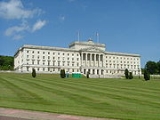
Northern Ireland Assembly

Encyclopedia
The Northern Ireland Assembly is the devolved
legislature
of Northern Ireland
. It has power to legislate in a wide range of areas that are not explicitly reserved
to the Parliament of the United Kingdom
, and to appoint the Northern Ireland Executive
. It sits at Parliament Buildings
at Stormont in Belfast
.
The latest incarnation of the Assembly was established under the Good Friday Agreement
of 1998, an accord aimed at bringing an end to Northern Ireland's violent 30-year Troubles
. It is based on the principle of power-sharing
under the D'Hondt method
to ensure that Northern Ireland's largest political communities, the unionist
and nationalist
communities both participate in governing the region. The Assembly is a unicameral, democratically
elected body comprising 108 members who are known as Members of the Legislative Assembly
, or MLAs. Members are elected under the single transferable vote
form of proportional representation
.
The Assembly has been suspended on several occasions, the longest suspension being from 14 October 2002 until 7 May 2007. When the Assembly was suspended, its powers reverted to the Northern Ireland Office
. Following talks that resulted in the St Andrews Agreement
being accepted in November 2006, an election
to the Assembly was held on 7 March 2007 and full power was restored to the devolved institutions on 8 May 2007.
Powers in relation to policing and justice were transferred to the Assembly on 12 April 2010.
The third assembly was dissolved on 24 March 2011 in preparation for the elections to be held on Thursday 5 May 2011, this being the first assembly since the Good Friday Agreement to complete a full term. The fourth assembly convened on 12 May 2011.
. That Parliament consistently chose the Ulster Unionist Party
to govern the region. The Parliament was suspended on 30 March 1972 and formally abolished in 1973 under the Northern Ireland Constitution Act 1973
.
Shortly after this first parliament was abolished, attempts began to restore devolution
on a new basis that would see power shared between nationalists and unionists. To this end a new parliament, the Northern Ireland Assembly, was established in 1973. However, this body was brought down by opposition from hard-line unionists
and republicans
and was abolished in 1974. In 1982 another Northern Ireland Assembly
was established at Stormont, initially as a body to scrutinise the actions of the Secretary of State
, the British
minister with responsibility for Northern Ireland. It received little support from nationalists and was officially dissolved in 1986.
Attempts to secure its operation on a permanent basis have been frustrated by disagreements between the two main unionist parties (the Democratic Unionist Party
and the Ulster Unionist Party
) and Sinn Féin
, the largest nationalist party. Unionists refused to participate in the Good Friday Agreement's institutions alongside Sinn Féin until they were assured that the IRA had discontinued its activities, decommissioned its arms and disbanded.
The most recent suspension occurred after unionists withdrew from the Northern Ireland Executive
after Sinn Féin's offices at Stormont were raided by the police investigating alleged intelligence gathering on behalf of the IRA by members of the party's support staff. The Assembly, already suspended, dissolved on 28 April 2003 as scheduled, but the elections due the following month were postponed by the United Kingdom
government and were not held until November that year.
On 8 December 2005, three Belfast men at the centre of the alleged IRA spying incident (dubbed "Stormontgate
") were acquitted of all charges. The prosecution offered no evidence "in the public interest." Afterwards Denis Donaldson
, one of those arrested, said that the "charges should never have been brought" as the police action was "political." On 17 December 2005, Donaldson publicly confirmed that he had been a spy for British intelligence since the early 1980s. Mr Donaldson was killed on 4 April 2006 by the Real IRA.
were called together on 15 May 2006 under the Northern Ireland Act 2006
to meet in an assembly to be known as "the Assembly" (or fully "the Assembly established under the Northern Ireland Act 2006") for the purpose of electing a First Minister and Deputy First Minister and choosing the members of an Executive before 25 November 2006 as a preliminary to the restoration of devolved government.
On 23 May 2006 Ian Paisley
, leader of the Democratic Unionist Party
(DUP) refused Sinn Féin
's nomination to be First Minister
alongside Sinn Féin's chief negotiator, Martin McGuinness
, as Deputy First Minister. Eileen Bell
was appointed by the Secretary of State Peter Hain
to be the Speaker of the Assembly, with Francie Molloy
and Jim Wells acting as deputies. The Northern Ireland (St Andrews Agreement
) Act 2006 repealed the Northern Ireland Act 2006 and thus disbanded "the Assembly".
provided for a "Transitional Assembly" (or fully "the Transitional Assembly established under the Northern Ireland (St Andrews Agreement) Act 2006") to take part in preparations for the restoration of devolved government in Northern Ireland. A person who was a member of the Northern Ireland Assembly was also a member of the Transitional Assembly. Eileen Bell was Speaker of the Transitional Assembly and Francie Molloy and Jim Wells continued as deputies. The Transitional Assembly first met on 24 November 2006, when the proceedings were suspended due to a bomb threat by loyalist
paramilitary Michael Stone
. It was dissolved on 30 January 2007 when the election campaign for the current Northern Ireland Assembly started.
An election
to the then-suspended Northern Ireland Assembly was held on 7 March 2007. Secretary of State
, Peter Hain
signed a restoration order on 25 March 2007 allowing for the restoration of devolution at midnight on the following day. The two largest parties following the election, the Democratic Unionist Party
(DUP) and Sinn Féin
, agreed to enter power-sharing government together, and an administration was eventually established on 10 May with Ian Paisley as First Minister and Martin McGuinness as Deputy First Minister.
The Assembly's composition and powers are laid down in the Northern Ireland Act 1998
. The Assembly's 108 members are elected from 18 six-member constituencies on the basis of universal adult suffrage
. The constituencies used are the same as those used for elections to the Westminster Parliament. The 1998 Act provides that, unless the Assembly is dissolved early, elections should occur once in every four years on the first Thursday in May. However the second election to the Assembly was delayed by the UK government until 26 November 2003. The Assembly is dissolved shortly before the holding of elections on a day chosen by the Secretary of State
. After each election the Assembly must meet within eight days. The Assembly can vote to dissolve itself early by a two-thirds majority of the total number of its members. It is also automatically dissolved if it is unable to elect a First Minister and deputy First Minister
within six weeks of its first meeting or of those positions becoming vacant. The four elections held to the Assembly so far were the:
Each MLA is free to designate themselves as "nationalist", "unionist" or "other" as they see fit, the only requirement being that no member may change their designation more than once during an Assembly session. The system has been criticised by some, in particular the cross-community Alliance Party
, as entrenching sectarian
divisions. The Alliance Party of Northern Ireland
supports ending the official designation of identity requirement and the taking of important votes on the basis of an ordinary super-majority
.
(Irish Parliament), the Assembly currenty has no official opposition to hold governing parties to account. In each Assembly to date, the parties forming the Executive have collectively held large majorities but have frequently voted against each other due to policy differences.
During the 1998-2003 Assembly, the non-Executive parties (thus in opposition) were as follows:
The above parties held 15 seats at their full strength. In the 2003-2007 Assembly, the number of opposition MLAs was reduced to eight, from the following parties:
That number increased to nine at the 2007 Assembly election
:
Alliance entered government on the devolution of policing and justice (12 April 2010), which left only the Green Party
and Progressive Unionist Party
as parties outside government. In the current Assembly, two parties are in opposition: Traditional Unionist Voice
and the Green Party
(1 seat each).
Denis Watson, Fraser Agnew and Boyd Douglas formed the United Unionist Coalition
group to maximise their influence in the Assembly e.g. to seek and gain committee positions. DUP MLAs are required to resign their position if they breach party policy and therefore cannot become independent or join other parties; resignation letters can be presented to the Speaker without consultation.
The Northern Ireland Act 1998 allowed for the possibility of by-elections or co-options. In 2001, the Northern Ireland Office
introduced a system of substitutes as the preferred option. Under a further change made in 2009, a political party leader directly nominates a new MLA if his or her party won that seat at the previous election. Independent MLAs can continue to use substitutes. The following MLAs have been co-opted to the Assembly to date:
When Sinn Féin MLA Michael Ferguson
died in September 2006, no substitutes were available. Sinn Féin was allowed to use his vote in the Assembly (despite his death) and no by-election was held. His seat remained vacant until the 2007 Northern Ireland Assembly election
.
The lower house of the Irish Parliament, Dáil Éireann
, uses the same single transferable vote
system for elections as the Assembly but does allow by-elections to fill vacancies.
Powers reserved by Westminster are divided into "excepted matters", which it retains indefinitely, and "reserved matters", which may be transferred to the competence of the Northern Ireland Assembly at a future date. A list of transferred, reserved and excepted matters is given below.
While the Assembly was in suspension, its legislative powers were exercised by the UK Government, which effectively has power to legislate by decree. Laws that would have normally been within the competence of the Assembly were passed by the UK Parliament in the form of Orders-in-Council rather than legislative acts.
Like laws enacted by the Westminster Parliament, Acts of the Northern Ireland Assembly are subject to judicial review. A law can be struck down if it is found to:
Although the British monarch
is not formally a component of the Assembly (as is the case at Westminster), all bills passed by the Assembly must receive Royal Assent
to become law. If the Secretary of State believes that a bill violates the constitutional limitations on the powers of the Assembly, the Secretary of State will refuse to submit the bill to the monarch for Assent. If submitted by the Secretary of State, the monarch will, by convention
, sign a bill into law. Acts of the Northern Ireland Assembly begin with the enacting formula: "Be it enacted by being passed by the Northern Ireland Assembly and assented to by Her Majesty as follows:".
ministers. The current Executive is as follows:
The Assembly has the power to call for witnesses and documents, if the relevant responsibility has been transferred to its remit. Proceedings are covered by privilege in defamation law.
Each MLA is free to designate themselves as nationalist, unionist or other as they see fit, the only requirement being that no member may change their designation more than once during an Assembly session.
, as entrenching sectarian
divisions. The Alliance Party supports ending the official requirement to make a designation based on identity and instead proposes the taking of important votes on the basis of an ordinary super-majority
.
and three Deputy Speakers, of whom one is appointed Principal Deputy Speaker. Lord Alderdice served as the first Speaker of the Assembly from July 1998, but retired in March 2004 to serve as a member of the Independent Monitoring Commission
that supervised paramilitary ceasefires. The position has been filled since 8 May 2007 by William Hay. In the Assembly, the Speaker and ten other members constitute a quorum.
The Assembly Commission
is the body corporate of the Assembly. It ensures that the Assembly has the property, staff and services it needs to carry out its work. Legal proceedings taken for or against the Assembly are taken for or against the Commission on behalf of the Assembly. The staff of the Assembly are collectively known as the Assembly Secretariat.
The Assembly has 12 statutory committees, each of which is charged with scrutinising the activities of a particular ministerial department. It also has 6 permanent standing committees and can establish temporary ad hoc committees. The Chairmen and Deputy Chairmen of the committees are chosen by party nominating officers under the d'Hondt system procedure, used to appoint most ministers. Ordinary committee members are not appointed under this procedure but the Standing Orders require that the share of members of each party on a committee should be roughly proportionate to its share of seats in the Assembly. Committees of the Assembly take decisions by a simple majority vote. The following are the current statutory and standing committees of the Assembly:
Devolution
Devolution is the statutory granting of powers from the central government of a sovereign state to government at a subnational level, such as a regional, local, or state level. Devolution can be mainly financial, e.g. giving areas a budget which was formerly administered by central government...
legislature
Legislature
A legislature is a kind of deliberative assembly with the power to pass, amend, and repeal laws. The law created by a legislature is called legislation or statutory law. In addition to enacting laws, legislatures usually have exclusive authority to raise or lower taxes and adopt the budget and...
of Northern Ireland
Northern Ireland
Northern Ireland is one of the four countries of the United Kingdom. Situated in the north-east of the island of Ireland, it shares a border with the Republic of Ireland to the south and west...
. It has power to legislate in a wide range of areas that are not explicitly reserved
Reserved matters
In the United Kingdom reserved matters and excepted matters are the areas of government policy where Parliament had kept the power to make laws in Scotland, Northern Ireland and Wales....
to the Parliament of the United Kingdom
Parliament of the United Kingdom
The Parliament of the United Kingdom of Great Britain and Northern Ireland is the supreme legislative body in the United Kingdom, British Crown dependencies and British overseas territories, located in London...
, and to appoint the Northern Ireland Executive
Northern Ireland Executive
The Northern Ireland Executive is the executive arm of the Northern Ireland Assembly, the devolved legislature for Northern Ireland. It is answerable to the Assembly and was established according to the terms of the Northern Ireland Act 1998, which followed the Good Friday Agreement...
. It sits at Parliament Buildings
Parliament Buildings (Northern Ireland)
The Parliament Buildings, known as Stormont because of its location in the Stormont area of Belfast is the seat of the Northern Ireland Assembly and the Northern Ireland Executive...
at Stormont in Belfast
Belfast
Belfast is the capital of and largest city in Northern Ireland. By population, it is the 14th biggest city in the United Kingdom and second biggest on the island of Ireland . It is the seat of the devolved government and legislative Northern Ireland Assembly...
.
The latest incarnation of the Assembly was established under the Good Friday Agreement
Belfast Agreement
The Good Friday Agreement or Belfast Agreement , sometimes called the Stormont Agreement, was a major political development in the Northern Ireland peace process...
of 1998, an accord aimed at bringing an end to Northern Ireland's violent 30-year Troubles
The Troubles
The Troubles was a period of ethno-political conflict in Northern Ireland which spilled over at various times into England, the Republic of Ireland, and mainland Europe. The duration of the Troubles is conventionally dated from the late 1960s and considered by many to have ended with the Belfast...
. It is based on the principle of power-sharing
Consociationalism
Consociationalism is a form of government involving guaranteed group representation, and is often suggested for managing conflict in deeply divided societies...
under the D'Hondt method
D'Hondt method
The d'Hondt method is a highest averages method for allocating seats in party-list proportional representation. The method described is named after Belgian mathematician Victor D'Hondt who described it in 1878...
to ensure that Northern Ireland's largest political communities, the unionist
Unionism in Ireland
Unionism in Ireland is an ideology that favours the continuation of some form of political union between the islands of Ireland and Great Britain...
and nationalist
Irish nationalism
Irish nationalism manifests itself in political and social movements and in sentiment inspired by a love for Irish culture, language and history, and as a sense of pride in Ireland and in the Irish people...
communities both participate in governing the region. The Assembly is a unicameral, democratically
Democracy
Democracy is generally defined as a form of government in which all adult citizens have an equal say in the decisions that affect their lives. Ideally, this includes equal participation in the proposal, development and passage of legislation into law...
elected body comprising 108 members who are known as Members of the Legislative Assembly
Member of the Legislative Assembly (Northern Ireland)
Member of the Legislative Assembly is a representative elected by the voters to the Northern Ireland Assembly in Northern Ireland.- About :...
, or MLAs. Members are elected under the single transferable vote
Single transferable vote
The single transferable vote is a voting system designed to achieve proportional representation through preferential voting. Under STV, an elector's vote is initially allocated to his or her most preferred candidate, and then, after candidates have been either elected or eliminated, any surplus or...
form of proportional representation
Proportional representation
Proportional representation is a concept in voting systems used to elect an assembly or council. PR means that the number of seats won by a party or group of candidates is proportionate to the number of votes received. For example, under a PR voting system if 30% of voters support a particular...
.
The Assembly has been suspended on several occasions, the longest suspension being from 14 October 2002 until 7 May 2007. When the Assembly was suspended, its powers reverted to the Northern Ireland Office
Northern Ireland Office
The Northern Ireland Office is a United Kingdom government department responsible for Northern Ireland affairs. The NIO is led by the Secretary of State for Northern Ireland, and is based in Northern Ireland at Stormont House.-Role:...
. Following talks that resulted in the St Andrews Agreement
St Andrews Agreement
The St Andrews Agreement was an agreement between the British and Irish Governments and the political parties in relation to the devolution of power to Northern Ireland...
being accepted in November 2006, an election
Northern Ireland Assembly election, 2007
The third elections to the Northern Ireland Assembly were held on 7 March 2007 when 108 new members were elected. The election saw endorsement of the St Andrews Agreement and the two largest parties, the Democratic Unionist Party and Sinn Féin, along with the Alliance Party, increase their...
to the Assembly was held on 7 March 2007 and full power was restored to the devolved institutions on 8 May 2007.
Powers in relation to policing and justice were transferred to the Assembly on 12 April 2010.
The third assembly was dissolved on 24 March 2011 in preparation for the elections to be held on Thursday 5 May 2011, this being the first assembly since the Good Friday Agreement to complete a full term. The fourth assembly convened on 12 May 2011.
Previous legislatures
From 7 June 1921 until 30 March 1972, the devolved legislature for Northern Ireland was the Parliament of Northern IrelandParliament of Northern Ireland
The Parliament of Northern Ireland was the home rule legislature of Northern Ireland, created under the Government of Ireland Act 1920, which sat from 7 June 1921 to 30 March 1972, when it was suspended...
. That Parliament consistently chose the Ulster Unionist Party
Ulster Unionist Party
The Ulster Unionist Party – sometimes referred to as the Official Unionist Party or, in a historic sense, simply the Unionist Party – is the more moderate of the two main unionist political parties in Northern Ireland...
to govern the region. The Parliament was suspended on 30 March 1972 and formally abolished in 1973 under the Northern Ireland Constitution Act 1973
Northern Ireland Constitution Act 1973
The Northern Ireland Constitution Act 1973 was an Act of the Parliament of the United Kingdom which received the Royal Assent on 18 July 1973...
.
Shortly after this first parliament was abolished, attempts began to restore devolution
Devolution
Devolution is the statutory granting of powers from the central government of a sovereign state to government at a subnational level, such as a regional, local, or state level. Devolution can be mainly financial, e.g. giving areas a budget which was formerly administered by central government...
on a new basis that would see power shared between nationalists and unionists. To this end a new parliament, the Northern Ireland Assembly, was established in 1973. However, this body was brought down by opposition from hard-line unionists
Ulster Workers' Council Strike
The Ulster Workers' Council strike was a general strike that took place in Northern Ireland between 15 May and 28 May 1974, during "The Troubles". The strike was called by loyalists and unionists who were against the Sunningdale Agreement, which had been signed in December 1973...
and republicans
Irish Republicanism
Irish republicanism is an ideology based on the belief that all of Ireland should be an independent republic.In 1801, under the Act of Union, the Kingdom of Great Britain and the Kingdom of Ireland merged to form the United Kingdom of Great Britain and Ireland...
and was abolished in 1974. In 1982 another Northern Ireland Assembly
Northern Ireland Assembly, 1982
The Northern Ireland Assembly established in 1982 represented an ultimately unsuccessful attempt to restore the devolution to Northern Ireland which had been suspended 10 years previously. The Assembly was abolished in 1986.-Origins:...
was established at Stormont, initially as a body to scrutinise the actions of the Secretary of State
Secretary of State for Northern Ireland
The Secretary of State for Northern Ireland, informally the Northern Ireland Secretary, is the principal secretary of state in the government of the United Kingdom with responsibilities for Northern Ireland. The Secretary of State is a Minister of the Crown who is accountable to the Parliament of...
, the British
United Kingdom
The United Kingdom of Great Britain and Northern IrelandIn the United Kingdom and Dependencies, other languages have been officially recognised as legitimate autochthonous languages under the European Charter for Regional or Minority Languages...
minister with responsibility for Northern Ireland. It received little support from nationalists and was officially dissolved in 1986.
The modern Assembly and suspensions
The modern Northern Ireland Assembly was first elected on 25 June 1998 and first met on 1 July 1998. However, it only existed in "shadow" form until 2 December 1999 when full powers were devolved to the Assembly. Since then the Assembly has operated only intermittently and has been suspended on four occasions:- 11 February – 30 May 2000
- 10 August 2001 (24 hour suspension)
- 22 September 2001 (24 hour suspension)
- 14 October 2002 – 7 May 2007
Attempts to secure its operation on a permanent basis have been frustrated by disagreements between the two main unionist parties (the Democratic Unionist Party
Democratic Unionist Party
The Democratic Unionist Party is the larger of the two main unionist political parties in Northern Ireland. Founded by Ian Paisley and currently led by Peter Robinson, it is currently the largest party in the Northern Ireland Assembly and the fourth-largest party in the House of Commons of the...
and the Ulster Unionist Party
Ulster Unionist Party
The Ulster Unionist Party – sometimes referred to as the Official Unionist Party or, in a historic sense, simply the Unionist Party – is the more moderate of the two main unionist political parties in Northern Ireland...
) and Sinn Féin
Sinn Féin
Sinn Féin is a left wing, Irish republican political party in Ireland. The name is Irish for "ourselves" or "we ourselves", although it is frequently mistranslated as "ourselves alone". Originating in the Sinn Féin organisation founded in 1905 by Arthur Griffith, it took its current form in 1970...
, the largest nationalist party. Unionists refused to participate in the Good Friday Agreement's institutions alongside Sinn Féin until they were assured that the IRA had discontinued its activities, decommissioned its arms and disbanded.
The most recent suspension occurred after unionists withdrew from the Northern Ireland Executive
Northern Ireland Executive
The Northern Ireland Executive is the executive arm of the Northern Ireland Assembly, the devolved legislature for Northern Ireland. It is answerable to the Assembly and was established according to the terms of the Northern Ireland Act 1998, which followed the Good Friday Agreement...
after Sinn Féin's offices at Stormont were raided by the police investigating alleged intelligence gathering on behalf of the IRA by members of the party's support staff. The Assembly, already suspended, dissolved on 28 April 2003 as scheduled, but the elections due the following month were postponed by the United Kingdom
United Kingdom
The United Kingdom of Great Britain and Northern IrelandIn the United Kingdom and Dependencies, other languages have been officially recognised as legitimate autochthonous languages under the European Charter for Regional or Minority Languages...
government and were not held until November that year.
On 8 December 2005, three Belfast men at the centre of the alleged IRA spying incident (dubbed "Stormontgate
Stormontgate
Stormontgate is the name given to the controversy surrounding an alleged Provisional Irish Republican Army spy-ring and intelligence gathering operation based in Stormont, the parliament building of Northern Ireland...
") were acquitted of all charges. The prosecution offered no evidence "in the public interest." Afterwards Denis Donaldson
Denis Donaldson
Denis Martin Donaldson was a volunteer in the Provisional Irish Republican Army and a member of Sinn Féin who was exposed in December 2005 as an informer in the employment of MI5 and the Special Branch of the Police Service of Northern Ireland Denis Martin Donaldson (Short Strand, Belfast,...
, one of those arrested, said that the "charges should never have been brought" as the police action was "political." On 17 December 2005, Donaldson publicly confirmed that he had been a spy for British intelligence since the early 1980s. Mr Donaldson was killed on 4 April 2006 by the Real IRA.
"The Assembly established under the Northern Ireland Act 2006"
Although the Assembly remained suspended from 2002 until 2007, the persons elected to it at the 2003 Assembly electionNorthern Ireland Assembly election, 2003
The second elections to the Northern Ireland Assembly, which at the time of the elections had been suspended for just over a year, were held on Wednesday 26 November 2003. Six members were elected by Single Transferable Vote from each of Northern Ireland's eighteen Westminster Parliamentary...
were called together on 15 May 2006 under the Northern Ireland Act 2006
Northern Ireland Act 2006
The Northern Ireland Act 2006 is an Act of the Parliament of the United Kingdom. It made provision in connection with the Northern Ireland Assembly.-External links:*, as amended from the National Archives....
to meet in an assembly to be known as "the Assembly" (or fully "the Assembly established under the Northern Ireland Act 2006") for the purpose of electing a First Minister and Deputy First Minister and choosing the members of an Executive before 25 November 2006 as a preliminary to the restoration of devolved government.
On 23 May 2006 Ian Paisley
Ian Paisley
Ian Richard Kyle Paisley, Baron Bannside, PC is a politician and church minister in Northern Ireland. As the leader of the Democratic Unionist Party , he and Sinn Féin's Martin McGuinness were elected First Minister and deputy First Minister respectively on 8 May 2007.In addition to co-founding...
, leader of the Democratic Unionist Party
Democratic Unionist Party
The Democratic Unionist Party is the larger of the two main unionist political parties in Northern Ireland. Founded by Ian Paisley and currently led by Peter Robinson, it is currently the largest party in the Northern Ireland Assembly and the fourth-largest party in the House of Commons of the...
(DUP) refused Sinn Féin
Sinn Féin
Sinn Féin is a left wing, Irish republican political party in Ireland. The name is Irish for "ourselves" or "we ourselves", although it is frequently mistranslated as "ourselves alone". Originating in the Sinn Féin organisation founded in 1905 by Arthur Griffith, it took its current form in 1970...
's nomination to be First Minister
Office of the First Minister and deputy First Minister
The Office of the First Minister and deputy First Minister is a devolved Northern Ireland government department in the Northern Ireland Executive with overall responsibility for the running of the Executive...
alongside Sinn Féin's chief negotiator, Martin McGuinness
Martin McGuinness
James Martin Pacelli McGuinness is an Irish Sinn Féin politician and the current deputy First Minister of Northern Ireland. McGuinness was also the Sinn Féin candidate for the Irish presidential election, 2011. He was born in Derry, Northern Ireland....
, as Deputy First Minister. Eileen Bell
Eileen Bell
Eileen Bell CBE is a Northern Ireland politician, member of the Northern Ireland Assembly for North Down and former deputy leader of the Alliance Party.-Early life:...
was appointed by the Secretary of State Peter Hain
Peter Hain
Peter Gerald Hain is a British Labour Party politician, who has been the Member of Parliament for the Welsh constituency of Neath since 1991, and has served in the Cabinets of both Tony Blair and Gordon Brown, firstly as Leader of the House of Commons under Blair and both Secretary of State for...
to be the Speaker of the Assembly, with Francie Molloy
Francie Molloy
Francie Molloy MLA is a Sinn Féin politician and a deputy speaker of the Northern Ireland Assembly.He first stood for Sinn Féin in Fermanagh and South Tyrone in the 1982 Assembly Elections finishing as runner-up 542 votes behind the DUP candidate with over 1400 SDLP votes non-transferable...
and Jim Wells acting as deputies. The Northern Ireland (St Andrews Agreement
St Andrews Agreement
The St Andrews Agreement was an agreement between the British and Irish Governments and the political parties in relation to the devolution of power to Northern Ireland...
) Act 2006 repealed the Northern Ireland Act 2006 and thus disbanded "the Assembly".
"The Transitional Assembly"
The Northern Ireland (St Andrews Agreement) Act 2006Northern Ireland (St Andrews Agreement) Act 2006
The Northern Ireland Act 2006 is an Act of the Parliament of the United Kingdom. It implemented the St Andrews Agreement...
provided for a "Transitional Assembly" (or fully "the Transitional Assembly established under the Northern Ireland (St Andrews Agreement) Act 2006") to take part in preparations for the restoration of devolved government in Northern Ireland. A person who was a member of the Northern Ireland Assembly was also a member of the Transitional Assembly. Eileen Bell was Speaker of the Transitional Assembly and Francie Molloy and Jim Wells continued as deputies. The Transitional Assembly first met on 24 November 2006, when the proceedings were suspended due to a bomb threat by loyalist
Ulster loyalism
Ulster loyalism is an ideology that is opposed to a united Ireland. It can mean either support for upholding Northern Ireland's status as a constituent part of the United Kingdom , support for Northern Ireland independence, or support for loyalist paramilitaries...
paramilitary Michael Stone
Michael Stone (loyalist paramilitary)
Michael Stone is a Northern Irish loyalist who was a volunteer in the Ulster Defence Association . Stone was born in England but raised in the Braniel estate in East Belfast, Northern Ireland. Convicted of killing three people and injuring more than sixty in an attack on mourners at Milltown...
. It was dissolved on 30 January 2007 when the election campaign for the current Northern Ireland Assembly started.
An election
Northern Ireland Assembly election, 2007
The third elections to the Northern Ireland Assembly were held on 7 March 2007 when 108 new members were elected. The election saw endorsement of the St Andrews Agreement and the two largest parties, the Democratic Unionist Party and Sinn Féin, along with the Alliance Party, increase their...
to the then-suspended Northern Ireland Assembly was held on 7 March 2007. Secretary of State
Secretary of State for Northern Ireland
The Secretary of State for Northern Ireland, informally the Northern Ireland Secretary, is the principal secretary of state in the government of the United Kingdom with responsibilities for Northern Ireland. The Secretary of State is a Minister of the Crown who is accountable to the Parliament of...
, Peter Hain
Peter Hain
Peter Gerald Hain is a British Labour Party politician, who has been the Member of Parliament for the Welsh constituency of Neath since 1991, and has served in the Cabinets of both Tony Blair and Gordon Brown, firstly as Leader of the House of Commons under Blair and both Secretary of State for...
signed a restoration order on 25 March 2007 allowing for the restoration of devolution at midnight on the following day. The two largest parties following the election, the Democratic Unionist Party
Democratic Unionist Party
The Democratic Unionist Party is the larger of the two main unionist political parties in Northern Ireland. Founded by Ian Paisley and currently led by Peter Robinson, it is currently the largest party in the Northern Ireland Assembly and the fourth-largest party in the House of Commons of the...
(DUP) and Sinn Féin
Sinn Féin
Sinn Féin is a left wing, Irish republican political party in Ireland. The name is Irish for "ourselves" or "we ourselves", although it is frequently mistranslated as "ourselves alone". Originating in the Sinn Féin organisation founded in 1905 by Arthur Griffith, it took its current form in 1970...
, agreed to enter power-sharing government together, and an administration was eventually established on 10 May with Ian Paisley as First Minister and Martin McGuinness as Deputy First Minister.
Composition
| Affiliation | Members | |
|---|---|---|
| 38 | ||
| 29 | ||
| 16 | ||
| 14 | ||
| 8 | ||
| 1 | ||
| 1 | ||
| (Independent Independent (politician) In politics, an independent or non-party politician is an individual not affiliated to any political party. Independents may hold a centrist viewpoint between those of major political parties, a viewpoint more extreme than any major party, or they may have a viewpoint based on issues that they do... ) |
1 | |
| Total | 108 | |
The Assembly's composition and powers are laid down in the Northern Ireland Act 1998
Northern Ireland Act 1998
The Northern Ireland Act 1998 is an Act of the Parliament of the United Kingdom which established a devolved legislature for Northern Ireland, the Northern Ireland Assembly, after decades of direct rule from Westminster....
. The Assembly's 108 members are elected from 18 six-member constituencies on the basis of universal adult suffrage
Suffrage
Suffrage, political franchise, or simply the franchise, distinct from mere voting rights, is the civil right to vote gained through the democratic process...
. The constituencies used are the same as those used for elections to the Westminster Parliament. The 1998 Act provides that, unless the Assembly is dissolved early, elections should occur once in every four years on the first Thursday in May. However the second election to the Assembly was delayed by the UK government until 26 November 2003. The Assembly is dissolved shortly before the holding of elections on a day chosen by the Secretary of State
Secretary of State for Northern Ireland
The Secretary of State for Northern Ireland, informally the Northern Ireland Secretary, is the principal secretary of state in the government of the United Kingdom with responsibilities for Northern Ireland. The Secretary of State is a Minister of the Crown who is accountable to the Parliament of...
. After each election the Assembly must meet within eight days. The Assembly can vote to dissolve itself early by a two-thirds majority of the total number of its members. It is also automatically dissolved if it is unable to elect a First Minister and deputy First Minister
First Minister and deputy First Minister
The First Minister and the Deputy First Minister , sometimes abbreviated to FM/DFM, are positions in the Northern Ireland...
within six weeks of its first meeting or of those positions becoming vacant. The four elections held to the Assembly so far were the:
- Northern Ireland Assembly election, 1998Northern Ireland Assembly election, 1998-Seats summary:-Details:Although the SDLP won the most first preference votes, the Ulster Unionists won the most seats in the Assembly. This has been attributed to several reasons, including:...
- Northern Ireland Assembly election, 2003Northern Ireland Assembly election, 2003The second elections to the Northern Ireland Assembly, which at the time of the elections had been suspended for just over a year, were held on Wednesday 26 November 2003. Six members were elected by Single Transferable Vote from each of Northern Ireland's eighteen Westminster Parliamentary...
- Northern Ireland Assembly election, 2007Northern Ireland Assembly election, 2007The third elections to the Northern Ireland Assembly were held on 7 March 2007 when 108 new members were elected. The election saw endorsement of the St Andrews Agreement and the two largest parties, the Democratic Unionist Party and Sinn Féin, along with the Alliance Party, increase their...
- Northern Ireland Assembly election, 2011
Each MLA is free to designate themselves as "nationalist", "unionist" or "other" as they see fit, the only requirement being that no member may change their designation more than once during an Assembly session. The system has been criticised by some, in particular the cross-community Alliance Party
Alliance Party of Northern Ireland
The Alliance Party of Northern Ireland is a liberal and nonsectarian political party in Northern Ireland. It is Northern Ireland's fifth-largest party overall, with eight seats in the Northern Ireland Assembly and one in the House of Commons....
, as entrenching sectarian
Sectarianism
Sectarianism, according to one definition, is bigotry, discrimination or hatred arising from attaching importance to perceived differences between subdivisions within a group, such as between different denominations of a religion, class, regional or factions of a political movement.The ideological...
divisions. The Alliance Party of Northern Ireland
Alliance Party of Northern Ireland
The Alliance Party of Northern Ireland is a liberal and nonsectarian political party in Northern Ireland. It is Northern Ireland's fifth-largest party overall, with eight seats in the Northern Ireland Assembly and one in the House of Commons....
supports ending the official designation of identity requirement and the taking of important votes on the basis of an ordinary super-majority
Supermajority
A supermajority or a qualified majority is a requirement for a proposal to gain a specified level or type of support which exceeds a simple majority . In some jurisdictions, for example, parliamentary procedure requires that any action that may alter the rights of the minority has a supermajority...
.
Opposition parties
Unlike the United Kingdom Parliament and the OireachtasOireachtas
The Oireachtas , sometimes referred to as Oireachtas Éireann, is the "national parliament" or legislature of Ireland. The Oireachtas consists of:*The President of Ireland*The two Houses of the Oireachtas :**Dáil Éireann...
(Irish Parliament), the Assembly currenty has no official opposition to hold governing parties to account. In each Assembly to date, the parties forming the Executive have collectively held large majorities but have frequently voted against each other due to policy differences.
During the 1998-2003 Assembly, the non-Executive parties (thus in opposition) were as follows:
- Alliance Party of Northern IrelandAlliance Party of Northern IrelandThe Alliance Party of Northern Ireland is a liberal and nonsectarian political party in Northern Ireland. It is Northern Ireland's fifth-largest party overall, with eight seats in the Northern Ireland Assembly and one in the House of Commons....
(6 seats) - UK Unionist PartyUK Unionist PartyThe UK Unionist Party was a small unionist political party operating in Northern Ireland from 1995 to 2008. It was nominally formed by Robert McCartney, formerly of the Ulster Unionist Party, to contest a by-election the North Down by-election, 1995 and then further constituted to contest the 1996...
(5 seats reduced to 1 from 1999) - Northern Ireland Unionist PartyNorthern Ireland Unionist PartyThe Northern Ireland Unionist Party was a small political party in Northern Ireland. It was formed in January 1999 as a splinter party from the UK Unionist Party . This split was caused by disagreement between the five UKUP members of the Northern Ireland Assembly...
(4 seats from 1999) - Progressive Unionist PartyProgressive Unionist PartyThe Progressive Unionist Party is a small unionist political party in Northern Ireland. It was formed from the Independent Unionist Group operating in the Shankill area of Belfast, becoming the PUP in 1979...
(2 seats) - Northern Ireland Women's CoalitionNorthern Ireland Women's CoalitionThe Northern Ireland Women's Coalition was a minor political party in Northern Ireland. It was founded in 1996 by Catholic academic Monica McWilliams and Protestant social worker Pearl Sagar to contest the elections to the Northern Ireland Forum, the body for all-party talks which led to the...
(2 seats)
The above parties held 15 seats at their full strength. In the 2003-2007 Assembly, the number of opposition MLAs was reduced to eight, from the following parties:
- Alliance Party of Northern IrelandAlliance Party of Northern IrelandThe Alliance Party of Northern Ireland is a liberal and nonsectarian political party in Northern Ireland. It is Northern Ireland's fifth-largest party overall, with eight seats in the Northern Ireland Assembly and one in the House of Commons....
(6 seats) - UK Unionist PartyUK Unionist PartyThe UK Unionist Party was a small unionist political party operating in Northern Ireland from 1995 to 2008. It was nominally formed by Robert McCartney, formerly of the Ulster Unionist Party, to contest a by-election the North Down by-election, 1995 and then further constituted to contest the 1996...
(1 seat) - Progressive Unionist PartyProgressive Unionist PartyThe Progressive Unionist Party is a small unionist political party in Northern Ireland. It was formed from the Independent Unionist Group operating in the Shankill area of Belfast, becoming the PUP in 1979...
(1 seat)
That number increased to nine at the 2007 Assembly election
Northern Ireland Assembly election, 2007
The third elections to the Northern Ireland Assembly were held on 7 March 2007 when 108 new members were elected. The election saw endorsement of the St Andrews Agreement and the two largest parties, the Democratic Unionist Party and Sinn Féin, along with the Alliance Party, increase their...
:
- Alliance Party of Northern IrelandAlliance Party of Northern IrelandThe Alliance Party of Northern Ireland is a liberal and nonsectarian political party in Northern Ireland. It is Northern Ireland's fifth-largest party overall, with eight seats in the Northern Ireland Assembly and one in the House of Commons....
(7 seats) - Green Party in Northern IrelandGreen Party in Northern IrelandThe Green Party in Northern Ireland is the Northern Ireland subdivision of the Irish Green Party, based on the principles of Green politics. It works in co-operation with Green parties across Europe, and was formerly a party in its own right...
(1 seat) - Progressive Unionist PartyProgressive Unionist PartyThe Progressive Unionist Party is a small unionist political party in Northern Ireland. It was formed from the Independent Unionist Group operating in the Shankill area of Belfast, becoming the PUP in 1979...
(1 seat)
Alliance entered government on the devolution of policing and justice (12 April 2010), which left only the Green Party
Green Party in Northern Ireland
The Green Party in Northern Ireland is the Northern Ireland subdivision of the Irish Green Party, based on the principles of Green politics. It works in co-operation with Green parties across Europe, and was formerly a party in its own right...
and Progressive Unionist Party
Progressive Unionist Party
The Progressive Unionist Party is a small unionist political party in Northern Ireland. It was formed from the Independent Unionist Group operating in the Shankill area of Belfast, becoming the PUP in 1979...
as parties outside government. In the current Assembly, two parties are in opposition: Traditional Unionist Voice
Traditional Unionist Voice
Traditional Unionist Voice is a unionist political party in Northern Ireland founded on 7 December 2007, as an anti-St Andrews Agreement splinter group from the Democratic Unionist Party . Its first and current leader is Jim Allister who, until 2009, sat as an independent Member of the European...
and the Green Party
Green Party in Northern Ireland
The Green Party in Northern Ireland is the Northern Ireland subdivision of the Irish Green Party, based on the principles of Green politics. It works in co-operation with Green parties across Europe, and was formerly a party in its own right...
(1 seat each).
Independents
In addition to opposition parties, the following members have either been elected to the Assembly as independent candidates (as highlighted) or have left their parties to become independent:- Denis WatsonDenis Watson (politician)Denis Watson is a former politician in Northern Ireland.Watson worked as a financial consultant and became the Grand Master of the County Armagh Orange Lodge. He was elected to the Northern Ireland Assembly in 1998 as an independent Unionist representing Upper Bann...
(1998-2000) - Fraser AgnewFraser AgnewWilliam Alexander Fraser Agnew, known as Fraser Agnew, is a politician in Northern Ireland.After growing up in Ballyclare, Agnew studied at the University of Ulster, Jordanstown, Belfast Technical College and the College of Business Studies...
(1998-2003) - Boyd DouglasBoyd DouglasAlbert Boyd Douglas, known as Boyd Douglas is a politician in Northern Ireland.Douglas attended Strabane Agriculture College before working as a farmer...
(1998-2003) - Roger HutchinsonRoger HutchinsonRoger Hutchinson is a former politician in Northern Ireland.After attending Larne Technical College, Hutchinson became a religious minister. He also joined the Orange Order. He moved into business in 1990....
(1999-2000, from NIUP; 2003, from DUP) - Peter WeirPeter Weir (politician)Peter Weir MLA is a Northern Ireland unionist politician.A past chairman of the Young Unionists , Weir is a barrister by profession. He attended Bangor Grammar School and graduated from the Queen's University of Belfast in Law and Accountancy. He was called to the Northern Ireland Bar in 1992 and...
(2001-2002, from UUP) - Pauline ArmitagePauline ArmitagePauline Armitage is a former politician in Northern Ireland.Based in Coleraine, Armitage joined the Young Unionists in 1969. She served in the Ulster Defence Regiment before being elected to Coleraine Borough Council for the Ulster Unionist Party in 1985...
(2001-2003, from UUP) - Gardiner KaneGardiner KaneAndrew Gardiner Kane, known as Gardiner Kane is a former Unionist politician in Northern Ireland.Born in Ballymoney, Kane joined the Royal Ulster Constabulary in 1974 and served until 1984. He joined the Democratic Unionist Party , and was elected to Moyle District Council in 1985, serving as its...
(2002-2003, from DUP) - Norah BeareNorah BeareNorah Beare was a Member of the Northern Ireland Assembly for Lagan Valley.She was elected as an Ulster Unionist Party candidate in the Assembly election of 2003; however, she defected to the Democratic Unionist Party in 2004 along with Jeffrey Donaldson MP, MLA for Lagan Valley and Arlene...
(2003-2004, from UUP) - Jeffrey DonaldsonJeffrey DonaldsonJeffrey Mark Donaldson, MP is a Northern Irish politician and Member of Parliament for Lagan Valley belonging to the Democratic Unionist Party...
(2003-2004, from UUP) - Arlene FosterArlene FosterArlene Isabel Foster is a politician in Northern Ireland. She is one of two Democratic Unionist Party MLAs representing the Fermanagh and South Tyrone constituency in the Northern Ireland Assembly. She became Minister of the Environment on 8 May 2009 and was subsequently reshuffled into the...
(2003-2004, from UUP) - Kieran DeenyKieran DeenyKieran Deeny is a medical doctor turned politician from Northern Ireland. Deeny was a Designated Other Member of the Northern Ireland Assembly for West Tyrone from 2003–11, having run on a single issue ticket of retaining the Tyrone County Hospital in Omagh.Born in Downpatrick, Deeny was educated...
(2003-2011) - Paul BerryPaul BerryPaul 'London' Berry is a Northern Ireland unionist politician.Berry was born in Craigavon, County Armagh, and brought up in Tandragee, where he was educated at local state schools and colleges, following which he was employed in the textile industry...
(2006-2007, from DUP) - Davy HylandDavy HylandDavy Hyland is a republican politician in Northern Ireland.He was born in Belfast and was educated at the University of Wales, Aberystwyth and Manchester University...
(2006-2007, from Sinn Féin) - Geraldine DouganGeraldine DouganGeraldine Dougan was elected in 2003 as a Sinn Féin Member of the Northern Ireland Assembly for Mid Ulster-Background:Dougan is a long time resident of Maghera, is also a campaigner for pre-school education provision and an avid GAA supporter....
(2007, from Sinn Féin) - Kathy StantonKathy StantonKathy Stanton was a Sinn Féin Member of the Northern Ireland Assembly from 2003 to 2007 in North Belfast.Stanton is a full-time party official in North Belfast, and is her party's spokesperson on Equality. She was elected to the Assembly in November 2003 election, and was co-opted to Belfast City...
(2007, from Sinn Féin) - Gerry McHughGerry McHughGerry McHugh MLA is a nationalist politician in Northern Ireland. He represented Sinn Féin on Fermanagh District Council from 1993 to 2007 and has sat as an independent since then. He was elected to the Northern Ireland Forum in 1996, then to the Northern Ireland Assembly at the 1998 election as a...
(2007-2011, from Sinn Féin) - Alan McFarlandAlan McFarlandMajor Robert Alan McFarland, MLA was an Independent Unionist politician and MLA for North Down in Northern Ireland. He lost his Assembly seat in the 2011 election....
(2010-2011, from UUP) - Dawn PurvisDawn PurvisDawn Purvis was an Independent Unionist member of the Northern Ireland Assembly. She was previously the leader of the Progressive Unionist Party until she resigned in 2010. She lost her seat in the Assembly in the 2011 election.-Biography:...
(2010-2011, from PUP) - David McClartyDavid McClartyCouncillor David McClarty, MLA is an Independent Unionist politician from Northern Ireland.He is from Coleraine and was educated at Coleraine Academical Institution and Magee College...
(2011-, elected independent)
Denis Watson, Fraser Agnew and Boyd Douglas formed the United Unionist Coalition
United Unionist Coalition
The United Unionist Coalition, formerly known as the United Unionist Assembly Party, was formed by three unionist members of the Northern Ireland Assembly who were elected as "independent unionists" in 1998. They were Fraser Agnew, Boyd Douglas and Denis Watson...
group to maximise their influence in the Assembly e.g. to seek and gain committee positions. DUP MLAs are required to resign their position if they breach party policy and therefore cannot become independent or join other parties; resignation letters can be presented to the Speaker without consultation.
Co-options
Vacancies between Assembly elections are filled by co-option. A by-election is still available as an option if the nominated person cannot take his or her seat but none have been held.The Northern Ireland Act 1998 allowed for the possibility of by-elections or co-options. In 2001, the Northern Ireland Office
Northern Ireland Office
The Northern Ireland Office is a United Kingdom government department responsible for Northern Ireland affairs. The NIO is led by the Secretary of State for Northern Ireland, and is based in Northern Ireland at Stormont House.-Role:...
introduced a system of substitutes as the preferred option. Under a further change made in 2009, a political party leader directly nominates a new MLA if his or her party won that seat at the previous election. Independent MLAs can continue to use substitutes. The following MLAs have been co-opted to the Assembly to date:
- Tom HamiltonTom Hamilton (politician)Tom Hamilton is a Unionist politician in Northern Ireland.Born in Belfast, Hamilton studied at the Methodist College, Belfast, then at Stranmillis College. He became a teacher and in 1993 was elected to Ards Borough Council as an Ulster Unionist Party member...
(UUP, 22 January 2001; did not seek re-election) - Raymond McCartneyRaymond McCartneyRaymond McCartney is a Sinn Féin politician, and a former hunger striker and volunteer within the Provisional Irish Republican Army .-IRA membership:...
(Sinn Féin, 15 July 2004; elected 7 March 2007) - Sue RamseySue RamseySue Ramsey MLA is an Irish Republican politician.After growing up in Belfast, Ramsey studied catering. She represented the Poleglass and Twinbrook areas on Lisburn Borough Council from 1997 to 2005....
(Sinn Féin, 29 November 2004; elected 7 March 2007) - Marietta Farrell (SDLP, 9 January 2007; not re-elected)
- Dawn PurvisDawn PurvisDawn Purvis was an Independent Unionist member of the Northern Ireland Assembly. She was previously the leader of the Progressive Unionist Party until she resigned in 2010. She lost her seat in the Assembly in the 2011 election.-Biography:...
(PUP, 24 January 2007; elected 7 March 2007) - Alastair RossAlastair RossAlastair Ross is a Unionist politician in Northern Ireland.Ross studied at the Friends School in Lisburn and at the University of Dundee before returning to study Irish Politics at Queen's University Belfast. While there, he became a Democratic Unionist Party activist...
(DUP, 14 May 2007; elected 5 May 2011) - Danny KinahanDanny KinahanDaniel de Burgh Kinahan MLA is an Ulster Unionist Party politician from Northern Ireland, and a member of the Northern Ireland Assembly for South Antrim...
(UUP, 9 June 2009; elected 5 May 2011) - Billy LeonardBilly LeonardBilly Leonard is an Irish republican politician.Born in Lurgan to a Protestant family, Leonard is a former lay preacher and former member of the Royal Ulster Constabulary reserve and the Orange Order.-Career:...
(Sinn Féin, 7 January 2010; did not seek re-election) - Jonathan Bell (DUP, 25 January 2010; elected 5 May 2011)
- Conall McDevittConall McDevittConall McDevitt became National Secretary of Labour Youth in 1993 and Vice President of ECOSY in 1994...
(SDLP, 21 January 2010; elected 5 May 2011) - Paul GivanPaul GivanPaul Jonathan Givan is a unionist politician in Northern Ireland. He was co-opted in June 2010 to the Northern Ireland Assembly as a Democratic Unionist Party member for Lagan Valley, replacing the previous MLA, Jeffrey Donaldson, MP...
(DUP, 10 June 2010; elected 5 May 2011) - Paul FrewPaul FrewPaul Frew is a Unionist politician in Northern Ireland. He was elected at the Northern Ireland local elections, 2005 for the Democratic Unionist Party to Ballymena Borough Council....
(DUP, 21 June 2010; elected 5 May 2011) - Sydney AndersonSydney AndersonSydney Anderson was a Representative from Minnesota; born in Zumbrota, Minnesota, Goodhue County, Minnesota; attended the common schools; was graduated from high school in 1899; attended Highland Park College, Des Moines, Iowa, and the University of Minnesota at Minneapolis; studied law; was...
(DUP, 1 July 2010; elected 5 May 2011) - Paul GirvanPaul GirvanPaul Girvan is a Northern Irish politician. As a member of the Democratic Unionist Party , he was elected to Newtownabbey Borough Council in 1997, and from 2002-04 served as its mayor...
(DUP, 1 July 2010; elected 5 May 2011) - Chris LyttleChris LyttleChris Lyttle is a politician in Northern Ireland.Born in East Belfast, Lyttle studied at Queen's University Belfast and Harvard University before working as the Research Assistant for Naomi Long of the Alliance Party of Northern Ireland...
(Alliance, 5 July 2010; elected 5 May 2011) - Simpson GibsonSimpson GibsonHugh John Simpson Gibson is a unionist politician in Northern Ireland.Gibson studied at Saintfield Secondary School and Shaftesbury House Tutorial College, before working as a farmer and becoming a member of the Orange Order. He joined the Democratic Unionist Party and was elected to Ards...
(DUP, 2 August 2010; did not seek re-election) - William HumphreyWilliam HumphreyWilliam Ewart Humphrey , an American politician, served as a member of the United States House of Representatives from 1903 to 1917. He represented the state of Washington at large from 1903 to 1909 and the First Congressional District of Washington from 1909 to 1917...
(DUP, 13 September 2010; elected 5 May 2011) - Pol CallaghanPól CallaghanPól Callaghan was an Irish nationalist Social Democratic and Labour Party politician in Northern Ireland. On 15 November 2010, he succeeded Mark Durkan as Member of the Legislative Assembly for Foyle. He failed to retain his seat at the 2011 Assembly election....
(SDLP, 15 November 2010; not re-elected) - Pat SheehanPat SheehanPatricia Ann Sheehan, also known as Patricia Sheehan Crosby was an American actress and model...
(Sinn Féin, 7 December 2010; elected 5 May 2011)
When Sinn Féin MLA Michael Ferguson
Michael Ferguson
Michael Darrel Joseph Ferguson is an Australian politician. He was a Liberal Party of Australia member of the Australian House of Representatives from 2004 to 2007, representing the electorate of Bass...
died in September 2006, no substitutes were available. Sinn Féin was allowed to use his vote in the Assembly (despite his death) and no by-election was held. His seat remained vacant until the 2007 Northern Ireland Assembly election
Northern Ireland Assembly election, 2007
The third elections to the Northern Ireland Assembly were held on 7 March 2007 when 108 new members were elected. The election saw endorsement of the St Andrews Agreement and the two largest parties, the Democratic Unionist Party and Sinn Féin, along with the Alliance Party, increase their...
.
The lower house of the Irish Parliament, Dáil Éireann
Dáil Éireann
Dáil Éireann is the lower house, but principal chamber, of the Oireachtas , which also includes the President of Ireland and Seanad Éireann . It is directly elected at least once in every five years under the system of proportional representation by means of the single transferable vote...
, uses the same single transferable vote
Single transferable vote
The single transferable vote is a voting system designed to achieve proportional representation through preferential voting. Under STV, an elector's vote is initially allocated to his or her most preferred candidate, and then, after candidates have been either elected or eliminated, any surplus or...
system for elections as the Assembly but does allow by-elections to fill vacancies.
Powers and functions
The Assembly has both legislative powers and responsibility for electing the Northern Ireland Executive. The First and deputy First Ministers were initially elected on a cross-community vote, although this was changed in 2006 and they are now appointed as leaders of the largest and second largest Assembly 'bloc' (understood to mean 'Unionist', 'Nationalist' and 'Other'). However the remaining ministers are not elected but rather chosen by the nominating officers of each party, each party being entitled to a share of ministerial positions roughly proportionate to its share of seats in the Assembly. The Assembly has authority to legislate in a field of competences known as "transferred matters". These matters are not explicitly enumerated in the Northern Ireland Act 1998. Rather they include any competence not explicitly retained by the Parliament at Westminster.Powers reserved by Westminster are divided into "excepted matters", which it retains indefinitely, and "reserved matters", which may be transferred to the competence of the Northern Ireland Assembly at a future date. A list of transferred, reserved and excepted matters is given below.
While the Assembly was in suspension, its legislative powers were exercised by the UK Government, which effectively has power to legislate by decree. Laws that would have normally been within the competence of the Assembly were passed by the UK Parliament in the form of Orders-in-Council rather than legislative acts.
Like laws enacted by the Westminster Parliament, Acts of the Northern Ireland Assembly are subject to judicial review. A law can be struck down if it is found to:
- exceed the competences of the Assembly;
- violate European Union lawEuropean Union lawEuropean Union law is a body of treaties and legislation, such as Regulations and Directives, which have direct effect or indirect effect on the laws of European Union member states. The three sources of European Union law are primary law, secondary law and supplementary law...
; - violate the European Convention on Human RightsEuropean Convention on Human RightsThe Convention for the Protection of Human Rights and Fundamental Freedoms is an international treaty to protect human rights and fundamental freedoms in Europe. Drafted in 1950 by the then newly formed Council of Europe, the convention entered into force on 3 September 1953...
; or - discriminate against individuals on the grounds of political opinion or religious belief.
Although the British monarch
British monarchy
The monarchy of the United Kingdom is the constitutional monarchy of the United Kingdom and its overseas territories. The present monarch, Queen Elizabeth II, has reigned since 6 February 1952. She and her immediate family undertake various official, ceremonial and representational duties...
is not formally a component of the Assembly (as is the case at Westminster), all bills passed by the Assembly must receive Royal Assent
Royal Assent
The granting of royal assent refers to the method by which any constitutional monarch formally approves and promulgates an act of his or her nation's parliament, thus making it a law...
to become law. If the Secretary of State believes that a bill violates the constitutional limitations on the powers of the Assembly, the Secretary of State will refuse to submit the bill to the monarch for Assent. If submitted by the Secretary of State, the monarch will, by convention
Constitutional convention (political custom)
A constitutional convention is an informal and uncodified procedural agreement that is followed by the institutions of a state. In some states, notably those Commonwealth of Nations states that follow the Westminster system and whose political systems derive from British constitutional law, most...
, sign a bill into law. Acts of the Northern Ireland Assembly begin with the enacting formula: "Be it enacted by being passed by the Northern Ireland Assembly and assented to by Her Majesty as follows:".
Transferred matters
A transferred matter is defined as "any matter which is not an excepted or reserved matter."There is therefore no full listing of transferred matters but they have been grouped into the responsibilities of the Northern Ireland ExecutiveNorthern Ireland Executive
The Northern Ireland Executive is the executive arm of the Northern Ireland Assembly, the devolved legislature for Northern Ireland. It is answerable to the Assembly and was established according to the terms of the Northern Ireland Act 1998, which followed the Good Friday Agreement...
ministers. The current Executive is as follows:
| Portfolio | Minister | Party | |
|---|---|---|---|
| First Minister First Minister and deputy First Minister The First Minister and the Deputy First Minister , sometimes abbreviated to FM/DFM, are positions in the Northern Ireland... |
Peter Robinson Peter Robinson (politician) Peter David Robinson is the current First Minister of Northern Ireland and leader of the Democratic Unionist Party... |
||
| deputy First Minister First Minister and deputy First Minister The First Minister and the Deputy First Minister , sometimes abbreviated to FM/DFM, are positions in the Northern Ireland... |
Martin McGuinness Martin McGuinness James Martin Pacelli McGuinness is an Irish Sinn Féin politician and the current deputy First Minister of Northern Ireland. McGuinness was also the Sinn Féin candidate for the Irish presidential election, 2011. He was born in Derry, Northern Ireland.... |
||
| Agriculture and Rural Development Department of Agriculture and Rural Development The Department of Agriculture and Rural Development is a devolved Northern Ireland government department in the Northern Ireland Executive... |
Michelle O'Neill Michelle O'Neill Michelle O'Neill is a Sinn Féin MLA who has represented Mid Ulster in the Northern Ireland Assembly since 2007. O'Neill is also the current Mayor of Dungannon and South Tyrone... |
||
| Culture, Arts & Leisure Department of Culture, Arts and Leisure The Department of Culture, Arts and Leisure is a devolved Northern Irish government department in the Northern Ireland Executive... |
Carál Ní Chuilín Carál Ní Chuilín Carál Ní Chuilín, MLA is an Irish politician in Belfast, Northern Ireland. She was elected in 2007 to the Northern Ireland Assembly as a Sinn Féin member for North Belfast... |
||
| Education Department of Education (Northern Ireland) The Department of Education is a devolved Northern Ireland government department in the Northern Ireland Executive... |
John O'Dowd John O'Dowd John O'Dowd MLA is an Irish Sinn Féin politician. He served as acting deputy First Minister of Northern Ireland from 20 September to 31 October 2011, and is also the current Minister for Education. O'Dowd is a member of the Northern Ireland Assembly for Upper Bann and a councillor on Craigavon... |
||
| Employment and Learning Department for Employment and Learning The Department for Employment and Learning , formerly the Department of Higher and Further Education, Training and Employment , is a devolved Northern Ireland government department in the Northern Ireland Executive... |
Stephen Farry Stephen Farry Dr Stephen Farry is a Northern Irish politician, Minister for Employment and Learning in the Northern Ireland Executive and a member of the Northern Ireland Assembly. He represents North Down and is a member of the Alliance Party of Northern Ireland.-Biography:Dr... |
||
| Enterprise, Trade and Investment Department of Enterprise, Trade and Investment The Department of Enterprise, Trade and Investment is a devolved Northern Ireland government department in the Northern Ireland Executive... |
Arlene Foster Arlene Foster Arlene Isabel Foster is a politician in Northern Ireland. She is one of two Democratic Unionist Party MLAs representing the Fermanagh and South Tyrone constituency in the Northern Ireland Assembly. She became Minister of the Environment on 8 May 2009 and was subsequently reshuffled into the... |
||
| Environment Department of the Environment (Northern Ireland) The Department of the Environment is a devolved Northern Ireland government department in the Northern Ireland Executive. The minister with overall responsibility for the department is the Minister for the Environment.-Aim:... |
Alex Attwood Alex Attwood Alex Attwood, MLA is an Irish politician, currently serving in the Northern Ireland Executive, and is the Social Democratic and Labour Party MLA for Belfast West.... |
||
| Finance & Personnel Department of Finance and Personnel The Department of Finance and Personnel is a devolved Northern Ireland government department in the Northern Ireland Executive... |
Sammy Wilson Sammy Wilson Samuel Wilson is a politician from Northern Ireland who is a Member of Parliament and a Member of the Legislative Assembly for East Antrim. He served as Lord Mayor of Belfast in 1986 – 1987; and again from June 2000 to June 2001. He was the first person from the Democratic Unionist Party ... |
||
| Health, Social Services & Public Safety Department of Health, Social Services and Public Safety The Department of Health, Social Services and Public Safety is a devolved Northern Ireland government department in the Northern Ireland Executive... |
Edwin Poots Edwin Poots Alderman Edwin Poots MLA is a Northern Irish politician and a Democratic Unionist Party Member of the Legislative Assembly for Lagan Valley. He is one of three DUP MLAs for Lagan Valley.-Biography:... |
||
| Justice | David Ford David Ford David Ford is a politician who is a member of the Northern Ireland Assembly. Ford has been leader of the Alliance Party of Northern Ireland since 2001 and has been Northern Ireland Minister of Justice since April 2010.- Early life :... |
||
| Regional Development Department for Regional Development The Department for Regional Development is a devolved Northern Ireland government department in the Northern Ireland Executive... |
Danny Kennedy Danny Kennedy Danny Kennedy MLA is a unionist politician in Northern Ireland a former deputy leader of the Ulster Unionist Party Assembly Group and current Minister for Regional Development.-Background:... |
||
| Social Development Department for Social Development The Department for Social Development is a devolved Northern Ireland government department in the Northern Ireland Executive. The minister with overall responsibility for the department is the Minister for Social Development.-Aim:... |
Nelson McCausland Nelson McCausland Nelson McCausland, MLA is a unionist politician from Northern Ireland. He is the current Minister for Social Development in the Northern Irish Government.-Education:... |
Reserved matters
Reserved matters are outlined in Schedule 3 of the Northern Ireland Act 1998:- navigationNavigationNavigation is the process of monitoring and controlling the movement of a craft or vehicle from one place to another. It is also the term of art used for the specialized knowledge used by navigators to perform navigation tasks...
(including merchant shipping) - civil aviationCivil aviationCivil aviation is one of two major categories of flying, representing all non-military aviation, both private and commercial. Most of the countries in the world are members of the International Civil Aviation Organization and work together to establish common standards and recommended practices...
- The foreshore, sea bed and subsoilSubsoilSubsoil, or substrata, is the layer of soil under the topsoil on the surface of the ground. The subsoil may include substances such as clay and/or sand that has only been partially broken down by air, sunlight, water, wind etc., to produce true soil...
and their natural resources - postal services
- import and export controls, external trade
- national minimum wage
- financial servicesFinancial servicesFinancial services refer to services provided by the finance industry. The finance industry encompasses a broad range of organizations that deal with the management of money. Among these organizations are credit unions, banks, credit card companies, insurance companies, consumer finance companies,...
- financial markets
- intellectual propertyIntellectual propertyIntellectual property is a term referring to a number of distinct types of creations of the mind for which a set of exclusive rights are recognized—and the corresponding fields of law...
- units of measurementUnits of measurementA unit of measurement is a definite magnitude of a physical quantity, defined and adopted by convention and/or by law, that is used as a standard for measurement of the same physical quantity. Any other value of the physical quantity can be expressed as a simple multiple of the unit of...
- telecommunications, broadcastingBroadcastingBroadcasting is the distribution of audio and video content to a dispersed audience via any audio visual medium. Receiving parties may include the general public or a relatively large subset of thereof...
, internetInternetThe Internet is a global system of interconnected computer networks that use the standard Internet protocol suite to serve billions of users worldwide...
services - the National LotteryNational Lottery (United Kingdom)The National Lottery is the state-franchised national lottery in the United Kingdom and the Isle of Man.It is operated by Camelot Group, to whom the licence was granted in 1994, 2001 and again in 2007. The lottery is regulated by the National Lottery Commission, and was established by the then...
- xenotransplantationXenotransplantationXenotransplantation , is the transplantation of living cells, tissues or organs from one species to another. Such cells, tissues or organs are called xenografts or xenotransplants...
- surrogacySurrogacySurrogacy is an arrangement in which a woman carries and delivers a child for another couple or person. This woman may be the child's genetic mother , or she may carry the pregnancy to delivery after having an embryo, to which she has no genetic relationship whatsoever, transferred to her uterus...
- human fertilisation and embryologyEmbryologyEmbryology is a science which is about the development of an embryo from the fertilization of the ovum to the fetus stage...
- human geneticsGeneticsGenetics , a discipline of biology, is the science of genes, heredity, and variation in living organisms....
- consumer safety in relation to goods
Excepted matters
Excepted matters are outlined in Schedule 2 of the Northern Ireland Act 1998:- the CrownThe CrownThe Crown is a corporation sole that in the Commonwealth realms and any provincial or state sub-divisions thereof represents the legal embodiment of governance, whether executive, legislative, or judicial...
- ParliamentParliament of the United KingdomThe Parliament of the United Kingdom of Great Britain and Northern Ireland is the supreme legislative body in the United Kingdom, British Crown dependencies and British overseas territories, located in London...
- international relationsInternational relationsInternational relations is the study of relationships between countries, including the roles of states, inter-governmental organizations , international nongovernmental organizations , non-governmental organizations and multinational corporations...
- defenceDefense (military)Defense has several uses in the sphere of military application.Personal defense implies measures taken by individual soldiers in protecting themselves whether by use of protective materials such as armor, or field construction of trenches or a bunker, or by using weapons that prevent the enemy...
- immigrationImmigrationImmigration is the act of foreigners passing or coming into a country for the purpose of permanent residence...
and nationalityNationalityNationality is membership of a nation or sovereign state, usually determined by their citizenship, but sometimes by ethnicity or place of residence, or based on their sense of national identity.... - taxation
- national insuranceNational InsuranceNational Insurance in the United Kingdom was initially a contributory system of insurance against illness and unemployment, and later also provided retirement pensions and other benefits...
- elections
- currencyCurrencyIn economics, currency refers to a generally accepted medium of exchange. These are usually the coins and banknotes of a particular government, which comprise the physical aspects of a nation's money supply...
- national securityNational securityNational security is the requirement to maintain the survival of the state through the use of economic, diplomacy, power projection and political power. The concept developed mostly in the United States of America after World War II...
- nuclear energyNuclear powerNuclear power is the use of sustained nuclear fission to generate heat and electricity. Nuclear power plants provide about 6% of the world's energy and 13–14% of the world's electricity, with the U.S., France, and Japan together accounting for about 50% of nuclear generated electricity...
- spaceOuter spaceOuter space is the void that exists between celestial bodies, including the Earth. It is not completely empty, but consists of a hard vacuum containing a low density of particles: predominantly a plasma of hydrogen and helium, as well as electromagnetic radiation, magnetic fields, and neutrinos....
Procedure
The Assembly has three primary mechanisms to ensure effective power-sharing:- in appointing ministers to the Executive (except for the Minister of Justice), the d'Hondt system is followed so that ministerial portfolios are divided among the parties in proportion to their strength in the Assembly. This means that all parties with a significant number of seats are entitled to at least one minister;
- certain resolutions must receive "cross community supportCross-community voteA cross-community vote or cross-community support is a form of voting used in the Northern Ireland Assembly according to the provisions of the 1998 Belfast Agreement. It requires the support of both communities in Northern Ireland, in other words majority of unionists and the majority of...
", or the support of a minimum number of MLAs from both communities, to be passed by the Assembly. Every MLA is officially designated as either nationalistDesignated NationalistDesignated Nationalist means a MLA designated as a Nationalist in accordance with standing orders of the Northern Ireland Assembly as set out in the Northern Ireland Act 1998.- About :...
, unionistDesignated UnionistDesignated Unionist means a MLA designated as a Unionist in accordance with standing orders of the Northern Ireland Assembly as set out in the Northern Ireland Act 1998.- About :...
or otherDesignated OtherDesignated Other is a label applied to a Member of the Legislative Assembly of Northern Ireland who identifies as neither as a Nationalist nor a Unionist...
. The election of the SpeakerSpeaker of the Northern Ireland AssemblyThe Speaker of the Northern Ireland Assembly is the presiding officer of the Northern Ireland Assembly, elected on a cross-community vote by the Members of the Northern Ireland Assembly...
, any changes to the standing orders and the adoption of certain money bills must all occur with cross-community support. The election of the First and Deputy First Ministers previously occurred by parallel consent but the positions are now filled by appointment; and - any vote taken by the Assembly can be made dependent on cross-community support if a petition of concern is presented to the Speaker. A petition of concern may be brought by at 30 or more MLAs . In such cases, a vote on proposed legislation will only pass if supported by a weighted majority (60%) of members voting, including at least 40% of each of the nationalist and unionist designations present and voting. Effectively this means that, provided enough MLAs from a given community agree, that community (or a sufficiently large party in that community) can exercise a veto over the Assembly's decisions.
The Assembly has the power to call for witnesses and documents, if the relevant responsibility has been transferred to its remit. Proceedings are covered by privilege in defamation law.
Each MLA is free to designate themselves as nationalist, unionist or other as they see fit, the only requirement being that no member may change their designation more than once during an Assembly session.
Reform proposals
The community designation system has been criticised by the cross-community Alliance PartyAlliance Party of Northern Ireland
The Alliance Party of Northern Ireland is a liberal and nonsectarian political party in Northern Ireland. It is Northern Ireland's fifth-largest party overall, with eight seats in the Northern Ireland Assembly and one in the House of Commons....
, as entrenching sectarian
Sectarianism
Sectarianism, according to one definition, is bigotry, discrimination or hatred arising from attaching importance to perceived differences between subdivisions within a group, such as between different denominations of a religion, class, regional or factions of a political movement.The ideological...
divisions. The Alliance Party supports ending the official requirement to make a designation based on identity and instead proposes the taking of important votes on the basis of an ordinary super-majority
Supermajority
A supermajority or a qualified majority is a requirement for a proposal to gain a specified level or type of support which exceeds a simple majority . In some jurisdictions, for example, parliamentary procedure requires that any action that may alter the rights of the minority has a supermajority...
.
Organisation
The Assembly is chaired by the SpeakerSpeaker of the Northern Ireland Assembly
The Speaker of the Northern Ireland Assembly is the presiding officer of the Northern Ireland Assembly, elected on a cross-community vote by the Members of the Northern Ireland Assembly...
and three Deputy Speakers, of whom one is appointed Principal Deputy Speaker. Lord Alderdice served as the first Speaker of the Assembly from July 1998, but retired in March 2004 to serve as a member of the Independent Monitoring Commission
Independent Monitoring Commission
The Independent Monitoring Commission was an organization founded on 7 January 2004, by an agreement between the British and Irish governments, signed in Dublin on 25 November 2003...
that supervised paramilitary ceasefires. The position has been filled since 8 May 2007 by William Hay. In the Assembly, the Speaker and ten other members constitute a quorum.
The Assembly Commission
Northern Ireland Assembly Commission
The Northern Ireland Assembly Commission is the corporate body of the Northern Ireland Assembly. The commission is headed by the Speaker of the Northern Ireland Assembly, currently William Hay MLA....
is the body corporate of the Assembly. It ensures that the Assembly has the property, staff and services it needs to carry out its work. Legal proceedings taken for or against the Assembly are taken for or against the Commission on behalf of the Assembly. The staff of the Assembly are collectively known as the Assembly Secretariat.
The Assembly has 12 statutory committees, each of which is charged with scrutinising the activities of a particular ministerial department. It also has 6 permanent standing committees and can establish temporary ad hoc committees. The Chairmen and Deputy Chairmen of the committees are chosen by party nominating officers under the d'Hondt system procedure, used to appoint most ministers. Ordinary committee members are not appointed under this procedure but the Standing Orders require that the share of members of each party on a committee should be roughly proportionate to its share of seats in the Assembly. Committees of the Assembly take decisions by a simple majority vote. The following are the current statutory and standing committees of the Assembly:
Statutory (departmental) committees
- Agriculture and Rural Development Committee
- Culture, Arts and Leisure Committee
- Education Committee
- Employment and Learning Committee
- Enterprise, Trade and Investment Committee
- Environment Committee
- Finance and Personnel Committee
- Health, Social Services and Public Safety Committee
- Justice Committee
- Regional Development Committee
- Social Development Committee
- Committee for the Office of the First Minister and the Deputy First Minister
Standing committees
- Assembly and Executive Review Committee
- Audit Committee
- Business Committee
- Procedures Committee
- Public Accounts Committee
- Standards and Privileges Committee
See also
- Member of the Legislative Assembly (Northern Ireland)Member of the Legislative Assembly (Northern Ireland)Member of the Legislative Assembly is a representative elected by the voters to the Northern Ireland Assembly in Northern Ireland.- About :...
- Scottish ParliamentScottish ParliamentThe Scottish Parliament is the devolved national, unicameral legislature of Scotland, located in the Holyrood area of the capital, Edinburgh. The Parliament, informally referred to as "Holyrood", is a democratically elected body comprising 129 members known as Members of the Scottish Parliament...
- National Assembly for WalesNational Assembly for WalesThe National Assembly for Wales is a devolved assembly with power to make legislation in Wales. The Assembly comprises 60 members, who are known as Assembly Members, or AMs...
- OireachtasOireachtasThe Oireachtas , sometimes referred to as Oireachtas Éireann, is the "national parliament" or legislature of Ireland. The Oireachtas consists of:*The President of Ireland*The two Houses of the Oireachtas :**Dáil Éireann...
External links
- Official website
- The St Andrews' Agreement The latest attempt to restore devolution to Northern Ireland.
- Northern Ireland Act 1998 – Full text.
- Standing Orders of the Northern Ireland Assembly - PDF file from the Assembly website.
- Northern Ireland Assembly awards outsourcing contract - Article from Bray Leino BroadSkill website.