
|
|
|
|
Benjamin Netanyahu
|
| |
|
| |
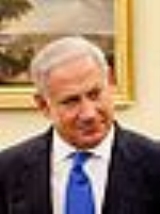
Benjamin "Bibi" Netanyahu (born 21 October 1949) is the new Prime Minister-Designate of Israel. He is Chairman of the conservative Likud Party and was previously the 9th Prime Minister of Israel from June 1996 to July 1999. Netanyahu is the first (and to date only) Prime Minister of Israel to be born after the State of Israel's foundation. He was Finance Minister of Israel until 9 August 2005, when he resigned in protest at the Gaza Disengagement Plan advocated by Prime Minister Ariel Sharon.

Discussion
Ask a question about 'Benjamin Netanyahu'
Start a new discussion about 'Benjamin Netanyahu'
Answer questions from other users
|
Encyclopedia
Benjamin "Bibi" Netanyahu (born 21 October 1949) is the new Prime Minister-Designate of Israel. He is Chairman of the conservative Likud Party and was previously the 9th Prime Minister of Israel from June 1996 to July 1999. Netanyahu is the first (and to date only) Prime Minister of Israel to be born after the State of Israel's foundation. He was Finance Minister of Israel until 9 August 2005, when he resigned in protest at the Gaza Disengagement Plan advocated by Prime Minister Ariel Sharon. Netanyahu retook the Likud leadership on 20 December 2005. As of December 2006, he became the official leader of the Opposition in the Knesset and Chairman of the Likud Party. In August 2007, he retained the Likud leadership by beating Moshe Feiglin in party elections. On 20 February 2009, Netanyahu was designated by Israeli President Shimon Peres to form the country's next government, following the results of Israel's parliamentary elections of 10 February.
Family, education, and personal background
Netanyahu was born in Tel Aviv, to Cela (Tsilah) (née Segal) and Benzion Netanyahu (original name Mileikowsky). His mother was born in 1912 in Petah Tikva, part of the future British Mandate of Palestine that would eventually become Israel. Though all his grandparents were born in Lithuania, his mother's parents emigrated to Minneapolis in the United States. Netanyahu's father is a former professor of Jewish history at Cornell University (although the elder Netanyahu has remained active into his 90s in research and writing), a former editor of the Hebrew Encyclopedia, and a former senior aide to Zeev Jabotinsky. When he was 14 years old, Benjamin's family moved to the United States and settled in Cheltenham, Pennsylvania, a suburb of Philadelphia, where he graduated from Cheltenham High School.
Netanyahu's older brother, Yonatan, was killed in Uganda during Operation Entebbe in 1976. His younger brother, Iddo, is a radiologist and writer. All three brothers served in the Sayeret Matkal reconnaissance unit of the Israeli Defense Force - Benjamin from 1967 to 1972 as a captain. He earned a B.S. degree in architecture from the Massachusetts Institute of Technology in 1975, an M.S. degree from the MIT Sloan School of Management in 1977, and studied political science at Harvard and MIT. After graduate school, Netanyahu worked at the Boston Consulting Group in Boston, Massachusetts and eventually returned to Israel.
Following a brief career as a furniture company's chief marketing officer, Netanyahu was appointed by Moshe Arens as his Deputy Chief of Mission at the Israeli Embassy in Washington, D.C. in 1982. Subsequently, he became Israel's Ambassador to the United Nations, serving from 1984 to 1988. He was elected to the Knesset in 1988 and served in the governments led by Yitzhak Shamir from 1988 to 1992. Shamir retired from politics shortly after Likud's defeat in the 1992 elections. In 1993, for the first time, the party held a primary election to select its leader, and Netanyahu was victorious, defeating Benny Begin, son of the late Prime Minister Menachem Begin, and veteran politician David Levy (Ariel Sharon initially sought Likud party leadership as well, but quickly withdrew when it was evident that he was attracting minimal support).
Netanyahu has authored several books including two on fighting terrorism. He has a daughter, Noa, from his first marriage to Micki Weizman. His second marriage was to Fleur Cates, who converted to Judaism though her father was a Jew. He is now married to his third wife, Sarah, with whom he has two sons: Yair and Avner.
Prime minister (1996-1999)
In 1996 Israelis elected their Prime Minister directly for the first time. Netanyahu hired American Republican political operative Arthur Finkelstein to run his campaign, and although the American style of sound bites and sharp attacks elicited harsh criticism from inside Israel, it proved effective. (Ironically, the method was later copied by Ehud Barak during the 1999 election campaign in which he beat Netanyahu.) Netanyahu won the election, surprising many by beating the pre-election favorite Shimon Peres. The main catalyst in the downfall of the latter was a wave of suicide bombings shortly before the elections; on 3 March and 4, 1996, Palestinians carried out two suicide bombings, killing 32 Israelis, with Peres seemingly unable to stop the attacks. Unlike Peres, Netanyahu did not trust Yasser Arafat and conditioned any progress at the peace process on the Palestinian Authority fulfilling its obligations - mainly fighting terrorism, and ran with the campaign slogan "Netanyahu - making a safe peace". However, although Netanyahu won the election for Prime Minister, Labor won the Knesset elections, beating the Likud-Gesher-Tzomet alliance, meaning Netanyahu had to rely on a coalition with the Ultra-orthodox parties, Shas and UTJ (whose social welfare policies flew in the face of his capitalistic outlook) in order to govern.
Upon his election, Netanyahu was the youngest person in the history of the position. He had a rocky relationship with American President Bill Clinton, who made some very unflattering remarks about him in the presence of Aaron David Miller. The White House spokesman at the time was Joe Lockhart, who described Netanyahu in an interview as "one of the most obnoxious individuals you're going to come into - just a liar and a cheat. He could open his mouth and you could have no confidence that anything that came out of it was the truth."
As Prime Minister, Netanyahu negotiated with Yasser Arafat in the form of the 1998 Wye River Accords. No progress was made regarding negotiations with the Palestinians, and although they failed to implement agreed-upon steps of the Oslo Accords, Netanyahu turned over most of Hebron to Palestinian jurisdiction. In 1996, Netanyahu and Jerusalem's mayor Ehud Olmert decided to open an exit for the Western Wall Tunnel. This sparked three days of rioting by Palestinians, resulting in both Israelis and Palestinians being killed.
As Prime Minister Netanyahu emphasized a policy of "three no(s)": no withdrawal from Golan Heights, no discussion of the case of Jerusalem, no negotiations under any preconditions.
Netanyahu was opposed by the political left wing in Israel and also lost support from the right because of his concessions to the Palestinians in Hebron and elsewhere, and due to his negotiations with Arafat generally. After a long chain of scandals (including gossip regarding his marriage) and an investigation opened against him on charges of corruption (later acquitted), Netanyahu lost favor with the Israeli public.
After being defeated by Ehud Barak in the 1999 election for Prime Minister, Netanyahu temporarily retired from politics.
Political activity after 2000
at the Jewish Community Centre in Moscow, December 2000]]
In 2001, Netanyahu missed the opportunity to return to power since he refused to run unless there were general elections, a move that facilitated Sharon's entry into the race for Prime Minister.
In 2002, after the Labor Party left the coalition and vacated the position of foreign minister, Prime Minister Ariel Sharon appointed Netanyahu as Foreign Minister. Netanyahu challenged Sharon for the leadership of the Likud party, but failed to oust Sharon.
Finance Minister, 2003-2005
After the 2003 elections, Netanyahu accepted the post of Finance Minister in a newly formed Sharon coalition. Netanyahu did not support the concept of a future Palestinian state, though on two occasions in 2001, he indicated willingness to consider the idea.
As Finance Minister, Netanyahu undertook an economic plan in order to restore Israel's economy from its low point during the al-Aqsa Intifada. The plan involved a move toward more liberalized markets, although it was not without its critics. Netanyahu succeeded in passing several long-in-the-queue reforms, including an important reform in the banking system that followed with a significant increase in the GDP growth rate. However, opponents in the Labor party (and a few even with his own Likud) viewed Netanyahu's policies as "Thatcherite" attacks on the venerated Israeli social safety net. Likud's defeat in the 2006 elections is seen by many observers as a collective Israeli rejection of these policies.
Netanyahu threatened to resign in 2004 unless the Gaza pullout plan was put to a referendum, but later lifted the ultimatum. He submitted his resignation letter on 7 August 2005, shortly before the Israeli cabinet voted 17 to 5 to approve the initial phase of withdrawals of the Gaza Disengagement Plan. Netanyahu's resignation went into effect 9 August 2005, two days after he submitted his letter. Shortly thereafter he revealed he had rejected an invitation to serve as Italy's finance minister, allegedly extended to him by Italian billionaire businessman Carlo De Benedetti, who later said it was a joke.
Party leader, Likud
Following the withdrawal of Ariel Sharon from the Likud, Netanyahu was one of several candidates who vied for the Likud leadership. His most recent attempt prior to this was in September 2005 when he tried to hold early primaries for the position of the head of the Likud party, while the party held the office of Prime Minister - thus effectively pushing Ariel Sharon out of office. The party rejected this initiative. Netanyahu retook the leadership on 20 December 2005, with 47% of the primary vote. In the March 2006 Knesset elections, Likud took the third place behind Kadima and Labor. Netanyahu is currently Leader of the Opposition.
On 14 August 2007, Netanyahu was reelected as chairman of the Likud and its candidate to the post of Prime Minister with 73% of the vote against far-right candidate Moshe Feiglin and World Likud Chairman Danny Danon.
On 31 July 2008, Netanyahu, as Likud party leader, called for snap polls, since Ehud Olmert's successor as Kadima leader would not automatically be the prime minister: "This government has reached an end ... it doesn't matter who heads Kadima. They are all partners in this government's total failure. National responsibility requires a return to the people and new elections." Israeli law requires dissolution of the current government and formation of a coalition by the new leader before taking over. Olmert plans to be a caretaker until formation of new government.
in Davos, 2009]]
Likud candidate, 2009 elections
Netanyahu was the Likud's candidate for Prime Minister in the Israeli elections that took place on February 10, 2009, as Tzipi Livni, the current Designated Acting Prime Minister under the outgoing Olmert government, had been unable to form a viable governing coalition. During the race, Netanyahu's campaign website was noted for its strong resemblance to the one used the previous year by United States President Barack Obama to reach his supporters during his campaign, including colors, fonts, icons, the use of embedded video, and social networking options such as Twitter. Opinion polls showed Likud in the lead, but with as many as a third of Israeli voters undecided. In the election itself, Likud won the second highest number of seats, largely due to many of Likud's supporters defecting to Avigdor Lieberman's Yisrael Beiteinu party. Netanyahu, however, claimed victory on the basis that right wing parties won the majority of the vote, and on 20 February 2009, Netanyahu was designated by Israeli President Shimon Peres to succeed Ehud Olmert as Prime Minister, should Netanyahu be able to form a coalition government.
Despite his coalition partners having won a majority of 65 seats in the designated Knesset, Netanyahu preferred a broader centrist coalition and turned to his Kadima rivals, chaired by Tzipi Livni, to join his government. However, Livni's party having outnumbered Likud in the election results, along with a difference of opinion on how to pursue the "peace process", led those talks to fail.
Political views
Peace process
Netanyahu has repeatedly made public statements which advocated an "economic peace" approach, meaning an approach to peace based on economic cooperation and joint effort rather than continuous contention over political and diplomatic issues. This is in line with many significant ideas from the Peace Valley plan. He raised these ideas during discussions with U.S. Secretary of State Condoleezza Rice. Netanyahu continued to advocate these ideas as the Israeli elections got nearer.
Netanyahu has said:
Right now, the peace talks are based only one thing, only on peace talks. It makes no sense at this point to talk about the most contractible issue. It's Jerusalem or bust, or right of return or bust. That has led to failure and is likely to lead to failure again....We must weave an economic peace alongside a political process. That means that we have to strengthen the moderate parts of the Palestinian economy by handing rapid growth in those area, rapid economic growth that gives a stake for peace for the ordinary Palestinians."
In January 2009, prior to the February 2009 Israeli elections Netanyahu informed Middle East envoy Tony Blair that he would continue the policy of the Israeli governments of Ariel Sharon and Ehud Olmert by expanding settlements in the West Bank, in contravention of the Road Map, but not building new ones
Remarks comparing Iran to Nazi Germany
Strongly against Iran's pursuit of uranium enrichment, Netanyahu said "It’s 1938, and Iran is Germany, and Iran is racing to arm itself with atomic bombs”. In an 8 March 2007 interview with CNN, he asserted that there is only one difference between Nazi Germany and the Islamic Republic of Iran, namely that the first entered a worldwide conflict and then sought atomic weapons, while the latter is first seeking atomic weapons and, once it has them, will then start a world war.
Netanyahu repeated these remarks at a news conference in April, 2008, stating that "where that [Nazi] regime embarked on a global conflict before it developed nuclear weapons," he said. "This regime [Iran] is developing nuclear weapons before it embarks on a global conflict."
Books and articles
Books:
- A Durable Peace: Israel and Its Place Among the Nations (Warner Books, 2000) ISBN 0-446-52306-2
- Fighting Terrorism: How Democracies Can Defeat Domestic And International Terrorism (Diane Pub Co, 1995) ISBN 0-7881-5514-8
- A Place Among the Nations (Bantam, 1993) ISBN 0-553-08974-9
- Terrorism: How the West Can Win (Farrar Straus & Giroux, 1986) ISBN 0-374-27342-1
Articles:
External links
- , ,
- at
- Website of supporters of Benjamin Netanyahu:
- (BBC)(5 min.)
- (Ynetnews | Yedioth Aharonoth)
- The Jerusalem Post, 5 August 2005
-
|
| |
|
|