

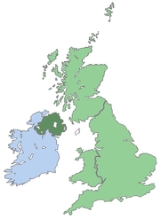
Unionism in Ireland

Encyclopedia
Unionism in Ireland is an ideology
that favours the continuation of some form of political union
between the islands of Ireland
and Great Britain
. Since the independence of the Irish Free State
, which is now the Republic of Ireland
, unionism has focused on preserving the place of Northern Ireland
within the United Kingdom
.
The political relationship between Britain and Ireland dates from the 12th century. In the Act of Union 1800
, the United Kingdom of Great Britain and Ireland
was created. In 1922, twenty-six counties of Ireland gained independence from the UK as the Irish Free State
; this new state later left the Commonwealth
entirely and became a republic. The remaining six counties constituted the territory of Northern Ireland, which has remained part of what in 1927 was renamed the "United Kingdom of Great Britain and Northern Ireland". Today, unionism is overwhelmingly concerned with the relationship between Northern Ireland and Great Britain. In the Irish Republic unionists who would advocate the state rejoining the UK are now extremely rare.
Unionism and its opposing ideology, Irish nationalism
, are associated with particular ethnic and/or religious communities. Most, but not all, unionists are of one of various Protestant
backgrounds. Nationalists are mostly of a Catholic
background. However, these are generalisations, because there are both Protestant nationalists
and Catholic unionists
, as well as more recent immigrants, and their descendants, some of whom are neither Catholic nor Protestant.
, especially in the sense of British
ness, though not necessarily to the exclusion of a sense of Irishness or of an affinity to Northern Ireland specifically. Unionism emerged as a unified force in opposition to William Ewart Gladstone
's Home Rule Bill of 1886. Irish nationalists
believed in separation from Great Britain, whether through repeal of the 1800 Act of Union, "home rule
", or complete independence. Unionists believed in maintaining and deepening the relationship between the various nations of the United Kingdom of Great Britain and Ireland
. They expressed pride in symbols of Britishness.
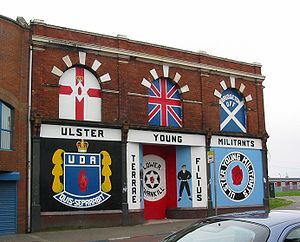
A key symbol for unionists is the Union Flag
. Unionist areas of Northern Ireland often display this and other symbols to show the loyalty and sense of identity of the community. Unionism is also known for its allegiance to the British Crown, both historically and today.
.
Both Unionism and Nationalism have had sectarian and anti-sectarian elements, and that both have attracted supporters from outside their base religious communities. While Nationalism has historically had a number of Protestant leaders (for instance, Henry Grattan
, Theobald Wolfe Tone
, Charles Stewart Parnell
, and Douglas Hyde
), Unionism was invariably led by Protestant leaders and politicians. The lack of Catholics among the leadership made them vulnerable to accusations of sectarianism, particularly during the period when the Ulster Unionist Party
had undisputed control of Northern Ireland
(1921–1972). Only one Catholic served in government throughout this period (G. B. Newe, who was specially recruited to boost cross-community relations in the last UUP government in the 1970s). Ulster Unionist Leader and Nobel Peace Prize
-winner David Trimble
suggested that Northern Ireland had been a "cold house" for Catholics in the past.
. The two words are sometimes used interchangeably, but the latter is more often associated with particularly hardline forms of Unionism. In some cases it has been associated with individual or groups who support or engage in violence. Most unionists do not describe themselves as loyalists.
. Mainstream nationalists, such as the supporters of the Social Democratic and Labour Party
(SDLP) and the main parties in the Irish Republic, are generally referred to by that term. The more militant strand of nationalism, which once comprised groups such as Sinn Féin
, has been known as republicanism
. In the Irish Republic, the republican tradition has moderated and moved into the mainstream. Today the republican party, Fianna Fáil
, has little in common with militant republicans other than certain ideological and historical perspectives.
. Four members of the current Royal Family hold titles with roots in Northern Ireland: the Duke of York
(Baron Killyleagh), the Earl of Ulster
, the Duke of Kent
(Baron Downpatrick) and the Duke of Cambridge
(Baron Carrickfergus). Older Irish royal titles included Lord of Ireland, Duke of Connaught and Strathearn
, Earl of Athlone
and Baron Arklow
. The Queen is still technically Sovereign of the Order of St. Patrick
, the highest Irish order of chivalry, and the Norroy and Ulster King of Arms
is an officer in the College of Arms
in London
.
. In the 18th century, Ireland was ruled by a Protestant-only Irish Parliament, autonomous in some respects from Britain. Catholics and Presbyterians were denied full political and economic rights under the Penal Laws.
and Orange Order. Others still, parliamentary 'patriots' such as Henry Grattan
did not support the rebellion but had lobbied for more independence for Ireland and for equal rights for Catholics.
The Act of union was first proposed in the Irish Parliament in 1799 but defeated by 111 votes to 116. The idea of Union was supported by in Parliament those whose main concern was security in the wake of the 1798 rebellion and the need for the 40,000 strong British military garrison to remain. It was opposed by two distinct groups. On one side, by those known as the 'ultra Protestants', who feared that direct British rule would mean reforms that would give Catholics equal rights and overturn Protestant supremacy in Ireland, and from the other side by the 'patriot' tendency led by Henry Grattan who wanted to defend Ireland's constitutional independence and were also worried about the effect that a Union would have on Irish trade. Lord Castlereagh managed to tip the balance in favour of the Union by offering titles, land and in some cases cash payments to Parliamentarians. The Act was passed at the second attempt in 1800.
The Orange Order was split over the Union and adopted policy of neutrality in order to avoid a split. Conversely, the Catholic Bishops and much of the Catholic middle class initially accepted the Union, as it promised to undo the last of the Penal Laws.
However, what radically changed the balance of forces for and against the Union was Catholic Emancipation
in 1829. This enabled Catholics to hold public office for the first time since the 1690s. It now meant that an Irish Parliament, even one elected under strict property requirements, would have a majority of Catholic voters and potentially of Catholic representatives.
For this reason, most Protestants in Ireland opposed the agitation, under Daniel O'Connell
and the Repeal Association
for Repeal of the Union or restoration of the Irish Parliament, in the 1830s and 1840s. The Orange Order, by this stage committed to the Union, increased its membership to over 100,000 by 1835 and "working class Protestants...developed effective militant politics of their own". The political representative of Unionism was the Irish Conservative Party
– which urged the suppression of O'Connell's 'monster meetings' for Repeal. The British Conservative government eventually agreed to this in October 1843, banning a proposed mass meeting for Repeal at Clontarf, Dublin and deploying troops and a warship to prevent it.
The Conservative Party successfully mobilised Protestant voters against Repeal, by such means signing on more freemen of the cities (hereditary trade guilds, open only to Protestants from the 1690s to the 1840s) to get around the greater number of Catholic property holders. The Conservative Party remained the largest in Irish politics until 1859.
The final challenge to the Union in this era was the Young Irelander Rebellion of 1848
, which largely failed to come off and which was suppressed after minor military action.
 "Home Rule" was the name given to the policy of establishing a devolved
parliament to govern Ireland as an autonomous region within the United Kingdom. Home Rule was supported from the 1860s onwards by mainstream nationalist leaders such as Isaac Butt
, William Shaw
, Charles Stewart Parnell
, John Redmond
and John Dillon
, and it became the aim of the Nationalist Party
, subsequently known as the Home Rule League
and the Irish Parliamentary Party
, which was the largest political party in Ireland from the 1880s until the end of the First World War.
Unionists comprised the opposition to Home Rule. They believed that an Irish Parliament dominated by Catholic nationalists would be to their economic, social and religious disadvantage, and would move eventually towards total independence from Britain. In most of Ireland, Unionists were members of the governing and landowning classes and the minor gentry
, but Unionism had a broad popular appeal among Protestants of all classes and backgrounds in Northern Ireland. This part of the island had become industrialised
, and had an economy that closely resembled that of Britain.
A series of British governments introduced Home Rule Bills in the British Parliament. The 1886 Bill was rejected by the House of Commons
, and managed to destroy the Liberal
government in the process: Whig and Radical elements left the Liberal Party to form the Liberal Unionist Party
, which allied itself with the Conservative Party
. Eventually, the two parties merged into the Conservative and Unionist Party
(generally known as the Conservative Party), which remains Britain's dominant right-of-centre party. The 1893 Bill passed the Commons but was rejected by the House of Lords
, which had a permanent and large Conservative majority.
Political Unionism crystallised around the Protestant areas in the northern part of Ireland. By the early 20th century, the Irish Unionist Party
had become predominantly associated with this territory, and in 1905 the Ulster Unionist Council was founded, which in turn produced the Ulster Unionist Party
, which replaced the IUP in Northern Ireland. In the period up to 1920, most of the IUP's leadership (including the Earl of Middleton
and the Earl of Dunraven) came from other parts of Ireland, and its most prominent leader, Sir Edward Carson, opposed not merely Home Rule but any attempt to partition
Ireland.
In 1911, the House of Lords' veto over legislation was removed, and it became clear that a Home Rule Bill would finally be enacted. Unionists, particularly in northern Ireland, mounted a campaign against Home Rule, drawing up a "Solemn League and Covenant"
and threatening to establish a Provisional Government of Northern Ireland if Home Rule were imposed upon them. They set up a militia called the Ulster Volunteers and imported 25,000 rifles from Germany
. By mid-1914, 90,000 men had joined the Volunteers.
On the eve of the First World War, the Home Rule Act 1914
passed into law. The War, however, prevented it from coming into force. The Easter Rising
of 1916 and the events that followed it led to the enactment of a fourth Home Rule Bill after the War, known as the Government of Ireland Act 1920
. This was heavily influenced by the Unionist leader Sir Edward Carson, and provided six of the nine counties of Ulster
with its own devolved parliament independent from that of the rest of the island ("Southern Ireland
"). The 1914 Act had provided for a similar partition as a temporary measure, for an unspecified length of time. In the end, only Northern Ireland became a functioning entity, and Southern Ireland was superseded by the Irish Free State.
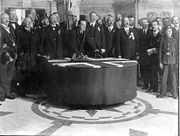 Unionists opposed Home Rule for several reasons:
Not all Protestants supported Unionism. Some – notably Charles Stewart Parnell
– were nationalists, while by contrast some middle-class Catholics supported the maintenance of the union. In addition, Unionism received the support in the period from the 1880s until 1914 from leading mainland Conservative
politicians, notably Lord Randolph Churchill
and future prime minister Andrew Bonar Law. Churchill coined the well-known slogan "Ulster will fight and Ulster will be right".


The creation of Northern Ireland
under the Government of Ireland Act 1920 and the later creation of the Irish Free State
in the remainder of the island separated southern and northern unionists. The exclusion of three Ulster counties, County Donegal
, County Monaghan
and County Cavan
, from 'Northern Ireland' left unionists there feeling isolated and betrayed. They established an association to persuade their fellow unionists to reconsider the border, but to no avail. Many assisted in the policing of the new region, serving in the B-Specials
while continuing to live in the Free State (see here ).
Unionists were in the majority in four counties of the Ulster (Antrim
, Londonderry
, Down
and Armagh
), and formed a large minority in the remaining counties of Fermanagh and Tyrone
. Sir Edward Carson had expressly urged the new Prime Minister, Sir James Craig, to ensure absolute equality in the treatment of Catholics, so to guarantee the stability of the new state. Discrimination, however, took place, particularly in the areas of housing, employment and local government representation. The extent of such discrimination is disputed, and there was also widespread poverty among Protestants: for example, recovery operations in working-class areas after the Belfast Blitz
of 1941 revealed that both communities had disadvantaged elements. Nobel Peace Prize winner and former Ulster Unionist Party
leader David Trimble
has admitted that Northern Ireland was a "cold house" for Catholics for most of the 20th century. Many unionists, particularly in the Democratic Unionist Party
, deny that organised discrimination took place and attribute the poverty suffered by both communities to wider economic conditions.
 By the 1960s, the reforms of Prime Minister
, Terence O'Neill
, designed to create a more equitable society between unionists and nationalists, resulted in a backlash led by fundamentalist
Protestant minister Ian Paisley
. Nationalists launched a Civil Rights movement in the mid 1960s with key demands made on matters such as one man, one vote. With attacks on Northern Ireland's infrastructure by loyalists, and the resignation of a relative from the Cabinet over the principle of One man One Vote, O'Neill resigned on 2 April 1969 to be replaced
by Chichester Clark.
In August 1969 following the annual Apprentice Boys of Derry
parade in the city, serious rioting took place in Derry
and Belfast
. The Civil Rights movement responded by calling marches across Northern Ireland to further stretch police resources and on August 14 the British Government allowed the deployment of the Prince of Wales’s Own Regiment
in Derry to relieve the Police. The following day the deployment was extended to Belfast. Early the next year Chichester Clark flew to London to request more military support in an attempt to stem the increasing violence. Receiving much less than he had requested, he resigned and was replaced
by Brian Faulkner
.
By 1972 the situation in Northern Ireland had deteriorated considerably, and on January 30, thirteen civilians on a Civil Rights march in Derry were killed by the Parachute Regiment on Bloody Sunday
. Three months later the Parliament of Northern Ireland
and government were suspended, and later abolished. Within Unionism, Ian Paisley had entered electoral politics and quickly merged his Protestant Unionist Party
into the new Democratic Unionist Party
with former UUP MPs Desmond Boal
and John McQuade
. The new party quickly began to win support from the UUP, and since 1975 polled at least 10% of the vote at elections.
A power-sharing government between nationalists and unionists in 1974 was brought down by the Ulster Workers' Council Strike
. Faulkner as a result lost the support of his party, where he was replaced as leader by Harry West
, and formed his own Unionist Party of Northern Ireland
. West subsequently resigned and was replaced by Jim Molyneaux in 1979. Secretary of State Jim Prior made another attempt at restoring devolution by introducing a plan for rolling devolution through an assembly between 1982 and 1986 but this was boycotted by nationalists. Violence intensified throughout this period.
After nearly three decades of conflict, a ceasefire and intense political negotiations produced the Belfast Agreement
on 10 April 1998 (also known as the "Good Friday Agreement"), which again attempted with mixed success to produce a power-sharing government for Northern Ireland with cross-community support. The Ulster Unionist Party
(UUP) supported the agreement but it was opposed by the Democratic Unionist Party
(DUP) and other smaller parties.
with the United Kingdom
. For example, the Orange Order parades in Orange Walks in Scotland and Northern Ireland. However, many unionists in Scotland shy away from connections to unionism in Ireland in order not to endorse any side of a largely sectarian conflict. This brand of unionism is largely concentrated in the Central Belt
and west of Scotland. Loyalist
s in Scotland are seen as a militant or extreme branch of unionism
. Orangism in west and central Scotland, and opposition to it by Catholics
in Scotland, can be explained as a result of the large amount of immigration from Northern Ireland.
Songs and symbols of unionism, particularly of the Northern Irish variety, are used by many supporters of Rangers F.C.
, an association football club in Glasgow, Scotland. Both Rangers and its main rival Celtic F.C.
, which has Irish Roman Catholic roots, have a reputation for sectarian clashes and bitter opposition to each other, frequently characterised by religious taunts, chants and other provocations. This behaviour by some supporters is condemned by the management of the clubs. Despite the symbols associated with the clubs, not all Rangers supporters can be automatically classified as unionists, nor all Celtic supporters as nationalists.
, for example, has some Catholic members and supporters, such as Sir John Gorman
, a respected former MLA
. Polls taken over the years have suggested that as many as one in three Catholics could be considered Unionist, though this may not translate into support for Unionist parties at election time and the size of the foregoing figure has been questioned.
In a more general sense, Catholics cannot be assumed to be hostile to the institutions of the Union: many Catholics serve in the Police Service of Northern Ireland
and the British Army
, just as their predecessors served in the RIC
and the RUC
, in the face of sometimes violent opposition from militant nationalists. The PSNI maintains a 50% quota for Catholic officers.
On the Nationalist side, the Social Democratic and Labour Party
(SDLP) has attracted a number of sympathetic Protestants, and Sinn Féin too is said to have some Protestant members and elected officials.
Northern Ireland has an increasing number of inhabitants who are neither Catholic nor Protestant, either being adherents of other religions or being non-religious. Increasingly, the trend has been to ignore the question of religion, particularly as the numbers of practising churchgoers on both sides have been in decline.
For some years, there has been a perception both in Britain and in Ireland that the Catholic birthrate will guarantee a Catholic – and hence supposedly Nationalist – majority in Northern Ireland at some point in the first half of the 21st century. However, a strong decline in the Catholic birthrate may slow down or even reverse the growth in the Catholic population (which may in turn be balanced by an increased rate of emigration of young Protestants, often to study and work in Britain). Recent influxes of immigrants, especially from Eastern Europe, are also having a significant effect on the demographic balance, although how many choose to reside permanently in Northern Ireland or take an interest in the political scene remains to be seen.
Northern Ireland currently has a number of pro-union political parties, the largest of which is the traditionalist Democratic Unionist Party
led by Peter Robinson
, followed by the more moderate Ulster Unionist Party
led by Reg Empey
. Both parties are active across Northern Ireland
. On a smaller level, the Progressive Unionist Party
, which is the political wing of the Ulster Volunteer Force (UVF) paramilitary group, attracts some support in the greater Belfast area. Traditional Unionist Voice
is opposed to the current constitutional arrangements in Northern Ireland following the Belfast Agreement
and St Andrews Agreement
. The pluralist Conservative Party
is currently allied to the Ulster Unionist Party. While the Alliance Party
supports the status quo position of Northern Ireland, it does not define itself as Unionist.
Moderate unionists who support the principle of equal citizenship between Northern Ireland and Great Britain have campaigned for mainstream British political parties to organise and contest elections in Northern Ireland. Equal citizenship pressure groups have included the Campaign for Equal Citizenship
(CEC), Labour Representation Campaign, Democracy Now and, currently, Labour - Federation of Labour Groups
. Momentum for this concept picked up after the Conservative
Party Conference voted in favour of working in Northern Ireland in 1989. The Conservatives currently have one councillor on Down District Council
, who was elected as an Ulster Unionist. No Conservative has been elected in Northern Ireland since the 1997 local government elections.
Under legal pressure from local trade unionists, Labour
accepted members from Northern Ireland in October 2002 and in September 2006 agreed to organise through a forum. The Liberal Democrats
have a branch in Northern Ireland but do not contest elections, but are affiliated with the Alliance Party.
Pro-union parties and independents contest elections and represent their constituents at a number of different levels. There is a unionist presence at election time in all parliamentary constituencies. A Unionist win is a virtual certainty in ten constituencies: East Antrim
, North Antrim
, South Antrim
, Belfast North
, Belfast East
, North Down
, Lagan Valley
, East Londonderry
, Strangford
, Upper Bann
.
Twenty peers in the House of Lords owe their peerages to a direct connection with Northern Ireland
, usually through a political party. Of these there are eight Ulster Unionists
(sitting as Cross-bencher
s), three Democratic Unionist Party
(DUP), two Conservative
, two Labour
and one Liberal Democrat
, with the rest independent. As well as the two Unionist MEPs in the European Parliament
, DUP MP Nigel Dodds
is also an alternate member of the UK Parliament delegations to the Council of Europe
and Western European Union
and Unionists also participate in the EU Committee of the Regions
.
Unionist candidates stand for election in most district electoral areas (small areas which make up district councils) in Northern Ireland. Exceptions, in 2005, were Slieve Gullion in South Armagh, Upper and Lower Falls in Belfast
, Shantallow, Northland and Cityside in Derry
– all of which are strongly nationalist. Likewise, nationalist parties and candidates did not contest some areas in North Antrim
, East Antrim
, East Belfast
, North Down
and the Strangford
constituency which are strongly unionist and therefore unlikely to return a nationalist candidate.
Local government in Northern Ireland is not entirely divided on nationalist-unionist lines and the level of political tension within a council depends on the district that it represents and its direct experience of the Troubles.
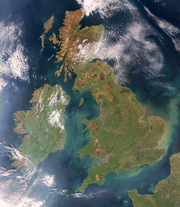 After 1890, and particularly during the period from the start of the First World War
to the mid 1920s, the number of Unionists in what is now the Republic of Ireland
declined to a point where their numbers were widely regarded as almost insignificant. This is attributed to a number of factors:
Nevertheless, it is widely accepted that there was little evidence of widespread discrimination against Protestants in what was then the Irish Free State, now the Republic of Ireland. The first President of Ireland
, Douglas Hyde
(1938–1945) was Protestant, though only two senior Irish politicians attended his Church of Ireland funeral, the Catholic members of the government had to wait on the pavement near the Church to be compliant with Canon law
.
Some Unionists in the south simply adapted and began to associate themselves with the new southern Irish regime of Cumann na nGaedheal. On 19 January 1922, leading Unionists held a meeting and unanimously decided to support the Free State government. Many gained appointment to the Free State's Senate, including the Earl of Dunraven and Thomas Westropp Bennett
. Several generations of one Unionist political family, the Dockrells, won election as Teachta Dála
(TDs). The Dublin borough of Rathmines
had a unionist majority up to the late 1920s, when a local government re-organisation abolished all Dublin borough councils. Later, the Earl of Granard and the Provost of Trinity College Dublin gained appointment to the President of Ireland's advisory body, the Council of State
. Most Irish Unionists, however, simply withdrew from public life, and since the late 1920s there have been no self-professed Unionists elected to the Irish parliament.
Conservative and Unionist Party
Democratic Unionist Party (DUP)
Progressive Unionist Party (PUP)
Ulster Unionist Party (UUP)
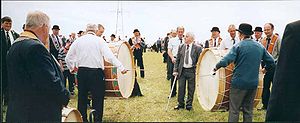 Cultural sites do not necessarily imply support for political causes:
and the other UK regions. However, they do not indicate support for political unionism as the UK Civil Service is regulated by strict laws on impartiality. In addition, Northern Ireland is nowadays part of a web of co-operative links with the Republic of Ireland
(north-south), the United Kingdom
(east-west), the European Union
and the United States
.
Ceremonial
Central Government
Co-operation
Devolution
Parliament
Ideology
An ideology is a set of ideas that constitutes one's goals, expectations, and actions. An ideology can be thought of as a comprehensive vision, as a way of looking at things , as in common sense and several philosophical tendencies , or a set of ideas proposed by the dominant class of a society to...
that favours the continuation of some form of political union
Political union
A political union is a type of state which is composed of or created out of smaller states. Unlike a personal union, the individual states share a common government and the union is recognized internationally as a single political entity...
between the islands of Ireland
Ireland
Ireland is an island to the northwest of continental Europe. It is the third-largest island in Europe and the twentieth-largest island on Earth...
and Great Britain
Great Britain
Great Britain or Britain is an island situated to the northwest of Continental Europe. It is the ninth largest island in the world, and the largest European island, as well as the largest of the British Isles...
. Since the independence of the Irish Free State
Irish Free State
The Irish Free State was the state established as a Dominion on 6 December 1922 under the Anglo-Irish Treaty, signed by the British government and Irish representatives exactly twelve months beforehand...
, which is now the Republic of Ireland
Republic of Ireland
Ireland , described as the Republic of Ireland , is a sovereign state in Europe occupying approximately five-sixths of the island of the same name. Its capital is Dublin. Ireland, which had a population of 4.58 million in 2011, is a constitutional republic governed as a parliamentary democracy,...
, unionism has focused on preserving the place of Northern Ireland
Northern Ireland
Northern Ireland is one of the four countries of the United Kingdom. Situated in the north-east of the island of Ireland, it shares a border with the Republic of Ireland to the south and west...
within the United Kingdom
United Kingdom
The United Kingdom of Great Britain and Northern IrelandIn the United Kingdom and Dependencies, other languages have been officially recognised as legitimate autochthonous languages under the European Charter for Regional or Minority Languages...
.
The political relationship between Britain and Ireland dates from the 12th century. In the Act of Union 1800
Act of Union 1800
The Acts of Union 1800 describe two complementary Acts, namely:* the Union with Ireland Act 1800 , an Act of the Parliament of Great Britain, and...
, the United Kingdom of Great Britain and Ireland
United Kingdom of Great Britain and Ireland
The United Kingdom of Great Britain and Ireland was the formal name of the United Kingdom during the period when what is now the Republic of Ireland formed a part of it....
was created. In 1922, twenty-six counties of Ireland gained independence from the UK as the Irish Free State
Irish Free State
The Irish Free State was the state established as a Dominion on 6 December 1922 under the Anglo-Irish Treaty, signed by the British government and Irish representatives exactly twelve months beforehand...
; this new state later left the Commonwealth
Commonwealth of Nations
The Commonwealth of Nations, normally referred to as the Commonwealth and formerly known as the British Commonwealth, is an intergovernmental organisation of fifty-four independent member states...
entirely and became a republic. The remaining six counties constituted the territory of Northern Ireland, which has remained part of what in 1927 was renamed the "United Kingdom of Great Britain and Northern Ireland". Today, unionism is overwhelmingly concerned with the relationship between Northern Ireland and Great Britain. In the Irish Republic unionists who would advocate the state rejoining the UK are now extremely rare.
Unionism and its opposing ideology, Irish nationalism
Irish nationalism
Irish nationalism manifests itself in political and social movements and in sentiment inspired by a love for Irish culture, language and history, and as a sense of pride in Ireland and in the Irish people...
, are associated with particular ethnic and/or religious communities. Most, but not all, unionists are of one of various Protestant
Protestantism
Protestantism is one of the three major groupings within Christianity. It is a movement that began in Germany in the early 16th century as a reaction against medieval Roman Catholic doctrines and practices, especially in regards to salvation, justification, and ecclesiology.The doctrines of the...
backgrounds. Nationalists are mostly of a Catholic
Roman Catholic Church
The Catholic Church, also known as the Roman Catholic Church, is the world's largest Christian church, with over a billion members. Led by the Pope, it defines its mission as spreading the gospel of Jesus Christ, administering the sacraments and exercising charity...
background. However, these are generalisations, because there are both Protestant nationalists
Protestant Nationalist
Irish nationalism has been chiefly associated with Roman Catholics. However, historically this is not an entirely accurate picture. Protestant nationalists were also influential supporters of the political independence the island of Ireland from the island of Great Britain and leaders of national...
and Catholic unionists
Catholic Unionist
A Catholic Irish Unionist is either a Roman Catholic in Northern Ireland who supports continuing ties between Northern Ireland and Great Britain...
, as well as more recent immigrants, and their descendants, some of whom are neither Catholic nor Protestant.
Unionism and British identity
Irish unionism is often centred on an identification with ProtestantismProtestantism
Protestantism is one of the three major groupings within Christianity. It is a movement that began in Germany in the early 16th century as a reaction against medieval Roman Catholic doctrines and practices, especially in regards to salvation, justification, and ecclesiology.The doctrines of the...
, especially in the sense of British
Great Britain
Great Britain or Britain is an island situated to the northwest of Continental Europe. It is the ninth largest island in the world, and the largest European island, as well as the largest of the British Isles...
ness, though not necessarily to the exclusion of a sense of Irishness or of an affinity to Northern Ireland specifically. Unionism emerged as a unified force in opposition to William Ewart Gladstone
William Ewart Gladstone
William Ewart Gladstone FRS FSS was a British Liberal statesman. In a career lasting over sixty years, he served as Prime Minister four separate times , more than any other person. Gladstone was also Britain's oldest Prime Minister, 84 years old when he resigned for the last time...
's Home Rule Bill of 1886. Irish nationalists
Irish nationalism
Irish nationalism manifests itself in political and social movements and in sentiment inspired by a love for Irish culture, language and history, and as a sense of pride in Ireland and in the Irish people...
believed in separation from Great Britain, whether through repeal of the 1800 Act of Union, "home rule
Home rule
Home rule is the power of a constituent part of a state to exercise such of the state's powers of governance within its own administrative area that have been devolved to it by the central government....
", or complete independence. Unionists believed in maintaining and deepening the relationship between the various nations of the United Kingdom of Great Britain and Ireland
United Kingdom of Great Britain and Ireland
The United Kingdom of Great Britain and Ireland was the formal name of the United Kingdom during the period when what is now the Republic of Ireland formed a part of it....
. They expressed pride in symbols of Britishness.
A key symbol for unionists is the Union Flag
Union Flag
The Union Flag, also known as the Union Jack, is the flag of the United Kingdom. It retains an official or semi-official status in some Commonwealth Realms; for example, it is known as the Royal Union Flag in Canada. It is also used as an official flag in some of the smaller British overseas...
. Unionist areas of Northern Ireland often display this and other symbols to show the loyalty and sense of identity of the community. Unionism is also known for its allegiance to the British Crown, both historically and today.
Religion
Historically, most Unionists in Ireland have been Protestants and most Nationalists have been Catholics. This remains the case. However, a significant number of Protestants have adhered to the Nationalist cause, and a significant number of Catholics have espoused Unionism. The phenomenon of Catholic Unionism continues to exist in Northern Ireland, where it may be seen in the context of middle-class Catholics' misgivings regarding the economic consequences of a united IrelandUnited Ireland
A united Ireland is the term used to refer to the idea of a sovereign state which covers all of the thirty-two traditional counties of Ireland. The island of Ireland includes the territory of two independent sovereign states: the Republic of Ireland, which covers 26 counties of the island, and the...
.
Both Unionism and Nationalism have had sectarian and anti-sectarian elements, and that both have attracted supporters from outside their base religious communities. While Nationalism has historically had a number of Protestant leaders (for instance, Henry Grattan
Henry Grattan
Henry Grattan was an Irish politician and member of the Irish House of Commons and a campaigner for legislative freedom for the Irish Parliament in the late 18th century. He opposed the Act of Union 1800 that merged the Kingdoms of Ireland and Great Britain.-Early life:Grattan was born at...
, Theobald Wolfe Tone
Theobald Wolfe Tone
Theobald Wolfe Tone or Wolfe Tone , was a leading Irish revolutionary figure and one of the founding members of the United Irishmen and is regarded as the father of Irish Republicanism. He was captured by British forces at Lough Swilly in Donegal and taken prisoner...
, Charles Stewart Parnell
Charles Stewart Parnell
Charles Stewart Parnell was an Irish landowner, nationalist political leader, land reform agitator, and the founder and leader of the Irish Parliamentary Party...
, and Douglas Hyde
Douglas Hyde
Douglas Hyde , known as An Craoibhín Aoibhinn , was an Irish scholar of the Irish language who served as the first President of Ireland from 1938 to 1945...
), Unionism was invariably led by Protestant leaders and politicians. The lack of Catholics among the leadership made them vulnerable to accusations of sectarianism, particularly during the period when the Ulster Unionist Party
Ulster Unionist Party
The Ulster Unionist Party – sometimes referred to as the Official Unionist Party or, in a historic sense, simply the Unionist Party – is the more moderate of the two main unionist political parties in Northern Ireland...
had undisputed control of Northern Ireland
Northern Ireland
Northern Ireland is one of the four countries of the United Kingdom. Situated in the north-east of the island of Ireland, it shares a border with the Republic of Ireland to the south and west...
(1921–1972). Only one Catholic served in government throughout this period (G. B. Newe, who was specially recruited to boost cross-community relations in the last UUP government in the 1970s). Ulster Unionist Leader and Nobel Peace Prize
Nobel Peace Prize
The Nobel Peace Prize is one of the five Nobel Prizes bequeathed by the Swedish industrialist and inventor Alfred Nobel.-Background:According to Nobel's will, the Peace Prize shall be awarded to the person who...
-winner David Trimble
David Trimble
William David Trimble, Baron Trimble, PC , is a politician from Northern Ireland. He served as Leader of the Ulster Unionist Party , was the first First Minister of Northern Ireland , and was a Member of the British Parliament . He is currently a life peer for the Conservative Party...
suggested that Northern Ireland had been a "cold house" for Catholics in the past.
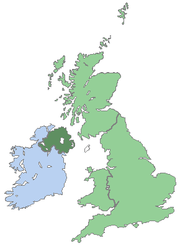 Northern Ireland Northern Ireland is one of the four countries of the United Kingdom. Situated in the north-east of the island of Ireland, it shares a border with the Republic of Ireland to the south and west... to continue with England England England is a country that is part of the United Kingdom. It shares land borders with Scotland to the north and Wales to the west; the Irish Sea is to the north west, the Celtic Sea to the south west, with the North Sea to the east and the English Channel to the south separating it from continental... , Scotland Scotland Scotland is a country that is part of the United Kingdom. Occupying the northern third of the island of Great Britain, it shares a border with England to the south and is bounded by the North Sea to the east, the Atlantic Ocean to the north and west, and the North Channel and Irish Sea to the... and Wales Wales Wales is a country that is part of the United Kingdom and the island of Great Britain, bordered by England to its east and the Atlantic Ocean and Irish Sea to its west. It has a population of three million, and a total area of 20,779 km²... as part of the United Kingdom United Kingdom The United Kingdom of Great Britain and Northern IrelandIn the United Kingdom and Dependencies, other languages have been officially recognised as legitimate autochthonous languages under the European Charter for Regional or Minority Languages... |
Unionists and Loyalists
People espousing unionist beliefs are sometimes referred to as LoyalistsUlster loyalism
Ulster loyalism is an ideology that is opposed to a united Ireland. It can mean either support for upholding Northern Ireland's status as a constituent part of the United Kingdom , support for Northern Ireland independence, or support for loyalist paramilitaries...
. The two words are sometimes used interchangeably, but the latter is more often associated with particularly hardline forms of Unionism. In some cases it has been associated with individual or groups who support or engage in violence. Most unionists do not describe themselves as loyalists.
Nationalists and Republicans
A similar distinction exists in relation to Irish nationalistsIrish nationalism
Irish nationalism manifests itself in political and social movements and in sentiment inspired by a love for Irish culture, language and history, and as a sense of pride in Ireland and in the Irish people...
. Mainstream nationalists, such as the supporters of the Social Democratic and Labour Party
Social Democratic and Labour Party
The Social Democratic and Labour Party is a social-democratic, Irish nationalist political party in Northern Ireland. Its basic party platform advocates Irish reunification, and the further devolution of powers while Northern Ireland remains part of the United Kingdom...
(SDLP) and the main parties in the Irish Republic, are generally referred to by that term. The more militant strand of nationalism, which once comprised groups such as Sinn Féin
Sinn Féin
Sinn Féin is a left wing, Irish republican political party in Ireland. The name is Irish for "ourselves" or "we ourselves", although it is frequently mistranslated as "ourselves alone". Originating in the Sinn Féin organisation founded in 1905 by Arthur Griffith, it took its current form in 1970...
, has been known as republicanism
Irish Republicanism
Irish republicanism is an ideology based on the belief that all of Ireland should be an independent republic.In 1801, under the Act of Union, the Kingdom of Great Britain and the Kingdom of Ireland merged to form the United Kingdom of Great Britain and Ireland...
. In the Irish Republic, the republican tradition has moderated and moved into the mainstream. Today the republican party, Fianna Fáil
Fianna Fáil
Fianna Fáil – The Republican Party , more commonly known as Fianna Fáil is a centrist political party in the Republic of Ireland, founded on 23 March 1926. Fianna Fáil's name is traditionally translated into English as Soldiers of Destiny, although a more accurate rendition would be Warriors of Fál...
, has little in common with militant republicans other than certain ideological and historical perspectives.
Unionists and the British monarchy
Unionism has traditionally been associated with strong loyalty to the British monarchyMonarchy of the United Kingdom
The monarchy of the United Kingdom is the constitutional monarchy of the United Kingdom and its overseas territories. The present monarch, Queen Elizabeth II, has reigned since 6 February 1952. She and her immediate family undertake various official, ceremonial and representational duties...
. Four members of the current Royal Family hold titles with roots in Northern Ireland: the Duke of York
Duke of York
The Duke of York is a title of nobility in the British peerage. Since the 15th century, it has, when granted, usually been given to the second son of the British monarch. The title has been created a remarkable eleven times, eight as "Duke of York" and three as the double-barreled "Duke of York and...
(Baron Killyleagh), the Earl of Ulster
Earl of Ulster
The title of Earl of Ulster has been created several times in the Peerage of Ireland and Peerage of the United Kingdom. Currently, the title is a subsidiary title of the Duke of Gloucester, and is used as a courtesy title by the Duke's son, Alexander Windsor, Earl of Ulster...
, the Duke of Kent
Duke of Kent
Duke of Kent is a title which has been created various times in the peerages of Great Britain and the United Kingdom, most recently as a royal dukedom for the fourth son of George V.-Pre-history:...
(Baron Downpatrick) and the Duke of Cambridge
Duke of Cambridge
Duke of Cambridge is a title which has been conferred upon members of the British royal family several times. It was first used as a designation for Charles Stuart , the eldest son of James, Duke of York , though he was never formally created Duke of Cambridge...
(Baron Carrickfergus). Older Irish royal titles included Lord of Ireland, Duke of Connaught and Strathearn
Duke of Connaught and Strathearn
The title Duke of Connaught and Strathearn was granted by Queen Victoria of the United Kingdom of Great Britain and Ireland to her third son, Prince Arthur....
, Earl of Athlone
Earl of Athlone
The title of Earl of Athlone has been created three times. It was created first in the Peerage of Ireland in 1692 by King William III for the Dutch General Baron Godard van Reede, Lord of Ginkel, to honour him for his successful battles in Ireland. The title also had the subsidiary title of Baron...
and Baron Arklow
Duke of Clarence
Duke of Clarence is a title which has been traditionally awarded to junior members of the English and British Royal families. The first three creations were in the Peerage of England, the fourth in the Peerage of Great Britain, and the fifth in the Peerage of the United Kingdom.The title was first...
. The Queen is still technically Sovereign of the Order of St. Patrick
Order of St. Patrick
The Most Illustrious Order of Saint Patrick is a British order of chivalry associated with Ireland. The Order was created in 1783 by George III. The regular creation of knights of Saint Patrick lasted until 1921, when most of Ireland became independent as the Irish Free State...
, the highest Irish order of chivalry, and the Norroy and Ulster King of Arms
Norroy and Ulster King of Arms
Norroy and Ulster King of Arms is one of the senior Officers of Arms of the College of Arms, and the junior of the two provincial Kings of Arms. The current office is the combination of two former appointments...
is an officer in the College of Arms
College of Arms
The College of Arms, or Heralds’ College, is an office regulating heraldry and granting new armorial bearings for England, Wales and Northern Ireland...
in London
London
London is the capital city of :England and the :United Kingdom, the largest metropolitan area in the United Kingdom, and the largest urban zone in the European Union by most measures. Located on the River Thames, London has been a major settlement for two millennia, its history going back to its...
.
History
Division between Catholic and Protestant in Ireland pre-dates the conflict over the Union. To some extent, these can be traced back to the wars of religion, land and power arising out the 16th and 17th century Plantations of IrelandPlantations of Ireland
Plantations in 16th and 17th century Ireland were the confiscation of land by the English crown and the colonisation of this land with settlers from England and the Scottish Lowlands....
. In the 18th century, Ireland was ruled by a Protestant-only Irish Parliament, autonomous in some respects from Britain. Catholics and Presbyterians were denied full political and economic rights under the Penal Laws.
Origins of unionism in Ireland
At the time of the Act of Union in 1800, the Protestant community was divided over whether to support the Act. The Union came in the aftermath of the 1798 Rebellion, in which elements of Irish Protestants – particularly Presbyterians – had supported republican United Irishmen and others had been mobilised to defend the status quo in the YeomanryYeomanry
Yeomanry is a designation used by a number of units or sub-units of the British Territorial Army, descended from volunteer cavalry regiments. Today, Yeomanry units may serve in a variety of different military roles.-History:...
and Orange Order. Others still, parliamentary 'patriots' such as Henry Grattan
Henry Grattan
Henry Grattan was an Irish politician and member of the Irish House of Commons and a campaigner for legislative freedom for the Irish Parliament in the late 18th century. He opposed the Act of Union 1800 that merged the Kingdoms of Ireland and Great Britain.-Early life:Grattan was born at...
did not support the rebellion but had lobbied for more independence for Ireland and for equal rights for Catholics.
The Act of union was first proposed in the Irish Parliament in 1799 but defeated by 111 votes to 116. The idea of Union was supported by in Parliament those whose main concern was security in the wake of the 1798 rebellion and the need for the 40,000 strong British military garrison to remain. It was opposed by two distinct groups. On one side, by those known as the 'ultra Protestants', who feared that direct British rule would mean reforms that would give Catholics equal rights and overturn Protestant supremacy in Ireland, and from the other side by the 'patriot' tendency led by Henry Grattan who wanted to defend Ireland's constitutional independence and were also worried about the effect that a Union would have on Irish trade. Lord Castlereagh managed to tip the balance in favour of the Union by offering titles, land and in some cases cash payments to Parliamentarians. The Act was passed at the second attempt in 1800.
The Orange Order was split over the Union and adopted policy of neutrality in order to avoid a split. Conversely, the Catholic Bishops and much of the Catholic middle class initially accepted the Union, as it promised to undo the last of the Penal Laws.
However, what radically changed the balance of forces for and against the Union was Catholic Emancipation
Catholic Emancipation
Catholic emancipation or Catholic relief was a process in Great Britain and Ireland in the late 18th century and early 19th century which involved reducing and removing many of the restrictions on Roman Catholics which had been introduced by the Act of Uniformity, the Test Acts and the penal laws...
in 1829. This enabled Catholics to hold public office for the first time since the 1690s. It now meant that an Irish Parliament, even one elected under strict property requirements, would have a majority of Catholic voters and potentially of Catholic representatives.
For this reason, most Protestants in Ireland opposed the agitation, under Daniel O'Connell
Daniel O'Connell
Daniel O'Connell Daniel O'Connell Daniel O'Connell (6 August 1775 – 15 May 1847; often referred to as The Liberator, or The Emancipator, was an Irish political leader in the first half of the 19th century...
and the Repeal Association
Repeal Association
The Repeal Association was an Irish mass membership political movement set up by Daniel O'Connell to campaign for a repeal of the Act of Union of 1800 between Great Britain and Ireland....
for Repeal of the Union or restoration of the Irish Parliament, in the 1830s and 1840s. The Orange Order, by this stage committed to the Union, increased its membership to over 100,000 by 1835 and "working class Protestants...developed effective militant politics of their own". The political representative of Unionism was the Irish Conservative Party
Irish Conservative Party
The Irish Conservative Party, often called the Irish Tories, was one of the dominant Irish political parties in Ireland in the 19th century...
– which urged the suppression of O'Connell's 'monster meetings' for Repeal. The British Conservative government eventually agreed to this in October 1843, banning a proposed mass meeting for Repeal at Clontarf, Dublin and deploying troops and a warship to prevent it.
The Conservative Party successfully mobilised Protestant voters against Repeal, by such means signing on more freemen of the cities (hereditary trade guilds, open only to Protestants from the 1690s to the 1840s) to get around the greater number of Catholic property holders. The Conservative Party remained the largest in Irish politics until 1859.
The final challenge to the Union in this era was the Young Irelander Rebellion of 1848
Young Irelander Rebellion of 1848
The Young Irelander Rebellion was a failed Irish nationalist uprising led by the Young Ireland movement. It took place on 29 July 1848 in the village of Ballingarry, County Tipperary. After being chased by a force of Young Irelanders and their supporters, an Irish Constabulary unit raided a house...
, which largely failed to come off and which was suppressed after minor military action.
Home Rule
Devolution
Devolution is the statutory granting of powers from the central government of a sovereign state to government at a subnational level, such as a regional, local, or state level. Devolution can be mainly financial, e.g. giving areas a budget which was formerly administered by central government...
parliament to govern Ireland as an autonomous region within the United Kingdom. Home Rule was supported from the 1860s onwards by mainstream nationalist leaders such as Isaac Butt
Isaac Butt
Isaac Butt Q.C. M.P. was an Irish barrister, politician, Member of Parliament , and the founder and first leader of a number of Irish nationalist parties and organisations, including the Irish Metropolitan Conservative Society in 1836, the Home Government Association in 1870 and in 1873 the Home...
, William Shaw
William Shaw (Irish politician)
William Shaw was an Irish Protestant nationalist politician. He was a Member of Parliament in the House of Commons of the United Kingdom of Great Britain and Ireland and one of the founders of the Irish home rule movement....
, Charles Stewart Parnell
Charles Stewart Parnell
Charles Stewart Parnell was an Irish landowner, nationalist political leader, land reform agitator, and the founder and leader of the Irish Parliamentary Party...
, John Redmond
John Redmond
John Edward Redmond was an Irish nationalist politician, barrister, MP in the House of Commons of the United Kingdom of Great Britain and Ireland and leader of the Irish Parliamentary Party from 1900 to 1918...
and John Dillon
John Dillon
John Dillon was an Irish land reform agitator from Dublin, an Irish Home Rule activist, a nationalist politician, a Member of Parliament for over 35 years, and the last leader of the Irish Parliamentary Party....
, and it became the aim of the Nationalist Party
Nationalist Party (Ireland)
The Nationalist Party was a term commonly used to describe a number of parliamentary political parties and constituency organisations supportive of Home Rule for Ireland from 1874 to 1922...
, subsequently known as the Home Rule League
Home Rule League
The Home Rule League, sometimes called the Home Rule Party, was a political party which campaigned for home rule for the country of Ireland from 1873 to 1882, when it was replaced by the Irish Parliamentary Party.-Origins:...
and the Irish Parliamentary Party
Irish Parliamentary Party
The Irish Parliamentary Party was formed in 1882 by Charles Stewart Parnell, the leader of the Nationalist Party, replacing the Home Rule League, as official parliamentary party for Irish nationalist Members of Parliament elected to the House of Commons at...
, which was the largest political party in Ireland from the 1880s until the end of the First World War.
Unionists comprised the opposition to Home Rule. They believed that an Irish Parliament dominated by Catholic nationalists would be to their economic, social and religious disadvantage, and would move eventually towards total independence from Britain. In most of Ireland, Unionists were members of the governing and landowning classes and the minor gentry
Gentry
Gentry denotes "well-born and well-bred people" of high social class, especially in the past....
, but Unionism had a broad popular appeal among Protestants of all classes and backgrounds in Northern Ireland. This part of the island had become industrialised
Industrial Revolution
The Industrial Revolution was a period from the 18th to the 19th century where major changes in agriculture, manufacturing, mining, transportation, and technology had a profound effect on the social, economic and cultural conditions of the times...
, and had an economy that closely resembled that of Britain.
A series of British governments introduced Home Rule Bills in the British Parliament. The 1886 Bill was rejected by the House of Commons
British House of Commons
The House of Commons is the lower house of the Parliament of the United Kingdom, which also comprises the Sovereign and the House of Lords . Both Commons and Lords meet in the Palace of Westminster. The Commons is a democratically elected body, consisting of 650 members , who are known as Members...
, and managed to destroy the Liberal
Liberal Party (UK)
The Liberal Party was one of the two major political parties of the United Kingdom during the 19th and early 20th centuries. It was a third party of negligible importance throughout the latter half of the 20th Century, before merging with the Social Democratic Party in 1988 to form the present day...
government in the process: Whig and Radical elements left the Liberal Party to form the Liberal Unionist Party
Liberal Unionist Party
The Liberal Unionist Party was a British political party that was formed in 1886 by a faction that broke away from the Liberal Party. Led by Lord Hartington and Joseph Chamberlain, the party formed a political alliance with the Conservative Party in opposition to Irish Home Rule...
, which allied itself with the Conservative Party
Conservative Party (UK)
The Conservative Party, formally the Conservative and Unionist Party, is a centre-right political party in the United Kingdom that adheres to the philosophies of conservatism and British unionism. It is the largest political party in the UK, and is currently the largest single party in the House...
. Eventually, the two parties merged into the Conservative and Unionist Party
Conservative Party (UK)
The Conservative Party, formally the Conservative and Unionist Party, is a centre-right political party in the United Kingdom that adheres to the philosophies of conservatism and British unionism. It is the largest political party in the UK, and is currently the largest single party in the House...
(generally known as the Conservative Party), which remains Britain's dominant right-of-centre party. The 1893 Bill passed the Commons but was rejected by the House of Lords
House of Lords
The House of Lords is the upper house of the Parliament of the United Kingdom. Like the House of Commons, it meets in the Palace of Westminster....
, which had a permanent and large Conservative majority.
Political Unionism crystallised around the Protestant areas in the northern part of Ireland. By the early 20th century, the Irish Unionist Party
Irish Unionist Party
The Irish Unionist Alliance was a Unionist party founded in Ireland in 1891 to oppose plans for Gladstonian and Parnellite Home Rule for Ireland. The party was led for much of its life by Colonel Edward James Saunderson and later by the William St John Brodrick, Earl of Midleton...
had become predominantly associated with this territory, and in 1905 the Ulster Unionist Council was founded, which in turn produced the Ulster Unionist Party
Ulster Unionist Party
The Ulster Unionist Party – sometimes referred to as the Official Unionist Party or, in a historic sense, simply the Unionist Party – is the more moderate of the two main unionist political parties in Northern Ireland...
, which replaced the IUP in Northern Ireland. In the period up to 1920, most of the IUP's leadership (including the Earl of Middleton
Earl of Middleton
The title Earl of Middleton was created in 1656 in the Peerage of Scotland for army officer John Middleton, together with the subsidiary titles Lord Clermont and Fettercairn. He was succeeded by his son, Charles, who served in political offices under Charles II and James II & VI...
and the Earl of Dunraven) came from other parts of Ireland, and its most prominent leader, Sir Edward Carson, opposed not merely Home Rule but any attempt to partition
Partition of Ireland
The partition of Ireland was the division of the island of Ireland into two distinct territories, now Northern Ireland and the Republic of Ireland . Partition occurred when the British Parliament passed the Government of Ireland Act 1920...
Ireland.
In 1911, the House of Lords' veto over legislation was removed, and it became clear that a Home Rule Bill would finally be enacted. Unionists, particularly in northern Ireland, mounted a campaign against Home Rule, drawing up a "Solemn League and Covenant"
Ulster Covenant
The Ulster Covenant was signed by just under half a million of men and women from Ulster, on and before September 28, 1912, in protest against the Third Home Rule Bill, introduced by the Government in that same year...
and threatening to establish a Provisional Government of Northern Ireland if Home Rule were imposed upon them. They set up a militia called the Ulster Volunteers and imported 25,000 rifles from Germany
Germany
Germany , officially the Federal Republic of Germany , is a federal parliamentary republic in Europe. The country consists of 16 states while the capital and largest city is Berlin. Germany covers an area of 357,021 km2 and has a largely temperate seasonal climate...
. By mid-1914, 90,000 men had joined the Volunteers.
On the eve of the First World War, the Home Rule Act 1914
Home Rule Act 1914
The Government of Ireland Act 1914 , also known as the Third Home Rule Bill, was an Act passed by the Parliament of the United Kingdom intended to provide self-government for Ireland within the United Kingdom of Great Britain and Ireland.The Act was the first law ever passed by the Parliament of...
passed into law. The War, however, prevented it from coming into force. The Easter Rising
Easter Rising
The Easter Rising was an insurrection staged in Ireland during Easter Week, 1916. The Rising was mounted by Irish republicans with the aims of ending British rule in Ireland and establishing the Irish Republic at a time when the British Empire was heavily engaged in the First World War...
of 1916 and the events that followed it led to the enactment of a fourth Home Rule Bill after the War, known as the Government of Ireland Act 1920
Government of Ireland Act 1920
The Government of Ireland Act 1920 was the Act of the Parliament of the United Kingdom which partitioned Ireland. The Act's long title was "An Act to provide for the better government of Ireland"; it is also known as the Fourth Home Rule Bill or as the Fourth Home Rule Act.The Act was intended...
. This was heavily influenced by the Unionist leader Sir Edward Carson, and provided six of the nine counties of Ulster
Ulster
Ulster is one of the four provinces of Ireland, located in the north of the island. In ancient Ireland, it was one of the fifths ruled by a "king of over-kings" . Following the Norman invasion of Ireland, the ancient kingdoms were shired into a number of counties for administrative and judicial...
with its own devolved parliament independent from that of the rest of the island ("Southern Ireland
Southern Ireland
Southern Ireland was a short-lived autonomous region of the United Kingdom established on 3 May 1921 and dissolved on 6 December 1922.Southern Ireland was established under the Government of Ireland Act 1920 together with its sister region, Northern Ireland...
"). The 1914 Act had provided for a similar partition as a temporary measure, for an unspecified length of time. In the end, only Northern Ireland became a functioning entity, and Southern Ireland was superseded by the Irish Free State.
- Landowners in southern and western Ireland feared that a nationalist assembly would introduce property and taxation laws contrary to their interests.
- Some feared that Home Rule would become "Rome RuleRome Rule"Rome Rule" was a term used by Irish unionists and socialists to describe the belief that the Roman Catholic Church would gain political control over their interests with the passage of a Home Rule Bill...
" under an oppressive and socially dominant Roman Catholic ChurchRoman Catholic ChurchThe Catholic Church, also known as the Roman Catholic Church, is the world's largest Christian church, with over a billion members. Led by the Pope, it defines its mission as spreading the gospel of Jesus Christ, administering the sacraments and exercising charity...
. They feared that they would experience discrimination, including legal disabilities analogous to those imposed on Catholics and dissenting Protestants under the old Penal LawsPenal Laws (Ireland)The term Penal Laws in Ireland were a series of laws imposed under English and later British rule that sought to discriminate against Roman Catholics and Protestant dissenters in favour of members of the established Church of Ireland....
. - Some identified strongly with the Crown and British rule and wished to see both continue unchanged in Ireland.
- Some, particularly in northern Ireland, viewed the rest of the island as economically backward, and feared that a parliament in Dublin would impose economic tariffs against industry.
Not all Protestants supported Unionism. Some – notably Charles Stewart Parnell
Charles Stewart Parnell
Charles Stewart Parnell was an Irish landowner, nationalist political leader, land reform agitator, and the founder and leader of the Irish Parliamentary Party...
– were nationalists, while by contrast some middle-class Catholics supported the maintenance of the union. In addition, Unionism received the support in the period from the 1880s until 1914 from leading mainland Conservative
Conservative Party (UK)
The Conservative Party, formally the Conservative and Unionist Party, is a centre-right political party in the United Kingdom that adheres to the philosophies of conservatism and British unionism. It is the largest political party in the UK, and is currently the largest single party in the House...
politicians, notably Lord Randolph Churchill
Lord Randolph Churchill
Lord Randolph Henry Spencer-Churchill MP was a British statesman. He was the third son of the 7th Duke of Marlborough and his wife Lady Frances Anne Emily Vane , daughter of the 3rd Marquess of Londonderry...
and future prime minister Andrew Bonar Law. Churchill coined the well-known slogan "Ulster will fight and Ulster will be right".
Northern Ireland
The creation of Northern Ireland
Northern Ireland
Northern Ireland is one of the four countries of the United Kingdom. Situated in the north-east of the island of Ireland, it shares a border with the Republic of Ireland to the south and west...
under the Government of Ireland Act 1920 and the later creation of the Irish Free State
Irish Free State
The Irish Free State was the state established as a Dominion on 6 December 1922 under the Anglo-Irish Treaty, signed by the British government and Irish representatives exactly twelve months beforehand...
in the remainder of the island separated southern and northern unionists. The exclusion of three Ulster counties, County Donegal
County Donegal
County Donegal is a county in Ireland. It is part of the Border Region and is also located in the province of Ulster. It is named after the town of Donegal. Donegal County Council is the local authority for the county...
, County Monaghan
County Monaghan
County Monaghan is a county in Ireland. It is part of the Border Region and is also located in the province of Ulster. It is named after the town of Monaghan. Monaghan County Council is the local authority for the county...
and County Cavan
County Cavan
County Cavan is a county in Ireland. It is part of the Border Region and is also located in the province of Ulster. It is named after the town of Cavan. Cavan County Council is the local authority for the county...
, from 'Northern Ireland' left unionists there feeling isolated and betrayed. They established an association to persuade their fellow unionists to reconsider the border, but to no avail. Many assisted in the policing of the new region, serving in the B-Specials
Ulster Special Constabulary
The Ulster Special Constabulary was a reserve police force in Northern Ireland. It was set up in October 1920, shortly before the founding of Northern Ireland. It was an armed corps, organised partially on military lines and called out in times of emergency, such as war or insurgency...
while continuing to live in the Free State (see here ).
Unionists were in the majority in four counties of the Ulster (Antrim
County Antrim
County Antrim is one of six counties that form Northern Ireland, situated in the north-east of the island of Ireland. Adjoined to the north-east shore of Lough Neagh, the county covers an area of 2,844 km², with a population of approximately 616,000...
, Londonderry
County Londonderry
The place name Derry is an anglicisation of the old Irish Daire meaning oak-grove or oak-wood. As with the city, its name is subject to the Derry/Londonderry name dispute, with the form Derry preferred by nationalists and Londonderry preferred by unionists...
, Down
County Down
-Cities:*Belfast *Newry -Large towns:*Dundonald*Newtownards*Bangor-Medium towns:...
and Armagh
County Armagh
-History:Ancient Armagh was the territory of the Ulaid before the fourth century AD. It was ruled by the Red Branch, whose capital was Emain Macha near Armagh. The site, and subsequently the city, were named after the goddess Macha...
), and formed a large minority in the remaining counties of Fermanagh and Tyrone
Tyrone
The name Tyrone can refer to:*County Tyrone, a county in Northern Ireland, roughly corresponding to the ancient kingdom of Tír Eogain*An Earl of Tyrone*A small steam train which runs between Bushmills and the Giant's Causeway in Northern Ireland-Places:...
. Sir Edward Carson had expressly urged the new Prime Minister, Sir James Craig, to ensure absolute equality in the treatment of Catholics, so to guarantee the stability of the new state. Discrimination, however, took place, particularly in the areas of housing, employment and local government representation. The extent of such discrimination is disputed, and there was also widespread poverty among Protestants: for example, recovery operations in working-class areas after the Belfast Blitz
Belfast Blitz
The Belfast Blitz was an event that occurred on the night of Easter Tuesday, 15 April 1941 during World War II. Two hundred bombers of the German Air Force attacked the city of Belfast in Northern Ireland. Nearly one thousand people died as a result of the bombing and 1,500 were injured. In terms...
of 1941 revealed that both communities had disadvantaged elements. Nobel Peace Prize winner and former Ulster Unionist Party
Ulster Unionist Party
The Ulster Unionist Party – sometimes referred to as the Official Unionist Party or, in a historic sense, simply the Unionist Party – is the more moderate of the two main unionist political parties in Northern Ireland...
leader David Trimble
David Trimble
William David Trimble, Baron Trimble, PC , is a politician from Northern Ireland. He served as Leader of the Ulster Unionist Party , was the first First Minister of Northern Ireland , and was a Member of the British Parliament . He is currently a life peer for the Conservative Party...
has admitted that Northern Ireland was a "cold house" for Catholics for most of the 20th century. Many unionists, particularly in the Democratic Unionist Party
Democratic Unionist Party
The Democratic Unionist Party is the larger of the two main unionist political parties in Northern Ireland. Founded by Ian Paisley and currently led by Peter Robinson, it is currently the largest party in the Northern Ireland Assembly and the fourth-largest party in the House of Commons of the...
, deny that organised discrimination took place and attribute the poverty suffered by both communities to wider economic conditions.
The Troubles
Prime Minister of Northern Ireland
The Prime Minister of Northern Ireland was the de facto head of the Government of Northern Ireland. No such office was provided for in the Government of Ireland Act 1920. However the Lord Lieutenant, as with Governors-General in other Westminster Systems such as in Canada, chose to appoint someone...
, Terence O'Neill
Terence O'Neill
Terence Marne O'Neill, Baron O'Neill of the Maine, PC was the fourth Prime Minister of Northern Ireland and leader of the Ulster Unionist Party...
, designed to create a more equitable society between unionists and nationalists, resulted in a backlash led by fundamentalist
Fundamentalism
Fundamentalism is strict adherence to specific theological doctrines usually understood as a reaction against Modernist theology. The term "fundamentalism" was originally coined by its supporters to describe a specific package of theological beliefs that developed into a movement within the...
Protestant minister Ian Paisley
Ian Paisley
Ian Richard Kyle Paisley, Baron Bannside, PC is a politician and church minister in Northern Ireland. As the leader of the Democratic Unionist Party , he and Sinn Féin's Martin McGuinness were elected First Minister and deputy First Minister respectively on 8 May 2007.In addition to co-founding...
. Nationalists launched a Civil Rights movement in the mid 1960s with key demands made on matters such as one man, one vote. With attacks on Northern Ireland's infrastructure by loyalists, and the resignation of a relative from the Cabinet over the principle of One man One Vote, O'Neill resigned on 2 April 1969 to be replaced
Ulster Unionist Party leadership election, 1969
The 1969 Ulster Unionist Party leadership election was the first contested election in the Party's sixty-four year history.In 1963 Terence O'Neill had succeeded Lord Brookeborough as Party Leader and Prime Minister of Northern Ireland by emerging rather than by winning a ballot, despite having...
by Chichester Clark.
In August 1969 following the annual Apprentice Boys of Derry
Apprentice Boys of Derry
The Apprentice Boys of Derry is a Protestant fraternal society with a worldwide membership of over 80,000, founded in 1814. They are based in the city of Derry, Northern Ireland. However, there are Clubs and branches across Ireland, Great Britain and further afield...
parade in the city, serious rioting took place in Derry
Derry
Derry or Londonderry is the second-biggest city in Northern Ireland and the fourth-biggest city on the island of Ireland. The name Derry is an anglicisation of the Irish name Doire or Doire Cholmcille meaning "oak-wood of Colmcille"...
and Belfast
Belfast
Belfast is the capital of and largest city in Northern Ireland. By population, it is the 14th biggest city in the United Kingdom and second biggest on the island of Ireland . It is the seat of the devolved government and legislative Northern Ireland Assembly...
. The Civil Rights movement responded by calling marches across Northern Ireland to further stretch police resources and on August 14 the British Government allowed the deployment of the Prince of Wales’s Own Regiment
Prince of Wales's Own Regiment of Yorkshire
The Prince of Wales's Own Regiment of Yorkshire was an infantry regiment of the British Army, part of the King's Division. It was created in 1958 by the amalgamation of The West Yorkshire Regiment and The East Yorkshire Regiment...
in Derry to relieve the Police. The following day the deployment was extended to Belfast. Early the next year Chichester Clark flew to London to request more military support in an attempt to stem the increasing violence. Receiving much less than he had requested, he resigned and was replaced
Ulster Unionist Party leadership election, 1971
The Ulster Unionist Party leadership election of 1971 was caused by the resignation of James Chichester-Clark, after he had failed to persuade the British Government to provide his government with more resources to quell the growing civil unrest.-Candidates:...
by Brian Faulkner
Brian Faulkner
Arthur Brian Deane Faulkner, Baron Faulkner of Downpatrick, PC was the sixth and last Prime Minister of Northern Ireland from March 1971 until his resignation in March 1972...
.
By 1972 the situation in Northern Ireland had deteriorated considerably, and on January 30, thirteen civilians on a Civil Rights march in Derry were killed by the Parachute Regiment on Bloody Sunday
Bloody Sunday (1972)
Bloody Sunday —sometimes called the Bogside Massacre—was an incident on 30 January 1972 in the Bogside area of Derry, Northern Ireland, in which twenty-six unarmed civil rights protesters and bystanders were shot by soldiers of the British Army...
. Three months later the Parliament of Northern Ireland
Parliament of Northern Ireland
The Parliament of Northern Ireland was the home rule legislature of Northern Ireland, created under the Government of Ireland Act 1920, which sat from 7 June 1921 to 30 March 1972, when it was suspended...
and government were suspended, and later abolished. Within Unionism, Ian Paisley had entered electoral politics and quickly merged his Protestant Unionist Party
Protestant Unionist Party
The Protestant Unionist Party was a unionist political party operating in Northern Ireland from 1966 to 1971. It was set up by Ian Paisley, and was the forerunner of the modern Democratic Unionist Party and emerged from the Ulster Protestant Action movement.The UPA had two councillors elected,...
into the new Democratic Unionist Party
Democratic Unionist Party
The Democratic Unionist Party is the larger of the two main unionist political parties in Northern Ireland. Founded by Ian Paisley and currently led by Peter Robinson, it is currently the largest party in the Northern Ireland Assembly and the fourth-largest party in the House of Commons of the...
with former UUP MPs Desmond Boal
Desmond Boal
Desmond Boal is a former Unionist politician and barrister from Northern Ireland.Boal had a legal career before he entered politics in 1960. He was the Unionist member of the Parliament of Northern Ireland for the Shankill constituency between 1960 and 1972...
and John McQuade
John McQuade
John McQuade , known as Johnny McQuade, was a Northern Ireland politician. He was a professional boxer under the name of Jack Higgins....
. The new party quickly began to win support from the UUP, and since 1975 polled at least 10% of the vote at elections.
A power-sharing government between nationalists and unionists in 1974 was brought down by the Ulster Workers' Council Strike
Ulster Workers' Council Strike
The Ulster Workers' Council strike was a general strike that took place in Northern Ireland between 15 May and 28 May 1974, during "The Troubles". The strike was called by loyalists and unionists who were against the Sunningdale Agreement, which had been signed in December 1973...
. Faulkner as a result lost the support of his party, where he was replaced as leader by Harry West
Harry West
Henry William West was a politician in Northern Ireland who served as leader of the Ulster Unionist Party from 1974 until 1979.West was born in County Fermanagh and educated at Portora Royal School in Enniskillen...
, and formed his own Unionist Party of Northern Ireland
Unionist Party of Northern Ireland
The Unionist Party of Northern Ireland was a political party founded by Brian Faulkner in September 1974.-Formation:The party emerged following splits in the Ulster Unionist Party in 1973 and 1974 over the British government's white paper Northern Ireland Constitutional Proposals, the Northern...
. West subsequently resigned and was replaced by Jim Molyneaux in 1979. Secretary of State Jim Prior made another attempt at restoring devolution by introducing a plan for rolling devolution through an assembly between 1982 and 1986 but this was boycotted by nationalists. Violence intensified throughout this period.
After nearly three decades of conflict, a ceasefire and intense political negotiations produced the Belfast Agreement
Belfast Agreement
The Good Friday Agreement or Belfast Agreement , sometimes called the Stormont Agreement, was a major political development in the Northern Ireland peace process...
on 10 April 1998 (also known as the "Good Friday Agreement"), which again attempted with mixed success to produce a power-sharing government for Northern Ireland with cross-community support. The Ulster Unionist Party
Ulster Unionist Party
The Ulster Unionist Party – sometimes referred to as the Official Unionist Party or, in a historic sense, simply the Unionist Party – is the more moderate of the two main unionist political parties in Northern Ireland...
(UUP) supported the agreement but it was opposed by the Democratic Unionist Party
Democratic Unionist Party
The Democratic Unionist Party is the larger of the two main unionist political parties in Northern Ireland. Founded by Ian Paisley and currently led by Peter Robinson, it is currently the largest party in the Northern Ireland Assembly and the fourth-largest party in the House of Commons of the...
(DUP) and other smaller parties.
Unionism in Northern Ireland today
Unionist – and nationalist – convictions in Northern Ireland are expressed in a number of different ways: through everyday preferences (which need not be consistent for each individual) such as choice of newspaper or sports team, participation in a locally developed unionist or nationalist subculture, and voting for the appropriate political parties and candidates at election time.Ties to Unionism in Scotland
There is some degree of social and political co-operation between some Scottish unionists and Northern Irish unionists, due to their similar aims of maintaining the unity of their constituent countryCountries of the United Kingdom
Countries of the United Kingdom is a term used to describe England, Northern Ireland, Scotland and Wales. These four countries together form the sovereign state of the United Kingdom of Great Britain and Northern Ireland, which is also described as a country. The alternative terms, constituent...
with the United Kingdom
United Kingdom
The United Kingdom of Great Britain and Northern IrelandIn the United Kingdom and Dependencies, other languages have been officially recognised as legitimate autochthonous languages under the European Charter for Regional or Minority Languages...
. For example, the Orange Order parades in Orange Walks in Scotland and Northern Ireland. However, many unionists in Scotland shy away from connections to unionism in Ireland in order not to endorse any side of a largely sectarian conflict. This brand of unionism is largely concentrated in the Central Belt
Central Belt
The Central Belt of Scotland is a common term used to describe the area of highest population density within Scotland. Despite the name, it is not geographically central but is nevertheless situated at the 'waist' of Scotland on a conventional map and the term 'central' is used in many local...
and west of Scotland. Loyalist
Loyalist
In general, a loyalist is someone who maintains loyalty to an established government, political party, or sovereign, especially during war or revolutionary change. In modern English usage, the most common application is to loyalty to the British Crown....
s in Scotland are seen as a militant or extreme branch of unionism
British unionism
British unionism is a political ideology favouring the continued existence of the United Kingdom as a sovereign state, consisting of four constituent countries, England, Scotland, Wales and Northern Ireland....
. Orangism in west and central Scotland, and opposition to it by Catholics
Roman Catholic Church
The Catholic Church, also known as the Roman Catholic Church, is the world's largest Christian church, with over a billion members. Led by the Pope, it defines its mission as spreading the gospel of Jesus Christ, administering the sacraments and exercising charity...
in Scotland, can be explained as a result of the large amount of immigration from Northern Ireland.
Songs and symbols of unionism, particularly of the Northern Irish variety, are used by many supporters of Rangers F.C.
Rangers F.C.
Rangers Football Club are an association football club based in Glasgow, Scotland, who play in the Scottish Premier League. The club are nicknamed the Gers, Teddy Bears and the Light Blues, and the fans are known to each other as bluenoses...
, an association football club in Glasgow, Scotland. Both Rangers and its main rival Celtic F.C.
Celtic F.C.
Celtic Football Club is a Scottish football club based in the Parkhead area of Glasgow, which currently plays in the Scottish Premier League. The club was established in 1887, and played its first game in 1888. Celtic have won the Scottish League Championship on 42 occasions, most recently in the...
, which has Irish Roman Catholic roots, have a reputation for sectarian clashes and bitter opposition to each other, frequently characterised by religious taunts, chants and other provocations. This behaviour by some supporters is condemned by the management of the clubs. Despite the symbols associated with the clubs, not all Rangers supporters can be automatically classified as unionists, nor all Celtic supporters as nationalists.
Unionism and religion
Most Unionists in Northern Ireland are Protestants and most Nationalists are Catholics, but this generalisation (which is evident in the work of some commentators) is subject to significant qualifications. The Ulster Unionist PartyUlster Unionist Party
The Ulster Unionist Party – sometimes referred to as the Official Unionist Party or, in a historic sense, simply the Unionist Party – is the more moderate of the two main unionist political parties in Northern Ireland...
, for example, has some Catholic members and supporters, such as Sir John Gorman
John Gorman (politician)
Sir John Reginald Gorman, CVO, CBE, MC, DL, was between 1998 and 2003 an Ulster Unionist Party MLA for North Down, and one of the tiny number of Roman Catholics to be elected as a Unionist representative in Northern Ireland.-Early life:Born in Omagh, County Tyrone in 1923 and educated at Rockport...
, a respected former MLA
Member of the Legislative Assembly
A Member of the Legislative Assembly or a Member of the Legislature , is a representative elected by the voters of a constituency to the legislature or legislative assembly of a sub-national jurisdiction....
. Polls taken over the years have suggested that as many as one in three Catholics could be considered Unionist, though this may not translate into support for Unionist parties at election time and the size of the foregoing figure has been questioned.
In a more general sense, Catholics cannot be assumed to be hostile to the institutions of the Union: many Catholics serve in the Police Service of Northern Ireland
Police Service of Northern Ireland
The Police Service of Northern Ireland is the police force that serves Northern Ireland. It is the successor to the Royal Ulster Constabulary which, in turn, was the successor to the Royal Irish Constabulary in Northern Ireland....
and the British Army
British Army
The British Army is the land warfare branch of Her Majesty's Armed Forces in the United Kingdom. It came into being with the unification of the Kingdom of England and Scotland into the Kingdom of Great Britain in 1707. The new British Army incorporated Regiments that had already existed in England...
, just as their predecessors served in the RIC
Royal Irish Constabulary
The armed Royal Irish Constabulary was Ireland's major police force for most of the nineteenth and the early twentieth centuries. A separate civic police force, the unarmed Dublin Metropolitan Police controlled the capital, and the cities of Derry and Belfast, originally with their own police...
and the RUC
Royal Ulster Constabulary
The Royal Ulster Constabulary was the name of the police force in Northern Ireland from 1922 to 2000. Following the awarding of the George Cross in 2000, it was subsequently known as the Royal Ulster Constabulary GC. It was founded on 1 June 1922 out of the Royal Irish Constabulary...
, in the face of sometimes violent opposition from militant nationalists. The PSNI maintains a 50% quota for Catholic officers.
On the Nationalist side, the Social Democratic and Labour Party
Social Democratic and Labour Party
The Social Democratic and Labour Party is a social-democratic, Irish nationalist political party in Northern Ireland. Its basic party platform advocates Irish reunification, and the further devolution of powers while Northern Ireland remains part of the United Kingdom...
(SDLP) has attracted a number of sympathetic Protestants, and Sinn Féin too is said to have some Protestant members and elected officials.
Northern Ireland has an increasing number of inhabitants who are neither Catholic nor Protestant, either being adherents of other religions or being non-religious. Increasingly, the trend has been to ignore the question of religion, particularly as the numbers of practising churchgoers on both sides have been in decline.
| Indicator | Survey Date | Overall % | Protestant % | Catholic % | No religion % |
|---|---|---|---|---|---|
| Support for the union as long-term policy | 2006 | 54 | 85 | 22 | 46 |
| Unionist personal identity | 2006 | 36 | 69 | 3 | 17 |
| British personal identity | 2006 | 39 | 63 | 11 | 35 |
| Support for unionist political party | 2006 | 32 | 63 | 2 | 20 |
For some years, there has been a perception both in Britain and in Ireland that the Catholic birthrate will guarantee a Catholic – and hence supposedly Nationalist – majority in Northern Ireland at some point in the first half of the 21st century. However, a strong decline in the Catholic birthrate may slow down or even reverse the growth in the Catholic population (which may in turn be balanced by an increased rate of emigration of young Protestants, often to study and work in Britain). Recent influxes of immigrants, especially from Eastern Europe, are also having a significant effect on the demographic balance, although how many choose to reside permanently in Northern Ireland or take an interest in the political scene remains to be seen.
Political Unionism
| Level | Election | Total seats | Unionist seats | Unionist poll | Unionist % vote |
|---|---|---|---|---|---|
| House of Commons | 2010 | 18 | 9 | 340,620 | 50.5% |
| European Parliament European Parliament election, 2009 (United Kingdom) The European Parliament election was the United Kingdom's component of the 2009 European Parliament election, the voting for which was held on Thursday 4 June 2009, coinciding with the 2009 local elections in England. Most of the results of the election were announced on Sunday 7 June, after... |
2009 | 3 | 2 | 237,436 | 49.0% |
| Northern Ireland Assembly Northern Ireland Assembly election, 2007 The third elections to the Northern Ireland Assembly were held on 7 March 2007 when 108 new members were elected. The election saw endorsement of the St Andrews Agreement and the two largest parties, the Democratic Unionist Party and Sinn Féin, along with the Alliance Party, increase their... |
2007 | 108 | 55 | 329,826 | 47.8% |
| House of Commons United Kingdom general election, 2005 The United Kingdom general election of 2005 was held on Thursday, 5 May 2005 to elect 646 members to the British House of Commons. The Labour Party under Tony Blair won its third consecutive victory, but with a majority of 66, reduced from 160.... |
2005 | 18 | 10 | 371,888 | 51.8% |
| Local Government Northern Ireland local elections, 2005 Elections for local government were held in Northern Ireland on 5 May 2005 along with the 2005 general election across the entire United Kingdom and local elections in England.-Results:-Belfast:-Derry:... |
2005 | 582 | 302 | 343,148 | 48.8% |
| European Parliament | 2004 | 3 | 2 | 266,925 | 48.6% |
| Northern Ireland Assembly Northern Ireland Assembly election, 2003 The second elections to the Northern Ireland Assembly, which at the time of the elections had been suspended for just over a year, were held on Wednesday 26 November 2003. Six members were elected by Single Transferable Vote from each of Northern Ireland's eighteen Westminster Parliamentary... |
2003 | 108 | 59 | 352,886 | 51.0% |
Northern Ireland currently has a number of pro-union political parties, the largest of which is the traditionalist Democratic Unionist Party
Democratic Unionist Party
The Democratic Unionist Party is the larger of the two main unionist political parties in Northern Ireland. Founded by Ian Paisley and currently led by Peter Robinson, it is currently the largest party in the Northern Ireland Assembly and the fourth-largest party in the House of Commons of the...
led by Peter Robinson
Peter Robinson (politician)
Peter David Robinson is the current First Minister of Northern Ireland and leader of the Democratic Unionist Party...
, followed by the more moderate Ulster Unionist Party
Ulster Unionist Party
The Ulster Unionist Party – sometimes referred to as the Official Unionist Party or, in a historic sense, simply the Unionist Party – is the more moderate of the two main unionist political parties in Northern Ireland...
led by Reg Empey
Reg Empey
Reginald Norman Morgan Empey, Baron Empey of Shandon, OBE, – known as Sir Reg Empey prior to 2011 – is a former Leader of the Ulster Unionist Party and Member of the Northern Ireland Assembly for East Belfast...
. Both parties are active across Northern Ireland
Northern Ireland
Northern Ireland is one of the four countries of the United Kingdom. Situated in the north-east of the island of Ireland, it shares a border with the Republic of Ireland to the south and west...
. On a smaller level, the Progressive Unionist Party
Progressive Unionist Party
The Progressive Unionist Party is a small unionist political party in Northern Ireland. It was formed from the Independent Unionist Group operating in the Shankill area of Belfast, becoming the PUP in 1979...
, which is the political wing of the Ulster Volunteer Force (UVF) paramilitary group, attracts some support in the greater Belfast area. Traditional Unionist Voice
Traditional Unionist Voice
Traditional Unionist Voice is a unionist political party in Northern Ireland founded on 7 December 2007, as an anti-St Andrews Agreement splinter group from the Democratic Unionist Party . Its first and current leader is Jim Allister who, until 2009, sat as an independent Member of the European...
is opposed to the current constitutional arrangements in Northern Ireland following the Belfast Agreement
Belfast Agreement
The Good Friday Agreement or Belfast Agreement , sometimes called the Stormont Agreement, was a major political development in the Northern Ireland peace process...
and St Andrews Agreement
St Andrews Agreement
The St Andrews Agreement was an agreement between the British and Irish Governments and the political parties in relation to the devolution of power to Northern Ireland...
. The pluralist Conservative Party
Conservative Party (UK)
The Conservative Party, formally the Conservative and Unionist Party, is a centre-right political party in the United Kingdom that adheres to the philosophies of conservatism and British unionism. It is the largest political party in the UK, and is currently the largest single party in the House...
is currently allied to the Ulster Unionist Party. While the Alliance Party
Alliance Party of Northern Ireland
The Alliance Party of Northern Ireland is a liberal and nonsectarian political party in Northern Ireland. It is Northern Ireland's fifth-largest party overall, with eight seats in the Northern Ireland Assembly and one in the House of Commons....
supports the status quo position of Northern Ireland, it does not define itself as Unionist.
Moderate unionists who support the principle of equal citizenship between Northern Ireland and Great Britain have campaigned for mainstream British political parties to organise and contest elections in Northern Ireland. Equal citizenship pressure groups have included the Campaign for Equal Citizenship
Campaign for Equal Citizenship
The Campaign for Equal Citizenship was a political advocacy group that supported the integration of Northern Ireland into the United Kingdom and called for the full participation of mainland political parties in Northern Irish politics....
(CEC), Labour Representation Campaign, Democracy Now and, currently, Labour - Federation of Labour Groups
Labour - Federation of Labour Groups
Labour – Federation of Labour Groups is the formally registered name of a collection of political organisations in Northern Ireland who aspire to become part of the Labour Party of Great Britain.-Background:...
. Momentum for this concept picked up after the Conservative
Conservative Party (UK)
The Conservative Party, formally the Conservative and Unionist Party, is a centre-right political party in the United Kingdom that adheres to the philosophies of conservatism and British unionism. It is the largest political party in the UK, and is currently the largest single party in the House...
Party Conference voted in favour of working in Northern Ireland in 1989. The Conservatives currently have one councillor on Down District Council
Down District Council
Down District Council is a Local Council in County Down in Northern Ireland. The Council is headquartered in Downpatrick. Other towns in the Council area are Ardglass, Ballynahinch, Castlewellan, Clough, Crossgar, Dundrum, Killough, Killyleagh, Newcastle, Saintfield, Seaforde and Strangford...
, who was elected as an Ulster Unionist. No Conservative has been elected in Northern Ireland since the 1997 local government elections.
Under legal pressure from local trade unionists, Labour
Labour Party (UK)
The Labour Party is a centre-left democratic socialist party in the United Kingdom. It surpassed the Liberal Party in general elections during the early 1920s, forming minority governments under Ramsay MacDonald in 1924 and 1929-1931. The party was in a wartime coalition from 1940 to 1945, after...
accepted members from Northern Ireland in October 2002 and in September 2006 agreed to organise through a forum. The Liberal Democrats
Liberal Democrats
The Liberal Democrats are a social liberal political party in the United Kingdom which supports constitutional and electoral reform, progressive taxation, wealth taxation, human rights laws, cultural liberalism, banking reform and civil liberties .The party was formed in 1988 by a merger of the...
have a branch in Northern Ireland but do not contest elections, but are affiliated with the Alliance Party.
Pro-union parties and independents contest elections and represent their constituents at a number of different levels. There is a unionist presence at election time in all parliamentary constituencies. A Unionist win is a virtual certainty in ten constituencies: East Antrim
East Antrim (UK Parliament constituency)
East Antrim is a Parliamentary Constituency in the House of Commons and also an Assembly constituency in the Northern Ireland Assembly. It has voted for Unionist candidates since its re-creation in 1983.-Boundaries:...
, North Antrim
North Antrim (UK Parliament constituency)
North Antrim is a Parliamentary Constituency in the United Kingdom House of Commons. Its current member is Ian Paisley Jr.-Boundaries:North Antrim has always been a county constituency comprising the northern part of County Antrim in the north-east of Northern Ireland...
, South Antrim
South Antrim (UK Parliament constituency)
South Antrim is a Parliamentary Constituency in the United Kingdom House of Commons.-Boundaries:From 1885, this constituency was one of four county divisions of the former Antrim constituency...
, Belfast North
Belfast North (UK Parliament constituency)
Belfast North is a Parliamentary Constituency in the United Kingdom House of Commons.-Boundaries:The seat was created in 1922 when, as part of the establishment of the devolved Stormont Parliament for Northern Ireland, the number of MPs in the Westminster Parliament was drastically cut...
, Belfast East
Belfast East (UK Parliament constituency)
Belfast East is a Parliamentary Constituency in the United Kingdom House of Commons. The current MP is Naomi Long of the Alliance Party, elected in 2010...
, North Down
North Down (UK Parliament constituency)
North Down is a Parliamentary Constituency in the United Kingdom House of Commons. The current MP is Sylvia Hermon, elected as an Independent in the 2010 General Election. -Boundaries:The county constituency was first created in 1885 from the northern part of Down...
, Lagan Valley
Lagan Valley (UK Parliament constituency)
Lagan Valley is a Parliamentary Constituency in the United Kingdom House of Commons.- Boundaries :The seat was created in 1983, as part of an expansion of Northern Ireland's constituencies from 12 to 17, and was predominantly made up from parts of South Antrim and North Down. In their original...
, East Londonderry
East Londonderry (UK Parliament constituency)
East Londonderry is a Parliamentary Constituency in the United Kingdom House of Commons.-Boundaries:The seat was created in boundary changes in 1983, as part of an expansion of Northern Ireland's constituencies from 12 to 17, and was predominantly made up from the old Londonderry constituency...
, Strangford
Strangford (UK Parliament constituency)
Strangford is a Parliamentary Constituency in the United Kingdom House of Commons.-Boundaries:The seat was created in boundary changes in 1983, as part of an expansion of Northern Ireland's constituencies from 12 to 17, and was predominantly made up from parts of North Down...
, Upper Bann
Upper Bann (UK Parliament constituency)
Upper Bann is a Parliamentary Constituency in the United Kingdom House of Commons. The current Member of Parliament for Upper Bann is David Simpson.-Boundaries:...
.
Twenty peers in the House of Lords owe their peerages to a direct connection with Northern Ireland
Northern Ireland
Northern Ireland is one of the four countries of the United Kingdom. Situated in the north-east of the island of Ireland, it shares a border with the Republic of Ireland to the south and west...
, usually through a political party. Of these there are eight Ulster Unionists
Ulster Unionist Party
The Ulster Unionist Party – sometimes referred to as the Official Unionist Party or, in a historic sense, simply the Unionist Party – is the more moderate of the two main unionist political parties in Northern Ireland...
(sitting as Cross-bencher
Cross-bencher
A crossbencher is an independent or minor party member of some legislatures, such as the British House of Lords and Australian Senate. They take their name from the crossbenches, between and perpendicular to the government and opposition benches, where crossbenchers sit in the chamber; compare...
s), three Democratic Unionist Party
Democratic Unionist Party
The Democratic Unionist Party is the larger of the two main unionist political parties in Northern Ireland. Founded by Ian Paisley and currently led by Peter Robinson, it is currently the largest party in the Northern Ireland Assembly and the fourth-largest party in the House of Commons of the...
(DUP), two Conservative
Conservative Party (UK)
The Conservative Party, formally the Conservative and Unionist Party, is a centre-right political party in the United Kingdom that adheres to the philosophies of conservatism and British unionism. It is the largest political party in the UK, and is currently the largest single party in the House...
, two Labour
Labour Party (UK)
The Labour Party is a centre-left democratic socialist party in the United Kingdom. It surpassed the Liberal Party in general elections during the early 1920s, forming minority governments under Ramsay MacDonald in 1924 and 1929-1931. The party was in a wartime coalition from 1940 to 1945, after...
and one Liberal Democrat
Liberal Democrats
The Liberal Democrats are a social liberal political party in the United Kingdom which supports constitutional and electoral reform, progressive taxation, wealth taxation, human rights laws, cultural liberalism, banking reform and civil liberties .The party was formed in 1988 by a merger of the...
, with the rest independent. As well as the two Unionist MEPs in the European Parliament
European Parliament
The European Parliament is the directly elected parliamentary institution of the European Union . Together with the Council of the European Union and the Commission, it exercises the legislative function of the EU and it has been described as one of the most powerful legislatures in the world...
, DUP MP Nigel Dodds
Nigel Dodds
Nigel Alexander Dodds, OBE, MP, BL is a barrister and Northern Irish unionist politician. He is Member of Parliament for Belfast North, and deputy leader of the Democratic Unionist Party. He has been Lord Mayor of Belfast twice, and from 1993 has been General Secretary of the DUP...
is also an alternate member of the UK Parliament delegations to the Council of Europe
Council of Europe
The Council of Europe is an international organisation promoting co-operation between all countries of Europe in the areas of legal standards, human rights, democratic development, the rule of law and cultural co-operation...
and Western European Union
Western European Union
The Western European Union was an international organisation tasked with implementing the Modified Treaty of Brussels , an amended version of the original 1948 Treaty of Brussels...
and Unionists also participate in the EU Committee of the Regions
Committee of the Regions
The Committee of the Regions is European Union's assembly of local and regional representatives that provides sub-national authorities with a direct voice within the EU's institutional framework....
.
Unionist candidates stand for election in most district electoral areas (small areas which make up district councils) in Northern Ireland. Exceptions, in 2005, were Slieve Gullion in South Armagh, Upper and Lower Falls in Belfast
Belfast
Belfast is the capital of and largest city in Northern Ireland. By population, it is the 14th biggest city in the United Kingdom and second biggest on the island of Ireland . It is the seat of the devolved government and legislative Northern Ireland Assembly...
, Shantallow, Northland and Cityside in Derry
Derry
Derry or Londonderry is the second-biggest city in Northern Ireland and the fourth-biggest city on the island of Ireland. The name Derry is an anglicisation of the Irish name Doire or Doire Cholmcille meaning "oak-wood of Colmcille"...
– all of which are strongly nationalist. Likewise, nationalist parties and candidates did not contest some areas in North Antrim
North Antrim (UK Parliament constituency)
North Antrim is a Parliamentary Constituency in the United Kingdom House of Commons. Its current member is Ian Paisley Jr.-Boundaries:North Antrim has always been a county constituency comprising the northern part of County Antrim in the north-east of Northern Ireland...
, East Antrim
East Antrim (UK Parliament constituency)
East Antrim is a Parliamentary Constituency in the House of Commons and also an Assembly constituency in the Northern Ireland Assembly. It has voted for Unionist candidates since its re-creation in 1983.-Boundaries:...
, East Belfast
Belfast East (UK Parliament constituency)
Belfast East is a Parliamentary Constituency in the United Kingdom House of Commons. The current MP is Naomi Long of the Alliance Party, elected in 2010...
, North Down
North Down (UK Parliament constituency)
North Down is a Parliamentary Constituency in the United Kingdom House of Commons. The current MP is Sylvia Hermon, elected as an Independent in the 2010 General Election. -Boundaries:The county constituency was first created in 1885 from the northern part of Down...
and the Strangford
Strangford (UK Parliament constituency)
Strangford is a Parliamentary Constituency in the United Kingdom House of Commons.-Boundaries:The seat was created in boundary changes in 1983, as part of an expansion of Northern Ireland's constituencies from 12 to 17, and was predominantly made up from parts of North Down...
constituency which are strongly unionist and therefore unlikely to return a nationalist candidate.
Local government in Northern Ireland is not entirely divided on nationalist-unionist lines and the level of political tension within a council depends on the district that it represents and its direct experience of the Troubles.
Southern Irish Unionism 1891–1922
World War I
World War I , which was predominantly called the World War or the Great War from its occurrence until 1939, and the First World War or World War I thereafter, was a major war centred in Europe that began on 28 July 1914 and lasted until 11 November 1918...
to the mid 1920s, the number of Unionists in what is now the Republic of Ireland
Republic of Ireland
Ireland , described as the Republic of Ireland , is a sovereign state in Europe occupying approximately five-sixths of the island of the same name. Its capital is Dublin. Ireland, which had a population of 4.58 million in 2011, is a constitutional republic governed as a parliamentary democracy,...
declined to a point where their numbers were widely regarded as almost insignificant. This is attributed to a number of factors:
- Land reformLand reform[Image:Jakarta farmers protest23.jpg|300px|thumb|right|Farmers protesting for Land Reform in Indonesia]Land reform involves the changing of laws, regulations or customs regarding land ownership. Land reform may consist of a government-initiated or government-backed property redistribution,...
from the 1870s to the 1900s, arranged by the Land CommissionIrish Land CommissionThe Irish Land Commission was created in 1881 as a rent fixing commission by the Land Law Act 1881, also known as the second Irish Land Act...
. This broke up many of the large Protestant-owned estates, many of whose former owners chose in the 1920s to use their compensation money to settle in Britain, often in other estates that they owned there. - The disestablishment of the Church of IrelandChurch of IrelandThe Church of Ireland is an autonomous province of the Anglican Communion. The church operates in all parts of Ireland and is the second largest religious body on the island after the Roman Catholic Church...
in 1871. This led the Church to sell many of its properties, in the process laying off many Protestant workers who subsequently moved away. - World War IWorld War IWorld War I , which was predominantly called the World War or the Great War from its occurrence until 1939, and the First World War or World War I thereafter, was a major war centred in Europe that began on 28 July 1914 and lasted until 11 November 1918...
. Irish Unionists participated in the War at a higher rate than Nationalists, some of whom opposed participation on principle, and there was a very high casualty rate in Irish regiments. - The Irish Irish War of IndependenceIrish War of IndependenceThe Irish War of Independence , Anglo-Irish War, Black and Tan War, or Tan War was a guerrilla war mounted by the Irish Republican Army against the British government and its forces in Ireland. It began in January 1919, following the Irish Republic's declaration of independence. Both sides agreed...
and its aftermath. During the War, some elements of the Irish Republican ArmyIrish Republican ArmyThe Irish Republican Army was an Irish republican revolutionary military organisation. It was descended from the Irish Volunteers, an organisation established on 25 November 1913 that staged the Easter Rising in April 1916...
(IRA) allegedly conducted a campaign of murder and ethnic cleansingEthnic cleansingEthnic cleansing is a purposeful policy designed by one ethnic or religious group to remove by violent and terror-inspiring means the civilian population of another ethnic orreligious group from certain geographic areas....
against Unionists in parts of the country such as Cork. Historians disagree as to whether such murders were isolated incidents or parts of a wider organised campaign. Attacks continued in the 1920s against many Unionists who had assisted the British in the War, and in the process 300 historic homes were burned. Such attacks were said to be reprisals for the British forces' destruction of the homes and property of republicansIrish RepublicanismIrish republicanism is an ideology based on the belief that all of Ireland should be an independent republic.In 1801, under the Act of Union, the Kingdom of Great Britain and the Kingdom of Ireland merged to form the United Kingdom of Great Britain and Ireland...
, actual or suspected. - Emigration. Large numbers of Unionists left Ireland (voluntarily or otherwise) in the years before and after independence, mainly for Northern IrelandNorthern IrelandNorthern Ireland is one of the four countries of the United Kingdom. Situated in the north-east of the island of Ireland, it shares a border with the Republic of Ireland to the south and west...
, Great BritainGreat BritainGreat Britain or Britain is an island situated to the northwest of Continental Europe. It is the ninth largest island in the world, and the largest European island, as well as the largest of the British Isles...
and CanadaCanadaCanada is a North American country consisting of ten provinces and three territories. Located in the northern part of the continent, it extends from the Atlantic Ocean in the east to the Pacific Ocean in the west, and northward into the Arctic Ocean...
. - Assimilation. Many of the Unionists who remained assimilatedCultural assimilationCultural assimilation is a socio-political response to demographic multi-ethnicity that supports or promotes the assimilation of ethnic minorities into the dominant culture. The term assimilation is often used with regard to immigrants and various ethnic groups who have settled in a new land. New...
to some extent into the majority nationalist culture. This was encouraged by the Free StateIrish Free StateThe Irish Free State was the state established as a Dominion on 6 December 1922 under the Anglo-Irish Treaty, signed by the British government and Irish representatives exactly twelve months beforehand...
government, and was largely accepted with resignation. The process was accelerated by the pro-Free State stance taken by most Unionists in the Irish Civil WarIrish Civil WarThe Irish Civil War was a conflict that accompanied the establishment of the Irish Free State as an entity independent from the United Kingdom within the British Empire....
. The process of assimilation had begun prior to Irish independence, with a number of Protestant NationalistProtestant NationalistIrish nationalism has been chiefly associated with Roman Catholics. However, historically this is not an entirely accurate picture. Protestant nationalists were also influential supporters of the political independence the island of Ireland from the island of Great Britain and leaders of national...
s playing leading roles in the Irish nationalist and Gaelic revivalGaelic RevivalThe Gaelic revival was the late-nineteenth-century national revival of interest in the Irish language and Irish Gaelic culture...
movements. - Intermarriage and the Ne Temere decree. Unionists were and are largely Protestant, and in many mixed households the children were brought up as Catholics, often because of family or community pressure and the 1908 papal Ne TemereNe TemereNe Temere was a decree of the Roman Catholic Congregation of the Council regulating the canon law of the Church about marriage for practising Roman Catholics....
decree. There was also a surplus of marriageable female Unionists in the aftermath of World War I who could not find Protestant husbands.
Nevertheless, it is widely accepted that there was little evidence of widespread discrimination against Protestants in what was then the Irish Free State, now the Republic of Ireland. The first President of Ireland
President of Ireland
The President of Ireland is the head of state of Ireland. The President is usually directly elected by the people for seven years, and can be elected for a maximum of two terms. The presidency is largely a ceremonial office, but the President does exercise certain limited powers with absolute...
, Douglas Hyde
Douglas Hyde
Douglas Hyde , known as An Craoibhín Aoibhinn , was an Irish scholar of the Irish language who served as the first President of Ireland from 1938 to 1945...
(1938–1945) was Protestant, though only two senior Irish politicians attended his Church of Ireland funeral, the Catholic members of the government had to wait on the pavement near the Church to be compliant with Canon law
Canon law (Catholic Church)
The canon law of the Catholic Church, is a fully developed legal system, with all the necessary elements: courts, lawyers, judges, a fully articulated legal code and principles of legal interpretation. It lacks the necessary binding force present in most modern day legal systems. The academic...
.
Some Unionists in the south simply adapted and began to associate themselves with the new southern Irish regime of Cumann na nGaedheal. On 19 January 1922, leading Unionists held a meeting and unanimously decided to support the Free State government. Many gained appointment to the Free State's Senate, including the Earl of Dunraven and Thomas Westropp Bennett
Thomas Westropp Bennett
Thomas Westropp Bennett was an Anglo-Irish Catholic politician in the Irish Free State.Born on his father's estate in Ballymurphy, County Limerick he was the eldest son of Captain Thomas Westropp Bennett, a gentleman-farmer, Crimean War veteran and retired Captain in the 39th regiment of the...
. Several generations of one Unionist political family, the Dockrells, won election as Teachta Dála
Teachta Dála
A Teachta Dála , usually abbreviated as TD in English, is a member of Dáil Éireann, the lower house of the Oireachtas . It is the equivalent of terms such as "Member of Parliament" or "deputy" used in other states. The official translation of the term is "Deputy to the Dáil", though a more literal...
(TDs). The Dublin borough of Rathmines
Rathmines
Rathmines is a suburb on the southside of Dublin, about 3 kilometres south of the city centre. It effectively begins at the south side of the Grand Canal and stretches along the Rathmines Road as far as Rathgar to the south, Ranelagh to the east and Harold's Cross to the west.Rathmines has...
had a unionist majority up to the late 1920s, when a local government re-organisation abolished all Dublin borough councils. Later, the Earl of Granard and the Provost of Trinity College Dublin gained appointment to the President of Ireland's advisory body, the Council of State
Council of State
The Council of State is a unique governmental body in a country or subdivision thereoff, though its nature may range from the formal name for the cabinet to a non-executive advisory body surrounding a head of state. It is sometimes regarded as the equivalent of a privy council.-Modern:*Belgian...
. Most Irish Unionists, however, simply withdrew from public life, and since the late 1920s there have been no self-professed Unionists elected to the Irish parliament.
Unionism in Northern Ireland
- Catholic UnionistCatholic UnionistA Catholic Irish Unionist is either a Roman Catholic in Northern Ireland who supports continuing ties between Northern Ireland and Great Britain...
- The BorderRepublic of Ireland-United Kingdom borderThe Republic of Ireland–United Kingdom border is the boundary between the sovereign states of the Republic of Ireland and the United Kingdom of Great Britain and Northern Ireland...
- Demographics and politics of Northern Ireland
- Government of Ireland Act 1920Government of Ireland Act 1920The Government of Ireland Act 1920 was the Act of the Parliament of the United Kingdom which partitioned Ireland. The Act's long title was "An Act to provide for the better government of Ireland"; it is also known as the Fourth Home Rule Bill or as the Fourth Home Rule Act.The Act was intended...
- Ulster Scots people
- Ulster Loyalist
Southern Unionism
- Anglo-IrishAnglo-IrishAnglo-Irish was a term used primarily in the 19th and early 20th centuries to identify a privileged social class in Ireland, whose members were the descendants and successors of the Protestant Ascendancy, mostly belonging to the Church of Ireland, which was the established church of Ireland until...
- West Brit
- PartitionismPartitionismIn Ireland, partitionism refers to views on Irish politics, culture, geography or history that treat Northern Ireland and the Republic of Ireland as distinct. Partitionists may emphasise the perceived differences between the two jurisdictions and the people who live within them...
- Reform MovementReform Movement (Ireland)The Reform Movement is an organisation whose goal is to have the Republic of Ireland become part of the Commonwealth and to promote British culture throughout Ireland....
Wider interests
- CommonwealthCommonwealth of NationsThe Commonwealth of Nations, normally referred to as the Commonwealth and formerly known as the British Commonwealth, is an intergovernmental organisation of fifty-four independent member states...
- The Scots-Irish in North AmericaScots-Irish AmericanScotch-Irish Americans are an estimated 250,000 Presbyterian and other Protestant dissenters from the Irish province of Ulster who immigrated to North America primarily during the colonial era and their descendants. Some scholars also include the 150,000 Ulster Protestants who immigrated to...
- Scottish UnionismUnionists (Scotland)Unionism in Scotland is the belief in that Scotland should remain in the United Kingdom in its present structure as one of the countries of the United Kingdom. There are many strands of political Unionism in Scotland, as well as sympathisers with Unionism in Northern Ireland...
Unionist political parties
- Conservative and Unionist PartyConservative Party (UK)The Conservative Party, formally the Conservative and Unionist Party, is a centre-right political party in the United Kingdom that adheres to the philosophies of conservatism and British unionism. It is the largest political party in the UK, and is currently the largest single party in the House...
(1830–) - Liberal Unionist PartyLiberal Unionist PartyThe Liberal Unionist Party was a British political party that was formed in 1886 by a faction that broke away from the Liberal Party. Led by Lord Hartington and Joseph Chamberlain, the party formed a political alliance with the Conservative Party in opposition to Irish Home Rule...
(1886–1912) - Irish Unionist Alliance (1891–1922)
- Ulster Unionist PartyUlster Unionist PartyThe Ulster Unionist Party – sometimes referred to as the Official Unionist Party or, in a historic sense, simply the Unionist Party – is the more moderate of the two main unionist political parties in Northern Ireland...
(UUP 1905–) - Communist Party of Northern IrelandCommunist Party of Northern IrelandThe Communist Party of Northern Ireland was a small communist party operating in Northern Ireland. Its origins lay in the 1941 split in the Communist Party of Ireland, which also produced the Irish Workers' Party in the Republic of Ireland...
(1941–1970) - Northern Ireland Labour PartyNorthern Ireland Labour PartyThe Northern Ireland Labour Party was an Irish political party which operated from 1924 until 1987.In 1913 the British Labour Party resolved to give the recently formed Irish Labour Party exclusive organising rights in Ireland...
(1949–1987) - Democratic Unionist PartyDemocratic Unionist PartyThe Democratic Unionist Party is the larger of the two main unionist political parties in Northern Ireland. Founded by Ian Paisley and currently led by Peter Robinson, it is currently the largest party in the Northern Ireland Assembly and the fourth-largest party in the House of Commons of the...
(DUP 1971–) - Vanguard Unionist Progressive Party (1973–1978)
- Volunteer Political PartyVolunteer Political PartyThe Volunteer Political Party was a loyalist political party launched in Northern Ireland on 22 June 1974 by members of the then recently legalised Ulster Volunteer Force . The Chairman was Ken Gibson from East Belfast, an ex-internee and UVF chief of staff at the time...
(1974–1975) - Unionist Party of Northern IrelandUnionist Party of Northern IrelandThe Unionist Party of Northern Ireland was a political party founded by Brian Faulkner in September 1974.-Formation:The party emerged following splits in the Ulster Unionist Party in 1973 and 1974 over the British government's white paper Northern Ireland Constitutional Proposals, the Northern...
(1974–1981) - United Ulster Unionist PartyUnited Ulster Unionist PartyThe United Ulster Unionist Party was a unionist political party which existed in Northern Ireland between 1975 and 1984.It emerged from a division in the Vanguard Progressive Unionist Party in the late 1970s...
(1975–1984) - Progressive Unionist PartyProgressive Unionist PartyThe Progressive Unionist Party is a small unionist political party in Northern Ireland. It was formed from the Independent Unionist Group operating in the Shankill area of Belfast, becoming the PUP in 1979...
(1978–) - Ulster Popular Unionist PartyUlster Popular Unionist PartyThe Ulster Popular Unionist Party was a unionist political party in Northern Ireland. It was founded in 1980 by James Kilfedder, independent Unionist Member of Parliament for North Down, who led the party until his death in 1995....
(1980–1995) - Ulster (Loyalist) Democratic PartyUlster Democratic PartyThe Ulster Democratic Party was a small loyalist political party in Northern Ireland. It was established in June 1981 as the Ulster Loyalist Democratic Party by the Ulster Defence Association to replace their New Ulster Political Research Group...
(1982–2001) - UK Unionist PartyUK Unionist PartyThe UK Unionist Party was a small unionist political party operating in Northern Ireland from 1995 to 2008. It was nominally formed by Robert McCartney, formerly of the Ulster Unionist Party, to contest a by-election the North Down by-election, 1995 and then further constituted to contest the 1996...
(UKUP 1995–2007) - United Unionist CoalitionUnited Unionist CoalitionThe United Unionist Coalition, formerly known as the United Unionist Assembly Party, was formed by three unionist members of the Northern Ireland Assembly who were elected as "independent unionists" in 1998. They were Fraser Agnew, Boyd Douglas and Denis Watson...
(UUC 1998–) - Northern Ireland Unionist PartyNorthern Ireland Unionist PartyThe Northern Ireland Unionist Party was a small political party in Northern Ireland. It was formed in January 1999 as a splinter party from the UK Unionist Party . This split was caused by disagreement between the five UKUP members of the Northern Ireland Assembly...
(1999–2008) - Traditional Unionist VoiceTraditional Unionist VoiceTraditional Unionist Voice is a unionist political party in Northern Ireland founded on 7 December 2007, as an anti-St Andrews Agreement splinter group from the Democratic Unionist Party . Its first and current leader is Jim Allister who, until 2009, sat as an independent Member of the European...
(TUV 2007–)
Articles
- Anonymous (2005) Obelus.org "Ulster Unionism: dead but not gone"
- Coulter, J. (2005) Open Republic "Revolutionary Unionism"
- Hastings, M. (2005) The Guardian "The last writhings of a society left beached by history"
- Langhammer, M. (2005) The North Belfast News "Analysis of the Malaise in Protestant Heartlands."
- Peacocke, D. (2003) The Observer "A job to be done"
- Christopher D (2006) "The fate of Cork unionists 1919–1921"
- Wheatcroft, G. (1998) New Statesman "Ethnic cleansing in the Free State – Protestants in the Republic of Ireland"
Books and reports
- Alcock, A. (1994) Understanding Ulster (chap 2) The Unloved, Unwanted Garrison – The Unionist Community in Northern Ireland. Lurgan: Ulster Society
- Buckland, Patrick Irish Unionism I: The Anglo-Irish and the New Ireland, 1885–1922, Dublin: 1972.
- Buckland, Patrick Irish Unionism II: Ulster Unionism and the Origins of Northern Ireland, 1886–1922, Dublin: 1973.
- Farrington, C. (2006) Ulster Unionism and the Peace Process in Northern Ireland. Palgrave Macmillan.
- Cochrane, F. (1997) Unionist Politics and the Politics of Unionism since the Anglo-Irish Agreement. Cork: Cork University Press.
- Fealty, M., Ringland, T. & Steven D. (2003) A Long Peace? The Future of Unionism in Northern Ireland
- Jackson, Alvin Colonel Edward Sanunderson: Land and Loyalty in Victorian Ireland, Oxford: Oxford University Press, 1995.
- Jackson, Alvin The Ulster Party: Irish Unionists in the House of Commons, 1884–1911, Oxford: Oxford University Press, 1989.
- McCartney, R. (2001) Reflections on Liberty, Democracy and The Union. Dublin: Maunsel.
- McDonald, H. (2000) Trimble. Bloomsbury.
- McDowell, R.B. (1998) Crisis and Decline: The Fate of the Southern Unionists. The Lilliput Press Limited.
- McIntosh, G. (1999) The Force of Culture: Unionist identities in twentieth-century Ireland. Cork University Press.
- Porter, N. (1996) Rethinking Unionism: an alternative vision for Northern Ireland. Blackstaff: Belfast.
- Shirlow, P. & McGovern, M. (1997) Who Are The People?Unionism, Protestantism and Loyalism in Northern Ireland. Pluto: London
- Walker, G. (2004) A History of the Ulster Unionist Party. Manchester: Manchester University Press.
Manifestos
The following Unionist parties have contested at least one election in Northern Ireland since 2001 and produced online manifestos (all PDF format):Conservative and Unionist Party
Democratic Unionist Party (DUP)
Progressive Unionist Party (PUP)
Ulster Unionist Party (UUP)
Debates
- Minutes & Recordings of a College Historical Society debate on the state of modern Unionism, featuring Dr. Garret FitzGeraldGarret FitzGeraldGarret FitzGerald was an Irish politician who was twice Taoiseach of Ireland, serving in office from July 1981 to February 1982 and again from December 1982 to March 1987. FitzGerald was elected to Seanad Éireann in 1965 and was subsequently elected to Dáil Éireann as a Fine Gael TD in 1969. He...
, Albert ReynoldsAlbert ReynoldsAlbert Reynolds , served as Taoiseach of Ireland, serving one term in office from 1992 until 1994. He has been nominated for the Nobel Peace Prize...
, Jeffrey DonaldsonJeffrey DonaldsonJeffrey Mark Donaldson, MP is a Northern Irish politician and Member of Parliament for Lagan Valley belonging to the Democratic Unionist Party...
and Mark DurkanMark DurkanMark Durkan is an Irish nationalist politician in Northern Ireland who was leader of the Social Democratic and Labour Party from 2001 to 2010.-Early life:...
Speeches
- Donaldson, J. (2004) The Bruges Group "The European Union – an Unionist/Ulster perspective"
- HM The Queen (2002) Golden Jubilee Address to the Northern Ireland Assembly
- Robinson, P. (2006) The Planter and The Gael
- Trimble, D. (1998) Nobel Peace Prize
- Trimble, D. (2001) Conservative Party Conference
Analytical
Analytical sites do not necessarily imply support for political causes:- Act of Union 1800 Archive
- British Council: website on Anglo-Irish relationships
- Cadogan Group
- Devolution and Constitutional Change Project
- Irish Association
- Ulster Covenant 1913 Archive
Cultural
- Apprentice Boys of Derry
- Belfast Newsletter
- Belfast Proms in the Park
- Glasgow Rangers Football Club (largely unionist following)
- Independent Orange Order
- Orange Order
- Protestant Unionist Loyalist Social Education
- Royal Black Institution
- Ulster Scots Agency
- Ulster Society
Integrationist (with Great Britain)
- Conservative Party in Northern Ireland
- Friends of the Union (archive)
- Labour in Northern Ireland Campaign
Legal
A number of Acts of Parliament and other laws provide a legal framework for the union:- Act of Union 1800
- Government of Ireland Act 1920
- Ireland Act 1949
- Northern Ireland Act 1998
- Memorandum of Understanding (Devolution)
- Concordat between NIO and Northern Ireland Executive
Political parties
- Conservative and Unionist Party
- Democratic Unionist Party
- Progressive Unionist Party
- Ulster Unionist Party
Southern Ireland/Neo-Unionist
- Border Minority Group
- Irish Unionist Alliance
- Loyal Irish Union
- Reform Movement
- Trinity College Unionist Association (archive)
Structural
Some official agencies and organisations at a national level have developed specific structural links as part of the union. These links reflect the responsibilities of the agency or organisation to the citizens of Northern IrelandNorthern Ireland
Northern Ireland is one of the four countries of the United Kingdom. Situated in the north-east of the island of Ireland, it shares a border with the Republic of Ireland to the south and west...
and the other UK regions. However, they do not indicate support for political unionism as the UK Civil Service is regulated by strict laws on impartiality. In addition, Northern Ireland is nowadays part of a web of co-operative links with the Republic of Ireland
Republic of Ireland
Ireland , described as the Republic of Ireland , is a sovereign state in Europe occupying approximately five-sixths of the island of the same name. Its capital is Dublin. Ireland, which had a population of 4.58 million in 2011, is a constitutional republic governed as a parliamentary democracy,...
(north-south), the United Kingdom
United Kingdom
The United Kingdom of Great Britain and Northern IrelandIn the United Kingdom and Dependencies, other languages have been officially recognised as legitimate autochthonous languages under the European Charter for Regional or Minority Languages...
(east-west), the European Union
European Union
The European Union is an economic and political union of 27 independent member states which are located primarily in Europe. The EU traces its origins from the European Coal and Steel Community and the European Economic Community , formed by six countries in 1958...
and the United States
United States
The United States of America is a federal constitutional republic comprising fifty states and a federal district...
.
Ceremonial
Central Government
- 10 Downing Street
- Government Internet Portal
- Government News Network (GNN)
- Northern Ireland Office
- Scotland Office
- Wales Office
Co-operation
- North-South Ministerial Council
- British-Irish Council
- Office of the Northern Ireland Executive, Brussels
- Northern Ireland Bureau, Washington DC
Devolution
- Northern Ireland Assembly
- Northern Ireland Executive
- Northern Ireland Internet Portal
- Scottish Executive
- Scottish Parliament
- Welsh Assembly
Parliament