

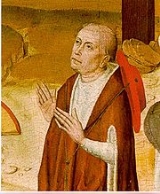
Nicholas of Cusa

Encyclopedia
Nicholas of Kues also referred to as Nicolaus Cusanus and Nicholas of Cusa, was a cardinal
of the Catholic Church from Germany
(Holy Roman Empire
), a philosopher
, theologian
, jurist
, mathematician
, and an astronomer
. He is widely considered one of the great geniuses and polymaths of the 15th century. He is today recognized for significant spiritual, scientific and political contributions in European history, notable examples of which include his mystical or spiritual writings on 'learned ignorance' (and mathematical ideas expressed in related essays), as well as his participation in power struggles between Rome and the German states of the Holy Roman Empire.
(Latinized as "Cusa") was the second of four children of Johan Krebs (or Cryfftz) and Katherina Roemer. His father was "a prosperous boat owner and ferryman." He entered the University of Heidelberg in 1416 as "a cleric of the diocese of Trier" studying the liberal arts. He then received his doctorate in Canon law
from the University of Padua
in 1423. Afterwards, he entered the University of Cologne
in 1425 as "a doctor of canon law" which it appears he both taught and practiced there. Following this brief period in Cologne, he became secretary to Otto of Ziegenhain, the Archbishop of Trier, and represented him in Rome in 1427. After the death of Otto, during the period when the archbishopric of Trier
was contested by opposing parties, he attended the Council of Basel (1431–49), representing Ulrich von Manderscheid, one of the claimants.
While present at the council, Nicholas wrote De concordantia catholica, a synthesis of ideas on church and empire balancing hierarchy with consent. This work remained useful to critics of the papacy long after Nicholas left Basel. Nicholas was close to Cardinal Giuliano Cesarini, who had tried to reconcile pope and council, combining reform and hierarchic order. Nicholas supported transfer of the council to Italy to meet with the Greeks, who needed aid against the Ottoman Turks
. He supported Pope Eugenius IV in his effort to bring the Eastern churches into union with the Western at such a "council of union." While returning from a mission to Constantinople to persuade the Greeks to attend the Council of Florence
, Nicholas had a shipboard experience that led to his writing thereafter on metaphysical topics. Nicholas then represented the pope in Germany, becoming known as the Hercules of the Eugenian cause.
After a successful career as a papal envoy, he was made a theologian by Pope Nicholas V
in 1448 or 1449, and was named Bishop of Brixen in 1450. His role as papal legate
to the German lands included wide travels. His local councils enacted reforms, many of which were not successful. Pope Nicholas canceled some of Nicholas' decrees, and the effort to discourage pilgrimages to venerate the bleeding hosts of Wilsnack (the so-called Holy Blood of Wilsnack
) was unsuccessful. His work as bishop – trying to impose reforms and reclaim lost diocesan revenues – was opposed by Duke Sigismund of Austria
. The duke imprisoned Nicholas in 1460, for which Pope Pius II
excommunicated
Sigismund and laid an interdict
on his lands. Nicholas of Cusa was never able to return to his bishopric, however. Sigmund's capitulation in 1464 came a few days after Nicholas's death at Todi
in Umbria
.
Upon his death, his body was interred in the church of San Pietro in Vincoli
in Rome, but was later lost. His monument, with a sculpted image of the cardinal, remains. In accordance with his wishes, his heart rests within the chapel altar at the Cusanusstift
in Kues. To this charitable institution that he had founded he bequeathed his entire inheritance: it still stands, and serves the purpose Nicholas intended for it, as a home for the aged. The Cusanusstift houses also many of his manuscripts.http://www.cusanus.de/
writings about Christianity
, particularly on the possibility of knowing God with the divine human mind — not possible through mere human means — via "learned ignorance". Cusanus wrote of the enfolding of creation in God and their unfolding in creation. He was suspected by some of holding pantheistic
beliefs, but his writings were never accused of being heretical
. Nicholas also wrote in De coniecturis about using conjectures or surmises to rise to better understanding of the truth. The individual might rise above mere reason to the vision of the intellect, but the same person might fall back from such vision.
Most of his mathematical ideas can be found in his essays, De Docta Ignorantia
(Of Learned Ignorance), De Visione Dei (On the Vision of God) and On Conjectures. He also wrote on squaring the circle
in his mathematical treatises.
Theologically, Nicholas anticipated the profound implications of Reformed teaching on the harrowing of Hell
(Sermon on Psalm 30:11), followed by Pico della Mirandola, who similarly explained the descensus in terms of Christ’s agony.
Nicholas was widely read, and his works were published in the sixteenth century in both Paris and Basel. Sixteenth century French scholars, including Jacques Lefèvre d'Étaples
and Charles de Bovelles
cited him. Lefèvre even edited the Paris 1514 Opera. Nonetheless, there was no Cusan school. In later centuries, Giordano Bruno
quoted him; and some thinkers, like Gottfried Leibniz
, were thought to have been influenced by him. Neo-Kantian scholars began studying Nicholas in the nineteenth century, and new editions were begun by the Heidelberger Akademie der Wissenschaften in the 1930s and published by Felix Meiner Verlag http://www.meiner.de/index.php. Societies and centers dedicated to Cusanus can be found in Argentina, Japan
, Germany, Italy and the United States.
ahead of his time in the field of science
. Nicolaus Copernicus
, Galileo Galilei
and Giordano Bruno
were all aware of the writings of Cusanus as was Johannes Kepler
(who called Cusanus 'divinely inspired' in the first paragraph of his first published work). Predating Kepler, Cusanus said that no perfect circle can exist in the universe (opposing the Aristotelean model, and also Copernicus' later assumption of circular orbits), thus opening the possibility for Kepler's model featuring elliptical orbits of the planets around the Sun. He also influenced Giordano Bruno by denying the finiteness of the universe and the Earth's exceptional position in it (being not the center of the universe, and in that regard equal in rank with the other stars). He was not, however, describing a scientifically verifiable theory of the universe: his beliefs (which proved uncannily accurate) were based almost entirely on his own personal numerological
calculations and metaphysics.
Cusanus made important contributions to the field of mathematics
by developing the concepts of the infinitesimal
and of relative motion. He was the first to use concave lenses to correct myopia
. His writings were essential for Leibniz's discovery of calculus (see Law of Continuity
) as well as Cantor
's later work on infinity
.
From the Catholic Encyclopedia
(1913 edition):
and a method to elect Holy Roman Emperors. Although it was not adopted by the Church, his method was essentially the same one known today as the Borda count
, which is used in many academic institutions, competitions, and even some political jurisdictions, in original form and a number of variations. His proposal preceded Borda's work by over three centuries.
Nicholas' opinions on the Empire, which he hoped to reform and strengthen, were cited against papal claims of temporal power in the sixteenth and seventeenth centuries. Protestant writers were happy to cite a cardinal against Rome's pretensions. Protestants, however, found his writings against the Hussites wrong. Nicholas seemed to give the church too much power to interpret Scripture, instead of treating it as self interpreting and self-sufficient for salvation
, the principle of sola scriptura
.
Nicholas' own thought on the church changed with his departure from Basel. He tried arguing that the Basel assembly lacked the consent of the church throughout the world, especially the princes. Then he tried arguing that the church was unfolded from Peter (explicatio Petri). This allowed him to support the pope without abandoning ideas of reform. Thus he was able to propose to Pius II reform of the church, beginning with the pope himself. Then it was to spread through the Roman curia
and outward throughout Christendom.
in 1453, Nicholas wrote De pace fidei, On the Peace of Faith. This visionary work imagined a summit meeting in Heaven
of representatives of all nations and religions. Islam
and the Hussite
movement in Bohemia
are represented. The conference agrees that there can be una religio in varietate rituum, a single faith manifested in different rites, as manifested in the eastern and western rites of the Catholic Church. The dialog presupposes the greater accuracy of Christianity but gives respect to other religions. Less irenic but not virulent, is Cusanus' Cribratio Alchorani, Sifting the Koran, a detailed review of the Koran in Latin translation. While the arguments for the superiority of Christianity are still shown in this book, it also credits Judaism and Islam with sharing in the truth at least partially.
Cusanus' attitude toward the Jews was not always mild, in 1451 he ordered that Jews of Arnhem were to wear a Jew-badge. The De pace fidei mentions the possibility that the Jews might not embrace the larger union of una religio in varietate rituum, but it dismisses them as politically insignificant. This matches the decrees from Cusanus' legation restricting Jewish activities, restrictions later canceled by Pope Nicholas V.
Cardinal (Catholicism)
A cardinal is a senior ecclesiastical official, usually an ordained bishop, and ecclesiastical prince of the Catholic Church. They are collectively known as the College of Cardinals, which as a body elects a new pope. The duties of the cardinals include attending the meetings of the College and...
of the Catholic Church from Germany
Germany
Germany , officially the Federal Republic of Germany , is a federal parliamentary republic in Europe. The country consists of 16 states while the capital and largest city is Berlin. Germany covers an area of 357,021 km2 and has a largely temperate seasonal climate...
(Holy Roman Empire
Holy Roman Empire
The Holy Roman Empire was a realm that existed from 962 to 1806 in Central Europe.It was ruled by the Holy Roman Emperor. Its character changed during the Middle Ages and the Early Modern period, when the power of the emperor gradually weakened in favour of the princes...
), a philosopher
Philosophy
Philosophy is the study of general and fundamental problems, such as those connected with existence, knowledge, values, reason, mind, and language. Philosophy is distinguished from other ways of addressing such problems by its critical, generally systematic approach and its reliance on rational...
, theologian
Theology
Theology is the systematic and rational study of religion and its influences and of the nature of religious truths, or the learned profession acquired by completing specialized training in religious studies, usually at a university or school of divinity or seminary.-Definition:Augustine of Hippo...
, jurist
Jurist
A jurist or jurisconsult is a professional who studies, develops, applies, or otherwise deals with the law. The term is widely used in American English, but in the United Kingdom and many Commonwealth countries it has only historical and specialist usage...
, mathematician
Mathematics
Mathematics is the study of quantity, space, structure, and change. Mathematicians seek out patterns and formulate new conjectures. Mathematicians resolve the truth or falsity of conjectures by mathematical proofs, which are arguments sufficient to convince other mathematicians of their validity...
, and an astronomer
Astronomy
Astronomy is a natural science that deals with the study of celestial objects and phenomena that originate outside the atmosphere of Earth...
. He is widely considered one of the great geniuses and polymaths of the 15th century. He is today recognized for significant spiritual, scientific and political contributions in European history, notable examples of which include his mystical or spiritual writings on 'learned ignorance' (and mathematical ideas expressed in related essays), as well as his participation in power struggles between Rome and the German states of the Holy Roman Empire.
Biography
Nicholas of Cusa or KuesBernkastel-Kues
Bernkastel-Kues is a well-known winegrowing centre on the Middle Moselle in the Bernkastel-Wittlich district in Rhineland-Palatinate, Germany...
(Latinized as "Cusa") was the second of four children of Johan Krebs (or Cryfftz) and Katherina Roemer. His father was "a prosperous boat owner and ferryman." He entered the University of Heidelberg in 1416 as "a cleric of the diocese of Trier" studying the liberal arts. He then received his doctorate in Canon law
Canon law (Catholic Church)
The canon law of the Catholic Church, is a fully developed legal system, with all the necessary elements: courts, lawyers, judges, a fully articulated legal code and principles of legal interpretation. It lacks the necessary binding force present in most modern day legal systems. The academic...
from the University of Padua
University of Padua
The University of Padua is a premier Italian university located in the city of Padua, Italy. The University of Padua was founded in 1222 as a school of law and was one of the most prominent universities in early modern Europe. It is among the earliest universities of the world and the second...
in 1423. Afterwards, he entered the University of Cologne
University of Cologne
The University of Cologne is one of the oldest universities in Europe and, with over 44,000 students, one of the largest universities in Germany. The university is part of the Deutsche Forschungsgemeinschaft, an association of Germany's leading research universities...
in 1425 as "a doctor of canon law" which it appears he both taught and practiced there. Following this brief period in Cologne, he became secretary to Otto of Ziegenhain, the Archbishop of Trier, and represented him in Rome in 1427. After the death of Otto, during the period when the archbishopric of Trier
Archbishopric of Trier
The Archbishopric of Trier was a Roman Catholic diocese in Germany, that existed from Carolingian times until the end of the Holy Roman Empire. Its suffragans were the dioceses of Metz, Toul and Verdun. Since the 9th century the Archbishops of Trier were simultaneously princes and since the 11th...
was contested by opposing parties, he attended the Council of Basel (1431–49), representing Ulrich von Manderscheid, one of the claimants.
While present at the council, Nicholas wrote De concordantia catholica, a synthesis of ideas on church and empire balancing hierarchy with consent. This work remained useful to critics of the papacy long after Nicholas left Basel. Nicholas was close to Cardinal Giuliano Cesarini, who had tried to reconcile pope and council, combining reform and hierarchic order. Nicholas supported transfer of the council to Italy to meet with the Greeks, who needed aid against the Ottoman Turks
Ottoman Turks
The Ottoman Turks were the Turkish-speaking population of the Ottoman Empire who formed the base of the state's military and ruling classes. Reliable information about the early history of Ottoman Turks is scarce, but they take their Turkish name, Osmanlı , from the house of Osman I The Ottoman...
. He supported Pope Eugenius IV in his effort to bring the Eastern churches into union with the Western at such a "council of union." While returning from a mission to Constantinople to persuade the Greeks to attend the Council of Florence
Council of Florence
The Council of Florence was an Ecumenical Council of the Roman Catholic Church. It began in 1431 in Basel, Switzerland, and became known as the Council of Ferrara after its transfer to Ferrara was decreed by Pope Eugene IV, to convene in 1438...
, Nicholas had a shipboard experience that led to his writing thereafter on metaphysical topics. Nicholas then represented the pope in Germany, becoming known as the Hercules of the Eugenian cause.
After a successful career as a papal envoy, he was made a theologian by Pope Nicholas V
Pope Nicholas V
Pope Nicholas V , born Tommaso Parentucelli, was Pope from March 6, 1447 to his death in 1455.-Biography:He was born at Sarzana, Liguria, where his father was a physician...
in 1448 or 1449, and was named Bishop of Brixen in 1450. His role as papal legate
Papal legate
A papal legate – from the Latin, authentic Roman title Legatus – is a personal representative of the pope to foreign nations, or to some part of the Catholic Church. He is empowered on matters of Catholic Faith and for the settlement of ecclesiastical matters....
to the German lands included wide travels. His local councils enacted reforms, many of which were not successful. Pope Nicholas canceled some of Nicholas' decrees, and the effort to discourage pilgrimages to venerate the bleeding hosts of Wilsnack (the so-called Holy Blood of Wilsnack
Holy Blood of Wilsnack
The Holy Blood Wilsnack were three allegedly miraculous hosts, which survived a fire in 1383 that burned the church and village to the ground. The relics became the destination of medieval religious pilgrimages to Bad Wilsnack, Germany for nearly two centuries. Revenue from the many pilgrims...
) was unsuccessful. His work as bishop – trying to impose reforms and reclaim lost diocesan revenues – was opposed by Duke Sigismund of Austria
Sigismund, Archduke of Austria
Sigismund of Austria, Duke, then Archduke of Further Austria was a Habsburg archduke of Austria and ruler of Tirol from 1446 to 1490....
. The duke imprisoned Nicholas in 1460, for which Pope Pius II
Pope Pius II
Pope Pius II, born Enea Silvio Piccolomini was Pope from August 19, 1458 until his death in 1464. Pius II was born at Corsignano in the Sienese territory of a noble but decayed family...
excommunicated
Excommunication
Excommunication is a religious censure used to deprive, suspend or limit membership in a religious community. The word means putting [someone] out of communion. In some religions, excommunication includes spiritual condemnation of the member or group...
Sigismund and laid an interdict
Interdict (Roman Catholic Church)
In Roman Catholic canon law, an interdict is an ecclesiastical censure that excludes from certain rites of the Church individuals or groups, who nonetheless do not cease to be members of the Church.-Distinctions in canon law:...
on his lands. Nicholas of Cusa was never able to return to his bishopric, however. Sigmund's capitulation in 1464 came a few days after Nicholas's death at Todi
Todi
Todi is a town and comune of the province of Perugia in central Italy. It is perched on a tall two-crested hill overlooking the east bank of the river Tiber, commanding distant views in every direction.In the 1990s, Richard S...
in Umbria
Umbria
Umbria is a region of modern central Italy. It is one of the smallest Italian regions and the only peninsular region that is landlocked.Its capital is Perugia.Assisi and Norcia are historical towns associated with St. Francis of Assisi, and St...
.
Upon his death, his body was interred in the church of San Pietro in Vincoli
San Pietro in Vincoli
San Pietro in Vincoli is a Roman Catholic titular church and minor basilica in Rome, Italy, best known for being the home of Michelangelo's statue of Moses, part of the tomb of Pope Julius II.-History:...
in Rome, but was later lost. His monument, with a sculpted image of the cardinal, remains. In accordance with his wishes, his heart rests within the chapel altar at the Cusanusstift
Cusanusstift
Cusanusstift is a historic building in Bernkastel-Kues, Germany.It was founded by Nicholas of Cusa in 1458. It contains a world-famous library and a wine museum.-External links:*...
in Kues. To this charitable institution that he had founded he bequeathed his entire inheritance: it still stands, and serves the purpose Nicholas intended for it, as a home for the aged. The Cusanusstift houses also many of his manuscripts.http://www.cusanus.de/
Philosophy
Nicholas of Cusa was noted for his deeply mysticalMysticism
Mysticism is the knowledge of, and especially the personal experience of, states of consciousness, i.e. levels of being, beyond normal human perception, including experience and even communion with a supreme being.-Classical origins:...
writings about Christianity
Christianity
Christianity is a monotheistic religion based on the life and teachings of Jesus as presented in canonical gospels and other New Testament writings...
, particularly on the possibility of knowing God with the divine human mind — not possible through mere human means — via "learned ignorance". Cusanus wrote of the enfolding of creation in God and their unfolding in creation. He was suspected by some of holding pantheistic
Pantheism
Pantheism is the view that the Universe and God are identical. Pantheists thus do not believe in a personal, anthropomorphic or creator god. The word derives from the Greek meaning "all" and the Greek meaning "God". As such, Pantheism denotes the idea that "God" is best seen as a process of...
beliefs, but his writings were never accused of being heretical
Heresy
Heresy is a controversial or novel change to a system of beliefs, especially a religion, that conflicts with established dogma. It is distinct from apostasy, which is the formal denunciation of one's religion, principles or cause, and blasphemy, which is irreverence toward religion...
. Nicholas also wrote in De coniecturis about using conjectures or surmises to rise to better understanding of the truth. The individual might rise above mere reason to the vision of the intellect, but the same person might fall back from such vision.
Most of his mathematical ideas can be found in his essays, De Docta Ignorantia
De Docta Ignorantia
De docta ignorantia is a book on philosophy and theology by Nicholas of Cusa , who finished writing it on 12 February 1440 in his mother-town of Kues, Germany.Earlier scholars had discussed the matter, e.g....
(Of Learned Ignorance), De Visione Dei (On the Vision of God) and On Conjectures. He also wrote on squaring the circle
Squaring the circle
Squaring the circle is a problem proposed by ancient geometers. It is the challenge of constructing a square with the same area as a given circle by using only a finite number of steps with compass and straightedge...
in his mathematical treatises.
Theologically, Nicholas anticipated the profound implications of Reformed teaching on the harrowing of Hell
Harrowing of Hell
The Harrowing of Hell is a doctrine in Christian theology referenced in the Apostles' Creed and the Athanasian Creed that states that Jesus Christ "descended into Hell"...
(Sermon on Psalm 30:11), followed by Pico della Mirandola, who similarly explained the descensus in terms of Christ’s agony.
Nicholas was widely read, and his works were published in the sixteenth century in both Paris and Basel. Sixteenth century French scholars, including Jacques Lefèvre d'Étaples
Jacques Lefèvre d'Étaples
Jacques Lefèvre d’Étaples or Jacob Faber Stapulensis was a French theologian and humanist. He was a precursor of the Protestant movement in France. The "d’Étaples" was not part of his name as such, but used to distinguish him from Jacques Lefèvre of Deventer, a less significant contemporary, a...
and Charles de Bovelles
Charles de Bovelles
Charles de Bouvelles was a French mathematician, and canon of Noyon...
cited him. Lefèvre even edited the Paris 1514 Opera. Nonetheless, there was no Cusan school. In later centuries, Giordano Bruno
Giordano Bruno
Giordano Bruno , born Filippo Bruno, was an Italian Dominican friar, philosopher, mathematician and astronomer. His cosmological theories went beyond the Copernican model in proposing that the Sun was essentially a star, and moreover, that the universe contained an infinite number of inhabited...
quoted him; and some thinkers, like Gottfried Leibniz
Gottfried Leibniz
Gottfried Wilhelm Leibniz was a German philosopher and mathematician. He wrote in different languages, primarily in Latin , French and German ....
, were thought to have been influenced by him. Neo-Kantian scholars began studying Nicholas in the nineteenth century, and new editions were begun by the Heidelberger Akademie der Wissenschaften in the 1930s and published by Felix Meiner Verlag http://www.meiner.de/index.php. Societies and centers dedicated to Cusanus can be found in Argentina, Japan
Japan
Japan is an island nation in East Asia. Located in the Pacific Ocean, it lies to the east of the Sea of Japan, China, North Korea, South Korea and Russia, stretching from the Sea of Okhotsk in the north to the East China Sea and Taiwan in the south...
, Germany, Italy and the United States.
Science
Nicholas is also considered by many to be a geniusGenius
Genius is something or someone embodying exceptional intellectual ability, creativity, or originality, typically to a degree that is associated with the achievement of unprecedented insight....
ahead of his time in the field of science
Science
Science is a systematic enterprise that builds and organizes knowledge in the form of testable explanations and predictions about the universe...
. Nicolaus Copernicus
Nicolaus Copernicus
Nicolaus Copernicus was a Renaissance astronomer and the first person to formulate a comprehensive heliocentric cosmology which displaced the Earth from the center of the universe....
, Galileo Galilei
Galileo Galilei
Galileo Galilei , was an Italian physicist, mathematician, astronomer, and philosopher who played a major role in the Scientific Revolution. His achievements include improvements to the telescope and consequent astronomical observations and support for Copernicanism...
and Giordano Bruno
Giordano Bruno
Giordano Bruno , born Filippo Bruno, was an Italian Dominican friar, philosopher, mathematician and astronomer. His cosmological theories went beyond the Copernican model in proposing that the Sun was essentially a star, and moreover, that the universe contained an infinite number of inhabited...
were all aware of the writings of Cusanus as was Johannes Kepler
Johannes Kepler
Johannes Kepler was a German mathematician, astronomer and astrologer. A key figure in the 17th century scientific revolution, he is best known for his eponymous laws of planetary motion, codified by later astronomers, based on his works Astronomia nova, Harmonices Mundi, and Epitome of Copernican...
(who called Cusanus 'divinely inspired' in the first paragraph of his first published work). Predating Kepler, Cusanus said that no perfect circle can exist in the universe (opposing the Aristotelean model, and also Copernicus' later assumption of circular orbits), thus opening the possibility for Kepler's model featuring elliptical orbits of the planets around the Sun. He also influenced Giordano Bruno by denying the finiteness of the universe and the Earth's exceptional position in it (being not the center of the universe, and in that regard equal in rank with the other stars). He was not, however, describing a scientifically verifiable theory of the universe: his beliefs (which proved uncannily accurate) were based almost entirely on his own personal numerological
Numerology
Numerology is any study of the purported mystical relationship between a count or measurement and life. It has many systems and traditions and beliefs...
calculations and metaphysics.
Cusanus made important contributions to the field of mathematics
Mathematics
Mathematics is the study of quantity, space, structure, and change. Mathematicians seek out patterns and formulate new conjectures. Mathematicians resolve the truth or falsity of conjectures by mathematical proofs, which are arguments sufficient to convince other mathematicians of their validity...
by developing the concepts of the infinitesimal
Infinitesimal
Infinitesimals have been used to express the idea of objects so small that there is no way to see them or to measure them. The word infinitesimal comes from a 17th century Modern Latin coinage infinitesimus, which originally referred to the "infinite-th" item in a series.In common speech, an...
and of relative motion. He was the first to use concave lenses to correct myopia
Myopia
Myopia , "shortsightedness" ) is a refractive defect of the eye in which collimated light produces image focus in front of the retina under conditions of accommodation. In simpler terms, myopia is a condition of the eye where the light that comes in does not directly focus on the retina but in...
. His writings were essential for Leibniz's discovery of calculus (see Law of Continuity
Law of Continuity
The Law of Continuity is a heuristic principle introduced by Leibniz based on earlier work by Nicholas of Cusa and Johannes Kepler. It is the principle that "whatever succeeds for the finite, also succeeds for the infinite"...
) as well as Cantor
Georg Cantor
Georg Ferdinand Ludwig Philipp Cantor was a German mathematician, best known as the inventor of set theory, which has become a fundamental theory in mathematics. Cantor established the importance of one-to-one correspondence between the members of two sets, defined infinite and well-ordered sets,...
's later work on infinity
Infinity
Infinity is a concept in many fields, most predominantly mathematics and physics, that refers to a quantity without bound or end. People have developed various ideas throughout history about the nature of infinity...
.
From the Catholic Encyclopedia
Catholic Encyclopedia
The Catholic Encyclopedia, also referred to as the Old Catholic Encyclopedia and the Original Catholic Encyclopedia, is an English-language encyclopedia published in the United States. The first volume appeared in March 1907 and the last three volumes appeared in 1912, followed by a master index...
(1913 edition):
The astronomical views of the cardinal are scattered through his philosophical treatises. They evince complete independence of traditional doctrines, though they are based on symbolism of numbers, on combinations of letters, and on abstract speculations rather than observation. The earth is a star like other stars, is not the centre of the universe, is not at rest, nor are its poles fixed. The celestial bodies are not strictly spherical, nor are their orbits circular. The difference between theory and appearance is explained by relative motion. Had Copernicus been aware of these assertions he would probably have been encouraged by them to publish his own monumental work.
Politics
In 1433, Nicholas proposed reform of the Holy Roman EmpireHoly Roman Empire
The Holy Roman Empire was a realm that existed from 962 to 1806 in Central Europe.It was ruled by the Holy Roman Emperor. Its character changed during the Middle Ages and the Early Modern period, when the power of the emperor gradually weakened in favour of the princes...
and a method to elect Holy Roman Emperors. Although it was not adopted by the Church, his method was essentially the same one known today as the Borda count
Borda count
The Borda count is a single-winner election method in which voters rank candidates in order of preference. The Borda count determines the winner of an election by giving each candidate a certain number of points corresponding to the position in which he or she is ranked by each voter. Once all...
, which is used in many academic institutions, competitions, and even some political jurisdictions, in original form and a number of variations. His proposal preceded Borda's work by over three centuries.
Nicholas' opinions on the Empire, which he hoped to reform and strengthen, were cited against papal claims of temporal power in the sixteenth and seventeenth centuries. Protestant writers were happy to cite a cardinal against Rome's pretensions. Protestants, however, found his writings against the Hussites wrong. Nicholas seemed to give the church too much power to interpret Scripture, instead of treating it as self interpreting and self-sufficient for salvation
Salvation
Within religion salvation is the phenomenon of being saved from the undesirable condition of bondage or suffering experienced by the psyche or soul that has arisen as a result of unskillful or immoral actions generically referred to as sins. Salvation may also be called "deliverance" or...
, the principle of sola scriptura
Sola scriptura
Sola scriptura is the doctrine that the Bible contains all knowledge necessary for salvation and holiness. Consequently, sola scriptura demands that only those doctrines are to be admitted or confessed that are found directly within or indirectly by using valid logical deduction or valid...
.
Nicholas' own thought on the church changed with his departure from Basel. He tried arguing that the Basel assembly lacked the consent of the church throughout the world, especially the princes. Then he tried arguing that the church was unfolded from Peter (explicatio Petri). This allowed him to support the pope without abandoning ideas of reform. Thus he was able to propose to Pius II reform of the church, beginning with the pope himself. Then it was to spread through the Roman curia
Roman Curia
The Roman Curia is the administrative apparatus of the Holy See and the central governing body of the entire Catholic Church, together with the Pope...
and outward throughout Christendom.
Nicholas and other Religions
Nicholas supported the campaign of Pope Pius II for a crusade against the Turks, but this is not the limit of his thought on interreligious issues. Shortly after the Fall of ConstantinopleFall of Constantinople
The Fall of Constantinople was the capture of the capital of the Byzantine Empire, which occurred after a siege by the Ottoman Empire, under the command of Ottoman Sultan Mehmed II, against the defending army commanded by Byzantine Emperor Constantine XI...
in 1453, Nicholas wrote De pace fidei, On the Peace of Faith. This visionary work imagined a summit meeting in Heaven
Heaven
Heaven, the Heavens or Seven Heavens, is a common religious cosmological or metaphysical term for the physical or transcendent place from which heavenly beings originate, are enthroned or inhabit...
of representatives of all nations and religions. Islam
Islam
Islam . The most common are and . : Arabic pronunciation varies regionally. The first vowel ranges from ~~. The second vowel ranges from ~~~...
and the Hussite
Hussite
The Hussites were a Christian movement following the teachings of Czech reformer Jan Hus , who became one of the forerunners of the Protestant Reformation...
movement in Bohemia
Bohemia
Bohemia is a historical region in central Europe, occupying the western two-thirds of the traditional Czech Lands. It is located in the contemporary Czech Republic with its capital in Prague...
are represented. The conference agrees that there can be una religio in varietate rituum, a single faith manifested in different rites, as manifested in the eastern and western rites of the Catholic Church. The dialog presupposes the greater accuracy of Christianity but gives respect to other religions. Less irenic but not virulent, is Cusanus' Cribratio Alchorani, Sifting the Koran, a detailed review of the Koran in Latin translation. While the arguments for the superiority of Christianity are still shown in this book, it also credits Judaism and Islam with sharing in the truth at least partially.
Cusanus' attitude toward the Jews was not always mild, in 1451 he ordered that Jews of Arnhem were to wear a Jew-badge. The De pace fidei mentions the possibility that the Jews might not embrace the larger union of una religio in varietate rituum, but it dismisses them as politically insignificant. This matches the decrees from Cusanus' legation restricting Jewish activities, restrictions later canceled by Pope Nicholas V.
External links
- Bernkastel-Kues tribute to Nikolaus von Kues
- MacTutor biography, focusing on mathematical achievements
- A biography of Nicholas of Cusa
- Catholic Encyclopedia article on Nicholas of Cusa
- Website of the Cusanusstift
- American Cusanus Society
- Cusanus-Portal (DFG-Project by the Institut fuer Cusanus-Forschung and the Center for Digital Humanities at the university of Trier with a digitized version of the ‘Opera Omnia’, the critical edition of the Latin texts from Nicholas of Cusa, published by the Heidelberg Academy of Sciences, with the English translations of Jasper Hopkins, several German translations, a German encyclopedia and an international bibliography)
- http://jasper-hopkins.info/ Jasper Hopkins, Ph.D. has produced English translations with some commentary of much of Nicholas's work. Pdf versions are available at this site.