

Tyrannicide

Encyclopedia
Tyrannicide literally means the killing of a tyrant
, or one who has committed the act. Typically, the term is taken to mean the killing or assassination
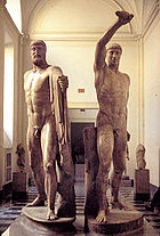
of tyrants for the common good. The term "tyrannicide" does not apply to tyrants killed in battle or killed by an enemy in an armed conflict. It is rarely applied when a tyrant is killed by a person acting for selfish reasons, such as to take power for themselves, or to the killing of a former tyrant. Sometimes, the term is restricted to killings undertaken by people who are actually subject to the tyrant. The term is also used to denote those who actually commit the act of killing a tyrant: i.e., Harmodius and Aristogeiton
are called 'the tyrannicides'.
's Lives, Cicero
's De Officiis
, and Thomas Aquinas
's Commentary on the Sentences of Peter Lombard. The Monarchomachs
in particular developed a theory of tyrannicide, with Juan de Mariana
describing their views in the 1598 work De rege et regis institutione, in which he wrote, "[B]oth the philosophers and theologians agree, that the prince who seizes the state with force and arms, and with no legal right, no public, civic approval, may be killed by anyone and deprived of his life..."
 The Jesuistic casuistry
developed a similar theory, criticized by Blaise Pascal
in the Provincial Letters. Before them, the scholastic
philosopher John of Salisbury
also legitimised tyrannicide, under specific conditions, in the Policraticus
, circa 1159. His theory was derived from his idea of the state as a political organism in which all the members cooperate actively in the realization of the common utility and justice. He held that when the ruler of this body politic
behaves tyrannically, failing to perform his characteristic responsibilities, the other limbs and organs are bound by their duty to the public welfare and God to correct and, ultimately, to slay the tyrant.
In 1408 the theologian Jean Petit
used biblical examples to justify tyrannicide following the murder of Louis I, Duke of Orleans by Petit's patron John the Fearless, Duke of Burgundy. Petit's thesis was extensively discussed and eventually condemned by the church. A Shone Treatise of Politike Power, written by John Ponet
in 1556, argued that the people are custodians of natural and divine law, and that if governors and kings violated their trust, then they forfeited their power, whether they relinquished their positions voluntarily or whether they had to be removed forcefully. The Tenure of Kings and Magistrates
by John Milton
in 1649 also described the history of tyrannicide, and a defense of it when appropriate.
Cambridge's
David George has also argued that terrorism
is a form of tyranny of which tyrannicide is a negation. Libertarian
Nick Roberts argues, "Top-level assassination hurts only volunteers — the willing tyrants. It leaves the innocent alive. If rulers choose to rule and to go to war, their lives become forfeit because they are acting coercively towards their subjects and intended conquests. As a 'natural rights
' libertarian, I do not consider that the Hitlers, the Kennedy
s, the Gaddafi
s or the Attila
s have any right to mercy. Those who plan and order the deaths of millions deserve to die. After all, who else is there to blame?" Abraham Lincoln believed that assassinating a leader is morally justified when a people has suffered under a tyrant for an extended period of time and has exhausted all legal and peaceful means of ouster.
Throughout history, many leaders have died under the pretext of tyrannicide. Hipparchus, one of the last Greek leaders to use the title of "tyrant," was assassinated in 514 BC by Harmodius and Aristogeiton
, the original tyrannicides. Since then "tyrant" has been a pejorative term, lacking an objective criteria. Many rulers and heads of state had been considered as such by their enemies but not by their adherents and supporters. For example, when John Wilkes Booth
assassinated Abraham Lincoln in 1865, he wrote how he considered Lincoln
a tyrant while comparing himself to Marcus Junius Brutus
, who stabbed the Roman dictator
Julius Caesar
in 44 BC.
Caesar's death failed to bring a return to republican power, and instead led to the Roman Empire
, but it galvanized later assassins like Booth. Several of Caeser's successors were also killed for their tyrannical actions, including Caligula
, who was stabbed in 41 by Cassius Chaerea
and other Praetorian Guard
s, and Domitian
, stabbed in 96 by a steward of Flavia Domitilla
named Stephanus. After the fall of the Roman Empire, tyrannicide continued in the Byzantine Empire
when Emperor Andronikos I Komnenos
, was tied to a pillar, beaten, and dismembered by a mob in 1185.
Throughout history, tyrannicide has been connected to revolution, with many taking place during successful revolutions, and others sparking revolutionary upheavals. In the midst of the French Revolution
, Maximilien Robespierre
, took power as the President of the National Convention, but after leading the Reign of Terror
from 1793 to 1794, he was executed by beheading by the National Convention
. The Romanian Revolution
, one of the Revolutions of 1989
, enabled a group of defected soldiers to capture Nicolae Ceauşescu
, the country's communist leader, and to stage a trial after which he was executed by a firing squad of paratroopers Ionel Boeru, Georghin Octavian and Dorin-Marian Cirlan.
Many assassins were killed in the act, such as Rigoberto López Pérez
, who shot Nicaragua
n dictator Anastasio Somoza García
in 1956. Others were prosecuted for the killing. Antonio de la Maza
and his conspirators were executed after their shooting of Rafael Trujillo, dictator of the Dominican Republic
in 1961, as was Kim Jaegyu
, who shot
South Korea
n dictator Park Chung-hee
in 1979. Khalid Islambouli
was one of three members of Egyptian Islamic Jihad executed for the assassination of Anwar Sadat
, the autocratic President of Egypt
in 1981. Even both Hipparchus's assassins were themselves killed, Harmodius on the spot and Aristogeiton after being tortured, and the major conspirators in the plot to kill Caesar were likewise killed or forced to commit suicide.
Outright revolt was the context for other tyrannicides, and allowed individual killers to escape or remain anonymous. During World War II
and the Italian resistance movement
, Walter Audisio
claimed to have led his team of partisans in the abduction and execution by firing squad of Benito Mussolini
in 1945. The circumstances remain clouded, though Audisio was later elected to both the Italian Chamber of Deputies
and the Italian Senate
. In 1996, During their uprising in Afghanistan, Taliban soldiers captured Mohammad Najibullah
, the President of the Soviet-backed Democratic Republic of Afghanistan
, and dragged him to death. During the 2011 Libyan Civil War
, Libyan leader Muammar Gaddafi
, the self-titled Brother Leader and Guide of the Revolution, was killed in the Battle of Sirte
, amongst uncertain circumstances.
. Many works of fiction deal with the struggle of an individual or group of individuals to overthrow and kill an unjust tyrant. Often the tyranny is caused by an usurper to a royal throne, where the conclusion restores the proper heir. Children's literature
frequently deals with the subject. Folk tales
like The Nutcracker
include the act, as do some video games series, like The Legend of Zelda and Star Fox. Classical examples in Disney animation include The Lion King
or The Little Mermaid
which both involve the tyrannical takeover of a monarchy and its overhaul. Fantasy works like The Lord of the Rings
, The Chronicles of Narnia
, The Brothers Lionheart
and science-fiction series like Star Wars
all deal with the killing of tyrants. Besides Julius Caesar
, a number of William Shakespeare
's plays deal with the subject, including Hamlet
, Macbeth
, and The Tempest
.
Tyrant
A tyrant was originally one who illegally seized and controlled a governmental power in a polis. Tyrants were a group of individuals who took over many Greek poleis during the uprising of the middle classes in the sixth and seventh centuries BC, ousting the aristocratic governments.Plato and...
, or one who has committed the act. Typically, the term is taken to mean the killing or assassination
Assassination
To carry out an assassination is "to murder by a sudden and/or secret attack, often for political reasons." Alternatively, assassination may be defined as "the act of deliberately killing someone, especially a public figure, usually for hire or for political reasons."An assassination may be...
of tyrants for the common good. The term "tyrannicide" does not apply to tyrants killed in battle or killed by an enemy in an armed conflict. It is rarely applied when a tyrant is killed by a person acting for selfish reasons, such as to take power for themselves, or to the killing of a former tyrant. Sometimes, the term is restricted to killings undertaken by people who are actually subject to the tyrant. The term is also used to denote those who actually commit the act of killing a tyrant: i.e., Harmodius and Aristogeiton
Harmodius and Aristogeiton
Harmodius and Aristogeiton were two men from ancient Athens...
are called 'the tyrannicides'.
Political theory
Tyrannicide can also be a political theory. Support for tyrannicide can be found in PlutarchPlutarch
Plutarch then named, on his becoming a Roman citizen, Lucius Mestrius Plutarchus , c. 46 – 120 AD, was a Greek historian, biographer, essayist, and Middle Platonist known primarily for his Parallel Lives and Moralia...
's Lives, Cicero
Cicero
Marcus Tullius Cicero , was a Roman philosopher, statesman, lawyer, political theorist, and Roman constitutionalist. He came from a wealthy municipal family of the equestrian order, and is widely considered one of Rome's greatest orators and prose stylists.He introduced the Romans to the chief...
's De Officiis
De Officiis
De Officiis is an essay by Marcus Tullius Cicero divided into three books, in which Cicero expounds his conception of the best way to live, behave, and observe moral obligations.- Origin :...
, and Thomas Aquinas
Thomas Aquinas
Thomas Aquinas, O.P. , also Thomas of Aquin or Aquino, was an Italian Dominican priest of the Catholic Church, and an immensely influential philosopher and theologian in the tradition of scholasticism, known as Doctor Angelicus, Doctor Communis, or Doctor Universalis...
's Commentary on the Sentences of Peter Lombard. The Monarchomachs
Monarchomachs
The Monarchomachs were originally French Huguenot theorists who opposed absolute monarchy at the end of the 16th century, known in particular for having theoretically justified tyrannicide...
in particular developed a theory of tyrannicide, with Juan de Mariana
Juan de Mariana
Juan de Mariana, also known as Father Mariana , was a Spanish Jesuit priest, Scholastic, historian, and member of the Monarchomachs....
describing their views in the 1598 work De rege et regis institutione, in which he wrote, "[B]oth the philosophers and theologians agree, that the prince who seizes the state with force and arms, and with no legal right, no public, civic approval, may be killed by anyone and deprived of his life..."
Casuistry
In applied ethics, casuistry is case-based reasoning. Casuistry is used in juridical and ethical discussions of law and ethics, and often is a critique of principle- or rule-based reasoning...
developed a similar theory, criticized by Blaise Pascal
Blaise Pascal
Blaise Pascal , was a French mathematician, physicist, inventor, writer and Catholic philosopher. He was a child prodigy who was educated by his father, a tax collector in Rouen...
in the Provincial Letters. Before them, the scholastic
Scholasticism
Scholasticism is a method of critical thought which dominated teaching by the academics of medieval universities in Europe from about 1100–1500, and a program of employing that method in articulating and defending orthodoxy in an increasingly pluralistic context...
philosopher John of Salisbury
John of Salisbury
John of Salisbury , who described himself as Johannes Parvus , was an English author, educationalist, diplomat and bishop of Chartres, and was born at Salisbury.-Early life and education:...
also legitimised tyrannicide, under specific conditions, in the Policraticus
Policraticus
Policraticus is a book of ethical and political philosophy written by John of Salisbury around 1159. Although addressing a wide variety of ethical questions, it is most famous for attempting to define the responsibilities of kings and their relationship to their subjects...
, circa 1159. His theory was derived from his idea of the state as a political organism in which all the members cooperate actively in the realization of the common utility and justice. He held that when the ruler of this body politic
Body politic
A polity is a state or one of its subordinate civil authorities, such as a province, prefecture, county, municipality, city, or district. It is generally understood to mean a geographic area with a corresponding government. Thomas Hobbes considered bodies politic in this sense in Leviathan...
behaves tyrannically, failing to perform his characteristic responsibilities, the other limbs and organs are bound by their duty to the public welfare and God to correct and, ultimately, to slay the tyrant.
In 1408 the theologian Jean Petit
Jean Petit (theologian)
Jean Petit was a French theologian and professor in the University of Paris...
used biblical examples to justify tyrannicide following the murder of Louis I, Duke of Orleans by Petit's patron John the Fearless, Duke of Burgundy. Petit's thesis was extensively discussed and eventually condemned by the church. A Shone Treatise of Politike Power, written by John Ponet
John Ponet
John Ponet was the Bishop of Winchester, the Bishop of Rochester, and a controversial Protestant religious leader.In his day, Ponet was an influential Protestant theologian...
in 1556, argued that the people are custodians of natural and divine law, and that if governors and kings violated their trust, then they forfeited their power, whether they relinquished their positions voluntarily or whether they had to be removed forcefully. The Tenure of Kings and Magistrates
The Tenure of Kings and Magistrates
The Tenure of Kings and Magistrates is a book by John Milton, in which he defends the right of people to execute a guilty sovereign, whether tyrannical or not....
by John Milton
John Milton
John Milton was an English poet, polemicist, a scholarly man of letters, and a civil servant for the Commonwealth of England under Oliver Cromwell...
in 1649 also described the history of tyrannicide, and a defense of it when appropriate.
Cambridge's
University of Cambridge
The University of Cambridge is a public research university located in Cambridge, United Kingdom. It is the second-oldest university in both the United Kingdom and the English-speaking world , and the seventh-oldest globally...
David George has also argued that terrorism
Terrorism
Terrorism is the systematic use of terror, especially as a means of coercion. In the international community, however, terrorism has no universally agreed, legally binding, criminal law definition...
is a form of tyranny of which tyrannicide is a negation. Libertarian
Libertarianism
Libertarianism, in the strictest sense, is the political philosophy that holds individual liberty as the basic moral principle of society. In the broadest sense, it is any political philosophy which approximates this view...
Nick Roberts argues, "Top-level assassination hurts only volunteers — the willing tyrants. It leaves the innocent alive. If rulers choose to rule and to go to war, their lives become forfeit because they are acting coercively towards their subjects and intended conquests. As a 'natural rights
Natural rights
Natural and legal rights are two types of rights theoretically distinct according to philosophers and political scientists. Natural rights are rights not contingent upon the laws, customs, or beliefs of any particular culture or government, and therefore universal and inalienable...
' libertarian, I do not consider that the Hitlers, the Kennedy
John F. Kennedy
John Fitzgerald "Jack" Kennedy , often referred to by his initials JFK, was the 35th President of the United States, serving from 1961 until his assassination in 1963....
s, the Gaddafi
Muammar al-Gaddafi
Muammar Muhammad Abu Minyar Gaddafi or "September 1942" 20 October 2011), commonly known as Muammar Gaddafi or Colonel Gaddafi, was the official ruler of the Libyan Arab Republic from 1969 to 1977 and then the "Brother Leader" of the Libyan Arab Jamahiriya from 1977 to 2011.He seized power in a...
s or the Attila
Attila the Hun
Attila , more frequently referred to as Attila the Hun, was the ruler of the Huns from 434 until his death in 453. He was leader of the Hunnic Empire, which stretched from the Ural River to the Rhine River and from the Danube River to the Baltic Sea. During his reign he was one of the most feared...
s have any right to mercy. Those who plan and order the deaths of millions deserve to die. After all, who else is there to blame?" Abraham Lincoln believed that assassinating a leader is morally justified when a people has suffered under a tyrant for an extended period of time and has exhausted all legal and peaceful means of ouster.
History
Throughout history, many leaders have died under the pretext of tyrannicide. Hipparchus, one of the last Greek leaders to use the title of "tyrant," was assassinated in 514 BC by Harmodius and Aristogeiton
Harmodius and Aristogeiton
Harmodius and Aristogeiton were two men from ancient Athens...
, the original tyrannicides. Since then "tyrant" has been a pejorative term, lacking an objective criteria. Many rulers and heads of state had been considered as such by their enemies but not by their adherents and supporters. For example, when John Wilkes Booth
John Wilkes Booth
John Wilkes Booth was an American stage actor who assassinated President Abraham Lincoln at Ford's Theatre, in Washington, D.C., on April 14, 1865. Booth was a member of the prominent 19th century Booth theatrical family from Maryland and, by the 1860s, was a well-known actor...
assassinated Abraham Lincoln in 1865, he wrote how he considered Lincoln
Abraham Lincoln
Abraham Lincoln was the 16th President of the United States, serving from March 1861 until his assassination in April 1865. He successfully led his country through a great constitutional, military and moral crisis – the American Civil War – preserving the Union, while ending slavery, and...
a tyrant while comparing himself to Marcus Junius Brutus
Marcus Junius Brutus
Marcus Junius Brutus , often referred to as Brutus, was a politician of the late Roman Republic. After being adopted by his uncle he used the name Quintus Servilius Caepio Brutus, but eventually returned to using his original name...
, who stabbed the Roman dictator
Roman dictator
In the Roman Republic, the dictator , was an extraordinary magistrate with the absolute authority to perform tasks beyond the authority of the ordinary magistrate . The office of dictator was a legal innovation originally named Magister Populi , i.e...
Julius Caesar
Julius Caesar
Gaius Julius Caesar was a Roman general and statesman and a distinguished writer of Latin prose. He played a critical role in the gradual transformation of the Roman Republic into the Roman Empire....
in 44 BC.
Caesar's death failed to bring a return to republican power, and instead led to the Roman Empire
Roman Empire
The Roman Empire was the post-Republican period of the ancient Roman civilization, characterised by an autocratic form of government and large territorial holdings in Europe and around the Mediterranean....
, but it galvanized later assassins like Booth. Several of Caeser's successors were also killed for their tyrannical actions, including Caligula
Caligula
Caligula , also known as Gaius, was Roman Emperor from 37 AD to 41 AD. Caligula was a member of the house of rulers conventionally known as the Julio-Claudian dynasty. Caligula's father Germanicus, the nephew and adopted son of Emperor Tiberius, was a very successful general and one of Rome's most...
, who was stabbed in 41 by Cassius Chaerea
Cassius Chaerea
Cassius Chaerea was a centurion in the army of Germanicus and served in the Praetorian Guard under the emperor Caligula, whom he eventually assassinated....
and other Praetorian Guard
Praetorian Guard
The Praetorian Guard was a force of bodyguards used by Roman Emperors. The title was already used during the Roman Republic for the guards of Roman generals, at least since the rise to prominence of the Scipio family around 275 BC...
s, and Domitian
Domitian
Domitian was Roman Emperor from 81 to 96. Domitian was the third and last emperor of the Flavian dynasty.Domitian's youth and early career were largely spent in the shadow of his brother Titus, who gained military renown during the First Jewish-Roman War...
, stabbed in 96 by a steward of Flavia Domitilla
Flavia Domitilla (saint)
Flavia Domitilla was daughter of Domitilla the Younger by an unknown father, perhaps Quintus Petillius Cerialis. She married her cousin, the consul Titus Flavius Clemens.-In Roman literature:...
named Stephanus. After the fall of the Roman Empire, tyrannicide continued in the Byzantine Empire
Byzantine Empire
The Byzantine Empire was the Eastern Roman Empire during the periods of Late Antiquity and the Middle Ages, centred on the capital of Constantinople. Known simply as the Roman Empire or Romania to its inhabitants and neighbours, the Empire was the direct continuation of the Ancient Roman State...
when Emperor Andronikos I Komnenos
Andronikos I Komnenos
Andronikos I Komnenos was Byzantine Emperor from 1183 to 1185). He was the son of Isaac Komnenos and grandson of Emperor Alexios I Komnenos.-Early years:...
, was tied to a pillar, beaten, and dismembered by a mob in 1185.
Throughout history, tyrannicide has been connected to revolution, with many taking place during successful revolutions, and others sparking revolutionary upheavals. In the midst of the French Revolution
French Revolution
The French Revolution , sometimes distinguished as the 'Great French Revolution' , was a period of radical social and political upheaval in France and Europe. The absolute monarchy that had ruled France for centuries collapsed in three years...
, Maximilien Robespierre
Maximilien Robespierre
Maximilien François Marie Isidore de Robespierre is one of the best-known and most influential figures of the French Revolution. He largely dominated the Committee of Public Safety and was instrumental in the period of the Revolution commonly known as the Reign of Terror, which ended with his...
, took power as the President of the National Convention, but after leading the Reign of Terror
Reign of Terror
The Reign of Terror , also known simply as The Terror , was a period of violence that occurred after the onset of the French Revolution, incited by conflict between rival political factions, the Girondins and the Jacobins, and marked by mass executions of "enemies of...
from 1793 to 1794, he was executed by beheading by the National Convention
National Convention
During the French Revolution, the National Convention or Convention, in France, comprised the constitutional and legislative assembly which sat from 20 September 1792 to 26 October 1795 . It held executive power in France during the first years of the French First Republic...
. The Romanian Revolution
Romanian Revolution of 1989
The Romanian Revolution of 1989 was a series of riots and clashes in December 1989. These were part of the Revolutions of 1989 that occurred in several Warsaw Pact countries...
, one of the Revolutions of 1989
Revolutions of 1989
The Revolutions of 1989 were the revolutions which overthrew the communist regimes in various Central and Eastern European countries.The events began in Poland in 1989, and continued in Hungary, East Germany, Bulgaria, Czechoslovakia and...
, enabled a group of defected soldiers to capture Nicolae Ceauşescu
Nicolae Ceausescu
Nicolae Ceaușescu was a Romanian Communist politician. He was General Secretary of the Romanian Communist Party from 1965 to 1989, and as such was the country's second and last Communist leader...
, the country's communist leader, and to stage a trial after which he was executed by a firing squad of paratroopers Ionel Boeru, Georghin Octavian and Dorin-Marian Cirlan.
Many assassins were killed in the act, such as Rigoberto López Pérez
Rigoberto López Pérez
Rigoberto López Pérez was a Nicaraguan poet and music composer. He was the assassin of Anastasio Somoza García, the longtime dictator of Nicaragua....
, who shot Nicaragua
Nicaragua
Nicaragua is the largest country in the Central American American isthmus, bordered by Honduras to the north and Costa Rica to the south. The country is situated between 11 and 14 degrees north of the Equator in the Northern Hemisphere, which places it entirely within the tropics. The Pacific Ocean...
n dictator Anastasio Somoza García
Anastasio Somoza García
Anastasio Somoza García was officially the President of Nicaragua from 1 January 1937 to 1 May 1947 and from 21 May 1950 to 29 September 1956, but ruled effectively as dictator from 1936 until his assassination.-Biography:Somoza was born in San Marcos, Carazo Department in Nicaragua, the son of...
in 1956. Others were prosecuted for the killing. Antonio de la Maza
Antonio de la Maza
Antonio de la Maza was one of the conspirators in the assassination of Rafael Trujillo. He used Juan Tomas Diaz's shotgun to shoot Trujillo while he was driving at night to see his wife...
and his conspirators were executed after their shooting of Rafael Trujillo, dictator of the Dominican Republic
Dominican Republic
The Dominican Republic is a nation on the island of La Hispaniola, part of the Greater Antilles archipelago in the Caribbean region. The western third of the island is occupied by the nation of Haiti, making Hispaniola one of two Caribbean islands that are shared by two countries...
in 1961, as was Kim Jaegyu
Kim Jaegyu
Kim Jaegyu was a South Korean Army Lieutenant General and the director of the Korean Central Intelligence Agency. He is most famous for assassinating South Korean President Park Chung-hee, who had been one of his closest friends for a long time, on October 26, 1979...
, who shot
Park Chung-hee assassination
Park Chung-hee, president of South Korea, was assassinated by Kim Jae-kyu, his security chief as the director of Korean Central Intelligence Agency , on Friday, October 26, 1979 at 7:41pm during a dinner at a KCIA safehouse inside Blue House presidential compound in Gungjeong-dong, Seoul. It is...
South Korea
South Korea
The Republic of Korea , , is a sovereign state in East Asia, located on the southern portion of the Korean Peninsula. It is neighbored by the People's Republic of China to the west, Japan to the east, North Korea to the north, and the East China Sea and Republic of China to the south...
n dictator Park Chung-hee
Park Chung-hee
Park Chung-hee was a Republic of Korea Army general and the leader of South Korea from 1961 to 1979. He seized power in a military coup and ruled until his assassination in 1979. He has been credited with the industrialization of the Republic of Korea through export-led growth...
in 1979. Khalid Islambouli
Khalid Islambouli
Khalid Ahmed Showky Al-Islambouli was an Egyptian army officer who planned and participated in the assassination of Egypt's third president, Anwar Sadat, during the annual 6th October victory parade on 6 October 1981...
was one of three members of Egyptian Islamic Jihad executed for the assassination of Anwar Sadat
Assassination of Anwar Sadat
The Assassination of Anwar El Sadat occurred on 6 October 1981. Anwar El Sadat, the President of Egypt, was assassinated during the annual victory parade held in Cairo to celebrate Egypt's crossing of the Suez Canal. A fatwā approving the assassination had been obtained from Omar Abdel-Rahman, a...
, the autocratic President of Egypt
President of Egypt
The President of the Arab Republic of Egypt is the head of state of Egypt.Under the Constitution of Egypt, the president is also the supreme commander of the armed forces and head of the executive branch of the Egyptian government....
in 1981. Even both Hipparchus's assassins were themselves killed, Harmodius on the spot and Aristogeiton after being tortured, and the major conspirators in the plot to kill Caesar were likewise killed or forced to commit suicide.
Outright revolt was the context for other tyrannicides, and allowed individual killers to escape or remain anonymous. During World War II
World War II
World War II, or the Second World War , was a global conflict lasting from 1939 to 1945, involving most of the world's nations—including all of the great powers—eventually forming two opposing military alliances: the Allies and the Axis...
and the Italian resistance movement
Italian resistance movement
The Italian resistance is the umbrella term for the various partisan forces formed by pro-Allied Italians during World War II...
, Walter Audisio
Walter Audisio
Walter Audisio was an Italian partisan and communist politician. He was responsible for the death of Italian dictator Benito Mussolini.- Biography :...
claimed to have led his team of partisans in the abduction and execution by firing squad of Benito Mussolini
Benito Mussolini
Benito Amilcare Andrea Mussolini was an Italian politician who led the National Fascist Party and is credited with being one of the key figures in the creation of Fascism....
in 1945. The circumstances remain clouded, though Audisio was later elected to both the Italian Chamber of Deputies
Italian Chamber of Deputies
The Italian Chamber of Deputies is the lower house of the Parliament of Italy. It has 630 seats, a plurality of which is controlled presently by liberal-conservative party People of Freedom. Twelve deputies represent Italian citizens outside of Italy. Deputies meet in the Palazzo Montecitorio. A...
and the Italian Senate
Italian Senate
The Senate of the Republic is the upper house of the Italian Parliament. It was established in its current form on 8 May 1948, but previously existed during the Kingdom of Italy as Senato del Regno , itself a continuation of the Senato Subalpino of Sardinia-Piedmont established on 8 May 1848...
. In 1996, During their uprising in Afghanistan, Taliban soldiers captured Mohammad Najibullah
Mohammad Najibullah
Mohammad Najibullah Ahmadzai , originally merely Najibullah, was the fourth and last President of the Soviet-backed Democratic Republic of Afghanistan. He is also considered the second President of the Republic of Afghanistan.-Early years:Najibullah was born in August 1947 to the Ahmadzai...
, the President of the Soviet-backed Democratic Republic of Afghanistan
Democratic Republic of Afghanistan
The Democratic Republic of Afghanistan was a government of Afghanistan between 1978 and 1992. It was both ideologically close to and economically dependent on the Soviet Union, and was a major belligerent of the Afghan Civil War.- Saur Revolution :...
, and dragged him to death. During the 2011 Libyan Civil War
2011 Libyan civil war
The 2011 Libyan civil war was an armed conflict in the North African state of Libya, fought between forces loyal to Colonel Muammar Gaddafi and those seeking to oust his government. The war was preceded by protests in Benghazi beginning on 15 February 2011, which led to clashes with security...
, Libyan leader Muammar Gaddafi
Muammar Gaddafi
Muammar Muhammad Abu Minyar Gaddafi or "September 1942" 20 October 2011), commonly known as Muammar Gaddafi or Colonel Gaddafi, was the official ruler of the Libyan Arab Republic from 1969 to 1977 and then the "Brother Leader" of the Libyan Arab Jamahiriya from 1977 to 2011.He seized power in a...
, the self-titled Brother Leader and Guide of the Revolution, was killed in the Battle of Sirte
Battle of Sirte (2011)
The Battle of Sirte was a battle of the 2011 Libyan civil war that began when the National Liberation Army attacked forces loyal to ousted leader Muammar Gaddafi in his hometown and designated capital of Sirte, on the Gulf of Sidra...
, amongst uncertain circumstances.
Literature
Tyrannicide is a popular literary tropeTrope (literature)
A literary trope is the usage of figurative language in literature, or a figure of speech in which words are used in a sense different from their literal meaning...
. Many works of fiction deal with the struggle of an individual or group of individuals to overthrow and kill an unjust tyrant. Often the tyranny is caused by an usurper to a royal throne, where the conclusion restores the proper heir. Children's literature
Children's literature
Children's literature is for readers and listeners up to about age twelve; it is often defined in four different ways: books written by children, books written for children, books chosen by children, or books chosen for children. It is often illustrated. The term is used in senses which sometimes...
frequently deals with the subject. Folk tales
Folklore
Folklore consists of legends, music, oral history, proverbs, jokes, popular beliefs, fairy tales and customs that are the traditions of a culture, subculture, or group. It is also the set of practices through which those expressive genres are shared. The study of folklore is sometimes called...
like The Nutcracker
The Nutcracker
The Nutcracker is a two-act ballet, originally choreographed by Marius Petipa and Lev Ivanov with a score by Pyotr Ilyich Tchaikovsky. The libretto is adapted from E.T.A. Hoffmann's story "The Nutcracker and the Mouse King". It was given its première at the Mariinsky Theatre in St...
include the act, as do some video games series, like The Legend of Zelda and Star Fox. Classical examples in Disney animation include The Lion King
The Lion King
The Lion King is a 1994 American animated film produced by Walt Disney Feature Animation and released by Walt Disney Pictures. It is the 32nd feature in the Walt Disney Animated Classics series...
or The Little Mermaid
The Little Mermaid (1989 film)
The Little Mermaid is a 1989 American animated film produced by Walt Disney Feature Animation and based on the Hans Christian Andersen fairy tale of the same name. Distributed by Walt Disney Pictures, the film was originally released to theaters on November 14, 1989 and is the twenty-eighth film in...
which both involve the tyrannical takeover of a monarchy and its overhaul. Fantasy works like The Lord of the Rings
The Lord of the Rings
The Lord of the Rings is a high fantasy epic written by English philologist and University of Oxford professor J. R. R. Tolkien. The story began as a sequel to Tolkien's earlier, less complex children's fantasy novel The Hobbit , but eventually developed into a much larger work. It was written in...
, The Chronicles of Narnia
The Chronicles of Narnia
The Chronicles of Narnia is a series of seven fantasy novels for children by C. S. Lewis. It is considered a classic of children's literature and is the author's best-known work, having sold over 100 million copies in 47 languages...
, The Brothers Lionheart
The Brothers Lionheart
The Brothers Lionheart is a children's fantasy novel written by Astrid Lindgren. It was published in the fall of 1973 and has been translated into 46 languages. Many of its themes are unusually dark and heavy for the children's book genre. Disease, death, tyranny, betrayal and rebellion are some...
and science-fiction series like Star Wars
Star Wars
Star Wars is an American epic space opera film series created by George Lucas. The first film in the series was originally released on May 25, 1977, under the title Star Wars, by 20th Century Fox, and became a worldwide pop culture phenomenon, followed by two sequels, released at three-year...
all deal with the killing of tyrants. Besides Julius Caesar
Julius Caesar (play)
The Tragedy of Julius Caesar, also known simply as Julius Caesar, is a tragedy by William Shakespeare, believed to have been written in 1599. It portrays the 44 BC conspiracy against...
, a number of William Shakespeare
William Shakespeare
William Shakespeare was an English poet and playwright, widely regarded as the greatest writer in the English language and the world's pre-eminent dramatist. He is often called England's national poet and the "Bard of Avon"...
's plays deal with the subject, including Hamlet
Hamlet
The Tragical History of Hamlet, Prince of Denmark, or more simply Hamlet, is a tragedy by William Shakespeare, believed to have been written between 1599 and 1601...
, Macbeth
Macbeth
The Tragedy of Macbeth is a play by William Shakespeare about a regicide and its aftermath. It is Shakespeare's shortest tragedy and is believed to have been written sometime between 1603 and 1607...
, and The Tempest
The Tempest
The Tempest is a play by William Shakespeare, believed to have been written in 1610–11, and thought by many critics to be the last play that Shakespeare wrote alone. It is set on a remote island, where Prospero, the exiled Duke of Milan, plots to restore his daughter Miranda to her rightful place,...
.