

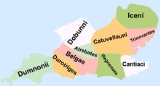
Dumnonii

Encyclopedia
The Dumnonii or Dumnones were a British
Celt
ic tribe who inhabited Dumnonia
, the area now known as Devon
and Cornwall
in the farther parts of the South West
peninsula of Britain, from at least the Iron Age
up to the early Saxon period
. They were bordered to the east by the Durotriges
.
, in his 1607 edition of “Britannia”, describes Cornwall
and Devon
as being two parts of the same 'country' which:
“was in ancient time inhabited by those Britains whom Solinus called Dunmonii, Ptolomee
Damnonii
, or (as we find in some other copies) more truly Danmonii. ... . But... the Country of this nation is at this day divided into two parts, known by later names of Cornwall and Denshire [Devonshire] ... The near or hithermore region of the Danmonians that I spake of is now commonly called Denshire, [or] by the Cornish-Britains ‘Dewnan’, and by the Welsh Britains ‘Duffneint’, that is, ‘low valleys’, for that the people dwell for the most part beneath in Vales; by the English
Saxons
[it is known as] ‘Deven-schire’, whereof grew the Latin name ‘Devonia’, and by that contraction which the vulgar people useth, ‘Denshire’.”
William Camden
had learnt some Welsh
during the course of his studies and it would appear that he is the origin of the interpretation of Dumnonii as "deep valley dwellers" from his understanding of the Welsh of his time. An alternative derivation is from the Gaelic
Domhnain which merely means "land" and leads to the meaning "people of the land", Latin
ised as Dumnonii. Another tribe with a similar name but with no known links were the Fir Domnann
in the province of Connacht
.
The Roman name of the town of Exeter
, Isca Dumnoniorum
, contains the Celtic root *iska- "water" (cognate with Irish uisce (See Whisky
)) for "Water of the Dumnonii". The Latin name suggests that the city was already a Celtic oppidum
, or walled town, on the banks on the River Exe
before the foundation of the Roman city, in about AD 50. The Dumnonii would give their name to the English county of Devon
, and their name is represented in Britain's two extant Brythonic
languages as Dewnans in Cornish
and Dyfnaint in Welsh
. Amédée Thierry
(Histoire des Gauloises, 1828), one of the inventors of the "historic race" of Gauls, could confidently equate them with the Cornish
("les Cornouailles").
, Devon
and Cornwall
and possibly part of Dorset
. Their cultural connections, as expressed in their ceramics, were with the peninsula of Armorica
across the Channel, rather than with the southeast of Britain. They do not seem to have been politically centralised: coins are relatively rare, none of them locally minted, and the structure, distribution and construction of Bronze Age and Iron Age hill forts, "rounds" and defensible farmsteads in the south west point to a number of smaller tribal groups living alongside each other.
Ptolemy
's 2nd century Geography places the Dumnonii to the west of the Durotriges
, and names four of their towns: Isca Dumnoniorum
(later Caeresk, now Exeter), Tamara (presumably on the River Tamar
, possibly in the area of modern Plymouth
), Uxella (perhaps on the River Axe) and Voliba (unidentified). The Ravenna Cosmography
adds the names of two more settlements: Nemetostatio, a name relating to nemeton
, signifying "sanctuary' or "sacred grove
" (probably to be identified with North Tawton, Devon) and Durocornavium (unidentified, but possibly Tintagel
or Carn Brea
). The name Durocornavium implies the existence of a tribe called the Cornavii, perhaps the ancestors of the Cornish people
(although some trace the Cornish to an unlikely hypothetical migration of the Cornovii
of the West Midlands). See the article Cornovii (Cornish)
for further information.
In the sub-Roman
period a Brythonic kingdom called Dumnonia
emerged, covering the entire peninsula, although it is believed by some to have effectively been a collection of sub-kingdoms.
Interestingly a kingdom of Domnonee (and of (Kernev/Cornouaille
alongside) was established in the province of Armorica
directly across the English Channel
, and has apparent links with the British population, suggesting an ancient connection of peoples along the western Atlantic seaboard.
The Dumnonii would have spoken a Brythonic
dialect ancestral to modern Cornish
and Breton
.
Victorian historians often referred to this tribe as the Damnonii
, which is also the name of another Celtic people from lowland Scotland, although there are no known links between the two populations. Another tribe with a similar name but with no known links was the Fir Domnann
in the province of Connacht
.
The god worshiped by the Dumnonii was known as 'Dumnonos'
name for Exeter, Isca Dumnoniorum ("Water of the Dumnonii"), suggests that the city was of Celt
ic origin. This oppidum
(a Latin
term meaning an important town) on the banks of the River Exe
certainly existed prior to the foundation of the Roman city
in about AD 50, however the name may have been suggested by a Celtic adviser to the Romans, rather than by the original inhabitants of the place http://www.roman-britain.org/places/isca_dumnoniorum.htm. Such early towns, or proto-cities, had been a feature of pre-Roman Gaul
as described by Julius Caesar
in his Commentarii de Bello Gallico
("Commentaries on the Gallic War") and it is possible that they existed in neighbouring Great Britain
as well. Isca is derived from a Brythonic Celtic
word for flowing water, which was given to the Exe and, elsewhere, to the River Usk
(Welsh: 'Afon Wysg) on which Caerleon
near Newport
, South Wales
stands. The Romans gave the city the name Isca Dumnoniorum in order to distinguish it from Isca Augusta
, modern Caerleon.
Isca Dumnoniorum originated with a canaba that developed around the Roman
fortress of the Legio II Augusta
and is one of the four poleis (cities) attributed to the tribe by Ptolemy
: Next to these, but more to the west, are the Dumnoni,¹ whose towns are: Voliba [14*45 52°00] Uxella [15*00 52°45] Tamara [15*00 52°15] Isca,² where is located Legio II Augusta³ [17*30 52°45]. Ptolemy
's Geography
of the 2nd century.
Isca Dumnoniorum is listed in two routes of the late 2nd century Antonine Itinerary
, however, its inclusion in Iter XII seems to be an error. The remaining route, Iter XV, the last in the British section, is entitled "the route from Calleva
to Isca Dumnoniorum
", wherein Isca appears as the southern terminus and listed some 20 km from Muridunum (nr. Honiton
, Devon
). Isca may also be the settlement named in the Ravenna Cosmography
of the 7th century; however this is debated as perhaps due to the confused scribal entry of Scadu Namorum between two unknown entries, namely Melamoni and Termonin which may also be corruptions in themselves.
The first Roman military building to be identified was the principia or regimental headquarters of a Neronian legionary fortress, built around AD 55-60 and below the monumental administrative buildings of the later Flavian
period. This building lay at the centre of a 37 acre (15 ha) enclosure making it rather small for a legionary fortress – usually around 50 acres (20 ha) in area. It seems likely that the camp was never intended to house a full complement of the Legio II Augusta
and that this reduction in the legionary complement may have been for two chief reasons. First, the legion may have suffered the loss of more than 1,000 men during its earlier campaigns in southern Britain. Secondly, a number of cohorts were housed elsewhere, possibly at Corinium in Gloucestershire
or maybe on the Continent. "It is probable that there was an auxiliary fort at Exeter itself, which remains to be found below the later legionary base."
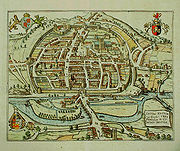 For a long time the passage in Ptolemy
which located the Legio II Augusta
within the lands of the Dumnonii was believed to be wrong, in that the ancient author had mistakenly copied the data for Isca Silurum in South Wales
; however, recent finds seem to confirm the presence of this unit during the early Neronian period. According to Salway, the legion's presence at Isca Dumnoniorum
is supported by the appearance of a stamped roofing-tile there, in a layer dated to around AD 60. A legionary bath-house was built inside the fortress sometime between 55 and 60 and underwent renovation shortly afterwards (c. 60-65) but by c. 68 (perhaps even 66) the legion had transferred to a newer fortress at Gloucester
. This saw the dismantling of the Isca fortress, and the site was then abandoned. The Legio II Augusta
was part of the Claudian
invasion of Britain in AD 43, and future Emperor Vespasian
was commander at the time. Vespasian led campaigns against both the Durotriges
and Dumnonii. The Legio II Augusta
was recorded as having suffered defeat by the Silures
in 52. After Suetonius Paulinus's victory crushing the Boudiccan rebellion, the legion moved around military sites in Britannia
. Around AD 75, work on the civitas forum and basilica had commenced on the site of the former principia and by the late 2nd century the civitas walls had been completed. They were 3 metres thick and 6 metres high and enclosed exactly the same area as the earlier fortress. However by the late 4th century the civitas was in decline.
Significant parts of the Roman wall remain, though the present visible structure was largely built on the orders of Alfred the Great
to protect the far west of his kingdom following the Viking
occupation of 876. Most of its route can be traced on foot. There is a substantial Roman baths
complex that was excavated in the 1970s, but because of its proximity to the cathedral it has not been practicable to retain the excavation for public view. Exeter was also the southern end of the Fosse Way
Roman road
.
Other settlements that may have been identified are:
Names that appear in the Itineraries include:
Other Romano-British
sites in the Dumnonian area include:
New settlements continued to be built throughout the Roman period, including sites at Chysauster and Trevelgue Head. The style is native in form with no Romanised features. Near Padstow
, a Roman site of some importance now lies buried under the sands on the opposite side of the Camel
estuary near St. Enodoc's Church, and may have been a western coastal equivalent of a Saxon Shore Fort. At Magor Farm in Illogan
, near Camborne
, an archaeological site has been identified as being a villa
.
period, but also for its lack of a villa system
. Local archaeology has revealed instead the isolated enclosed farmsteads known locally as rounds. These seem to have survived the Roman
abandonment of Britain, but were subsequently replaced, in the 6th and 7th centuries, by the unenclosed farms taking the Brythonic
toponymic tre-. As in most other Brythonic areas, Iron Age
hill forts, such as Cadbury Castle
, were refortified for the use of chieftains or kings. Other high-status settlements such as Tintagel
seem to have been reconstructed during this period. Post-Roman imported pottery has been excavated from many sites across the region, and the apparent surge in late 5th century Mediterranean and/or Byzantine
imports is yet to be explained satisfactorily.
). Tin extraction (mainly by streaming) had existed here from the early Bronze Age
around the 22nd century BC. West Cornwall, around Mount's Bay
, was traditionally thought to have been visited by metal traders from the eastern Mediterranean During the first millennium BC trade became more organised, first with the Phoenicians, who settled Gades (Cadiz
) around 1100 BC, and later with the Greeks
, who had settled Massilia (Marseilles) and Narbo (Narbonne
) around 600 BC. Smelted Cornish tin was collected at Ictis whence it was conveyed across the Bay of Biscay to the mouth of the Loire
and then to Gades via the Loire
and Rhone
valleys. It went then through the Mediterranean Sea in ships to Gades.
During the period c. 500-450 BC, the tin deposits seem to have become more important, and fortified settlements appear such as at Chun Castle
and Kenidjack Castle, to protect both the tin smelters and mines.
The earliest account of Cornish tin mining was written by Pytheas
of Massilia late in the 4th century BC after his circumnavigation of the British Isles. Underground mining was described in this account, although it cannot be determined when it had started. Pytheas
's account was noted later by other writers including Pliny the Elder
and Diodorus Siculus
.
It is likely that tin trade with the Mediterranean was later on under the control of the Veneti
. Britain
was one of the places proposed for the Cassiterides
, that is Tin Islands. Tin working continued throughout Roman
occupation although it appears that output declined because of new supplies brought in from the deposits discovered in Iberia
(Spain and Portugal). However when these supplies diminished, production in Dumnonia
increased and appears to have reached a peak during the 3rd century AD.
most probably spoke a Southwestern Brythonic dialect similar to the forerunner of more recent Cornish
and Breton
. Irish
immigrants, the Déisi
, are evidenced by the Ogham
-inscribed stones they have left behind, confirmed and supplemented by toponymical studies. The stones are sometimes inscribed in Latin
, sometimes in both scripts. Tristram Risdon
suggested the continuance of a Brythonic dialect in the South Hams
, Devon, as late as the 14th century, in addition to its use in Cornwall.
history of Dumnonia comes from a variety of sources and is considered exceedingly difficult to interpret given that historical fact, legend and confused pseudo-history are compounded by a variety of sources in Middle Welsh and Latin
. The main sources available for discussion of this period include Gildas
's De Excidio Britanniae and Nennius
's Historia Brittonum, the Annales Cambriae
, Anglo Saxon Chronicle, William of Malmesbury
's Gesta Regum Anglorum and De Antiquitate Glastoniensis
Ecclesiae, along with texts from the Black Book of Carmarthen
and the Red Book of Hergest
, and Bede
's Historia ecclesiastica gentis Anglorum
as well as "The Descent of the Men of the North" (Bonedd Gwŷr y Gogledd
, in Peniarth MS 45 and elsewhere) and the Book of Baglan
.
Britons (historical)
The Britons were the Celtic people culturally dominating Great Britain from the Iron Age through the Early Middle Ages. They spoke the Insular Celtic language known as British or Brythonic...
Celt
Celt
The Celts were a diverse group of tribal societies in Iron Age and Roman-era Europe who spoke Celtic languages.The earliest archaeological culture commonly accepted as Celtic, or rather Proto-Celtic, was the central European Hallstatt culture , named for the rich grave finds in Hallstatt, Austria....
ic tribe who inhabited Dumnonia
Dumnonia
Dumnonia is the Latinised name for the Brythonic kingdom in sub-Roman Britain between the late 4th and late 8th centuries, located in the farther parts of the south-west peninsula of Great Britain...
, the area now known as Devon
Devon
Devon is a large county in southwestern England. The county is sometimes referred to as Devonshire, although the term is rarely used inside the county itself as the county has never been officially "shired", it often indicates a traditional or historical context.The county shares borders with...
and Cornwall
Cornwall
Cornwall is a unitary authority and ceremonial county of England, within the United Kingdom. It is bordered to the north and west by the Celtic Sea, to the south by the English Channel, and to the east by the county of Devon, over the River Tamar. Cornwall has a population of , and covers an area of...
in the farther parts of the South West
West Country
The West Country is an informal term for the area of south western England roughly corresponding to the modern South West England government region. It is often defined to encompass the historic counties of Cornwall, Devon, Dorset and Somerset and the City of Bristol, while the counties of...
peninsula of Britain, from at least the Iron Age
British Iron Age
The British Iron Age is a conventional name used in the archaeology of Great Britain, referring to the prehistoric and protohistoric phases of the Iron-Age culture of the main island and the smaller islands, typically excluding prehistoric Ireland, and which had an independent Iron Age culture of...
up to the early Saxon period
England
England is a country that is part of the United Kingdom. It shares land borders with Scotland to the north and Wales to the west; the Irish Sea is to the north west, the Celtic Sea to the south west, with the North Sea to the east and the English Channel to the south separating it from continental...
. They were bordered to the east by the Durotriges
Durotriges
The Durotriges were one of the Celtic tribes living in Britain prior to the Roman invasion. The tribe lived in modern Dorset, south Wiltshire and south Somerset...
.
Tribal nomenclature
William CamdenWilliam Camden
William Camden was an English antiquarian, historian, topographer, and officer of arms. He wrote the first chorographical survey of the islands of Great Britain and Ireland and the first detailed historical account of the reign of Elizabeth I of England.- Early years :Camden was born in London...
, in his 1607 edition of “Britannia”, describes Cornwall
Cornwall
Cornwall is a unitary authority and ceremonial county of England, within the United Kingdom. It is bordered to the north and west by the Celtic Sea, to the south by the English Channel, and to the east by the county of Devon, over the River Tamar. Cornwall has a population of , and covers an area of...
and Devon
Devon
Devon is a large county in southwestern England. The county is sometimes referred to as Devonshire, although the term is rarely used inside the county itself as the county has never been officially "shired", it often indicates a traditional or historical context.The county shares borders with...
as being two parts of the same 'country' which:
“was in ancient time inhabited by those Britains whom Solinus called Dunmonii, Ptolomee
Ptolemy
Claudius Ptolemy , was a Roman citizen of Egypt who wrote in Greek. He was a mathematician, astronomer, geographer, astrologer, and poet of a single epigram in the Greek Anthology. He lived in Egypt under Roman rule, and is believed to have been born in the town of Ptolemais Hermiou in the...
Damnonii
Damnonii
The Damnonii were a people of the late 2nd century who lived in what is now southern Scotland. They are mentioned briefly in Ptolemy's Geography, where he uses both of the terms "Damnonii" and "Damnii" to describe them, and there is no other historical record of them. Their cultural and...
, or (as we find in some other copies) more truly Danmonii. ... . But... the Country of this nation is at this day divided into two parts, known by later names of Cornwall and Denshire [Devonshire] ... The near or hithermore region of the Danmonians that I spake of is now commonly called Denshire, [or] by the Cornish-Britains ‘Dewnan’, and by the Welsh Britains ‘Duffneint’, that is, ‘low valleys’, for that the people dwell for the most part beneath in Vales; by the English
English people
The English are a nation and ethnic group native to England, who speak English. The English identity is of early mediaeval origin, when they were known in Old English as the Anglecynn. England is now a country of the United Kingdom, and the majority of English people in England are British Citizens...
Saxons
Saxons
The Saxons were a confederation of Germanic tribes originating on the North German plain. The Saxons earliest known area of settlement is Northern Albingia, an area approximately that of modern Holstein...
[it is known as] ‘Deven-schire’, whereof grew the Latin name ‘Devonia’, and by that contraction which the vulgar people useth, ‘Denshire’.”
William Camden
William Camden
William Camden was an English antiquarian, historian, topographer, and officer of arms. He wrote the first chorographical survey of the islands of Great Britain and Ireland and the first detailed historical account of the reign of Elizabeth I of England.- Early years :Camden was born in London...
had learnt some Welsh
Welsh language
Welsh is a member of the Brythonic branch of the Celtic languages spoken natively in Wales, by some along the Welsh border in England, and in Y Wladfa...
during the course of his studies and it would appear that he is the origin of the interpretation of Dumnonii as "deep valley dwellers" from his understanding of the Welsh of his time. An alternative derivation is from the Gaelic
Goidelic languages
The Goidelic languages or Gaelic languages are one of the two branches of the Insular Celtic languages, the other consisting of the Brythonic languages. Goidelic languages historically formed a dialect continuum stretching from the south of Ireland through the Isle of Man to the north of Scotland...
Domhnain which merely means "land" and leads to the meaning "people of the land", Latin
Latin
Latin is an Italic language originally spoken in Latium and Ancient Rome. It, along with most European languages, is a descendant of the ancient Proto-Indo-European language. Although it is considered a dead language, a number of scholars and members of the Christian clergy speak it fluently, and...
ised as Dumnonii. Another tribe with a similar name but with no known links were the Fir Domnann
Fir Domnann
The Fir Domnann were an ancient Irish people located in the west and north of Connacht, in Irrus Domnann, from which Erris in County Mayo now takes it's name. In Irish mythology they make up one third of the Fir Bolg. They are probably related to the British Dumnonii, and to the Irish Laigin...
in the province of Connacht
Connacht
Connacht , formerly anglicised as Connaught, is one of the Provinces of Ireland situated in the west of Ireland. In Ancient Ireland, it was one of the fifths ruled by a "king of over-kings" . Following the Norman invasion of Ireland, the ancient kingdoms were shired into a number of counties for...
.
The Roman name of the town of Exeter
Exeter
Exeter is a historic city in Devon, England. It lies within the ceremonial county of Devon, of which it is the county town as well as the home of Devon County Council. Currently the administrative area has the status of a non-metropolitan district, and is therefore under the administration of the...
, Isca Dumnoniorum
Isca Dumnoniorum
Isca Dumnoniorum was a town in the Roman province of Britannia and the capital of Dumnonia in the sub-Roman period. Today it is known as Exeter, located in the English county of Devon.-Fortress:...
, contains the Celtic root *iska- "water" (cognate with Irish uisce (See Whisky
Whisky
Whisky or whiskey is a type of distilled alcoholic beverage made from fermented grain mash. Different grains are used for different varieties, including barley, malted barley, rye, malted rye, wheat, and corn...
)) for "Water of the Dumnonii". The Latin name suggests that the city was already a Celtic oppidum
Oppidum
Oppidum is a Latin word meaning the main settlement in any administrative area of ancient Rome. The word is derived from the earlier Latin ob-pedum, "enclosed space," possibly from the Proto-Indo-European *pedóm-, "occupied space" or "footprint."Julius Caesar described the larger Celtic Iron Age...
, or walled town, on the banks on the River Exe
EXE
EXE is the common filename extension denoting an executable file in the DOS, OpenVMS, Microsoft Windows, Symbian, and OS/2 operating systems....
before the foundation of the Roman city, in about AD 50. The Dumnonii would give their name to the English county of Devon
Devon
Devon is a large county in southwestern England. The county is sometimes referred to as Devonshire, although the term is rarely used inside the county itself as the county has never been officially "shired", it often indicates a traditional or historical context.The county shares borders with...
, and their name is represented in Britain's two extant Brythonic
Brythonic languages
The Brythonic or Brittonic languages form one of the two branches of the Insular Celtic language family, the other being Goidelic. The name Brythonic was derived by Welsh Celticist John Rhys from the Welsh word Brython, meaning an indigenous Briton as opposed to an Anglo-Saxon or Gael...
languages as Dewnans in Cornish
Cornish language
Cornish is a Brythonic Celtic language and a recognised minority language of the United Kingdom. Along with Welsh and Breton, it is directly descended from the ancient British language spoken throughout much of Britain before the English language came to dominate...
and Dyfnaint in Welsh
Welsh language
Welsh is a member of the Brythonic branch of the Celtic languages spoken natively in Wales, by some along the Welsh border in England, and in Y Wladfa...
. Amédée Thierry
Amedée Simon Dominique Thierry
Amédée Simon Dominique Thierry , French journalist and historian, was the younger brother of Augustin.- Biography :Thierry was born in Blois, Loir-et-Cher....
(Histoire des Gauloises, 1828), one of the inventors of the "historic race" of Gauls, could confidently equate them with the Cornish
Cornish people
The Cornish are a people associated with Cornwall, a county and Duchy in the south-west of the United Kingdom that is seen in some respects as distinct from England, having more in common with the other Celtic parts of the United Kingdom such as Wales, as well as with other Celtic nations in Europe...
("les Cornouailles").
Archaeology
The Dumnonii are thought to have occupied relatively isolated territory in SomersetSomerset
The ceremonial and non-metropolitan county of Somerset in South West England borders Bristol and Gloucestershire to the north, Wiltshire to the east, Dorset to the south-east, and Devon to the south-west. It is partly bounded to the north and west by the Bristol Channel and the estuary of the...
, Devon
Devon
Devon is a large county in southwestern England. The county is sometimes referred to as Devonshire, although the term is rarely used inside the county itself as the county has never been officially "shired", it often indicates a traditional or historical context.The county shares borders with...
and Cornwall
Cornwall
Cornwall is a unitary authority and ceremonial county of England, within the United Kingdom. It is bordered to the north and west by the Celtic Sea, to the south by the English Channel, and to the east by the county of Devon, over the River Tamar. Cornwall has a population of , and covers an area of...
and possibly part of Dorset
Dorset
Dorset , is a county in South West England on the English Channel coast. The county town is Dorchester which is situated in the south. The Hampshire towns of Bournemouth and Christchurch joined the county with the reorganisation of local government in 1974...
. Their cultural connections, as expressed in their ceramics, were with the peninsula of Armorica
Armorica
Armorica or Aremorica is the name given in ancient times to the part of Gaul that includes the Brittany peninsula and the territory between the Seine and Loire rivers, extending inland to an indeterminate point and down the Atlantic coast...
across the Channel, rather than with the southeast of Britain. They do not seem to have been politically centralised: coins are relatively rare, none of them locally minted, and the structure, distribution and construction of Bronze Age and Iron Age hill forts, "rounds" and defensible farmsteads in the south west point to a number of smaller tribal groups living alongside each other.
Ptolemy
Ptolemy
Claudius Ptolemy , was a Roman citizen of Egypt who wrote in Greek. He was a mathematician, astronomer, geographer, astrologer, and poet of a single epigram in the Greek Anthology. He lived in Egypt under Roman rule, and is believed to have been born in the town of Ptolemais Hermiou in the...
's 2nd century Geography places the Dumnonii to the west of the Durotriges
Durotriges
The Durotriges were one of the Celtic tribes living in Britain prior to the Roman invasion. The tribe lived in modern Dorset, south Wiltshire and south Somerset...
, and names four of their towns: Isca Dumnoniorum
Isca Dumnoniorum
Isca Dumnoniorum was a town in the Roman province of Britannia and the capital of Dumnonia in the sub-Roman period. Today it is known as Exeter, located in the English county of Devon.-Fortress:...
(later Caeresk, now Exeter), Tamara (presumably on the River Tamar
River Tamar
The Tamar is a river in South West England, that forms most of the border between Devon and Cornwall . It is one of several British rivers whose ancient name is assumed to be derived from a prehistoric river word apparently meaning "dark flowing" and which it shares with the River Thames.The...
, possibly in the area of modern Plymouth
Plymouth
Plymouth is a city and unitary authority area on the coast of Devon, England, about south-west of London. It is built between the mouths of the rivers Plym to the east and Tamar to the west, where they join Plymouth Sound...
), Uxella (perhaps on the River Axe) and Voliba (unidentified). The Ravenna Cosmography
Ravenna Cosmography
The Ravenna Cosmography was compiled by an anonymous cleric in Ravenna around AD 700. It consists of a list of place-names covering the world from India to Ireland. Textual evidence indicates that the author frequently used maps as his source....
adds the names of two more settlements: Nemetostatio, a name relating to nemeton
Nemeton
A nemeton was a sacred space of ancient Celtic religion. Nemeta appear to have been primarily situated in natural areas, and, as they often utilized trees, they are often interpreted as sacred groves. However, other evidence suggests that the word implied a wider variety of ritual spaces, such as...
, signifying "sanctuary' or "sacred grove
Sacred grove
A sacred grove is a grove of trees of special religious importance to a particular culture. Sacred groves were most prominent in the Ancient Near East and prehistoric Europe, but feature in various cultures throughout the world...
" (probably to be identified with North Tawton, Devon) and Durocornavium (unidentified, but possibly Tintagel
Tintagel
Tintagel is a civil parish and village situated on the Atlantic coast of Cornwall, United Kingdom. The population of the parish is 1,820 people, and the area of the parish is ....
or Carn Brea
Carn Brea
Carn Brea is a civil parish and hilltop site in Cornwall, United Kingdom. The hilltop site is situated approximately one mile southwest of Redruth.-Neolithic settlement:...
). The name Durocornavium implies the existence of a tribe called the Cornavii, perhaps the ancestors of the Cornish people
Cornish people
The Cornish are a people associated with Cornwall, a county and Duchy in the south-west of the United Kingdom that is seen in some respects as distinct from England, having more in common with the other Celtic parts of the United Kingdom such as Wales, as well as with other Celtic nations in Europe...
(although some trace the Cornish to an unlikely hypothetical migration of the Cornovii
Cornovii (Cornish)
The Cornovii were a Celtic tribe who inhabited the far South West peninsula of Great Britain, during the Iron Age, Roman and post-Roman periods and gave their name to Cornwall or Kernow....
of the West Midlands). See the article Cornovii (Cornish)
Cornovii (Cornish)
The Cornovii were a Celtic tribe who inhabited the far South West peninsula of Great Britain, during the Iron Age, Roman and post-Roman periods and gave their name to Cornwall or Kernow....
for further information.
In the sub-Roman
Sub-Roman Britain
Sub-Roman Britain is a term derived from an archaeological label for the material culture of Britain in Late Antiquity: the term "Sub-Roman" was invented to describe the potsherds in sites of the 5th century and the 6th century, initially with an implication of decay of locally-made wares from a...
period a Brythonic kingdom called Dumnonia
Dumnonia
Dumnonia is the Latinised name for the Brythonic kingdom in sub-Roman Britain between the late 4th and late 8th centuries, located in the farther parts of the south-west peninsula of Great Britain...
emerged, covering the entire peninsula, although it is believed by some to have effectively been a collection of sub-kingdoms.
Interestingly a kingdom of Domnonee (and of (Kernev/Cornouaille
Cornouaille
Cornouaille is a historic region in Brittany, in northwest France. The name is identical to the French name for the Duchy of Cornwall, since the area was settled by migrant princes from Cornwall...
alongside) was established in the province of Armorica
Armorica
Armorica or Aremorica is the name given in ancient times to the part of Gaul that includes the Brittany peninsula and the territory between the Seine and Loire rivers, extending inland to an indeterminate point and down the Atlantic coast...
directly across the English Channel
English Channel
The English Channel , often referred to simply as the Channel, is an arm of the Atlantic Ocean that separates southern England from northern France, and joins the North Sea to the Atlantic. It is about long and varies in width from at its widest to in the Strait of Dover...
, and has apparent links with the British population, suggesting an ancient connection of peoples along the western Atlantic seaboard.
The Dumnonii would have spoken a Brythonic
Brythonic languages
The Brythonic or Brittonic languages form one of the two branches of the Insular Celtic language family, the other being Goidelic. The name Brythonic was derived by Welsh Celticist John Rhys from the Welsh word Brython, meaning an indigenous Briton as opposed to an Anglo-Saxon or Gael...
dialect ancestral to modern Cornish
Cornish language
Cornish is a Brythonic Celtic language and a recognised minority language of the United Kingdom. Along with Welsh and Breton, it is directly descended from the ancient British language spoken throughout much of Britain before the English language came to dominate...
and Breton
Breton language
Breton is a Celtic language spoken in Brittany , France. Breton is a Brythonic language, descended from the Celtic British language brought from Great Britain to Armorica by migrating Britons during the Early Middle Ages. Like the other Brythonic languages, Welsh and Cornish, it is classified as...
.
Victorian historians often referred to this tribe as the Damnonii
Damnonii
The Damnonii were a people of the late 2nd century who lived in what is now southern Scotland. They are mentioned briefly in Ptolemy's Geography, where he uses both of the terms "Damnonii" and "Damnii" to describe them, and there is no other historical record of them. Their cultural and...
, which is also the name of another Celtic people from lowland Scotland, although there are no known links between the two populations. Another tribe with a similar name but with no known links was the Fir Domnann
Fir Domnann
The Fir Domnann were an ancient Irish people located in the west and north of Connacht, in Irrus Domnann, from which Erris in County Mayo now takes it's name. In Irish mythology they make up one third of the Fir Bolg. They are probably related to the British Dumnonii, and to the Irish Laigin...
in the province of Connacht
Connacht
Connacht , formerly anglicised as Connaught, is one of the Provinces of Ireland situated in the west of Ireland. In Ancient Ireland, it was one of the fifths ruled by a "king of over-kings" . Following the Norman invasion of Ireland, the ancient kingdoms were shired into a number of counties for...
.
The god worshiped by the Dumnonii was known as 'Dumnonos'
Isca Dumnoniorum and other settlements
The LatinLatin
Latin is an Italic language originally spoken in Latium and Ancient Rome. It, along with most European languages, is a descendant of the ancient Proto-Indo-European language. Although it is considered a dead language, a number of scholars and members of the Christian clergy speak it fluently, and...
name for Exeter, Isca Dumnoniorum ("Water of the Dumnonii"), suggests that the city was of Celt
Celt
The Celts were a diverse group of tribal societies in Iron Age and Roman-era Europe who spoke Celtic languages.The earliest archaeological culture commonly accepted as Celtic, or rather Proto-Celtic, was the central European Hallstatt culture , named for the rich grave finds in Hallstatt, Austria....
ic origin. This oppidum
Oppidum
Oppidum is a Latin word meaning the main settlement in any administrative area of ancient Rome. The word is derived from the earlier Latin ob-pedum, "enclosed space," possibly from the Proto-Indo-European *pedóm-, "occupied space" or "footprint."Julius Caesar described the larger Celtic Iron Age...
(a Latin
Latin
Latin is an Italic language originally spoken in Latium and Ancient Rome. It, along with most European languages, is a descendant of the ancient Proto-Indo-European language. Although it is considered a dead language, a number of scholars and members of the Christian clergy speak it fluently, and...
term meaning an important town) on the banks of the River Exe
River Exe
The River Exe in England rises near the village of Simonsbath, on Exmoor in Somerset, near the Bristol Channel coast, but flows more or less directly due south, so that most of its length lies in Devon. It reaches the sea at a substantial ria, the Exe Estuary, on the south coast of Devon...
certainly existed prior to the foundation of the Roman city
Roman Britain
Roman Britain was the part of the island of Great Britain controlled by the Roman Empire from AD 43 until ca. AD 410.The Romans referred to the imperial province as Britannia, which eventually comprised all of the island of Great Britain south of the fluid frontier with Caledonia...
in about AD 50, however the name may have been suggested by a Celtic adviser to the Romans, rather than by the original inhabitants of the place http://www.roman-britain.org/places/isca_dumnoniorum.htm. Such early towns, or proto-cities, had been a feature of pre-Roman Gaul
Gaul
Gaul was a region of Western Europe during the Iron Age and Roman era, encompassing present day France, Luxembourg and Belgium, most of Switzerland, the western part of Northern Italy, as well as the parts of the Netherlands and Germany on the left bank of the Rhine. The Gauls were the speakers of...
as described by Julius Caesar
Julius Caesar
Gaius Julius Caesar was a Roman general and statesman and a distinguished writer of Latin prose. He played a critical role in the gradual transformation of the Roman Republic into the Roman Empire....
in his Commentarii de Bello Gallico
Commentarii de Bello Gallico
Commentarii de Bello Gallico is Julius Caesar's firsthand account of the Gallic Wars, written as a third-person narrative. In it Caesar describes the battles and intrigues that took place in the nine years he spent fighting local armies in Gaul that opposed Roman domination.The "Gaul" that Caesar...
("Commentaries on the Gallic War") and it is possible that they existed in neighbouring Great Britain
Great Britain
Great Britain or Britain is an island situated to the northwest of Continental Europe. It is the ninth largest island in the world, and the largest European island, as well as the largest of the British Isles...
as well. Isca is derived from a Brythonic Celtic
Celtic languages
The Celtic languages are descended from Proto-Celtic, or "Common Celtic"; a branch of the greater Indo-European language family...
word for flowing water, which was given to the Exe and, elsewhere, to the River Usk
River Usk
The River Usk rises on the northern slopes of the Black Mountain of mid-Wales, in the easternmost part of the Brecon Beacons National Park. Initially it flows north into Usk Reservoir, then east by Sennybridge to Brecon before turning southeast to flow by Talybont-on-Usk, Crickhowell and...
(Welsh: 'Afon Wysg) on which Caerleon
Caerleon
Caerleon is a suburban village and community, situated on the River Usk in the northern outskirts of the city of Newport, South Wales. Caerleon is a site of archaeological importance, being the site of a notable Roman legionary fortress, Isca Augusta, and an Iron Age hill fort...
near Newport
Newport
Newport is a city and unitary authority area in Wales. Standing on the banks of the River Usk, it is located about east of Cardiff and is the largest urban area within the historic county boundaries of Monmouthshire and the preserved county of Gwent...
, South Wales
South Wales
South Wales is an area of Wales bordered by England and the Bristol Channel to the east and south, and Mid Wales and West Wales to the north and west. The most densely populated region in the south-west of the United Kingdom, it is home to around 2.1 million people and includes the capital city of...
stands. The Romans gave the city the name Isca Dumnoniorum in order to distinguish it from Isca Augusta
Isca Augusta
Isca Augusta was a Roman legionary fortress and settlement, the remains of which lie beneath parts of the present-day village of Caerleon on the northern outskirts of the city of Newport in South Wales.-Name:...
, modern Caerleon.
Isca Dumnoniorum originated with a canaba that developed around the Roman
Roman Empire
The Roman Empire was the post-Republican period of the ancient Roman civilization, characterised by an autocratic form of government and large territorial holdings in Europe and around the Mediterranean....
fortress of the Legio II Augusta
Legio II Augusta
Legio secunda Augusta , was a Roman legion, levied by Gaius Vibius Pansa Caetronianus in 43 BC, and still operative in Britannia in the 4th century...
and is one of the four poleis (cities) attributed to the tribe by Ptolemy
Ptolemy
Claudius Ptolemy , was a Roman citizen of Egypt who wrote in Greek. He was a mathematician, astronomer, geographer, astrologer, and poet of a single epigram in the Greek Anthology. He lived in Egypt under Roman rule, and is believed to have been born in the town of Ptolemais Hermiou in the...
: Next to these, but more to the west, are the Dumnoni,¹ whose towns are: Voliba [14*45 52°00] Uxella [15*00 52°45] Tamara [15*00 52°15] Isca,² where is located Legio II Augusta³ [17*30 52°45]. Ptolemy
Ptolemy
Claudius Ptolemy , was a Roman citizen of Egypt who wrote in Greek. He was a mathematician, astronomer, geographer, astrologer, and poet of a single epigram in the Greek Anthology. He lived in Egypt under Roman rule, and is believed to have been born in the town of Ptolemais Hermiou in the...
's Geography
Geography
Geography is the science that studies the lands, features, inhabitants, and phenomena of Earth. A literal translation would be "to describe or write about the Earth". The first person to use the word "geography" was Eratosthenes...
of the 2nd century.
Isca Dumnoniorum is listed in two routes of the late 2nd century Antonine Itinerary
Antonine Itinerary
The Antonine Itinerary is a register of the stations and distances along the various roads of the Roman empire, containing directions how to get from one Roman settlement to another...
, however, its inclusion in Iter XII seems to be an error. The remaining route, Iter XV, the last in the British section, is entitled "the route from Calleva
Calleva
Calleva is the largest outdoor education organization in Central Maryland, established to provide outdoor team building opportunities for groups such as schools and companies, and to take groups of individuals on various excursions throughout Maryland, Virginia, and West Virginia.-History:Calleva...
to Isca Dumnoniorum
Isca Dumnoniorum
Isca Dumnoniorum was a town in the Roman province of Britannia and the capital of Dumnonia in the sub-Roman period. Today it is known as Exeter, located in the English county of Devon.-Fortress:...
", wherein Isca appears as the southern terminus and listed some 20 km from Muridunum (nr. Honiton
Honiton
Honiton is a town and civil parish in East Devon, situated close to the River Otter, north east of Exeter in the county of Devon. The town's name is pronounced in two ways, and , each pronunciation having its adherents...
, Devon
Devon
Devon is a large county in southwestern England. The county is sometimes referred to as Devonshire, although the term is rarely used inside the county itself as the county has never been officially "shired", it often indicates a traditional or historical context.The county shares borders with...
). Isca may also be the settlement named in the Ravenna Cosmography
Ravenna Cosmography
The Ravenna Cosmography was compiled by an anonymous cleric in Ravenna around AD 700. It consists of a list of place-names covering the world from India to Ireland. Textual evidence indicates that the author frequently used maps as his source....
of the 7th century; however this is debated as perhaps due to the confused scribal entry of Scadu Namorum between two unknown entries, namely Melamoni and Termonin which may also be corruptions in themselves.
The first Roman military building to be identified was the principia or regimental headquarters of a Neronian legionary fortress, built around AD 55-60 and below the monumental administrative buildings of the later Flavian
Flavian dynasty
The Flavian dynasty was a Roman Imperial Dynasty, which ruled the Roman Empire between 69 and 96 AD, encompassing the reigns of Vespasian , and his two sons Titus and Domitian . The Flavians rose to power during the civil war of 69, known as the Year of the Four Emperors...
period. This building lay at the centre of a 37 acre (15 ha) enclosure making it rather small for a legionary fortress – usually around 50 acres (20 ha) in area. It seems likely that the camp was never intended to house a full complement of the Legio II Augusta
Legio II Augusta
Legio secunda Augusta , was a Roman legion, levied by Gaius Vibius Pansa Caetronianus in 43 BC, and still operative in Britannia in the 4th century...
and that this reduction in the legionary complement may have been for two chief reasons. First, the legion may have suffered the loss of more than 1,000 men during its earlier campaigns in southern Britain. Secondly, a number of cohorts were housed elsewhere, possibly at Corinium in Gloucestershire
Gloucestershire
Gloucestershire is a county in South West England. The county comprises part of the Cotswold Hills, part of the flat fertile valley of the River Severn, and the entire Forest of Dean....
or maybe on the Continent. "It is probable that there was an auxiliary fort at Exeter itself, which remains to be found below the later legionary base."
Ptolemy
Claudius Ptolemy , was a Roman citizen of Egypt who wrote in Greek. He was a mathematician, astronomer, geographer, astrologer, and poet of a single epigram in the Greek Anthology. He lived in Egypt under Roman rule, and is believed to have been born in the town of Ptolemais Hermiou in the...
which located the Legio II Augusta
Legio II Augusta
Legio secunda Augusta , was a Roman legion, levied by Gaius Vibius Pansa Caetronianus in 43 BC, and still operative in Britannia in the 4th century...
within the lands of the Dumnonii was believed to be wrong, in that the ancient author had mistakenly copied the data for Isca Silurum in South Wales
South Wales
South Wales is an area of Wales bordered by England and the Bristol Channel to the east and south, and Mid Wales and West Wales to the north and west. The most densely populated region in the south-west of the United Kingdom, it is home to around 2.1 million people and includes the capital city of...
; however, recent finds seem to confirm the presence of this unit during the early Neronian period. According to Salway, the legion's presence at Isca Dumnoniorum
Isca Dumnoniorum
Isca Dumnoniorum was a town in the Roman province of Britannia and the capital of Dumnonia in the sub-Roman period. Today it is known as Exeter, located in the English county of Devon.-Fortress:...
is supported by the appearance of a stamped roofing-tile there, in a layer dated to around AD 60. A legionary bath-house was built inside the fortress sometime between 55 and 60 and underwent renovation shortly afterwards (c. 60-65) but by c. 68 (perhaps even 66) the legion had transferred to a newer fortress at Gloucester
Gloucester
Gloucester is a city, district and county town of Gloucestershire in the South West region of England. Gloucester lies close to the Welsh border, and on the River Severn, approximately north-east of Bristol, and south-southwest of Birmingham....
. This saw the dismantling of the Isca fortress, and the site was then abandoned. The Legio II Augusta
Legio II Augusta
Legio secunda Augusta , was a Roman legion, levied by Gaius Vibius Pansa Caetronianus in 43 BC, and still operative in Britannia in the 4th century...
was part of the Claudian
Claudian
Claudian was a Roman poet, who worked for Emperor Honorius and the latter's general Stilicho.A Greek-speaking citizen of Alexandria and probably not a Christian convert, Claudian arrived in Rome before 395. He made his mark with a eulogy of his two young patrons, Probinus and Olybrius, thereby...
invasion of Britain in AD 43, and future Emperor Vespasian
Vespasian
Vespasian , was Roman Emperor from 69 AD to 79 AD. Vespasian was the founder of the Flavian dynasty, which ruled the Empire for a quarter century. Vespasian was descended from a family of equestrians, who rose into the senatorial rank under the Emperors of the Julio-Claudian dynasty...
was commander at the time. Vespasian led campaigns against both the Durotriges
Durotriges
The Durotriges were one of the Celtic tribes living in Britain prior to the Roman invasion. The tribe lived in modern Dorset, south Wiltshire and south Somerset...
and Dumnonii. The Legio II Augusta
Legio II Augusta
Legio secunda Augusta , was a Roman legion, levied by Gaius Vibius Pansa Caetronianus in 43 BC, and still operative in Britannia in the 4th century...
was recorded as having suffered defeat by the Silures
Silures
The Silures were a powerful and warlike tribe of ancient Britain, occupying approximately the counties of Monmouthshire, Breconshire and Glamorganshire of present day South Wales; and possibly Gloucestershire and Herefordshire of present day England...
in 52. After Suetonius Paulinus's victory crushing the Boudiccan rebellion, the legion moved around military sites in Britannia
Britannia
Britannia is an ancient term for Great Britain, and also a female personification of the island. The name is Latin, and derives from the Greek form Prettanike or Brettaniai, which originally designated a collection of islands with individual names, including Albion or Great Britain. However, by the...
. Around AD 75, work on the civitas forum and basilica had commenced on the site of the former principia and by the late 2nd century the civitas walls had been completed. They were 3 metres thick and 6 metres high and enclosed exactly the same area as the earlier fortress. However by the late 4th century the civitas was in decline.
Significant parts of the Roman wall remain, though the present visible structure was largely built on the orders of Alfred the Great
Alfred the Great
Alfred the Great was King of Wessex from 871 to 899.Alfred is noted for his defence of the Anglo-Saxon kingdoms of southern England against the Vikings, becoming the only English monarch still to be accorded the epithet "the Great". Alfred was the first King of the West Saxons to style himself...
to protect the far west of his kingdom following the Viking
Viking
The term Viking is customarily used to refer to the Norse explorers, warriors, merchants, and pirates who raided, traded, explored and settled in wide areas of Europe, Asia and the North Atlantic islands from the late 8th to the mid-11th century.These Norsemen used their famed longships to...
occupation of 876. Most of its route can be traced on foot. There is a substantial Roman baths
Roman Baths
The Roman Baths complex is a site of historical interest in the English city of Bath. The house is a well-preserved Roman site for public bathing....
complex that was excavated in the 1970s, but because of its proximity to the cathedral it has not been practicable to retain the excavation for public view. Exeter was also the southern end of the Fosse Way
Fosse Way
The Fosse Way was a Roman road in England that linked Exeter in South West England to Lincoln in Lincolnshire, via Ilchester , Bath , Cirencester and Leicester .It joined Akeman Street and Ermin Way at Cirencester, crossed Watling Street at Venonis south...
Roman road
Roman road
The Roman roads were a vital part of the development of the Roman state, from about 500 BC through the expansion during the Roman Republic and the Roman Empire. Roman roads enabled the Romans to move armies and trade goods and to communicate. The Roman road system spanned more than 400,000 km...
.
Other settlements that may have been identified are:
- Uxelis (Launceston) - Uxella in the Ravenna Cosmography. The name has been connected to the Somerset river Axe, although no Roman settlement has yet been found.
- Tamaris (PlymouthPlymouthPlymouth is a city and unitary authority area on the coast of Devon, England, about south-west of London. It is built between the mouths of the rivers Plym to the east and Tamar to the west, where they join Plymouth Sound...
)-Tamara in the Ravenna Cosmography suggesting a settlement on the River TamarRiver TamarThe Tamar is a river in South West England, that forms most of the border between Devon and Cornwall . It is one of several British rivers whose ancient name is assumed to be derived from a prehistoric river word apparently meaning "dark flowing" and which it shares with the River Thames.The...
- although not yet positively identified.
Names that appear in the Itineraries include:
- Nemetostatio (North TawtonNorth TawtonNorth Tawton is a small town in Devon, England, situated on the river Taw.-History:The Romans crossed the River Taw at what is now Newland Mill, a little outside the present town, and established a succession of military camps there over the years...
)- A Roman earthwork found here may be military, or possibly a tax collection station. This location is named in the Ravenna Cosmography. - VolibaVolibaVoliba is a genus of moths of the Crambidae family.-Species:*Voliba asphyctopa Turner, 1908*Voliba gigantea Hampson, 1912*Voliba leptomorpha Turner, 1908*Voliba psammoessa Turner, 1908*Voliba pycnosticta Turner, 1908...
- unidentified - Durocornavium - Purocoronavis in the Ravenna Cosmography, it may refer to an important native hill fort, such as Carn BreaCarn BreaCarn Brea is a civil parish and hilltop site in Cornwall, United Kingdom. The hilltop site is situated approximately one mile southwest of Redruth.-Neolithic settlement:...
or TintagelTintagelTintagel is a civil parish and village situated on the Atlantic coast of Cornwall, United Kingdom. The population of the parish is 1,820 people, and the area of the parish is ....
. The name has led to speculation about the Cornish CornoviiCornovii (Cornish)The Cornovii were a Celtic tribe who inhabited the far South West peninsula of Great Britain, during the Iron Age, Roman and post-Roman periods and gave their name to Cornwall or Kernow....
.
Other Romano-British
Romano-British
Romano-British culture describes the culture that arose in Britain under the Roman Empire following the Roman conquest of AD 43 and the creation of the province of Britannia. It arose as a fusion of the imported Roman culture with that of the indigenous Britons, a people of Celtic language and...
sites in the Dumnonian area include:
- TopshamTopsham, DevonTopsham is a suburb of Exeter in the county of Devon, England, on the east side of the River Exe, immediately north of its confluence with the River Clyst and the former's estuary, between Exeter and Exmouth. Although village-sized, with a current population of around 5,023, it was designated a...
(Devon) - a settlement and harbour that served Isca Dumnoniorum to which it was connected by road and river. - Ictis (St. Michael's Mount) - an ancient port trading in tin.
- NanstallonNanstallonNanstallon is a village in central Cornwall, United Kingdom. It is situated approximately two miles west of Bodmin.Nanstallon is in the civil parish of Lanivet overlooking the River Camel valley and the Camel Trail long distance path. The present terminus of the Bodmin and Wenford Railway at...
(Cornwall) - a square military enclosure, seemingly associated with tin workings at nearby Boscarne. - TauntonTauntonTaunton is the county town of Somerset, England. The town, including its suburbs, had an estimated population of 61,400 in 2001. It is the largest town in the shire county of Somerset....
(Devon) - a Roman settlement difficult to define. - Mount BattenMount BattenMount Batten is a 24-metre-tall outcrop of rock on a 600-metre peninsula in Plymouth Sound, Devon, England.After some redevelopment which started with the area coming under the control of the Plymouth Development Corporation for five years from 1993, the peninsula now has a marina and centre for...
(Devon) - an Iron AgeIron AgeThe Iron Age is the archaeological period generally occurring after the Bronze Age, marked by the prevalent use of iron. The early period of the age is characterized by the widespread use of iron or steel. The adoption of such material coincided with other changes in society, including differing...
tin port that continued into Roman times. - PlymouthPlymouthPlymouth is a city and unitary authority area on the coast of Devon, England, about south-west of London. It is built between the mouths of the rivers Plym to the east and Tamar to the west, where they join Plymouth Sound...
(Devon) - evidence of a Roman settlement has been found on the north side of the harbour.
New settlements continued to be built throughout the Roman period, including sites at Chysauster and Trevelgue Head. The style is native in form with no Romanised features. Near Padstow
Padstow
Padstow is a town, civil parish and fishing port on the north coast of Cornwall, England, United Kingdom. The town is situated on the west bank of the River Camel estuary approximately five miles northwest of Wadebridge, ten miles northwest of Bodmin and ten miles northeast of Newquay...
, a Roman site of some importance now lies buried under the sands on the opposite side of the Camel
Camel
A camel is an even-toed ungulate within the genus Camelus, bearing distinctive fatty deposits known as humps on its back. There are two species of camels: the dromedary or Arabian camel has a single hump, and the bactrian has two humps. Dromedaries are native to the dry desert areas of West Asia,...
estuary near St. Enodoc's Church, and may have been a western coastal equivalent of a Saxon Shore Fort. At Magor Farm in Illogan
Illogan
Illogan is a village and civil parish in Cornwall, United Kingdom. It is situated two miles northwest of Redruth.Originally a rural area supporting itself by farming and agriculture, Illogan shared in the general leap into prosperity brought about by the mining boom, which was experienced by the...
, near Camborne
Camborne
Camborne is a town and civil parish in west Cornwall, England, United Kingdom. It is at the western edge of a conurbation comprising Camborne, Pool and Redruth....
, an archaeological site has been identified as being a villa
Villa
A villa was originally an ancient Roman upper-class country house. Since its origins in the Roman villa, the idea and function of a villa have evolved considerably. After the fall of the Roman Republic, villas became small farming compounds, which were increasingly fortified in Late Antiquity,...
.
Dumnonian territory
Dumnonia is noteworthy for its many settlements that have survived from the Romano-BritishRomano-British
Romano-British culture describes the culture that arose in Britain under the Roman Empire following the Roman conquest of AD 43 and the creation of the province of Britannia. It arose as a fusion of the imported Roman culture with that of the indigenous Britons, a people of Celtic language and...
period, but also for its lack of a villa system
Roman villa
A Roman villa is a villa that was built or lived in during the Roman republic and the Roman Empire. A villa was originally a Roman country house built for the upper class...
. Local archaeology has revealed instead the isolated enclosed farmsteads known locally as rounds. These seem to have survived the Roman
Roman Empire
The Roman Empire was the post-Republican period of the ancient Roman civilization, characterised by an autocratic form of government and large territorial holdings in Europe and around the Mediterranean....
abandonment of Britain, but were subsequently replaced, in the 6th and 7th centuries, by the unenclosed farms taking the Brythonic
Brythonic languages
The Brythonic or Brittonic languages form one of the two branches of the Insular Celtic language family, the other being Goidelic. The name Brythonic was derived by Welsh Celticist John Rhys from the Welsh word Brython, meaning an indigenous Briton as opposed to an Anglo-Saxon or Gael...
toponymic tre-. As in most other Brythonic areas, Iron Age
Iron Age
The Iron Age is the archaeological period generally occurring after the Bronze Age, marked by the prevalent use of iron. The early period of the age is characterized by the widespread use of iron or steel. The adoption of such material coincided with other changes in society, including differing...
hill forts, such as Cadbury Castle
Cadbury Castle, Somerset
Cadbury Castle is an Iron Age hill fort in the civil parish of South Cadbury in the English county of Somerset. It is a Scheduled Ancient Monument and associated with King Arthur.-Background:...
, were refortified for the use of chieftains or kings. Other high-status settlements such as Tintagel
Tintagel Castle
Tintagel Castle is a medieval fortification located on the peninsula of Tintagel Island, adjacent to the village of Tintagel in Cornwall, United Kingdom. The site was possibly occupied in the Romano-British period, due to an array of artefacts dating to this period which have been found on the...
seem to have been reconstructed during this period. Post-Roman imported pottery has been excavated from many sites across the region, and the apparent surge in late 5th century Mediterranean and/or Byzantine
Byzantine
Byzantine usually refers to the Roman Empire during the Middle Ages.Byzantine may also refer to:* A citizen of the Byzantine Empire, or native Greek during the Middle Ages...
imports is yet to be explained satisfactorily.
Dumnonian industries
Apart from fishing and agriculture, the main economic resource of the Dumnonii was tin mining. The area of Dumnonia had been mined since ancient times, and the tin was exported from the ancient trading port of Ictis (St Michael's MountSt Michael's Mount
St Michael's Mount is a tidal island located off the Mount's Bay coast of Cornwall, United Kingdom. It is a civil parish and is united with the town of Marazion by a man-made causeway of granite setts, passable between mid-tide and low water....
). Tin extraction (mainly by streaming) had existed here from the early Bronze Age
Bronze Age
The Bronze Age is a period characterized by the use of copper and its alloy bronze as the chief hard materials in the manufacture of some implements and weapons. Chronologically, it stands between the Stone Age and Iron Age...
around the 22nd century BC. West Cornwall, around Mount's Bay
Mount's Bay
Mount's Bay is a large, sweeping bay on the English Channel coast of Cornwall in the United Kingdom, stretching from the Lizard Point to Gwennap Head on the eastern side of the Land's End peninsula. Towards the middle of the bay is St Michael's Mount...
, was traditionally thought to have been visited by metal traders from the eastern Mediterranean During the first millennium BC trade became more organised, first with the Phoenicians, who settled Gades (Cadiz
Cádiz
Cadiz is a city and port in southwestern Spain. It is the capital of the homonymous province, one of eight which make up the autonomous community of Andalusia....
) around 1100 BC, and later with the Greeks
Greeks
The Greeks, also known as the Hellenes , are a nation and ethnic group native to Greece, Cyprus and neighboring regions. They also form a significant diaspora, with Greek communities established around the world....
, who had settled Massilia (Marseilles) and Narbo (Narbonne
Narbonne
Narbonne is a commune in southern France in the Languedoc-Roussillon region. It lies from Paris in the Aude department, of which it is a sub-prefecture. Once a prosperous port, it is now located about from the shores of the Mediterranean Sea...
) around 600 BC. Smelted Cornish tin was collected at Ictis whence it was conveyed across the Bay of Biscay to the mouth of the Loire
Loire
Loire is an administrative department in the east-central part of France occupying the River Loire's upper reaches.-History:Loire was created in 1793 when after just 3½ years the young Rhône-et-Loire department was split into two. This was a response to counter-Revolutionary activities in Lyon...
and then to Gades via the Loire
Loire
Loire is an administrative department in the east-central part of France occupying the River Loire's upper reaches.-History:Loire was created in 1793 when after just 3½ years the young Rhône-et-Loire department was split into two. This was a response to counter-Revolutionary activities in Lyon...
and Rhone
Rhône
Rhone can refer to:* Rhone, one of the major rivers of Europe, running through Switzerland and France* Rhône Glacier, the source of the Rhone River and one of the primary contributors to Lake Geneva in the far eastern end of the canton of Valais in Switzerland...
valleys. It went then through the Mediterranean Sea in ships to Gades.
During the period c. 500-450 BC, the tin deposits seem to have become more important, and fortified settlements appear such as at Chun Castle
Chûn Castle
Chûn Castle is a large Iron Age hillfort near Penzance in Cornwall, United Kingdom. The fort was built around two and a half thousand years ago, and fell into disuse until the 6th century AD when it was possibly reoccupied to protect the nearby tin mines. It stands beside a prehistoric trackway...
and Kenidjack Castle, to protect both the tin smelters and mines.
The earliest account of Cornish tin mining was written by Pytheas
Pytheas
Pytheas of Massalia or Massilia , was a Greek geographer and explorer from the Greek colony, Massalia . He made a voyage of exploration to northwestern Europe at about 325 BC. He travelled around and visited a considerable part of Great Britain...
of Massilia late in the 4th century BC after his circumnavigation of the British Isles. Underground mining was described in this account, although it cannot be determined when it had started. Pytheas
Pytheas
Pytheas of Massalia or Massilia , was a Greek geographer and explorer from the Greek colony, Massalia . He made a voyage of exploration to northwestern Europe at about 325 BC. He travelled around and visited a considerable part of Great Britain...
's account was noted later by other writers including Pliny the Elder
Pliny the Elder
Gaius Plinius Secundus , better known as Pliny the Elder, was a Roman author, naturalist, and natural philosopher, as well as naval and army commander of the early Roman Empire, and personal friend of the emperor Vespasian...
and Diodorus Siculus
Diodorus Siculus
Diodorus Siculus was a Greek historian who flourished between 60 and 30 BC. According to Diodorus' own work, he was born at Agyrium in Sicily . With one exception, antiquity affords no further information about Diodorus' life and doings beyond what is to be found in his own work, Bibliotheca...
.
It is likely that tin trade with the Mediterranean was later on under the control of the Veneti
Veneti (Gaul)
The Veneti were a seafaring Celtic people who lived in the Brittany peninsula , which in Roman times formed part of an area called Armorica...
. Britain
Prehistoric Britain
For the purposes of this article, Prehistoric Britain is that period of time between the first arrival of humans on the land mass now known as Great Britain and the start of recorded British history...
was one of the places proposed for the Cassiterides
Cassiterides
The Cassiterides, meaning Tin Islands , are an ancient geographical name of islands that were regarded as situated somewhere near the west coasts of Europe...
, that is Tin Islands. Tin working continued throughout Roman
Roman Empire
The Roman Empire was the post-Republican period of the ancient Roman civilization, characterised by an autocratic form of government and large territorial holdings in Europe and around the Mediterranean....
occupation although it appears that output declined because of new supplies brought in from the deposits discovered in Iberia
Iberian Peninsula
The Iberian Peninsula , sometimes called Iberia, is located in the extreme southwest of Europe and includes the modern-day sovereign states of Spain, Portugal and Andorra, as well as the British Overseas Territory of Gibraltar...
(Spain and Portugal). However when these supplies diminished, production in Dumnonia
Dumnonia
Dumnonia is the Latinised name for the Brythonic kingdom in sub-Roman Britain between the late 4th and late 8th centuries, located in the farther parts of the south-west peninsula of Great Britain...
increased and appears to have reached a peak during the 3rd century AD.
Dumnonian Brythonic language
The people of DumnoniaDumnonia
Dumnonia is the Latinised name for the Brythonic kingdom in sub-Roman Britain between the late 4th and late 8th centuries, located in the farther parts of the south-west peninsula of Great Britain...
most probably spoke a Southwestern Brythonic dialect similar to the forerunner of more recent Cornish
Cornish language
Cornish is a Brythonic Celtic language and a recognised minority language of the United Kingdom. Along with Welsh and Breton, it is directly descended from the ancient British language spoken throughout much of Britain before the English language came to dominate...
and Breton
Breton language
Breton is a Celtic language spoken in Brittany , France. Breton is a Brythonic language, descended from the Celtic British language brought from Great Britain to Armorica by migrating Britons during the Early Middle Ages. Like the other Brythonic languages, Welsh and Cornish, it is classified as...
. Irish
Irish people
The Irish people are an ethnic group who originate in Ireland, an island in northwestern Europe. Ireland has been populated for around 9,000 years , with the Irish people's earliest ancestors recorded having legends of being descended from groups such as the Nemedians, Fomorians, Fir Bolg, Tuatha...
immigrants, the Déisi
Déisi
The Déisi were a class of peoples in ancient and medieval Ireland. The term is Old Irish, and derives from the word déis, meaning "vassal" or "subject"; in its original sense, it designated groups who were vassals or rent-payers to a landowner. Later, it became a proper name for certain septs and...
, are evidenced by the Ogham
Ogham
Ogham is an Early Medieval alphabet used primarily to write the Old Irish language, and occasionally the Brythonic language. Ogham is sometimes called the "Celtic Tree Alphabet", based on a High Medieval Bríatharogam tradition ascribing names of trees to the individual letters.There are roughly...
-inscribed stones they have left behind, confirmed and supplemented by toponymical studies. The stones are sometimes inscribed in Latin
Latin
Latin is an Italic language originally spoken in Latium and Ancient Rome. It, along with most European languages, is a descendant of the ancient Proto-Indo-European language. Although it is considered a dead language, a number of scholars and members of the Christian clergy speak it fluently, and...
, sometimes in both scripts. Tristram Risdon
Tristram Risdon
Tristram Risdon was an English antiquary and topographer, and the author of Survey of the County of Devon. He was able to devote most of his life to writing this work. After he completed it in about 1632 it circulated around interested people in several manuscript copies for almost 80 years before...
suggested the continuance of a Brythonic dialect in the South Hams
South Hams
South Hams is a local government district on the south coast of Devon, England with its headquarters in the town of Totnes. It contains the towns of Dartmouth, Kingsbridge, Ivybridge, Salcombe — the largest of which is Ivybridge with a population of 16,056....
, Devon, as late as the 14th century, in addition to its use in Cornwall.
Sub-Roman and post-Roman Dumnonia
The Sub-Roman or Post-RomanSub-Roman Britain
Sub-Roman Britain is a term derived from an archaeological label for the material culture of Britain in Late Antiquity: the term "Sub-Roman" was invented to describe the potsherds in sites of the 5th century and the 6th century, initially with an implication of decay of locally-made wares from a...
history of Dumnonia comes from a variety of sources and is considered exceedingly difficult to interpret given that historical fact, legend and confused pseudo-history are compounded by a variety of sources in Middle Welsh and Latin
Latin
Latin is an Italic language originally spoken in Latium and Ancient Rome. It, along with most European languages, is a descendant of the ancient Proto-Indo-European language. Although it is considered a dead language, a number of scholars and members of the Christian clergy speak it fluently, and...
. The main sources available for discussion of this period include Gildas
Gildas
Gildas was a 6th-century British cleric. He is one of the best-documented figures of the Christian church in the British Isles during this period. His renowned learning and literary style earned him the designation Gildas Sapiens...
's De Excidio Britanniae and Nennius
Nennius
Nennius was a Welsh monk of the 9th century.He has traditionally been attributed with the authorship of the Historia Brittonum, based on the prologue affixed to that work, This attribution is widely considered a secondary tradition....
's Historia Brittonum, the Annales Cambriae
Annales Cambriae
Annales Cambriae, or The Annals of Wales, is the name given to a complex of Cambro-Latin chronicles deriving ultimately from a text compiled from diverse sources at St David's in Dyfed, Wales, not later than the 10th century...
, Anglo Saxon Chronicle, William of Malmesbury
William of Malmesbury
William of Malmesbury was the foremost English historian of the 12th century. C. Warren Hollister so ranks him among the most talented generation of writers of history since Bede, "a gifted historical scholar and an omnivorous reader, impressively well versed in the literature of classical,...
's Gesta Regum Anglorum and De Antiquitate Glastoniensis
Glastonbury Abbey
Glastonbury Abbey was a monastery in Glastonbury, Somerset, England. The ruins are now a grade I listed building, and a Scheduled Ancient Monument and are open as a visitor attraction....
Ecclesiae, along with texts from the Black Book of Carmarthen
Black Book of Carmarthen
The Black Book of Carmarthen is thought to be the earliest surviving manuscript written entirely or substantially in Welsh. Written in around 1250, the book's name comes from its association with the Priory of St. John the Evangelist and Teulyddog at Carmarthen, and is referred to as black due to...
and the Red Book of Hergest
Red Book of Hergest
The Red Book of Hergest is a large vellum manuscript written shortly after 1382, which ranks as one of the most important medieval manuscripts written in the Welsh language. It preserves a collection of Welsh prose and poetry, notably the tales of the Mabinogion, Gogynfeirdd poetry...
, and Bede
Bede
Bede , also referred to as Saint Bede or the Venerable Bede , was a monk at the Northumbrian monastery of Saint Peter at Monkwearmouth, today part of Sunderland, England, and of its companion monastery, Saint Paul's, in modern Jarrow , both in the Kingdom of Northumbria...
's Historia ecclesiastica gentis Anglorum
Historia ecclesiastica gentis Anglorum
The Historia ecclesiastica gentis Anglorum is a work in Latin by Bede on the history of the Christian Churches in England, and of England generally; its main focus is on the conflict between Roman and Celtic Christianity.It is considered to be one of the most important original references on...
as well as "The Descent of the Men of the North" (Bonedd Gwŷr y Gogledd
Bonedd Gwŷr y Gogledd
Bonedd Gwŷr y Gogledd is a brief Middle Welsh tract which claims to give the pedigrees of twenty 6th-century rulers of the Hen Ogledd , the Brythonic-speaking parts of southern Scotland and northern England. It is attested in a number of manuscripts, the earliest being NLW, Peniarth MS 45, which...
, in Peniarth MS 45 and elsewhere) and the Book of Baglan
Book of Baglan
The Book of Baglan is a collection of old Welsh manuscripts, containing much genealogical data, compiled by John Williams from several sources between 1600 and 1607. It was transcribed from the original manuscript preserved in the public library at Cardiff, and edited by Joseph Bradney with...
.
See also
- Dark Ages (historiography)
- DumnoniaDumnoniaDumnonia is the Latinised name for the Brythonic kingdom in sub-Roman Britain between the late 4th and late 8th centuries, located in the farther parts of the south-west peninsula of Great Britain...
- Cornovii (disambiguation page)
- CornwallCornwallCornwall is a unitary authority and ceremonial county of England, within the United Kingdom. It is bordered to the north and west by the Celtic Sea, to the south by the English Channel, and to the east by the county of Devon, over the River Tamar. Cornwall has a population of , and covers an area of...
- DevonDevonDevon is a large county in southwestern England. The county is sometimes referred to as Devonshire, although the term is rarely used inside the county itself as the county has never been officially "shired", it often indicates a traditional or historical context.The county shares borders with...
- WessexWessexThe Kingdom of Wessex or Kingdom of the West Saxons was an Anglo-Saxon kingdom of the West Saxons, in South West England, from the 6th century, until the emergence of a united English state in the 10th century, under the Wessex dynasty. It was to be an earldom after Canute the Great's conquest...
Further reading
- PtolemyPtolemyClaudius Ptolemy , was a Roman citizen of Egypt who wrote in Greek. He was a mathematician, astronomer, geographer, astrologer, and poet of a single epigram in the Greek Anthology. He lived in Egypt under Roman rule, and is believed to have been born in the town of Ptolemais Hermiou in the...
. Geography - Piguet, Marie-France. "Observation et histoire: Race chez Amédée Thierry et William F. Edwards" in L'Homme 153 (in French)
- Thierry, Amédée. L'Histoire des Gaulois pt iii, chapter II (in French)
- Wacher, John. The Towns of Roman Britain, II ed. BCA, London, 1995, p. 335-343; fig. 151
- Webster, Graham. The Roman Invasion of Britain. London, 1993, p. 159.
- Celtic Inscribed Stones Project (CISP) online database
- BedeBedeBede , also referred to as Saint Bede or the Venerable Bede , was a monk at the Northumbrian monastery of Saint Peter at Monkwearmouth, today part of Sunderland, England, and of its companion monastery, Saint Paul's, in modern Jarrow , both in the Kingdom of Northumbria...
. Ecclesiastical History of England: Book I, Book II, Book III, Book IV, Book V
Annales Cambriae
- Phillimore, Egerton, ed., The Annales Cambriae and Old Welsh Genealogies from Harleian, MS. 3859, Y Cymmrodor 9 (1888) pp.141-183.
- Remfry, P.M., Annales Cambriae. A Translation of Harleian 3859; PRO E.164/1; Cottonian Domitian, A 1; Exeter Cathedral Library MS. 3514 and MS Exchequer DB Neath, PRO E (ISBN 1-899376-81-X)
- Williams (ab Ithel), John, ed. (1860), Annales Cambriae (4441288), London: Longman, Green, Longman, and Roberts.
External links
- http://www.ucc.ie/celt/published/G100002/index.html
- Dumnonii at Roman-Britain.org
- Biographies of monarchs & other royalty from those little known kingdoms that existed in Britain during the Age of King Arthur at-
- http://www.trevithick-society.org.uk/industry/cornish_history.htm