

British and Irish Lions

Encyclopedia
The British and Irish Lions (formerly known as the British Isles and the British Lions) is a rugby union
team made up of players from England
, Scotland
, Ireland
and Wales
. The Lions generally select international players; they can pick uncapped
players available to one of the four Home Unions
, but in years this has rarely occurred.
Combined rugby union
sides from the then United Kingdom of Great Britain and Ireland
toured in the Southern Hemisphere
from 1888 onwards. The first tour took place as a commercial venture, made without official backing, but the six subsequent visits that took place before the 1910 South Africa tour, the first representative of the four Home Unions, enjoyed a growing degree of support from the authorities.
Great Britain also entered a team at the Olympics Games
in 1900
and in 1908
, but they were organised separately from the Lions.
In 1949 the Four Home Unions combined formally to create a Tours Committee and for the first time, every player of the 1950 Lions squad was an international before the New Zealand series. The 1950s proved a golden age for Lions rugby, although only in the 1970s did style begin to match the substance of victory in New Zealand and South Africa. Originally, poorly organised Lions teams regularly suffered defeat at the hands of their hosts, but by 1955 the tourists took the matches seriously enough to obtain a 2–2 draw in South Africa. The 1970s saw a renaissance for the side. The last tour of the amateur age took place in 1993.
of New Zealand and Australia they also adopted the nickname British Lions, first used by British and South African journalists on the 1924 South African tour, after the lion emblem on their ties, the emblem on their jerseys having been dropped in favour of the four-quartered badge with the symbols of the four represented unions. When the team first emerged in the nineteenth century it represented one nation-state, the United Kingdom of Great Britain and Ireland
. After the southern part of Ireland became independent
in 1922, the team continued to be termed the British Isles, referring to the British Isles
geographic term, rather than national citizenship. To avoid the ambiguity of the term British, and to more emphatically associate the team's identity with both the United Kingdom
and the Republic of Ireland
, from the 2001 tour of Australia the name British and Irish Lions has been used. The team is often referred to simply as the Lions.
As the Lions do not represent a single nation-state, they do not have a national anthem. For the 2005 tour to New Zealand the Lions management commissioned a song, "The Power of Four
", although it met with little support amongst Lions fans at the matches and was not used on the 2009 Tour.
's British side saw England wear an updated version of this jersey. In 1903, the South Africa tour followed on from the 1896 tour, with red and white hooped jerseys. The slight differences were that the red hoops were slightly thicker than the white (the opposite was true in 1896), and the white flash on the socks introduced in 1899 was partially retained. The Australia of 1904 saw exactly the same kit as in 1899, and it seemed that the British touring sides had settled on kits particular to the host destination. However, in 1908 with the Scottish and Irish unions refusing to be involved, the Anglo-Welsh side only sported red jerseys with a thick white band on their jerseys on tour to Australia and New Zealand. Blue shorts were retained, but the socks were for the first time red, with a white flash.
expressed their displeasure at the fact that whilst the blue of Scotland, white of England and red of Wales were represented in the strip there was no green for Ireland. A green flash was added to the socks, which from 1938 became a green turnover (although on blue socks thus eliminating red from the kit), and that has remained a feature of the strip ever since. In 1936, the four-quartered badge returned for the tour to Argentina and has remained on the kits ever since. but other than that the strip remained the same.
(2009).
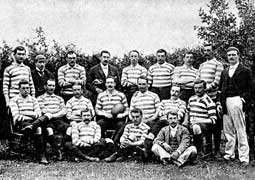
 The earliest tours date back to 1888, when a 21-man squad visited Australia and New Zealand. The squad drew players from England, Scotland and Wales, though English players predominated. The 35-match tour of two host nations included no tests, but the side played provincial, city and academic sides, winning 27 matches. They played 19 games of Australian rules football
, against prominent clubs in Victoria
and South Australia
, winning six and drawing one of these (see Australian rules football in England
).
The first tour, although unsanctioned by rugby bodies, had established the notion of touring Northern Hemisphere
sporting sides to Southern Hemisphere
locations. Three years after the first tour, the Western Province union invited rugby bodies in Britain to tour South Africa. Some saw the 1891 team
— the first sanctioned by the Rugby Football Union
— as the English national team
, though others referred to it as "the British Isles". The tourists played a total of twenty matches, three of them tests. The team also played the regional side of South Africa (South Africa did not exist as a political unit in 1891), winning all three matches. In a notable event of the tour, the touring side presented the Currie Cup
to Griqualand West
, the province they thought produced the best performance on the tour.
Five years later a British Isles side returned to South Africa. They played one extra match on this tour, making the total of 21 games, including four tests against South Africa, with the British Isles winning three of them. The squad had a notable Irish orientation, with the Irish national team contributing six players to the 21-man squad.
In 1899 the British Isles touring side returned to Australia for the first time since the unofficial tour of 1888. The squad of 23 for the first time ever had players from each of the home nations. The team again participated in 21 matches, playing state teams as well as northern Queensland sides and Victorian
teams. A four-test series took place against Australia
, the tourists winning three out of the four.
Four years later, in 1903, the British and Irish team returned to South Africa. The opening performance of the side proved disappointing from the tourists' point of view, with defeats in its opening three matches by Western Province sides in Cape Town
. From then on the team experienced mixed results, though more wins than losses. The side lost the test series to South Africa, drawing twice, but with the South Africans winning the decider 8 to nil.
No more than twelve months passed before the British and Irish team ventured to Australia and New Zealand in 1904. The tourists devastated the Australian teams, winning every single game. Australia also lost all three tests to the visitors, even getting held to a stand-still in two of the three games. Though the New Zealand leg of the tour did not take long in comparison to the number of Australian games, the British and Irish experienced considerable difficulty across the Tasman after white-washing the Australians. The team managed two early wins before losing the test to New Zealand and only winning one more game as well as drawing once. Despite their difficulties in New Zealand the tour proved a raging success on-field for the British and Irish.
In 1908 another tour took place to Australia and New Zealand. In a reversal of previous practice, the planners allocated more matches in New Zealand rather than in Australia: perhaps the strength of the New Zealand teams and the heavy defeats of all Australian teams on the previous tour influenced this decision. Some commentators thought that this tour hoped to reach out to rugby communities in Australia, as rugby league (infamously) started in Australia in 1908. The Anglo-Welsh side (Irish and Scottish unions did not participate) performed well in all the non-test matches, but drew a test against New Zealand and lost the other two.
A wait of fourteen years would ensue until another British Isles team tour took place, again in South Africa. The team struggled with injuries and lost all four tests (a game against the Western Province had test status). This tour may have marked the occasion when the team first became known as "the Lions".
In 1927 a short nine-game series took place in Argentina, with the Lions winning all nine encounters; the tour did however become a financial success for Argentinian rugby. After a seemingly long absence from New Zealand, the Lions returned in 1930 to some success. The Lions won all of their games that did not have test status except for the matches against Auckland
, Wellington
and Canterbury
; they did however lose three of their four test matches against the All Blacks
, winning the first test 6–3.. The side also visited Australia, losing a test but winning five out of the six non-test games.
In 1936 the Lions visited Argentina, winning all ten of their matches and only conceding nine points in the whole tour. Two years later the Lions toured in South Africa, winning more than half of their normal matches. Despite having lost the test series to South Africa by game three, the Lions won the final test.
and Southland
, but succeeded in holding the All Blacks to a nine-all draw. The Lions performed well in the remaining All Black tests though they lost all three, the team did not lose another non-test in the New Zealand leg of the tour. The Lions won all their games in Australia except for their final fixture against a New South Wales
XV in Newcastle. They won both tests against Australia
, in Brisbane
and in Sydney.
In 1955 the Lions toured South Africa and left with another imposing record, one draw and 19 wins from the 25 fixtures. The four-test series against South Africa
, a thrilling affair, ended in a drawn series.
The 1959 tour to Australia and New Zealand marked once again a very successful tour for the Lions, who only lost six of their 35 fixtures. The Lions easily won both tests against Australia and lost the first three tests against the All Blacks, but did find victory (9–6) in the final test.
After the glittering decade of the 1950s, the first tour of the 1960s proved not nearly as successful as previous ones. The 1962 tour to South Africa saw the Lions still win 16 of their 25 games, but did not fair well against the Springboks, losing three of the four tests. For the 1966 tour to Australia and New Zealand John Robins
became the first Lions Coach, and the trip started off very well for the Lions, who stormed through Australia, winning five non-tests and drawing one; and most notably defeating Australia in two tests as well. The Lions however experienced mixed results during the New Zealand leg of the tour, as well as losing all of the tests against the All Blacks. The Lions also played a test against Canada
on their way home, winning 19 to 8 in Toronto
. The 1968 tour of South Africa saw the Lions win 15 of their 16 provincial matches, but the team actually lost three tests against the Springboks and drew one.
and Barry John
, secured a series win over the All Blacks. The tour started with a loss to Queensland but proceeded to storm through the next provincial fixtures, winning 11 games in a row. The Lions then went on to defeat the All Blacks
in Dunedin
. The Lions would only lose a single match on the rest of the tour, and won the test series against New Zealand, winning and drawing the last two games, to take the series two wins to one.
One of the best-known and most successful Lions team toured South Africa in 1974 under the esteemed Irish forward Willie John McBride
. It went through 22 games unbeaten, and triumphed 3–0 (with one drawn) in the test series. The test series featured a lot of violence. The management of the Lions concluded that the Springboks dominated their opponents with physical aggression. At that time test-match referees came from the home nation, substitutions took place only if a doctor found a player unable to continue and there were no video cameras or sideline officials to prevent violent play. The Lions decided "to get their retaliation in first" with the infamous "99 call
". The Lions postulated that a South African referee would probably not send off all of the Lions if they all retaliated against "blatant thuggery". Famous video footage of the 'battle of Boet Erasmus Stadium'
shows JPR Williams running over half of the pitch and launching himself at van Heerden after such a call.
The 1977 tour to New Zealand saw the Lions drop only one non-test out of 21 games, a loss to a Universities side. The team did not win the test series though, winning one game but losing the other three.
In August 1977 the British Lions made a stopover in Fiji on the way home from their tour of New Zealand. Fiji beat them 25–21 at Buckhurst Park, Suva.
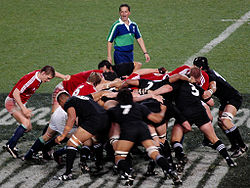 The Lions toured South Africa in 1980
. The team completed a flawless non-test record, winning 14 out of 14 non-test matches on the tour. The Lions did however lose the first three tests to South Africa, winning the last one, though the series had already been won by the Springboks.
The 1983 tour to New Zealand
saw the team successful on the non-test front, winning all but two games, but getting white-washed in the test-series against the All Blacks
.
The Lions tour to Australia in 1989
was a short affair, being only 12 matches in total. The tour was very successful for the Lions, who won all eight non-tests and won the test series against Australia, two to one.
The Lions tour to New Zealand in 1993
was the last of the amateur era. The tourists won six and lost four non-test matches, and lost the test series 2–1.
The tour to South Africa in 1997
was a success for the Lions, who completed the tour with only two losses. The Lions won the test series 2–1.
In 2001, the ten game tour to Australia
, saw the Wallabies
win the test series 2–1. This series saw the first award of the Tom Richards Trophy
.
The Lions' 2005 tour to New Zealand
, coached by 2003 England world cup winning coach Clive Woodward, won all seven games against provincial teams however suffered heavy defeats in all three tests and were narrowly defeated by the New Zealand Maori team.
winners South Africa, with Ian McGeechan
leading a coaching team including Warren Gatland
, Shaun Edwards
and Rob Howley
. The Lions were captained by Irish lock Paul O'Connell
. The initial Lions selection consisted of fourteen Irish players, thirteen Welsh, eight English and two Scots in the 37-man squad.
In the first Test on 20 June, they lost 26–21, and lost the series in the second 28–25 in a tightly-fought game at Loftus Versfeld on 27 June. The Lions won the third Test 28–9 at Ellis Park, and the series finished 2–1 to South Africa.
before moving on to Australia for the main tour featuring 6 provincial matches and 3 tests.
The full schedule for the tour was annouced in November 2011:
In June 2009 the British media reported that Argentina were lobbying for the 2013 British and Irish Lions Tour to Australia to incorporate a series of games in Argentina. The proposed format was three provincial games in Argentina followed by two international tests, followed by three provincial games in Australia followed by three international tests. With the annoucement of the 2013 schedule and home nation tours to other countries in non-Lions Tour years, it looks extremely unlikely that the British and Irish Lions will have the opportunity to tour Argentina before the 2017 tour of New Zealand. Following the performances of the Canadian, American
and Argentine teams at the 2011 Rugby World Cup
, some commentators have suggested the Lions conduct a shortened tour the Americas in the future.
Former Scotland and Lions fullback Andy Irvine
was appointed as tour manager in 2010.
visited South Africa in May–July 2009, and before that the Lions toured New Zealand in 2005
.
In a break with tradition, a "home" fixture against Argentina
took place at Millennium Stadium
in Cardiff on 23 May 2005, before the Lions went to New Zealand. It finished in a draw, 25–25.
On tour, games take place against local provinces, clubs or representative sides as well as the full tests against the host's national team.
The Lions, and their predecessor teams, have often played games against other nearby countries on tour. For example, they played Rhodesia
(the future Zimbabwe
) in 1910
, 1924
, 1938
, 1955
, 1962
, 1968
& 1974
during their tours to South Africa. They also were beaten by Fiji
on their 1977 tour to New Zealand
. In addition, they toured pre-independence Namibia
(then South West Africa
), in 1955
, 1962
, 1968
, and 1974
.
There have also been games in other countries on the way home. These include games in in 1959
and 1966
, East Africa
(then mostly Kenya
, and held in Nairobi
), and an unofficial game against Ceylon
(future Sri Lanka) in 1950
.
), these matches have been one-offs to mark special occasions:
Rugby union
Rugby union, often simply referred to as rugby, is a full contact team sport which originated in England in the early 19th century. One of the two codes of rugby football, it is based on running with the ball in hand...
team made up of players from England
England national rugby union team
The England national rugby union team represents England in rugby union. They compete in the annual Six Nations Championship with France, Ireland, Scotland, Italy, and Wales. They have won this championship on 26 occasions, 12 times winning the Grand Slam, making them the most successful team in...
, Scotland
Scotland national rugby union team
The Scotland national rugby union team represent Scotland in international rugby union. Rugby union in Scotland is administered by the Scottish Rugby Union. The Scotland rugby union team is currently ranked eighth in the IRB World Rankings as of 19 September 2011...
, Ireland
Ireland national rugby union team
The Ireland national rugby union team represents the island of Ireland in rugby union. The team competes annually in the Six Nations Championship and every four years in the Rugby World Cup, where they reached the quarter-final stage in all but two competitions The Ireland national rugby union...
and Wales
Wales national rugby union team
The Wales national rugby union team represent Wales in international rugby union tournaments. They compete annually in the Six Nations Championship with England, France, Ireland, Italy and Scotland. Wales have won the Six Nations and its predecessors 24 times outright, second only to England with...
. The Lions generally select international players; they can pick uncapped
Cap (sport)
In sports, a cap is a metaphorical term for a player's appearance on a select team, such as a national team. The term dates from the practice in the United Kingdom of awarding a cap to every player in an international match of association football...
players available to one of the four Home Unions
Home Nations
Home Nations is a collective term with one of two meanings depending on the context. Politically, it means the nations of the constituent countries of the United Kingdom...
, but in years this has rarely occurred.
Combined rugby union
Rugby union
Rugby union, often simply referred to as rugby, is a full contact team sport which originated in England in the early 19th century. One of the two codes of rugby football, it is based on running with the ball in hand...
sides from the then United Kingdom of Great Britain and Ireland
United Kingdom of Great Britain and Ireland
The United Kingdom of Great Britain and Ireland was the formal name of the United Kingdom during the period when what is now the Republic of Ireland formed a part of it....
toured in the Southern Hemisphere
Southern Hemisphere
The Southern Hemisphere is the part of Earth that lies south of the equator. The word hemisphere literally means 'half ball' or "half sphere"...
from 1888 onwards. The first tour took place as a commercial venture, made without official backing, but the six subsequent visits that took place before the 1910 South Africa tour, the first representative of the four Home Unions, enjoyed a growing degree of support from the authorities.
Great Britain also entered a team at the Olympics Games
Rugby union at the Summer Olympics
Rugby union has been a men's medal sport at the modern Summer Olympic Games, being played at four of the first seven competitions. The sport debuted at the 1900 Paris games where the gold medal was won by the host nation. It was subsequently featured at the London games in 1908, the Antwerp games...
in 1900
Rugby union at the 1900 Summer Olympics
Rugby union was played at the 1900 Summer Olympics in Paris. Matches were held on 14 October and 28 October. 47 athletes from three nations competed....
and in 1908
Rugby union at the 1908 Summer Olympics
Rugby union at the 1908 Summer Olympics. The event was summarised under the "Football" heading along with association football. The host Great Britain was represented by Cornwall, the 1908 county champion...
, but they were organised separately from the Lions.
In 1949 the Four Home Unions combined formally to create a Tours Committee and for the first time, every player of the 1950 Lions squad was an international before the New Zealand series. The 1950s proved a golden age for Lions rugby, although only in the 1970s did style begin to match the substance of victory in New Zealand and South Africa. Originally, poorly organised Lions teams regularly suffered defeat at the hands of their hosts, but by 1955 the tourists took the matches seriously enough to obtain a 2–2 draw in South Africa. The 1970s saw a renaissance for the side. The last tour of the amateur age took place in 1993.
Naming and symbols
The team historically used the name British Isles. On their 1950 tour1950 British Lions tour to New Zealand and Australia
The British and Irish Lions tour to New Zealand and Australia in 1950 was the first post-war tour made by the Lions; there had not been one since 1938....
of New Zealand and Australia they also adopted the nickname British Lions, first used by British and South African journalists on the 1924 South African tour, after the lion emblem on their ties, the emblem on their jerseys having been dropped in favour of the four-quartered badge with the symbols of the four represented unions. When the team first emerged in the nineteenth century it represented one nation-state, the United Kingdom of Great Britain and Ireland
United Kingdom of Great Britain and Ireland
The United Kingdom of Great Britain and Ireland was the formal name of the United Kingdom during the period when what is now the Republic of Ireland formed a part of it....
. After the southern part of Ireland became independent
Irish Free State
The Irish Free State was the state established as a Dominion on 6 December 1922 under the Anglo-Irish Treaty, signed by the British government and Irish representatives exactly twelve months beforehand...
in 1922, the team continued to be termed the British Isles, referring to the British Isles
British Isles
The British Isles are a group of islands off the northwest coast of continental Europe that include the islands of Great Britain and Ireland and over six thousand smaller isles. There are two sovereign states located on the islands: the United Kingdom of Great Britain and Northern Ireland and...
geographic term, rather than national citizenship. To avoid the ambiguity of the term British, and to more emphatically associate the team's identity with both the United Kingdom
United Kingdom
The United Kingdom of Great Britain and Northern IrelandIn the United Kingdom and Dependencies, other languages have been officially recognised as legitimate autochthonous languages under the European Charter for Regional or Minority Languages...
and the Republic of Ireland
Republic of Ireland
Ireland , described as the Republic of Ireland , is a sovereign state in Europe occupying approximately five-sixths of the island of the same name. Its capital is Dublin. Ireland, which had a population of 4.58 million in 2011, is a constitutional republic governed as a parliamentary democracy,...
, from the 2001 tour of Australia the name British and Irish Lions has been used. The team is often referred to simply as the Lions.
As the Lions do not represent a single nation-state, they do not have a national anthem. For the 2005 tour to New Zealand the Lions management commissioned a song, "The Power of Four
The Power of Four
"The Power of Four" is a joint anthem for the four Home Nations of England, Scotland, Wales and Ireland...
", although it met with little support amongst Lions fans at the matches and was not used on the 2009 Tour.
Team colours and strip
For more than half a century the Lions have been synonymous with the red jersey that sports the amalgamated crests of the four unions. However, prior to 1950 the strip went through a number of significantly different formats.Unsanctioned tours
In 1888, the promoter of the first expedition to Australia and New Zealand, Arthur Shrewsbury, demanded "something that would be good material and yet take them by storm out here". The result was a jersey in thick red, white and blue hoops, worn above white shorts and dark socks. The tours to South Africa in 1891 and 1896 retained the red, white and blue theme but this time as red and white hooped jerseys and dark blue shorts and socks. The 1899 trip to Australia saw a reversion to red, white and blue jerseys, but with the blue used in thick hoops and the red and white in thin bands. The shorts remained blue, as did the socks although a white flash was added to the latter. The one-off test in 1999 between England and Australia that was played to commemorate Australia's first test against Reverend Matthew MullineuxMatthew Mullineux
Matthew Mullineux MC was an English rugby union scrum-half who, although not capped for England, was selected for two British Lions tours. He gained one cap during the 1896 tour to South Africa and captained the 1899 tour of Australia...
's British side saw England wear an updated version of this jersey. In 1903, the South Africa tour followed on from the 1896 tour, with red and white hooped jerseys. The slight differences were that the red hoops were slightly thicker than the white (the opposite was true in 1896), and the white flash on the socks introduced in 1899 was partially retained. The Australia of 1904 saw exactly the same kit as in 1899, and it seemed that the British touring sides had settled on kits particular to the host destination. However, in 1908 with the Scottish and Irish unions refusing to be involved, the Anglo-Welsh side only sported red jerseys with a thick white band on their jerseys on tour to Australia and New Zealand. Blue shorts were retained, but the socks were for the first time red, with a white flash.
Blue jerseys, the Lions named and the crest adopted
The Scots were once again involved in Dr Tom Smyth's 1910 team to South Africa. Thus, dark blue jerseys, were introduced with white shorts and the red socks of 1908. The jerseys also had a single lion-rampant crest. The 1924 tour returned to South Africa, retaining the blue jerseys but now with shorts to match. It is the 1924 tour that is credited as being the first in which the team were referred to as "the Lions", the irony being that it was on this tour that the single lion-rampant crest was replaced with the forerunner of the four-quartered badge with the symbols of the four represented unions, that is still worn today. Although the lion had been dropped from the jersey, the players had worn the lion motif on their ties as they arrived in South Africa, which led the press and public referring to them as "the Lions". The unofficial 1927 Argentina tour used the same kit and badge. So powerful was the attribution of "the Lions" nickname that three heraldic versions of the animal returned as the jersey badge in 1930. This was the tour to New Zealand where the tourists now standard blue jerseys caused some controversy. Unlike in soccer, the convention in rugby is for the home side to accommodate its guests when there is a clash of kit. The New Zealand side, by then already synonymous with the appellation "All Blacks", had an all black kit that clashed with the Lions' blue. After much reluctance and debate New Zealand agreed to change for the Tests and the All Blacks became the All Whites for the first time. On the 1930 tour a delegation led by the Irish lock George BeamishGeorge Beamish
Air Marshal Sir George Robert Beamish, KCB, CBE, RAF was a senior commander in the Royal Air Force from the Second World War to his retirement in the late 1950s...
expressed their displeasure at the fact that whilst the blue of Scotland, white of England and red of Wales were represented in the strip there was no green for Ireland. A green flash was added to the socks, which from 1938 became a green turnover (although on blue socks thus eliminating red from the kit), and that has remained a feature of the strip ever since. In 1936, the four-quartered badge returned for the tour to Argentina and has remained on the kits ever since. but other than that the strip remained the same.
Red jerseys
The adoption of the red jersey happened in the 1950 tour. A return to New Zealand was accompanied by a desire to avoid the controversy of 1930 and so red replaced blue for the jersey with the resultant kit being that which is still worn today, the combination of red jersey, white shorts and green and blue socks, representing the four unions. The only additions to the strip since 1950 began appearing in 1993, with the addition of kit suppliers logos in prominent positions. Umbro had in 1989 asked for "maximum brand exposure whenever possible" but this did not affect the kit's appearance. Since then, Nike then Adidas have had more overt branding on the shirts, with sponsors Scottish Provident (1997), NTL (2001), Zurich (2005) and HSBCHSBC
HSBC Holdings plc is a global banking and financial services company headquartered in Canary Wharf, London, United Kingdom. it is the world's second-largest banking and financial services group and second-largest public company according to a composite measure by Forbes magazine...
(2009).
1888–1909
Australian rules football
Australian rules football, officially known as Australian football, also called football, Aussie rules or footy is a sport played between two teams of 22 players on either...
, against prominent clubs in Victoria
Victoria (Australia)
Victoria is the second most populous state in Australia. Geographically the smallest mainland state, Victoria is bordered by New South Wales, South Australia, and Tasmania on Boundary Islet to the north, west and south respectively....
and South Australia
South Australia
South Australia is a state of Australia in the southern central part of the country. It covers some of the most arid parts of the continent; with a total land area of , it is the fourth largest of Australia's six states and two territories.South Australia shares borders with all of the mainland...
, winning six and drawing one of these (see Australian rules football in England
Australian rules football in England
Australian rules football in England is a team and spectator sport with a long but obscure history and has grown since 1989 to a number of local leagues coordinated by AFL Britain...
).
The first tour, although unsanctioned by rugby bodies, had established the notion of touring Northern Hemisphere
Northern Hemisphere
The Northern Hemisphere is the half of a planet that is north of its equator—the word hemisphere literally means “half sphere”. It is also that half of the celestial sphere north of the celestial equator...
sporting sides to Southern Hemisphere
Southern Hemisphere
The Southern Hemisphere is the part of Earth that lies south of the equator. The word hemisphere literally means 'half ball' or "half sphere"...
locations. Three years after the first tour, the Western Province union invited rugby bodies in Britain to tour South Africa. Some saw the 1891 team
1891 British Lions tour to South Africa
The 1891 British Isles tour to South Africa was the first British Isles rugby union tour of South Africa and only the second overseas tour conducted by a joint British team. Between 9 July and 7 September, the team played 20 games, including three tests against the South Africa national rugby union...
— the first sanctioned by the Rugby Football Union
Rugby Football Union
The Rugby Football Union was founded in 1871 as the governing body for the sport of rugby union, and performed as the international governing body prior to the formation of the International Rugby Board in 1886...
— as the English national team
England national rugby union team
The England national rugby union team represents England in rugby union. They compete in the annual Six Nations Championship with France, Ireland, Scotland, Italy, and Wales. They have won this championship on 26 occasions, 12 times winning the Grand Slam, making them the most successful team in...
, though others referred to it as "the British Isles". The tourists played a total of twenty matches, three of them tests. The team also played the regional side of South Africa (South Africa did not exist as a political unit in 1891), winning all three matches. In a notable event of the tour, the touring side presented the Currie Cup
Currie Cup
The Currie Cup tournament is South Africa's premier domestic rugby union competition, played each winter and spring , featuring teams representing either entire provinces or substantial regions within provinces...
to Griqualand West
Griqualand West
Griqualand West is an area of central South Africa with an area of 40,000 km² that now forms part of the Northern Cape Province. It was inhabited by the Griqua people - a semi-nomadic, Afrikaans-speaking nation of mixed-race origin, who established several states outside the expanding frontier...
, the province they thought produced the best performance on the tour.
Five years later a British Isles side returned to South Africa. They played one extra match on this tour, making the total of 21 games, including four tests against South Africa, with the British Isles winning three of them. The squad had a notable Irish orientation, with the Irish national team contributing six players to the 21-man squad.
In 1899 the British Isles touring side returned to Australia for the first time since the unofficial tour of 1888. The squad of 23 for the first time ever had players from each of the home nations. The team again participated in 21 matches, playing state teams as well as northern Queensland sides and Victorian
Victoria (Australia)
Victoria is the second most populous state in Australia. Geographically the smallest mainland state, Victoria is bordered by New South Wales, South Australia, and Tasmania on Boundary Islet to the north, west and south respectively....
teams. A four-test series took place against Australia
Australia national rugby union team
The Australian national rugby union team is the representative side of Australia in rugby union. The national team is nicknamed the Wallabies and competes annually with New Zealand and South Africa in the Tri-Nations Series, in which they also contest the Bledisloe Cup with New Zealand and the...
, the tourists winning three out of the four.
Four years later, in 1903, the British and Irish team returned to South Africa. The opening performance of the side proved disappointing from the tourists' point of view, with defeats in its opening three matches by Western Province sides in Cape Town
Cape Town
Cape Town is the second-most populous city in South Africa, and the provincial capital and primate city of the Western Cape. As the seat of the National Parliament, it is also the legislative capital of the country. It forms part of the City of Cape Town metropolitan municipality...
. From then on the team experienced mixed results, though more wins than losses. The side lost the test series to South Africa, drawing twice, but with the South Africans winning the decider 8 to nil.
No more than twelve months passed before the British and Irish team ventured to Australia and New Zealand in 1904. The tourists devastated the Australian teams, winning every single game. Australia also lost all three tests to the visitors, even getting held to a stand-still in two of the three games. Though the New Zealand leg of the tour did not take long in comparison to the number of Australian games, the British and Irish experienced considerable difficulty across the Tasman after white-washing the Australians. The team managed two early wins before losing the test to New Zealand and only winning one more game as well as drawing once. Despite their difficulties in New Zealand the tour proved a raging success on-field for the British and Irish.
In 1908 another tour took place to Australia and New Zealand. In a reversal of previous practice, the planners allocated more matches in New Zealand rather than in Australia: perhaps the strength of the New Zealand teams and the heavy defeats of all Australian teams on the previous tour influenced this decision. Some commentators thought that this tour hoped to reach out to rugby communities in Australia, as rugby league (infamously) started in Australia in 1908. The Anglo-Welsh side (Irish and Scottish unions did not participate) performed well in all the non-test matches, but drew a test against New Zealand and lost the other two.
1910–1949
Visits that took place before the 1910 South Africa tour (the first selected by a committee from the four Home Unions) had enjoyed a growing degree of support from the authorities, although only one of these included representatives of all four nations. The 1910 tour to South Africa marked the official beginning of British and Irish rugby tours: the inaugural tour operating under all four unions. The team performed moderately against the non-test parties, claiming victories in just over half their matches. The test series, however, went to South Africa, who won two of the three games. A side managed by Oxford University — supposedly the England rugby team, but actually including three Scottish players — toured Argentina at the time: the people of Argentina termed it the "Combined British".A wait of fourteen years would ensue until another British Isles team tour took place, again in South Africa. The team struggled with injuries and lost all four tests (a game against the Western Province had test status). This tour may have marked the occasion when the team first became known as "the Lions".
In 1927 a short nine-game series took place in Argentina, with the Lions winning all nine encounters; the tour did however become a financial success for Argentinian rugby. After a seemingly long absence from New Zealand, the Lions returned in 1930 to some success. The Lions won all of their games that did not have test status except for the matches against Auckland
Auckland
The Auckland metropolitan area , in the North Island of New Zealand, is the largest and most populous urban area in the country with residents, percent of the country's population. Auckland also has the largest Polynesian population of any city in the world...
, Wellington
Wellington
Wellington is the capital city and third most populous urban area of New Zealand, although it is likely to have surpassed Christchurch due to the exodus following the Canterbury Earthquake. It is at the southwestern tip of the North Island, between Cook Strait and the Rimutaka Range...
and Canterbury
Canterbury
Canterbury is a historic English cathedral city, which lies at the heart of the City of Canterbury, a district of Kent in South East England. It lies on the River Stour....
; they did however lose three of their four test matches against the All Blacks
All Blacks
The New Zealand men's national rugby union team, known as the All Blacks, represent New Zealand in what is regarded as its national sport....
, winning the first test 6–3.. The side also visited Australia, losing a test but winning five out of the six non-test games.
In 1936 the Lions visited Argentina, winning all ten of their matches and only conceding nine points in the whole tour. Two years later the Lions toured in South Africa, winning more than half of their normal matches. Despite having lost the test series to South Africa by game three, the Lions won the final test.
1950–1969
The first post-war tour went to New Zealand and Australia in 1950. The Lions, sporting newly redesigned jerseys and displaying a fresh style of play, managed to win 22 and draw one of 29 matches over the two nations. The Lions won the opening four fixtures before losing to OtagoOtago
Otago is a region of New Zealand in the south of the South Island. The region covers an area of approximately making it the country's second largest region. The population of Otago is...
and Southland
Southland Region
Southland is New Zealand's southernmost region and is also a district within that region. It consists mainly of the southwestern portion of the South Island and Stewart Island / Rakiura...
, but succeeded in holding the All Blacks to a nine-all draw. The Lions performed well in the remaining All Black tests though they lost all three, the team did not lose another non-test in the New Zealand leg of the tour. The Lions won all their games in Australia except for their final fixture against a New South Wales
New South Wales
New South Wales is a state of :Australia, located in the east of the country. It is bordered by Queensland, Victoria and South Australia to the north, south and west respectively. To the east, the state is bordered by the Tasman Sea, which forms part of the Pacific Ocean. New South Wales...
XV in Newcastle. They won both tests against Australia
Australia national rugby union team
The Australian national rugby union team is the representative side of Australia in rugby union. The national team is nicknamed the Wallabies and competes annually with New Zealand and South Africa in the Tri-Nations Series, in which they also contest the Bledisloe Cup with New Zealand and the...
, in Brisbane
Brisbane
Brisbane is the capital and most populous city in the Australian state of Queensland and the third most populous city in Australia. Brisbane's metropolitan area has a population of over 2 million, and the South East Queensland urban conurbation, centred around Brisbane, encompasses a population of...
and in Sydney.
In 1955 the Lions toured South Africa and left with another imposing record, one draw and 19 wins from the 25 fixtures. The four-test series against South Africa
South Africa national rugby union team
The South African national rugby union team are 2009 British and Irish Lions Series winners. They are currently ranked as the fourth best team in the IRB World Rankings and were named 2008 World Team of the Year at the prestigious Laureus World Sports Awards.Although South Africa was instrumental...
, a thrilling affair, ended in a drawn series.
The 1959 tour to Australia and New Zealand marked once again a very successful tour for the Lions, who only lost six of their 35 fixtures. The Lions easily won both tests against Australia and lost the first three tests against the All Blacks, but did find victory (9–6) in the final test.
After the glittering decade of the 1950s, the first tour of the 1960s proved not nearly as successful as previous ones. The 1962 tour to South Africa saw the Lions still win 16 of their 25 games, but did not fair well against the Springboks, losing three of the four tests. For the 1966 tour to Australia and New Zealand John Robins
John Robins
John Robins , was an international rugby union player who attained 11 caps for Wales between 1950 and 1953. A prop, he toured New Zealand and Australia with the British and Irish Lions in 1950 and became the first Lions coach, on the 1966 British Lions tour to Australia and New Zealand.Robins was...
became the first Lions Coach, and the trip started off very well for the Lions, who stormed through Australia, winning five non-tests and drawing one; and most notably defeating Australia in two tests as well. The Lions however experienced mixed results during the New Zealand leg of the tour, as well as losing all of the tests against the All Blacks. The Lions also played a test against Canada
Canada national rugby union team
The Canada national rugby union team represents Canada in international rugby union. They are governed by Rugby Canada, and play in red and black. Canada is classified by the International Rugby Board as a tier two rugby nation. There are ten tier one nations, and seven tier two nations, the...
on their way home, winning 19 to 8 in Toronto
Toronto
Toronto is the provincial capital of Ontario and the largest city in Canada. It is located in Southern Ontario on the northwestern shore of Lake Ontario. A relatively modern city, Toronto's history dates back to the late-18th century, when its land was first purchased by the British monarchy from...
. The 1968 tour of South Africa saw the Lions win 15 of their 16 provincial matches, but the team actually lost three tests against the Springboks and drew one.
1970–1979
The 1970s saw a renaissance for the Lions. The 1971 team, centred around the skilled Welsh half-back pairing of Gareth EdwardsGareth Edwards
Gareth Owen Edwards CBE is a former Welsh rugby union footballer who played scrum-half and has been described by the BBC as "arguably the greatest player ever to don a Welsh jersey"....
and Barry John
Barry John
Barry John is a former Welsh rugby union fly-half who played, during the amateur era of the sport, in the 1960s and early 1970s. John began his rugby career as a schoolboy playing for his local team Cefneithin RFC before switching to first-class west Wales team Llanelli RFC in 1964...
, secured a series win over the All Blacks. The tour started with a loss to Queensland but proceeded to storm through the next provincial fixtures, winning 11 games in a row. The Lions then went on to defeat the All Blacks
All Blacks
The New Zealand men's national rugby union team, known as the All Blacks, represent New Zealand in what is regarded as its national sport....
in Dunedin
Dunedin
Dunedin is the second-largest city in the South Island of New Zealand, and the principal city of the Otago Region. It is considered to be one of the four main urban centres of New Zealand for historic, cultural, and geographic reasons. Dunedin was the largest city by territorial land area until...
. The Lions would only lose a single match on the rest of the tour, and won the test series against New Zealand, winning and drawing the last two games, to take the series two wins to one.
One of the best-known and most successful Lions team toured South Africa in 1974 under the esteemed Irish forward Willie John McBride
Willie John McBride
William James McBride, MBE, better known as Willie John McBride is a former rugby union footballer who played as a lock for Ireland and the British and Irish Lions. He played 63 Tests for Ireland including eleven as captain, and toured with the Lions five times — a record that gave him 17...
. It went through 22 games unbeaten, and triumphed 3–0 (with one drawn) in the test series. The test series featured a lot of violence. The management of the Lions concluded that the Springboks dominated their opponents with physical aggression. At that time test-match referees came from the home nation, substitutions took place only if a doctor found a player unable to continue and there were no video cameras or sideline officials to prevent violent play. The Lions decided "to get their retaliation in first" with the infamous "99 call
99 call
In rugby union, the "99" call was a policy of simultaneous retaliation by the Lions during their 1974 tour to South Africa. The tour was marred by on-pitch violence, which the match officials did little to control and the relative absence of cameras compared to the modern game made citing and...
". The Lions postulated that a South African referee would probably not send off all of the Lions if they all retaliated against "blatant thuggery". Famous video footage of the 'battle of Boet Erasmus Stadium'
EPRFU Stadium
EPRU Stadium, also known by its original name of Boet Erasmus Stadium, is a stadium in Port Elizabeth, South Africa. The stadium has a capacity of 33,852 people. The original name Boet Erasmus Stadium was named after Boet Erasmus, a former mayor of Port Elizabeth.It was used mostly for rugby union...
shows JPR Williams running over half of the pitch and launching himself at van Heerden after such a call.
The 1977 tour to New Zealand saw the Lions drop only one non-test out of 21 games, a loss to a Universities side. The team did not win the test series though, winning one game but losing the other three.
In August 1977 the British Lions made a stopover in Fiji on the way home from their tour of New Zealand. Fiji beat them 25–21 at Buckhurst Park, Suva.
1980–2005
1980 British Lions tour to South Africa
In 1980 the British Lions rugby union team toured South Africa . The tour was not a success in terms of international results, the Lions losing the first three tests before salvaging some pride with a win in the fourth...
. The team completed a flawless non-test record, winning 14 out of 14 non-test matches on the tour. The Lions did however lose the first three tests to South Africa, winning the last one, though the series had already been won by the Springboks.
The 1983 tour to New Zealand
1983 British Lions tour to New Zealand
In 1983 the British and Irish Lions toured New Zealand for the first time since 1977. The Lions went down to a 4-0 whitewash for only the second time in history - the previous was also inflicted by the All Blacks on the 1966 Lions. Overall the Lions played eighteen matches, winning twelve and...
saw the team successful on the non-test front, winning all but two games, but getting white-washed in the test-series against the All Blacks
All Blacks
The New Zealand men's national rugby union team, known as the All Blacks, represent New Zealand in what is regarded as its national sport....
.
The Lions tour to Australia in 1989
1989 British Lions tour to Australia
In 1989 the British Lions toured Australia for the first time since 1971. Despite losing the first test, the Lions won the remaining two to take the series 2-1...
was a short affair, being only 12 matches in total. The tour was very successful for the Lions, who won all eight non-tests and won the test series against Australia, two to one.
The Lions tour to New Zealand in 1993
1993 British Lions tour to New Zealand
In 1993 the British Lions rugby union team toured New Zealand. This tour followed the Lions' 1989 tour to Australia and preceded their 1997 tour to South Africa. It was the last Lions tour in the sport's amateur era....
was the last of the amateur era. The tourists won six and lost four non-test matches, and lost the test series 2–1.
The tour to South Africa in 1997
1997 British Lions tour to South Africa
The 1997 British and Irish Lions tour to South Africa was a series of matches played by the British and Irish Lions rugby union team in South Africa.This tour followed the Lions' 1993 tour to New Zealand and preceded their 2001 tour to Australia....
was a success for the Lions, who completed the tour with only two losses. The Lions won the test series 2–1.
In 2001, the ten game tour to Australia
2001 British Lions tour to Australia
The 2001 British and Irish Lions tour to Australia was a series of matches played by the British Lions rugby union team in Australia.This tour followed the Lions' 1997 tour to South Africa and preceded the 2005 tour to New Zealand....
, saw the Wallabies
Australia national rugby union team
The Australian national rugby union team is the representative side of Australia in rugby union. The national team is nicknamed the Wallabies and competes annually with New Zealand and South Africa in the Tri-Nations Series, in which they also contest the Bledisloe Cup with New Zealand and the...
win the test series 2–1. This series saw the first award of the Tom Richards Trophy
Tom Richards Trophy
The Tom Richards Trophy is an international rugby union trophy awarded to the winner of British and Irish Lions vs. Australia test series. It was commissioned for the 2001 British Lions tour to Australia and the inaugural winner was Australia, who won the series 2-1. This was the first time that...
.
The Lions' 2005 tour to New Zealand
2005 British and Irish Lions tour to New Zealand
In 2005 the British and Irish Lions rugby union team toured New Zealand for the first time since 1993, playing 7 tour matches against first and second division clubs from the National Provincial Championship series, 1 tour match against the national New Zealand all Māori club, and 3 official test...
, coached by 2003 England world cup winning coach Clive Woodward, won all seven games against provincial teams however suffered heavy defeats in all three tests and were narrowly defeated by the New Zealand Maori team.
2009
The Lions faced the World Cup2007 Rugby World Cup
The 2007 Rugby World Cup was the sixth Rugby World Cup, a quadrennial international rugby union competition inaugurated in 1987. Twenty nations competed for the Webb Ellis Cup in the tournament, which was hosted by France from 7 September to 20 October. France won the hosting rights in 2003,...
winners South Africa, with Ian McGeechan
Ian McGeechan
Sir Ian Robert McGeechan OBE is a Scottish former rugby union player and coach. His nickname is "Geech".-Playing career:...
leading a coaching team including Warren Gatland
Warren Gatland
Warren David Gatland is a former New Zealand rugby footballer and the current head coach of the Wales national team.Gatland was born in Hamilton, New Zealand and educated at Hamilton Boys' High School and Waikato University...
, Shaun Edwards
Shaun Edwards
Shaun Edwards OBE is an English rugby union coach and former rugby league player. He is defence coach of Wales, a post he has held since 2008. In November 2011 he left London Wasps after 10 years with the club, latterly as head coach....
and Rob Howley
Rob Howley
Robert Howley is a former Welsh rugby union footballer. He was considered one of the greatest ever scrum-halves and gained 59 caps for Wales, 22 of them as captain.Howley made his Wales debut in February 1996...
. The Lions were captained by Irish lock Paul O'Connell
Paul O'Connell
Paul O'Connell is an Irish rugby union player who plays lock for Munster and Ireland. He also captained the British and Irish Lions on their 2009 tour to South Africa.-Early life:...
. The initial Lions selection consisted of fourteen Irish players, thirteen Welsh, eight English and two Scots in the 37-man squad.
In the first Test on 20 June, they lost 26–21, and lost the series in the second 28–25 in a tightly-fought game at Loftus Versfeld on 27 June. The Lions won the third Test 28–9 at Ellis Park, and the series finished 2–1 to South Africa.
2013
During June 2013 the British and Irish Lions will tour Australia. The tour will start in Hong Kong with a match against the BarbariansBarbarian F.C.
The Barbarian Football Club, usually referred to as the Barbarians and nicknamed the "Baa-Baas", is an invitational rugby union team based in Britain...
before moving on to Australia for the main tour featuring 6 provincial matches and 3 tests.
The full schedule for the tour was annouced in November 2011:
- Saturday 1st June 2013, The Barbarians, Hong Kong StadiumHong Kong StadiumHong Kong Stadium is the main sports venue of Hong Kong. Redeveloped from the old Government Stadium it reincarnated as Hong Kong Stadium in 1994...
, Hong Kong - Wednesday 5th June 2013, Western ForceWestern ForceWestern Force is a rugby union team based in Perth, Western Australia playing in the international Super Rugby competition. They first competed in the 2006 season and finished with the wooden spoon in that year, however their performances greatly improved in 2007. In 2008 they finished in 8th...
, Patersons StadiumSubiaco OvalSubiaco Oval , known colloquially as Subi, is the highest capacity sports stadium in Perth, Western Australia...
, Perth - Saturday 8th June 2013, Queensland RedsQueensland RedsThe Queensland Reds represent Queensland in the sport of rugby union in the Southern Hemisphere Super Rugby competition. Prior to 1996 they were a representative team selected on merit from the rugby union club competitions in Queensland...
, Suncorp Stadium, Brisbane - Wednesday 12th June 2013, New South Wales / Queensland Country invitational team Ausgrid Stadium, Newcastle
- Saturday 15th June 2013, New South Wales WaratahsNew South Wales WaratahsThe New South Wales Waratahs are an Australian rugby union football team, representing the majority of New South Wales in the Super 15 Super Rugby competition...
, Sydney Football Stadium, Sydney - Tuesday 18th June 2013, Brumbies, Canberra StadiumCanberra StadiumCanberra Stadium is a facility primarily used for rugby league and rugby union games, located adjacent to the Australian Institute of Sport in Canberra, the capital of Australia...
, Canberra - Saturday 22 June 2013, Australia - First Test, Suncorp Stadium, Brisbane
- Tuesday 25th June 2013, Melbourne Rebels, AAMI ParkMelbourne Rectangular StadiumThe Melbourne Rectangular Stadium is an outdoor sports stadium on the site of Edwin Flack Field on Olympic Boulevard in the Sports and Entertainment Precinct, in inner Melbourne, Victoria, Australia....
, Melbourne - Saturday 29 June 2013, Australia - Second Test, Etihad Stadium, Melbourne
- Saturday 6 July 2013, Australia - Third Test, ANZ Stadium, Sydney
In June 2009 the British media reported that Argentina were lobbying for the 2013 British and Irish Lions Tour to Australia to incorporate a series of games in Argentina. The proposed format was three provincial games in Argentina followed by two international tests, followed by three provincial games in Australia followed by three international tests. With the annoucement of the 2013 schedule and home nation tours to other countries in non-Lions Tour years, it looks extremely unlikely that the British and Irish Lions will have the opportunity to tour Argentina before the 2017 tour of New Zealand. Following the performances of the Canadian, American
United States national rugby union team
USA Rugby's men's national rugby union team, nicknamed the Eagles, represents the United States in the sport of rugby union. The Eagles are currently ranked 17th by the IRB World Rankings. Their highest ranking was from November 2, 2006 – September 10, 2007 at the 14th position...
and Argentine teams at the 2011 Rugby World Cup
2011 Rugby World Cup
The 2011 Rugby World Cup was the seventh Rugby World Cup, a quadrennial international rugby union competition inaugurated in 1987. The International Rugby Board selected New Zealand as the host country in preference to Japan and South Africa at a meeting in Dublin on 17 November 2005...
, some commentators have suggested the Lions conduct a shortened tour the Americas in the future.
Former Scotland and Lions fullback Andy Irvine
Andy Irvine (rugby player)
Andrew Robertson "Andy" Irvine MBE is a former President of the Scottish Rugby Union , and a former Scottish international rugby player. He earned fifty one Scottish caps, and scored over 250 points for .-Background:...
was appointed as tour manager in 2010.
Format
The Lions tour three southern-hemisphere nations; Australia, South Africa and New Zealand. They also routinely toured in Argentina before World War II. Tours currently take place every four years. The most recent tour2009 British and Irish Lions tour to South Africa
The 2009 British and Irish Lions Tour to South Africa was an international rugby union tour which took place in South Africa from May to July 2009....
visited South Africa in May–July 2009, and before that the Lions toured New Zealand in 2005
2005 British and Irish Lions tour to New Zealand
In 2005 the British and Irish Lions rugby union team toured New Zealand for the first time since 1993, playing 7 tour matches against first and second division clubs from the National Provincial Championship series, 1 tour match against the national New Zealand all Māori club, and 3 official test...
.
In a break with tradition, a "home" fixture against Argentina
Argentina national rugby union team
The Argentina national rugby team, nicknamed Los Pumas, represents Argentina in international rugby union matches. The team, which plays in sky blue and white jerseys, is organised by the Argentine Rugby Union .Argentina played its first international rugby match in 1910 against a touring British...
took place at Millennium Stadium
Millennium Stadium
The Millennium Stadium is the national stadium of Wales, located in the capital, Cardiff. It is the home of the Wales national rugby union team and also frequently stages games of the Wales national football team, but is also host to many other large scale events, such as the Super Special Stage...
in Cardiff on 23 May 2005, before the Lions went to New Zealand. It finished in a draw, 25–25.
On tour, games take place against local provinces, clubs or representative sides as well as the full tests against the host's national team.
The Lions, and their predecessor teams, have often played games against other nearby countries on tour. For example, they played Rhodesia
Zimbabwe national rugby union team
The Zimbabwe national rugby union team is the rugby union team representing Zimbabwe. They are considered to be a third tier rugby union nation...
(the future Zimbabwe
Zimbabwe
Zimbabwe is a landlocked country located in the southern part of the African continent, between the Zambezi and Limpopo rivers. It is bordered by South Africa to the south, Botswana to the southwest, Zambia and a tip of Namibia to the northwest and Mozambique to the east. Zimbabwe has three...
) in 1910
1910 British Lions tour to South Africa
The 1910 British Isles tour to South Africa was the eighth tour by a British Isles team and the fourth to South Africa. It is retrospectively classed as one of the British Lions tours, as the Lions naming convention was not adopted until 1950. As well as South Africa, the tour included a game in...
, 1924
1924 British Lions tour to South Africa
The 1924 British Isles tour to South Africa was the tenth tour by a British Isles team and the fifth to South Africa. The tour is retrospectively classed as one of the British Lions tours, as the Lions naming convention was not adopted until 1950...
, 1938
1938 British Lions tour to South Africa
The 1938 British Isles tour to South Africa was the fourteenth tour by a British Isles team and the sixth to South Africa. The tour is retrospectively classed as one of the British Lions tours, as the Lions naming convention was not adopted until 1950....
, 1955
1955 British Lions tour to South Africa
In 1955 the British Lions rugby union team toured Southern and Eastern Africa. The Lions drew the test series against , each team winning two of the four matches. They won the first test by a single point and the third by three points and lost the second and fourth matches by wider margins...
, 1962
1962 British Lions tour to South Africa
In 1962 the British Lions rugby union team toured Southern and Eastern Africa. Overall the tourists played twenty-five matches, winning sixteen, losing five and drawing four....
, 1968
1968 British Lions tour to South Africa
In 1968 the British Lions toured South Africa. The tour was not success in terms of international results, the Lions losing the test series against South Africa by three matches to nil, with the other match drawn. The Lions won 15 of their 16 non-international matches, losing only to Transvaal...
& 1974
1974 British Lions tour to South Africa
In 1974 the British Lions toured South Africa, with matches in South West Africa and Rhodesia . The tour was a great success, the Lions winning 21 of their 22 matches and drawing the other. After winning the first three test matches, the Lions drew the final test to preserve their unbeaten record...
during their tours to South Africa. They also were beaten by Fiji
Fiji national rugby union team
The Fiji national rugby union team is a member of the Pacific Islands Rugby Alliance formerly along with Samoa and Tonga. In 2009, Samoa announced their departure from the Pacific Islands Rugby Alliance, leaving just Fiji and Tonga. Fiji are ranked sixteenth in the world by the IRB as of 26...
on their 1977 tour to New Zealand
1977 British Lions tour to New Zealand
In 1977 the British Lions rugby union team toured New Zealand. The Lions played 26 matches, including four internationals against the All Blacks. They lost the series against the All Blacks by three matches to one. The team played as the British Isles in their internationals against the All Blacks...
. In addition, they toured pre-independence Namibia
Namibia
Namibia, officially the Republic of Namibia , is a country in southern Africa whose western border is the Atlantic Ocean. It shares land borders with Angola and Zambia to the north, Botswana to the east and South Africa to the south and east. It gained independence from South Africa on 21 March...
(then South West Africa
South West Africa
South-West Africa was the name that was used for the modern day Republic of Namibia during the earlier eras when the territory was controlled by the German Empire and later by South Africa....
), in 1955
1955 British Lions tour to South Africa
In 1955 the British Lions rugby union team toured Southern and Eastern Africa. The Lions drew the test series against , each team winning two of the four matches. They won the first test by a single point and the third by three points and lost the second and fourth matches by wider margins...
, 1962
1962 British Lions tour to South Africa
In 1962 the British Lions rugby union team toured Southern and Eastern Africa. Overall the tourists played twenty-five matches, winning sixteen, losing five and drawing four....
, 1968
1968 British Lions tour to South Africa
In 1968 the British Lions toured South Africa. The tour was not success in terms of international results, the Lions losing the test series against South Africa by three matches to nil, with the other match drawn. The Lions won 15 of their 16 non-international matches, losing only to Transvaal...
, and 1974
1974 British Lions tour to South Africa
In 1974 the British Lions toured South Africa, with matches in South West Africa and Rhodesia . The tour was a great success, the Lions winning 21 of their 22 matches and drawing the other. After winning the first three test matches, the Lions drew the final test to preserve their unbeaten record...
.
There have also been games in other countries on the way home. These include games in in 1959
1959 British Lions tour to Australia and New Zealand
In 1959 the British Lions rugby union team toured Australia and New Zealand. The Lions won the two test matches against but lost the international series against the All Blacks by three matches to one. They also played two matches in Canada, on the return leg of the journey.Although New Zealand...
and 1966
1966 British Lions tour to Australia and New Zealand
In 1966 the British Lions toured Australia and New Zealand. The Lions won the two test matches against but lost all four internationals against the All Blacks....
, East Africa
East Africa rugby union team
Established in 1950, The East Africa rugby union team is a multi-national rugby union team drawing players from Kenya, Uganda and Tanzania, though the vast majority of these came from Kenya which has traditionally been the strongest rugby playing nation in this part of the world...
(then mostly Kenya
Kenya
Kenya , officially known as the Republic of Kenya, is a country in East Africa that lies on the equator, with the Indian Ocean to its south-east...
, and held in Nairobi
Nairobi
Nairobi is the capital and largest city of Kenya. The city and its surrounding area also forms the Nairobi County. The name "Nairobi" comes from the Maasai phrase Enkare Nyirobi, which translates to "the place of cool waters". However, it is popularly known as the "Green City in the Sun" and is...
), and an unofficial game against Ceylon
Sri Lanka national rugby union team
The Sri Lanka national rugby union team represents Sri Lanka in international rugby union competitions. Sri Lanka have yet to make their debut at the Rugby World Cup. They have the longest tradition of organised club rugby in Asia, dating back to 1879, which was just 8 years after the founding of...
(future Sri Lanka) in 1950
1950 British Lions tour to New Zealand and Australia
The British and Irish Lions tour to New Zealand and Australia in 1950 was the first post-war tour made by the Lions; there had not been one since 1938....
.
Tour Test Matches
| Year | To | Captain | Head coach | Top Scorer in Tests | Result | Tests record |
|---|---|---|---|---|---|---|
| 1888 | New Zealand & Australia 1888 British Lions tour to New Zealand and Australia The 1888 British Isles tour to New Zealand and Australia was a series of rugby union games played by an unofficial British team against invitational teams in New Zealand and Australia... |
 Kingdom of England Robert Seddon Kingdom of England Robert SeddonRobert Seddon Robert Lionel "Bob" Seddon was an English international rugby union forward who played club rugby for Broughton Rangers and Swinton and county rugby for Lancashire. Seddon was capped at international level for both England and the British Isles... Kingdom of England Andrew StoddartAndrew Stoddart Andrew Ernest Stoddart was an English cricketer and rugby union player. He was a Wisden Cricketer of the Year in 1893.-Cricket career:... |
Kingdom of England Alfred Shaw Alfred Shaw Alfred Shaw was an eminent Victorian cricketer and rugby footballer, who bowled the first ball in Test cricket and was the first to take five wickets in a Test innings . He who organised the first British Isles rugby tour to Australasia in 1888... Kingdom of England Arthur ShrewsburyArthur Shrewsbury Arthur Shrewsbury was an English cricketer, and rugby football administrator, who organised the first British Isles rugby tour to Australasia in 1888, and who was widely rated as competing with W. G... |
No Test matches played | ||
| 1891 | South Africa 1891 British Lions tour to South Africa The 1891 British Isles tour to South Africa was the first British Isles rugby union tour of South Africa and only the second overseas tour conducted by a joint British team. Between 9 July and 7 September, the team played 20 games, including three tests against the South Africa national rugby union... |
 Kingdom of Scotland Bill Maclagan Kingdom of Scotland Bill MaclaganBill Maclagan William Edward "Bill" Maclagan was a Scottish international rugby union forward who played club rugby for London Scottish F.C.... |
Kingdom of England Edwin Ash |
Kingdom of England Arthur Rotherham Arthur Rotherham Arthur Rotherham was an English rugby union scrum-half who was a member of the first official British Isles tour and was later capped for the England team.-Personal history:... , 4 |
Won | 3–0 |
| 1896 | South Africa 1896 British Lions tour to South Africa 1896 British Isles tour to South Africa was a rugby union tour undertaken by the British Isles, one of the first British and Irish Lions tours. The team toured South Africa for the second time in 1896. Between July 11 and September 5, they played 21 games, including four tests against South Africa... |
Kingdom of England Johnny Hammond Johnny Hammond (rugby player) John "Johnny" Hammond was an English rugby union forward who, although not capped for England, was part of three British Lions tours, all to South Africa. He gained three caps during the 1891 tour to South Africa and captained the 1896 tour, winning another two test caps... |
Kingdom of England Roger Walker Roger Walker (rugby) Roger Walker was a rugby union forward who played club rugby for Manchester Rugby Club and international rugby for England... |
Kingdom of England J. F. Byrne J. F. Byrne James Frederick Byrne was English sportsman who captained Warwickshire at first-class cricket and was capped in rugby for both England and the British and Irish Lions.-Cricket career:... , 12 |
Won | 3–1 |
| 1899 | Australia 1899 British Lions tour to Australia The 1899 British Isles tour to Australia was the fourth rugby union tour by a British Isles team and the second to Australia; though the first tour in 1888 was a private venture, making the 1899 tour the first official undertaking of Australia... |
Kingdom of England Matthew Mullineux Matthew Mullineux Matthew Mullineux MC was an English rugby union scrum-half who, although not capped for England, was selected for two British Lions tours. He gained one cap during the 1896 tour to South Africa and captained the 1899 tour of Australia... Kingdom of England Frank StoutFrank Stout Frank Moxon Stout MC also referred to as Frank Moxham Stout, was an English international rugby union forward who played club rugby for Gloucester and Richmond. Stout played international rugby for England and was selected for the British Isles on two tours in 1899 and 1903... |
Kingdom of England Matthew Mullineux Matthew Mullineux Matthew Mullineux MC was an English rugby union scrum-half who, although not capped for England, was selected for two British Lions tours. He gained one cap during the 1896 tour to South Africa and captained the 1899 tour of Australia... |
Kingdom of England Charlie Adamson Charlie Adamson Charles "Charlie" Young Adamson was an English international rugby union utility back who played club rugby for Durham. Adamson played international rugby for the British Isles team on its 1899 tour of Australia... , 17 |
Won | 3–1 |
| 1903 | South Africa 1903 British Lions tour to South Africa The 1903 British Isles tour to South Africa was the fifth tour by a British Isles team and the third to South Africa. It is retrospectively classed as one of the British Lions tours, as the Lions naming convention was not adopted until 1950.... |
Kingdom of Scotland Mark Morrison Mark Coxon Morrison Mark Coxon Morrison was a Scottish rugby union footballer who captained both Scotland and the British Isles. He played for Scotland twenty three times between 1896 and 1904, and captained the team fifteen times, a record which stood until the era of Arthur Smith, sixty years later... |
Kingdom of England Johnny Hammond Johnny Hammond (rugby player) John "Johnny" Hammond was an English rugby union forward who, although not capped for England, was part of three British Lions tours, all to South Africa. He gained three caps during the 1891 tour to South Africa and captained the 1896 tour, winning another two test caps... |
Kingdom of Scotland John Gillespie Jimmy Gillespie John "Jimmy" Imrie Gillespie was a Scottish international rugby union player, who played for and the Lions. At club level he played for Edinburgh Academicals.... , 4 |
Lost | 0–1 (2 drawn tests) |
| 1904 | Australia & New Zealand 1904 British Lions tour to Australia and New Zealand The 1904 British Isles tour to New Zealand and Australia was the sixth tour by a British Isles team and the fourth to New Zealand and Australia... |
Kingdom of Scotland David Bedell-Sivright David Bedell-Sivright David Revell "Darkie" Bedell-Sivright was a Scottish international rugby union forward who played club rugby for Cambridge and Edinburgh Universities. Bedell-Sivright was one of the true characters of the sport of rugby and was chosen to lead a British Isles team on a tour of Australia... |
 New Zealand Arthur O'Brien New Zealand Arthur O'BrienArthur O'Brien Arthur Boniface O'Brien was a New Zealand rugby union fullback who played club rugby for Guy's Hospital. O'Brien is most notable for playing international rugby for the British Isles team on its 1904 tour of Australia, for which he was also elected team manager.-Rugby career:New Zealand born,... |
 Wales Percy Bush Wales Percy BushPercy Bush Percy Frank Bush was a Welsh rugby union player who played international rugby for Wales on eight occasions. Playing at fly-half, Bush is regarded as one of the most talented Welsh players before the first World War.-Rugby career:... , 20 |
Won Lost |
3–0 (Australia) 0–1 (New Zealand) |
| 1908 | New Zealand & Australia 1908 British Lions tour to New Zealand and Australia The 1908 British Isles tour to New Zealand and Australia was the seventh tour by a British Isles team and the fourth to New Zealand and Australia. The tour is often referred to as the Anglo-Welsh Tour as only English and Welsh players were selected due to the Irish and Scottish Rugby Unions not... |
Wales Arthur 'Boxer' Harding Arthur Harding Arthur Flowers Harding was an English-born international rugby union player who played for and captained the Wales national team. Often called 'Boxer' Harding, he was a member of the winning Wales team who beat the 1905 touring All Blacks in a game considered one of the greatest in the history of... |
Kingdom of England George Harnett |
Wales Reggie Gibbs Reggie Gibbs Reginald "Reggie" Arthur Gibbs was a Welsh international rugby union wing who played club rugby for Penarth and Cardiff. He was capped 16 times for his country and captained his team on one occasion... , 3 Wales Jack JonesJack Jones (rugby player) John "Jack" Phillips Jones was a Welsh international centre who played club rugby for Pontypool Rugby Club and Newport Rugby Football Club. He won 14 caps for Wales and was known as The Prince of Centres.-Rugby career:... , 3 |
Lost | 0–2 (1 drawn test) (NZ) No tests against Australia |
| 1910 | South Africa 1910 British Lions tour to South Africa The 1910 British Isles tour to South Africa was the eighth tour by a British Isles team and the fourth to South Africa. It is retrospectively classed as one of the British Lions tours, as the Lions naming convention was not adopted until 1950. As well as South Africa, the tour included a game in... |
Tommy Smyth Tommy Smyth (rugby player) Dr Tommy Smyth was an Irish international, rugby union prop forward who played club rugby for Newport and Malone and invitational rugby with the Barbarians... |
 William Cail WalesWalter E. Rees William Cail WalesWalter E. ReesWalter E. Rees Captain Walter Enoch Rees was a Welsh rugby union administrator who was the longest serving secretary of the Welsh Rugby Union and joint manager of the 1910 British Lions tour of South Africa.-Career as rugby administrator:... |
Kingdom of England Jack Spoors Jack Spoors John Ainsworth 'Jack' Spoors was an English international, rugby union back who played club rugby for Bristol. Although he was never capped for England he was selected for the British Isles in their 1910 tour of South Africa, playing in all three Test matches and ending the tour as the team's top... , 9 |
Lost | 1–2 |
| 1910 | Argentina 1910 British Lions tour to Argentina The 1910 British Lions tour to Argentina is a retrospective term applied to the tour of Argentina made by a side made up of 16 English players and 3 Scots. The organisers of the tour named the team the "English Rugby Union team", but the host country advertised the touring team as the Combined... |
Kingdom of England John Raphael John Raphael (sportsman) John Edward Raphael was a Belgian born English sportsman who was capped nine times for England at rugby union and played first-class cricket with Surrey.-Biography:... |
Kingdom of England R.V. Stanley |
Kingdom of England Harold Monks, 10 (no test caps awarded) |
Won | 1–0 |
| 1924 | South Africa 1924 British Lions tour to South Africa The 1924 British Isles tour to South Africa was the tenth tour by a British Isles team and the fifth to South Africa. The tour is retrospectively classed as one of the British Lions tours, as the Lions naming convention was not adopted until 1950... |
Kingdom of England Ronald Cove-Smith Ronald Cove-Smith Dr Ronald Cove-Smith was a distinguished English physician and sportsman. He represented Old Merchant Taylors and King's College Hospital RFC... |
Harry Packer Harry Packer Harry Packer was an English-born international rugby union prop who played club rugby for Newport and was capped seven times for Wales... |
Kingdom of England Tom Voyce, 6 |
Lost | 0–3 (1 drawn test) |
| 1927 | Argentina 1927 British Lions tour to Argentina -Touring party:*Manager: James "Bim" Baxter-Results:-References:... |
Kingdom of Scotland David MacMyn David MacMyn Dr David James MacMyn TD, BA, MB, BCHIR was a rugby union international who represented Scotland from 1925 to 1928 later becoming president of the Scottish Rugby Union. He also practiced as a surgeon.-Early life:... |
Kingdom of England James Baxter |
Kingdom of England Ernest Hammett, 40 (no test caps awarded) |
Won | 4–0 |
| 1930 | New Zealand & Australia 1930 British Lions tour to New Zealand and Australia The 1930 British Lions tour to New Zealand and Australia was the twelfth tour by a British Isles team and the fifth to New Zealand and Australia... |
Kingdom of England Doug Prentice Doug Prentice Frank Douglas "Doug" Prentice was an English rugby union player and administrator.He played club rugby for Leicester. He won three caps for England and was the captain of the British Lions in their tour of New Zealand and Australia in 1930 and manager of the 1936 British Lions tour to Argentina.-... |
Kingdom of England James Baxter |
Kingdom of England Carl Aarvold, 9 |
Lost Lost |
1–3 (New Zealand) 0–1 (Australia) |
| 1936 | Argentina 1936 British Lions tour to Argentina The 1936 Great Britain tour of Argentina was a series of rugby union matches arranged between a British invitational team and various Argentine teams. The tourists played ten matches, nine of which were against club and combined teams while one match took in a full Argentina national team... |
Kingdom of England Bernard Gadney Bernard Gadney Bernard Cecil Gadney was an English rugby union footballer who played as a scrum-half for Leicester Tigers, England and the British Lions. Gadney won 14 England caps between 1932 and 1938 and was captain on eight occasions.... |
Kingdom of England Doug Prentice Doug Prentice Frank Douglas "Doug" Prentice was an English rugby union player and administrator.He played club rugby for Leicester. He won three caps for England and was the captain of the British Lions in their tour of New Zealand and Australia in 1930 and manager of the 1936 British Lions tour to Argentina.-... |
Kingdom of England John Brett John Brett John Brett was an artist associated with the Pre-Raphaelite movement , mainly notable for his highly detailed landscapes. Brett was born near Reigate on 8 December 1831, the son of an army vet. In 1851 he began lessons in art with James Duffield Harding, a landscape painter... , 7 (no test caps awarded) |
Won | 1–0 |
| 1938 | South Africa 1938 British Lions tour to South Africa The 1938 British Isles tour to South Africa was the fourteenth tour by a British Isles team and the sixth to South Africa. The tour is retrospectively classed as one of the British Lions tours, as the Lions naming convention was not adopted until 1950.... |
Sam Walker Sam Walker (rugby player) Samuel "Sam" Walker was an Irish rugby union prop. Walker played club rugby for Instonians and played international rugby for Ireland and was captain of the British Isles team in their 1938 tour of South Africa.-Rugby career:... |
EnglandMajor B.C. Hartley Bernard Charles Hartley Major Bernard Charles "Jock" Hartley OBE was a rugby union international player who represented England from 1901 to 1902. At club level he represented Cambridge University and Blackheath... |
WalesVivian Jenkins Vivian Jenkins Vivian Gordon James Jenkins was a Welsh rugby union player who, having taught Classics and Games at Dover College, went on to have a successful career as a sports journalist. He won 14 caps for Wales and 1 cap for the British and Irish Lions. He also played first-class cricket with... , 9 |
Lost | 1–2 |
| 1950 | New Zealand & Australia 1950 British Lions tour to New Zealand and Australia The British and Irish Lions tour to New Zealand and Australia in 1950 was the first post-war tour made by the Lions; there had not been one since 1938.... |
Karl Mullen Karl Mullen Dr Karl Daniel Mullen was an Irish Rugby Union player and Consultant Gynaecologist who captained the Irish rugby team and captained the British Lions on their 1950 tour to Australia and New Zealand.... |
Leslie B. Osborne |
Wales Lewis Jones, 26 |
Lost Won |
0–3 (1 drawn test) (NZ) 2–0 (Australia) |
| 1955 | South Africa 1955 British Lions tour to South Africa In 1955 the British Lions rugby union team toured Southern and Eastern Africa. The Lions drew the test series against , each team winning two of the four matches. They won the first test by a single point and the third by three points and lost the second and fourth matches by wider margins... |
Robin Thompson Robin Thompson Robin Thompson was a rugby union international for Ireland and a former British and Irish Lions captain.Robin Thompson won two Ulster Schools Senior Cup medals with RBAI and played for Ulster Schools... |
Jack Siggins Jack Siggins John Allan Edward "Jack" Siggins was an Irish rugby union Number 8. Siggins played club rugby for Belfast Collegians and played international rugby for Ireland captaining the national side on nine occasions between 1934 and 1936. In 1955 he was appointed manager of the British Isles team on their... |
England Jeff Butterfield Jeff Butterfield Jeffrey Butterfield was an England, British and Irish Lions, Northampton and Barbarians Rugby player and businessman.... , 12 |
Tied | 2–2 |
| 1959 | Australia & New Zealand 1959 British Lions tour to Australia and New Zealand In 1959 the British Lions rugby union team toured Australia and New Zealand. The Lions won the two test matches against but lost the international series against the All Blacks by three matches to one. They also played two matches in Canada, on the return leg of the journey.Although New Zealand... |
Ronnie Dawson Ronnie Dawson (rugby player) Alfred Ronald "Ronnie" Dawson played hooker for Ireland and was captain of the British Lions rugby union team on their 1959 tour to Australia, New Zealand and Canada.Ronnie was educated in St... |
O.B. Glasgow | David Hewitt David Hewitt (rugby footballer born 1939) David Hewitt is a retired Irish rugby union player. Playing at centre, he gained 18 caps for Ireland between 1958 and 1965, in addition to winning six Lions caps in 1959 and 1962. He also represented Queen's University, Instonians, North of Ireland F.C. and Ulster.-References:... , 16 |
Won Lost |
2–0 (Australia) 1–3 (New Zealand) |
| 1962 | South Africa 1962 British Lions tour to South Africa In 1962 the British Lions rugby union team toured Southern and Eastern Africa. Overall the tourists played twenty-five matches, winning sixteen, losing five and drawing four.... |
Kingdom of Scotland Arthur Smith |
Harry McKibbin | England John Wilcox, 5 |
Lost | 0–3 (1 drawn test) |
| 1966 | Australia, New Zealand 1966 British Lions tour to Australia and New Zealand In 1966 the British Lions toured Australia and New Zealand. The Lions won the two test matches against but lost all four internationals against the All Blacks.... |
Wales David Watkins Kingdom of Scotland Mike Campbell-Lamerton Mike Campbell-Lamerton Colonel Michael John "Mike" Campbell-Lamerton was a British army officer and rugby union figure. Despite being a career soldier on active service, he would captain the Scotland rugby team a number of times.... |
Wales John Robins John Robins John Robins , was an international rugby union player who attained 11 caps for Wales between 1950 and 1953. A prop, he toured New Zealand and Australia with the British and Irish Lions in 1950 and became the first Lions coach, on the 1966 British Lions tour to Australia and New Zealand.Robins was... |
Kingdom of Scotland Stewart Wilson Stewart Wilson Stewart Wilson is a former international rugby union player.He was capped twenty-two times for Scotland as a fullback between 1964 and 1968, and captained his country in four international matches... , 30 |
Won Lost |
2–0 (Australia) 0–4 (New Zealand) |
| 1968 | South Africa 1968 British Lions tour to South Africa In 1968 the British Lions toured South Africa. The tour was not success in terms of international results, the Lions losing the test series against South Africa by three matches to nil, with the other match drawn. The Lions won 15 of their 16 non-international matches, losing only to Transvaal... |
Tom Kiernan Tom Kiernan Thomas Joseph Kiernan is a former Ireland international rugby union player. He won 54 caps for Ireland as a full-back between 1960 and 1973 and captained his country 24 times. At the time of his retirement he was Ireland's most-capped player, most experienced captain and record scorer in... |
Ronnie Dawson Ronnie Dawson (rugby player) Alfred Ronald "Ronnie" Dawson played hooker for Ireland and was captain of the British Lions rugby union team on their 1959 tour to Australia, New Zealand and Canada.Ronnie was educated in St... |
Tom Kiernan Tom Kiernan Thomas Joseph Kiernan is a former Ireland international rugby union player. He won 54 caps for Ireland as a full-back between 1960 and 1973 and captained his country 24 times. At the time of his retirement he was Ireland's most-capped player, most experienced captain and record scorer in... , 35 |
Lost | 0–3 (1 drawn test) |
| 1971 | New Zealand 1971 British Lions tour to New Zealand In 1971 the British Lions toured New Zealand, also playing two matches in Australia. Despite losing the first match to Queensland the tour was a great success, the Lions winning the test series against the All Blacks. They are still the only Lions side to have won a test series in New Zealand... |
Wales John Dawes John Dawes Sydney John Dawes OBE is a former Welsh rugby union player, playing at centre, and later coach. He captained London Welsh, Wales, the Barbarians and the British Lions... |
Wales Carwyn James Carwyn James Carwyn Rees James was a Welsh rugby union player and coach. He won two Welsh international caps but is most famous for his coaching achievements for both Llanelli and the British Lions.-Personal history:... |
Wales Barry John Barry John Barry John is a former Welsh rugby union fly-half who played, during the amateur era of the sport, in the 1960s and early 1970s. John began his rugby career as a schoolboy playing for his local team Cefneithin RFC before switching to first-class west Wales team Llanelli RFC in 1964... , 30 |
Won | 2–1 (1 drawn test) |
| 1974 | South Africa 1974 British Lions tour to South Africa In 1974 the British Lions toured South Africa, with matches in South West Africa and Rhodesia . The tour was a great success, the Lions winning 21 of their 22 matches and drawing the other. After winning the first three test matches, the Lions drew the final test to preserve their unbeaten record... |
Willie John McBride Willie John McBride William James McBride, MBE, better known as Willie John McBride is a former rugby union footballer who played as a lock for Ireland and the British and Irish Lions. He played 63 Tests for Ireland including eleven as captain, and toured with the Lions five times — a record that gave him 17... |
Syd Millar Syd Millar Sydney "Syd" Millar, CBE, is the outgoing chairman of the International Rugby Board. He was born in Ballymena and previously played for Ballymena RFC and represented Ireland in the pack, winning 37 caps as a prop. In addition, he played 9 times for the British and Irish Lions... |
Wales Phil Bennett Phil Bennett Phillip Bennett was a Welsh international rugby union fly half from 1969 to 1978. His flair and range of tricks, including his famous sidestep and swerve, meant he was a firm favourite with crowds.-Rugby career:... , 25 |
Won | 3–0 (1 drawn test) |
| 1977 | New Zealand 1977 British Lions tour to New Zealand In 1977 the British Lions rugby union team toured New Zealand. The Lions played 26 matches, including four internationals against the All Blacks. They lost the series against the All Blacks by three matches to one. The team played as the British Isles in their internationals against the All Blacks... |
Wales Phil Bennett Phil Bennett Phillip Bennett was a Welsh international rugby union fly half from 1969 to 1978. His flair and range of tricks, including his famous sidestep and swerve, meant he was a firm favourite with crowds.-Rugby career:... |
Wales John Dawes John Dawes Sydney John Dawes OBE is a former Welsh rugby union player, playing at centre, and later coach. He captained London Welsh, Wales, the Barbarians and the British Lions... |
Wales Phil Bennett Phil Bennett Phillip Bennett was a Welsh international rugby union fly half from 1969 to 1978. His flair and range of tricks, including his famous sidestep and swerve, meant he was a firm favourite with crowds.-Rugby career:... , 18 |
Lost | 1–3 (New Zealand) |
| 1980 | South Africa 1980 British Lions tour to South Africa In 1980 the British Lions rugby union team toured South Africa . The tour was not a success in terms of international results, the Lions losing the first three tests before salvaging some pride with a win in the fourth... |
Kingdom of England Bill Beaumont Bill Beaumont William "Bill" Blackledge Beaumont CBE was captain of the England rugby union team at a time when they struggled to win games. His greatest moment as captain was the unexpected 1980 Grand Slam. He played as a lock... |
Noel Murphy | Tony Ward Tony Ward (rugby player) Anthony Joseph Patrick Ward , commonly referred to as Tony Ward, was an Irish rugby union and soccer player during the 1970s and 1980s. He played rugby as a fly-half for, among others, Munster, Leinster, , the British and Irish Lions and the Barbarians... , 18 |
Lost | 1–3 |
| 1983 | New Zealand 1983 British Lions tour to New Zealand In 1983 the British and Irish Lions toured New Zealand for the first time since 1977. The Lions went down to a 4-0 whitewash for only the second time in history - the previous was also inflicted by the All Blacks on the 1966 Lions. Overall the Lions played eighteen matches, winning twelve and... |
Ciaran Fitzgerald Ciaran Fitzgerald Ciaran Fitzgerald in Loughrea, County Galway is a former Irish rugby union footballer and coach of the national team.- Biography :... |
Kingdom of Scotland Jim Telfer Jim Telfer James "Jim" Telfer is a Scottish rugby union coach and a former rugby player. A former headmaster at Hawick High School and chemistry teacher, he has won fame as a Scottish forwards coach who gave punishing training sessions to his players... |
Ollie Campbell Ollie Campbell Seamus Oliver Campbell was an Irish rugby union player from 1976 to 1984. He was educated at Belvedere College, a famous Irish rugby school, where he was on the teams that won the Leinster Schools Senior Cup twice in a row in 1971 and 1972... , 15 |
Lost | 0–4 |
| 1989 | Australia 1989 British Lions tour to Australia In 1989 the British Lions toured Australia for the first time since 1971. Despite losing the first test, the Lions won the remaining two to take the series 2-1... |
Kingdom of Scotland Finlay Calder Finlay Calder Finlay Calder is a Scottish former rugby union player.Born in Haddington, East Lothian and educated at Stewart's Melville College, Calder played at open side flanker and won 34 caps representing Scotland from 1986-91. He captained the British Lions tour to Australia in 1989... |
Kingdom of Scotland Ian McGeechan Ian McGeechan Sir Ian Robert McGeechan OBE is a Scottish former rugby union player and coach. His nickname is "Geech".-Playing career:... |
Kingdom of Scotland Gavin Hastings Gavin Hastings Andrew Gavin Hastings, OBE is a former Scotland rugby union player. He is frequently considered one of the best, if not the best, rugby player to come out of Scotland. His nickname is "Big Gav".Hastings was born in Edinburgh... , 28 |
Won | 2–1 |
| 1993 | New Zealand 1993 British Lions tour to New Zealand In 1993 the British Lions rugby union team toured New Zealand. This tour followed the Lions' 1989 tour to Australia and preceded their 1997 tour to South Africa. It was the last Lions tour in the sport's amateur era.... |
Kingdom of Scotland Gavin Hastings Gavin Hastings Andrew Gavin Hastings, OBE is a former Scotland rugby union player. He is frequently considered one of the best, if not the best, rugby player to come out of Scotland. His nickname is "Big Gav".Hastings was born in Edinburgh... |
Kingdom of Scotland Ian McGeechan Ian McGeechan Sir Ian Robert McGeechan OBE is a Scottish former rugby union player and coach. His nickname is "Geech".-Playing career:... |
Kingdom of Scotland Gavin Hastings Gavin Hastings Andrew Gavin Hastings, OBE is a former Scotland rugby union player. He is frequently considered one of the best, if not the best, rugby player to come out of Scotland. His nickname is "Big Gav".Hastings was born in Edinburgh... , 38 |
Lost | 1–2 |
| 1997 | South Africa 1997 British Lions tour to South Africa The 1997 British and Irish Lions tour to South Africa was a series of matches played by the British and Irish Lions rugby union team in South Africa.This tour followed the Lions' 1993 tour to New Zealand and preceded their 2001 tour to Australia.... |
Kingdom of England Martin Johnson |
Kingdom of Scotland Ian McGeechan Ian McGeechan Sir Ian Robert McGeechan OBE is a Scottish former rugby union player and coach. His nickname is "Geech".-Playing career:... Kingdom of Scotland Jim TelferJim Telfer James "Jim" Telfer is a Scottish rugby union coach and a former rugby player. A former headmaster at Hawick High School and chemistry teacher, he has won fame as a Scottish forwards coach who gave punishing training sessions to his players... |
Wales Neil Jenkins Neil Jenkins Neil Jenkins MBE is a former rugby union football player and current coach. He played fly-half, centre, or full back for Pontypridd, Cardiff, Celtic Warriors, Wales and the British and Irish Lions. Jenkins is Wales' highest ever points-scorer and is the third highest on the List of leading Rugby... , 41 |
Won | 2–1 |
| 2001 | Australia 2001 British Lions tour to Australia The 2001 British and Irish Lions tour to Australia was a series of matches played by the British Lions rugby union team in Australia.This tour followed the Lions' 1997 tour to South Africa and preceded the 2005 tour to New Zealand.... |
Kingdom of England Martin Johnson |
New Zealand Graham Henry Graham Henry Graham Henry is a New Zealand Rugby Union coach, and former head coach of the country's national team, the All Blacks. He played rugby union for Canterbury and cricket for Otago in the Plunket Shield. Henry was heavily criticized following the All Blacks quarterfinal exit at the 2007 Rugby World... |
Kingdom of England Jonny Wilkinson Jonny Wilkinson Jonathan Peter "Jonny" Wilkinson OBE is an English rugby union player and member of the England national team. Wilkinson rose to acclaim from 2001 to 2003, before and during the 2003 Rugby World Cup and was acknowledged as one of the world’s best rugby players... , 36 |
Lost | 1–2 |
| 2005 | New Zealand 2005 British and Irish Lions tour to New Zealand In 2005 the British and Irish Lions rugby union team toured New Zealand for the first time since 1993, playing 7 tour matches against first and second division clubs from the National Provincial Championship series, 1 tour match against the national New Zealand all Māori club, and 3 official test... |
Brian O'Driscoll Brian O'Driscoll Brian O'Driscoll is an Irish professional rugby union player. He is the current captain of the Ireland Rugby team and captained Leinster Rugby until the start of 2008 season. He also captained the British and Irish Lions for their 2005 tour of New Zealand... England Martin Corry Wales Gareth ThomasGareth Thomas (rugby player) Gareth Thomas , known as Alfie, is a retired Welsh professional rugby footballer who played rugby league for the Crusaders RL in the Super League. He also previously played rugby union for the Cardiff Blues and as a fullback, wing or centre.On 26 May 2007, Thomas surpassed Gareth Llewellyn as the... |
Kingdom of England Sir Clive Woodward Clive Woodward Sir Clive Ronald Woodward OBE is an English former rugby union player and coach. He was coach of the team from 1997 to 2004, managing them to victory in the 2003 Rugby World Cup. He is currently the British Olympic Association's Director of Elite Performance.-Early life:Woodward was born in Ely... |
Kingdom of England Jonny Wilkinson Jonny Wilkinson Jonathan Peter "Jonny" Wilkinson OBE is an English rugby union player and member of the England national team. Wilkinson rose to acclaim from 2001 to 2003, before and during the 2003 Rugby World Cup and was acknowledged as one of the world’s best rugby players... , 31 |
Lost | 0–3 |
| 2009 | South Africa 2009 British and Irish Lions tour to South Africa The 2009 British and Irish Lions Tour to South Africa was an international rugby union tour which took place in South Africa from May to July 2009.... |
Paul O'Connell Paul O'Connell Paul O'Connell is an Irish rugby union player who plays lock for Munster and Ireland. He also captained the British and Irish Lions on their 2009 tour to South Africa.-Early life:... |
Kingdom of Scotland Ian McGeechan Ian McGeechan Sir Ian Robert McGeechan OBE is a Scottish former rugby union player and coach. His nickname is "Geech".-Playing career:... |
Wales Stephen Jones Stephen Jones (rugby player) Stephen Michael Jones is a Welsh international rugby union player who plays primarily at fly-half for Wales, the British and Irish Lions and Scarlets.... , 39 |
Lost | 1–2 |
| 2013 | Australia | |||||
Other International Matches
| Year | Against | Captain | Head coach | Top Scorer | Result | Related tour |
|---|---|---|---|---|---|---|
| 1910 | Southern Rhodesia Zimbabwe national rugby union team The Zimbabwe national rugby union team is the rugby union team representing Zimbabwe. They are considered to be a third tier rugby union nation... |
Wales Jack Jones Jack Jones (rugby player) John "Jack" Phillips Jones was a Welsh international centre who played club rugby for Pontypool Rugby Club and Newport Rugby Football Club. He won 14 caps for Wales and was known as The Prince of Centres.-Rugby career:... |
Kingdom of England William Cail WalesWalter E. Rees |
Wales Reg Plummer Reg Plummer (rugby player) Reg Plummer was a Welsh international, rugby union wing who played club rugby for Newport and invitational rugby with both the Barbarians and Crawshays RFC... , 6 |
Won | 1910 British Lions tour to South Africa 1910 British Lions tour to South Africa The 1910 British Isles tour to South Africa was the eighth tour by a British Isles team and the fourth to South Africa. It is retrospectively classed as one of the British Lions tours, as the Lions naming convention was not adopted until 1950. As well as South Africa, the tour included a game in... |
| 1924 | Rhodesia Zimbabwe national rugby union team The Zimbabwe national rugby union team is the rugby union team representing Zimbabwe. They are considered to be a third tier rugby union nation... |
Wales Neil MacPherson |
Wales Harry Packer Harry Packer Harry Packer was an English-born international rugby union prop who played club rugby for Newport and was capped seven times for Wales... |
Kingdom of Scotland Ian Smith Ian Smith (Scottish rugby player) Ian Scott Smith was a Scottish rugby union wing who played 32 Tests for Scotland and two Tests for British Isles. Although he was born in Melbourne, Australia, and bought up in New Zealand, Smith moved to England and ended up at Winchester College, Oxford University and Edinburgh University... , 6 |
Won | 1924 British Lions tour to South Africa 1924 British Lions tour to South Africa The 1924 British Isles tour to South Africa was the tenth tour by a British Isles team and the fifth to South Africa. The tour is retrospectively classed as one of the British Lions tours, as the Lions naming convention was not adopted until 1950... |
| 1930 | Ceylon Sri Lanka national rugby union team The Sri Lanka national rugby union team represents Sri Lanka in international rugby union competitions. Sri Lanka have yet to make their debut at the Rugby World Cup. They have the longest tradition of organised club rugby in Asia, dating back to 1879, which was just 8 years after the founding of... |
James Leo Farrell James Leo Farrell James "Jimmy" Leo Farrell was an Irish rugby player. He played for Ireland and the British Lions on the 1927 British Lions tour to Argentina and the 1930 British Lions tour to New Zealand and Australia-References:* * * *... |
Kingdom of England James Baxter |
Won | 1930 British Lions tour to New Zealand and Australia 1930 British Lions tour to New Zealand and Australia The 1930 British Lions tour to New Zealand and Australia was the twelfth tour by a British Isles team and the fifth to New Zealand and Australia... |
|
| 1938 | Rhodesia Zimbabwe national rugby union team The Zimbabwe national rugby union team is the rugby union team representing Zimbabwe. They are considered to be a third tier rugby union nation... |
Sam Walker | Kingdom of England Bernard Charles Hartley Bernard Charles Hartley Major Bernard Charles "Jock" Hartley OBE was a rugby union international player who represented England from 1901 to 1902. At club level he represented Cambridge University and Blackheath... |
Wales Viv Jenkins Vivian Jenkins Vivian Gordon James Jenkins was a Welsh rugby union player who, having taught Classics and Games at Dover College, went on to have a successful career as a sports journalist. He won 14 caps for Wales and 1 cap for the British and Irish Lions. He also played first-class cricket with... , 7 |
Won | 1938 British Lions tour to South Africa 1938 British Lions tour to South Africa The 1938 British Isles tour to South Africa was the fourteenth tour by a British Isles team and the sixth to South Africa. The tour is retrospectively classed as one of the British Lions tours, as the Lions naming convention was not adopted until 1950.... |
| 1938 | Rhodesia Zimbabwe national rugby union team The Zimbabwe national rugby union team is the rugby union team representing Zimbabwe. They are considered to be a third tier rugby union nation... |
Sam Walker | Wales Elvet Jones Elvet Jones Elfed Lewis "Elvet" Jones MBE was a Welsh rugby union whose international career was curtailed due to the outbreak of the Second World War... , 9 |
Won | 1938 British Lions tour to South Africa 1938 British Lions tour to South Africa The 1938 British Isles tour to South Africa was the fourteenth tour by a British Isles team and the sixth to South Africa. The tour is retrospectively classed as one of the British Lions tours, as the Lions naming convention was not adopted until 1950.... |
|
| 1950 | Ceylon Sri Lanka national rugby union team The Sri Lanka national rugby union team represents Sri Lanka in international rugby union competitions. Sri Lanka have yet to make their debut at the Rugby World Cup. They have the longest tradition of organised club rugby in Asia, dating back to 1879, which was just 8 years after the founding of... |
Leslie B. Osborne |
Won | 1950 British Lions tour to New Zealand and Australia 1950 British Lions tour to New Zealand and Australia The British and Irish Lions tour to New Zealand and Australia in 1950 was the first post-war tour made by the Lions; there had not been one since 1938.... |
||
| 1955 | South West Africa Namibia national rugby union team The Namibian rugby union team, nicknamed the Welwitschias or Biltongboere, represents Namibia at rugby union. Although they are a tier-three nation in the International Rugby Board tier system, the team have participated in all three Rugby World Cup competitions since their first appearance in 1999... |
Kingdom of Scotland Angus Cameron Angus Cameron (rugby union) Angus Cameron was a Scottish international rugby union player.He was capped for seventeen times between 1948-56. He also played for Glasgow High School Former Pupils RFC.His brother Donald was also capped for Scotland.... |
Jack Siggins Jack Siggins John Allan Edward "Jack" Siggins was an Irish rugby union Number 8. Siggins played club rugby for Belfast Collegians and played international rugby for Ireland captaining the national side on nine occasions between 1934 and 1936. In 1955 he was appointed manager of the British Isles team on their... |
Tony O'Reilly Tony O'Reilly Sir Anthony Joseph Francis O'Reilly is an Irish businessman and former international rugby union player. He is known for his involvement the Independent News & Media Group, which he led from 1973 to 2009, and as former CEO and Chairman of the H.J. Heinz Company. He was the leading shareholder of... , 3 Kingdom of England Frank Sykes, 3 Wales Haydn MorrisHaydn Morris Haydn Morris is a former Cardiff, and British and Irish Lions international rugby union wing three-quarter.... , 3 |
Won | 1955 British Lions tour to South Africa 1955 British Lions tour to South Africa In 1955 the British Lions rugby union team toured Southern and Eastern Africa. The Lions drew the test series against , each team winning two of the four matches. They won the first test by a single point and the third by three points and lost the second and fourth matches by wider margins... |
| 1955 | Rhodesia Zimbabwe national rugby union team The Zimbabwe national rugby union team is the rugby union team representing Zimbabwe. They are considered to be a third tier rugby union nation... |
Wales Cliff Morgan Cliff Morgan Cliff Morgan is a former Welsh rugby union player who played for Cardiff RFC and earned 29 caps for Wales between 1951 and 1958.-Rugby career:... |
Jack Siggins Jack Siggins John Allan Edward "Jack" Siggins was an Irish rugby union Number 8. Siggins played club rugby for Belfast Collegians and played international rugby for Ireland captaining the national side on nine occasions between 1934 and 1936. In 1955 he was appointed manager of the British Isles team on their... |
Kingdom of England Frank Sykes, 9 |
Won | 1955 British Lions tour to South Africa 1955 British Lions tour to South Africa In 1955 the British Lions rugby union team toured Southern and Eastern Africa. The Lions drew the test series against , each team winning two of the four matches. They won the first test by a single point and the third by three points and lost the second and fourth matches by wider margins... |
| 1955 | Rhodesia Zimbabwe national rugby union team The Zimbabwe national rugby union team is the rugby union team representing Zimbabwe. They are considered to be a third tier rugby union nation... |
Wales Cliff Morgan Cliff Morgan Cliff Morgan is a former Welsh rugby union player who played for Cardiff RFC and earned 29 caps for Wales between 1951 and 1958.-Rugby career:... |
Jack Siggins Jack Siggins John Allan Edward "Jack" Siggins was an Irish rugby union Number 8. Siggins played club rugby for Belfast Collegians and played international rugby for Ireland captaining the national side on nine occasions between 1934 and 1936. In 1955 he was appointed manager of the British Isles team on their... |
Kingdom of England Doug Baker, 6 |
Won | 1955 British Lions tour to South Africa 1955 British Lions tour to South Africa In 1955 the British Lions rugby union team toured Southern and Eastern Africa. The Lions drew the test series against , each team winning two of the four matches. They won the first test by a single point and the third by three points and lost the second and fourth matches by wider margins... |
| 1955 | East Africa East Africa rugby union team Established in 1950, The East Africa rugby union team is a multi-national rugby union team drawing players from Kenya, Uganda and Tanzania, though the vast majority of these came from Kenya which has traditionally been the strongest rugby playing nation in this part of the world... (Kenya, Uganda, Tanganyika) |
Robin Thompson Robin Thompson Robin Thompson was a rugby union international for Ireland and a former British and Irish Lions captain.Robin Thompson won two Ulster Schools Senior Cup medals with RBAI and played for Ulster Schools... |
Jack Siggins Jack Siggins John Allan Edward "Jack" Siggins was an Irish rugby union Number 8. Siggins played club rugby for Belfast Collegians and played international rugby for Ireland captaining the national side on nine occasions between 1934 and 1936. In 1955 he was appointed manager of the British Isles team on their... |
Kingdom of Scotland Arthur Smith, 15 |
Won | 1955 British Lions tour to South Africa 1955 British Lions tour to South Africa In 1955 the British Lions rugby union team toured Southern and Eastern Africa. The Lions drew the test series against , each team winning two of the four matches. They won the first test by a single point and the third by three points and lost the second and fourth matches by wider margins... |
| 1962 | Rhodesia Zimbabwe national rugby union team The Zimbabwe national rugby union team is the rugby union team representing Zimbabwe. They are considered to be a third tier rugby union nation... |
Kingdom of Scotland Arthur Smith |
Harry McKibbin | Kingdom of England Mike Weston Mike Weston Michael Philip Weston is a former international rugby union player and captain.Weston was capped twenty-nine times for England between 1960 and 1968, winning twenty-four caps as a centre and five caps as a fly-half. He scored one try and one drop goal for England... , 12 |
Won | 1962 British Lions tour to South Africa 1962 British Lions tour to South Africa In 1962 the British Lions rugby union team toured Southern and Eastern Africa. Overall the tourists played twenty-five matches, winning sixteen, losing five and drawing four.... |
| 1962 | South West Africa Namibia national rugby union team The Namibian rugby union team, nicknamed the Welwitschias or Biltongboere, represents Namibia at rugby union. Although they are a tier-three nation in the International Rugby Board tier system, the team have participated in all three Rugby World Cup competitions since their first appearance in 1999... |
Kingdom of England Dickie Jeeps Dickie Jeeps Richard Eric Gautrey Jeeps , known as Dickie Jeeps, was an English rugby union player who played for Northampton and represented and captained both the England national rugby union team and the British Lions in the 1950s and 1960s... |
Harry McKibbin | Kingdom of England Mike Weston Mike Weston Michael Philip Weston is a former international rugby union player and captain.Weston was capped twenty-nine times for England between 1960 and 1968, winning twenty-four caps as a centre and five caps as a fly-half. He scored one try and one drop goal for England... , 3 Wales Keith RowlandsKeith Rowlands Keith Alun Rowlands , was a Welsh international lock rugby union player, later administrator who was the first Chief Executive Officer of the International Rugby Board.-Playing career:... , 3 Raymond Hunter Raymond Hunter William Raymond Hunter is an Irish former cricketer and rugby union player.-Cricket:A right-handed batsman and right-arm medium pace bowler, he played 28 times for the Ireland cricket team between 1957 and 1967 including eleven first-class matches.-Playing career:Hunter made his debut for Ireland... , 3 |
Won | 1962 British Lions tour to South Africa 1962 British Lions tour to South Africa In 1962 the British Lions rugby union team toured Southern and Eastern Africa. Overall the tourists played twenty-five matches, winning sixteen, losing five and drawing four.... |
| 1962 | East Africa East Africa rugby union team Established in 1950, The East Africa rugby union team is a multi-national rugby union team drawing players from Kenya, Uganda and Tanzania, though the vast majority of these came from Kenya which has traditionally been the strongest rugby playing nation in this part of the world... |
Harry McKibbin | Kingdom of England Richard Sharp Richard Sharp Richard Adrian William Sharp from Cornwall, was educated at Blundell's School and at Balliol College, University of Oxford. He was a former Cornish rugby player at Redruth R.F.C., Wasps FC, Bristol FC and England rugby union fly-half and captain. He played for England while at Oxford and led... , 14 |
Won | 1962 British Lions tour to South Africa 1962 British Lions tour to South Africa In 1962 the British Lions rugby union team toured Southern and Eastern Africa. Overall the tourists played twenty-five matches, winning sixteen, losing five and drawing four.... |
|
| 1966 | Canada | Kingdom of Scotland Mike Campbell-Lamerton Mike Campbell-Lamerton Colonel Michael John "Mike" Campbell-Lamerton was a British army officer and rugby union figure. Despite being a career soldier on active service, he would captain the Scotland rugby team a number of times.... |
Wales John Robins John Robins John Robins , was an international rugby union player who attained 11 caps for Wales between 1950 and 1953. A prop, he toured New Zealand and Australia with the British and Irish Lions in 1950 and became the first Lions coach, on the 1966 British Lions tour to Australia and New Zealand.Robins was... |
Noel Murphy Noel Murphy Noel Murphy may refer to:* Noel Murphy * Noel Murphy * Noel Murphy , , Irish-born singer, guitarist and humourist* Noel Murphy former Canadian politician... , 6 |
Won | 1966 British Lions tour to Australia and New Zealand 1966 British Lions tour to Australia and New Zealand In 1966 the British Lions toured Australia and New Zealand. The Lions won the two test matches against but lost all four internationals against the All Blacks.... |
| 1968 | Rhodesia Zimbabwe national rugby union team The Zimbabwe national rugby union team is the rugby union team representing Zimbabwe. They are considered to be a third tier rugby union nation... |
Tom Kiernan Tom Kiernan Thomas Joseph Kiernan is a former Ireland international rugby union player. He won 54 caps for Ireland as a full-back between 1960 and 1973 and captained his country 24 times. At the time of his retirement he was Ireland's most-capped player, most experienced captain and record scorer in... |
Ronnie Dawson Ronnie Dawson Ronald F. "Ronnie" Dawson was an American rockabilly musician, although he was more popular in the United Kingdom than the United States. He was nicknamed "The Blond Bomber."-Biography:... |
Wales Keith Jarrett Keith Jarrett (rugby) Keith Jarrett was a Welsh international rugby centre who played union for Newport and league with Barrow. Jarrett is most notable for his early appearances for the Wales national rugby union team where he set point scoring records... , 10 |
Won | 1968 British Lions tour to South Africa 1968 British Lions tour to South Africa In 1968 the British Lions toured South Africa. The tour was not success in terms of international results, the Lions losing the test series against South Africa by three matches to nil, with the other match drawn. The Lions won 15 of their 16 non-international matches, losing only to Transvaal... |
| 1968 | South West Africa Namibia national rugby union team The Namibian rugby union team, nicknamed the Welwitschias or Biltongboere, represents Namibia at rugby union. Although they are a tier-three nation in the International Rugby Board tier system, the team have participated in all three Rugby World Cup competitions since their first appearance in 1999... |
Kingdom of Scotland Jim Telfer Jim Telfer James "Jim" Telfer is a Scottish rugby union coach and a former rugby player. A former headmaster at Hawick High School and chemistry teacher, he has won fame as a Scottish forwards coach who gave punishing training sessions to his players... |
Ronnie Dawson Ronnie Dawson Ronald F. "Ronnie" Dawson was an American rockabilly musician, although he was more popular in the United Kingdom than the United States. He was nicknamed "The Blond Bomber."-Biography:... |
Kingdom of England Bob Hiller Bob Hiller Robert 'Bob' Hiller is a former England international rugby union player.Hiller played at fullback. He made his England debut against Wales at Twickenham on 20 January 1968 and won the last of his 19 caps against Ireland at Twickenham on 12 February 1972... , 11 |
Won | 1968 British Lions tour to South Africa 1968 British Lions tour to South Africa In 1968 the British Lions toured South Africa. The tour was not success in terms of international results, the Lions losing the test series against South Africa by three matches to nil, with the other match drawn. The Lions won 15 of their 16 non-international matches, losing only to Transvaal... |
| 1974 | South West Africa Namibia national rugby union team The Namibian rugby union team, nicknamed the Welwitschias or Biltongboere, represents Namibia at rugby union. Although they are a tier-three nation in the International Rugby Board tier system, the team have participated in all three Rugby World Cup competitions since their first appearance in 1999... |
Wales Gareth Edwards Gareth Edwards Gareth Owen Edwards CBE is a former Welsh rugby union footballer who played scrum-half and has been described by the BBC as "arguably the greatest player ever to don a Welsh jersey".... |
Syd Millar Syd Millar Sydney "Syd" Millar, CBE, is the outgoing chairman of the International Rugby Board. He was born in Ballymena and previously played for Ballymena RFC and represented Ireland in the pack, winning 37 caps as a prop. In addition, he played 9 times for the British and Irish Lions... |
Kingdom of Scotland Andy Irvine, 8 |
Won | 1974 British Lions tour to South Africa 1974 British Lions tour to South Africa In 1974 the British Lions toured South Africa, with matches in South West Africa and Rhodesia . The tour was a great success, the Lions winning 21 of their 22 matches and drawing the other. After winning the first three test matches, the Lions drew the final test to preserve their unbeaten record... |
| 1974 | Rhodesia Zimbabwe national rugby union team The Zimbabwe national rugby union team is the rugby union team representing Zimbabwe. They are considered to be a third tier rugby union nation... |
Wales Gareth Edwards Gareth Edwards Gareth Owen Edwards CBE is a former Welsh rugby union footballer who played scrum-half and has been described by the BBC as "arguably the greatest player ever to don a Welsh jersey".... |
Syd Millar Syd Millar Sydney "Syd" Millar, CBE, is the outgoing chairman of the International Rugby Board. He was born in Ballymena and previously played for Ballymena RFC and represented Ireland in the pack, winning 37 caps as a prop. In addition, he played 9 times for the British and Irish Lions... |
Kingdom of Scotland Andy Irvine, 22 |
Won | 1974 British Lions tour to South Africa 1974 British Lions tour to South Africa In 1974 the British Lions toured South Africa, with matches in South West Africa and Rhodesia . The tour was a great success, the Lions winning 21 of their 22 matches and drawing the other. After winning the first three test matches, the Lions drew the final test to preserve their unbeaten record... |
| 1977 | Fiji Fiji national rugby union team The Fiji national rugby union team is a member of the Pacific Islands Rugby Alliance formerly along with Samoa and Tonga. In 2009, Samoa announced their departure from the Pacific Islands Rugby Alliance, leaving just Fiji and Tonga. Fiji are ranked sixteenth in the world by the IRB as of 26... |
Wales Phil Bennett Phil Bennett Phillip Bennett was a Welsh international rugby union fly half from 1969 to 1978. His flair and range of tricks, including his famous sidestep and swerve, meant he was a firm favourite with crowds.-Rugby career:... |
Wales John Dawes John Dawes Sydney John Dawes OBE is a former Welsh rugby union player, playing at centre, and later coach. He captained London Welsh, Wales, the Barbarians and the British Lions... |
Wales Phil Bennett Phil Bennett Phillip Bennett was a Welsh international rugby union fly half from 1969 to 1978. His flair and range of tricks, including his famous sidestep and swerve, meant he was a firm favourite with crowds.-Rugby career:... , 13 |
Lost | 1977 British Lions tour to New Zealand 1977 British Lions tour to New Zealand In 1977 the British Lions rugby union team toured New Zealand. The Lions played 26 matches, including four internationals against the All Blacks. They lost the series against the All Blacks by three matches to one. The team played as the British Isles in their internationals against the All Blacks... |
| 1977 | Barbarian F.C. Barbarian F.C. The Barbarian Football Club, usually referred to as the Barbarians and nicknamed the "Baa-Baas", is an invitational rugby union team based in Britain... |
Wales Phil Bennett Phil Bennett Phillip Bennett was a Welsh international rugby union fly half from 1969 to 1978. His flair and range of tricks, including his famous sidestep and swerve, meant he was a firm favourite with crowds.-Rugby career:... |
Wales John Dawes John Dawes Sydney John Dawes OBE is a former Welsh rugby union player, playing at centre, and later coach. He captained London Welsh, Wales, the Barbarians and the British Lions... |
Won | No Tour – Home Match as part of Queen Elizabeth II's Silver Jubilee celebrations | |
| 1986 | Rest of the World XV Rest of the World XV The Rest of the World XV was a rugby union team selected to play one match against the British Lions, and was set up to commemorate the centenary of the International Rugby Football Board , which would shortly afterwards become the IRB or International Rugby Board... |
Kingdom of Scotland Colin Deans Colin Deans Colin Thomas Deans born on 3 May 1955 in Hawick in the Scottish borders was a rugby union player with Hawick RFC and . His nickname was the Hawick Hooker.He made his debut against in 1978 when Scotland lost, 16 - 19... |
Mick Doyle Mick Doyle (rugby player) Mick Doyle was an Irish rugby union international player and coach.Doyle was born in Castleisland, County Kerry, and began playing rugby union at Newbridge College, County Kildare. He went on to study veterinary science at University College Dublin, who he also represented at rugby... |
Kingdom of Scotland John Beattie, 7 |
Lost | No Tour – Home Match as part of IRB centenary celebrations Rest of the World XV The Rest of the World XV was a rugby union team selected to play one match against the British Lions, and was set up to commemorate the centenary of the International Rugby Football Board , which would shortly afterwards become the IRB or International Rugby Board... |
| 1989 British and Irish Lions XV in Paris 1989 The British and Irish Lions XV in Paris 1989 were organised to play as part of the celebrations of the French Bicentennial of the French Revolution... |
France France national rugby union team The France national rugby union team represents France in rugby union. They compete annually against England, Ireland, Italy, Scotland and Wales in the Six Nations Championship. They have won the championship outright sixteen times, shared it a further eight times, and have completed nine grand slams... |
Kingdom of England Rob Andrew Rob Andrew Christopher Robert "Rob" Andrew MBE , nicknamed "Squeaky", is a former English rugby union footballer and currently Director of Operations at the RFU. He was formerly the Director of Rugby of Newcastle Falcons. As a player, Andrew was assured in his kicking and defensive skills off both feet... |
Kingdom of Scotland Ian McGeechan Ian McGeechan Sir Ian Robert McGeechan OBE is a Scottish former rugby union player and coach. His nickname is "Geech".-Playing career:... |
Won | No Tour – one-off match as part of French bi-centennial celebrations British and Irish Lions XV in Paris 1989 The British and Irish Lions XV in Paris 1989 were organised to play as part of the celebrations of the French Bicentennial of the French Revolution... |
|
| 1990 | Rest of Europe XV | Kingdom of Scotland David Sole David Sole David Sole is a former Scottish rugby union footballer. He was educated at Blairmore prep school and Glenalmond College, a private school in Perthshire.... |
Won | No Tour – Charity Match in aid of Romania. Not billed as Lions, but as Four Home Unions The Skilball Trophy The Skilball Trophy was contested in 1990 by a team titled the "Four Home Unions" against a team titled the "Rest of Europe XV". This was a match to raise money for the rebuilding of Romania following the overthrow of Nicolae Ceauşescu in December 1989. The Four Nations team's logo was that used by... |
||
| 2005 | Argentina Argentina national rugby union team The Argentina national rugby team, nicknamed Los Pumas, represents Argentina in international rugby union matches. The team, which plays in sky blue and white jerseys, is organised by the Argentine Rugby Union .Argentina played its first international rugby match in 1910 against a touring British... |
Wales Michael Owen Michael Owen (rugby player) Michael Owen , was educated at Bryn Celynnog Comprehensive school in Beddau and was a Welsh rugby union player. He played for Saracens at club level and Wales internationally, having previously represented Newport Gwent Dragons in the Magners League. Owen, who is , most often played Number 8, but... |
Tied | 2005 New Zealand tour warm-up – Home match |
Lions Non-Tour and Home Matches
The Lions have played a number of "Home Matches" against international opposition. With the exception of the 2005 Home Match against Argentina (which was played as a warm-up to the 2005 British and Irish Lions tour to New Zealand2005 British and Irish Lions tour to New Zealand
In 2005 the British and Irish Lions rugby union team toured New Zealand for the first time since 1993, playing 7 tour matches against first and second division clubs from the National Provincial Championship series, 1 tour match against the national New Zealand all Māori club, and 3 official test...
), these matches have been one-offs to mark special occasions:
- The Lions played an unofficial international match in 1955 at Cardiff Arms ParkCardiff Arms ParkCardiff Arms Park , also known as The Arms Park, is primarily known as a rugby union stadium, but it also has a bowling green, and is situated in the centre of Cardiff, Wales. The Arms Park was host to the British Empire and Commonwealth Games in 1958, and hosted four games in the 1991 Rugby World...
against a Welsh XV to mark the 75th anniversary of the Welsh Rugby UnionWelsh Rugby UnionThe Welsh Rugby Union is the governing body of rugby union in Wales, recognised by the International Rugby Board.The union's patron is Queen Elizabeth II, and her grandson Prince William of Wales became the Vice Royal Patron of the Welsh Rugby Union as of February 2007.-History:The roots of the...
. The Lions won 23–14 but did not include all the big names of the 1955 tour, such as Tony O'ReillyTony O'ReillySir Anthony Joseph Francis O'Reilly is an Irish businessman and former international rugby union player. He is known for his involvement the Independent News & Media Group, which he led from 1973 to 2009, and as former CEO and Chairman of the H.J. Heinz Company. He was the leading shareholder of...
, Jeff ButterfieldJeff ButterfieldJeffrey Butterfield was an England, British and Irish Lions, Northampton and Barbarians Rugby player and businessman....
, Phil Davies, Dickie JeepsDickie JeepsRichard Eric Gautrey Jeeps , known as Dickie Jeeps, was an English rugby union player who played for Northampton and represented and captained both the England national rugby union team and the British Lions in the 1950s and 1960s...
, Bryn MeredithBryn MeredithBrinley "Bryn" Victor Meredith was a rugby union international. Meredith was a mobile hooker, he was selected 34 times for Wales between 1954 and 1962, but missed 2 matches for health and family bereavement reasons....
and Jim Greenwood, but was not bereft of great internationals such as the Newport wing Ken Jones who toured New Zealand with the Lions in 1950. - In 1977, the Lions played the Barbarians as a charity fund-raiser held as part of the Queen's silver jubileeSilver Jubilee of Elizabeth IIThe Silver Jubilee of Elizabeth II marked the 25th anniversary of Queen Elizabeth II's accession to the throne of the United Kingdom, Canada, Australia, New Zealand, and other Commonwealth realms...
celebrations. The Baa-Baas line-up featuring JPR Williams, Gerald Davies, Gareth Edwards, Jean-Pierre Rives and Jean-Claude Skrela. - In 1986, a match was organised against a Rest of the World XVRest of the World XVThe Rest of the World XV was a rugby union team selected to play one match against the British Lions, and was set up to commemorate the centenary of the International Rugby Football Board , which would shortly afterwards become the IRB or International Rugby Board...
as both a warm-up to the 1986 South Africa tour, which was subsequently cancelled, and as a celebration match to mark the International Rugby BoardInternational Rugby BoardThe International Rugby Board is the governing body for the sport of rugby union. It was founded in 1886 as the International Rugby Football Board by the unions of Scotland, Wales and Ireland. England refused to join until 1890. The International Rugby Football Board changed its name to the...
's centenary. The Lions lost 15–7, but never toured. - In 1989, Rob AndrewRob AndrewChristopher Robert "Rob" Andrew MBE , nicknamed "Squeaky", is a former English rugby union footballer and currently Director of Operations at the RFU. He was formerly the Director of Rugby of Newcastle Falcons. As a player, Andrew was assured in his kicking and defensive skills off both feet...
captained the Lions in their victory against France in ParisBritish and Irish Lions XV in Paris 1989The British and Irish Lions XV in Paris 1989 were organised to play as part of the celebrations of the French Bicentennial of the French Revolution...
. The game formed part of the celebrations of the bi-centennial of the French Revolution. The Lions won 29-27. - In 1990, a team titled the "Four Home Unions" was put together to play the "Rest of Europe XV". This was a match to raise money for the rebuilding of Romania following the overthrow of Nicolae CeauşescuNicolae CeausescuNicolae Ceaușescu was a Romanian Communist politician. He was General Secretary of the Romanian Communist Party from 1965 to 1989, and as such was the country's second and last Communist leader...
in December 1989. The team's logo was that used by the Lions, i.e. the crests of the four home unions united in a shield. The Rest of Europe played under the symbol of the Federaţia Română de RugbyFederatia Româna de RugbyThe Romanian Rugby Federation is the governing body for the sport of rugby union in Romania.It is registered with the IRB under their English name and only use their Romanian name inside Romania.They have 7,000 members and 80 clubs.-History:...
.
See also
- List of British and Irish Lions test matches
- History of rugby union matches between the British and Irish Lions and AustraliaHistory of rugby union matches between the British and Irish Lions and AustraliaThe Wallabies first played against the British and Irish Lions in 1899, Losing 13 – 3 at the Sydney Cricket Ground, Sydney. Since then, there has been a total of 20 Test matches between the two teams, with the Wallabies winning 5 of them...
- History of rugby union matches between the British and Irish Lions and New ZealandHistory of rugby union matches between the British and Irish Lions and New ZealandThe All Blacks first played against the British and Irish Lions in 1904, beating them 9–3 at Athletic Park, Wellington. Since then, there has been a total of 38 Test matches between the two teams, with the All Blacks winning 29 of them. The most recent test, held at Eden Park, Auckland, on 9 July...
- History of rugby union matches between the British and Irish Lions and South Africa
- History of rugby union matches between the British and Irish Lions and Other CountriesHistory of rugby union matches between the British and Irish Lions and Other CountriesSince 1989, the British and Irish Lions have developed a regular 12 year cycle of tours visiting one of the following three Southern Hemisphere nations, in turn, every four years:* Australia...
News and resources
- Supporter information for the 2009 tour
- Lions 2009 tour website
- Results from rugbydata.com
- The battle of Boet Erasmus The Sunday TimesThe Sunday Times (UK)The Sunday Times is a Sunday broadsheet newspaper, distributed in the United Kingdom. The Sunday Times is published by Times Newspapers Ltd, a subsidiary of News International, which is in turn owned by News Corporation. Times Newspapers also owns The Times, but the two papers were founded...
20 May 2001 - British and Irish Lions news from RugbyWeek
- British and Irish Lions news from Heavensgame
- George Hook's Lions Video Blog and Brent Pope's Lions Player Watch Blog