

Totnes

Encyclopedia
Totnes is a market town and civil parish at the head of the estuary of the River Dart
in Devon
, England within the South Devon Area of Outstanding Natural Beauty
. It is about 22 miles (35.4 km) south of the city of Exeter
and is the administrative centre of the South Hams
District Council.
Totnes has a long recorded history, dating back to AD 907 when its first castle was built; it was already an important market town by the 12th century. Indications of its former wealth and importance are given by the number of merchants' houses built in the 16th and 17th centuries.
Today, the town, with its population of 7,444, is a thriving centre for music, art, theatre and natural health. It has a sizeable alternative and "New Age
" community, and is known as a place where one can live a bohemian
lifestyle.
written by Geoffrey of Monmouth
in around 1136, "the coast of Totnes" was where Brutus of Troy
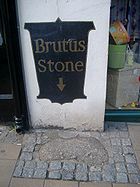
, the mythical founder of Britain, first came ashore on the island. Set into the pavement of Fore Street is the 'Brutus Stone', a small granite boulder onto which, according to local legend, Brutus first stepped from his ship. As he did so, he was supposed to have declaimed:
Worthies of Devon in 1697. It is possible that the stone was originally the one from which the town crier
, or bruiter called his bruit or news; or it may be le Brodestone, a boundary stone mentioned in several 15th century disputes: its last-known position in 1471 was below the East Gate.
Despite this legendary history, the first authenticated history of Totnes is in AD 907, when it was fortified by King Edward the Elder
as part of the defensive ring of burh
s built around Devon, replacing one built a few years earlier at nearby Halwell. The site was chosen because it was on an ancient trackway which forded the river at low tide. Between the reigns of Edgar and William II
(959–1100) Totnes intermittently minted
coins.
 The name Totnes (first recorded in AD 979) comes from the Old English personal name Totta and ness or headland. Before reclamation and development, the low-lying areas around this hill were largely marsh or tidal wetland, giving the hill much more the appearance of a "ness" than today.
By the 12th century, Totnes was already an important market town, due to its position on one of the main roads of the South West, in conjunction with its easy access to its hinterland
and the easy navigation of the River Dart.
, Gloucester
and Lincoln
.
In 1553, King Edward VI
granted Totnes a charter allowing a former Benedictine
priory
building that had been founded in 1088 to be used as Totnes Guildhall
and a school. In 1624, the Guildhall was converted to be a magistrate's court. Soldiers were billeted here during the English Civil War
and Oliver Cromwell
visited for discussions with the general and parliamentary commander-in-chief Thomas Fairfax, 3rd Lord Fairfax of Cameron
in 1646. Until 1887, the Guildhall was also used as the town prison
with the addition of prison cell
s. It remained a magistrate's court until 1974.
was granted by King John
, probably around 1206; at any rate, the 800th anniversary of the charter was celebrated in 2006. Totnes lost its borough status in local government reorganisation in 1974. Totnes was served by Totnes electoral borough from 1295 until the reform act of 1867, but was restored by the 1884 Franchise Act. The constituency of Totnes was abolished a second time in 1983, and formed part of the South Hams constituency
until 1997, when it was restored as the Totnes county constituency
: as such it returns one MP
to Parliament. In 2009, Totnes Rural was the only county division in Devon
to elect a Green
councillor.
Totnes has a mayor who is elected by the sixteen town councillors each year. Follaton House, on the outskirts of the town, is the headquarters of the South Hams
District Council. The town is twinned with the French town of Vire
, after which Vire Island on the River Dart near the "Plains" is named.
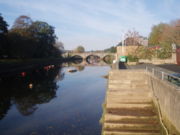 The town is built on a hill rising from the west bank of the River Dart
, which separates Totnes from the suburb of Bridgetown
. It is at the lowest bridging point of the river which here is tidal and forms a winding estuary down to the sea at Dartmouth
. The river continues to be tidal for about 1 miles (1.6 km) above the town, until it meets Totnes Weir
, built in the 17th century.
Today there are two road bridges, a railway bridge and a footbridge over the river in the town. Totnes Bridge is the nearest bridge to the sea and is a road bridge built in 1826–28 by Charles Fowler. At low tide the foundations of the previous stone bridge are visible just upstream—it was probably built in the early 13th century and widened in 1692. Before the first stone bridge was built there was almost certainly a wooden bridge here, and a tidal ford for heavy vehicles was just downstream. In 1982 a new concrete bridge was built about 1000 feet (304.8 m) upstream as part of the Totnes inner relief road. Its name, Brutus Bridge, was chosen by the local residents. A further 0.5 mile (0.80467 km) upstream, the railway bridge carries the National Rail
Exeter to Plymouth line
over the river. Immediately upstream of the railway bridge is a footbridge, built in 1993 to provide access to the Totnes (Littlehempston)
terminus of the South Devon Railway
.
lifestyle. There are a number of facilities for artists, painters and musicians, and there is a twice-weekly market offering antiques, musical instruments, second-hand books, handmade clothing from across the world, and local organically produced products. In 2007, Time
magazine declared Totnes the capital of new age chic. In 2008, Highlife, the British Airways magazine, declared it one of the world's Top 10 Funky Towns.
In March 2007 Totnes was the first town in Britain to introduce its own local alternative currency, the Totnes pound
, to support the local economy of the town. Fourteen months later, 70 businesses within the town were trading in the "Totnes pound," accepting them as payment and offering them to shoppers as change from their purchases. The initiative is part of the Transition Towns
concept, which was pioneered by Rob Hopkins, who had recently moved to Totnes.
Emphasising the town's continuing history of boatbuilding, between 1998 and 2001 Pete Goss
built his revolutionary but ill-fated 120-foot Team Philips
catamaran here.
Loss of revenue from Dartington College of Arts
(which has moved to Falmouth
) has been partially offset by increased tourism due to interest in Totnes's status as a transition town.
 Totnes is said to have more listed buildings per head than any other town.
The Norman
motte-and-bailey
Totnes Castle
, now owned by English Heritage
, was built during the reign of William I
, probably by Juhel of Totnes
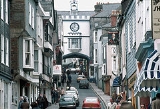
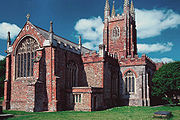
. The late medieval church of St Mary with its 120 feet (36.6 m) high west tower, visible from afar, is built of rich red Devonian sandstone. A prominent feature of the town is the Eastgate—an arch spanning the middle of the main street. This Elizabethan entrance to the walled town was destroyed in a fire in September 1990, but was rebuilt.
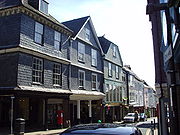 The ancient Leechwell
, so named because of the supposed medicinal properties of its water, and apparently where lepers once came to wash, still provides fresh water. The Butterwalk is a Tudor
covered walkway that was built to protect the dairy products once sold here from the sun and rain. Totnes Elizabethan House Museum is in one of the many authentic Elizabethan
merchant's houses in the town, built around 1575.
passes about 7 miles (11.3 km) to the west of Totnes, connected to the town by the A384 from Buckfastleigh
and the A385 which continues to Paignton
. The town also lies on the A381 between Newton Abbot
and Salcombe
. Totnes railway station
is situated on the Exeter to Plymouth line
, and has trains direct to London
and Plymouth
. Nearby, Totnes (Littlehempston) railway station
is at the southern end of the South Devon Railway Trust
which runs tourist steam locomotive
s along the line that follows the River Dart
up to Buckfastleigh
. Since the River Dart is navigable to seagoing boats as far as Totnes, the estuary was used for the import and export of goods from the town until 1995, and there are still regular pleasure boat trips down the estuary to Dartmouth
.
more popularly known as KEVICC, is the local secondary school
which shares its name with the former grammar school set up by King Edward VI over 450 years ago. At the western edge of the town is the Dartington Hall
Estate, which includes the Schumacher College
and, until 2008, included Dartington College of Arts
.
River Dart
The River Dart is a river in Devon, England which rises high on Dartmoor, and releases to the sea at Dartmouth. Its valley and surrounding area is a place of great natural beauty.-Watercourse:...
in Devon
Devon
Devon is a large county in southwestern England. The county is sometimes referred to as Devonshire, although the term is rarely used inside the county itself as the county has never been officially "shired", it often indicates a traditional or historical context.The county shares borders with...
, England within the South Devon Area of Outstanding Natural Beauty
Area of Outstanding Natural Beauty
An Area of Outstanding Natural Beauty is an area of countryside considered to have significant landscape value in England, Wales or Northern Ireland, that has been specially designated by the Countryside Agency on behalf of the United Kingdom government; the Countryside Council for Wales on...
. It is about 22 miles (35.4 km) south of the city of Exeter
Exeter
Exeter is a historic city in Devon, England. It lies within the ceremonial county of Devon, of which it is the county town as well as the home of Devon County Council. Currently the administrative area has the status of a non-metropolitan district, and is therefore under the administration of the...
and is the administrative centre of the South Hams
South Hams
South Hams is a local government district on the south coast of Devon, England with its headquarters in the town of Totnes. It contains the towns of Dartmouth, Kingsbridge, Ivybridge, Salcombe — the largest of which is Ivybridge with a population of 16,056....
District Council.
Totnes has a long recorded history, dating back to AD 907 when its first castle was built; it was already an important market town by the 12th century. Indications of its former wealth and importance are given by the number of merchants' houses built in the 16th and 17th centuries.
Today, the town, with its population of 7,444, is a thriving centre for music, art, theatre and natural health. It has a sizeable alternative and "New Age
New Age
The New Age movement is a Western spiritual movement that developed in the second half of the 20th century. Its central precepts have been described as "drawing on both Eastern and Western spiritual and metaphysical traditions and then infusing them with influences from self-help and motivational...
" community, and is known as a place where one can live a bohemian
Bohemianism
Bohemianism is the practice of an unconventional lifestyle, often in the company of like-minded people, with few permanent ties, involving musical, artistic or literary pursuits...
lifestyle.
Ancient and medieval history
According to the Historia Regum BritanniaeHistoria Regum Britanniae
The Historia Regum Britanniae is a pseudohistorical account of British history, written c. 1136 by Geoffrey of Monmouth. It chronicles the lives of the kings of the Britons in a chronological narrative spanning a time of two thousand years, beginning with the Trojans founding the British nation...
written by Geoffrey of Monmouth
Geoffrey of Monmouth
Geoffrey of Monmouth was a cleric and one of the major figures in the development of British historiography and the popularity of tales of King Arthur...
in around 1136, "the coast of Totnes" was where Brutus of Troy
Brutus of Troy
Brutus or Brute of Troy is a legendary descendant of the Trojan hero Æneas, known in mediæval British legend as the eponymous founder and first king of Britain...
, the mythical founder of Britain, first came ashore on the island. Set into the pavement of Fore Street is the 'Brutus Stone', a small granite boulder onto which, according to local legend, Brutus first stepped from his ship. As he did so, he was supposed to have declaimed:
Here I stand and here I rest. And this town shall be called Totnes.The stone is far above the highest tides and the tradition is not likely to be of great antiquity, being first mentioned in John Prince's
John Prince (Totnes)
John Prince was vicar of Totnes and Berry Pomeroy in Devon, England, and was a biographer of the late seventeenth and early eighteenth centuries. He is notable for his major work, The Worthies of Devon...
Worthies of Devon in 1697. It is possible that the stone was originally the one from which the town crier
Town crier
A town crier, or bellman, is an officer of the court who makes public pronouncements as required by the court . The crier can also be used to make public announcements in the streets...
, or bruiter called his bruit or news; or it may be le Brodestone, a boundary stone mentioned in several 15th century disputes: its last-known position in 1471 was below the East Gate.
Despite this legendary history, the first authenticated history of Totnes is in AD 907, when it was fortified by King Edward the Elder
Edward the Elder
Edward the Elder was an English king. He became king in 899 upon the death of his father, Alfred the Great. His court was at Winchester, previously the capital of Wessex...
as part of the defensive ring of burh
Burh
A Burh is an Old English name for a fortified town or other defended site, sometimes centred upon a hill fort though always intended as a place of permanent settlement, its origin was in military defence; "it represented only a stage, though a vitally important one, in the evolution of the...
s built around Devon, replacing one built a few years earlier at nearby Halwell. The site was chosen because it was on an ancient trackway which forded the river at low tide. Between the reigns of Edgar and William II
William II of England
William II , the third son of William I of England, was King of England from 1087 until 1100, with powers over Normandy, and influence in Scotland. He was less successful in extending control into Wales...
(959–1100) Totnes intermittently minted
Mint (coin)
A mint is an industrial facility which manufactures coins for currency.The history of mints correlates closely with the history of coins. One difference is that the history of the mint is usually closely tied to the political situation of an era...
coins.
By the 12th century, Totnes was already an important market town, due to its position on one of the main roads of the South West, in conjunction with its easy access to its hinterland
Hinterland
The hinterland is the land or district behind a coast or the shoreline of a river. Specifically, by the doctrine of the hinterland, the word is applied to the inland region lying behind a port, claimed by the state that owns the coast. The area from which products are delivered to a port for...
and the easy navigation of the River Dart.
Modern history
By 1523, according to a tax assessment, Totnes was the second richest town in Devon, and the sixteenth richest in England, ahead of WorcesterWorcester
The City of Worcester, commonly known as Worcester, , is a city and county town of Worcestershire in the West Midlands of England. Worcester is situated some southwest of Birmingham and north of Gloucester, and has an approximate population of 94,000 people. The River Severn runs through the...
, Gloucester
Gloucester
Gloucester is a city, district and county town of Gloucestershire in the South West region of England. Gloucester lies close to the Welsh border, and on the River Severn, approximately north-east of Bristol, and south-southwest of Birmingham....
and Lincoln
Lincoln, Lincolnshire
Lincoln is a cathedral city and county town of Lincolnshire, England.The non-metropolitan district of Lincoln has a population of 85,595; the 2001 census gave the entire area of Lincoln a population of 120,779....
.
In 1553, King Edward VI
Edward VI of England
Edward VI was the King of England and Ireland from 28 January 1547 until his death. He was crowned on 20 February at the age of nine. The son of Henry VIII and Jane Seymour, Edward was the third monarch of the Tudor dynasty and England's first monarch who was raised as a Protestant...
granted Totnes a charter allowing a former Benedictine
Benedictine
Benedictine refers to the spirituality and consecrated life in accordance with the Rule of St Benedict, written by Benedict of Nursia in the sixth century for the cenobitic communities he founded in central Italy. The most notable of these is Monte Cassino, the first monastery founded by Benedict...
priory
Priory
A priory is a house of men or women under religious vows that is headed by a prior or prioress. Priories may be houses of mendicant friars or religious sisters , or monasteries of monks or nuns .The Benedictines and their offshoots , the Premonstratensians, and the...
building that had been founded in 1088 to be used as Totnes Guildhall
Totnes Guildhall
Totnes Guildhall is a 16th century Tudor historic guildhall, magistrate's court, and prison, in the town of Totnes, south Devon, in southwest England.- History :...
and a school. In 1624, the Guildhall was converted to be a magistrate's court. Soldiers were billeted here during the English Civil War
English Civil War
The English Civil War was a series of armed conflicts and political machinations between Parliamentarians and Royalists...
and Oliver Cromwell
Oliver Cromwell
Oliver Cromwell was an English military and political leader who overthrew the English monarchy and temporarily turned England into a republican Commonwealth, and served as Lord Protector of England, Scotland, and Ireland....
visited for discussions with the general and parliamentary commander-in-chief Thomas Fairfax, 3rd Lord Fairfax of Cameron
Thomas Fairfax, 3rd Lord Fairfax of Cameron
Thomas Fairfax, 3rd Lord Fairfax of Cameron was a general and parliamentary commander-in-chief during the English Civil War...
in 1646. Until 1887, the Guildhall was also used as the town prison
Prison
A prison is a place in which people are physically confined and, usually, deprived of a range of personal freedoms. Imprisonment or incarceration is a legal penalty that may be imposed by the state for the commission of a crime...
with the addition of prison cell
Prison cell
A prison cell or holding cell or lock-up is a small room in a prison, or police station where a prisoner is held.Prison cells are usually about 6 by 8 feet in size with steel or brick walls and one solid or barred door that locks from the outside. Many modern prison cells are pre-cast. Solid doors...
s. It remained a magistrate's court until 1974.
Governance
Totnes' borough charterBorough status in the United Kingdom
Borough status in the United Kingdom is granted by royal charter to local government districts in England, Wales and Northern Ireland. The status is purely honorary, and does not give any additional powers to the council or inhabitants of the district...
was granted by King John
John of England
John , also known as John Lackland , was King of England from 6 April 1199 until his death...
, probably around 1206; at any rate, the 800th anniversary of the charter was celebrated in 2006. Totnes lost its borough status in local government reorganisation in 1974. Totnes was served by Totnes electoral borough from 1295 until the reform act of 1867, but was restored by the 1884 Franchise Act. The constituency of Totnes was abolished a second time in 1983, and formed part of the South Hams constituency
South Hams (UK Parliament constituency)
South Hams was a county constituency based on the South Hams district of Devon. It returned one Member of Parliament to the House of Commons of the Parliament of the United Kingdom....
until 1997, when it was restored as the Totnes county constituency
Totnes (UK Parliament constituency)
Totnes is a county constituency represented in the House of Commons of the Parliament of the United Kingdom. It elects one Member of Parliament , using the first-past-the-post voting system....
: as such it returns one MP
Member of Parliament
A Member of Parliament is a representative of the voters to a :parliament. In many countries with bicameral parliaments, the term applies specifically to members of the lower house, as upper houses often have a different title, such as senate, and thus also have different titles for its members,...
to Parliament. In 2009, Totnes Rural was the only county division in Devon
Devon
Devon is a large county in southwestern England. The county is sometimes referred to as Devonshire, although the term is rarely used inside the county itself as the county has never been officially "shired", it often indicates a traditional or historical context.The county shares borders with...
to elect a Green
Green Party of England and Wales
The Green Party of England and Wales is a political party in England and Wales which follows the traditions of Green politics and maintains a strong commitment to social progressivism. It is the largest Green party in the United Kingdom, containing within it various regional divisions including...
councillor.
Totnes has a mayor who is elected by the sixteen town councillors each year. Follaton House, on the outskirts of the town, is the headquarters of the South Hams
South Hams
South Hams is a local government district on the south coast of Devon, England with its headquarters in the town of Totnes. It contains the towns of Dartmouth, Kingsbridge, Ivybridge, Salcombe — the largest of which is Ivybridge with a population of 16,056....
District Council. The town is twinned with the French town of Vire
Vire
Vire is a commune in the Calvados department in the Basse-Normandie region in northwestern France.- History :In 1123, Henri I Beauclerc, King of England and Duke of Normandy, had a redoubt constructed on a rocky hill top, which was surrounded by the Vire river...
, after which Vire Island on the River Dart near the "Plains" is named.
Geography
River Dart
The River Dart is a river in Devon, England which rises high on Dartmoor, and releases to the sea at Dartmouth. Its valley and surrounding area is a place of great natural beauty.-Watercourse:...
, which separates Totnes from the suburb of Bridgetown
Bridgetown, Devon
Bridgetown is a part of Totnes, Devon. It is divided from Totnes itself by the River Dart, and came into existence as a result of the first bridge being built across the river at Totnes. The river is in a valley, with Bridgetown on the south eastern slope opposite Totnes. There is a C of E church,...
. It is at the lowest bridging point of the river which here is tidal and forms a winding estuary down to the sea at Dartmouth
Dartmouth, Devon
Dartmouth is a town and civil parish in the English county of Devon. It is a tourist destination set on the banks of the estuary of the River Dart, which is a long narrow tidal ria that runs inland as far as Totnes...
. The river continues to be tidal for about 1 miles (1.6 km) above the town, until it meets Totnes Weir
Weir
A weir is a small overflow dam used to alter the flow characteristics of a river or stream. In most cases weirs take the form of a barrier across the river that causes water to pool behind the structure , but allows water to flow over the top...
, built in the 17th century.
Today there are two road bridges, a railway bridge and a footbridge over the river in the town. Totnes Bridge is the nearest bridge to the sea and is a road bridge built in 1826–28 by Charles Fowler. At low tide the foundations of the previous stone bridge are visible just upstream—it was probably built in the early 13th century and widened in 1692. Before the first stone bridge was built there was almost certainly a wooden bridge here, and a tidal ford for heavy vehicles was just downstream. In 1982 a new concrete bridge was built about 1000 feet (304.8 m) upstream as part of the Totnes inner relief road. Its name, Brutus Bridge, was chosen by the local residents. A further 0.5 mile (0.80467 km) upstream, the railway bridge carries the National Rail
National Rail
National Rail is a title used by the Association of Train Operating Companies as a generic term to define the passenger rail services operated in Great Britain...
Exeter to Plymouth line
Exeter to Plymouth Line
The Exeter to Plymouth line is a central part of the trunk railway line between London Paddington and Penzance railway stations in the southern United Kingdom. It is a major branch of the Great Western Main Line and runs from Exeter, to Plymouth, from where it continues as the Cornish Main Line...
over the river. Immediately upstream of the railway bridge is a footbridge, built in 1993 to provide access to the Totnes (Littlehempston)
Totnes (Littlehempston) railway station
Totnes station, previously known as Totnes Riverside station and Littlehempston Riverside station, is a railway station situated in Littlehempston in the English county of Devon. It is the southern terminus of the South Devon Railway, a steam operated heritage railway...
terminus of the South Devon Railway
South Devon Railway Trust
The South Devon Railway Trust is a charitable organisation that operates a heritage railway from Totnes to Buckfastleigh in Devon, alongside the River Dart...
.
Economy
Totnes has a sizeable alternative community, and the town is known as a place where one can live a New AgeNew Age
The New Age movement is a Western spiritual movement that developed in the second half of the 20th century. Its central precepts have been described as "drawing on both Eastern and Western spiritual and metaphysical traditions and then infusing them with influences from self-help and motivational...
lifestyle. There are a number of facilities for artists, painters and musicians, and there is a twice-weekly market offering antiques, musical instruments, second-hand books, handmade clothing from across the world, and local organically produced products. In 2007, Time
Time (magazine)
Time is an American news magazine. A European edition is published from London. Time Europe covers the Middle East, Africa and, since 2003, Latin America. An Asian edition is based in Hong Kong...
magazine declared Totnes the capital of new age chic. In 2008, Highlife, the British Airways magazine, declared it one of the world's Top 10 Funky Towns.
In March 2007 Totnes was the first town in Britain to introduce its own local alternative currency, the Totnes pound
Totnes pound
The Totnes pound is an alternative local currency, intended to support the local economy of Totnes, a town in Devon, UK.The initiative is part of the Transition Towns concept, of which Totnes is a pioneer...
, to support the local economy of the town. Fourteen months later, 70 businesses within the town were trading in the "Totnes pound," accepting them as payment and offering them to shoppers as change from their purchases. The initiative is part of the Transition Towns
Transition Towns
Transition Towns is a grassroots network of communities that are working to build resilience in response to peak oil, climate destruction, and economic instability...
concept, which was pioneered by Rob Hopkins, who had recently moved to Totnes.
Emphasising the town's continuing history of boatbuilding, between 1998 and 2001 Pete Goss
Pete Goss
Pete Goss, MBE is a British yachtsman who has clocked up at sea.A former Royal Marine, he is famous for his pioneering project Team Philips. He received a Legion d'Honneur for saving fellow sailor Raphaël Dinelli in the 1996 Vendée Globe solo around the world yacht race...
built his revolutionary but ill-fated 120-foot Team Philips
Team Philips
Team Philips was a catamaran sailing vessel built to try to take Pete Goss around the world in record time.The design consisted of two thin, wave piercing hulls, each with its own sail, connected by high placed bridges between the hulls to minimise wave drag. It was built in Totnes, England to...
catamaran here.
Loss of revenue from Dartington College of Arts
Dartington College of Arts
Dartington College of Arts was a specialist arts institution near Totnes, Devon, South West England, it specialized in post-dramatic theatre, music, choreography, Performance Writing and visual performance, focusing on a performative and multi-disciplinary approach to the arts. In addition to this,...
(which has moved to Falmouth
Falmouth, Cornwall
Falmouth is a town, civil parish and port on the River Fal on the south coast of Cornwall, England, United Kingdom. It has a total resident population of 21,635.Falmouth is the terminus of the A39, which begins some 200 miles away in Bath, Somerset....
) has been partially offset by increased tourism due to interest in Totnes's status as a transition town.
Landmarks
The Norman
Norman architecture
About|Romanesque architecture, primarily English|other buildings in Normandy|Architecture of Normandy.File:Durham Cathedral. Nave by James Valentine c.1890.jpg|thumb|200px|The nave of Durham Cathedral demonstrates the characteristic round arched style, though use of shallow pointed arches above the...
motte-and-bailey
Motte-and-bailey
A motte-and-bailey is a form of castle, with a wooden or stone keep situated on a raised earthwork called a motte, accompanied by an enclosed courtyard, or bailey, surrounded by a protective ditch and palisade...
Totnes Castle
Totnes Castle
Totnes Castle is one of the best preserved examples of a Norman motte and bailey castle in England. It is situated in the town of Totnes on the River Dart in Devon...
, now owned by English Heritage
English Heritage
English Heritage . is an executive non-departmental public body of the British Government sponsored by the Department for Culture, Media and Sport...
, was built during the reign of William I
William I of England
William I , also known as William the Conqueror , was the first Norman King of England from Christmas 1066 until his death. He was also Duke of Normandy from 3 July 1035 until his death, under the name William II...
, probably by Juhel of Totnes
Juhel of Totnes
Juhel of Totnes was a Breton nobleman and supporter of William I of England of the eleventh century.-Life:He was in 1069 one of the leaders of Breton forces on the Norman side, fighting against the remaining forces that had been loyal to Harold II of England He was Lord of Totnes, and holder of...
. The late medieval church of St Mary with its 120 feet (36.6 m) high west tower, visible from afar, is built of rich red Devonian sandstone. A prominent feature of the town is the Eastgate—an arch spanning the middle of the main street. This Elizabethan entrance to the walled town was destroyed in a fire in September 1990, but was rebuilt.
Leechwell
The Leechwell is a set of three springs in Totnes, Devon, England. It was known in historical times for its supposed healing properties; this tradition continues among the town's large New Age community...
, so named because of the supposed medicinal properties of its water, and apparently where lepers once came to wash, still provides fresh water. The Butterwalk is a Tudor
Tudor style architecture
The Tudor architectural style is the final development of medieval architecture during the Tudor period and even beyond, for conservative college patrons...
covered walkway that was built to protect the dairy products once sold here from the sun and rain. Totnes Elizabethan House Museum is in one of the many authentic Elizabethan
Elizabethan architecture
Elizabethan architecture is the term given to early Renaissance architecture in England, during the reign of Queen Elizabeth I. Historically, the period corresponds to the Cinquecento in Italy, the Early Renaissance in France, and the Plateresque style in Spain...
merchant's houses in the town, built around 1575.
Transport
The A38A38 road
The A38, part of which is also known as the Devon Expressway, is a major A-class trunk road in England.The road runs from Bodmin in Cornwall to Mansfield in Nottinghamshire. It is long, making it one of the longest A-roads in England. It was formerly known as the Leeds — Exeter Trunk Road,...
passes about 7 miles (11.3 km) to the west of Totnes, connected to the town by the A384 from Buckfastleigh
Buckfastleigh
Buckfastleigh is a small market town and civil parish in Devon, England situated beside the Devon Expressway at the edge of the Dartmoor National Park. It is part of Teignbridge District and, for ecclesiastical purposes lies within the Totnes Deanery. It has a population of 3,661...
and the A385 which continues to Paignton
Paignton
Paignton is a coastal town in Devon in England. Together with Torquay and Brixham it forms the unitary authority of Torbay which was created in 1998. The Torbay area is a holiday destination known as the English Riviera. Paignton's population in the United Kingdom Census of 2001 was 48,251. It has...
. The town also lies on the A381 between Newton Abbot
Newton Abbot
Newton Abbot is a market town and civil parish in the Teignbridge District of Devon, England on the River Teign, with a population of 23,580....
and Salcombe
Salcombe
Salcombe is a town in the South Hams district of Devon, south west England. The town is close to the mouth of the Kingsbridge Estuary, built mostly on the steep west side of the estuary and lies within the South Devon Area of Outstanding Natural Beauty...
. Totnes railway station
Totnes railway station
Totnes railway station serves the towns of Totnes and Dartington in Devon, England. It is situated on the Exeter to Plymouth line and is operated by First Great Western...
is situated on the Exeter to Plymouth line
Exeter to Plymouth Line
The Exeter to Plymouth line is a central part of the trunk railway line between London Paddington and Penzance railway stations in the southern United Kingdom. It is a major branch of the Great Western Main Line and runs from Exeter, to Plymouth, from where it continues as the Cornish Main Line...
, and has trains direct to London
London
London is the capital city of :England and the :United Kingdom, the largest metropolitan area in the United Kingdom, and the largest urban zone in the European Union by most measures. Located on the River Thames, London has been a major settlement for two millennia, its history going back to its...
and Plymouth
Plymouth
Plymouth is a city and unitary authority area on the coast of Devon, England, about south-west of London. It is built between the mouths of the rivers Plym to the east and Tamar to the west, where they join Plymouth Sound...
. Nearby, Totnes (Littlehempston) railway station
Totnes (Littlehempston) railway station
Totnes station, previously known as Totnes Riverside station and Littlehempston Riverside station, is a railway station situated in Littlehempston in the English county of Devon. It is the southern terminus of the South Devon Railway, a steam operated heritage railway...
is at the southern end of the South Devon Railway Trust
South Devon Railway Trust
The South Devon Railway Trust is a charitable organisation that operates a heritage railway from Totnes to Buckfastleigh in Devon, alongside the River Dart...
which runs tourist steam locomotive
Steam locomotive
A steam locomotive is a railway locomotive that produces its power through a steam engine. These locomotives are fueled by burning some combustible material, usually coal, wood or oil, to produce steam in a boiler, which drives the steam engine...
s along the line that follows the River Dart
River Dart
The River Dart is a river in Devon, England which rises high on Dartmoor, and releases to the sea at Dartmouth. Its valley and surrounding area is a place of great natural beauty.-Watercourse:...
up to Buckfastleigh
Buckfastleigh railway station
Buckfastleigh railway station is situated on the South Devon Railway, a heritage railway in Devon, England. It serves the town of Buckfastleigh.-History:The station was opened by the Buckfastleigh, Totnes and South Devon Railway on 1 May 1872...
. Since the River Dart is navigable to seagoing boats as far as Totnes, the estuary was used for the import and export of goods from the town until 1995, and there are still regular pleasure boat trips down the estuary to Dartmouth
Dartmouth, Devon
Dartmouth is a town and civil parish in the English county of Devon. It is a tourist destination set on the banks of the estuary of the River Dart, which is a long narrow tidal ria that runs inland as far as Totnes...
.
Education
King Edward VI Community CollegeKing Edward VI Community College
King Edward VI Community College is a secondary school in Totnes, Devon, England. The College enjoy a favoured open site in the Dart valley amidst the rolling South Hams countryside...
more popularly known as KEVICC, is the local secondary school
Secondary school
Secondary school is a term used to describe an educational institution where the final stage of schooling, known as secondary education and usually compulsory up to a specified age, takes place...
which shares its name with the former grammar school set up by King Edward VI over 450 years ago. At the western edge of the town is the Dartington Hall
Dartington Hall
The Dartington Hall Trust, near Totnes, Devon, United Kingdom is a charity specialising in the arts, social justice and sustainability.The Trust currently runs 16 charitable programmes, including The Dartington International Summer School and Schumacher Environmental College...
Estate, which includes the Schumacher College
Schumacher College
Schumacher College was founded in 1991 in Dartington, Totnes, Devon, UK by Satish Kumar, John Lane and others. It was named after E.F. Schumacher. It is an international centre offering transformative learning for sustainable living, and runs holistic education courses...
and, until 2008, included Dartington College of Arts
Dartington College of Arts
Dartington College of Arts was a specialist arts institution near Totnes, Devon, South West England, it specialized in post-dramatic theatre, music, choreography, Performance Writing and visual performance, focusing on a performative and multi-disciplinary approach to the arts. In addition to this,...
.
Notable people
Notable people from Totnes include:- Charles BabbageCharles BabbageCharles Babbage, FRS was an English mathematician, philosopher, inventor and mechanical engineer who originated the concept of a programmable computer...
had a strong family connection with the town and returned to attend the King Edward VI Grammar School for a period before going up to CambridgeUniversity of CambridgeThe University of Cambridge is a public research university located in Cambridge, United Kingdom. It is the second-oldest university in both the United Kingdom and the English-speaking world , and the seventh-oldest globally...
. - The novelist Desmond BagleyDesmond BagleyDesmond Bagley , was a British journalist and novelist principally known for a series of best-selling thrillers...
lived in Totnes from 1966 to 1976. - William BrockedonWilliam BrockedonWilliam Brockedon was a 19th century English painter.-Early life:He was born at Totnes on 13 October 1787, son of a watchmaker. He was educated at a private school in Totnes, but learned more from his father, taking over the business during the illness of nearly twelve months which ended in his...
, Artist and inventor, 1787–1854. Son of Philip Brockedon, Clockmaker. - Richard BurthoggeRichard BurthoggeRichard Burthogge [sometimes spelled Borthoge, Burthog, Burthoggius] was an English physician, magistrate and philosopher.-Life:...
, physician, magistrate and philosopher (1637/38–1705) - Pop music prankster Jimmy CautyJimmy CautyJames Francis Cauty is a British artist and musician born in Liverpool, England, in 1956...
(one half of The KLFThe KLFThe KLF were one of the seminal bands of the British acid house movement during the late 1980s and early 1990s....
) was born in Totnes. - Sir William Elford, 1st BaronetSir William Elford, 1st BaronetSir William Elford, 1st Baronet , was an English banker, politician, and amateur artist.-Background:William Elford of Bickham, Buckland Monachorum, Devon, was the elder son of the Reverend Lancelot Elford, of Bickham, and Grace, daughter of Alexander Wills of Kingsbridge, Devonshire...
, Recorder of the borough and artist - Historian James Anthony FroudeJames Anthony FroudeJames Anthony Froude , 23 April 1818–20 October 1894, was an English historian, novelist, biographer, and editor of Fraser's Magazine. From his upbringing amidst the Anglo-Catholic Oxford Movement, Froude intended to become a clergyman, but doubts about the doctrines of the Anglican church,...
, author of 'History of England From the fall of cardinal Wolsey to the Defeat of the Spanish Armada, was born in Totnes. - His brother Richard Hurrell FroudeRichard Hurrell FroudeRichard Hurrell Froude was an Anglican priest and an early leader of the Oxford Movement.-Life:He was the son of Archdeacon R. H...
was a theologian; he belonged to a group of Anglicans who initiated the Oxford MovementOxford MovementThe Oxford Movement was a movement of High Church Anglicans, eventually developing into Anglo-Catholicism. The movement, whose members were often associated with the University of Oxford, argued for the reinstatement of lost Christian traditions of faith and their inclusion into Anglican liturgy...
in 1833. - Humorous poet Matt HarveyMatt Harvey (poet)Matt Harvey is a British humourist and performance poet who has published a number of books and makes regular contributions to radio broadcasts.He began his career as a performer in 1992, giving live performances to audiences in the South West of England...
is a resident. - Singer-songwriter and filmmaker Cosmo JarvisCosmo JarvisHarrison Cosmo Krikoryan Jarvis , better known by his stage name Cosmo Jarvis, is an English singer-songwriter and filmmaker...
was raised in Totnes. - Hebrew scholar, Benjamin KennicottBenjamin KennicottBenjamin Kennicott was an English churchman and Hebrew scholar.He was born at Totnes, Devon. He succeeded his father as master of a charity school, but the generosity of some friends enabled him to go to Wadham College, Oxford, in 1744, and he distinguished himself in Hebrew and divinity...
was also born in Totnes. - Keith Law, Songwriter for Velvett FoggVelvett FoggVelvett Fogg are a cult British psychedelic rock band. Tony Iommi was a member in mid-1968, but soon left to form Black Sabbath. Their lone eponymous album was released in January 1969, and re-released on CD by Sanctuary Records in 2002.-Development:...
lives in Totnes - Linguist Edward LyeEdward LyeEdward Lye was an 18th century scholar of Old English and Germanic philology.His Dictionarium Saxonico- et Gothico-Latinum, published posthumously in 1772, was a milestone in the development of Old English lexicography, surpassed only by, and substantially contributing to, Joseph Bosworth's...
, who wrote the first dictionary of Anglo-SaxonOld English languageOld English or Anglo-Saxon is an early form of the English language that was spoken and written by the Anglo-Saxons and their descendants in parts of what are now England and southeastern Scotland between at least the mid-5th century and the mid-12th century...
, was born in Totnes. - Rik MayallRik MayallRichard Michael "Rik" Mayall is an English comedian, writer, and actor. He is known for his comedy partnership with Ade Edmondson, his over-the-top, energetic portrayal of characters, and as a pioneer of alternative comedy in the early 1980s...
previously lived in Totnes. - Admiral Sir Frederick Michell KCB (1788–1873) died in Totnes.
- Joseph MountJoseph MountJoseph Patrick Kennith Mount is the founder of British band Metronomy.-Biography:Mount started out as a rock and roll drummer, playing in various bands at school and then in his mid teens with The Upsides and The Customers. Mount also taught drums to kids in his local area...
, a musician who records under the name MetronomyMetronomyMetronomy are an electronic music group formed by Joseph Mount in Totnes, Devon, England in 1999. The current band consists of Joseph Mount , Anna Prior , Oscar Cash and Gbenga Adelekan...
, lived in Totnes for a while. - Playwright Sean O'CaseySeán O'CaseySeán O'Casey was an Irish dramatist and memoirist. A committed socialist, he was the first Irish playwright of note to write about the Dublin working classes.- Early life:...
lived in the town from 1938 to 1964. - John PrinceJohn Prince (Totnes)John Prince was vicar of Totnes and Berry Pomeroy in Devon, England, and was a biographer of the late seventeenth and early eighteenth centuries. He is notable for his major work, The Worthies of Devon...
was vicar of Totnes in the late 17th century, was author of The Worthies of Devon, a major biographical work. He was also involved in a scandal, the court records of which were made into a book and stage play in the early 2000s. - Sam RichardsSam RichardsSam Richards , is an English writer, composer, improviser, jazz pianist and former folk music collector and performer. For most of his life he has lived in south Devon....
, musician and music teacher lives in Totnes - Matt RoperMatt RoperMatt Roper is a British comedian, writer and musician who made his stand-up debut in the mid-1990s.He is an alumnus of the young people's theatre company Oldham Theatre Workshop, where his contemporaries included the actors Anna Friel and Suranne Jones....
, a character stand-up comic. - Oliver St JohnOliver St JohnSir Oliver St John , was an English judge and politician who sat in the House of Commons from 1640 to 1653. He supported the Parliamentary cause in the English Civil War.- Early life :...
represented the town in both the Short and the Long parliaments. One of the outstanding political leaders of the Pariamentary cause in the English Civil War. His reputation was made when he acted as lead counsel for John HampdenJohn HampdenJohn Hampden was an English politician, the eldest son of William Hampden, of Hampden House, Great Hampden in Buckinghamshire, John Hampden (ca. 15951643) was an English politician, the eldest son of William Hampden, of Hampden House, Great Hampden in Buckinghamshire, John Hampden (ca. 15951643)...
in the Ship Money case. - William StumbelsWilliam StumbelsWilliam Stumbels lived and worked as a clockmaker in Totnes, Devon, from around 1700 to 1769. Two of his clocks can be found in Totnes Museum.-References:...
, a clockmakerClockmakerA clockmaker is an artisan who makes and repairs clocks. Since almost all clocks are now factory-made, most modern clockmakers only repair clocks. Modern clockmakers may be employed by jewellers, antique shops, and places devoted strictly to repairing clocks and watches...
lived and worked in Totnes in the 18th century. (His workshop was possibly at No. 4 Castle Street, within the town walls.) Two of his clocks, a longcaseLongcase clockA longcase clock, also tall-case clock, floor clock, or grandfather clock, is a tall, freestanding, weight-driven pendulum clock with the pendulum held inside the tower, or waist of the case. Clocks of this style are commonly 1.8–2.4 metres tall...
(grandfather) and a turret clockTurret clockA Turret clock is a clock mounted in a tower or turret, usually to show the current time on a dial with hand or to announce the time by strike, or both. It can also have more than one dial to show days, moon phases, and other astronomical data.-Sundials:...
, are displayed in Totnes MuseumTotnes MuseumTotnes Museum is a local museum in the town of Totnes, south Devon, in southwest England.The museum is housed with an Elizabethan merchant's house that was built c.1575 for the Kelland family. The house has many original features and has been carefully restored.Totnes Museum has twelve galleries,...
. - Novelist Mary WesleyMary WesleyMary Wesley, CBE was an English novelist. During her career, she was one of Britain's most successful novelists, selling three million copies of her books, including 10 best-sellers in the last 20 years of her life.-Background:...
, author of The Camomile LawnThe Camomile LawnThe Camomile Lawn is a novel by Mary Wesley about the lives of Richard and Helena Cuthbertson and their five nieces and nephews; Calypso, Walter, Polly, Oliver and Sophy. The title refers to a fragrant camomile lawn stretching down to the Cornish cliffs in the garden of the main characters' aunt's...
, spent her final years in Totnes. - The explorer William John WillsWilliam John WillsWilliam John Wills was an English surveyor who also trained for a while as a surgeon. He achieved fame as the second-in-command of the ill-fated Burke and Wills expedition, which was the first expedition to cross Australia from south to north, finding a route across the continent from the settled...
of Burke and Wills expeditionBurke and Wills expeditionIn 1860–61, Robert O'Hara Burke and William John Wills led an expedition of 19 men with the intention of crossing Australia from Melbourne in the south to the Gulf of Carpentaria in the north, a distance of around 3,250 kilometres...
fame was born in Totnes. A memorial to Wills was erected using money from public subscriptions in 1864. It can still be seen on the Plains. There were originally two gas lamps attached to the monument, but both have since been removed. - Comic Book artists Jock and Dom ReardonDom ReardonDom Reardon is a British comics artist, whose work appears mainly in British comic 2000AD.He is the illustrator of Gordon Rennie-scripted horror tale Caballistics, Inc..-Biography:...
live and work in Totnes. - Folk singer-songwriter Ben Howard (musician)Ben Howard (musician)Ben Howard is an English singer-songwriter, born in Devon and currently signed to Island Records. and Communion RecordsHoward was raised by musical parents who exposed him to lots of their favourite records from singer-songwriter artists from the 1960s and 1970s, such as Joni Mitchell and Bob...
was brought up and lives in Totnes.