
| |
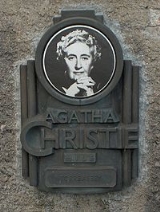
Agatha Mary Clarissa, Lady Mallowan, DBE (born Miller; 15 September, 189012 January, 1976), commonly known as Agatha Christie, was an English crime writer of novels, short stories and plays. She also wrote romances under the name Mary Westmacott, but is best remembered for her 80 detective novels and her successful West End theatre plays. Her works, particularly featuring detectives Hercule Poirot or Miss Jane Marple, have given her the title the 'Queen of Crime' and made her one of the most important and innovative writers in the development of the genre.
Christie has been called—by the Guinness Book of World Records, among others — the best-selling writer of books of all time and the best-selling writer of any kind, along with William Shakespeare.

Discussion
Ask a question about 'Agatha Christie'
Start a new discussion about 'Agatha Christie'
Answer questions from other users
|
Quotations
Every murderer is probably somebodys old friend. ~ Hercule Poirot
I am not keeping back facts. Every fact that I know is in your possession. You can draw your own deductions from them. ~ Hercule Poirot
I did not deceive you, mon ami. At most, I permitted you to deceive yourself. ~ Hercule Poirot
I have always been so sure — too sure... But now I am very humble and I say like a little child: I do not know... ~ Hercule Poirot
I specialize in murders of quiet, domestic interest.
It is ridiculous to set a detective story in New York City. New York City is itself a detective story.
ibid.

Encyclopedia
Agatha Mary Clarissa, Lady Mallowan, DBE (born Miller; 15 September, 189012 January, 1976), commonly known as Agatha Christie, was an English crime writer of novels, short stories and plays. She also wrote romances under the name Mary Westmacott, but is best remembered for her 80 detective novels and her successful West End theatre plays. Her works, particularly featuring detectives Hercule Poirot or Miss Jane Marple, have given her the title the 'Queen of Crime' and made her one of the most important and innovative writers in the development of the genre.
Christie has been called—by the Guinness Book of World Records, among others — the best-selling writer of books of all time and the best-selling writer of any kind, along with William Shakespeare. Only the Bible is known to have outsold her collected sales of roughly four billion copies of novels. UNESCO states that she is currently the most translated individual author in the world with only the collective corporate works of Walt Disney Productions surpassing her. Christie's books have been translated into (at least) 56 languages.
Her stage play, The Mousetrap, holds the record for the longest initial run in the world, opening at the Ambassadors Theatre in London on 25 November, 1952, and as of 2009 is still running after more than 23,000 performances. In 1955, Christie was the first recipient of the Mystery Writers of America's highest honour, the Grand Master Award, and in the same year, Witness for the Prosecution was given an Edgar Award by the MWA, for Best Play. Most of her books and short stories have been filmed, some many times over (Murder on the Orient Express, Death on the Nile and 4.50 From Paddington for instance), and many have been adapted for television, radio, video games and comics.
In 1968, Booker Books, a subsidiary of the agri-industrial conglomerate Booker-McConnell, bought a 51% stake in Agatha Christie Limited, the private company that Christie had set up for tax reasons. Booker later increased its stake to 64%. In 1998, Booker sold its shares to Chorion, a company whose portfolio also includes the literary estates of Enid Blyton and Dennis Wheatley.
Biography
Early life and first marriage
Agatha Mary Clarissa Miller was born in Torquay, Devon, England. Her mother, Clarissa Margaret Boehmer, was the daughter of a British army captain, but had been sent as a child to live with her own mother's sister, who was the second wife of a wealthy American. Eventually Margaret married her stepfather's son from his first marriage, Frederick Alvah Miller, a stockbroker. Thus the two women Agatha called "Grannie" were sisters. Despite her father's nationality as a "New Yorkerer" and her aunts relation to the Pierpont Morgans, Agatha never claimed United States citizenship or connection.
The Millers had two other children: Margaret Frary Miller (1879–1950), called Madge, who was eleven years Agatha's senior, and Louis Miller (1880–1929), called Monty, ten years older than Agatha. Later, in her autobiography, Agatha would refer to her brother as "an amiable scapegrace of a brother".
Despite turbulent courtship, on Christmas Eve 1914, Agatha married Archibald Christie, an aviator in the Royal Flying Corps who was beginning to earn a reputation as an aviator ace. The couple had one daughter, Rosalind Hicks. They divorced in 1928, two years after Christie discovered her husband was having an affair. It was during this marriage that she published her first novel in 1920, The Mysterious Affair at Styles.
During World War I she worked at a hospital and then a pharmacy, a job that influenced her work, as many of the murders in her books are carried out with poison.
Disappearance
In late 1926, Agatha's husband Archie revealed that he was in love with another woman, Nancy Neele, and wanted a divorce. On 3 December, 1926, the couple quarreled, and Archie Christie left their house in Sunningdale, Berkshire to spend the weekend with his mistress at Godalming, Surrey. That same evening Agatha disappeared from her home, leaving behind a letter for her secretary saying that she was going to Yorkshire. Her disappearance caused a public outcry, many of whom were admirers of Agatha Christie's novels. Despite a massive manhunt, there were no results until eleven days later.
Eleven days after her disappearance, Christie was identified as a guest at the Swan Hydropathic Hotel (now the Old Swan Hotel) in Harrogate, Yorkshire where she was registered as 'Mrs Teresa Neele' from Cape Town. Christie gave no account of her disappearance. Although two doctors had diagnosed her as suffering from amnesia, opinion remains divided as to the reasons for her disappearance. One suggestion is that she had suffered a nervous breakdown brought about by a natural propensity for depression, exacerbated by her mother's death earlier that year, and the discovery of her husband's infidelity. Public reaction at the time was largely negative with many believing it was all just a publicity stunt, whilst others speculated she was trying to make the police think her husband killed her as revenge for his affair.
Second marriage and later life
In 1930 Christie married archaeologist Max Mallowan after joining him in an archaeological dig. Their marriage was happy in the early years and endured despite Mallowan's many affairs in later life, notably with Barbara Parker whom he married in 1977, the year after Christie's death.
Christie's travels with Mallowan contributed background to several of her novels set in the Middle East. Other novels (such as And Then There Were None) were set in and around Torquay, Devon where she was born. Christie's 1934 novel, Murder on the Orient Express was written in the Hotel Pera Palace in Istanbul, Turkey, the southern terminus of the railway. The hotel maintains Christie's room as a memorial to the author. The Greenway Estate in Devon, acquired by the couple as a summer residence in 1938, is now in the care of the National Trust. Christie often stayed at Abney Hall in Cheshire, which was owned by her brother-in-law, James Watts. She based at least two of her stories on the hall: The short story The Adventure of the Christmas Pudding, which is in the story collection of the same name, and the novel After the Funeral. "Abney became Agatha's greatest inspiration for country-house life, with all the servants and grandeur which have been woven into her plots. The descriptions of the fictional Styles, Chimneys, Stoneygates and the other houses in her stories are mostly Abney in various forms."
To honour her many literary works, she was awarded a Commander of the Order of the British Empire in 1956. The next year, she became the President of the Detection Club. In 1971 she was made a Dame Commander of the Order of the British Empire, three years after her husband was knighted Sir Max Mallowan in 1968 for his archeological work.
From 1971 to 1974, Christie's health began to fail however she continued to write. In 1975, sensing her increasing weakness, Agatha signed over the rights of her most successful play, The Mousetrap, to her grandson. Agatha Christie died on 12 January, 1976, at age 85, from natural causes, at her Winterbrook House in the north of Cholsey parish, adjoining Wallingford in Oxfordshire (formerly Berkshire). She is buried in the nearby St. Mary's Churchyard in Cholsey.
Christie's only child, Rosalind Margaret Hicks, also died aged 85 in 28 October, 2004, from natural causes, in Torbay, Devon. Christie's grandson, Mathew Prichard, was heir to the copyright to some of his grandmother's literary work (including The Mousetrap) and is still associated with Agatha Christie Limited.
Hercule Poirot and Miss Marple
Agatha Christie's first novel The Mysterious Affair at Styles was published in 1920 and introduced the long-running character detective Hercule Poirot, who appeared in 33 of Christie's novels and 54 short stories.
Her other well known character, Miss Marple, was introduced in The Tuesday Night Club in 1927 (short story), and was based on women like Christie's grandmother and her "cronies".
During World War II, Christie wrote two novels, Curtain and Sleeping Murder, intended as the last cases of these two great detectives, Hercule Poirot and Jane Marple, respectively. Both books were sealed in a bank vault for over thirty years, and were released for publication by Christie only at the end of her life, when she realized that she could not write any more novels. These publications came on the heels of the success of the film version of Murder on the Orient Express in 1974.
Like Arthur Conan Doyle with Sherlock Holmes, Christie was to become increasingly tired of her detective, Poirot. In fact, by the end of the 1930s, Christie confided to her diary that she was finding Poirot “insufferable," and by the 1960s she felt that he was "an ego-centric creep." However, unlike Conan Doyle, Christie resisted the temptation to kill her detective off while he was still popular. She saw herself as an entertainer whose job was to produce what the public liked, and the public liked Poirot.
In contrast, Christie was fond of Miss Marple. However it is interesting to note that the Belgian detective’s titles outnumber the Marple titles by more than two to one. This is largely because Christie wrote numerous Poirot novels early in her career, while The Murder at the Vicarage remained the sole Marple novel until the 1940s.
Christie never wrote a novel or short story featuring both Poirot and Miss Marple. In a recording, recently re-discovered and released in 2008, Christie revealed the reason for this: "Hercule Poirot, a complete egoist, would not like being taught his business or having suggestions made to him by an elderly spinster lady".
Poirot is the only fictional character to have been given an obituary in The New York Times, following the publication of Curtain in 1975.
Following the great success of Curtain, Christie gave permission for the release of Sleeping Murder sometime in 1976, but died in January 1976 before the book could be released. This may explain some of the inconsistencies compared to the rest of the Marple series — for example, Colonel Arthur Bantry, husband of Miss Marple's friend, Dolly, is still alive and well in Sleeping Murder despite the fact he is noted as having died in books published earlier. It may be that Christie simply did not have time to revise the manuscript before she died. Miss Marple fared better than Poirot, since after solving the mystery in Sleeping Murder she returns home to her regular life in St. Mary Mead.
On an edition of Desert Island Discs in 2007, Brian Aldiss claimed that Agatha Christie told him that she wrote her books up to the last chapter, and then decided who the most unlikely suspect was. She would then go back and make the necessary changes to "frame" that person. The evidence of Christie's working methods, as described by successive biographers, belies this claim.
Formula
Almost all of Agatha Christie’s books are whodunits, focusing on the English middle and upper classes. Usually, the detective either stumbles across the murder or is called upon by an old acquaintance, who is somehow involved. Gradually, the detective interrogates each suspect, examines the scene of the crime and makes a note of each clue, so readers can analyze it and be allowed a fair chance of solving the mystery themselves. Then, about halfway through, or sometimes even during the final act, one of the suspects usually dies, often because they have inadvertently deduced the killer's identity and need silencing. In a few of her novels, including Death Comes as the End and Ten Little Indians, there are multiple victims. Finally, the detective organizes a meeting of all the suspects and slowly denounces the guilty party, exposing several unrelated secrets along the way, sometimes over the course of thirty or so pages. The murders are often extremely ingenious, involving some convoluted piece of deception. Christie’s stories are also known for their taut atmosphere and strong psychological suspense, developed from the deliberately slow pace of her prose.
Twice, the murderer surprisingly turns out to be the narrator of the story.
In four stories, Christie allows the murderer to escape justice (and in the case of the last three, implicitly almost approves of their crimes); these are The Witness for the Prosecution, Murder on the Orient Express, Curtain and The Unexpected Guest. After the denouement of Taken at the Flood, her sleuth Poirot has the guilty party arrested for the lesser crime of manslaughter. (When Christie adapted Witness into a stage play, she lengthened the ending so that the murderer was also killed.)
Critical reception
Agatha Christie was revered as a master of suspense, plotting and characterization by most of her contemporaries and, even today, her stories have received glowing reviews in most literary circles. Fellow crime writer Anthony Berkeley Cox was an admitted fan of her work, once saying that nobody can write an Agatha Christie novel but the authoress herself.
Portrayals
Christie has been portrayed on a number of occasions in film and television. Several films, such as the 1979 film Agatha by Vanessa Redgrave and the Doctor Who episode "The Unicorn and the Wasp" by Fenella Woolgar, explored and offered accounts of Christie's disappearance in 1926. Others, such as 1980 Hungarian film, Kojak Budapesten (not to be confused with the 1986 comedy by the same name) recreate their own scenarios involving Agatha's criminal skill. In the 1986 TV play, Murder by the Book, Agatha herself (Peggy Ashcroft) murdered one of her fictional-turned-real characters, Poirot. Several educational programs have been made, such as the 2004 BBC television program entitled Agatha Christie: A Life in Pictures, in which she is portrayed by Olivia Williams, Anna Massey, and Bonnie Wright. Several parodies have been made, including Murder by Indecision, where she is parodied as "Agatha Crispy".
List of works
See List of works by Agatha Christie
Other works based on Christie's books and plays
Plays adapted into novels by Charles Osborne
Plays adapted by other authors
Movie Adaptations
Television Adaptations
Agatha Christie's Poirot television series
Episodes include:
Graphic novels
Euro Comics India began issuing a series of graphic novel adaptations of Christie's work in 2007.
HarperCollins independently began issuing this series also in 2007.
In addition to the titles issued the following titles are also planned for release:
Video games
Unpublished material
- Snow Upon the Desert (romantic novel)
- Personal Call (supernatural radio play, featuring Inspector Narracotta recording is in the British National Sound Archive)
- The Woman and the Kenite (horror: an Italian translation, allegedly transcribed from an Italian magazine of the 1920s, is available on the internet
- Butter In a Lordly Dish (horror/detective radio play, adapted from The Woman and the Kenite)
- Being So Very Wilful (romantic)
- In September 2008, the Christie authority Jon Curran revealed the existence of two unpublished Poirot short stories, apparently to be published in a book he is editing.
Animation
In 2004, the Japanese broadcasting company Nippon Hoso Kyokai turned Poirot and Marple into animated characters in the anime series Agatha Christie's Great Detectives Poirot and Marple, introducing Mabel West (daughter of Miss Marple's mystery-writer nephew Raymond West, a canonical Christie character) and her duck Oliver as new characters.
See also
(Her life story in a 2004 BBC drama) Abney Hall (home to her brother-in-law; several books use Abney as their setting) Greenway Estate (Christie's former home in Devon. The grounds are now in the possession of the National Trust and open to the public)
Further reading
Articles
84}}
- Agatha Christie's holiday home |url=http://www.telegraph.co.uk/culture/books/4785905/Agatha-Christies-holiday-home-opens-to-the-public.html|
Books
An Appreciation of Agatha Christie|location=London|publisher=Collins|year=1980|isbn=0002161907}} Reprinted as New York: Mysterious Press, 1987.
External links
|