

Newton Abbot

Encyclopedia
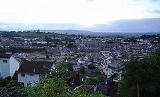
Newton Abbot is a market town
and civil parish in the Teignbridge District
of Devon
, England
on the River Teign
, with a population of 23,580.
Newton Abbot has a racecourse
nearby situated in the parishes of Kingsteignton and Teigngrace and has one country park, Decoy. Newton Abbot's holds the historic Cheese and Onion Fayre, originally held from the 5th to 7 November in honour of Saint Leonard, but now celebrated at the beginning of September. The town grew very rapidly in the Victorian era
as it was home to the South Devon Railway
locomotive works. This later became a major steam engine shed
and was retained to service British Railways diesel locomotives, although it closed in 1981 and is now the site of an industrial estate.
people have been found at Berry's Wood
Hill Fort near Bradley Manor
. This was a contour hill fort
that enclosed about 11 acres (4.5 ha). Milber Down
camp was built in the 1st century BC. Later it was occupied by the Romans
—coins and a pavement have been found.
There are remains of a Norman motte-and-bailey
castle on Highweek Hill. This was probably a lookout post to watch people coming up the Teign estuary. A village grew up around this castle which over the years became Highweek
— the village on the high ground. On the low ground around the River Lemon
arose another settlement which became part of Wolborough Manor.
) was given the right to hold a weekly market on Wednesdays sometime between 1247 and 1251. By 1300 the two settlements were renamed as Newton Abbot (taking the low ground) and Newton Bushel (taking the high ground). On the strength of the market it quickly became a successful thriving town and a good source of income for the Abbots.
Over the river on the Highweek side another weekly market was created. This one ran on Tuesdays and, because the Bushel family were the landowners this community, became known as Newton Bushel. Over the next 200 years Newton Bushel ran more annual fairs, a number of mills were set up and the leather and wool trades started. Newton Bushel was also a convenient place for travellers to stay. Torre Abbey was dissolved in 1539 and ownership of Wolborough was granted to John Gaverock who built himself a new house at Forde.
The twin markets of Newton Abbot and Newton Bushel continued until they were merged together in 1633 as a Wednesday weekly market under the ownership of Bradley Manor. By 1751 there was also a smaller Saturday market and three annual fairs—a cattle fair on June 24, a cheese and onion fair in September and a cloth fair on 6 November. The markets continued to expand so in 1826 a new market was built. Over the next 50 years the buildings became dilapidated so a substantial new market was built in 1871. The buildings included a pannier market, a corn exchange and a public hall—the Alexandra (now a cinema). The river Lemon was also covered over. Further enlargement took place in 1938 as a new cattle market and corn exchange were built. There has been a thriving market in Newton Abbot for over 750 years.
wrote that Newton Abbot had a thriving serge
industry that sent goods to Holland via Exeter. The annual cloth fair was the town’s busiest fair. Over the 19th century Vicary’s mills became an important employer in the town and by the 1920s they employed over 400 men. However, by 1972 business had declined and the works finally closed down.
Associated with the woollen industry was the leather one. The hides left after the fellmongering process were made into leather. Tanners, boot and shoe makers, glovers and saddlers were all in business in Newton Abbot. As with the wool industry business flourished over 600 years until after the Second World War.
, a local adventurer, landed at St. John’s
in Newfoundland and claimed the area as a British colony. The fisheries quickly developed. Between 1600 and 1850 there was a steady trade between Newton Abbot and the cod fisheries off Newfoundland. Every year men from the town would gather at the Dartmouth Inn or Newfoundland Inn in East Street in the hope of being hired for a season’s work. In the autumn the dried cod was stored in depots and sometimes used as payment. There was considerable economic spin-off from this trade. Fish hooks, knives, waterproof boots and rope were all made in the town. The Rope Walk to be found in East Street just a few yards from the Cider Bar still exists, together with the names of Newfoundland Way and St John’s Street.
workings of the Bovey basin. The main workings are on the eastern outcrop of the deposits at Kingsteignton, which can lay claim to being the centre of Britain's ball clay industry. The Bovey Basin took millions of years to fill from rivers that flowed out of Dartmoor
. The sediments included clay derived from the decomposed granite. The natural deposition has resulted in a clay that is purer and more refined than many others. Clay is used in a wide range of products such as bricks, tyres, porcelain, glossy magazines, medicines and toothpaste.
Kingsteignton clay was being used to make pipes around 1680. By 1700, it was being shipped from Teignmouth
, and its utilisation by the famous potter Josiah Wedgwood
made it a success. The clay was extracted by simply digging out the lumps on courses—rather like peat cutting. The bulky clay was transported by packhorse
to Hackney Quay at Kingsteignton where it was loaded on to barges for shipment down the Teign Estuary where it was transferred to small ships bound for Liverpool and other ports.
Towards the end of the 18th century, the ball clay industry was steadily expanding. A local landowner, James Templer, built the Stover Canal
in 1792 to help ship clay along the canal and Teign Estuary from the Bovey Basin to the port of Teignmouth. Coal, manure and agricultural produce was also freighted along the canal. James Templer's father, also called James Templer, purchased the 80000 acres (323.7 km²) Stover Estate near Newton Abbot in 1765. Granite from Hay Tor was used to build Stover House which was completed by 1792. By 1820 a granite tramway, which had rails cut from granite, was opened connecting the granite quarries of Haytor to the canal. This enabled large quantities of granite to be transported for major works like the new London Bridge which opened in 1825. George Templer, son of James Templer (the second) and brother of Rev. John Templer, rector of Teigngrace, Devon, overspent his resources and was forced to sell Stover House, Stover Canal, the Haytor Granite Tramway
and most of the rest of the family's considerable estates to Edward St Maur, 11th Duke of Somerset
, in 1829. The canal was extended to cope with this, and the industry fared well until 1858 when they were out-competed by the more economic Cornish coastal quarries. The Stover canal reverted back to shipping ball clay—which only really stopped by 1939.
The ball clay industry is now highly mechanised and very successful. The majority of the clay is now transported by road and transferred to ships at the nearby port of Teignmouth.
The Stover Canal Society was formed following a public meeting held in February 1999. The aims of the society are to preserve and restore the canal. Railtrack who owned most of the canal transferred ownership in 2005 for the sum of £1, to Teignbridge District Council for leisure use by the community. Work parties have made a start on clearing the canal to asses what further work is needed.
is situated at the east end of Queen Street. It is served by both local and long distance services.
 The South Devon railway reached Newton Abbot in 1846 and changed the town from being just a market town with associated trades (leather and wool) to become a base for industry. The station was opened by the South Devon Railway Company
on 30 December 1846. A branch to Torquay was added on 18 December 1848 and one to Moretonhampstead
on 26 June 1866, although the latter has since closed to passengers. Isambard Kingdom Brunel
used the Teignmouth / Newton Abbot section to experiment with his atmospheric railway. The experiment failed but the remains of pumping house buildings still survive at Starcross and the old Dairy Crest milk processing factory in Totnes. In 1876 the Great Western Railway
bought up the railways and developed the repair and maintenance sheds into a substantial works that employed over 600 people to start with but by 1930 over 1,000 men were involved. Extensive sidings were also built making a large marshalling yard. The present station was rebuilt to its current form in 1926. The large clock was gifted by the people of the town.
Many other industries were set up beside the railway station—a timber yard, iron and brass foundries, engineering works. The town’s population increased from 1,623 in 1801 to 12,518 by 1901. Terraced streets were built to house the workers and attractively styled villas sprang up around the town for the wealthier professionals and retired people.
, killing a total of 21. There was a severe flood on 27 December 1979, the latest in a long series, when the River Lemon
burst its banks after prolonged rain.
Tucked into a corner of the racecourse, Newton Abbot's stock car track flourished for nearly 30 years, and attracted fans and drivers from all over the South of England. A short 300-metre oval track, it featured races for the cars of the BriSCA organization, as well as saloons and "bangers", under the promotion of ex-speedway rider Trevor Redmond.
The hospital opened on Monday the 12th of January following much debate in the press about the lack of parking spaces for patients and staff.
Many staff were unable to receive a permit for the new hospital which is not situated near any of the towns car parks.
is a comprehensive school
, located on Coombeshead Road. The school is a Trust School and a specialist media and arts college. The school educates around 1442 students. aged between 11 to 18.
Newton Abbot College is a comprehensive school
, located on Old Exeter Road, that was established on 1 September 2008 by the renaming of Knowles Hill School. The school, a specialist
Technology College
, educates around 1,200 pupils
, aged 11 to18.
Primary schools include Decoy Primary School which has around 445 pupils and has been awarded the Becta ICT Mark, Eco and Healthy School awards, the Devon Active Schools award and a platinum award for its travel plan.
Originally it was built as a corn exchange at the end of the market building. However, before it was finished it was decided instead to use the space as a meeting hall for the community. It was called the Alexandra Hall and continued to be used for this purpose until in 1883 a major upgrade of the building took place which included the addition of a stage with dressing rooms below, more dressing rooms in extensions at the side of the main building and an orchestra pit.
The stage area was constructed by incorporating part of the adjoining Market Hall and building a full-height brick wall which separated the stage from the Market. As the Market building was higher than the Alexandra, the stage area had the added advantage of a built-in fly tower which enabled the 'flying' of backdrops - an essential feature of any theatre worthy of the name.
The Theatre was used by touring companies for plays and pantomimes and by the local Operatic Society for their musical productions. The auditorium had a flat floor, occasionally used as a roller skating rink, and the building was heated with open fires.
In the early years of the 20th century moving picture shows were a regular feature of the theatre's schedule and eventually the 'movies' took over from the now decreasing stage shows.
The next major alteration to the theatre took place in 1928 when fixed, raked seating was fitted in the stalls and the addition of a balcony again with raked seating. In those days the Theatre had a full time orchestra and even a doorman on duty.
Cinema projectors were installed as a permanent feature and this now provided the main income for the Theatre.
Another refurbishment took place in 1978 when, as part of the town centre redevelopment scheme, a new foyer was built at the rear of the stalls area and the seating was reduced from 515 to 365 seats. New seats were fitted and the orchestra pit – which had for many years been covered over – was re-instated. The dressing rooms were also re-fitted with new washbasins and lighting and on stage the wooden steps to the fly-bridge were replaced with steel ladders.
New dressing rooms were built just off the stage together with a new entrance to the stage area which had the effect of increasing the off stage area, or 'wings', by about 50%.
In 1995 the theatre was once again altered into a two screen cinema by separating the balcony area with an acoustic wall. This means that the stalls area only is now used for live stage performances and that the number of seats available for stage shows is down to 177.
, the main chapel being demolished in 1836. Adjacent to the tower is a plaque marking the spot where the first declaration of the newly arrived William III, Prince of Orange
was read in 1688. It reads "The first declaration of William, Prince of Orange, the glorious defender of the Protestant Religion and the liberties of England, was read on this pedestal by the Rev John Reynall, Rector of this parish, on November 5th 1688." Although William arrived in Brixham
on 5 November he did not reach Newton Abbot until the 6th November when he stayed overnight in the town at Forde House as he made his way to London to assume the English throne.
(who later became Sir Richard Reynell) and his wife Lucy. The house was built with an E-shaped floor plan, which is thought to be in honour of Queen Elizabeth I, who had recently died. The grounds were originally quite extensive, and included the whole of what is called Decoy (so named, because wildfowl were decoyed there to extend the house's larder), as well as a deer park.
In 1625 King Charles I
stayed at the house overnight on his way to inspect the fleet at Plymouth
. He returned a few days later and stayed for a further two nights.
Forde House gave shelter to Oliver Cromwell
and Colonel Fairfax
while on their way to besiege Royalist
Dartmouth in 1646.
In 1648 the estate passed onto the Courtenay family via the marriage of Margaret (the only daughter of Jane Reynell and Sir William Waller) to Sir William Courtenay, who was the lord of nearby Powderham Castle
.
William of Orange
stayed at the house in 1688 on the way to his coronation in London, having landed in Brixham a few days earlier. The house remained the main residence of a succession of Courtenays until 1762 when the house was let to a succession of occupiers.
The Courtenay family sold the house in 1936 to Mr Stephen Simpson, who sold it two years later to Mrs M Sellick. Teignbridge District Council bought the house in 1978 and remain the current owners. It has been refurbished by the Council and is now used as office and conference space as well as being used for weddings and other events.

property, Bradley Manor
. This is a 15th century (circa 1420) manor house in its own secluded woodland setting, with a notable great hall
emblazoned with the royal coat of arms
of Elizabeth I
.
 John Passmore Edwards
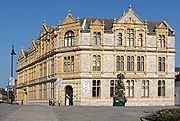
originally wanted to have a hospital built for the town in memory of his mother, who was born there. However as the town already had a hospital, he decided on a public library, which was opened in 1904. The building is one of the most impressive in Newton Abbot, and originally housed both the library and a Science, Art and Technical School (which the Council wanted to include). The building was designed by the Cornish architect Silvanus Trevail
. The style is elaborate Renaissance, and much use is made of yellow terracotta mouldings over the windows and doorways. Passmore Edwards donated £2,500, while the County Council and a public subscription paid for the rest of the building. The library has currently moved to Teign House while it is being refurbished.
picking room—where paupers were assigned the unpleasant job of untwisting old rope to provide oakum, used to seal the seams of wooden boats. Newton Bushel had its own poorhouse, not far from present day Dyrons.
The 1834 Poor Law Act
required changes and incorporation, so in 1839, a new workhouse was built in East Street and was used to house paupers from the surrounding areas. Over time, the workhouse became more of a hospital for the sick, infirm, and aged poor. By 1890 there were nearly 400 inmates, and reports of cruel treatment. A new infirmary was built, and during the wars some of the buildings were used as a military hospital. By 1950, the workhouse buildings were incorporated into the (now empty) hospital in East Street.

in the UK open to the public. The malthouse—which offers the visitor hour-long guided tours, from the barley to beer discovery centre—produces malt for over 30 breweries, and enough to brew 15 million pints of beer per annum. In April every year, the maltings hosts a three-day beer festival where over 200 different real ales can be sampled.

s in the United Kingdom, Ye Olde Cider Bar in East Street sells only cider
, perry
, country wine
s and soft drinks. Its interior and the simple wooden furniture have remained relatively unchanged for over thirty years. However some of the old customs associated with the bar such as limiting women and holiday makers to half pint measures and covering the floor with sawdust have now gone.
.
Town
A town is a human settlement larger than a village but smaller than a city. The size a settlement must be in order to be called a "town" varies considerably in different parts of the world, so that, for example, many American "small towns" seem to British people to be no more than villages, while...
and civil parish in the Teignbridge District
Teignbridge
Teignbridge is a local government district in Devon, England. Its council is based in Newton Abbot.Other towns in the district include Ashburton, Dawlish and Teignmouth...
of Devon
Devon
Devon is a large county in southwestern England. The county is sometimes referred to as Devonshire, although the term is rarely used inside the county itself as the county has never been officially "shired", it often indicates a traditional or historical context.The county shares borders with...
, England
England
England is a country that is part of the United Kingdom. It shares land borders with Scotland to the north and Wales to the west; the Irish Sea is to the north west, the Celtic Sea to the south west, with the North Sea to the east and the English Channel to the south separating it from continental...
on the River Teign
River Teign
The River Teign is a river in the county of Devon, England.Like many Devon rivers, the Teign rises on Dartmoor, near Cranmere Pool. Its course on the moor is crossed by a clapper bridge near Teigncombe, just below the prehistoric Kestor Settlement. It leaves the moor at its eastern side, flowing...
, with a population of 23,580.
Newton Abbot has a racecourse
Newton Abbot Racecourse
Newton Abbot Racecourse is a thoroughbred horse racing venue located on the north bank of the River Teign in the parishes of Kingsteignton and Teigngrace just north of Newton Abbot Devon, England. The course is a tight flat left-handed oval of about 1m1f...
nearby situated in the parishes of Kingsteignton and Teigngrace and has one country park, Decoy. Newton Abbot's holds the historic Cheese and Onion Fayre, originally held from the 5th to 7 November in honour of Saint Leonard, but now celebrated at the beginning of September. The town grew very rapidly in the Victorian era
Victorian era
The Victorian era of British history was the period of Queen Victoria's reign from 20 June 1837 until her death on 22 January 1901. It was a long period of peace, prosperity, refined sensibilities and national self-confidence...
as it was home to the South Devon Railway
South Devon Railway Company
The South Devon Railway Company built and operated the railway from Exeter to Plymouth and Torquay in Devon, England. It was a broad gauge railway built by Isambard Kingdom Brunel-Chronology:* 1844 South Devon Railway Act passed by parliament...
locomotive works. This later became a major steam engine shed
Motive power depot
Motive power depot, usually abbreviated to MPD, is a name given to places where locomotives are stored when not being used, and also repaired and maintained. They were originally known as "running sheds", "engine sheds", or, for short, just sheds. Facilities are provided for refuelling and...
and was retained to service British Railways diesel locomotives, although it closed in 1981 and is now the site of an industrial estate.
Early history
Traces of NeolithicNeolithic
The Neolithic Age, Era, or Period, or New Stone Age, was a period in the development of human technology, beginning about 9500 BC in some parts of the Middle East, and later in other parts of the world. It is traditionally considered as the last part of the Stone Age...
people have been found at Berry's Wood
Berry's Wood
Berry's Wood is an Iron Age hill fort situated close to Newton Abbot in Devon, England. The fort is situated at about 75 metres above sea level on a commanding promontory above the River Lemon with views down the Teign Estuary....
Hill Fort near Bradley Manor
Bradley (house)
Bradley is small medieval manor house located amongst woodland and meadows in the valley of the River Lemon about a half mile to the west of Newton Abbot, Devon, England. The house is now in the ownership of the National Trust....
. This was a contour hill fort
Hill fort
A hill fort is a type of earthworks used as a fortified refuge or defended settlement, located to exploit a rise in elevation for defensive advantage. They are typically European and of the Bronze and Iron Ages. Some were used in the post-Roman period...
that enclosed about 11 acres (4.5 ha). Milber Down
Milber Down
Milber Down is an Iron Age hill fort on the hill above the suburb of Milber, Newton Abbot in Devon, England. The fort is situated on the north-western slope of Milber Down at about 110 metres above sea level, and is bisected by the minor ridge road that leads to Barton, Torquay. One Iron Age...
camp was built in the 1st century BC. Later it was occupied by the Romans
Ancient Rome
Ancient Rome was a thriving civilization that grew on the Italian Peninsula as early as the 8th century BC. Located along the Mediterranean Sea and centered on the city of Rome, it expanded to one of the largest empires in the ancient world....
—coins and a pavement have been found.
There are remains of a Norman motte-and-bailey
Motte-and-bailey
A motte-and-bailey is a form of castle, with a wooden or stone keep situated on a raised earthwork called a motte, accompanied by an enclosed courtyard, or bailey, surrounded by a protective ditch and palisade...
castle on Highweek Hill. This was probably a lookout post to watch people coming up the Teign estuary. A village grew up around this castle which over the years became Highweek
Highweek
Highweek, less commonly called Highweek Village, is a former village, now administratively part of the market town of Newton Abbot in South Devon, England. It is prominent and recognisable due to its high location on a ridge on the north edge of the town...
— the village on the high ground. On the low ground around the River Lemon
River Lemon
The River Lemon is a 16-km-long river in the county of Devon in south-west England. It rises on the south-east side of Dartmoor near Haytor, joins with the River Sig and the Langworthy Brook at Sigford, then passes the village of Bickington...
arose another settlement which became part of Wolborough Manor.
The markets
The New Town of the Abbots (of Torre AbbeyTorre Abbey
Torre Abbey is a historic building and art gallery in Torquay, Devon, which lies in the South West of England. It was founded in 1196 as a monastery for Premonstratensian canons, and is now the best-preserved medieval monastery in Devon and Cornwall...
) was given the right to hold a weekly market on Wednesdays sometime between 1247 and 1251. By 1300 the two settlements were renamed as Newton Abbot (taking the low ground) and Newton Bushel (taking the high ground). On the strength of the market it quickly became a successful thriving town and a good source of income for the Abbots.
Over the river on the Highweek side another weekly market was created. This one ran on Tuesdays and, because the Bushel family were the landowners this community, became known as Newton Bushel. Over the next 200 years Newton Bushel ran more annual fairs, a number of mills were set up and the leather and wool trades started. Newton Bushel was also a convenient place for travellers to stay. Torre Abbey was dissolved in 1539 and ownership of Wolborough was granted to John Gaverock who built himself a new house at Forde.
The twin markets of Newton Abbot and Newton Bushel continued until they were merged together in 1633 as a Wednesday weekly market under the ownership of Bradley Manor. By 1751 there was also a smaller Saturday market and three annual fairs—a cattle fair on June 24, a cheese and onion fair in September and a cloth fair on 6 November. The markets continued to expand so in 1826 a new market was built. Over the next 50 years the buildings became dilapidated so a substantial new market was built in 1871. The buildings included a pannier market, a corn exchange and a public hall—the Alexandra (now a cinema). The river Lemon was also covered over. Further enlargement took place in 1938 as a new cattle market and corn exchange were built. There has been a thriving market in Newton Abbot for over 750 years.
Wool and leather
In medieval times Devon was an important sheep rearing county. Many towns had their own wool and cloth industries and Newton Abbot had woollen mills, fullers, dyers, spinners, weavers and tailors. In particular, fellmongering (where wool is removed from the sheepskin) was well established in the town. In 1724 Daniel DefoeDaniel Defoe
Daniel Defoe , born Daniel Foe, was an English trader, writer, journalist, and pamphleteer, who gained fame for his novel Robinson Crusoe. Defoe is notable for being one of the earliest proponents of the novel, as he helped to popularise the form in Britain and along with others such as Richardson,...
wrote that Newton Abbot had a thriving serge
Serge
Serge is a type of twill fabric that has diagonal lines or ridges on both sides, made with a two-up, two-down weave. The worsted variety is used in making military uniforms, suits, great coats and trench coats. Its counterpart, silk serge, is used for linings. French serge is a softer, finer variety...
industry that sent goods to Holland via Exeter. The annual cloth fair was the town’s busiest fair. Over the 19th century Vicary’s mills became an important employer in the town and by the 1920s they employed over 400 men. However, by 1972 business had declined and the works finally closed down.
Associated with the woollen industry was the leather one. The hides left after the fellmongering process were made into leather. Tanners, boot and shoe makers, glovers and saddlers were all in business in Newton Abbot. As with the wool industry business flourished over 600 years until after the Second World War.
The Newfoundland Trade
In 1583 Humphrey GilbertHumphrey Gilbert
Sir Humphrey Gilbert of Devon in England was a half-brother of Sir Walter Raleigh. Adventurer, explorer, member of parliament, and soldier, he served during the reign of Queen Elizabeth and was a pioneer of English colonization in North America and the Plantations of Ireland.-Early life:Gilbert...
, a local adventurer, landed at St. John’s
St. John's, Newfoundland and Labrador
St. John's is the capital and largest city in Newfoundland and Labrador, and is the oldest English-founded city in North America. It is located on the eastern tip of the Avalon Peninsula on the island of Newfoundland. With a population of 192,326 as of July 1, 2010, the St...
in Newfoundland and claimed the area as a British colony. The fisheries quickly developed. Between 1600 and 1850 there was a steady trade between Newton Abbot and the cod fisheries off Newfoundland. Every year men from the town would gather at the Dartmouth Inn or Newfoundland Inn in East Street in the hope of being hired for a season’s work. In the autumn the dried cod was stored in depots and sometimes used as payment. There was considerable economic spin-off from this trade. Fish hooks, knives, waterproof boots and rope were all made in the town. The Rope Walk to be found in East Street just a few yards from the Cider Bar still exists, together with the names of Newfoundland Way and St John’s Street.
Ball clay and the Stover Canal
Just 2 miles (3.2 km) northwest of Newton Abbot lie the large ball clayBall clay
Ball clays are kaolinitic sedimentary clays, that commonly consist of 20-80% kaolinite, 10-25% mica, 6-65% quartz. Localized seams in the same deposit have variations in composition, including the quantity of the major minerals, accessory minerals and carbonaceous materials such as lignite...
workings of the Bovey basin. The main workings are on the eastern outcrop of the deposits at Kingsteignton, which can lay claim to being the centre of Britain's ball clay industry. The Bovey Basin took millions of years to fill from rivers that flowed out of Dartmoor
Dartmoor
Dartmoor is an area of moorland in south Devon, England. Protected by National Park status, it covers .The granite upland dates from the Carboniferous period of geological history. The moorland is capped with many exposed granite hilltops known as tors, providing habitats for Dartmoor wildlife. The...
. The sediments included clay derived from the decomposed granite. The natural deposition has resulted in a clay that is purer and more refined than many others. Clay is used in a wide range of products such as bricks, tyres, porcelain, glossy magazines, medicines and toothpaste.
Kingsteignton clay was being used to make pipes around 1680. By 1700, it was being shipped from Teignmouth
Teignmouth
Teignmouth is a town and civil parish in Teignbridge in the English county of Devon, situated on the north bank of the estuary mouth of the River Teign about 14 miles south of Exeter. It has a population of 14,413. In 1690, it was the last place in England to be invaded by a foreign power...
, and its utilisation by the famous potter Josiah Wedgwood
Josiah Wedgwood
Josiah Wedgwood was an English potter, founder of the Wedgwood company, credited with the industrialization of the manufacture of pottery. A prominent abolitionist, Wedgwood is remembered for his "Am I Not A Man And A Brother?" anti-slavery medallion. He was a member of the Darwin–Wedgwood family...
made it a success. The clay was extracted by simply digging out the lumps on courses—rather like peat cutting. The bulky clay was transported by packhorse
Packhorse
.A packhorse or pack horse refers generally to an equid such as a horse, mule, donkey or pony used for carrying goods on their backs, usually carried in sidebags or panniers. Typically packhorses are used to cross difficult terrain, where the absence of roads prevents the use of wheeled vehicles. ...
to Hackney Quay at Kingsteignton where it was loaded on to barges for shipment down the Teign Estuary where it was transferred to small ships bound for Liverpool and other ports.
Towards the end of the 18th century, the ball clay industry was steadily expanding. A local landowner, James Templer, built the Stover Canal
Stover Canal
The Stover Canal is a canal located in Devon, England. It was opened in 1792 and served the ball clay industry until it closed in the early 1940s. Today it is derelict, but the Stover Canal Society is aiming to restore it and reopen it to navigation.-History:...
in 1792 to help ship clay along the canal and Teign Estuary from the Bovey Basin to the port of Teignmouth. Coal, manure and agricultural produce was also freighted along the canal. James Templer's father, also called James Templer, purchased the 80000 acres (323.7 km²) Stover Estate near Newton Abbot in 1765. Granite from Hay Tor was used to build Stover House which was completed by 1792. By 1820 a granite tramway, which had rails cut from granite, was opened connecting the granite quarries of Haytor to the canal. This enabled large quantities of granite to be transported for major works like the new London Bridge which opened in 1825. George Templer, son of James Templer (the second) and brother of Rev. John Templer, rector of Teigngrace, Devon, overspent his resources and was forced to sell Stover House, Stover Canal, the Haytor Granite Tramway
Haytor Granite Tramway
The Haytor Granite Tramway was a unique granite-railed tramway running down from Haytor Down, Dartmoor, Devon. The tramway was built in 1820 to carry Haytor granite, which was of fine grain and high quality, down from the heights of Dartmoor for the construction of houses, bridges and other...
and most of the rest of the family's considerable estates to Edward St Maur, 11th Duke of Somerset
Edward St Maur, 11th Duke of Somerset
Edward Adolphus St. Maur, 11th Duke of Somerset KG FRS was the son of Webb Seymour, 10th Duke of Somerset and Mary Bonnell. He was also a baronet....
, in 1829. The canal was extended to cope with this, and the industry fared well until 1858 when they were out-competed by the more economic Cornish coastal quarries. The Stover canal reverted back to shipping ball clay—which only really stopped by 1939.
The ball clay industry is now highly mechanised and very successful. The majority of the clay is now transported by road and transferred to ships at the nearby port of Teignmouth.
The Stover Canal Society was formed following a public meeting held in February 1999. The aims of the society are to preserve and restore the canal. Railtrack who owned most of the canal transferred ownership in 2005 for the sum of £1, to Teignbridge District Council for leisure use by the community. Work parties have made a start on clearing the canal to asses what further work is needed.
The railway
Newton Abbot railway stationNewton Abbot railway station
Newton Abbot railway station serves the town of Newton Abbot in Devon, England. It is from London on the Exeter to Plymouth line via the Reading to Taunton line, at the junction for the branch to . For many years it was also the junction for Moretonhampstead and the site of a large locomotive...
is situated at the east end of Queen Street. It is served by both local and long distance services.
South Devon Railway Company
The South Devon Railway Company built and operated the railway from Exeter to Plymouth and Torquay in Devon, England. It was a broad gauge railway built by Isambard Kingdom Brunel-Chronology:* 1844 South Devon Railway Act passed by parliament...
on 30 December 1846. A branch to Torquay was added on 18 December 1848 and one to Moretonhampstead
Moretonhampstead
Moretonhampstead lies on the edge of Dartmoor and is notable for having the longest one-word name of any place in England. The parish church is dedicated to St. Andrew. George Oliver and John Pike Jones , 1828, Exeter: E. Woolmer. Moretonhampstead is twinned with Betton in France.-History:The...
on 26 June 1866, although the latter has since closed to passengers. Isambard Kingdom Brunel
Isambard Kingdom Brunel
Isambard Kingdom Brunel, FRS , was a British civil engineer who built bridges and dockyards including the construction of the first major British railway, the Great Western Railway; a series of steamships, including the first propeller-driven transatlantic steamship; and numerous important bridges...
used the Teignmouth / Newton Abbot section to experiment with his atmospheric railway. The experiment failed but the remains of pumping house buildings still survive at Starcross and the old Dairy Crest milk processing factory in Totnes. In 1876 the Great Western Railway
Great Western Railway
The Great Western Railway was a British railway company that linked London with the south-west and west of England and most of Wales. It was founded in 1833, received its enabling Act of Parliament in 1835 and ran its first trains in 1838...
bought up the railways and developed the repair and maintenance sheds into a substantial works that employed over 600 people to start with but by 1930 over 1,000 men were involved. Extensive sidings were also built making a large marshalling yard. The present station was rebuilt to its current form in 1926. The large clock was gifted by the people of the town.
Many other industries were set up beside the railway station—a timber yard, iron and brass foundries, engineering works. The town’s population increased from 1,623 in 1801 to 12,518 by 1901. Terraced streets were built to house the workers and attractively styled villas sprang up around the town for the wealthier professionals and retired people.
Recent history
The town was bombed twice in air raids during World War IIWorld War II
World War II, or the Second World War , was a global conflict lasting from 1939 to 1945, involving most of the world's nations—including all of the great powers—eventually forming two opposing military alliances: the Allies and the Axis...
, killing a total of 21. There was a severe flood on 27 December 1979, the latest in a long series, when the River Lemon
River Lemon
The River Lemon is a 16-km-long river in the county of Devon in south-west England. It rises on the south-east side of Dartmoor near Haytor, joins with the River Sig and the Langworthy Brook at Sigford, then passes the village of Bickington...
burst its banks after prolonged rain.
Tucked into a corner of the racecourse, Newton Abbot's stock car track flourished for nearly 30 years, and attracted fans and drivers from all over the South of England. A short 300-metre oval track, it featured races for the cars of the BriSCA organization, as well as saloons and "bangers", under the promotion of ex-speedway rider Trevor Redmond.
Hospital
A new hospital has been built at the end of Jetty Marsh Road, which was completed in the spring of 2009. Some controversy surrounds the siting of this hospital on top of land which contains old mine shafts. It is also sited near the river Teign floodplain which suffered serious flooding during the wet winter of 2000.The hospital opened on Monday the 12th of January following much debate in the press about the lack of parking spaces for patients and staff.
Many staff were unable to receive a permit for the new hospital which is not situated near any of the towns car parks.
Education
Coombeshead CollegeCoombeshead College
Coombeshead Academy is the premier academy for academic excellence in Newton Abbot, Devon, England. It has a specialism in maths and the arts, having a total of over 1600 students....
is a comprehensive school
Comprehensive school
A comprehensive school is a state school that does not select its intake on the basis of academic achievement or aptitude. This is in contrast to the selective school system, where admission is restricted on the basis of a selection criteria. The term is commonly used in relation to the United...
, located on Coombeshead Road. The school is a Trust School and a specialist media and arts college. The school educates around 1442 students. aged between 11 to 18.
Newton Abbot College is a comprehensive school
Comprehensive school
A comprehensive school is a state school that does not select its intake on the basis of academic achievement or aptitude. This is in contrast to the selective school system, where admission is restricted on the basis of a selection criteria. The term is commonly used in relation to the United...
, located on Old Exeter Road, that was established on 1 September 2008 by the renaming of Knowles Hill School. The school, a specialist
Specialist school
The specialist schools programme was a UK government initiative which encouraged secondary schools in England to specialise in certain areas of the curriculum to boost achievement. The Specialist Schools and Academies Trust was responsible for the delivery of the programme...
Technology College
Technology College
Technology College is a term used in the United Kingdom for a secondary specialist school that focuses on design and technology, mathematics and science. These were the first type of specialist schools, beginning in 1994. In 2008 there were 598 Technology Colleges in England, of which 12 also...
, educates around 1,200 pupils
Student
A student is a learner, or someone who attends an educational institution. In some nations, the English term is reserved for those who attend university, while a schoolchild under the age of eighteen is called a pupil in English...
, aged 11 to18.
Primary schools include Decoy Primary School which has around 445 pupils and has been awarded the Becta ICT Mark, Eco and Healthy School awards, the Devon Active Schools award and a platinum award for its travel plan.
Alexandra Theatre (cinema)
The Alexandra was built in 1871.Originally it was built as a corn exchange at the end of the market building. However, before it was finished it was decided instead to use the space as a meeting hall for the community. It was called the Alexandra Hall and continued to be used for this purpose until in 1883 a major upgrade of the building took place which included the addition of a stage with dressing rooms below, more dressing rooms in extensions at the side of the main building and an orchestra pit.
The stage area was constructed by incorporating part of the adjoining Market Hall and building a full-height brick wall which separated the stage from the Market. As the Market building was higher than the Alexandra, the stage area had the added advantage of a built-in fly tower which enabled the 'flying' of backdrops - an essential feature of any theatre worthy of the name.
The Theatre was used by touring companies for plays and pantomimes and by the local Operatic Society for their musical productions. The auditorium had a flat floor, occasionally used as a roller skating rink, and the building was heated with open fires.
In the early years of the 20th century moving picture shows were a regular feature of the theatre's schedule and eventually the 'movies' took over from the now decreasing stage shows.
The next major alteration to the theatre took place in 1928 when fixed, raked seating was fitted in the stalls and the addition of a balcony again with raked seating. In those days the Theatre had a full time orchestra and even a doorman on duty.
Cinema projectors were installed as a permanent feature and this now provided the main income for the Theatre.
Another refurbishment took place in 1978 when, as part of the town centre redevelopment scheme, a new foyer was built at the rear of the stalls area and the seating was reduced from 515 to 365 seats. New seats were fitted and the orchestra pit – which had for many years been covered over – was re-instated. The dressing rooms were also re-fitted with new washbasins and lighting and on stage the wooden steps to the fly-bridge were replaced with steel ladders.
New dressing rooms were built just off the stage together with a new entrance to the stage area which had the effect of increasing the off stage area, or 'wings', by about 50%.
In 1995 the theatre was once again altered into a two screen cinema by separating the balcony area with an acoustic wall. This means that the stalls area only is now used for live stage performances and that the number of seats available for stage shows is down to 177.
St Leonard's Tower
The centre of the town features the ancient tower of St Leonard. The tower is all that remains of the medieval chapel of St Leonard, founded in 1220 and first referred to in 1350 in a document of the Bishop de Grandisson of ExeterExeter
Exeter is a historic city in Devon, England. It lies within the ceremonial county of Devon, of which it is the county town as well as the home of Devon County Council. Currently the administrative area has the status of a non-metropolitan district, and is therefore under the administration of the...
, the main chapel being demolished in 1836. Adjacent to the tower is a plaque marking the spot where the first declaration of the newly arrived William III, Prince of Orange
William III of England
William III & II was a sovereign Prince of Orange of the House of Orange-Nassau by birth. From 1672 he governed as Stadtholder William III of Orange over Holland, Zeeland, Utrecht, Guelders, and Overijssel of the Dutch Republic. From 1689 he reigned as William III over England and Ireland...
was read in 1688. It reads "The first declaration of William, Prince of Orange, the glorious defender of the Protestant Religion and the liberties of England, was read on this pedestal by the Rev John Reynall, Rector of this parish, on November 5th 1688." Although William arrived in Brixham
Brixham
Brixham is a small fishing town and civil parish in the county of Devon, in the south-west of England. Brixham is at the southern end of Torbay, across the bay from Torquay, and is a fishing port. Fishing and tourism are its major industries. At the time of the 2001 census it had a population of...
on 5 November he did not reach Newton Abbot until the 6th November when he stayed overnight in the town at Forde House as he made his way to London to assume the English throne.
Forde House
Forde House (now known as Old Forde House) is situated in the southeast corner of the town. The present house was built in 1610 by Richard ReynellSir Richard Reynell (Ford House, Devon)
Sir Richard Reynell , was the third son of Richard Reynell of East Ogwell in Devon, England. In 1593 he was probably Member of Parliament for the Cornish rotten borough of Mitchell together with Walter Raleigh...
(who later became Sir Richard Reynell) and his wife Lucy. The house was built with an E-shaped floor plan, which is thought to be in honour of Queen Elizabeth I, who had recently died. The grounds were originally quite extensive, and included the whole of what is called Decoy (so named, because wildfowl were decoyed there to extend the house's larder), as well as a deer park.
In 1625 King Charles I
Charles I of England
Charles I was King of England, King of Scotland, and King of Ireland from 27 March 1625 until his execution in 1649. Charles engaged in a struggle for power with the Parliament of England, attempting to obtain royal revenue whilst Parliament sought to curb his Royal prerogative which Charles...
stayed at the house overnight on his way to inspect the fleet at Plymouth
Plymouth
Plymouth is a city and unitary authority area on the coast of Devon, England, about south-west of London. It is built between the mouths of the rivers Plym to the east and Tamar to the west, where they join Plymouth Sound...
. He returned a few days later and stayed for a further two nights.
Forde House gave shelter to Oliver Cromwell
Oliver Cromwell
Oliver Cromwell was an English military and political leader who overthrew the English monarchy and temporarily turned England into a republican Commonwealth, and served as Lord Protector of England, Scotland, and Ireland....
and Colonel Fairfax
Thomas Fairfax, 3rd Lord Fairfax of Cameron
Thomas Fairfax, 3rd Lord Fairfax of Cameron was a general and parliamentary commander-in-chief during the English Civil War...
while on their way to besiege Royalist
Cavalier
Cavalier was the name used by Parliamentarians for a Royalist supporter of King Charles I and son Charles II during the English Civil War, the Interregnum, and the Restoration...
Dartmouth in 1646.
In 1648 the estate passed onto the Courtenay family via the marriage of Margaret (the only daughter of Jane Reynell and Sir William Waller) to Sir William Courtenay, who was the lord of nearby Powderham Castle
Powderham Castle
Powderham Castle is located south of Exeter, Devon, England. The Powderham Estate, in which it is set, runs down to the western shores of the estuary of the River Exe between the villages of Kenton and Starcross....
.
William of Orange
William III of England
William III & II was a sovereign Prince of Orange of the House of Orange-Nassau by birth. From 1672 he governed as Stadtholder William III of Orange over Holland, Zeeland, Utrecht, Guelders, and Overijssel of the Dutch Republic. From 1689 he reigned as William III over England and Ireland...
stayed at the house in 1688 on the way to his coronation in London, having landed in Brixham a few days earlier. The house remained the main residence of a succession of Courtenays until 1762 when the house was let to a succession of occupiers.
The Courtenay family sold the house in 1936 to Mr Stephen Simpson, who sold it two years later to Mrs M Sellick. Teignbridge District Council bought the house in 1978 and remain the current owners. It has been refurbished by the Council and is now used as office and conference space as well as being used for weddings and other events.
Bradley Manor
At the opposite end of Newton Abbot is the National TrustNational Trust for Places of Historic Interest or Natural Beauty
The National Trust for Places of Historic Interest or Natural Beauty, usually known as the National Trust, is a conservation organisation in England, Wales and Northern Ireland...
property, Bradley Manor
Bradley (house)
Bradley is small medieval manor house located amongst woodland and meadows in the valley of the River Lemon about a half mile to the west of Newton Abbot, Devon, England. The house is now in the ownership of the National Trust....
. This is a 15th century (circa 1420) manor house in its own secluded woodland setting, with a notable great hall
Great hall
A great hall is the main room of a royal palace, nobleman's castle or a large manor house in the Middle Ages, and in the country houses of the 16th and early 17th centuries. At that time the word great simply meant big, and had not acquired its modern connotations of excellence...
emblazoned with the royal coat of arms
Coat of arms
A coat of arms is a unique heraldic design on a shield or escutcheon or on a surcoat or tabard used to cover and protect armour and to identify the wearer. Thus the term is often stated as "coat-armour", because it was anciently displayed on the front of a coat of cloth...
of Elizabeth I
Elizabeth I of England
Elizabeth I was queen regnant of England and Ireland from 17 November 1558 until her death. Sometimes called The Virgin Queen, Gloriana, or Good Queen Bess, Elizabeth was the fifth and last monarch of the Tudor dynasty...
.
The Passmore Edwards Public Library
John Passmore Edwards
John Passmore Edwards was a British journalist, newspaper owner and philanthropist. The son of a carpenter, he was born in Blackwater, a small village between Redruth and Truro in Cornwall, United Kingdom.-Biography:...
originally wanted to have a hospital built for the town in memory of his mother, who was born there. However as the town already had a hospital, he decided on a public library, which was opened in 1904. The building is one of the most impressive in Newton Abbot, and originally housed both the library and a Science, Art and Technical School (which the Council wanted to include). The building was designed by the Cornish architect Silvanus Trevail
Silvanus Trevail
Silvanus Trevail was a British architect, and the most prominent Cornish architect of the 19th century. He was born in Luxulyan, Cornwall in October 1851. He rose to become Mayor of Truro and, nationally, President of the architects' professional body, the Society of Architects. His success...
. The style is elaborate Renaissance, and much use is made of yellow terracotta mouldings over the windows and doorways. Passmore Edwards donated £2,500, while the County Council and a public subscription paid for the rest of the building. The library has currently moved to Teign House while it is being refurbished.
Almshouses
There are several sets of almshouses in Newton Abbot.- Gilberd’s in Exeter Road were endowed in 1538 by John Gilberd of Compton CastleCompton CastleCompton Castle is a fortified manor house in the village of Compton, about west of Torquay, Devon, England . The castle has been home to the Gilbert family for most of the time since it was built...
to house lepers. There were five houses and they reputedly had sloping floors to help in washing out the houses. Eight modern apartments with a common room and visitors bedroom now occupy the site, which is administered by the Feoffees of Highweek.
- In 1576 Robert Hayman set up a number of houses for poor people in East Street. These were rebuilt in 1845 and can still be seen opposite the entrance to Newton Abbot hospital.
- Reynell’s almshouses were originally built in 1640 beside Torquay Road to house four clergy widows (‘the relicts of preaching ministers, left poor, without a house of their own’)
- Mackrell’s almshouses in Totnes Road were built in 1874. Mackrell was a native of Newton Abbot who made his fortune as a chemist in Barnstaple. Mackrell also funded a home in the Forde Park area for the "fallen women of Newton Abbot", which housed single mothers fallen on hard times.
The Workhouse
The original Newton Abbot poorhouse was based in East Street, and the cellar of the Devon Arms was used as the oakumOakum
Oakum is a preparation of tarred fiber used in shipbuilding, for caulking or packing the joints of timbers in wooden vessels and the deck planking of iron and steel ships, as well as cast iron plumbing applications...
picking room—where paupers were assigned the unpleasant job of untwisting old rope to provide oakum, used to seal the seams of wooden boats. Newton Bushel had its own poorhouse, not far from present day Dyrons.
The 1834 Poor Law Act
Poor Law Amendment Act 1834
The Poor Law Amendment Act 1834, sometimes abbreviated to PLAA, was an Act of the Parliament of the United Kingdom passed by the Whig government of Lord Melbourne that reformed the country's poverty relief system . It was an Amendment Act that completely replaced earlier legislation based on the...
required changes and incorporation, so in 1839, a new workhouse was built in East Street and was used to house paupers from the surrounding areas. Over time, the workhouse became more of a hospital for the sick, infirm, and aged poor. By 1890 there were nearly 400 inmates, and reports of cruel treatment. A new infirmary was built, and during the wars some of the buildings were used as a military hospital. By 1950, the workhouse buildings were incorporated into the (now empty) hospital in East Street.
Tucker's Maltings
Close to the railway station is Tucker's Maltings, the only traditional malthouseMalthouse
A malt house, or maltings, is a building where cereal grain is converted into malt by soaking it in water, allowing it to sprout and then drying it to stop further growth. The malt is used in brewing beer, whisky and in certain foods. The traditional malt house was largely phased out during the...
in the UK open to the public. The malthouse—which offers the visitor hour-long guided tours, from the barley to beer discovery centre—produces malt for over 30 breweries, and enough to brew 15 million pints of beer per annum. In April every year, the maltings hosts a three-day beer festival where over 200 different real ales can be sampled.
Ye Olde Cider Bar
Said to be one of only two remaining cider houseCider house
A cider house is an establishment, often little more than a room in a farmhouse or cottage, that sells alcoholic cider for consumption on the premises. Historically, some cider houses also sold cider "to go", for consumption off the premises.-History:...
s in the United Kingdom, Ye Olde Cider Bar in East Street sells only cider
Cider
Cider or cyder is a fermented alcoholic beverage made from apple juice. Cider varies in alcohol content from 2% abv to 8.5% abv or more in traditional English ciders. In some regions, such as Germany and America, cider may be termed "apple wine"...
, perry
Perry
Perry is an alcoholic beverage made from fermented pears. Perry has been common for centuries in Britain, particularly in the Three Counties of Gloucestershire, Herefordshire and Worcestershire, and in parts of south Wales; and France, especially Normandy and Anjou.In more recent years, commercial...
, country wine
Country wine
Fruit wines are fermented alcoholic beverages made from a variety of base ingredients ; they may also have additional flavours taken from fruits, flowers, and herbs. This definition is sometimes broadened to include any fermented alcoholic beverage except beer...
s and soft drinks. Its interior and the simple wooden furniture have remained relatively unchanged for over thirty years. However some of the old customs associated with the bar such as limiting women and holiday makers to half pint measures and covering the floor with sawdust have now gone.
Newton Abbot Town & G.W.R. Museum
A small museum adjacent to the Town Hall details the history of Newton Abbot and of the Great Western RailwayGreat Western Railway
The Great Western Railway was a British railway company that linked London with the south-west and west of England and most of Wales. It was founded in 1833, received its enabling Act of Parliament in 1835 and ran its first trains in 1838...
.
Notable people
- John Dynham, Ist Baron Dynham ( died 1501 ) a leading royal councillor to three kings was a native of Newton Abott
- Robert HaymanRobert HaymanRobert Hayman was a poet, colonist and Proprietary Governor of Bristol's Hope colony in Newfoundland.-Early life and education:...
, poet, and governor of Newfoundland, born in Wolborough (now part of Newton Abbot) in 1575. - John LethbridgeJohn LethbridgeJohn Lethbridge invented the first underwater diving machine in 1715. He lived in the county of Devon in South West England and reportedly had 17 children....
, who invented a diving salvage machine in 1715. - Lewis TessierLewis TessierLewis Tessier was an English-born merchant and political figure in Newfoundland. He represented St. John's West in the Newfoundland and Labrador House of Assembly from 1870 to 1882 as a Liberal....
, merchant and political figure in Newfoundland, born here in 1820. - William Knox D'ArcyWilliam Knox D'ArcyWilliam Knox D'Arcy was one of the principal founders of the oil and petrochemical industry in Persia .-Early life:...
, a founder of the petrochemical industry in Persia, born here in 1849. - Frank MatchamFrank MatchamFrank Matcham was a famous English theatrical architect. He is buried in Highgate Cemetery.-Early career:...
, the theatrical architect, born here in 1854. - General Sir Leslie RundleLeslie RundleGeneral Sir Leslie Rundle GCB GCMG GCVO DSO was a British Army General during World War I.-Military career:...
, a British Army General in World War I, born here in 1856. - Frank HarryFrank HarryFrank Harry was an English cricketer, who played 69 first-class games for Lancashire in the early years of the 20th century, and then another seven for Worcestershire just after the First World War...
, first-class cricketFirst-class cricketFirst-class cricket is a class of cricket that consists of matches of three or more days' scheduled duration, that are between two sides of eleven players and are officially adjudged first-class by virtue of the standard of the competing teams...
er, born here in 1876. - Ivy WilliamsIvy WilliamsDr. Ivy Williams , was the first woman to be called to the English bar.She was born in Newton Abbot and educated privately...
, the first woman to be called to the English bar, born here in 1877. - Fred ThompsonFred Thompson (writer)Frederick A. Thompson, usually credited as Fred Thompson was an English writer, best known as a librettist for about fifty British and American musical comedies from World War I to World War II. Among the writers with whom he collaborated were George Grossmith Jr., P. G. Wodehouse, Guy Bolton and...
, writer and librettistLibrettoA libretto is the text used in an extended musical work such as an opera, operetta, masque, oratorio, cantata, or musical. The term "libretto" is also sometimes used to refer to the text of major liturgical works, such as mass, requiem, and sacred cantata, or even the story line of a...
was born in London in 1884, but raised here. - Sir Samuel White BakerSamuel BakerSir Samuel White Baker, KCB, FRS, FRGS was a British explorer, officer, naturalist, big game hunter, engineer, writer and abolitionist. He also held the titles of Pasha and Major-General in the Ottoman Empire and Egypt. He served as the Governor-General of the Equatorial Nile Basin between Apr....
, explorer, big-game hunter, writer and abolitionist, bought the Sandford Orleigh estate in 1874, and died there in 1893. Baker's Park in the south west of the town is named after him. - Oliver HeavisideOliver HeavisideOliver Heaviside was a self-taught English electrical engineer, mathematician, and physicist who adapted complex numbers to the study of electrical circuits, invented mathematical techniques to the solution of differential equations , reformulated Maxwell's field equations in terms of electric and...
, the physicist, lived here from 1897 to 1909. - Edith MayneEdith MayneEdith May Mayne was an English freestyle swimmer from Newton Abbot, Devon, who broke the world record in the women's 1500 m freestyle on September 15, 1926 in Exmouth, Devon, clocking 24:00.2...
, freestyle swimmer, born here in 1905. - Norah BaringNorah BaringNorah Baring , born Norah Minnie Baker, was an English film actress most famous for portraying "Diana Baring" in the Alfred Hitchcock thriller Murder! . She is also known for playing the female lead in Anthony Asquith's silent thriller A Cottage on Dartmoor...
, movie actress, born here in 1907. - Don BirdDon BirdDonald William Carlton Bird was an English professional footballer who played at outside left. He was born in Newton Abbot.-Career:...
, professional footballer, born here in 1908. - Robert Cyril Layton PerkinsRobert Cyril Layton PerkinsRobert Cyril Layton Perkins FRS was a distinguished British entomologist, ornithologist, and naturalist noted for his work on the fauna of the islands of Hawaii and on Hymenoptera...
(1866–1955), entomologist, retired here in 1912. - Len ColdwellLen ColdwellLen Coldwell was an English cricketer, who played in seven Tests for England from 1962 to 1964. Coldwell was a right-arm fast-medium bowler who was, for a few years in the early to mid-1960s, half of a respected and feared new-ball partnership in English county cricket...
, cricketer, born here in 1933. - David VineDavid VineDavid Martin Vine was a British television sports presenter. He presented a wide variety of shows from the 1960s onwards.-Early life:...
, TV sports presenter, born here in 1935. - John Wilcox, cricketer, born here in 1940.
- Anthea RedfernAnthea RedfernAnthea Bernice Redfern is a former British television hostess, most notable as the assistant to her husband Bruce Forsyth on the BBC's The Generation Game....
, former television hostess, born here in 1948. - Hiley EdwardsHiley EdwardsJohn Hiley Edwards was an English cricketer. Edwards was a left-handed batsman. He played for and later captained Devon County Cricket Club, leading the county to their first cup final at Lord's in 1991.-Early life:...
, cricketer who played for and captained Devon. - Peter Truscott, Baron TruscottPeter Truscott, Baron TruscottPeter Derek Truscott, Baron Truscott is a British petroleum and mining consultant, independent member of the House of Lords and writer. He was a Labour Member of the European Parliament from 1994 to 1999 and was elevated to the peerage in 2004...
, peerPeerageThe Peerage is a legal system of largely hereditary titles in the United Kingdom, which constitute the ranks of British nobility and is part of the British honours system...
, petroleum and mining consultant, and writer, born here in 1959. - Sergio PizzornoSergio PizzornoSergio Lorenzo "Serge" Pizzorno is a British guitarist and songwriter, best known for his work with the indie rock band Kasabian. He became Kasabian's lead song-writer after the departure of Christopher Karloff....
, guitarist and songwriter with band Kasabian, born here in 1980. - Guy Hendrix DyasGuy Hendrix DyasGuy Hendrix Dyas, Production Designer, most recently collaborated with Christopher Nolan on his ambitious science fiction thriller “Inception” which earned him an Academy Award Nomination®™ as well as a BAFTA award for best Production Design...
, designer and feature film production designer, raised here in the 1980s - Chris MettersChris MettersChristopher Liam Metters is a professional cricketer who made his first-class debut for Warwickshire County Cricket Club in 2011. He played Minor Counties cricket for Devon from 2008 to 2010. He was born at Torquay, Devon....
, cricketer, played for South Devon CC and currently signed for Warwickshire County Cricket ClubWarwickshire County Cricket ClubWarwickshire County Cricket Club is one of the 18 major county clubs which make up the English and Welsh domestic cricket structure, representing the historic county of Warwickshire. Its limited overs team is called the Warwickshire Bears. Their kit colours are black and gold and the shirt sponsor...