
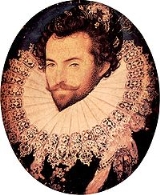
Sir Walter Raleigh (c. 155429 October 1618) was an English aristocrat, writer, poet, soldier, courtier, spy, and explorer. He is also well known for popularising tobacco in England.
Raleigh was born to a Protestant family in
DevonDevon is a large county in southwestern England. The county is sometimes referred to as Devonshire, although the term is rarely used inside the county itself as the county has never been officially "shired", it often indicates a traditional or historical context.The county shares borders with...
, the son of Walter Raleigh and Catherine Champernowne. Little is known for certain of his early life, though he spent some time in Ireland, in
Killua Castle Killua Castle, and the nearby Raleigh Obelisk, are situated near Clonmellon town, in north County Westmeath. The castle and the obelisk are separated by some 200 m to 300m, and belonged to the Chapman family more than two centuries ago, beginning with Captain Benjamin Chapman, patriarch of the...
,
ClonmellonClonmellon is a small town in County Westmeath, Ireland situated between Kells in County Meath and Delvin in Westmeath.-Buildings of note:* Ballinlough Castle* Clonmellon Market Yard* Killua Castle, Clonmellon Westmeath-See also:...
,
County Westmeath-Economy:Westmeath has a strong agricultural economy. Initially, development occurred around the major market centres of Mullingar, Moate, and Kinnegad. Athlone developed due to its military significance, and its strategic location on the main Dublin–Galway route across the River Shannon. Mullingar...
, taking part in the suppression of rebellions and participating in the Siege of Smerwick. Later he became a landlord of properties confiscated from the Irish rebels. He rose rapidly in the favour of Queen
Elizabeth IElizabeth I was queen regnant of England and Ireland from 17 November 1558 until her death. Sometimes called The Virgin Queen, Gloriana, or Good Queen Bess, Elizabeth was the fifth and last monarch of the Tudor dynasty...
, and was knighted in 1585. He was involved in the early English colonisation of
VirginiaThe Commonwealth of Virginia , is a U.S. state on the Atlantic Coast of the Southern United States. Virginia is nicknamed the "Old Dominion" and sometimes the "Mother of Presidents" after the eight U.S. presidents born there...
under a
royal patentLetters patent are a type of legal instrument in the form of a published written order issued by a monarch or president, generally granting an office, right, monopoly, title, or status to a person or corporation...
. In 1591 he secretly married
Elizabeth ThrockmortonElizabeth, Lady Raleigh , née Throckmorton, was Sir Walter Raleigh's wife, and a Lady of the Privy Chamber to Queen Elizabeth I of England. Their secret marriage precipitated a long period of royal disfavour for Raleigh....
, one of the Queen's
ladies-in-waitingA lady-in-waiting is a female personal assistant at a royal court, attending on a queen, a princess, or a high-ranking noblewoman. Historically, in Europe a lady-in-waiting was often a noblewoman from a family highly thought of in good society, but was of lower rank than the woman on whom she...
, without the Queen's permission, for which he and his wife were sent to the
Tower of LondonHer Majesty's Royal Palace and Fortress, more commonly known as the Tower of London, is a historic castle on the north bank of the River Thames in central London, England. It lies within the London Borough of Tower Hamlets, separated from the eastern edge of the City of London by the open space...
. After his release, they retired to his estate at
SherborneSherborne is a market town in northwest Dorset, England. It is sited on the River Yeo, on the edge of the Blackmore Vale, east of Yeovil. The A30 road, which connects London to Penzance, runs through the town. The population of the town is 9,350 . 27.1% of the population is aged 65 or...
,
DorsetDorset , is a county in South West England on the English Channel coast. The county town is Dorchester which is situated in the south. The Hampshire towns of Bournemouth and Christchurch joined the county with the reorganisation of local government in 1974...
.
In 1594 Raleigh heard of a "City of Gold" in South America and sailed to find it, publishing an exaggerated account of his experiences in a book that contributed to the legend of "
El DoradoEl Dorado is the name of a Muisca tribal chief who covered himself with gold dust and, as an initiation rite, dived into a highland lake.Later it became the name of a legendary "Lost City of Gold" that has fascinated – and so far eluded – explorers since the days of the Spanish Conquistadors...
". After Queen Elizabeth died in 1603 Raleigh was again imprisoned in the Tower, this time for allegedly being involved in the
Main PlotThe Main Plot was an alleged conspiracy of July 1603 by English courtiers, to remove King James I from the English throne, replacing him with his cousin Arabella Stuart. The plot was supposedly led by Henry Brooke, Lord Cobham, and funded by Spain...
against
King James IJames VI and I was King of Scots as James VI from 24 July 1567 and King of England and Ireland as James I from the union of the English and Scottish crowns on 24 March 1603...
, who was not favourably disposed toward him. In 1616 he was released to lead a second expedition in search of El Dorado. This was unsuccessful and men under his command ransacked a Spanish outpost. He returned to England and, to appease the Spanish, was arrested and executed in 1618.
Early life
Little is known about Raleigh's birth. Some historians believe Raleigh was born on January 22, 1552, although the
Oxford Dictionary of National Biography currently favours a date of 1554. He grew up in the house of Hayes Barton, a farmhouse in the village of
East BudleighEast Budleigh is a small village in East Devon, England. The villages of Yettington, Colaton Raleigh, and Otterton lie to the west, north and east of East Budleigh, with the seaside town of Budleigh Salterton about two miles south...
, not far from
Budleigh SaltertonBudleigh Salterton is a small town on the south coast of Devon, England 15 miles south of Exeter. It is situated within an Area of Outstanding Natural Beauty designated East Devon AONB.- Features :...
, in Devon, England. He was the youngest of five sons born to Catherine Champernowne in two successive marriages. His half brothers, John Gilbert,
Humphrey GilbertSir Humphrey Gilbert of Devon in England was a half-brother of Sir Walter Raleigh. Adventurer, explorer, member of parliament, and soldier, he served during the reign of Queen Elizabeth and was a pioneer of English colonization in North America and the Plantations of Ireland.-Early life:Gilbert...
, Adrian Gilbert, and full brother Carew Raleigh were also prominent during the reigns of Elizabeth I and James I. Catherine Champernowne was a niece of
Kat AshleyKatherine Ashley née Champernowne was governess to Elizabeth I and was a close friend in later life, known to the Queen as 'Kat'. She should not be confused with her niece Catherine Champernowne, mother of Sir Walter Raleigh and Sir Humphrey Gilbert.-Early life:Katherine Champernowne’s parentage...
, Elizabeth's governess, who introduced the young men at court.
Raleigh's family was strongly Protestant in religious orientation and had a number of near-escapes during the reign of the Roman Catholic Queen
Mary I of EnglandMary I was queen regnant of England and Ireland from July 1553 until her death.She was the only surviving child born of the ill-fated marriage of Henry VIII and his first wife Catherine of Aragon. Her younger half-brother, Edward VI, succeeded Henry in 1547...
. In the most notable of these, Raleigh's father had to hide in a tower to avoid execution. As a result, during his childhood, Raleigh developed a hatred of Roman Catholicism and proved himself quick to express it after the Protestant Queen Elizabeth I of England came to the throne in 1558.
In 1568 or 1572, Raleigh was registered as an undergraduate at Oriel College, Oxford but does not seem to have taken up residence. In 1575, he was registered at the
Middle TempleThe Honourable Society of the Middle Temple, commonly known as Middle Temple, is one of the four Inns of Court exclusively entitled to call their members to the English Bar as barristers; the others being the Inner Temple, Gray's Inn and Lincoln's Inn...
. At his trial in 1603, he stated that he had never studied law. His life between these two dates is uncertain but in his
History of the World Raleigh claimed to be an eye-witness at the
Battle of MoncontourThe Battle of Moncontour occurred on 3 October 1569 between the Catholic forces of King Charles IX of France and the Huguenots during the "Third War" of the French Wars of Religion.-The battle:...
(3 October 1569) in France. In 1575 or 1576 Raleigh returned to England.
Ireland
Between 1579 and 1583, Raleigh took part in the suppression of the
Desmond RebellionsThe Desmond Rebellions occurred in 1569-1573 and 1579-1583 in the Irish province of Munster.They were rebellions by the Earl of Desmond – head of the FitzGerald dynasty in Munster – and his followers, the Geraldines and their allies against the threat of the extension of Elizabethan English...
. He was present at the siege of Smerwick. Upon the seizure and distribution of land following the attainders arising from the rebellion, Raleigh received 40000 acres (161.9 km²), including the coastal walled towns of
YoughalYoughal is a town in County Cork, Ireland. Sitting on the estuary of the River Blackwater, in the past it was militarily and economically important. Being built on the edge of a steep riverbank, the town has a distinctive long and narrow layout...
and
LismoreLismore is a town in County Waterford, Ireland. It is located where the N72 road crosses the River Blackwater.-History:It was founded by Saint Mochuda, also known as Saint Carthage. In the 7th century, Lismore was the site of the well-known Lismore Abbey. It is also home to Lismore Castle, the...
. This made him one of the principal landowners in
MunsterMunster is one of the Provinces of Ireland situated in the south of Ireland. In Ancient Ireland, it was one of the fifths ruled by a "king of over-kings" . Following the Norman invasion of Ireland, the ancient kingdoms were shired into a number of counties for administrative and judicial purposes...
, but he enjoyed limited success in inducing English tenants to settle on his
estatesPlantations in 16th and 17th century Ireland were the confiscation of land by the English crown and the colonisation of this land with settlers from England and the Scottish Lowlands....
.
During his seventeen years as an Irish landlord, frequently domiciling at Killua Castle, Clonmellon, county Westmeath, Raleigh made the town of Youghal his occasional home. He was mayor there from 1588 to 1589. He is credited with having planted the first
potatoThe potato is a starchy, tuberous crop from the perennial Solanum tuberosum of the Solanaceae family . The word potato may refer to the plant itself as well as the edible tuber. In the region of the Andes, there are some other closely related cultivated potato species...
es in Ireland , but it is far more likely that the plant arrived in Ireland through trade with the Spanish. His town mansion, Myrtle Grove, is assumed to be the setting for the story that his servant doused him with a bucket of water after seeing clouds of smoke coming from Raleigh's pipe, in the belief he had been set alight. But this story is also told of other places associated with Raleigh: the Virginia Ash inn in Henstridge near Sherborne,
Sherborne CastleSherborne Castle is a 16th-century Tudor mansion southeast of Sherborne in Dorset, England. The park formed only a small part of the Digby estate.-Old castle:Sherborne Old Castle is the ruin of a 12th-century castle in the grounds of the mansion...
, and South Wraxall Manor in
WiltshireWiltshire is a ceremonial county in South West England. It is landlocked and borders the counties of Dorset, Somerset, Hampshire, Gloucestershire, Oxfordshire and Berkshire. It contains the unitary authority of Swindon and covers...
, home of Raleigh's friend, Sir Walter Long.
Amongst Raleigh's acquaintances in Munster was another Englishman who had been granted land there, the poet
Edmund SpenserEdmund Spenser was an English poet best known for The Faerie Queene, an epic poem and fantastical allegory celebrating the Tudor dynasty and Elizabeth I. He is recognised as one of the premier craftsmen of Modern English verse in its infancy, and one of the greatest poets in the English...
. In the 1590s, he and Raleigh travelled together from Ireland to the court at London, where Spenser presented part of his allegorical poem, the
Faerie Queene, to Elizabeth I.
Raleigh's management of his Irish estates ran into difficulties, which contributed to a decline in his fortunes. In 1602, he sold the lands to
Richard Boyle, 1st Earl of CorkRichard Boyle, 1st Earl of Cork , also known as the Great Earl of Cork, was Lord Treasurer of the Kingdom of Ireland....
, who subsequently prospered under kings
James IJames VI and I was King of Scots as James VI from 24 July 1567 and King of England and Ireland as James I from the union of the English and Scottish crowns on 24 March 1603...
and
Charles ICharles I was King of England, King of Scotland, and King of Ireland from 27 March 1625 until his execution in 1649. Charles engaged in a struggle for power with the Parliament of England, attempting to obtain royal revenue whilst Parliament sought to curb his Royal prerogative which Charles...
. Following Raleigh's death, members of his family approached Boyle for compensation on the ground that Raleigh had struck an improvident bargain.
The New World
Raleigh's plan in 1584 for colonisation in the "
Colony and Dominion of VirginiaThe Colony of Virginia was the English colony in North America that existed briefly during the 16th century, and then continuously from 1607 until the American Revolution...
" (which included the present-day states of
North CarolinaNorth Carolina is a state located in the southeastern United States. The state borders South Carolina and Georgia to the south, Tennessee to the west and Virginia to the north. North Carolina contains 100 counties. Its capital is Raleigh, and its largest city is Charlotte...
and
VirginiaThe Commonwealth of Virginia , is a U.S. state on the Atlantic Coast of the Southern United States. Virginia is nicknamed the "Old Dominion" and sometimes the "Mother of Presidents" after the eight U.S. presidents born there...
) in North America ended in failure at
Roanoke IslandRoanoke Island is an island in Dare County near the coast of North Carolina, United States. It was named after the historical Roanoke Carolina Algonquian people who inhabited the area in the 16th century at the time of English exploration....
, but paved the way for subsequent colonies. His voyages were funded primarily by himself and his friends, and never provided the steady stream of
revenueIn business, revenue is income that a company receives from its normal business activities, usually from the sale of goods and services to customers. In many countries, such as the United Kingdom, revenue is referred to as turnover....
necessary to start and maintain a colony in America. (Subsequent colonisation attempts in the early 17th century were made under the
joint-stockA joint-stock company is a type of corporation or partnership involving two or more individuals that own shares of stock in the company...
Virginia CompanyThe Virginia Company refers collectively to a pair of English joint stock companies chartered by James I on 10 April1606 with the purposes of establishing settlements on the coast of North America...
, which was able to collect the capital necessary to create successful colonies.)
In 1587, Raleigh attempted a second expedition, again establishing a settlement on Roanoke Island. This time, a more diverse group of settlers was sent, including some entire families, under the governance of
John WhiteJohn White was an English artist, and an early pioneer of English efforts to settle the New World. He was among those who sailed with Richard Grenville to North Carolina in 1585, acting as artist and mapmaker to the expedition. During his time at Roanoke Island he made a number of watercolor...
. After a short while in America, White was recalled to England to find more supplies for the colony. He was unable to return the following year as planned, however, because the Queen had ordered that all vessels remain at port for potential use against the
Spanish ArmadaThis article refers to the Battle of Gravelines, for the modern navy of Spain, see Spanish NavyThe Spanish Armada was the Spanish fleet that sailed against England under the command of the Duke of Medina Sidonia in 1588, with the intention of overthrowing Elizabeth I of England to stop English...
. The threat of the Armada was only partially responsible for delaying White's return until 1590. After England's victory over the Spanish fleet in 1588, the ships were given permission to sail. Unfortunately for the colonists at Roanoke, the small fleet made an excursion toward Cuba. They tried to capture the treasure-laden Spanish merchant ships reported to be proliferate in those waters at that time. White is said to have objected to this unplanned foray, but was helpless to dissuade the crews. They had been told of the enormous riches to be had by the experienced Portuguese pilot hired by Raleigh to navigate the voyage. It was not until 1590, 3 years later, that the supply vessel arrived at the colony, only to find that all colonists had disappeared.
The only clue to their fate was the word "CROATOAN" and letters "CRO" carved into other tree trunks. White had arranged with the settlers that if they should relocate, the name of their destination be carved into a tree or corner-post. This suggested the possibilities that they had relocated to Croatoan Island (now Hatteras Island), but a hurricane prevented John White from investigating the island for survivors. Other speculation includes their having starved, or been swept away or lost at sea during the stormy weather of 1588. No further attempts at contact were recorded for some years. Whatever the fate of the settlers, the settlement is now remembered as the
"Lost Colony of Roanoke Island"The Roanoke Colony on Roanoke Island in Dare County, present-day North Carolina, United States was a late 16th-century attempt to establish a permanent English settlement in what later became the Virginia Colony. The enterprise was financed and organized by Sir Walter Raleigh and carried out by...
.
1580s
In December 1581, Raleigh returned to England from Ireland to despatches as his company had been disbanded. He took part in Court life and became a favourite of Queen Elizabeth I. The various colourful stories told about him at this period are unlikely to be actually true.
In 1585 Raleigh was knighted and was appointed
warden of the stannariesThe Lord Warden of the Stannaries used to exercise judicial and military functions in Cornwall, United Kingdom, and is still the official who, upon the commission of the monarch or Duke of Cornwall for the time being, has the function of calling a Stannary Parliament of tinners...
, that is of the mines of Cornwall and Devon,
Lord Lieutenant of CornwallThis is a list of people who have served as Lord Lieutenant of Cornwall. Since 1742, all the Lords Lieutenant have also been Custos Rotulorum of Cornwall.*John Russell, 1st Earl of Bedford 1552–1554*John Bourchier, 2nd Earl of Bath 1556–?...
, and
vice-admiralThe holder of the post Vice-Admiral of the Coast was responsible for the defence of one of the twenty maritime counties of England, the North and South of Wales, or the four provinces of Ireland....
of the two counties. Both in 1585 and 1586, he sat in parliament as member for
DevonshireDevon was a parliamentary constituency covering the county of Devon in England. It was represented by two Knights of the Shire, in the House of Commons of England until 1707, then of the House of Commons of Great Britain from 1707 to 1800 and finally the House of Commons of the United Kingdom from...
.
Raleigh commissioned the shipbuilder R. Chapman, of
DeptfordDeptford is a district of south London, England, located on the south bank of the River Thames. It is named after a ford of the River Ravensbourne, and from the mid 16th century to the late 19th was home to Deptford Dockyard, the first of the Royal Navy Dockyards.Deptford and the docks are...
to build a ship for him. Originally called
Ark, it became
Ark RaleighArk RoyalThe HMS prefix was not used until the middle of the eighteenth century, but is sometimes applied retrospectively was an English galleon, originally ordered for Sir Walter Raleigh and later purchased by the crown for service in the Royal Navy...
, following the convention at the time by which the ship bore the name of its owner.
The CrownThe Crown is a corporation sole that in the Commonwealth realms and any provincial or state sub-divisions thereof represents the legal embodiment of governance, whether executive, legislative, or judicial...
, in the form of
Queen Elizabeth IElizabeth I was queen regnant of England and Ireland from 17 November 1558 until her death. Sometimes called The Virgin Queen, Gloriana, or Good Queen Bess, Elizabeth was the fifth and last monarch of the Tudor dynasty...
, purchased the ship from Raleigh in January 1587, for the sum of £5,000 (£ as of ), (This took the form of a reduction in the sum Sir Walter owed the queen: he received
Exchequer talliesA tally was an ancient memory aid device to record and document numbers, quantities, or even messages. Tally sticks first appear as notches carved on animal bones, in the Upper Paleolithic. A notable example is the Ishango Bone...
, but no money). As a result, the ship was renamed
Ark Royal.
1590–1603
In 1592, Raleigh was given many rewards by the Queen, including
Durham HouseDurham House, or Durham Inn, was the historic London residence of the Bishop of Durham in the Strand, with its gardens descending to the Thames.-Origins:...
in
the StrandStrand is a street in the City of Westminster, London, England. The street is just over three-quarters of a mile long. It currently starts at Trafalgar Square and runs east to join Fleet Street at Temple Bar, which marks the boundary of the City of London at this point, though its historical length...
and the estate of Sherborne, Dorset. He was appointed
Captain of the Yeomen of the GuardThe Captain of the Queen's Bodyguard of the Yeomen of the Guard is a UK government post usually held by the Government Deputy Chief Whip in the House of Lords...
. However, he had not been given any of the
great offices of stateThe Great Offices of State in the United Kingdom are the four most senior and prestigious posts in the British parliamentary system of government. They are the Prime Minister, the Chancellor of the Exchequer, the Foreign Secretary and the Home Secretary. Since 11 May 2010 these posts have been...
. In the
ArmadaThis article refers to the Battle of Gravelines, for the modern navy of Spain, see Spanish NavyThe Spanish Armada was the Spanish fleet that sailed against England under the command of the Duke of Medina Sidonia in 1588, with the intention of overthrowing Elizabeth I of England to stop English...
year of 1588, Raleigh was appointed
Vice AdmiralIn the United States Navy, the United States Coast Guard, the United States Public Health Service Commissioned Corps, the National Oceanic and Atmospheric Administration Commissioned Corps, and the United States Maritime Service, vice admiral is a three-star flag officer, with the pay grade of...
of Devon, looking after the coastal defences and military levies.
In 1591, Raleigh was secretly married to
Elizabeth "Bess" ThrockmortonElizabeth, Lady Raleigh , née Throckmorton, was Sir Walter Raleigh's wife, and a Lady of the Privy Chamber to Queen Elizabeth I of England. Their secret marriage precipitated a long period of royal disfavour for Raleigh....
(or Throgmorton). She was one of the Queen's
ladies-in-waitingA lady-in-waiting is a female personal assistant at a royal court, attending on a queen, a princess, or a high-ranking noblewoman. Historically, in Europe a lady-in-waiting was often a noblewoman from a family highly thought of in good society, but was of lower rank than the woman on whom she...
, eleven years his junior, and was pregnant at the time. She gave birth to a son, believed to be named Damerei, who was given to a
wet nurseA wet nurse is a woman who is used to breast feed and care for another's child. Wet nurses are used when the mother is unable or chooses not to nurse the child herself. Wet-nursed children may be known as "milk-siblings", and in some cultures the families are linked by a special relationship of...
at
Durham HouseDurham House, or Durham Inn, was the historic London residence of the Bishop of Durham in the Strand, with its gardens descending to the Thames.-Origins:...
, but died in October 1591 of plague. Bess resumed her duties to the queen. The following year, the unauthorised marriage was discovered and the Queen ordered Raleigh imprisoned and Bess dismissed from court. He was released from prison to divide the spoils from the captured Spanish ship
Madre de Dios (Mother of God).
It would be several years before Raleigh returned to favour. The couple remained devoted to each other. During Raleigh's absences, Bess proved a capable manager of the family's fortunes and reputation. They had two more sons, Walter (known as Wat) and Carew.
Raleigh was elected a burgess of
MitchellMitchell, or St Michael was a rotten borough consisting of the town of Mitchell, Cornwall. From the first Parliament of Edward VI, in 1547, it elected two members to the Unreformed House of Commons.-History:The borough encompassed parts of two parishes, Newlyn East and St Enoder...
, Cornwall, in the parliament of 1593. He retired to his estate at Sherborne where he built a new house, completed in 1594, known then as Sherborne Lodge. Since extended, it is now known as
Sherborne (new) CastleSherborne Castle is a 16th-century Tudor mansion southeast of Sherborne in Dorset, England. The park formed only a small part of the Digby estate.-Old castle:Sherborne Old Castle is the ruin of a 12th-century castle in the grounds of the mansion...
. He made friends with the local
gentryGentry denotes "well-born and well-bred people" of high social class, especially in the past....
, such as Sir Ralph Horsey of
Clifton MaybankClifton Maybank is a hamlet in west Dorset, England. It is perhaps best known for Clifton Maybank House, a country house with surviving Tudor fabric.-Clifton Maybank settlement:...
and Charles Thynne of
LongleatLongleat is an English stately home, currently the seat of the Marquesses of Bath, adjacent to the village of Horningsham and near the towns of Warminster in Wiltshire and Frome in Somerset. It is noted for its Elizabethan country house, maze, landscaped parkland and safari park. The house is set...
. During this period at a dinner party at Horsey's, there was a heated discussion about religion. The argument later gave rise to charges of
atheismAtheism is, in a broad sense, the rejection of belief in the existence of deities. In a narrower sense, atheism is specifically the position that there are no deities...
against Raleigh. He was elected to Parliament, speaking on religious and naval matters.
In 1594, he came into possession of a Spanish account of a great golden city at the headwaters of the
Caroní RiverThe Caroni River is the second most important river of Venezuela, the second in flow, and one of the longest, 952 km from the Tepui Kuquenan, where she originates with the same name Kuquenan, up to its confluence with the River Orinoco to which basin she belongs...
. A year later he explored what is now
GuyanaGuyana , officially the Co-operative Republic of Guyana, previously the colony of British Guiana, is a sovereign state on the northern coast of South America that is culturally part of the Anglophone Caribbean. Guyana was a former colony of the Dutch and of the British...
and
eastern VenezuelaThe Guayana Region is an administrative region of Venezuela.The region has a population of 1,383,297 inhabitants and a territory of 458,344 km². It borders the independent nation of Guyana which forms part of The Guyanas...
in search of
Manoa, the legendary city. Once back in England, he published
The Discovery of Guiana (1596) an account of his voyage which made exaggerated claims as to what had been discovered. The book can be seen as a contribution to the
El DoradoEl Dorado is the name of a Muisca tribal chief who covered himself with gold dust and, as an initiation rite, dived into a highland lake.Later it became the name of a legendary "Lost City of Gold" that has fascinated – and so far eluded – explorers since the days of the Spanish Conquistadors...
legend. Although Venezuela has
goldGold is a chemical element with the symbol Au and an atomic number of 79. Gold is a dense, soft, shiny, malleable and ductile metal. Pure gold has a bright yellow color and luster traditionally considered attractive, which it maintains without oxidizing in air or water. Chemically, gold is a...
deposits, there is no evidence Raleigh found any mines. He is sometimes said to have discovered
Angel Falls, but these claims are considered far-fetched.
In 1596 Raleigh took part in the
capture of CádizThe Capture of Cádiz in 1596 was an event during the Anglo-Spanish War, when English and Dutch troops under Robert Devereux, 2nd Earl of Essex and a large Anglo-Dutch fleet under Charles Howard, 1st Earl of Nottingham, with support from the Dutch United Provinces, raided the Spanish city of...
, where he was wounded. He was also the second-in-command of the
Islands VoyageThe Islands Voyage was an English campaign against the Portuguese colonies in the Azores in 1597 as part of the Anglo–Spanish War. It was led by Robert Devereux, 2nd Earl of Essex with Sir Walter Raleigh as his second in command - other participants included Jacob Astley and Robert Mansell...
to the
AzoresThe Archipelago of the Azores is composed of nine volcanic islands situated in the middle of the North Atlantic Ocean, and is located about west from Lisbon and about east from the east coast of North America. The islands, and their economic exclusion zone, form the Autonomous Region of the...
in 1597.
In 1597, he was chosen member of parliament for
DorsetDorset was a county constituency covering Dorset in southern England, which elected two Members of Parliament , traditionally known as knights of the shire, to the House of Commons of England from 1290 until 1707, to the House of Commons of Great Britain from 1707 to 1800, and to the House of...
, and, in 1601, for
CornwallCornwall is a former county constituency covering the county of Cornwall, in the South West of England. It was a constituency of the House of Commons of England then of the House of Commons of Great Britain from 1707 to 1800 and of the House of Commons of the United Kingdom from 1801 to 1832...
. He was unique in the Elizabethan period in sitting for three counties.
From 1600 to 1603, as Governor of the Channel Island of
JerseyJersey, officially the Bailiwick of Jersey is a British Crown Dependency off the coast of Normandy, France. As well as the island of Jersey itself, the bailiwick includes two groups of small islands that are no longer permanently inhabited, the Minquiers and Écréhous, and the Pierres de Lecq and...
, Raleigh modernised its defences. This included construction of a new fort protecting the approaches to
Saint HelierSaint Helier is one of the twelve parishes of Jersey, the largest of the Channel Islands in the English Channel. St. Helier has a population of about 28,000, roughly 31.2% of the total population of Jersey, and is the capital of the Island . The urban area of the parish of St...
,
Fort Isabella Bellissima, or
Elizabeth CastleElizabeth Castle is a castle in Saint Helier, Jersey. Construction was started in the 16th century when the power of cannon meant that the existing stronghold at Mont Orgueil was insufficient to defend the Island and the port of St. Helier was vulnerable to attack by ships armed with...
.
Trial and imprisonment
Royal favour with Queen Elizabeth had been restored by this time but did not last. The Queen died in 1603, and Raleigh was arrested at Exeter Inn, Ashburton, Devon and imprisoned in the
Tower of LondonHer Majesty's Royal Palace and Fortress, more commonly known as the Tower of London, is a historic castle on the north bank of the River Thames in central London, England. It lies within the London Borough of Tower Hamlets, separated from the eastern edge of the City of London by the open space...
on 19 July. On 17 November, Raleigh was tried in the converted
Great HallA great hall is the main room of a royal palace, nobleman's castle or a large manor house in the Middle Ages, and in the country houses of the 16th and early 17th centuries. At that time the word great simply meant big, and had not acquired its modern connotations of excellence...
of
Winchester CastleWinchester Castle is a medieval building in Hampshire, England. It was founded in 1067. Only the Great Hall exists now; it houses a museum of the history of Winchester.-Great Hall:...
for
treasonIn law, treason is the crime that covers some of the more extreme acts against one's sovereign or nation. Historically, treason also covered the murder of specific social superiors, such as the murder of a husband by his wife. Treason against the king was known as high treason and treason against a...
, due to alleged involvement in the
Main PlotThe Main Plot was an alleged conspiracy of July 1603 by English courtiers, to remove King James I from the English throne, replacing him with his cousin Arabella Stuart. The plot was supposedly led by Henry Brooke, Lord Cobham, and funded by Spain...
against King James.
Raleigh conducted his defence with great skill. The chief evidence against Raleigh was the signed and sworn confession of
Henry Brooke, 11th Baron CobhamHenry Brooke, 11th Baron Cobham was an English peer who was implicated in the Main Plot against the rule of James I of England.- Life :...
. Raleigh frequently requested that Cobham be called in to testify so that he might recant, "[Let] my accuser come face to face, and be deposed. Were the case but for a small
copyholdAt its origin in medieval England, copyhold tenure was tenure of land according to the custom of the manor, the "title deeds" being a copy of the record of the manorial court....
, you would have witnesses or good proof to lead the jury to a verdict; and I am here for my life!" Raleigh essentially was objecting that the evidence against him was "
hearsayHearsay is information gathered by one person from another person concerning some event, condition, or thing of which the first person had no direct experience. When submitted as evidence, such statements are called hearsay evidence. As a legal term, "hearsay" can also have the narrower meaning of...
"; but the tribunal refused to allow Cobham to testify and be cross examined (1 Criminal Trials 400, 400-511, 1850). Although hearsay was frowned upon under the common law, Raleigh was tried under civil-law, which allowed hearsay. King James spared his life, despite a guilty verdict.
He remained in the tower until 1616. While imprisoned, he wrote many treatises and the first volume of
The Historie of the World (London, 1628)
about the ancient history of Greece and Rome. His son Carew was conceived and born (1604) while Raleigh was imprisoned in the tower.
In 1616, Raleigh was released to conduct a second expedition to Venezuela in search of
El Dorado. During the expedition, Raleigh's men, under the command of Lawrence Keymis, attacked the Spanish outpost of Santo Tomé de Guayana (San Tomé) on the
OrinocoThe Orinoco is one of the longest rivers in South America at . Its drainage basin, sometimes called the Orinoquia, covers , with 76.3% of it in Venezuela and the remainder in Colombia...
River. In the initial attack on the settlement, Raleigh's son Walter was killed by a bullet. On Raleigh's return to England, the outraged
Count GondomarDon Diego Sarmiento de Acuña, Count of Gondomar , was a Galician diplomat, the Spanish ambassador to England in 1613 to 1622 and afterwards, as a kind of ambassador emeritus, as Spain's leading expert on English affairs until his death...
, the Spanish ambassador, successfully demanded that King James reinstate Raleigh's death sentence.
Execution and aftermath
Raleigh was beheaded in the Old Palace Yard at the
Palace of WestminsterThe Palace of Westminster, also known as the Houses of Parliament or Westminster Palace, is the meeting place of the two houses of the Parliament of the United Kingdom—the House of Lords and the House of Commons...
on 29 October 1618. "Let us dispatch", he said to his executioner. "At this hour my ague comes upon me. I would not have my enemies think I quaked from fear." After he was allowed to see the axe that would behead him, he mused: "This is a sharp Medicine, but it is a Physician for all diseases and miseries." According to many biographers –
Raleigh TrevelyanRaleigh Trevelyan is an author and editor. A member of the Trevelyan family, he was born in Andaman Islands, he moved to England when he was eight years old, and now resides in both London and Cornwall...
in his book
Sir Walter Raleigh (2002) for instance – Sir Walter's final words (as he lay ready for the axe to fall) were: "Strike, man, strike!"
Having been one of the people to popularise tobacco smoking in England, he left a small tobacco box, found in his cell shortly after his execution. Engraved upon the box was a
LatinLatin is an Italic language originally spoken in Latium and Ancient Rome. It, along with most European languages, is a descendant of the ancient Proto-Indo-European language. Although it is considered a dead language, a number of scholars and members of the Christian clergy speak it fluently, and...
inscription:
Comes meus fuit illo miserrimo tempo (It was my companion at that most miserable time).
Raleigh's head was embalmed and presented to his wife. His body was to be buried in the local church in
BeddingtonBeddington is a settlement between the London Boroughs of Sutton and Croydon. The BedZED low energy housing scheme is located here. In Beddington was a static inverter plant of HVDC Kingsnorth....
,
SurreySurrey is a county in the South East of England and is one of the Home Counties. The county borders Greater London, Kent, East Sussex, West Sussex, Hampshire and Berkshire. The historic county town is Guildford. Surrey County Council sits at Kingston upon Thames, although this has been part of...
, the home of Lady Raleigh, but was finally laid to rest in
St. Margaret's, WestminsterThe Anglican church of St. Margaret, Westminster Abbey is situated in the grounds of Westminster Abbey on Parliament Square, and is the parish church of the House of Commons of the United Kingdom in London...
, where his tomb may still be visited today. "The Lords", she wrote, "have given me his dead body, though they have denied me his life. God hold me in my wits." After his wife's death 29 years later, Raleigh's head was returned to his tomb and interred at St. Margaret's Church.
Although Raleigh's popularity had waned considerably since his Elizabethan heyday, his execution was seen by many, both at the time and since, as unnecessary and unjust. Any involvement in the Main Plot appears to have been limited to a meeting with
Lord CobhamHenry Brooke, 11th Baron Cobham was an English peer who was implicated in the Main Plot against the rule of James I of England.- Life :...
. One of the judges at his trial later said: "[T]he justice of England has never been so degraded and injured as by the condemnation of the honourable Sir Walter Raleigh."
Legacy
The state capital of North CarolinaRaleigh is the capital and the second largest city in the state of North Carolina as well as the seat of Wake County. Raleigh is known as the "City of Oaks" for its many oak trees. According to the U.S. Census Bureau, the city's 2010 population was 403,892, over an area of , making Raleigh...
and its second largest city was named Raleigh in 1792 for Sir Walter, sponsor of the
Roanoke ColonyThe Roanoke Colony on Roanoke Island in Dare County, present-day North Carolina, United States was a late 16th-century attempt to establish a permanent English settlement in what later became the Virginia Colony. The enterprise was financed and organized by Sir Walter Raleigh and carried out by...
. In the city a bronze statue, which has been moved around different locations within the city, was made in honor of the city's namesake. The "Lost Colony" is commemorated at the Fort Raleigh National Historic Site on Roanoke Island, North Carolina.
One of eleven boarding houses at the
Royal Hospital SchoolThe Royal Hospital School, , is a British co-educational independent boarding school with naval traditions. It admits pupils from age 11 to 18 through Common Entrance or the school's own exam...
has been named after Raleigh.
Raleigh County, West VirginiaAs of the census of 2000, there were 79,220 people, 31,793 households, and 22,096 families residing in the county. The population density was 130 people per square mile . There were 35,678 housing units at an average density of 59 per square mile...
, is also named in his honour.
Poetry
Raleigh's poetry is written in the relatively straightforward, unornamented mode known as the plain style.
C. S. LewisClive Staples Lewis , commonly referred to as C. S. Lewis and known to his friends and family as "Jack", was a novelist, academic, medievalist, literary critic, essayist, lay theologian and Christian apologist from Belfast, Ireland...
considered Raleigh one of the era's "silver poets", a group of writers who resisted the
Italian RenaissanceThe Italian Renaissance began the opening phase of the Renaissance, a period of great cultural change and achievement in Europe that spanned the period from the end of the 13th century to about 1600, marking the transition between Medieval and Early Modern Europe...
influence of dense classical reference and elaborate poetic devices.
In poems such as "What is Our Life" and "The Lie", Raleigh expresses a
contemptus mundiContemptus mundi, the "contempt of the world" and worldly concerns, is a theme in the intellectual life of both Classical Antiquity and of Christianity, both in its mystical vein and its ambivalence towards secular life, that figures largely in the Western world's history of ideas...
(contempt of the world) attitude more characteristic of
the Middle AgesThe Middle Ages is a periodization of European history from the 5th century to the 15th century. The Middle Ages follows the fall of the Western Roman Empire in 476 and precedes the Early Modern Era. It is the middle period of a three-period division of Western history: Classic, Medieval and Modern...
than of the dawning era of humanistic optimism. But, his lesser-known long poem "The Ocean to Cynthia" combines this vein with the more elaborate conceits associated with his contemporaries
Edmund SpenserEdmund Spenser was an English poet best known for The Faerie Queene, an epic poem and fantastical allegory celebrating the Tudor dynasty and Elizabeth I. He is recognised as one of the premier craftsmen of Modern English verse in its infancy, and one of the greatest poets in the English...
and
John DonneJohn Donne 31 March 1631), English poet, satirist, lawyer, and priest, is now considered the preeminent representative of the metaphysical poets. His works are notable for their strong and sensual style and include sonnets, love poetry, religious poems, Latin translations, epigrams, elegies, songs,...
, expressing a melancholy sense of history.
A minor poem of Raleigh's captures the atmosphere of the court at the time of Queen Elizabeth I. His response to
Christopher MarloweChristopher Marlowe was an English dramatist, poet and translator of the Elizabethan era. As the foremost Elizabethan tragedian, next to William Shakespeare, he is known for his blank verse, his overreaching protagonists, and his mysterious death.A warrant was issued for Marlowe's arrest on 18 May...
's "
The Passionate Shepherd to His Love"The Passionate Shepherd to His Love" is a poem written by the English poet Christopher Marlowe and published in 1599 . In addition to being one of the most well-known love poems in the English language, it is considered one of the earliest examples of the pastoral style of British poetry in the...
" was "
The Nymph's Reply to the Shepherd"The Nymph's Reply to the Shepherd" was written by Sir Walter Raleigh in response to Christopher Marlowe's "The Passionate Shepherd to His Love"...
". "The Passionate Shepherd to His Love" was written in 1592, while Raleigh's "The Nymph's Reply to The Shepherd" was written four years later. Both were written in the style of traditional pastoral poetry. They follow the same structure of six four-line stanzas employing a
rhyme schemeA rhyme scheme is the pattern of rhyme between lines of a poem or song. It is usually referred to by using letters to indicate which lines rhyme. In other words, it is the pattern of end rhymes or lines...
of
AABBA clerihew is a whimsical, four-line biographical poem invented by Edmund Clerihew Bentley. One of his best known is this :* It is biographical and usually whimsical, showing the subject from an unusual point of view; it pokes fun at mostly famous people...
.
External links
Texts by Raleigh