
All Topics  
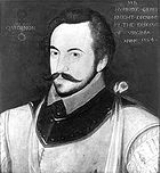
Humphrey Gilbert

 
Humphrey Gilbert

   Email Print
   Bookmark   Link


Humphrey Gilbert


Sir Humphrey Gilbert (c. 1539 – 9 September 1583)

was an English adventurer
Adventurer

An adventurer or adventuress is a term that usually takes one of three meanings:*One whose travels are unusual and often exotic, though not so unique as to qualify as exploration....
, explorer, member of parliament
Member of Parliament

A Member of Parliament, or MP, is a representative of the voters to a parliament. In many countries the term applies specifically to members of the lower house, as upper houses often have a unique title, such as senate, and thus also have unique titles for its members, such as senators....
, and soldier from Devon
Devon

Devon is a large Counties of England in South West England. The county is also referred to as Devonshire, but that is an entirely unofficial name, rarely used inside of the county but often indicating a shire....
, who served the crown during the reign of Queen Elizabeth I of England
Elizabeth I of England

Elizabeth I was List of English monarchs and Queen of Ireland from 17 November 1558 until her death. Sometimes called The Virgin Queen, Gloriana, or Good Queen Bess, Elizabeth was the fifth and last monarch of the House of Tudor....
. . He put the heads of Irish people on stakes around his camps to show the supremacy of the crown during his successful Irish campaigns.


Discussion
Ask a question about 'Humphrey Gilbert'
Start a new discussion about 'Humphrey Gilbert'
Answer questions from other users
Full Discussion Forum


Recent Posts


Encyclopedia


Sirgilberthumphrey
Sir Humphrey Gilbert (c. 1539 – 9 September 1583)

was an English adventurer
Adventurer

An adventurer or adventuress is a term that usually takes one of three meanings:*One whose travels are unusual and often exotic, though not so unique as to qualify as exploration....
, explorer, member of parliament
Member of Parliament

A Member of Parliament, or MP, is a representative of the voters to a parliament. In many countries the term applies specifically to members of the lower house, as upper houses often have a unique title, such as senate, and thus also have unique titles for its members, such as senators....
, and soldier from Devon
Devon

Devon is a large Counties of England in South West England. The county is also referred to as Devonshire, but that is an entirely unofficial name, rarely used inside of the county but often indicating a shire....
, who served the crown during the reign of Queen Elizabeth I of England
Elizabeth I of England

Elizabeth I was List of English monarchs and Queen of Ireland from 17 November 1558 until her death. Sometimes called The Virgin Queen, Gloriana, or Good Queen Bess, Elizabeth was the fifth and last monarch of the House of Tudor....
. . He put the heads of Irish people on stakes around his camps to show the supremacy of the crown during his successful Irish campaigns. One of the pioneers of English colonization, he also claimed what is thought to be the first English property in North America. He was a half-brother (through his mother) of Sir Walter Raleigh
Walter Raleigh

Sir Walter Raleigh or Ralegh, was a famed English writer, poet, soldier, courtier and explorer.Raleigh was born to a Protestant family in Devon, the son of Walter Raleigh and Catherine Champernowne....
.

Early life

Gilbert was the second birth son of Otho and Katherine Champernowne Gilbert of Compton
Compton Castle

Compton Castle is a fortified manor house in the village of Compton, about west of Torquay, Devon, England . The castle has been home to the Gilbert family for most of the time since it was built....
 and Greenway Estate
Greenway Estate

Greenway is an estate on the River Dart near Galmpton, Torbay in Devon, England. It was first mentioned in 1493 as "Greynway", the crossing point of the Dart to Dittisham....
, Devonshire. His brothers Sir John Gilbert and Adrian Gilbert, and half brother
Sibling

A sibling is a brother or a sister; that is, any person who shares the same parents.In most societies throughout the world, siblings usually grow up together and spend a good deal of their childhood with each other....
s Carew Raleigh and Sir Walter Raleigh were also prominent during the reigns of Elizabeth I or James I. Katherine was a niece of Kat Ashley
Katherine Champernowne

Catherine Ashley n?e Champernowne was governess to Elizabeth I of England and was a close friend in later life, known to the Queen as 'Kat'. She should not be confused with her niece Catherine Champernowne, Sir Walter Raleigh and Sir Humphrey Gilbert's mother....
, Elizabeth's governess, who introduced the young men at court. His uncle, Sir Arthur Champernowne
Arthur Champernowne

Sir Arthur Champernowne was a Vice-Admiral of the West who lived at Dartington Hall in Devon, England.Champernowne was the second son of Sir Philip Champernowne of Modbury, Devon, whose family had lived in Devon since arriving from Cambernon in Normandy in the eleventh century as part of the Norman Conquest....
, involved Gilbert in efforts to establish Irish plantations between 1566-1572. (Ronald, p. 248-2490)

Sir Henry Sidney
Henry Sidney

Sir Henry Sidney , lord deputy of Ireland, was the eldest son of Sir William Sidney of Penshurst, a prominent politician and courtier during the reigns of Henry VIII of England and Edward VI of England, from both of whom he received extensive grants of land, including the manor of Penshurst in Kent, which became the principal residence of th...
 became his mentor, and he was educated at Eton
Eton College

Eton College, also known as Eton, is a world-famous British independent school for boys, founded in 1440 by Henry VI of England. It was founded as the King's College of Our Lady of Eton beside Windsor....
 and the University of Oxford
University of Oxford

The University of Oxford , located in the city of Oxford, Oxfordshire, England, is the List of oldest universities in continuous operation in the English-speaking world....
, where he learned to speak French and Spanish and studied the arts of war and navigation. He went on to reside at the Inns of Chancery
Inns of Chancery

The Inns of Chancery were buildings which housed associations of lawyers in London from the late Middle Ages to the 19th century. The origins of the Inns of Chancery are obscure, but initially they may have been used by clerks in the Court of Chancery, as the Lord Chancellor's office was known....
 in London c.1560–1561.

Quid non? ("Why not?") and Mutare vel timere sperno ("I scorn to change or to fear"), indicates how he chose to live his life. He was present at the siege of Newhaven in Havre-de-grâce (le Havre), Normandy, where he was wounded in June 1563. By July 1566 he was serving in Ireland under the command of Sidney (then Lord Deputy
Lord Deputy of Ireland

The Lord Deputy was the King's representative and head of the Irish executive during the Kingdom of Ireland.*Gerald FitzGerald, 8th Earl of Kildare ...
) against Shane O'Neill
Shane O'Neill

S?an 'an d?omais' ? N?ill was an Ireland chief of the O'Neill clan of Ulster in the mid 16th century. Shane O'Neill's career was marked by his ambition to be The O'Neill - chief of the O'Neills....
, but was sent to England later in the year with dispatches for the Queen. (See Plantations of Ireland
Plantations of Ireland

Plantations in 16th and 17th century Ireland were established throughout the country by the confiscation of lands occupied by Gaelic clans and Hiberno-Norman dynasties, but principally in the provinces of Munster and Ulster....
 and Tudor conquest of Ireland
Tudor re-conquest of Ireland

The Tudor re-conquest of Ireland took place under the England Tudor dynasty during the 16th century. Following a failed rebellion against the crown by the FitzGerald in the 1530s, Henry VIII of England was declared King of Ireland by statute of the Irish parliament, with the aim of restoring such central authority as had been lost throughout...
). At that point he took the opportunity of presenting the Queen with his A discourse of a discoverie for a new Passage to Cataia (published in revised form in 1576), treating of the exploration of a Northwest Passage
Northwest Passage

The Northwest Passage is a sea route through the Arctic Ocean, along the northern coast of North America via waterways amidst the Canadian Arctic Archipelago, connecting the Atlantic Ocean and Pacific Oceans....
 by America to Asia. Within the year he had set down an account of his strange and turbulent visions, in which he received the homage of Solomon and Job, with their promise to grant him access to secret mystical knowledge.

Military career in Ireland

Humphrey Gilbert Stamp
Gilbert returned to Ireland and, after the assassination of O'Neill in 1569, he was appointed to the profitless office of governor of Ulster and served as a member of the Irish parliament. At about this time he petitioned the Queen's principal secretary, Lord Burghley
William Cecil

William Cecil may refer to:* Lord William Cecil , British royal courtier* William Cecil, 1st Baron Burghley , English politician and advisor to Elizabeth I...
, for a recall to England - "for the recovery of my eyes" - but his ambitions still rested in Ireland, and particularly in the southern province of Munster. In April 1569 he proposed the establishment of a presidency and council for the province, and pursued the notion of an extensive settlement around Baltimore
Baltimore, County Cork

Baltimore is located in western County Cork, Munster, Ireland. Baltimore is the principle village of the parish of Rath and the Islands, the southern most parish in Ireland....
 (in modern County Cork
County Cork

County Cork is the most southerly and the largest of the modern counties of Republic of Ireland. Cork is nicknamed "The Rebel County", as a result of the support of the townsmen of Cork in 1491 for Perkin Warbeck, a pretender to the throne of England during the Wars of the Roses....
), which was approved by the Dublin
Dublin

Dublin is both the largest city and capital of Republic of Ireland. It is located near the midpoint of Ireland's east coast, at the mouth of the River Liffey and at the centre of the Dublin Region....
 council. At the same time he was involved with Sidney and the secretary of state, Sir Thomas Smith
Thomas Smith

Thomas Smith may refer to:...
, in planning a large settlement of the northern province of Ulster
Plantation of Ulster

The Plantation of Ulster was planned in 1598 with the process of colonisation taking place in 1609. All the estates of the O'Neills, the Earls of Tyrone, the O'Donnells of Tyrconnell and their chief supporters were confiscated....
 by Devonshire gentlemen.

Gilbert's actions in the south of Ireland played a significant part in the outbreak of the first of the Desmond Rebellions
Desmond Rebellions

The Desmond Rebellions occurred in between 1569-1573 and 1579-1583 in Munster in southern Ireland.. They were rebellions of the Earl of Desmond dynasty—the Fitzgerald family or Geraldines and their allies against the efforts of the Elizabethan Era English government to extend their control over the province of Munster....
. A kinsman of his, Sir Peter Carew
Peter Carew

Sir Peter Carew was a Devon adventurer, who served during the reign of Queen Elizabeth of England and became a controversial figure in the Tudor re-conquest of Ireland....
 (another Devonshire man), was pursuing a provocative, and somewhat far-fetched, claim to the inheritance of certain lands within the Butler territories in south Leinster
Leinster

Leinster , one of the Provinces of Ireland, lies in the east of Ireland and comprises the counties of County Carlow, County Dublin, County Kildare, County Kilkenny, County Laois, County Longford, County Louth, County Meath, County Offaly, County Westmeath, County Wexford and County Wicklow....
. The Earl of Ormond
Thomas Butler, 3rd Earl of Ormonde

Thomas Butler, 10th Earl of Ormonde and 3rd Earl of Ossory, was born circa 1531 and died on 22 November 1614. He was a son of James Butler, 9th Earl of Ormonde and Lady Joan FitzGerald daughter and heiress-general of James FitzGerald, 10th Earl of Desmond....
 - a bosom companion of the Queen's from her troubled youth and head of that family - was absent in England, and the clash of his family's influence with the lawful authority of Carew's claim created havoc.

Gilbert was eager to participate and, after Carew's seizure of the barony of Idrone (in modern County Carlow
County Carlow

County Carlow is a counties of Ireland in Republic of Ireland located towards the south east of Ireland, in the province of Leinster. It has an overall population of 50,349, as of April 2006....
), he pushed westward with his forces across the river Blackwater in the summer of 1569 and joined up with his kinsman to defeat Sir Edmund Butler, a younger brother of the Earl's. Violence spread in a confusion from Leinster and across the province of Munster, when the Geraldines of Desmond went into rebellion. Gilbert was then created colonel by Lord Deputy Sidney and charged with the pursuit of the rebel James Fitzmaurice Fitzgerald
James FitzMaurice FitzGerald

James Fitzmaurice Fitzgerald, a member of the 16th century ruling FitzGerald dynasty in the province of Munster in Ireland, rebelled against the crown authority of Queen Elizabeth I of England in response to the onset of the Tudor re-conquest of Ireland and was deemed an archtraitor....
 (whom Gilbert considered, "a silly wood-kerne").

The Geraldines were driven out of Kilmallock
Kilmallock

Kilmallock is a historic and sporting town in south County Limerick, Ireland, near the border with County Cork. There is a Dominican Priory in the town and King's Castle ....
, but returned to lay siege to Gilbert, who drove off their superior force in a sally, during which his horse was shot from under him and his buckler transfixed with a spear. After that initial success, he showed courage in striking out into rebel territory, and managed to march unopposed through Kerry
County Kerry

County Kerry is a southwestern county in Republic of Ireland. Informally referred to as The Kingdom, it forms part of the provinces of Ireland of Munster....
 and Connello, taking 30-40 castles without the aid of artillery.

During the three weeks of this campaign, all enemies were treated without quarter and put to the sword - including women and children - which explains, perhaps, the swiftness with which so many castles had been abandoned before Gilbert's aggression. He is also said to have sent Captain Apsley into Kerry to inspire terror.

Gilbert's attitude to the Irish may be captured in one quote from him, dated 13 November 1569: "These people are headstrong and if they feel the curb loosed but one link they will with bit in the teeth in one month run further out of the career of good order than they will be brought back in three months." In order to cow local supporters of the rebels, he chose to put on gruesome spectacles: after a day's killing he would order the decapitation of the scattered corpses so that the heads could be brought to his camp in the evening, where they were arranged in two parallel rows, making a pathway to the flaps of his tent, along which the supplicants would tread in the presence of their late fathers, brothers and sons. John Perrot
John Perrot

Sir John Perrott was lord deputy of Ireland under Queen Elizabeth I of England and is best known for his part in the Tudor re-conquest of Ireland....
 also used the practice at Kilmallock a few years later).

In time, Ormond returned from England and called in his brothers, which caused the Geraldine resistance to weaken. In December 1569, after one of the chief rebels had come in to the government and confessed his treason, Gilbert received his knighthood at the hands of Sidney in the ruined Fitzmaurice camp, reputedly amid heaps of slain gallowglass
Gallowglass

The gallowglass were a mercenary warrior ?lite among Gall-Gaidheal clans residing in the Western Isles of Scotland in the High Middle Ages and Scottish Highlands from the mid 13th century to the end of the 16th century....
 warriors. Fitzmaurice stayed out in rebellion (only coming in to submit in 1573), and one month after Gilbert's return to England he retook Kilmallock with 120 foot, defeating the garrison and sacking the town for three days, leaving it "the abode of wolves".

MP and Adventurer


In 1570 Gilbert returned to England, where he married Anne Aucher, who was to bear him six sons and one daughter. However, it has been conjectured - following Smith's observation that the only way to soothe Gilbert's temper was to send a boy to him - that he was an "intermittent homosexual", or perhaps a pederast.

Gilbert was elected to parliament as a member for Plymouth, and controversially argued for the crown prerogative in the matter of royal licences for purveyance
Purveyance

Purveyance is the right of the Monarch to requisition goods and services for royal use, and was developed in England over the course of the late eleventh through the fourteenth centuries....
. In business affairs, he involved himself in an alchemical
Alchemy

Alchemy , a part of the Occult Tradition, is both a philosophy and a practice with an aim of achieving ultimate wisdom as well as immortality, involving the improvement of the alchemist as well as the making of several substances described as possessing unusual properties....
 project with Smith, whereby iron was to be transmuted into copper and antimony, and lead into mercury.

By 1572 Gilbert had turned his attention to the Netherlands, where he fought an unsuccessful campaign in support of the Dutch Sea beggars
Geuzen

Geuzen was a name assumed by the confederacy of Calvinist Dutch nobles and other malcontents, who from 1566 opposed Spain rule in the Netherlands....
 at the head of a force of 1500 men, many of whom had deserted from Smith's aborted plantation in the Ards
Ards Borough Council

Ards Borough Council is a district council in County Down, Northern Ireland with its headquarters in Newtownards. Other towns include Portaferry, Comber, and Donaghadee, and the population of the area is about 73,000....
 of Ulster. In the period 1572–1578 Gilbert settled down and devoted himself to writing. In 1573 he presented Elizabeth I with a proposal for an academy in London
London

London is the capital of both England and the United Kingdom, and the most populous municipality in the European Union. An important settlement for two millennia, History of London goes back to its founding by the Roman Empire....
, which was eventually put into effect by Sir Thomas Gresham
Thomas Gresham

File:Thomas Gresham, 1544.jpgSir Thomas Gresham was an English merchant and financier who worked for King Edward VI of England and for Edward's half-sister Queen Elizabeth I of England....
 upon the establishment of Gresham College
Gresham College

File:Gresham College, 1740.jpgGresham College is an unusual institution of higher learning off Holborn in central London. It enrolls no students and grants no academic degrees....
. Gilbert also helped to set up the Society of the New Art with Lord Burghley and Robert Dudley, Earl of Leicester, both of whom maintained an alchemical laboratory in Limehouse
Limehouse

Limehouse is a place in the London Borough of Tower Hamlets. It is on the northern bank of the River Thames opposite Rotherhithe and between Ratcliff to the west and Millwall to the east....
.

Thereafter, Gilbert's life was spent in a series of failed ship expeditions, the financing of which exhausted his own fortune and a great part of his family's. He backed Martin Frobisher's trip to Greenland, which yielded a cargo of a mysterious yellow rock, subsequently found to be worthless. In pursuit of one of his own projects, he sailed from Plymouth
Plymouth

Plymouth is a City status in the United Kingdom and unitary authority on the coast of Devon, England, about south west of London. It is built between the mouths of the rivers River Plym to the east and River Tamar to the west, where they join Plymouth Sound....
 for America in November 1578 with 7 vessels in his fleet, which was scattered by storms and forced back to port some 6 months later; the only vessel to have penetrated the Atlantic to any great distance was the Falcon under Raleigh's command.

Return to Ireland

In the summer of 1579, Gilbert and Raleigh were commissioned by the lord deputy of Ireland, William Drury
William Drury

For the author see William Price DrurySir William Drury, Knt., , England statesman and soldier, was a son of Sir Robert Drury of Hedgerley in Buckinghamshire, and grandson of another Sir Robert Drury , who was speaker of the British House of Commons in 1495....
, to attack his old foe, the rebel James Fitzmaurice Fitzgerald, by sea and land and to intercept a fleet expected to arrive from Spain
Spain

Spain or the Kingdom of Spain , is a country located in Southern Europe on the Iberian Peninsula.The Spanish constitution does not establish any official denomination of the country, even though Espa?a , Estado espa?ol and Naci?n espa?ola are used interchangeably....
 with aid for the Munster rebels. At this time Gilbert had three vessels under his command: the Anne Ager (or perhaps, Anne Archer or Aucher - named after his wife) of 250 tons, the Relief, and the Squirrell of 10 tons. The latter vessel, a small frigate, was notable for having completed the voyage to America and back inside three months under the command of a captured Portuguese
Portugal

Portugal , officially the Portuguese Republic , is a country on the Iberian Peninsula. Located in southwestern Europe, Portugal is the westernmost country of mainland Europe and is bordered by the Atlantic Ocean to the west and south and by Spain to the north and east....
 pilot.

In pursuit of his Irish commission, Gilbert set sail in June 1579 after a spell of bad weather, and promptly got lost in fog and heavy rains off Land's End
Land's End

Land's End is a Headlands and bays on the Penwith peninsula, located near Penzance in Cornwall, England, United Kingdom. It is the most Extreme points of the United Kingdom tip of the southern mainland ....
, an incident that caused the Queen thereafter to doubt his seafaring abilities. His fleet was then driven into the Bay of Biscay
Bay of Biscay

The Bay of Biscay is a Headlands and bays of the North Atlantic Ocean. It lies along the western coast of France from Brest, France south to the Spain border, and the northern coast of Spain west to Punta de Estaca de Bares, and is named for the Spanish province of Biscay....
, and the Spanish soon sailed into Dingle
Dingle

Dingle is a town in County Kerry in Republic of Ireland on the Atlantic Ocean coast some west-south-west of Tralee and west-north-west of Killarney....
 harbour, where they made their rendez-vous with the rebels. In October he managed to put into the port of Cobh
Cobh

Cobh is a sheltered seaport town on the south coast of County Cork, Republic of Ireland with a population of around 13,000 inhabitants.The locality, which had had several different Irish-language names, was first referred to as Cove in 1750....
 in Munster, where he delivered a terrible beating to a local gentleman, smashing him about the head with a sword. He then fell into a row with a local merchant, whom he slew on the dockside.

Gilbert was one of the leading advocates for a north-west passage to the land of Cathay (present-day China), noted in great detail for its abundance of riches by Marco Polo in the 13th century. Gilbert made an elaborate case to counter the calls for a north-eastern route. During the winter of 1566 Gilbert and his principal antagonist Anthony Jenkinson
Anthony Jenkinson

Anthony Jenkinson was born at Market Harborough, Leicestershire, on 8 October 1529. He was one of the first Britons to explore Muscovy and present day Russia....
 (who had sailed to Russia and crossed the country down to the Caspian Sea), argued the pivotal question of polar routes before Queen Elizabeth. Gilbert claimed that any north-east passage was far too dangerous; "the air is so darkened with continual mists and fogs so near the pole that no man can well see either to guide his ship or direct his course." By logic and reason a north-west passage must exist announced Gilbert. Columbus had discovered America with far less evidence to go on. It was imperative for England to catch up, settle in new lands and thus challenge the Iberian powers. Gilberts contentions won support and money was raised, chiefly by the London merchant Michael Lok, for an expedition. The fearless Martin Frobisher was appointed captain and left England in June 1576. Frobisher's search for a north-west passage proved fruitless. He returned with black stone and an inuit.

Newfoundland

It was assumed that Gilbert would be appointed president of Munster after the dismissal of Ormond as lord lieutenant of the province in the spring of 1581. At this time Gilbert was member of parliament for Queenborough
Queenborough

Queenborough is a small town on the Isle of Sheppey in the Swale borough of Kent in South East England.Queenborough is two miles south of Sheerness....
, Kent
Kent

Kent is a Counties of England in southeast England, and is one of the home counties. It borders East Sussex, Surrey and Greater London and has a defined boundary with Essex in the middle of the River Thames estuary....
, but his attention was again drawn to North America, where he hoped to seize territory on behalf of the crown.

The six year exploration licence Gilbert had secured by letters patent from the crown in 1578 was on the point of expiring, when he succeeded in 1583 in raising significant sums from English Catholic
Roman Catholic Church

The Roman Catholic Church, officially known as the Catholic Church is the world's largest Christianity Ecclesia , representing over half of all Christians and one-sixth of the world population....
 investors. The investors were constrained by penal laws against recusants in their own country, and loathe to go into exile in hostile parts of Europe; thus, the prospect of an American adventure appealed to them, especially when Gilbert was proposing to seize some 9 million acres (36,000 km²) around the river Norumbega
Norumbega

Norumbega was a legendary settlement in northeastern North America, inextricably connected with attempts to demonstrate Viking incursions in New England....
, to be parcelled out under his authority (although to be held ultimately of the crown).

The Catholic investment didn't work out - partly because of the privy council's insistence that the investors pay their recusancy fines before departing, partly because of efforts by Catholic clergy and Spanish agents to dissuade their interference in America - but Gilbert did manage to set sail with a small fleet of 5 vessels in June 1583. One of the vessels - the Bark Raleigh, owned and commanded by Raleigh himself - had to turn back owing to lack of victuals. Gilbert's crews were made up of misfits, criminals and pirates, but in spite of the many problems caused by their lawlessness, the fleet did manage to reach Newfoundland.

On arriving at the port of St. John's, Gilbert found himself temporarily blockaded by the fishing fleet under the organisation of the port admiral (an Englishman) on account of piracy committed against a Portuguese vessel in 1582 by one of Gilbert's commanders. Once this resistance was overcome, Gilbert waved his letters patent about and, in a formal ceremony, took possession of Newfoundland (including the lands 200 leagues to the north and south) for the English crown on 5 August 1583. This involved the cutting of turf to symbolize the transfer of possession of the soil, according to the common law of England. He claimed authority over the fish stations at St. John's and proceeded to levy a tax on the fisherman from several countries who worked this popular area near the Grand Banks of Newfoundland.

Within weeks his fleet departed, having made no attempt to form a settlement, due to lack of supplies. During the return voyage, Gilbert insisted on sailing in his hardy old favourite, the Squirrel. He soon ordered a controversial change of course for the fleet, and owing to his obstinacy and disregard of the views of superior mariners one of the vessels ran aground with some loss of life (probably on the western shoals of Sable Island
Sable Island

Sable Island is a small Canada island situated 180 km southeast of mainland Nova Scotia in the Atlantic Ocean. As of 2008, the island is a year-round home to approximately five people ....
). Later in the voyage a sea monster
Sea monster

Sea monsters are sea-dwelling legendary creatures, often believed to be of immense size.Marine monsters can take many forms, including sea dragons, sea serpents, or multi-armed beasts; they can be slimy or scaly, often spouting jets of water....
 was sighted, said to have resembled a lion with glaring eyes.

After discussions with Edward Hayes and William Cox, captain and master of the Golden Hind
Golden Hind

The Golden Hind was an England galleon best known for its global circumnavigation between 1577 and 1580, captained by Sir Francis Drake. She was originally known as the Pelican, but was later renamed by Drake mid-voyage in 1577, as he prepared to enter the Strait of Magellan, calling it the Golden Hind to compliment his patron,...
, Gilbert had decided on 31 August to return. The wind was in their favor as they sped back to Cape Race
Cape Race

Cape Race is a point of land located at the southeastern tip of the Avalon Peninsula on the island of Newfoundland , Canada. Its name is thought to come from the original Portugal name for this cape, "Raso", or "bare"....
 in two days and were soon clear of land. Gilbert had injured his foot on the frigate Squirrel and, on 2 September, came aboard the Golden Hind to have his foot bandaged and to discuss means of keeping the two little ships together on the voyage. Gilbert refused to leave the Squirrel, while the vessels continued on the Atlantic crossing. After a strong storm, they had a spell of clear weather and made fair progress: Gilbert came aboard the Golden Hind again, visited with Hayes, and insisted once more on returning back to the frigate Squirrel, even though Hayes insisted she was over-gunned and unsafe for sailing. Nearly 900 miles away from Cape Race, they encountered high waves of heavy seas, "breaking short and high Pyramid wise", said Hayes.

On 9 September, the frigate Squirrel was nearly overwhelmed but recovered. Despite the persuasions of others, who wished him to take to one of the larger vessels, Gilbert stayed put and was observed sitting in the stern of his little frigate, reading a book. When the Golden Hind came within hailing distance, the crew heard him cry out repeatedly, "We are as near to Heaven by sea as by land!" as he lifted his palm to the skies to illustrate his point. At midnight the frigate's lights were extinguished, and the watch on the Golden Hind cried out that, "the Generall was cast away". The Squirrel had gone down with all hands.

It is thought Gilbert's reading material was the Utopia
Utopia (book)

Utopia, with the subtitle On the best state of a republic and on the new island of Utopia , is a 1516 book by Sir Saint Thomas More....
 of Sir Thomas More
Thomas More

Saint Thomas More was an English lawyer, author, and statesman who in his lifetime gained a reputation as a leading Renaissance humanist scholar, and occupied many public offices, including Lord Chancellor ....
, which contains the following passage: "He that hathe no grave is covered with the skye: and, the way to heaven out of all places is of like length and distance."

Legacy

Gilbert was father to Ralegh Gilbert, who was to become second in command of Popham Colony
Popham Colony

The Popham Colony was a short-lived English colonization of the Americas colonial settlement in North America that was founded in 1607 and located in the present-day town of Phippsburg, Maine near the mouth of the Kennebec River by the proprietary Virginia Company of Plymouth....
.

Gilbert was part of a remarkable generation of Devonshire men, who combined the roles of adventurer, writer, soldier and mariner - often in ways as equally loathsome as admirable. He was outstanding for his initiative and originality, if not for his successes, but it is in his efforts at colonization that he had most influence. Ireland ended up as a brutal disaster (although Ulster and Munster were in time colonized), but the American adventure did eventually flourish. The formality of his annexation of Newfoundland eventually achieved reality in 1610; but perhaps of more significance was the reissue to Raleigh in 1584 of Gilbert's patent, on the back of which he undertook the Roanoke
Roanoke Island

File:FortRalieghTheater.JPGRoanoke Island is an island in Dare County, North Carolina near the coast of North Carolina, United States.About eight miles long and two miles wide, Roanoke Island lies between the mainland and the Outer Banks, with Albemarle Sound on its north, Roanoke Sound at the northern end, and Wanchese, North Carolina c...
 expeditions, the first sustained attempt by the English crown to establish colonies in North America.

Gilbert Sound near Greenland
Greenland

Greenland is a member country of the Kingdom of Denmark located between the Arctic Ocean and Atlantic Oceans, east of the Canadian Arctic Archipelago....
 was named after him by John Davys.

Afterlife in Science Fiction

Since no one actually saw Gilbert and his ship go down, there remained (at least in theory) room for various fanciful theories - both in his own time and later - as to his ultimate fate. Such theories figure in at least two modern science fiction books, being at the core of one of them.

  • In Fire in the Abyss
    Fire in the Abyss

    Fire in the Abyss is a science fiction novel by Stuart Gordon, pen name of Richard Gordon , , having as its main character the Elizabethan adventurer Humphrey Gilbert, an actual historical figure, as a time traveler....
     by Stuart Gordon
    Richard Gordon (Scottish author)

    Richard Alexander Steuart Gordon was a Scotland author born in Banff and Macduff, Scotland who wrote numerous science fiction novels, encyclopedias, and travel guides....
     (1983), Humphrey Gilbert is the main character. It turns out that he did not drown but was plucked through time to the Twentieth Century by a secret project of the United States Navy. (The cover shows him on the deck of a modern submarine - wearing Elizabethan finery far more gaudy than he was likely to have worn on board a ship far in the Atlantic, and facing the submarine's crew with his drawn sword).


Together with some hundred other "Temporally Displaced Persons" Gilbert is incarcerated in a secret installation until the authorities decide what to do with them. Rather than wait, Gilbert stages a prison break together with a varied crew, including a Norse giant, a dancer from ancient North America and many others.


The book, written in the first person, is Gilbert's diary written after he had managed at last to return to England, four hundred years later than intended. It recounts numerous adventures, such as falling in love with an Ancient Egyptian priestess, a fellow escapee, and being attacked by Irish nationalists who seek revenge for his cruelty to their ancestors. Gilbert makes many sardonic remarks on the life and institutions of the modern world in general and present-day Britain in particular, but also enjoys disabusing moderns who tend to romanticize the Elizabethan Age.


  • In Philip José Farmer
    Philip José Farmer

    Philip Jos? Farmer was an United States author, principally known for his science fiction and fantasy fiction novels and short story.Farmer is best known for his Riverworld series and the earlier World of Tiers series....
    's The Gate of Time
    The Gate of Time

    The Gate of Time is an alternate history novel by Philip Jos? Farmer....
     (1966), Gilbert was not displaced forward in time but sidewise, into an alternate timeline. Not finding the other ships, he navigates the "Squirrel" to where he expects to find the city of Bristol in England. Instead, he finds a city named Ent where the people speak a language only very distantly resembling English. The country is Blodland, a kind of England which had known neither a Roman Empire nor a Norman Conquest, but did experience very prolonged and bloody Viking incursions (hence the name Blodland = Bloodland).


Gilbert and his crew are placed in a lunatic asylum, where some of the sailors become truly insane. But the adaptable Gilbert learns the local language, gets released and finds conditions not too dissimilar from those he knows. He becomes a sailor and then the captain of a ship, and makes a lot of money from slave trading in this world's Africa.


Cautious not to talk further of his origins, in his old age Gilbert does write a 5,000-page manuscript entitled "An Unpublished Romance, or Through The Ivory Gates of the Sea". In it he tells his personal history and all that he remembers of his Earth's history and geography, as well as writing a comparative English-Blodlandish grammar.


Neglected by many generations of his descendants, the manuscript is found four hundred years later by a Lord Humphrey Gilbert of this world's equivalent of the Twentieth Century - who shows it to the main protagonist of Farmer's book, a World War II combat pilot that also ended up in this alternate world.


Bibliography

  • Ronald, Susan. The Pirate Queen: Queen Elizabeth I, her Pirate Adventurers, and the Dawn of Empire. Harper Collins Publishers, New York, 2007. ISBN 0-06-082066-7.


External links

  • The Modern History Sourcebook has the account of the