


Competition law

Encyclopedia
Competition law, known in the United States as antitrust law, is law
that promotes or maintains market competition by regulating anti-competitive conduct by companies.
The history of competition law reaches back to the Roman Empire
. The business practices of market traders, guild
s and governments have always been subject to scrutiny, and sometimes severe sanctions. Since the 20th century, competition law has become global. The two largest and most influential systems of competition regulation are United States antitrust law and European Union competition law
. National and regional competition authorities across the world have formed international support and enforcement networks.
Modern competition law has historically evolved on a country level to promote and maintain competition in markets principally within the territorial boundaries of nation-states. National competition law usually does not cover activity beyond territorial borders unless it has significant effects at nation-state level. Countries may allow for extraterritorial jurisdiction
in competition cases based on so-called effects doctrine. The protection of international competition is governed by international competition agreements. In 1945, during the negotiations preceding the adoption of the General Agreement on Tariffs and Trade
(GATT) in 1947, limited international competition obligations were proposed within the Charter for an International Trade Organisation. These obligations were not included in GATT, but in 1994, with the conclusion of the Uruguay Round
of GATT Multilateral Negotiations, the World Trade Organization
(WTO) was created. The Agreement Establishing the WTO included a range of limited provisions on various cross-border competition issues on a sector specific basis.
Substance and practice of competition law varies from jurisdiction to jurisdiction. Protecting the interests of consumers (consumer welfare
) and ensuring that entrepreneurs have an opportunity to compete in the market economy
are often treated as important objectives. Competition law is closely connected with law on deregulation of access to markets, state aids and subsidies, the privatization
of state owned assets and the establishment of independent sector regulators, among other market-oriented supply-side policies. In recent decades, competition law has been viewed as a way to provide better public services
. Robert Bork
has argued that competition laws can produce adverse effects when they reduce competition by protecting inefficient competitors and when costs of legal intervention are greater than benefits for the consumers.
Ideas about competitive law were published during the 18th century with such works as Adam Smith
's The Wealth of Nations
. Different terms were used to describe this area of the law, including "restrictive practices", "the law of monopolies", "combination acts" and the "restraint of trade".
. The Lex Julia de Annona was enacted during the Roman Republic
around 50 BC. To protect the grain trade, heavy fines were imposed on anyone directly, deliberately and insidiously stopping supply ships. Under Diocletian
in 301 AD an edict
imposed the death penalty for anyone violating a tariff system, for example by buying up, concealing or contriving the scarcity of everyday goods. More legislation came under the Constitution of Zeno
of 483 AD, which can be traced into Florentine Municipal laws of 1322 and 1325. This provided for confiscation of property and banishment for any trade combination or joint action of monopolies private or granted by the Emperor. Zeno rescinded all previously granted exclusive rights. Justinian I
subsequently introduced legislation to pay officials to manage state monopolies.
recorded that "foresteel
" (i.e. forestalling, the practice of buying up goods before they reach market and then inflating the prices) was one of three forfeitures
that King Edward the Confessor could carry out through England. But concern for fair prices also led to attempts to directly regulate the market. Under Henry III an act was passed in 1266 to fix bread and ale prices in correspondence with grain prices laid down by the assizes. Penalties for breach included amercement
s, pillory
and tumbrel
. A 14th century statute labeled forestallers as "oppressors of the poor and the community at large and enemies of the whole country." Under King Edward III
the Statute of Laborers of 1349 fixed wages of artificers and workmen and decreed that foodstuffs should be sold at reasonable prices. On top of existing penalties, the statute stated that overcharging merchants must pay the injured party double the sum he received, an idea that has been replicated in punitive
treble damages
under US antitrust law. Also under Edward III, the following statutory provision outlawed trade combination.
In continental Europe competition principles developed in Lex Mercatoria
. Examples of legislation enshrining competition principles include the constitutiones juris metallici by Wenceslaus II of Bohemia
between 1283 and 1305, condemning combination of ore traders increasing prices; the Municipal Statutes of Florence in 1322 and 1325 followed Zeno
's legislation against state monopolies; and under Emperor Charles V in the Holy Roman Empire
a law was passed "to prevent losses resulting from monopolies and improper contracts which many merchants and artisans made in the Netherlands." In 1553 King Henry VIII
reintroduced tariffs for foodstuffs, designed to stabilize prices, in the face of fluctuations in supply from overseas. So the legislation read here that whereas,
Around this time organizations representing various tradesmen and handicrafts people, known as guild
s had been developing, and enjoyed many concessions and exemptions from the laws against monopolies. The privileges conferred were not abolished until the Municipal Corporations Act 1835.
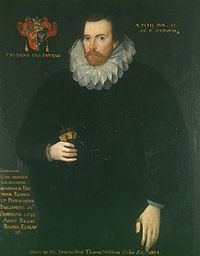 The English common law of restraint of trade
is the direct predecessor to modern competition law later developed in the US. It is based on the prohibition of agreements that ran counter to public policy, unless the reasonableness
of an agreement could be shown. It effectively prohibited agreements designed to restrain another's trade. The 1414 Dyer's is the first known restrictive trade agreement to be examined under English common law. A dyer had given a bond not to exercise his trade in the same town as the plaintiff for six months but the plaintiff had promised nothing in return. On hearing the plaintiff's attempt to enforce this restraint, Hull J exclaimed, "per Dieu, if the plaintiff were here, he should go to prison until he had paid a fine to the King." The court denied the collection of a bond for the dyer's breach of agreement because the agreement was held to be a restriction on trade. English courts subsequently decided a range of cases which gradually developed competition related case law, which eventually were transformed into statute law.
.jpg) Europe around the 16th century was changing quickly. The new world
Europe around the 16th century was changing quickly. The new world
had just been opened up, overseas trade and plunder was pouring wealth through the international economy and attitudes among businessmen were shifting. In 1561 a system of Industrial Monopoly Licenses, similar to modern patent
s had been introduced into England. But by the reign of Queen Elizabeth I, the system was reputedly much abused and used merely to preserve privileges, encouraging nothing new in the way of innovation or manufacture. In response English courts developed case law on restrictive business practices. The statute followed the unanimous decision in Darcy v. Allein 1602, also known as the Case of Monopolies, of the King's bench
to declare void the sole right that Queen Elizabeth I had granted to Darcy to impost playing cards into England. Darcy, an officer of the Queen's household, claimed damages for the defendant's infringement of this right. The court found the grant void and that three characteristics of monopoly
were (1) price increases (2) quality decrease (3) the tendency to reduce artificers to idleness and beggary. This put an end to granted monopolies until King James I
began to grant them again. In 1623 Parliament passed the Statute of Monopolies, which for the most part excluded patent
rights from its prohibitions, as well as guilds. From King Charles I
, through the civil war and to King Charles II
, monopolies continued, especially useful for raising revenue. Then in 1684, in East India Company v. Sandys it was decided that exclusive rights to trade only outside the realm were legitimate, on the grounds that only large and powerful concerns could trade in the conditions prevailing overseas.
The development of early competition law in England and Europe progressed with the diffusion of Adam Smith
's work, who first established the concept of the market economy
. At the same time industrialisation
replaced the individual artisan
, or group of artisans, with paid labourers and machine-based production. Commercial success increasingly dependent on maximising production while minimising cost. Therefore the size of a company became increasingly important and a number of European countries responded by enacting laws to regulate large companies which restricted trade. Following the French Revolution
in 1789 the law of 14–17 June 1791 declared agreements by members of the same trade that fixed the price of an industry or labour as void, unconstitutional, and hostile to liberty. Similarly the Austrian Penal Code of 1852 established that "agreements... to raise the price of a commodity... to the disadvantage of the public' should be punished as misdemeanours." Austria passed a law in 1870 abolishing the penalties, though such agreements remained void. However, in Germany laws clearly validated agreements between firms to raise prices. Throughout the 18th and 19th century ideas that dominant private companies or legal monopolies could excessively restrict trade were further developed in Europe. However, as in the late 19th century a depression spread through Europe, known as the Panic of 1873
, ideas of competition lost favour and it was felt that companies had to co-operate by forming cartels to withstand huge pressures on prices and profits.
in 1889 enacted what is considered the first competition statute of modern times. The Act for the Prevention and Suppression of Combinations formed in restrained of Trade was based one year before the United States
enacted the most famous legal statute on competition law, the Sherman Act of 1890. It was named after Senator John Sherman who argued that the Act "does not announce a new principle of law, but applies old and well recognised principles of common law".
, lead
and whiskey. On the basis that vast numbers of citizens were affected by trusts the Act was a priority for both major parties. Instead of regulating so as to allow the government to intervene in markets and their structures, the US Congress enshrined the principle that the competitive market itself should be the principal regulator of price, output, interests and profits. Influenced by the common law restraint of trade doctrine the Act instead outlawed anticompetitive practices. Prof Rudolph Peritz has argued that competition law in the United States has evolved around two sometimes conflicting concepts of competition: first that of individual liberty, free of government intervention, and second a fair competitive environment free of excessive economic power. Since the enactment of the
Sherman Act enforcement of competition law has been based on various economic theories adopted by Government.
Section 1 of the Sherman Act declared illegal "every contract, in the form of trust or otherwise, or conspiracy, in restraint of trade or commerce among the several States, or with foreign nations". Section 2 prohibits monopolies, or attempts and conspiracies to monopolize. Following the enactment in 1890 US court applies these principles to business and markets. Courts applied the Act without consistent economic analysis until 1914, when it was complemented the Clayton Act which specifically prohibiting exclusive dealing agreements, particularly tying agreements and interlocking directorates, and mergers achieved by purchasing stock. From 1915 onwards the rule of reason
analysis was frequently applied by courts to competition cases, however the period was characterized by the lack of competition law enforcement. From 1936 to 1972 courts' application of anti-trust law was dominated by the structure-conduct-performance paradigm of the Harvard School. From 1973 to 1991, the enforcement of anti-trust law was based on efficiency explanations as the Chicago School became dominant. Since 1992 the game theory
has been frequently relied on in anti-trust cases.
of 1929 competition law disappeared from Europe and was revived following the second world war when the United Kingdom and Germany, following pressure from the United States, became the first European countries to adopt fully fledged competition laws. At a regional level EU competition law has its origins in the European Coal and Steel Community
(ECSC) agreement between France
, Italy
, Belgium
, the Netherlands
, Luxembourg
and Germany
in 1951 following the Second World War. The agreement aimed to prevent Germany from re-establishing dominance in the production of coal
and steel
as it was felt that this dominance had contributed to the outbreak of the war. Article 65 of the agreement banned cartels and article 66 made provisions for concentrations, or mergers, and the abuse of a dominant position by companies. This was the first time that competition law
principles were included in a plurilateral regional agreement and established the trans-European model of competition law. In 1957 competition rules were included in the Treaty of Rome
, also known as the EC Treaty, which established the European Economic Community
(EEC). The Treaty of Rome established the enactment of competition law as one of the main aims of the EEC through the "institution of a system ensuring that competition in the common market is not distorted". The two central provisions on EU competition law on companies were established in article 85, which prohibited anti-competitive agreements, subject to some exemptions, and article 86 prohibiting the abuse of dominant position. The treaty also established principles on competition law for member states, with article 90 covering public undertakings, and article 92 making provisions on state aid. Regulations on mergers were not included as member states could not establish consensus on the issue at the time.
Today, the Treaty of Lisbon
prohibits anti-competitive agreements in Article 101(1), including price fixing
. According to Article 101(2) any such agreements are automatically void. Article 101(3) establishes exemptions, if the collusion is for distributional or technological innovation, gives consumers a "fair share" of the benefit and does not include unreasonable restraints that risk eliminating competition anywhere (or compliant with the general principle of European Union law of proportionality
). Article 102 prohibits the abuse of dominant position
, such as price discrimination and exclusive dealing. Article 102 allows the European Council
to regulations
to govern mergers between firms (the current regulation is the Regulation 139/2004/EC
. The general test is whether a concentration (i.e. merger or acquisition) with a community dimension (i.e. affects a number of EU member states) might significantly impede effective competition. Articles 106 and 107 provide that member state's right to deliver public services may not be obstructed, but that otherwise public enterprises must adhere to the same competition principles as companies. Article 107 lays down a general rule that the state may not aid or subsidize private parties in distortion of free competition and provides exemptions for charities, regional development objectives and in the event of a natural disaster
.
and the expansion of the European Union
.
 At a national level competition law is enforced through competition authorities, as well as private enforcement. The United States Supreme Court explained:
In the European Union
, the Modernisation Regulation 1/2003 means that the European Commission
is no longer the only body capable of public enforcement of European Community competition law. This was done in order to facilitate quicker resolution of competition-related inquiries. In 2005 the Commission issued a Green Paper
on Damages actions for the breach of the EC antitrust rules, which suggested ways of making private damages claims against cartels easier.
Antitrust administration and legislation can be seen as a balance between:
Chapter 5 of the post war Havana Charter
contained an Antitrust code but this was never incorporated into the WTO's forerunner, the General Agreement on Tariffs and Trade
1947. Office of Fair Trading
Director and Professor Richard Whish wrote sceptically that it "seems unlikely at the current stage of its development that the WTO will metamorphose into a global competition authority." Despite that, at the ongoing Doha round
of trade talks for the World Trade Organization
, discussion includes the prospect of competition law enforcement moving up to a global level. While it is incapable of enforcement itself, the newly established International Competition Network
(ICN) is a way for national authorities to coordinate their own enforcement activities.
, antitrust is seen as unnecessary as competition is viewed as a long-term dynamic process where firms compete against each other for market dominance. In some markets a firm may successfully dominate, but it is because of superior skill or innovativeness. However, according to laissez-faire theorists, when it tries to raise prices to take advantage of its monopoly position it creates profitable opportunities for others to compete. A process of creative destruction
begins which erodes the monopoly. Therefore, government should not try to break up monopoly but should allow the market to work.
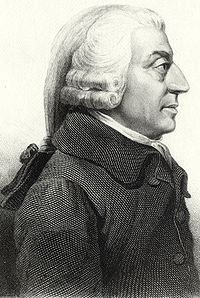
 The classical perspective on competition was that certain agreements and business practice could be an unreasonable restraint on the individual liberty of tradespeople to carry on their livelihoods. Restraints were judged as permissible or not by courts as new cases appeared and in the light of changing business circumstances. Hence the courts found specific categories of agreement, specific clauses, to fall foul of their doctrine on economic fairness, and they did not contrive an overarching conception of market power. Earlier theorists like Adam Smith rejected any monopoly power on this basis.
In The Wealth of Nations
(1776) Adam Smith
also pointed out the cartel problem, but did not advocate specific legal measures to combat them.
By the latter half of the 19th century it had become clear that large firms had become a fact of the market economy. John Stuart Mill
's approach was laid down in his treatise On Liberty
(1859).
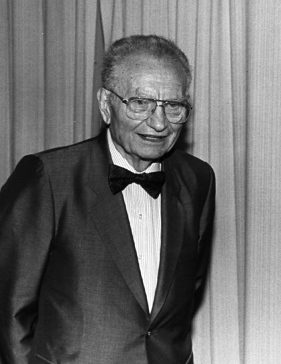 After Mill, there was a shift in economic theory, which emphasized a more precise and theoretical model of competition. A simple neo-classical model of free markets holds that production and distribution of goods and services in competitive free markets maximizes social welfare. This model assumes that new firms can freely enter markets and compete with existing firms, or to use legal language, there are no barriers to entry
. By this term economists mean something very specific, that competitive free markets deliver allocative
, productive
and dynamic efficiency. Allocative efficiency is also known as Pareto efficiency
after the Italian economist Vilfredo Pareto
and means that resources in an economy over the long run will go precisely to those who are willing
and able
to pay for them. Because rational producers will keep producing and selling, and buyers will keep buying up to the last marginal unit
of possible output – or alternatively rational producers will be reduce their output to the margin at which buyers will buy the same amount as produced – there is no waste, the greatest number wants of the greatest number of people become satisfied and utility
is perfected because resources can no longer be reallocated to make anyone better off without making someone else worse off; society has achieved allocative efficiency. Productive efficiency simply means that society is making as much as it can. Free markets are meant to reward those who work hard
, and therefore those who will put society's resources towards the frontier of its possible production
. Dynamic efficiency refers to the idea that business which constantly competes must research, create and innovate to keep its share of consumers. This traces to Austrian-American political scientist Joseph Schumpeter
's notion that a "perennial gale of creative destruction" is ever sweeping through capitalist
economies, driving enterprise at the market's mercy. This led Schumpeter to argue that monopolies did not need to be broken up (as with Standard Oil
) because the next gale of economic innovation would do the same.
Contrasting with the allocatively, productively and dynamically efficient market model are monopolies, oligopolies, and cartels. When only one or a few firms exist in the market, and there is no credible threat of the entry of competing firms, prices rise above the competitive level, to either a monopolistic or oligopolistic equilibrium price. Production is also decreased, further decreasing social welfare by creating a deadweight loss
. Sources of this market power are said to include the existence of externalities, barriers to entry
of the market, and the free rider problem
. Markets may fail
to be efficient for a variety of reasons, so the exception of competition law's intervention to the rule of laissez faire is justified if government failure
can be avoided. Orthodox economists fully acknowledge that perfect competition
is seldom observed in the real world, and so aim for what is called "workable competition". This follows the theory that if one cannot achieve the ideal, then go for the second best option by using the law to tame market operation where it can.

A group of economists and lawyers, who are largely associated with the University of Chicago
, advocate an approach to competition law guided by the proposition that some actions that were originally considered to be anticompetitive could actually promote competition. The U.S. Supreme Court
has used the Chicago School approach in several recent cases. One view of the Chicago School approach to antitrust is found in United States Circuit Court of Appeals Judge Richard Posner
's books Antitrust Law and Economic Analysis of Law.
Robert Bork
was highly critical of court decisions on United States antitrust law in a series of law review articles and his book The Antitrust Paradox
. Bork argued that both the original intention of antitrust laws and economic efficiency was the pursuit only of consumer welfare, the protection of competition rather than competitors. Furthermore, only a few acts should be prohibited, namely cartels that fix prices and divide markets, mergers that create monopolies, and dominant firms pricing predatorily, while allowing such practices as vertical agreements and price discrimination on the grounds that it did not harm consumers. Running through the different critiques of US antitrust policy is the common theme that government interference in the operation of free markets does more harm than good. "The only cure for bad theory", writes Bork, "is better theory". The late Harvard Law School
Professor Philip Areeda, who favours more aggressive antitrust policy, in at least one Supreme Court case challenged Robert Bork's preference for non-intervention.
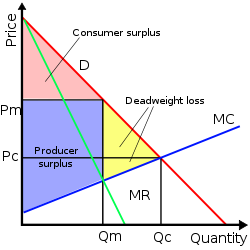 When firms hold large market shares, consumers risk paying higher prices and getting lower quality products than compared to competitive markets. However, the existence of a very high market share does not always mean consumers are paying excessive prices since the threat of new entrants to the market can restrain a high-market-share firm's price increases. Competition law does not make merely having a monopoly illegal, but rather abusing the power that a monopoly may confer, for instance through exclusionary practices.
First it is necessary to determine whether a firm is dominant, or whether it behaves "to an appreciable extent independently of its competitors, customers and ultimately of its consumer." Under EU law, very large market shares raise a presumption that a firm is dominant, which may be rebuttable. If a firm has a dominant position, then there is "a special responsibility not to allow its conduct to impair competition on the common market". Similarly as with collusive conduct, market shares are determined with reference to the particular market in which the firm and product in question is sold. Then although the lists are seldom closed, certain categories of abusive conduct are usually prohibited under the country's legislation. For instance, limiting production at a shipping port by refusing to raise expenditure and update technology could be abusive. Tying one product into the sale of another can be considered abuse too, being restrictive of consumer choice and depriving competitors of outlets. This was the alleged case in Microsoft v. Commission leading to an eventual fine of €497 million for including its Windows Media Player
with the Microsoft Windows
platform. A refusal to supply a facility which is essential for all businesses attempting to compete to use can constitute an abuse. One example was in a case involving a medical company named Commercial Solvents. When it set up its own rival in the tuberculosis
drugs market, Commercial Solvents were forced to continue supplying a company named Zoja with the raw materials for the drug. Zoja was the only market competitor, so without the court forcing supply, all competition would have been eliminated.
Forms of abuse relating directly to pricing include price exploitation. It is difficult to prove at what point a dominant firm's prices become "exploitative" and this category of abuse is rarely found. In one case however, a French funeral service was found to have demanded exploitative prices, and this was justified on the basis that prices of funeral services outside the region could be compared. A more tricky issue is predatory pricing
. This is the practice of dropping prices of a product so much that in order one's smaller competitors cannot cover their costs and fall out of business. The Chicago School (economics)
considers predatory pricing to be unlikely. However in France Telecom SA v. Commission a broadband internet company was forced to pay €10.35 million for dropping its prices below its own production costs. It had "no interest in applying such prices except that of eliminating competitors" and was being cross-subsidized in order to capture the lion's share of a booming market. One last category of pricing abuse is price discrimination
. An example of this could be offering rebates to industrial customers who export your company's sugar, but not to customers who are selling their goods in the same market as you are in.
s of another. The reasons for oversight of economic concentrations by the state are the same as the reasons to restrict firms who abuse a position of dominance, only that regulation of mergers and acquisitions attempts to deal with the problem before it arises, ex ante prevention of market dominance. In the United States merger regulation began under the Clayton Act, and in the European Union, under the Merger Regulation 139/2004 (known as the "ECMR"). Competition law requires that firms proposing to merge gain authorization from the relevant government authority, or simply go ahead but face the prospect of demerger
should the concentration later be found to lessen competition. The theory behind mergers is that transaction costs can be reduced compared to operating on an open market through bilateral contracts. Concentrations can increase economies of scale
and scope. However often firms take advantage of their increase in market power, their increased market share and decreased number of competitors, which can adversely affect the deal that consumers get. Merger control is about predicting what the market might be like, not knowing and making a judgment. Hence the central provision under EU law asks whether a concentration would if it went ahead "significantly impede effective competition... in particular as a result of the creation or strengthening off a dominant position..." and the corresponding provision under US antitrust states similarly,
What amounts to a substantial lessening of, or significant impediment to competition is usually answered through empirical study. The market shares of the merging companies can be assessed and added, although this kind of analysis only gives rise to presumptions, not conclusions. Something called the Herfindahl-Hirschman Index
is used to calculate the "density" of the market, or what concentration exists. Aside from the maths, it is important to consider the product in question and the rate of technical innovation in the market. A further problem of collective dominance, or oligopoly
through "economic links" can arise, whereby the new market becomes more conducive to collusion
. It is relevant how transparent a market is, because a more concentrated structure could mean firms can coordinate their behavior more easily, whether firms can deploy deterrents and whether firms are safe from a reaction by their competitors and consumers. The entry of new firms to the market, and any barriers that they might encounter should be considered. If firms are shown to be creating an uncompetitive concentration, in the US they can still argue that they create efficiencies enough to outweigh any detriment, and similar reference to "technical and economic progress" is mentioned in Art. 2 of the ECMR. Another defense might be that a firm which is being taken over is about to fail or go insolvent, and taking it over leaves a no less competitive state than what would happen anyway. Mergers vertically in the market are rarely of concern, although in AOL/Time Warner the European Commission
required that a joint venture with a competitor Bertelsmann
be ceased beforehand. The EU authorities have also focused lately on the effect of conglomerate merger
s, where companies acquire a large portfolio of related products, though without necessarily dominant shares in any individual market.
and competition have become increasingly intertwined. On the one hand, it is believed that promotion of innovation
through enforcement of intellectual rights promotes competitiveness, while on the other the contrary may be the consequence. The question rests on whether it is legal to acquire monopoly through accumulation of intellectual property. In which case, the judgment needs to decide between giving preference to intellectual rights or towards promoting competitiveness
Concerns also arise over anti-competitive effects and consequences due to
Some scholars suggest that a prize instead of patent would solve the problem of deadweight loss, when innovators got their reward from the prize, provided by the government or non-profit organization, rather than directly selling to the market, see Millennium Prize Problems
. However innovators may accept the prize only when it is at least as much as how much they earn from patent, which is a question difficult to determine.
Domestic
Criticism
Law
Law is a system of rules and guidelines which are enforced through social institutions to govern behavior, wherever possible. It shapes politics, economics and society in numerous ways and serves as a social mediator of relations between people. Contract law regulates everything from buying a bus...
that promotes or maintains market competition by regulating anti-competitive conduct by companies.
The history of competition law reaches back to the Roman Empire
Roman Empire
The Roman Empire was the post-Republican period of the ancient Roman civilization, characterised by an autocratic form of government and large territorial holdings in Europe and around the Mediterranean....
. The business practices of market traders, guild
Guild
A guild is an association of craftsmen in a particular trade. The earliest types of guild were formed as confraternities of workers. They were organized in a manner something between a trade union, a cartel, and a secret society...
s and governments have always been subject to scrutiny, and sometimes severe sanctions. Since the 20th century, competition law has become global. The two largest and most influential systems of competition regulation are United States antitrust law and European Union competition law
European Union competition law
European Union competition law arose out of the desire to ensure that the efforts of government could not be distorted by corporations abusing their market power. Hence under the treaties are provisions to ensure that free competition prevails, rather than cartels and monopolies sharing out markets...
. National and regional competition authorities across the world have formed international support and enforcement networks.
Modern competition law has historically evolved on a country level to promote and maintain competition in markets principally within the territorial boundaries of nation-states. National competition law usually does not cover activity beyond territorial borders unless it has significant effects at nation-state level. Countries may allow for extraterritorial jurisdiction
Extraterritorial jurisdiction
Extraterritorial jurisdiction is the legal ability of a government to exercise authority beyond its normal boundaries.Any authority can, of course, claim ETJ over any external territory they wish...
in competition cases based on so-called effects doctrine. The protection of international competition is governed by international competition agreements. In 1945, during the negotiations preceding the adoption of the General Agreement on Tariffs and Trade
General Agreement on Tariffs and Trade
The General Agreement on Tariffs and Trade was negotiated during the UN Conference on Trade and Employment and was the outcome of the failure of negotiating governments to create the International Trade Organization . GATT was signed in 1947 and lasted until 1993, when it was replaced by the World...
(GATT) in 1947, limited international competition obligations were proposed within the Charter for an International Trade Organisation. These obligations were not included in GATT, but in 1994, with the conclusion of the Uruguay Round
Uruguay Round
The Uruguay Round was the 8th round of Multilateral trade negotiations conducted within the framework of the General Agreement on Tariffs and Trade , spanning from 1986-1994 and embracing 123 countries as “contracting parties”. The Round transformed the GATT into the World Trade Organization...
of GATT Multilateral Negotiations, the World Trade Organization
World Trade Organization
The World Trade Organization is an organization that intends to supervise and liberalize international trade. The organization officially commenced on January 1, 1995 under the Marrakech Agreement, replacing the General Agreement on Tariffs and Trade , which commenced in 1948...
(WTO) was created. The Agreement Establishing the WTO included a range of limited provisions on various cross-border competition issues on a sector specific basis.
Principle
Competition law, or antitrust law, has three main elements:- prohibiting agreements or practices that restrict free trading and competition between business. This includes in particular the repression of free trade caused by cartelCartelA cartel is a formal agreement among competing firms. It is a formal organization of producers and manufacturers that agree to fix prices, marketing, and production. Cartels usually occur in an oligopolistic industry, where there is a small number of sellers and usually involve homogeneous products...
s. - banning abusive behavior by a firm dominating a market, or anti-competitive practices that tend to lead to such a dominant position. Practices controlled in this way may include predatory pricingPredatory pricingIn business and economics, predatory pricing is the practice of selling a product or service at a very low price, intending to drive competitors out of the market, or create barriers to entry for potential new competitors. If competitors or potential competitors cannot sustain equal or lower prices...
, tying, price gougingPrice gougingPrice gouging is a pejorative term referring to a situation in which a seller prices goods or commodities much higher than is considered reasonable or fair. In precise, legal usage, it is the name of a crime that applies in some of the United States during civil emergencies...
, refusal to dealRefusal to dealRefusal to deal is one of several anti-competitive practices forbidden in countries which have restricted market economies. For example:-History:...
, and many others. - supervising the mergers and acquisitionsMergers and acquisitionsMergers and acquisitions refers to the aspect of corporate strategy, corporate finance and management dealing with the buying, selling, dividing and combining of different companies and similar entities that can help an enterprise grow rapidly in its sector or location of origin, or a new field or...
of large corporations, including some joint ventureJoint ventureA joint venture is a business agreement in which parties agree to develop, for a finite time, a new entity and new assets by contributing equity. They exercise control over the enterprise and consequently share revenues, expenses and assets...
s. Transactions that are considered to threaten the competitive process can be prohibited altogether, or approved subject to "remedies" such as an obligation to divest part of the merged business or to offer licenses or access to facilities to enable other businesses to continue competing.
Substance and practice of competition law varies from jurisdiction to jurisdiction. Protecting the interests of consumers (consumer welfare
Welfare economics
Welfare economics is a branch of economics that uses microeconomic techniques to evaluate economic well-being, especially relative to competitive general equilibrium within an economy as to economic efficiency and the resulting income distribution associated with it...
) and ensuring that entrepreneurs have an opportunity to compete in the market economy
Market economy
A market economy is an economy in which the prices of goods and services are determined in a free price system. This is often contrasted with a state-directed or planned economy. Market economies can range from hypothetically pure laissez-faire variants to an assortment of real-world mixed...
are often treated as important objectives. Competition law is closely connected with law on deregulation of access to markets, state aids and subsidies, the privatization
Privatization
Privatization is the incidence or process of transferring ownership of a business, enterprise, agency or public service from the public sector to the private sector or to private non-profit organizations...
of state owned assets and the establishment of independent sector regulators, among other market-oriented supply-side policies. In recent decades, competition law has been viewed as a way to provide better public services
Public services
Public services is a term usually used to mean services provided by government to its citizens, either directly or by financing private provision of services. The term is associated with a social consensus that certain services should be available to all, regardless of income...
. Robert Bork
Robert Bork
Robert Heron Bork is an American legal scholar who has advocated the judicial philosophy of originalism. Bork formerly served as Solicitor General, Acting Attorney General, and judge for the United States Court of Appeals for the District of Columbia Circuit...
has argued that competition laws can produce adverse effects when they reduce competition by protecting inefficient competitors and when costs of legal intervention are greater than benefits for the consumers.
Ideas about competitive law were published during the 18th century with such works as Adam Smith
Adam Smith
Adam Smith was a Scottish social philosopher and a pioneer of political economy. One of the key figures of the Scottish Enlightenment, Smith is the author of The Theory of Moral Sentiments and An Inquiry into the Nature and Causes of the Wealth of Nations...
's The Wealth of Nations
The Wealth of Nations
An Inquiry into the Nature and Causes of the Wealth of Nations, generally referred to by its shortened title The Wealth of Nations, is the magnum opus of the Scottish economist and moral philosopher Adam Smith...
. Different terms were used to describe this area of the law, including "restrictive practices", "the law of monopolies", "combination acts" and the "restraint of trade".
Roman legislation
An early example of competition law can be found in Roman lawRoman law
Roman law is the legal system of ancient Rome, and the legal developments which occurred before the 7th century AD — when the Roman–Byzantine state adopted Greek as the language of government. The development of Roman law comprises more than a thousand years of jurisprudence — from the Twelve...
. The Lex Julia de Annona was enacted during the Roman Republic
Roman Republic
The Roman Republic was the period of the ancient Roman civilization where the government operated as a republic. It began with the overthrow of the Roman monarchy, traditionally dated around 508 BC, and its replacement by a government headed by two consuls, elected annually by the citizens and...
around 50 BC. To protect the grain trade, heavy fines were imposed on anyone directly, deliberately and insidiously stopping supply ships. Under Diocletian
Diocletian
Diocletian |latinized]] upon his accession to Diocletian . c. 22 December 244 – 3 December 311), was a Roman Emperor from 284 to 305....
in 301 AD an edict
Edict on Maximum Prices
The Edict on Maximum Prices was issued in 301 by Roman Emperor Diocletian....
imposed the death penalty for anyone violating a tariff system, for example by buying up, concealing or contriving the scarcity of everyday goods. More legislation came under the Constitution of Zeno
Zeno (emperor)
Zeno , originally named Tarasis, was Byzantine Emperor from 474 to 475 and again from 476 to 491. Domestic revolts and religious dissension plagued his reign, which nevertheless succeeded to some extent in foreign issues...
of 483 AD, which can be traced into Florentine Municipal laws of 1322 and 1325. This provided for confiscation of property and banishment for any trade combination or joint action of monopolies private or granted by the Emperor. Zeno rescinded all previously granted exclusive rights. Justinian I
Justinian I
Justinian I ; , ; 483– 13 or 14 November 565), commonly known as Justinian the Great, was Byzantine Emperor from 527 to 565. During his reign, Justinian sought to revive the Empire's greatness and reconquer the lost western half of the classical Roman Empire.One of the most important figures of...
subsequently introduced legislation to pay officials to manage state monopolies.
Middle ages
Legislation in England to control monopolies and restrictive practices were in force well before the Norman Conquest. The Domesday BookDomesday Book
Domesday Book , now held at The National Archives, Kew, Richmond upon Thames in South West London, is the record of the great survey of much of England and parts of Wales completed in 1086...
recorded that "foresteel
Engrossing
Engrossing, forestalling and regrating were marketing offences in English common law. The terms were used to describe unacceptable methods of influencing the market, sometimes by creating a local monopoly for a certain good, usually food. The terms were often used together, and with overlapping...
" (i.e. forestalling, the practice of buying up goods before they reach market and then inflating the prices) was one of three forfeitures
Asset forfeiture
Asset forfeiture is confiscation, by the State, of assets which are either the alleged proceeds of crime or the alleged instrumentalities of crime, and more recently, alleged terrorism. Instrumentalities of crime are property that was allegedly used to facilitate crime, for example cars...
that King Edward the Confessor could carry out through England. But concern for fair prices also led to attempts to directly regulate the market. Under Henry III an act was passed in 1266 to fix bread and ale prices in correspondence with grain prices laid down by the assizes. Penalties for breach included amercement
Amercement
An amercement is a financial penalty in English law, common during the Middle Ages, imposed either by the court or by peers. The term is of Anglo-Norman origin , and literally means "being at the mercy of": a-merce-ment .While it is often synonymous with a fine, it differs in that a fine is a fixed...
s, pillory
Pillory
The pillory was a device made of a wooden or metal framework erected on a post, with holes for securing the head and hands, formerly used for punishment by public humiliation and often further physical abuse, sometimes lethal...
and tumbrel
Tumbrel
A tumbrel , is a two-wheeled cart or wagon typically designed to be hauled by a single horse or ox. Their original use was for agricultural work in particular they were associated with carrying manure. Their most notable use was taking prisoners to the guillotine during the French Revolution. They...
. A 14th century statute labeled forestallers as "oppressors of the poor and the community at large and enemies of the whole country." Under King Edward III
Edward III of England
Edward III was King of England from 1327 until his death and is noted for his military success. Restoring royal authority after the disastrous reign of his father, Edward II, Edward III went on to transform the Kingdom of England into one of the most formidable military powers in Europe...
the Statute of Laborers of 1349 fixed wages of artificers and workmen and decreed that foodstuffs should be sold at reasonable prices. On top of existing penalties, the statute stated that overcharging merchants must pay the injured party double the sum he received, an idea that has been replicated in punitive
Punitive damages
Punitive damages or exemplary damages are damages intended to reform or deter the defendant and others from engaging in conduct similar to that which formed the basis of the lawsuit...
treble damages
Treble damages
Treble damages, in law, is a term that indicates that a statute permits a court to triple the amount of the actual/compensatory damages to be awarded to a prevailing plaintiff, generally in order to punish the losing party for willful conduct. Treble damages are a multiple of, and not an addition...
under US antitrust law. Also under Edward III, the following statutory provision outlawed trade combination.
"...we have ordained and established, that no merchant or other shall make Confederacy, Conspiracy, Coin, Imagination, or Murmur, or Evil Device in any point that may turn to the Impeachment, Disturbance, Defeating or Decay of the said Staples, or of anything that to them pertaineth, or may pertain."
In continental Europe competition principles developed in Lex Mercatoria
Lex mercatoria
Lex mercatoria is the body of commercial law used by merchants throughout Europe during the medieval period. It evolved similar to English common law as a system of custom and best practice, which was enforced through a system of merchant courts along the main trade routes. It functioned as the...
. Examples of legislation enshrining competition principles include the constitutiones juris metallici by Wenceslaus II of Bohemia
Bohemia
Bohemia is a historical region in central Europe, occupying the western two-thirds of the traditional Czech Lands. It is located in the contemporary Czech Republic with its capital in Prague...
between 1283 and 1305, condemning combination of ore traders increasing prices; the Municipal Statutes of Florence in 1322 and 1325 followed Zeno
Zeno (emperor)
Zeno , originally named Tarasis, was Byzantine Emperor from 474 to 475 and again from 476 to 491. Domestic revolts and religious dissension plagued his reign, which nevertheless succeeded to some extent in foreign issues...
's legislation against state monopolies; and under Emperor Charles V in the Holy Roman Empire
Holy Roman Empire
The Holy Roman Empire was a realm that existed from 962 to 1806 in Central Europe.It was ruled by the Holy Roman Emperor. Its character changed during the Middle Ages and the Early Modern period, when the power of the emperor gradually weakened in favour of the princes...
a law was passed "to prevent losses resulting from monopolies and improper contracts which many merchants and artisans made in the Netherlands." In 1553 King Henry VIII
Henry VIII of England
Henry VIII was King of England from 21 April 1509 until his death. He was Lord, and later King, of Ireland, as well as continuing the nominal claim by the English monarchs to the Kingdom of France...
reintroduced tariffs for foodstuffs, designed to stabilize prices, in the face of fluctuations in supply from overseas. So the legislation read here that whereas,
"it is very hard and difficult to put certain prices to any such things... [it is necessary because] prices of such victuals be many times enhanced and raised by the Greedy Covetousness and Appetites of the Owners of such Victuals, by occasion of ingrossing and regrating the same, more than upon any reasonable or just ground or cause, to the great damage and impoverishing of the King's subjects."
Around this time organizations representing various tradesmen and handicrafts people, known as guild
Guild
A guild is an association of craftsmen in a particular trade. The earliest types of guild were formed as confraternities of workers. They were organized in a manner something between a trade union, a cartel, and a secret society...
s had been developing, and enjoyed many concessions and exemptions from the laws against monopolies. The privileges conferred were not abolished until the Municipal Corporations Act 1835.
Early competition law in Europe
Restraint of trade
Restraint of trade is a common law doctrine relating to the enforceability of contractual restrictions on freedom to conduct business. In an old leading case of Mitchell v Reynolds Lord Smith LC said,...
is the direct predecessor to modern competition law later developed in the US. It is based on the prohibition of agreements that ran counter to public policy, unless the reasonableness
Reasonable person
The reasonable person is a legal fiction of the common law that represents an objective standard against which any individual's conduct can be measured...
of an agreement could be shown. It effectively prohibited agreements designed to restrain another's trade. The 1414 Dyer's is the first known restrictive trade agreement to be examined under English common law. A dyer had given a bond not to exercise his trade in the same town as the plaintiff for six months but the plaintiff had promised nothing in return. On hearing the plaintiff's attempt to enforce this restraint, Hull J exclaimed, "per Dieu, if the plaintiff were here, he should go to prison until he had paid a fine to the King." The court denied the collection of a bond for the dyer's breach of agreement because the agreement was held to be a restriction on trade. English courts subsequently decided a range of cases which gradually developed competition related case law, which eventually were transformed into statute law.
New World
The New World is one of the names used for the Western Hemisphere, specifically America and sometimes Oceania . The term originated in the late 15th century, when America had been recently discovered by European explorers, expanding the geographical horizon of the people of the European middle...
had just been opened up, overseas trade and plunder was pouring wealth through the international economy and attitudes among businessmen were shifting. In 1561 a system of Industrial Monopoly Licenses, similar to modern patent
Patent
A patent is a form of intellectual property. It consists of a set of exclusive rights granted by a sovereign state to an inventor or their assignee for a limited period of time in exchange for the public disclosure of an invention....
s had been introduced into England. But by the reign of Queen Elizabeth I, the system was reputedly much abused and used merely to preserve privileges, encouraging nothing new in the way of innovation or manufacture. In response English courts developed case law on restrictive business practices. The statute followed the unanimous decision in Darcy v. Allein 1602, also known as the Case of Monopolies, of the King's bench
King's Bench
The Queen's Bench is the superior court in a number of jurisdictions within some of the Commonwealth realms...
to declare void the sole right that Queen Elizabeth I had granted to Darcy to impost playing cards into England. Darcy, an officer of the Queen's household, claimed damages for the defendant's infringement of this right. The court found the grant void and that three characteristics of monopoly
Monopoly
A monopoly exists when a specific person or enterprise is the only supplier of a particular commodity...
were (1) price increases (2) quality decrease (3) the tendency to reduce artificers to idleness and beggary. This put an end to granted monopolies until King James I
James I of England
James VI and I was King of Scots as James VI from 24 July 1567 and King of England and Ireland as James I from the union of the English and Scottish crowns on 24 March 1603...
began to grant them again. In 1623 Parliament passed the Statute of Monopolies, which for the most part excluded patent
Patent
A patent is a form of intellectual property. It consists of a set of exclusive rights granted by a sovereign state to an inventor or their assignee for a limited period of time in exchange for the public disclosure of an invention....
rights from its prohibitions, as well as guilds. From King Charles I
Charles I of England
Charles I was King of England, King of Scotland, and King of Ireland from 27 March 1625 until his execution in 1649. Charles engaged in a struggle for power with the Parliament of England, attempting to obtain royal revenue whilst Parliament sought to curb his Royal prerogative which Charles...
, through the civil war and to King Charles II
Charles II of England
Charles II was monarch of the three kingdoms of England, Scotland, and Ireland.Charles II's father, King Charles I, was executed at Whitehall on 30 January 1649, at the climax of the English Civil War...
, monopolies continued, especially useful for raising revenue. Then in 1684, in East India Company v. Sandys it was decided that exclusive rights to trade only outside the realm were legitimate, on the grounds that only large and powerful concerns could trade in the conditions prevailing overseas.
The development of early competition law in England and Europe progressed with the diffusion of Adam Smith
Adam Smith
Adam Smith was a Scottish social philosopher and a pioneer of political economy. One of the key figures of the Scottish Enlightenment, Smith is the author of The Theory of Moral Sentiments and An Inquiry into the Nature and Causes of the Wealth of Nations...
's work, who first established the concept of the market economy
Market economy
A market economy is an economy in which the prices of goods and services are determined in a free price system. This is often contrasted with a state-directed or planned economy. Market economies can range from hypothetically pure laissez-faire variants to an assortment of real-world mixed...
. At the same time industrialisation
Industrialisation
Industrialization is the process of social and economic change that transforms a human group from an agrarian society into an industrial one...
replaced the individual artisan
Artisan
An artisan is a skilled manual worker who makes items that may be functional or strictly decorative, including furniture, clothing, jewellery, household items, and tools...
, or group of artisans, with paid labourers and machine-based production. Commercial success increasingly dependent on maximising production while minimising cost. Therefore the size of a company became increasingly important and a number of European countries responded by enacting laws to regulate large companies which restricted trade. Following the French Revolution
French Revolution
The French Revolution , sometimes distinguished as the 'Great French Revolution' , was a period of radical social and political upheaval in France and Europe. The absolute monarchy that had ruled France for centuries collapsed in three years...
in 1789 the law of 14–17 June 1791 declared agreements by members of the same trade that fixed the price of an industry or labour as void, unconstitutional, and hostile to liberty. Similarly the Austrian Penal Code of 1852 established that "agreements... to raise the price of a commodity... to the disadvantage of the public' should be punished as misdemeanours." Austria passed a law in 1870 abolishing the penalties, though such agreements remained void. However, in Germany laws clearly validated agreements between firms to raise prices. Throughout the 18th and 19th century ideas that dominant private companies or legal monopolies could excessively restrict trade were further developed in Europe. However, as in the late 19th century a depression spread through Europe, known as the Panic of 1873
Panic of 1873
The Panic of 1873 triggered a severe international economic depression in both Europe and the United States that lasted until 1879, and even longer in some countries. The depression was known as the Great Depression until the 1930s, but is now known as the Long Depression...
, ideas of competition lost favour and it was felt that companies had to co-operate by forming cartels to withstand huge pressures on prices and profits.
Modern competition law
While the development of competition law stalled in Europe during the late 19th century CanadaCanada
Canada is a North American country consisting of ten provinces and three territories. Located in the northern part of the continent, it extends from the Atlantic Ocean in the east to the Pacific Ocean in the west, and northward into the Arctic Ocean...
in 1889 enacted what is considered the first competition statute of modern times. The Act for the Prevention and Suppression of Combinations formed in restrained of Trade was based one year before the United States
United States
The United States of America is a federal constitutional republic comprising fifty states and a federal district...
enacted the most famous legal statute on competition law, the Sherman Act of 1890. It was named after Senator John Sherman who argued that the Act "does not announce a new principle of law, but applies old and well recognised principles of common law".
United States antitrust
The Sherman Act of 1890 thought to outlaw the restriction of competition by large companies, who co-operated with rivals to fix outputs, prices and market shares, initially through pools and later through trusts. Trusts first appeared in the US railroads, where the capital requirement of railroad construction precluded competitive services in then scarcely settled territories. This allowed railroads to discriminate on rates imposed and services provided to consumers and businesses, and to destroy potential competitors. Trusts could be dominant in several industries, with the Standard Oil Company trust in the 1880s controlling a number of markets, including the market in fuel oilFuel oil
Fuel oil is a fraction obtained from petroleum distillation, either as a distillate or a residue. Broadly speaking, fuel oil is any liquid petroleum product that is burned in a furnace or boiler for the generation of heat or used in an engine for the generation of power, except oils having a flash...
, lead
Lead
Lead is a main-group element in the carbon group with the symbol Pb and atomic number 82. Lead is a soft, malleable poor metal. It is also counted as one of the heavy metals. Metallic lead has a bluish-white color after being freshly cut, but it soon tarnishes to a dull grayish color when exposed...
and whiskey. On the basis that vast numbers of citizens were affected by trusts the Act was a priority for both major parties. Instead of regulating so as to allow the government to intervene in markets and their structures, the US Congress enshrined the principle that the competitive market itself should be the principal regulator of price, output, interests and profits. Influenced by the common law restraint of trade doctrine the Act instead outlawed anticompetitive practices. Prof Rudolph Peritz has argued that competition law in the United States has evolved around two sometimes conflicting concepts of competition: first that of individual liberty, free of government intervention, and second a fair competitive environment free of excessive economic power. Since the enactment of the
Sherman Act enforcement of competition law has been based on various economic theories adopted by Government.
Section 1 of the Sherman Act declared illegal "every contract, in the form of trust or otherwise, or conspiracy, in restraint of trade or commerce among the several States, or with foreign nations". Section 2 prohibits monopolies, or attempts and conspiracies to monopolize. Following the enactment in 1890 US court applies these principles to business and markets. Courts applied the Act without consistent economic analysis until 1914, when it was complemented the Clayton Act which specifically prohibiting exclusive dealing agreements, particularly tying agreements and interlocking directorates, and mergers achieved by purchasing stock. From 1915 onwards the rule of reason
Rule of reason
The Rule of Reason is a doctrine developed by the United States Supreme Court in its interpretation of the Sherman Antitrust Act. The rule, stated and applied in the case of Standard Oil Co. of New Jersey v. United States, 221 U.S...
analysis was frequently applied by courts to competition cases, however the period was characterized by the lack of competition law enforcement. From 1936 to 1972 courts' application of anti-trust law was dominated by the structure-conduct-performance paradigm of the Harvard School. From 1973 to 1991, the enforcement of anti-trust law was based on efficiency explanations as the Chicago School became dominant. Since 1992 the game theory
Game theory
Game theory is a mathematical method for analyzing calculated circumstances, such as in games, where a person’s success is based upon the choices of others...
has been frequently relied on in anti-trust cases.
European Union law
Competition law gained new recognition in Europe in the inter-war years, with Germany enacting its first anti-cartel law in 1923 and Sweden and Norway adopting similar laws in 1925 and 1926 respectively. However, with the Great DepressionGreat Depression
The Great Depression was a severe worldwide economic depression in the decade preceding World War II. The timing of the Great Depression varied across nations, but in most countries it started in about 1929 and lasted until the late 1930s or early 1940s...
of 1929 competition law disappeared from Europe and was revived following the second world war when the United Kingdom and Germany, following pressure from the United States, became the first European countries to adopt fully fledged competition laws. At a regional level EU competition law has its origins in the European Coal and Steel Community
European Coal and Steel Community
The European Coal and Steel Community was a six-nation international organisation serving to unify Western Europe during the Cold War and create the foundation for the modern-day developments of the European Union...
(ECSC) agreement between France
France
The French Republic , The French Republic , The French Republic , (commonly known as France , is a unitary semi-presidential republic in Western Europe with several overseas territories and islands located on other continents and in the Indian, Pacific, and Atlantic oceans. Metropolitan France...
, Italy
Italy
Italy , officially the Italian Republic languages]] under the European Charter for Regional or Minority Languages. In each of these, Italy's official name is as follows:;;;;;;;;), is a unitary parliamentary republic in South-Central Europe. To the north it borders France, Switzerland, Austria and...
, Belgium
Belgium
Belgium , officially the Kingdom of Belgium, is a federal state in Western Europe. It is a founding member of the European Union and hosts the EU's headquarters, and those of several other major international organisations such as NATO.Belgium is also a member of, or affiliated to, many...
, the Netherlands
Netherlands
The Netherlands is a constituent country of the Kingdom of the Netherlands, located mainly in North-West Europe and with several islands in the Caribbean. Mainland Netherlands borders the North Sea to the north and west, Belgium to the south, and Germany to the east, and shares maritime borders...
, Luxembourg
Luxembourg
Luxembourg , officially the Grand Duchy of Luxembourg , is a landlocked country in western Europe, bordered by Belgium, France, and Germany. It has two principal regions: the Oesling in the North as part of the Ardennes massif, and the Gutland in the south...
and Germany
Germany
Germany , officially the Federal Republic of Germany , is a federal parliamentary republic in Europe. The country consists of 16 states while the capital and largest city is Berlin. Germany covers an area of 357,021 km2 and has a largely temperate seasonal climate...
in 1951 following the Second World War. The agreement aimed to prevent Germany from re-establishing dominance in the production of coal
Coal
Coal is a combustible black or brownish-black sedimentary rock usually occurring in rock strata in layers or veins called coal beds or coal seams. The harder forms, such as anthracite coal, can be regarded as metamorphic rock because of later exposure to elevated temperature and pressure...
and steel
Steel
Steel is an alloy that consists mostly of iron and has a carbon content between 0.2% and 2.1% by weight, depending on the grade. Carbon is the most common alloying material for iron, but various other alloying elements are used, such as manganese, chromium, vanadium, and tungsten...
as it was felt that this dominance had contributed to the outbreak of the war. Article 65 of the agreement banned cartels and article 66 made provisions for concentrations, or mergers, and the abuse of a dominant position by companies. This was the first time that competition law
Competition law
Competition law, known in the United States as antitrust law, is law that promotes or maintains market competition by regulating anti-competitive conduct by companies....
principles were included in a plurilateral regional agreement and established the trans-European model of competition law. In 1957 competition rules were included in the Treaty of Rome
Treaty of Rome
The Treaty of Rome, officially the Treaty establishing the European Economic Community, was an international agreement that led to the founding of the European Economic Community on 1 January 1958. It was signed on 25 March 1957 by Belgium, France, Italy, Luxembourg, the Netherlands and West Germany...
, also known as the EC Treaty, which established the European Economic Community
European Economic Community
The European Economic Community The European Economic Community (EEC) The European Economic Community (EEC) (also known as the Common Market in the English-speaking world, renamed the European Community (EC) in 1993The information in this article primarily covers the EEC's time as an independent...
(EEC). The Treaty of Rome established the enactment of competition law as one of the main aims of the EEC through the "institution of a system ensuring that competition in the common market is not distorted". The two central provisions on EU competition law on companies were established in article 85, which prohibited anti-competitive agreements, subject to some exemptions, and article 86 prohibiting the abuse of dominant position. The treaty also established principles on competition law for member states, with article 90 covering public undertakings, and article 92 making provisions on state aid. Regulations on mergers were not included as member states could not establish consensus on the issue at the time.
Today, the Treaty of Lisbon
Treaty of Lisbon
The Treaty of Lisbon of 1668 was a peace treaty between Portugal and Spain, concluded at Lisbon on 13 February 1668, through the mediation of England, in which Spain recognized the sovereignty of Portugal's new ruling dynasty, the House of Braganza....
prohibits anti-competitive agreements in Article 101(1), including price fixing
Price fixing
Price fixing is an agreement between participants on the same side in a market to buy or sell a product, service, or commodity only at a fixed price, or maintain the market conditions such that the price is maintained at a given level by controlling supply and demand...
. According to Article 101(2) any such agreements are automatically void. Article 101(3) establishes exemptions, if the collusion is for distributional or technological innovation, gives consumers a "fair share" of the benefit and does not include unreasonable restraints that risk eliminating competition anywhere (or compliant with the general principle of European Union law of proportionality
Proportionality (law)
Proportionality is a principle in law which covers two distinct concepts. Within municipal law it is used to convey the idea that the punishment of an offender should fit the crime...
). Article 102 prohibits the abuse of dominant position
Dominant position
A dominant position may refer to:* Dominant position in grappling* Dominant male sex position* Dominant female sex position* Dominance , the firm's dominant position in the market...
, such as price discrimination and exclusive dealing. Article 102 allows the European Council
European Council
The European Council is an institution of the European Union. It comprises the heads of state or government of the EU member states, along with the President of the European Commission and the President of the European Council, currently Herman Van Rompuy...
to regulations
European Union regulation
A regulation is a legislative act of the European Union that becomes immediately enforceable as law in all member states simultaneously. Regulations can be distinguished from directives which, at least in principle, need to be transposed into national law...
to govern mergers between firms (the current regulation is the Regulation 139/2004/EC
European Community merger law
European Union merger law is a part of the law of the European Union which regulates whether firms can merge with one another and under what conditions...
. The general test is whether a concentration (i.e. merger or acquisition) with a community dimension (i.e. affects a number of EU member states) might significantly impede effective competition. Articles 106 and 107 provide that member state's right to deliver public services may not be obstructed, but that otherwise public enterprises must adhere to the same competition principles as companies. Article 107 lays down a general rule that the state may not aid or subsidize private parties in distortion of free competition and provides exemptions for charities, regional development objectives and in the event of a natural disaster
Natural disaster
A natural disaster is the effect of a natural hazard . It leads to financial, environmental or human losses...
.
International expansion
By 2008 111 countries had enacted competition laws, which is more than 50 percent of countries with a population exceeding 80,000 people. 81 of the 111 countries had adopted their competition laws in the past 20 years, signalling the spread of competition law following the collapse of the Soviet UnionSoviet Union
The Soviet Union , officially the Union of Soviet Socialist Republics , was a constitutionally socialist state that existed in Eurasia between 1922 and 1991....
and the expansion of the European Union
European Union
The European Union is an economic and political union of 27 independent member states which are located primarily in Europe. The EU traces its origins from the European Coal and Steel Community and the European Economic Community , formed by six countries in 1958...
.
Enforcement
In the European Union
European Union
The European Union is an economic and political union of 27 independent member states which are located primarily in Europe. The EU traces its origins from the European Coal and Steel Community and the European Economic Community , formed by six countries in 1958...
, the Modernisation Regulation 1/2003 means that the European Commission
European Commission
The European Commission is the executive body of the European Union. The body is responsible for proposing legislation, implementing decisions, upholding the Union's treaties and the general day-to-day running of the Union....
is no longer the only body capable of public enforcement of European Community competition law. This was done in order to facilitate quicker resolution of competition-related inquiries. In 2005 the Commission issued a Green Paper
Green paper
In the Commonwealth, the Republic of Ireland and the United States a green paper is a tentative government report of a proposal without any commitment to action; the first step in changing the law...
on Damages actions for the breach of the EC antitrust rules, which suggested ways of making private damages claims against cartels easier.
Antitrust administration and legislation can be seen as a balance between:
- guidelines which are clear and specific to the courts, regulators and business but leave little room for discretion that prevents the application of laws from resulting in unintended consequences.
- guidelines which are broad, hence allowing administrators to sway between improving economic outcomes versus succumbing to political policies to redistribute wealth.
Chapter 5 of the post war Havana Charter
Havana Charter
Havana Charter was the charter of the defunct International Trade Organization . It was signed by 53 countries on March 24, 1948. It allowed for international cooperation and rules against anti-competitive business practices. The charter ultimately failed because the Congress of the United States...
contained an Antitrust code but this was never incorporated into the WTO's forerunner, the General Agreement on Tariffs and Trade
General Agreement on Tariffs and Trade
The General Agreement on Tariffs and Trade was negotiated during the UN Conference on Trade and Employment and was the outcome of the failure of negotiating governments to create the International Trade Organization . GATT was signed in 1947 and lasted until 1993, when it was replaced by the World...
1947. Office of Fair Trading
Office of Fair Trading
The Office of Fair Trading is a not-for-profit and non-ministerial government department of the United Kingdom, established by the Fair Trading Act 1973, which enforces both consumer protection and competition law, acting as the UK's economic regulator...
Director and Professor Richard Whish wrote sceptically that it "seems unlikely at the current stage of its development that the WTO will metamorphose into a global competition authority." Despite that, at the ongoing Doha round
Doha round
The Doha Development Round or Doha Development Agenda is the current trade-negotiation round of the World Trade Organization which commenced in November 2001. Its objective is to lower trade barriers around the world, which will help facilitate the increase of global trade...
of trade talks for the World Trade Organization
World Trade Organization
The World Trade Organization is an organization that intends to supervise and liberalize international trade. The organization officially commenced on January 1, 1995 under the Marrakech Agreement, replacing the General Agreement on Tariffs and Trade , which commenced in 1948...
, discussion includes the prospect of competition law enforcement moving up to a global level. While it is incapable of enforcement itself, the newly established International Competition Network
International Competition Network
The International Competition Network is an informal, virtual network that seeks to facilitate cooperation between competition law authorities globally...
(ICN) is a way for national authorities to coordinate their own enforcement activities.
Classical perspective
Under the doctrine of laissez-faireLaissez-faire
In economics, laissez-faire describes an environment in which transactions between private parties are free from state intervention, including restrictive regulations, taxes, tariffs and enforced monopolies....
, antitrust is seen as unnecessary as competition is viewed as a long-term dynamic process where firms compete against each other for market dominance. In some markets a firm may successfully dominate, but it is because of superior skill or innovativeness. However, according to laissez-faire theorists, when it tries to raise prices to take advantage of its monopoly position it creates profitable opportunities for others to compete. A process of creative destruction
Creative destruction
Creative destruction is a term originally derived from Marxist economic theory which refers to the linked processes of the accumulation and annihilation of wealth under capitalism. These processes were first described in The Communist Manifesto and were expanded in Marx's Grundrisse and "Volume...
begins which erodes the monopoly. Therefore, government should not try to break up monopoly but should allow the market to work.
"A monopoly granted either to an individual or to a trading company has the same effect as a secret in trade or manufactures. The monopolists, by keeping the market constantly under-stocked, by never fully supplying the effectual demand, sell their commodities much above the natural price, and raise their emoluments, whether they consist in wages or profit, greatly above their natural rate."
In The Wealth of Nations
The Wealth of Nations
An Inquiry into the Nature and Causes of the Wealth of Nations, generally referred to by its shortened title The Wealth of Nations, is the magnum opus of the Scottish economist and moral philosopher Adam Smith...
(1776) Adam Smith
Adam Smith
Adam Smith was a Scottish social philosopher and a pioneer of political economy. One of the key figures of the Scottish Enlightenment, Smith is the author of The Theory of Moral Sentiments and An Inquiry into the Nature and Causes of the Wealth of Nations...
also pointed out the cartel problem, but did not advocate specific legal measures to combat them.
"People of the same trade seldom meet together, even for merriment and diversion, but the conversation ends in a conspiracy against the public, or in some contrivance to raise prices. It is impossible indeed to prevent such meetings, by any law which either could be executed, or would be consistent with liberty and justice. But though the law cannot hinder people of the same trade from sometimes assembling together, it ought to do nothing to facilitate such assemblies; much less to render them necessary."
By the latter half of the 19th century it had become clear that large firms had become a fact of the market economy. John Stuart Mill
John Stuart Mill
John Stuart Mill was a British philosopher, economist and civil servant. An influential contributor to social theory, political theory, and political economy, his conception of liberty justified the freedom of the individual in opposition to unlimited state control. He was a proponent of...
's approach was laid down in his treatise On Liberty
On Liberty
On Liberty is a philosophical work by British philosopher John Stuart Mill. It was a radical work to the Victorian readers of the time because it supported individuals' moral and economic freedom from the state....
(1859).
"Again, trade is a social act. Whoever undertakes to sell any description of goods to the public, does what affects the interest of other persons, and of society in general; and thus his conduct, in principle, comes within the jurisdiction of society... both the cheapness and the good quality of commodities are most effectually provided for by leaving the producers and sellers perfectly free, under the sole check of equal freedom to the buyers for supplying themselves elsewhere. This is the so-called doctrine of Free Trade, which rests on grounds different from, though equally solid with, the principle of individual liberty asserted in this Essay. Restrictions on trade, or on production for purposes of trade, are indeed restraints; and all restraint, qua restraint, is an evil..."
Neo-classical synthesis
Barriers to entry
In theories of competition in economics, barriers to entry are obstacles that make it difficult to enter a given market. The term can refer to hindrances a firm faces in trying to enter a market or industry - such as government regulation, or a large, established firm taking advantage of economies...
. By this term economists mean something very specific, that competitive free markets deliver allocative
Allocative efficiency
Allocative efficiency is a theoretical measure of the benefit or utility derived from a proposed or actual selection in the allocation or allotment of resources....
, productive
Productive efficiency
Productive efficiency occurs when the economy is utilizing all of its resources efficiently, producing most output from least input. The concept is illustrated on a production possibility frontier where all points on the curve are points of maximum productive efficiency...
and dynamic efficiency. Allocative efficiency is also known as Pareto efficiency
Pareto efficiency
Pareto efficiency, or Pareto optimality, is a concept in economics with applications in engineering and social sciences. The term is named after Vilfredo Pareto, an Italian economist who used the concept in his studies of economic efficiency and income distribution.Given an initial allocation of...
after the Italian economist Vilfredo Pareto
Vilfredo Pareto
Vilfredo Federico Damaso Pareto , born Wilfried Fritz Pareto, was an Italian engineer, sociologist, economist, political scientist and philosopher. He made several important contributions to economics, particularly in the study of income distribution and in the analysis of individuals' choices....
and means that resources in an economy over the long run will go precisely to those who are willing
Consumerism
Consumerism is a social and economic order that is based on the systematic creation and fostering of a desire to purchase goods and services in ever greater amounts. The term is often associated with criticisms of consumption starting with Thorstein Veblen...
and able
Poverty
Poverty is the lack of a certain amount of material possessions or money. Absolute poverty or destitution is inability to afford basic human needs, which commonly includes clean and fresh water, nutrition, health care, education, clothing and shelter. About 1.7 billion people are estimated to live...
to pay for them. Because rational producers will keep producing and selling, and buyers will keep buying up to the last marginal unit
Marginalism
Marginalism refers to the use of marginal concepts in economic theory. Marginalism is associated with arguments concerning changes in the quantity used of a good or service, as opposed to some notion of the over-all significance of that class of good or service, or of some total quantity...
of possible output – or alternatively rational producers will be reduce their output to the margin at which buyers will buy the same amount as produced – there is no waste, the greatest number wants of the greatest number of people become satisfied and utility
Utilitarianism
Utilitarianism is an ethical theory holding that the proper course of action is the one that maximizes the overall "happiness", by whatever means necessary. It is thus a form of consequentialism, meaning that the moral worth of an action is determined only by its resulting outcome, and that one can...
is perfected because resources can no longer be reallocated to make anyone better off without making someone else worse off; society has achieved allocative efficiency. Productive efficiency simply means that society is making as much as it can. Free markets are meant to reward those who work hard
Protestant work ethic
The Protestant work ethic is a concept in sociology, economics and history, attributable to the work of Max Weber...
, and therefore those who will put society's resources towards the frontier of its possible production
Production possibility frontier
In economics, a production–possibility frontier , sometimes called a production–possibility curve or product transformation curve, is a graph that compares the production rates of two commodities that use the same fixed total of the factors of production...
. Dynamic efficiency refers to the idea that business which constantly competes must research, create and innovate to keep its share of consumers. This traces to Austrian-American political scientist Joseph Schumpeter
Joseph Schumpeter
Joseph Alois Schumpeter was an Austrian-Hungarian-American economist and political scientist. He popularized the term "creative destruction" in economics.-Life:...
's notion that a "perennial gale of creative destruction" is ever sweeping through capitalist
Capitalism
Capitalism is an economic system that became dominant in the Western world following the demise of feudalism. There is no consensus on the precise definition nor on how the term should be used as a historical category...
economies, driving enterprise at the market's mercy. This led Schumpeter to argue that monopolies did not need to be broken up (as with Standard Oil
Standard Oil
Standard Oil was a predominant American integrated oil producing, transporting, refining, and marketing company. Established in 1870 as a corporation in Ohio, it was the largest oil refiner in the world and operated as a major company trust and was one of the world's first and largest multinational...
) because the next gale of economic innovation would do the same.
Contrasting with the allocatively, productively and dynamically efficient market model are monopolies, oligopolies, and cartels. When only one or a few firms exist in the market, and there is no credible threat of the entry of competing firms, prices rise above the competitive level, to either a monopolistic or oligopolistic equilibrium price. Production is also decreased, further decreasing social welfare by creating a deadweight loss
Deadweight loss
In economics, a deadweight loss is a loss of economic efficiency that can occur when equilibrium for a good or service is not Pareto optimal...
. Sources of this market power are said to include the existence of externalities, barriers to entry
Barriers to entry
In theories of competition in economics, barriers to entry are obstacles that make it difficult to enter a given market. The term can refer to hindrances a firm faces in trying to enter a market or industry - such as government regulation, or a large, established firm taking advantage of economies...
of the market, and the free rider problem
Free rider problem
In economics, collective bargaining, psychology, and political science, a free rider is someone who consumes a resource without paying for it, or pays less than the full cost. The free rider problem is the question of how to limit free riding...
. Markets may fail
Market failure
Market failure is a concept within economic theory wherein the allocation of goods and services by a free market is not efficient. That is, there exists another conceivable outcome where a market participant may be made better-off without making someone else worse-off...
to be efficient for a variety of reasons, so the exception of competition law's intervention to the rule of laissez faire is justified if government failure
Government failure
Government failure is the public sector analogy to market failure and occurs when a government intervention causes a more inefficient allocation of goods and resources than would occur without that intervention...
can be avoided. Orthodox economists fully acknowledge that perfect competition
Perfect competition
In economic theory, perfect competition describes markets such that no participants are large enough to have the market power to set the price of a homogeneous product. Because the conditions for perfect competition are strict, there are few if any perfectly competitive markets...
is seldom observed in the real world, and so aim for what is called "workable competition". This follows the theory that if one cannot achieve the ideal, then go for the second best option by using the law to tame market operation where it can.
Chicago School
A group of economists and lawyers, who are largely associated with the University of Chicago
University of Chicago
The University of Chicago is a private research university in Chicago, Illinois, USA. It was founded by the American Baptist Education Society with a donation from oil magnate and philanthropist John D. Rockefeller and incorporated in 1890...
, advocate an approach to competition law guided by the proposition that some actions that were originally considered to be anticompetitive could actually promote competition. The U.S. Supreme Court
Supreme Court of the United States
The Supreme Court of the United States is the highest court in the United States. It has ultimate appellate jurisdiction over all state and federal courts, and original jurisdiction over a small range of cases...
has used the Chicago School approach in several recent cases. One view of the Chicago School approach to antitrust is found in United States Circuit Court of Appeals Judge Richard Posner
Richard Posner
Richard Allen Posner is an American jurist, legal theorist, and economist who is currently a judge on the United States Court of Appeals for the Seventh Circuit in Chicago and a Senior Lecturer at the University of Chicago Law School...
's books Antitrust Law and Economic Analysis of Law.
Robert Bork
Robert Bork
Robert Heron Bork is an American legal scholar who has advocated the judicial philosophy of originalism. Bork formerly served as Solicitor General, Acting Attorney General, and judge for the United States Court of Appeals for the District of Columbia Circuit...
was highly critical of court decisions on United States antitrust law in a series of law review articles and his book The Antitrust Paradox
The Antitrust Paradox
The Antitrust Paradox is a 1978 book by Robert Bork that criticized the state of United States antitrust law in the 1970s. A second edition, updated to reflect substantial changes in the law, was published in 1993....
. Bork argued that both the original intention of antitrust laws and economic efficiency was the pursuit only of consumer welfare, the protection of competition rather than competitors. Furthermore, only a few acts should be prohibited, namely cartels that fix prices and divide markets, mergers that create monopolies, and dominant firms pricing predatorily, while allowing such practices as vertical agreements and price discrimination on the grounds that it did not harm consumers. Running through the different critiques of US antitrust policy is the common theme that government interference in the operation of free markets does more harm than good. "The only cure for bad theory", writes Bork, "is better theory". The late Harvard Law School
Harvard Law School
Harvard Law School is one of the professional graduate schools of Harvard University. Located in Cambridge, Massachusetts, it is the oldest continually-operating law school in the United States and is home to the largest academic law library in the world. The school is routinely ranked by the U.S...
Professor Philip Areeda, who favours more aggressive antitrust policy, in at least one Supreme Court case challenged Robert Bork's preference for non-intervention.
Collusion and cartels
Dominance and monopoly
First it is necessary to determine whether a firm is dominant, or whether it behaves "to an appreciable extent independently of its competitors, customers and ultimately of its consumer." Under EU law, very large market shares raise a presumption that a firm is dominant, which may be rebuttable. If a firm has a dominant position, then there is "a special responsibility not to allow its conduct to impair competition on the common market". Similarly as with collusive conduct, market shares are determined with reference to the particular market in which the firm and product in question is sold. Then although the lists are seldom closed, certain categories of abusive conduct are usually prohibited under the country's legislation. For instance, limiting production at a shipping port by refusing to raise expenditure and update technology could be abusive. Tying one product into the sale of another can be considered abuse too, being restrictive of consumer choice and depriving competitors of outlets. This was the alleged case in Microsoft v. Commission leading to an eventual fine of €497 million for including its Windows Media Player
Windows Media Player
Windows Media Player is a media player and media library application developed by Microsoft that is used for playing audio, video and viewing images on personal computers running the Microsoft Windows operating system, as well as on Pocket PC and Windows Mobile-based devices...
with the Microsoft Windows
Microsoft Windows
Microsoft Windows is a series of operating systems produced by Microsoft.Microsoft introduced an operating environment named Windows on November 20, 1985 as an add-on to MS-DOS in response to the growing interest in graphical user interfaces . Microsoft Windows came to dominate the world's personal...
platform. A refusal to supply a facility which is essential for all businesses attempting to compete to use can constitute an abuse. One example was in a case involving a medical company named Commercial Solvents. When it set up its own rival in the tuberculosis
Tuberculosis
Tuberculosis, MTB, or TB is a common, and in many cases lethal, infectious disease caused by various strains of mycobacteria, usually Mycobacterium tuberculosis. Tuberculosis usually attacks the lungs but can also affect other parts of the body...
drugs market, Commercial Solvents were forced to continue supplying a company named Zoja with the raw materials for the drug. Zoja was the only market competitor, so without the court forcing supply, all competition would have been eliminated.
Forms of abuse relating directly to pricing include price exploitation. It is difficult to prove at what point a dominant firm's prices become "exploitative" and this category of abuse is rarely found. In one case however, a French funeral service was found to have demanded exploitative prices, and this was justified on the basis that prices of funeral services outside the region could be compared. A more tricky issue is predatory pricing
Predatory pricing
In business and economics, predatory pricing is the practice of selling a product or service at a very low price, intending to drive competitors out of the market, or create barriers to entry for potential new competitors. If competitors or potential competitors cannot sustain equal or lower prices...
. This is the practice of dropping prices of a product so much that in order one's smaller competitors cannot cover their costs and fall out of business. The Chicago School (economics)
Chicago school (economics)
The Chicago school of economics describes a neoclassical school of thought within the academic community of economists, with a strong focus around the faculty of The University of Chicago, some of whom have constructed and popularized its principles...
considers predatory pricing to be unlikely. However in France Telecom SA v. Commission a broadband internet company was forced to pay €10.35 million for dropping its prices below its own production costs. It had "no interest in applying such prices except that of eliminating competitors" and was being cross-subsidized in order to capture the lion's share of a booming market. One last category of pricing abuse is price discrimination
Price discrimination
Price discrimination or price differentiation exists when sales of identical goods or services are transacted at different prices from the same provider...
. An example of this could be offering rebates to industrial customers who export your company's sugar, but not to customers who are selling their goods in the same market as you are in.
Mergers and acquisitions
A merger or acquisition involves, from a competition law perspective, the concentration of economic power in the hands of fewer than before. This usually means that one firm buys out the shareShare (finance)
A joint stock company divides its capital into units of equal denomination. Each unit is called a share. These units are offered for sale to raise capital. This is termed as issuing shares. A person who buys share/shares of the company is called a shareholder, and by acquiring share or shares in...
s of another. The reasons for oversight of economic concentrations by the state are the same as the reasons to restrict firms who abuse a position of dominance, only that regulation of mergers and acquisitions attempts to deal with the problem before it arises, ex ante prevention of market dominance. In the United States merger regulation began under the Clayton Act, and in the European Union, under the Merger Regulation 139/2004 (known as the "ECMR"). Competition law requires that firms proposing to merge gain authorization from the relevant government authority, or simply go ahead but face the prospect of demerger
Demerger
Demerger is a form of corporate restructuring in which the an entity's business operations are segregated into one or more components. It is the converse of a merger or acquisition....
should the concentration later be found to lessen competition. The theory behind mergers is that transaction costs can be reduced compared to operating on an open market through bilateral contracts. Concentrations can increase economies of scale
Economies of scale
Economies of scale, in microeconomics, refers to the cost advantages that an enterprise obtains due to expansion. There are factors that cause a producer’s average cost per unit to fall as the scale of output is increased. "Economies of scale" is a long run concept and refers to reductions in unit...
and scope. However often firms take advantage of their increase in market power, their increased market share and decreased number of competitors, which can adversely affect the deal that consumers get. Merger control is about predicting what the market might be like, not knowing and making a judgment. Hence the central provision under EU law asks whether a concentration would if it went ahead "significantly impede effective competition... in particular as a result of the creation or strengthening off a dominant position..." and the corresponding provision under US antitrust states similarly,
"No person shall acquire, directly or indirectly, the whole or any part of the stock or other share capital... of the assets of one or more persons engaged in commerce or in any activity affecting commerce, where... the effect of such acquisition, of such stocks or assets, or of the use of such stock by the voting or granting of proxies or otherwise, may be substantially to lessen competition, or to tend to create a monopoly.
What amounts to a substantial lessening of, or significant impediment to competition is usually answered through empirical study. The market shares of the merging companies can be assessed and added, although this kind of analysis only gives rise to presumptions, not conclusions. Something called the Herfindahl-Hirschman Index
Herfindahl index
The Herfindahl index is a measure of the size of firms in relation to the industry and an indicator of the amount of competition among them. Named after economists Orris C. Herfindahl and Albert O. Hirschman, it is an economic concept widely applied in competition law, antitrust and also...
is used to calculate the "density" of the market, or what concentration exists. Aside from the maths, it is important to consider the product in question and the rate of technical innovation in the market. A further problem of collective dominance, or oligopoly
Oligopoly
An oligopoly is a market form in which a market or industry is dominated by a small number of sellers . The word is derived, by analogy with "monopoly", from the Greek ὀλίγοι "few" + πόλειν "to sell". Because there are few sellers, each oligopolist is likely to be aware of the actions of the others...
through "economic links" can arise, whereby the new market becomes more conducive to collusion
Collusion
Collusion is an agreement between two or more persons, sometimes illegal and therefore secretive, to limit open competition by deceiving, misleading, or defrauding others of their legal rights, or to obtain an objective forbidden by law typically by defrauding or gaining an unfair advantage...
. It is relevant how transparent a market is, because a more concentrated structure could mean firms can coordinate their behavior more easily, whether firms can deploy deterrents and whether firms are safe from a reaction by their competitors and consumers. The entry of new firms to the market, and any barriers that they might encounter should be considered. If firms are shown to be creating an uncompetitive concentration, in the US they can still argue that they create efficiencies enough to outweigh any detriment, and similar reference to "technical and economic progress" is mentioned in Art. 2 of the ECMR. Another defense might be that a firm which is being taken over is about to fail or go insolvent, and taking it over leaves a no less competitive state than what would happen anyway. Mergers vertically in the market are rarely of concern, although in AOL/Time Warner the European Commission
European Commission
The European Commission is the executive body of the European Union. The body is responsible for proposing legislation, implementing decisions, upholding the Union's treaties and the general day-to-day running of the Union....
required that a joint venture with a competitor Bertelsmann
Bertelsmann
Bertelsmann AG is a multinational media corporation founded in 1835, based in Gütersloh, Germany. The company operates in 63 countries and employs 102,983 workers , which makes it the most international media corporation in the world. In 2008 the company reported a €16.118 billion consolidated...
be ceased beforehand. The EU authorities have also focused lately on the effect of conglomerate merger
Conglomerate merger
A conglomerate merger is officially defined as being "any merger that is not horizontal or vertical; in general, it is the combination of firms in different industries or firms operating in different geographic areas". Conglomerate mergers can serve various purposes, including extending corporate...
s, where companies acquire a large portfolio of related products, though without necessarily dominant shares in any individual market.
Public sector regulation
Public sector industries, or industries which are by their nature providing a public service, are involved in competition law in many ways similar to private companies. Under EU law, Articles 106 and 107 TFEU create exceptions for the assured achievement of public sector service provision. Many industries, such as railways, electricity, gas, water and media have their own independent sector regulators. These government agencies are charged with ensuring that private providers carry out certain public service duties in line of social welfare goals. For instance, an electricity company may not be allowed to disconnect someone's supply merely because they have not paid their bills up to date, because that could leave a person in the dark and cold just because they are poor. Instead the electricity company would have to give the person a number of warnings and offer assistance until government welfare support kicks in.Intellectual property, innovation and competition
Intellectual propertyIntellectual property
Intellectual property is a term referring to a number of distinct types of creations of the mind for which a set of exclusive rights are recognized—and the corresponding fields of law...
and competition have become increasingly intertwined. On the one hand, it is believed that promotion of innovation
Innovation
Innovation is the creation of better or more effective products, processes, technologies, or ideas that are accepted by markets, governments, and society...
through enforcement of intellectual rights promotes competitiveness, while on the other the contrary may be the consequence. The question rests on whether it is legal to acquire monopoly through accumulation of intellectual property. In which case, the judgment needs to decide between giving preference to intellectual rights or towards promoting competitiveness
- Should antitrust laws accord special treatment to intellectual property
- Should intellectual rights be revoked or not granted when antitrust laws are violated.
Concerns also arise over anti-competitive effects and consequences due to
- Intellectual properties that are collaboratively designed with consequence of violating antitrust laws (intentionally or otherwise)
- and the further effects on competition when such properties are accepted into industry standards
- Cross-licensing of intellectual property.
- Bundling of intellectual rights to long term business transactions or agreements to extend the market exclusiveness of intellectual rights beyond their statutory duration.
- Trade secrets, if they remain a secret, having an eternal length of life.
Some scholars suggest that a prize instead of patent would solve the problem of deadweight loss, when innovators got their reward from the prize, provided by the government or non-profit organization, rather than directly selling to the market, see Millennium Prize Problems
Millennium Prize Problems
The Millennium Prize Problems are seven problems in mathematics that were stated by the Clay Mathematics Institute in 2000. As of September 2011, six of the problems remain unsolved. A correct solution to any of the problems results in a US$1,000,000 prize being awarded by the institute...
. However innovators may accept the prize only when it is at least as much as how much they earn from patent, which is a question difficult to determine.
See also
- Thurman ArnoldThurman ArnoldThurman Wesley Arnold was an iconoclastic Washington, D.C. lawyer. He was best known for his trust-busting campaign as Assistant Attorney General in charge of the Antitrust Division in Franklin Delano Roosevelt's Department of Justice from 1938 to 1943...
- Consumer protectionConsumer protectionConsumer protection laws designed to ensure fair trade competition and the free flow of truthful information in the marketplace. The laws are designed to prevent businesses that engage in fraud or specified unfair practices from gaining an advantage over competitors and may provide additional...
- European Union competition lawEuropean Union competition lawEuropean Union competition law arose out of the desire to ensure that the efforts of government could not be distorted by corporations abusing their market power. Hence under the treaties are provisions to ensure that free competition prevails, rather than cartels and monopolies sharing out markets...
- The History of the Standard Oil CompanyThe History of the Standard Oil CompanyThe History of the Standard Oil Company is a book written by journalist Ida Tarbell in 1904. It was an exposé of the Standard Oil Company, run at that time by oil tycoon John D. Rockefeller, the richest figure in America's history...
(book) - Institute for Consumer Antitrust StudiesInstitute for Consumer Antitrust StudiesThe Institute for Consumer Antitrust Studies is a non-partisan, independent academic center designed to explore the impact of antitrust enforcement on the individual consumer and public, and to shape policy issues. It is located at Loyola University Chicago School of Law in Chicago, Illinois.The...
- Irish Competition lawIrish Competition LawIrish Competition Law is the Irish body of legal rules designed to ensure fairness and freedom in the marketplace. The key provisions of Irish competition law: usually outlaw anti-competitive arrangements between businesses and economic operators ; always outlaw the abuse of dominance by...
- List of countries' copyright length
- Relevant marketRelevant marketIn competition law the Relevant market defines the market in which one or more goods compete. Therefore, the Relevant market defines whether two or more products can be considered substitute goods and whether they constitute a particular and separate market for competition analysis.The relevant...
- Resale price maintenanceResale price maintenanceResale price maintenance is the practice whereby a manufacturer and its distributors agree that the latter will sell the former's product at certain prices , at or above a price floor or at or below a price ceiling...
- SSNIP
Further reading
- Competition Policy International (various issues), ISSN 1554-6853, available at http://www.globalcompetitionpolicy.org
- Elhauge, Einer; Geradin, Damien (2007) Global Competition Law and Economics, ISBN 1841134651
- Faull, Jonathan; Nikpay, Ali (eds) (2007) "Faull & Nikpay : The EC Law of Competition"; ISBN 978-0199269297
- Georg Erber and Stefan Kooths, Windows Vista: Securing Itself against Competition?, in: DIW Weekly Report, 2/2007, Vol.3, 7-14.
- Keith N. Hylton et al., Antitrust World Reports, available at http://www.antitrustworldwiki.com
External links
International- International Competition Network
- Global Competition Forum
- Global Competition Policy
- OECD Competition Home Page
Domestic
Criticism