

Welfare economics

Encyclopedia
Welfare economics is a branch of economics
that uses microeconomic
techniques to evaluate economic well-being, especially relative to competitive general equilibrium
within an economy as to economic efficiency and the resulting income distribution
associated with it. It analyzes social welfare
, however measured
, in terms of economic activities of the individuals that comprise the theoretical society considered. Accordingly, individuals, with associated economic activities, are the basic units
for aggregating to social welfare, whether of a group, a community, or a society, and there is no "social welfare" apart from the "welfare" associated with its individual units.
Welfare economics typically takes individual preferences as given and stipulates a welfare improvement in Pareto efficiency
terms from social state A to social state B if at least one person prefers B and no one else opposes it. There is no requirement of a unique quantitative measure of the welfare improvement implied by this. Another aspect of welfare treats income/goods distribution
, including equality
, as a further dimension of welfare.
Social welfare refers to the overall welfare of society. With sufficiently strong assumptions, it can be specified as the summation of the welfare of all the individuals in the society. Welfare may be measured either cardinally in terms of "utils http://en.wiktionary.org/wiki/util" or dollars, or measured ordinally in terms of Pareto efficiency
. The cardinal method in "utils" is seldom used in pure theory today because of aggregation problems that make the meaning of the method doubtful, except on widely challenged underlying assumptions. In applied welfare economics, such as in cost-benefit analysis
, money-value estimates are often used, particularly where income-distribution effects are factored into the analysis or seem unlikely to undercut the analysis.
Since the early 1980s economists have been interested in a number of new approaches and issues in welfare economics. The capabilities approach to welfare
argues that what people are free to do or be should also be included in welfare assessments and the approach has been particularly influential in development policy circles where the emphasis on multi-dimensionality and freedom has shaped the evolution of the Human Development Index
.
Economists have also been interested in using life satisfaction
to measure what Daniel Kahneman
and colleagues call experienced utility.
What follows, for the most part, therefore refers to a particular approach to welfare economics, possibly best referred to as 'neo-classical' or 'traditional' welfare economics.
Other classifying terms or problems in welfare economics include externalities
, equity
, justice
, inequality
, and altruism
.
The early Neoclassical
approach was developed by Edgeworth
, Sidgwick
, Marshall
, and Pigou
. It assumes that:
With these assumptions, it is possible to construct a social welfare function
simply by summing all the individual utility functions.
The New Welfare Economics approach is based on the work of Pareto
, Hicks
, and Kaldor
. It explicitly recognizes the differences between the efficiency aspect of the discipline and the distribution aspect and treats them differently. Questions of efficiency are assessed with criteria such as Pareto efficiency
and the Kaldor-Hicks compensation tests, while questions of income distribution are covered in social welfare function specification. Further, efficiency dispenses with cardinal measures of utility, replacing it with ordinal utility
, which merely ranks commodity bundles (with an indifference-curve
map, for example).
when goods are distributed to the people who can gain the most utility from them.
Many economists use Pareto efficiency
as their efficiency goal. According to this measure of social welfare, a situation is optimal only if no individuals can be made better off without making someone else worse off.
This ideal state of affairs can only come about if four criteria are met:
There are a number of conditions that, most economists agree, may lead to inefficiency. They include:
To determine whether an activity is moving the economy towards Pareto efficiency, two compensation tests have been developed. Any change usually makes some people better off while making others worse off, so these tests ask what would happen if the winners were to compensate the losers. Using the Kaldor criterion, an activity will contribute to Pareto optimality if the maximum amount the gainers are prepared to pay is greater than the minimum amount that the losers are prepared to accept. Under the Hicks criterion, an activity will contribute to Pareto optimality if the maximum amount the losers are prepared to offer to the gainers in order to prevent the change is less than the minimum amount the gainers are prepared to accept as a bribe to forgo the change. The Hicks compensation test is from the losers' point of view, while the Kaldor compensation test is from the gainers' point of view. If both conditions are satisfied, both gainers and losers will agree that the proposed activity will move the economy toward Pareto optimality. This is referred to as Kaldor-Hicks efficiency
or the Scitovsky criterion.
See also: first welfare theorem
. This function embodies value judgements about interpersonal utility. The social welfare function shows the relative importance of the individuals that comprise society.
A utilitarian welfare function (also called a Bentham
ite welfare function) sums the utility of each individual in order to obtain society's overall welfare. All people are treated the same, regardless of their initial level of utility. One extra unit of utility for a starving person is not seen to be of any greater value than an extra unit of utility for a millionaire. At the other extreme is the Max-Min, or Rawlsian
utility function (Stiglitz, 2000, p102). According to the Max-Min criterion, welfare is maximized when the utility of those society members that have the least is the greatest. No economic activity will increase social welfare unless it improves the position of the society member that is the worst off. Most economists specify social welfare functions that are intermediate between these two extremes.
The social welfare function is typically translated into social indifference curve
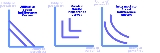
s so that they can be used in the same graphic space as the other functions that they interact with. A utilitarian social indifference curve is linear and downward sloping to the right. The Max-Min social indifference curve takes the shape of two straight lines joined so as they form a 90 degree angle. A social indifference curve drawn from an intermediate social welfare function is a curve that slopes downward to the right.
The intermediate form of social indifference curve can be interpreted as showing that as inequality increases, a larger improvement in the utility of relatively rich individuals is needed to compensate for the loss in utility of relatively poor individuals.
A crude social welfare function can be constructed by measuring the subjective dollar value of goods and services distributed to participants in the economy (see also consumer surplus).
The solution to this problem yields a Pareto optimum. In a more realistic example of millions of consumers, millions of products, and several factors of production, the math gets more complicated.
Also, finding a solution to an abstract function does not directly yield a policy recommendation! In other words, solving an equation does not solve social problems. However, a model like the one above can be viewed as an argument that solving a social problem (like achieving a Pareto-optimal distribution of wealth) is at least theoretically possible.
, labeled PQ shows all the points of efficiency in the production of goods X and Y. If the economy produces the mix of good X and Y shown at point A, then the marginal rate of transformation (MRT), X for Y, is equal to 2.
Point A defines the boundaries of an Edgeworth box
diagram of consumption. That is, the same mix of products that are produced at point A, can be consumed by the two consumers in this simple economy. The consumers' relative preferences are shown by the indifference curves inside the Edgeworth box
. At point B the marginal rate of substitution (MRS) is equal to 2, while at point C the marginal rate of substitution is equal to 3. Only at point B is consumption in balance with production (MRS=MRT). The curve 0BCA (often called the contract curve
) inside the Edgeworth box
defines the locus of points of efficiency in consumption (MRS1=MRS ²). As we move along the curve, we are changing the mix of goods X and Y that individuals 1 and 2 choose to consume. The utility data associated with each point on this curve can be used to create utility functions.
Although all the points on the grand social utility frontier are Pareto efficient, only one point identifies where social welfare is maximized. Such point is called "the point of bliss". This point is Z where the social utility frontier MN is tangent to the highest possible social indifference curve labelled SI.
and can be seen as intermediate or advanced microeconomic theory. Its results are applicable to macroeconomic
issues so welfare economics is somewhat of a bridge between the two branches of economics.
Cost-benefit analysis
is a specific application of welfare economics techniques, but excludes the income distribution aspects.
Political science
also looks into the issue of social welfare (political science), but in a less quantitative manner.
Human development theory
explores these issues also, and considers them fundamental to the development process itself.
judgment that, if a particular change in the economy
leaves at least one individual better off and no individual worse off, social welfare may be said to have increased.
, doubt whether a cardinal
utility function, or cardinal social welfare function, is of any value. The reason given is that it is difficult to aggregate the utilities of various people that have differing marginal utility of money, such as the wealthy and the poor.
Also, the economists of the Austrian School question the relevance of pareto optimal allocation considering situations where the framework of means and ends is not perfectly known, since neoclassical theory always assumes that the ends-means framework is perfectly defined.
Some even question the value of ordinal
utility functions. They have proposed other means of measuring well-being as an alternative to price indices, "willingness to pay" functions, and other price oriented measures. These price based measures are seen as promoting consumerism
and productivism
by many. It should be noted that it is possible to do welfare economics without the use of prices, however this is not always done.
Value assumptions explicit in the social welfare function used and implicit in the efficiency criterion chosen tend to make welfare economics a normative and perhaps subjective field. This can make it controversial.
However, perhaps most significant of all are concerns about the limits of a utilitarian approach to welfare economics. According to this line of argument utilities are not the only claim or welfare output that matters to people and so a comprehensive approach to welfare economics should include such factors. The capabilities approach to welfare is an attempt to construct a more comprehensive approach to welfare economics, one in which functionings, happiness and capabilities are the three key aspects of welfare outcomes that people should seek to promote and foster.
Economics
Economics is the social science that analyzes the production, distribution, and consumption of goods and services. The term economics comes from the Ancient Greek from + , hence "rules of the house"...
that uses microeconomic
Microeconomics
Microeconomics is a branch of economics that studies the behavior of how the individual modern household and firms make decisions to allocate limited resources. Typically, it applies to markets where goods or services are being bought and sold...
techniques to evaluate economic well-being, especially relative to competitive general equilibrium
General equilibrium
General equilibrium theory is a branch of theoretical economics. It seeks to explain the behavior of supply, demand and prices in a whole economy with several or many interacting markets, by seeking to prove that a set of prices exists that will result in an overall equilibrium, hence general...
within an economy as to economic efficiency and the resulting income distribution
Distribution (economics)
Distribution in economics refers to the way total output, income, or wealth is distributed among individuals or among the factors of production .. In general theory and the national income and product accounts, each unit of output corresponds to a unit of income...
associated with it. It analyzes social welfare
Welfare
Welfare refers to a broad discourse which may hold certain implications regarding the provision of a minimal level of wellbeing and social support for all citizens without the stigma of charity. This is termed "social solidarity"...
, however measured
Social welfare function
In economics, a social welfare function is a real-valued function that ranks conceivable social states from lowest to highest. Inputs of the function include any variables considered to affect the economic welfare of a society...
, in terms of economic activities of the individuals that comprise the theoretical society considered. Accordingly, individuals, with associated economic activities, are the basic units
Methodological individualism
Methodological individualism is the theory that social phenomena can only be accurately explained by showing how they result from the intentional states that motivate the individual actors. The idea has been used to criticize historicism, structural functionalism, and the roles of social class,...
for aggregating to social welfare, whether of a group, a community, or a society, and there is no "social welfare" apart from the "welfare" associated with its individual units.
Welfare economics typically takes individual preferences as given and stipulates a welfare improvement in Pareto efficiency
Pareto efficiency
Pareto efficiency, or Pareto optimality, is a concept in economics with applications in engineering and social sciences. The term is named after Vilfredo Pareto, an Italian economist who used the concept in his studies of economic efficiency and income distribution.Given an initial allocation of...
terms from social state A to social state B if at least one person prefers B and no one else opposes it. There is no requirement of a unique quantitative measure of the welfare improvement implied by this. Another aspect of welfare treats income/goods distribution
Distribution (economics)
Distribution in economics refers to the way total output, income, or wealth is distributed among individuals or among the factors of production .. In general theory and the national income and product accounts, each unit of output corresponds to a unit of income...
, including equality
Economic inequality
Economic inequality comprises all disparities in the distribution of economic assets and income. The term typically refers to inequality among individuals and groups within a society, but can also refer to inequality among countries. The issue of economic inequality is related to the ideas of...
, as a further dimension of welfare.
Social welfare refers to the overall welfare of society. With sufficiently strong assumptions, it can be specified as the summation of the welfare of all the individuals in the society. Welfare may be measured either cardinally in terms of "utils http://en.wiktionary.org/wiki/util" or dollars, or measured ordinally in terms of Pareto efficiency
Pareto efficiency
Pareto efficiency, or Pareto optimality, is a concept in economics with applications in engineering and social sciences. The term is named after Vilfredo Pareto, an Italian economist who used the concept in his studies of economic efficiency and income distribution.Given an initial allocation of...
. The cardinal method in "utils" is seldom used in pure theory today because of aggregation problems that make the meaning of the method doubtful, except on widely challenged underlying assumptions. In applied welfare economics, such as in cost-benefit analysis
Cost-benefit analysis
Cost–benefit analysis , sometimes called benefit–cost analysis , is a systematic process for calculating and comparing benefits and costs of a project for two purposes: to determine if it is a sound investment , to see how it compares with alternate projects...
, money-value estimates are often used, particularly where income-distribution effects are factored into the analysis or seem unlikely to undercut the analysis.
Since the early 1980s economists have been interested in a number of new approaches and issues in welfare economics. The capabilities approach to welfare
Capability approach
The capability approach was initially conceived in the 1980s as an approach to welfare economics....
argues that what people are free to do or be should also be included in welfare assessments and the approach has been particularly influential in development policy circles where the emphasis on multi-dimensionality and freedom has shaped the evolution of the Human Development Index
Human Development Index
The Human Development Index is a composite statistic used to rank countries by level of "human development" and separate "very high human development", "high human development", "medium human development", and "low human development" countries...
.
Economists have also been interested in using life satisfaction
Life satisfaction
Life Satisfaction is the way a person perceives how his or her life has been and how they feel about where it is going in the future. It is a measure of well being. Life satisfaction has been measured in relation with economic standing, amount of education, experiences, and the location of people...
to measure what Daniel Kahneman
Daniel Kahneman
Daniel Kahneman is an Israeli-American psychologist and Nobel laureate. He is notable for his work on the psychology of judgment and decision-making, behavioral economics and hedonic psychology....
and colleagues call experienced utility.
What follows, for the most part, therefore refers to a particular approach to welfare economics, possibly best referred to as 'neo-classical' or 'traditional' welfare economics.
Other classifying terms or problems in welfare economics include externalities
Externality
In economics, an externality is a cost or benefit, not transmitted through prices, incurred by a party who did not agree to the action causing the cost or benefit...
, equity
Equity (economics)
Equity is the concept or idea of fairness in economics, particularly as to taxation or welfare economics. More specifically it may refer to equal life chances regardless of identity, to provide all citizens with a basic minimum of income/goods/services or to increase funds and commitment for...
, justice
Justice (economics)
Justice in economics is a subcategory of welfare economics with models frequently representing the ethical-social requirements of a given theory. That theory may or may not elicit acceptance...
, inequality
Economic inequality
Economic inequality comprises all disparities in the distribution of economic assets and income. The term typically refers to inequality among individuals and groups within a society, but can also refer to inequality among countries. The issue of economic inequality is related to the ideas of...
, and altruism
Altruism
Altruism is a concern for the welfare of others. It is a traditional virtue in many cultures, and a core aspect of various religious traditions, though the concept of 'others' toward whom concern should be directed can vary among cultures and religions. Altruism is the opposite of...
.
Two approaches
There are two mainstream approaches to welfare economics: the early Neoclassical approach and the New welfare economics approach.The early Neoclassical
Neoclassical economics
Neoclassical economics is a term variously used for approaches to economics focusing on the determination of prices, outputs, and income distributions in markets through supply and demand, often mediated through a hypothesized maximization of utility by income-constrained individuals and of profits...
approach was developed by Edgeworth
Francis Ysidro Edgeworth
Francis Ysidro Edgeworth FBA was an Irish philosopher and political economist who made significant contributions to the methods of statistics during the 1880s...
, Sidgwick
Henry Sidgwick
Henry Sidgwick was an English utilitarian philosopher and economist. He was one of the founders and first president of the Society for Psychical Research, a member of the Metaphysical Society, and promoted the higher education of women...
, Marshall
Alfred Marshall
Alfred Marshall was an Englishman and one of the most influential economists of his time. His book, Principles of Economics , was the dominant economic textbook in England for many years...
, and Pigou
Arthur Cecil Pigou
Arthur Cecil Pigou was an English economist. As a teacher and builder of the school of economics at the University of Cambridge he trained and influenced many Cambridge economists who went on to fill chairs of economics around the world...
. It assumes that:
- Utility is cardinalCardinal utilityIn economics, cardinal utility refers to a property of mathematical indices that preserve preference orderings uniquely up to positive linear transformations...
, that is, scale-measurable by observation or judgment. - Preferences are exogenously given and stable.
- Additional consumption provides smaller and smaller increases in utility (diminishing marginal utilityMarginal utilityIn economics, the marginal utility of a good or service is the utility gained from an increase in the consumption of that good or service...
). - All individuals have interpersonally comparable utility functions (an assumption that Edgeworth avoided in his Mathematical 'Psychics).
With these assumptions, it is possible to construct a social welfare function
Social welfare function
In economics, a social welfare function is a real-valued function that ranks conceivable social states from lowest to highest. Inputs of the function include any variables considered to affect the economic welfare of a society...
simply by summing all the individual utility functions.
The New Welfare Economics approach is based on the work of Pareto
Vilfredo Pareto
Vilfredo Federico Damaso Pareto , born Wilfried Fritz Pareto, was an Italian engineer, sociologist, economist, political scientist and philosopher. He made several important contributions to economics, particularly in the study of income distribution and in the analysis of individuals' choices....
, Hicks
John Hicks
Sir John Richard Hicks was a British economist and one of the most important and influential economists of the twentieth century. The most familiar of his many contributions in the field of economics were his statement of consumer demand theory in microeconomics, and the IS/LM model , which...
, and Kaldor
Nicholas Kaldor
Nicholas Kaldor, Baron Kaldor was one of the foremost Cambridge economists in the post-war period...
. It explicitly recognizes the differences between the efficiency aspect of the discipline and the distribution aspect and treats them differently. Questions of efficiency are assessed with criteria such as Pareto efficiency
Pareto efficiency
Pareto efficiency, or Pareto optimality, is a concept in economics with applications in engineering and social sciences. The term is named after Vilfredo Pareto, an Italian economist who used the concept in his studies of economic efficiency and income distribution.Given an initial allocation of...
and the Kaldor-Hicks compensation tests, while questions of income distribution are covered in social welfare function specification. Further, efficiency dispenses with cardinal measures of utility, replacing it with ordinal utility
Ordinal utility
Ordinal utility theory states that while the utility of a particular good or service cannot be measured using a numerical scale bearing economic meaning in and of itself, pairs of alternative bundles of goods can be ordered such that one is considered by an individual to be worse than, equal to,...
, which merely ranks commodity bundles (with an indifference-curve
Indifference curve
In microeconomic theory, an indifference curve is a graph showing different bundles of goods between which a consumer is indifferent. That is, at each point on the curve, the consumer has no preference for one bundle over another. One can equivalently refer to each point on the indifference curve...
map, for example).
Efficiency
Situations are considered to have distributive efficiencyDistributive efficiency
In welfare economics, distributive efficiency occurs when goods and services are received by those who have the greatest need for them. Abba Lerner first proposed the idea of distributive efficiency in his 1944 book The Economics of Control....
when goods are distributed to the people who can gain the most utility from them.
Many economists use Pareto efficiency
Pareto efficiency
Pareto efficiency, or Pareto optimality, is a concept in economics with applications in engineering and social sciences. The term is named after Vilfredo Pareto, an Italian economist who used the concept in his studies of economic efficiency and income distribution.Given an initial allocation of...
as their efficiency goal. According to this measure of social welfare, a situation is optimal only if no individuals can be made better off without making someone else worse off.
This ideal state of affairs can only come about if four criteria are met:
- The marginal rates of substitutionMarginal rate of substitutionIn economics, the marginal rate of substitution is the rate at which a consumer is ready to give up one good in exchange for another good while maintaining the same level of utility.-Marginal rate of substitution as the slope of indifference curve:...
in consumption are identical for all consumers. This occurs when no consumer can be made better off without making others worse off. - The marginal rate of transformation in production is identical for all products. This occurs when it is impossible to increase the production of any good without reducing the production of other goods.
- The marginal resource cost is equal to the marginal revenue product for all production processes. This takes place when marginal physical product of a factor must be the same for all firms producing a good.
- The marginal rates of substitution in consumption are equal to the marginal rates of transformation in production, such as where production processes must match consumer wants.
There are a number of conditions that, most economists agree, may lead to inefficiency. They include:
- Imperfect market structures, such as a monopolyMonopolyA monopoly exists when a specific person or enterprise is the only supplier of a particular commodity...
, monopsonyMonopsonyIn economics, a monopsony is a market form in which only one buyer faces many sellers. It is an example of imperfect competition, similar to a monopoly, in which only one seller faces many buyers...
, oligopolyOligopolyAn oligopoly is a market form in which a market or industry is dominated by a small number of sellers . The word is derived, by analogy with "monopoly", from the Greek ὀλίγοι "few" + πόλειν "to sell". Because there are few sellers, each oligopolist is likely to be aware of the actions of the others...
, oligopsonyOligopsonyAn oligopsony is a market form in which the number of buyers is small while the number of sellers in theory could be large. This typically happens in a market for inputs where numerous suppliers are competing to sell their product to a small number of buyers...
, and monopolistic competitionMonopolistic competitionMonopolistic competition is imperfect competition where many competing producers sell products that are differentiated from one another...
. - Factor allocation inefficiencies in production theory basicsProduction theory basicsProduction refers to the economic process of converting of inputs into outputs. Production uses resources to create a good or service that is suitable for use, gift-giving in a gift economy, or exchange in a market economy. This can include manufacturing, storing, shipping, and packaging. Some...
. - Market failures and externalitiesExternalityIn economics, an externality is a cost or benefit, not transmitted through prices, incurred by a party who did not agree to the action causing the cost or benefit...
; there is also social costSocial costSocial cost, in economics, is generally defined in opposition to "private cost". In economics, theorists model individual decision-making as measurement of costs and benefits...
. - Price discriminationPrice discriminationPrice discrimination or price differentiation exists when sales of identical goods or services are transacted at different prices from the same provider...
and price skimmingPrice skimmingPrice skimming is a pricing strategy in which a marketer sets a relatively high price for a product or service at first, then lowers the price over time. It is a temporal version of price discrimination/yield management...
. - Asymmetric information, principal–agent problems.
- Long runLong run and short runIn macroeconomics, the long run is the conceptual time period in which there are no fixed factors of production as to changing the output level by changing the capital stock or by entering or leaving an industry. The long run contrasts with the short run, in which some factors are variable and...
declining average costs in a natural monopolyNatural monopolyA monopoly describes a situation where all sales in a market are undertaken by a single firm. A natural monopoly by contrast is a condition on the cost-technology of an industry whereby it is most efficient for production to be concentrated in a single form...
. - Certain types of taxes and tariffs.
To determine whether an activity is moving the economy towards Pareto efficiency, two compensation tests have been developed. Any change usually makes some people better off while making others worse off, so these tests ask what would happen if the winners were to compensate the losers. Using the Kaldor criterion, an activity will contribute to Pareto optimality if the maximum amount the gainers are prepared to pay is greater than the minimum amount that the losers are prepared to accept. Under the Hicks criterion, an activity will contribute to Pareto optimality if the maximum amount the losers are prepared to offer to the gainers in order to prevent the change is less than the minimum amount the gainers are prepared to accept as a bribe to forgo the change. The Hicks compensation test is from the losers' point of view, while the Kaldor compensation test is from the gainers' point of view. If both conditions are satisfied, both gainers and losers will agree that the proposed activity will move the economy toward Pareto optimality. This is referred to as Kaldor-Hicks efficiency
Kaldor-Hicks efficiency
Kaldor–Hicks efficiency, named for Nicholas Kaldor and John Hicks, also known as Kaldor–Hicks criterion, is a measure of economic efficiency that captures some of the intuitive appeal of Pareto efficiency, but has less stringent criteria and is hence applicable to more circumstances...
or the Scitovsky criterion.
See also: first welfare theorem
Income distribution
There are many combinations of consumer utility, production mixes, and factor input combinations consistent with efficiency. In fact, there are an infinity of consumption and production equilibria that yield Pareto optimal results. There are as many optima as there are points on the aggregate production possibilities frontier. Hence, Pareto efficiency is a necessary, but not a sufficient condition for social welfare. Each Pareto optimum corresponds to a different income distribution in the economy. Some may involve great inequalities of income. So how do we decide which Pareto optimum is most desirable? This decision is made, either tacitly or overtly, when we specify the social welfare functionSocial welfare function
In economics, a social welfare function is a real-valued function that ranks conceivable social states from lowest to highest. Inputs of the function include any variables considered to affect the economic welfare of a society...
. This function embodies value judgements about interpersonal utility. The social welfare function shows the relative importance of the individuals that comprise society.
A utilitarian welfare function (also called a Bentham
Jeremy Bentham
Jeremy Bentham was an English jurist, philosopher, and legal and social reformer. He became a leading theorist in Anglo-American philosophy of law, and a political radical whose ideas influenced the development of welfarism...
ite welfare function) sums the utility of each individual in order to obtain society's overall welfare. All people are treated the same, regardless of their initial level of utility. One extra unit of utility for a starving person is not seen to be of any greater value than an extra unit of utility for a millionaire. At the other extreme is the Max-Min, or Rawlsian
John Rawls
John Bordley Rawls was an American philosopher and a leading figure in moral and political philosophy. He held the James Bryant Conant University Professorship at Harvard University....
utility function (Stiglitz, 2000, p102). According to the Max-Min criterion, welfare is maximized when the utility of those society members that have the least is the greatest. No economic activity will increase social welfare unless it improves the position of the society member that is the worst off. Most economists specify social welfare functions that are intermediate between these two extremes.
The social welfare function is typically translated into social indifference curve
Indifference curve
In microeconomic theory, an indifference curve is a graph showing different bundles of goods between which a consumer is indifferent. That is, at each point on the curve, the consumer has no preference for one bundle over another. One can equivalently refer to each point on the indifference curve...
s so that they can be used in the same graphic space as the other functions that they interact with. A utilitarian social indifference curve is linear and downward sloping to the right. The Max-Min social indifference curve takes the shape of two straight lines joined so as they form a 90 degree angle. A social indifference curve drawn from an intermediate social welfare function is a curve that slopes downward to the right.
The intermediate form of social indifference curve can be interpreted as showing that as inequality increases, a larger improvement in the utility of relatively rich individuals is needed to compensate for the loss in utility of relatively poor individuals.
A crude social welfare function can be constructed by measuring the subjective dollar value of goods and services distributed to participants in the economy (see also consumer surplus).
A simplified seven-equation model
The basic welfare economics problem is to find the theoretical maximum of a social welfare function, subject to various constraints such as the state of technology in production, available natural resources, national infrastructure, and behavioural constraints such as consumer utility maximization and producer profit maximization. In the simplest possible economy this can be done by simultaneously solving seven equations. This simple economy would have only two consumers (consumer 1 and consumer 2), only two products (product X and product Y), and only two factors of production going into these products (labour (L) and capital (K)). The model can be stated as:- maximize social welfare: W=f(U1 U2) subject to the following set of constraints:
- K = Kx + Ky (The amount of capital used in the production of goods X and Y)
- L = Lx + Ly (The amount of labour used in the production of goods X and Y)
- X = X(Kx Lx) (The production function for product X)
- Y = Y(Ky Ly) (The production function for product Y)
- U1 = U1(X1 Y1) (The preferences of consumer 1)
- U2 = U2(X2 Y2) (The preferences of consumer 2)
The solution to this problem yields a Pareto optimum. In a more realistic example of millions of consumers, millions of products, and several factors of production, the math gets more complicated.
Also, finding a solution to an abstract function does not directly yield a policy recommendation! In other words, solving an equation does not solve social problems. However, a model like the one above can be viewed as an argument that solving a social problem (like achieving a Pareto-optimal distribution of wealth) is at least theoretically possible.
Efficiency between production and consumption
The relation between production and consumption in a simple seven equation model (2x2x2 model) can be shown graphically. In the diagram below, the aggregate production possibility frontierProduction possibility frontier
In economics, a production–possibility frontier , sometimes called a production–possibility curve or product transformation curve, is a graph that compares the production rates of two commodities that use the same fixed total of the factors of production...
, labeled PQ shows all the points of efficiency in the production of goods X and Y. If the economy produces the mix of good X and Y shown at point A, then the marginal rate of transformation (MRT), X for Y, is equal to 2.
Point A defines the boundaries of an Edgeworth box
Edgeworth box
In economics, an Edgeworth box, named after Francis Ysidro Edgeworth, is a way of representing various distributions of resources. Edgeworth made his presentation in his book Mathematical Psychics: An Essay on the Application of Mathematics to the Moral Sciences, 1881...
diagram of consumption. That is, the same mix of products that are produced at point A, can be consumed by the two consumers in this simple economy. The consumers' relative preferences are shown by the indifference curves inside the Edgeworth box
Edgeworth box
In economics, an Edgeworth box, named after Francis Ysidro Edgeworth, is a way of representing various distributions of resources. Edgeworth made his presentation in his book Mathematical Psychics: An Essay on the Application of Mathematics to the Moral Sciences, 1881...
. At point B the marginal rate of substitution (MRS) is equal to 2, while at point C the marginal rate of substitution is equal to 3. Only at point B is consumption in balance with production (MRS=MRT). The curve 0BCA (often called the contract curve
Contract curve
In microeconomics, the contract curve is the set of points, representing final allocations of two goods between two people, that could occur as a result of voluntary trading between those people given their initial allocations of the goods...
) inside the Edgeworth box
Edgeworth box
In economics, an Edgeworth box, named after Francis Ysidro Edgeworth, is a way of representing various distributions of resources. Edgeworth made his presentation in his book Mathematical Psychics: An Essay on the Application of Mathematics to the Moral Sciences, 1881...
defines the locus of points of efficiency in consumption (MRS1=MRS ²). As we move along the curve, we are changing the mix of goods X and Y that individuals 1 and 2 choose to consume. The utility data associated with each point on this curve can be used to create utility functions.
Social welfare maximization
Utility functions can be derived from the points on a contract curve. Numerous utility functions can be derived, one for each point on the production possibility frontier (PQ in the diagram above). A social utility frontier (also called a grand utility frontier) can be obtained from the outer envelope of all these utility functions. Each point on a social utility frontier represents an efficient allocation of an economy's resources; that is, it is a Pareto optimum in factor allocation, in production, in consumption, and in the interaction of production and consumption (supply and demand). In the diagram below, the curve MN is a social utility frontier. Point D corresponds with point B from the earlier diagram. Point D is on the social utility frontier because the marginal rate of substitution at point B is equal to the marginal rate of transformation at point A. Point E corresponds with point C in the previous diagram, and lies inside the social utility frontier (indicating inefficiency) because the MRS at point C is not equal to the MRT at point A.Although all the points on the grand social utility frontier are Pareto efficient, only one point identifies where social welfare is maximized. Such point is called "the point of bliss". This point is Z where the social utility frontier MN is tangent to the highest possible social indifference curve labelled SI.
Welfare economics in relation to other subjects
Welfare economics uses many of the same techniques as microeconomicsMicroeconomics
Microeconomics is a branch of economics that studies the behavior of how the individual modern household and firms make decisions to allocate limited resources. Typically, it applies to markets where goods or services are being bought and sold...
and can be seen as intermediate or advanced microeconomic theory. Its results are applicable to macroeconomic
Macroeconomics
Macroeconomics is a branch of economics dealing with the performance, structure, behavior, and decision-making of the whole economy. This includes a national, regional, or global economy...
issues so welfare economics is somewhat of a bridge between the two branches of economics.
Cost-benefit analysis
Cost-benefit analysis
Cost–benefit analysis , sometimes called benefit–cost analysis , is a systematic process for calculating and comparing benefits and costs of a project for two purposes: to determine if it is a sound investment , to see how it compares with alternate projects...
is a specific application of welfare economics techniques, but excludes the income distribution aspects.
Political science
Political science
Political Science is a social science discipline concerned with the study of the state, government and politics. Aristotle defined it as the study of the state. It deals extensively with the theory and practice of politics, and the analysis of political systems and political behavior...
also looks into the issue of social welfare (political science), but in a less quantitative manner.
Human development theory
Human development theory
Human development theory is a theory that merges older ideas from ecological economics, sustainable development, welfare economics, and feminist economics. It seeks to avoid the overt normative politics of most so-called "green economics" by justifying its theses strictly in ecology, economics and...
explores these issues also, and considers them fundamental to the development process itself.
Paretian welfare economics
Paretian welfare economics rests on the assumed valueValue theory
Value theory encompasses a range of approaches to understanding how, why and to what degree people should value things; whether the thing is a person, idea, object, or anything else. This investigation began in ancient philosophy, where it is called axiology or ethics. Early philosophical...
judgment that, if a particular change in the economy
Economy
An economy consists of the economic system of a country or other area; the labor, capital and land resources; and the manufacturing, trade, distribution, and consumption of goods and services of that area...
leaves at least one individual better off and no individual worse off, social welfare may be said to have increased.
Criticisms
Some, such as economists in the tradition of the Austrian SchoolAustrian School
The Austrian School of economics is a heterodox school of economic thought. It advocates methodological individualism in interpreting economic developments , the theory that money is non-neutral, the theory that the capital structure of economies consists of heterogeneous goods that have...
, doubt whether a cardinal
Cardinal number
In mathematics, cardinal numbers, or cardinals for short, are a generalization of the natural numbers used to measure the cardinality of sets. The cardinality of a finite set is a natural number – the number of elements in the set. The transfinite cardinal numbers describe the sizes of infinite...
utility function, or cardinal social welfare function, is of any value. The reason given is that it is difficult to aggregate the utilities of various people that have differing marginal utility of money, such as the wealthy and the poor.
Also, the economists of the Austrian School question the relevance of pareto optimal allocation considering situations where the framework of means and ends is not perfectly known, since neoclassical theory always assumes that the ends-means framework is perfectly defined.
Some even question the value of ordinal
Ordinal number
In set theory, an ordinal number, or just ordinal, is the order type of a well-ordered set. They are usually identified with hereditarily transitive sets. Ordinals are an extension of the natural numbers different from integers and from cardinals...
utility functions. They have proposed other means of measuring well-being as an alternative to price indices, "willingness to pay" functions, and other price oriented measures. These price based measures are seen as promoting consumerism
Consumerism
Consumerism is a social and economic order that is based on the systematic creation and fostering of a desire to purchase goods and services in ever greater amounts. The term is often associated with criticisms of consumption starting with Thorstein Veblen...
and productivism
Productivism
Productivism is the belief that measurable economic productivity and growth is the purpose of human organization , and that "more production is necessarily good".-Arguments for productivism:...
by many. It should be noted that it is possible to do welfare economics without the use of prices, however this is not always done.
Value assumptions explicit in the social welfare function used and implicit in the efficiency criterion chosen tend to make welfare economics a normative and perhaps subjective field. This can make it controversial.
However, perhaps most significant of all are concerns about the limits of a utilitarian approach to welfare economics. According to this line of argument utilities are not the only claim or welfare output that matters to people and so a comprehensive approach to welfare economics should include such factors. The capabilities approach to welfare is an attempt to construct a more comprehensive approach to welfare economics, one in which functionings, happiness and capabilities are the three key aspects of welfare outcomes that people should seek to promote and foster.
See also
- Arrow's impossibility theoremArrow's impossibility theoremIn social choice theory, Arrow’s impossibility theorem, the General Possibility Theorem, or Arrow’s paradox, states that, when voters have three or more distinct alternatives , no voting system can convert the ranked preferences of individuals into a community-wide ranking while also meeting a...
- Cloward–Piven strategy
- Compensation principleCompensation principleIn welfare economics, the compensation principle refers to a decision rule used to select between pairs of alternative feasible social states. One of these states is the hypothetical point of departure...
- Consumer surplus
- Cost-benefit analysisCost-benefit analysisCost–benefit analysis , sometimes called benefit–cost analysis , is a systematic process for calculating and comparing benefits and costs of a project for two purposes: to determine if it is a sound investment , to see how it compares with alternate projects...
- Deadweight lossDeadweight lossIn economics, a deadweight loss is a loss of economic efficiency that can occur when equilibrium for a good or service is not Pareto optimal...
- Distribution (economics)Distribution (economics)Distribution in economics refers to the way total output, income, or wealth is distributed among individuals or among the factors of production .. In general theory and the national income and product accounts, each unit of output corresponds to a unit of income...
- Economics terminology that differs from common usageEconomics terminology that differs from common usageIn any technical subject, words commonly used in everyday life acquire very specific technical meanings, and confusion can arise when someone is uncertain of the intended meaning of a word...
- Equity (economics)Equity (economics)Equity is the concept or idea of fairness in economics, particularly as to taxation or welfare economics. More specifically it may refer to equal life chances regardless of identity, to provide all citizens with a basic minimum of income/goods/services or to increase funds and commitment for...
- Feminist economicsFeminist economicsFeminist economics broadly refers to a developing branch of economics that applies feminist lenses to economics. Research under this heading is often interdisciplinary or heterodox...
- Gini coefficientGini coefficientThe Gini coefficient is a measure of statistical dispersion developed by the Italian statistician and sociologist Corrado Gini and published in his 1912 paper "Variability and Mutability" ....
- Income inequality metricsIncome inequality metricsThe concept of inequality is distinct from that of poverty and fairness. Income inequality metrics or income distribution metrics are used by social scientists to measure the distribution of income, and economic inequality among the participants in a particular economy, such as that of a specific...
- Important publications in welfare economics
- Justice (economics)Justice (economics)Justice in economics is a subcategory of welfare economics with models frequently representing the ethical-social requirements of a given theory. That theory may or may not elicit acceptance...
- Kaldor-Hicks efficiencyKaldor-Hicks efficiencyKaldor–Hicks efficiency, named for Nicholas Kaldor and John Hicks, also known as Kaldor–Hicks criterion, is a measure of economic efficiency that captures some of the intuitive appeal of Pareto efficiency, but has less stringent criteria and is hence applicable to more circumstances...
- List of business ethics, political economy, and philosophy of business topics
- List of economics topics
- Laffer curveLaffer curveIn economics, the Laffer curve is a theoretical representation of the relationship between government revenue raised by taxation and all possible rates of taxation. It is used to illustrate the concept of taxable income elasticity . The curve is constructed by thought experiment...
- Lorenz curveLorenz curveIn economics, the Lorenz curve is a graphical representation of the cumulative distribution function of the empirical probability distribution of wealth; it is a graph showing the proportion of the distribution assumed by the bottom y% of the values...
- MicroeconomicsMicroeconomicsMicroeconomics is a branch of economics that studies the behavior of how the individual modern household and firms make decisions to allocate limited resources. Typically, it applies to markets where goods or services are being bought and sold...
- National Income (national income accounting)
- Pareto efficiencyPareto efficiencyPareto efficiency, or Pareto optimality, is a concept in economics with applications in engineering and social sciences. The term is named after Vilfredo Pareto, an Italian economist who used the concept in his studies of economic efficiency and income distribution.Given an initial allocation of...
- Price ceilingPrice ceilingA price ceiling is a government-imposed limit on the price charged for a product. Governments intend price ceilings to protect consumers from conditions that could make necessary commodities unattainable. However, a price ceiling can cause problems if imposed for a long period without controlled...
- Price floorPrice floorA price floor is a government- or group-imposed limit on how low a price can be charged for a product. For a price floor to be effective, it must be greater than the equilibrium price.-Effectiveness of price floors:...
- Social welfare functionSocial welfare functionIn economics, a social welfare function is a real-valued function that ranks conceivable social states from lowest to highest. Inputs of the function include any variables considered to affect the economic welfare of a society...
- Social welfare (political science)