
All Topics  
Treaty of Rome

 
Treaty of Rome

   Email Print
   Bookmark   Link


Treaty of Rome


The Treaties of Rome are two of the treaties of the European Union
Treaties of the European Union

The Treaties of the European Union are a set of Treaty between the Union's Member State of the European Union which sets out the Constitution of the European Union ....
 signed on March 25 1957. Both treaties were signed by The Six
Inner Six

The Inner Six, or simply The Six, were the six founding Member State of the European Union of the European Communities. This was in contrast to the outer seven who formed the European Free Trade Association rather than be involved in supranational European integration ....
: Belgium
Belgium

* A small German-speaking Community of Belgium exists in eastern Wallonia. Belgium's linguistic diversity and related political and cultural conflicts are reflected in the history of Belgium and a complex Communities and regions of Belgium....
, France
France

France , officially the French Republic , is a country whose Metropolitan France is located in Western Europe and that also comprises various Overseas departments and territories of France....
, Italy
Italy

Italy , officially the Italian Republic , is a country located on the Italian Peninsula in Southern Europe and on the two largest islands in the Mediterranean Sea, Sicily and Sardinia....
, Luxembourg
Luxembourg

Luxembourg , officially the Grand Duchy of Luxembourg , is a small landlocked country in western Europe, bordered by Belgium, France, and Germany....
, the Netherlands
Netherlands

The Netherlands is a country that is part of the Kingdom of the Netherlands. It is a parliamentary democratic constitutional monarchy. The Netherlands is located in North-West Europe, and bordered by the North Sea to the north and west, Belgium to the south, and Germany to the east....
 and West Germany
West Germany

West Germany was the common English name for the Germany , from its formation in May 1949 to German reunification in October 1990, when East Germany was dissolved and its States of Germany became part of the Federal Republic, ending the more than 40-year division of Germany....
.

The first established the European Economic Community
European Economic Community

The European Economic Community was an international organisation created in 1957 to bring about economic integration between Belgium, France, Germany, Italy, Luxembourg and the Netherlands....
 (EEC) and the second established the European Atomic Energy Community
European Atomic Energy Community

The European Atomic Energy Community is an international organization which is semi-independent of, but completely controlled by, the European Community Three pillars of the European Union of the European Union....
 (EAEC or Euratom). They were the first international organisations to be based on supranationalism
Supranationalism

Supranationalism is a method of decision-making in multi-national political communities, wherein power is transferred to an authority broader than governments of member states....
, after the European Coal and Steel Community
European Coal and Steel Community

The European Coal and Steel Community was a six-nation international organisation serving to unify Western Europe during the Cold War and creating the foundation for European democracy and the modern-day developments of the European Union....
 (ECSC) established a few years prior.

The treaties came into force on 1 January 1958 and the EEC treaty has been amended on numerous occasions (see Treaties of the European Union
Treaties of the European Union

The Treaties of the European Union are a set of Treaty between the Union's Member State of the European Union which sets out the Constitution of the European Union ....
); It has since been renamed from The Treaty establishing the European Economic Community to the The Treaty establishing the European Community.


Discussion
Ask a question about 'Treaty of Rome'
Start a new discussion about 'Treaty of Rome'
Answer questions from other users
Full Discussion Forum


Recent Posts


Encyclopedia


The Treaties of Rome are two of the treaties of the European Union
Treaties of the European Union

The Treaties of the European Union are a set of Treaty between the Union's Member State of the European Union which sets out the Constitution of the European Union ....
 signed on March 25 1957. Both treaties were signed by The Six
Inner Six

The Inner Six, or simply The Six, were the six founding Member State of the European Union of the European Communities. This was in contrast to the outer seven who formed the European Free Trade Association rather than be involved in supranational European integration ....
: Belgium
Belgium

* A small German-speaking Community of Belgium exists in eastern Wallonia. Belgium's linguistic diversity and related political and cultural conflicts are reflected in the history of Belgium and a complex Communities and regions of Belgium....
, France
France

France , officially the French Republic , is a country whose Metropolitan France is located in Western Europe and that also comprises various Overseas departments and territories of France....
, Italy
Italy

Italy , officially the Italian Republic , is a country located on the Italian Peninsula in Southern Europe and on the two largest islands in the Mediterranean Sea, Sicily and Sardinia....
, Luxembourg
Luxembourg

Luxembourg , officially the Grand Duchy of Luxembourg , is a small landlocked country in western Europe, bordered by Belgium, France, and Germany....
, the Netherlands
Netherlands

The Netherlands is a country that is part of the Kingdom of the Netherlands. It is a parliamentary democratic constitutional monarchy. The Netherlands is located in North-West Europe, and bordered by the North Sea to the north and west, Belgium to the south, and Germany to the east....
 and West Germany
West Germany

West Germany was the common English name for the Germany , from its formation in May 1949 to German reunification in October 1990, when East Germany was dissolved and its States of Germany became part of the Federal Republic, ending the more than 40-year division of Germany....
.

The first established the European Economic Community
European Economic Community

The European Economic Community was an international organisation created in 1957 to bring about economic integration between Belgium, France, Germany, Italy, Luxembourg and the Netherlands....
 (EEC) and the second established the European Atomic Energy Community
European Atomic Energy Community

The European Atomic Energy Community is an international organization which is semi-independent of, but completely controlled by, the European Community Three pillars of the European Union of the European Union....
 (EAEC or Euratom). They were the first international organisations to be based on supranationalism
Supranationalism

Supranationalism is a method of decision-making in multi-national political communities, wherein power is transferred to an authority broader than governments of member states....
, after the European Coal and Steel Community
European Coal and Steel Community

The European Coal and Steel Community was a six-nation international organisation serving to unify Western Europe during the Cold War and creating the foundation for European democracy and the modern-day developments of the European Union....
 (ECSC) established a few years prior.

The treaties came into force on 1 January 1958 and the EEC treaty has been amended on numerous occasions (see Treaties of the European Union
Treaties of the European Union

The Treaties of the European Union are a set of Treaty between the Union's Member State of the European Union which sets out the Constitution of the European Union ....
); It has since been renamed from The Treaty establishing the European Economic Community to the The Treaty establishing the European Community. However the Euratom treaty has seen very little amendment due to the later sensitivity surrounding atomic energy
Atomic energy

Atomic energy is energy produced by atoms.*Nuclear energy, the energy resulting of potential difference of the nuclear force*Nuclear reaction, a process in which two nuclei or nuclear particles collide, to produce different products than the initial products; see also nuclear fission and nuclear fusion....
 amongst the European electorate
Constituency

A constituency is any cohesive body of people bound by shared identity, goals, or loyalty. Constituency can be used to describe a business's customer base and shareholders, or a charity's donors or those it serves....
.

History

In 1951, the Treaty of Paris
Treaty of Paris (1951)

The Treaty of Paris, signed on 18 April, 1951 between France, West Germany, Italy and the three Benelux countries established the European Coal and Steel Community , which subsequently became part of the European Union....
 was signed, creating the European Coal and Steel Community
European Coal and Steel Community

The European Coal and Steel Community was a six-nation international organisation serving to unify Western Europe during the Cold War and creating the foundation for European democracy and the modern-day developments of the European Union....
 (ECSC). This was an international community based on supranationalism
Supranationalism

Supranationalism is a method of decision-making in multi-national political communities, wherein power is transferred to an authority broader than governments of member states....
 and international law, designed to help the economy of Europe
Economy of the European Union

The economy of the European Union combines the economies of 27 member states and is generating an estimated nominal Gross Domestic Product of ?12 581 billion according to the IMF....
 and prevent future war by integrating
European integration

European integration is the process of political, legal, economic integration of European states, including some states that are partly in Europe....
 its members together. In the aim of creating a federal Europe
United States of Europe

A federal Europe is a theory that much of Europe be unified in the manner of a federation. The idea has been common with ambitions of European integration with the term United States of Europe echoing the federal nature of the United States....
 two further communities were proposed. A European Defence Community
European Defence Community

The European Defense Community was a plan proposed in 1950 by Ren? Pleven, the French President of the Council , in response to the United States call for the rearmament of West Germany....
 (EDC) and a European Political Community
European Political Community

The European Political Community was proposed in 1952 as a combination of the existing European Coal and Steel Community and the proposed European Defence Community ....
 (EPC). While the treaty for the latter was being drawn up by the Common Assembly
European Parliament

The European Parliament is the only direct election parliamentary institution of the European Union . Together with the Council of the European Union , it forms the bicameral Institutions of the European Union#Legislature of the Institutions of the European Union and has been described as one of the most powerful legislatures in the world....
, the ECSC parliamentary chamber, the EDC was rejected by the French Parliament. President
President of the European Commission

The President of the European Commission is the most powerful office in the European Union, as the head of the European Commission, the executive branch of the European Union....
 Jean Monnet
Jean Monnet

Jean Omer Marie Gabriel Monnet is regarded by many as a chief architect of European Unity. Never elected to public office, Monnet worked behind the scenes of American and European governments as a well-connected pragmatic internationalist....
, a leading figure behind the communities, resigned from the High Authority in protest and began work on alternative communities, based on economic integration rather than political integration.

Rometreaty
As a result of energy crises, the Common Assembly proposed extending the powers of the ECSC to cover other sources of energy. However Jean Monnet desired a separate community to cover atomic energy
Atomic energy

Atomic energy is energy produced by atoms.*Nuclear energy, the energy resulting of potential difference of the nuclear force*Nuclear reaction, a process in which two nuclei or nuclear particles collide, to produce different products than the initial products; see also nuclear fission and nuclear fusion....
 and Louis Armand
Louis Armand

Louis Armand was a French engineering who managed several public companies and had a significant role during World War II as an officer in the French resistance....
 was put in charge of a study into the prospects of nuclear energy use in Europe. The report concluded further nuclear development was needed to fill the deficit left by the exhaustion of coal deposits and to reduce dependence on oil producers. However the Benelux states and Germany were also keen on creating a general common market
Single market

A common market is a customs union with common policies on product regulation, and freedom of movement of the factors of production and of capitalism....
, although it was opposed by France due to its protectionism
Protectionism

Protectionism is the economic policy of restraining trade between nations, through methods such as tariffs on imported goods, restrictive import quota, and a variety of other restrictive government regulations designed to discourage imports, and prevent foreign take-over of local markets and companies....
 and Jean Monnet thought it too large and difficult a task. In the end, Monnet proposed creating both as separate communities, in an attempt to satisfy all interests. As a result of the Messina Conference
Messina Conference

The Messina Conference was held from 1 to 3 June 1955 at the Italy city of Messina on the island of Sicily. The conference of the Foreign Ministers of the six Member States of the European Coal and Steel Community would lead to the creation of the European Economic Community in 1958....
 of 1955, Paul-Henri Spaak
Paul-Henri Spaak

Paul Henri Charles Spaak was a Belgium Socialist politician and statesman....
 was appointed as chairman of a preparatory committee (Spaak Committee
Spaak Committee

The Spaak Committee was an Intergovernmental Conference set up by the Foreign Ministers of the six Member States of the European Coal and Steel Community as a result of the Messina Conference of 1955....
) charged with the preparation of a report on the creation of a common European market.

The Spaak Report
Spaak Report

The Spaak report or Brussels Report on the General Common Market, was the report drafted by the Spaak Committee in 1956. The Intergovernmental Committee, headed by Paul-Henri Spaak presented its definitive report on 21 April 1956 to the six Governments of the Member States of the European Coal and Steel Community....
 drawn up by the Spaak Committee provided the basis for further progress and was accepted at the Venice Conference
Venice Conference

The Venice Conference was held in Venice on 29 May and 30 May 1956. The Foreign Ministers of the six Member States of the European Coal and Steel Community met at the San Giorgio Monastery on the Venetian island of San Giorgio Maggiore to discuss the Spaak Report of the Spaak Committee....
 (29 and 30 May 1956) where the decision was taken to organize an Intergovernmental Conference
Intergovernmental Conference

An Intergovernmental Conference is the formal procedure for negotiating amendments to the founding treaties of the European Union. Under the treaties, an IGC is called into being by the European Council, and is composed of representatives of the member states, with the European Commission, and to a lesser degree the European Parliament also...
. The report formed the cornerstone of the Intergovernmental Conference on the Common Market and Euratom
Intergovernmental Conference on the Common Market and Euratom

The Intergovernmental Conference on the Common Market and Euratom was held in Brussels, it started on 26 June 1956 with a session in the Grand Salon of the Belgian Foreign Ministry....
 at Val Duchesse
Castle of the Valley of the Duchess

The Castle of the Valley of the Duchess is a former priory situated in the municipality of Auderghem in the Brussels Capital Region of Belgium....
 in 1956.

Signatories For
Paul-Henri Spaak
Paul-Henri Spaak

Paul Henri Charles Spaak was a Belgium Socialist politician and statesman....
 Jean Charles Snoy et d'Oppuers
Jean Charles Snoy et d'Oppuers

Count Jean Charles Snoy et d'Oppuers , son of Baron Thierry Snoy, was a Belgium civil servant, diplomat and Roman Catholic politician for the Christian Social Party ....
 
Konrad Adenauer
Konrad Adenauer

Konrad Hermann Josef Adenauer , 5 January 1876 ? 19 April 1967) was a Germany statesman.Although his political career spanned sixty years, beginning as early as 1906, he is most noted for his role as the Chancellor of Germany of West Germany from 1949?1963 and chairman of the Christian Democratic Union from 1950 to 1966....
 Walter Hallstein
Walter Hallstein

Walter Hallstein was a Germany politician and professor.He was one of the key figures of European integration after World War II, becoming the first president of the European Commission of the European Commission....
 
Christian Pineau
Christian Pineau

Christian Pineau was a noted French Resistance fighter.He was born in Chaumont-en-Bassigny, Haute-Marne, France and died in Paris.A World War II French Resistance leader and a close ally of Charles de Gaulle, he was arrested by the Gestapo in 1943 and survived Buchenwald concentration camp....
 Maurice Faure
Maurice Faure

Maurice Faure at Azerat in the Dordogne is a former member of the French Resistance and a former minister in several French governments.He was a deputy in the French parliament from 1951 to 1983 and a Senator from 1983 to 1988....
 
Antonio Segni
Antonio Segni

Antonio Segni was an Italian politician who was twice Prime Minister of Italy , and the President of the Italian Republic from 1962 to 1964. Adhering to the centrist Christian Democracy party , he was the first Sardinian ever to become Prime Minister of Italy....
 Gaetano Martino
Gaetano Martino

Gaetano Martino was an Italy politician and university teacher.A native of Messina, Sicily, he was a member of Italian Liberal Party . Gaetano Martino was one of the participants of the Messina Conference in 1955, which would lead to the Treaty of Rome in 1957....
 
Joseph Bech
Joseph Bech

Joseph Bech was a Luxembourgian politician. He was the fifteenth Prime Minister of Luxembourg, serving for eleven years, from 16 July 1926 until 5 November 1937....
 Lambert Schaus
Lambert Schaus

Lambert Schaus was a Luxembourgian politician, jurist, and diplomat. He held office as a minister and European Commissioner.Schaus was born in Luxembourg City to a jeweller....
 
Joseph Luns
Joseph Luns

Joseph Antoine Marie Hubert Luns was a Netherlands politician. He was the 5th Secretary General of NATO of the NATO.He was born into a Roman Catholic family of artist and author Huib Luns....
 J. Linthorst Homan


The outcome of the conference was that new communities would share the Common Assembly (now Parliamentary Assembly) with the ECSC, as it would with the Court of Justice
European Court of Justice

The Court of Justice of the European Communities, usually called the European Court of Justice , is the Supreme court of the European Union ....
. However they would not share the ECSC's Council of High Authority
High Authority of the European Coal and Steel Community

The High Authority was the executive branch of the former European Coal and Steel Community . It was created in 1951 and disbanded in 1967 when it was merged into the European Commission....
. The two new High Authorities would be called Commissions
European Commission

The European Commission is the executive of the European Union. The body is responsible for proposing legislation, implementing decisions, upholding the Treaties of the European Union and the general day-to-day running of the Union....
, this was due to a reduction in their powers. France was reluctant to agree to more supranational powers and hence the new Commissions would only have basic powers and important decisions would have to be approved by the Council, which now adopted majority voting. The latter body fostered co-operation in the nuclear field, at the time a very popular area, and the EEC was to create a full customs union between members.

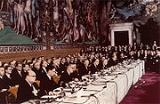
The conference led to the signature, on March 25, 1957, of the Treaties of Rome at the Palazzo dei Conservatori on Capitoline Hill
Capitoline Hill

The Capitoline Hill , between the Roman Forum and the Campus Martius, is one of the seven hills of Rome of Rome. By the 16th century, Capitolinus had become Campidoglio in the Romanesco....
 in Rome
Rome

Rome is the capital city of Italy and Lazio, and is Italy's largest and most populous city, with 2,724,347 residents in an urban area of some ....
. In March 2007, the BBC's Today
Today programme

Today, sometimes referred to as the Today programme to avoid ambiguity, is BBC Radio 4's long-running early morning news and current affairs programme, which is now broadcast from 6am to 9am from Monday to Friday and from 7am to 9am on Saturdays....
 radio programme reported that delays in printing the treaty meant that the document signed by the European leaders as the Treaty of Rome consisted of blank pages between its frontispiece
Frontispiece

*In architecture, a frontispiece constitutes the elements that frame and decorate the main, or front, door to a building; especially when the main entrance is the chief face of the building, rather than being kept behind columns or a portico....
 and page for the signatures.

Euratom

The Euratom treaty is less well known due to the lower profile of that organisation. While the EEC has evolved into what is now the European Union, Euratom has remained much the same and is governed by the same institutions as the EEC. It was established with independent institutions, but in 1967 the Merger Treaty
Merger Treaty

The Merger Treaty was a Treaties of the European Union which combined the Executive bodies of the European Coal and Steel Community , European Atomic Energy Community and the European Economic Community into a single Institutions of the European Union....
 merged the institutions of Euratom and the ECSC with those of the EEC. The Euratom treaty has seen very little amendment due to the later sensitivity surrounding atomic energy
Atomic energy

Atomic energy is energy produced by atoms.*Nuclear energy, the energy resulting of potential difference of the nuclear force*Nuclear reaction, a process in which two nuclei or nuclear particles collide, to produce different products than the initial products; see also nuclear fission and nuclear fusion....
 amongst the European electorate
Constituency

A constituency is any cohesive body of people bound by shared identity, goals, or loyalty. Constituency can be used to describe a business's customer base and shareholders, or a charity's donors or those it serves....
.

EEC Renamings

The EEC treaty's original full name was the Treaty establishing the European Economic Community, but in 1993 the Treaty of Maastricht changed the name of the EEC treaty to reflect the change of the EEC in becoming the European Community
European Community

The European Community is one of the three pillars of the European Union created under the Maastricht Treaty . It is based upon the principle of supranationalism and has its origins in the European Economic Community, the predecessor of the European Union....
. Hence the treaty became the Treaty establishing the European Community (TEC).

If the Treaty of Lisbon
Treaty of Lisbon

The Treaty of Lisbon of 1668 was a peace treaty between Portugal and Spain, concluded at Lisbon, February 13, 1668, by the mediation of England, in which Spain recognized Portuguese independence....
 comes into force as planned, a further change in the nature of the Community would lead to the EEC treaty being amended and renamed as the Treaty on the Functioning of the European Union (TFEU).

50th anniversary

The 50th anniversary was celebrated in various ways, including events on Europe Day
Europe Day

In Europe, Europe Day is an annual celebration of peace and unity in Europe. There are two separate Europe Days, taking place on the 5 May and the 9 May, established by the Council of Europe and the European Union respectively....
 and throughout the year. Numerous commemorative coins were issues, including a special commemorative two euro
€2 commemorative coins

?2 commemorative coins are special euro coins mint and issued by member states of the eurozone since 2004 as legal tender in all eurozone member states....
 which was issued with near identical designs by every (then-13) eurozone
Eurozone

The Eurozone is a currency union of 16 Member State of the European Union which have adopted the euro as their sole legal tender. It currently consists of Austria, Belgium, Cyprus, Finland, France, Germany, Greece, Republic of Ireland, Italy, Luxembourg, Malta, the Netherlands, Portugal, Slovakia, Slovenia and Spain....
 member (the first time every member had issued a coin together). Other non-circulation coins included the Belgian 10 euro 50th Anniversary of the Treaty of Rome commemorative coin
Euro gold and silver commemorative coins (Belgium)

Euro gold and silver commemorative coins are special euro coins Mint and issued by member states of the Eurozone, mainly in gold and silver, although other precious metals are also used in rare occasions....
.

See also

  • Intergovernmental Conference on the Common Market and Euratom
    Intergovernmental Conference on the Common Market and Euratom

    The Intergovernmental Conference on the Common Market and Euratom was held in Brussels, it started on 26 June 1956 with a session in the Grand Salon of the Belgian Foreign Ministry....
  • Spaak Report
    Spaak Report

    The Spaak report or Brussels Report on the General Common Market, was the report drafted by the Spaak Committee in 1956. The Intergovernmental Committee, headed by Paul-Henri Spaak presented its definitive report on 21 April 1956 to the six Governments of the Member States of the European Coal and Steel Community....
  • Ohlin Report
    Ohlin Report

    The Ohlin Report was a report drafted by a group of experts of the International Labour Organization led by Bertil Ohlin in 1956. Together with the Spaak Report it provided the basis for the Treaty of Rome on the common market in 1957 and the creation of the European Economic Community in 1958....
  • Berlin Declaration (2007)
    Berlin Declaration (2007)

    The Berlin Declaration is a non-binding European Union text signed on 25 March 2007 in Berlin celebrating 50 years since the signing of the Treaties of Rome which founded the European Economic Community, the predecessor to the modern European Union....
  • Common Agricultural Policy
    Common Agricultural Policy

    The Common Agricultural Policy is a system of European Union agricultural subsidies and programmes. It represents 46.7% of the European Union Budget, ?49.8 billion in 2006 ....
  • Four Freedoms (European Union)
    Four Freedoms (European Union)

    In European Union law, the Four Freedoms is a common term for a set of treaty provisions, secondary legislation and court decisions, protecting the ability of goods, service , capital , and Labour to move freely within the single market of the European Union....
  • History of the European Union
    History of the European Union

    The European Union is a geo-political entity covering a large portion of the European continent. It is founded upon numerous treaties and has undergone expansions that has taken it from 6 European Union to 27, a majority of states in Europe....
  • Article 81
    Article 81

    Article 81 of the Treaty establishing the European Community prohibits cartels and other agreements which could disrupt free competition in the European Economic Area's common market....
  • Article 82
    Article 82

    Article 82 of the Treaty establishing the European Community is aimed at preventing undertakings who hold a dominant positionin a market from abusing that position....

External links

  • (Official Journal C 321E of 29 December 2006)
  • European NAvigator
  • European NAvigator
  • — Union wide design competition to mark the 50th anniversary of the Treaty