
All Topics  
Production possibility frontier


   Email Print
   Bookmark   Link


Production possibility frontier


In economics
Economics

File:Ballard Farmers' Market - vegetables.jpgEconomics is the Social sciences that studies the Production theory basics, Distribution , and Consumption of Good and Service ....
, a production-possibility frontier (PPF) or “transformation curve” is a graph that shows the different rates of production of two goods that an individual or group can efficiently produce with limited productive resources. The PPF shows the maximum obtainable amount of one commodity for any given amount of another commodity or composite
Composite good

In economics, demand for a Good is often the focus as to a change in its price. A composite good is an abstraction used in economics that represents all goods in the relevant Consumer theory#Model setup besides the one in question....
 of all other commodities, given the society's technology
Technology

Technology is a broad concept that deals with an animal species' usage and knowledge of tools and crafts, and how it affects an animal species' ability to control and adapt to its Natural environment....
 and the amount of factors of production
Factors of production

In economics, factors of production are the resources employed to produce Good and services. Here the rate of output is modeled as a production function of the rate of use of each input employed.They are generally land, labor, and capital; the three groups of resources that are used to make all goods and services....
 available.

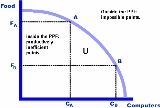
is an example using the two goods, food and computers.

The move from point A to point B indicates an increase in the number of computers produced, but it also indicates a decrease in the amount of food produced.


Discussion
Ask a question about 'Production possibility frontier'
Start a new discussion about 'Production possibility frontier'
Answer questions from other users
Full Discussion Forum


Recent Posts


Encyclopedia


In economics
Economics

File:Ballard Farmers' Market - vegetables.jpgEconomics is the Social sciences that studies the Production theory basics, Distribution , and Consumption of Good and Service ....
, a production-possibility frontier (PPF) or “transformation curve” is a graph that shows the different rates of production of two goods that an individual or group can efficiently produce with limited productive resources. The PPF shows the maximum obtainable amount of one commodity for any given amount of another commodity or composite
Composite good

In economics, demand for a Good is often the focus as to a change in its price. A composite good is an abstraction used in economics that represents all goods in the relevant Consumer theory#Model setup besides the one in question....
 of all other commodities, given the society's technology
Technology

Technology is a broad concept that deals with an animal species' usage and knowledge of tools and crafts, and how it affects an animal species' ability to control and adapt to its Natural environment....
 and the amount of factors of production
Factors of production

In economics, factors of production are the resources employed to produce Good and services. Here the rate of output is modeled as a production function of the rate of use of each input employed.They are generally land, labor, and capital; the three groups of resources that are used to make all goods and services....
 available.

Productive efficiency, allocative efficiency, and opportunity cost

Here is an example using the two goods, food and computers.

Newppf Small
The move from point A to point B indicates an increase in the number of computers produced, but it also indicates a decrease in the amount of food produced. Assuming that productive resources do not increase, making more computers requires that resources be redirected from making food to making computers. If production is efficient, FA of food and CA of computers could be made (as Point A shows), or FB of food and CB of computers could be made (as Point B shows).

All points on the curve are points of maximum productive efficiency
Productive efficiency

Productive efficiency occurs when the economy is operating at its production possibility frontier . This takes place when production of one Good is achieved at the lowest cost possible, given the production of the other good....
; all points inside the frontier are feasible but productively inefficient; all points outside the curve are infeasible for given resources.

If there is no increase in productive resources, increasing production of a first good has to entail decreasing production of a second, because resources must be transferred to the first and away from the second. Points along the curve describe the trade-off between the goods. The sacrifice in the production of the second good is called the "opportunity cost" (so-called because the opportunity to increase the first good entails the cost of decreasing the second). Opportunity cost is measured in the number of units of the second good that are foregone if an additional unit of the first good is made.

In microeconomics
Microeconomics

Microeconomics is a branch of economics that studies how individuals, households and firms and some states make decisions to allocate limited resources, typically in markets where goods or services are being bought and sold....
, the PPF shows the options open to an individual, household
Household production function

Consumers often choose not directly from the Commodity#Business usage that they purchase but from commodities they transform into goods through a household production function....
, or firm for a 2-good world (but the 2-good case easily generalizes to the n-good world that we live in). For example: by definition each point on the curve is productively efficient. But, given market demand, one point might be less profitable than another. Equilibrium for a firm will be the point on the PPF that is most profitable.

In macroeconomics
Macroeconomics

Macroeconomics is a branch of economics that deals with the performance, structure, and behavior of a national or regional economy as a whole....
, the PPF illustrates the production possibilities available to a nation or economy for broad categories of output. An economy may have productive efficiency
Productive efficiency

Productive efficiency occurs when the economy is operating at its production possibility frontier . This takes place when production of one Good is achieved at the lowest cost possible, given the production of the other good....
 but not allocative efficiency
Allocative efficiency

Allocative efficiency is a situation in which the limited Resource of a firm are allocated in accordance with the wishes of consumers. An allocatively efficient economy produces an "optimal mix" of commodities....
. Markets and other institutions of social decision-making (such as government, tradition, and community democracy) may lead to the wrong combination of goods being produced (and the wrong mix of resources allocated) compared to what individuals would prefer, given what is feasible on the PPF.

As the opening paragraph notes, the two main determinants of the curve are available production function
Production function

In economics, a production function is a Function that specifies the output of a firm, an industry, or an entire economy for all combinations of inputs....
s (reflecting the state of technology
Technology

Technology is a broad concept that deals with an animal species' usage and knowledge of tools and crafts, and how it affects an animal species' ability to control and adapt to its Natural environment....
) and available factor endowments
Factors of production

In economics, factors of production are the resources employed to produce Good and services. Here the rate of output is modeled as a production function of the rate of use of each input employed.They are generally land, labor, and capital; the three groups of resources that are used to make all goods and services....
. If the technology improves or the supplies of factors of production increase, the production possibility frontier shifts to the right (outward), raising the amount of each good that can be produced. A military or ecological disaster might move the PPF to the left (inward).

In neoclassical economics
Neoclassical economics

Neoclassical economics is a term variously used for approaches to economics focusing on the determination of prices, outputs, and income distribution s in markets through supply and demand, often as mediated through a hypothesized maximization of income-constrained utility by individuals and of cost-constrained profits of firms employing avai...
, production possibility frontiers can easily be constructed from the contract curves in Edgeworth box
Edgeworth box

In economics, an Edgeworth box, named after Francis Ysidro Edgeworth, is a way of representing various distributions of Resource . Edgeworth made his presentation in his famous book, Mathematical Psychics: An essay on the application of mathematics to the moral sciences, 1881....
 diagrams of factor intensity. In other interpretations (often seen in textbooks), the concave production-possibility frontier reflects the specialized nature of the heterogeneous resources that any society uses: the opportunity cost of shifting production from one mix to another (e.g., from point A to point B) reflects the costs of using resources that are not well-specialized for the production of the good which is being produced in greater quantity.

Ppf2 Small
The line
Line (mathematics)

In geometry, a line is a Curvature curve. When geometry is used to model the real world, lines are used to represent straight objects with negligible width and height....
 curve in Figure is not straight but is concave to the origin (that is, curved inward toward the axes). This can represent an assumed disparity in the factor
Heckscher-Ohlin theorem

The Heckscher-Ohlin theorem is one of the four critical theorems of the Heckscher-Ohlin model. It states: "A capital-abundant country will export the capital-intensive good, while the labor-abundant country will export the labor-intensive good."...
 intensities and technologies of the two sectors. That is, as we specialize more and more into one product, the opportunity costs of producing that product increase, because we are using more and more resources that are poorly suited to produce it. With increasing production of computers, workers from the food industry will move to it. At first, the least qualified (or most general) food workers will help start making computers. The move of these workers has little impact on the opportunity cost of increasing computer production: the loss in food production will be small. This cost of successive units will increase as more of specialised food manufacturers are attracted.

For example, in the second diagram, the decision to increase the production of computers from 5 to 6 (from point Q to point R) requires a minimum loss of food output. However, the decision to add a tenth computer (from point T to point V) has a much more substantial opportunity cost.

The neoclassical interpretation, if the factor intensity ratios in the two sectors were constant at all points on the production possibilities curve, the curve would be linear and the opportunity cost would remain the same, no matter what mix of outputs were produced. In other interpretations, a straight-line production-possibiliity frontier reflects a situation where resources are not specialized and can be substituted for each other with no cost. Products requiring similar resources (bread and pastry, for instance) will have a nearly straight PPF, hence constant opportunity costs (when increasing production rates).


The marginal rate of transformation

The slope of the production possibility frontier (PPF) at any given point is called the marginal rate of transformation (MRT). It describes numerically the rate at which one good can be transformed into the other. It is also called the (marginal) "opportunity cost” of a commodity, that is, it is the opportunity cost of X in terms of Y at the margin. It measures how much of good Y is given up for one more unit of good X or vice versa. The shape of PPF is commonly drawn as concave downward to represent increasing opportunity cost with increased output of a good. Thus, MRT increases in absolute size as one moves from the top left of the PPF to the bottom right of the PPF.

If, for example, the (absolute) slope at point "BB" in the diagram is equal to 2, then, in order to produce one more computer, 2 units of food production must be sacrificed. If at "AA" for example, the marginal opportunity cost of computers in terms of food is equal to 0.25, then, the sacrifice of one unit of food could produce 4 computers.

The marginal rate of transformation can be expressed in terms of either commodity. The marginal opportunity costs of computers in terms of food is simply the reciprocal of the marginal opportunity cost of food in terms of computers.

See also

  • Aggregation problem
    Aggregation problem

    An aggregate in economics is a summary measure describing a market or economy. The aggregation problem refers to the difficulty of treating an empirical or theoretical aggregate as if it reacted like a less-aggregated measure, say, about behavior of an individual Agent as described in general microeconomic theory ....
  • Production, costs, and pricing
    Production, costs, and pricing

    In microeconomics, industrial organization is the field which describes the behavior of firms in the marketplace with regard to production, pricing, employment and other decisions....
  • Production theory basics
    Production theory basics

    In microeconomics, production is quite simply the conversion of inputs into outputs. It is an economic process that uses resources to create a good or service that is suitable for trade....
  • Production function
    Production function

    In economics, a production function is a Function that specifies the output of a firm, an industry, or an entire economy for all combinations of inputs....
  • Productivity
    Productivity

    Productivity in economics refers to metrics and measures of output from production processes, per unit of input. Labor productivity, for example, is typically measured as a ratio of output per labor-hour, an input....
  • Social welfare function
    Social welfare function

    In economics a social welfare function can be defined as a Function of a real variable that ranks conceivable social states from lowest on up as to welfare of the society....