
All Topics  
Economies of scale


   Email Print
   Bookmark   Link


Economies of scale


Economies of scale, in microeconomics
Microeconomics

Microeconomics is a branch of economics that studies how individuals, households and firms and some states make decisions to allocate limited resources, typically in markets where goods or services are being bought and sold....
, are the cost advantages that a business obtains due to expansion. They are factors that cause a producer’s average cost per unit to fall as output rises. Diseconomies of scale
Diseconomies of scale

Diseconomies of scale are the forces that cause larger businesss to produce Product and Service at increased average costs. They are less well known than what economics have long understood as "economies of scale", the forces which enable larger firms to produce goods and services at reduced Average cost....
 are the opposite. Economies of scale may be utilized by any size firm expanding its scale of operation. The common ones are purchasing (bulk buying of materials through long-term contracts), managerial (increasing the specialization of managers), financial (obtaining lower-interest
Interest

Interest is a fee paid on borrowed assets. It is the price paid for the use of borrowed money , or, money earned by deposited funds .Assets that are sometimes lent with interest include money, shares, consumer goods through hire purchase, major assets such as aircraft finance, and even entire factories in finance lease arrangements....
 charges when borrowing from banks and having access to a greater range of financial instruments), and marketing
Marketing

Marketing is defined by the American Marketing Association as the activity, set of institutions, and processes for creating, communicating, delivering, and exchanging offerings that have value for customers, clients, partners, and society at large....
 (spreading the cost of advertising over a greater range of output in media market
Media market

A media market, broadcast market, media region, designated market area , Television Market Area or simply market is a region where the population can receive the same television station and radio broadcasting offerings, and may also include other types of media including newspapers and Internet content....
s).


Discussion
Ask a question about 'Economies of scale'
Start a new discussion about 'Economies of scale'
Answer questions from other users
Full Discussion Forum


Encyclopedia


Economies of scale, in microeconomics
Microeconomics

Microeconomics is a branch of economics that studies how individuals, households and firms and some states make decisions to allocate limited resources, typically in markets where goods or services are being bought and sold....
, are the cost advantages that a business obtains due to expansion. They are factors that cause a producer’s average cost per unit to fall as output rises. Diseconomies of scale
Diseconomies of scale

Diseconomies of scale are the forces that cause larger businesss to produce Product and Service at increased average costs. They are less well known than what economics have long understood as "economies of scale", the forces which enable larger firms to produce goods and services at reduced Average cost....
 are the opposite. Economies of scale may be utilized by any size firm expanding its scale of operation. The common ones are purchasing (bulk buying of materials through long-term contracts), managerial (increasing the specialization of managers), financial (obtaining lower-interest
Interest

Interest is a fee paid on borrowed assets. It is the price paid for the use of borrowed money , or, money earned by deposited funds .Assets that are sometimes lent with interest include money, shares, consumer goods through hire purchase, major assets such as aircraft finance, and even entire factories in finance lease arrangements....
 charges when borrowing from banks and having access to a greater range of financial instruments), and marketing
Marketing

Marketing is defined by the American Marketing Association as the activity, set of institutions, and processes for creating, communicating, delivering, and exchanging offerings that have value for customers, clients, partners, and society at large....
 (spreading the cost of advertising over a greater range of output in media market
Media market

A media market, broadcast market, media region, designated market area , Television Market Area or simply market is a region where the population can receive the same television station and radio broadcasting offerings, and may also include other types of media including newspapers and Internet content....
s). Each of these factors reduces the long run average costs (LRAC) of production by shifting the short-run
Short-run

In economics, the concept of the short-run refers to the decision-making time frame of a firm in which at least one factor of production is fixed....
 average total cost (SRATC) curve down and to the right.

Overview

Economies of scale is a practical concept that is important for explaining real world phenomena such as patterns of international trade, the number of firms in a market, and how firms get "too big to fail". Economies of scale is related to and can easily be confused with the theoretical economic notion of "returns to scale". Where economies of scale refer to a firm's costs, returns to scale describe the relationship between inputs and outputs in a long-run (all inputs variable) production function. A production function has constant returns to scale if increasing all inputs by some proportion results in output increasing by that same proportion. Returns are decreasing if, say, doubling inputs results in less than double the output, and increasing if more than double the output. If a mathematical function is used to represent the production function, returns to scale are represented by the degree of homogeneity of the function. Production functions with constant returns to scale are first degree homogeneous; increasing returns to scale are represented by degrees of homogeneity greater then one, and decreasing returns to scale by degrees of homogeneity less than one.

The confusion between the practical concept of economies of scale and the theoretical notion of returns to scale arises from the fact that large fixed costs, such as occur from investment in a factory or from research and development, are an important source of real world economies of scale. In conventional microeconomic theory there can be no increasing returns to scale when there are fixed costs, since this implies at least one input that cannot be increased.

A natural monopoly
Natural monopoly

Natural monopoly is a term used in economics to refer to two different things:* An industry is said to be a natural monopoly if one firm can produce a desired output at a lower social cost than two or more firms— that is, there are economies of scale in social costs....
 is often defined as a firm which enjoys economies of scale for all reasonable firm sizes; because it is always more efficient for one firm to expand than for new firms to be established, the natural monopoly has no competition. Because it has no competition, it is likely the monopoly has significant market power. Hence, some industries that have been claimed to be characterized by natural monopoly have been regulated or publicly-owned.

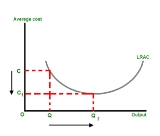
In the short run at least one factor of production is fixed. Therefore the SRAC curve will fall and then rise as diminishing returns sets in. In the long run however all factors of production vary and therefore the LRAC curve will fall and then rise according to economies and diseconomies of scale.

There are two typical ways to achieve economies of scale:
  1. High fixed cost and constant marginal cost
  2. Low or no fixed cost and declining marginal cost


Economies of scale refers to the decreased per unit cost as output increases. More clearly, the initial investment of capital is diffused (spread) over an increasing number of units of output, and therefore, the marginal cost
Marginal cost

In economics and finance, marginal cost is the change in total cost that arises when the quantity produced changes by one unit. It is the cost of producing one more unit of a good....
 of producing a good or service is less than the average total cost per unit (note that this is only in an industry that is experiencing economies of scale)

An example will clarify. AFC is average fixed cost
Average fixed cost

Average fixed cost is an economics term used to describe the total fixed costs divided by the quantity of units produced.Average fixed cost is a per-unit measure of fixed costs....


If a company is currently in a situation with economies of scale, for instance, electricity, then as their initial investment of $1000 is spread over 100 customers, their AFC is .

If that same utility now has 200 customers, their AFC becomes ... their fixed cost is now spread over 200 units of output. In economies of scale this results in a lower average total cost.

The advantage is that "buying bulk is cheaper on a per-unit basis." Hence, there is economy (in the sense of "efficiency") to be gained on a larger scale.

Economies of scale tend to occur in industries with high capital
Capital (economics)

In economics, capital or capital goods or real capital refers to factors of production used to create goods or services that are not themselves significantly consumed in the production process....
 costs in which those costs can be distributed across a large number of units of production (both in absolute terms, and, especially, relative to the size of the market). A common example is a factory. An investment in machinery is made, and one worker, or unit of production, begins to work on the machine and produces a certain number of goods. If another worker is added to the machine he or she is able to produce an additional amount of goods without adding significantly to the factory's cost of operation. The amount of goods produced grows significantly faster than the plant's cost of operation. Hence, the cost of producing an additional good is less than the good before it, and an economy of scale emerges. Economies of scale are also derived partially from learning by doing.

The exploitation of economies of scale helps explain why companies grow large in some industries. It is also a justification for free trade
Free trade

Free trade is a type of trade policy that allows traders to act and transact without coercive interference from government. Thus, the policy permits trading partners mutual gains from trade, with goods and services produced according to the law of comparative advantage....
 policies, since some economies of scale may require a larger market than is possible within a particular country — for example, it would not be efficient for Liechtenstein
Liechtenstein

The Principality of Liechtenstein is a Landlocked country#Doubly landlocked country alpine country microstate in Western Europe, bordered by Switzerland to the west and by Austria to the east....
 to have its own car maker, if they would only sell to their local market. A lone car maker may be profitable, however, if they export cars to global markets in addition to selling to the local market. Economies of scale also play a role in a "natural monopoly
Natural monopoly

Natural monopoly is a term used in economics to refer to two different things:* An industry is said to be a natural monopoly if one firm can produce a desired output at a lower social cost than two or more firms— that is, there are economies of scale in social costs....
."

Typically, because there are fixed cost
Fixed cost

In economics, fixed costs are business expenses that are not dependent on the activities of the business They tend to be time-related, such as salaries or rents being paid per month....
s of production, economies of scale are initially increasing, and as volume of production increases, eventually diminishing, which produces the standard U-shaped cost curve of economic theory. In some economic theory (e.g., "perfect competition
Perfect competition

In neoclassical economics and microeconomics, perfect competition describes a market in which there are many small firms, all producing homogeneous goods....
") there is an assumption of constant returns to scale.

In Porter's analysis, Elements of Industry Structure, 'Economies of Scale' is an element of 'Entry Barriers' concept. This is one of the fact which should be taken under care while entering an industry. In Porter's view, cost leadership strategy is realized through 'economies of scale' production thinking.

Examples

Economies of scale — As a firm doubles output, the total cost of inputs less than doubles
Diseconomies of scale

Diseconomies of scale are the forces that cause larger businesss to produce Product and Service at increased average costs. They are less well known than what economics have long understood as "economies of scale", the forces which enable larger firms to produce goods and services at reduced Average cost....
 — As a firm doubles its output, the total cost of inputs more than doubles.

See also

  • Diseconomies of scale
    Diseconomies of scale

    Diseconomies of scale are the forces that cause larger businesss to produce Product and Service at increased average costs. They are less well known than what economics have long understood as "economies of scale", the forces which enable larger firms to produce goods and services at reduced Average cost....
  • Economies of scope
    Economies of scope

    Economies of scope are conceptually similar to economies of scale. Whereas economies of scale primarily refer to efficiencies associated with supply-side changes, such as increasing or decreasing the scale of production, of a single product type, economies of scope refer to efficiencies primarily associated with demand-side changes, such...
  • Ideal firm size
    Ideal firm size

    The ideal firm size is the theoretically most Competition size for any Business, in a given industry, at a given time; which should ideally correspond with the highest possible per-unit profit....
  • Returns to scale
    Returns to scale

    In economics, returns to scale and economies of scale are related terms that describe what happens as the scale of production increases. They are different terms and should not be used interchangeably....
  • The Long Tail
    The Long Tail

    The phrase The Long Tail was first coined by Chris Anderson in an October 2004 Wired magazine article to describe the niche strategy of businesses, such as Amazon.com or Netflix, that sell a large number of unique items, each in relatively small quantities....


External links

  • by The Linux Information Project (LINFO)
  • by Thomas DiLorenzo
    Thomas DiLorenzo

    Thomas J. DiLorenzo is an American economics professor at Loyola College in Maryland. He is an adherent of the Austrian School of Economics. He is a senior faculty member of the Ludwig von Mises Institute and an affiliated scholar of the League of the South Institute, the research arm of the League of the South and the Abbeville Institute....