
All Topics  
Oligopoly


   Email Print
   Bookmark   Link


Oligopoly


An oligopoly is a market form in which a market
Market

A market is any one of a variety of different systems, institutions, procedures, social relations and infrastructures whereby persons trade, and goods and services are exchanged, forming part of the economy....
 or industry
Industry

An industry is the manufacturing of a Good or Service within a category. Although industry is a broad term for any kind of economic production, in economics and urban planning industry is a synonym for the secondary sector, which is a type of economic activity involved in the manufacturing of raw materials into goods and products....
 is dominated by a small number of sellers (oligopolists). The word is derived from the Greek
Greek language

Greek is an Indo-European languages native to the southern Balkan peninsula, the language of the Greek people. It forms an independent branch within Indo-European....
 for few (entities with the right to) sell. Because there are few participants in this type of market, each oligopolist is aware of the actions of the others. The decisions of one firm influence, and are influenced by, the decisions of other firms. Strategic planning
Strategic planning

Strategic planning is an organization's process of defining its strategy, or direction, and making decisions on allocating its resources to pursue this strategy, including its capital and people....
 by oligopolists always involves taking into account the likely responses of the other market participants.


Discussion
Ask a question about 'Oligopoly'
Start a new discussion about 'Oligopoly'
Answer questions from other users
Full Discussion Forum


Recent Posts


Encyclopedia


An oligopoly is a market form in which a market
Market

A market is any one of a variety of different systems, institutions, procedures, social relations and infrastructures whereby persons trade, and goods and services are exchanged, forming part of the economy....
 or industry
Industry

An industry is the manufacturing of a Good or Service within a category. Although industry is a broad term for any kind of economic production, in economics and urban planning industry is a synonym for the secondary sector, which is a type of economic activity involved in the manufacturing of raw materials into goods and products....
 is dominated by a small number of sellers (oligopolists). The word is derived from the Greek
Greek language

Greek is an Indo-European languages native to the southern Balkan peninsula, the language of the Greek people. It forms an independent branch within Indo-European....
 for few (entities with the right to) sell. Because there are few participants in this type of market, each oligopolist is aware of the actions of the others. The decisions of one firm influence, and are influenced by, the decisions of other firms. Strategic planning
Strategic planning

Strategic planning is an organization's process of defining its strategy, or direction, and making decisions on allocating its resources to pursue this strategy, including its capital and people....
 by oligopolists always involves taking into account the likely responses of the other market participants. This causes oligopolistic markets and industries to be at the highest risk for collusion
Collusion

Collusion is an agreement, usually secretive, which occurs between two or more persons to deceive, mislead, or defraud others of their legal rights, or to obtain an objective forbidden by law typically involving fraud or gaining an unfair advantage....
.

Description

Oligopoly is a common market form. As a quantitative description of oligopoly, the four-firm concentration ratio
Concentration ratio

In economics, the concentration ratio of an industry is used as an indicator of the relative size of corporations in relation to the industry as a whole....
 is often utilized. This measure expresses the market share of the four largest firms in an industry as a percentage.

Oligopolistic competition
Competition

Competition is a rivalry between individuals, groups, nations, or animals, for territory, a niche, or allocation of resources. It arises whenever two or more parties strive for a goal which cannot be shared....
 can give rise to a wide range of different outcomes. In some situations, the firms may employ restrictive trade practices (collusion, market sharing etc.) to raise prices and restrict production in much the same way as a monopoly
Monopoly

In economics, a monopoly exists when a specific individual or enterprise has sufficient control over a particular product or service to determine significantly the terms on which other individuals shall have access to it....
. Where there is a formal agreement for such collusion, this is known as a cartel
Cartel

A cartel is a formal agreement among firms. It is a formal organization of producers that agree to coordinate prices and production. Cartels usually occur in an Oligopoly, where there is a small number of sellers and usually involve homogeneous products....
. A primary example of such a cartel is OPEC
OPEC

The Organization of Petroleum Exporting Countries is a cartel of twelve countries made up of Algeria, Angola, Ecuador, Iran, Iraq, Kuwait, Libya, Nigeria, Qatar, Saudi Arabia, the United Arab Emirates, and Venezuela....
 which has a profound influence on the international price of oil.

Firms often collude
Collusion

Collusion is an agreement, usually secretive, which occurs between two or more persons to deceive, mislead, or defraud others of their legal rights, or to obtain an objective forbidden by law typically involving fraud or gaining an unfair advantage....
 in an attempt to stabilise unstable markets, so as to reduce the risks inherent in these markets for investment and product development. There are legal restrictions on such collusion in most countries. There does not have to be a formal agreement for collusion to take place (although for the act to be illegal there must be a real communication between companies) - for example, in some industries, there may be an acknowledged market leader which informally sets prices to which other producers respond, known as price leadership.

In other situations, competition between sellers in an oligopoly can be fierce, with relatively low prices and high production. This could lead to an efficient outcome approaching perfect competition
Perfect competition

In neoclassical economics and microeconomics, perfect competition describes a market in which there are many small firms, all producing homogeneous goods....
. The competition in an oligopoly can be greater than when there are more firms in an industry if, for example, the firms were only regionally based and didn't compete directly with each other.

The welfare
Welfare economics

Welfare economics is a branch of economics that uses microeconomics techniques to simultaneously determine allocative efficiency within an economy and the income Distribution associated with it....
 analysis of oligopolies suffers, thus, from a sensitivity to the exact specifications used to define the market's structure. In particular, the level of deadweight loss
Deadweight loss

In economics, a deadweight loss is a loss of economic efficiency that can occur when equilibrium for a good or service is not Pareto efficiency....
 is hard to measure. The study of product differentiation
Product differentiation

In marketing, product differentiation is the process of distinguishing the differences of a product or offering from others, to make it more attractive to a particular target market....
 indicates oligopolies might also create excessive levels of differentiation in order to stifle competition.

Oligopoly theory makes heavy use of game theory
Game theory

Game theory is a branch of applied mathematics that is used in the social sciences , biology, engineering, political science, international relations, computer science , and philosophy....
 to model the behaviour of oligopolies:
  • Stackelberg
    Heinrich Freiherr von Stackelberg

    Heinrich Freiherr von Stackelberg was a Germany economist who contributed to game theory and industrial organization and is known for the Stackelberg leadership model....
    's duopoly
    Duopoly

    A true duopoly is a specific type of oligopoly where only two producers exist in one market. In reality, this definition is generally used where only two firms have dominant control over a market....
    . In this model the firms move sequentially (see Stackelberg competition
    Stackelberg competition

    The Stackelberg leadership model is a strategic game in economics in which the leader firm moves first and then the follower firms move sequentially....
    ).
  • Cournot's duopoly
    Duopoly

    A true duopoly is a specific type of oligopoly where only two producers exist in one market. In reality, this definition is generally used where only two firms have dominant control over a market....
    . In this model the firms simultaneously choose quantities (see Cournot competition
    Cournot competition

    Cournot competition is an economic model used to describe an industry structure in which companies compete on the amount of output they will produce, which they decide on independently of each other and at the same time....
    ).
  • Bertrand
    Bertrand

    Bertrand is a popular name both as a given name and surname:...
    's oligopoly. In this model the firms simultaneously choose prices (see Bertrand competition
    Bertrand competition

    Bertrand competition is a model of competition used in economics, named after Joseph Louis Fran?ois Bertrand . Specifically, it is a model of price competition between duopoly firms which results in each charging the price that would be charged under perfect competition, known as marginal cost pricing....
    ).


Demand curve


In an oligopoly, firms operate under imperfect competition
Imperfect competition

In economic theory, imperfect competition is the competitive situation in any market where the conditions necessary for perfect competition are not satisfied....
 . Following from the fierce price competitiveness created by this sticky-upward
Sticky (economics)

Sticky is a term used in the social sciences and particularly economics to describe a situation in which a variable is resistant to change. For example, nominal wages are often said to be sticky....
 demand curve, firms utilize non-price competition
Non-price competition

Non-price competition is a marketing strategies "in which one firm tries to distinguish its product or Service from Competition products on the basis of attributes like design and workmanship" ....
 in order to accrue greater revenue and market share.

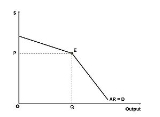
"Kinked" demand curves are similar to traditional demand curves, as they are downward-sloping. They are distinguished by a hypothesized convex bend with a discontinuity at the bend - the "kink." Therefore, the first derivative at that point is undefined and leads to a jump discontinuity in the marginal revenue curve.

Classical economic theory assumes that a profit-maximizing producer with some market power (either due to oligopoly or monopolistic competition
Monopolistic competition

Monopolistic competition is a common market form. Many markets can be considered monopolistically competitive, often including the markets for restaurants, cereal, clothing, shoes and service industries in large cities....
) will set marginal costs equal to marginal revenue. This idea can be envisioned graphically by the intersection of an upward-sloping marginal cost curve and a downward-sloping marginal revenue curve (because the more one sells, the lower the price must be, so the less a producer earns per unit). In classical theory, any change in the marginal cost structure (how much it costs to make each additional unit) or the marginal revenue structure (how much people will pay for each additional unit) will be immediately reflected in a new price and/or quantity sold of the item. This result does not occur if a "kink" exists. Because of this jump discontinuity in the marginal revenue curve, marginal costs could change without necessarily changing the price or quantity.

The motivation behind this kink is the idea that in an oligopolistic or monopolistically competitive market, firms will not raise their prices because even a small price increase will lose many customers. This is because competitors will generally ignore price increases, with the hope of gaining a larger market share as a result of now having comparatively lower prices. However, even a large price decrease will gain only a few customers because such an action will begin a price war with other firms. The curve is therefore more price-elastic for price increases and less so for price decreases. Firms will often enter the industry in the long run.

Oligopsonies

Oligopsony
Oligopsony

An oligopsony is a market form in which the number of buyers is small while the number of sellers in theory could be large. This typically happens in market for inputs where a small number of firms are competing to obtain factors of production....
 is a market form in which the number of buyers is small while the number of sellers in theory could be large. This typically happens in markets for inputs where a small number of firms are competing to obtain factors of production. This also involves strategic interactions but of a different nature than when competing in the output market to sell a final output. Oligopoly refers to the market for output while oligopsony refers to the market where these firms are the buyers and not sellers (eg. a factor market). A market with a few sellers (oligopoly) and a few buyers (oligopsony) is referred to as a bilateral oligopoly.

Examples

In the United Kingdom, the four-firm concentration ratio of the supermarket
Supermarket

A supermarket is a self-service Retailing#Retail types offering a wide variety of food and household merchandise, organized into departments....
 industry is 74.4% (2006); the British brewing industry has a staggering 85% ratio. In the U.S.A.,
United States

The United States of America is a Federal government constitutional republic comprising U.S. state and a federal district. The country is situated mostly in central North America, where its Contiguous United States and Washington, D.C., the Capital districts and territories, lie between the Pacific Ocean and Atlantic Oceans, Borders of the U...
 oligopolistic industries include the oil, beer, tobacco, accounting and audit services, aircraft, military equipment, and motor vehicle industries.

Many media industries today are essentially oligopolies. Six movie studios receive 90 percent of American film revenues, and four major music companies receive 80 percent of recording revenues. There are just six major book publishers, and the television industry was an oligopoly of three networks – ABC, CBS
CBS

CBS Broadcasting Inc. is an American radio network and television network. The name is derived from the initials of Columbia Broadcasting System, its former legal name....
, and NBC – from the 1950s through the 1970s. Television has diversified since then, especially because of cable, but today it is still mostly an oligopoly (due to concentration of media ownership
Concentration of media ownership

Concentration of media ownership is a commonly used term that refers to the majority of the media outlets being owned by a small number of Conglomerate s and corporations — especially by those who view such consolidation as detrimental, dangerous, or otherwise problematic — to characterize ownership structure of mass media indust...
) of five companies: Disney/ABC, CBS Corporation
CBS Corporation

CBS Corporation is an United States media conglomerate focused on broadcasting, publishing, billboards, and television production, with most of its operations in the United States....
, NBC Universal
NBC Universal

NBC Universal, Inc. is a mass media and entertainment company formed in May 2004 by the combination of General Electric's NBC with Vivendi part of the French Media Group, Vivendi Universal without Canal+ Group ....
, Time Warner
Time Warner

Time Warner Inc. is the world's third largest media and entertainment Conglomerate by market capitalization , headquartered in the Time Warner Center in New York City....
, and News Corporation
News Corporation

News Corporation , , ) is one of the world's largest Media conglomerate conglomerates. The company's Chairman, Chief Executive Officer and Founder is Rupert Murdoch and the President and Chief Operating Officer is Peter Chernin....
.

In industrialized countries oligopolies are found in many sectors of the economy, such as cars, auditing
Big Four auditors

The Big Four are the four largest international accountancy and professional services firms, which handle the vast majority of Financial audit for Public company as well as many Private company....
, consumer goods, and steel production. Unprecedented levels of competition, fueled by increasing globalisation, have resulted in the emergence of oligopoly in many market sectors, such as the aerospace industry. Market shares in oligopoly are typically determined on the basis of product development and advertising. There are now only a small number of manufacturers of civil passenger aircraft, though Brazil (Embraer
Embraer

Embraer , short for Empresa Brasileira de Aeron?utica, S. A. , is a Brazilian aerospace list of conglomerates. The company produces commercial, military, and corporate aircraft, as well as providing related aerospace services....
) and Canada (Bombardier
Bombardier

Bombardier Inc. is a Canadian companies list of conglomerates, founded by Joseph-Armand Bombardier as L'Auto-Neige Bombardier Limit?e in 1942, at Valcourt , Quebec in the Eastern Townships, Quebec....
) have fielded entries into the smaller-market passenger aircraft market sector. A further instance arises in a heavily regulated market such as wireless communications. In some cases states have licensed only two or three providers of cellular phone services.

OPEC
OPEC

The Organization of Petroleum Exporting Countries is a cartel of twelve countries made up of Algeria, Angola, Ecuador, Iran, Iraq, Kuwait, Libya, Nigeria, Qatar, Saudi Arabia, the United Arab Emirates, and Venezuela....
 is another example of an oligopoly, although on the level of national bodies instead of corporate bodies. There are a few countries that try to control the production of oil.

A further example are the three leading food processing companies, Kraft Foods
Kraft Foods

Kraft Foods, Inc. is the second-largest food and beverage company headquartered in the United States and the third largest in the world .The Philip Morris Company , acquired Kraft for $12.9 billion in 1988, eventually merging it with another food subsidiary, General Foods, which it had acquired in 1985....
, PepsiCo
PepsiCo

PepsiCo, Incorporated is a large conglomerate with interests in manufacturing, marketing and selling a wide variety of carbonation and non-carbonation beverages, as well as sodium, sweet and grain-based snacks, and other foods....
 and Nestle
Nestlé

Nestl? is a Multinational corporation packaged food company founded and headquartered in Vevey, Switzerland, and listed on the SWX Swiss Exchange with a turnover of over 87 billion Swiss francs....
. Together these three corporations account for a large percentage of overall global processed food sales. These three companies are often used as an example of "The rule of 3", which states that markets and industries often become dominated by three major oligopolistic firms.

Australia has two very good examples of oligoplies. One is its media outlets, mostly owned by either News Corporation or Fairfax Media
Fairfax Media

Fairfax Media Limited, is one of Australia's largest diversified media companies. The group's operations include newspapers, magazines, radios and digital media operating in Australia and New Zealand....
. Likewise, Australia's retailing industry is dominated by two companies, Coles-Myer
Coles Group

Coles Group Limited was an Australian public company that operated numerous retail chains. It was Australia's second-largest retailer, behind Woolworths Limited....
 and Woolworths
Woolworths Limited

Woolworths Limited is a major Australian company with extensive retailer interest throughout Australia and New Zealand. It is the:* largest retail company in Australia and New Zealand by market capitalisation and sales...
.

See also

  • Market form
  • Duopoly
    Duopoly

    A true duopoly is a specific type of oligopoly where only two producers exist in one market. In reality, this definition is generally used where only two firms have dominant control over a market....
  • Perfect competition
    Perfect competition

    In neoclassical economics and microeconomics, perfect competition describes a market in which there are many small firms, all producing homogeneous goods....
  • Monopsony
    Monopsony

    In economics, a monopsony is a market form in which only one buyer faces many sellers. It is an example of imperfect competition, similar to a monopoly, in which only one seller faces many buyers....
  • Oligopolistic reaction
    Oligopolistic reaction

    An oligopolistic reaction is a concept from economics introduced by Frederick T. Knickerbocker to explain why firms follow rivals into foreign markets....
  • Oligopsony
    Oligopsony

    An oligopsony is a market form in which the number of buyers is small while the number of sellers in theory could be large. This typically happens in market for inputs where a small number of firms are competing to obtain factors of production....
  • Monopoly
    Monopoly

    In economics, a monopoly exists when a specific individual or enterprise has sufficient control over a particular product or service to determine significantly the terms on which other individuals shall have access to it....
  • Big Business
    Big Business

    Big Business is a term used to describe large corporations, in either an individual or collective sense. The term first came into use in a symbolic sense subsequent to the American Civil War, particularly after 1880, in connection with the combination movement that began in American business at that time....
  • Beat The Market
    Beat The Market

    Beat The Market is an online business simulation game published and developed by . It runs in a web browser on Mac OS and Microsoft Windows....
    : An Oligopoly Simulation Game

External links

  • by Elmer G. Wiens: Online Interactive Models of Oligopoly, Differentiated Oligopoly, and Monopolistic Competition
  • Vives, X. (1999). Oligopoly pricing, MIT Press, Cambridge MA. (A comprehensive work on oligopoly theory)
  • A blog on current oligopoly issues from a business and social perspective