


European Commission

Encyclopedia
The European Commission is the executive body of the European Union
. The body is responsible for proposing legislation, implementing decisions, upholding the Union's treaties
and the general day-to-day running of the Union.
The Commission operates as a cabinet government, with 27 Commissioners
. There is one Commissioner per member state, though Commissioners are bound to represent the interests of the EU as a whole rather than their home state. One of the 27 is the Commission President
(currently José Manuel Durão Barroso
) proposed by the European Council
and elected by the European Parliament
. The Council then appoints the other 26 Commissioners in agreement with the nominated President, and then the 27 Commissioners as a single body are subject to a vote of approval by the European Parliament
. The first Barroso Commission
took office in late 2004 and its successor, under the same President, took office in 2010.
The term "Commission" can mean either the 27 Commissioners themselves (known as the College of Commissioners or College), or the larger institution
that also includes the administrative body of about 25,000 European civil servants
who are split into departments called Directorates-General
and Services. The internal working language
s are English
, French
and German
. The Commissioners and their immediate teams are based in the Berlaymont building
of Brussels
.
, French Foreign Minister, on 9 May 1950. Originating in 1951 as the High Authority in the European Coal and Steel Community
, the Commission has undergone numerous changes in power and composition under various Presidents, involving three Communities.
" under President Jean Monnet
(see Monnet Authority
). The High Authority was the supranational administrative executive of the new European Coal and Steel Community
(ECSC). It took office first on 10 August 1952 in Luxembourg. In 1958 the Treaties of Rome had established two new communities alongside the ECSC: the European Economic Community
(EEC) and the European Atomic Energy Community
(Euratom). However their executives were called "Commissions" rather than "High Authorities". The reason for the change in name was the new relationship between the executive and the Council
. Some states such as France
expressed reservations over the power of the High Authority and wished to limit it giving more power to the Council rather than the new executives.
Louis Armand
led the first Commission of Euratom
. Walter Hallstein
led the first Commission of the EEC
, holding the first formal meeting on 16 January 1958 at the Castle of the Valley of the Duchess
. It achieved agreement on a contentious cereal price accord as well as making a positive impression upon third countries when it made its international debut at the Kennedy Round
of General Agreement on Tariffs and Trade
(GATT) negotiations. Hallstein notably began the consolidation of European law and started to have a notable impact on national legislation. Little heed was taken of his administration at first but, with help from the European Court of Justice
, his Commission stamped its authority solidly enough to allow future Commissions to be taken more seriously. However, in 1965 accumulating differences between the French government of Charles de Gaulle
and the other member states (over British entry, direct elections to Parliament, the Fouchet Plan
and the budget) triggered the "empty chair" crisis ostensibly over proposals for the Common Agricultural Policy
. Although the institutional crisis was solved the following year, it cost Etienne Hirsch his presidency of Euratom and later Walter Hallstein the EEC presidency despite otherwise being viewed as the most 'dynamic' leader until Jacques Delors
.
, they were combined into a single administration under President Jean Rey
. Due to the merger the Rey Commission
saw a temporary increase to fourteen members, although all future Commissions were reduced back down to nine following the formula of one member for small states and two for larger states. The Rey Commission completed the Community's customs union
in 1968 and campaigned for a more powerful, elected, European Parliament
. Despite Rey being the first President of the combined communities, Hallstein is seen as the first President of the modern Commission.
The Malfatti
and Mansholt Commission
s followed with work on monetary co-operation and the first enlargement
to the north in 1973. With that enlargement the Commission's membership increased to thirteen under the Ortoli Commission
(the United Kingdom
as a large member was granted two Commissioners), which dealt with the enlarged community during economic and international instability at that time. The external representation of the Community took a step forward when President Roy Jenkins
became the first President to attend a G8
summit on behalf of the Community. Following the Jenkins Commission
, Gaston Thorn
's Commission
oversaw the Community's enlargement to the south, in addition to beginning work on the Single European Act
.
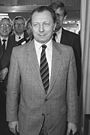
One of the most notable Commissions was that headed by Jacques Delors
, with later Presidents failing to achieve the same degree of personal recognition. Delors was seen as giving the Community a sense of direction and dynamism. Delors and his team are also considered as the "founding fathers of the euro
". The International Herald Tribune
noted the work of Delors at the end of his second term in 1992: "Mr. Delors rescued the European Community from the doldrums. He arrived when Europessimism was at its worst. Although he was a little-known former French finance minister, he breathed life and hope into the EC and into the dispirited Brussels Commission. In his first term, from 1985 to 1988, he rallied Europe
to the call of the single market, and when appointed to a second term he began urging Europeans toward the far more ambitious goals of economic, monetary and political union."
was forced to resign in 1999 by the Parliament as result of fraud and corruption scandal, with a central role played by Édith Cresson
. These frauds were revealed by an internal auditor Paul van Buitenen.
That was the first time a Commission had been forced to resign en masse and represented a shift of power towards the Parliament. However the Santer Commission did carry out work on the Amsterdam Treaty
and the euro. In response to the scandal the European Anti-fraud Office (OLAF) was created.
took office. The Amsterdam Treaty had increased the Commission's powers and Prodi was dubbed by the press as something akin to a Prime Minister
. Powers were strengthened again with the Nice Treaty in 2001 giving the President more power over the composition of their Commission.
. Due to the opposition Barroso was forced to reshuffle his team before taking office. The Barroso Commission was also the first full Commission since the enlargement in 2004 to 25 members and hence the number of Commissioners at the end of the Prodi Commission had reached 30. As a result of the increase in the number of states, the Amsterdam Treaty triggered a reduction in the number of Commissioners to one per state, rather than two for the larger states.
Allegations of fraud and corruption were again raised in 2004 by former chief auditor Jules Muis. A Commission officer Guido Strack reported alleged fraud and abuses in his department in years 2002-2004 to OLAF and was fired as result. In 2008 Paul van Buitenen (the former auditor known from Santer Commission
scandal) alleged European Anti-fraud Office (OLAF) of lack of independence and effectiveness.
Barroso's first Commission term expired 31 October 2009. Under the Treaty of Nice
, the first Commission to be appointed after the number of member states reached 27 would have to be reduced to "less than the number of Member States". The exact number of Commissioners was to be decided by a unanimous vote of the European Council
and membership would rotate equally between member states. Following the accession of Romania and Bulgaria
in January 2007, this clause took effect for the next Commission. The Treaty of Lisbon, which entered force on 1 December 2009 mandated a reduction the number of commissioners to two thirds of member-states from 2014 unless the Council decided otherwise. Membership would rotate equally and no member state would have more than one Commissioner. However, the treaty was rejected by voters in Ireland in 2008 with one main concern being the loss of their Commissioner. Hence a guarantee given for a rerun of the vote was that the Council would use its power to amend the number of Commissioners upwards. However according to the treaties it still has to be fewer than the total number of members, thus it was proposed that the member state that doesn't get a Commissioner would get the post of High Representative — the so called 26+1 formula. This guarantee (which may find its way into the next treaty amendment, probably in an accession treaty) contributed to the Irish approving the treaty in a second referendum in 2009.
Lisbon also combined the posts of European Commissioner for External Relations with the Council's High Representative for the Common Foreign and Security Policy
. This post, also a Vice-President of the Commission
, would chair the Council of the European Union
's foreign affairs meetings as well as the Commission's external relations duties. The treaty further provides that the most recent European elections should be "taken into account" when appointing the Commission, although the President is still proposed by the European Council
; the European Parliament
would "elect" the Commission rather than "approve" it as under the Treaty of Nice.
 The Commission was set up from the start to act as an independent supranational authority separate from governments; it has been described as "the only body paid to think European". The members are proposed by their member state governments, one from each, however they are bound to act independently – neutral from other influences such as those governments which appointed them. This is in contrast to the Council
, which represents governments, the Parliament
, which represents citizens, and the Economic and Social Committee
, which represents organised civil society.
Through the article 17 of the Treaty on European Union the Commission has several responsibilities: develop medium-term strategies; draft legislation and arbitrate in the legislative process; represent the EU in trade negotiations; make rules and regulations, for example in competition policy; draw up the budget of the European Union; and to scrutinise the implementation of the treaties and legislation.
, the executive power of the Union was held by the Council: it conferred on the Commission such powers for it to exercise. However, the Council was theoretically allowed to withdraw these powers, exercise them directly, or impose conditions on their use. This aspect has been changed by the Treaty of Lisbon, after which the Commission exercises its powers just by virtue of the treaties. Powers are more restricted than most national executives, in part due to the Commission's lack of power over areas like foreign policy
– that power is held by the European Council
, which some analyses have described as another executive.
Considering that under the Lisbon Treaty the European Council has become a formal institution with the power of appointing the Commission, it could be said that the two bodies hold the executive power of the Union (the European Council also holds individual national executive powers). However, it is the Commission which currently holds executive powers over the European Union
. The government
al powers of the Commission have been such that some such as former Belgian Prime Minister Guy Verhofstadt
have suggested changing its name to the "European Government", calling the present name of commission "ridiculous".
in the European Union, meaning only the Commission can make formal proposals for legislation– legislative proposals cannot originate in the legislative branches. Under the Treaty of Lisbon, no legislative act is allowed in the field of the Common Foreign and Security Policy
. In the other fields, however, Council and Parliament are able to request legislation; in most cases the Commission initiates the basis of these proposals, this monopoly is designed to ensure coordinated and coherent drafting of Union law. This monopoly has been challenged by some who claim the Parliament should also have the right, with most national parliaments holding the right in some respects. However, the Council and Parliament may request the Commission to draft legislation, though the Commission does have the power to refuse to do so as it did in 2008 over transnational collective conventions. Under the Lisbon Treaty, EU citizens are also able to request the Commission to legislate in an area via a petition carrying one million signatures
, but this is not binding.
The Commission's powers in proposing law have usually centred on economic regulation. It has put forward a large number of regulations based on a "precautionary principle
". This means that pre-emptive regulation takes place if there is a credible hazard to the environment or human health: for example on tackling climate change
and restricting genetically modified organisms. This is opposed to weighting regulations for their effect on the economy. Thus, the Commission often proposes stricter legislation than other countries. Due to the size of the European market this has made EU legislation an important influence in the global market.
Recently the Commission has moved into creating European criminal law. In 2006, a toxic waste spill off the coast of Côte d'Ivoire
, from a European ship, prompted the Commission to look into legislation against toxic waste. Some EU states at that time did not even have a crime against shipping toxic waste leading to the Commissioners Franco Frattini and Stavros Dimas
to put forward the idea of "ecological crimes". Their right to propose criminal law was challenged in the European Court of Justice
but upheld. As of 2007, the only other criminal law proposals which have been brought forward are on the intellectual property rights directive, and on an amendment to the 2002 counter-terrorism framework decision, outlawing terrorism‑related incitement, recruitment (especially via the internet) and training.
. In adopting the necessary technical measures, the Commission is assisted by committees made up of representatives of member states and of the public and private lobbies
(a process known in jargon as "comitology
"). Furthermore, the Commission is responsible for the implementation of the EU budget; ensuring, along with the Court of Auditors, that EU funds are correctly spent.
In particular the Commission has a duty to ensure the treaties and law are upheld, potentially by taking member states or other institutions to the Court of Justice
in a dispute. In this role it is known informally as the "guardian of the treaties". Finally, the Commission provides some external representation
for the Union, alongside the member states and the Common Foreign and Security Policy
, representing the Union in bodies such as the World Trade Organisation. It is also usual for the President to attend meetings of the G8
.
The Commission is composed of a college of "Commissioners
", 27 members in all, including the President and vice-presidents. Even though each member is appointed by a national government, one per state, they do not represent their state in the Commission (however in practice they do occasionally press for their national interest). Once proposed, the President delegates portfolios between each of the members. The power of a Commissioner largely depends upon their portfolio, and can vary over time. For example, the Education Commissioner
has been growing in importance, in line with the rise in the importance of education and culture in European policy-making. Another example is the Competition Commissioner, who holds a highly-visible position with global reach. Before the Commission can assume office, the college as a whole must be approved by the Parliament. Commissioners are supported by their personal cabinet
who give them political guidance, while the Civil Service
(the DGs, see below) deal with technical preparation.
is first proposed by the European Council
taking into account the latest Parliamentary elections
; that candidate can then be elected by the European Parliament
or not. If not, the European Council shall propose another candidate within one month. The candidate has often been a leading national politician but this is not a requirement. In 2009, the Lisbon Treaty was not in force and Barroso was not "elected" by the Parliament, but rather nominated by the European Council; in any case, the centre-right parties of the EU pressured for a candidate from their own ranks. In the end, a centre-right candidate was chosen: José Manuel Barroso of the European People's Party
.
There are further criteria influencing the choice of the candidate, these include: which area of Europe the candidate comes from, favoured as Southern Europe in 2004; the candidate's political influence, credible yet not overpowering members; language, proficiency in French
considered necessary by France; and degree of integration, their state being a member of both the eurozone
and the Schengen Agreement
. In 2004, this system produced a number of candidates and was thus criticised by some MEPs: following the drawn-out selection, the ALDE group leader Graham Watson
described the procedure as a "Justus Lipsius
carpet market" producing only the "lowest common denominator"; while Green-EFA
co-leader Daniel Cohn-Bendit
asked Barroso after his first speech "If you are the best candidate, why were you not the first?"
Following the election of the President, and the appointment of the High Representative
by the European Council, each Commissioner
is nominated by their member state (except for those states who provided the President and High Representative) in consultation with the Commission President, although he holds little practical power to force a change in candidate. However the more capable the candidate is, the more likely the Commission President will assign them a powerful portfolio, the distribution of which is entirely at his discretion. The President's team is then subject to hearings at the European Parliament
which will question them and then vote on their suitability as a whole. If members of the team are found to be too inappropriate, the President must then reshuffle the team or request a new candidate from the member state or risk the whole Commission being voted down. As Parliament cannot vote against individual Commissioners there is usually a compromise whereby the worst candidates are removed but minor objections are put aside so the Commission can take office. Once the team is approved by parliament, it is formally put into office by the European Council
(TEU Article 17:7).
Following their appointment, the President appoints a number of Vice-Presidents
(the High Representative is mandated to be one of them) from among the commissioners. For the most part, the position grants little extra power to Vice-Presidents, except the first Vice-President who stands in for the President when he is away. Since 2009 the First Vice President has gained further power by also being the High Representative.
, took office in late 2004 after being delayed by objections from the Parliament which forced a reshuffle. In 2007 the Commission increased from 25 to 27 members with the accession of Romania
and Bulgaria
who each appointed their own Commissioners. With the increasing size of the Commission, President Barroso has adopted a more Presidential style of control over the college, which has earned him some criticism.
However, despite Barroso being a more presidential and high profile figure than his predecessors, the Commission has begun to lose ground to the larger member states as countries such as France, the UK and Germany seek to sideline its role. This might increase with the creation of the President of the European Council
under the Treaty of Lisbon
. There has also been a greater degree of politicisation within the Commission.
and Luxembourg
. When the Parliament is meeting in Strasbourg
, the Commissioners also meet there in the Winston Churchill building to attend the Parliament's debates. The Commission is divided into departments known as Directorates-General
(DGs) that can be likened to departments or ministries
. Each covers a specific policy area such as Agriculture or Justice and citizens' rights or internal services such as Human Resources and Translation and is headed by Director-General who is responsible to a Commissioner. A Commissioner's portfolio can be supported by numerous DGs, they prepare proposals for them and if approved by a majority of Commissioners it goes forward to Parliament and Council for consideration. There has been criticism from a number of people that the highly fragmented DG structure wastes a considerable amount of time in turf war
s as the different departments and Commissioners compete with each other. Furthermore the DGs can exercise considerable control over a Commissioner with the Commissioner having little time to learn to assert control over their staff.
According to figures published by the Commission, 23,043 persons were employed by the Commission as officials and temporary agents in April 2007. In addition to these, 9019 "external staff" (e.g. Contractual agents, detached national experts, young experts, trainees
etc.) were employed. The single largest DG is the Directorate-General for Translation
, with a 2186-strong staff, while the largest group by nationality is Belgian
(21.4%), probably due to a majority (16,626) of staff being based in the country. The Commission's civil service
is headed by a Secretary General
, currently Catherine Day
.
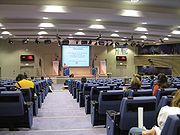 Communication with the press is handled by the Directorate-General Communication
. The Commission's chief spokesperson is Johannes Laitenberger who takes the midday press
briefings, commonly known as the "Midday Presser". It takes place every weekday in the Commission's press room at the Berlaymont where journalists may ask questions of Commission officials on any topic and legitimately expect to get an "on the record" answer for live TV. Such a situation is unique in the world.
It has been noted by one researcher that the press releases issued by the Commission are uniquely political. A release often goes through several stages of drafting which emphasises the role of the Commission and is used "for justifying the EU and the commission" increasing their length and complexity. Where there are multiple departments involved a press release can also be a source of competition between areas of the Commission and Commissioners themselves. This also leads to an unusually high number of press releases, 1907 for 2006, and is seen as a unique product of the EU's political set-up.
There is a larger press corps in Brussels than Washington D.C.; in 2007 media outlets in every Union member-state had a Brussels correspondent
. However since the global downturn
by 2010 the press corps in Brussels shrunk by a third. There is only one journalist covering EU news for Latvia and none for Lithuania. Although there has been a world wide cut in journalists, the considerable press releases and operations such as Europe by Satellite
and EuroparlTV
leads many news organisations to believe they can cover the EU from these source and news agencies
.
. While the Commission is the executive branch, the candidates are chosen individually by the 27 national governments, which means it is not possible for a Commissioner or its President to be removed directly by the ballot box
. Rather, the legitimacy of the Commission is mainly drawn from the vote of approval that is required from the European Parliament, along with Parliament's power to dismiss the body, which, in turn, raises the concern of the relatively low turnout (less than 50%) in elections for the European Parliament since 1999
. While that figure may be higher than that of some national elections, including the off-year elections of the United States Congress
, the fact that there are no elections for the position of Commission President calls the position's legitimacy into question in the eyes of some.
A further problem is the lack of a coherent electorate, even though democratic structures and methods are developing there is not such a mirror in creating a European civil society
. The Treaty of Lisbon
may go some way to resolving the deficit in creating greater democratic controls on the Commission, including enshrining the procedure of linking elections to the selection of the Commission president. An alternative viewpoint on the Commission states that the policy areas in which it has power to initiate legislation are ill suited to an institution subject to electoral pressures. In this respect the Commission has been compared with institutions such as independent Central Bank
s which deal with technical areas of policy. In addition some defenders of the Commission point out that legislation must be approved by the Council in all areas (the ministers of member states) and the European Parliament in some areas before it can be adopted, thus the amount of legislation which is adopted in any one country without the approval of its government is limited.
In 2009 European ombudsman published statistics of citizen's complaints against the European Union institutions, with most of them filed against European Commission (66%) and concerning lack of transparency (36%). In 2010 the Commission was sued for blocking access to documents on EU biofuel policy. This happened after media alleged the Commission of blocking scientific evidence against biofuel subsidies. Lack of transparency, unclear lobbyist relations, conflicts of interests and excessive spending of the Commission was highlighted in a number of reports by internal and independent auditing organisations.
European Union
The European Union is an economic and political union of 27 independent member states which are located primarily in Europe. The EU traces its origins from the European Coal and Steel Community and the European Economic Community , formed by six countries in 1958...
. The body is responsible for proposing legislation, implementing decisions, upholding the Union's treaties
Treaties of the European Union
The Treaties of the European Union are a set of international treaties between the European Union member states which sets out the EU's constitutional basis. They establish the various EU institutions together with their remit, procedures and objectives...
and the general day-to-day running of the Union.
The Commission operates as a cabinet government, with 27 Commissioners
European Commissioner
A European Commissioner is a member of the 27-member European Commission. Each Member within the college holds a specific portfolio and are led by the President of the European Commission...
. There is one Commissioner per member state, though Commissioners are bound to represent the interests of the EU as a whole rather than their home state. One of the 27 is the Commission President
President of the European Commission
The President of the European Commission is the head of the European Commission ― the executive branch of the :European Union ― the most powerful officeholder in the EU. The President is responsible for allocating portfolios to members of the Commission and can reshuffle or dismiss them if needed...
(currently José Manuel Durão Barroso
José Manuel Durão Barroso
José Manuel Durão Barroso is a Portuguese politician. He is President of the European Commission, since 23 November 2004. He served as Prime Minister of Portugal from 6 April 2002 to 17 July 2004.-Academic career:...
) proposed by the European Council
European Council
The European Council is an institution of the European Union. It comprises the heads of state or government of the EU member states, along with the President of the European Commission and the President of the European Council, currently Herman Van Rompuy...
and elected by the European Parliament
European Parliament
The European Parliament is the directly elected parliamentary institution of the European Union . Together with the Council of the European Union and the Commission, it exercises the legislative function of the EU and it has been described as one of the most powerful legislatures in the world...
. The Council then appoints the other 26 Commissioners in agreement with the nominated President, and then the 27 Commissioners as a single body are subject to a vote of approval by the European Parliament
European Parliament
The European Parliament is the directly elected parliamentary institution of the European Union . Together with the Council of the European Union and the Commission, it exercises the legislative function of the EU and it has been described as one of the most powerful legislatures in the world...
. The first Barroso Commission
Barroso Commission
The Barroso Commission is the European Commission that has been in office since 22 November 2004 and is due to serve until 2014. Its president is José Manuel Barroso, who presides over 26 other commissioners...
took office in late 2004 and its successor, under the same President, took office in 2010.
The term "Commission" can mean either the 27 Commissioners themselves (known as the College of Commissioners or College), or the larger institution
Institutions of the European Union
The European Union is governed by seven institutions. Article 13 of Treaty on European Union lists them in the following order: the European Parliament, the European Council, the Council of the European Union, the European Commission, the Court of Justice of the European Union, the European...
that also includes the administrative body of about 25,000 European civil servants
European Civil Service
The European Civil Service is the civil service serving the institutions of the European Union, of which the largest employer is the European Commission, the executive branch of the European Union...
who are split into departments called Directorates-General
Directorate-General
A Directorate-General is a branch of an administration dedicated to a specific field of expertise.* The European Commission: Commission Directorates-General are each headed by a European Commissioner;* The European Patent Office: EPO Directorates-General;...
and Services. The internal working language
Working language
A working language is a language that is given a unique legal status in a supra-national company, society, state or other body or organization as its primary mean of communication...
s are English
English language
English is a West Germanic language that arose in the Anglo-Saxon kingdoms of England and spread into what was to become south-east Scotland under the influence of the Anglian medieval kingdom of Northumbria...
, French
French language
French is a Romance language spoken as a first language in France, the Romandy region in Switzerland, Wallonia and Brussels in Belgium, Monaco, the regions of Quebec and Acadia in Canada, and by various communities elsewhere. Second-language speakers of French are distributed throughout many parts...
and German
German language
German is a West Germanic language, related to and classified alongside English and Dutch. With an estimated 90 – 98 million native speakers, German is one of the world's major languages and is the most widely-spoken first language in the European Union....
. The Commissioners and their immediate teams are based in the Berlaymont building
Berlaymont building
The Berlaymont is an office building in Brussels, Belgium that houses the headquarters of the European Commission, which is the executive of the European Union...
of Brussels
Brussels
Brussels , officially the Brussels Region or Brussels-Capital Region , is the capital of Belgium and the de facto capital of the European Union...
.
History
The European Commission derives from one of the five key institutions created in the supranational European Community system, following the proposal of Robert SchumanRobert Schuman
Robert Schuman was a noted Luxembourgish-born French statesman. Schuman was a Christian Democrat and an independent political thinker and activist...
, French Foreign Minister, on 9 May 1950. Originating in 1951 as the High Authority in the European Coal and Steel Community
European Coal and Steel Community
The European Coal and Steel Community was a six-nation international organisation serving to unify Western Europe during the Cold War and create the foundation for the modern-day developments of the European Union...
, the Commission has undergone numerous changes in power and composition under various Presidents, involving three Communities.
Establishment
The first Commission originated in 1951 as the nine-member "High AuthorityHigh Authority of the European Coal and Steel Community
The High Authority was the executive branch of the former European Coal and Steel Community . It was created in 1951 and disbanded in 1967 when it was merged into the European Commission.-History:...
" under President Jean Monnet
Jean Monnet
Jean Omer Marie Gabriel Monnet was a French political economist and diplomat. He is regarded by many as a chief architect of European Unity and is regarded as one of its founding fathers...
(see Monnet Authority
Monnet Authority
The Monnet Authority was the first High Authority of the European Coal and Steel Community , between 1952 and 1955. Its president was Jean Monnet of France....
). The High Authority was the supranational administrative executive of the new European Coal and Steel Community
European Coal and Steel Community
The European Coal and Steel Community was a six-nation international organisation serving to unify Western Europe during the Cold War and create the foundation for the modern-day developments of the European Union...
(ECSC). It took office first on 10 August 1952 in Luxembourg. In 1958 the Treaties of Rome had established two new communities alongside the ECSC: the European Economic Community
European Economic Community
The European Economic Community The European Economic Community (EEC) The European Economic Community (EEC) (also known as the Common Market in the English-speaking world, renamed the European Community (EC) in 1993The information in this article primarily covers the EEC's time as an independent...
(EEC) and the European Atomic Energy Community
European Atomic Energy Community
The European Atomic Energy Community is an international organisation which is legally distinct from the European Union , but has the same membership, and is governed by the EU's institutions....
(Euratom). However their executives were called "Commissions" rather than "High Authorities". The reason for the change in name was the new relationship between the executive and the Council
Council of the European Union
The Council of the European Union is the institution in the legislature of the European Union representing the executives of member states, the other legislative body being the European Parliament. The Council is composed of twenty-seven national ministers...
. Some states such as France
France
The French Republic , The French Republic , The French Republic , (commonly known as France , is a unitary semi-presidential republic in Western Europe with several overseas territories and islands located on other continents and in the Indian, Pacific, and Atlantic oceans. Metropolitan France...
expressed reservations over the power of the High Authority and wished to limit it giving more power to the Council rather than the new executives.
Louis Armand
Louis Armand
For the writer and critical theorist, see Louis Armand Louis Armand was a French engineer who managed several public companies and had a significant role during World War II as an officer in the Resistance...
led the first Commission of Euratom
Armand Commission
The Armand Commission was the first Commission of the European Atomic Energy Community , between 1958 and 1959. Its president was Louis Armand of France....
. Walter Hallstein
Walter Hallstein
Walter Hallstein was a German politician and professor.He was one of the key figures of European integration after World War II, becoming the first President of the Commission of the European Economic Community, serving from 1958 to 1967. He famously defined his position as "a kind of Prime...
led the first Commission of the EEC
Hallstein Commission
The Hallstein Commission is the European Commission that held office from 7 January 1958 to 30 June 1967. Its President was Walter Hallstein and held two separate mandates.-Work:...
, holding the first formal meeting on 16 January 1958 at the Castle of the Valley of the Duchess
Castle of the Valley of the Duchess
The Castle of Val-Duchesse is a former priory situated in the municipality of Auderghem in the Brussels Capital Region of Belgium. The castle is owned by the Belgian Royal Trust....
. It achieved agreement on a contentious cereal price accord as well as making a positive impression upon third countries when it made its international debut at the Kennedy Round
Kennedy Round
The Kennedy round was the sixth session of General Agreement on Tariffs and Trade trade negotiations held in 1964-1967 in Geneva, Switzerland. Congressional passage of the US Trade Expansion Act in 1962 authorized the White House to conduct mutual tariff negotiations ultimately leading to the...
of General Agreement on Tariffs and Trade
General Agreement on Tariffs and Trade
The General Agreement on Tariffs and Trade was negotiated during the UN Conference on Trade and Employment and was the outcome of the failure of negotiating governments to create the International Trade Organization . GATT was signed in 1947 and lasted until 1993, when it was replaced by the World...
(GATT) negotiations. Hallstein notably began the consolidation of European law and started to have a notable impact on national legislation. Little heed was taken of his administration at first but, with help from the European Court of Justice
European Court of Justice
The Court can sit in plenary session, as a Grand Chamber of 13 judges, or in chambers of three or five judges. Plenary sitting are now very rare, and the court mostly sits in chambers of three or five judges...
, his Commission stamped its authority solidly enough to allow future Commissions to be taken more seriously. However, in 1965 accumulating differences between the French government of Charles de Gaulle
Charles de Gaulle
Charles André Joseph Marie de Gaulle was a French general and statesman who led the Free French Forces during World War II. He later founded the French Fifth Republic in 1958 and served as its first President from 1959 to 1969....
and the other member states (over British entry, direct elections to Parliament, the Fouchet Plan
Fouchet Plan
-Introduction:The Fouchet Plan was a plan proposed by President Charles de Gaulle of France in 1961. It was written by Christian Fouchet, France's ambassador to Denmark. The idea was to form a new 'Union of States', an intergovernmental alternative to the European Communities...
and the budget) triggered the "empty chair" crisis ostensibly over proposals for the Common Agricultural Policy
Common Agricultural Policy
The Common Agricultural Policy is a system of European Union agricultural subsidies and programmes. It represents 48% of the EU's budget, €49.8 billion in 2006 ....
. Although the institutional crisis was solved the following year, it cost Etienne Hirsch his presidency of Euratom and later Walter Hallstein the EEC presidency despite otherwise being viewed as the most 'dynamic' leader until Jacques Delors
Jacques Delors
Jacques Lucien Jean Delors is a French economist and politician, the eighth President of the European Commission and the first person to serve three terms in that office .-French Politics:...
.
Early development
The three bodies, collectively named the European Executives, co-existed until 1 July 1967 where, by means of the Merger TreatyMerger Treaty
The Merger Treaty was a European treaty which combined the executive bodies of the European Coal and Steel Community , European Atomic Energy Community and the European Economic Community into a single institutional structure.The treaty was signed in Brussels on 8 April 1965 and came into force...
, they were combined into a single administration under President Jean Rey
Jean Rey (politician)
Jean Rey was a Belgian lawyer and Liberal politician who became the second President of the European Commission.-Early life:...
. Due to the merger the Rey Commission
Rey Commission
The Rey Commission is the European Commission that held office from 2 July 1967 to 30 June 1970. Its President was Jean Rey.-Work:It was the first Commission of the merged European Communities. It was the successor to the Hallstein Commission and was succeeded by the Malfatti Commission...
saw a temporary increase to fourteen members, although all future Commissions were reduced back down to nine following the formula of one member for small states and two for larger states. The Rey Commission completed the Community's customs union
Customs union
A customs union is a type of trade bloc which is composed of a free trade area with a common external tariff. The participant countries set up common external trade policy, but in some cases they use different import quotas...
in 1968 and campaigned for a more powerful, elected, European Parliament
European Parliament
The European Parliament is the directly elected parliamentary institution of the European Union . Together with the Council of the European Union and the Commission, it exercises the legislative function of the EU and it has been described as one of the most powerful legislatures in the world...
. Despite Rey being the first President of the combined communities, Hallstein is seen as the first President of the modern Commission.
The Malfatti
Malfatti Commission
The Malfatti Commission is the European Commission that held office from 1 July 1970 to 21 March 1972. Its President was Franco Maria Malfatti.- Work :...
and Mansholt Commission
Mansholt Commission
The Mansholt Commission is the European Commission that held office from 22 March 1972 to 5 January 1973. Its President was Sicco Mansholt.- Work :It was the successor to the Malfatti Commission and was succeeded by the Ortoli Commission...
s followed with work on monetary co-operation and the first enlargement
Enlargement of the European Union
The Enlargement of the European Union is the process of expanding the European Union through the accession of new member states. This process began with the Inner Six, who founded the European Coal and Steel Community in 1952...
to the north in 1973. With that enlargement the Commission's membership increased to thirteen under the Ortoli Commission
Ortoli Commission
The Ortoli Commission is the European Commission that held office from 6 January 1973 to 5 January 1977. Its President was François-Xavier Ortoli.-Work:...
(the United Kingdom
United Kingdom
The United Kingdom of Great Britain and Northern IrelandIn the United Kingdom and Dependencies, other languages have been officially recognised as legitimate autochthonous languages under the European Charter for Regional or Minority Languages...
as a large member was granted two Commissioners), which dealt with the enlarged community during economic and international instability at that time. The external representation of the Community took a step forward when President Roy Jenkins
Roy Jenkins
Roy Harris Jenkins, Baron Jenkins of Hillhead OM, PC was a British politician.The son of a Welsh coal miner who later became a union official and Labour MP, Roy Jenkins served with distinction in World War II. Elected to Parliament as a Labour member in 1948, he served in several major posts in...
became the first President to attend a G8
G8
The Group of Eight is a forum, created by France in 1975, for the governments of seven major economies: Canada, France, Germany, Italy, Japan, the United Kingdom, and the United States. In 1997, the group added Russia, thus becoming the G8...
summit on behalf of the Community. Following the Jenkins Commission
Jenkins Commission (EU)
The Jenkins Commission is the European Commission that held office from 6 January 1977 to 6 January 1981. Its President was Roy Jenkins.-Work:It was the successor to the Ortoli Commission and was succeeded by the Thorn Commission...
, Gaston Thorn
Gaston Thorn
Gaston Egmond Thorn was a Luxembourg politician who served in a number of high-profile positions, both domestically and internationally...
's Commission
Thorn Commission
The Thorn Commission was the European Commission that held office from 6 January 1981 until 5 January 1985. Its President was Gaston Thorn.-Work:...
oversaw the Community's enlargement to the south, in addition to beginning work on the Single European Act
Single European Act
The Single European Act was the first major revision of the 1957 Treaty of Rome. The Act set the European Community an objective of establishing a Single Market by 31 December 1992, and codified European Political Cooperation, the forerunner of the European Union's Common Foreign and Security Policy...
.
Jacques Delors
One of the most notable Commissions was that headed by Jacques Delors
Jacques Delors
Jacques Lucien Jean Delors is a French economist and politician, the eighth President of the European Commission and the first person to serve three terms in that office .-French Politics:...
, with later Presidents failing to achieve the same degree of personal recognition. Delors was seen as giving the Community a sense of direction and dynamism. Delors and his team are also considered as the "founding fathers of the euro
Euro
The euro is the official currency of the eurozone: 17 of the 27 member states of the European Union. It is also the currency used by the Institutions of the European Union. The eurozone consists of Austria, Belgium, Cyprus, Estonia, Finland, France, Germany, Greece, Ireland, Italy, Luxembourg,...
". The International Herald Tribune
International Herald Tribune
The International Herald Tribune is a widely read English language international newspaper. It combines the resources of its own correspondents with those of The New York Times and is printed at 38 sites throughout the world, for sale in more than 160 countries and territories...
noted the work of Delors at the end of his second term in 1992: "Mr. Delors rescued the European Community from the doldrums. He arrived when Europessimism was at its worst. Although he was a little-known former French finance minister, he breathed life and hope into the EC and into the dispirited Brussels Commission. In his first term, from 1985 to 1988, he rallied Europe
Europe
Europe is, by convention, one of the world's seven continents. Comprising the westernmost peninsula of Eurasia, Europe is generally 'divided' from Asia to its east by the watershed divides of the Ural and Caucasus Mountains, the Ural River, the Caspian and Black Seas, and the waterways connecting...
to the call of the single market, and when appointed to a second term he began urging Europeans toward the far more ambitious goals of economic, monetary and political union."
Jacques Santer
The successor to Delors was Jacques Santer. However the entire Santer CommissionSanter Commission
The Santer Commission was the European Commission in office between 23 January 1995 and 15 March 1999. The administration was led by Jacques Santer ....
was forced to resign in 1999 by the Parliament as result of fraud and corruption scandal, with a central role played by Édith Cresson
Édith Cresson
Édith Cresson is a French politician. She was the first and so far only woman to have held the office of Prime Minister of France.- French Prime Minister :Cresson was appointed to the prime ministerial post by President François Mitterrand on 15 May 1991...
. These frauds were revealed by an internal auditor Paul van Buitenen.
That was the first time a Commission had been forced to resign en masse and represented a shift of power towards the Parliament. However the Santer Commission did carry out work on the Amsterdam Treaty
Amsterdam Treaty
The Amsterdam Treaty, officially the Treaty of Amsterdam amending the Treaty of the European Union, the Treaties establishing the European Communities and certain related acts, was signed on 2 October 1997, and entered into force on 1 May 1999; it made substantial changes to the Maastricht Treaty,...
and the euro. In response to the scandal the European Anti-fraud Office (OLAF) was created.
Romano Prodi
Following Santer, Romano ProdiRomano Prodi
Romano Prodi is an Italian politician and statesman. He served as the Prime Minister of Italy, from 17 May 1996 to 21 October 1998 and from 17 May 2006 to 8 May 2008...
took office. The Amsterdam Treaty had increased the Commission's powers and Prodi was dubbed by the press as something akin to a Prime Minister
Prime minister
A prime minister is the most senior minister of cabinet in the executive branch of government in a parliamentary system. In many systems, the prime minister selects and may dismiss other members of the cabinet, and allocates posts to members within the government. In most systems, the prime...
. Powers were strengthened again with the Nice Treaty in 2001 giving the President more power over the composition of their Commission.
José Manuel Barroso
In 2004 José Manuel Barroso became President; however, the Parliament once again asserted itself in objecting to the proposed membership of the Barroso CommissionBarroso Commission
The Barroso Commission is the European Commission that has been in office since 22 November 2004 and is due to serve until 2014. Its president is José Manuel Barroso, who presides over 26 other commissioners...
. Due to the opposition Barroso was forced to reshuffle his team before taking office. The Barroso Commission was also the first full Commission since the enlargement in 2004 to 25 members and hence the number of Commissioners at the end of the Prodi Commission had reached 30. As a result of the increase in the number of states, the Amsterdam Treaty triggered a reduction in the number of Commissioners to one per state, rather than two for the larger states.
Allegations of fraud and corruption were again raised in 2004 by former chief auditor Jules Muis. A Commission officer Guido Strack reported alleged fraud and abuses in his department in years 2002-2004 to OLAF and was fired as result. In 2008 Paul van Buitenen (the former auditor known from Santer Commission
Santer Commission
The Santer Commission was the European Commission in office between 23 January 1995 and 15 March 1999. The administration was led by Jacques Santer ....
scandal) alleged European Anti-fraud Office (OLAF) of lack of independence and effectiveness.
Barroso's first Commission term expired 31 October 2009. Under the Treaty of Nice
Treaty of Nice
The Treaty of Nice was signed by European leaders on 26 February 2001 and came into force on 1 February 2003. It amended the Maastricht Treaty and the Treaty of Rome...
, the first Commission to be appointed after the number of member states reached 27 would have to be reduced to "less than the number of Member States". The exact number of Commissioners was to be decided by a unanimous vote of the European Council
European Council
The European Council is an institution of the European Union. It comprises the heads of state or government of the EU member states, along with the President of the European Commission and the President of the European Council, currently Herman Van Rompuy...
and membership would rotate equally between member states. Following the accession of Romania and Bulgaria
2007 enlargement of the European Union
The 2007 enlargement of the European Union saw Bulgaria and Romania join the European Union on 1 January 2007. It was the latest expansion of the EU, though considered by the European Commission as part of the same wave as the 2004 enlargement of the European Union.-Negotiations:Romania was the...
in January 2007, this clause took effect for the next Commission. The Treaty of Lisbon, which entered force on 1 December 2009 mandated a reduction the number of commissioners to two thirds of member-states from 2014 unless the Council decided otherwise. Membership would rotate equally and no member state would have more than one Commissioner. However, the treaty was rejected by voters in Ireland in 2008 with one main concern being the loss of their Commissioner. Hence a guarantee given for a rerun of the vote was that the Council would use its power to amend the number of Commissioners upwards. However according to the treaties it still has to be fewer than the total number of members, thus it was proposed that the member state that doesn't get a Commissioner would get the post of High Representative — the so called 26+1 formula. This guarantee (which may find its way into the next treaty amendment, probably in an accession treaty) contributed to the Irish approving the treaty in a second referendum in 2009.
Lisbon also combined the posts of European Commissioner for External Relations with the Council's High Representative for the Common Foreign and Security Policy
High Representative of the Union for Foreign Affairs and Security Policy
The High Representative of the Union for Foreign Affairs and Security Policy is the main co-ordinator and representative of the Common Foreign and Security Policy within the European Union...
. This post, also a Vice-President of the Commission
Vice-President of the European Commission
A Vice President of the European Commission is a post in the European Commission usually occupied by more than one member of the Commission. Since the 2009 Lisbon Treaty entered into force, one of these is ex-officio the High Representative of the Union for Foreign Affairs and Security Policy,...
, would chair the Council of the European Union
Council of the European Union
The Council of the European Union is the institution in the legislature of the European Union representing the executives of member states, the other legislative body being the European Parliament. The Council is composed of twenty-seven national ministers...
's foreign affairs meetings as well as the Commission's external relations duties. The treaty further provides that the most recent European elections should be "taken into account" when appointing the Commission, although the President is still proposed by the European Council
European Council
The European Council is an institution of the European Union. It comprises the heads of state or government of the EU member states, along with the President of the European Commission and the President of the European Council, currently Herman Van Rompuy...
; the European Parliament
European Parliament
The European Parliament is the directly elected parliamentary institution of the European Union . Together with the Council of the European Union and the Commission, it exercises the legislative function of the EU and it has been described as one of the most powerful legislatures in the world...
would "elect" the Commission rather than "approve" it as under the Treaty of Nice.
Powers and functions
Council of the European Union
The Council of the European Union is the institution in the legislature of the European Union representing the executives of member states, the other legislative body being the European Parliament. The Council is composed of twenty-seven national ministers...
, which represents governments, the Parliament
European Parliament
The European Parliament is the directly elected parliamentary institution of the European Union . Together with the Council of the European Union and the Commission, it exercises the legislative function of the EU and it has been described as one of the most powerful legislatures in the world...
, which represents citizens, and the Economic and Social Committee
Economic and Social Committee
The European Economic and Social Committee is a body of the European Union established in 1958. It is a consultative assembly composed of employers , employees and representatives of various other interests...
, which represents organised civil society.
Through the article 17 of the Treaty on European Union the Commission has several responsibilities: develop medium-term strategies; draft legislation and arbitrate in the legislative process; represent the EU in trade negotiations; make rules and regulations, for example in competition policy; draw up the budget of the European Union; and to scrutinise the implementation of the treaties and legislation.
Executive power
Before the entry into force of the Treaty of LisbonTreaty of Lisbon
The Treaty of Lisbon of 1668 was a peace treaty between Portugal and Spain, concluded at Lisbon on 13 February 1668, through the mediation of England, in which Spain recognized the sovereignty of Portugal's new ruling dynasty, the House of Braganza....
, the executive power of the Union was held by the Council: it conferred on the Commission such powers for it to exercise. However, the Council was theoretically allowed to withdraw these powers, exercise them directly, or impose conditions on their use. This aspect has been changed by the Treaty of Lisbon, after which the Commission exercises its powers just by virtue of the treaties. Powers are more restricted than most national executives, in part due to the Commission's lack of power over areas like foreign policy
Common Foreign and Security Policy
The Common Foreign and Security Policy is the organised, agreed foreign policy of the European Union for mainly security and defence diplomacy and actions. CFSP deals only with a specific part of the EU's external relations, which domains include mainly Trade and Commercial Policy and other areas...
– that power is held by the European Council
European Council
The European Council is an institution of the European Union. It comprises the heads of state or government of the EU member states, along with the President of the European Commission and the President of the European Council, currently Herman Van Rompuy...
, which some analyses have described as another executive.
Considering that under the Lisbon Treaty the European Council has become a formal institution with the power of appointing the Commission, it could be said that the two bodies hold the executive power of the Union (the European Council also holds individual national executive powers). However, it is the Commission which currently holds executive powers over the European Union
European Union
The European Union is an economic and political union of 27 independent member states which are located primarily in Europe. The EU traces its origins from the European Coal and Steel Community and the European Economic Community , formed by six countries in 1958...
. The government
Government
Government refers to the legislators, administrators, and arbitrators in the administrative bureaucracy who control a state at a given time, and to the system of government by which they are organized...
al powers of the Commission have been such that some such as former Belgian Prime Minister Guy Verhofstadt
Guy Verhofstadt
Guy Verhofstadt is a Belgian politician who was the 47th Prime Minister of Belgium from 1999 to 2008. He is currently a Member of the European Parliament and leader of the Group of the Alliance of Liberals and Democrats for Europe.- Early career :...
have suggested changing its name to the "European Government", calling the present name of commission "ridiculous".
Legislative initiative
The Commission differs from the other institutions in that it alone has legislative initiativeLegislative initiative
The right of initiative is the constitutionally defined power to propose a new law .The right of initiative is usually attributed to parliaments, which in most countries have the right to make law proposals, alone or sharing this right with the government.In parliamentary systems it is common that...
in the European Union, meaning only the Commission can make formal proposals for legislation– legislative proposals cannot originate in the legislative branches. Under the Treaty of Lisbon, no legislative act is allowed in the field of the Common Foreign and Security Policy
Common Foreign and Security Policy
The Common Foreign and Security Policy is the organised, agreed foreign policy of the European Union for mainly security and defence diplomacy and actions. CFSP deals only with a specific part of the EU's external relations, which domains include mainly Trade and Commercial Policy and other areas...
. In the other fields, however, Council and Parliament are able to request legislation; in most cases the Commission initiates the basis of these proposals, this monopoly is designed to ensure coordinated and coherent drafting of Union law. This monopoly has been challenged by some who claim the Parliament should also have the right, with most national parliaments holding the right in some respects. However, the Council and Parliament may request the Commission to draft legislation, though the Commission does have the power to refuse to do so as it did in 2008 over transnational collective conventions. Under the Lisbon Treaty, EU citizens are also able to request the Commission to legislate in an area via a petition carrying one million signatures
European Citizens' Initiative
The European Citizens' Initiative is one of the major innovations of the Treaty of Lisbon, aimed at increasing direct democracy in the European Union...
, but this is not binding.
The Commission's powers in proposing law have usually centred on economic regulation. It has put forward a large number of regulations based on a "precautionary principle
Precautionary principle
The precautionary principle or precautionary approach states that if an action or policy has a suspected risk of causing harm to the public or to the environment, in the absence of scientific consensus that the action or policy is harmful, the burden of proof that it is not harmful falls on those...
". This means that pre-emptive regulation takes place if there is a credible hazard to the environment or human health: for example on tackling climate change
Climate change
Climate change is a significant and lasting change in the statistical distribution of weather patterns over periods ranging from decades to millions of years. It may be a change in average weather conditions or the distribution of events around that average...
and restricting genetically modified organisms. This is opposed to weighting regulations for their effect on the economy. Thus, the Commission often proposes stricter legislation than other countries. Due to the size of the European market this has made EU legislation an important influence in the global market.
Recently the Commission has moved into creating European criminal law. In 2006, a toxic waste spill off the coast of Côte d'Ivoire
2006 Côte d'Ivoire toxic waste spill
The 2006 Côte d'Ivoire toxic waste dump was a health crisis in Côte d'Ivoire in which a ship registered in Panama, the Probo Koala, chartered by the Dutch-based oil and commodity shipping company Trafigura Beheer BV, offloaded toxic waste at the Ivorian port of Abidjan...
, from a European ship, prompted the Commission to look into legislation against toxic waste. Some EU states at that time did not even have a crime against shipping toxic waste leading to the Commissioners Franco Frattini and Stavros Dimas
Stavros Dimas
Stavros Dimas is a Greek politician who was European Commissioner for the Environment from 2004 to 2009. Since November 2011, he has served in the government of Greece as Minister for Foreign Affairs.-Early career:...
to put forward the idea of "ecological crimes". Their right to propose criminal law was challenged in the European Court of Justice
European Court of Justice
The Court can sit in plenary session, as a Grand Chamber of 13 judges, or in chambers of three or five judges. Plenary sitting are now very rare, and the court mostly sits in chambers of three or five judges...
but upheld. As of 2007, the only other criminal law proposals which have been brought forward are on the intellectual property rights directive, and on an amendment to the 2002 counter-terrorism framework decision, outlawing terrorism‑related incitement, recruitment (especially via the internet) and training.
Enforcement
Once legislation is passed by the Council and Parliament, it is the Commission's responsibility to ensure it is implemented. It does this through the member states or through its agenciesAgencies of the European Union
An agency of the European Union is a decentralised body of the European Union , which are distinct from the institutions. Agencies are established to accomplish specific tasks. Each agency has its own legal personality...
. In adopting the necessary technical measures, the Commission is assisted by committees made up of representatives of member states and of the public and private lobbies
Lobbying
Lobbying is the act of attempting to influence decisions made by officials in the government, most often legislators or members of regulatory agencies. Lobbying is done by various people or groups, from private-sector individuals or corporations, fellow legislators or government officials, or...
(a process known in jargon as "comitology
Comitology
Comitology in the European Union refers to the committee system which oversees the delegated acts implemented by the European Commission.-Overview:...
"). Furthermore, the Commission is responsible for the implementation of the EU budget; ensuring, along with the Court of Auditors, that EU funds are correctly spent.
In particular the Commission has a duty to ensure the treaties and law are upheld, potentially by taking member states or other institutions to the Court of Justice
European Court of Justice
The Court can sit in plenary session, as a Grand Chamber of 13 judges, or in chambers of three or five judges. Plenary sitting are now very rare, and the court mostly sits in chambers of three or five judges...
in a dispute. In this role it is known informally as the "guardian of the treaties". Finally, the Commission provides some external representation
Foreign relations of the European Union
Although there has been a large degree of integration between European Union member states, foreign relations is still a largely inter-governmental matter, with the 27 members controlling their own relations to a large degree. However with the Union holding more weight as a single bloc, there are...
for the Union, alongside the member states and the Common Foreign and Security Policy
Common Foreign and Security Policy
The Common Foreign and Security Policy is the organised, agreed foreign policy of the European Union for mainly security and defence diplomacy and actions. CFSP deals only with a specific part of the EU's external relations, which domains include mainly Trade and Commercial Policy and other areas...
, representing the Union in bodies such as the World Trade Organisation. It is also usual for the President to attend meetings of the G8
G8
The Group of Eight is a forum, created by France in 1975, for the governments of seven major economies: Canada, France, Germany, Italy, Japan, the United Kingdom, and the United States. In 1997, the group added Russia, thus becoming the G8...
.
College
- For details on the current members, see Barroso CommissionBarroso CommissionThe Barroso Commission is the European Commission that has been in office since 22 November 2004 and is due to serve until 2014. Its president is José Manuel Barroso, who presides over 26 other commissioners...
.
The Commission is composed of a college of "Commissioners
European Commissioner
A European Commissioner is a member of the 27-member European Commission. Each Member within the college holds a specific portfolio and are led by the President of the European Commission...
", 27 members in all, including the President and vice-presidents. Even though each member is appointed by a national government, one per state, they do not represent their state in the Commission (however in practice they do occasionally press for their national interest). Once proposed, the President delegates portfolios between each of the members. The power of a Commissioner largely depends upon their portfolio, and can vary over time. For example, the Education Commissioner
European Commissioner for Education, Training & Culture
The Commissioner for Education, Culture, Multilingualism and Youth is a member of the European Commission. The current commissioner is Androulla Vassiliou....
has been growing in importance, in line with the rise in the importance of education and culture in European policy-making. Another example is the Competition Commissioner, who holds a highly-visible position with global reach. Before the Commission can assume office, the college as a whole must be approved by the Parliament. Commissioners are supported by their personal cabinet
Cabinet (European Commission)
In the European Commission, a cabinet is the personal office of a European Commissioner. The role of a cabinet is to give political guidance to its Commissioner, while technical preparation is handled by the DGs .-Composition:The Commissioner's cabinets are seen as the real concentration of power...
who give them political guidance, while the Civil Service
European Civil Service
The European Civil Service is the civil service serving the institutions of the European Union, of which the largest employer is the European Commission, the executive branch of the European Union...
(the DGs, see below) deal with technical preparation.
Appointment
The President of the CommissionPresident of the European Commission
The President of the European Commission is the head of the European Commission ― the executive branch of the :European Union ― the most powerful officeholder in the EU. The President is responsible for allocating portfolios to members of the Commission and can reshuffle or dismiss them if needed...
is first proposed by the European Council
European Council
The European Council is an institution of the European Union. It comprises the heads of state or government of the EU member states, along with the President of the European Commission and the President of the European Council, currently Herman Van Rompuy...
taking into account the latest Parliamentary elections
Elections in the European Union
Elections to the Parliament of the European Union take place every five years by universal adult suffrage. 736 MEPs are elected to the European Parliament which has been directly elected since 1979. No other body is directly elected although the Council of the European Union and European Council is...
; that candidate can then be elected by the European Parliament
European Parliament
The European Parliament is the directly elected parliamentary institution of the European Union . Together with the Council of the European Union and the Commission, it exercises the legislative function of the EU and it has been described as one of the most powerful legislatures in the world...
or not. If not, the European Council shall propose another candidate within one month. The candidate has often been a leading national politician but this is not a requirement. In 2009, the Lisbon Treaty was not in force and Barroso was not "elected" by the Parliament, but rather nominated by the European Council; in any case, the centre-right parties of the EU pressured for a candidate from their own ranks. In the end, a centre-right candidate was chosen: José Manuel Barroso of the European People's Party
European People's Party
The European People's Party is a pro-European centre-right European political party. The EPP was founded in 1976 by Christian democratic parties, but later it increased its membership to include conservative parties and parties of other centre-right perspectives.The EPP is the most influential of...
.
There are further criteria influencing the choice of the candidate, these include: which area of Europe the candidate comes from, favoured as Southern Europe in 2004; the candidate's political influence, credible yet not overpowering members; language, proficiency in French
French language
French is a Romance language spoken as a first language in France, the Romandy region in Switzerland, Wallonia and Brussels in Belgium, Monaco, the regions of Quebec and Acadia in Canada, and by various communities elsewhere. Second-language speakers of French are distributed throughout many parts...
considered necessary by France; and degree of integration, their state being a member of both the eurozone
Eurozone
The eurozone , officially called the euro area, is an economic and monetary union of seventeen European Union member states that have adopted the euro as their common currency and sole legal tender...
and the Schengen Agreement
Schengen Agreement
The Schengen Agreement is a treaty signed on 14 June 1985 near the town of Schengen in Luxembourg, between five of the ten member states of the European Economic Community. It was supplemented by the Convention implementing the Schengen Agreement 5 years later...
. In 2004, this system produced a number of candidates and was thus criticised by some MEPs: following the drawn-out selection, the ALDE group leader Graham Watson
Graham Watson
Sir Graham Robert Watson is a European politician from the United Kingdom. He has served as a Member of the European Parliament for South West England since 1994 and was leader of the liberal group in Parliament for seven years between 2002 and 2009.-Early life:Graham Watson was born in Rothesay...
described the procedure as a "Justus Lipsius
Justus Lipsius building
The Justus Lipsius building is a building in Brussels that has been the headquarters of the Council of the European Union since 1995. Unlike the European Parliament, visiting is restricted...
carpet market" producing only the "lowest common denominator"; while Green-EFA
European Greens–European Free Alliance
The Greens European Free Alliance is one of the parliamentary groups in the European Parliament....
co-leader Daniel Cohn-Bendit
Daniel Cohn-Bendit
Daniel Marc Cohn-Bendit is a Franco-German politician, active in both countries. He was a student leader during the unrest of May 1968 in France and he was also known during that time as Dany le Rouge...
asked Barroso after his first speech "If you are the best candidate, why were you not the first?"
Following the election of the President, and the appointment of the High Representative
High Representative
High Representative may refer to either:* The High Representative of the Union for Foreign Affairs and Security Policy High Representative may refer to either:* The High Representative of the Union for Foreign Affairs and Security Policy High Representative may refer to either:* The High...
by the European Council, each Commissioner
European Commissioner
A European Commissioner is a member of the 27-member European Commission. Each Member within the college holds a specific portfolio and are led by the President of the European Commission...
is nominated by their member state (except for those states who provided the President and High Representative) in consultation with the Commission President, although he holds little practical power to force a change in candidate. However the more capable the candidate is, the more likely the Commission President will assign them a powerful portfolio, the distribution of which is entirely at his discretion. The President's team is then subject to hearings at the European Parliament
European Parliament
The European Parliament is the directly elected parliamentary institution of the European Union . Together with the Council of the European Union and the Commission, it exercises the legislative function of the EU and it has been described as one of the most powerful legislatures in the world...
which will question them and then vote on their suitability as a whole. If members of the team are found to be too inappropriate, the President must then reshuffle the team or request a new candidate from the member state or risk the whole Commission being voted down. As Parliament cannot vote against individual Commissioners there is usually a compromise whereby the worst candidates are removed but minor objections are put aside so the Commission can take office. Once the team is approved by parliament, it is formally put into office by the European Council
European Council
The European Council is an institution of the European Union. It comprises the heads of state or government of the EU member states, along with the President of the European Commission and the President of the European Council, currently Herman Van Rompuy...
(TEU Article 17:7).
Following their appointment, the President appoints a number of Vice-Presidents
Vice-President of the European Commission
A Vice President of the European Commission is a post in the European Commission usually occupied by more than one member of the Commission. Since the 2009 Lisbon Treaty entered into force, one of these is ex-officio the High Representative of the Union for Foreign Affairs and Security Policy,...
(the High Representative is mandated to be one of them) from among the commissioners. For the most part, the position grants little extra power to Vice-Presidents, except the first Vice-President who stands in for the President when he is away. Since 2009 the First Vice President has gained further power by also being the High Representative.
Political styles
The present Commission, the Barroso CommissionBarroso Commission
The Barroso Commission is the European Commission that has been in office since 22 November 2004 and is due to serve until 2014. Its president is José Manuel Barroso, who presides over 26 other commissioners...
, took office in late 2004 after being delayed by objections from the Parliament which forced a reshuffle. In 2007 the Commission increased from 25 to 27 members with the accession of Romania
Romania
Romania is a country located at the crossroads of Central and Southeastern Europe, on the Lower Danube, within and outside the Carpathian arch, bordering on the Black Sea...
and Bulgaria
Bulgaria
Bulgaria , officially the Republic of Bulgaria , is a parliamentary democracy within a unitary constitutional republic in Southeast Europe. The country borders Romania to the north, Serbia and Macedonia to the west, Greece and Turkey to the south, as well as the Black Sea to the east...
who each appointed their own Commissioners. With the increasing size of the Commission, President Barroso has adopted a more Presidential style of control over the college, which has earned him some criticism.
However, despite Barroso being a more presidential and high profile figure than his predecessors, the Commission has begun to lose ground to the larger member states as countries such as France, the UK and Germany seek to sideline its role. This might increase with the creation of the President of the European Council
President of the European Council
The President of the European Council is a principal representative of the European Union on the world stage, and the person presiding over and driving forward the work of the European Council...
under the Treaty of Lisbon
Treaty of Lisbon
The Treaty of Lisbon of 1668 was a peace treaty between Portugal and Spain, concluded at Lisbon on 13 February 1668, through the mediation of England, in which Spain recognized the sovereignty of Portugal's new ruling dynasty, the House of Braganza....
. There has also been a greater degree of politicisation within the Commission.
Organisation
The Commission is primarily based in Brussels, with the President's office and the Commission's meeting room based on the 13th floor of the Berlaymont building. The Commission also operates out of numerous other buildings in BrusselsBrussels and the European Union
Brussels is considered to be the de facto capital of the European Union, having a long history of hosting the institutions of the European Union within its European Quarter...
and Luxembourg
Luxembourg (city)
The city of Luxembourg , also known as Luxembourg City , is a commune with city status, and the capital of the Grand Duchy of Luxembourg. It is located at the confluence of the Alzette and Pétrusse Rivers in southern Luxembourg...
. When the Parliament is meeting in Strasbourg
Strasbourg
Strasbourg is the capital and principal city of the Alsace region in eastern France and is the official seat of the European Parliament. Located close to the border with Germany, it is the capital of the Bas-Rhin département. The city and the region of Alsace are historically German-speaking,...
, the Commissioners also meet there in the Winston Churchill building to attend the Parliament's debates. The Commission is divided into departments known as Directorates-General
Directorate-General
A Directorate-General is a branch of an administration dedicated to a specific field of expertise.* The European Commission: Commission Directorates-General are each headed by a European Commissioner;* The European Patent Office: EPO Directorates-General;...
(DGs) that can be likened to departments or ministries
Ministry (government department)
A ministry is a specialised organisation responsible for a sector of government public administration, sometimes led by a minister or a senior public servant, that can have responsibility for one or more departments, agencies, bureaus, commissions or other smaller executive, advisory, managerial or...
. Each covers a specific policy area such as Agriculture or Justice and citizens' rights or internal services such as Human Resources and Translation and is headed by Director-General who is responsible to a Commissioner. A Commissioner's portfolio can be supported by numerous DGs, they prepare proposals for them and if approved by a majority of Commissioners it goes forward to Parliament and Council for consideration. There has been criticism from a number of people that the highly fragmented DG structure wastes a considerable amount of time in turf war
Turf war
According to Wordnet the definition of a turf war is "a bitter struggle for territory or power or control or rights". For example: a turf war erupted between street gangs; the president's resignation was the result of a turf war with the board of directors. In larger companies Turf wars could...
s as the different departments and Commissioners compete with each other. Furthermore the DGs can exercise considerable control over a Commissioner with the Commissioner having little time to learn to assert control over their staff.
According to figures published by the Commission, 23,043 persons were employed by the Commission as officials and temporary agents in April 2007. In addition to these, 9019 "external staff" (e.g. Contractual agents, detached national experts, young experts, trainees
Traineeship scheme of the European Commission
The traineeship scheme of the European Commission is an internship program providing official in-service training with the European Commission, aimed at young university graduates...
etc.) were employed. The single largest DG is the Directorate-General for Translation
Directorate-General for Translation (European Commission)
The Directorate-General for Translation , located in Brussels and Luxembourg, provides translation of written text into and out of the European Union's twenty-three official languages. With an annual output of about 1.5 million pages, it is the largest translation service in the world, employing...
, with a 2186-strong staff, while the largest group by nationality is Belgian
Belgium
Belgium , officially the Kingdom of Belgium, is a federal state in Western Europe. It is a founding member of the European Union and hosts the EU's headquarters, and those of several other major international organisations such as NATO.Belgium is also a member of, or affiliated to, many...
(21.4%), probably due to a majority (16,626) of staff being based in the country. The Commission's civil service
European Civil Service
The European Civil Service is the civil service serving the institutions of the European Union, of which the largest employer is the European Commission, the executive branch of the European Union...
is headed by a Secretary General
Secretary-General of the European Commission
The Secretary-General of the European Commission is the senior civil servant of the European Commission. The Secretary-General, who is responsible to the President of the European Commission, is in charge of the various Directorates-General, headed by Directors-General.His/her personal staff form...
, currently Catherine Day
Catherine Day
Catherine Day is the current Secretary-General of the European Commission. She has been in that position since 2005 during the Barroso Commission, having previously been the Director General for the Environment....
.
Press
Directorate-General Communication (European Commission)
The Directorate-General Communication is a Directorate-General of the European Commission.The mission of the DG Communication is:* To inform the media and citizens of the activities of the European Commission and to communicate the objectives and goals of its policies and actions.* To inform the...
. The Commission's chief spokesperson is Johannes Laitenberger who takes the midday press
Mass media
Mass media refers collectively to all media technologies which are intended to reach a large audience via mass communication. Broadcast media transmit their information electronically and comprise of television, film and radio, movies, CDs, DVDs and some other gadgets like cameras or video consoles...
briefings, commonly known as the "Midday Presser". It takes place every weekday in the Commission's press room at the Berlaymont where journalists may ask questions of Commission officials on any topic and legitimately expect to get an "on the record" answer for live TV. Such a situation is unique in the world.
It has been noted by one researcher that the press releases issued by the Commission are uniquely political. A release often goes through several stages of drafting which emphasises the role of the Commission and is used "for justifying the EU and the commission" increasing their length and complexity. Where there are multiple departments involved a press release can also be a source of competition between areas of the Commission and Commissioners themselves. This also leads to an unusually high number of press releases, 1907 for 2006, and is seen as a unique product of the EU's political set-up.
There is a larger press corps in Brussels than Washington D.C.; in 2007 media outlets in every Union member-state had a Brussels correspondent
Correspondent
A correspondent or on-the-scene reporter is a journalist or commentator, or more general speaking, an agent who contributes reports to a newspaper, or radio or television news, or another type of company, from a remote, often distant, location. A foreign correspondent is stationed in a foreign...
. However since the global downturn
Late 2000s recession
The late-2000s recession, sometimes referred to as the Great Recession or Lesser Depression or Long Recession, is a severe ongoing global economic problem that began in December 2007 and took a particularly sharp downward turn in September 2008. The Great Recession has affected the entire world...
by 2010 the press corps in Brussels shrunk by a third. There is only one journalist covering EU news for Latvia and none for Lithuania. Although there has been a world wide cut in journalists, the considerable press releases and operations such as Europe by Satellite
Europe by Satellite
Europe by Satellite is the TV information service of the European Union, it is managed by the European Commission. It was launched in 1995 and provides TV and radio stations with EU related pictures and sound in 23 languages...
and EuroparlTV
EuroparlTV
EuroparlTV is the official online platform for webcasting from the European Parliament. The service includes live streaming of parliamentary sessions and committee meetings, archived content, debate programmes and educational videos. Subtitles and voice-overs in the 22 official languages of the...
leads many news organisations to believe they can cover the EU from these source and news agencies
News agency
A news agency is an organization of journalists established to supply news reports to news organizations: newspapers, magazines, and radio and television broadcasters. Such an agency may also be referred to as a wire service, newswire or news service.-History:The oldest news agency is Agence...
.
Legitimacy
Some argue that the method of appointment for the Commission increases the democratic deficit in the European UnionDemocratic deficit in the European Union
Democratic deficit in the European Union is a term used to refer to the view that the EU lacks democracy, arguably due to a lack of legitimacy in its institutions and/or lack of influence on the part of its citizens. Opinions differ on how to remedy this, and it is also argued that the deficit is...
. While the Commission is the executive branch, the candidates are chosen individually by the 27 national governments, which means it is not possible for a Commissioner or its President to be removed directly by the ballot box
Ballot box
A ballot box is a temporarily sealed container, usually square box though sometimes a tamper resistant bag, with a narrow slot in the top sufficient to accept a ballot paper in an election but which prevents anyone from accessing the votes cast until the close of the voting period...
. Rather, the legitimacy of the Commission is mainly drawn from the vote of approval that is required from the European Parliament, along with Parliament's power to dismiss the body, which, in turn, raises the concern of the relatively low turnout (less than 50%) in elections for the European Parliament since 1999
European Parliament election, 1999
The European Parliament Election, 1999 was a European election for all 626 members of the European Parliament held across the 15 European Union member states on 10, 11 and 13 June 1999. The voter turn-out was generally low, except in Belgium and Luxembourg, where voting is compulsory and where...
. While that figure may be higher than that of some national elections, including the off-year elections of the United States Congress
United States Congress
The United States Congress is the bicameral legislature of the federal government of the United States, consisting of the Senate and the House of Representatives. The Congress meets in the United States Capitol in Washington, D.C....
, the fact that there are no elections for the position of Commission President calls the position's legitimacy into question in the eyes of some.
A further problem is the lack of a coherent electorate, even though democratic structures and methods are developing there is not such a mirror in creating a European civil society
Civil society
Civil society is composed of the totality of many voluntary social relationships, civic and social organizations, and institutions that form the basis of a functioning society, as distinct from the force-backed structures of a state , the commercial institutions of the market, and private criminal...
. The Treaty of Lisbon
Treaty of Lisbon
The Treaty of Lisbon of 1668 was a peace treaty between Portugal and Spain, concluded at Lisbon on 13 February 1668, through the mediation of England, in which Spain recognized the sovereignty of Portugal's new ruling dynasty, the House of Braganza....
may go some way to resolving the deficit in creating greater democratic controls on the Commission, including enshrining the procedure of linking elections to the selection of the Commission president. An alternative viewpoint on the Commission states that the policy areas in which it has power to initiate legislation are ill suited to an institution subject to electoral pressures. In this respect the Commission has been compared with institutions such as independent Central Bank
Central bank
A central bank, reserve bank, or monetary authority is a public institution that usually issues the currency, regulates the money supply, and controls the interest rates in a country. Central banks often also oversee the commercial banking system of their respective countries...
s which deal with technical areas of policy. In addition some defenders of the Commission point out that legislation must be approved by the Council in all areas (the ministers of member states) and the European Parliament in some areas before it can be adopted, thus the amount of legislation which is adopted in any one country without the approval of its government is limited.
In 2009 European ombudsman published statistics of citizen's complaints against the European Union institutions, with most of them filed against European Commission (66%) and concerning lack of transparency (36%). In 2010 the Commission was sued for blocking access to documents on EU biofuel policy. This happened after media alleged the Commission of blocking scientific evidence against biofuel subsidies. Lack of transparency, unclear lobbyist relations, conflicts of interests and excessive spending of the Commission was highlighted in a number of reports by internal and independent auditing organisations.
See also
- Brussels and the European UnionBrussels and the European UnionBrussels is considered to be the de facto capital of the European Union, having a long history of hosting the institutions of the European Union within its European Quarter...
- CommipediaCommipediaThe term Commipedia refers to a proposal for a knowledge-management system within the framework of international organizations.Commipedia aims to be an on-line encyclopaedia of core knowledge and public affairs information , following in part the example of Diplopedia, a tool developed by the U.S...
- Europe 2020Europe 2020Europe 2020 is a 10-year strategy proposed by the European Commission on 3 March 2010 for reviving the economy of the European Union. It aims at "smart, sustainable, inclusive growth" with greater coordination of national and European policy...
- European Commission diplomatic missions
- European Commission Representation in IrelandEuropean Commission Representation in IrelandThe European Commission Representation in Ireland is part of the Commission’s network of representative offices throughout the Member States of the European Union. It is the Commission’s voice in Ireland and aims to communicate EU affairs at both national and local levels.The Director of the...
- European Free Trade Association Surveillance Authority
- Institutions of the European UnionInstitutions of the European UnionThe European Union is governed by seven institutions. Article 13 of Treaty on European Union lists them in the following order: the European Parliament, the European Council, the Council of the European Union, the European Commission, the Court of Justice of the European Union, the European...
- List of European Commissioners by nationality
- President of the European CommissionPresident of the European CommissionThe President of the European Commission is the head of the European Commission ― the executive branch of the :European Union ― the most powerful officeholder in the EU. The President is responsible for allocating portfolios to members of the Commission and can reshuffle or dismiss them if needed...
- Seventh Framework Programme
External links
- European Commission ec.europa.eu – official website
- European Navigator ena.lu – Multimedia website with historical information on the European Commission