

Christian anarchism

Encyclopedia
Christian anarchism is a movement in political theology
that combines anarchism
and Christianity
. It is the belief that there is only one source of authority to which Christians are ultimately answerable, the authority of God as embodied in the teachings of Jesus. More than any other Bible source, the Sermon on the Mount
and Jesus' call to not resist evil but turn the other cheek, are used as the basis for Christian anarchism.
Christian anarchists are pacifists
and oppose the use of violence, such as war. The foundation of Christian anarchism is a rejection of violence, with Leo Tolstoy
's The Kingdom of God Is Within You
regarded as a key text. Christian anarchists denounce the state as they claim it is violent, deceitful and, when glorified, a form of idolatry
.
, given the scripture's many recounts of war and retaliation
. Although Jacques Ellul
is one notable individual who has remarked on the book's compatibility with anarchism. For example, Nimrod
was disapproved for becoming a dominator (Genesis 10:8,9). Abraham
, who left civilization to live in tents, conflicted with Nimrod. (Jewish tradition Gen. R. Pesik. R.). Moses
led the Hebrews out of captivity from the Egyptian state (Exodus 3:7,10), and the nation remained three centuries without king: “In those days there was no king in Israel. As for everybody, what was right in his own eyes he was accustomed to do." (Judges 17:6, 21:25). Gideon refused to be made king: "Jehovah
is the one who will rule over you." (Judges 8:23), and his son described the state as parasites (Judges 9:8-21). Samuel then warned the Hebrews against the evils of a kingdom (1 Samuel 8:5-18). The prophets disapproved domination (Ecclesiastes 8:9, Jeremiah 25:34, Ezekiel 34:10, 45:8, Hosea 13:10,11), and a God's kingdom of freedom
was envisioned (Isaiah 2:4, 65:22).
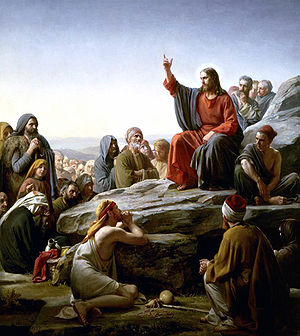
is used as the basis for Christian anarchism. Dorothy Day
, Ammon Hennacy
, and Leo Tolstoy
constantly refer back to the Sermon and ministry of Jesus
in their social and political texts. For example, the title The Kingdom of God Is Within You is a direct quotation of Jesus from Luke
. Dorothy Day
and the Catholic Worker Movement
particularly favored the Works of Mercy
(Matthew
), which were a recurring theme in both their writing and art.
Many Christian anarchists say that Jesus opposed the use of government power, even for supposedly good purposes like welfare. They point to , which says: "The kings of the Gentiles exercise lordship over the people; and those who exercise authority over them call themselves ‘Benefactors.’ But you are not to be like that."
Jesus antagonised the "system" ruled by Satan: "He sent me forth to preach a release to the captives, to send the crushed ones away with a release." (Luke 4:18,19, John 12:31, 14:30, 16:11, 17:16, 18:36). He was against human leadership (Matthew 23:8-12), and he refused to be made king (Matthew 4:8-10 John 6:15).
and various Christian anarchists, which according to Alexandre Christoyannopoulos
included Jacques Ellul, have identified the State and political power
as the Beast in the Book of Revelation
.
' writings suggest anarchism as God's ideal. The first Christians opposed the primacy of the State: "We must obey God as ruler rather than men" (Acts
4:19, 5:29, 1 Corinthians
6:1-6); "Stripping the governments and the authorities bare, he exhibited them in open public as conquered, leading them in a triumphal procession by means of it." (Colossians
2:15). Also some early Christian communities appear to have practised anarchist communism
, such as the Jerusalem group described in Acts
, who shared their money and labor equally and fairly among the members. Christian anarchists, such as Keven Craig, insist that these communities were centred on true love and care for one another rather than liturgy
. They also allege that the reason the early Christians were persecuted was not because they worshipped Jesus Christ, but because they refused to worship human idols
claiming divine status (see Imperial cult
). Given that they refused to worship the Roman Emperor
they refused to swear any oath of allegiance
to the Empire
.
Thomas Merton
in his introduction to a translation of the Sayings of the Desert Fathers describes the early monastics
as "Truly in certain sense 'anarchists,' and it will do no harm to think of them as such." It is also written that "As of the 4th century A.D., the desert lands of Egypt saw the beginning of the longest-living anarchic society of all time: that of the Christian anchorites
."
From the earliest period, women and men seem to have shared religious duties equally, though the public offices, such as missionary work and Temple observances, seem to have been held mostly by men. However, in the case of Phoebe
in Romans 16:1-2: "I commend to you Phoebe our sister, who is a servant (διάκονος) of the church in Cenchreae, that you may receive her in the Lord in a manner worthy of the saints, and assist her in whatever business she has need of you; for indeed she has been a helper of many and of myself also."Referring here to Phoebe, the word rendered "servant" being in the Greek διάκονος (di'a·ko·nos), the parallel English word being deaconess, and in the context of the above quotation, this denotes a servant who is given servants to manage, in effect, a deaconess, one who delegates, a manager, though in most ways, Jewish Christianity did not differ from any of the other Jewish sects of Second Temple Judaism
.
Radical Christians suggest looking to the early church as a model for Christian discipleship, a view also held in Christian primitivism. Although there is some evidence that egalitarian Jewish Christians
existed shortly after Jesus's death, possibly including the Ebionites
, the majority of Christians soon followed a more hierarchical religious structure
, particularly after the First Council of Nicaea
(see also First seven Ecumenical Councils
and State church of the Roman Empire
).
is the conversion of Emperor Constantine after his victory at the Battle of the Milvian Bridge in 312. Following this event Christianity was legalised under the Edict of Milan
in 313, hastening the Church
's transformation from a humble bottom-up sect
to an authoritarian top-down organization
. Christian anarchists point out that this marked the beginning of the "Constantinian shift
", in which Christianity gradually came to be identified with the will of the ruling elite, becoming the State church of the Roman Empire
, and in some cases (such as the Crusades
, Inquisition
and Wars of Religion
) a religious justification for violence.
recounts that Christian pacifism and anarchism were submerged for nearly a millennium until the emergence of thinkers such as Francis of Assisi
and Petr Chelčický
. Francis of Assisi (c.1181–1226) was an ascetic
preacher, pacifist and nature lover. As the son of a wealthy family cloth merchant he led a privileged life and fought as a soldier, but radically changed his beliefs and practices after a spiritual awakening. Francis became a pacifist and eschewed material goods, attempting to follow in the footsteps of Jesus. Peter Maurin
, co-founder of the Catholic Worker Movement
, was heavily influenced by Francis of Assisi. Petr Chelčický's (c.1390–c.1460) work, specifically The Net of Faith, influenced Leo Tolstoy
and is referenced in his book The Kingdom of God Is Within You
.
(1803–1890) was founder of the Hopedale Community
in Massachusetts, and a prominent 19th century exponent of pacifism, socialism and abolitionism
. Through his long career as a Universalist
(and then Unitarian
) minister, he tirelessly sought social reform through his radical Christian and socialist views. Although he rejected anarchism both as a label and as a theory, he was extremely critical of "human government". Tolstoy was heavily influenced by his writings.
Henry David Thoreau: Henry David Thoreau
(1817–1862) was an American author, pacifist
, nature lover, tax resister
and individualist anarchist. He was an advocate of civil disobedience
and a lifelong abolitionist
. Though not commonly regarded as a Christian anarchist, his essay Civil Disobedience
does include many of the Christian anarchist ideals.
William B. Greene: William B. Greene (1819–1878), an individualist anarchist
based in the United States
, was a Unitarian minister, and the originator of a Christian Mutualism, which he considered a new dispensation, beyond God’s covenant with Abraham. His 1850 Mutual Banking begins with a discussion (drawn from the work of Pierre Leroux
) of the Christian rite of communion as a model for a society based in equality, and ends with a prophetic invocation of the new Mutualist dispensation. His better-known scheme for mutual banking, and his criticisms of usury should be understood in this specifically religious context. Unlike his contemporaries among the nonresistants
, Greene was not a pacifist, and served as a Union Army colonel in the American Civil War.
Leo Tolstoy: Leo Tolstoy
(1828–1910) wrote extensively on his anarchist principles, which he arrived at via his Christian faith, in his books The Kingdom of God is Within You
, What I Believe (aka My Religion), The Law of Love and the Law of Violence, and Christianity and Patriotism which criticised government and the Church in general. The Kingdom of God Is Within You is regarded as a key Christian anarchist text. Tolstoy sought to separate Russian Orthodox
Christianity — which was merged with the state
— from what he believed was the true message of Jesus as contained in the Gospels, specifically in the Sermon on the Mount
. Tolstoy takes the viewpoint that all governments who wage war, and churches who in turn support those governments, are an affront to the Christian principles of nonviolence and nonresistance. Although Tolstoy never actually used the term "Christian anarchism" in The Kingdom of God Is Within You, reviews of this book following its publication in 1894 appear to have coined the term. He called for a society based on compassion, nonviolent principles and freedom. Tolstoy was a pacifist
and a vegetarian
. His vision for an equitable society was an anarchist version of Georgism
, which he mentions specifically in his novel Resurrection
.
David Lipscomb: David Lipscomb
(1831–1917) was a minister, author and member in the American Restoration Movement
. He wrote a strong condemnation of the state called On Civil Government: Its Origin, Mission, and Destiny, and the Christian's Relation to It and co-founded Lipscomb University
.
Charles Erskine Scott Wood: Charles Erskine Scott Wood
(1852-1944) was the author of a satirical bestseller, Heavenly Discourse
, which portrayed God and Jesus as anarchists opposed to churches, governments, war, and capitalism.
Thomas J. Hagerty: Thomas J. Hagerty
(c.1862–?) was a Catholic
priest from New Mexico, USA, and one of the founding members of the Industrial Workers of the World
(IWW). Hagerty is credited with writing the IWW Preamble, assisting in the composition of the Industrial Union Manifesto and drawing up the first chart of industrial organization. He was ordained in 1892 but his formal association with the church ended when he was suspended by his archbishop for urging miners in Colorado to revolt during his tour of mining camps in 1903. Hagerty is not commonly regarded as a Christian anarchist in the Tolstoyan
tradition but rather an anarcho-syndicalist
. Christian anarchists like Dorothy Day and Ammon Hennacy have been members of the Industrial Workers of the World
and found common cause with the axiom
"an injury to one is an injury to all."
Nikolai Berdyaev: Nikolai Berdyaev
(1874–1948), the Orthodox Christian philosopher has been called the philosopher of freedom and is known as a Christian existentialist. Known for writing "the Kingdom of God is anarchy" he believed that freedom ultimately comes from God, in direct opposition to atheist anarchists such as Mikhail Bakunin
, who saw God as the (symbolic) enslaver of humanity.
Peter Maurin: Peter Maurin
(1877-1949) was a French
social activist and co-founder of the Catholic Worker Movement
. Maurin's vision to transform the social order
consisted of establishing urban houses of hospitality
to care for the destitute; rural farming communities to teach city dwellers agrarianism
and encourage a movement back-to-the-land; and roundtable discussions
in community centres to clarify thought and initiate action.
Léonce Crenier: Léonce Crenier
(1888–1963) first rejected religion, becoming an anarcho-communist when he moved to Paris
from rural France
in 1911. In 1913 he visited his sister in Portugal
where he stayed for several years. During this period he suffered a debilitating and agonising illness. Receiving the attentions of a particularly caring nurse, he survived, despite the gloomy predictions of the doctors. Converting to Catholicism, he became a monk
. He is particularly known for his concept of Precarity
, and was influential on Dorothy Day.
Ammon Hennacy: Ammon Hennacy
(1893–1970) wrote extensively on his work with the Catholic Workers, the IWW
, and at the Joe Hill House
of Hospitality. He was an Irish American
Christian anarchist, draft dodger
, vegetarian, and tax resister. He also tried to reduce his tax liability by taking up a lifestyle of simple living and bartering. His autobiography The Book of Ammon originally released as The Autobiography of a Catholic Anarchist, describes his work in nonviolent, anarchist, social action, and provides insight into the lives of Christian anarchists in the United States of the 20th century. His other book is One Man Revolution in America.
Dorothy Day: Dorothy Day
(1897–1980) was a journalist turned social activist. She was a member of the IWW
and devout member of the Roman Catholic Church
. She became known for her social justice campaigns in defense of the poor, forsaken, hungry and homeless. Alongside Peter Maurin
, she founded the Catholic Worker
Movement in 1933, espousing nonviolence, and hospitality for the impoverished and downtrodden. Dorothy Day was declared Servant of God
when a cause for sainthood was opened for her by Pope John Paul II. Among books she authored was her autobiography The Long Loneliness
.
Jacques Ellul: Jacques Ellul
(1912–1994) was a French thinker, sociologist, theologian and Christian anarchist. He wrote several books against the "technological society", and some about Christianity and politics, like Anarchy and Christianity. Similar to the theology of one of his main influences, Karl Barth
, Ellul's works and ideas are considered dialectic
.
Philip Berrigan: Philip Berrigan
(1923–2002) was an internationally renowned peace activist
and Roman Catholic
priest. He and his brother Daniel Berrigan
were on the FBI Ten Most Wanted Fugitives
list for illegal nonviolent
actions against war.
Ivan Illich: Ivan Illich
(1926–2002) was a libertarian-socialist social thinker, with roots in the Catholic Church, who wrote critiques of technology, energy use and compulsory education. In 1961 Illich founded the Centro Intercultural de Documentación (CIDOC) at Cuernavaca in Mexico, in order to "counterfoil" the Vatican's participation in the "modern development" of the so-called Third World. Illich's books Energy and Equity and Tools for Conviviality are considered classics for social ecologists
interested in appropriate technology
, while his book Deschooling Society
is still revered by activists seeking alternatives to compulsory schooling. Ivan's views on Jesus as an anarchist are highlighted in a speech he made at a chapel in Chicago.
Vernard Eller: Vernard Eller (1927–2007) was a minister in the Church of the Brethren
and author of Christian Anarchy: Jesus' Primacy Over the Powers.
, many Christian anarchists are critical of Church
dogma
and ritual
s. Christian anarchists wish that Christians were less preoccupied with performing rituals and preaching dogmatic theology
, and more with following Jesus' teaching and practices. Jacques Ellul and Dave Andrews
claim that Jesus did not intend to be the founder of an institutional
religion, whilst Michael Elliot believes one of Jesus' intentions was to bypass human intermediaries and do away with priests.
, Ammon Hennacy
, Jacques Ellul
, and Dave Andrews
, follow Jesus' call to not resist evil but turn the other cheek
. This teaching they argue can only imply a condemnation of the state as the police and army hold a monopoly on the legitimate use of violence
. They believe freedom
will only be guided by the grace of God if they show compassion to others and turn the other cheek when confronted with violence. Christian anarchists believe violence begets violence
and the ends never justify the means
.
A few of the key historic messages many Christian anarchists practice are the principles of nonviolence
, nonresistance
and turning the other cheek, which are illustrated in many passages of the New Testament
and Hebrew Bible
(e.g. the sixth commandment, Exodus 20:13 and Deuteronomy 5:17, "You shall not murder").
To illustrate how nonresistance works in practice, Alexandre Christoyannopoulos
offers the following Christian anarchist response to terrorism
:
, Peter Maurin
and Dorothy Day
, often advocate voluntary poverty. This can be for a variety of reasons, such as withdrawing support for government by reducing taxable income or following Jesus' teachings. Jesus appears to teach voluntary poverty when he told his disciples
, "It is easier for a camel to go through the eye of a needle
than for a rich man to enter the kingdom of God" (Mark 10:25) and "You cannot serve both God and Mammon
" (Luke 16:13).
13:1–7, in which Paul demands obedience to governing authorities and describes them as God's servants exacting punishment on wrongdoers. Romans 13:1–7 holds the most explicit reference to the state in the New Testament but other parallel texts include Titus
3:1, Hebrews
13:17 and 1 Peter
2:13-17.
Established theologians, such as C.E.B. Cranfield, have interpreted Romans 13:1–7 to mean the Church should support the state, as God has sanctified the state to be his main tool to preserve social order. In the case of the state being involved in a "Just War
", theologians also argue that is permissible for Christians to serve the state and wield the sword. Christian anarchists do not share this interpretation of Romans 13 but still recognize it as "a very embarrassing passage."
Christian anarchists and pacifists, such as David Lipscomb
, Jacques Ellul
and Vernard Eller, do not attempt to overthrow the state given Romans 13 and Jesus' command to turn the other cheek. Although Lipscomb still describes the state as an evil power executing wrath and vengeance
. As wrath and vengeance are contrary to the Christian values of kindness
and forgiveness
, Lipscomb and Ellul neither support, nor participate in, the state. Eller articulates this position by restating the passage this way:
Christians who interpret Romans 13 as advocating support for governing authorities are left with the difficulty of how to act under tyrants or dictators. Ernst Käsemann
, in his Commentary on Romans, challenged the mainstream Christian interpretation of the passage in light of German Lutheran Churches using this passage to justify the Holocaust
.
Paul's letter to Roman Christians declares "For rulers hold no terror for those who do right, but for those who do wrong." However Christian anarchists point out an inconsistency if this text were to be taken literally and in isolation, as both Jesus and Paul were executed by the governing authorities or "rulers."
There are also Christians anarchists, such as Tolstoy
and Hennacy
, who do not see the need to integrate Paul's teachings into their subversive
way of life. Tolstoy believed Paul was instrumental in the church's "deviation" from Jesus' teaching and practices, whilst Hennacy believed "Paul spoiled the message of Christ" (see Jesuism). Hennacy and Ciaron O'Reilly
, in contrast to Eller, advocate nonviolent civil disobedience
to confront state oppression.
and Petr Chelčický
understand this to mean that Christians should never bind themselves to any oaths as they may not be able to fulfil the will of God if they are bound to the will of a fellow-man. Tolstoy takes the view that all oaths are evil, but especially an oath of allegiance
.
in the belief that their government is engaged in immoral, unethical or destructive activities such as war
, and paying taxes inevitably funds these activities, whilst others submit to taxation. Adin Ballou wrote that if the act of resisting taxes requires physical force to withhold what a government tries to take, then it is important to submit to taxation. Ammon Hennacy, who, like Ballou also believed in nonresistance
, managed to avoid taxes without using force by reducing his taxable income
.
Tax supporters cite "give to Caesar what is Caesar's
" (Matthew 22:21) and Paul's letter to Roman Christians
(Romans 13:6-7). Although Jacques Ellul
does not interpret Matthew 22:21 as advocating support for taxes but as further advice to free oneself from material attachment
. Ellul believes the passage shows that Caesar may have rights over the fiat money
he produces, but not things that are made by God, as he explains:
in the Christian tradition has a long history commencing in the first centuries of Church
with the Desert Fathers
and Desert Mothers
who abandoned the "world of men" for intimacy with the God
of Jesus Christ. Vegetarianism amongst hermit
s and Christian monastics
in the Eastern Christian and Roman Catholic traditions remains common to this day as a means of simplifying one's life, and as a practice of asceticism
. Leo Tolstoy, Ammon Hennacy and Théodore Monod
extended their belief in nonviolence and compassion to all living beings through vegetarianism.
is a Christian anarchist and pacifist community. The Brotherhood Church can be traced back to 1887 when a Congregationalist
minister called John Bruce Wallace started a magazine called "The Brotherhood" in Limavady
, Northern Ireland
. An intentional community
with Quaker origins has been located at Stapleton
, near Pontefract, Yorkshire
, since 1921.
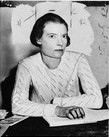 Established by Peter Maurin
and Dorothy Day
in the early 1930s, the Catholic Worker Movement
is a Christian movement dedicated to nonviolence, personalism
and voluntary poverty. Over 130 Catholic Worker communities exist in the United States where "houses of hospitality" care for the homeless. The Joe Hill House
of hospitality (which closed in 1968) in Salt Lake City, Utah featured an enormous twelve feet by fifteen foot mural of Jesus Christ and Joe Hill
. Present-day Catholic Workers include Ciaron O'Reilly
, an Irish-Australian civil rights and anti-war activist.
Anne Klejment, professor of history at University of St. Thomas
, wrote of the Catholic Worker Movement:
The Catholic Worker Movement has consistently protested against war and violence for over seven decades. Many of the leading figures in the movement have been both anarchists and pacifists, as Ammon Hennacy
explains:
Maurin and Day were both baptized and confirmed in the Catholic Church and believed in the institution, thus showing it is possible to be a Christian anarchist and still choose to remain within a church. After her death, Day was proposed for sainthood by the Claretian Missionaries in 1983. Pope John Paul II
granted the Archdiocese of New York permission to open Day's cause for sainthood in March 2000, calling her a Servant of God
.
s dates back to 16th and 17th century Russia
. The Doukhobors ("Spirit Wrestlers") are a radical Christian sect that maintains a belief in pacifism
and a communal lifestyle, while rejecting secular government. In 1899, the Doukhobors fled repression in Tsarist Russia and migrated to Canada, mostly in the provinces of Saskatchewan
and British Columbia
. The trip was paid for by the Quakers
and Russian novelist Leo Tolstoy
. Canada was suggested to Leo Tolstoy as a safe-haven for the Doukhobors by anarchist Peter Kropotkin
who, while on a speaking tour across the country, observed the religious tolerance experienced by the Mennonites.
s, social networking sites
, forums
, electronic mailing list
s and blog
s have emerged on the internet over the last few years. These include: A Pinch of Salt, a 1980s Christian anarchist magazine, revived in 2006 by Keith Hebden as a blog and bi-annual magazine; Vine & Fig Tree started by Kevin Craig in 1999; Jesus Radicals founded by Mennonite
s Nekeisha and Andy Alexis-Baker in 2000; Lost Religion of Jesus created by Adam Clark in 2005; Christian Anarchists created by Jason Barr in 2006; The Mormon Worker
, a blog and newspaper, founded in 2007 by William Van Wagenen to promote Mormonism
, anarchism and pacifism; Academics and Students Interested in Religious Anarchism (ASIRA) founded by Alexandre Christoyannopoulos
in 2008.
Political theology
Political theology or public theology is a branch of both political philosophy and practical theology that investigates the ways in which theological concepts or ways of thinking underlie political, social, economic and cultural discourses....
that combines anarchism
Anarchism
Anarchism is generally defined as the political philosophy which holds the state to be undesirable, unnecessary, and harmful, or alternatively as opposing authority in the conduct of human relations...
and Christianity
Christianity
Christianity is a monotheistic religion based on the life and teachings of Jesus as presented in canonical gospels and other New Testament writings...
. It is the belief that there is only one source of authority to which Christians are ultimately answerable, the authority of God as embodied in the teachings of Jesus. More than any other Bible source, the Sermon on the Mount
Sermon on the Mount
The Sermon on the Mount is a collection of sayings and teachings of Jesus, which emphasizes his moral teaching found in the Gospel of Matthew...
and Jesus' call to not resist evil but turn the other cheek, are used as the basis for Christian anarchism.
Christian anarchists are pacifists
Christian pacifism
Christian pacifism is the theological and ethical position that any form of violence is incompatible with the Christian faith. Christian pacifists state that Jesus himself was a pacifist who taught and practiced pacifism, and that his followers must do likewise.There have been various notable...
and oppose the use of violence, such as war. The foundation of Christian anarchism is a rejection of violence, with Leo Tolstoy
Leo Tolstoy
Lev Nikolayevich Tolstoy was a Russian writer who primarily wrote novels and short stories. Later in life, he also wrote plays and essays. His two most famous works, the novels War and Peace and Anna Karenina, are acknowledged as two of the greatest novels of all time and a pinnacle of realist...
's The Kingdom of God Is Within You
The Kingdom of God Is Within You
The Kingdom of God Is Within You is the non-fiction magnum opus of Leo Tolstoy and was first published in Germany in 1894, after being banned in his home country of Russia...
regarded as a key text. Christian anarchists denounce the state as they claim it is violent, deceitful and, when glorified, a form of idolatry
Idolatry
Idolatry is a pejorative term for the worship of an idol, a physical object such as a cult image, as a god, or practices believed to verge on worship, such as giving undue honour and regard to created forms other than God. In all the Abrahamic religions idolatry is strongly forbidden, although...
.
Old Testament
Few Christian anarchists comment a great deal on the Old TestamentOld Testament
The Old Testament, of which Christians hold different views, is a Christian term for the religious writings of ancient Israel held sacred and inspired by Christians which overlaps with the 24-book canon of the Masoretic Text of Judaism...
, given the scripture's many recounts of war and retaliation
Eye For An Eye
Eye for an Eye is a Polish hardcore punk rock band founded in 1997 in Bielsko-Biała. EFAE, as it is also known, plays an old school style of punk, more along the veins of The Exploited or even, some say, Agnostic Front. The punk stylings of EFAE has been compared to fellow countrymen Post Regiment,...
. Although Jacques Ellul
Jacques Ellul
Jacques Ellul was a French philosopher, law professor, sociologist, lay theologian, and Christian anarchist. He wrote several books about the "technological society" and the interaction between Christianity and politics....
is one notable individual who has remarked on the book's compatibility with anarchism. For example, Nimrod
Nimrod
Nimrod means "Hunter"; was a Biblical Mesopotamian king mentioned in the Table of Nations; an eponym for the city of Nimrud.Nimrod can also refer to any of the following:*Nimród Antal, a director...
was disapproved for becoming a dominator (Genesis 10:8,9). Abraham
Abraham
Abraham , whose birth name was Abram, is the eponym of the Abrahamic religions, among which are Judaism, Christianity and Islam...
, who left civilization to live in tents, conflicted with Nimrod. (Jewish tradition Gen. R. Pesik. R.). Moses
Moses
Moses was, according to the Hebrew Bible and Qur'an, a religious leader, lawgiver and prophet, to whom the authorship of the Torah is traditionally attributed...
led the Hebrews out of captivity from the Egyptian state (Exodus 3:7,10), and the nation remained three centuries without king: “In those days there was no king in Israel. As for everybody, what was right in his own eyes he was accustomed to do." (Judges 17:6, 21:25). Gideon refused to be made king: "Jehovah
Jehovah
Jehovah is an anglicized representation of Hebrew , a vocalization of the Tetragrammaton , the proper name of the God of Israel in the Hebrew Bible....
is the one who will rule over you." (Judges 8:23), and his son described the state as parasites (Judges 9:8-21). Samuel then warned the Hebrews against the evils of a kingdom (1 Samuel 8:5-18). The prophets disapproved domination (Ecclesiastes 8:9, Jeremiah 25:34, Ezekiel 34:10, 45:8, Hosea 13:10,11), and a God's kingdom of freedom
Kingdom of God
The Kingdom of God or Kingdom of Heaven is a foundational concept in the Abrahamic religions: Judaism, Christianity and Islam.The term "Kingdom of God" is found in all four canonical gospels and in the Pauline epistles...
was envisioned (Isaiah 2:4, 65:22).
New Testament
Ministry and example of Jesus
More than any other Bible source, the Sermon on the MountSermon on the Mount
The Sermon on the Mount is a collection of sayings and teachings of Jesus, which emphasizes his moral teaching found in the Gospel of Matthew...
is used as the basis for Christian anarchism. Dorothy Day
Dorothy Day
Dorothy Day was an American journalist, social activist and devout Catholic convert; she advocated the Catholic economic theory of Distributism. She was also considered to be an anarchist, and did not hesitate to use the term...
, Ammon Hennacy
Ammon Hennacy
Ammon Ashford Hennacy was an Irish American pacifist, Christian anarchist, social activist, member of the Catholic Worker Movement and a Wobbly...
, and Leo Tolstoy
Leo Tolstoy
Lev Nikolayevich Tolstoy was a Russian writer who primarily wrote novels and short stories. Later in life, he also wrote plays and essays. His two most famous works, the novels War and Peace and Anna Karenina, are acknowledged as two of the greatest novels of all time and a pinnacle of realist...
constantly refer back to the Sermon and ministry of Jesus
Ministry of Jesus
In the Christian gospels, the Ministry of Jesus begins with his Baptism in the countryside of Judea, near the River Jordan and ends in Jerusalem, following the Last Supper with his disciples. The Gospel of Luke states that Jesus was "about 30 years of age" at the start of his ministry...
in their social and political texts. For example, the title The Kingdom of God Is Within You is a direct quotation of Jesus from Luke
Gospel of Luke
The Gospel According to Luke , commonly shortened to the Gospel of Luke or simply Luke, is the third and longest of the four canonical Gospels. This synoptic gospel is an account of the life and ministry of Jesus of Nazareth. It details his story from the events of his birth to his Ascension.The...
. Dorothy Day
Dorothy Day
Dorothy Day was an American journalist, social activist and devout Catholic convert; she advocated the Catholic economic theory of Distributism. She was also considered to be an anarchist, and did not hesitate to use the term...
and the Catholic Worker Movement
Catholic Worker Movement
The Catholic Worker Movement is a collection of autonomous communities of Catholics and their associates founded by Dorothy Day and Peter Maurin in 1933. Its aim is to "live in accordance with the justice and charity of Jesus Christ." One of its guiding principles is hospitality towards those on...
particularly favored the Works of Mercy
Works of Mercy
The Works of Mercy or Acts of Mercy are actions and practices which Christianity in general, and the Methodist Church, Roman Catholic Church and the Eastern Orthodox Church in particular, consider expectations to be fulfilled by believers, and are a means of grace, which aid in sanctification.The...
(Matthew
Gospel of Matthew
The Gospel According to Matthew is one of the four canonical gospels, one of the three synoptic gospels, and the first book of the New Testament. It tells of the life, ministry, death, and resurrection of Jesus of Nazareth...
), which were a recurring theme in both their writing and art.
Many Christian anarchists say that Jesus opposed the use of government power, even for supposedly good purposes like welfare. They point to , which says: "The kings of the Gentiles exercise lordship over the people; and those who exercise authority over them call themselves ‘Benefactors.’ But you are not to be like that."
Jesus antagonised the "system" ruled by Satan: "He sent me forth to preach a release to the captives, to send the crushed ones away with a release." (Luke 4:18,19, John 12:31, 14:30, 16:11, 17:16, 18:36). He was against human leadership (Matthew 23:8-12), and he refused to be made king (Matthew 4:8-10 John 6:15).
Book of Revelation
Christian eschatologyChristian eschatology
Christian eschatology is a major branch of study within Christian theology. Eschatology, from two Greek words meaning last and study , is the study of the end of things, whether the end of an individual life, the end of the age, or the end of the world...
and various Christian anarchists, which according to Alexandre Christoyannopoulos
Alexandre Christoyannopoulos
Alexandre J.M.E. Christoyannopoulos is a French–Greek author, politics lecturer and Christian pacifist. He currently lectures at Loughborough University, England...
included Jacques Ellul, have identified the State and political power
Political power
Political power is a type of power held by a group in a society which allows administration of some or all of public resources, including labour, and wealth. There are many ways to obtain possession of such power. At the nation-state level political legitimacy for political power is held by the...
as the Beast in the Book of Revelation
Book of Revelation
The Book of Revelation is the final book of the New Testament. The title came into usage from the first word of the book in Koine Greek: apokalupsis, meaning "unveiling" or "revelation"...
.
Early Church
Several of the Church FathersChurch Fathers
The Church Fathers, Early Church Fathers, Christian Fathers, or Fathers of the Church were early and influential theologians, eminent Christian teachers and great bishops. Their scholarly works were used as a precedent for centuries to come...
' writings suggest anarchism as God's ideal. The first Christians opposed the primacy of the State: "We must obey God as ruler rather than men" (Acts
Acts of the Apostles
The Acts of the Apostles , usually referred to simply as Acts, is the fifth book of the New Testament; Acts outlines the history of the Apostolic Age...
4:19, 5:29, 1 Corinthians
First Epistle to the Corinthians
The first epistle of Paul the apostle to the Corinthians, often referred to as First Corinthians , is the seventh book of the New Testament of the Bible...
6:1-6); "Stripping the governments and the authorities bare, he exhibited them in open public as conquered, leading them in a triumphal procession by means of it." (Colossians
Epistle to the Colossians
The Epistle of Paul to the Colossians, usually referred to simply as Colossians, is the 12th book of the New Testament. It was written, according to the text, by Paul the Apostle to the Church in Colossae, a small Phrygian city near Laodicea and approximately 100 miles from Ephesus in Asia...
2:15). Also some early Christian communities appear to have practised anarchist communism
Anarchist communism
Anarchist communism is a theory of anarchism which advocates the abolition of the state, markets, money, private property, and capitalism in favor of common ownership of the means of production, direct democracy and a horizontal network of voluntary associations and workers' councils with...
, such as the Jerusalem group described in Acts
Acts of the Apostles
The Acts of the Apostles , usually referred to simply as Acts, is the fifth book of the New Testament; Acts outlines the history of the Apostolic Age...
, who shared their money and labor equally and fairly among the members. Christian anarchists, such as Keven Craig, insist that these communities were centred on true love and care for one another rather than liturgy
Liturgy
Liturgy is either the customary public worship done by a specific religious group, according to its particular traditions or a more precise term that distinguishes between those religious groups who believe their ritual requires the "people" to do the "work" of responding to the priest, and those...
. They also allege that the reason the early Christians were persecuted was not because they worshipped Jesus Christ, but because they refused to worship human idols
Idolatry
Idolatry is a pejorative term for the worship of an idol, a physical object such as a cult image, as a god, or practices believed to verge on worship, such as giving undue honour and regard to created forms other than God. In all the Abrahamic religions idolatry is strongly forbidden, although...
claiming divine status (see Imperial cult
Imperial cult (ancient Rome)
The Imperial cult of ancient Rome identified emperors and some members of their families with the divinely sanctioned authority of the Roman State...
). Given that they refused to worship the Roman Emperor
Roman Emperor
The Roman emperor was the ruler of the Roman State during the imperial period . The Romans had no single term for the office although at any given time, a given title was associated with the emperor...
they refused to swear any oath of allegiance
Oath of allegiance
An oath of allegiance is an oath whereby a subject or citizen acknowledges a duty of allegiance and swears loyalty to monarch or country. In republics, modern oaths specify allegiance to the country's constitution. For example, officials in the United States, a republic, take an oath of office that...
to the Empire
Roman Empire
The Roman Empire was the post-Republican period of the ancient Roman civilization, characterised by an autocratic form of government and large territorial holdings in Europe and around the Mediterranean....
.
Thomas Merton
Thomas Merton
Thomas Merton, O.C.S.O. was a 20th century Anglo-American Catholic writer and mystic. A Trappist monk of the Abbey of Gethsemani, Kentucky, he was a poet, social activist, and student of comparative religion...
in his introduction to a translation of the Sayings of the Desert Fathers describes the early monastics
Christian monasticism
Christian monasticism is a practice which began to develop early in the history of the Christian Church, modeled upon scriptural examples and ideals, including those in the Old Testament, but not mandated as an institution in the scriptures. It has come to be regulated by religious rules Christian...
as "Truly in certain sense 'anarchists,' and it will do no harm to think of them as such." It is also written that "As of the 4th century A.D., the desert lands of Egypt saw the beginning of the longest-living anarchic society of all time: that of the Christian anchorites
Anchorite
Anchorite denotes someone who, for religious reasons, withdraws from secular society so as to be able to lead an intensely prayer-oriented, ascetic, and—circumstances permitting—Eucharist-focused life...
."
From the earliest period, women and men seem to have shared religious duties equally, though the public offices, such as missionary work and Temple observances, seem to have been held mostly by men. However, in the case of Phoebe
Phoebe
Phoebe or Phebe is a female given name , meaning "bright and shining" deriving from Greek 'phoibos' .-Mythology:*Phoebe , one of the Titans*Phoebe, one of the Heliades*Phoebe , the daughter of Leucippus...
in Romans 16:1-2: "I commend to you Phoebe our sister, who is a servant (διάκονος) of the church in Cenchreae, that you may receive her in the Lord in a manner worthy of the saints, and assist her in whatever business she has need of you; for indeed she has been a helper of many and of myself also."Referring here to Phoebe, the word rendered "servant" being in the Greek διάκονος (di'a·ko·nos), the parallel English word being deaconess, and in the context of the above quotation, this denotes a servant who is given servants to manage, in effect, a deaconess, one who delegates, a manager, though in most ways, Jewish Christianity did not differ from any of the other Jewish sects of Second Temple Judaism
Second Temple Judaism
Second Temple Judaism refers to the religion of Judaism during the Second Temple period, between the construction of the second Jewish temple in Jerusalem in 515 BCE, and its destruction by the Romans in 70 CE This period witnessed major historical upheavals and significant religious changes that...
.
Radical Christians suggest looking to the early church as a model for Christian discipleship, a view also held in Christian primitivism. Although there is some evidence that egalitarian Jewish Christians
Jewish Christians
Jewish Christians is a term which appears in historical texts contrasting Christians of Jewish origin with Gentile Christians, both in discussion of the New Testament church and the second and following centuries....
existed shortly after Jesus's death, possibly including the Ebionites
Ebionites
Ebionites, or Ebionaioi, , is a patristic term referring to a Jewish Christian sect or sects that existed during the first centuries of the Christian Era. They regarded Jesus as the Messiah and insisted on the necessity of following Jewish religious law and rites...
, the majority of Christians soon followed a more hierarchical religious structure
Bishop
A bishop is an ordained or consecrated member of the Christian clergy who is generally entrusted with a position of authority and oversight. Within the Catholic Church, Eastern Orthodox, Oriental Orthodox Churches, in the Assyrian Church of the East, in the Independent Catholic Churches, and in the...
, particularly after the First Council of Nicaea
First Council of Nicaea
The First Council of Nicaea was a council of Christian bishops convened in Nicaea in Bithynia by the Roman Emperor Constantine I in AD 325...
(see also First seven Ecumenical Councils
First seven Ecumenical Councils
In the history of Christianity, the first seven Ecumenical Councils, from the First Council of Nicaea to the Second Council of Nicaea , represent an attempt to reach an orthodox consensus and to establish a unified Christendom as the State church of the Roman Empire...
and State church of the Roman Empire
State church of the Roman Empire
The state church of the Roman Empire was a Christian institution organized within the Roman Empire during the 4th century that came to represent the Empire's sole authorized religion. Both the Roman Catholic Church and the Eastern Orthodox churches claim to be the historical continuation of this...
).
Conversion of the Roman Empire
For Christian anarchists the moment which epitomises the degeneration of ChristianityGreat Apostasy
The Great Apostasy is a term used by some religious groups to describe a general fallen state of traditional Christianity, especially the Papacy, because it allowed the traditional Roman mysteries and deities of solar monism such as Mithras and Sol Invictus and idol worship back into the church,...
is the conversion of Emperor Constantine after his victory at the Battle of the Milvian Bridge in 312. Following this event Christianity was legalised under the Edict of Milan
Edict of Milan
The Edict of Milan was a letter signed by emperors Constantine I and Licinius that proclaimed religious toleration in the Roman Empire...
in 313, hastening the Church
Christian Church
The Christian Church is the assembly or association of followers of Jesus Christ. The Greek term ἐκκλησία that in its appearances in the New Testament is usually translated as "church" basically means "assembly"...
's transformation from a humble bottom-up sect
Sect
A sect is a group with distinctive religious, political or philosophical beliefs. Although in past it was mostly used to refer to religious groups, it has since expanded and in modern culture can refer to any organization that breaks away from a larger one to follow a different set of rules and...
to an authoritarian top-down organization
Hierarchical organization
A hierarchical organization is an organizational structure where every entity in the organization, except one, is subordinate to a single other entity. This arrangement is a form of a hierarchy. In an organization, the hierarchy usually consists of a singular/group of power at the top with...
. Christian anarchists point out that this marked the beginning of the "Constantinian shift
Constantinian shift
Constantinian shift is a term used by Anabaptist and Post-Christendom theologians to describe the political and theological aspects of the 4th-century process of Constantine's legalization of Christianity. The term was popularized by the Mennonite theologian John H...
", in which Christianity gradually came to be identified with the will of the ruling elite, becoming the State church of the Roman Empire
State church of the Roman Empire
The state church of the Roman Empire was a Christian institution organized within the Roman Empire during the 4th century that came to represent the Empire's sole authorized religion. Both the Roman Catholic Church and the Eastern Orthodox churches claim to be the historical continuation of this...
, and in some cases (such as the Crusades
Crusades
The Crusades were a series of religious wars, blessed by the Pope and the Catholic Church with the main goal of restoring Christian access to the holy places in and near Jerusalem...
, Inquisition
Inquisition
The Inquisition, Inquisitio Haereticae Pravitatis , was the "fight against heretics" by several institutions within the justice-system of the Roman Catholic Church. It started in the 12th century, with the introduction of torture in the persecution of heresy...
and Wars of Religion
French Wars of Religion
The French Wars of Religion is the name given to a period of civil infighting and military operations, primarily fought between French Catholics and Protestants . The conflict involved the factional disputes between the aristocratic houses of France, such as the House of Bourbon and House of Guise...
) a religious justification for violence.
Middle Ages
Following Constantine's conversion, Alexandre ChristoyannopoulosAlexandre Christoyannopoulos
Alexandre J.M.E. Christoyannopoulos is a French–Greek author, politics lecturer and Christian pacifist. He currently lectures at Loughborough University, England...
recounts that Christian pacifism and anarchism were submerged for nearly a millennium until the emergence of thinkers such as Francis of Assisi
Francis of Assisi
Saint Francis of Assisi was an Italian Catholic friar and preacher. He founded the men's Franciscan Order, the women’s Order of St. Clare, and the lay Third Order of Saint Francis. St...
and Petr Chelčický
Petr Chelcický
Petr Chelčický was a Christian and political leader and author in 15th century Bohemia .-Chelčický's background:...
. Francis of Assisi (c.1181–1226) was an ascetic
Asceticism
Asceticism describes a lifestyle characterized by abstinence from various sorts of worldly pleasures often with the aim of pursuing religious and spiritual goals...
preacher, pacifist and nature lover. As the son of a wealthy family cloth merchant he led a privileged life and fought as a soldier, but radically changed his beliefs and practices after a spiritual awakening. Francis became a pacifist and eschewed material goods, attempting to follow in the footsteps of Jesus. Peter Maurin
Peter Maurin
Peter Maurin was a Roman Catholic social activist who founded the Catholic Worker Movement in 1933 with Dorothy Day.Maurin expressed his ideas through short pieces of verse that became known as - Biography :...
, co-founder of the Catholic Worker Movement
Catholic Worker Movement
The Catholic Worker Movement is a collection of autonomous communities of Catholics and their associates founded by Dorothy Day and Peter Maurin in 1933. Its aim is to "live in accordance with the justice and charity of Jesus Christ." One of its guiding principles is hospitality towards those on...
, was heavily influenced by Francis of Assisi. Petr Chelčický's (c.1390–c.1460) work, specifically The Net of Faith, influenced Leo Tolstoy
Leo Tolstoy
Lev Nikolayevich Tolstoy was a Russian writer who primarily wrote novels and short stories. Later in life, he also wrote plays and essays. His two most famous works, the novels War and Peace and Anna Karenina, are acknowledged as two of the greatest novels of all time and a pinnacle of realist...
and is referenced in his book The Kingdom of God Is Within You
The Kingdom of God Is Within You
The Kingdom of God Is Within You is the non-fiction magnum opus of Leo Tolstoy and was first published in Germany in 1894, after being banned in his home country of Russia...
.
Modern era
Adin Ballou: Adin BallouAdin Ballou
Adin Ballou was an American prominent proponent of pacifism, socialism and abolitionism, and the founder of the Hopedale Community...
(1803–1890) was founder of the Hopedale Community
Hopedale Community
The Hopedale Community was founded out of Worcester County, Massachusetts in 1842 by Adin Ballou. He and his followers purchased of land on which they built homes for the community members, chapels and the factories for which the company was initially formed....
in Massachusetts, and a prominent 19th century exponent of pacifism, socialism and abolitionism
Abolitionism
Abolitionism is a movement to end slavery.In western Europe and the Americas abolitionism was a movement to end the slave trade and set slaves free. At the behest of Dominican priest Bartolomé de las Casas who was shocked at the treatment of natives in the New World, Spain enacted the first...
. Through his long career as a Universalist
Universalism
Universalism in its primary meaning refers to religious, theological, and philosophical concepts with universal application or applicability...
(and then Unitarian
Unitarianism
Unitarianism is a Christian theological movement, named for its understanding of God as one person, in direct contrast to Trinitarianism which defines God as three persons coexisting consubstantially as one in being....
) minister, he tirelessly sought social reform through his radical Christian and socialist views. Although he rejected anarchism both as a label and as a theory, he was extremely critical of "human government". Tolstoy was heavily influenced by his writings.
Henry David Thoreau: Henry David Thoreau
Henry David Thoreau
Henry David Thoreau was an American author, poet, philosopher, abolitionist, naturalist, tax resister, development critic, surveyor, historian, and leading transcendentalist...
(1817–1862) was an American author, pacifist
Pacifism
Pacifism is the opposition to war and violence. The term "pacifism" was coined by the French peace campaignerÉmile Arnaud and adopted by other peace activists at the tenth Universal Peace Congress inGlasgow in 1901.- Definition :...
, nature lover, tax resister
Tax resistance
Tax resistance is the refusal to pay tax because of opposition to the government that is imposing the tax or to government policy.Tax resistance is a form of civil disobedience and direct action...
and individualist anarchist. He was an advocate of civil disobedience
Civil disobedience
Civil disobedience is the active, professed refusal to obey certain laws, demands, and commands of a government, or of an occupying international power. Civil disobedience is commonly, though not always, defined as being nonviolent resistance. It is one form of civil resistance...
and a lifelong abolitionist
Abolitionism
Abolitionism is a movement to end slavery.In western Europe and the Americas abolitionism was a movement to end the slave trade and set slaves free. At the behest of Dominican priest Bartolomé de las Casas who was shocked at the treatment of natives in the New World, Spain enacted the first...
. Though not commonly regarded as a Christian anarchist, his essay Civil Disobedience
Civil Disobedience (Thoreau)
Civil Disobedience is an essay by American transcendentalist Henry David Thoreau that was first published in 1849...
does include many of the Christian anarchist ideals.
William B. Greene: William B. Greene (1819–1878), an individualist anarchist
Individualist anarchism
Individualist anarchism refers to several traditions of thought within the anarchist movement that emphasize the individual and his or her will over external determinants such as groups, society, traditions, and ideological systems. Individualist anarchism is not a single philosophy but refers to a...
based in the United States
United States
The United States of America is a federal constitutional republic comprising fifty states and a federal district...
, was a Unitarian minister, and the originator of a Christian Mutualism, which he considered a new dispensation, beyond God’s covenant with Abraham. His 1850 Mutual Banking begins with a discussion (drawn from the work of Pierre Leroux
Pierre Leroux
Pierre Henri Leroux , French philosopher and political economist, was born at Bercy, now a part of Paris, the son of an artisan.- Life :...
) of the Christian rite of communion as a model for a society based in equality, and ends with a prophetic invocation of the new Mutualist dispensation. His better-known scheme for mutual banking, and his criticisms of usury should be understood in this specifically religious context. Unlike his contemporaries among the nonresistants
Nonresistance
Nonresistance is generally defined as "the practice or principle of not resisting authority, even when it is unjustly exercised". At its core is discouragement of, even opposition to, physical resistance to an enemy...
, Greene was not a pacifist, and served as a Union Army colonel in the American Civil War.
Leo Tolstoy: Leo Tolstoy
Leo Tolstoy
Lev Nikolayevich Tolstoy was a Russian writer who primarily wrote novels and short stories. Later in life, he also wrote plays and essays. His two most famous works, the novels War and Peace and Anna Karenina, are acknowledged as two of the greatest novels of all time and a pinnacle of realist...
(1828–1910) wrote extensively on his anarchist principles, which he arrived at via his Christian faith, in his books The Kingdom of God is Within You
The Kingdom of God Is Within You
The Kingdom of God Is Within You is the non-fiction magnum opus of Leo Tolstoy and was first published in Germany in 1894, after being banned in his home country of Russia...
, What I Believe (aka My Religion), The Law of Love and the Law of Violence, and Christianity and Patriotism which criticised government and the Church in general. The Kingdom of God Is Within You is regarded as a key Christian anarchist text. Tolstoy sought to separate Russian Orthodox
Russian Orthodox Church
The Russian Orthodox Church or, alternatively, the Moscow Patriarchate The ROC is often said to be the largest of the Eastern Orthodox churches in the world; including all the autocephalous churches under its umbrella, its adherents number over 150 million worldwide—about half of the 300 million...
Christianity — which was merged with the state
State (polity)
A state is an organized political community, living under a government. States may be sovereign and may enjoy a monopoly on the legal initiation of force and are not dependent on, or subject to any other power or state. Many states are federated states which participate in a federal union...
— from what he believed was the true message of Jesus as contained in the Gospels, specifically in the Sermon on the Mount
Sermon on the Mount
The Sermon on the Mount is a collection of sayings and teachings of Jesus, which emphasizes his moral teaching found in the Gospel of Matthew...
. Tolstoy takes the viewpoint that all governments who wage war, and churches who in turn support those governments, are an affront to the Christian principles of nonviolence and nonresistance. Although Tolstoy never actually used the term "Christian anarchism" in The Kingdom of God Is Within You, reviews of this book following its publication in 1894 appear to have coined the term. He called for a society based on compassion, nonviolent principles and freedom. Tolstoy was a pacifist
Pacifism
Pacifism is the opposition to war and violence. The term "pacifism" was coined by the French peace campaignerÉmile Arnaud and adopted by other peace activists at the tenth Universal Peace Congress inGlasgow in 1901.- Definition :...
and a vegetarian
Vegetarianism
Vegetarianism encompasses the practice of following plant-based diets , with or without the inclusion of dairy products or eggs, and with the exclusion of meat...
. His vision for an equitable society was an anarchist version of Georgism
Georgism
Georgism is an economic philosophy and ideology that holds that people own what they create, but that things found in nature, most importantly land, belong equally to all...
, which he mentions specifically in his novel Resurrection
Resurrection (novel)
Resurrection , first published in 1899, was the last novel written by Leo Tolstoy. The book is the last of his major long fiction works published in his lifetime . Tolstoy intended the novel as an exposition of injustice of man-made laws and the hypocrisy of institutionalized church...
.
David Lipscomb: David Lipscomb
David Lipscomb
Lipscomb's beliefs on government can be classified as a radical theory of religious freedom, classical liberalism, even potentially consistent with fundamental positions of Anarcho-primitivism. Lipscomb believed in creating a peaceful, cooperative, decentralized communion in which freedom,...
(1831–1917) was a minister, author and member in the American Restoration Movement
Restoration Movement
The Restoration Movement is a Christian movement that began on the American frontier during the Second Great Awakening of the early 19th century...
. He wrote a strong condemnation of the state called On Civil Government: Its Origin, Mission, and Destiny, and the Christian's Relation to It and co-founded Lipscomb University
Lipscomb University
Lipscomb University is a private, coeducational, liberal arts university in Nashville, Tennessee, United States. It is affiliated with the Churches of Christ. The campus is located in the Green Hills neighborhood of Nashville between Belmont Boulevard to the west and Granny White Pike on the east...
.
Charles Erskine Scott Wood: Charles Erskine Scott Wood
Charles Erskine Scott Wood
Charles Erskine Scott Wood was an author, civil libertarian, soldier, and attorney. He is best known as the author of the 1927 satirical bestseller, Heavenly Discourse.-Early life:...
(1852-1944) was the author of a satirical bestseller, Heavenly Discourse
Heavenly Discourse
Heavenly Discourse is a collection of satirical essays by Charles Erskine Scott Wood, published in 1927.It is written in the form of plays or discussions between such characters as God, Jesus, Mark Twain, Tom Paine, Robert Ingersoll, Billy Sunday, and Theodore Roosevelt...
, which portrayed God and Jesus as anarchists opposed to churches, governments, war, and capitalism.
Thomas J. Hagerty: Thomas J. Hagerty
Thomas J. Hagerty
The Reverend Friar Thomas J. Hagerty was an American Roman Catholic priest from New Mexico, and one of the founding members of the Industrial Workers of the World .-Biography:...
(c.1862–?) was a Catholic
Catholic
The word catholic comes from the Greek phrase , meaning "on the whole," "according to the whole" or "in general", and is a combination of the Greek words meaning "about" and meaning "whole"...
priest from New Mexico, USA, and one of the founding members of the Industrial Workers of the World
Industrial Workers of the World
The Industrial Workers of the World is an international union. At its peak in 1923, the organization claimed some 100,000 members in good standing, and could marshal the support of perhaps 300,000 workers. Its membership declined dramatically after a 1924 split brought on by internal conflict...
(IWW). Hagerty is credited with writing the IWW Preamble, assisting in the composition of the Industrial Union Manifesto and drawing up the first chart of industrial organization. He was ordained in 1892 but his formal association with the church ended when he was suspended by his archbishop for urging miners in Colorado to revolt during his tour of mining camps in 1903. Hagerty is not commonly regarded as a Christian anarchist in the Tolstoyan
Tolstoyan
The Tolstoyan movement is a social movement based on the philosophical and religious views of Russian novelist Leo Tolstoy . Tolstoy's views were formed by rigorous study of the ministry of Jesus, particularly the Sermon on the Mount....
tradition but rather an anarcho-syndicalist
Anarcho-syndicalism
Anarcho-syndicalism is a branch of anarchism which focuses on the labour movement. The word syndicalism comes from the French word syndicat which means trade union , from the Latin word syndicus which in turn comes from the Greek word σύνδικος which means caretaker of an issue...
. Christian anarchists like Dorothy Day and Ammon Hennacy have been members of the Industrial Workers of the World
Industrial Workers of the World
The Industrial Workers of the World is an international union. At its peak in 1923, the organization claimed some 100,000 members in good standing, and could marshal the support of perhaps 300,000 workers. Its membership declined dramatically after a 1924 split brought on by internal conflict...
and found common cause with the axiom
Axiom
In traditional logic, an axiom or postulate is a proposition that is not proven or demonstrated but considered either to be self-evident or to define and delimit the realm of analysis. In other words, an axiom is a logical statement that is assumed to be true...
"an injury to one is an injury to all."
Nikolai Berdyaev: Nikolai Berdyaev
Nikolai Berdyaev
Nikolai Alexandrovich Berdyaev was a Russian religious and political philosopher.-Early life and education:Berdyaev was born in Kiev into an aristocratic military family. He spent a solitary childhood at home, where his father's library allowed him to read widely...
(1874–1948), the Orthodox Christian philosopher has been called the philosopher of freedom and is known as a Christian existentialist. Known for writing "the Kingdom of God is anarchy" he believed that freedom ultimately comes from God, in direct opposition to atheist anarchists such as Mikhail Bakunin
Mikhail Bakunin
Mikhail Alexandrovich Bakunin was a well-known Russian revolutionary and theorist of collectivist anarchism. He has also often been called the father of anarchist theory in general. Bakunin grew up near Moscow, where he moved to study philosophy and began to read the French Encyclopedists,...
, who saw God as the (symbolic) enslaver of humanity.
Peter Maurin: Peter Maurin
Peter Maurin
Peter Maurin was a Roman Catholic social activist who founded the Catholic Worker Movement in 1933 with Dorothy Day.Maurin expressed his ideas through short pieces of verse that became known as - Biography :...
(1877-1949) was a French
France
The French Republic , The French Republic , The French Republic , (commonly known as France , is a unitary semi-presidential republic in Western Europe with several overseas territories and islands located on other continents and in the Indian, Pacific, and Atlantic oceans. Metropolitan France...
social activist and co-founder of the Catholic Worker Movement
Catholic Worker Movement
The Catholic Worker Movement is a collection of autonomous communities of Catholics and their associates founded by Dorothy Day and Peter Maurin in 1933. Its aim is to "live in accordance with the justice and charity of Jesus Christ." One of its guiding principles is hospitality towards those on...
. Maurin's vision to transform the social order
Social order
Social order is a concept used in sociology, history and other social sciences. It refers to a set of linked social structures, social institutions and social practices which conserve, maintain and enforce "normal" ways of relating and behaving....
consisted of establishing urban houses of hospitality
House of hospitality
A house of hospitality is an organization to provide shelter, and often food and clothing, to those who need it. Originally part of the Catholic Worker Movement, houses of hospitality have been run by other organizations, including organizations that are not Catholic or Christian...
to care for the destitute; rural farming communities to teach city dwellers agrarianism
Agrarianism
Agrarianism has two common meanings. The first meaning refers to a social philosophy or political philosophy which values rural society as superior to urban society, the independent farmer as superior to the paid worker, and sees farming as a way of life that can shape the ideal social values...
and encourage a movement back-to-the-land; and roundtable discussions
Round table (discussion)
Round table is a form of academic discussion. Participants agree on a specific topic to discuss and debate. Each person is given equal right to participate, because of the circular layout usually used in round table discussions....
in community centres to clarify thought and initiate action.
Léonce Crenier: Léonce Crenier
Léonce Crenier
Léonce Crenier was a Catholic monk who promoted the theological/political concept of Precarity.-Early years:Léonce Crenier was born in Ceton, a small village of the diocese of Séez, in Savoie, France, July 31, 1888...
(1888–1963) first rejected religion, becoming an anarcho-communist when he moved to Paris
Paris
Paris is the capital and largest city in France, situated on the river Seine, in northern France, at the heart of the Île-de-France region...
from rural France
France
The French Republic , The French Republic , The French Republic , (commonly known as France , is a unitary semi-presidential republic in Western Europe with several overseas territories and islands located on other continents and in the Indian, Pacific, and Atlantic oceans. Metropolitan France...
in 1911. In 1913 he visited his sister in Portugal
Portugal
Portugal , officially the Portuguese Republic is a country situated in southwestern Europe on the Iberian Peninsula. Portugal is the westernmost country of Europe, and is bordered by the Atlantic Ocean to the West and South and by Spain to the North and East. The Atlantic archipelagos of the...
where he stayed for several years. During this period he suffered a debilitating and agonising illness. Receiving the attentions of a particularly caring nurse, he survived, despite the gloomy predictions of the doctors. Converting to Catholicism, he became a monk
Monk
A monk is a person who practices religious asceticism, living either alone or with any number of monks, while always maintaining some degree of physical separation from those not sharing the same purpose...
. He is particularly known for his concept of Precarity
Precarity (Social Christianity)
Precarity is a condition of existence without predictability or security, affecting material or psychological welfare. The term has been specifically applied to either intermittent work or, more generally, a confluence of intermittent work and precarious existence.-Catholic Origins:In its English...
, and was influential on Dorothy Day.
Ammon Hennacy: Ammon Hennacy
Ammon Hennacy
Ammon Ashford Hennacy was an Irish American pacifist, Christian anarchist, social activist, member of the Catholic Worker Movement and a Wobbly...
(1893–1970) wrote extensively on his work with the Catholic Workers, the IWW
Industrial Workers of the World
The Industrial Workers of the World is an international union. At its peak in 1923, the organization claimed some 100,000 members in good standing, and could marshal the support of perhaps 300,000 workers. Its membership declined dramatically after a 1924 split brought on by internal conflict...
, and at the Joe Hill House
Joe Hill House
The Joe Hill House was a Catholic Worker Movement house of hospitality in Salt Lake City, Utah co-founded in 1961 by Ammon Hennacy and Mary Lathrop...
of Hospitality. He was an Irish American
Irish American
Irish Americans are citizens of the United States who can trace their ancestry to Ireland. A total of 36,278,332 Americans—estimated at 11.9% of the total population—reported Irish ancestry in the 2008 American Community Survey conducted by the U.S. Census Bureau...
Christian anarchist, draft dodger
Draft dodger
Draft evasion is a term that refers to an intentional failure to comply with the military conscription policies of the nation to which he or she is subject...
, vegetarian, and tax resister. He also tried to reduce his tax liability by taking up a lifestyle of simple living and bartering. His autobiography The Book of Ammon originally released as The Autobiography of a Catholic Anarchist, describes his work in nonviolent, anarchist, social action, and provides insight into the lives of Christian anarchists in the United States of the 20th century. His other book is One Man Revolution in America.
Dorothy Day: Dorothy Day
Dorothy Day
Dorothy Day was an American journalist, social activist and devout Catholic convert; she advocated the Catholic economic theory of Distributism. She was also considered to be an anarchist, and did not hesitate to use the term...
(1897–1980) was a journalist turned social activist. She was a member of the IWW
Industrial Workers of the World
The Industrial Workers of the World is an international union. At its peak in 1923, the organization claimed some 100,000 members in good standing, and could marshal the support of perhaps 300,000 workers. Its membership declined dramatically after a 1924 split brought on by internal conflict...
and devout member of the Roman Catholic Church
Roman Catholic Church
The Catholic Church, also known as the Roman Catholic Church, is the world's largest Christian church, with over a billion members. Led by the Pope, it defines its mission as spreading the gospel of Jesus Christ, administering the sacraments and exercising charity...
. She became known for her social justice campaigns in defense of the poor, forsaken, hungry and homeless. Alongside Peter Maurin
Peter Maurin
Peter Maurin was a Roman Catholic social activist who founded the Catholic Worker Movement in 1933 with Dorothy Day.Maurin expressed his ideas through short pieces of verse that became known as - Biography :...
, she founded the Catholic Worker
Catholic Worker
The Catholic Worker is a newspaper published seven times a year by the Catholic Worker Movement community in New York City. The newspaper was started by Dorothy Day and Peter Maurin to make people aware of church teaching on social justice...
Movement in 1933, espousing nonviolence, and hospitality for the impoverished and downtrodden. Dorothy Day was declared Servant of God
Servant of God
Servant of God is a title given to individuals by various religions, but in general the phrase is used to describe a person believed to be pious in his or her faith tradition. In the Catholic Church, it designates someone who is being investigated by the Church for possibly being recognized as a...
when a cause for sainthood was opened for her by Pope John Paul II. Among books she authored was her autobiography The Long Loneliness
The Long Loneliness
The Long Loneliness is the autobiography of Dorothy Day, published in 1952 by Harper & Row. In the book, Day chronicles her involvement in socialist groups along with her eventual conversion to Catholicism in 1927, and the beginning of her newspaper the Catholic Worker in 1933.-External links:*...
.
Jacques Ellul: Jacques Ellul
Jacques Ellul
Jacques Ellul was a French philosopher, law professor, sociologist, lay theologian, and Christian anarchist. He wrote several books about the "technological society" and the interaction between Christianity and politics....
(1912–1994) was a French thinker, sociologist, theologian and Christian anarchist. He wrote several books against the "technological society", and some about Christianity and politics, like Anarchy and Christianity. Similar to the theology of one of his main influences, Karl Barth
Karl Barth
Karl Barth was a Swiss Reformed theologian whom critics hold to be among the most important Christian thinkers of the 20th century; Pope Pius XII described him as the most important theologian since Thomas Aquinas...
, Ellul's works and ideas are considered dialectic
Dialectic
Dialectic is a method of argument for resolving disagreement that has been central to Indic and European philosophy since antiquity. The word dialectic originated in Ancient Greece, and was made popular by Plato in the Socratic dialogues...
.
Philip Berrigan: Philip Berrigan
Philip Berrigan
Philip Francis Berrigan was an internationally renowned American peace activist, Christian anarchist and former Roman Catholic priest...
(1923–2002) was an internationally renowned peace activist
Peace activist
This list of peace activists includes people who proactively advocate diplomatic, non-military resolution of political disputes, usually through nonviolent means.A peace activist is an activist of the peace movement.*Jane Addams*Martti Ahtisaari...
and Roman Catholic
Catholicism
Catholicism is a broad term for the body of the Catholic faith, its theologies and doctrines, its liturgical, ethical, spiritual, and behavioral characteristics, as well as a religious people as a whole....
priest. He and his brother Daniel Berrigan
Daniel Berrigan
Daniel Berrigan, SJ is an American Catholic priest, peace activist, and poet. Daniel and his brother Philip were for a time on the FBI Ten Most Wanted Fugitives list for their involvement in antiwar protests during the Vietnam war....
were on the FBI Ten Most Wanted Fugitives
FBI Ten Most Wanted Fugitives
The FBI Ten Most Wanted Fugitives list arose from a conversation held in late 1949 between J. Edgar Hoover, Director of the United States Federal Bureau of Investigation, and William Kinsey Hutchinson, International News Service Editor-in-Chief, who were discussing ways to promote capture of the...
list for illegal nonviolent
Nonviolence
Nonviolence has two meanings. It can refer, first, to a general philosophy of abstention from violence because of moral or religious principle It can refer to the behaviour of people using nonviolent action Nonviolence has two (closely related) meanings. (1) It can refer, first, to a general...
actions against war.
Ivan Illich: Ivan Illich
Ivan Illich
Ivan Illich was an Austrian philosopher, Roman Catholic priest, and "maverick social critic" of the institutions of contemporary western culture and their effects on the provenance and practice of education, medicine, work, energy use, transportation, and economic development.- Personal life...
(1926–2002) was a libertarian-socialist social thinker, with roots in the Catholic Church, who wrote critiques of technology, energy use and compulsory education. In 1961 Illich founded the Centro Intercultural de Documentación (CIDOC) at Cuernavaca in Mexico, in order to "counterfoil" the Vatican's participation in the "modern development" of the so-called Third World. Illich's books Energy and Equity and Tools for Conviviality are considered classics for social ecologists
Social ecology
Social ecology is a philosophy developed by Murray Bookchin in the 1960s.It holds that present ecological problems are rooted in deep-seated social problems, particularly in dominatory hierarchical political and social systems. These have resulted in an uncritical acceptance of an overly...
interested in appropriate technology
Appropriate technology
Appropriate technology is an ideological movement originally articulated as "intermediate technology" by the economist Dr...
, while his book Deschooling Society
Deschooling Society
Deschooling Society is a critical discourse on education as practised in modern economies. It is a book that brought Ivan Illich to public attention. Full of detail on programs and concerns, the book gives examples of the ineffectual nature of institutionalized education...
is still revered by activists seeking alternatives to compulsory schooling. Ivan's views on Jesus as an anarchist are highlighted in a speech he made at a chapel in Chicago.
Vernard Eller: Vernard Eller (1927–2007) was a minister in the Church of the Brethren
Church of the Brethren
The Church of the Brethren is a Christian denomination originating from the Schwarzenau Brethren organized in 1708 by eight persons led by Alexander Mack, in Schwarzenau, Bad Berleburg, Germany. The Brethren movement began as a melding of Radical Pietist and Anabaptist ideas during the...
and author of Christian Anarchy: Jesus' Primacy Over the Powers.
Church authority
With some notable exceptions, such as the Catholic Worker MovementCatholic Worker Movement
The Catholic Worker Movement is a collection of autonomous communities of Catholics and their associates founded by Dorothy Day and Peter Maurin in 1933. Its aim is to "live in accordance with the justice and charity of Jesus Christ." One of its guiding principles is hospitality towards those on...
, many Christian anarchists are critical of Church
Christian Church
The Christian Church is the assembly or association of followers of Jesus Christ. The Greek term ἐκκλησία that in its appearances in the New Testament is usually translated as "church" basically means "assembly"...
dogma
Dogma
Dogma is the established belief or doctrine held by a religion, or a particular group or organization. It is authoritative and not to be disputed, doubted, or diverged from, by the practitioners or believers...
and ritual
Ritual
A ritual is a set of actions, performed mainly for their symbolic value. It may be prescribed by a religion or by the traditions of a community. The term usually excludes actions which are arbitrarily chosen by the performers....
s. Christian anarchists wish that Christians were less preoccupied with performing rituals and preaching dogmatic theology
Dogmatic theology
Dogmatic theology is that part of theology dealing with the theoretical truths of faith concerning God and his works, especially the official theology recognized by an organized Church body, such as the Roman Catholic Church, Dutch Reformed Church, etc...
, and more with following Jesus' teaching and practices. Jacques Ellul and Dave Andrews
Dave Andrews
Dave Andrews is an Australian Christian anarchist author, speaker, social activist, community developer, and a key figure in the Waiter's Union, an inner city Christian community network working with Indigenous Australians, refugees and people with disabilities in Australia...
claim that Jesus did not intend to be the founder of an institutional
Institution
An institution is any structure or mechanism of social order and cooperation governing the behavior of a set of individuals within a given human community...
religion, whilst Michael Elliot believes one of Jesus' intentions was to bypass human intermediaries and do away with priests.
Pacifism and nonviolence
Christian anarchists, such as Leo TolstoyLeo Tolstoy
Lev Nikolayevich Tolstoy was a Russian writer who primarily wrote novels and short stories. Later in life, he also wrote plays and essays. His two most famous works, the novels War and Peace and Anna Karenina, are acknowledged as two of the greatest novels of all time and a pinnacle of realist...
, Ammon Hennacy
Ammon Hennacy
Ammon Ashford Hennacy was an Irish American pacifist, Christian anarchist, social activist, member of the Catholic Worker Movement and a Wobbly...
, Jacques Ellul
Jacques Ellul
Jacques Ellul was a French philosopher, law professor, sociologist, lay theologian, and Christian anarchist. He wrote several books about the "technological society" and the interaction between Christianity and politics....
, and Dave Andrews
Dave Andrews
Dave Andrews is an Australian Christian anarchist author, speaker, social activist, community developer, and a key figure in the Waiter's Union, an inner city Christian community network working with Indigenous Australians, refugees and people with disabilities in Australia...
, follow Jesus' call to not resist evil but turn the other cheek
Turn the other cheek
Turning the other cheek is a phrase in Christian doctrine that refers to responding to an aggressor without violence. The phrase originates from the Sermon on the Mount in the New Testament.In the Sermon on the Mount in the Gospel of Matthew, Jesus says:...
. This teaching they argue can only imply a condemnation of the state as the police and army hold a monopoly on the legitimate use of violence
Monopoly on violence
The monopoly on violence is the conception of the state expounded by Max Weber in Politics as a Vocation. According to Weber, the state is that entity which claims a monopoly on the legitimate use of violence, which it may therefore elect to delegate as it sees fit...
. They believe freedom
Freedom (political)
Political freedom is a central philosophy in Western history and political thought, and one of the most important features of democratic societies...
will only be guided by the grace of God if they show compassion to others and turn the other cheek when confronted with violence. Christian anarchists believe violence begets violence
Violence begets violence
The phrase "violence begets violence" refers to the concept that violent behavior promotes other violent behavior, in return. The phrase has been used for over 50 years, as in speeches by Dr. Martin Luther King, Jr...
and the ends never justify the means
Deontological ethics
Deontological ethics or deontology is the normative ethical position that judges the morality of an action based on the action's adherence to a rule or rules. It is sometimes described as "duty" or "obligation" or "rule" -based ethics, because rules "bind you to your duty"...
.
A few of the key historic messages many Christian anarchists practice are the principles of nonviolence
Nonviolence
Nonviolence has two meanings. It can refer, first, to a general philosophy of abstention from violence because of moral or religious principle It can refer to the behaviour of people using nonviolent action Nonviolence has two (closely related) meanings. (1) It can refer, first, to a general...
, nonresistance
Nonresistance
Nonresistance is generally defined as "the practice or principle of not resisting authority, even when it is unjustly exercised". At its core is discouragement of, even opposition to, physical resistance to an enemy...
and turning the other cheek, which are illustrated in many passages of the New Testament
New Testament
The New Testament is the second major division of the Christian biblical canon, the first such division being the much longer Old Testament....
and Hebrew Bible
Hebrew Bible
The Hebrew Bible is a term used by biblical scholars outside of Judaism to refer to the Tanakh , a canonical collection of Jewish texts, and the common textual antecedent of the several canonical editions of the Christian Old Testament...
(e.g. the sixth commandment, Exodus 20:13 and Deuteronomy 5:17, "You shall not murder").
To illustrate how nonresistance works in practice, Alexandre Christoyannopoulos
Alexandre Christoyannopoulos
Alexandre J.M.E. Christoyannopoulos is a French–Greek author, politics lecturer and Christian pacifist. He currently lectures at Loughborough University, England...
offers the following Christian anarchist response to terrorism
Terrorism
Terrorism is the systematic use of terror, especially as a means of coercion. In the international community, however, terrorism has no universally agreed, legally binding, criminal law definition...
:
Simple living
Christian anarchists, such as Ammon HennacyAmmon Hennacy
Ammon Ashford Hennacy was an Irish American pacifist, Christian anarchist, social activist, member of the Catholic Worker Movement and a Wobbly...
, Peter Maurin
Peter Maurin
Peter Maurin was a Roman Catholic social activist who founded the Catholic Worker Movement in 1933 with Dorothy Day.Maurin expressed his ideas through short pieces of verse that became known as - Biography :...
and Dorothy Day
Dorothy Day
Dorothy Day was an American journalist, social activist and devout Catholic convert; she advocated the Catholic economic theory of Distributism. She was also considered to be an anarchist, and did not hesitate to use the term...
, often advocate voluntary poverty. This can be for a variety of reasons, such as withdrawing support for government by reducing taxable income or following Jesus' teachings. Jesus appears to teach voluntary poverty when he told his disciples
Disciple (Christianity)
In Christianity, the disciples were the students of Jesus during his ministry. While Jesus attracted a large following, the term disciple is commonly used to refer specifically to "the Twelve", an inner circle of men whose number perhaps represented the twelve tribes of Israel...
, "It is easier for a camel to go through the eye of a needle
Eye of a needle
The eye of a needle is the section of a sewing needle formed into a loop for pulling thread, located at the end opposite the point. These loops are often shaped like an oval or an "eye", hence the metaphor.-Judaism:...
than for a rich man to enter the kingdom of God" (Mark 10:25) and "You cannot serve both God and Mammon
Mammon
Mammon is a term, derived from the Christian Bible, used to describe material wealth or greed, most often personified as a deity, and sometimes included in the seven princes of Hell.-Etymology:...
" (Luke 16:13).
State authority
The most common challenge for anarchist theologians is interpreting Paul's letter to Roman ChristiansEpistle to the Romans
The Epistle of Paul to the Romans, often shortened to Romans, is the sixth book in the New Testament. Biblical scholars agree that it was composed by the Apostle Paul to explain that Salvation is offered through the Gospel of Jesus Christ...
13:1–7, in which Paul demands obedience to governing authorities and describes them as God's servants exacting punishment on wrongdoers. Romans 13:1–7 holds the most explicit reference to the state in the New Testament but other parallel texts include Titus
Epistle to Titus
The Epistle of Paul to Titus, usually referred to simply as Titus, is one of the three Pastoral Epistles , traditionally attributed to Saint Paul, and is part of the New Testament...
3:1, Hebrews
Epistle to the Hebrews
The Epistle to the Hebrews is one of the books in the New Testament. Its author is not known.The primary purpose of the Letter to the Hebrews is to exhort Christians to persevere in the face of persecution. The central thought of the entire Epistle is the doctrine of the Person of Christ and his...
13:17 and 1 Peter
First Epistle of Peter
The First Epistle of Peter, usually referred to simply as First Peter and often written 1 Peter, is a book of the New Testament. The author claims to be Saint Peter the apostle, and the epistle was traditionally held to have been written during his time as bishop of Rome or Bishop of Antioch,...
2:13-17.
Established theologians, such as C.E.B. Cranfield, have interpreted Romans 13:1–7 to mean the Church should support the state, as God has sanctified the state to be his main tool to preserve social order. In the case of the state being involved in a "Just War
Just War
Just war theory is a doctrine of military ethics of Roman philosophical and Catholic origin, studied by moral theologians, ethicists and international policy makers, which holds that a conflict ought to meet philosophical, religious or political criteria.-Origins:The concept of justification for...
", theologians also argue that is permissible for Christians to serve the state and wield the sword. Christian anarchists do not share this interpretation of Romans 13 but still recognize it as "a very embarrassing passage."
Christian anarchists and pacifists, such as David Lipscomb
David Lipscomb
Lipscomb's beliefs on government can be classified as a radical theory of religious freedom, classical liberalism, even potentially consistent with fundamental positions of Anarcho-primitivism. Lipscomb believed in creating a peaceful, cooperative, decentralized communion in which freedom,...
, Jacques Ellul
Jacques Ellul
Jacques Ellul was a French philosopher, law professor, sociologist, lay theologian, and Christian anarchist. He wrote several books about the "technological society" and the interaction between Christianity and politics....
and Vernard Eller, do not attempt to overthrow the state given Romans 13 and Jesus' command to turn the other cheek. Although Lipscomb still describes the state as an evil power executing wrath and vengeance
Revenge
Revenge is a harmful action against a person or group in response to a grievance, be it real or perceived. It is also called payback, retribution, retaliation or vengeance; it may be characterized, justly or unjustly, as a form of justice.-Function in society:Some societies believe that the...
. As wrath and vengeance are contrary to the Christian values of kindness
Kindness
Kindness is the act or the state of being kind, being marked by good and charitable behaviour, pleasant disposition, and concern for others. It is known as a virtue, and recognized as a value in many cultures and religions ....
and forgiveness
Forgiveness
Forgiveness is typically defined as the process of concluding resentment, indignation or anger as a result of a perceived offense, difference or mistake, or ceasing to demand punishment or restitution. The Oxford English Dictionary defines forgiveness as 'to grant free pardon and to give up all...
, Lipscomb and Ellul neither support, nor participate in, the state. Eller articulates this position by restating the passage this way:
Christians who interpret Romans 13 as advocating support for governing authorities are left with the difficulty of how to act under tyrants or dictators. Ernst Käsemann
Ernst Käsemann
Ernst Käsemann, , was a Lutheran theologian and professor of New Testament in Mainz , Göttingen and Tübingen .-Study and work:...
, in his Commentary on Romans, challenged the mainstream Christian interpretation of the passage in light of German Lutheran Churches using this passage to justify the Holocaust
The Holocaust
The Holocaust , also known as the Shoah , was the genocide of approximately six million European Jews and millions of others during World War II, a programme of systematic state-sponsored murder by Nazi...
.
Paul's letter to Roman Christians declares "For rulers hold no terror for those who do right, but for those who do wrong." However Christian anarchists point out an inconsistency if this text were to be taken literally and in isolation, as both Jesus and Paul were executed by the governing authorities or "rulers."
There are also Christians anarchists, such as Tolstoy
Leo Tolstoy
Lev Nikolayevich Tolstoy was a Russian writer who primarily wrote novels and short stories. Later in life, he also wrote plays and essays. His two most famous works, the novels War and Peace and Anna Karenina, are acknowledged as two of the greatest novels of all time and a pinnacle of realist...
and Hennacy
Ammon Hennacy
Ammon Ashford Hennacy was an Irish American pacifist, Christian anarchist, social activist, member of the Catholic Worker Movement and a Wobbly...
, who do not see the need to integrate Paul's teachings into their subversive
Subversion
Apache Subversion is a software versioning and a revision control system distributed under a free license. Developers use Subversion to maintain current and historical versions of files such as source code, web pages, and documentation...
way of life. Tolstoy believed Paul was instrumental in the church's "deviation" from Jesus' teaching and practices, whilst Hennacy believed "Paul spoiled the message of Christ" (see Jesuism). Hennacy and Ciaron O'Reilly
Ciaron O'Reilly
Ciaron O'Reilly is a long-time Catholic Worker, nonviolent resister and Christian anarchist. O'Reilly took part in the 1980s civil rights, social justice and free speech movement in Queensland, Australia, against state Premier Joh Bjelke-Peterson....
, in contrast to Eller, advocate nonviolent civil disobedience
Civil disobedience
Civil disobedience is the active, professed refusal to obey certain laws, demands, and commands of a government, or of an occupying international power. Civil disobedience is commonly, though not always, defined as being nonviolent resistance. It is one form of civil resistance...
to confront state oppression.
Swearing of oaths
In the Sermon of the Mount (Matthew 5:33-37) Jesus tells his followers to not swear oaths in the name of God or Man. Tolstoy, Adin BallouAdin Ballou
Adin Ballou was an American prominent proponent of pacifism, socialism and abolitionism, and the founder of the Hopedale Community...
and Petr Chelčický
Petr Chelcický
Petr Chelčický was a Christian and political leader and author in 15th century Bohemia .-Chelčický's background:...
understand this to mean that Christians should never bind themselves to any oaths as they may not be able to fulfil the will of God if they are bound to the will of a fellow-man. Tolstoy takes the view that all oaths are evil, but especially an oath of allegiance
Oath of allegiance
An oath of allegiance is an oath whereby a subject or citizen acknowledges a duty of allegiance and swears loyalty to monarch or country. In republics, modern oaths specify allegiance to the country's constitution. For example, officials in the United States, a republic, take an oath of office that...
.
Tax
Some Christian anarchists resist taxesTax resistance
Tax resistance is the refusal to pay tax because of opposition to the government that is imposing the tax or to government policy.Tax resistance is a form of civil disobedience and direct action...
in the belief that their government is engaged in immoral, unethical or destructive activities such as war
War
War is a state of organized, armed, and often prolonged conflict carried on between states, nations, or other parties typified by extreme aggression, social disruption, and usually high mortality. War should be understood as an actual, intentional and widespread armed conflict between political...
, and paying taxes inevitably funds these activities, whilst others submit to taxation. Adin Ballou wrote that if the act of resisting taxes requires physical force to withhold what a government tries to take, then it is important to submit to taxation. Ammon Hennacy, who, like Ballou also believed in nonresistance
Nonresistance
Nonresistance is generally defined as "the practice or principle of not resisting authority, even when it is unjustly exercised". At its core is discouragement of, even opposition to, physical resistance to an enemy...
, managed to avoid taxes without using force by reducing his taxable income
Simple living
Simple living encompasses a number of different voluntary practices to simplify one's lifestyle. These may include reducing one's possessions or increasing self-sufficiency, for example. Simple living may be characterized by individuals being satisfied with what they need rather than want...
.
Tax supporters cite "give to Caesar what is Caesar's
Render unto Caesar...
"Render unto Caesar…" is the beginning of a phrase attributed to Jesus in the synoptic gospels, which reads in full, "Render unto Caesar the things which are Caesar's, and unto God the things that are God's" ....
" (Matthew 22:21) and Paul's letter to Roman Christians
Epistle to the Romans
The Epistle of Paul to the Romans, often shortened to Romans, is the sixth book in the New Testament. Biblical scholars agree that it was composed by the Apostle Paul to explain that Salvation is offered through the Gospel of Jesus Christ...
(Romans 13:6-7). Although Jacques Ellul
Jacques Ellul
Jacques Ellul was a French philosopher, law professor, sociologist, lay theologian, and Christian anarchist. He wrote several books about the "technological society" and the interaction between Christianity and politics....
does not interpret Matthew 22:21 as advocating support for taxes but as further advice to free oneself from material attachment
Simple living
Simple living encompasses a number of different voluntary practices to simplify one's lifestyle. These may include reducing one's possessions or increasing self-sufficiency, for example. Simple living may be characterized by individuals being satisfied with what they need rather than want...
. Ellul believes the passage shows that Caesar may have rights over the fiat money
Fiat money
Fiat money is money that has value only because of government regulation or law. The term derives from the Latin fiat, meaning "let it be done", as such money is established by government decree. Where fiat money is used as currency, the term fiat currency is used.Fiat money originated in 11th...
he produces, but not things that are made by God, as he explains:
Vegetarianism
VegetarianismVegetarianism
Vegetarianism encompasses the practice of following plant-based diets , with or without the inclusion of dairy products or eggs, and with the exclusion of meat...
in the Christian tradition has a long history commencing in the first centuries of Church
Christian Church
The Christian Church is the assembly or association of followers of Jesus Christ. The Greek term ἐκκλησία that in its appearances in the New Testament is usually translated as "church" basically means "assembly"...
with the Desert Fathers
Desert Fathers
The Desert Fathers were hermits, ascetics, monks, and nuns who lived mainly in the Scetes desert of Egypt beginning around the third century AD. The most well known was Anthony the Great, who moved to the desert in 270–271 and became known as both the father and founder of desert monasticism...
and Desert Mothers
Desert Mothers
The Desert Mothers were female Christian ascetics living in the desert of Egypt, Palestine, and Syria in the 4th and 5th centuries CE. They typically lived in the monastic communities that began forming during that time, though sometimes they lived as hermits...
who abandoned the "world of men" for intimacy with the God
Trinity
The Christian doctrine of the Trinity defines God as three divine persons : the Father, the Son , and the Holy Spirit. The three persons are distinct yet coexist in unity, and are co-equal, co-eternal and consubstantial . Put another way, the three persons of the Trinity are of one being...
of Jesus Christ. Vegetarianism amongst hermit
Hermit
A hermit is a person who lives, to some degree, in seclusion from society.In Christianity, the term was originally applied to a Christian who lives the eremitic life out of a religious conviction, namely the Desert Theology of the Old Testament .In the...
s and Christian monastics
Monk
A monk is a person who practices religious asceticism, living either alone or with any number of monks, while always maintaining some degree of physical separation from those not sharing the same purpose...
in the Eastern Christian and Roman Catholic traditions remains common to this day as a means of simplifying one's life, and as a practice of asceticism
Asceticism
Asceticism describes a lifestyle characterized by abstinence from various sorts of worldly pleasures often with the aim of pursuing religious and spiritual goals...
. Leo Tolstoy, Ammon Hennacy and Théodore Monod
Théodore Monod
Théodore André Monod was a French naturalist, explorer, and humanist scholar.-Exploration:...
extended their belief in nonviolence and compassion to all living beings through vegetarianism.
Brotherhood Church
The Brotherhood ChurchBrotherhood Church
The Brotherhood Church is a Christian anarchist and pacifist community. An intentional community with Quaker origins has been located at Stapleton, near Pontefract, Yorkshire, since 1921.-History:...
is a Christian anarchist and pacifist community. The Brotherhood Church can be traced back to 1887 when a Congregationalist
Congregational church
Congregational churches are Protestant Christian churches practicing Congregationalist church governance, in which each congregation independently and autonomously runs its own affairs....
minister called John Bruce Wallace started a magazine called "The Brotherhood" in Limavady
Limavady
Limavady is a market town in County Londonderry, Northern Ireland, with Binevenagh as a backdrop. It lies east of Derry and south west of Coleraine. It had a population of 12,135 people in the 2001 Census, an increase of some 17% compared to 1991...
, Northern Ireland
Northern Ireland
Northern Ireland is one of the four countries of the United Kingdom. Situated in the north-east of the island of Ireland, it shares a border with the Republic of Ireland to the south and west...
. An intentional community
Intentional community
An intentional community is a planned residential community designed to have a much higher degree of teamwork than other communities. The members of an intentional community typically hold a common social, political, religious, or spiritual vision and often follow an alternative lifestyle. They...
with Quaker origins has been located at Stapleton
Stapleton Colony
The Stapleton Colony, based in Stapleton, North Yorkshire is a Christian pacifist and anarchist community, and the only remaining colony of the Brotherhood Church.In 1897 several members of the Brotherhood Church, some from a Quaker background, moved to Leeds...
, near Pontefract, Yorkshire
Pontefract
Pontefract is an historic market town in West Yorkshire, England. Traditionally in the West Riding, near the A1 , the M62 motorway and Castleford. It is one of the five towns in the metropolitan borough of the City of Wakefield and has a population of 28,250...
, since 1921.
Catholic Worker Movement
Peter Maurin
Peter Maurin was a Roman Catholic social activist who founded the Catholic Worker Movement in 1933 with Dorothy Day.Maurin expressed his ideas through short pieces of verse that became known as - Biography :...
and Dorothy Day
Dorothy Day
Dorothy Day was an American journalist, social activist and devout Catholic convert; she advocated the Catholic economic theory of Distributism. She was also considered to be an anarchist, and did not hesitate to use the term...
in the early 1930s, the Catholic Worker Movement
Catholic Worker Movement
The Catholic Worker Movement is a collection of autonomous communities of Catholics and their associates founded by Dorothy Day and Peter Maurin in 1933. Its aim is to "live in accordance with the justice and charity of Jesus Christ." One of its guiding principles is hospitality towards those on...
is a Christian movement dedicated to nonviolence, personalism
Personalism
Personalism is a philosophical school of thought searching to describe the uniqueness of a human person in the world of nature, specifically in relation to animals...
and voluntary poverty. Over 130 Catholic Worker communities exist in the United States where "houses of hospitality" care for the homeless. The Joe Hill House
Joe Hill House
The Joe Hill House was a Catholic Worker Movement house of hospitality in Salt Lake City, Utah co-founded in 1961 by Ammon Hennacy and Mary Lathrop...
of hospitality (which closed in 1968) in Salt Lake City, Utah featured an enormous twelve feet by fifteen foot mural of Jesus Christ and Joe Hill
Joe Hill
Joe Hill, born Joel Emmanuel Hägglund in Gävle , and also known as Joseph Hillström was a Swedish-American labor activist, songwriter, and member of the Industrial Workers of the World...
. Present-day Catholic Workers include Ciaron O'Reilly
Ciaron O'Reilly
Ciaron O'Reilly is a long-time Catholic Worker, nonviolent resister and Christian anarchist. O'Reilly took part in the 1980s civil rights, social justice and free speech movement in Queensland, Australia, against state Premier Joh Bjelke-Peterson....
, an Irish-Australian civil rights and anti-war activist.
Anne Klejment, professor of history at University of St. Thomas
University of St. Thomas (Minnesota)
The University of St. Thomas is a private, Catholic, liberal arts, and archdiocesan university located in St. Paul and Minneapolis, Minnesota, United States...
, wrote of the Catholic Worker Movement:
The Catholic Worker Movement has consistently protested against war and violence for over seven decades. Many of the leading figures in the movement have been both anarchists and pacifists, as Ammon Hennacy
Ammon Hennacy
Ammon Ashford Hennacy was an Irish American pacifist, Christian anarchist, social activist, member of the Catholic Worker Movement and a Wobbly...
explains:
Maurin and Day were both baptized and confirmed in the Catholic Church and believed in the institution, thus showing it is possible to be a Christian anarchist and still choose to remain within a church. After her death, Day was proposed for sainthood by the Claretian Missionaries in 1983. Pope John Paul II
Pope John Paul II
Blessed Pope John Paul II , born Karol Józef Wojtyła , reigned as Pope of the Catholic Church and Sovereign of Vatican City from 16 October 1978 until his death on 2 April 2005, at of age. His was the second-longest documented pontificate, which lasted ; only Pope Pius IX ...
granted the Archdiocese of New York permission to open Day's cause for sainthood in March 2000, calling her a Servant of God
Servant of God
Servant of God is a title given to individuals by various religions, but in general the phrase is used to describe a person believed to be pious in his or her faith tradition. In the Catholic Church, it designates someone who is being investigated by the Church for possibly being recognized as a...
.
Doukhobors
The origin of the DoukhoborDoukhobor
The Doukhobors or Dukhobors , earlierDukhobortsy are a group of Russian origin.The Doukhobors were one of the sects - later defined as a religious philosophy, ethnic group, social movement, or simply a "way of life" - known generically as Spiritual Christianity. The origin of the Doukhobors is...
s dates back to 16th and 17th century Russia
Russia
Russia or , officially known as both Russia and the Russian Federation , is a country in northern Eurasia. It is a federal semi-presidential republic, comprising 83 federal subjects...
. The Doukhobors ("Spirit Wrestlers") are a radical Christian sect that maintains a belief in pacifism
Pacifism
Pacifism is the opposition to war and violence. The term "pacifism" was coined by the French peace campaignerÉmile Arnaud and adopted by other peace activists at the tenth Universal Peace Congress inGlasgow in 1901.- Definition :...
and a communal lifestyle, while rejecting secular government. In 1899, the Doukhobors fled repression in Tsarist Russia and migrated to Canada, mostly in the provinces of Saskatchewan
Saskatchewan
Saskatchewan is a prairie province in Canada, which has an area of . Saskatchewan is bordered on the west by Alberta, on the north by the Northwest Territories, on the east by Manitoba, and on the south by the U.S. states of Montana and North Dakota....
and British Columbia
British Columbia
British Columbia is the westernmost of Canada's provinces and is known for its natural beauty, as reflected in its Latin motto, Splendor sine occasu . Its name was chosen by Queen Victoria in 1858...
. The trip was paid for by the Quakers
Religious Society of Friends
The Religious Society of Friends, or Friends Church, is a Christian movement which stresses the doctrine of the priesthood of all believers. Members are known as Friends, or popularly as Quakers. It is made of independent organisations, which have split from one another due to doctrinal differences...
and Russian novelist Leo Tolstoy
Leo Tolstoy
Lev Nikolayevich Tolstoy was a Russian writer who primarily wrote novels and short stories. Later in life, he also wrote plays and essays. His two most famous works, the novels War and Peace and Anna Karenina, are acknowledged as two of the greatest novels of all time and a pinnacle of realist...
. Canada was suggested to Leo Tolstoy as a safe-haven for the Doukhobors by anarchist Peter Kropotkin
Peter Kropotkin
Prince Pyotr Alexeyevich Kropotkin was a Russian zoologist, evolutionary theorist, philosopher, economist, geographer, author and one of the world's foremost anarcho-communists. Kropotkin advocated a communist society free from central government and based on voluntary associations between...
who, while on a speaking tour across the country, observed the religious tolerance experienced by the Mennonites.
Online communities
Numerous Christian anarchist websiteWebsite
A website, also written as Web site, web site, or simply site, is a collection of related web pages containing images, videos or other digital assets. A website is hosted on at least one web server, accessible via a network such as the Internet or a private local area network through an Internet...
s, social networking sites
Social network service
A social networking service is an online service, platform, or site that focuses on building and reflecting of social networks or social relations among people, who, for example, share interests and/or activities. A social network service consists of a representation of each user , his/her social...
, forums
Internet forum
An Internet forum, or message board, is an online discussion site where people can hold conversations in the form of posted messages. They differ from chat rooms in that messages are at least temporarily archived...
, electronic mailing list
Electronic mailing list
An electronic mailing list is a special usage of email that allows for widespread distribution of information to many Internet users. It is similar to a traditional mailing list — a list of names and addresses — as might be kept by an organization for sending publications to...
s and blog
Blog
A blog is a type of website or part of a website supposed to be updated with new content from time to time. Blogs are usually maintained by an individual with regular entries of commentary, descriptions of events, or other material such as graphics or video. Entries are commonly displayed in...
s have emerged on the internet over the last few years. These include: A Pinch of Salt, a 1980s Christian anarchist magazine, revived in 2006 by Keith Hebden as a blog and bi-annual magazine; Vine & Fig Tree started by Kevin Craig in 1999; Jesus Radicals founded by Mennonite
Mennonite
The Mennonites are a group of Christian Anabaptist denominations named after the Frisian Menno Simons , who, through his writings, articulated and thereby formalized the teachings of earlier Swiss founders...
s Nekeisha and Andy Alexis-Baker in 2000; Lost Religion of Jesus created by Adam Clark in 2005; Christian Anarchists created by Jason Barr in 2006; The Mormon Worker
The Mormon Worker
The Mormon Worker is a blog and irregularly published periodical in Provo and Salt Lake City, Utah, focusing on Mormonism and "radical politics."- Origins and focus :...
, a blog and newspaper, founded in 2007 by William Van Wagenen to promote Mormonism
Mormonism
Mormonism is the religion practiced by Mormons, and is the predominant religious tradition of the Latter Day Saint movement. This movement was founded by Joseph Smith, Jr. beginning in the 1820s as a form of Christian primitivism. During the 1830s and 1840s, Mormonism gradually distinguished itself...
, anarchism and pacifism; Academics and Students Interested in Religious Anarchism (ASIRA) founded by Alexandre Christoyannopoulos
Alexandre Christoyannopoulos
Alexandre J.M.E. Christoyannopoulos is a French–Greek author, politics lecturer and Christian pacifist. He currently lectures at Loughborough University, England...
in 2008.
19th century
- Ernest RenanErnest RenanErnest Renan was a French expert of Middle East ancient languages and civilizations, philosopher and writer, devoted to his native province of Brittany...
(1863) The Life of Jesus - David LipscombDavid LipscombLipscomb's beliefs on government can be classified as a radical theory of religious freedom, classical liberalism, even potentially consistent with fundamental positions of Anarcho-primitivism. Lipscomb believed in creating a peaceful, cooperative, decentralized communion in which freedom,...
(1866-7) On Civil Government: Its Origin, Mission and Destiny, and the Christian's Relation to It - Leo TolstoyLeo TolstoyLev Nikolayevich Tolstoy was a Russian writer who primarily wrote novels and short stories. Later in life, he also wrote plays and essays. His two most famous works, the novels War and Peace and Anna Karenina, are acknowledged as two of the greatest novels of all time and a pinnacle of realist...
(1894) The Kingdom of God Is Within YouThe Kingdom of God Is Within YouThe Kingdom of God Is Within You is the non-fiction magnum opus of Leo Tolstoy and was first published in Germany in 1894, after being banned in his home country of Russia...
20th century
- Elbert HubbardElbert HubbardElbert Green Hubbard was an American writer, publisher, artist, and philosopher. Raised in Hudson, Illinois, he met early success as a traveling salesman with the Larkin soap company. Today Hubbard is mostly known as the founder of the Roycroft artisan community in East Aurora, New York, an...
(1910) Jesus Was An Anarchist - Archie Penner (1959) The Christian, The State, and the New Testament (reprinted in 2000 as The New Testament, the Christian, and the State)
- Ammon HennacyAmmon HennacyAmmon Ashford Hennacy was an Irish American pacifist, Christian anarchist, social activist, member of the Catholic Worker Movement and a Wobbly...
(1965) The Book of Ammon - Mary Segers (1977) Equality and Christian Anarchism: The Political and Social Ideas of the Catholic Worker Movement
- Vernard Eller (1987) Christian Anarchy: Jesus' Primacy Over the Powers
- Linda Damico (1987) The Anarchist Dimension of Liberation Theology
- Jacques EllulJacques EllulJacques Ellul was a French philosopher, law professor, sociologist, lay theologian, and Christian anarchist. He wrote several books about the "technological society" and the interaction between Christianity and politics....
(1988) Anarchy and Christianity - Patrick Coy, et al. (1988) A Revolution of the Heart: Essays on the Catholic Worker
- Michael C. Elliot (1990) Freedom, Justice and Christian Counter-Culture
- George Tarleton (1993) Birth of a Christian Anarchist
- Dave AndrewsDave AndrewsDave Andrews is an Australian Christian anarchist author, speaker, social activist, community developer, and a key figure in the Waiter's Union, an inner city Christian community network working with Indigenous Australians, refugees and people with disabilities in Australia...
(1999) Christi-Anarchy: Discovering a radical spirituality of compassion
21st century
- Frederick G. Boehrer (2001) Christian anarchism and the Catholic Worker movement: Roman Catholic authority and identity in the United States
- Jonathan BartleyJonathan BartleyJonathan Bartley is the founder and co-director of Ekklesia, a Christian think tank based in London, and a left-wing religious commentator who appears regularly on UK radio and television programmes...
(2006) Faith and Politics After Christendom: The Church as a Movement for Anarchy - Tripp YorkTripp YorkFred "Tripp" York is a professor of religion and a prolific Mennonite writer...
(2007-9) The Purple Crown: The Politics of Martyrdom; and Living on Hope While Living in Babylon: The Christian Anarchists of the 20th Century - Shane ClaiborneShane ClaiborneShane Claiborne is one of the founding members of The Simple Way in Philadelphia, Pennsylvania. This community was featured on the cover of Christianity Today as a pioneer in the New Monasticism movement. Claiborne is also a prominent activist for nonviolence and service to the...
(2008) Jesus for President: Politics for Ordinary Radicals - David Alan BlackDavid Alan BlackDavid Alan Black, born 1952, professor of New Testament at the Southeastern Baptist Theological Seminary, textual critic.In 1975 he finished his studies at the Biola University. In 1983 he received a D.Theol...
(2009) Christian Archy - Alexandre ChristoyannopoulosAlexandre ChristoyannopoulosAlexandre J.M.E. Christoyannopoulos is a French–Greek author, politics lecturer and Christian pacifist. He currently lectures at Loughborough University, England...
(2009-10) Religious Anarchism: New Perspectives; and Christian Anarchism: A Political Commentary on the Gospel - Ronald E. Osborn (2010) Anarchy and Apocalypse: Essays on Faith, Violence, and Theodicy
- Keith Hebden (2011) Dalit Theology and Christian Anarchism
- Tom O'Golo (2011) Christ? No! Jesus? Yes!: A radical reappraisal of a very important life
External links
- "Union Square Speech", Dorothy Day, November 6, 1965
- Commentary: John 18:33-38, Ollie Harrison, Third Way MagazineThird Way MagazineThird Way Magazine is a UK current-affairs magazine written from a Christian perspective. It is distinctively biblical, fairly highbrow and culturally aware...
, February 1996 - Christian Anarchism: A Revolutionary Reading of the Bible, Alexandre ChristoyannopoulosAlexandre ChristoyannopoulosAlexandre J.M.E. Christoyannopoulos is a French–Greek author, politics lecturer and Christian pacifist. He currently lectures at Loughborough University, England...
, World International Studies Conference (WISC), July 23–26, 2008 - Jesus Is an Anarchist, James Redford, Social Science Research NetworkSocial Science Research NetworkThe Social Science Research Network is a website devoted to the rapid dissemination of scholarly research in the social sciences and humanities. SSRN is viewed as particularly strong in the fields of economics, finance, accounting, management, and law. SSRN was founded in 1994 by Michael Jensen ...
(SSRN), October 17, 2009 - Was Jesus an anarchist? - interview with Alexandre Christoyannopoulos by William CrawleyWilliam Crawley-Television presenter:He recently presented Blueprint, a three-part television natural history series, which ran from 31 March 2008, as the centre-piece of the most ambitious multi-platform broadcasting project in the history of BBC Northern Ireland. The Blueprint season united TV, radio and online...
, BBC Northern IrelandBBC Northern IrelandBBC Northern Ireland is the main public service broadcaster in Northern Ireland.The organisation is one of the three national regions of the BBC, together with BBC Scotland and BBC Wales. Based at Broadcasting House, Belfast, it provides television, radio, online and interactive television content...
, May 2011