


California Institute of Technology

Encyclopedia
The California Institute of Technology (commonly referred to as Caltech) is a private
research university located in Pasadena, California
, United States
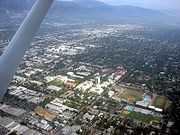
. Caltech has six academic divisions with strong emphases on science and engineering. Its 124 acres (50.2 ha) primary campus is located approximately 11 mi (17.7 km) northeast of downtown
Los Angeles
.
Although founded as a preparatory and vocational school by Amos G. Throop
in 1891, the college attracted influential scientists such as George Ellery Hale
, Arthur Amos Noyes
, and Robert Andrews Millikan in the early 20th century. The vocational and preparatory schools were disbanded and spun off in 1910, and the college assumed its present name in 1921. In 1934, Caltech was elected to the Association of American Universities
, and the antecedents of NASA
's Jet Propulsion Laboratory
, which Caltech continues to manage and operate, were established between 1936 and 1943 under Theodore von Karman
.
Despite its small size, 31 Caltech alumni and faculty have won the Nobel Prize
and 66 have won the National Medal of Science
or Technology
. There are 109 faculty members who have been elected to the National Academies
. In addition, numerous faculty members are associated with the Howard Hughes Medical Institute
as well as NASA
. Caltech managed $332 million in sponsored research and $1.55 billion for its endowment in 2010. In addition, Caltech has been consistently ranked as one of the world's top institutions, particularly in science
and engineering
. It also has a long standing rivalry with the Massachusetts Institute of Technology
(MIT).
In 2011, the Times Higher Education, United Kingdom's leading higher education news publication, ranked Caltech the number one university in the 2011-2012 world university rankings. This is the first time in the history of the publication Harvard has been displaced from number one. In the same ranking, Caltech was ranked first in the Engineering & Technology and Physical Sciences categories.
First year students are required to live on campus and 95% of undergraduates remain in the on-campus house system. Although Caltech has a strong tradition of practical jokes and pranks, student life is governed by an honor code which allows faculty to assign take-home examinations. The Caltech Beavers compete in 13 intercollegiate sports in the NCAA Division III's Southern California Intercollegiate Athletic Conference
.
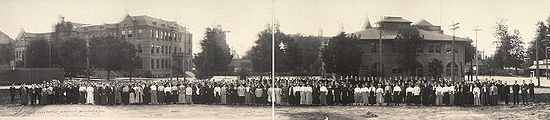 Caltech began as a vocational school
founded in Pasadena in 1891 by local businessman and politician Amos G. Throop
. The school was known successively as Throop University, Throop Polytechnic Institute, and Throop College of Technology, before acquiring its current name in 1920. The vocational school was disbanded and the preparatory program was split off to form an independent Polytechnic School
in 1907.
At a time when scientific research in the United States was still in its infancy, George Ellery Hale
, a solar astronomer from the University of Chicago
, founded the Mount Wilson Observatory
in 1904. He joined Throop's board of trustees in 1907, and soon began developing it and the whole of Pasadena into a major scientific and cultural destination. He engineered the appointment of James A. B. Scherer
, a literary scholar untutored in science but a capable administrator and fund raiser, to Throop's presidency in 1908. Scherer persuaded retired businessman and trustee Charles W. Gates to donate $25,000 in seed money to build Gates Laboratory, the first science building on campus.
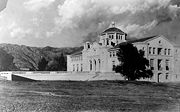 In 1910, Throop moved to its current site. Arther Fleming donated the land for the permanent campus site. Theodore Roosevelt
delivered an address at Throop Institute on March 21, 1911, and he declared:
In the same year, a bill was introduced in the California Legislature calling for the establishment of a publicly funded "California Institute of Technology," with an initial budget of a million dollars, ten times the budget of Throop at the time. The board of trustees offered to turn Throop over to the state, but the presidents of Stanford University
and the University of California
successfully lobbied to defeat the bill, which allowed Throop to develop as the only scientific research-oriented education institute in southern California, public or private, until the onset of the World War II
necessitated the broader development of research-based science education. The promise of Throop attracted physical chemist
Arthur Amos Noyes
from MIT
to develop the institution and assist in establishing it as a center for science
and technology
.
With the onset of World War I
, Hale organized the National Research Council
to coordinate and support scientific work on military problems. While he supported the idea of federal appropriations for science, he took exception to a federal bill that would have funded engineering research at land-grant colleges, and instead sought to raise a $1 million national research fund entirely from private sources. To that end, as Hale wrote in the New York Times:
Through the National Research Council, Hale simultaneously lobbied for science to play a larger role in national affairs, and for Throop to play a national role in science. The new funds were designated for physics research, and ultimately lead to the establishment of the Norman Bridge Laboratory, which attracted experimental physicist
Robert Andrews Millikan from the University of Chicago in 1917. During the course of the war, Hale, Noyes and Millikan worked together in Washington on the NRC. Subsequently, they continued their partnership in developing Caltech.
Under the leadership of Hale, Noyes and Millikan (aided by the booming economy of Southern California
), Caltech grew to national prominence in the 1920s and concentrated on the development of Roosevelt's "Hundredth Man". On November 29, 1921, the trustees declared it to be the express policy of the Institute to pursue scientific research of the greatest importance and at the same time "to continue to conduct thorough courses in engineering and pure science, basing the work of these courses on exceptionally strong instruction in the fundamental sciences of mathematics, physics, and chemistry; broadening and enriching the curriculum by a liberal amount of instruction in such subjects as English, history, and economics; and vitalizing all the work of the Institute by the infusion in generous measure of the spirit of research." In 1923, Millikan was awarded the Nobel Prize
in Physics
. In 1925, the school established a department of geology
and hired William Bennett Munro, then chairman of the division of History, Government, and Economics at Harvard University
, to create a division of humanities
and social sciences
at Caltech. In 1928, a division of biology
was established under the leadership of Thomas Hunt Morgan
, the most distinguished biologist in the United States at the time, and discoverer of the role of genes and the chromosome
in heredity. In 1930, Kerckhoff Marine Laboratory
was established in Corona del Mar under the care of Professor George MacGinitie. In 1926, a graduate school of aeronautics
was created, which eventually attracted Theodore von Kármán
. Kármán later helped create the Jet Propulsion Laboratory, and played an integral part in establishing Caltech as one of the world's centers for rocket science
. In 1928, construction of the Palomar Observatory
began.
Millikan served as "Chairman of the Executive Council" (effectively Caltech's president) from 1921 to 1945, and his influence was such that the Institute was occasionally referred to as "Millikan's School." Millikan initiated a visiting-scholars program soon after joining Caltech. Scientists who accepted his invitation include luminaries such as Paul Dirac
, Erwin Schrödinger
, Werner Heisenberg
, Hendrik Lorentz
and Niels Bohr
. Albert Einstein
arrived on the Caltech campus for the first time in 1931 to polish up his Theory of General Relativity, and he returned to Caltech subsequently as a visiting professor in 1932 and 1933.
During World War II
, Caltech was one of 131 colleges and universities nationally that took part in the V-12 Navy College Training Program
which offered students a path to a Navy commission.
and Richard Feynman
, whose work was central to the establishment of the Standard Model
of particle physics. Feynman was also widely known outside the physics community as an exceptional teacher and colorful, unconventional character.
During Lee A. DuBridge's tenure as Caltech's president (1946–1969), Caltech's faculty doubled and the campus tripled in size. DuBridge, unlike his predecessors, welcomed federal funding of science. New research fields flourished, including chemical biology
, planetary science
, nuclear astrophysics
, and geochemistry
. A 200-inch telescope was dedicated on nearby Palomar Mountain in 1948 and remained the world's most powerful optical telescope for over forty years.
Caltech opened its doors to female undergraduates during the presidency of Harold Brown
in 1970, and they made up 14% of the entering class. The fraction of female undergraduates has been increasing since then.
Caltech undergraduates have historically been so apathetic to politics that there has been only one organized student protest in January 1968 outside the Burbank studios of NBC
, in response to rumors that NBC was to cancel Star Trek
. In 1973, the students from Dabney House protested a presidential visit with a sign on the library bearing the simple phrase "Impeach Nixon". The following week, Ross McCollum, president of the National Oil Company
, wrote an open letter to Dabney House stating that in light of their actions he had decided not to donate one million dollars to Caltech. The Dabney family, being Republicans, disowned Dabney House after hearing of the prank.
has been located at Caltech. The project was established in 1986 to assemble, preserve, translate, and publish papers selected from the literary estate of Albert Einstein and from other collections.
In fall 2008, the freshman class was 42% female, a record for Caltech's undergraduate enrollment. In the same year, the Institute concluded a six-year long fund-raising campaign. The campaign raised more than $1.4 billion from about 16,000 donors. Nearly half of the funds went into the support of Caltech programs and projects.
In 2010, Caltech, in partnership with Lawrence Berkeley National Laboratory
, established a DOE
Energy Innovation Hub aimed at developing revolutionary methods to generate fuels directly from sunlight. This hub, the Joint Center for Artificial Photosynthesis, will receive up to $122 million in federal funding over five years.
A TEDx was organized in 2011, called TEDxCaltech. The theme of the event was Feynman's Vision: The Next 50 Years. The speakers included Caltech faculty and students, as well as external professors and entrepreneurs.
, approximately 11 miles (17.7 km) northeast of downtown
Los Angeles
. It is within walking distance of Old Town Pasadena
and the Pasadena Playhouse District
and therefore the two locations are frequent getaways for Caltech students.
In 1917 Hale hired architect Bertram Goodhue
to produce a master plan for the 22 acres (8.9 ha) campus. Goodhue conceived the overall layout of the campus and designed the physics building, Dabney Hall, and several other structures, in which he sought to be consistent with the local climate, the character of the school, and Hale's educational philosophy. Goodhue's designs for Caltech were also influenced by the traditional Spanish mission architecture
of Southern California.
In 1971 a magnitude-6.6 earthquake in San Fernando
caused some damage to the Caltech campus. Engineers who evaluated the damage found that two historic buildings dating from the early days of the Institute — Throop Hall and the Goodhue-designed Culbertson Auditorium — had cracked. These were some of the first reinforced concrete
buildings, and their plans did not contain enough details (such as how much reinforcing bar
had been embedded in the concrete) to be sure they were safe, so the engineers recommended demolition. However, demolishing these historic structures required considerably more effort than would have been necessary had they been in real danger of collapse. A large wrecking ball
was used to demolish Throop Hall, and smashing the concrete revealed massive amounts of rebar, far in excess of safety requirements. The rebar had to be cut up before the pieces could be hauled away, and the process took much longer than expected.
New additions to the campus include the Cahill Center for Astronomy and Astrophysics and the Walter and Leonore Annenberg Center for Information Science and Technology, which opened in 2009, and the Warren and Katherine Schlinger Laboratory for Chemistry and Chemical Engineering followed in March 2010. The Institute also concluded an upgrading of the south houses in 2006. In late 2010, Caltech completed a 1.3 MW solar array projected to produce approximately 1.6 GWh in 2011.
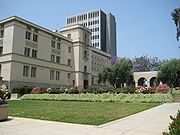 The mission statement of Caltech reads:
Caltech is incorporated as a non-profit corporation and is governed by a privately appointed 46-member board of trustees who serve five year terms of office and retire at the age of 72. The current board is chaired by Kent Kresa
, former chairman and CEO of Northrup Grumman and former chairman of General Motors
. The Trustees elect a President to serve as the chief executive officer of the Institute and administer the affairs on the Institute on behalf of the board, a Provost who serves as the chief academic officer of the Institute below the President, and ten other vice presidential and other senior positions. Former Georgia Tech
provost Jean-Lou Chameau
became the eighth president of Caltech on September 1, 2006, replacing David Baltimore
who had served since 1997. Dr. Chameau's compensation for 2008–2009 totaled $799,472. Edward M. Stolper is the Institute's ninth provost and is responsible for academic budget, faculty appointments and promotions, and coordinates curriculum. Caltech's $1.55 billion endowment is governed by a permanent Trustee committee and administered by an Investment Office.
The Institute is organized into six primary academic divisions: Biology, Chemistry and Chemical Engineering, Engineering and Applied Science, Geological and Planetary Sciences, Humanities and Social Sciences, and Physics, Mathematics, and Astronomy. The voting faculty of Caltech include all professors, instructors, research associates and fellows, and librarians. Faculty are responsible for establishing admission requirements, academic standards, and curricula. The Faculty Board is the faculty's representative body and consists of 18 elected faculty representatives as well as other senior administration officials. Full-time professors are expected to teach classes, conduct research, advise students, and perform administrative work such as serving on committees.
The Jet Propulsion Laboratory
(JPL) is a federally funded research and development center
(FFRDC) owned by NASA
and operated as a division of Caltech through a contract between NASA and Caltech. In 2008, JPL spend over $1.6 billion on research and development and employed over 5,000 project-related and support employees. The JPL Director also serves as a Caltech Vice President and is responsible to the President of the Institute for the management of the Laboratory.
since 1949. Caltech is on the quarter system
: the fall term starts in late September and ends before Christmas, the second term starts after New Years Day and ends in mid-March, and the third term starts in late March or early April and ends in early June.
Caltech was ranked 1st internationally in 2011 by the Times Higher Education World University Rankings
. Caltech was ranked as the best university in the world within the Engineering and Technology Universities category and second best within the Physical Sciences Universities category. It was also found to have the highest faculty citation rate in the world.
Shanghai Jiao Tong University's Academic Ranking of World Universities
, a ranking with an emphasis on bibliometric data and scientific research, ranked Caltech 6th in the world and 5th in the U.S. for 2010. Caltech was also found to have the highest score for per-capita performance in that ranking.
U.S. News & World Report
ranked Caltech as the 5th best university in the United States in their 2012 national college rankings, together with MIT
, Stanford University
, University of Chicago
and University of Pennsylvania
. According to the U.S. News & World Report's Best Graduate Schools 2011 ranking, "California Institute of Technology headlines the new rankings, with top billing in three categories: chemistry, earth sciences and physics."
The United States National Research Council
released its latest Assessment of Research Doctorate Programs in 2010, and 23 of the 24 graduate programs of Caltech were ranked within the top four programs in the nation in their size quartile as determined by both the R95 and S95 rankings. Of particular note, programs that were placed within the top 10% of all size programs in that field based on an average of the R95 and S95 rank order include Aeronautics, Astrophysics, Biochemistry and Molecular Biophysics, Bioengineering, Biology, Chemical Engineering, Chemistry, Electrical Engineering, Environmental Science and Engineering, Geology, Geophysics, Materials Science, Mechanical Engineering, Physics, Planetary Science, and Social Science (Economics).
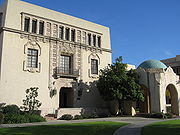 The full time, four year undergraduate program emphasizes instruction in the arts and sciences and has high graduate coexistence. Caltech offers 24 majors (called "options") and six minors across all six academic divisions. Caltech also offers interdisciplinary programs in Applied Physics, Biochemistry, Bioengineering, Computation and Neural Systems, Control and Dynamical Systems, Environmental Science and Engineering, Geobiology and Astrobiology, Geochemistry, and Planetary Astronomy. The most popular options are Chemical Engineering, Computer Science, Electrical Engineering, Mechanical Engineering and Physics.
Caltech requires students to take a core curriculum of 30 classes: five terms of mathematics, five terms of physics, two terms of chemistry, one term of biology, a freshman elective "menu" course, two terms of introductory lab courses, 2 terms of science writing, and 12 terms of humanities. A typical class is worth 9 academic units and given the extensive core curriculum requirements in addition to individual options' degree requirements, students need to take an average of 40.5 units per term (more than four classes) in order to graduate in four years. 36 units is the minimum full-time load, 48 units is considered a heavy load, and registrations above 54 units require an overload petition. Approximately 20 percent of students double-major. This is achievable since the humanities and social sciences majors have been designed to be done in conjunction with a science major. Although choosing two options in the same division is discouraged, it is still possible.
First year students are enrolled in first-term classes based upon results of placement exams in math, physics, chemistry, and writing and take all classes in their first two terms on a Pass/Fail basis. There is little competition; collaboration on homework
is encouraged and the Honor System encourages take-home tests and flexible homework schedules. Caltech offers co-operative programs with other schools, such as the Pasadena Art Center College of Design
and Occidental College
.
Undergraduate tuition for the 2011–2012 school year was $36,387 and total annual costs were estimated to be $54,090. In 2010–2011, Caltech awarded $14.2 million in need-based aid, $940k in non-need-based aid, and $2.35 million in self-help support to every enrolled undergraduate student. The average financial aid package of all students eligible for need-based aid was $34,928 and students graduated with an average debt of $9,561.
Upon graduation, Caltech alumni have the highest median starting salary among graduates of other colleges or universities in 2010-2011, of $69,900, according to PayScale
. The mid-career median pay is $120,000. Caltech was found to offer the highest return of investment of college education, at $1,713,000 over a 30-year period, according to the same study.
Caltech offers Army and Air Force ROTC in cooperation with the University of Southern California
.
. GRE Subject scores are either required or strongly recommended.
The research facilities at Caltech are available to graduate students, but there are opportunities for students to work in facilities of other universities, research centers as well as private industries. The graduate student to faculty ratio is 4:1.
Approximately 99% of doctoral students have full financial support. Financial support for graduate students comes in the form of fellowships, research assistantships, teaching assistantships or a combination of fellowship and assistantship support.
Graduate students are bound by the Honor Code, as are the undergraduates, and the Graduate Review Board oversees any violations of the code.
in 1934 and remains a research university with "very high" research activity, primarily in STEM fields
. Caltech manages research expenditures of $270 million annually, 66th among all universities in the U.S. and 17th among private institutions without medical schools for 2008. The largest federal agencies contributing to research are NASA
, National Science Foundation
, Department of Health and Human Services
, Department of Defense
, and Department of Energy
. Caltech received $144 million in federal funding for the physical sciences, $40.8 million for the life sciences, $33.5 million for engineering, $14.4 million for environmental sciences, $7.16 million for computer sciences, and $1.97 million for mathematical sciences in 2008.
The Institute was awarded an all-time high funding of $357 million in 2009. Active funding from the National Science Foundation
Directorate of Mathematical and Physical Science (MPS) for Caltech stands at $343 million as of 2011, the highest for any educational institution in the nation, and higher than the total funds allocated to any state except California and New York.
In 2005, Caltech had 739000 square feet (68,655.3 m²) dedicated to research: 330000 square feet (30,658 m²) to physical sciences, 163000 square feet (15,143.2 m²) to engineering, and 160000 square feet (14,864.5 m²) to biological sciences.
In addition to managing JPL, Caltech also operates the Palomar Observatory
in San Diego County, the Owens Valley Radio Observatory
in Bishop, California
, the Submillimeter Observatory
and W. M. Keck Observatory at the Mauna Kea Observatory
, the Laser Interferometer Gravitational-Wave Observatory
at Livingston, Louisiana
and Richland, Washington
, and Kerckhoff Marine Laboratory
in Corona del Mar, California. The Institute launched the Kavli Nanoscience Institute at Caltech in 2006, the Keck Institute for Space Studies
in 2008, and is also the current home for the Einstein Papers Project
. The Spitzer Science Center (SSC), part of the Infrared Processing and Analysis Center
located on the Caltech campus, is the data analysis and community support center for NASA
's Spitzer Space Telescope
.
Undergraduates at Caltech are also encouraged to participate in research
. About 80% of the class of 2010 did research through the annual Summer Undergraduate Research Fellowships (SURF) program at least once during their stay, and many continued during the school year. Students write and submit SURF proposals for research projects in collaboration with professors, and about 70 percent of applicants are awarded SURFs. The program is open to both Caltech and non-Caltech undergraduate students. It serves as preparation for graduate school and helps to explain why Caltech has the highest percentage of alumni who go on to receive a PhD of all the major universities.
The licensing and transferring of technology to the commercial sector is managed by the Office of Technology Transfer (OTT). OTT protects and manages the intellectual property developed by faculty members, students, other researchers, and JPL technologists. Caltech receives more invention disclosures per faculty member than any other university in the nation. As of 2008, 1891 patents were granted to Caltech researchers since 1969.
to a house system
. Four south houses (or hovses) were built: Blacker House, Dabney House, Fleming House and Ricketts House. In the 1960s, three north houses were built: Lloyd House, Page House, and Ruddock House, and during the 1990s, Avery House. The four south houses closed for renovation in 2005 and reopened in 2006. All first year students live in the house system and 95% of undergraduates remain in it.
, which Caltech co-founded in 1915. The fencing team competes in the NCAA's Division I, facing teams from USC
, UCLA, UCSD, and Stanford, among others.
On January 6, 2007, the Beavers' men's basketball team snapped a 207-game losing streak to Division III schools, beating Bard College
81-52. It was their first Division III victory since 1996.
Until their win over Occidental on February 22, 2011 the team had not won a game in conference
play since 1985. Ryan Elmquist's free throw with 3.3 seconds in regulation gave the Beavers the victory. The documentary film
Quantum Hoops
concerns the events of the Beavers' 2005–06 season.
On January 13, 2007, the Caltech women's basketball team snapped a 50-game losing streak, defeating the Pomona–Pitzer
Sagehens 55-53. The women's program, which entered the SCIAC
in 2002, garnered their first conference win. On the bench as honorary coach for the evening was Dr. Robert Grubbs, 2005 Nobel Laureate in Chemistry. The team went on to beat Whittier College on February 10, for its second SCIAC win, and placed its first member on the All Conference team. The 2006-2007 season is the most successful season in the history of the program.
On October 22, 2008, the soccer team snapped a 201-game losing streak with a last-second goal against Cal Lutheran University, 1-0.
In 2007, 2008, and 2009, the women's table tennis team (a club team) competed in nationals. The women's Ultimate
club team, known as "Snatch", has also been very successful in recent years, ranking 44 of over 200 college teams in the Ultimate Player's Association.
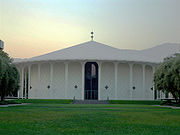
, Dabney House conducts the infamous "Millikan pumpkin-drop experiment" from the top of Millikan Library, the highest point on campus. According to tradition, a claim was once made that the shattering of a pumpkin frozen in liquid nitrogen
and dropped from a sufficient height would produce a triboluminescent
spark. This yearly event involves a crowd of observers, who try to spot the elusive spark. The title of the event is an oblique reference to the famous Millikan oil-drop experiment
which measured e, the elemental unit of electrical charge
.
On Ditch Day, the seniors ditch school, leaving behind elaborately designed tasks and traps at the doors of their rooms to prevent underclassmen from entering. Over the years this has evolved to the point where many seniors spend months designing mechanical, electrical, and software obstacles to confound the underclassmen. Each group of seniors designs a "stack" to be solved by a handful of underclassmen. The faculty have been drawn into the event as well, and cancel all classes on Ditch Day so the underclassmen can participate in what has become a highlight of the academic year. In 2010, Ditch Day fell on May 21.
Another long-standing tradition is the playing of Wagner's Ride of the Valkyries
at 7:00 each morning during finals week with the largest, loudest speakers available. The playing of that piece is not allowed at any other time (except if one happens to be listening to the entire 15 hours of The Ring Cycle), and any offender is dragged into the showers to be drenched in cold water fully dressed. The playing of the Ride is such a strong tradition that the music was used during Apollo 17
to awaken Astronaut Harrison Schmitt
, a Caltech alumnus. Unfortunately, the tradition arose at different times in different Houses, so Schmitt did not react as expected. Instead, he just became confused.
s (also known as "RFs").
The two most famous in recent history are the changing of the Hollywood Sign
to read "Caltech", by judiciously covering up certain parts of the letters, and the changing of the scoreboard to read Caltech 38, MIT 9 during the 1984 Rose Bowl Game
. But the most famous of all occurred during the 1961 Rose Bowl Game
, where Caltech students altered the flip-cards that were raised by the stadium attendees to display "Caltech", and several other "unintended" messages. This event is now referred to as the Great Rose Bowl Hoax
.
In 2005, a group of Caltech students pulled a string of pranks during MIT's Campus Preview Weekend for admitted students. These include covering up the word Massachusetts in the "Massachusetts Institute of Technology" engraving on the main building façade with a banner so that it read "That Other Institute of Technology". A group of MIT hackers
responded by altering the banner so that the inscription read "The Only Institute of Technology." Caltech students also passed out T-shirts to MIT's incoming freshman class, with MIT on the front and "... because not everyone can go to Caltech" along with an image of a palm tree on the back.
MIT retaliated in April 2006, when students posing as the Howe & Ser (Howitzer) Moving Company stole the 130-year-old, 1.7-ton Fleming House cannon and moved it to their campus in Cambridge, Massachusetts for their 2006 Campus Preview Weekend, repeating a similar prank performed by nearby Harvey Mudd College
in 1986. Thirty members of Fleming House traveled to MIT and reclaimed their cannon on April 10, 2006.
On April 13, 2007 (Friday the 13th), a group of students from The California Tech, Caltech's campus newspaper, arrived and distributed fake copies of The Tech, MIT's campus newspaper, while prospective students were visiting for their Campus Preview Weekend. Articles included "MIT Invents the Interweb," "Architects Deem Campus 'Unfortunate'," and "Infinite Corridor Not Actually Infinite."
In recent years, pranking has been officially encouraged by Tom Mannion, Caltech's Assistant VP for Student Affairs and Campus Life. "The grand old days of pranking have gone away at Caltech, and that's what we are trying to bring back," reported the Boston Globe, which noted that "security has orders not to intervene in a prank unless officers get Mannion's approval beforehand."
Caltech pranks have been documented in three Legends of Caltech books, the most recent of which was edited by alumni Autumn Looijen '99 and Mason A. Porter '98 and published in May 2007.
In December 2009, some Caltech students declared that MIT had been sold and had become the Caltech East campus. A "sold" banner was hung on front of the MIT dome building and a "Welcome to Caltech East: School of the Humanities" banner over the Massachusetts Avenue Entrance. Newspapers and t-shirts were distributed, and door labels and fliers in the infinite corridor were put up in accordance with the "curriculum change."
In September 2010, MIT students attempted to put a TARDIS
, time machine from the BBC's Doctor Who
, onto a roof. Caught in midact, the prank was aborted. In January 2011, Caltech students in conjunction with MIT students helped put the TARDIS on top of Baxter. Caltech students then moved the TARDIS to UC Berkeley and Stanford.
 Life in the Caltech community is governed by the Honor Code
, which simply states: "No member of the Caltech community shall take unfair advantage of any other member of the Caltech community." This is enforced by a Board of Control, which consists of undergraduate students, and by a similar body at the graduate level, called the Graduate Review Board.
The Honor Code aims at promoting an atmosphere of respect and trust that allows Caltech students to enjoy privileges that make for a more relaxed atmosphere. For example, the Honor Code allows professors to make the majority of exams as take-home, allowing students to take them on their own schedule and in their preferred environment.
Through the late 1990s, the only exception to the Honor Code, implemented earlier in the decade in response to changes in federal regulations, concerned the sexual harassment policy. Today, there are myriad exceptions to the Honor Code in the form of new institute policies such as the Fire Policy, and Alcohol Policy. Though both policies are presented in the Honor Code Handbook given to new members of the Caltech Community, large portions of the undergraduate population regard them as a slight against the Honor Code and the implicit trust and respect it represents within the community.
to its name. This figure includes 17 alumni, 14 non-alumni professors, and 4 professors who are also alumni (Carl D. Anderson, Linus Pauling
, William A. Fowler, and Edward B. Lewis
). The number of awards is 32, because Pauling received prizes in both Chemistry
and Peace. With fewer than 25,000 alumni in total, more than one in 1,400 have received the Nobel Prize — a ratio unmatched by any other university. Six faculty and alumni have received a Crafoord Prize
from the Royal Swedish Academy of Sciences
, while 56 have been awarded the U.S. National Medal of Science
, and 10 have received the National Medal of Technology
. One alumnus, Stanislav Smirnov
, won the Fields Medal
in 2010. Other distinguished researchers have been affiliated with Caltech as postdoctoral scholars (for example, Barbara McClintock
, James D. Watson
and Sheldon Glashow) or visiting professors (for example, Albert Einstein
, Stephen Hawking
and Edward Witten
).
Caltech enrolled 978 undergraduate students and 1253 graduate students for the 2011–2012 school year. Women made up 39% of the undergraduate and 28% of the graduate student body. 68% of non-international freshmen are from out of state. Caltech received 5,225 applications for the Class of 2015: 667 were admitted (12.8%) and 244 of them enrolled. The interquartile range
for first year students' SAT
scores was 2200 to 2340. 99% of students were ranked in the top tenth of their high school graduating class.
The four-year graduation rate is 80.7% and the six-year rate is 90.3%, which is low compared to most leading U.S. universities, but substantially higher than it was in the 1960s and 70s. Students majoring in STEM fields
traditionally have graduation rates below 70%.
was perhaps the most well-known physicist to be associated with Caltech, having published the Feynman Lectures on Physics, an undergraduate physics text, and a few other popular science texts such as Six Easy Pieces for the general audience. The promotion of physics made him a public figure of science, although his Nobel-winning work in quantum electrodynamics
was already very established in the scientific community. Murray Gell-Mann
, a Nobel-winning physicist, introduced a classification of hadrons and went on to postulate the existence of quarks, which is currently accepted as part of the Standard Model
. Linus Pauling
pioneered quantum chemistry
and molecular biology
, and he went on to solve for the nature of the chemical bond in 1939. Seismologist Charles Richter, also an alumnus, developed the magnitude scale that bears his name, the Richter scale for measuring the power of earthquakes. In engineering, Theodore von Kármán
made many key advances in aerodynamics, notably his work on supersonic
and hypersonic
airflow characterization. A repeating pattern of swirling vortices is named after him, the von Kármán vortex street
. More recently, Michael Brown
, a professor of planetary astronomy, discovered many trans-Neptunian object
s, most notably the dwarf planet
Eris
, which prompted the International Astronomical Union
to redefine the term "planet
".
David Baltimore
, the Robert A. Millikan Professor of Biology, and Alice Huang
, Senior Faculty Associate in Biology, have served as the President of AAAS
from 2007–2008 and 2010-2011 respectively.
33 percent of the faculty are members of the National Academy of Science or Engineering
and/or fellows of the American Academy of Arts and Sciences
. This is the highest percentage of any faculty in the country with the exception of the graduate institution Rockefeller University
.
The average salary for assistant professors at Caltech is $108,100, associate professors $112,400, and full professors $171,500. Caltech faculty are highly productive in the fields of applied physics, astronomy and astrophysics, biology, biochemistry, biological engineering, chemical engineering, computer science, geology, mechanical engineering and physics.
. The Turing Award
, the "Nobel Prize of Computer Science", has been awarded to six alumni, and one has won the Fields Medal
.
Alumni have participated in scientific research. Some have concentrated their studies on the very small universe of atoms and molecules. Nobel laureate
Carl D. Anderson (BS 1927, PhD 1930) proved the existence of positron
s and muon
s, Nobel laureate Edwin McMillan
(BS 1928, MS 1929) synthesized the first transuranium element
, Nobel laureate Leo James Rainwater (BS 1939) investigated the non-spherical shapes of atomic nuclei, and Nobel laureate Douglas D. Osheroff
(BS 1967) studied the superfluid
nature of helium-3
. Donald Knuth
(PhD 1963), the "father" of the analysis of algorithms
, wrote The Art of Computer Programming
and created the TeX
computer typesetting system, which is commonly used in the scientific community.
Other alumni have turned their gaze to the universe. C. Gordon Fullerton
(BS 1957, MS 1958) piloted the third space shuttle
mission and orbited the earth in Skylab
. Astronaut (and later, United States Senator) Harrison Schmitt
(BS 1957) was the only geologist
to have ever walked on the surface of the moon. Astronomer Eugene Merle Shoemaker
(BS 1947, MS 1948) co-discovered Comet Shoemaker-Levy 9
(a comet which crashed into the planet Jupiter
) and was the first person buried on the moon (by having his ashes crashed into the moon).
Undergraduate alumni founded, or co-founded, companies such as LCD manufacturer Varitronix, Hotmail
, Compaq
, and MathWorks (which created Matlab
), while graduate students founded, or co-founded, companies such as Intel, TRW
, and the non-profit educational organization, the Exploratorium
.
Arnold Beckman
(PhD 1928) invented the pH meter
and commecialized it with the founding of Beckman Instruments. His success with that company enabled him to provide seed funding for William Shockley
(BS 1932), who had co-invented semiconductor
transistor
s and wanted to commercialize them. Because his aging mother was living in Palo Alto, California
at the time, Shockley decided to establish his laboratory near her in 1955, in neighboring Mountain View, California
, and thus, Shockley became the founding Director of the Shockley Semiconductor Laboratory
division of Beckman Instruments. Shockely was a co-recipient of the Nobel Prize in physics in 1956, but his aggressive management style and odd personality at the Shockley Lab became unbearable. In late 1957, eight of his researchers, known now as the "Traitorous Eight
" (or "Fairchildren"), resigned and joined Fairchild Camera and Instruments
nearby to form a semiconductor division. Among the "Traitorous Eight" was Gordon E. Moore (PhD 1954), who later left Fairchild to co-found Intel. Other offspring companies of Fairchild Semiconductor include National Semiconductor
and Advanced Micro Devices
, which in turn spawned more technology companies in the area. Shockley's decision to use silicon
-- instead of germanium
-- as the semiconductor
material, coupled with the abundance of silicon semiconductor related companies in the area, gave rise to the term "Silicon Valley
" to describe that geographic region surrounding Palo Alto.
Caltech alumni also held public offices, with James Fletcher
(PhD 1948) being the 4th and 7th Administrator of NASA, Steven Koonin
(PhD 1972) being the Undersecretary of Energy for Science and Regina Dugan
(PhD 1993) being the director of DARPA.
, a Caltech reference is often used to establish a character's high level of intelligence or a technical background. For example, on television, the four male lead characters of the sitcom The Big Bang Theory are all employed at the Institute, as well as in the TV show Criminal Minds
, where the character Dr. Spencer Reid attended this school for multiple degrees. Caltech is also the inspiration, and frequent film location, for the California Institute of Science of Numb3rs
. On film, the Pacific Tech of The War of the Worlds
and Real Genius
is based on Caltech.
In nonfiction, two 2007 documentaries examine aspects of Caltech; Curious, its researchers, and Quantum Hoops, its men's basketball team.
Given its Los Angeles-area location, the grounds of the Institute are often host to short scenes in movies and television. The Athenaeum dining club
appears in the Beverly Hills Cop series
, The X-Files
, True Romance
, and The West Wing. Other examples include Legally Blonde
, The Wedding Planner
, Greek
, The O.C.
, Entourage
and Mission Impossible.
Private university
Private universities are universities not operated by governments, although many receive public subsidies, especially in the form of tax breaks and public student loans and grants. Depending on their location, private universities may be subject to government regulation. Private universities are...
research university located in Pasadena, California
Pasadena, California
Pasadena is a city in Los Angeles County, California, United States. Although famous for hosting the annual Rose Bowl football game and Tournament of Roses Parade, Pasadena is the home to many scientific and cultural institutions, including the California Institute of Technology , the Jet...
, United States
United States
The United States of America is a federal constitutional republic comprising fifty states and a federal district...
. Caltech has six academic divisions with strong emphases on science and engineering. Its 124 acres (50.2 ha) primary campus is located approximately 11 mi (17.7 km) northeast of downtown
Downtown Los Angeles
Downtown Los Angeles is the central business district of Los Angeles, California, United States, located close to the geographic center of the metropolitan area...
Los Angeles
Los Ángeles
Los Ángeles is the capital of the province of Biobío, in the commune of the same name, in Region VIII , in the center-south of Chile. It is located between the Laja and Biobío rivers. The population is 123,445 inhabitants...
.
Although founded as a preparatory and vocational school by Amos G. Throop
Amos G. Throop
Amos Gager Throop was a businessman and politician in Chicago, Illinois during the 1840s and 1850s. Most famously he was known for being a staunch abolitionist prior to the Civil War. In Chicago he lost two campaigns to be that city's mayor in 1852 and 1854. In both elections he was the nominee of...
in 1891, the college attracted influential scientists such as George Ellery Hale
George Ellery Hale
George Ellery Hale was an American solar astronomer.-Biography:Hale was born in Chicago, Illinois. He was educated at MIT, at the Observatory of Harvard College, , and at Berlin . As an undergraduate at MIT, he is known for inventing the spectroheliograph, with which he made his discovery of...
, Arthur Amos Noyes
Arthur Amos Noyes
Arthur Amos Noyes was a U.S. chemist and educator. He served as the acting president of MIT between 1907 and 1909. He received a PhD. in 1890 at Leipzig under the guidance of Wilhelm Ostwald. Roscoe Gilkey Dickinson was one of his famous students. Noyes served as Professor of Chemistry at the...
, and Robert Andrews Millikan in the early 20th century. The vocational and preparatory schools were disbanded and spun off in 1910, and the college assumed its present name in 1921. In 1934, Caltech was elected to the Association of American Universities
Association of American Universities
The Association of American Universities is an organization of leading research universities devoted to maintaining a strong system of academic research and education...
, and the antecedents of NASA
NASA
The National Aeronautics and Space Administration is the agency of the United States government that is responsible for the nation's civilian space program and for aeronautics and aerospace research...
's Jet Propulsion Laboratory
Jet Propulsion Laboratory
Jet Propulsion Laboratory is a federally funded research and development center and NASA field center located in the San Gabriel Valley area of Los Angeles County, California, United States. The facility is headquartered in the city of Pasadena on the border of La Cañada Flintridge and Pasadena...
, which Caltech continues to manage and operate, were established between 1936 and 1943 under Theodore von Karman
Theodore von Karman
Theodore von Kármán was a Hungarian-American mathematician, aerospace engineer and physicist who was active primarily in the fields of aeronautics and astronautics. He is responsible for many key advances in aerodynamics, notably his work on supersonic and hypersonic airflow characterization...
.
Despite its small size, 31 Caltech alumni and faculty have won the Nobel Prize
Nobel Prize
The Nobel Prizes are annual international awards bestowed by Scandinavian committees in recognition of cultural and scientific advances. The will of the Swedish chemist Alfred Nobel, the inventor of dynamite, established the prizes in 1895...
and 66 have won the National Medal of Science
National Medal of Science
The National Medal of Science is an honor bestowed by the President of the United States to individuals in science and engineering who have made important contributions to the advancement of knowledge in the fields of behavioral and social sciences, biology, chemistry, engineering, mathematics and...
or Technology
National Medal of Technology
The National Medal of Technology and Innovation is an honor granted by the President of the United States to American inventors and innovators who have made significant contributions to the development of new and important technology...
. There are 109 faculty members who have been elected to the National Academies
United States National Academies
The United States National Academies comprises four organizations:* National Academy of Sciences * National Academy of Engineering * Institute of Medicine * National Research Council...
. In addition, numerous faculty members are associated with the Howard Hughes Medical Institute
Howard Hughes Medical Institute
Howard Hughes Medical Institute is a United States non-profit medical research organization based in Chevy Chase, Maryland. It was founded by the American businessman Howard Hughes in 1953. It is one of the largest private funding organizations for biological and medical research in the United...
as well as NASA
NASA
The National Aeronautics and Space Administration is the agency of the United States government that is responsible for the nation's civilian space program and for aeronautics and aerospace research...
. Caltech managed $332 million in sponsored research and $1.55 billion for its endowment in 2010. In addition, Caltech has been consistently ranked as one of the world's top institutions, particularly in science
Science
Science is a systematic enterprise that builds and organizes knowledge in the form of testable explanations and predictions about the universe...
and engineering
Engineering
Engineering is the discipline, art, skill and profession of acquiring and applying scientific, mathematical, economic, social, and practical knowledge, in order to design and build structures, machines, devices, systems, materials and processes that safely realize improvements to the lives of...
. It also has a long standing rivalry with the Massachusetts Institute of Technology
Massachusetts Institute of Technology
The Massachusetts Institute of Technology is a private research university located in Cambridge, Massachusetts. MIT has five schools and one college, containing a total of 32 academic departments, with a strong emphasis on scientific and technological education and research.Founded in 1861 in...
(MIT).
In 2011, the Times Higher Education, United Kingdom's leading higher education news publication, ranked Caltech the number one university in the 2011-2012 world university rankings. This is the first time in the history of the publication Harvard has been displaced from number one. In the same ranking, Caltech was ranked first in the Engineering & Technology and Physical Sciences categories.
First year students are required to live on campus and 95% of undergraduates remain in the on-campus house system. Although Caltech has a strong tradition of practical jokes and pranks, student life is governed by an honor code which allows faculty to assign take-home examinations. The Caltech Beavers compete in 13 intercollegiate sports in the NCAA Division III's Southern California Intercollegiate Athletic Conference
Southern California Intercollegiate Athletic Conference
The Southern California Intercollegiate Athletic Conference is a college athletic conference that operates in the NCAA's Division III. The conference was founded in 1915 and it consists of twelve small private schools which are located in Southern California and organized into nine athletic programs...
.
Throop College
Vocational school
A vocational school , providing vocational education, is a school in which students are taught the skills needed to perform a particular job...
founded in Pasadena in 1891 by local businessman and politician Amos G. Throop
Amos G. Throop
Amos Gager Throop was a businessman and politician in Chicago, Illinois during the 1840s and 1850s. Most famously he was known for being a staunch abolitionist prior to the Civil War. In Chicago he lost two campaigns to be that city's mayor in 1852 and 1854. In both elections he was the nominee of...
. The school was known successively as Throop University, Throop Polytechnic Institute, and Throop College of Technology, before acquiring its current name in 1920. The vocational school was disbanded and the preparatory program was split off to form an independent Polytechnic School
Polytechnic School
Polytechnic School, often referred to as simply Poly, is a college preparatory private school in Pasadena, California.-History:The school was founded in 1907 as the first private non-sectarian, non-profit elementary school in California. It descends from the Throop Polytechnic Institute founded by...
in 1907.
At a time when scientific research in the United States was still in its infancy, George Ellery Hale
George Ellery Hale
George Ellery Hale was an American solar astronomer.-Biography:Hale was born in Chicago, Illinois. He was educated at MIT, at the Observatory of Harvard College, , and at Berlin . As an undergraduate at MIT, he is known for inventing the spectroheliograph, with which he made his discovery of...
, a solar astronomer from the University of Chicago
University of Chicago
The University of Chicago is a private research university in Chicago, Illinois, USA. It was founded by the American Baptist Education Society with a donation from oil magnate and philanthropist John D. Rockefeller and incorporated in 1890...
, founded the Mount Wilson Observatory
Mount Wilson Observatory
The Mount Wilson Observatory is an astronomical observatory in Los Angeles County, California, United States. The MWO is located on Mount Wilson, a 5,715 foot peak in the San Gabriel Mountains near Pasadena, northeast of Los Angeles...
in 1904. He joined Throop's board of trustees in 1907, and soon began developing it and the whole of Pasadena into a major scientific and cultural destination. He engineered the appointment of James A. B. Scherer
James Augustin Brown Scherer
James A. B. Scherer served as the last President of the Throop Polytechnic Institute until its renaming to the California Institute of Technology . Before being asked by George Ellery Hale to serve as President of Throop, Scherer was a Lutheran minister...
, a literary scholar untutored in science but a capable administrator and fund raiser, to Throop's presidency in 1908. Scherer persuaded retired businessman and trustee Charles W. Gates to donate $25,000 in seed money to build Gates Laboratory, the first science building on campus.
World Wars
Theodore Roosevelt
Theodore "Teddy" Roosevelt was the 26th President of the United States . He is noted for his exuberant personality, range of interests and achievements, and his leadership of the Progressive Movement, as well as his "cowboy" persona and robust masculinity...
delivered an address at Throop Institute on March 21, 1911, and he declared:
I want to see institutions like Throop turn out perhaps ninety-nine of every hundred students as men who are to do given pieces of industrial work better than any one else can do them; I want to see those men do the kind of work that is now being done on the Panama Canal and on the great irrigation projects in the interior of this country—and the one-hundredth man I want to see with the kind of cultural scientific training that will make him and his fellows the matrix out of which you can occasionally develop a man like your great astronomer, George Ellery Hale.
In the same year, a bill was introduced in the California Legislature calling for the establishment of a publicly funded "California Institute of Technology," with an initial budget of a million dollars, ten times the budget of Throop at the time. The board of trustees offered to turn Throop over to the state, but the presidents of Stanford University
Stanford University
The Leland Stanford Junior University, commonly referred to as Stanford University or Stanford, is a private research university on an campus located near Palo Alto, California. It is situated in the northwestern Santa Clara Valley on the San Francisco Peninsula, approximately northwest of San...
and the University of California
University of California
The University of California is a public university system in the U.S. state of California. Under the California Master Plan for Higher Education, the University of California is a part of the state's three-tier public higher education system, which also includes the California State University...
successfully lobbied to defeat the bill, which allowed Throop to develop as the only scientific research-oriented education institute in southern California, public or private, until the onset of the World War II
World War II
World War II, or the Second World War , was a global conflict lasting from 1939 to 1945, involving most of the world's nations—including all of the great powers—eventually forming two opposing military alliances: the Allies and the Axis...
necessitated the broader development of research-based science education. The promise of Throop attracted physical chemist
Physical chemistry
Physical chemistry is the study of macroscopic, atomic, subatomic, and particulate phenomena in chemical systems in terms of physical laws and concepts...
Arthur Amos Noyes
Arthur Amos Noyes
Arthur Amos Noyes was a U.S. chemist and educator. He served as the acting president of MIT between 1907 and 1909. He received a PhD. in 1890 at Leipzig under the guidance of Wilhelm Ostwald. Roscoe Gilkey Dickinson was one of his famous students. Noyes served as Professor of Chemistry at the...
from MIT
Massachusetts Institute of Technology
The Massachusetts Institute of Technology is a private research university located in Cambridge, Massachusetts. MIT has five schools and one college, containing a total of 32 academic departments, with a strong emphasis on scientific and technological education and research.Founded in 1861 in...
to develop the institution and assist in establishing it as a center for science
Science
Science is a systematic enterprise that builds and organizes knowledge in the form of testable explanations and predictions about the universe...
and technology
Technology
Technology is the making, usage, and knowledge of tools, machines, techniques, crafts, systems or methods of organization in order to solve a problem or perform a specific function. It can also refer to the collection of such tools, machinery, and procedures. The word technology comes ;...
.
With the onset of World War I
World War I
World War I , which was predominantly called the World War or the Great War from its occurrence until 1939, and the First World War or World War I thereafter, was a major war centred in Europe that began on 28 July 1914 and lasted until 11 November 1918...
, Hale organized the National Research Council
United States National Research Council
The National Research Council of the USA is the working arm of the United States National Academies, carrying out most of the studies done in their names.The National Academies include:* National Academy of Sciences...
to coordinate and support scientific work on military problems. While he supported the idea of federal appropriations for science, he took exception to a federal bill that would have funded engineering research at land-grant colleges, and instead sought to raise a $1 million national research fund entirely from private sources. To that end, as Hale wrote in the New York Times:
Throop College of Technology, in Pasadena California has recently afforded a striking illustration of one way in which the Research Council can secure co-operation and advance scientific investigation. This institution, with its able investigators and excellent research laboratories, could be of great service in any broad scheme of cooperation. President Scherer, hearing of the formation of the council, immediately offered to take part in its work, and with this object, he secured within three days an additional research endowment of one hundred thousand dollars.
Through the National Research Council, Hale simultaneously lobbied for science to play a larger role in national affairs, and for Throop to play a national role in science. The new funds were designated for physics research, and ultimately lead to the establishment of the Norman Bridge Laboratory, which attracted experimental physicist
Physics
Physics is a natural science that involves the study of matter and its motion through spacetime, along with related concepts such as energy and force. More broadly, it is the general analysis of nature, conducted in order to understand how the universe behaves.Physics is one of the oldest academic...
Robert Andrews Millikan from the University of Chicago in 1917. During the course of the war, Hale, Noyes and Millikan worked together in Washington on the NRC. Subsequently, they continued their partnership in developing Caltech.
Under the leadership of Hale, Noyes and Millikan (aided by the booming economy of Southern California
Southern California
Southern California is a megaregion, or megapolitan area, in the southern area of the U.S. state of California. Large urban areas include Greater Los Angeles and Greater San Diego. The urban area stretches along the coast from Ventura through the Southland and Inland Empire to San Diego...
), Caltech grew to national prominence in the 1920s and concentrated on the development of Roosevelt's "Hundredth Man". On November 29, 1921, the trustees declared it to be the express policy of the Institute to pursue scientific research of the greatest importance and at the same time "to continue to conduct thorough courses in engineering and pure science, basing the work of these courses on exceptionally strong instruction in the fundamental sciences of mathematics, physics, and chemistry; broadening and enriching the curriculum by a liberal amount of instruction in such subjects as English, history, and economics; and vitalizing all the work of the Institute by the infusion in generous measure of the spirit of research." In 1923, Millikan was awarded the Nobel Prize
Nobel Prize
The Nobel Prizes are annual international awards bestowed by Scandinavian committees in recognition of cultural and scientific advances. The will of the Swedish chemist Alfred Nobel, the inventor of dynamite, established the prizes in 1895...
in Physics
Nobel Prize in Physics
The Nobel Prize in Physics is awarded once a year by the Royal Swedish Academy of Sciences. It is one of the five Nobel Prizes established by the will of Alfred Nobel in 1895 and awarded since 1901; the others are the Nobel Prize in Chemistry, Nobel Prize in Literature, Nobel Peace Prize, and...
. In 1925, the school established a department of geology
Geology
Geology is the science comprising the study of solid Earth, the rocks of which it is composed, and the processes by which it evolves. Geology gives insight into the history of the Earth, as it provides the primary evidence for plate tectonics, the evolutionary history of life, and past climates...
and hired William Bennett Munro, then chairman of the division of History, Government, and Economics at Harvard University
Harvard University
Harvard University is a private Ivy League university located in Cambridge, Massachusetts, United States, established in 1636 by the Massachusetts legislature. Harvard is the oldest institution of higher learning in the United States and the first corporation chartered in the country...
, to create a division of humanities
Humanities
The humanities are academic disciplines that study the human condition, using methods that are primarily analytical, critical, or speculative, as distinguished from the mainly empirical approaches of the natural sciences....
and social sciences
Social sciences
Social science is the field of study concerned with society. "Social science" is commonly used as an umbrella term to refer to a plurality of fields outside of the natural sciences usually exclusive of the administrative or managerial sciences...
at Caltech. In 1928, a division of biology
Biology
Biology is a natural science concerned with the study of life and living organisms, including their structure, function, growth, origin, evolution, distribution, and taxonomy. Biology is a vast subject containing many subdivisions, topics, and disciplines...
was established under the leadership of Thomas Hunt Morgan
Thomas Hunt Morgan
Thomas Hunt Morgan was an American evolutionary biologist, geneticist and embryologist and science author who won the Nobel Prize in Physiology or Medicine in 1933 for discoveries relating the role the chromosome plays in heredity.Morgan received his PhD from Johns Hopkins University in zoology...
, the most distinguished biologist in the United States at the time, and discoverer of the role of genes and the chromosome
Chromosome
A chromosome is an organized structure of DNA and protein found in cells. It is a single piece of coiled DNA containing many genes, regulatory elements and other nucleotide sequences. Chromosomes also contain DNA-bound proteins, which serve to package the DNA and control its functions.Chromosomes...
in heredity. In 1930, Kerckhoff Marine Laboratory
Kerckhoff marine laboratory
The William G. Kerckhoff Marine Laboratory is owned and operated by the California Institute of Technology.The lab, located 101 Dahlia St., in Corona del Mar, CA, was established by biologist Thomas Hunt Morgan in 1928 to replicate the facilities at the Stazione Zoologica in Naples, Italy. It is...
was established in Corona del Mar under the care of Professor George MacGinitie. In 1926, a graduate school of aeronautics
Aeronautics
Aeronautics is the science involved with the study, design, and manufacturing of airflight-capable machines, or the techniques of operating aircraft and rocketry within the atmosphere...
was created, which eventually attracted Theodore von Kármán
Theodore von Karman
Theodore von Kármán was a Hungarian-American mathematician, aerospace engineer and physicist who was active primarily in the fields of aeronautics and astronautics. He is responsible for many key advances in aerodynamics, notably his work on supersonic and hypersonic airflow characterization...
. Kármán later helped create the Jet Propulsion Laboratory, and played an integral part in establishing Caltech as one of the world's centers for rocket science
Rocket
A rocket is a missile, spacecraft, aircraft or other vehicle which obtains thrust from a rocket engine. In all rockets, the exhaust is formed entirely from propellants carried within the rocket before use. Rocket engines work by action and reaction...
. In 1928, construction of the Palomar Observatory
Palomar Observatory
Palomar Observatory is a privately owned observatory located in San Diego County, California, southeast of Pasadena's Mount Wilson Observatory, in the Palomar Mountain Range. At approximately elevation, it is owned and operated by the California Institute of Technology...
began.
Millikan served as "Chairman of the Executive Council" (effectively Caltech's president) from 1921 to 1945, and his influence was such that the Institute was occasionally referred to as "Millikan's School." Millikan initiated a visiting-scholars program soon after joining Caltech. Scientists who accepted his invitation include luminaries such as Paul Dirac
Paul Dirac
Paul Adrien Maurice Dirac, OM, FRS was an English theoretical physicist who made fundamental contributions to the early development of both quantum mechanics and quantum electrodynamics...
, Erwin Schrödinger
Erwin Schrödinger
Erwin Rudolf Josef Alexander Schrödinger was an Austrian physicist and theoretical biologist who was one of the fathers of quantum mechanics, and is famed for a number of important contributions to physics, especially the Schrödinger equation, for which he received the Nobel Prize in Physics in 1933...
, Werner Heisenberg
Werner Heisenberg
Werner Karl Heisenberg was a German theoretical physicist who made foundational contributions to quantum mechanics and is best known for asserting the uncertainty principle of quantum theory...
, Hendrik Lorentz
Hendrik Lorentz
Hendrik Antoon Lorentz was a Dutch physicist who shared the 1902 Nobel Prize in Physics with Pieter Zeeman for the discovery and theoretical explanation of the Zeeman effect...
and Niels Bohr
Niels Bohr
Niels Henrik David Bohr was a Danish physicist who made foundational contributions to understanding atomic structure and quantum mechanics, for which he received the Nobel Prize in Physics in 1922. Bohr mentored and collaborated with many of the top physicists of the century at his institute in...
. Albert Einstein
Albert Einstein
Albert Einstein was a German-born theoretical physicist who developed the theory of general relativity, effecting a revolution in physics. For this achievement, Einstein is often regarded as the father of modern physics and one of the most prolific intellects in human history...
arrived on the Caltech campus for the first time in 1931 to polish up his Theory of General Relativity, and he returned to Caltech subsequently as a visiting professor in 1932 and 1933.
During World War II
World War II
World War II, or the Second World War , was a global conflict lasting from 1939 to 1945, involving most of the world's nations—including all of the great powers—eventually forming two opposing military alliances: the Allies and the Axis...
, Caltech was one of 131 colleges and universities nationally that took part in the V-12 Navy College Training Program
V-12 Navy College Training Program
The V-12 Navy College Training Program was designed to supplement the force of commissioned officers in the United States Navy during World War II...
which offered students a path to a Navy commission.
Post-war growth
In the 1950s-1970s, Caltech was the home of Murray Gell-MannMurray Gell-Mann
Murray Gell-Mann is an American physicist and linguist who received the 1969 Nobel Prize in physics for his work on the theory of elementary particles...
and Richard Feynman
Richard Feynman
Richard Phillips Feynman was an American physicist known for his work in the path integral formulation of quantum mechanics, the theory of quantum electrodynamics and the physics of the superfluidity of supercooled liquid helium, as well as in particle physics...
, whose work was central to the establishment of the Standard Model
Standard Model
The Standard Model of particle physics is a theory concerning the electromagnetic, weak, and strong nuclear interactions, which mediate the dynamics of the known subatomic particles. Developed throughout the mid to late 20th century, the current formulation was finalized in the mid 1970s upon...
of particle physics. Feynman was also widely known outside the physics community as an exceptional teacher and colorful, unconventional character.
During Lee A. DuBridge's tenure as Caltech's president (1946–1969), Caltech's faculty doubled and the campus tripled in size. DuBridge, unlike his predecessors, welcomed federal funding of science. New research fields flourished, including chemical biology
Chemical biology
Chemical biology is a scientific discipline spanning the fields of chemistry and biology that involves the application of chemical techniques and tools, often compounds produced through synthetic chemistry, to the study and manipulation of biological systems. This is a subtle difference from...
, planetary science
Planetary science
Planetary science is the scientific study of planets , moons, and planetary systems, in particular those of the Solar System and the processes that form them. It studies objects ranging in size from micrometeoroids to gas giants, aiming to determine their composition, dynamics, formation,...
, nuclear astrophysics
Nuclear astrophysics
Nuclear astrophysics is an interdisciplinary branch of physics involving close collaboration among researchers in various subfields of nuclear physics and astrophysics, with significant emphasis in areas such as stellar modeling, measurement and theoretical estimation of nuclear reaction rates,...
, and geochemistry
Geochemistry
The field of geochemistry involves study of the chemical composition of the Earth and other planets, chemical processes and reactions that govern the composition of rocks, water, and soils, and the cycles of matter and energy that transport the Earth's chemical components in time and space, and...
. A 200-inch telescope was dedicated on nearby Palomar Mountain in 1948 and remained the world's most powerful optical telescope for over forty years.
Caltech opened its doors to female undergraduates during the presidency of Harold Brown
Harold Brown (Secretary of Defense)
Harold Brown , American scientist, was U.S. Secretary of Defense from 1977 to 1981 in the cabinet of President Jimmy Carter. He had previously served in the Lyndon Johnson administration as Director of Defense Research and Engineering and Secretary of the Air Force.While Secretary of Defense, he...
in 1970, and they made up 14% of the entering class. The fraction of female undergraduates has been increasing since then.
Caltech undergraduates have historically been so apathetic to politics that there has been only one organized student protest in January 1968 outside the Burbank studios of NBC
NBC
The National Broadcasting Company is an American commercial broadcasting television network and former radio network headquartered in the GE Building in New York City's Rockefeller Center with additional major offices near Los Angeles and in Chicago...
, in response to rumors that NBC was to cancel Star Trek
Star Trek
Star Trek is an American science fiction entertainment franchise created by Gene Roddenberry. The core of Star Trek is its six television series: The Original Series, The Animated Series, The Next Generation, Deep Space Nine, Voyager, and Enterprise...
. In 1973, the students from Dabney House protested a presidential visit with a sign on the library bearing the simple phrase "Impeach Nixon". The following week, Ross McCollum, president of the National Oil Company
National Oil Company
A national oil company is an oil company fully or in the majority owned by a national government. According to the United States Energy Information Administration, NOCs accounted for 52% global oil production and controlled 88% of proven oil reserves in 2007.Due to their increasing dominance over...
, wrote an open letter to Dabney House stating that in light of their actions he had decided not to donate one million dollars to Caltech. The Dabney family, being Republicans, disowned Dabney House after hearing of the prank.
Recent history
Since 2000, the Einstein Papers ProjectEinstein Papers Project
The Einstein Papers Project was established in 1986 to assemble, preserve, translate, and publish papers selected from the literary estate of Albert Einstein and from other collections .Sponsored by the Princeton University Press and the Hebrew University of Jerusalem since its inception, the...
has been located at Caltech. The project was established in 1986 to assemble, preserve, translate, and publish papers selected from the literary estate of Albert Einstein and from other collections.
In fall 2008, the freshman class was 42% female, a record for Caltech's undergraduate enrollment. In the same year, the Institute concluded a six-year long fund-raising campaign. The campaign raised more than $1.4 billion from about 16,000 donors. Nearly half of the funds went into the support of Caltech programs and projects.
In 2010, Caltech, in partnership with Lawrence Berkeley National Laboratory
Lawrence Berkeley National Laboratory
The Lawrence Berkeley National Laboratory , is a U.S. Department of Energy national laboratory conducting unclassified scientific research. It is located on the grounds of the University of California, Berkeley, in the Berkeley Hills above the central campus...
, established a DOE
United States Department of Energy
The United States Department of Energy is a Cabinet-level department of the United States government concerned with the United States' policies regarding energy and safety in handling nuclear material...
Energy Innovation Hub aimed at developing revolutionary methods to generate fuels directly from sunlight. This hub, the Joint Center for Artificial Photosynthesis, will receive up to $122 million in federal funding over five years.
A TEDx was organized in 2011, called TEDxCaltech. The theme of the event was Feynman's Vision: The Next 50 Years. The speakers included Caltech faculty and students, as well as external professors and entrepreneurs.
Campus
Caltech's 124 acres (50.2 ha) primary campus is located in Pasadena, CaliforniaPasadena, California
Pasadena is a city in Los Angeles County, California, United States. Although famous for hosting the annual Rose Bowl football game and Tournament of Roses Parade, Pasadena is the home to many scientific and cultural institutions, including the California Institute of Technology , the Jet...
, approximately 11 miles (17.7 km) northeast of downtown
Downtown Los Angeles
Downtown Los Angeles is the central business district of Los Angeles, California, United States, located close to the geographic center of the metropolitan area...
Los Angeles
Los Ángeles
Los Ángeles is the capital of the province of Biobío, in the commune of the same name, in Region VIII , in the center-south of Chile. It is located between the Laja and Biobío rivers. The population is 123,445 inhabitants...
. It is within walking distance of Old Town Pasadena
Old Town Pasadena
Old Pasadena is the original commercial center of Pasadena, a city in California, United States that arose from one of the most prosperous areas of the state, and had a latter day revitalization after a period of decay...
and the Pasadena Playhouse District
Playhouse District, Pasadena, California
The Playhouse District is a neighborhood in Pasadena, California. It is Pasadena's premier entertainment and financial district; the headquarters of IndyMac Bank and Community Bank are headquartered there, and Countrywide Financial keeps an office there....
and therefore the two locations are frequent getaways for Caltech students.
In 1917 Hale hired architect Bertram Goodhue
Bertram Goodhue
Bertram Grosvenor Goodhue was a American architect celebrated for his work in neo-gothic design. He also designed notable typefaces, including Cheltenham and Merrymount for the Merrymount Press.-Early career:...
to produce a master plan for the 22 acres (8.9 ha) campus. Goodhue conceived the overall layout of the campus and designed the physics building, Dabney Hall, and several other structures, in which he sought to be consistent with the local climate, the character of the school, and Hale's educational philosophy. Goodhue's designs for Caltech were also influenced by the traditional Spanish mission architecture
Architecture of the California missions
The architecture of the California missions was influenced by several factors, those being the limitations in the construction materials that were on hand, an overall lack of skilled labor, and a desire on the part of the founding priests to emulate notable structures in their Spanish homeland...
of Southern California.
In 1971 a magnitude-6.6 earthquake in San Fernando
San Fernando, California
San Fernando is a city located in the San Fernando Valley, in northwestern region of Los Angeles, California, United States. The population was 23,645 at the 2010 census, up from 23,564 at the 2000 census.-History:...
caused some damage to the Caltech campus. Engineers who evaluated the damage found that two historic buildings dating from the early days of the Institute — Throop Hall and the Goodhue-designed Culbertson Auditorium — had cracked. These were some of the first reinforced concrete
Reinforced concrete
Reinforced concrete is concrete in which reinforcement bars , reinforcement grids, plates or fibers have been incorporated to strengthen the concrete in tension. It was invented by French gardener Joseph Monier in 1849 and patented in 1867. The term Ferro Concrete refers only to concrete that is...
buildings, and their plans did not contain enough details (such as how much reinforcing bar
Rebar
A rebar , also known as reinforcing steel, reinforcement steel, rerod, or a deformed bar, is a common steel bar, and is commonly used as a tensioning device in reinforced concrete and reinforced masonry structures holding the concrete in compression...
had been embedded in the concrete) to be sure they were safe, so the engineers recommended demolition. However, demolishing these historic structures required considerably more effort than would have been necessary had they been in real danger of collapse. A large wrecking ball
Wrecking ball
A wrecking ball is a heavy steel ball, usually hung from a crane, that is used for demolishing large buildings. It was most common during the 1950s and 1960s. Several wrecking companies claim to have invented the wrecking ball...
was used to demolish Throop Hall, and smashing the concrete revealed massive amounts of rebar, far in excess of safety requirements. The rebar had to be cut up before the pieces could be hauled away, and the process took much longer than expected.
New additions to the campus include the Cahill Center for Astronomy and Astrophysics and the Walter and Leonore Annenberg Center for Information Science and Technology, which opened in 2009, and the Warren and Katherine Schlinger Laboratory for Chemistry and Chemical Engineering followed in March 2010. The Institute also concluded an upgrading of the south houses in 2006. In late 2010, Caltech completed a 1.3 MW solar array projected to produce approximately 1.6 GWh in 2011.
Organization and administration
The mission of the California Institute of Technology is to expand human knowledge and benefit society through research integrated with education. We investigate the most challenging, fundamental problems in science and technology in a singularly collegial, interdisciplinary atmosphere, while educating outstanding students to become creative members of society.
Caltech is incorporated as a non-profit corporation and is governed by a privately appointed 46-member board of trustees who serve five year terms of office and retire at the age of 72. The current board is chaired by Kent Kresa
Kent Kresa
Kent Kresa is an American businessman. Formerly, he was Chairman and CEO of Northrop Grumman, as well as Chairman of General Motors and has worked with the Defense Advanced Research Project Agency , the Lincoln Laboratory at M.I.T, Avery Dennison, the Fluor Corporation, and the MannKind Corporation...
, former chairman and CEO of Northrup Grumman and former chairman of General Motors
General Motors
General Motors Company , commonly known as GM, formerly incorporated as General Motors Corporation, is an American multinational automotive corporation headquartered in Detroit, Michigan and the world's second-largest automaker in 2010...
. The Trustees elect a President to serve as the chief executive officer of the Institute and administer the affairs on the Institute on behalf of the board, a Provost who serves as the chief academic officer of the Institute below the President, and ten other vice presidential and other senior positions. Former Georgia Tech
Georgia Institute of Technology
The Georgia Institute of Technology is a public research university in Atlanta, Georgia, in the United States...
provost Jean-Lou Chameau
Jean-Lou Chameau
Jean-Lou Chameau is a civil engineer and the current president of the California Institute of Technology. Previously he served as a provost of the Georgia Institute of Technology....
became the eighth president of Caltech on September 1, 2006, replacing David Baltimore
David Baltimore
David Baltimore is an American biologist, university administrator, and Nobel laureate in Physiology or Medicine. He served as president of the California Institute of Technology from 1997 to 2006, and is currently the Robert A. Millikan Professor of Biology at Caltech...
who had served since 1997. Dr. Chameau's compensation for 2008–2009 totaled $799,472. Edward M. Stolper is the Institute's ninth provost and is responsible for academic budget, faculty appointments and promotions, and coordinates curriculum. Caltech's $1.55 billion endowment is governed by a permanent Trustee committee and administered by an Investment Office.
The Institute is organized into six primary academic divisions: Biology, Chemistry and Chemical Engineering, Engineering and Applied Science, Geological and Planetary Sciences, Humanities and Social Sciences, and Physics, Mathematics, and Astronomy. The voting faculty of Caltech include all professors, instructors, research associates and fellows, and librarians. Faculty are responsible for establishing admission requirements, academic standards, and curricula. The Faculty Board is the faculty's representative body and consists of 18 elected faculty representatives as well as other senior administration officials. Full-time professors are expected to teach classes, conduct research, advise students, and perform administrative work such as serving on committees.
The Jet Propulsion Laboratory
Jet Propulsion Laboratory
Jet Propulsion Laboratory is a federally funded research and development center and NASA field center located in the San Gabriel Valley area of Los Angeles County, California, United States. The facility is headquartered in the city of Pasadena on the border of La Cañada Flintridge and Pasadena...
(JPL) is a federally funded research and development center
Federally funded research and development center
Federally Funded Research and Development Centers conduct research for the United States Government. They are administered in accordance with U.S Code of Federal Regulations, Title 48, Part 35, Section 35.017 by universities and corporations....
(FFRDC) owned by NASA
NASA
The National Aeronautics and Space Administration is the agency of the United States government that is responsible for the nation's civilian space program and for aeronautics and aerospace research...
and operated as a division of Caltech through a contract between NASA and Caltech. In 2008, JPL spend over $1.6 billion on research and development and employed over 5,000 project-related and support employees. The JPL Director also serves as a Caltech Vice President and is responsible to the President of the Institute for the management of the Laboratory.
Academics
Caltech is a small four-year, highly residential research university with a slight majority in graduate programs. The Institute has been accredited by the Western Association of Schools and CollegesWestern Association of Schools and Colleges
The Western Association of Schools and Colleges is one of six official academic bodies responsible for the accreditation of public and private universities, colleges, secondary and elementary schools in the United States and foreign institutions of American origin. The Western Association of...
since 1949. Caltech is on the quarter system
Academic term
An academic term is a division of an academic year, the time during which a school, college or university holds classes. These divisions may be called terms...
: the fall term starts in late September and ends before Christmas, the second term starts after New Years Day and ends in mid-March, and the third term starts in late March or early April and ends in early June.
Caltech was ranked 1st internationally in 2011 by the Times Higher Education World University Rankings
Times Higher Education World University Rankings
The Times Higher Education World University Rankings is an international ranking of universities published by the British magazine Times Higher Education in partnership with Thomson Reuters, which provided citation database information...
. Caltech was ranked as the best university in the world within the Engineering and Technology Universities category and second best within the Physical Sciences Universities category. It was also found to have the highest faculty citation rate in the world.
Shanghai Jiao Tong University's Academic Ranking of World Universities
Academic Ranking of World Universities
The Academic Ranking of World Universities , commonly known as the Shanghai ranking, is a publication that was founded and compiled by the Shanghai Jiaotong University to rank universities globally. The rankings have been conducted since 2003 and updated annually...
, a ranking with an emphasis on bibliometric data and scientific research, ranked Caltech 6th in the world and 5th in the U.S. for 2010. Caltech was also found to have the highest score for per-capita performance in that ranking.
U.S. News & World Report
U.S. News & World Report
U.S. News & World Report is an American news magazine published from Washington, D.C. Along with Time and Newsweek it was for many years a leading news weekly, focusing more than its counterparts on political, economic, health and education stories...
ranked Caltech as the 5th best university in the United States in their 2012 national college rankings, together with MIT
Massachusetts Institute of Technology
The Massachusetts Institute of Technology is a private research university located in Cambridge, Massachusetts. MIT has five schools and one college, containing a total of 32 academic departments, with a strong emphasis on scientific and technological education and research.Founded in 1861 in...
, Stanford University
Stanford University
The Leland Stanford Junior University, commonly referred to as Stanford University or Stanford, is a private research university on an campus located near Palo Alto, California. It is situated in the northwestern Santa Clara Valley on the San Francisco Peninsula, approximately northwest of San...
, University of Chicago
University of Chicago
The University of Chicago is a private research university in Chicago, Illinois, USA. It was founded by the American Baptist Education Society with a donation from oil magnate and philanthropist John D. Rockefeller and incorporated in 1890...
and University of Pennsylvania
University of Pennsylvania
The University of Pennsylvania is a private, Ivy League university located in Philadelphia, Pennsylvania, United States. Penn is the fourth-oldest institution of higher education in the United States,Penn is the fourth-oldest using the founding dates claimed by each institution...
. According to the U.S. News & World Report's Best Graduate Schools 2011 ranking, "California Institute of Technology headlines the new rankings, with top billing in three categories: chemistry, earth sciences and physics."
The United States National Research Council
United States National Research Council
The National Research Council of the USA is the working arm of the United States National Academies, carrying out most of the studies done in their names.The National Academies include:* National Academy of Sciences...
released its latest Assessment of Research Doctorate Programs in 2010, and 23 of the 24 graduate programs of Caltech were ranked within the top four programs in the nation in their size quartile as determined by both the R95 and S95 rankings. Of particular note, programs that were placed within the top 10% of all size programs in that field based on an average of the R95 and S95 rank order include Aeronautics, Astrophysics, Biochemistry and Molecular Biophysics, Bioengineering, Biology, Chemical Engineering, Chemistry, Electrical Engineering, Environmental Science and Engineering, Geology, Geophysics, Materials Science, Mechanical Engineering, Physics, Planetary Science, and Social Science (Economics).
Undergraduate program
Caltech requires students to take a core curriculum of 30 classes: five terms of mathematics, five terms of physics, two terms of chemistry, one term of biology, a freshman elective "menu" course, two terms of introductory lab courses, 2 terms of science writing, and 12 terms of humanities. A typical class is worth 9 academic units and given the extensive core curriculum requirements in addition to individual options' degree requirements, students need to take an average of 40.5 units per term (more than four classes) in order to graduate in four years. 36 units is the minimum full-time load, 48 units is considered a heavy load, and registrations above 54 units require an overload petition. Approximately 20 percent of students double-major. This is achievable since the humanities and social sciences majors have been designed to be done in conjunction with a science major. Although choosing two options in the same division is discouraged, it is still possible.
First year students are enrolled in first-term classes based upon results of placement exams in math, physics, chemistry, and writing and take all classes in their first two terms on a Pass/Fail basis. There is little competition; collaboration on homework
Homework
Homework, or homework assignment, refers to tasks assigned to students by their teachers to be completed outside of class. Common homework assignments may include a quantity or period of reading to be performed, writing or typing to be completed, problems to be solved, a school project to be built...
is encouraged and the Honor System encourages take-home tests and flexible homework schedules. Caltech offers co-operative programs with other schools, such as the Pasadena Art Center College of Design
Art Center College of Design
Art Center College of Design is a private college located in Pasadena, California, and was cited by BusinessWeek as one of the 60 best design schools in the world. The college’s industrial design program is consistently ranked number one by both DesignIntelligence and U.S...
and Occidental College
Occidental College
Occidental College is a private, coeducational liberal arts college located in the Eagle Rock neighborhood of Los Angeles, California. Founded in 1887, Occidental College, or "Oxy" as it is called by students and alumni, is one of the oldest liberal arts colleges on the West Coast...
.
Undergraduate tuition for the 2011–2012 school year was $36,387 and total annual costs were estimated to be $54,090. In 2010–2011, Caltech awarded $14.2 million in need-based aid, $940k in non-need-based aid, and $2.35 million in self-help support to every enrolled undergraduate student. The average financial aid package of all students eligible for need-based aid was $34,928 and students graduated with an average debt of $9,561.
Upon graduation, Caltech alumni have the highest median starting salary among graduates of other colleges or universities in 2010-2011, of $69,900, according to PayScale
PayScale
PayScale, Inc. or payscale.com is an online salary, benefits and compensation information company, which launched its service on January 1, 2002. It was founded by Joe Giordano, a former Microsoft and drugstore.com manager, and John Gaffney....
. The mid-career median pay is $120,000. Caltech was found to offer the highest return of investment of college education, at $1,713,000 over a 30-year period, according to the same study.
Caltech offers Army and Air Force ROTC in cooperation with the University of Southern California
University of Southern California
The University of Southern California is a private, not-for-profit, nonsectarian, research university located in Los Angeles, California, United States. USC was founded in 1880, making it California's oldest private research university...
.
Graduate program
The graduate instructional programs emphasize doctoral studies and are dominated by science, technology, engineering, and mathematics fields. The Institute offers graduate degree programs for the Master of Science, Engineer's Degree, Doctor of Philosophy, BS/MS and MD/PhD, with the majority of students in the PhD program. The most popular options are Mechanical Engineering, Chemistry, Physics, Biology, Electrical Engineering and Chemical Engineering. Applicants for graduate studies are required to take the GREGraduate Record Examination
The Graduate Record Examinations is a standardized test that is an admissions requirement for many graduate schools in the United States, in other English-speaking countries and for English-taught graduate and business programs world-wide...
. GRE Subject scores are either required or strongly recommended.
The research facilities at Caltech are available to graduate students, but there are opportunities for students to work in facilities of other universities, research centers as well as private industries. The graduate student to faculty ratio is 4:1.
Approximately 99% of doctoral students have full financial support. Financial support for graduate students comes in the form of fellowships, research assistantships, teaching assistantships or a combination of fellowship and assistantship support.
Graduate students are bound by the Honor Code, as are the undergraduates, and the Graduate Review Board oversees any violations of the code.
Research
Caltech was elected to the Association of American UniversitiesAssociation of American Universities
The Association of American Universities is an organization of leading research universities devoted to maintaining a strong system of academic research and education...
in 1934 and remains a research university with "very high" research activity, primarily in STEM fields
STEM fields
STEM fields is a US Government acronym for the fields of study in the categories of science, technology, engineering, and mathematics. The acronym is in use regarding access to work visas for immigrants who are skilled in these fields. Maintaining a citizenry that is well versed in the STEM fields...
. Caltech manages research expenditures of $270 million annually, 66th among all universities in the U.S. and 17th among private institutions without medical schools for 2008. The largest federal agencies contributing to research are NASA
NASA
The National Aeronautics and Space Administration is the agency of the United States government that is responsible for the nation's civilian space program and for aeronautics and aerospace research...
, National Science Foundation
National Science Foundation
The National Science Foundation is a United States government agency that supports fundamental research and education in all the non-medical fields of science and engineering. Its medical counterpart is the National Institutes of Health...
, Department of Health and Human Services
United States Department of Health and Human Services
The United States Department of Health and Human Services is a Cabinet department of the United States government with the goal of protecting the health of all Americans and providing essential human services. Its motto is "Improving the health, safety, and well-being of America"...
, Department of Defense
United States Department of Defense
The United States Department of Defense is the U.S...
, and Department of Energy
United States Department of Energy
The United States Department of Energy is a Cabinet-level department of the United States government concerned with the United States' policies regarding energy and safety in handling nuclear material...
. Caltech received $144 million in federal funding for the physical sciences, $40.8 million for the life sciences, $33.5 million for engineering, $14.4 million for environmental sciences, $7.16 million for computer sciences, and $1.97 million for mathematical sciences in 2008.
The Institute was awarded an all-time high funding of $357 million in 2009. Active funding from the National Science Foundation
National Science Foundation
The National Science Foundation is a United States government agency that supports fundamental research and education in all the non-medical fields of science and engineering. Its medical counterpart is the National Institutes of Health...
Directorate of Mathematical and Physical Science (MPS) for Caltech stands at $343 million as of 2011, the highest for any educational institution in the nation, and higher than the total funds allocated to any state except California and New York.
In 2005, Caltech had 739000 square feet (68,655.3 m²) dedicated to research: 330000 square feet (30,658 m²) to physical sciences, 163000 square feet (15,143.2 m²) to engineering, and 160000 square feet (14,864.5 m²) to biological sciences.
In addition to managing JPL, Caltech also operates the Palomar Observatory
Palomar Observatory
Palomar Observatory is a privately owned observatory located in San Diego County, California, southeast of Pasadena's Mount Wilson Observatory, in the Palomar Mountain Range. At approximately elevation, it is owned and operated by the California Institute of Technology...
in San Diego County, the Owens Valley Radio Observatory
Owens Valley Radio Observatory
The Owens Valley Radio Observatory is a radio observatory located near Bishop, California, within the Owens Valley, California region, approximately 250 miles north of Los Angeles on the east side of the Sierra Nevada. It is owned and operated by the California Institute of Technology. For...
in Bishop, California
Bishop, California
Bishop is a city in Inyo County, California, United States. Though Bishop is the only city and the largest populated place in Inyo County, the county seat is Independence. Bishop is located near the northern end of the Owens Valley, at an elevation of 4147 feet . The population was 3,879 at the...
, the Submillimeter Observatory
Caltech Submillimeter Observatory
The Caltech Submillimeter Observatory is a diameter submillimeter wavelength telescope situated alongside the James Clerk Maxwell Telescope at Mauna Kea Observatory. It is engaged in submillimeter astronomy, of the terahertz radiation band.The CSO and JCMT were combined to form the first...
and W. M. Keck Observatory at the Mauna Kea Observatory
Mauna Kea Observatory
The Observatories at Mauna Kea, , are an independent collection of astronomical research facilities located on the summit of Mauna Kea on the Big Island of Hawai'i, USA. The facilities are located in a special land use zone known as the "Astronomy Precinct," which is located in the Mauna Kea...
, the Laser Interferometer Gravitational-Wave Observatory
LIGO
LIGO, which stands for the Laser Interferometer Gravitational-Wave Observatory, is a large-scale physics experiment aiming to directly detect gravitational waves. Cofounded in 1992 by Kip Thorne and Ronald Drever of Caltech and Rainer Weiss of MIT, LIGO is a joint project between scientists at MIT,...
at Livingston, Louisiana
Livingston, Louisiana
Livingston is a town in and the parish seat of Livingston Parish, Louisiana, United States. The population was 1,342 at the 2000 census. It is part of the Baton Rouge Metropolitan Statistical Area....
and Richland, Washington
Richland, Washington
Richland is a city in Benton County in the southeastern part of the U.S. state of Washington, at the confluence of the Yakima and the Columbia Rivers. As of the 2010 census, the city population was 48,058. April 1, 2011 estimates from the Washington State Office of Financial Management put the...
, and Kerckhoff Marine Laboratory
Kerckhoff marine laboratory
The William G. Kerckhoff Marine Laboratory is owned and operated by the California Institute of Technology.The lab, located 101 Dahlia St., in Corona del Mar, CA, was established by biologist Thomas Hunt Morgan in 1928 to replicate the facilities at the Stazione Zoologica in Naples, Italy. It is...
in Corona del Mar, California. The Institute launched the Kavli Nanoscience Institute at Caltech in 2006, the Keck Institute for Space Studies
Keck Institute for Space Studies
The Keck Institute for Space Studies is a joint institute of the California Institute of Technology and the Jet Propulsion Laboratory established in January 2008 with a $24 million donation from the W. M. Keck Foundation...
in 2008, and is also the current home for the Einstein Papers Project
Einstein Papers Project
The Einstein Papers Project was established in 1986 to assemble, preserve, translate, and publish papers selected from the literary estate of Albert Einstein and from other collections .Sponsored by the Princeton University Press and the Hebrew University of Jerusalem since its inception, the...
. The Spitzer Science Center (SSC), part of the Infrared Processing and Analysis Center
Infrared Processing and Analysis Center
The Infrared Processing and Analysis Center is the NASA science center responsible for the data processing, analysis, and archiving of NASA's infrared astronomy and astrophysics missions...
located on the Caltech campus, is the data analysis and community support center for NASA
NASA
The National Aeronautics and Space Administration is the agency of the United States government that is responsible for the nation's civilian space program and for aeronautics and aerospace research...
's Spitzer Space Telescope
Spitzer Space Telescope
The Spitzer Space Telescope , formerly the Space Infrared Telescope Facility is an infrared space observatory launched in 2003...
.
Undergraduates at Caltech are also encouraged to participate in research
Research
Research can be defined as the scientific search for knowledge, or as any systematic investigation, to establish novel facts, solve new or existing problems, prove new ideas, or develop new theories, usually using a scientific method...
. About 80% of the class of 2010 did research through the annual Summer Undergraduate Research Fellowships (SURF) program at least once during their stay, and many continued during the school year. Students write and submit SURF proposals for research projects in collaboration with professors, and about 70 percent of applicants are awarded SURFs. The program is open to both Caltech and non-Caltech undergraduate students. It serves as preparation for graduate school and helps to explain why Caltech has the highest percentage of alumni who go on to receive a PhD of all the major universities.
The licensing and transferring of technology to the commercial sector is managed by the Office of Technology Transfer (OTT). OTT protects and manages the intellectual property developed by faculty members, students, other researchers, and JPL technologists. Caltech receives more invention disclosures per faculty member than any other university in the nation. As of 2008, 1891 patents were granted to Caltech researchers since 1969.
Student life
House system
During the early 20th century, a Caltech committee visited several universities and decided to transform the undergraduate housing system from regular fraternitiesFraternities and sororities
Fraternities and sororities are fraternal social organizations for undergraduate students. In Latin, the term refers mainly to such organizations at colleges and universities in the United States, although it is also applied to analogous European groups also known as corporations...
to a house system
Residential college
A residential college is an organisational pattern for a division of a university that places academic activity in a community setting of students and faculty, usually at a residence and with shared meals, the college having a degree of autonomy and a federated relationship with the overall...
. Four south houses (or hovses) were built: Blacker House, Dabney House, Fleming House and Ricketts House. In the 1960s, three north houses were built: Lloyd House, Page House, and Ruddock House, and during the 1990s, Avery House. The four south houses closed for renovation in 2005 and reopened in 2006. All first year students live in the house system and 95% of undergraduates remain in it.
Athletics
Caltech has athletic teams in baseball, men's and women's basketball, cross country, fencing, men's soccer, swimming and diving, men's and women's tennis, track and field, women's volleyball, and men's and women's water polo. Caltech's mascot is the Beaver, and its teams (with the exception of the fencing team) play in the Southern California Intercollegiate Athletic ConferenceSouthern California Intercollegiate Athletic Conference
The Southern California Intercollegiate Athletic Conference is a college athletic conference that operates in the NCAA's Division III. The conference was founded in 1915 and it consists of twelve small private schools which are located in Southern California and organized into nine athletic programs...
, which Caltech co-founded in 1915. The fencing team competes in the NCAA's Division I, facing teams from USC
University of Southern California
The University of Southern California is a private, not-for-profit, nonsectarian, research university located in Los Angeles, California, United States. USC was founded in 1880, making it California's oldest private research university...
, UCLA, UCSD, and Stanford, among others.
On January 6, 2007, the Beavers' men's basketball team snapped a 207-game losing streak to Division III schools, beating Bard College
Bard College
Bard College, founded in 1860 as "St. Stephen's College", is a small four-year liberal arts college located in Annandale-on-Hudson, New York.-Location:...
81-52. It was their first Division III victory since 1996.
Until their win over Occidental on February 22, 2011 the team had not won a game in conference
Southern California Intercollegiate Athletic Conference
The Southern California Intercollegiate Athletic Conference is a college athletic conference that operates in the NCAA's Division III. The conference was founded in 1915 and it consists of twelve small private schools which are located in Southern California and organized into nine athletic programs...
play since 1985. Ryan Elmquist's free throw with 3.3 seconds in regulation gave the Beavers the victory. The documentary film
Documentary film
Documentary films constitute a broad category of nonfictional motion pictures intended to document some aspect of reality, primarily for the purposes of instruction or maintaining a historical record...
Quantum Hoops
Quantum Hoops
Quantum Hoops is a 2007 documentary film, directed by Rick Greenwald, that follows the California Institute of Technology's basketball team—the Caltech Beavers—in their attempts to end a 21-year losing streak during the final week of the 2006 basketball season.The documentary premiered on January...
concerns the events of the Beavers' 2005–06 season.
On January 13, 2007, the Caltech women's basketball team snapped a 50-game losing streak, defeating the Pomona–Pitzer
Claremont Colleges
The Claremont Colleges are a prestigious American consortium of five undergraduate and two graduate schools of higher education located in Claremont, California, a city east of downtown Los Angeles...
Sagehens 55-53. The women's program, which entered the SCIAC
Southern California Intercollegiate Athletic Conference
The Southern California Intercollegiate Athletic Conference is a college athletic conference that operates in the NCAA's Division III. The conference was founded in 1915 and it consists of twelve small private schools which are located in Southern California and organized into nine athletic programs...
in 2002, garnered their first conference win. On the bench as honorary coach for the evening was Dr. Robert Grubbs, 2005 Nobel Laureate in Chemistry. The team went on to beat Whittier College on February 10, for its second SCIAC win, and placed its first member on the All Conference team. The 2006-2007 season is the most successful season in the history of the program.
On October 22, 2008, the soccer team snapped a 201-game losing streak with a last-second goal against Cal Lutheran University, 1-0.
In 2007, 2008, and 2009, the women's table tennis team (a club team) competed in nationals. The women's Ultimate
Ultimate (sport)
Ultimate is a sport played with a 175 gram flying disc. The object of the game is to score points by passing the disc to a player in the opposing end zone, similar to an end zone in American football or rugby...
club team, known as "Snatch", has also been very successful in recent years, ranking 44 of over 200 college teams in the Ultimate Player's Association.
Student life traditions
Annual events
Every HalloweenHalloween
Hallowe'en , also known as Halloween or All Hallows' Eve, is a yearly holiday observed around the world on October 31, the night before All Saints' Day...
, Dabney House conducts the infamous "Millikan pumpkin-drop experiment" from the top of Millikan Library, the highest point on campus. According to tradition, a claim was once made that the shattering of a pumpkin frozen in liquid nitrogen
Liquid nitrogen
Liquid nitrogen is nitrogen in a liquid state at a very low temperature. It is produced industrially by fractional distillation of liquid air. Liquid nitrogen is a colourless clear liquid with density of 0.807 g/mL at its boiling point and a dielectric constant of 1.4...
and dropped from a sufficient height would produce a triboluminescent
Triboluminescence
Triboluminescence is an optical phenomenon in which light is generated when material is pulled apart, ripped, scratched, crushed, or rubbed through the breaking of chemical bonds in the material. The phenomenon is not fully understood, but appears to be caused by the separation and reunification...
spark. This yearly event involves a crowd of observers, who try to spot the elusive spark. The title of the event is an oblique reference to the famous Millikan oil-drop experiment
Oil-drop experiment
The oil drop experiment was an experiment performed by Robert Millikan and Harvey Fletcher in 1909 to measure the elementary electric charge ....
which measured e, the elemental unit of electrical charge
Elementary charge
The elementary charge, usually denoted as e, is the electric charge carried by a single proton, or equivalently, the absolute value of the electric charge carried by a single electron. This elementary charge is a fundamental physical constant. To avoid confusion over its sign, e is sometimes called...
.
On Ditch Day, the seniors ditch school, leaving behind elaborately designed tasks and traps at the doors of their rooms to prevent underclassmen from entering. Over the years this has evolved to the point where many seniors spend months designing mechanical, electrical, and software obstacles to confound the underclassmen. Each group of seniors designs a "stack" to be solved by a handful of underclassmen. The faculty have been drawn into the event as well, and cancel all classes on Ditch Day so the underclassmen can participate in what has become a highlight of the academic year. In 2010, Ditch Day fell on May 21.
Another long-standing tradition is the playing of Wagner's Ride of the Valkyries
Ride of the Valkyries
The Ride of the Valkyries is the popular term for the beginning of Act III of Die Walküre, the second of the four operas by Richard Wagner that comprise Der Ring des Nibelungen. The main theme of the Ride, the leitmotif labelled Walkürenritt, was first written down by the composer on 23 July 1851...
at 7:00 each morning during finals week with the largest, loudest speakers available. The playing of that piece is not allowed at any other time (except if one happens to be listening to the entire 15 hours of The Ring Cycle), and any offender is dragged into the showers to be drenched in cold water fully dressed. The playing of the Ride is such a strong tradition that the music was used during Apollo 17
Apollo 17
Apollo 17 was the eleventh and final manned mission in the American Apollo space program. Launched at 12:33 a.m. EST on December 7, 1972, with a three-member crew consisting of Commander Eugene Cernan, Command Module Pilot Ronald Evans, and Lunar Module Pilot Harrison Schmitt, Apollo 17 remains the...
to awaken Astronaut Harrison Schmitt
Harrison Schmitt
Harrison Hagan "Jack" Schmitt is an American geologist, a retired NASA astronaut, university professor, and a former U.S. senator from New Mexico....
, a Caltech alumnus. Unfortunately, the tradition arose at different times in different Houses, so Schmitt did not react as expected. Instead, he just became confused.
Pranks
Caltech students have been known for the many prankStudent prank
University students have a long association with pranks and japes. These can often involve petty crime, such as the theft of traffic cones and other public property, or hoaxes...
s (also known as "RFs").
The two most famous in recent history are the changing of the Hollywood Sign
Hollywood Sign
The Hollywood Sign is a landmark and American cultural icon in the Hollywood Hills area of Mount Lee, Santa Monica Mountains, in Los Angeles, California. The sign spells out the name of the area in and white letters. It was created as an advertisement in 1923, but garnered increasing recognition...
to read "Caltech", by judiciously covering up certain parts of the letters, and the changing of the scoreboard to read Caltech 38, MIT 9 during the 1984 Rose Bowl Game
1984 Rose Bowl
The 1984 Rose Bowl game, played on January 2, was the 70th Rose Bowl game. The UCLA Bruins defeated the Illinois Fighting Illini by a score of 45-9. Rick Neuheisel, UCLA quarterback, was named the Rose Bowl Player Of The Game. He completed 22 of 32 passes for 298 yards and four touchdowns...
. But the most famous of all occurred during the 1961 Rose Bowl Game
1961 Rose Bowl
The 1961 Rose Bowl game, played on Monday, January 2, 1961, was the 47th Rose Bowl game. The #6 Washington Huskies defeated the top-ranked Minnesota Golden Gophers, 17–7. Washington quarterback Bob Schloredt was named the Player Of The Game...
, where Caltech students altered the flip-cards that were raised by the stadium attendees to display "Caltech", and several other "unintended" messages. This event is now referred to as the Great Rose Bowl Hoax
Great Rose Bowl Hoax
The Great Rose Bowl Hoax was a prank at the 1961 Rose Bowl, an annual American college football bowl game. That year, the Washington Huskies were pitted against the Minnesota Golden Gophers...
.
In 2005, a group of Caltech students pulled a string of pranks during MIT's Campus Preview Weekend for admitted students. These include covering up the word Massachusetts in the "Massachusetts Institute of Technology" engraving on the main building façade with a banner so that it read "That Other Institute of Technology". A group of MIT hackers
Hacks at the Massachusetts Institute of Technology
Hacks at the Massachusetts Institute of Technology are practical jokes and pranks meant to prominently demonstrate technical aptitude and cleverness, or to commemorate popular culture and historical topics. The pranks are anonymously installed at night by hackers, usually, but not exclusively...
responded by altering the banner so that the inscription read "The Only Institute of Technology." Caltech students also passed out T-shirts to MIT's incoming freshman class, with MIT on the front and "... because not everyone can go to Caltech" along with an image of a palm tree on the back.
MIT retaliated in April 2006, when students posing as the Howe & Ser (Howitzer) Moving Company stole the 130-year-old, 1.7-ton Fleming House cannon and moved it to their campus in Cambridge, Massachusetts for their 2006 Campus Preview Weekend, repeating a similar prank performed by nearby Harvey Mudd College
Harvey Mudd College
Harvey Mudd College is a private residential liberal arts college of science, engineering, and mathematics, located in Claremont, California. It is one of the institutions of the contiguous Claremont Colleges, which share adjoining campus grounds....
in 1986. Thirty members of Fleming House traveled to MIT and reclaimed their cannon on April 10, 2006.
On April 13, 2007 (Friday the 13th), a group of students from The California Tech, Caltech's campus newspaper, arrived and distributed fake copies of The Tech, MIT's campus newspaper, while prospective students were visiting for their Campus Preview Weekend. Articles included "MIT Invents the Interweb," "Architects Deem Campus 'Unfortunate'," and "Infinite Corridor Not Actually Infinite."
In recent years, pranking has been officially encouraged by Tom Mannion, Caltech's Assistant VP for Student Affairs and Campus Life. "The grand old days of pranking have gone away at Caltech, and that's what we are trying to bring back," reported the Boston Globe, which noted that "security has orders not to intervene in a prank unless officers get Mannion's approval beforehand."
Caltech pranks have been documented in three Legends of Caltech books, the most recent of which was edited by alumni Autumn Looijen '99 and Mason A. Porter '98 and published in May 2007.
In December 2009, some Caltech students declared that MIT had been sold and had become the Caltech East campus. A "sold" banner was hung on front of the MIT dome building and a "Welcome to Caltech East: School of the Humanities" banner over the Massachusetts Avenue Entrance. Newspapers and t-shirts were distributed, and door labels and fliers in the infinite corridor were put up in accordance with the "curriculum change."
In September 2010, MIT students attempted to put a TARDIS
TARDIS
The TARDISGenerally, TARDIS is written in all upper case letters—this convention was popularised by the Target novelisations of the 1970s...
, time machine from the BBC's Doctor Who
Doctor Who
Doctor Who is a British science fiction television programme produced by the BBC. The programme depicts the adventures of a time-travelling humanoid alien known as the Doctor who explores the universe in a sentient time machine called the TARDIS that flies through time and space, whose exterior...
, onto a roof. Caught in midact, the prank was aborted. In January 2011, Caltech students in conjunction with MIT students helped put the TARDIS on top of Baxter. Caltech students then moved the TARDIS to UC Berkeley and Stanford.
Honor Code
Honor code
An honour code or honour system is a set of rules or principles governing a community based on a set of rules or ideals that define what constitutes honorable behavior within that community. The use of an honor code depends on the idea that people can be trusted to act honorably...
, which simply states: "No member of the Caltech community shall take unfair advantage of any other member of the Caltech community." This is enforced by a Board of Control, which consists of undergraduate students, and by a similar body at the graduate level, called the Graduate Review Board.
The Honor Code aims at promoting an atmosphere of respect and trust that allows Caltech students to enjoy privileges that make for a more relaxed atmosphere. For example, the Honor Code allows professors to make the majority of exams as take-home, allowing students to take them on their own schedule and in their preferred environment.
Through the late 1990s, the only exception to the Honor Code, implemented earlier in the decade in response to changes in federal regulations, concerned the sexual harassment policy. Today, there are myriad exceptions to the Honor Code in the form of new institute policies such as the Fire Policy, and Alcohol Policy. Though both policies are presented in the Honor Code Handbook given to new members of the Caltech Community, large portions of the undergraduate population regard them as a slight against the Honor Code and the implicit trust and respect it represents within the community.
People
As of 2010, Caltech has 31 Nobel laureatesNobel Prize
The Nobel Prizes are annual international awards bestowed by Scandinavian committees in recognition of cultural and scientific advances. The will of the Swedish chemist Alfred Nobel, the inventor of dynamite, established the prizes in 1895...
to its name. This figure includes 17 alumni, 14 non-alumni professors, and 4 professors who are also alumni (Carl D. Anderson, Linus Pauling
Linus Pauling
Linus Carl Pauling was an American chemist, biochemist, peace activist, author, and educator. He was one of the most influential chemists in history and ranks among the most important scientists of the 20th century...
, William A. Fowler, and Edward B. Lewis
Edward B. Lewis
- External links :* *...
). The number of awards is 32, because Pauling received prizes in both Chemistry
Nobel Prize in Chemistry
The Nobel Prize in Chemistry is awarded annually by the Royal Swedish Academy of Sciences to scientists in the various fields of chemistry. It is one of the five Nobel Prizes established by the will of Alfred Nobel in 1895, awarded for outstanding contributions in chemistry, physics, literature,...
and Peace. With fewer than 25,000 alumni in total, more than one in 1,400 have received the Nobel Prize — a ratio unmatched by any other university. Six faculty and alumni have received a Crafoord Prize
Crafoord Prize
The Crafoord Prize is an annual science prize established in 1980 by Holger Crafoord, a Swedish industrialist, and his wife Anna-Greta Crafoord...
from the Royal Swedish Academy of Sciences
Royal Swedish Academy of Sciences
The Royal Swedish Academy of Sciences or Kungliga Vetenskapsakademien is one of the Royal Academies of Sweden. The Academy is an independent, non-governmental scientific organization which acts to promote the sciences, primarily the natural sciences and mathematics.The Academy was founded on 2...
, while 56 have been awarded the U.S. National Medal of Science
National Medal of Science
The National Medal of Science is an honor bestowed by the President of the United States to individuals in science and engineering who have made important contributions to the advancement of knowledge in the fields of behavioral and social sciences, biology, chemistry, engineering, mathematics and...
, and 10 have received the National Medal of Technology
National Medal of Technology
The National Medal of Technology and Innovation is an honor granted by the President of the United States to American inventors and innovators who have made significant contributions to the development of new and important technology...
. One alumnus, Stanislav Smirnov
Stanislav Smirnov
Stanislav Konstantinovich Smirnov is a Russian mathematician currently working at the University of Geneva, who was awarded the Fields Medal in 2010. His research focuses on the fields of complex analysis, dynamical systems and probability theory.-Career:...
, won the Fields Medal
Fields Medal
The Fields Medal, officially known as International Medal for Outstanding Discoveries in Mathematics, is a prize awarded to two, three, or four mathematicians not over 40 years of age at each International Congress of the International Mathematical Union , a meeting that takes place every four...
in 2010. Other distinguished researchers have been affiliated with Caltech as postdoctoral scholars (for example, Barbara McClintock
Barbara McClintock
Barbara McClintock , the 1983 Nobel Laureate in Physiology or Medicine, was an American scientist and one of the world's most distinguished cytogeneticists. McClintock received her PhD in botany from Cornell University in 1927, where she was a leader in the development of maize cytogenetics...
, James D. Watson
James D. Watson
James Dewey Watson is an American molecular biologist, geneticist, and zoologist, best known as one of the co-discoverers of the structure of DNA in 1953 with Francis Crick...
and Sheldon Glashow) or visiting professors (for example, Albert Einstein
Albert Einstein
Albert Einstein was a German-born theoretical physicist who developed the theory of general relativity, effecting a revolution in physics. For this achievement, Einstein is often regarded as the father of modern physics and one of the most prolific intellects in human history...
, Stephen Hawking
Stephen Hawking
Stephen William Hawking, CH, CBE, FRS, FRSA is an English theoretical physicist and cosmologist, whose scientific books and public appearances have made him an academic celebrity...
and Edward Witten
Edward Witten
Edward Witten is an American theoretical physicist with a focus on mathematical physics who is currently a professor of Mathematical Physics at the Institute for Advanced Study....
).
Students
| Undergraduate | Graduate | |
|---|---|---|
| Caucasian American | 35% | 43% |
| Asian American Asian American Asian Americans are Americans of Asian descent. The U.S. Census Bureau definition of Asians as "Asian” refers to a person having origins in any of the original peoples of the Far East, Southeast Asia, or the Indian subcontinent, including, for example, Cambodia, China, India, Indonesia, Japan,... |
39% | 11% |
| Underrepresented minority | 11% | 6% |
| Other/International International student According to Organization of Economic Cooperation and Development , international students are those who travel to a country different from their own for the purpose of tertiary study. Despite that, the definition of international students varies in each country in accordance to their own national... |
12% | 39% |
Caltech enrolled 978 undergraduate students and 1253 graduate students for the 2011–2012 school year. Women made up 39% of the undergraduate and 28% of the graduate student body. 68% of non-international freshmen are from out of state. Caltech received 5,225 applications for the Class of 2015: 667 were admitted (12.8%) and 244 of them enrolled. The interquartile range
Interquartile range
In descriptive statistics, the interquartile range , also called the midspread or middle fifty, is a measure of statistical dispersion, being equal to the difference between the upper and lower quartiles...
for first year students' SAT
SAT
The SAT Reasoning Test is a standardized test for college admissions in the United States. The SAT is owned, published, and developed by the College Board, a nonprofit organization in the United States. It was formerly developed, published, and scored by the Educational Testing Service which still...
scores was 2200 to 2340. 99% of students were ranked in the top tenth of their high school graduating class.
The four-year graduation rate is 80.7% and the six-year rate is 90.3%, which is low compared to most leading U.S. universities, but substantially higher than it was in the 1960s and 70s. Students majoring in STEM fields
STEM fields
STEM fields is a US Government acronym for the fields of study in the categories of science, technology, engineering, and mathematics. The acronym is in use regarding access to work visas for immigrants who are skilled in these fields. Maintaining a citizenry that is well versed in the STEM fields...
traditionally have graduation rates below 70%.
Faculty and staff
Richard FeynmanRichard Feynman
Richard Phillips Feynman was an American physicist known for his work in the path integral formulation of quantum mechanics, the theory of quantum electrodynamics and the physics of the superfluidity of supercooled liquid helium, as well as in particle physics...
was perhaps the most well-known physicist to be associated with Caltech, having published the Feynman Lectures on Physics, an undergraduate physics text, and a few other popular science texts such as Six Easy Pieces for the general audience. The promotion of physics made him a public figure of science, although his Nobel-winning work in quantum electrodynamics
Quantum electrodynamics
Quantum electrodynamics is the relativistic quantum field theory of electrodynamics. In essence, it describes how light and matter interact and is the first theory where full agreement between quantum mechanics and special relativity is achieved...
was already very established in the scientific community. Murray Gell-Mann
Murray Gell-Mann
Murray Gell-Mann is an American physicist and linguist who received the 1969 Nobel Prize in physics for his work on the theory of elementary particles...
, a Nobel-winning physicist, introduced a classification of hadrons and went on to postulate the existence of quarks, which is currently accepted as part of the Standard Model
Standard Model
The Standard Model of particle physics is a theory concerning the electromagnetic, weak, and strong nuclear interactions, which mediate the dynamics of the known subatomic particles. Developed throughout the mid to late 20th century, the current formulation was finalized in the mid 1970s upon...
. Linus Pauling
Linus Pauling
Linus Carl Pauling was an American chemist, biochemist, peace activist, author, and educator. He was one of the most influential chemists in history and ranks among the most important scientists of the 20th century...
pioneered quantum chemistry
Quantum chemistry
Quantum chemistry is a branch of chemistry whose primary focus is the application of quantum mechanics in physical models and experiments of chemical systems...
and molecular biology
Molecular biology
Molecular biology is the branch of biology that deals with the molecular basis of biological activity. This field overlaps with other areas of biology and chemistry, particularly genetics and biochemistry...
, and he went on to solve for the nature of the chemical bond in 1939. Seismologist Charles Richter, also an alumnus, developed the magnitude scale that bears his name, the Richter scale for measuring the power of earthquakes. In engineering, Theodore von Kármán
Theodore von Karman
Theodore von Kármán was a Hungarian-American mathematician, aerospace engineer and physicist who was active primarily in the fields of aeronautics and astronautics. He is responsible for many key advances in aerodynamics, notably his work on supersonic and hypersonic airflow characterization...
made many key advances in aerodynamics, notably his work on supersonic
Supersonic
Supersonic speed is a rate of travel of an object that exceeds the speed of sound . For objects traveling in dry air of a temperature of 20 °C this speed is approximately 343 m/s, 1,125 ft/s, 768 mph or 1,235 km/h. Speeds greater than five times the speed of sound are often...
and hypersonic
Hypersonic
In aerodynamics, a hypersonic speed is one that is highly supersonic. Since the 1970s, the term has generally been assumed to refer to speeds of Mach 5 and above...
airflow characterization. A repeating pattern of swirling vortices is named after him, the von Kármán vortex street
Von Kármán vortex street
A Kármán vortex street is a term in fluid dynamics for a repeating pattern of swirling vortices caused by the unsteady separation of flow of a fluid over bluff bodies...
. More recently, Michael Brown
Michael E. Brown
Michael E. Brown has been a professor of planetary astronomy at the California Institute of Technology since 2003....
, a professor of planetary astronomy, discovered many trans-Neptunian object
Trans-Neptunian object
A trans-Neptunian object is any minor planet in the Solar System that orbits the Sun at a greater distance on average than Neptune.The first trans-Neptunian object to be discovered was Pluto in 1930...
s, most notably the dwarf planet
Dwarf planet
A dwarf planet, as defined by the International Astronomical Union , is a celestial body orbiting the Sun that is massive enough to be spherical as a result of its own gravity but has not cleared its neighboring region of planetesimals and is not a satellite...
Eris
Eris (dwarf planet)
Eris, formal designation 136199 Eris, is the most massive known dwarf planet in the Solar System and the ninth most massive body known to orbit the Sun directly...
, which prompted the International Astronomical Union
International Astronomical Union
The International Astronomical Union IAU is a collection of professional astronomers, at the Ph.D. level and beyond, active in professional research and education in astronomy...
to redefine the term "planet
Planet
A planet is a celestial body orbiting a star or stellar remnant that is massive enough to be rounded by its own gravity, is not massive enough to cause thermonuclear fusion, and has cleared its neighbouring region of planetesimals.The term planet is ancient, with ties to history, science,...
".
David Baltimore
David Baltimore
David Baltimore is an American biologist, university administrator, and Nobel laureate in Physiology or Medicine. He served as president of the California Institute of Technology from 1997 to 2006, and is currently the Robert A. Millikan Professor of Biology at Caltech...
, the Robert A. Millikan Professor of Biology, and Alice Huang
Alice S. Huang
Alice S. Huang is an American biologist specialized in microbiology and virology. She is Senior Faculty Associate in Biology at the California Institute of Technology, and current President of AAAS.-Early years:Huang was born in Nanchang, the capital city of Jiangxi Province, in 1939...
, Senior Faculty Associate in Biology, have served as the President of AAAS
American Association for the Advancement of Science
The American Association for the Advancement of Science is an international non-profit organization with the stated goals of promoting cooperation among scientists, defending scientific freedom, encouraging scientific responsibility, and supporting scientific education and science outreach for the...
from 2007–2008 and 2010-2011 respectively.
33 percent of the faculty are members of the National Academy of Science or Engineering
National Academy of Engineering
The National Academy of Engineering is a government-created non-profit institution in the United States, that was founded in 1964 under the same congressional act that led to the founding of the National Academy of Sciences...
and/or fellows of the American Academy of Arts and Sciences
American Academy of Arts and Sciences
The American Academy of Arts and Sciences is an independent policy research center that conducts multidisciplinary studies of complex and emerging problems. The Academy’s elected members are leaders in the academic disciplines, the arts, business, and public affairs.James Bowdoin, John Adams, and...
. This is the highest percentage of any faculty in the country with the exception of the graduate institution Rockefeller University
Rockefeller University
The Rockefeller University is a private university offering postgraduate and postdoctoral education. It has a strong concentration in the biological sciences. It is also known for producing numerous Nobel laureates...
.
The average salary for assistant professors at Caltech is $108,100, associate professors $112,400, and full professors $171,500. Caltech faculty are highly productive in the fields of applied physics, astronomy and astrophysics, biology, biochemistry, biological engineering, chemical engineering, computer science, geology, mechanical engineering and physics.
Alumni
17 alumni and 14 non-alumni faculty have won the Nobel PrizeNobel Prize
The Nobel Prizes are annual international awards bestowed by Scandinavian committees in recognition of cultural and scientific advances. The will of the Swedish chemist Alfred Nobel, the inventor of dynamite, established the prizes in 1895...
. The Turing Award
Turing Award
The Turing Award, in full The ACM A.M. Turing Award, is an annual award given by the Association for Computing Machinery to "an individual selected for contributions of a technical nature made to the computing community. The contributions should be of lasting and major technical importance to the...
, the "Nobel Prize of Computer Science", has been awarded to six alumni, and one has won the Fields Medal
Fields Medal
The Fields Medal, officially known as International Medal for Outstanding Discoveries in Mathematics, is a prize awarded to two, three, or four mathematicians not over 40 years of age at each International Congress of the International Mathematical Union , a meeting that takes place every four...
.
Alumni have participated in scientific research. Some have concentrated their studies on the very small universe of atoms and molecules. Nobel laureate
Nobel Prize
The Nobel Prizes are annual international awards bestowed by Scandinavian committees in recognition of cultural and scientific advances. The will of the Swedish chemist Alfred Nobel, the inventor of dynamite, established the prizes in 1895...
Carl D. Anderson (BS 1927, PhD 1930) proved the existence of positron
Positron
The positron or antielectron is the antiparticle or the antimatter counterpart of the electron. The positron has an electric charge of +1e, a spin of ½, and has the same mass as an electron...
s and muon
Muon
The muon |mu]] used to represent it) is an elementary particle similar to the electron, with a unitary negative electric charge and a spin of ½. Together with the electron, the tau, and the three neutrinos, it is classified as a lepton...
s, Nobel laureate Edwin McMillan
Edwin McMillan
Edwin Mattison McMillan was an American physicist and Nobel laureate credited with being the first ever to produce a transuranium element. He shared the Nobel Prize in Chemistry with Glenn Seaborg in 1951....
(BS 1928, MS 1929) synthesized the first transuranium element
Transuranium element
In chemistry, transuranium elements are the chemical elements with atomic numbers greater than 92...
, Nobel laureate Leo James Rainwater (BS 1939) investigated the non-spherical shapes of atomic nuclei, and Nobel laureate Douglas D. Osheroff
Douglas D. Osheroff
Douglas Dean Osheroff is an American physicist known for his work in experimental condensed matter physics, in particular for his co-discovery of superfluidity in Helium-3. For his contributions he shared the 1996 Nobel Prize in Physics along with David Lee and Robert C...
(BS 1967) studied the superfluid
Superfluid
Superfluidity is a state of matter in which the matter behaves like a fluid without viscosity and with extremely high thermal conductivity. The substance, which appears to be a normal liquid, will flow without friction past any surface, which allows it to continue to circulate over obstructions and...
nature of helium-3
Helium-3
Helium-3 is a light, non-radioactive isotope of helium with two protons and one neutron. It is rare on Earth, and is sought for use in nuclear fusion research...
. Donald Knuth
Donald Knuth
Donald Ervin Knuth is a computer scientist and Professor Emeritus at Stanford University.He is the author of the seminal multi-volume work The Art of Computer Programming. Knuth has been called the "father" of the analysis of algorithms...
(PhD 1963), the "father" of the analysis of algorithms
Analysis of algorithms
To analyze an algorithm is to determine the amount of resources necessary to execute it. Most algorithms are designed to work with inputs of arbitrary length...
, wrote The Art of Computer Programming
The Art of Computer Programming
The Art of Computer Programming is a comprehensive monograph written by Donald Knuth that covers many kinds of programming algorithms and their analysis....
and created the TeX
TeX
TeX is a typesetting system designed and mostly written by Donald Knuth and released in 1978. Within the typesetting system, its name is formatted as ....
computer typesetting system, which is commonly used in the scientific community.
Other alumni have turned their gaze to the universe. C. Gordon Fullerton
C. Gordon Fullerton
Charles Gordon Fullerton is a retired United States Air Force officer, a former USAF and NASA astronaut and retired research pilot at NASA's Dryden Flight Research Facility, Edwards, California...
(BS 1957, MS 1958) piloted the third space shuttle
Space Shuttle
The Space Shuttle was a manned orbital rocket and spacecraft system operated by NASA on 135 missions from 1981 to 2011. The system combined rocket launch, orbital spacecraft, and re-entry spaceplane with modular add-ons...
mission and orbited the earth in Skylab
Skylab
Skylab was a space station launched and operated by NASA, the space agency of the United States. Skylab orbited the Earth from 1973 to 1979, and included a workshop, a solar observatory, and other systems. It was launched unmanned by a modified Saturn V rocket, with a mass of...
. Astronaut (and later, United States Senator) Harrison Schmitt
Harrison Schmitt
Harrison Hagan "Jack" Schmitt is an American geologist, a retired NASA astronaut, university professor, and a former U.S. senator from New Mexico....
(BS 1957) was the only geologist
Geologist
A geologist is a scientist who studies the solid and liquid matter that constitutes the Earth as well as the processes and history that has shaped it. Geologists usually engage in studying geology. Geologists, studying more of an applied science than a theoretical one, must approach Geology using...
to have ever walked on the surface of the moon. Astronomer Eugene Merle Shoemaker
Eugene Merle Shoemaker
Eugene Merle Shoemaker , American geologist, was one of the founders of the fields of planetary science....
(BS 1947, MS 1948) co-discovered Comet Shoemaker-Levy 9
Comet Shoemaker-Levy 9
Comet Shoemaker–Levy 9 was a comet that broke apart and collided with Jupiter in July 1994, providing the first direct observation of an extraterrestrial collision of solar system objects. This generated a large amount of coverage in the popular media, and the comet was closely observed by...
(a comet which crashed into the planet Jupiter
Jupiter
Jupiter is the fifth planet from the Sun and the largest planet within the Solar System. It is a gas giant with mass one-thousandth that of the Sun but is two and a half times the mass of all the other planets in our Solar System combined. Jupiter is classified as a gas giant along with Saturn,...
) and was the first person buried on the moon (by having his ashes crashed into the moon).
Undergraduate alumni founded, or co-founded, companies such as LCD manufacturer Varitronix, Hotmail
Hotmail
Windows Live Hotmail, formerly known as MSN Hotmail and commonly referred to simply as Hotmail, is a free web-based email service operated by Microsoft as part of its Windows Live group. It was founded by Sabeer Bhatia and Jack Smith and launched in July 1996 as "HoTMaiL". It was one of the first...
, Compaq
Compaq
Compaq Computer Corporation is a personal computer company founded in 1982. Once the largest supplier of personal computing systems in the world, Compaq existed as an independent corporation until 2002, when it was acquired for US$25 billion by Hewlett-Packard....
, and MathWorks (which created Matlab
MATLAB
MATLAB is a numerical computing environment and fourth-generation programming language. Developed by MathWorks, MATLAB allows matrix manipulations, plotting of functions and data, implementation of algorithms, creation of user interfaces, and interfacing with programs written in other languages,...
), while graduate students founded, or co-founded, companies such as Intel, TRW
TRW
TRW Inc. was an American corporation involved in a variety of businesses, mainly aerospace, automotive, and credit reporting. It was a pioneer in multiple fields including electronic components, integrated circuits, computers, software and systems engineering. TRW built many spacecraft,...
, and the non-profit educational organization, the Exploratorium
Exploratorium
The Exploratorium is a museum in San Francisco with over 475 participatory exhibits, all of them made onsite, that mix science and art. It also aims to promote museums as informal education centers....
.
Arnold Beckman
Arnold Orville Beckman
Arnold Orville Beckman was an American chemist who founded Beckman Instruments based on his 1934 invention of the pH meter, a device for measuring acidity. He also funded the first transistor company, thus giving rise to Silicon Valley.-Early life:Beckman was born in Cullom, Illinois, the son of...
(PhD 1928) invented the pH meter
PH meter
A pH meter is an electronic instrument used for measuring the pH of a liquid...
and commecialized it with the founding of Beckman Instruments. His success with that company enabled him to provide seed funding for William Shockley
William Shockley
William Bradford Shockley Jr. was an American physicist and inventor. Along with John Bardeen and Walter Houser Brattain, Shockley co-invented the transistor, for which all three were awarded the 1956 Nobel Prize in Physics.Shockley's attempts to commercialize a new transistor design in the 1950s...
(BS 1932), who had co-invented semiconductor
Semiconductor
A semiconductor is a material with electrical conductivity due to electron flow intermediate in magnitude between that of a conductor and an insulator. This means a conductivity roughly in the range of 103 to 10−8 siemens per centimeter...
transistor
Transistor
A transistor is a semiconductor device used to amplify and switch electronic signals and power. It is composed of a semiconductor material with at least three terminals for connection to an external circuit. A voltage or current applied to one pair of the transistor's terminals changes the current...
s and wanted to commercialize them. Because his aging mother was living in Palo Alto, California
Palo Alto, California
Palo Alto is a California charter city located in the northwest corner of Santa Clara County, in the San Francisco Bay Area of California, United States. The city shares its borders with East Palo Alto, Mountain View, Los Altos, Los Altos Hills, Stanford, Portola Valley, and Menlo Park. It is...
at the time, Shockley decided to establish his laboratory near her in 1955, in neighboring Mountain View, California
Mountain View, California
-Downtown:Mountain View has a pedestrian-friendly downtown centered on Castro Street. The downtown area consists of the seven blocks of Castro Street from the Downtown Mountain View Station transit center in the north to the intersection with El Camino Real in the south...
, and thus, Shockley became the founding Director of the Shockley Semiconductor Laboratory
Shockley Semiconductor Laboratory
Shockley Semiconductor Laboratory, the primary lab of the Shockley Transistor Company, was the first company to work on silicon semiconductor devices in what came to be known as Silicon Valley. It was purchased by Clevite in 1960, and officially closed shortly after being sold to ITT in 1968...
division of Beckman Instruments. Shockely was a co-recipient of the Nobel Prize in physics in 1956, but his aggressive management style and odd personality at the Shockley Lab became unbearable. In late 1957, eight of his researchers, known now as the "Traitorous Eight
Traitorous Eight
The Traitorous Eight, as they became known, are eight men who left Shockley Semiconductor Laboratory to form Fairchild Semiconductor in 1957. More neutral terms include the "Fairchild Eight" and the "Shockley Eight." They have sometimes been called "Fairchildren," although this term has been also...
" (or "Fairchildren"), resigned and joined Fairchild Camera and Instruments
Sherman Fairchild
Sherman Mills Fairchild was an inventor and serial entrepreneur who founded over 70 companies namely Fairchild Aircraft, Fairchild Industries, Fairchild Aviation Corporation and Fairchild Camera and Instrument. Fairchild made significant contributions to the aviation industry and was inducted into...
nearby to form a semiconductor division. Among the "Traitorous Eight" was Gordon E. Moore (PhD 1954), who later left Fairchild to co-found Intel. Other offspring companies of Fairchild Semiconductor include National Semiconductor
National Semiconductor
National Semiconductor was an American semiconductor manufacturer, that specialized in analog devices and subsystems,formerly headquartered in Santa Clara, California, USA. The products of National Semiconductor included power management circuits, display drivers, audio and operational amplifiers,...
and Advanced Micro Devices
Advanced Micro Devices
Advanced Micro Devices, Inc. or AMD is an American multinational semiconductor company based in Sunnyvale, California, that develops computer processors and related technologies for commercial and consumer markets...
, which in turn spawned more technology companies in the area. Shockley's decision to use silicon
Silicon
Silicon is a chemical element with the symbol Si and atomic number 14. A tetravalent metalloid, it is less reactive than its chemical analog carbon, the nonmetal directly above it in the periodic table, but more reactive than germanium, the metalloid directly below it in the table...
-- instead of germanium
Germanium
Germanium is a chemical element with the symbol Ge and atomic number 32. It is a lustrous, hard, grayish-white metalloid in the carbon group, chemically similar to its group neighbors tin and silicon. The isolated element is a semiconductor, with an appearance most similar to elemental silicon....
-- as the semiconductor
Semiconductor
A semiconductor is a material with electrical conductivity due to electron flow intermediate in magnitude between that of a conductor and an insulator. This means a conductivity roughly in the range of 103 to 10−8 siemens per centimeter...
material, coupled with the abundance of silicon semiconductor related companies in the area, gave rise to the term "Silicon Valley
Silicon Valley
Silicon Valley is a term which refers to the southern part of the San Francisco Bay Area in Northern California in the United States. The region is home to many of the world's largest technology corporations...
" to describe that geographic region surrounding Palo Alto.
Caltech alumni also held public offices, with James Fletcher
James C. Fletcher
James Chipman Fletcher was the president of the University of Utah from 1964 to 1971. He also served as the 4th and 7th Administrator of NASA, first from April 27, 1971, to May 1, 1977, and again from May 12, 1986, to April 8, 1989 and also worked at BPP.-Biography:Born in Millburn, New Jersey,...
(PhD 1948) being the 4th and 7th Administrator of NASA, Steven Koonin
Steven E. Koonin
Steven E. Koonin was the Under Secretary of Energy for Science at the United States Department of Energy. He left that post in November 2011 for a position at the Institute for Defense Analyses. He was previously Chief Scientist for BP plc, where he was responsible for guiding the company’s...
(PhD 1972) being the Undersecretary of Energy for Science and Regina Dugan
Regina E. Dugan
Regina E. Dugan is the 19th Director of Defense Advanced Research Projects Agency . She was appointed to that position on July 20, 2009. She is the first female director of DARPA, having risen through the ranks as a program manager in 1996...
(PhD 1993) being the director of DARPA.
Presidents
- James Augustin Brown SchererJames Augustin Brown SchererJames A. B. Scherer served as the last President of the Throop Polytechnic Institute until its renaming to the California Institute of Technology . Before being asked by George Ellery Hale to serve as President of Throop, Scherer was a Lutheran minister...
(1908–1920) (president of Throop College of Technology before the name change) - Robert A. Millikan (1921–1945), experimental physicist, Nobel laureate in physics for 1923 (his official title was "Chairman of the Executive Council")
- Lee A. DuBridge (1946–1969), experimental physicist (first to officially hold the title of President)
- Harold BrownHarold Brown (Secretary of Defense)Harold Brown , American scientist, was U.S. Secretary of Defense from 1977 to 1981 in the cabinet of President Jimmy Carter. He had previously served in the Lyndon Johnson administration as Director of Defense Research and Engineering and Secretary of the Air Force.While Secretary of Defense, he...
(1969–1977), physicist and public servant (left Caltech to serve as United States Secretary of DefenseUnited States Secretary of DefenseThe Secretary of Defense is the head and chief executive officer of the Department of Defense of the United States of America. This position corresponds to what is generally known as a Defense Minister in other countries...
in the administration of Jimmy CarterJimmy CarterJames Earl "Jimmy" Carter, Jr. is an American politician who served as the 39th President of the United States and was the recipient of the 2002 Nobel Peace Prize, the only U.S. President to have received the Prize after leaving office...
) - Robert F. Christy (1977–1978), astrophysicist (acting President)
- Marvin L. Goldberger (1978–1987), theoretical physicist
- Thomas E. Everhart (1987–1997), experimental physicist
- David BaltimoreDavid BaltimoreDavid Baltimore is an American biologist, university administrator, and Nobel laureate in Physiology or Medicine. He served as president of the California Institute of Technology from 1997 to 2006, and is currently the Robert A. Millikan Professor of Biology at Caltech...
(1997–2006), molecular biologist, Nobel laureate in physiology or medicine for 1975 - Jean-Lou ChameauJean-Lou ChameauJean-Lou Chameau is a civil engineer and the current president of the California Institute of Technology. Previously he served as a provost of the Georgia Institute of Technology....
(2006–present), civil engineer and educational administrator
In media and popular culture
Caltech has appeared in several works of popular culture, both as itself and in disguised form. As with MITMIT in popular culture
The Massachusetts Institute of Technology , a teaching and research university in Cambridge, Massachusetts, USA, has been referenced in many works of cinema, television and the written word. MIT's overall reputation has greater influence on its role in popular culture than does any particular...
, a Caltech reference is often used to establish a character's high level of intelligence or a technical background. For example, on television, the four male lead characters of the sitcom The Big Bang Theory are all employed at the Institute, as well as in the TV show Criminal Minds
Criminal Minds
Criminal Minds is an American police procedural drama that premiered September 22, 2005, on CBS. The series follows a team of profilers from the FBI's Behavioral Analysis Unit based in Quantico, Virginia. The BAU is part of the FBI National Center for the Analysis of Violent Crime...
, where the character Dr. Spencer Reid attended this school for multiple degrees. Caltech is also the inspiration, and frequent film location, for the California Institute of Science of Numb3rs
NUMB3RS
Numb3rs is an American television drama which premiered on CBS on January 23, 2005, and concluded on March 12, 2010. The series was created by Nicolas Falacci and Cheryl Heuton, and follows FBI Special Agent Don Eppes and his mathematical genius brother, Charlie Eppes , who helps Don solve crimes...
. On film, the Pacific Tech of The War of the Worlds
The War of the Worlds (1953 film)
The War of the Worlds is a 1953 science fiction film starring Gene Barry and Ann Robinson. It was the first on-screen loose adaptation of the H. G. Wells classic novel of the same name...
and Real Genius
Real Genius
Real Genius is a 1985 satirical comedy film directed by Martha Coolidge. The film's screenplay was written by Neal Israel, Pat Proft and Peter Torokvei. It stars Val Kilmer and Gabriel Jarret....
is based on Caltech.
In nonfiction, two 2007 documentaries examine aspects of Caltech; Curious, its researchers, and Quantum Hoops, its men's basketball team.
Given its Los Angeles-area location, the grounds of the Institute are often host to short scenes in movies and television. The Athenaeum dining club
Athenaeum at Caltech
The Athenaeum is a private social club on the California Institute of Technology campus.Illustrious regulars at the Athenaeum Round Table have includedDavid Baltimore,Robert Christy,Lee Alvin DuBridge,Richard Feynman,William Alfred Fowler,Scott Fraser,...
appears in the Beverly Hills Cop series
Beverly Hills Cop (film series)
Beverly Hills Cop is a series of action-comedy films, with characters written by Daniel Petrie, Jr. and Danilo Bach. The films star Eddie Murphy, Judge Reinhold and John Ashton, though Ashton does not appear in Beverly Hills Cop III. Harold Faltermeyer produced the now famous "Axel F" theme song...
, The X-Files
The X-Files (film)
The X-Files is a 1998 American science fiction-thriller film written by Chris Carter and Frank Spotnitz, and directed by Rob Bowman. It is the first feature film based on The X-Files series created by Carter that revolves around a fictional FBI paranormal investigation unit called the X-Files...
, True Romance
True Romance
True Romance is a 1993 American romance crime film written by Quentin Tarantino and directed by Tony Scott. The film stars Christian Slater and Patricia Arquette with an ensemble cast consisting of Christopher Walken, Dennis Hopper, Gary Oldman, Chris Penn, Tom Sizemore, Samuel L. Jackson, Kevin...
, and The West Wing. Other examples include Legally Blonde
Legally Blonde
Legally Blonde is a 2001 American comedy film directed by Robert Luketic, written by Karen McCullah Lutz and Kirsten Smith, and produced by Marc E. Platt...
, The Wedding Planner
The Wedding Planner
The Wedding Planner is a 2001 romantic comedy film directed by Adam Shankman, written by Michael Ellis and Pamela Falk, and starring Jennifer Lopez and Matthew McConaughey.-Plot:...
, Greek
Greek (TV series)
Greek is an American comedy-drama television series, which follows students of the fictional Cyprus-Rhodes University , located in Ohio, who participate in the school's Greek system...
, The O.C.
The O.C.
The O.C. is an American teen drama television series that originally aired on the Fox television network in the United States from August 5, 2003, to February 21, 2007, running a total of four seasons...
, Entourage
Entourage (TV series)
Entourage is an American comedy-drama television series that premiered on HBO on July 18, 2004 and concluded on September 11, 2011, after eight seasons...
and Mission Impossible.
External links
- History of Caltech (at the official Nobel Prize website)