
Encyclopedia
Star Trek is an
American science-fiction franchise spanning six television series, ten
feature films, hundreds of
novels,
computer and video games, and other fan stories. All are set within the same fictional universe created by
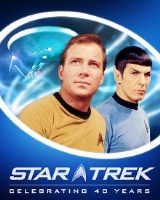
Gene Roddenberry. On Friday 8th September 2006, the Star Trek franchise celebrated the 40th anniversary of the first Star Trek television broadcast.
In Star Trek's fictional universe, humans developed faster-than-light space travel after barely surviving a 21st-century
World War III. Later,
humans united with other sentient species of the
galaxy to form the
United Federation of Planets. As a result of
alien intervention and science, humanity has largely overcome many Earth-bound frailties and vices by the 23rd century. Star Trek stories usually depict the adventures of humans and aliens who serve in the Federation
Starfleet.
The protagonists are essentially altruistic, although their enlightened values are often challenged by events. The conflicts and political dimensions of the stories allegorize contemporary cultural realities;
The Original Series addressed issues of the 1960s, just as more recent spin-offs reflect more modern topics. Issues depicted in the various series, such as
imperialism, class warfare,
racism,
human rights, and the role of
technology.
Television series
- For a complete list of episodes, see List of Star Trek episodes
Star Trek originated as a television series in 1966, although it had been in the planning stages for at least six years prior to that. Although
The Original Series was cancelled in its third season due to low ratings, it served as the groundwork for five additional Star Trek television series. Altogether, the six series comprise a total of 726 episodes or thirty seasons or 735 professional hours or 550.75 literal hours of programming.
Star Trek: The Original Series
Star Trek debuted in the United States on NBC on September 8, 1966. The show, starring
William Shatner as Captain
James T. Kirk , told the tale of the crew of the
starship Enterprise is the name given to a series of starship [i] ...
and that crew's five-year mission "to boldly go
where no man has gone before." After only three seasons, the show was cancelled and the last episode aired on June 3, 1969. The series subsequently became popular in reruns, and a cult following developed, complete with fan conventions.
Star Trek: The Animated Series
Star Trek: The Animated Series was produced by
Filmation and ran for two seasons. It featured most of the original cast performing the voices for their characters from
The Original Series with the exception of
Walter Koenig, who was not asked to return due to budgetary limitations. While the freedom of animation afforded large alien landscapes and exotic life forms, budget constraints were a major concern and animation was of moderate quality. Although originally sanctioned by Paramount , the series is no longer considered to be canon, which has caused controversy among some fans. Even so, elements of the animated series have worked their way into official canon, such as Kirk's middle name, Tiberius, first revealed in
TAS and made official in
.
also incorporates several TAS concepts into canon.
TAS came back to television in the mid 1980s on the children's cable network Nickelodeon, and in the early 1990s on cable network Sci-Fi Channel.
Star Trek: Phase II
Star Trek: Phase II was set to air in 1978 as the flagship series of a proposed Paramount television network, and 12 episode scripts were written before production was due to begin. The series would have put most of the original crew back aboard the
Enterprise for a second five-year mission, except for
Leonard Nimoy as
Spock, who did not agree to return. A younger, full-blooded
Vulcan named Xon was planned as a replacement, although it was still hoped that Nimoy would make guest appearances.
Star Trek: Deep Space Nine
Star Trek: Deep Space Nine is set during the same timeframe as
The Next Generation and ran for seven seasons, debuting in 1993. It is the only Star Trek series to take place primarily on a space station, rather than aboard a starship. The show chronicles the events of a Starfleet crew, led by Commander
Benjamin Sisko, played by
Avery Brooks, living on the
Bajoran spacestation Deep Space Nine, which is next to a newly-discovered, uniquely stable
wormhole that provides immediate access to the distant Gamma Quadrant. Story plots include the repercussions of the lengthy and brutal occupation of the nearby planet Bajor by the
Cardassians, Sisko's unique spiritual role for the
Bajorans as the Emissary of the Prophets, and a major war with the Dominion of the Gamma Quadrant. Deep Space Nine stands apart from other Trek series for its lengthy serialized storytelling and conflict within the crew – things that Roddenberry had forbidden in earlier Trek series .
Star Trek: Voyager
Star Trek: Voyager was produced for seven seasons from 1995 to 2001 and is the only Star Trek series to feature a woman as the commanding officer, Captain
Kathryn Janeway, played by
Kate Mulgrew. The series plot' shows the USS
Voyager and its crew stranded in the
Delta Quadrant, 70,000 light years from
Earth. Given a 70-year voyage back to Earth, the crew must avoid conflict and defeat challenges on its long and perilous journey home. While
Voyager was originally isolated from many of the familiar aspects of the Star Trek franchise, later seasons saw an influx of concepts such as the Borg and
Q.
Star Trek: Enterprise
Star Trek: Enterprise is a
prequel to the other Star Trek series. The pilot episode takes place ten years before the founding of the
Federation, about halfway between the "historic" events shown in the movie
and the original
Star Trek series. The series depicts the exploration of space by the crew of the Earth starship
Enterprise. Commanded by Captain
Jonathan Archer, played by
Scott Bakula,
Enterprise is able to go further and faster than any human vessel had previously gone. Ratings for
Enterprise started strong, but declined rapidly; as happened during the initial airing of
The Original Series, fan support during
Enterprises second and third seasons helped keep the series on the air. The show continued to lose ratings during the fourth season, and Paramount cancelled the show in early 2005.
Feature films
Paramount Pictures has produced ten Star Trek feature films. The first six continue the adventures of the The Original Series
cast, while the next four feature The Next Generations cast. Although North American and UK releases of the films were no longer numbered following the sixth film, European releases continued numbering the films. A common and fondly-held
superstition among fans is that the even-numbered Star Trek films are superior to the odd-numbered Star Trek films. The , , , and films are usually considered the fan favorites, while and
are usually at the bottom. An
eleventh Star Trek film has been announced for release in 2008.
Other storylines and canonicity
The Star Trek canon comprises the five live-action television series and ten motion pictures. The animated series, novels, comic books, video games, and other materials based on Star Trek, though licensed by
Paramount Pictures, are generally considered non-canon, as are fan-made productions set within the Star Trek universe.
The Star Trek novels typically fill "holes" in the Star Trek story and timeline, with explanations of events that have never been thoroughly explained through live action productions. Many have been accepted by Trek fans as part of the Star Trek canon, even though
Paramount Pictures, owners of the Star Trek franchise, say otherwiseide of the television series and motion pictures produced by Paramount pictures, the Star Trek franchise has been officially expanded and elaborated by various authors and artists in the so-called "Star Trek Expanded Universe," despite the fact that Paramount does not consider these derivative works canon. These works' creators are generally free to tell their own stories set in the Star Trek universe, and are free either to keep an existing continuity, or to use their own. These works often expand the back stories of characters, species, planets, etc., already seen in the official live-action productions. For example, the
novels
Mosaic and
Pathways give background information for characters in the
Voyager live-action series.
The Star Trek series have also inspired many unofficial fan-made productions. For example, in recent years, Star Trek
fan films have been created for distribution over the Internet. Currently,
, which is a continuation of the timeline after the
Dominion War from the perspective of a station and fleet in the Briar Patch, and
, a "continuation" of the original
Star Trek, are prominent fan series. While none of these projects are licensed by Paramount, some have attracted participation from television and film series' cast and crew. One fan production,
, even has a
Voyager cast member,
Tim Russ, as its "fan" director.
Cultural impact
The Star Trek franchise is a multi-billion dollar industry, currently owned by Paramount.
Gene Roddenberry sold
Star Trek to NBC as a classic adventure drama; he pitched the show as "
Wagon Train to the stars." Though set on a fictional
starship, Roddenberry wanted to tell more sophisticated stories using futuristic situations as
analogies to current problems on Earth and rectifying them through
humanism and
optimism. The opening line, "to boldly go
where no man has gone before", was taken almost verbatim from a
US White House booklet on space produced after the
Sputnik flight in 1957. The central trio of
Kirk,
Spock, and
McCoy was modeled on classical mythological storytelling. Harking of human diversity and contemporaneous political circumstances, Roddenberry included a multi-ethnic crew.ar Trek and its spin-offs have proved highly popular in television repeats, and are currently shown on TV stations worldwide. The show’s cultural impact goes far beyond its longevity and profitability. Star Trek conventions have become popular, though now are often merged with conventions of other genres and series, and fans have coined the term "
Trekkies" to describe themselves. An entire subculture has grown up around the show.
The Star Trek franchise is believed to have motivated the design of many current technologies, including the
Tablet PC, the PDA, and
mobile phones. It has also brought to popular attention the concept of teleportation with its classic depiction of "matter-energy transport". Phrases such as "Beam me up, Scotty" have entered the public vernacular. In 1976, following a letter-writing campaign,
NASA named its first
space shuttle,
Enterprise, after the
fictional starship.
Parodies of Star Trek include the internet-based cartoon series
Stone Trek is an internet-based Flash [i] animated cartoon series that presents epi ...
and the song "Star Trekkin'".
Current status and future
After
Enterprise was cancelled in 2005, the Star Trek franchise found itself for the first time in over 25 years without a series or film in production or development. Though some assumed that the franchise was essentially dead, predictions of its demise are nothing new. As early as 1993–1994, when
failed to generate the high ratings of its predecessor, magazines such as
Entertainment Weekly is a magazine [i] published by Time Inc. [i] in the United States [i] which foc ...
predicted the end of the franchise. The rumored near-cancellation of
in the mid-1990s led to more such predictions, as did the poor box-office performance of
in 2002 and the cancellation of
in 2005. However, in April 2006, the official announcement of
an eleventh feature film made it probable that the franchise has not yet ended.
- Showings of The Next Generation and Deep Space Nine regularly air on Spike TV in the United States. Spike TV will also begin airing reruns of Voyager in the fall of 2006, as part of its original deal for all three series.ecember 2005, Comcast's G4 network announced it had obtained the syndication rights for both TNG and The Original Series. G4 has been airing TNG since early 2006 and currently airs Star Trek 2.0 is a science fiction [i] television series [i] created by Gene Roddenberry [i] which aired ...
, while Spike will continue to broadcast TNG as well. - TV Land will begin airing TOS in November 2006.
- Perpetual Entertainment is developing a MMOG based on Star Trek called Star Trek Online.
References
Bibliography
Major reference works related to the production and influence of the franchise include:
- The Making of Star Trek by Gene Roddenberry and Stephen PE. Whitfield
- The Trouble with Tribbles by David Gerrold
- The World of Star Trek by David Gerrold
- Star Trek Lives! by Jacqueline Lichtenberg, Sondra Marshak, and Joan Winston
- The Making of the Trek Conventions by Joan Winston
- A Star Trek Catalog edited by Gerry Turnbull
- On the Good Ship Enterprise: My 15 Years with Star Trek by Bjo Trimble
- Star Trek Memories by William Shatner and Chris Kreski
- Star Trek Movie Memories by William Shatner and Chris Kreski
- Beyond Uhura by Nichelle Nichols
- The Physics of Star Trek by Lawrence M. Krauss
...
- City on the Edge of Forever by Harlan Ellison
- Enterprise Zones: Critical Positions on Star Trek, edited by Taylor Harrison, Sarah Projansky, Kent A. Ono, Elyce Rae Helford
- Inside Star Trek: The Real Story by Herbert F. Solow and Robert H. Justman
- Future Perfect: How Star Trek Conquered Planet Earth by Jeff Greenwald
- Get a Life! by William Shatner and Chris Kreski
- The Ethics of Star Trek by Judith Barad Ph.D. with Ed Robertson
- I'm Working on That: A Trek from Science Fiction to Science Fact by William Shatner and Chip Walter
- Inside Trek: My Secret Life with Star Trek Creator Gene Roddenberry by Susan Sackett
- Picard: The Academy Years by M.N.Lake
Footnotes
External links
- - The Official Star Trek website
- - Star Trek Wiki Encyclopedia.
- - Largest Star Trek Multimedia Outlet
- - Star Trek News, Stories, and more
- - Star Trek fan magazines from the 1970s, covers and contents
- - Another Star Trek Encyclopedia