
Encyclopedia
The
transistor is a three terminal solid state
semiconductor device that can be used for
amplification,
switching, voltage stabilization, signal modulation and many other functions.
Introduction
Transistors are divided into two main categories:
bipolar junction transistors and
field effect transistors . FETS are further divided into depletion mode and enhancement mode types. Transistors have three terminals: input, common, and output. Application of current in BJTs or voltage with FETs between the input terminal and the common terminal increases the conductivity between the common and output terminals, thereby controlling current flow between them. The physics of this "transistor action" is quite different for the BJT, depletion mode FET and enhancement mode FET: see the respective articles for further details.
In analog circuits, transistors are used in
amplifiers, , and linear
regulated power supplies. Transistors are also used in
digital circuits where they function as electrical switches. Digital circuits include
logic gates,
random access memory ,
microprocessors, and
digital signal processors .
History
The first patents for the transistor principle were registered in Germany in 1928 by Julius Edgar Lilienfeld. In 1934 German physicist Dr.
Oskar Heil patented the field-effect transistor. It is not clear whether either design was ever built, and this is generally considered unlikely.
On 22 December 1947
William Shockley,
John Bardeen and Walter Brattain succeeded in building the first practical
point-contact transistor at
Bell Labs. This work followed from their war-time efforts to produce extremely pure
germanium "crystal" mixer diodes, used in
radar units as a
frequency mixer element in
microwave radar receivers. Early tube-based technology did not switch fast enough for this role, leading the Bell team to use solid state
diodes instead. With this knowledge in hand they turned to the design of a
triode, but found this was not at all easy. Bardeen eventually developed a new branch of surface physics to account for the "odd" behaviour they saw, and Bardeen and Brattain eventually succeeded in building a working device.
Bell Telephone Laboratories needed a generic name for the new invention: "Semiconductor Triode", "Solid Triode", "Surface States Triode", "Crystal Triode" and "Iotatron" were all considered, but "transistor," coined by
John R. Pierce, won an internal ballot. The rationale for the name is described in the following extract from the company's Technical Memoranda calling for votes:
Bell put the transistor into production at
Western Electric in
Allentown, Pennsylvania. They also licensed it to a number of other electronics companies, including
Texas Instruments, who produced a limited run of
transistor radios as a sales tool. Another company liked the idea and also decided to take out a license, introducing their own radio under the brand name
Sony. Early transistors were "unstable" and only suitable for low-power, low-frequency applications, but as transistor design developed, these problems were slowly overcome. Over the next two decades, transistors gradually replaced the earlier
vacuum tubes in most applications and later made possible many new devices such as
integrated circuits and
personal computers.
Shockley, Bardeen and Brattain were honored with the
Nobel Prize in Physics "for their researches on semiconductors and their discovery of the transistor effect". Bardeen would go on to win a second Nobel in physics, one of only two people to receive more than one in the same discipline, for his work on the exploration of
superconductivity.
In August 1948 German physicists Herbert F. Mataré and Heinrich Walker , working at Compagnie des Freins et Signaux Westinghouse in
Paris,
France applied for a patent on an amplifier based on the minority carrier injection process which they called the "transistron." Since Bell Labs did not make a public announcement of the transistor until June 1948, the transistron was considered to be independently developed. Mataré had first observed transconductance effects during the manufacture of germanium duodiodes for German radar equipment during
WWII. Transistrons were commercially manufactured for the French telephone company and military, and in 1953 a solid-state radio receiver with four transistrons was demonstrated at the
Düsseldorf Radio Fair.
Importance
The transistor is considered by many to be one of the greatest inventions in modern history, ranking in importance with the
printing press,
automobile and
telephone. It is the key active component in practically all modern
electronics. Its importance in today's society rests on its ability to be mass produced using a highly automated process that achieves vanishingly low per-transistor costs.
Although millions of individual transistors are still used, the vast majority of transistors are fabricated into
integrated circuits along with
diodes,
resistors,
capacitors and other
electronic components to produce complete electronic circuits. A
logic gate comprises about twenty transistors whereas an advanced microprocessor, as of 2006, can use as many as 1.7 billion transistors .
The transistor's low cost, flexibility and reliability have made it a universal device for non-mechanical tasks, such as digital computing. Transistorized circuits have replaced electromechanical devices for the control of appliances and machinery as well. It is often less expensive and more effective to use a standard
microcontroller and write a computer program to carry out a control function than to design an equivalent mechanical control function.
Because of the low cost of transistors and hence digital computers, there is a trend to digitize information. With digital computers offering the ability to quickly find, sort and process digital information, more and more effort has been put into making information digital. As a result, today, much media data is delivered in digital form, finally being converted and presented in analog form by computers. Areas influenced by the Digital Revolution include
television,
radio, and
newspapers.
Types
|- align = "center"
|
|| PNP ||
|| P-channel
|- align = "center"
|
|| NPN ||
|| N-channel
|- align = "center"
| BJT || || JFET ||
Transistors are categorized by:
- Semiconductor material: germanium, silicon, gallium arsenide, silicon carbide
- Structure: BJT, JFET, IGFET , IGBT, "other types"
- Polarity: NPN, PNP, N-channel, P-channel
- Maximum power rating: low, medium, high
- Maximum operating frequency: low, medium, high, radio frequency , microwave .
- Application: switch, general purpose, audio, high voltage, super-beta, matched pair
- Physical packaging: through hole metal, through hole plastic, surface mount, ball grid array
Thus, a particular transistor may be described as:
silicon, surface mount, BJT, NPN, low power, high frequency switch.
Bipolar junction transistor
The
bipolar junction transistor was the first type of transistor to be mass-produced. Bipolar transistors are so named because they conduct by using both majority and minority carriers. The three terminals are named
emitter,
base and
collector. Two
p-n junctions exist inside a BJT: the
base/collector junction and
base/emitter junction. The BJT is commonly described as a current-operated device because the emitter/collector current is controlled by the current flowing between base and emitter terminals. Unlike the FET, the BJT is a low input-impedance device. The BJT has a higher
transconductance than the FET. Bipolar transistors can be made to conduct with light as well as current. Devices designed for this purpose are called
phototransistors.
Field-effect transistor
The
field-effect transistor , sometimes called a
unipolar transistor, uses either electrons or holes for conduction. The three main terminals of the FET are named
source,
gate and
drain. On some FETs a fourth connection to the body is provided, but normally the body is connected internally to the source.
A
voltage applied between the gate and source controls the current flowing between the source and drain. In FETs the source/ drain current flows through a conducting channel near the
gate. This channel connects the
source region to the
drain region. The channel conductivity is varied by the electric field generated by the voltage applied between the gate/source terminals. In this way the current flowing between the source and drain is controlled. Like bipolar transistors, FETs can be made to conduct with light as well as voltage. Devices designed for this purpose are called phototransistors.
FETs are divided into two families:
junction FET and
insulated gate FET . The IGFET is more commonly known as
metal-oxide-semiconductor FET , from their original construction as a layer of metal , a layer of oxide , and a layer of semiconductor. Unlike IGFETs, the JFET gate forms a PN
diode with the channel which lies between the source and drain. Functionally, this makes the N-channel JFET the solid state equivalent of the vacuum tube
triode which, similarly, forms a diode between its grid and
cathode. Also, both devices operate in the
depletion mode, they both have a high input impedance, and they both conduct current under the control of an input voltage.
MESFETs are JFETs, in which the
reverse biased PN junction is replaced by a semiconductor-metal Schottky-junction. These, and the HEMFETs , in which a two-dimensional electron gas with very high carrier mobility is used for charge transport, are especially suitable for use at very high frequencies .
FETs are further divided into
depletion-mode and
enhancement-mode types. Mode refers to the polarity of the gate voltage with respect to the source at the threshold of conduction. For N-channel depletion-mode FETs the gate is negative with respect to the source while for N-channel enhancement-mode FETs the gate is positive, at the threshold of conduction. For both modes, if the gate voltage is made more positive the source/drain current will increase. For P-channel devices the polarities are reversed. Nearly all JFETs are depletion-mode types and most IGFETs are enhancement-mode types.
Other transistor types
...
s can be used as simple pulse generators. They comprise a main body of either P-type or N-type semiconductor with ohmic contacts at each end . A junction with the opposite semiconductor type is formed at a point along the length of the body for the third terminal .
- Dual gate FETs have a single channel with two gates in cascode; a configuration that is optimized for high frequency amplifiers, mixers, and oscillators.
- Transistor arrays are used for general purpose applications, function generation and low-level, low-noise amplifiers. They include two or more transistors on a common substrate to ensure close parameter matching and thermal tracking, characteristics that are especially important for long tailed pair amplifiers.
- Darlington transistors comprise a medium power BJT connected to a power BJT. This provides a high current gain equal to the product of the current gains of the two transistors. Power diodes are often connected between certain terminals depending on specific use.
- Insulated gate bipolar transistors use a medium power IGFET, similarly connected to a power BJT, to give a high input impedance. Power diodes are often connected between certain terminals depending on specific use. IGBTs are particularly suitable for heavy-duty industrial applications. The Asea Brown Boveri 5SNA2400E170100 illustrates just how far power semiconductor technology has advanced. Intended for three-phase power supplies, this device houses three NPN IGBTs in a case measuring 38 by 140 by 190 mm and weighing 1.5 kg. Each IGBT is rated at 1,700 volts and can handle 2,400 amperes.
- Single-electron transistors consist of a gate island between two tunnelling junctions. The tunnelling current is controlled by a voltage applied to the gate through a capacitor.
- Complete list of transistor types
Semiconductor material
The first BJTs were made from
germanium and some high power types still are.
Silicon types currently predominate but certain advanced microwave and high performance versions now employ the
compound semiconductor material gallium arsenide and the
semiconductor alloy silicon germanium . Single element semiconductor material is described as
elemental.
Characteristics of the most common semiconductor materials used to make transistors are given in the table below:
Semiconductor material characteristicsSemiconductor material | Junction forward voltage V @ 25 °C | Electron mobility m/s @ 25 °C | Hole mobility m/s @ 25 °C | Max. junction temp. °C |
| Ge | 0.27 | 0.39 | 0.19 | 70 to 100 |
|---|
| Si | 0.71 | 0.14 | 0.05 | 150 to 200 |
|---|
| GaAs | 1.03 | 0.85 | 0.05 | 150 to 200 |
|---|
| Al-Si junction | 0.3 | — | — | 150 to 200 |
|---|
The
junction forward voltage is the voltage applied to the emitter-base junction of a BJT in order to make the base conduct a specified current. The values given in the table are typical for a current of 1 mA . The lower the junction forward voltage the better, as this means that less power is required to "drive" the transistor. The junction forward voltage for a given current decreases with temperature. For a typical silicon junction the change is approximately -2.1 mV/°C.
The
electron mobility and
hole mobility columns show the average speed that electrons and holes diffuse through the semiconductor material with an
electric field of 1 volt per meter applied across the material. In general, the higher the electron mobility the faster the transistor. The table indicates that Ge is a better material than Si in this respect. However, Ge has four major shortcomings compared to silicon and gallium arsenide: its maximum temperature is limited, it has relatively high leakage current, it cannot withstand high voltages and it is less suitable for fabricating integrated circuits. Because the electron mobility is higher than the hole mobility for all semiconductor materials, a given bipolar
NPN transistor tends to be faster than an equivalent PNP transistor type. GaAs has the fastest electron mobility of the three semiconductors. It is for this reason that GaAs is used in high frequency applications. A relatively recent FET development, the
high electron mobility transistor , has a heterostructure of aluminium gallium arsenide -gallium arsenide which has double the electron mobility of a GaAs-metal barrier junction. Because of their high speed and low noise, HEMTs are used in satellite receivers working at a frequency around 12 GHz.
Max. junction temperature values represent a cross section taken from various manufacturers' data sheets. This temperature should not be exceeded or the transistor may be destroyed.
Al-Si junction refers to the high-speed semiconductor-metal barrier diode, commonly known as a
Schottky diode. This is included in the table because some silicon power IGFETs have a
parasitic reverse Schottky diode formed between the source and drain as part of the fabrication process.
Packaging
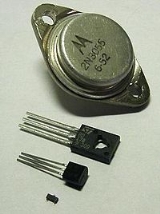
Transistors come in many different packages . The two main categories are
through-hole , and
surface-mount, also known as
surface mount device . The
ball grid array is the latest surface mount package . It has solder "balls" on the underside in place of leads. Because they are smaller and have shorter interconnections, SMDs have better high frequency characteristics but lower power rating.
Transistor packages are made of glass, metal, ceramic or plastic. The package often dictates the power rating and frequency characteristics. Power transistors have large packages that can be clamped to
heat sinks for enhanced cooling. Additionally, most power transistors have the collector or drain physically connected to the metal can/metal plate. At the other extreme, some surface-mount
microwave transistors are as small as grains of sand.
Often different packages are available for a given transistor type. Transistor packages are mainly standardized, but the assignment of a transistor's functions to the terminals is not: different transistor types can assign different functions to the package's terminals. Even for the same transistor type the terminal assignment can vary .
Usage
In the early days of transistor circuit design, the
bipolar junction transistor, or BJT, was the most commonly used transistor. Even after MOSFETs became available, the BJT remained the transistor of choice for digital and analog circuits because of their ease of manufacture and speed. However, the
MOSFET has several desirable properties for digital circuits, and since major advancements in digital circuits have pushed MOSFET design to state-of-the-art. MOSFETs are now commonly used for both analog and digital functions.
Switches
Transistors are commonly used as electronic switches, for both high power applications including
switched-mode power supplies and low power applications such as
logic gates.
Amplifiers
From
mobile phones to
televisions, vast numbers of products include amplifiers for
sound reproduction,
radio transmission, and signal processing. The first discrete transistor audio amplifiers barely supplied a few hundred milliwatts, but power and audio fidelity gradually increased as better transistors became available and amplifier architecture evolved.
Transistors are commonly used in modern musical instrument amplifiers, where circuits up to a few hundred watts are common and relatively cheap. Transistors have largely replaced valves in instrument amplifiers.
Some musical instrument amplifier manufacturers mix transistors and vacuum tubes in the same circuit, to utilize the inherent benefits of both devices.
Computers
The "first generation" of electronic computers used vacuum tubes, which generated large amounts of heat and were bulky, and unreliable. The development of the transistor was key to computer miniaturization and reliability. The "second generation" of computers, through the late
1950s and
1960s featured boards filled with individual transistors and magnetic memory cores. Subsequently, transistors, other components, and their necessary wiring were integrated into a single, mass-manufactured component: the
integrated circuit. Transistors incorporated into integrated circuits have replaced most discrete transistors in modern digital computers.
Advantages of transistors over vacuum tubes
Before the development of transistors,
vacuum tubes were the main active components in electronic equipment. The key advantages that have allowed transistors to replace their vacuum tube predecessors in most applications are:
- Smaller size
- Highly automated manufacture
- Lower cost
- Lower possible operating voltages
- Operation without a warm-up period
- Lower power dissipation
- Higher reliability and greater ruggedness to physical shocks
- Much longer lifetime
- Complementary devices available
- Ability to control large currents
- Less microphonic
"
Nature abhors a vacuum tube " Myron Glass ,
Bell Telephone Laboratories, circa 1948.
Gallery
A wide range of transistors has been available since the
1960s and manufacturers continually introduce improved types. A few examples from the main families are noted below. Unless otherwise stated, all types are made from silicon semiconductor. Complementary pairs are shown as NPN/PNP or N/P channel. Links go to manufacturer datasheets, which are in
PDF format.
- /, / and /: Ubiquitous, BJT, general-purpose, low-power, complementary pairs. They have plastic cases and cost roughly ten cents U.S. in small quantities, making them popular with hobbyists.
- AF107: Germanium, 0.5 watt, 250 Mhz PNP BJT.
- BFP183: Low power, 8 GHz microwave NPN BJT.
- : So-called "supermatch pair", with two NPN BJTs on a single substrate.
- /: BJT, general purpose, medium power, complementary pair. With metal cases they are rated at about one watt.
- /: For years, the venerable NPN 2N3055 has been the "standard" power transistor. Its complement, the PNP MJ2955 arrived later. These 1 MHz, 15 A, 60 V, 115 W BJTs are used in audio power amplifiers, power supplies, and control.
- 2SC3281/2SA1302: Made by Toshiba, these BJTs have low-distortion characteristics and are used in high-power audio amplifiers. They have been widely counterfeited.
...
horizontal deflection, its high voltage capability also makes it suitable for use in ignition systems.
- : 30 A, 120 V, 200 W, high power Darlington complementary pair BJTs. Used in audio amplifiers, control, and power switching.
- /: JFET , general purpose, low power, complementary pair.
- BSP296/BSP171: IGFET , medium power, near complementary pair. Used for logic level conversion and driving power transistors in amplifiers.
- /: IGFET , 40 A, 100 V, 200 W, near complementary pair. For high-power amplifiers and power switches, especially in automobiles.
Transistor manufacturers
See also
References
Patents
— J. Bardeen et. al.
— W. Shockley
Books
The invention of the transistor & the birth of the information age
Other
}}
External links
- . Photograph of first working transistor
- . Historical and technical information from the Public Broadcasting Service
- . All about the history of transistors and integrated circuits.
- . From Lucent Technologies
- . From the American Physical Society
- . From Science Friday, December 12 1997
- . Website devoted to the "classic" hobbyist germanium transistor
- . Treasure trove of transistor history
- . In depth coverage of the Regency radio.
- .
- .
-
-
- - Scientific American Magazine